The language of Brazilian theatre has always been employed as a tool for contesting race relations and for reinforcing black subjectivities. The teatros negros (black theatres), such as the Black Experimental Theatre (Teatro Experimental do Negro, or TEN), in the first half of the twentieth century conceived of the stage as a place from which it was possible to rupture political, ethical and aesthetic determinations, and stereotyped imaginaries around bodies of blackness.Footnote 2
In 1994, armed with dreams forged by ancestral heritage, Abdias Nascimento, a prominent black militant leader in Brazil, founded TEN. Nascimento aimed to put on stage the colour of black skin in its wholeness and to establish new paradigms for those black people stigmatized by the perverse white hegemony reigning on Brazil's stages and dominating its dramaturgy.
From this perspective, TEN affected the social, political and cultural life by staging the Afro-Brazilian identity in both the theatre and society. Nascimento's political and social proposal, as well as his theatre, was part of a trend that included the politicization of culture and the critique of prevailing notions of national identity. As stated by Abdias Nascimento, ‘At the core of those discussions lay the racial question, still formulated through the terms of mixed-raced evolutionism, continuously repressed, which resulted in the ideology of racial democracy.’Footnote 3
To sow the seeds of an artistic vision with this purpose required TEN to develop its very own dramaturgy because it was from the dramatic text that the company aimed to weave a discourse that deconstructed stereotypes attributed to black people. Therefore TEN appeared on the scene with the objective of producing a black political theatre that conveyed a series of significant images that aimed to translate the wide spectrum of black people's experience and memory in Brazil. Through dramaturgical innovation, TEN intended to destroy stereotypes that reproduce racial prejudices, repositioning black people from being objects of utterance to the enunciating subjects of their own history.
To accomplish the mission of creating a dramatic literature that foregrounded black people as protagonists and their culture as significant, TEN staged several plays. Among the plays presented by the group, the following performances stand out: The Emperor Jones (1945) by Eugene O'Neill and Sortilégio: Mistério negro (Sortilege: Black Mystery, 1957) by Abdias Nascimento.
Nascimento's play, which premiered at the Municipal Theatre of Rio de Janeiro on 21 August 1957, is a moral fable that develops metaphors for understanding the situation of black people in Brazil: the protagonist of Sortilege seeks to conform to the white world; he goes through a process of ‘whitening’ his behaviours, denying his past and his old traditions. In this quest, he goes through a process of psychological and cultural self-violation. A milestone in Brazilian dramatic literature, Sortilege's dramaturgy values Brazilian black culture, while attempting to help fashion a black aesthetic in theatre.
Between 1944 and 2021, several collectives and projects emerged, creating a theatre that is conceived, designed and produced by black artists in an attempt to apprehend, represent and present bodies of blackness on the stage. Every action of the Brazilian black theatrical scene is heir, directly and indirectly, to Teatro Experimental do Negro. The contemporary scene broadens and updates the purposes of TEN: it deconstructs racist stereotypes, and, above all, fabulates other memories, images, subjectivities and aesthetics about blackness.
In the past decade, black theatres have emerged to help make visible hidden bodies, images and stories, and to help generate new ones. In these political theatres, the blurred space between reality and fiction creates the possibility of going back to the past and drawing other narratives to re-choreograph the gaps of memory and to weave, as Leda Martins suggests, ‘stories/histories that are composed in the times of living and telling’.Footnote 4
If the term ‘black’, according to Achille Mbembe, is ‘the product of a social and technological machine … invented to signify exclusion, brutalization and degradation’,Footnote 5 a fiction largely constructed by white people about black people, then those fictions form part of an ongoing process of re-creation, via which the black subject may emerge in time as an image, a writing, an epistemology of desire.Footnote 6 From this perspective, Brazilian black theatres have always aimed to erase biased representations of black bodies, (re-)choreographing our existence inside and outside the stage. Consequently, black theatres have been striving to invent new forms for black subjects to present ourselves in a plurality of meanings/senses.
Plurality, here, has to do with conceiving a way of making art that elaborates the existence of a black subject that is not primarily shaped by the alienating presence of the white ‘other’. In this sense, some contemporary black Brazilian theatre practices approach black bodies not just as the painful symptoms of white oppression, but as documents of cultural and personal history, joy and hope, contributing to a self-determined and distinctive poetics of black aesthetic form. This conceptual shift is important, since it proposes a deconstruction of stereotypes – not in the Derridean sense of dismantling and reinterpreting texts, but in the sense of imploding imaginaries forged within racialized frameworks, whose objective is to prevent black people from participating in modern history as free, sensitive and independent forces. According to Leda Martins, it involves
If we agree that theatre thinks and produces thought, novel ways of being black emerge in the world and on the stage. Thus many black Brazilian theatre practices forge plural spaces re-elaborating racism and everything it engenders in an inventive language.
This language places fabular processes onstage, allowing the construction of a space in which black people can exist without restraints, creating and re-creating memories and temporalities which aim to retell history. These black theatricalities, from TEN to more contemporary practices, produce images, fabular gazes and emergent identities from the critical rereading of history and its retelling of the world.
As an example, the performance othersRosas (2019), from Collective Tropeço, allows us to think about how the reimagining of history and its mark on the present can activate political desire in the present and create a space for utopian longing.Footnote 8 othersRosas is a text that constructs narratives and pieces of knowledge from the restoration and presentation of the past, burdened by trauma and weighed down with melancholy. The dramaturgy is produced by the complex interweaving of different historical contexts, by the summoning of memory by the body and in the weaving of times – past, present, future – and by continuously seeking new meanings, translated and transformed into new historical knowledge.
othersRosas is a text by the playwright Anderson Feliciano, based on the life and activism of Rosa Parks. Public transport in the city of Montgomery, Alabama, where Parks lived, was legally segregated by race. On 1 December 1955, Rosa Parks got on the bus, paid her fare and sat in the first row of seats reserved for blacks. As the bus was full, some white people were left standing, and the driver asked the black people to get up so the white people could sit down. Three black people stood up, and Parks refused. In fact, she did move, but to the window seat, and the driver, upon seeing that reaction, asked her ‘why don't you stand up?’, to which Parks replied, ‘Eu não deveria ter que me levantar’ (‘I shouldn't have to get up’).Footnote 9 The driver then called the police, who arrested her. Parks was accused of violating Chapter Six, Section 11 of the segregation law of the Montgomery City code, despite not having sat on a seat reserved for white people. The case drew a lot of attention from civil rights activists, triggering the movement known as the ‘Montgomery bus boycott’, in which over 40,000 black bus users stopped using public transport for 381 days. In 1956, the American Supreme Court ruled that racial segregation on public transport was unconstitutional.
A seat. A woman. A decision not to stand up. And a sentence that reclaims and emphasizes the existence of a black female subjectivity. In Feliciano's text, the original sentence in Portuguese was modified to ‘Eu não penso que deveria ter que me levantar’ (‘I do not think I should have to stand up’).Footnote 10 That sentence, by anticipating the element of denial (não) and using the verb pensar (‘think’), highlights a subjective position, which includes a more critical reflection of history: it is as if, along with the legal sentence, there was also a subtext that, in Feliciano's dramaturgy, seems to say, repeatedly, ‘I want to stop the scourging, and the depreciation of my humanity; I want to prevent the scourging and the depreciation of my humanity.’
The dramaturgy of othersRosas consists in the repetition of Parks's statement in Portuguese, written and performed in 7,053 characters. When Parks was arrested in 1955, she was recorded as prisoner ‘7053’, as has become known through her police photograph. Thus othersRosas reclaims this number in order to create a narrative that resignifies the past, fabulates the present and speculates about the future.
In the performance, repetition is a device that allows for new meanings to emerge that inevitably connect Feliciano's performative text to other contexts and texts, spaces and times, therefore challenging the political imagination of the reader–audience.
The imagination is also summoned to give continuity to the text, since the performance ends with an incomplete sentence, radically respecting Parks's jail number when she was arrested in the context of institutionalized racism: ‘Eu não penso que deveria ter …’ (‘I do not think I should have to …’).Footnote 11 In that moment of the text, which is performed several times, many stories, images and histories of resistance are invoked, lived, re-created and fabulated. Other ways of living in the present and future come into view.
In this moment, it is as if all Rosas, all black woman, are saying, not only do I think that I should not have to stand up, but I offer you, the audience, other images, grammars, and texts about bodies of blackness from the critical fabulation of history. I create new memories and temporalities. I construct a future in the present in which black people can exist in their plenitude and desire, since desire ‘is the driving force of every subject and any personal, intimate or social relationship. Its choreography draws the path of individuals and social groups, impressing a mark upon affections and human conflicts.’Footnote 12
It is from desiring that black theatres are able to design other figurations of the subject, moving and rupturing traditional theatrical representation and limited conceptions of black subjectivity. From movement and rupture, it is possible to challenge the spectator's imagination to invent new meanings that dissolve stereotypes.
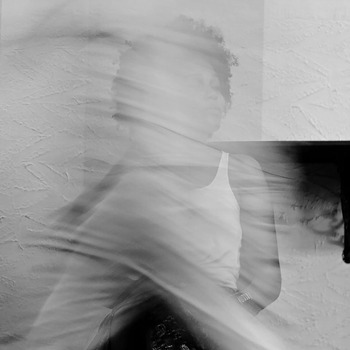
1955, Rosa Parks. 2019, I, Soraya Martins, a performer from Collective Tropeço. From one event to the other I as a performer, observer, witness, critic and creator, project Feliciano's text on Parks's text. Mine is a gesture that aims to connect bodies and words across time, longing to resignify and recentre the black body that was once socially, historically and psychologically projected as belonging to the outside. This gesture reiterates the need for black bodies to keep repeating the inaugural gesture: to sit and refuse to be moved by the authorities that would have it that way, by saying, ‘Eu não penso que deveria ter que me levantar.’Footnote 13 In 2019, this performed gesture aestheticizes the persistent link between the past and the present, which theatre helps us to articulate and witness. It also opens up new ways of responding to familiar history, bringing to the surface new memories and subjectivities, and challenging us to honour it while imagining alternative futures (Fig. 1).
Soraya Martins in a 2019 performance of othersRosas (2019). Photograph by Daniel Pitanga.

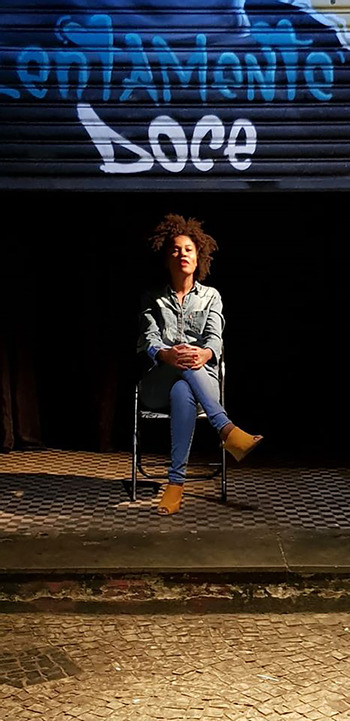
By not standing up, I extend and rearticulate Parks's resistance as my own. When I decide to remain seated onstage, I gather my hair over my head. By tying up my kinky hair and choreographing my afro in performance, I aim to propose that black hair should not be seen as a neutral element in the corporeal ensemble, but as a sign of ethnic–racial belonging. Putting my black hair up in othersRosas in 2019 was intended to showcase black bodily aesthetics, and to highlight how these aesthetics and parts can be sites of discipline and resistance in both theatrical and self-performance.
The gesture also resorted to irony to rupture rigidly fixed representations. Raising my hair is a way of grating against the irrationality and pseudo-superiority of racism, which over time classified black hair as something bad, thus devoid of beauty. The gesture of raising my hair (Fig. 2) was followed by a burst of laughter that intended to express the groundwork of freedom: I laugh because I subvert the ways in which my body, like Rosa's has been deemed to be grotesque. My laughter shakes the system that excludes me. Thus I cast myself in the terrain of humankind, being several other Rosas, carrying the future that someone dreamed for me, many years ago, and the future that many others dream for now too.
Soraya Martins in a performance of othersRosas (2019). Photograph by Paulo Proença.

My body wishes to present itself, without standing up, as a historical document, a memory script, an affectionate landscape. It does not want to be just a body, but a performative body that repeats/reverberates experiences, perceptions, bodies of knowledge and traditional knowledge in an ongoing movement of re-creation and transformation. My body in performance inhabits a spiralling temporality of colonial enslavement and its legacy. It inhabits both temporalities simultaneously, and invites audiences to bear witness to both too. In this intersecting of times, bodies and stories, performance implodes the idea of historical linearity. It is in this sense, according to Leda Martins, that
the performance re-creates, restores and revises the phenomenological circle in which it pulses, in the same contemporaneity, the action of a continuous past, synchronized in the same present temporality that attracts the past and the future to itself, and within them it spreads out, abolishing not only time but its linear and consecutive conception.Footnote 14
Thus the idea of temporal succession is suppressed by the ‘reactivation and re-updating of action, similar and diverse, already realized not only in the before but also after the instant that restores it, in an event’.Footnote 15 In the curves of spiralling time, where everything comes and goes in a constant process of re-creation, black bodies that were previously dehumanized, bought, sold, raped, aborted, tortured, animalized, become the agents of historical inquiry and future imagining. In this respect, as Kênia Freitas puts it, ‘a great majority of black diaspora expressivities post-enslavement era have been made from the necessity of historical reconstruction and realism; the speculation as black expressivity places itself as a persistent contraposition’.Footnote 16
In othersRosas, my body functions as a ‘vital act of transfer, transmitting … memory and a sense of identity through reiterated actions’.Footnote 17 My body rescues, safeguards, nourishes, expresses and produces alternative memory. The body in performance, and the body which is a performance, narrate stories/histories that official historical texts camouflage, and reveal experiences that make the journey from the personal to the collective and vice versa. In this sense, performing what had happened to Rosa Parks involves fabulating new stories about the past, present and future, through interrogating and harnessing the confluence of memory, history and desire.
Black Brazilian theatre practices have always used the stage as a tool for political engagement – to review history and its oppressions, to animate the present and to fuel the future and its possibilities. In theatre, we glimpse the ways in which black bodies have been injured and curtailed, and their power as free, independent and creative forces.