1. Introduction
Granitoids are the most abundant igneous rocks in the Earth’s upper continental crust and like other igneous rocks represent information about internal parts of the Earth. Petrogenesis of these rocks is closely connected with tectonics and geodynamics. As defined by Loiselle & Wones (Reference Loiselle and Wones1979), A-type granitoids are referred to as a group of rocks that form in anorogenic tectonic settings. The origin of A-type granites is generally connected with an extensional regime in the lithosphere (Bonin, Reference Bonin2007). The occurrence of A-type granites can also indicate collided plate suture zones (Balen et al. Reference Balen, Schneider, Massone, Opitz, Luptáková, Putiš and Petrinec2020). A-type granites are geochemically characterized by elevated high-field-strength elements (HFSEs) (Zr, Nb, Ta), rare earth elements (REEs) (except Eu) and F contents, and high FeOt/MgO and Ga/Al ratios and low CaO and trace elements such as Co, Sc, Cr, Ni, Ba, Sr and Eu (Loiselle & Wones, Reference Loiselle and Wones1979; Collins et al. Reference Collins, Beams, White and Chappell1982; Whalen et al. Reference Whalen, Currie and Chappell1987; Eby, Reference Eby1990; Bonin, Reference Bonin2007; Whalen & Hildebrand, Reference Whalen and Hildebrand2019; Bonin et al. Reference Bonin, Janoušek, Moyen, Janoušek, Bonin, Collins, Farina and Bowden2020). Eby (Reference Eby1992) subdivided A-type granites into two main types, A1 and A2. The A2-type granites form in post-collisional and/or post-orogenic tectonic settings and they occur in a short time interval (10–20 Myr) after compressional tectonics (Eby, Reference Eby2011). The source and formation mechanisms of A-type granites are controversial, and different sources from mantle to crustal or mixed-sources (mantle–crustal) have been considered for their generation (Eby, Reference Eby1990; Bonin, Reference Bonin2007; Shellnutt & Zhou, Reference Shellnutt and Zhou2007; Frost & Frost, Reference Frost and Frost2011; Grebennikov, Reference Grebennikov2014; Lu et al. Reference Lu, Zhang and Liu2020). Frost & Frost (Reference Frost and Frost2011) suggested that it could be better if the A-type idiom was replaced by ferroan, but because of the wide usage of the A-type idiom before and after their suggestion, we prefer not to abandon this term completely. Regardless of the source type, the generating mechanisms of these rocks can be summarized into three main categories: partial melting, fractional crystallization, and magma mixing or hybridization.
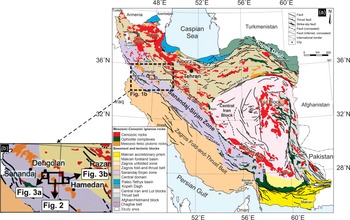
The Iranian Plateau, as a part of Alpine–Himalayan orogenic belt, has an important geological situation. The geology and tectonic style of Iran are highly influenced by the history and evolution of the Tethyan oceans (Mehdipour Ghazi & Moazzen, Reference Mehdipour Ghazi and Moazzen2015). As illustrated in Figure 1a, the Iranian Plateau has been divided into several structural zones, namely the Zagros, Makran, Sanandaj–Sirjan zone, Urmia–Dokhtar magmatic assemblage, Central Iran block, Alborz magmatic zone, Sistan Suture zone and other zones. The simplified geological map of Iran is shown in Figure 1a. The Sanandaj–Sirjan zone (SaSZ) is a narrow metamorphic and magmatic band that extends c. 1500 km from northwest (Sanandaj) to southeast (Sirjan) with a width of 150–200 km and is parallel to the Zagros Fold-Thrust belt (Mohajjel & Fergusson, Reference Mohajjel and Fergusson2000; Esna-Ashari et al. Reference Esna-Ashari, Tiepolo, Valizadeh, Hassanzadeh and Sepahi2012; Mehdipour Ghazi & Moazzen, Reference Mehdipour Ghazi and Moazzen2015). The SaSZ is the highly deformed part of the Zagros Orogen and has a NW–SE structural trend.
(a) Simplified geological map and tectonic subdivisions of the Iranian Plateau (modified after Richards et al. Reference Richards, Spell, Rameh, Razique and Fletcher2012). (b) The general location of the Almogholagh–Dehgolan region in the NSaSZ.

The geological history and tectonic setting of the SaSZ are controversial, and different models including continental magmatic arc (e.g. Arvin et al. Reference Arvin, Pan, Dargahi, Malekizadeh and Babaei2007; Torkian et al. Reference Torkian, Khalili and Sepahi2008; Maanijou et al. Reference Maanijou, Aliani, Miri and Lentz2013; Moinevaziri et al. Reference Moinevaziri, Akbarpour and Azizi2015; Hassanzadeh & Wernicke, Reference Hassanzadeh and Wernicke2016; Sepahi et al. Reference Sepahi, Salami, Lentz, McFarlane and Maanijou2018; Elahi-Janatmakan et al. Reference Elahi-Janatmakan, Maghdour-Mashhour and Tabakh Shabani2020; Moradi et al. Reference Moradi, Shabanian, Davoudian, Azizi, Santos and Asahara2020; Shakerardakani et al. Reference Shakerardakani, Li, Neubauer, Ling, Li, Monfaredi and Wu2020; Maghdour-Mashhour et al. Reference Maghdour-Mashhour, Hayes, Pang, Bolhar, Tabakh Shabani and Elahi-Janatmakan2021) and/or even continental rift tectonic settings (Hunziker et al. Reference Hunziker, Burg, Bouilhol and von Quadt2015; Azizi et al. Reference Azizi, Nouri, Stern, Azizi, Lucci, Asahara, Zarinkoub and Chung2018; Azizi & Stern, Reference Azizi and Stern2019; Azizi, Reference Azizi2020) have been suggested for this zone.
Using the geochemical evidence, some researchers have promoted the propagation of a continental rift in the entire SaSZ during Jurassic time (Hunziker et al. Reference Hunziker, Burg, Bouilhol and von Quadt2015; Lechmann et al. Reference Lechmann, Burg, Ulmer, Mohammadi, Guillong and Faridi2018; Azizi & Stern, Reference Azizi and Stern2019; Azizi, Reference Azizi2020) and that the initiation of subduction occurred during mid-Cretaceous time (Shafaii Moghadam et al. Reference Shafaii Moghadam, Li, Li, Stern, Levresse, Santos, Lopez Martinez, Ducea, Ghorbani and Hassannezhad2020). However, a continental rift model for the SaSZ is at odds with many observations and geochemical data (voluminous calc-alkaline arc rocks of Jurassic age) that have previously been reported (Elahi-Janatmakan et al. Reference Elahi-Janatmakan, Maghdour-Mashhour and Tabakh Shabani2020; Maghdour-Mashhour et al. Reference Maghdour-Mashhour, Hayes, Pang, Bolhar, Tabakh Shabani and Elahi-Janatmakan2021). Moreover, there is no stratigraphic record showing mid-Jurassic continental rifting in the central SaSZ (Elahi-Janatmakan et al. Reference Elahi-Janatmakan, Maghdour-Mashhour and Tabakh Shabani2020).
During Palaeozoic time, the SaSZ was a part of NE Gondwana and was separated from the Eurasian plate by the Palaeo-Tethys Ocean. The initiation of northward subduction of the Neo-Tethys beneath the Iranian Plateau occurred during Late Triassic – Early Jurassic time (Agard et al. Reference Agard, Omrani, Jolivet, Whitechurch, Vrielynck, Spakman, Monie, Meyer and Wortel2011; Hassanzadeh & Wernicke, Reference Hassanzadeh and Wernicke2016; Elahi-Janatmakan et al. Reference Elahi-Janatmakan, Maghdour-Mashhour and Tabakh Shabani2020). Early to Middle Jurassic arc magmatism is considered to record a period of subduction of the Neo-Tethys oceanic plate, as reflected in voluminous calc-alkaline, metaluminous I-type granites and mafic magmatism (Shakerardakani et al. Reference Shakerardakani, Li, Neubauer, Ling, Li, Monfaredi and Wu2020). In all sectors of the SaSZ, the dominance of calc-alkaline rocks that are largely subparallel to the Zagros suture is robust evidence for their formation in a continental arc setting (Maghdour-Mashhour et al. Reference Maghdour-Mashhour, Hayes, Pang, Bolhar, Tabakh Shabani and Elahi-Janatmakan2021). The arc magmatism was followed by emplacement of Late Jurassic to Early Cretaceous A- and S-type granites into Jurassic metamorphic host rocks through the SaSZ (Fazlnia et al. Reference Fazlnia, Schenk, Van Der Straaten and Mirmohammadi2009; Azizi & Asahara, Reference Azizi and Asahara2013; Azizi et al. Reference Azizi, Mohammadi, Asahara, Tsuboi, Daneshvar and Mehrabi2016; Yang et al. Reference Yang, Chen, Liang, Xin, Aghazadeh, Hou and Zhang2018). Collision of the Arabian and Eurasian continents occurred during Late Cretaceous to Oligocene time (McQuarrie et al. Reference McQuarrie, Stock, Verdel and Wernicke2003) and caused the formation of the Urumieh–Dokhtar magmatic arc (Verdel et al. Reference Verdel, Wernicke, Hassanzadeh and Guest2011). However, the timing of the Arabia–Eurasia collision along the Main Zagros Thrust is controversial, and a time between 35 and 5 Ma has been suggested for it (Omrani et al. Reference Omrani, Agard, Whitechurch, Benoit, Prouteau and Jolivet2008; Agard et al. Reference Agard, Omrani, Jolivet, Whitechurch, Vrielynck, Spakman, Monie, Meyer and Wortel2011; Cowgill et al. Reference Cowgill, Forte, Niemi, Avdeev, Tye, Trexler, Javakhishvili, Elashvili and Godoladze2016; Zhang, Z. et al. Reference Zhang, Xiao, Ji, Majidifard, Rezaeian, Talebian, Xiang, Chen, Wan, Ao and Esmaeili2018).
Most Jurassic granitoids of the SaSZ mainly have I-type characteristics and are related to active continental margin magmatism (arc-type magma) in a subduction environment due to subduction of the Neo-Tethys oceanic crust beneath the Central Iranian Microplate (Ahmadi Khalaji et al. Reference Ahmadi Khalaji, Esmaeily, Valizadeh and Rahimpour-Bonab2007; Torkian et al. Reference Torkian, Khalili and Sepahi2008; Mahmoudi et al. Reference Mahmoudi, Corfu, Masoudi, Mehrabi and Mohajjel2011; Jamshidibadr et al. Reference Jamshidibadr, Collins, Salomao and Costa2018; Tavakoli et al. Reference Tavakoli, Shabanian, Davoudian, Azizi, Neubauer, Asahara, Bernroider and Lee2021). In addition to I-type granites, A-type granites have also been reported from some localities of the SaSZ (e.g. Sepahi & Athari, Reference Sepahi and Athari2006; Mansouri Esfahani et al. Reference Mansouri Esfahani, Khalili, Kochhar and Gupta2010; Alirezaei & Hassanzadeh, Reference Alirezaei and Hassanzadeh2012; Maanijou et al. Reference Maanijou, Aliani, Miri and Lentz2013; Sarjoughian et al. Reference Sarjoughian, Kananian, Hashchke and Ahmadian2015; Shahbazi et al. Reference Shahbazi, Siebel, Ghorbani, Pourmoafi, Sepahi, VosoughiAbedini and Shang2015; Yajam et al. Reference Yajam, Montra, Scarrow, Ghalamghash, Razavi and Bea2015; Tavakoli et al. Reference Tavakoli, Shabanian, Davoudian, Azizi, Neubauer, Asahara, Bernroider and Lee2021). In the studied area, there are several granitoid bodies that are scattered from the Almogholagh region in the southeast to the Dehgolan region in the northwest. From a petrological point of view, the spatial and temporal co-development of A- and I-type granites in the North Sanandaj–Sirjan Zone (NSaSZ) is very important. As suggested by Eby (Reference Eby1992), A-type granites, as good indicators of tectonic settings, may provide significant constraints on the origin of magmatism. The close association of A- and I-type granites provides a great opportunity to examine their origins and relationships. If the granites of the studied area are considered, there are several questions, including: (1) What are the field, petrographic, geochemical and isotopic characteristics of A-type granites compared to I-type granites in the Almogholagh–Dehgolan region, as a part of the NSaSZ? (2) Is there a genetic relationship between A- and I-type granites in the area? (3) What was the cause of the A-type magmatism in the region? (4) What was the tectonic setting in which the studied granites were formed? (5) How is the association of A- and I-type granites in the studied area explained? These and some more questions are the main scientific problems that will be argued in the present research.
2. Geological setting
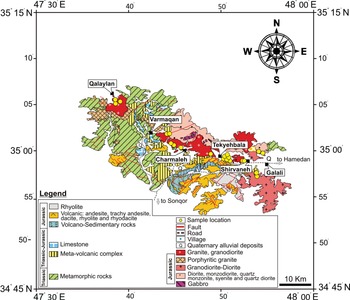
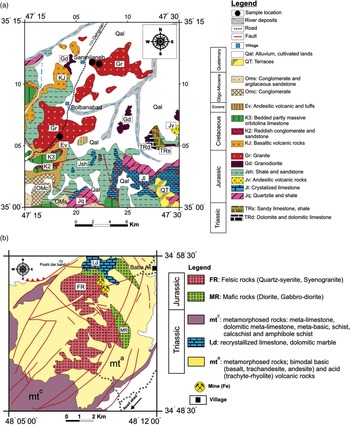
Several igneous plutons with different sizes and mafic to intermediate and felsic compositions have been exposed. From the southeast to the northwest, intrusive bodies include the Almogholagh, Galali, Shirvaneh, Tekyehbala, Charmaleh, Varmaqan, Qalaylan, Saranjianeh and Bolbanabad. These stocks and plutons have all been emplaced into Jurassic metamorphic units and have various compositions that range from gabbro to granite. The granitoid intrusive bodies are generally called the Almogholagh–Dehgolan granitoids. The general location of the area is shown in Figure 1b. The geological map of the Galali, Shirvaneh, Tekyehbala, Charmaleh, Varmaqan and Qalaylan plutons is illustrated in Figure 2. Figure 3a, b shows the geological map of the Saranjianeh–Bolbanabad and Almogholagh intrusive bodies. Towards the Hamedan region, these plutons (a) intruded Middle Jurassic regional metamorphic rocks known as the ‘Hamedan Phyllites’ (Monfaredi et al. Reference Monfaredi, Hauzenberger, Neubauer, Schulz, Shakerardakani, Genser and Halama2016), (b) intruded an Upper Jurassic pyroclastic sequence towards the Sonqor region, and (c) finally were emplaced in an Upper Triassic to Jurassic metabasite sequence in the Qorveh region (Eshraghi et al. Reference Eshraghi, Jafarian and Eghlimi1996; Hosseini et al. Reference Hosseini, Mosawery and Karimynia1999). Generally, metamorphic rocks occur in a vast portion of the area and are composed of schist, marble, amphibolite and gneiss that together with the igneous plutonic bodies form the rough topography of the region. The plutonic igneous bodies are gabbrodiorite, diorite, granodiorite, syenite and granite, which are younger in age than the metamorphic rocks. Volcano-sedimentary rocks include rhyolitic to rhyodacitic tuffs with trachyandesite of Jurassic–Cretaceous age.
Geological map of the area including the Galali, Shirvaneh, Tekyehbala, Charmaleh, Varmaqan and Qalaylan intrusive bodies (modified after Hosseini et al. Reference Hosseini, Mosawery and Karimynia1999).

(a) Geological map of the Saranjianeh–Bolbanabad intrusive bodies (modified after Zahedi & Hajian, Reference Zahedi and Hajian1985). (b) Geological map of the Almogholagh region (modified after Eshraghi & Mahmoudi Gharai, Reference Eshraghi and Mahmoudi Gharai2003).

The I-type granites of the NSaSZ mainly have the geochemical characteristics of arc-related magmas (e.g. Sepahi & Athari, Reference Sepahi and Athari2006; Ahmadi Khalaji et al. Reference Ahmadi Khalaji, Esmaeily, Valizadeh and Rahimpour-Bonab2007; Torkian et al. Reference Torkian, Khalili and Sepahi2008; Mahmoudi et al. Reference Mahmoudi, Corfu, Masoudi, Mehrabi and Mohajjel2011; Maanijou et al. Reference Maanijou, Aliani, Miri and Lentz2013; Sarjoughian et al. Reference Sarjoughian, Kananian, Hashchke and Ahmadian2015; Yajam et al. Reference Yajam, Montra, Scarrow, Ghalamghash, Razavi and Bea2015; Amiri et al. Reference Amiri, Ahmadi Khalaji, Tahmasbi, Santos, Zarei Sahahmieh and Zamanian2017; Jamshidibadr et al. Reference Jamshidibadr, Collins, Salomao and Costa2018). In the case of the Qalaylan granitoids, Azizi et al. (Reference Azizi, Zanjefili-Beiranvand and Asahara2015) suggested that these rocks are geochemically similar to high-silica adakites and Archaean tonalite–trondhjemite–granodiorite (TTG) rocks and that their generation was related to an extensional basin, such as a back-arc setting, which had been developed between the Sonqor–Qorveh island arc and the SaSZ. As suggested by Yajam et al. (Reference Yajam, Montra, Scarrow, Ghalamghash, Razavi and Bea2015), subduction-related magmatism started in Early Jurassic time and included the southern plutonic bodies of the NSaSZ and continued to the Galali pluton with the formation of a mafic-rock source magma during Late Jurassic time (∼160 Ma). Zhang, H. et al. (Reference Zhang, Xiao, Ji, Majidifard, Rezaeian, Talebian, Xiang, Chen, Wan, Ao and Esmaeili2018) geochemically subdivided the plutonic rocks of the Qorveh Plutonic Complex (QPC) into two groups. They proposed that the Mobarak Abad diorites and Qorveh gabbros and diorites most likely formed from magmas derived from a subduction-modified region of the subcontinental lithospheric mantle. In comparison, the Qorveh A-type quartz monzonites formed from a quartzo-feldspathic igneous crustal source, whereas the Bolbanabad A-type granites were probably formed from depleted mantle-derived magmas that underwent assimilation and fractional crystallization processes. They suggested a slab window geodynamic model for the generation of the QPC during subduction of the Neo-Tethys. Yeganeh et al. (Reference Yeganeh, Torkian, Christiansen and Sepahi2018) also pointed to an intra-arc extensional tectonic setting for the generation of the mafic to intermediate rocks of the Darvazeh plutonic suite (south Qorveh) in Late Jurassic time, and suggested that these rocks were formed in a continental arc experiencing extension as the Neo-Tethys oceanic lithosphere subducted beneath the Central Iranian Plate. Recently, Azizi et al. (Reference Azizi, Asahara, Minami and Anma2020) suggested that the mafic–intermediate and felsic rocks in southern Qorveh (Meiham–Shirvaneh) were formed in an extensional environment (continental rift) during Late Jurassic time in the central SaSZ. However, their proposed rift model differs from the active continental margin setting of the SaSZ.
On the basis of SHRIMP U–Pb zircon dating of the seven intrusive bodies in the Qorveh–Dehgolan region, Yajam et al. (Reference Yajam, Montra, Scarrow, Ghalamghash, Razavi and Bea2015) suggested that magmatic activity spanned 20 Myr (∼160–140 Ma). They also reported ages of 149 ± 2 Ma, 148 ± 1.1 Ma and 144 ± 1 Ma for the A-type granites of the Galali, Saranjianeh and Bolbanabad plutons, respectively. Jamshidibadr et al. (Reference Jamshidibadr, Collins, Salomao and Costa2018) detected a Late Jurassic to Early Cretaceous (148–143 Ma) crystallization age for the felsic rocks of the Almogholagh intrusive complex through U–Pb analysis of zircons. Zhang, H. et al. (Reference Zhang, Xiao, Ji, Majidifard, Rezaeian, Talebian, Xiang, Chen, Wan, Ao and Esmaeili2018) reported an age of 146 ± 2 Ma for the Bolbanabad A-type granite and interpreted this age as the timing of crystallization of the Bolbanabad pluton. Zhang, Z. et al. (Reference Zhang, Xiao, Ji, Majidifard, Rezaeian, Talebian, Xiang, Chen, Wan, Ao and Esmaeili2018) presented new zircon dating results and Hf isotope data from 22 samples of previously dated and undated granitoids in the SaSZ. In their study, a range of gabbroic to granitic lithologies were sampled from the Meso-Cenozoic intrusive rocks along the SaSZ (figs 2, 3 in Zhang, Z. et al. Reference Zhang, Xiao, Ji, Majidifard, Rezaeian, Talebian, Xiang, Chen, Wan, Ao and Esmaeili2018). They calculated 206Pb–238U ages of 153.6 ± 2.6 Ma and 150.7 ± 2.5 Ma for the Suffi Abad and Saranjianeh plutons, respectively. Their calculated age for the Saranjianeh pluton is identical (within error) to the SHRIMP zircon U–Pb age of 148 ± 1.1 Ma reported by Yajam et al. (Reference Yajam, Montra, Scarrow, Ghalamghash, Razavi and Bea2015). Furthermore, geochemical data for the samples from these two plutons suggest a typical A-type granitic signature (Zhang, Z. et al. Reference Zhang, Xiao, Ji, Majidifard, Rezaeian, Talebian, Xiang, Chen, Wan, Ao and Esmaeili2018). They suggested that Late Jurassic magmatism is favoured to have been formed in a continental extensional environment (probably a back-arc tectonic setting) by the involvement of lower crust partial melting.
The granites from the intrusive bodies show similar field, petrographic and geochemical features. It is noteworthy that all of the abovementioned dated granites (with the exception of the Suffi Abad) are geochemically A-type granites. On the basis that some granites of the study area have already been dated by those researchers and have field, compositional and geochemical similarities, our studied granites (Almogholagh–Dehgolan region) have relatively the same age. Therefore, we have considered an average age of 150 Ma (approximately) for the granites.
3. Field relationships and petrography
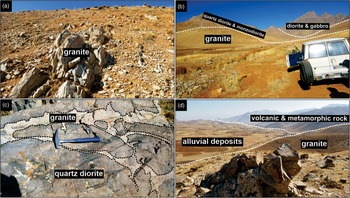
In the Almogholagh–Dehgolan region, the main constituent rock suites are plutonic and metamorphic rocks. In addition to the plutonic rocks, volcanic and metasedimentary rocks also occur in the area (Fig. 4). Mafic rocks, including gabbro and diorite together with volcanic and metamorphic rocks, form the rough topography of the region, and the contacts between the granites and country rocks (mafic–intermediate and metamorphic) are very distinct and sharp (Fig. 4a, b). The granites in the region are exposed as stocks or irregular dykes that intruded into the other plutonic rock suites composed of diorite, monzodiorite, quartz-monzodiorite and monzonite. On the basis of field observations, such as irregular dykes of granites intruding into the dioritic host rocks, the granites are relatively younger than the host rocks. Nevertheless, in some parts of the area, the coeval intrusion of mafic and felsic magmas occurs with cuspate contacts (Fig. 4c). The Almogholagh–Dehgolan granites are white to grey and medium to fine grained (Fig. 4d). The field properties of the granites in the plutons are largely the same, and for this reason, they cannot be classified or categorized based on their field properties. In total, 240 samples were collected from the plutons (granitoids).
Photographs showing a general view and field relationships of the granitic rocks (Almogholagh–Dehgolan region). (a) There are different rock suites around Tekyehbala village as a part of the Almogholagh–Dehgolan region (view direction is towards the southeast). (b) The granites of the area have a sharp contact with the host dioritic and mafic rocks (view direction is towards the northwest). (c) Irregular and vein granitic dykes (light grey) penetrated as a network into the host dioritic rocks (dark grey). This picture may also show evidence of coeval intrusion of mafic and felsic magmas. (d) An outcrop showing the granites of the area, which are white-light grey and medium to fine grained. Hammer for scale is ∼35 cm long.

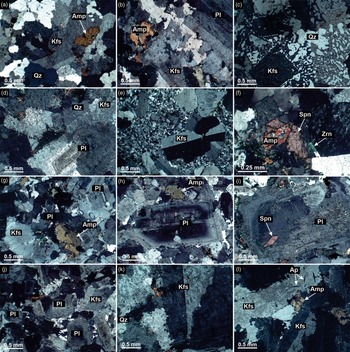
Petrographic studies show that the granitoid rocks of the region have a relatively similar mineral assemblage. This assemblage includes major minerals (quartz, K-feldspar, plagioclase) and mafic minerals (amphibole, biotite). Accessory minerals (apatite, titanite, zircon, and Fe–Ti oxides) are also common in the rocks. Figure 5 shows photomicrographs of the granitoid rocks. Despite the relatively identical mineralogical composition, the granitoid rocks of the massifs are different in terms of the abundance of modal minerals, especially the main minerals, as well as textural characteristics. Therefore, according to mineralogical and textural features, the granitoids can be categorized into at least three groups as follows.
Photomicrographs displaying the main constituent minerals of the Almogholagh–Dehgolan granitic rocks and their petrographic features (cross-polarized light). (a) The main constituent minerals of the Almogholagh–Dehgolan granitic rocks, including quartz, K-feldspar and plagioclase. (b) Perthitic orthoclase with Carlsbad twinning in the studied granites. (c) In the granites, plagioclase shows compositional zoning and is altered to sericite and epidote. (d) Mafic minerals including amphibole and biotite are common in the granites. (e) Secondary minerals including epidote, chlorite and sericite. (f) Photomicrograph showing the accessory minerals including sphene and Fe–Ti oxides in the Almogholagh–Dehgolan granites. (g) Granophyric texture is the most common intergrowth texture of the granites. (h) Photomicrograph showing anti-rapakivi texture in the granites, in which plagioclase is rimmed by overgrown K-feldspar. (i) Mylonitic texture/structure in the granites. Coarse twinned K-feldspar crystals have been formed in the fine groundmass comprising quartz, K-feldspar and plagioclase. Similar mineral assemblages are seen in the granites of the plutons. Abbreviations are after Whitney & Evans (Reference Whitney and Evans2010).

The first group includes the massifs of Almogholagh, Galali, Tekyehbala, Charmaleh, Varmaqan and Saranjianeh–Bolbanabad. These granitoids are mainly composed of abundant K-feldspar (25–55 vol. %) with lower contents of plagioclase (10–40 vol. %). In these rocks, quartz occurs as anhedral crystals (25–40 vol. %), which are formed interstitially with K-feldspar and plagioclase. Anhedral to subhedral orthoclase crystals have Carlsbad twinning and are highly perthitic in most samples (Fig. 5a). Subhedral to euhedral plagioclase crystals are less abundant and show polysynthetic twinning (Fig. 5b). Amphibole and biotite (5–10 vol. %) are the main mafic minerals, which are formed along the boundaries of K-feldspar, plagioclase and quartz (Fig. 5a, b). Intergrowth textures (perthitic, granophyric and micrographic) are the main characteristic feature of the granitoids of this group (Fig. 5c). Anti-rapakivi, as an overgrowth texture, is another petrographic feature of the rocks (Fig. 5d). Nevertheless, this feature is not widespread and occurs locally. Deformed fabric such as mylonitic fabric/structure is another common feature of this group, especially in the Galali and Varmaqan granitoid rocks (Fig. 5e) in which the large crystals of K-feldspar, plagioclase and quartz are formed in a fine-grained mass composed of these minerals. Accessory minerals such as zircon, sphene and Fe–Ti oxides are common in these rocks (Fig. 5f).
The second group only includes the Qalaylan massif. The Qalaylan granitoids have a lower K-feldspar content (35–40 vol. %) and relatively higher content (20–35 vol. %) of plagioclase compared to the granitoids of group 1. The rocks have a relatively high quartz content (30–40 vol. %) and amphibole is the dominant mafic mineral, which is formed as euhedral to anhedral crystals (Fig. 5g). In these rocks, dominantly euhedral to subhedral plagioclase crystals are distinctively different from those of group 1. Zoning is the main feature of plagioclase crystals in the Qalaylan granitoids, which is not observed in the massifs of group 1 (Fig. 5h). In some places, zoned plagioclase crystals have been somewhat altered and sericitized in their central parts and have inclusions of accessory minerals, such as sphene and/or zircon (Fig. 5i). Moreover, these granitoids are texturally different in that the K-feldspar crystals are less perthitic and intergrowth textures such as granophyric or micrographic are absent (Fig. 5j).
The third group is actually a subset of group 1 and includes samples from the Galali, Charmaleh and Varmaqan massifs. These rocks show mineralogical and textural features identical to the granitoids of group 1, but in terms of composition, they are relatively different and have much lower amounts of quartz. These rocks have 10–15 vol. % quartz, 70–75 vol. % K-feldspar and 10–20 vol. % plagioclase. K-feldspar crystals are very abundant and in many places perthitic and show Carlsbad twinning (Fig. 5k). The amount of quartz and plagioclase in these rocks is considerably less than other granitoids. Mafic minerals include amphibole and biotite. For the accessory minerals, apatite is more common and has been formed as needle-shaped crystals (Fig. 5l).
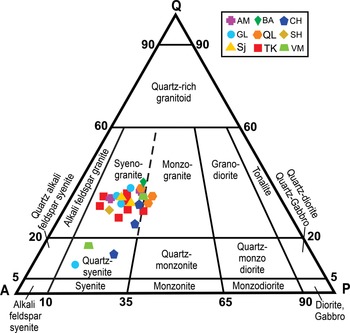
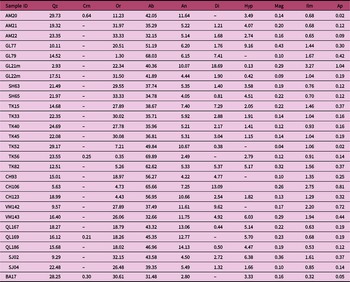
The rocks have been given a nomenclature that follows the International Union of Geological Sciences (IUGS) classification. No point counting instrument was used, and, instead, we have used standard graphical charts to estimate the approximate percentage of constituent minerals. In Table 1, the modal values are calculated as a percentage relative to the sum up to 100 %. Finally, on the basis of the approximate percentage of modal minerals (Table 1) the coordinates for a QAP triangle diagram were calculated. Thus, on the basis of the QAP modal classification diagram of Streckeisen (Reference Streckeisen1979), the rocks are mainly granite. As illustrated in the QAP diagram (Fig. 6), the rocks of group 1 are mainly plotted in the syenogranite field and the rocks of the Qalaylan massif (group 2) are much closer to the monzogranite field. Unlike the previous two groups, samples GL21m, CH106 and VM142 as the third group have a lower modal content of quartz (less than 20 %) and, therefore, are placed in the field of quartz syenite. However, Figure 6 shows that the distribution of the samples in the QAP diagram is completely consistent with their petrographic characteristics. In Table 2 the CIPW normative minerals for the samples are presented. The normative values are consistent with the observed petrographic and geochemical features of the samples, because orthoclase crystals are commonly perthitic in these rocks. The amounts of normative anorthite are related to the modal plagioclase, titanite and partly to the amphibole content of the samples. The normative quartz values are consistent with the modal per cent of this mineral.
Calculated approximate percentage of modal felsic minerals (QAP) for the Almogholagh–Dehgolan granites

Abbreviations: Q – quartz; A – alkali-feldspar; P – plagioclase.
Modal QAP classification diagram of plutonic rocks (Streckeisen, Reference Streckeisen1979) for the Almogholagh–Dehgolan granitic rocks. AM – Almogholagh; GL – Galali; SH – Shirvaneh; TK – Tekyehbala; CH – Charmaleh; VM – Varmaqan; QL – Qalaylan; SJ – Saranjianeh; BA – Bolbanabad.

CIPW normative minerals for the studied samples

Abbreviations: Qz – quartz; Crn – corundum; Or – orthoclase; Ab – albite; An – anorthite; Di – diopside; Hyp – hypersthene; Mag – magnetite; Ilm – ilmenite; Ap – apatite.
4. Analytical techniques
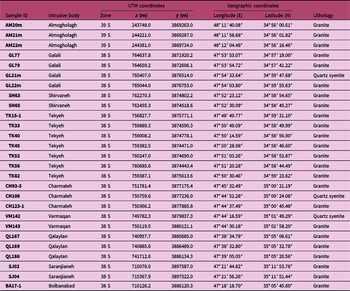
Twenty-seven samples from the granitoid bodies were selected for whole-rock chemical analysis. The locations of samples selected for whole-rock analyses are listed in Table 3. Whole-rock chemical analysis was performed at the MSLABS Laboratory in Canada. Major-element oxides were analysed by the inductively coupled plasma emission spectroscopy (ICP-ES) method with a lithium borate fusion. Trace elements and REEs were determined by the inductively coupled plasma mass spectroscopy (ICP-MS) and lithium borate fusion method. The standard samples include STD SY-4 and STD GMN-04. STD OREAS 601 and STD OREAS 24B were used for external calibration. The detection limit was 0.01 wt % for all major-element oxides and less than 0.1 ppm for trace elements. Whole-rock major- and trace-element compositions of the Almogholagh–Dehgolan granites are listed in Table 4.
Location (UTM and geographic coordinates) of samples selected for whole-rock chemical analysis

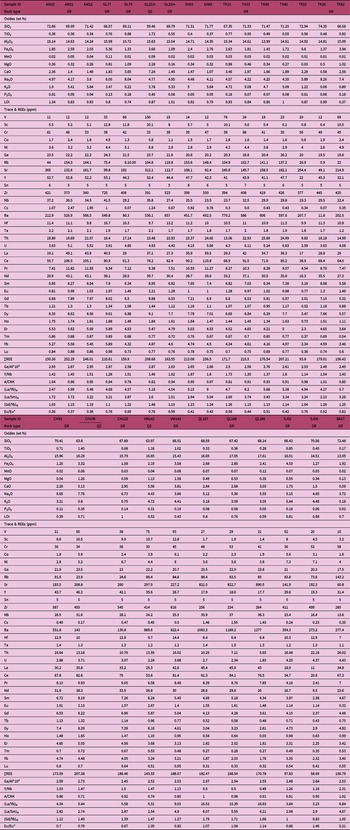
Major- and trace-element whole-rock compositions of granitoid rocks from the Almogholagh–Dehgolan intrusive bodies

*Note: LOI – loss on ignition; A/CNK = molar Al2O3/(CaO + Na2O + K2O); N – chondrite normalized; Eu/Eu* – EuN/(SmNGdN)(1/2); wt % – weight per cent; ppm – part per million; GR – granite; QS – quartz syenite
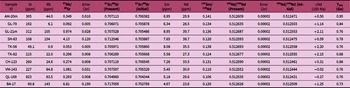
Following the petrographic study of 27 thin-sections from the granitic rocks, ten samples were chosen for Nd and Sr isotope analyses at the University of Aveiro (UA), Portugal. For these analyses, the samples were crushed to less than 60 µm. In the Laboratory of Isotope Geology of the UA, the powdered samples were dissolved and submitted to ion chromatography, using the procedures described by Moradi et al. (Reference Moradi, Shabanian, Davoudian, Azizi, Santos and Asahara2020). In the same lab, the Sr and Nd isotope ratios were measured using a VG Sector 54 thermal ionization mass spectrometer (TIMS). Mass fractionation was corrected considering 88Sr/86Sr = 0.1194 and 146Nd/144Nd = 0.7219. The analyses using the SRM-987 standard gave an average value of 87Sr/86Sr = 0.710271 ± 0.000011 (N = 14; confidence limit = 95 %) and the JNdi-1 standard gave an average value of 143Nd/144Nd = 0.5120973 ± 0.0000090 (N = 12; confidence limit = 95 %). The values of the 87Sr/86Sr and 143Nd/144Nd ratios of the studied granites are listed in Table 5.
Sr–Nd isotope data for the Almogholagh–Dehgolan granites

5. Geochemistry and tectonic setting
5.a. Geochemistry
The granites have SiO2 values between 59.46 and 74.35 wt % with an average value of 68.99 wt %, except for sample GL21m, which has a lower SiO2 content (Table 4). The rocks show an average Al2O3 content of 15.34 ± 3.31 wt % (n = 27) and low TiO2, MgO, CaO and P2O5 contents. Total alkali contents are high (average = 8.88 ± 0.88 wt %, n = 27) and FeOt content varies between 0.54 and 4.82 wt %. According to the data in Table 4, K2O shows a relatively wide range of values from 0.06 to 5.64 wt %. Therefore, on the basis of K2O content, the rocks can generally be categorized into three groups: (1) high-K rocks (K2O = 4–6 wt %), (2) mid-K rocks (K2O = 2–4 wt %) and (3) low-K rocks (K2O = 0–2 wt %).
The group 1, high-K rocks includes samples from the Almogholagh, Galali, Shirvaneh, Tekyehbala, Varmaqan, Saranjianeh and Bolbanabad massifs. These rocks have high contents of K2O, which indicates significant amounts of K-bearing minerals such as K-feldspar (orthoclase). This group can be considered equivalent to the unmetasomatized samples of group 1 of the petrographic classification scheme in which perthitic K-feldspar is the most abundant mineral.
The group 2, mid-K rocks includes mainly the Qalaylan granites and some samples from the Galali and Charmaleh massifs. The rocks of this group have moderate K2O contents. The Qalaylan granites have the lowest K2O contents (3.05–3.18 wt %) among the rocks of this group. As discussed in Section 3, plagioclase is the dominant mineral of the granites of the Qalaylan massif, and K-feldspar is less abundant in contrast to the other massifs, which is consistent with their geochemical data. Therefore, the geochemical data for the rocks of this group are in great agreement with their petrographic characteristics and confirm their petrographic classification.
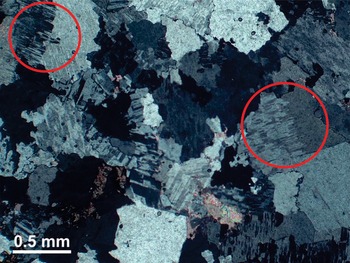
The rocks with low contents of K2O fall into groups 1 and 3 of Section 3, and they include some samples from the Tekyehbala, Charmaleh, Galali and Almogholagh massifs. These rocks have K2O values of between 0.06 and 1.9 wt %. The geochemical data (Table 4) show that the rocks with low K2O contents have relatively high Na2O contents. Moreover, the petrographic evidence shows that metasomatic processes (i.e. sodic metasomatism) have extensively affected these rocks (Fig. 7). Such a mechanism may cause potassium–sodium exchange between constituent minerals and finally the replacement of K-feldspar (orthoclase) by sodic plagioclase. This feature is obviously seen in the granitoid rocks, especially in the Charmaleh and Tekyehbala massifs. The total amounts of alkali oxides (K2O + Na2O) are nearly constant, but the K2O/Na2O ratios are considerably different. Their differences may be due to secondary chemical changes in some samples. The granitoids with various K2O contents cannot be separated from each other in the field outcrops because no sharp contacts exist between them. On the other hand, replacement textures produced by Na-metasomatism are observable in the thin-sections of low-K samples. Thus, they are not, in fact, separate groups of granitic rocks. As is obvious in the photomicrograph (Fig. 7), albite is not in primary magmatic contact with remnants of orthoclase, and the two minerals have not crystallized simultaneously from the magma. For example, on the right side of Figure 7 and also in the upper left of the figure, albite has no sharp contact with the remnants of orthoclase and albite is gradually replacing orthoclase. If albite had crystallized simultaneously with orthoclase, the whole crystal should show the same relative distribution of albite throughout the orthoclase and not have one side devoid of any albite. The abundance of the CaO content in such rocks is related to their fairly high titanite content.
Photomicrograph showing evidence of replacement of perthitic orthoclase by albite due to Na-metasomatism.

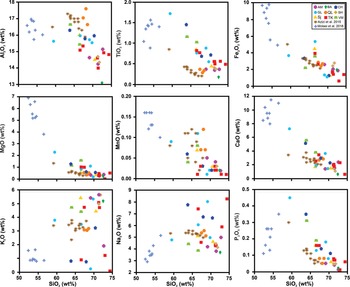
Figure 8 shows variation diagrams of major-element oxides versus SiO2 (Harker, Reference Harker1909) for the granites. As illustrated in this figure, a negative correlation generally exists between major-element oxides and SiO2 contents. In most samples, Al2O3, CaO, TiO2, MgO, P2O5 and Fe2O3 contents decrease with increasing SiO2 amounts. K2O and Na2O show relatively scattered trends partly due to secondary alteration and metasomatism. Decreasing trends for major-element oxides indicate their participation in the corresponding minerals. For example, separation of Ca-bearing plagioclases during the early stages of magma generation can reduce the amount of CaO and Al2O3 in the melt. Likewise, the trends for TiO2, Fe2O3 and P2O5 can be explained by the presence of accessory minerals, including sphene, Fe–Ti oxides and apatite, which are present in the studied granites.
Harker variation diagrams of major oxides versus SiO2 for the samples.

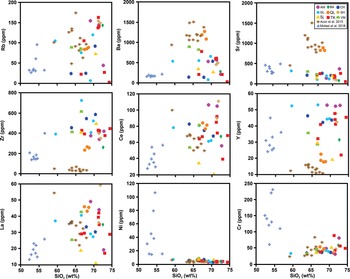
Multiple plots of trace elements versus SiO2 for the Almogholagh–Dehgolan granites are shown in Figure 9. In these diagrams, there is no distinct correlation (negative or positive) between SiO2 and trace elements. Nevertheless, some trace elements such as Sr and Ba show relatively decreasing trends with increasing SiO2. A decreasing trend for Sr and Ba can be considered in relation to their compatibility in some minerals such as alkali-feldspar and plagioclase, respectively (Rollinson, Reference Rollinson1993).
Harker variation diagrams of trace elements versus SiO2 for the samples.

In addition to the Almogholagh–Dehgolan granites (this study) data for the Qalaylan granitoids (Azizi et al. Reference Azizi, Zanjefili-Beiranvand and Asahara2015) and gabbroic diorites of the Darvazeh intrusive bodies (Yeganeh et. al. Reference Yeganeh, Torkian, Christiansen and Sepahi2018) are also presented for comparison. As illustrated in Figures 8, 9, the Qalaylan granitoids show trends that are not separate from the studied granites. In contrast, the gabbroic diorites show distinct trends. The different trends for the granites and gabbroic diorites of the area indicate that they most probably are not co-magmatic. Therefore, it can be concluded that these two different rock suites have followed separate magmatic evolution paths and are geochemically independent.
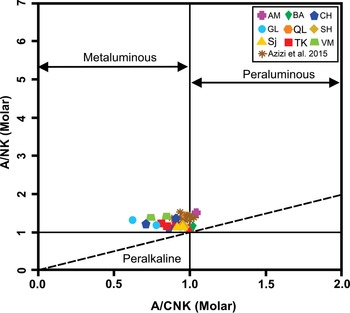
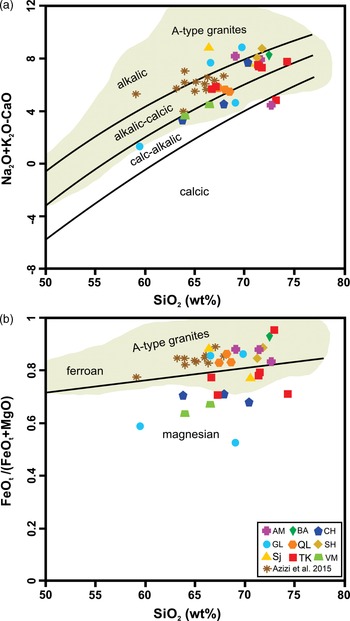
If the Al2O3/(Na2O + K2O) versus Al2O3/(CaO + Na2O + K2O) (A/NK versus A/CNK) diagram (Shand, Reference Shand1943) is used, the studied granites plot mainly in the metaluminous field with A/CNK = 0.62 to 1.04 (Fig. 10). Furthermore, in the SiO2 versus total alkali (Na2O + K2O) and ((FeO)t/(FeOt + MgO)) diagrams of Frost et al. (Reference Frost, Barnes, Collins, Arculus, Ellis and Frost2001) the samples plot mainly in the alkalic to alkali-calcic and calc-alkalic (Fig. 11a) and ferroan to magnesian fields (Fig. 11b).
A/NK versus A/CNK diagram (Shand, Reference Shand1943) (A/CNK = molar Al2O3/(CaO + Na2O + K2O) and A/NK = molar Al2O3/(Na2O + K2O)). AM – Almogholagh; GL – Galali; SH – Shirvaneh; TK – Tekyehbala; CH – Charmaleh; VM – Varmaqan; QL – Qalaylan; SJ – Saranjianeh; BA – Bolbanabad.

Geochemical classification diagrams (Frost et al. Reference Frost, Barnes, Collins, Arculus, Ellis and Frost2001). (a) Na2O + K2O − CaO versus SiO2 diagram. (b) FeOt/(FeOt + MgO) versus SiO2. AM – Almogholagh; GL – Galali; SH – Shirvaneh; TK – Tekyehbala; CH – Charmaleh; VM – Varmaqan; QL – Qalaylan; SJ – Saranjianeh; BA – Bolbanabad.

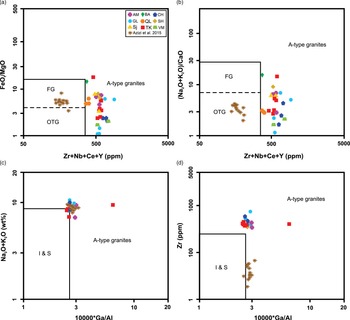
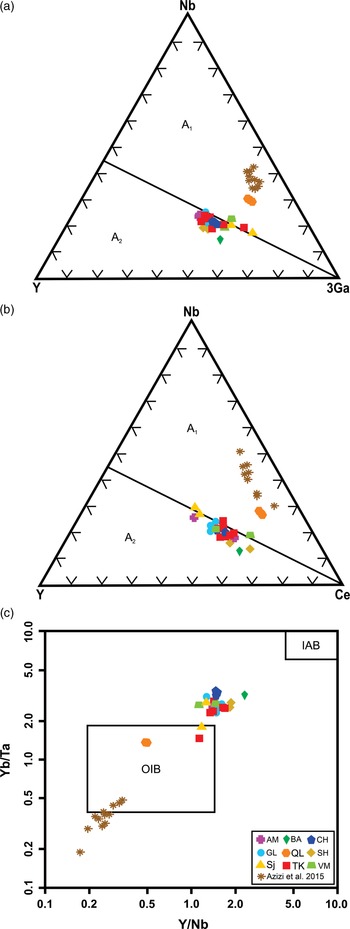
The discrimination diagrams of Whalen et al. (Reference Whalen, Currie and Chappell1987) can be utilized to distinguish the A-type granites from the others. In these diagrams, the Almogholagh–Dehgolan granites plot mainly in the A-type granite field (Fig. 12). Eby (Reference Eby1992) divided the A-type granites into two groups. As illustrated in Figure 13a, b, with the exception of the Qalaylan granites, all the granites plot in the A2-type field. The Yb/Ta versus Y/Nb diagram also shows a similar result for the Qalaylan granites (Fig. 13c). It has been suggested that A1-type granitoids have a Y/Nb ratio < 1.2 and that A2-types have a Y/Nb ratio > 1.2 (Eby, Reference Eby1992).
Geochemical diagrams of Whalen et al. (Reference Whalen, Currie and Chappell1987) for the discrimination of A-type granites from the other granites. (a) FeOtotal/MgO versus Zr + Nb + Ce + Y. (b) (Na2O + K2O)/CaO versus Zr + Nb + Ce + Y. (c) Na2O + K2O versus 10 000*Ga/Al. (d) Zr versus 10 000*Ga/Al. FG – fractionated granites; OTG – other granite types; AM – Almogholagh; GL – Galali; SH – Shirvaneh; TK – Tekyehbala; CH – Charmaleh; VM – Varmaqan; QL – Qalaylan; SJ – Saranjianeh; BA – Bolbanabad.

Geochemical diagrams of Eby (Reference Eby1992) for subdividing A-type granites. (a) Y–Nb–Ga*3. (b) Y–Nb–Ce. (c) Yb/Ta versus Y/Nb. AM – Almogholagh; GL – Galali; SH – Shirvaneh; TK – Tekyehbala; CH – Charmaleh; VM – Varmaqan; QL – Qalaylan; SJ – Saranjianeh; BA – Bolbanabad; OIB – ocean island basalt; IAB – island arc basalt.

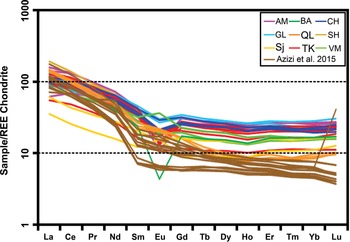
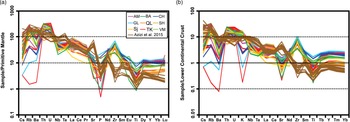
Chondrite-normalized REE patterns (Boynton, Reference Boynton and Henderson1984) for the Almogholagh–Dehgolan A-type granites are illustrated in Figure 14. The A-type granites are characterized by enrichment of light rare earth elements (LREEs) relative to heavy rare earth elements (HREEs) with (La/Yb)N = 2.44–16.47. The granites display slightly to moderately negative Eu anomalies, whereas some samples have positive anomalies (Eu/Eu* = 0.21–1.47, average value = 0.70). Primitive mantle-normalized trace-element spider diagrams (McDonough & Sun, Reference McDonough and Sun1995) show relatively similar characteristics for the Almogholagh–Dehgolan A-type granites (Fig. 15a). In this diagram, most samples display pronounced negative Nb, P, Ti and Ba anomalies indicative of subduction-related magmatism. They are enriched in Rb, Th and U, and enrichment of Zr is also pronounced in all samples. Lower continental crust-normalized trace-element patterns (Taylor & McLennan, Reference Taylor and McLennan1995) for the A-type granites of the Almogholagh–Dehgolan plutons show similarities to the Earth’s lower continental crust (Fig. 15b).
Chondrite-normalized REE patterns (Boynton, Reference Boynton and Henderson1984). AM – Almogholagh; GL – Galali; SH – Shirvaneh; TK – Tekyehbala; CH – Charmaleh; VM – Varmaqan; QL – Qalaylan; SJ – Saranjianeh; BA – Bolbanabad.

(a) Primitive mantle-normalized spider diagrams (McDonough & Sun, Reference McDonough and Sun1995). (b) Lower continental crust-normalized trace-element patterns (Taylor & McLennan, Reference Taylor and McLennan1995). AM – Almogholagh; GL – Galali; SH – Shirvaneh; TK – Tekyehbala; CH – Charmaleh; VM – Varmaqan; QL – Qalaylan; SJ – Saranjianeh; BA – Bolbanabad.

5.b. Tectonic setting
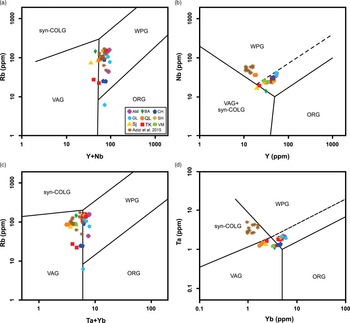
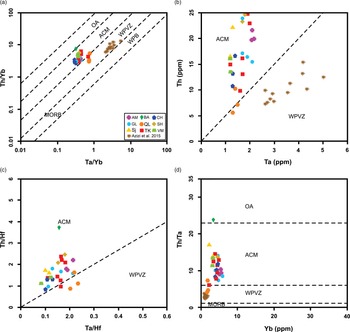
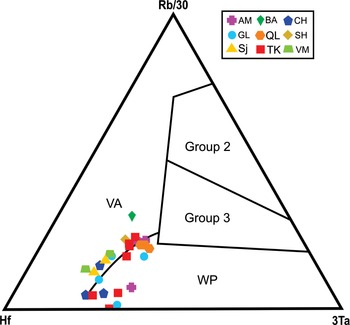
The geotectonic discrimination diagrams of Pearce et al. (Reference Pearce, Harris and Tindle1984) were used to distinguish the tectonic setting of the Almogholagh–Dehgolan granites (Fig. 16). In these diagrams, samples plot mainly in the fields of within-plate granites (WPG) and volcanic arc granites (VAG). In the tectonic discrimination diagrams of Schandl & Gorton (Reference Schandl and Gorton2002) the A-type granites plot mainly in the active continental margin (ACM) and within-plate volcanic zone (WPVZ) fields (Fig. 17). In the 3Ta–Hf–Rb/3 ternary diagram (Harris et al. Reference Harris, Pearce, Tindle, Coward and Ries1986) the samples plot in the volcanic arc (VA) and within-plate (WP) fields (Fig. 18). A common feature of these diagrams is that the Almogholagh–Dehgolan granites plot in the fields of both the volcanic arc and within-plate tectonic settings, which implies a post-orogenic-like tectonic setting.
Geotectonic discrimination diagrams of Pearce et al. (Reference Pearce, Harris and Tindle1984) for the Almogholagh–Dehgolan A-type granites. (a) Rb versus Y + Nb diagram. (b) Nb versus Y diagram. (c) Rb versus Ta + Yb diagram. (d) Ta versus Yb diagram. Abbreviations: SYN-COLG – syn-collisional granites; WPG – within-plate granites; VAG – volcanic arc granites; ORG – ocean ridge granites; AM – Almogholagh; GL – Galali; SH – Shirvaneh; TK – Tekyehbala; CH – Charmaleh; VM – Varmaqan; QL – Qalaylan; SJ – Saranjianeh; BA – Bolbanabad.

Geotectonic discrimination diagrams of Schandl & Gorton (Reference Schandl and Gorton2002) for the Almogholagh–Dehgolan A-type granites. (a) Th/Yb versus Ta/Yb. (b) Th versus Ta. (c) Th/Hf versus Ta/Hf. (d) Th/Ta versus Yb. Abbreviations: OA – oceanic arcs; ACM – active continental margins; WPVZ – within-plate volcanic zones; WPB – within-plate basalts; MORB – mid-ocean ridge basalts. AM – Almogholagh; GL – Galali; SH – Shirvaneh; TK – Tekyehbala; CH – Charmaleh; VM – Varmaqan; QL – Qalaylan; SJ – Saranjianeh; BA – Bolbanabad.

3Ta–Hf–Rb/30 tectonic discrimination diagram (Harris et al. Reference Harris, Pearce, Tindle, Coward and Ries1986). Abbreviations: VA – volcanic arcs; WP – within-plate; Group 2 – syn-collision; Group 3 – late-post collision. AM – Almogholagh; GL – Galali; SH – Shirvaneh; TK – Tekyehbala; CH – Charmaleh; VM – Varmaqan; QL – Qalaylan; SJ – Saranjianeh; BA – Bolbanabad.

5.c. Sr–Nd isotopes
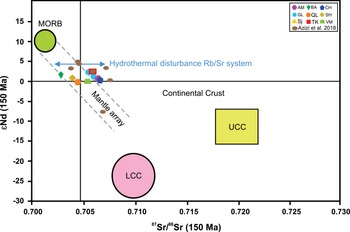
Sr–Nd isotopic data for the Almogholagh–Dehgolan granites are presented in Table 5. To calculate the initial Sr and Nd isotope ratios, the age of 150 Ma was used for the A-type granites, taking into account that this value is within the range of ages reported by Zhang, H. et al. (Reference Zhang, Xiao, Ji, Majidifard, Rezaeian, Talebian, Xiang, Chen, Wan, Ao and Esmaeili2018). The initial Sr isotope ratios were calculated using the 87Rb decay constant proposed by Villa et al. (Reference Villa, De Bièvre, Holden and Renne2015), which is recommended by the IUGS and International Union of Pure and Applied Chemistry (IUAPC). Generally, the Nd isotope compositions result from the magmatic features, and they should not have been significantly affected by post-magmatic processes because both Sm and Nd are relatively mobile elements. In contrast, Rb and Sr are commonly susceptible to modifications during events of hydrothermal and/or meteoric alteration.
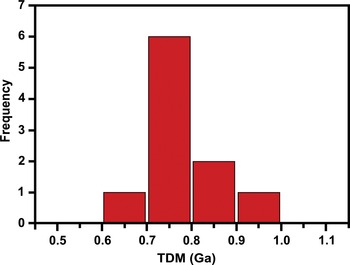
For the samples, the initial 87Sr/86Sr and 143Nd/144Nd values vary from 0.702769 to 0.706545 and 0.512431 to 0.512558, respectively (Table 5). The Sr–Nd isotope correlation diagram for the Almogholagh–Dehgolan A-type granites is shown in Figure 19. For an age of 150 Ma, epsilon Nd (ϵNd) values vary in a relatively limited range, between +2.2 (TK-56) and −0.3 (QL-159). Initial Sr isotope ratios have a significant variation from 0.7028 (BA-17) to 0.7065 (CH-123). The distribution histogram of calculated Nd model ages (TDM) for the Almogholagh–Dehgolan A-type granites is shown in Figure 20. On the basis of our calculations, the Nd model ages (TDM) range from 0.68 to 0.95 Ga with an average value of 0.79 Ga, which mainly correspond to the Neoproterozoic period.
ϵNd versus 87Sr/86Sr correlation diagram (modified after Zindler & Hart, Reference Zindler and Hart1986). UCC – upper continental crust; LCC – lower continental crust; AM – Almogholagh; GL – Galali; SH – Shirvaneh; TK – Tekyehbala; CH – Charmaleh; VM – Varmaqan; QL – Qalaylan; SJ – Saranjianeh; BA – Bolbanabad.

Histogram of Nd model age frequency for the Almogholagh–Dehgolan A-type granites.

6. Discussion
Many samples of the Almogholagh–Dehgolan granites show characteristic features of A-type granites, such as high SiO2, FeO/MgO, total alkali (Na2O, K2O), Zr, Ga/Al and REEs (except for Eu) and low CaO, MgO and P2O5 contents, but samples with lower SiO2 and lower FeO/MgO ratios also significantly exist. Enriched flat-shaped patterns for HREEs imply that melting of the A-type granite source magma has occurred at pressures lower than the stability field of garnet (Wang et al. Reference Wang, Jiang, Liu, Ni, Qing and Zhang2015). Generally, enrichments in large ion lithophile elements and HFSEs are characteristic features of A-type granites (Loiselle & Wones, Reference Loiselle and Wones1979; Whalen et al. Reference Whalen, Currie and Chappell1987; King et al. Reference King, White, Chappell and Allen1997), which are clearly observed in many samples of the Almogholagh–Dehgolan granites.
As illustrated in Figure 19, the Sr–Nd isotope composition of the Almogholagh–Dehgolan granites is relatively primitive (similar to the Bulk Silicate Earth). The samples have negative to positive values of ϵNd(i) and plot in the mantle array with a slight shift to higher 87Sr/86Sr(i). On the other hand, the existence of inherited zircons (reported by Yajam et al. Reference Yajam, Montra, Scarrow, Ghalamghash, Razavi and Bea2015) and elevated Nd model ages (this study) for the studied granites are not consistent with a pure mantle source origin. Nevertheless, it seems that the sources of the parental melts correspond either to mantle and/or crustal rocks. In some places, the granites with mantle-like isotopic ratios could be produced by the reworking of juvenile crustal rocks. As suggested by Dahlquist et al. (Reference Dahlquist, Alasino, Eby, Galindo and Casquet2010), one of the main sources for the A-type granites is the variable mixture of asthenospheric mantle and continental crust melts. Metaluminous A-type granitic rocks are thought to be derived from a mixture of mantle and crustal components (Schmitt et al. Reference Schmitt, Emmermann, Trumbull, Buhn and Henjes-Kunst2000; Kemp et al. Reference Kemp, Wormald, Whitehouse and Price2005; Bonin, Reference Bonin2007).
We suggest that the derivation of the Almogholagh–Dehgolan granites from mixed mantle–crustal source materials could well explain their geochemical and isotopic compositions. The mafic mantle magmas played an important role in providing both the heat and material sources for crustal melting and the generation of the granites.
6.a. Petrogenesis
The rocks mostly show geochemical characteristics of A-type granites (Table 4), and based on the subdivision of Eby (Reference Eby1992) plot in the field of A2-type granites (with the exception of the Qalaylan granites, which plot in the A1-type field). Generally, A2-type granites are related to post-collisional and/or post-orogenic tectonic settings (Eby, Reference Eby1992). A2-type granitoids include a greater diversity of compositions, from metaluminous to peraluminous and peralkaline, and from alkalic to calc-alkalic (Frost & Frost, Reference Frost and Frost2011). These granitoids have mixed geochemical signatures of continental crust and island arc (Wu et al. Reference Wu, Sun, Li, Jahn and Wilde2002). Placement of the Almogholagh–Dehgolan granites in the post-orogenic setting field can also be explained by an extensional tectonic setting in the subduction environment of the SaSZ.
On the basis of the transitional nature of the Almogholagh–Dehgolan granites, their formation by fractionation of I-type melts is unlikely. Many investigators (e.g. Maanijou et al. Reference Maanijou, Aliani, Miri and Lentz2013; Sarjoughian et al. Reference Sarjoughian, Kananian, Hashchke and Ahmadian2015; Yajam et al. Reference Yajam, Montra, Scarrow, Ghalamghash, Razavi and Bea2015; Amiri et al. Reference Amiri, Ahmadi Khalaji, Tahmasbi, Santos, Zarei Sahahmieh and Zamanian2017; Jamshidibadr et al. Reference Jamshidibadr, Collins, Salomao and Costa2018) have studied the mafic rocks of the Qorveh region and adjacent areas in the NSaSZ. On the basis of their investigations, these rocks have the geochemical characteristics of arc-type magmas and are related to subduction of the Neo-Tethys oceanic crust. The mafic rocks mainly have a mantle source, and there is no genetic relationship between these rocks with the granitic rocks of the region.
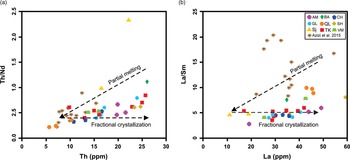
Fractionation of alkaline basaltic magmas causes the formation of alkaline granites, which is in contrast with the metaluminous nature of the granites of the Almogholagh–Dehgolan. Owing to the lack of field evidence of magma mixing (such as mafic enclaves) in the Almogholagh–Dehgolan granites, the role of mixing processes in their formation is not clear. However, in some parts of the region coeval intrusion of mafic and felsic rocks probably indicates magma mingling processes. Magma evolution diagrams (Fig. 21a, b) show that the Almogholagh–Dehgolan granites follow the trend of partial melting rather than fractional crystallization, which implies that the partial melting process (regardless of the source type) had an important role in the generation of the granite magma source.
Magma evolution diagrams for the Almogholagh–Dehgolan A-type granites. (a) Th/Nd versus Th diagram. (b) La/Sm versus La diagram. The trends of partial melting and fractional crystallization are modified after Kong et al. (Reference Kong, Li, Wu, Xi, Dick and Gabo-Ratio2018). AM – Almogholagh; GL – Galali; SH – Shirvaneh; TK – Tekyehbala; CH – Charmaleh; VM – Varmaqan; QL – Qalaylan; SJ – Saranjianeh; BA – Bolbanabad.

The granites have little or no depletion in HREEs, which rules out garnet as an important phase during their petrogenesis. On the other hand, the granites of the Almogholagh–Dehgolan cannot be formed by the partial melting of metasedimentary components, because, in this case, the resultant granites are mainly peraluminous whereas the Almogholagh–Dehgolan granites are metaluminous. Relatively high contents of K2O and Na2O in the Almogholagh–Dehgolan granites indicate the existence of plagioclase and K-feldspar or biotite in their source. In addition, negative Sr anomalies accompanied by high HREE contents indicate the presence of plagioclase and the absence of garnet in their source (Watkins et al. Reference Watkins, Clemens and Treloar2007).
One of the basic requirements for the generation of A-type granites by partial melting of crustal materials is an external heat source. Mantle-derived mafic magmas could supply heat and fluid to facilitate the partial melting of crustal rocks (Gao et al. Reference Gao, Zheng and Zhao2016). The Qalaylan granites show different geochemical features relative to the other granites. These granites have geochemical characteristics of calc-alkaline I-type granites. Moreover, the lack of intergrowth textures such as perthitic texture in these rocks is one of the main petrographic differences with A-type granites. On the basis of petrographic, geochemical and geochronological (older age) characteristics of the Qalaylan granites in comparison to the other A2-type granites in the Almogholagh–Dehgolan region, their formation mechanism may be different. We suggest that the Qalaylan I-type granites were formed during the earlier stages (159 ± 3 Ma: Yajam et al. Reference Yajam, Montra, Scarrow, Ghalamghash, Razavi and Bea2015) of the Neo-Tethys subduction, and their apparent pseudo-A1 affinity has been acquired by metasomatic fluids, which makes them similar to those of ocean island basalt (OIB)-like magma sources. On the basis of the geochemical and isotopic compositions, the formation of the metaluminous A2-type granites of the Almogholagh–Dehgolan is most likely related to partial melting of lower crustal dry rocks with a considerable contribution of mafic magmas from the mantle.
6.b. Geodynamic notes
Generally, geochemical differences between I- and A-type granites indicate their different tectonic environments. Yan & Shi (Reference Yan and Shi2016) suggested that I-type granites are related to compression and the A-type ones are related to extension. Therefore, co-development of roughly contemporaneous I- and A-type granites in the NSaSZ (Almogholagh–Dehgolan region) indicates the geodynamic changes under which these two different types of granites were formed.
The Almogholagh–Dehgolan granites (this study) share transitional geochemical characteristics of I- to A-type granites with more A-type affinities. In geotectonic discrimination diagrams, the rocks mainly plot in the fields of volcanic arc and within-plate granites. These granites may correspond to a shift from pure I-type to pure A-type granites and, therefore, from collisional to post-orogenic stages of the SaSZ orogenic belt during Jurassic time. But, considering the geological history of the SaSZ (i.e. the lack of continent–continent collision during Jurassic time) this issue cannot be well explained by a simple ocean–continent subduction model. Therefore, considering the field, petrographic and geochemical characteristics of the granites (this study) and the geodynamic constraints of the NSaSZ during Jurassic time, we may compare two possible weakly extensional geodynamic models (an intra-arc extensional tectonic setting and a post-arc–continent collision environment) for the generation of the granites, but each model should be considered with some uncertainties. As previously mentioned by some authors (e.g. Sarjoughian et al. Reference Sarjoughian, Kananian, Hashchke and Ahmadian2015), too, there is a transitional I-type to A-type magmatism in the region that possibly resulted from no pure and pervasive extensional regime at the time and a local transition from a compressional to weakly extensional period.
During Early–Late Jurassic time, arc magmas were generated owing to subduction of the Neo-Tethys oceanic crust beneath the Central Iranian Microplate. Mantle-derived mafic magmas have geochemical characteristics typical of volcanic arc magmas related to an active continental margin setting. Underplating of these mafic magmas into the lower crust has caused melting or/and modification of the crustal rocks. Geochemically, Early–Middle Jurassic granitoids of the SaSZ are I-type. These I-type granites are mainly calc-alkaline and plot in the VAG field of tectonic discrimination diagrams (e.g. Ahmadi Khalaji et al. Reference Ahmadi Khalaji, Esmaeily, Valizadeh and Rahimpour-Bonab2007; Mahmoudi et al. Reference Mahmoudi, Corfu, Masoudi, Mehrabi and Mohajjel2011; Esna-Ashari et al. Reference Esna-Ashari, Tiepolo, Valizadeh, Hassanzadeh and Sepahi2012; Maanijou et al. Reference Maanijou, Aliani, Miri and Lentz2013; Sepahi et al. Reference Sepahi, Salami, Lentz, McFarlane and Maanijou2018; Tavakoli et al. Reference Tavakoli, Shabanian, Davoudian, Azizi, Neubauer, Asahara, Bernroider and Lee2021). Moreover, different sources from mantle to crustal materials have been suggested for their generation.
Subsequent Late Jurassic magmatism may have been triggered in a continental extensional environment, probably a back-arc tectonic setting (Moinevaziri et al. Reference Moinevaziri, Akbarpour and Azizi2015; Zhang, Z. et al. Reference Zhang, Xiao, Ji, Majidifard, Rezaeian, Talebian, Xiang, Chen, Wan, Ao and Esmaeili2018). However, there are serious objections to the extensional back-arc model (i.e. due to the slab roll-back mechanism) at 150 Ma in the region. On the other hand, transition from a compressional to an extensional geodynamic model has been previously suggested for the region (Sarjoughian et al. Reference Sarjoughian, Kananian, Hashchke and Ahmadian2015; Yajam et al. Reference Yajam, Montra, Scarrow, Ghalamghash, Razavi and Bea2015). Considering all available evidence, we suggest that a local intra-arc extensional environment may explain the formation of A-type granites in the region. In this model, as the subduction continued, deep strike-slip faults caused the development of a local extensional environment. These extensional structures facilitated the ascent and emplacement of asthenospheric magmas into the lower crust. Subsequently, mantle convection caused the asthenosphere to upwell. Mantle-derived magmas played an important role in the generation of A-type granites by providing heat and source materials. As discussed earlier, Sr–Nd isotopic data show a mixed mantle–crustal source for the Almogholagh–Dehgolan granites. Finally, we suggest that partial melting of dry lower crustal rocks (i.e. a charnockite-like lithology) with a contribution of mantle mafic magmas was the main mechanism for the generation of A-type granites in the region.
The third alternative model could be a late-orogenic model (a stage between the collision to post-orogenic stage), but arguing about the possible existence of many models will just complicate the geodynamic interpretation of the region. Therefore, we prefer not to propose another new model for the region.
As has been explained in Section 1, different controversial models have been proposed for the geodynamic evolution of the SaSZ. However, the majority are concentrated on a continental magmatic arc setting as a part of an orogenic belt. Finding an exclusive model consistent with all available geological data that occur in the SaSZ is truly difficult. For example, recently Azizi & Stern (Reference Azizi and Stern2019) presented a propagating rift model to interpret Jurassic magmatism in the region, but on the basis of huge volumes of calc-alkaline plutonic rocks, this model may not be a model that correlates with geological observations. We agree with most other authors such as Torkian et al. (Reference Torkian, Khalili and Sepahi2008), Shahbazi et al. (Reference Shahbazi, Siebel, Pourmoafee, Ghorbani, Sepahi, Shang and Vousoughi-Abedini2010), Agard et al. (Reference Agard, Omrani, Jolivet, Whitechurch, Vrielynck, Spakman, Monie, Meyer and Wortel2011), Sepahi et al. (Reference Sepahi, Borzoei and Salami2013, Reference Sepahi, Salami, Lentz, McFarlane and Maanijou2018) and Hassanzadeh & Wernicke (Reference Hassanzadeh and Wernicke2016), who have argued for a subduction-related environment (continental arc or active continental margin) for a petrogenetic interpretation of the region in Jurassic time.
The Zagros orogeny is intimately linked with the closure of the Neo-Tethys (from subduction to collision). Subduction of the Neo-Tethys below Eurasia probably happened from Late Triassic or Early Jurassic time onwards, as testified by arc magmatism in the SaSZ (Agard et al. Reference Agard, Omrani, Jolivet, Whitechurch, Vrielynck, Spakman, Monie, Meyer and Wortel2011). The latter authors also argued that collision and progressive build-up of the Zagros orogen took place from Oligocene time (∼30 ± 5 Ma). Their investigations show that continent–continent collision did not happen during Jurassic time.
7. Conclusions
Our new geochemical data indicate that most of the Almogholagh–Dehgolan granites share characteristic features of A-type granites. With the exception of the Qalaylan granites, all the granites are A2-type. On the basis of geotectonic discrimination diagrams, these metaluminous A2-type granites were formed in a subduction-related extensional tectonic setting. The Qalaylan granites have geochemical features of I-type granites and are not A-type. The results of the Sr–Nd isotope analysis show that, for an age of 150 Ma, the initial 87Sr/86Sr ratios vary in a wide range. Contrary to the Sr isotope ratios, ϵNd values vary in a limited range. Calculated Nd model ages (TDM) mainly correspond to the Neoproterozoic period. However, Sr–Nd isotope characteristics of the Almogholagh–Dehgolan granites are relatively primitive (similar to the Bulk Earth). Nd isotopic data indicate mixed mantle–crustal materials acted as the source for the A-type granites. We suggest a geodynamic model involving partial melting of lower crustal rocks for the generation of the A-type granites. In this model, contemporaneous mantle-derived mafic magmas played an important role as the heat sources for partial melting of the lower crustal rocks and/or as part of magmas responsible for the generation of the A-type granites. This process has occurred in a weakly extensional environment. I-type granites of the SaSZ are representatives of compression episodes, whereas A-type granites are representatives of extension episodes. Therefore, the co-development of these two types of granites in the region indicates transitional geodynamic changes from compressional to extensional during Late Jurassic time in the NSaSZ.
Acknowledgements
This work was financially supported by the Iran National Science Foundation (INSF), [grant number: 96013382-2017] as a part of Ph.D. thesis at Bu-Ali Sina University, Hamedan, Iran. The authors also gratefully acknowledge Professor Lorence G. Collins for his constructive comments on editing of the manuscript.
Conflict of interests
None.