Intergovernmentalism in Global Governance
IN April 1919, representatives of the victorious powers of World War I met in Cannes, France, to establish an international nongovernmental organization (ingo), the League of Red Cross Societies (lrcs), rather than an intergovernmental organization (igo), to deal with international health concerns in times of peace. A few months later, as a typhus epidemic swept through Europe, the new League of Nations chose not to establish a health organization as part of its own intergovernmental structures, nor did it turn to the International Office of Public Health, an igo that had existed since 1907.Footnote 1 Instead, the League of Nations requested that the lrcs take the lead in fighting the epidemic. But in 1923, governments established the League Health Organization (lho), replacing the lrcs as the leading organization dealing with epidemics and, more broadly, as the main “global governor”Footnote 2 in the health realm. In the 1930s, the global economic crisis caused League of Nations member states to reduce substantially lho funding, personnel, and activities. In fact, the lho probably would have been shut down if the nongovernmental Rockefeller Foundation hadn’t financed about half its work.
After World War II, the World Health Organization (who), an igo, became the clear leader in global health, albeit one intended to work alongside other actors, “orchestrating” international efforts.Footnote 3 But over the past decade, observers have noted the who’s increasing “irrelevance” and the empowerment of nongovernmental actors, especially the Gates Foundation,Footnote 4 which supports igos, such as the who, and also ingos and private-public initiatives like the Global Forum for Health Research (gfhr). Currently, almost half of all global health funding comes from nongovernmental, rather than governmental, sources.Footnote 5
Other issue-areas show similar variation across time in the degree to which global governance has been more intergovernmental or nongovernmental in nature. This article seeks to explain such variations. We primarily focus on governments’ decisions to establish igos to resolve global problems rather than stepping back and allowing or encouraging nongovernmental actors, such as ingos, philanthropic foundations, and private businesses, to take the lead. These decisions are the most meaningful manifestations of intergovernmentalism. We also consider governments’ decisions to join igos to see whether our arguments can be extended to other manifestations of intergovernmentalism.
We regard states’ decisions to become involved in global governance through igos as purposeful choices. Existing literature has long focused on the important choice between multilateralism and unilateralism. This decision has been framed primarily in the context of governments’ abilities to cooperate with one another.Footnote 6 We complement the literature with a discussion of a second choice, one between intergovernmental and nongovernmental approaches to global governance. This additional choice—whether states want to become involved in the global governance of an issue-area—precedes the ubiquitous question of whether they can cooperate with others to establish igos.
Intergovernmentalism refers to governments acting together to tackle collective problems. Nongovernmentalism is a broader term, subsuming all other possible options for resolving such problems when the main global governors aren’t governments or igos. Nongovernmentalism thus has more possible manifestations than intergovernmentalism.
First, nongovernmentalism can take different forms depending on the types of actors that become involved in global governance. Indeed, in the global health realm there have been times when ingos, such as the lrcs, private foundations, such as the Rockefeller or Gates foundations, or public-private partnerships, such as the gfhr, played important roles. Despite the differences between these types of actors, we consider that all such nongovernmental entities can be treated by governmental actors as being fairly similar. When activist governments decide to play a more meaningful role in global governance, they may crowd out one or more types of nongovernmental actors, pushing the system toward intergovernmentalism. Alternatively, when governments do not act or when they encourage others to act, the system shifts away from intergovernmentalism, regardless of the types of nongovernmental actors that end up playing a greater role in global governance.
Second, the various forms of nongovernmentalism vary according to the degree to which governmental actors play greater or smaller roles in resolving collective problems. In some instances governments simply don’t act, leaving room for nongovernmental actors to fill the void left in global governance, and are indifferent to whether a nongovernmental solution is adopted and what that solution may be. In other instances, governments take complete control of an issue-area without allowing nongovernmental actors to play any role. But most cases fall somewhere on the continuum between the extremes of pure government passivism and government activism. For example, governmental actors can actively seek hybrid intergovernmental-nongovernmental solutions, such as those in which igos orchestrate the work of nongovernmental actors, or they can launch public-private partnerships.Footnote 7 Governments can also directly encourage the adoption of a specific nongovernmental solution.
We should point out that the nongovernmental nature of global governance depends not only on whether governments allow or encourage nongovernmental actors to play a more prominent role, but also on whether such actors accept this role. The choice faced by nongovernmental actors is, of course, an important one. But we suggest that a full explanation of its complexities requires a separate and comprehensive study. Therefore, we limit this article to the study of governments’ choices to tackle global issues through igos or to leave the task of global governance to nongovernmental actors. We assume that when governments take a more hands-on approach to global issues, the system will likely shift toward intergovernmentalism; when they take a more hands-off approach, then global governance is likely to become more nongovernmental.
Our work complements not only the broad body of literature on questions of intergovernmental cooperation and multilateralism, but also the literature explaining the current increasing role of nongovernmental actors—whether acting independently or through orchestration—in global governance.Footnote 8 Some of this literature addresses questions similar to ours by emphasizing the differences between intergovernmental and nongovernmental initiatives (like the higher entry costs of formal igos compared to those of flexible nongovernmental actors)Footnote 9 or the differences between states (in terms of political freedoms and decentralization).Footnote 10
While accepting such arguments, we suggest that governments’ decisions to establish and join igos—the main focus of this study—are largely the result of powerful states projecting domestic preferences to global governance. Specifically, we argue that governments that adopt a more activist approach to domestic issues are likely to promote a more hands-on (intergovernmental) approach to global governance. Those that take a passive approach domestically are likely to accept or promote nongovernmental global solutions. While some scholars have used similar arguments to explain connections between US New Deal domestic activism and the establishment of global igos after World War II,Footnote 11 our study extends this logic across time, states, and types of government preferences. More broadly, our historical approach complements the recent literature by placing the apparently linear trends of the past decades in a wider perspective and instead suggesting the presence of cyclical dynamics (as in the example of global health).
After offering some prima facie evidence of the connections between domestic government activism and intergovernmentalism in the case of the United States, which played a major role in shaping global governance during most of the period we investigate, we explain the mechanisms behind such connections. We build on the existing literature to tease out two possible mechanisms: one based on ideology, the other on institutions. We then discuss the aggregation of government interests in forging a more or less intergovernmental form of global governance. The sections that follow test our main arguments. We first consider the case of global governance in education. This case study is complemented by statistical analyses of states establishing and joining igos over the past century and a half. The results of these tests support our main arguments. To conclude, we discuss the relevance of our findings.
Projecting Domestic Activism to Global Governance: Initial Evidence from US policies
An essential question facing all domestic political systems is the degree to which governments should involve themselves in resolving collective problems. Of course, governments aren’t the only actors that can deal with such problems. The literature considers the government sector to be one of three existing domestic sectors, along with the business and voluntary nonprofit sectors.Footnote 12 Based on such an understanding, when governments take on a more active role, nongovernmental entities from one or both of the other sectors—whether markets, ngos, private foundations, or hybrid private-public entities—are crowded out of the governance process. Conversely, when governments adopt a passive approach to governance, one or both of the other two sectors may gain greater roles.
Government activism can be the result of ideologies, such as statism or authoritarianism. Passivism is often purposeful and associated with such ideologies as laissez-faire or democratic pluralism. A laissez-faire ideology promotes a greater role for the private sector, while democratic pluralism promotes a greater role for the voluntary nonprofit sector. Both of these latter ideologies call for governments to play a smaller role and for nongovernmental actors to play a greater one.
We should point out that the various ideologies supporting either activism or passivism don’t always go hand in hand. A number of authoritarian states have encouraged laissez-faire economic policies and governments of democratic states have embraced ideologies that call for greater state intervention in economic affairs. But individually, these ideologies have shaped government decisions to intervene in resolving domestic problems, and therefore each is relevant to this study.
The question of government activism has been raised at different times across many issues. Around the turn of the twentieth century, progressives and socialists in France, Germany, the UK, and the US argued for the role of governments to include social issues like health care and labor.Footnote 13 In the 1930s, the role of government expanded dramatically with New Deal policies in response to worldwide economic depression. And during the Cold War, even further expansion of government roles occurred, leading to the emergence of the welfare state across the developed world.
But the trend toward active government hasn’t been continuous. The fall of communism in the late 1980s led to a retrenchment of government roles in former Soviet-bloc states, and earlier progressive and New Deal eras were also followed by periods of reversals of activism. It’s perhaps most significant that throughout the 1980s, many states, led by the US and UK, encouraged the deregulation and privatization of public services. Although state retrenchment hasn’t been as acute since the end of the Cold War, scholars note that areas of “ungovernance” have deliberately been left open for nonstate actors.Footnote 14
US policies illustrate that domestic government activism often goes hand in hand with support for intergovernmentalism. Indeed, even though US government activism immediately prior to World War I was considerably lower than by today’s standards, the domestic legislation adopted by progressives was considered groundbreaking at the time.Footnote 15 Soon after such domestic changes, the Woodrow Wilson administration led efforts to establish a strong role for igos to take on issue-areas previously controlled by nongovernmental entities. For example, Wilson supported replacing the nongovernmental International Association for Labor Legislation with an intergovernmental (or hybrid) organization, the International Labor Organization (ilo).
Shortly after World War I, while US domestic government activism was being rolled back during President Warren Harding’s “return to normalcy,” American intergovernmentalism was also eroded, most visibly by the Senate’s decision not to ratify US membership in the League of Nations. Throughout the 1920s, American nongovernmental actors, such as the American Red Cross and the Rockefeller Foundation, were more active in global governance than the US government.Footnote 16
Similarly, President Franklin Roosevelt’s administration, which implemented New Deal policies domestically throughout the 1930s, embraced intergovernmentalism even before World War II. The US became active in igos like the ilo, which it joined in 1934, and even in the League of Nations itself, where it supported the Bruce Committee that assessed the igo’s potential role in global economic and social issues.Footnote 17 US intergovernmentalism gained strength towards the end of World War II and immediately after it, for example when promoting the establishment of the who in 1945. Domestically, Roosevelt had supported the 1943 Wagner-Murray-Dingell Bill that sought to introduce a national medical and hospitalization program.
In 1946, a year after Roosevelt’s death, Republicans gained control of the US Congress and domestic government activism was once again tamped down. In the international realm, US support for new igos declined along with its support for using existing igos to implement foreign policy. The US even hesitated to join the who, an organization it had helped launch.Footnote 18
In a reversal, US domestic government activism increased substantially throughout the 1960s and 1970s, as reflected in the ratio between federal spending and a rising gdp.Footnote 19 Support for intergovernmentalism was also high during this period. The US backed the establishment of new igos, such as the International Energy Agency (1973), and the empowerment of existing ones, such as the World Bank when Robert McNamara served as its president.
But during the presidency of Ronald Reagan, the US again began to decrease the role of government domestically while it simultaneously moved away from intergovernmentalism in global governance. It opposed establishing new igosFootnote 20 and even withdrew from some existing ones.Footnote 21 For example, at the 1981 United Nations Conference on New and Renewable Sources of Energy, the Reagan administration refused to back a new international agency funded solely by governments, preferring instead a more nongovernmental approach based on public-private funding.Footnote 22 It wasn’t until 2009, when the US was once again supportive of government activism, that the intergovernmental International Renewable Energy Agency was established.
After the end of the Cold War, American domestic government activism remained relatively low. At the same time, the US often promoted policies at the global level that purposefully left issue-areas free of intergovernmental intervention, albeit not as often as it had in the 1980s.Footnote 23 Nongovernmental actors, such as the International Accounting Standards Board and the Forest Stewardship Council, took on global issues that could have been handed to igos.Footnote 24
Similar parallel trends between domestic activism and intergovernmentalism are observed in other states, including the UK and USSR/Russia. How can we explain the apparent connections between such domestic and global developments?
Explaining the Domestic-International Connections
We posit that two important mechanisms link domestic government activism to intergovernmentalism. The first is based on the connections generated by ideologies across the domestic-international divide. The second focuses on the impact of domestic institutions on states’ interests and ability to adopt intergovernmental solutions.
The literature has long emphasized that an ideology should be understood as a coherent sets of ideas. While belief systems held by individuals can logically be contradictory, ideologies cluster some beliefs together. This need for clustering gives ideological approaches their rigid character, which can constrain the beliefs and actions of individuals. In contrast, the literature points out that pragmatism implies choosing belief systems that work best in a given situation, whether they fit together or not.Footnote 25 An important aspect of ideologies is that they generally characterize the beliefs of narrow groups within a society, usually political elites.Footnote 26
This understanding of ideologies has several implications for our study. First, the ideologies promoted by states are likely to shift when governing elites change. Second, and related to the first, we expect ideologies to be relevant for elites rather than for lower-level bureaucrats who tend to remain in their positions even when governments change. Moreover, elites are more likely to exhibit ideological preferences because they decide on policies in multiple issue-areas (where consistency matters).
Most important, we expect ideologies to constrain beliefs and actions not only across issue-areas, but also across the domestic-international divide. Specifically, we expect that when ideologies prescribe domestic government activism, top officials are also inclined to promote intergovernmentalism in global governance.Footnote 27 Roosevelt’s 1941 “Four Freedoms” speech, considered one of the first steps toward American global engagement in World War II and beyond, offers an example of activism spilling over from US domestic policies to foreign policies. In other words, ideologies that are responsible for governments stepping in to take domestic action also pressure them to take international action to resolve global problems.
Conversely, when governments embrace an ideology of limited government at the domestic level, they’re unlikely to support new intergovernmental bureaucracies in the international realm. For example, in 1988 Prime Minister Margaret Thatcher argued against powerful European institutions, stating, “We have not successfully rolled back the frontiers of the state in Britain, only to see them re-imposed at a European level.”Footnote 28
There are several reasons why ideologies may constrain elites to connect international beliefs to domestic ones regarding government activism. For example, such individuals may simply seek consistency in their own personal beliefs to avoid cognitive dissonance.Footnote 29 It’s difficult for some political leaders to accept a situation in which their own government is willing to take on a domestic problem but won’t consider the fate of individuals in other countries facing similar problems. Another possibility is that even elites who don’t personally feel a need for consistency may still promote similar policies at the domestic and international levels, if only to avoid the risk of domestic (and even international) audiences questioning their sincerity. For instance, it would be difficult for a top government official to promote a greater role for ngos domestically but to oppose it at the global level. Such discrepancies may weaken the ideology itself and, implicitly, existing arguments backing important government policies. As the literature suggests, we expect such ideologically induced linkages between domestic and international beliefs to be presented by elites in normative terms rather than in pragmatic ways.
A second explanation for the domestic-international linkages is institutional in nature. Specifically, we suggest that states are more likely to seek intergovernmental solutions to global problems after they’ve established institutions to deal with similar domestic problems or have empowered existing ones. Such institutions have bureaucracies that develop the necessary expertise and vested interests to establish and join igos. For example, one of the most important factors leading to the founding of the ilo was that powerful countries had recently established labor ministries (in 1906 in France, 1913 in the US, and 1916 in the UK). In 1918, officials from those ministries initiated discussions for establishing the ilo.
The main actors responsible for such domestic-international institutional linkages are officials from domestic specialized offices who represent their countries in international forums. The literature considers that when given the opportunity, such individuals promote not only their state’s interests, but also their own organizational interests.Footnote 30 Organizations, in turn, have long been viewed as rational, goal-oriented actors. They seek survival and growth.Footnote 31 Growth is especially pertinent in the early stages of an institution, before it reaches the survival threshold (the point at which it’s large enough to have developed routinized relationships with major clients). Growth inevitably slows down a few years after an institution is created, as many of the entrepreneurial individuals responsible for establishing it leave for more dynamic environments.Footnote 32 But even in later stages, an institution has incentives for expanding its work to gain material resources and prestige.
One way for domestic institutions to grow is to take on international tasks. When domestic institutions expand to collaborate with counterparts from other countries, their representatives can gain valuable experience, increase their budget, create new positions in an international office, and garner the prestige that comes from participating in international forums. There are many examples of government officials from domestic government institutions spearheading international initiatives that led to the establishment of igos. For instance, some of the main proponents of the aforementioned League Health Organization in 1923 were representatives from the British Ministry of Health (established in 1919) and the French Health Ministry (established in 1921).Footnote 33 Likewise, top officials from domestic nongovernmental institutions push for the creation of ingos.Footnote 34
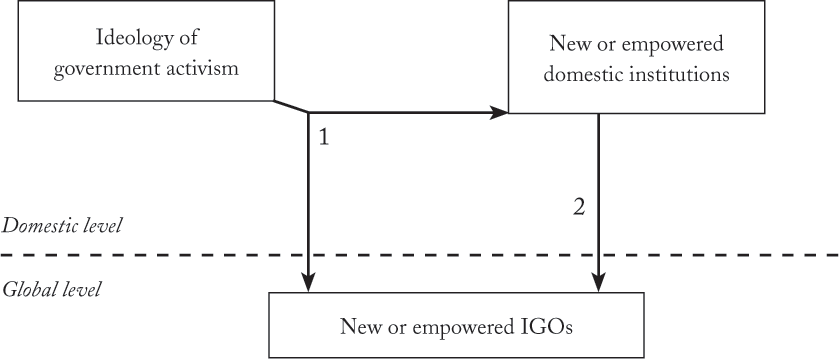
Figure 1 illustrates how the two hypothesized mechanisms link domestic activism to intergovernmentalism. As arrow 1 shows, activist ideologies can simultaneously empower both domestic and international institutions. Then, even when such ideologies are no longer promoted, the new domestic institutions increase the likelihood that igos will be established or empowered because the bureaucracy has interests in expanding its work to international projects (arrow 2). One or both mechanisms can operate at a given time.
Mechanisms Connecting Domestic Government Activism to Intergovernmentalism

Although it’s generally hard to distinguish between the effects of these two mechanisms, the above discussion suggests several potential differences. First, institutions-based mechanisms are expected to function narrowly, within only one issue-area. For example, officials from domestic labor institutions are likely to promote intergovernmentalism only in the labor realm. Their vested interests or expertise shouldn’t affect developments in other areas.Footnote 35 In contrast, ideologies apply both to multiple levels of governance and to issues. That’s because all decisions in favor of greater government activism (or of rolling it back) across various issue-areas are influenced by similar belief systems.
Second, as mentioned above, it’s usually elites who make ideological arguments for or against intergovernmentalism. In contrast, an institutions-based mechanism will manifest itself through representatives of specialized domestic institutions. We consider the direct involvement of officials from such institutions (like health ministries) in decisions to establish international institutions to be necessary, but not sufficient, evidence of the institutions-based mechanism.
Third, because domestic institutions are more likely to value growth early on (before reaching their survival threshold), we expect institutional mechanisms to be more prominent in the first few years after domestic institutions are established. Later promotion of intergovernmentalism or nongovernmentalism during an institution’s existence is more likely to result from ideological mechanisms.
Last, because ideologies are characterized by the need for consistency of beliefs, we expect the arguments underlying an ideological mechanism to be normative in nature. Institutions-based mechanisms, in contrast, will be reflected in more technical, pragmatic arguments regarding the greater effectiveness of either an intergovernmental or a nongovernmental approach.
The Aggregation of Preferences: Hypotheses
The section above argues that individual states tend to export their activist domestic preferences to global governance. But how do individual state preferences aggregate to shape more intergovernmental global structures? Preferences, of course, vary across states. For example, at the 1919 Cannes Medical Conference discussed above, the US promoted a nongovernmental approach. The UK preferred an intergovernmental one, arguing, “[T]he prevention of disease and the protection of the health of the people [is] a primary responsibility and function of the government.”Footnote 36 A British official explained the difference, arguing that although both countries balanced “official work” with “voluntary work,” “in England, the official work predominates; in America, I believe I should not be far wrong from saying, it may be the other way around.”Footnote 37 Indeed, at the time, the UK had just established its Ministry of Health, while the US wouldn’t have a national health department for several more decades. Of course, there are instances of even wider differences between great powers’ preferences for government activism, such as those between the US and USSR throughout the Cold War.
To explain how domestic preferences aggregate at the global level, we make two related assumptions. First, we posit that the most powerful states play the biggest role in shaping global governance.Footnote 38 We begin by considering the impact of the single most powerful state in the system. This expectation is based on extant literature that has long argued that hegemons shape global structures to match their preferences and models.Footnote 39 But we also test whether the two or three most powerful states jointly affect the degree of intergovernmentalism in global governance. Indeed, even if the negotiations for establishing an igo don’t involve all future members (since many states accept what the powerful decide), the original decision to establish it usually includes one or two additional great powers along with the most powerful state. It’s rare that more than three countries drive this process. For example, although the initiative for establishing the League of Nations originated among American officials, the US later discussed plans for the new igo with the British and then the French (and only later, to a lesser degree, with other states). Similarly, ideas underlying the UN originated in the US State Department and were later discussed with British officials in December 1941 and with the Soviets in 1943.Footnote 40
Second, we posit that when great powers decide on global governance structures, the end result is a compromise between their preferences—which may be similar (as when the who was established) or different (as when the lrcs was established). Overall, we argue that great powers’ average level of support for government activism will determine the outcome.Footnote 41
These arguments lead to the following main hypothesis:
—H1. The greater the degree of domestic government activism of the most powerful states in the system, the more likely it is that igos will be established.
To assess whether domestic activism influences preferences for intergovernmentalism beyond igo establishment, we offer an analogous hypothesis based on the same logic as H1, regarding the likelihood of states joining an igo:
—H2. The greater the degree of domestic government activism in a state, the more likely the state will join igos.
We also draw on the existing literature to identify (and control for) the potential role of nongovernmental actors in shaping global governance.Footnote 42 Early literature tended to imply that governmental actors who are determined to play a stronger role in global governance will simply step in and replace nongovernmental actors.Footnote 43 Recent literature continues to acknowledge that when governmental actors have powerful incentives to control global governance (especially where there are strong sovereignty costs to them, as in the security realm), they’ll be virtually alone in shaping issue-areas. But this literature also recognizes that nongovernmental actors often have their own specific preferences and can take actions that run counter to states’ interests. Footnote 44
The literature also notes that nongovernmental actors, like all organizations,Footnote 45 conduct their work rationally, seeking to maximize material and nonmaterial resources.Footnote 46 When governments don’t act, new nongovernmental entities emerge and existing ones see opportunities to grow, strategically filling niches where they have an advantage.Footnote 47 Even when governments don’t completely step aside from an issue-area, nongovernmental actors have an interest in becoming involved in global governance. Most important, they often seek to work with igos that share similar goals because they can gain material resources, expertise, and prestige through such collaboration.Footnote 48
The decisions of nongovernmental actors to become involved in global governance aren’t based solely on narrow organizational interests. Nor are the decisions of governmental actors to allow or encourage them to do so based solely on ideological or domestic institutional factors. Such decisions may also stem from the functional differences between the two types of actors that give each of them greater advantages or disadvantages in various realms and at various times. In other words, one type of actor may be more effective than the other in a given circumstance. Indeed, the flexibility, entrepreneurial qualities, and low entry costs of nongovernmental actors allow them to become more quickly involved in a global issue-area than igos.Footnote 49 Once nongovernmental actors establish a prominent role, they may seek to maintain that position by framing problems and acting as gatekeepers to issue-areas.Footnote 50
Although these characteristics of nongovernmental actors initially lead to more of these actors, the growth tapers off in time because competition arises among them and the available niches fill up. Increases in organizational density of nongovernmental actors may thus lead to more demand for other types of actors, such as intergovernmental ones, to step in. Footnote 51
Nongovernmental actors also have disadvantages that may affect their participation in some issue-areas. Chiefly, their weakness in enforcing international agreements is seen as a major hindrance to their capacity to deal with problems where the stakes are especially high for governments, such as territorial disputes.Footnote 52 More broadly, the literature notes that when sovereignty costs are high, as in the security realm, nongovernmental actors are less likely to participate in global governance.Footnote 53 That relative lack of involvement isn’t solely caused by governments selfishly seeking to keep the issue-area to themselves. It’s also due to a common understanding that nongovernmental actors aren’t as well suited to deal with such problems. When testing our main arguments regarding governments establishing and joining igos, we therefore take into account the potential differences brought about by organizational density as well as those due to sovereignty costs.
The section below tests our arguments through an in-depth study of the global governance of education. This issue can be considered a relatively hard case for intergovernmentalism.Footnote 54 For a long time, states felt that education was too important to allow outside influence because of its key role in shaping ideas and national identities. Indeed, until World War II the strong link between education and sovereignty led states to argue that the issue would always fall outside the competence of igos.Footnote 55
We choose to focus on global education because over the last century and a half, there has been significant variation in its intergovernmental nature, for example, cases of nongovernmental actors being preferred over igos, igos replacing nongovernmental actors, and powerful states joining and leaving igos. Such variation gives us numerous successive cases to assess the strength of our arguments. For each instance of change in global governance, we ascertain the degree to which governmental or nongovernmental domestic institutions in the most powerful states were dealing with education. We also determine whether officials from such states supported an intergovernmental or nongovernmental approach to the global governance of education. We expect to find that states where governments took an active role in education domestically were more likely to support establishing education-related igos (H1) and to become members of such organizations (H2).
Additionally, this case study lets us distinguish between changes due to the ideology-based mechanism and those due to the institutions-based one. We expect officials from domestic education institutions to have focused solely on establishing and joining igos in the education realm (the institutions-based mechanism), and top officials to have connected their arguments regarding the education realm to broader developments (the ideology-based mechanism). We also expect that officials from domestic specialized institutions would promote the establishment of international organizations most actively in the first years after the creation of their own institution. Last, we expect that normative arguments in support of one form of global governance or another were more likely to be presented by top-level elites rather than by officials from specialized domestic institutions.
Intergovernmentalism in the Global Governance of Education
The first successful international collaborative efforts in the education realm were nongovernmental in nature, starting with the International Bureau of New Schools, founded in Geneva, Switzerland, in 1899. Although dozens of education ingos emerged at the turn of the twentieth century, all early attempts to create an education-focused igo, such as the Permanent and International Council of Education (in 1885), were unsuccessful.Footnote 56 Until World War I, efforts to establish such igos lacked governmental support primarily because most states had no national public education institutions to become involved in these initiatives, but there were exceptions. In the late eighteenth century, Prussia became the first major state to partially centralize the administration of education. France followed, establishing a Ministry of Public Instruction in 1828. The British education system, in contrast, was primarily private; before World War II the government’s role in education was weak, and it wasn’t until 1944 that the Education Act established a full-fledged Ministry of Education.Footnote 57 In the US, various small federal offices for education were established in 1867 and then upgraded slightly in 1939 and 1953, but the education system was highly decentralized. The US Department of Education did not become a cabinet-level department until 1979.Footnote 58
Early on, the weakness of American federal education institutions limited the country’s ability to become involved in international negotiations for establishing education igos. In 1912, the US Office for Education did not participate in international negotiations to establish an education igo. Instead, it appointed Fannie Fern Andrews, president of the nongovernmental American School Citizenship League, as “Special Collaborator of the US Office for Education” to represent the US in the talks.Footnote 59
Nongovernmental pressure to have the League of Nations address questions of education and establish an intergovernmental International Bureau of Education was brought up at the 1919 Paris peace talks. Yet the four major powers negotiating the founding of the League ignored the issue.
Because the League lacked a structure to deal with education, member states deflected collaborative initiatives to nongovernmental actors. For example, in 1920 the League Council offered the nongovernmental Union of International Associations financial support to establish an international university rather than have the League create the institution.Footnote 60
In 1921, several small states proposed that the League establish an igo to deal with “intellectual cooperation” (including cooperation in education). The main opposition to this proposal came from the British representative, who cited his country’s “strong liberal and individualistic tradition” to explain why intellectual cooperation “should be left to private organizations and individuals.”Footnote 61 Few states backed the initiative (Italy was the only powerful state to support it), and the proposal failed. The British view was reflected in a League Council report that concluded, “[U]nder present world conditions intellectual cooperation can best be advanced by means of voluntary efforts.”Footnote 62
A few months later, the balance in great power support for an education igo appeared to shift. Léon Bérard, the French Minister of Public Instruction, convinced his cabinet colleague, Foreign Minister Aristide Briand, to promote the creation of a League office for international intellectual relations among universities and schools.Footnote 63 But despite this renewed effort, British oppositionFootnote 64 led the League to conclude, “[N]ational education lies outside and will always lie outside the competence of any official committee of the League.”Footnote 65
By the mid-1920s it was clear that the League would not take up education issues, so those who supported international initiatives in this realm promoted the establishment of two organizations. The first was the International Institute for Intellectual Cooperation (iiic), a French initiative that developed soon after the country’s 1924 elections seated a government with strong activist views.Footnote 66 Officials from the French Ministry of Public Instruction preferred an igo specifically for education, but realized that the majority of League members wouldn’t support it. Therefore, they presented a proposal to the incoming minister of public instruction, François Albert (an outspoken supporter of the state’s role in education),Footnote 67 to establish the iiic under the League umbrella. The institute would include education as one aspect of intellectual cooperation and would be funded entirely by the French government. League members accepted the new institute (dismissing the token British opposition) as it came at no cost to them.Footnote 68 But despite French efforts to have the iiic deal with some education issues, the League refused to expand the institute’s role to this realm.
The second collaborative international initiative was the nongovernmental International Bureau for Education (ibe), founded in 1926 by the Canton of Geneva, several small states, and the Rockefeller Foundation, which financed much of the work. The ibe’s intended role was to engage in the education tasks that the League refused to take on, but no major power backed its establishment. The French government initially preferred to channel its international work and financial commitments in this realm solely through the iiic.Footnote 69 By 1929, without meaningful government financing and with more ingos vying for the reduced resources available, it was clear that the ibe couldn’t fulfill the tasks envisioned by its founders.Footnote 70 But by that time there were already enough states, including France, willing to transform the ibe into an igo. France, Germany, and Italy (all with strong domestic government education institutions)Footnote 71 became members of the intergovernmental ibe. The UK and US did not join. With its limited membership, the ibe could engage in only a few small tasks and after World War II it was absorbed by the UN Educational, Scientific, and Cultural Organization (UNESCO).
Planning for a post-World War II education igo started in the UK. During the war, the country had begun the process of establishing the modern welfare state. The 1942 Beveridge Report called for tackling society’s “five giant evils”: squalor, want, idleness, disease, and ignorance, and the 1944 Education Act increased the government’s role by creating an Education Ministry.Footnote 72
The man assigned to oversee the establishment of the new ministry, Richard Butler, sought to expand its role. He quickly understood the need and opportunity for international initiatives: he opened discussions with education ministers from eight governments in exile in London and scheduled periodic meetings with them to discuss postwar educational reconstruction.Footnote 73 In January 1943, the newly formed Conference of Allied Ministers of Education (came) called for the establishment of an intergovernmental “United Nations Bureau for Educational Reconstruction.”Footnote 74
In July 1943, under American pressure, came broadened its membership to non-European states.Footnote 75 US interest in the new igo arrived on the heels of increased American domestic activism in education. Indeed, by 1939, as part of the Roosevelt administration’s development of government functions, a new Federal Security Agency had taken over the small Bureau of Education and transformed it into a comprehensive office. Just like the British Ministry of Education, the new US Office of Education sought to expand its work through international initiatives. For example, in 1941 it proposed establishing an intellectual and educational igo for the Western Hemisphere.Footnote 76
The US first attended came in April 1944 with a delegation of individuals experienced in education policy, including top officials from the new Office of Education. The US quickly took control of came proceedings, submitting a proposal to establish an “entirely new organization”Footnote 77 that was envisioned as strictly intergovernmental, with virtually no role for ingos. Although US representatives framed the need for an international organization in normative terms, as reflected in the US-authored preamble of UNESCO’s constitution,Footnote 78 their support for an intergovernmental solution was presented pragmatically, suggesting simply that the igo would complement the nongovernmental work already taking place in the educational, cultural, and scientific realms.Footnote 79
The French used the example of the ilo, which had been in existence more than twenty years, as a hybrid model for UNESCO.Footnote 80 They proposed an organization in which each state would be represented by two delegates from governments and three from national education and culture ngos. As in the ilo, delegates would vote independently rather than as national groups. Small states preferred this structure, believing it would erode great power influence.Footnote 81 France also supported it, thinking that appealing to the iiic’s still-vibrant network of Paris-based ingos would gain support for France’s main goal: landing the headquarters of the igo in Paris. The US and UK argued that less developed states wouldn’t be able to send five delegates; they called for each state to have only one vote.Footnote 82
At the November 1945 London preparatory conference, delegates were faced with a choice between two proposals: a purely intergovernmental one, authored by the UK and US, and a hybrid one, sponsored by France, which would give membership and votes to both governments and nongovernmental entities.Footnote 83 During negotiations, the US and UK largely retained the intergovernmental character of their proposal but acquiesced to some nongovernmental elements. They agreed that individuals on UNESCO’s Board could come from nongovernmental institutions, not just governmental ones, and would sit in their personal capacity rather than represent governments.Footnote 84 Also, although ingos had no voting power, UNESCO’s constitution called for “suitable arrangements for consultation and co-operation” with ingos, thus setting an example for the entire UN system.Footnote 85 Moreover, it specified— as no igo founding document had done before—that the organization could support ingos financially. During the early postwar years, most UNESCO projects were tasked to existing ingos or to new ones that often were established with UNESCO funding.Footnote 86
By the 1950s, UNESCO’s nongovernmental elements had begun to erode, in part because of US McCarthyist pressures to eliminate staff independence across the entire UN system. Additionally, when the Soviet Union joined the organization in 1954 it promoted its statist ideology to UNESCO’s working methods and policies. Throughout the 1960s and 1970s, many other Second and Third World states embraced the strong Soviet intergovernmental approach to global governance. One UNESCO official noted that during that period, the “wind [blew] increasingly cold for ngos.”Footnote 87
In the late 1970s, the US began complaining about the igo’s policies. Tensions rose during the Reagan administration due to what observers considered to be powerful conservative ideological factors.Footnote 88 In December 1983 the US threatened to leave UNESCO, accusing it of “statism” because of its “tendency to prefer government institutions of development to those of the private sector.”Footnote 89 A senior political appointee from the State Department characterized the organization as a “compulsively statist… Orwellian nightmare—complete with ‘Big Brother.’”Footnote 90 The US left the igo in 1984. The UK followed a year later using similar arguments.Footnote 91
During its two decades of absence from UNESCO, the United States sought other channels to deliver education aid, especially through ingos. And wherever the US had greater influence, such as the World Bank and UNICEF, it pushed igos to become more involved in this issue-area. Both of these igos began giving more prominent roles to ingos.Footnote 92 Starting in 2000, the neoliberal approach to education primarily promoted by the World Bank, which saw education as an investment in human capital and promoted a shift from public to private education systems, and the redistribution-based approach emphasized by UNESCO came closer together through the efforts of the European Union.Footnote 93
When the US returned to UNESCO in 2003, it continued to promote a more nongovernmental character for the igo. In 2012, it played the leading role in getting UNESCO to adopt the Policy Framework for Strategic Partnership, which formalized relations with the private sector.Footnote 94 Powerful private organizations, such as the Gates and Hewlett foundations, have since become active in international education programs through igos and directly on their own.Footnote 95 In UNESCO, private foundations now contribute more to educational programs, through voluntary donations, than do governments.Footnote 96 This change can be interpreted as yet another facet of the recent shift toward nongovernmentalism in this realm.
Discussion of the Case Study
The above narrative offers support for our main arguments. As a reminder, we expected that states where governments took a more active role in education domestically were more likely to support establishing igos (H1) and joining them (H2). Indeed, in the early twentieth century, France took an activist domestic-government approach to education and was the main proponent of establishing an education igo. France was successful in creating the iiic, albeit with the understanding that the institute wouldn’t take up the question of education. After the ibe was established as an igo in 1929, France, Germany, and Italy, all with strong government roles in education, became members; the UK and US, with nongovernmental inclinations at that time, did not join.
After World War II, when the UK and US shifted toward greater government involvement in education domestically, they also supported an igo in the education realm. As the Soviet Union gained international influence, it sought to project its domestic statist views to igos like UNESCO. By the 1980s, the US and UK had moved away from activism in domestic governance. They also criticized UNESCO’s statist approach and eventually withdrew from it. Powerful states whose governments played strong roles in education remained members. Over the past two decades, US promotion of its domestic public-private partnership models to global governance led to a shift toward nongovernmentalism in the education realm.
In sum, the case study shows that shifts toward intergovernmentalism were promoted primarily by powerful states with strong domestic activist preferences.Footnote 97 Shifts toward nongovernmentalism were generally promoted by states that opposed activism domestically.
We also expected that officials from domestic education institutions would contribute to the decisions to establish and join international education organizations. Indeed, attempts to establish an education igo before World War I failed in large part because powerful states didn’t yet have domestic institutions that could send representatives to negotiate intergovernmental agreements. For example, in 1912 the US sent the director of an ngo as its representative to an international conference intended to establish an igo. The result was that global governance remained nongovernmental.
After World War I, the British and American representatives who were involved in debates on possible collaborations in education came not from the weak domestic governmental education offices, but rather from top government institutions. The main support for a new igo at that time came from the French Ministry of Public Instruction, a powerful specialized institution. The fact that the education minister was a cabinet member with direct access to the foreign minister (his colleague) explains France’s support for the igo.
British plans for UNESCO after World War II came from its new Education Ministry. The US was also prepared for intergovernmental negotiations in this realm after the Office of Education was expanded in 1939. Following World War II, all major states had the necessary domestic institutions to negotiate detailed questions of education in igos.
The evolution of the education realm also reveals instances where government officials invoked ideological arguments. This appears to have been the case in the 1920s and 1980s, when the US and UK argued against intergovernmentalism, and throughout the entire Cold War, when the Soviet Union promoted intergovernmentalism. As expected, in these instances the arguments were made by top officials dealing with multiple issues, rather than by officials from education institutions, and were framed in normative terms.
Thus the change in the intergovernmental nature of global education governance reveals evidence of both norms-based and institutions-based mechanisms. Predictably, the strongest evidence of the institutions-based mechanism can be found after World War II, in the years immediately following the establishment of education institutions in the US and UK. But even in this case, the new domestic institutions emerged because of shifts in domestic ideological activism. Moreover, it was high-level government elites with clear ideological preferences who decided to add officials from education institutions to the international delegations determining the fate of igos. This suggests that institutional mechanisms, even when they were present, may have been the immediate cause of changes in global governance, whereas ideological mechanisms were the permissive causes of change.Footnote 98 Further in-depth research of developments in other issue-areas is needed to gain a better understanding of the relationship between the two mechanisms, as well as the potential differences across such issues.
The history of the education realm reminds us that factors other than domestic ideologies and institutions can affect intergovernmental approaches to global governance. Indeed, the cyclical nature of global governance in the education realm is largely a result of the rise and decline of great powers, as well as of changes in domestic government ideologies and institutions in such states. But the shift toward intergovernmentalism or nongovernmentalism can be explained by other factors influencing great power interests. For instance, French support for a hybrid UNESCO was primarily a bargaining chip for securing the igo’s headquarters in Paris. Similarly, US McCarthyist pressures that eroded the nongovernmental character of UNESCO were due to emerging Cold War tensions between superpowers, rather than a projection of domestic government activism.
Large-N Tests
Can our findings in global education governance be generalized to other realms? To answer this question, we conducted several large-N tests of governments’ decisions to (H1) establish and (H2) join igos.Footnote 99
For our statistical analysis of igo establishment, we used data from the Yearbook of International Organizations,Footnote 100 which has collected information on igos and ingos for more than a century and is often used for developing data sets involving such organizations.Footnote 101 Our measure of igo establishment is the number of new organizations to emerge each year (New igos). It accounts for all organizations, regional and global. The number of new igos varies between 0 and 55.
For our main model (1.1), the explanatory variable reflects domestic government activism of the most powerful state (GovActivism). We also developed measures for the average government activism of the two and three most powerful states, weighted by their power (measured using scores from the Composite Indicator of National Capability [cinc]) to reflect power differences among these states.Footnote 102 We identified the most powerful states using data from the National Material Capabilities (nmc) data set (v 4.0).Footnote 103 GovActivism was operationalized as the ratio between states’ government expenditures and their gdp. It isn’t a perfect measure of activism, as government spending is also influenced by other international and domestic factors that governments don’t directly control, such as wars and broad economic and demographic trends, but it’s still a representative gauge of government involvement in resolving domestic collective problems. Practitioners and academics alike have used such an operationalization to illustrate the degree of government activism across states.Footnote 104 Our measure is based on data from the Cross-National Time-Series Data Archive.Footnote 105 We standardized this variable to facilitate the interpretation of the results.Footnote 106
Our models control for factors identified in the literature as affecting the establishment of igos. First, research suggests that igos are less likely to form during times of conflict, but their numbers surge immediately after major wars because states seek to promote cooperation.Footnote 107 The variable Conflict is the number of disputes in which the (one, two, or three) most powerful states were involved in a given year.Footnote 108 This is based on data from the Correlates of War 1816–2007 data set (v 4.0).Footnote 109
Conversely, the literature notes that peaceful interactions between states lead to igo establishment. Such cooperation is seen as a result of both greater economic interdependence and greater information flows. Trade and information flows lead to more similar interests among states and, implicitly, to more igos for resolving collective problems.Footnote 110
Because economic and informational interactions are strongly correlated, a model that simultaneously tests the independent impact of these two factors would face problems of multicollinearity. We therefore developed a composite measure (Interactions) that brings together two measures used by the previous literature: the relative degree of information flowsFootnote 111 and the relative degree of economic flows (as measured by the country’s imports and exports), giving them equal weight. For this measure we used data from the Cross-National Time-Series Data Archive.Footnote 112 Interactions represents the sum of such measures for the one, two, or three most powerful states, respectively.
The literature also suggests that as more states emerge, the more problems there are to resolve through igos.Footnote 113 Indeed, as the number of independent states doubled during the era of decolonization, regional and global igos mushroomed, trying to keep up with issues relevant for such states. The relative number of new states (NewStates) is operationalized as the ratio between new states established in a given year and the existing number of states. It’s based on data from the Correlates of War Project’s State System Membership data set, v2011.
We also control for the distribution of power in the international system, because it’s long been argued that cooperation is more likely when the most powerful states (or at least the hegemon) can impose the rules underlying new igos.Footnote 114 The distribution of power (Power) is a measure based on data from the nmc data set. It’s operationalized as the sum of the cinc scores (proportion of the world’s power) of the one, two, or three most powerful countries.Footnote 115
Our models also control for the number of existing intergovernmental and nongovernmental actors in a given year (igos and ingos). We do so because, as mentioned, recent research shows that organizational density in global governance may lead organizations to compete for the limited resources available.Footnote 116 This suggests that the number of igos or ingosFootnote 117 in existence will impact governments’ decisions to establish new igos. The ingos variable is also operationalized using data from the Yearbook of International Organizations.
The descriptive statistics for all measures are presented in Table A1 in the supplementary material.Footnote 118 The main model being tested is model 1.1:
 $${\rm New{\scriptsize\rm IGO}s} = {\rm B_0} + {\rm B}_1({\rm GovActivism}) + {\rm B}_2({\rm Conflict}) + {\rm B}_3({\rm Interactions}) + {\rm B}_4({\rm NewStates}) + {\rm B}_5({\rm Power}) + {\rm B}_6({\scriptsize\rm IGO}{\rm s}) + {\rm B}_7({\scriptsize\rm INGO}{\rm s}) + {\rm e}. $$
The literature suggests that negotiations for establishing igos generally take several years. Because previous studies chose five-year time frames for assessing igo establishment,Footnote 119 we use five-year lags based on weighted moving averages for explanatory and control variables. We test model 1.1 using Prais-Winsten regression with robust standard errors,Footnote 120 because we find that using time-series data violates the assumption of nonautocorrelation (Durbin-Watson statistic of .778). The analysis considers yearly observations from 1866 to 2007, the longest period for which all necessary data were available.
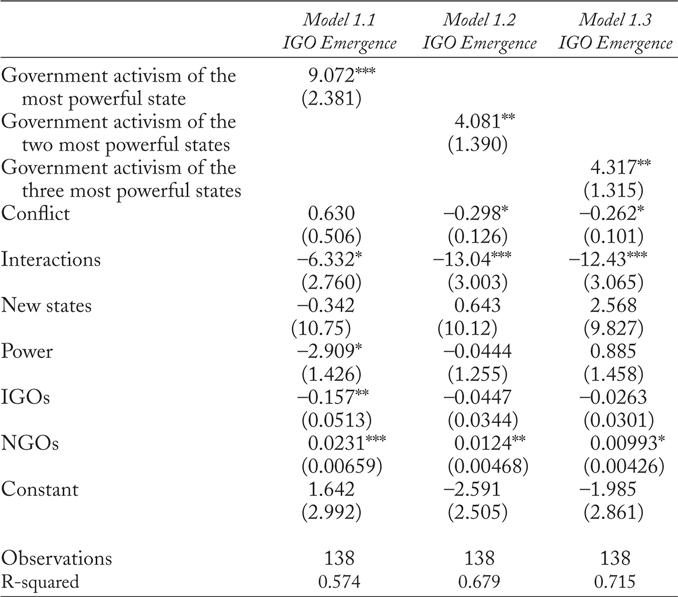
Table 1 presents the results of these tests. We include results for the main model, which considers the impact of government activism of the most powerful state (model 1.1), and for the models that consider the two and three most powerful states (models 1.2 and 1.3, respectively).
Government Activism and Establishment of IGOs

* p < .05, ** p < .01, *** p < .001; Prais-Winsten regression with robust standard errors in parentheses
The results show that domestic government activism of the most powerful states is indeed a strong predictor of intergovernmentalism, as reflected in the emergence of new igos. This is true whether one considers only the role of the most powerful state, or the role of the two or three most powerful states. In fact, as we move from considering only the role of the most powerful state (model 1.1) to those of the two and then three most powerful states (models 1.2 and 1.3), our predictive power appears to improve, with slightly higher R-squared for the models. Moreover, it’s important to point out that this variable is significant even when controlling for the explanatory factors mentioned in other works as influencing the emergence of igos.
We run additional tests to assess the robustness of our findings. (The results of the additional tests are included in the supplementary material.)Footnote 121 We control for military expenditures (model 1.4), and test models with only one of three strongly correlated variables (igos, ingos, and Interactions), excluding the other two variables (models 1.5, 1.6, and 1.7). We consider a model in which we control for the level of democracy of the most powerful states (model 1.8) to ensure that we’re capturing the broader impact of government activism and not just authoritarianism. Model 1.9 assesses power based solely on economic factors. Model 1.10 controls for the emergence of security igos to assess the impact of sovereignty costs for governments. Model 1.11 considers the reverse of our main hypothesis: whether lack of government activism in the most powerful state leads to an increase in the number of nongovernmental actors taking on global issues (as a reflection of nongovernmentalism). Model 1.12 uses the total number of states in the system (rather than the proportion of new states to the total number of states). Model 1.13 controls for the variable Year to assess whether the estimation is robust to the inclusion of time trends. In models 1.14 and 1.15, we control for the power of the single most powerful state (the hegemon) instead of the aggregate proportion of global power of the two and three most powerful states. We also run robustness checks for models 1.1 to 1.3 using negative binomial regression (models 1.16, 1.17, and 1.18). See the supplementary material for a more in-depth discussion of the reasons for introducing such tests, the measures we used, and the results. All additional tests support our main hypothesis.
We also test H2 regarding the likelihood that states will join (or leave) igos. Model 2.1, the main one for this hypothesis, utilizes as dependent variable (igo Member) the percentage change in igo membership for a country over the past five years. It’s based on data from the Correlates of War International Governmental Organizations data set (v 2.0).Footnote 122 We consider change over five years because the data set only covers observations every five years prior to 1965. To gain greater confidence in our results, we also run a test (model 2.2) utilizing as a dependent variable the percentage change in igo membership over one year alone. We ran this test only for the period when yearly data were available: 1965-2005.
Models 2.1 and 2.2 use the same explanatory variables reflecting government activism as models 1.1 to 1.3. We also control, for the same reasons mentioned in our discussion of model 1.1, for the number of disputes in which the country is involved and the level of economic and informational interactions. Although we don’t consider the system-level variables reflecting power distribution, number of ingos, and number of new states (as these don’t impact individual states joining an igo), we do control for the number of igos in existence because such numbers affect states’ options for joining new igos. Additionally, we control for states’ levels of democracy (Democracy) because the literature shows that such levels impact decisions to join igos.Footnote 123 The measure is based on democracy scores from the Polity IV data set.Footnote 124 Tables A2 and A3 in the supplementary material offer descriptive statistics for models 2.1 and 2.2, respectively.Footnote 125 Model 2:
 $$ {\scriptsize\rm IGO}{\rm Member} = {\rm B}_0 + {\rm B}_1({\rm GovActivism}) + {\rm B}_2({\rm Conflict}) + {\rm B}_3({\rm Interactions}) + {\rm B}_4({\rm IGOs}) + {\rm B}_5({\rm Democracy}) + {\rm e}. $$
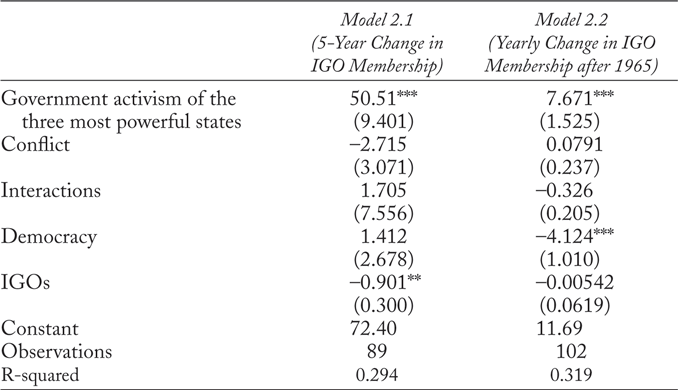
To test this model, we use pooled time series cross-sectional analysis with country fixed effects.Footnote 126 The unit of analysis is country-year. We consider only the three most powerful countries, due to the lack of data for smaller states. The results are presented in Table 2.
Government Activism and IGO Membership

** p < .01, *** p < .001; pooled time series cross-sectional analysis with country fixed effects; standard errors in parentheses
These tests support the argument that states are more likely to join igos during times of greater domestic government activism. Indeed, government activism is highly significant whether one uses five-year or one-year intervals. Additionally, the time frames of the two tests (more than 140 years and 40 years) have no significant effect on results for the main variable.Footnote 127
Model 2.1 shows that one standard deviation increase in a state’s government activism leads that state to join 50.51 more igos over a period of five years. Model 2.2 shows that one standard deviation increase in a state’s government activism in a one-year period leads that state to join 7.67 more igos. Again, it’s important to note the significance of our explanatory variable even when controlling for all other factors already discussed in the literature.
Conclusions: Implications of the Findings
Taken together, the case study and statistical analyses offer considerable support for our main argument. Powerful states are more likely to promote intergovernmentalism when they embrace government activism domestically. This finding complements the broad body of literature that discusses states’ choices between multilateralism and unilateralism. Overall, states are more likely to seek intergovernmental solutions to global problems when (1) they believe they should step in to deal with such problems, and (2) they can cooperate with each other.
But our findings don’t just reflect choices for establishing and joining igos. They have important implications for broader debates in the study of global governance. The world’s movement across time and issue-area, back and forth on the intergovernmental-nongovernmental continuum, may reflect the degree to which global governance in general has shifted toward (or away from) having states as the only relevant actors. Placing recent developments in this study’s broader temporal context helps us understand that changes are likely temporary, and that it’s not as clear as some may implyFootnote 128 that states are losing control over global governance. Shifts across the broader intergovernmental-nongovernmental continuum aren’t unidirectional. The cyclical patterns may be partially due to shifts in systemic factors, such as global conflict, economic interactions, or support for democracy. But often, they’re also caused by the rise and decline of great powers and the ideological shifts that such countries experience. Just as we saw the US support a more governmental approach during the first half of the Cold War and a more nongovernmental approach during the 1920s and since the 1980s, we can expect changes in the future. For example, with China’s rise, that country’s activist domestic approach may drive global shifts toward greater intergovernmentalism. And the very different positions of candidates in the 2016 US primary and general elections suggest how quickly the most powerful state can shift preferences on the governmental-nongovernmental continuum, depending on which candidates are elected.
At a deeper theoretical level, our findings support the argument that domestic ideologies and institutions affect global structures. To understand global developments, we must combine structural factors (related to conflict, interdependence, and power distribution) with state preferences. It’s such “social purpose” that affects the nature of global governance institutions.Footnote 129 By bringing state preferences into the explanation of igo emergence and membership, this research offers yet another link between the domestic and international realms—long considered so different that they could only be explained by using separate theoretical approaches.
Our study takes an important step toward answering the call of world polity theory to develop a general theory of conditions under which nongovernmental or intergovernmental actors are more likely to take the lead.Footnote 130 We examine this question from a political science perspective rather than from the sociological perspective that generated world polity theory. Therefore, it shouldn’t be surprising that while we take the role of nongovernmental actors into account, we place a greater emphasis on powerful states and their ability to alter global governance. In fact, we believe that our approach, focusing on governments’ choices and the emergence and use of igos (political science’s usual turf), must be combined with an approach explaining how transnational nongovernmental actors and societal forces react to government efforts to change the global system (the traditional turf of sociology).
Such a two-pronged approach may offer the most promising direction for future research to explain both nongovernmental and intergovernmental trends in global governance. It would allow us to address some of the questions touched on only indirectly in this study: Can nongovernmental actors alter the nature of global governance even when powerful states leave them little space for action? Under what conditions will nongovernmental actors take on a greater role in global governance, if and when governments allow or encourage them to assume such a role? The pursuit of these questions may lead to a rich research agenda that would add to our understanding of past and future shifts across the intergovernmental-nongovernmental continuum.
Supplementary Material
Supplementary material for this article can be found at https://doi.org/10.1017/S0043887118000151.
Data
Replication data for this article can be found at https://doi.org/10.7910/DVN/ES6FJO.
Acknowledgments
A previous version of this paper was presented at the annual meeting of the International Studies Association, March 16-19, 2016, in Atlanta, Georgia. We thank Ekrem Başer, Elizabeth Bloodgood, Thomas Davies, Claudio Katz, Robert Keohane, Vincent Mahler, Molly Melin, Charles Roger, Noah Sobe, Jonas Tallberg, and Peter Willetts for their helpful comments. Kimberly Loontjer and Paul Olander provided valuable research assistance.
Authors
Alexandru Grigorescu is a professor of political science at Loyola University Chicago. His research analyzes the relationship between changes in international relations and those in the domestic realm, with a special focus on the workings of international organizations. Grigorescu is the author of Democratic Intergovernmental Organizations? Normative Pressures and Decision-Making Rules (2015). He can be reached at agrigor@luc.edu.
Çağlayan Başer is a doctoral candidate in political science at Loyola University Chicago and a visiting research scholar at University of Illinois, Urbana-Champaign. Her fields of specialization include international organizations and political violence. She can be reached at ccetin@luc.edu.