Introduction
The Ural platinum belt stretches along the Urals for 920 km and includes a series of platinum-group mineral (PGM) placer systems. The characteristics of the lode sources of these placers – Uralian–Alaskan type massifs or zonal clinopyroxene–dunite massifs are discussed in numerous publications (Zavaritsky, Reference Zavaritsky1928; Betekhtin, Reference Betekhtin1935; Lazarenkov et al., Reference Lazarenkov, Malitch and Sakhyanov1992; Ivanov, Reference Ivanov1997; Garuti et al., Reference Garuti, Pushkarev, Zaccarini, Cabella and Anikina2003; Auge et al., Reference Auge, Genna, Legendre, Ivanov and Volchenko2005; Tolstykh et al., Reference Tolstykh, Telegin and Kozlov2011; Stepanov et al., Reference Stepanov, Pilyugin and Zolotarev2015; Malitch et al., Reference Malitch, Stepanov, Badanina and Khiller2017; Stepanov et al., Reference Stepanov, Malitch, Kozlov, Badanina and Antonov2017; Palamarchuk et al., Reference Palamarchuk, Stepanov, Khanin and Antonov2017a; Reference Palamarchuk, Stepanov, Khanin, Antonov and Zolotarev2017b; Stepanov et al., Reference Stepanov, Palamarchuk, Khanin, Varlamov and Antonov2018). In contrast, the features of the PGM of the Ural platinum belt have been significantly less studied (Barannikov and Osovetsky, Reference Barannikov and Osovetsky2014) than, for example, the Koryak–Kamchatka belt (Tolstykh et al., Reference Tolstykh, Sidorov, Laajoki, Krivenko and Podlipskiy2000; Sidorov et al., Reference Sidorov, Tolstykh, Podlipsky and Pakhomov2004; Tolstykh et al., Reference Tolstykh, Sidorov and Kozlov2004; Mochalov, Reference Mochalov2013; Kutyrev et al., Reference Kutyrev, Sidorov, Antonov and Chubarov2018; Sidorov et al., Reference Sidorov, Kutyrev, Zhitova, Chubarov and Khanin2019) and other regions of the World (Cabri et al. Reference Cabri, Criddle, Laflamme, Bearne and Harris1981; Johan et al., Reference Johan, Ohnenstetter, Fisher and Amosse1990; Nixon et al., Reference Nixon, Cabri and Laflamme1990; Slansky et al., Reference Slansky, Johan, Ohnenstetter, Barron and Suppel1991; Cabri et al., Reference Cabri, Harris and Weiser1996; Johan et al., Reference Johan, Slansky and Kelly2000; Tolstykh et al., Reference Tolstykh, Foley, Sidorov and Laajoki2002; Weiser, Reference Weiser and Cabri2002).
The features of the PGM assemblages of the placers associated with these massifs are not well characterised (Stepanov et al., Reference Stepanov, Palamarchuk, Kozlov, Khanin, Varlamov and Kiseleva2019a). The Nyasminskaya placer system, including the Malaya Kamenushka River placer, is related to the eroded rocks of the Kamenushensky massif and is the third largest in the Urals by volume of extracted PGM. Currently, the only study of the placer assemblage is that of Vysotsky (Reference Vysotsky1923). Unlike most other Uralian–Alaskan type massifs and associated placers, characterised by Pt–Fe alloys and associated rare mineral inclusions, the PGM assemblages from the Kamenushensky massif (Tolstykh et al., Reference Tolstykh, Telegin and Kozlov2011) and associated placer deposits are enriched in Os–Ir–Ru alloys and platinum-group element (PGE) sulfides, which can reach 50% of the total grain volume.
The objective of this study is to characterise the PGM assemblages from the Malaya Kamenushka River placer belonging to the Nyasminskaya placer system and to describe the morphological features and compositions of the PGM assemblages from both placers and lode sources. The description of the bedrock PGM assemblage is from Tolstykh et al. (Reference Tolstykh, Telegin and Kozlov2011).
This work includes a database of the compositions of Os–Ir–Ru alloys compiled during investigations of the Uralian–Alaskan type massifs in the Urals (Supplementary material – see below). As a result of our research and from literature data (Auge et al., Reference Auge, Genna, Legendre, Ivanov and Volchenko2005; Tolstykh et al., Reference Tolstykh, Telegin and Kozlov2011 etc.), we report the composition of Os–Ir–Ru alloys from each of the Uralian–Alaskan type massifs of the Urals from the south (Uktus) to the north (Zheltaya Sopka).
Geological setting
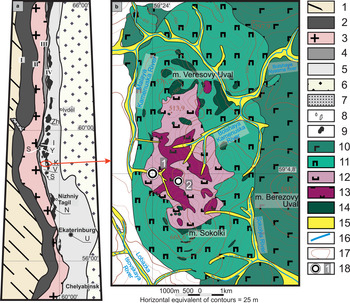
The Ural Platinum Belt is a meridionally-elongated structure located in the Tagilo–Magnitogorskaya Megazone (Fig. 1a) to the east of the Main Uralian Fault. It includes many Uralian–Alaskan type massifs (in Russian literature more commonly termed ‘dunite-clinopyroxenite-gabbro formation massifs’). These are divided into the two geographically separate groups of the Middle (Nizhnetagilsky, Svetloborsky, Veresovoborsky and Kamenuskensky) and North Urals (Konzhakovsky group – Sosnovsky, Yudinsky or Kytlymsky and Iovsky, Zheltaya Sopka) massifs. The Uktus complex is discussed separately due to its isolated position (Pushkarev, Reference Pushkarev2000). Any massif containing dunites is related to economic PGE deposits (Vysotsky, Reference Vysotsky1923). The formation of the Nyasminskaya placer system, including the Malaya Kamenushka River placer, is associated with the erosion of the Kamenushensky clinopyroxenite–dunite massif. In common with other Uralian–Alaskan type massifs of the Middle Urals (Nizhnetagilsky, Svetloborsky and Veresovoborsky), the Kamenushensky massif is composed of the rocks of the Kachkanarsky dunite–clinopyroxenite–gabbro complex. Its structure is typical of zoned clinopyroxenite–dunite massifs (Fig. 1b), with a central core of medium-grained dunites surrounded by fine- to medium-grained peripheral dunites. The dunites are enveloped by a thick clinopyroxenite rim with individual bodies of wherlite.
(a) Locations of the Uralian–Alaskan type massifs in the Urals (compiled from state geological maps at 1:000 000 scale). Key: [1] Palaeozoic of the East European Platform; [2] Western Ural fold-thrust zone; [3] Central Ural uplift; [4] Tagilo–Magnitogorskaya megazone; [5] Salatimskaya suture zone; [6] sedimentary cover of the West Siberian platform; [7] Polyudovsk uplift; [8 and 9] the massifs of the Uralian Platinum Belt (8 – dunite bodies, 9 – pyroxenites, gabbros and volcanics). Roman numerals indicate the main faults (thrusts): I – Main Western Ural; II – Osevoy; III – Prisalatimsky; IV – Main Uralian Fault. Letters denote the Uralian–Alaskan type massifs: U – Uktus, N – Nizhnetagilsky, S – Svetloborsky; V – Veresovoborsky, K – Kamenushensky, S – Sosnovsky, Y – Yudinsky, I – Iovsky, Zh – Zheltaya Sopka. (b) Geological structure of the Kamenushensky massif according to (Ivanov, Reference Ivanov1997) with additions: [10] gabbro; [11] pyroxenites; [12–13] dunites (12 – fine/small grained, 13 – medium grained); [14] wherlites; [15] alluvial sediment; [16] rivers, streams; [17] relief contours; [18] the placer site with detailed sampling: 1 – Malaya Kamenushka River placer, 2 – lode chromitite (Tolstykh et al., Reference Tolstykh, Telegin and Kozlov2011).

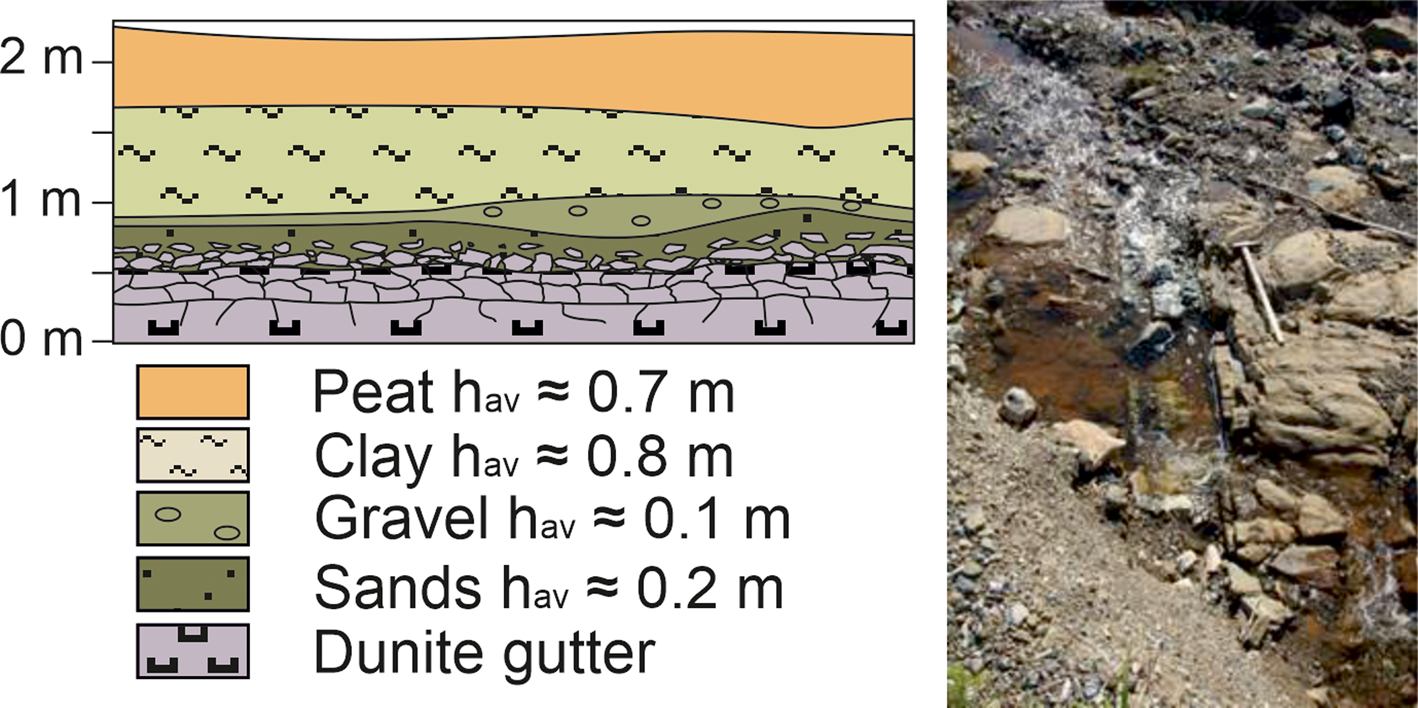
The Kamenushensky massif is drained by five watercourses. The sources of two, the Bolshaya and Malaya Kamenushka Rivers, are located in the dunite ‘core’. Both rivers are platiniferous over their length. The proximal placer investigated is located at the headwaters of the Malaya Kamenushka River in the western part of the massif. In several places ravines expose a complete cross section of the placer. This consists of a sand layer (~0.2 m) which overlies the bedrock (extensively weathered dunite), covered with a small interlayer of gravel and a 2-metre layer of gravel-sand-clay sediment with a predominance of clay materials (Fig. 2). A similar structure of these placers was reported by Vysotsky (Reference Vysotsky1923) for the same area.
Geological section of the ravine placer with platinum-bearing sands and photograph of the sampling site.

Sampling and analytical methods
Sample collection and processing
Five samples with an average volume of 12 litres were collected in one area at a distance of 10 metres from each other. The samples were panned and the resulting concentrates consisting mainly of chromite and PGM grains were dried on a portable gas stove. Subsequently, PGM were extracted from the concentrates using a field-based air separation method which permits separation of chromite from PGM on the basis of the difference in their density. Grains of PGM were studied using a binocular microscope, followed by mounting on carbon conductive adhesive tape, and investigated by scanning electron microscopy (SEM).
Analytical methods
The morphological features of PGM grains and aggregates, as well as their internal structure and composition, were examined using a CamScan MV2300 (IEM RAS, Chernogolovka, Russia) SEM with INCA Energy 350 energy-dispersive X-ray spectrometry (EDS) at an accelerating voltage of 20 kV, working distance 25 mm and acquisition time of 70 s. Samples were also analysed using a Hitachi S-3400N SEM (Research Park of St. Petersburg State University «Centre for Geo-Environmental Research and Modelling», Saint-Petersburg, Russia), coupled with an Oxford X-Max 20 EDS system (20 kV, 1 nA, 30 s per spectra). The following reference materials were used: synthetic FeS2 for S; InAs for As; pure elements for PGE, Cu, Fe, Ni, Co and Sb. Scanning electron microscopy images were obtained mainly using a back-scattered electrons (BSE) detector.
The composition of PGM was determined using a Camebax SX50 electron microprobe equipped with five wavelength-dispersive (WDX) spectrometers (Moscow State University, Russia) at an accelerating voltage of 20 kV and a beam current of 30 nA. The following standards were used for calibration: pure metals for Ru, Rh, Pd, Os, Ir and Pt; CuSbS2 for Sb and Cu; CoAsS for Co; NiS for Ni; FeS for Fe and S. Analytical limit of detections is (wt.%): Os – 0.08, Ir – 0.1, Ru – 0.05, Rh – 0.05, Pd – 0.05, Pt – 0.05, Fe – 0.03, Ni – 0.03, Cu – 0.03, S – 0.05, As – 0.05, Co – 0.03, Pb – 0.08 and Bi – 0.1.
According to the nomenclature of PGM (Cabri and Feather, Reference Cabri and Feather1975; Harris and Cabri, Reference Harris and Cabri1991) the following Pt–Fe alloys are known: native platinum; isoferroplatinum (Pt3Fe); ferroan platinum (Pt2–3Fe); and members of the tetraferroplatinum (PtFe) – tulameenite (Pt2FeCu) – ferronickelplatinum (Pt2FeNi) solid-solution series. The compositions of isoferroplatinum and ferroan platinum partially overlap.
To assign accurately Pt–Fe alloys to a particular structural type, X-ray diffraction was undertaken on four grains approximating Pt3Fe in composition. Qualitative X-ray phase analysis was performed by the Gandolfi method using a Rigaku R-AXIS RAPID II single-crystal diffractometer with a cylindrical detector (d = 127.4 mm; CoKα radiation), followed by processing the obtained X-ray powder data using OSC2XRD (Britvin et al., Reference Britvin, Dolivo-Dobrovolsky and Krzhizhanovskaya2017) and PDXL-2 software.
Results
Morphological features of PGM aggregates
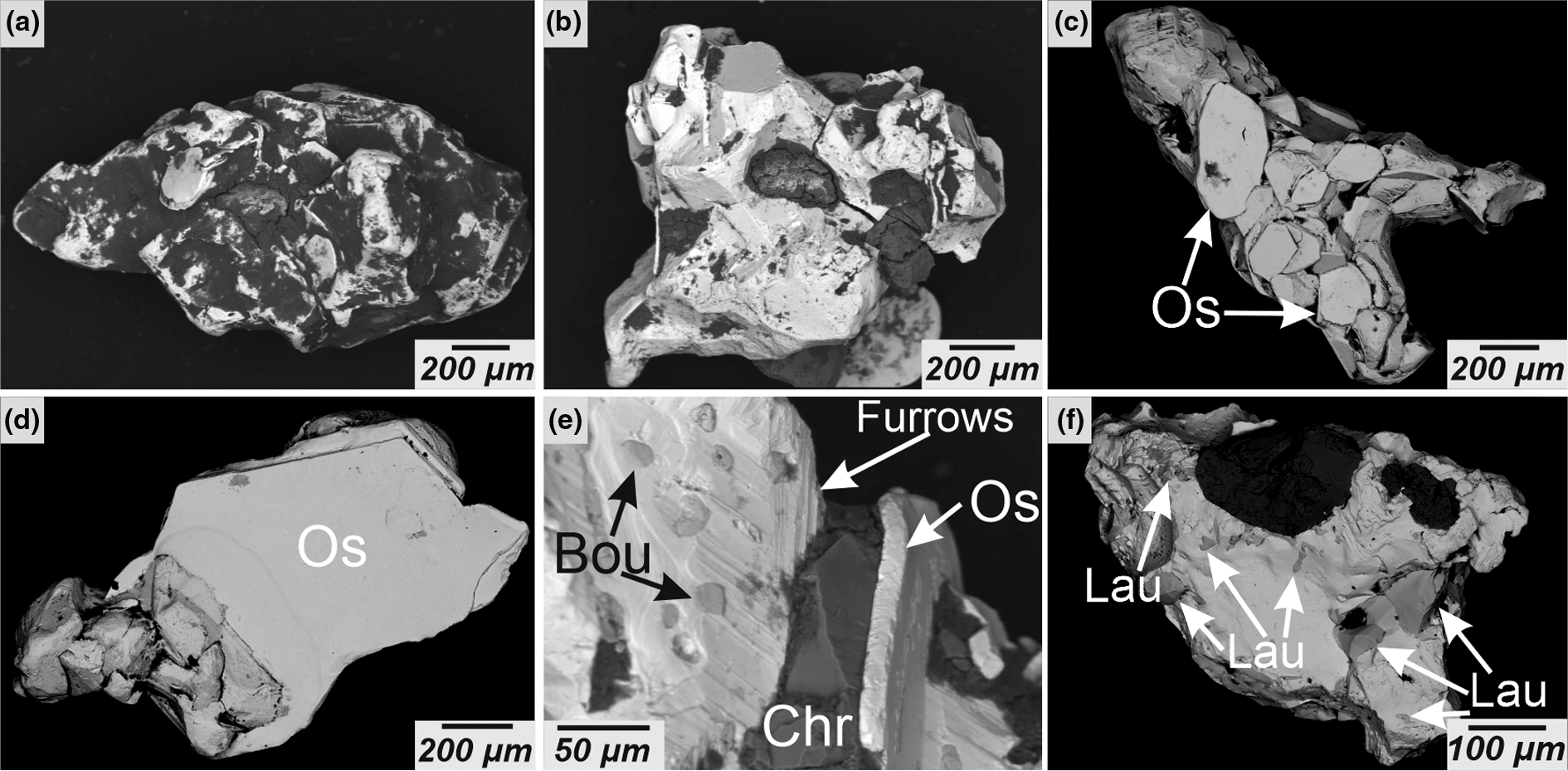
Aggregates of PGM extracted from the placer are elongated (Fig. 3a), rarely isometric (Fig. 3b) grains up to 1 mm in size (0.4–0.6 mm on average). Pt–Fe alloys are intergrown predominantly with lamellar crystals of osmium (Fig. 3c) and rare grains of PGE sulfides. Large pinacoidal osmium crystals are present as single grains (Fig. 3d). Most PGM aggregates were ‘liberated’ from bedrock minerals (olivine, chromite, etc.), although Pt–Fe alloys were found occasionally intergrown with chromite (Fig. 3e).
(a) Elongated and (b) isometric aggregates of Pt–Fe alloys; (c) osmium plates in isoferroplatinum; (d) large osmium grain; (e) bowieite and osmium inclusions in isoferroplatinum; and (f) laurite inclusions in isoferroplatinum. (BSE images) Bou = boweite; Chr = chromite; Lau = laurite.

The PGM grains have numerous flat-faced surfaces (Fig. 3b), some of which show regular growth furrows (Fig. 3e). Some of these furrows are combinational, but the predominant furrow patterns result from the simultaneous growth of Pt–Fe alloys and chromite. Pronounced edges and vertices are noted in some grains, although most are smooth (Fig. 3b) as a result of mechanical deformation during placer formation.
Morphological features of Os–Ir–Ru crystals
Osmium crystals dominate as inclusions in the Pt–Fe alloys and can reach up to 50 vol.% of the PGM aggregate (Fig. 3a,c). Osmium grains have a pinacoidal habit (Fig. 3d) with crystal sizes up to 200–250 μm in diameter. Some grains retain their shape outside of the grains of Pt–Fe alloys (Fig. 3c,e), indicating higher resistance of osmium to mechanical abrasion compared to other PGM.
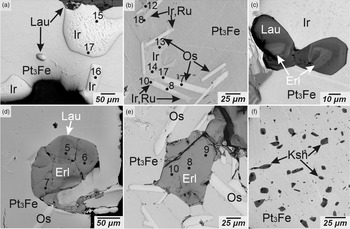
Iridium is present in large quantities forming two different types of grains. One consists of large (up to 150 μm) segregations with smooth boundaries (Fig. 4a). Although rare, they can make up to 5 vol.% of the entire PGM aggregate. Exsolution of Pt–Fe alloys are observed in the majority of these large iridium segregations. Similar structures were described for PGM from the Nizhnetagilsky massif (Ramdohr, Reference Ramdohr1960). Osmium is usually absent in these types of aggregates of Pt–Fe alloys and iridium. The other type of iridium segregations form clusters of small size (up to 50 μm) with sharply convolute boundaries. Such iridium clusters are usually found intimately intergrown with osmium plates (Fig. 4b).
PGM aggregates with numerous inclusions of (a, b) osmium and iridium, and (c–e) minerals of the laurite–erlichmanite and (f) kashinite–bowieite series. The point numbers correspond to (a, b) the compositions of osmium and iridium given in Table 2; and (d, e) compositions for PGE sulfides in Table 4. BSE images. Image (a) in reflected light. Ir – iridium, Lau – laurite, Erl – erlichmanite and Ksh – kashinite.

Morphological features of PGE sulfides
Platinum-group element sulfides are also found as inclusions in the Pt–Fe alloy. Minerals of the laurite–erlichmanite solid solution series are the most common (Fig. 4c). Laurite was found as individual crystals with complex faceting and a predominance of straight faces (Fig. 4c), with sizes up to 70 μm. Laurite is euhedral to iridium and isoferroplatinum grains.
Large (up to 110 μm) grains of erlichmanite are encountered in several PGM aggregates. The morphology of these grains varies widely. Figure 4d shows erlichmanite of isometric habit with smooth boundaries and a crystallographic shape that is difficult to identify, whereas individual crystals (Fig. 4e) have straight boundaries resembling a hexagonal plate of osmium. The grains of the kashinite–bowieite solid-solution series were found in subordinate amounts. They occur as small (15 μm) zoned isometric euhedral inclusions distributed uniformly in the Pt–Fe matrix (Fig. 3e, 4f).
Relationship between PGM and chromite crystals
Regarding the relationship of isoferroplatinum with other PGM and chromite, it is noted that the lamellar crystals of osmium are found predominantly in isoferroplatinum (Fig. 4b). They are commonly randomly distributed but can be found at the boundary between chromite and isoferroplatinum grains. Rarely, isoferroplatinum nuggets are enveloped by lamellar crystals of osmium (Fig. 5a).
The relationship of osmium with (a) isoferroplatinum (Pt3Fe), (b–e) chromite (CrSp), and (f) a zoned grain of laurite–erlichmanite with chromite. Point numbers correspond to the compositions in Table 2. BSE images.

The osmium crystals can be either idiomorphic inclusions related to chromites in isoferroplatinum or osmium or confined to chromites (Fig. 5b). In some examples, chromite fills the free space between the intergrown lamellar osmium crystals (Fig. 5c,d). Sometimes the peripheral zones of chromite grains are enriched in iron. In such zones, osmium plates with small iridium crystals at their boundaries are in chromite (Fig. 5e), Osmium crystals probably do not grow in chromite, and this mineral fills the space between isoferroplatinum and osmium crystals. Rarely laurite grows together with chromite (Fig 5f).
Composition of platinum-group minerals
Pt–Fe alloys
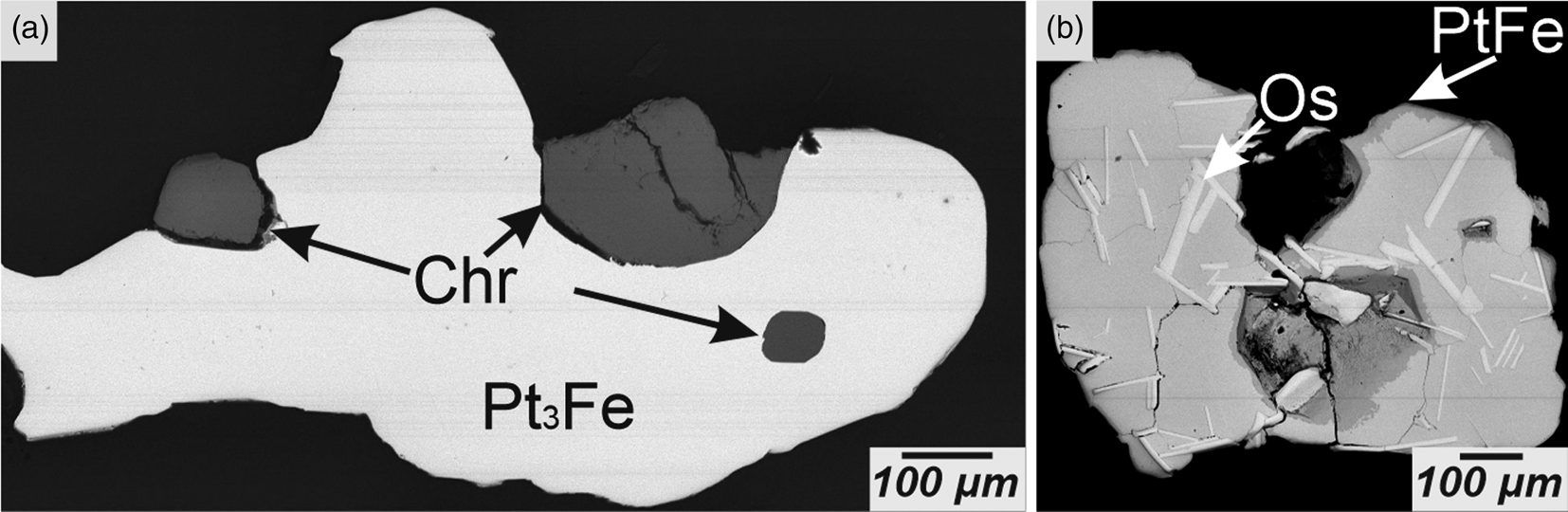
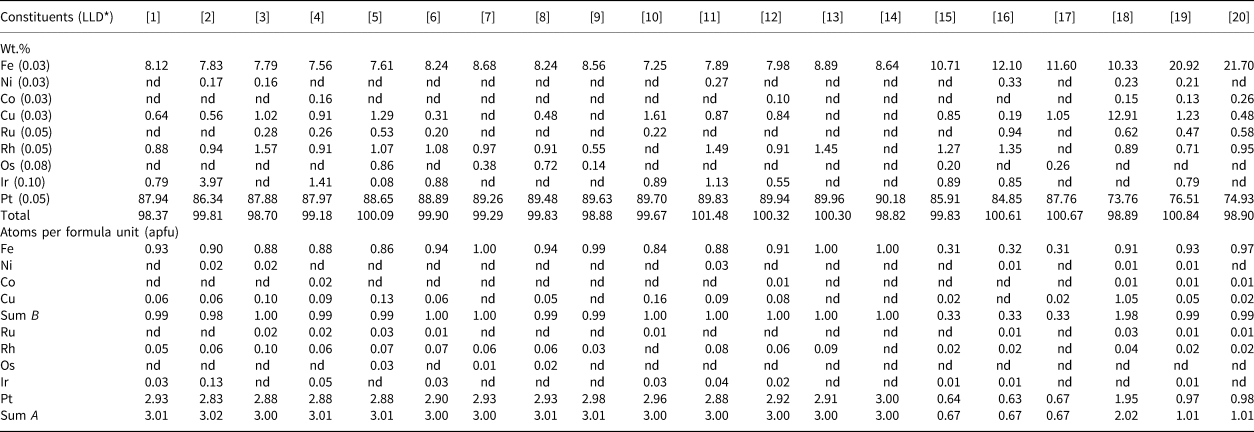
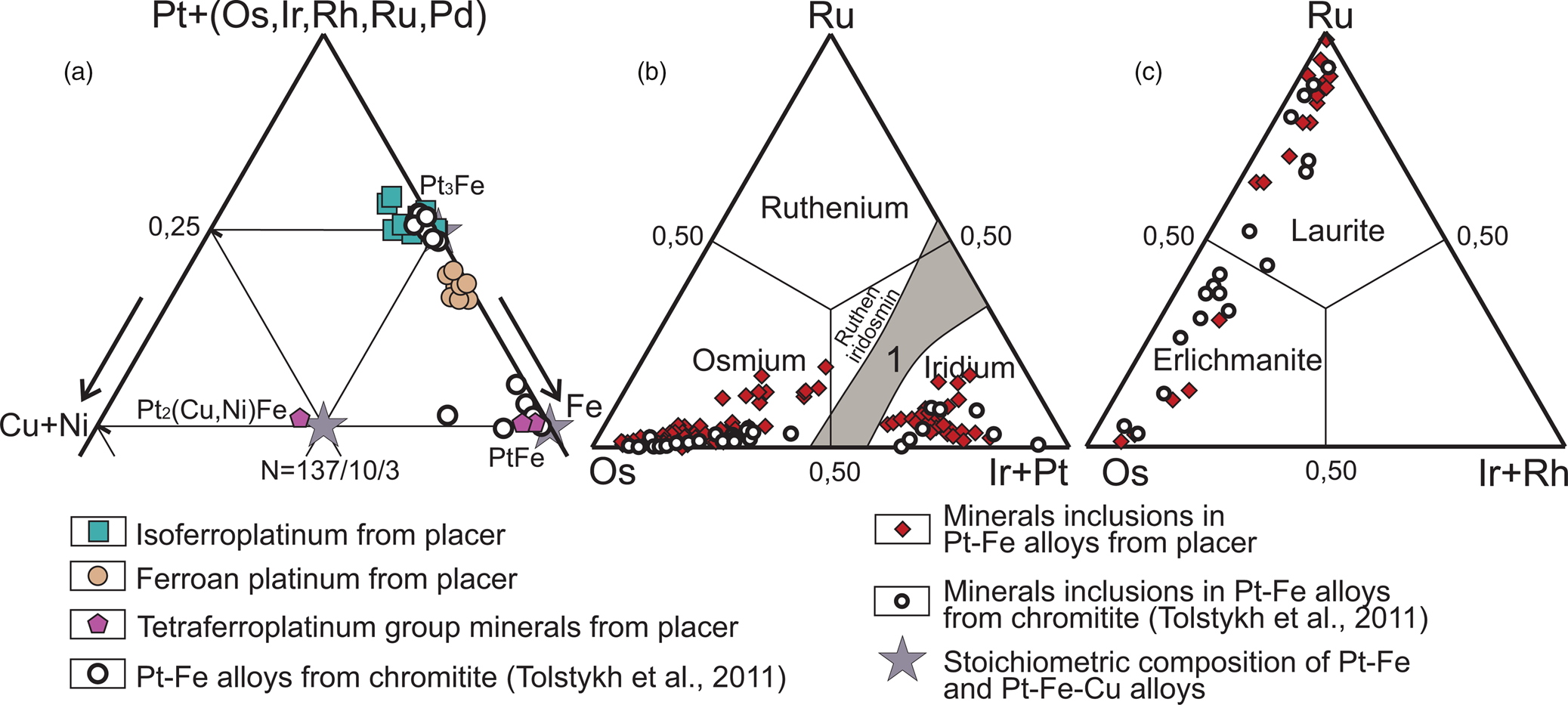
According to the analysis of more than 150 points, isoferroplatinum dominates among the Pt–Fe alloys from the Malaya Kamenushka River placer (95% of all analyses; Table 1), Pt contents range from 70 to 75 at.% (average 72 at.% Pt). The commonest minor elements in these alloys are Rh, Ru and Ir. The concentration of Ir ranges from 1 to 5 at.%, whereas the Rh content varies significantly between not detectable and 3 at.%. Palladium contents are generally below the detection limit. Copper contents range from 1 to 3 at.%. Most Pt–Fe alloy grains have a consistent composition that does not vary within the grain (Fig. 6a). Regardless of the Pt content, the total PGE content varies slightly and is close to 75 at.% on average (standard deviation is +/– 0.04), which corresponds to the ideal formula of isoferroplatinum.
(a) Homogeneous grain of isoferroplatinum (Pt3Fe) intergrown with chromite (Chr); (b) Pt–Fe alloy aggregate with tetraferroplatinum (PtFe) rim and numerous osmium (Os) inclusions. (BSE images).

Compositions of Pt–Fe and Pt–Fe–Cu alloys.

Notes: * (LLD) – Lower Limits of Detection in brackets; Sum B = Fe+Ni+Co+Cu; Sum A = Ru+Rh+Os+Ir+Pt. Compositions [1–14] are isoferroplatinum; [15–17] are ferroan platinum; [18] tulameenite; [19–20] tetraferroplatinum. The formulae of isoferroplatinum and tulameenite are calculated on 4 apfu; tetraferroplatinum on 2 apfu; and ferroan platinum on 1 apfu. ‘nd’ = not detected.
Small, isometric grains of a Pt–Fe alloy with an average Pt content of 63 at.% were observed in isoferroplatinum. The distribution of other minor elements in these grains is similar to those of the isoferroplatinum (Table 1, #15–17).
Pt–Fe–Cu alloys
Tetraferroplatinum–tulameenite series minerals were found as grains replacing Pt–Fe alloys. They are mainly localised along the peripheries and cracks in Pt–Fe alloys with complex outlines (Fig. 6b). Both tetraferroplatinum with a consistent composition and tulameenite rims (Table 1) were found.
Os–Ir–Ru alloys
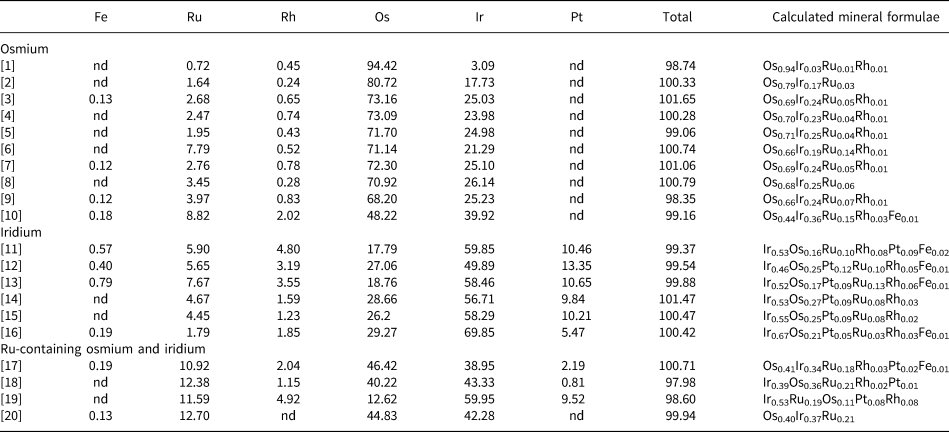
In the Pt–Fe alloys a significant number of inclusions of Os–Ir–Ru alloys were found, which according to the ternary classification of Harris and Cabri (Reference Harris and Cabri1973) are osmium and iridium. The amount of Os in some osmium grains can reach 94 at.%, with Ir, Ru and Rh as the main additional components (Table 2). Platinum contents are not characteristic of osmium and Pd is below the detection limit. Most osmium grains are homogeneous. However, zoning is observed in some lamellar crystals (Fig. 4b). This is caused by the substitution of Ru- (up to 7 at.%) and Rh-containing (up to 1 at.%; Table 2, #7–8) osmium to the minerals close to the osmium–rutheniridosmine boundary, with a significant amount of Ru (up to 21 at.%) and a higher Rh content (up to 3 at.%) (Table 2, #10). The latter osmium crystals are typically spatially associated with the second type of iridium grains.
Composition of Os–Ir–Ru alloys (wt.%).

Notes: Pd, Co, Ni and Cu contents are below the detection limits. ‘nd’ = not detected.
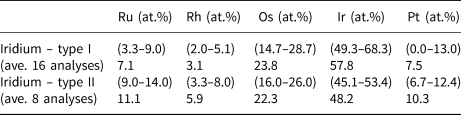
The composition of iridium varies widely (Table 2), but unlike osmium, Pt can reach 16 at.%, with Rh constantly present and ranging from 1 to 5 at.%. Analysis of the composition of iridium segregations of the different morphological types described above (Table 3) shows a significant difference in their mean PGE content. However, the concentration ranges overlap for most elements. Only the Ru content shows a statistically significant difference and is slightly less in the first type of iridium grains. The Ru contents can reach up to 21 at.% (Table 2) in osmium and iridium of both types. Osmium is enriched in Ru in the marginal parts of some crystals.
PGE content in iridium of various morphological types.

Notes: The values are given in the (minimum–maximum) format and the arithmetic mean of all analyses of the morphological types. Pd content is below the detection limits.
Laurite–erlichmanite (RuS2–OsS2)
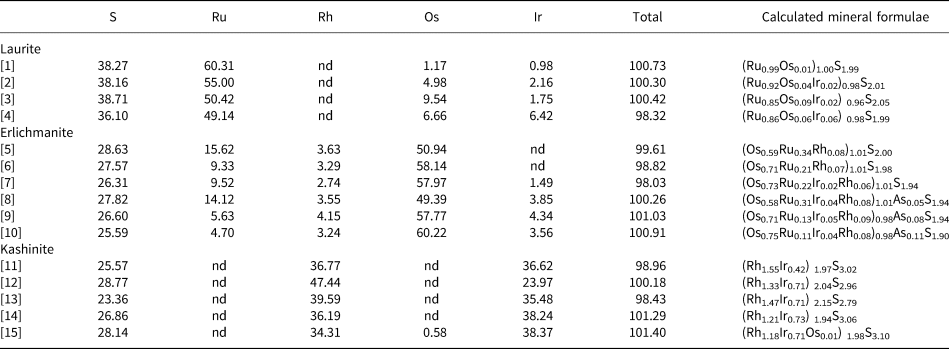
Most of the laurite–erlichmanite grains show oscillatory zoning. Laurite crystals generally show an increase in the Os/Ru ratio from the periphery to the centre of the grain (Fig. 5f), however, some grains have a more complex structure (Fig. 4c). Laurite is the most common mineral among PGE sulfides (50% of all analyses). The Ru content decreases from 33 at.% (which corresponds to the ideal formula) to 20 at.% (Table 4) with Os increasing from 0 to 11 at.%. The Ir content ranges from 1–3 at.%, whereas Pt, Pd and Rh concentrations are below detection limits.
Composition (wt.%) of laurite–erlichmanite and kashinite–bowieite solid solutions.

Notes: the formulae for compositions [1–10] are calculated for 3 atoms; [11–15] for 5 atoms.
As contents: [8] = 1.53 wt.%; [9] = 2.54 wt.%; [10] = 3.60 wt.%.
Pt and Pd contents are below the detection limits. ‘nd’ = not detected.
The compositions of the erlichmanite grains are heterogeneous. Typically it shows a decrease of Os content from 25 to 19 at.% from the centre to margin, whereas the Ru concentration increases from 0 to 10 at.% (Fig. 4d; Table 4). Erlichmanite grains contain low Rh and Ir contents. The Pt and Pd contents are below the detection limit. The composition of the laurite–erlichmanite solid-solution series varies from pure laurite to almost pure erlichmanite. The content of Rh and Ir ranges significantly from not detected in laurite up to 4 at.% of Rh+Ir in erlichmanite (Fig. 7). However, in most laurite, the amount of Rh is below the detection limit. The Rh and Ir contents in erlichmanite are similar.
Ternary plots of the compositions of: (a) Pt–Fe alloys; (b) Os–Ir–Ru inclusions; (c) inclusions of laurite–erlichmanite series from Malaya Kamenushka River placer and chromitite of the Kamenushensky massif (Tolstykh et al., Reference Tolstykh, Telegin and Kozlov2011). N is the amount of isoferroplatinum / ferroan platinum / tetraferroplatinum–tulameenite–ferronickelplatinum.

Kashinite–bowieite (Ir2S3–Rh2S3)
Bowieite is more common than kashinite, both minerals have significant variations in the content of the main components (Table 4). The amount of Rh ranges from 34 to 17 at.%, whereas the Ir content varies from 7 to 23 at.%. Contents of other PGE are usually insignificant.
The assemblage of rare minerals
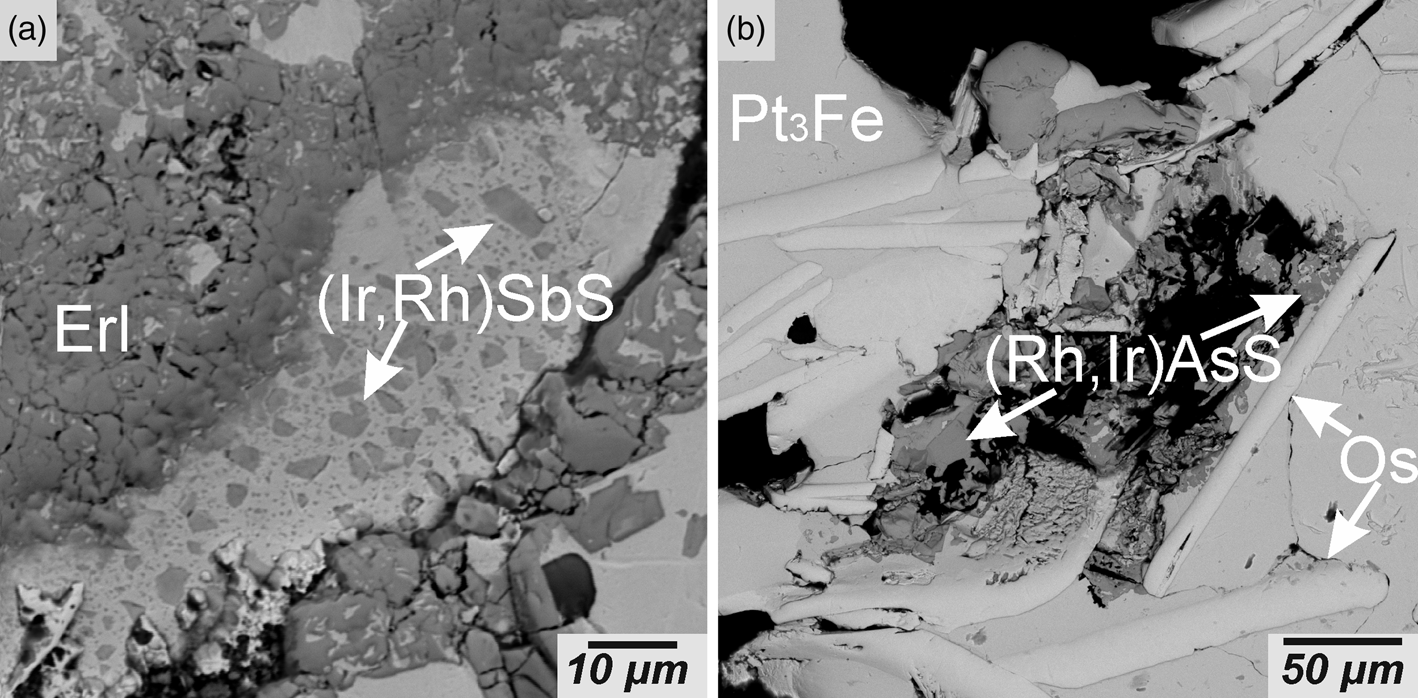
The As-, Sb-, Hg-rich and other rare minerals are not characteristic of PGM of the placer. Small grains of tolovkite with an average calculated formula of (Ir0.66Rh0.14Pt0.13Ru0.02Os0.02)0.97(Sb0.86As0.04)0.90S1.00 are associated spatially with erlichmanite (Fig. 8a). In another Pt–Fe aggregate, a zone of development of late sulfides and PGE sulfoarsenides (Fig. 8b), were observed to consist primarily of hollingworthite (Rh0.82Ir0.12Pt0.02Os0.01Fe0.01Ni0.01Co0.01)1.00As0.97S1.03 with a significant variation in the Rh content (3–5 at.%).
BSE images of the later-formed minerals: (a) rhodium tolovkite ((Ir, Rh) SbS) and (b) hollingworthite ((Rh,Ir)AsS). Erl – erlichmanite, Pt3Fe – isoferroplatinum, Os – osmium.

In summary, the PGM assemblage of the Malaya Kamenushka River placer is characterised by a predominance of isoferroplatinum of consistent composition. Ferroan platinum and the secondary minerals of the tetraferroplatinum–tulameenite series are subordinate. A large number of separated osmium plates is a feature of the PGM assemblage. Iridium segregations are widespread in the Pt–Fe alloys and represented by two morphological varieties. Members of the laurite–erlichmanite and kashinite–bowieite solid-solution series were found as mineral inclusions in the Pt–Fe alloy grains.
X-ray diffraction of Pt–Fe alloys
To define accurately the different Pt–Fe alloys, X-ray diffraction was carried out on 4 grains approximating to Pt3Fe in composition. Diffraction patterns obtained correspond to isoferroplatinum and tulameenite (in one grain). Characteristic diffraction peaks of native or ferroan platinum were not observed. These data indicate that the Pt–Fe alloy corresponding to the Pt3Fe stoichiometric ratio is isoferroplatinum.
Discussion
Order of mineral formation
The morphological features of the PGM and their relationships with chromite confirm the previously formulated magmatic model of mineral formation for the PGM systems of the Uralian–Alaskan type massifs (Tolstykh et al., Reference Tolstykh, Telegin and Kozlov2011; Stepanov et al., Reference Stepanov, Palamarchuk, Antonov, Kozlov, Varlamov, Khanin and Zolotarev2020). The bulk of the PGM, specifically Os–Ir–Ru, PGE sulfides and Pt–Fe alloys, are formed at the magmatic stage of the formation of the massif, whereas the formation of Pt–Fe–Cu minerals is associated with subsequent transformations of bedrock (e.g. serpentinisation).
Two types of iridium were found characterised by markedly different morphological features. The first type overgrows and partially replaces osmium plates. Its composition commonly includes significant concentrations of Pt, demonstrating a genetic relationship with the crystallisation of Pt–Fe alloys and iridium of a second type. The latter is most probably formed as a result of the decomposition of a complex Pt–Ir–Ru–Fe solid solution. Both isoferroplatinum with exsolution of iridium, and iridium with exsolution of isoferroplatinum, are formed by the decomposition of such a complex solid solution (Fig.4c). A few As-, Sb- and Hg-bearing minerals formed later than the bulk PGM. However, it is not possible to determine if their formation is connected with the intrusion of late-stage granite bodies or with postmagmatic fluids and autometasomatism processes, as observed in the Galmoenansky massif (Sidorov et al., Reference Sidorov, Kozlov and Tolstykh2012) and some layered complexes (Barkov et al., Reference Barkov, Fleet, Martin and Halkoaho2005 etc.).
Comparison of lode and placer PGM assemblages of the Kamenushensky massif
Pt–Fe alloys are of euhedral habit and occur in both placers and lode chromitites. They are characterised by a complex appearance, resulting from the alternation of idiomorphic, intergrown and xenomorphic surfaces. A larger size range compared to the lode PGM assemblage characterises the placer PGM. Thus, the size of the PGM aggregates in the bedrock varies from 10 to only 150 μm with the predominance of particles in the size range of 20–60 μm (Tolstykh et al., Reference Tolstykh, Telegin and Kozlov2011), whereas large aggregates up to 1 mm in size are present in the Malaya Kamenushka River placers. Based on our observations and previous studies (Oberthür, Reference Oberthür2018), such a difference in the sizes of PGM aggregates is associated not with the growth of platinum grains in water, but with the nature of the release of metal grains from bedrock intergrowths. Large segregations are accumulated next to the bedrock during the transition to placers, where the PGM grain sizes decreases with an increase in the distance of transport, leading to an uneven distribution of grains (Stepanov et al., Reference Stepanov, Palamarchuk, Kozlov, Khanin, Varlamov and Kiseleva2019a).
A common feature of the lode (Tolstykh et al. Reference Tolstykh, Telegin and Kozlov2011) and placer PGM assemblages of the Kamenushensky massif is the wide distribution of pinacoidal osmium crystals. They usually are present as inclusions in Pt–Fe alloys, but also occur as isolated crystals.
Iridium was found in intergrowths either with isoferroplatinum or as thin emulsion-like impregnations in isoferroplatinum resulting from Pt–Fe–Ir exsolution, and as intergrowths of isoferroplatinum, osmium and iridium. Similar features of the iridium distribution among isoferroplatinum are present in the placer assemblage. A significant number of laurite–erlichmanite grains forming up to 30 μm idiomorphic grains are observed in the primary chromitites. In contrast to the placer assemblage, where bowieite forms as small crystals in isoferroplatinum, large bowieite inclusions (up to 50 μm) were described from the primary ores (Tolstykh et al., Reference Tolstykh, Telegin and Kozlov2011).
The lode PGM assemblages contain As-, Sb- and Hg-bearing minerals in significant amounts that are not characteristic of the associated placers. Irarsite, platarsite, cooperite, sperrylite and various secondary oxide minerals described for the chromitites of the Kamenushensky massif (Tolstykh et al., Reference Tolstykh, Telegin and Kozlov2011) were not found in the placers. Probably, these PGM were destroyed during weathering and fluvial transport because of their low mechanical strength. The only minerals of the latest paragenesis described from the bedrock and identified in the placer assemblage are hollingworthite and tolovkite. The latter is characterised by significant Rh contents in both assemblages. Thus, the placer and lode PGM assemblages have similar features. The most significant distinction is the weak distribution of the latest secondary minerals among placer PGM as compared to the bedrock. Based on the almost complete similarity between the placer and lode PGM assemblages of the Kamenushensky massif and the Malaya Kamenushka River placer, it is possible to evaluate the features of a lode PGM assemblage using the placer material.
In addition, the coincidence of PGM associations from the chromites of the Kamenushensky massif and the Malaya Kamenushka shows that there is no radical vertical zoning, at least for the size of the erosional area of the massif. Similar results were obtained for the alluvial system associated with the weathering of the Svetloborsky massif rocks (Stepanov et al., Reference Stepanov, Palamarchuk, Kozlov, Khanin, Varlamov and Kiseleva2019a).
Comparison of Os–Ir–Ru alloy compositions from other Uralian–Alaskan type massifs
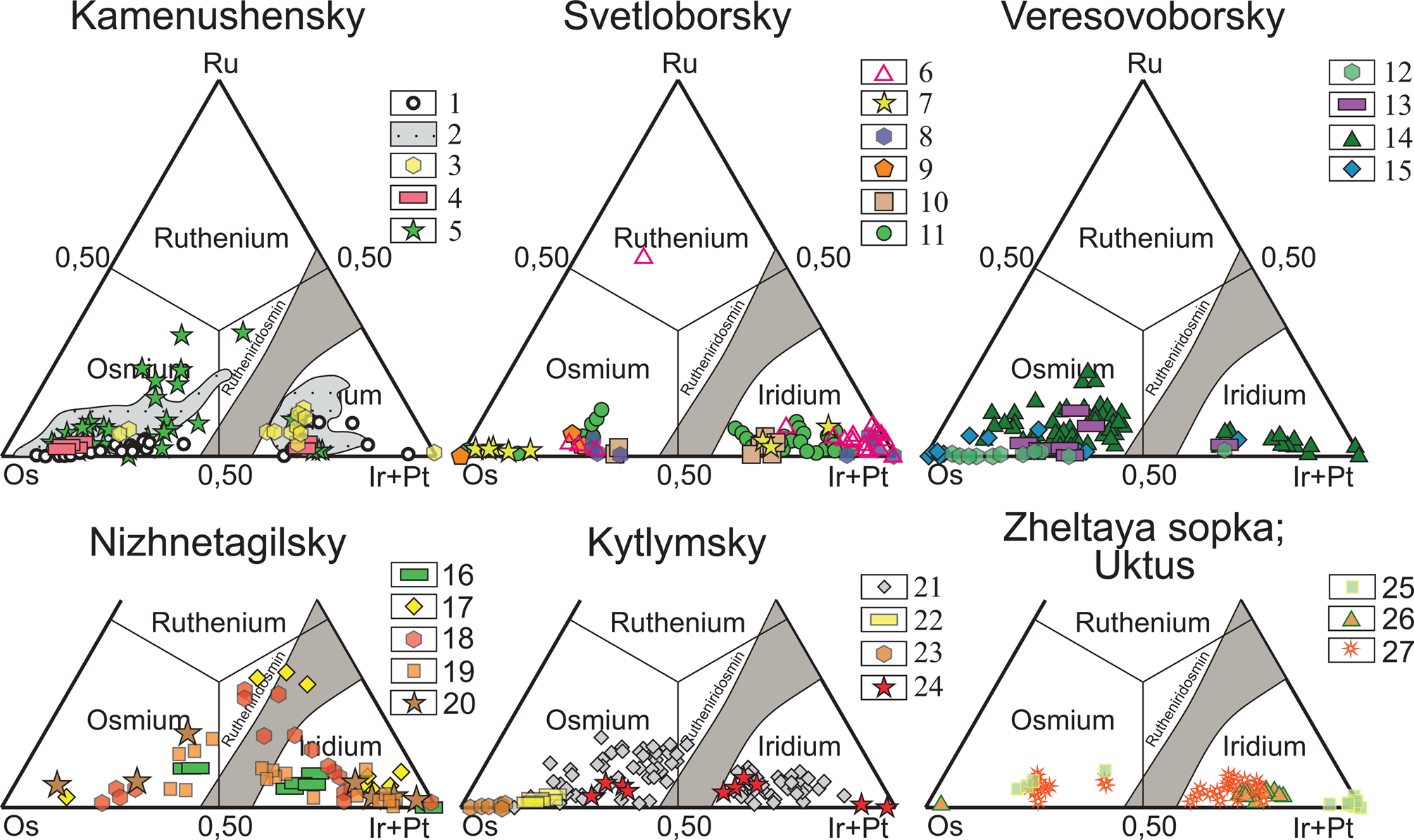
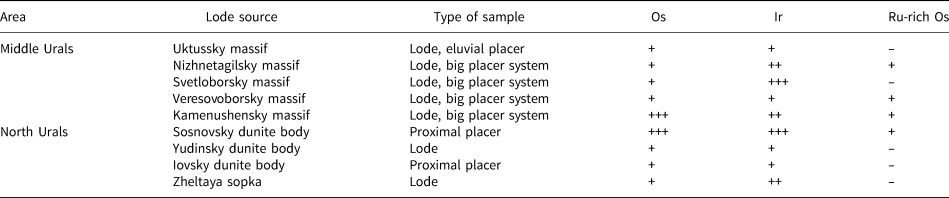
One feature of PGM ophiolite assemblages is the predominance of Os–Ir–Ru alloys over Pt–Fe alloys. In addition, Os–Ir–Ru alloys of these PGM assemblages are enriched in Ru. Commonly, these features are used to determine the affiliation of the alloys to either Uralian–Alaskan type massifs or ophiolite complexes. However, a detailed examination of the characteristics of the PGM assemblages reveals a number of exceptions. Comparisons of the PGM assemblages of the Uralian–Alaskan type massifs occurring in the Ural platinum belt, shows that different massifs are characterised by a different amount of Os–Ir–Ru alloys (Table 5). Thus, the PGM assemblages of the Uktussky, Nizhnetagilsky, Veresovoborsky massifs, and the Yudinskiy and Iovskiy dunite bodies are generally characterised by small amounts of osmium. In contrast, the Kamenushensky massif and the Sosnovsky dunite body are characterised by significant amounts of Os–Ir–Ru inclusions. Occasionally, there are independent grains of osmium (in the Kamenushensky massif) or iridium (in the Sosnovsky massif). Placers of the Svetloborsky massif are distinguished by large independent segregations of iridium, while osmium is much less common. As some massifs have similar PGM assemblages and different erosional levels (for example, Kamenushensky and Sosnovsky), such differences in the number of Os–Ir–Ru grains cannot be explained by the erosional levels of the massifs. Probably, the quantitative ratio of osmium, iridium and Pt–Fe grains is related to the degree of melting of the parent substrate, from which the Uralian–Alaskan type massifs were formed, or to different degrees of their fractionation in magma chambers. The compositional differences of the Os–Ir–Ru alloys are not as significant. For example, placers of the Kamenushensky, Sosnovsky and Nizhnetagilsky massifs are characterised by elevated Ru contents (Fig. 9).
The composition of Os–Ir–Ru alloys from different Uralian-Alaskan type massifs and associated placers located within the Ural platinum belt. Compositions 2–6, 8–16, 18–19, 21–22, 24–25 are author's data, other data as cited: [1] lode dunite and chromitite Kamenushensky massif (Tolstykh et al., Reference Tolstykh, Telegin and Kozlov2011); [2] the Malaya Kamenushka proximal placer; [3] headwaters of the Bolshaya Kamenushka river; [4] conglomerates of the Bolshaya Kamenushka distal placer; [5] Generalka gold-PGM distal placer; [6] lode chromitite; [7] lode dunite and chromitite (Tolstykh et al., Reference Tolstykh, Telegin and Kozlov2011); [8] eluvial placer from the Vershinnyi district (Palamarchuk et al., Reference Palamarchuk, Stepanov, Khanin, Antonov and Zolotarev2017b); [9] proximal placer of the Travyanistyi ravine; [10] iridium nuggets from the 2nd ravine; [11] Glubokinskoe distal placer; [12] lode chromitite; [13] eluvial placer; [14] Veresovka proximal placer (Stepanov et al., Reference Stepanov, Palamarchuk, Varlamov, Kozlov, Khanin and Antonov2019b); [15] Prostakishenka distal placer; [16] lode chromitite and dunite; [17] lode chromitite (Tolstykh et al., Reference Tolstykh, Telegin and Kozlov2011); [18] proximal placer of the Krutoy ravine; [19] Rublevik distal placer; [20] proximal and distal placers of the Chaush river and the Novy ravine, respectively (Auge et al., Reference Auge, Genna, Legendre, Ivanov and Volchenko2005; Malitch and Thalhammer, Reference Malitch and Thalhammer2002); [21] Sosnovka proximal placer, Sosnovsky massif (Palamarchuk et al., Reference Palamarchuk, Stepanov and Varlamov2019); [22] lode chromitite of the Yudinsky dunite body; [23] lode chromitite of the Yudinsky dunite body (Garuti et al., Reference Garuti, Pushkarev and Zaccarini2002; Pushkarev et al., Reference Pushkarev, Anikina, Garuti and Zaccarini2007); [24] proximal placer of the Iovsky dunite body; [25] lode chromitite of the Zheltaya sopka massif; [26] lode chromitite, Uktus massif (Pushkarev, Reference Pushkarev2000; Garuti et al., Reference Garuti, Pushkarev and Zaccarini2002; Zaccarini et al., Reference Zaccarini, Garuti, Pushkarev and Thalhammer2018); and [27] alluvial placer, Uktus massif (Zaccarini et al., Reference Zaccarini, Pushkarev, Garuti, Krause, Dvornik, Stanley and Bindi2013).

The volume of Os–Ir–Ru alloys from different Uralian–Alaskan type massifs of the Urals and/or placer associated with them.

Notes: ‘+’ rare inclusions in Pt-Fe alloys; ‘++’ common inclusions in Pt-Fe alloys; ‘+++’ very common inclusions and rare grains; ‘–’ a mineral has not been found.
Conclusions
The specific features of the PGM assemblage of the Malaya Kamenushka River placer correspond to the placers of iridium–platinum mineralogical geochemical type (Korchuganova, Reference Korchuganova2010; Mochalov, Reference Mochalov2013), characteristic of most placers associated with Uralian–Alaskan type massifs (Cabri et al., Reference Cabri, Harris and Weiser1996; Weiser, Reference Weiser and Cabri2002). The extensive development of the Os–Ir–Ru mineral inclusions and PGE sulfides is a characteristic feature of the PGM assemblage of the Malaya Kamenushka River placer.
In general, the PGM assemblage of the Malaya Kamenushka River placer is similar to those of the lode PGM assemblage, although it has several differences, such as the presence of ferroan platinum, which is very rare among the Pt–Fe alloys of the bedrock. Similarly, the latest minerals (sulfoarsenides, stibnides, etc.), which occur in significant amounts in the lode assemblage, are rarely found among the placer PGM. Regardless of these differences, the characteristics of the Os–Ir–Ru inclusions and PGE sulfides, together with the presence of rhodium-containing tolovkite, emphasises the similarity of the lode chromite–platinum and placer PGM assemblages of the Kamenushensky massif.
A comparison of PGM assemblages from the Malaya Kamenushka River placer with other placers and massifs of Ural platinum belt demonstrates a significant difference in the number of Os–Ir–Ru inclusions. Such differences for minerals of refractory elements cannot be explained by the vertical zoning of lode mineralisation. Most probably this is associated with the enrichment of the primary substrate with Os, Ir and Ru and/or the degree of its melting.
Acknowledgements
This work was supported by Russian Foundation for basic research (RFBR) grant No. 18-35-00151\19. The authors thank the reviewers and editors of the Mineralogical Magazine for assistance with the publication of these data and conclusions.
Supplementary material
To view supplementary material for this article, please visit https://doi.org/10.1180/mgm.2020.87