1. Introduction
Positing a persuasive, unified account that systematically explains the range of meanings associated with will and be going to has occupied linguists for decades. In addition to semantic explanations, the two future markers have received analysis in terms of pragmatic relevance theory (Nicolle, Reference Nicolle1997), syntactic constructions (Szmrecsanyi, Reference Szmrecsanyi2003), and grammaticalization (e.g., Brisard, Reference Brisard2001; Bybee, Perkins, & Pagliuca, Reference Bybee, Perkins and Pagliuca1994; Catasso, Reference Catasso2012; Evans & Green, Reference Evans and Green2006; Traugott & Dasher, Reference Traugott and Dasher2002). The majority of analyses of the two future markers tend to focus on their individual properties as they relate to a tense system without fully integrating both will and be going to into the English modal verb framework. Moreover, while many of these previous accounts have described the various meanings of futurity associated with will and be going to, to our knowledge none have provided a motivated, unifying explanation for the array of meanings that the constructions exhibit. In the course of this paper, we will describe the meanings identified with will and be going to, including those posited by previous Cognitive Linguistic accounts, and argue for an account that identifies the role of embodied experience as central in explaining the meanings associated with these future markers. We argue that previous analyses (e.g., Brisard, Reference Brisard2001; Langacker, Reference Langacker1987), which rely on binary features to distinguish will versus be going to, are inadequate, particularly when the two future markers are integrated into the overall English modal system. Next, we take up the concept that one important source of the polysemous meanings associated with a lexical item lies in invited inferences inherent in the original spatial/physical meaning of the lexical unit (Bybee et al., Reference Bybee, Perkins and Pagliuca1994) or in usage-events involving the lexical unit. We relate this to Evans’ (e.g., 2009, 2010, 2014) concept of conceptual parameters within his Theory of Lexical Concepts and Cognitive Models (LCCM). Finally, we argue that the shared general meaning of future associated with both will and be going to represent a case of inter-lexical polysemy as addressed in LCCM theory (Evans, Reference Evans, Evans and Chilton2010, Reference Evans2014, Reference Evans2015b).
2. be going to versus will
A considerable body of literature has examined the construction be going to, the role it plays as an alternative form to the future marker will, and the contexts that govern the use of each future marker (e.g., Brisard, Reference Brisard2001; Bybee et al., Reference Bybee, Perkins and Pagliuca1994; Cacoullos & Walker, Reference Cacoullos and Walker2009; Evans, Reference Evans2014; Haegeman, Reference Haegeman1989; Klinge, Reference Klinge1993; Leech, Reference Leech1971; Nicolle, Reference Nicolle1997; Szmrecsanyi, Reference Szmrecsanyi2003; Traugott & Dasher, Reference Traugott and Dasher2002). Accounts that analyzed the English tense–modal verb systems (e.g., Leech, Reference Leech1971; Palmer, Reference Palmer1974) typically have recognized will as the default marker of futurity, while representing be going to as an additional, more peripheral construction expressing futurity. Thus, will has been treated as the primary marker of futurity, while be going to has traditionally been considered the “next most important way of expressing future time” (Leech, Reference Leech1971, p. 54; see also Brisard, Reference Brisard2001) in English. Celce-Murcia and Larsen-Freeman (Reference Celce-Murcia and Larsen-Freeman1999), among others, represent be going to as a more informal way of expressing futurity. It is not surprising, then, that the two have been the foci of a sizable amount of research that addresses the subtle differences in meaning associated with each.
According to Leech (1971, p. 52), will provides the “nearest approximation to a neutral or colorless future” in English with its general meaning of prediction or “irrealis potential” (potential, but not real) (Klinge, Reference Klinge1993, p. 315), denoting affairs that have not yet come into being but about whose probability the speaker expresses no question (Brisard, Reference Brisard, Verspoor, Lee and Sweetser1997, Reference Brisard2001; Leech, Reference Leech1971). This neutral sense of future seems to be what is on display in sentences having to do with scheduled events such as:
-
(1) a. The train will leave Euston Station at 4:49.
b. The conference will take place this coming March.
c. Frank says he will come for dinner tonight.
Presumably this sense is discussed as the ‘colorless’ future because the choice of will does not interject any subjective modulation of certainty on the part of the speaker. (A corpus search, using the Corpus of Contemporary American English (COCA), of 200 random uses of will revealed that approximately 25% of the tokens demonstrated the neutral, scheduled event sense of will.)
The second meaning associated with will, the volitional meaning, more clearly involves notions of intention, volition, or willingness: this meaning is what Cacoullos and Walker (2009, p. 327) refer to as ‘the volition-based will-future’. The volition-based will-future sense retains the root meaning of will (see Sweetser, Reference Sweetser1990, for a discussion of will’s root modality) in which speaker internal desire and volition are central to the meaning. The volitional meaning can be seen in examples like the following, adopted from Sweetser (Reference Sweetser1990):
-
(2) a. All right, I’ll do it.
b. See if John will help you out.
In (2a), the speaker uses will to express her agreement, or willingness, to do the intended task at some point in the future; in (2b), the speaker’s meaning involves determining if John is willing to help at some point in the future, i.e., agrees through his personal volition to help. Klinge (Reference Klinge1993) and Brisard (Reference Brisard, Verspoor, Lee and Sweetser1997) add that many uses of the will futurate also have a sense of no prior planning on the part of the actor. This is consistent with the uses in (2). Neither of these uses involves prior planning or prior intention on the part of the actor undertaking the action. In (2a) the speaker’s utterance is in response to the interlocutor’s immediate request; in (2b) there is no prior planning on the potential actor’s (John’s) part. Note, however, that in the ‘neutral’ uses of will, as illustrated in (1a–b), speaker knowledge about future events involves information confirmed before the moment of speaking (i.e., information gathered from the train schedule or conference announcement), and hence a situation involving prior planning or intention on the part of the authority responsible for the information, as well as prior action taken by the speaker to gather the information before the moment of speaking. In (1c), prior planning (on Frank’s part) is clearly involved.
Be going to is argued to display a distinct and wider range of meanings in comparison to will, beyond the neutral future meaning discussed above and distinct from the volitional meaning. Nicolle (Reference Nicolle1997) identified four additional meanings: prior intention, imminence, assumption, and inevitability. Brisard (Reference Brisard2001) largely accepts Nicolle’s analysis. Let’s first consider prior intention. This meaning can be clearly contrasted with the volitional use of will where the actor’s intention does not involve previous planning (Brisard, Reference Brisard2001). The following examples (adopted from Brisard) illustrate the difference between the two:
-
(3) Can somebody visit John tomorrow?
a. I’m going to visit him.
b. I’ll visit him.
Brisard, in agreement with Nicolle (Reference Nicolle1997), argues that the intention to visit John in (3a) was already present or planned on the part of the speaker prior to the request being made, whereas in (3b) the intention is born as a result of the request. (The speaker appears to be volunteering to go in response to the speaker’s request.) This distinction involving volitional will jives with our intuitions. Again, we note that, in contrast to ‘volitional’ will, ‘neutral’ uses of will often do involve some kind of planning/scheduling or prior intent (as illustrated in (1a–c)).
The second usage associated with be going to has been termed imminence by Brisard (Reference Brisard2001) and Nicolle (Reference Nicolle1997). Klinge (Reference Klinge1993) referred to it as a ‘verified’ state of affairs not yet realized. In many instances this sense of be going to can clearly be contrasted with will. The meaning of imminence indicates that the speaker or actor has accessed information that provides strong support that certain conditions or consequences will follow very soon. As such, this usage is argued to highlight near future (in the case of be going to) in contrast to the general future (in the case of will) and a high level of likelihood. The imminence sense indicates the speaker’s high degree of certainty about a future state, based on experienced signs or clues in the present environment (Brisard, Reference Brisard, Verspoor, Lee and Sweetser1997; Leech, Reference Leech1971). By Brisard’s account, the interpretation of available clues that are observed by the speaker translate into certainty about what is going to happen.
-
(4) It looks like it’s going to rain.
To illustrate, a statement such as (4) carries the meaning that the speaker believes it is highly likely to rain. This confident judgment made by the speaker is the result of strong evidence. Under Brisard’s account, this evidence is often in the form of physical or material conditions in the immediate environment, as in the case of seeing heavy clouds in the sky and a sense of high humidity in the air.
The sentences in (5a–b) give a clear contrast between will and be going to in terms of the sense of imminence.
-
(5) a. I’m going to be sick!
b. I’ll be sick!
In (5a), the condition of becoming sick is interpreted to be more imminent and more likely than in (5b); the sense in (5a) is that becoming sick is happening very soon and the speaker is already experiencing signs that lead him to think so (Brisard, Reference Brisard2001). Moreover, at this point, the speaker does not have control over the imminent event.
In contrast, in (5b), the possibility of becoming sick seems to be conditioned upon the fulfillment of some requirement (Binnick, 1974, as cited in Brisard, Reference Brisard2001), as in saying, for instance, I’ll be sick if I eat any more ice-cream or in a scenario such as:
-
a. Come on. Let’s go on the roller coaster again.
b . I can’t. I’m already dizzy. Another ride and I’ll be sick.
The condition on the future action or state described in the will sentences are more clearly under the volition of the speaker (or actor); this is consistent with the volitional meaning of will discussed above. The necessary conditions still remain unfulfilled at the point of speaking; the speaker can control whether the conditions, i.e., eating more ice cream or riding the roller coaster, are fulfilled.
A third meaning of be going to is that of assumption (Brisard, Reference Brisard2001). It is more strongly associated with conceptual evidence in the mind of the speaker, rather than physical, observable cues in the environment. assumption includes “instances of be going to that construe an event in the future as assumed … (or) taken for granted that the event will occur, even though at the time of speaking it is still non actual” (Brisard, Reference Brisard2001, p. 259). Brisard adopts the following example from Binnick (1974, as cited in Brisard, Reference Brisard2001).
-
(6) a. Most Congressmen are dubious about what is going to happen to money in local hands.
b. Most Congressmen are dubious about what will happen to money in local hands.
The suggested meaning associated with be going to in (6a) is that of presupposed assumption about the transfer of money to local authorities as in fact unquestionably happening, i.e., perhaps some legislation has been passed and the conditions for the unquestioned consequences of money being transferred are already in motion. Whereas this assumption is not present in (6b); the sentence can be paraphrased as meaning Most Congressmen are dubious about [the prospect of] transferring money to local authorities [and are probably going to vote against it]. As with the imminence sense, the use of will here implies that the conditions for fulfillment are not yet met. Meeting those conditions appears to be under the control of the actors (Congressmen).
The fourth meaning identified for be going to is that of inevitability, and its meaning contrasts with ‘contingency’ or unfulfilled condition found in the uses of will discussed above. The following minimal pair demonstrates the differences in meaning (adopted from Brisard, Reference Brisard2001).
-
(7) a. Don’t get near that parcel! It’s going to explode!
b. Don’t get near that parcel! It will explode!
In (7a), the explosion is not dependent on the addressee getting near the parcel, rather the message is that it is merely a matter of time before the package explodes, perhaps because of a pre-set timer or some already attained state that will inevitably end in certain explosion. Importantly, the actor/addressee has no voluntary control over the situation. In (7b), on the other hand, the explosion event would be triggered by the action of the addressee getting near the parcel. With the will future, the eventuality of the explosion is, at least to some extent, under the control of the actor/addressee and meeting the conditions for fulfillment.
In sum, both future markers are polysemous. Two meanings are associated with will, the neutral/scheduled meaning and the volitional meaning. Five meanings have been identified as being associated with be going to: neutral future, prior intention, imminence, assumption, and inevitability. These last four meanings of be going to contrast with uses of will. We find it particularly noteworthy that the meaning contrasts are between volitional will and be going to and not between neutral will and be going to.
3. be going to: towards identifying a unified account
As outlined in the previous section, in many ways Brisard’s (Reference Brisard2001) account of be going to represents the most comprehensive treatment of this construction in that he identifies four meanings for be going to, in addition to its neutral future sense: prior intenion, imminence, assumption, and inevitability, and clearly illustrates how they differ from will. Footnote 1 He provides a number of excellent examples illustrating the range of nuanced meanings associated with be going to, as well as the subtle differences in interpretation between the two futurate constructions.
Building on Langacker’s (Reference Langacker1987) insight that simple reliance on the metaphor time is motion is inadequate to explain the competing future constructions in English and their many extended meanings, Brisard (Reference Brisard2001) proposes an explanation whose primary argument is that the differences in interpretations are best represented by differences in configurations of the binary semantic features +/–G (Given, i.e., realized actuality) and +/–P (Present, i.e., access to immediate confirmative evidence). He posits that will is best characterized with binary features –G/–P, while be going to is –G/+P. In other words, Brisard argues that the key meaning difference between the two forms is that speakers choose be going to when they have strong, confirmatory evidence at the moment of speaking that a not-yet-realized state or event will be realized, while they use will in circumstances where strong, confirmatory evidence of not-yet- realized states is not available at the moment of speaking. Despite Brisard’s important insights, this presentation is problematic on a number of scores. We argue that reliance on binary features to account for the semantics of will versus be going to is inadequate.
Our first argument is that the binary semantic feature +/–P is inadequate to account for the two different senses of will itself. Recall that will has been identified as having two senses: a neutral, colorless future sense and a volitional future sense. As the above examples of ‘neutral’ will demonstrated, will is used to discuss events scheduled to take place in the future. In such cases, the speaker has clear, confirmatory evidence that an event is highly likely to take place, as, for instance, with official announcements about conferences or knowledge of the cyclic calendar or a report from a friend about her plans for dinner.
In terms of ‘volitional’ will and its contrasts with be going to in the sense of imminence, Brisard (Reference Brisard2001) argues that when speakers use be going to, most of the time physical cues are present and support the speaker’s certainty about the ultimate fulfillment of not-yet-realized events. However, he adds that the evidence does not have to be immediately present at the time of speaking; it may be sufficient if the evidence is salient to the speaker’s conceptualization of the situation, as in the case of having checked the weather forecast or information coming from an official source. However, the COCA corpus reveals that either will or be going to occur in these situations. Consider the following pair of sentences:
-
(8) a. The paper says it will rain today.
b. The paper says it’s going to rain today.
When surveyed, several native speakers said that the two sentences were nearly synonymous, with the will version actually sounding slightly stronger in terms of speaker surety. In such cases, it appears that the speaker is relying on the same amount and type of ‘confirmatory’ evidence to comment about not-yet-realized events. Thus, we appear to have a case in which both will and be going to must be designated as having the same P status. Interestingly, in case of a set schedule, English also uses simple present tense to express not-yet-realized events, as in:
-
(9) a. The first game of the World Cup is next Monday.
b. The next train for Chester leaves at 1:10 this afternoon.
Langacker (Reference Langacker1987) explains these unexpected uses of present tense to indicate future in terms of the speaker setting up a mental space that acts as a virtual schedule that the speaker scans, thus treating the not-yet-realized event as a salient part of her structured reality. Whether or not one agrees with the particulars of this analysis, it is difficult to deny that the speaker is using strong, confirmatory evidence that is available at the time of speaking to talk about a not-yet-realized event. The fact that there is conceptual overlap between this use of English present tense, will, and be going to raises serious questions about an analysis of will versus be going to that rests on +/–P designations.
The next step in our critique of Brisard’s (Reference Brisard2001) approach rests on the generally accepted analysis that will and be going to are part of the English modal verb system. An analysis of the semantics of will and be going to that relies on the binary G/P features is problematic when one considers the two future constructions in relation to a fuller range of English modal verbs. More specifically, all English modals (with the exception of can) have future colorings in both their root and logical prediction (epistemic) meanings, in other words, they have a not-yet-realized meaning. This suggests that, under Brisard’s analysis, they all have a –G feature. Consider the following sentences:
-
(10) a. John will come home.
b. John would come home (but he’s afraid of his mother).
c. John must come home.
d. John could come home.
e. John might come home.
f. John should come home.
g. John needs to come home.
In each case, the speaker is indicating that John being at home is a not-yet-realized situation. Simultaneously, the modals indicate a wide range of speaker attitudes concerning the future event, which are not captured by the simple notion of presence or absence of “immediate, confirmative evidence” (or a +/–P designation). A more nuanced, multi-faceted analysis is needed to represent the many shades of meaning. As Talmy (Reference Talmy2000), Sweetser (Reference Sweetser1990), and Tyler (Reference Tyler, Robinson and Ellis2008) argue, the nuanced differences in speaker attitudes represented by the modals seem best represented in terms of the speaker’s perception of forces and barriers to the actor’s forward progress towards the not-yet-realized state or event. For instance, must involves a strong external force or authority placing irresistible force on the actor; all force propelling forward movement comes from outside the actor. In contrast, should involves a strong external authority that is also recognized as legitimate by the actor; thus the force propelling forward motion comes from both external and internal forces. See the ‘Appendix’ for Tyler’s set of force-dynamic diagrams for the modals.
Now consider the use of the modals to express logical prediction. Here the issue is the speaker’s commitment to the likelihood that her logical conclusion about a not-yet-confirmed situation is correct, or an expression of the speaker’s level of certainty about a situation for which she does not have absolute confirmation. Because the degree of the speaker’s certainty is closely tied to confirmatory evidence, an analysis of the epistemic values of the modals could potentially fit into a version of Brisard’s (Reference Brisard2001) +P framework. Let’s consider the following sentences:
-
(11) [Someone knocks at the door. The speaker cannot see who is knocking. The speaker says:]
-
a. That will be John.
b. That’s going to be John.
c. That would be John.
d. That must be John.
e. That should be John.
f. That could be John.
g. That might be John.
-
With these examples, rather than a categorical presence or absence of confirmatory evidence in the present, the modals exhibit a continuum of speaker level of certainty (or access to confirmatory evidence). Indeed, of all the English modals, will seems to indicate the highest degree of speaker certainty, and hence by Brisard’s argument, presumably the highest degree of speaker access to “immediate, confirmative evidence”. Thus, within the overall modal system and its epistemic values, Brisard’s analysis fails to address the fact that will conveys perhaps the strongest degree of speaker certainty and hence the strongest level of P. In sum, it is not clear how the binary features suggested by Brisard can possibly account for the range of speaker attitudes expressed in either root meanings or the range of certainty expressed in epistemic uses of the full set of English modals. At first glance, binary features might appear to provide a certain theoretical elegance when considering will and be going to in isolation from the other modals (although, as we already saw, there are questions about the adequacy of the account for ‘neutral’ or ‘scheduled’ will); however, when taking a broader perspective, binary features are too blunt an instrument for explaining the complex set of meanings associated with English modals. We argue that an analysis that both theoretically situates will and be going to within the overall modal system and explains the distinct future patterns of use of will and be going to offers a superior and ultimately more insightful analysis.
Our analysis draws heavily on the tenets of embodied experience and force dynamics. Although Brisard (Reference Brisard2001) mentions the original force dynamics of each construction (will and be going to) as playing a role in their current usages, he does not develop this line of thinking. We present an analysis of the two future constructions that is closely related to the embodied meaning at the core of their original meanings, which – we argue – continues to be active in present-day uses.
Finally, little in Brisard’s (Reference Brisard2001) analysis addresses the motivation for the development of the various meanings associated with will versus be going to. Moreover, the binary feature analysis is not presented within a broader analysis of how temporal events are represented in general. We are left with several fundamental questions: Are all verb constructions marked with G/P features? How are the components of the construction, i.e., the marking for imperfective aspect and the allative marker, handled in terms of the semantic feature specification? Do binary features change over time and, if they do, what mechanisms or patterns of use allow for or propel the change? Optimally, we would want an analysis that offers a motivated explanation for why will developed both neutral future and volitional future meanings and why be going to developed the five meanings currently associated with it. We will argue that grammaticalization patterns for constructions such as be going to discovered by Bybee et al. (Reference Bybee, Perkins and Pagliuca1994) and expanded upon by Traugott and Dasher (Reference Traugott and Dasher2002) offer support for our fundamental analysis that grammaticalization trends from spatial/physical meaning to more subjective and abstract meaning and is embodied. The multiple components of the construction be going to add further nuances to the multiple interpretations of this construction. Finally, we argue that this analysis is consonant with the LCCM theory of semantics postulated by Vyv Evans (e.g., Evans, Reference Evans2009, Reference Evans, Evans and Chilton2010, Reference Evans2014, Reference Evans2015b), in which he argues for semantic parameters that reflect embodied experience and inter-lexical polysemy.
3.1. grammaticalization analyses
Many linguists working in grammaticalization theory have discussed be going to (e.g., Bybee et al., Reference Bybee, Perkins and Pagliuca1994; Hopper & Traugott, Reference Hopper and Traugott1993; Traugott & Dasher, Reference Traugott and Dasher2002). These analyses have primarily limited themselves to explaining the shift from be going to solely indicating motion through space to its development as a future marker. Like Langacker (Reference Langacker1987) and Brisard (Reference Brisard2001), these researchers also reject the adequacy of the general metaphor time is motion to explain the development of the future readings. However, all the grammaticalization analyses agree with Sweetser’s (Reference Sweetser1990) claim that semantic extension tends to follow the path of a lexical unit first having a spatial/physical meaning from which a more subjective, abstract meaning develops; Sweetser discusses these extensions in rather general terms of metaphorical extension.
Bybee et al. (Reference Bybee, Perkins and Pagliuca1994) undertook a large-scale, cross-linguistic corpus study of lexical items that equate with come/go and develop a future marker interpretation. They discovered that the future reading only arises in the context of a construction that also contains a marker of imperfective aspect and an allative marker (indicating that the motion is toward a goal). Traugott and Dasher (Reference Traugott and Dasher2002) discuss this finding and reiterate Bybee et al.’s (Reference Bybee, Perkins and Pagliuca1994) interpretation that the future meaning seems to arise from invited inferences of temporality and intentionality inherent in the construction:
The temporal meaning that comes to dominate the semantics of the [be going to] construction is already present as an invited inference from the spatial meaning. When one moves along a path towards a goal in space, one also moves in time … When a speaker announces that s/he is going somewhere … s/he is also announcing the intention to do this thing … (Bybee, et al., Reference Bybee, Perkins and Pagliuca1994, p. 268).
Note that a central part of the argument is that movement through space, especially forward movement along a path towards a goal, inherently involves a temporal element or invites an inherent inference of temporality. According to Traugott and Dasher (Reference Traugott and Dasher2002), the presence of the imperfective aspect reinforces the notion that the spatial process is taking place in time: “motion towards something takes time (i.e., is imperfective) and one will arrive there only at some time later than the motion starts” (p. 83). They argue that, over many uses, “the motion through space meaning can be backgrounded while the inherent temporal meaning is highlighted and through pragmatic strengthening can come to be independently associated with the construction as a distinct meaning” (pp. 83–84). Importantly, Bybee et al. (Reference Bybee, Perkins and Pagliuca1994) further argue that the invited inference of intentionality is also a key foundational element for the future interpretation. Traugott and Dasher offer historical evidence from written text that be going to was first used primarily to indicate motion through space and only later also came to be used to indicate temporality (i.e., future).
We find several important insights from the research in grammaticalization: (1) across many languages, patterns of extension are systemic and motivated, going from the spatial/physical to the more subjective and abstract; (2) semantic extensions can be based in invited inferences that are present when a lexical unit is used to indicate its core spatial/physical meaning; (3) semantic extension is gradual, and can go from nuanced highlighting of a component of the lexical unit’s meaning to an independent, distinct sense; (4) semantic extension results in polysemy networks in which the original spatial/physical meaning is the core and often continues as one of the primary uses of the lexical item (note that be going to continues to indicate physical/spatial movement towards a goal, as in I’m going to the store); and (5) the usage-event of declaring one is about to do something entails the announcement of the intention to do that thing. Nevertheless, we argue that the explanations as such are slightly askew and do not adequately explain either be going to’s extension from the spatial/physical motion interpretation to the neutral future interpretation. We will argue that several elements of embodied semantics are missing from these earlier accounts. Particularly important is the fact that the analysis does not account for the several additional senses associated with be going to. Moreover, these analyses do not address the semantic relationship between will and be going to. We will argue that the analysis does not sufficiently take into consideration the etymological roots of be going to and will; close examination of earlier attested meanings reveals important traces of the original meaning, which continue to constrain and color the extended, present uses. Evans (Reference Evans2009, Reference Evans, Evans and Chilton2010, Reference Evans2014, Reference Evans2015b) discusses this phenomenon in terms of semantic parameters and inter-lexical polysemy in his analysis of the subtle, but important differences between the state sense associated with English in and the state sense associated with English on.
3.2. will
Historically, the first attested uses of the cognates of will can be traced as far back as Sanskrit vrnoti, which indicated choosing or strongly desiring. Although the form has undergone considerable change, strong reflexes of the original meaning of strong desire or wish have persisted. According to the Online Etymological Dictionary, the reconstructed Proto-Indo-European form *wel meant ‘to wish’, based on cognates in Old Frisian, Old Norse, Old Saxon, and Old English which all have verb cognates that meant ‘to desire, to wish’. Interestingly, the Old English cognate wel was already developing a future use. Moreover, wel included an implication of intention or volition which distinguished it from sheele ‘shall’, which indicated obligation. Footnote 2
According to the OED, the earlier cognate forms of desiring or wishing were often expressed by an authority figure, so that a desired act or event was considered compelled. Thus, the strong desire of a god or person of authority caused the state or act to be accomplished, as in:
-
(12) The king wills these laws be enforced.
In other words, it is the king’s desire, born of his own internal volition, that the laws be enforced. Further, in an interactive, social situation, an authority figure’s announcement of a strong desire to have something accomplished is likely to evoke a response by the addressee of expressing the volition to see that the authority figure’s desire is fulfilled. Thus, many instances in which will would have occurred not only expressed strong desire but also strong volition. In either case, i.e., the authority figure announcing a strong desire or the addressee announcing a strong volition to fulfill that desire, the initiating forces in these historical uses of will are internal to particular actors. Through grammaticalization, certain uses of will have been bleached of this internal, volitional force (Traugott & Dasher, Reference Traugott and Dasher2002). Traugott and Dasher provide evidence that by Middle English will had developed the neutral, scheduled future sense. Tyler’s (Reference Tyler, Robinson and Ellis2008) analysis argues that this neutral future sense initially stems from the speaker’s certainty about her own desire and volition to fulfill some future goal.
Tyler (Reference Tyler, Robinson and Ellis2008) did not develop the link between the speaker’s certainty about her own desires and the actual fulfillment of those desires. Building on this earlier work, we add another element of embodied experience to the evolution of the modals. If one regularly makes a commitment and successfully fulfills it, the association between making the commitment and surety of the not-yet-realized event actually happening becomes strongly linked. Similarly, if one regularly experiences an outside authority (like the national train service or your favorite movie theater) or a reliable actor announcing a scheduled but not-yet-realized event and that event actually occurring at the announced time, one forms a strong association between announced, scheduled events and the actual fulfillment of those events. Note that the announcement of one’s strong desire or volition invites an inference that the speaker has the intention of fulfilling that desire. This argument draws on the Bybee at al. (1994) argument that the announcement of going somewhere entails an announcement of the intent to go somewhere. We would add that the announcement of strong volition not only invites an inference of strong intention, but also an inference of prediction that the not-yet-realized situation will be realized at some point in the future. Thus, the embodied experiential links between the announced desire/volition and the concurrent implied intention to fulfill the desire, on the one hand, and the realization of the event, on the other hand, become so strongly entrenched that the form will, which originally only indicated an individual actor’s strong desire or volition, came to have the additional meaning of ‘neutral’ or ‘scheduled’, ‘certain’ future.
The inferences of intention and prediction associated with the use of will are very similar to those Bybee et al. (Reference Bybee, Perkins and Pagliuca1994) and Traugott and Dasher (Reference Traugott and Dasher2002) hypothesize for be going to. However, it would seem that such invited inferences are inherent in any usage event of communicating that one is about to do something, not only from the particular verb constructions be going to and will. When a speaker tells an addressee that she is preparing to drive the car to the university, this is a declaration of intention and a prediction the intention will be fulfilled. It is worth noting that the kind of linking between the invited inferences inherent in the use of a lexical construction (as in I’m going to the store) and the embodied experience of regularly having the entailed predictions fulfilled is not the same type of experiential linking discussed by Grady (e.g., 1997) and Lakoff and Johnson (Reference Lakoff and Johnson1996) as experiential correlation or primary metaphor. Experiential correlation refers to two independent physical/spatial events or states co-occurring so frequently that they become linked in memory, such as the independent events of adding more of a liquid to a container and the observation of a rise in vertical elevation in the level of the liquid. Once the two states or events are strongly linked in memory, language associated with one physical/spatial sense can be used to refer to the other physical/spatial scene or event. Thus, English speakers use language concerning vertical elevation to refer to the independent domain of amount, as in the well-known primary metaphor more is up. Rather, the linking between invited inferences inherent in a language usage event (i.e., particular language used in a particular communicative context) and frequent, recurring human experience, such as having the intention implied in the usage event fulfilled, seems to more akin to what Evans (Reference Evans2009, Reference Evans2014, Reference Evans2015b) discusses as the link between a lexical concept and a cognitive model. In this case, humans develop a cognitive model of speech events in which a speaker’s declaration of an intention to do something or go somewhere includes that declaration as being understood as a prediction on the part of the speaker that the intention is likely to be fulfilled. The cognitive model is accessed or activated via the language the speaker uses to declare the intended action. This is an important distinction to make as it emphasizes that meaning extension takes place by multiple routes, invited inferences and primary metaphor being two. Footnote 3
Although grammaticalization and bleaching have occurred with will, and its original meaning of volition or desire has been bleached from one important use, the neutral or scheduled use, we have already seen in other instances that the volitional sense is still active. Additionally, in current English, related forms such as willing, willingness, willfulness, and the noun form will (e.g., She has a will of her own) strongly relate to individual volition, a central aspect of our embodied experiences as human beings. A fundamental human experience is desiring some state and intending to attain that state. For instance, a primary, universal experience is for an infant to feel hungry and desire to be fed; the infant’s hungry cry evidences her intention to attain the state of being fed. We would further argue that paying close attention to embodied meaning and its complex meaningfulness for humans is not the same as reliance on a general metaphor, such as time is motion. Indeed, our analysis relies on fine-grained embodied experience closely tied to internal volition, as labeled by will.
Our analysis of will is highly parallel to the analysis of the semantic extension of be going to from expressing a purely spatial meaning to an additional, independent future meaning put forward by Evans (Reference Evans2014) and Evans and Green (Reference Evans and Green2006). Evans argues that all lexical items are made up of a complex set of parameters, or atoms of meaning, that comprise their lexical sense. Resonating with Bybee et al. (Reference Bybee, Perkins and Pagliuca1994) and Traugott and Dasher (Reference Traugott and Dasher2002), he argues that many of these parameters are inherent in the initial action labeled by the lexical unit. In the case of be going to, Evans presents bridging sentences (C. Johnson, Reference Johnson, Hiraga, Sinha and Wilcox1999), such as I’m going to eat, that can be interpreted as both expressing motion (i.e., the speaker has to move from their present position in space to another position in space in order to be appropriately placed to eat), as well as expressing the not-yet-realized intention to eat.
[I]n any case, motion towards some goal implies an intention to reach that goal for some purpose. In short, intentionality is an inference that arises from the act of moving from A to B: it is a semantic parameter that arises from motion scenarios … (Evans, Reference Evans2015a, p. 22).
Evans further argues that the sense of prediction arises from intention. Finally, a prediction sense extends to a future sense. Various shades of meaning can be foregrounded by the contexts in which the word occurs. If a meaning is foregrounded frequently, it can become an independent sense associated with the lexical form (pragmatic strengthening). Thus, the meanings associated with be going to are argued to have evolved from spatial to intention to prediction to an independent expression of future that, in certain contexts, is no longer used to refer to movement through space. Importantly, Evans states that the invited inferences reside in the cognitive model or ‘semantic parameter that arises from motion scenarios’, thus moving the level of abstraction from the lexical level to a higher order schema. We believe this reasoning is entirely in the appropriate direction.
A key difference between our position and that of Evans (Reference Evans2015a), and indeed of Bybee et al. (Reference Bybee, Perkins and Pagliuca1994) and Traugott and Dasher (Reference Traugott and Dasher2002), is that we argue that the declaration by the speaker of engaging in any process or action that has not yet reached an endpoint, entails not only an announcement of an intention, but also a prediction of fulfilling that intention. So, a sentence such as I’m leaving for the store invites the inferences that (a) the speaker intends to leave for the store; (b) the speaker expects (predicts) she will accomplish the act of leaving; and (c) the speaker intends and expects (predicts) she will arrive at the store. A similar set of inferences are present in a statement such as I’m giving a lecture in a few minutes. Indeed, these basic inferences are present in all scenes described by verbs of intentional action in imperfect aspect; they are grounded in everyday embodied experience. Thus, our notion of futurity would seem to come from multiple types of action (not just intentional motion from point A to point B); rather, a sense of future essentially stems from intending to do something, beginning the action, and understanding that, if completed, the action will be completed sometime after it was initiated. This sequence is highlighted when we communicate our intention to perform an action and thus declare our prediction that the intention will be realized.
In the next section, we argue that embodied experience is key to understanding the range of meanings associated with be going to and its semantic contrasts with will. Specifically, we show that the historical origin of go lies in Sanskrit and Old Germanic ga meaning ‘walk’. Moreover, the embodied experiences involved in the human walk cycle, as originally labeled by ga, rather straightforwardly account for the multiple meanings associated with current uses of be going to. Finally, we argue that this analysis is consonant with the LCCM model of semantics postulated by Evans (e.g., 2009, 2014, 2015b), in which he argues for semantic parameters that reflect embodied experience.
4. be going to and the walking experience: a unifying account
4.1. on the origin of go
In order to explicate the meanings associated with the construction be going to, we start by examining the etymological history of the word go, which is the lexical core component of the construction. Although be going to has clearly undergone a high degree of grammaticalization, and thus much of its original lexical meaning has been bleached away, recent studies show that many lexical units that have undergone grammaticalization continue to retain essential elements of the original lexical item (e.g., Evans, Reference Evans, Evans and Chilton2010; Mahpeykar & Tyler, Reference Mahpeykar and Tyler2015; Nikolaev, Reference Nikolaev2013; Sweetser, Reference Sweetser1990; Tyler & Evans, Reference Tyler and Evans2003), and be going to is no exception.
Sweetser (Reference Sweetser1990) argues persuasively that most modals, as well as many other words, retain key traces of their original meanings. Polysemy researchers argue that a given lexical item undergoing change will often “exhibit the co-existing layers of its past” (Tyler & Evans, Reference Tyler and Evans2003; see also Evans, Reference Evans, Evans and Chilton2010, Reference Evans2014). A look into the history of the verb go reveals that current meanings of be going to, which are often seen as difficult to explain as systematically related, can be accounted for when one takes its etymology into account.
Pérez (Reference Pérez1990) argues that the origin for go is found in Sanskrit jangha ‘the lower part of the leg’, as well as gan, which is analyzed as descending from a Proto-Germanic stem ga, meaning ‘walk’. Etymological dictionaries relate go to cognates in Old German (e.g., Hoad, Reference Hoad1986) and even present-day Dutch and Swedish, which mean ‘walk’.
4.2. on the constituents of be going to
Another component that is crucial to our understanding of be going to is consideration of all the constituents that make up the construction, e.g., the lexical verb go ‘walk’, the progressive marker -ing and the preposition to. Our analysis resonates with Bybee et al.’s (Reference Bybee, Perkins and Pagliuca1994) cross-linguistic discovery that general motion verbs tend to develop a future meaning only in the context of imperfective aspect and some kind of allative marker. Our analysis differs from Bybee et al. (Reference Bybee, Perkins and Pagliuca1994) and Traugott and Dasher (Reference Traugott and Dasher2002) in two important ways. Traugott and Dasher summarize Bybee et al.’s explanation of why this type of construction develops a future meaning in the following manner: “motion towards something takes time (i.e. is imperfective) and one will arrive only at some time later than the motion starts” (Traugott & Dasher, Reference Traugott and Dasher2002, p. 83). Our sense is that this argument does not move us very far from Lakoff and Johnson’s (Reference Lakoff and Johnson1980) explanation of the metaphor time is motion; in both cases, this argument for humans’ sense of future rests on the co-occurring experiences of intentional forward motion through space and simultaneously realizing that time elapses from the point the motion begins until it ends. However, if we accept Langacker’s (Reference Langacker1987) basic definition of a verb, i.e., a verb indicates a process that exists through time, all verbs have the semantic quality of a process that finishes some time later than it began. The information that the process/action is taking place in time is part of what Evans (e.g., 2014) would call part of the general conceptual model of ‘verb’. Thus, all verbs would seem to have the potential to invite the inference of temporality; any verb used to express intentionality has the potential to invite an inference of futurity.
This raises the question of why, cross-linguistically and in English in particular, don’t just any intentional motion verbs develop a future sense? Notice that embedded in Bybee et al. (Reference Bybee, Perkins and Pagliuca1994) and Traugott and Dasher (Reference Traugott and Dasher2002) is the notion that the motion verbs that give rise to a future marker are verbs of forward motion. Indeed in English, a number of verbs of forward motion are used to indicate a not-yet-realized end-state or goal, and hence an implied future:
-
(13) a. We are rapidly moving towards a conclusion.
b. We are crawling towards the end of the semester.
But these verbs of forward motion have not developed as independent future markers.
Our hypothesis is that there is something fundamentally more salient about the general, default human action of moving one’s entire body from point A to point B that makes words indicating ‘coming’ and ‘going’ more likely to develop a future meaning. For most human beings, the major act of intentional motion is moving the whole body from one location to another, specifically walking. After all, standing erect and circumlocating via our hind legs is one of the anatomical design features that make humans unique. Moreover, walking is a highly salient achievement most infants accomplish during their first year of life, absorbing many hours of concentrated experimentation and practice; it’s not surprising that this general motion may be more salient than other intentional motion, such as reaching out one’s hand and grasping an object as a reflex movement.
The information the imperfective adds is that the action is not yet completed. It is that subjective focus, in which the endpoint of the process is not part of the scene being conveyed, that signals that the endpoint has not yet been achieved, and hence strongly implicates the potential for some future completion. In general, humans interpret each other as rational creatures who undertake an action in order to reach some sort of goal or endpoint. However, the allative marker explicitly marks and therefore highlights an intended goal. The imperfective and the allative marker combine to paint a scene focusing on the not-yet-realized status of the intended action. In sum, the progressive directly signals that the subject is in the midst of the activity, and thus that the endpoint is not yet actualized; the prepositional marker to signals directionality, pointing to the goal (Tyler & Evans, Reference Tyler and Evans2003), and so also contributes to the not-yet-actualized semantics of the construction (the fact that to is used as the infinitive marker in English underlines its contribution of ‘not yet actualized’ generally in the English language and, in particular, in this construction).
4.3. be going to , embodied experience, and the walk cycle
Recent work on the inter-relatedness of human language, cognition, and the human bodily experience has shown that our everyday interactions with the world shape our cognition as well as our language (e.g., Bergen, Reference Bergen2012). An abundance of studies have shown that embodied experience plays an important role in explaining why certain meanings are associated with certain words (e.g., Bergen, Reference Bergen2012; Evans, Reference Evans2014; Gibbs, Reference Gibbs2003). If we ignore embodied experience and etymological origins, the picture may not be clear as to how many of be going to’s meanings could have evolved from the general, present-day meaning of go as a mannerless motion verb. In the absence of this consideration, Langacker (Reference Langacker1987, Reference Langacker1991) and Brisard (Reference Brisard2001) have paired go’s meaning of mannerless motion to the vague, general metaphor time is motion and rejected the metaphor’s ability to explain the multiple meanings associated with be going to, especially for its inadequacy to explain how meanings like prior intention or inevitability came to be associated with the construction (Brisard, Reference Brisard2001).
Although Brisard (Reference Brisard2001) correctly identifies the notion of prior intention as a central component of the current meaning of be going to, he argues that this meaning is not part of the original meaning of the construction. He further argues that a goal of his analysis is to determine how prior intentionality came to be associated with be going to, which he does by positing +P, i.e., speaker’s access to confirmatory evidence in the present. In this particular case, the speaker has confirmatory evidence that the action will occur based on having already planned to undertake the action. However, Brisard does not explain the process by which be going to, which did not originally have the +P feature, came to have one; nor the process by which will, which very well could have had a +P designation, lost it.
When one considers the original meaning of walk, the picture becomes clearer. The action originally indicated by go, with its historical roots in Sanskrit and Old German and its relation to current Danish ga ‘walk’, involves a good deal of intentionality. Indeed, intentionality is a central characteristic of the human act of walking, as we discussed above, simply not found in many verbs of movement, such as twitch, jerk, fall, tumble, etc.
We contend that prior intention associated with be going to arises as a straightforward invited inference stemming from the act of walking; intentionality is and has always been a central component of the human act of standing erect and moving forward, i.e., in the conceptualization and performance of walking. In Evans’ (Reference Evans2015b) terms, prior intention is part of the cognitive model associated with walking. For the developing infant, learning to stand is a long, intentional, effortful process involving learning how to resist gravity and find balance. Certainly, the development between the self-locomotion of crawling and the self-locomotion of walking is highly intentional. Although at certain moments the young child may appear to be unaware that she has actually taken steps, the many attempts that allowed the child to reach this stage were self-aware and intention-ful. When the young toddler wants an object that is at a distance, the act of walking in order to reach that object is clearly intentional. Once the individual learns to walk, the muscle memory becomes deeply entrenched and in many ways is automatic. But unlike the automatic alpha wave cycles or the pumping of one’s heart, walking is an ‘automatic’ action under the control of the individual. One decides whether to remain sitting or move to a standing position; one decides to move from a static standing position to the motion event of walking.
Further, we argue that the other meanings associated with be going to are motivated by human embodied experience of walking and its kinesthetic dynamics. The action of walking and the spatio-physical interactions and affordances created by walking create experiential meanings that we identify with this action. Walking takes volition and prior planning, which involves lifting a leg with the support of core muscles and arms, as well as other gross motor muscles participating in balancing the body and keeping an upright body posture. Once the walk cycle is initiated, an inevitable sequence of events occurs. One leg is lifted and the body makes a forward motion, with the opposite arm moving forward in synchronization; it is inevitable that the lifted leg will come down in momentum (it is inarguable that a human cannot stand on one leg indefinitely) and the arm that was swinging forward will swing back like a pendulum caught in motion. As the first leg goes down and touches the ground, with the body caught in the inertia of motion, the second leg lifts and the opposite arm moves forward. Once walking is established as a routine activity of the young child, a sense of inevitability becomes closely tied with this physical progression and momentum of the force dynamics involved in walking. Footnote 4
In terms of imminence and assumption, an infant learning to walk will learn, as she takes more steps in the world, that the distance that separates her from objects she wishes to obtain will shrink as she takes forward steps, bringing her closer to a parent she is trying to reach or a desired toy she wants. Entities in her surroundings become closer, physical cues in the environment become more apparent, and her sense of accomplishing her goal becomes imminent. As the infant takes more steps, she will develop concepts about affordances and the amount of effort needed to reach her goals. As she becomes an expert walker, she will become better at observing possible barriers to her forward progress, better at figuring out how to overcome these potential barriers, and thus better at making accurate estimates about how reachable the objects in her environment are.
4.4. on the english modals and embodied experience
The role of embodied experience and force dynamics has been used to explain many linguistic phenomena, including the meanings of the English modals. For example, Sweetser (Reference Sweetser1990) argues that while on the surface the epistemic and root uses of the English modals seem to bear no similarities in meanings, the link between root and epistemic uses of modals can be systematically explained by means of defining the modals in terms of appropriate force dynamics (forces of propulsion and barriers to forward movement) and extension through conceptual metaphor. In other words, Sweetser suggests that the link between the two types of modal use lies in metaphorically extending our understanding of exterior, social and physical forces and barriers – in the case of root modality – to internal, mental forces of logical reasoning – in the case of epistemic modality. Sweetser does not directly talk about these forces in terms of embodied experience, but notions such as social and physical forces exerted upon an actor and internal forces propelling an actor strongly imply embodied meaning; these explanations are, after all, grounded in affordances and interactions humans have with the real world. Tyler’s (Reference Tyler, Robinson and Ellis2008) analysis more overtly adds embodied experience to Sweetser’s analysis by representing the force dynamics associated with modals in term of human actors and human levels of certainty about as-yet-unrealized events and states, as well as distinguishing the modals in terms of the particular types of forces propelling the actors and barriers to the actor’s forward movement. R. Lakoff (Reference Lakoff1972) refers to will as the strongest modal that shows the strongest commitment to certainty of future action. This analysis involves the actor’s internal commitment in the present to an unquestioned future event or state. Sweetser (1990, p. 55) observes that in many utterances involving will-futurate “the speaker undertakes to see to it or to command that the action be done” (an external authority, such as the law, can exert this responsibility or commanding power). Our position is that the central future reading of will involves that speaker’s declaration of her strong internal determination to complete an action or intention. As discussed above, an inherent invited inference to such strong declaration is the speaker’s strong prediction of the successful completion of the intended action. In physical-force dynamic terms, the speaker is declaring an absence of any foreseeable barriers to completing the action or intention; the path to the future is clear, level, and unobstructed. Sentences (14a–b) illustrate the root/future and epistemic meanings respectively:
-
(14) a. Karen says she will finish the project this morning.
b. [Some unseen person knocks at the door] That will be Karen.
Through repeated highlighting of the inherent, invited inference of strong prediction, an understanding of the root force dynamic progression (strong determined forward motion with no barriers to realizing the desired action or state and a declaration of strong intention with the concomitant strong prediction of success) is extended to an epistemic version of will. In the sentence That will be Karen, the speaker identifies with absolute certainty that the unverified hypothesis that Karen is the unseen person knocking at the door will be confirmed; there is strong evidence to support the speaker’s hypothesis and no foreseeable alternatives to stand in the way of drawing that conclusion.
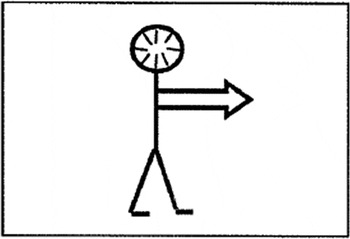
Tyler (Reference Tyler, Robinson and Ellis2008) drew on Sweetser’s (Reference Sweetser1990) explanations of the English modals involving force dynamics and – by implication – embodied experience, to posit visual representations of the semantics of the modals. Where will is concerned (see Figure 1), Tyler represents the meaning as a figure, the actor or mover, who is moving forward; the lines in the figure’s head indicate internal force, volition, or desire. The figure’s double arms are extended forward to represent strong forward momentum and determination. There are no barriers in the figure’s path.
An embodied, force dynamic representation of will reproduced from Tyler (Reference Tyler, Robinson and Ellis2008).

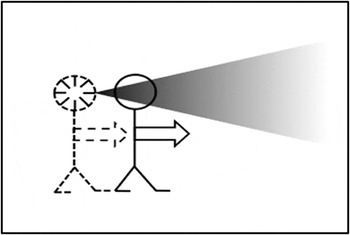
Following Tyler’s (Reference Tyler, Robinson and Ellis2008) model, we propose a systematic representation that captures the meanings of be going to within this general framework for the English modals and periphrastic modals. For the first meaning, prior intention, we represent a ‘ghostly’ actor in the position that precedes the moving figure; the ‘ghostly’ figure represents the intention or planning that precedes the movement, distinguishing between will’s meaning of strong, internally generated determination and be going to’s prior or planned intention (see Figure 2). As explained earlier, walking requires an intentional choice or plan that precedes the physical movement. The category of prior intention corresponds to the source of motion or energy behind it, i.e., the prior decision or plan to walk. Figure 2 illustrates prior intention as the figure in broken lines that precedes the figure in bold lines, where the latter represents the present moment of speaking. The future (represented by the shadowed area) is projected from this prior intention: although not yet realized, it is strongly presumed, and it provides a central sense that is relevant in the description of all usage types of be going to.
Prior intention.

As explained earlier, prior intention is an inherent part of the human embodied experience of walking. It is this inherent meaning that makes sentences such as the one in (16) sound ungrammatical or unacceptable (after Catasso, Reference Catasso2012).
-
(15) a. I can’t stand cigarette smoke.
b. Oh, I’ll stop smoking this cigarette.
-
(16) a. I can’t stand cigarette smoke.
-
b. *Oh, I am going to stop smoking this cigarette.
Such usage, where intention does not originate prior to the time of speaking, is acceptable with will but not be going to.
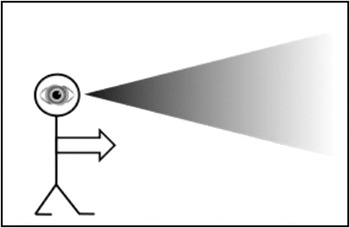
The second meaning is that of imminence, where future is presented as near and immediate. If we were to think of an actor in the midst of walking towards a goal, the actor will have a clearer perception of a target than when he started. As one physically approaches the goal, objects, states of affairs, or events that were distal are seen to be nearer, thus providing physical signs of the successful end of the action approaching. As the actor navigates through the physical world, more immediate evidence in the environment becomes visible or more clearly apprehended. Figure 3 illustrates the meaning of imminence (based on observation of cues), where the observed, tangible, and physical clues are represented by the eye in the actor’s head.
Imminence.

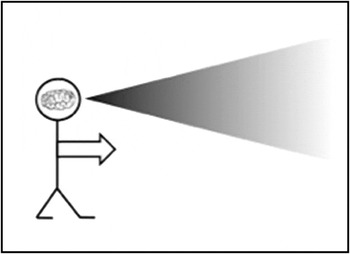
The third meaning attributed to be going to is the meaning of assumption. This meaning is similar to that of imminence in that the two categories draw on clues and signs to the future state of affairs. Brisard (Reference Brisard2001) argues that the primary difference between the two lies in the type of clues available. In the case of imminence, the cues are, for the most part, immediately present in the environment. In contrast, in the case of assumption, the cues stem from the conceptual knowledge in the mind of the speaker. In both cases, evidence is a resource on which the speaker draws conclusions about the future and assumes the interlocutor is likely to reach the same conceptualization. If one has walked a route numerous times, a set of memories or conceptualizations about what to expect are built up. For instance, if one walks a route that often has lots of traffic, one learns to take care when crossing the road. Even on a particular day when the traffic is light and one does not have the immediate auditory and visual cues of oncoming traffic, one continues to be alert and assume, based on past experience and conceptual knowledge, that caution is necessary. Not-yet-encountered traffic is likely to appear. Thus, a store of conceptual knowledge related to walking various paths is experientially correlated with the walk cycle. Figure 4 illustrates the notion of conceptual clues that project the future state. The source of this projection is the mind of the conceptualizer.
Assumption.

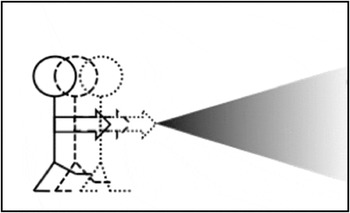
The last meaning associated with be going to is that of inevitability. It is represented by the progression of the leg movement in the walking action. As discussed above, once the walk cycle is started, certain movements, like the swinging of the arm and the placement of the raised foot back on the ground, are inevitable. With this meaning, the future is represented as proceeding with a very high degree of certainty and force. Figure 5 illustrates this meaning.
Inevitability.

In this series of overlapping figures, the first figure is in solid lines and is depicted with one leg raised; this is the first physical stage of the walk cycle. The second figure is in dashed but bolded lines, representing the inevitable, very near future motion that immediately follows the initial action. Note that the lifted leg is descending relative to the height of the leg in the initial position. The third figure is in dashed, unbolded lines, indicating a position in a slightly more removed future. Here the leg is in contact with the ground; the first half of the walk cycle is completed. The overlapping of the three figures indicates that the action is continuous.
Under our analysis, then, the overall meaning of futurity associated with be going to comes from the information supplied by the full construction that the actor is in the midst of an action (signaled by the imperfective/progressive) of forward motion involving the entire body (signaled by the lexical unit go ‘walk’) towards a goal (signaled by to). In many cases, the not-yet-realized goal will be a not-yet-realized action, event, or state. When part of a usage-event, this compositionally formed meaning strongly invites the inference that the goal (or action, event, or state) is highly likely to be reached at some later time, i.e., the future. Additionally, the particular subjective stances towards the not-yet-realized event are a set of invited inferences inherent in the embodied experience of walking. In other words, the extended meanings of prior intention, inevitability, imminence, and assumption that distinguish be going to from will all arise from invited inferences inherent in a cognitive model linked to the original lexical item, [ga].
The spirit of this analysis is coherent with Evans (e.g., 2009, 2010, 2014, 2015b) in that it recognizes invited inferences as (nearly) synonymous with the notion of each lexical unit being semantically complex and comprised of multiple cognitive parameters, or semantic atoms. Through pragmatic strengthening, certain of these component semantic elements can be highlighted repeatedly until they are established as independent senses associated with the lexical item. Our analysis also emphasizes embodied experience associated with usage-events as part of the process of semantic extension. This is the missing link in the semantic extension arguments put forward by Bybee et al. (Reference Bybee, Perkins and Pagliuca1994) and Traugott and Dasher (Reference Traugott and Dasher2002). While the declaration of a speaker’s intention to do something involves an important invited inference that accompanies the usage event of uttering a sentence such as I’m going to the store, concomitant with the declared intention is the speaker’s prediction that the intention will be realized. The final step in the establishment of the future markers is that such predictions are regularly realized. Thus, a strong mental association is formed between the act of declaring an intention and concomitantly the actual realization of that intention. Futurity seems to be an invited inference inherent in all usage-events involving the speaker’s declaration of an intentional action. We hypothesize that will developed as the default marker of futurity from the very strong declaration of desire and volition inherent in its central meaning. This suggests that the widely accepted explanation that human understanding of future resides in our experiences of physical/spatial forward motion towards a goal simultaneously taking place in time has been overstated (e.g., Bybee et al., Reference Bybee, Perkins and Pagliuca1994; Evans, Reference Evans2014; Lakoff & Johnson, Reference Lakoff and Johnson1980; Traugott & Dasher, Reference Traugott and Dasher2002). On the other hand, be going to obviously has to do with moving from point A to point B (with point B being highlighted as a goal) and did develop into an important marker of future in English. We have argued that the particular lexical item go developed as the central lexical item in this future construction because the verb originally labeled the particularly salient human action of walking. Thus, we would not deny that some of our human understanding of time, and in particular the future, stems from our embodied experience of moving through space, coupled with an understanding of time elapsing as we move from point A to point B. However, as Evans (Reference Evans2004) elucidated, our conceptualization of time is far more complex and nuanced than this.
Evans’ LCCM model addresses three kinds of polysemy, including what he terms ‘inter-lexical polysemy’. His groundbreaking (2010) chapter makes the first persuasive case for the need to recognize and account for the phenomenon of two (or more) lexical items developing broadly overlapping meanings that are nevertheless distinguished in subtle ways. Under Evans’ analysis, these subtle differences arise from the original parameters of the distinct lexical items. Evans (Reference Evans, Evans and Chilton2010) notes that both in and on have developed extended ‘state senses’, as in Chuck’s in love and The police are on high alert. However, corpus data shows that the two prepositions occur with a distinct set of collocates and the nuances of the states indicated by in are distinct from those indicated by on. He further argues that the semantic distinctions can be traced to the distinct parameters of the cognitive models associated with the original spatial/functional meanings of the two prepositions. We argue that will and be going to are also examples of inter-lexical polysemy. They both share a general meaning of future; however, close examination reveals that, in the majority of cases, the two forms have subtle differences in meaning. Moreover, these differences in meaning can be traced back to differences in the original meanings (or the original cognitive models) associated with the lexical items.
5. Conclusion
In the course of this paper we have shown that the range of meanings of futurity that will and be going to express can be explained in a systematic, motivated way when embodied experience forms the basis of the analysis. In spite of a high degree of grammaticalization, both constructions still retain shadings of their original meanings. Will’s original meaning of strong desire and volition is clearly on display with its volitional uses. The extension to neutral, scheduled future has been argued to be a motivated semantic extension based on embodied experience and invited inferences of intention and prediction included in a speaker’s declaration, as well as entrenched experiential links between an actor regularly having strong volition to accomplish some goal and the actual realization of that goal. The historical origin of go, with its meaning of ‘walk’, combined with the other components that make up the construction, explain how futurity became associated with be going to. Our analysis offers further evidence of the central role of human embodied experience in informing semantic extensions. Force dynamics of the walk cycle as a planned, intentional motion undertaken by a volitional agent were extended from their original domain of motion to the linguistic expression of futurity to mean (1) future based on prior intention, (2) imminent future based on physical clues, (3) strong assumption about the near future based on conceptual clues, and (4) future as inevitable. The analyses of these constructions, which is based on embodied experience involving force dynamics and barriers to forward motion, places them squarely within the general framework proposed by Sweetser (Reference Sweetser1990) and Tyler (Reference Tyler, Robinson and Ellis2008) for all English modal verbs.
We have further argued that these two future forms illustrate Evans’ (Reference Evans, Evans and Chilton2010, Reference Evans2014, Reference Evans2015b) notion of inter-lexical polysemy and generally provide support for LCCM theory. As predicted by LCCM theory, two distinct lexical units developed extended meanings that overlap in a general conceptual field (in this case a general, neutral, scheduled future), but remain distinguished by nuanced differences in many of their uses. This is analogous to Evans’ (Reference Evans, Evans and Chilton2010) discussion of the state senses of in and on.
Finally, the analysis refines previous discussions of the grammaticalization process of both future forms (Bybee et al., Reference Bybee, Perkins and Pagliuca1994; Evans & Green, Reference Evans and Green2006; Traugott & Dasher, Reference Traugott and Dasher2002) by noting that the understanding that motion is taking place in time is inherited from the higher, more abstract schema for verb, which is defined by Langacker (Reference Langacker1991) as denoting a process that unfolds through time. The key notions of intention and prediction, which would seem to be closely tied to ‘future’, are part of the usage-event of a speaker stating she (or someone else) is about to do something, and thus are part of all speech events in which a speaker declares she (or someone else) is about to do something. The important experiential link between prediction and future is the regular, successful actualization of the declared, intended event or action. We hypothesize that the cross-linguistic tendency for words of general forward motion, such as come/go, to become future markers lies in the particularly high saliency of moving one’s entire body from point A to point B. The fact that in English the construction for forward motion that involves the lexical item go with imperfective and allative markers developed into the future construction be going to has its etymological roots in the lexical label for ‘walk’ highlights the unique, embodied saliency of the act of walking for human beings. An important future step in this analysis would be to seek out cross-linguistic evidence for similar grammaticalization paths with verbs of walking. One place to start might be a re-examination of the data analyzed by Bybee et al. (Reference Bybee, Perkins and Pagliuca1994) to determine if many of the verbs of general motion they studied also had their origin in words for ‘walk’.
APPENDIX
English modal verbs (Tyler, Reference Tyler, Robinson and Ellis2008)
Past tense indicates a weakened force of the utterance and less surety on the part of the speaker (move from realis/here& now to irrealis or there/then). Present tense is indicated by solid lines; past tense is indicated by dotted lines.