INTRODUCTION
Dirivultidae Humes & Dojiri, Reference Humes and Dojiri1980a is a primitive family of siphonostomatoid copepods whose species have been collected in large numbers from vent fields in the Atlantic and Pacific Oceans (Humes & Segonzac, Reference Humes and Segonzac1998; Ivanenko & Defaye, Reference Ivanenko, Defaye, Desbruyères, Segonzac and Bright2006a; Gollner et al., Reference Gollner, Ivanenko, Martínez Arbizu and Bright2010; Ivanenko et al., Reference Ivanenko, Ferrari, Defaye, Sarradin and Sarrazin2011). Although specimens of the type species Dirivultus dentaneus Humes & Dojiri, Reference Humes and Dojiri1980a were described from a vestimentiferan not specifically associated with a hydrothermal vent field, species of dirivultids are now considered endemic to deep-sea hydrothermal vent ecosystems. Including the actions proposed in this paper, Dirivultidae currently consists of 51 species in 13 genera: 6 genera (Chasmatopontius Humes, Reference Humes1990, Fissuricola Humes, Reference Humes1987, Humesipontius Ivanenko & Ferrari, Reference Ivanenko and Ferrari2003a, Nilva Humes, Reference Humes1987, Rimipontius Humes, Reference Humes1996 and Scotoecetes Humes, Reference Humes1987) are monotypic; the genera Benthoxynus Humes, Reference Humes1984, and Dirivultus Humes & Dojiri, Reference Humes and Dojiri1980a each contain 2 species, Exrima Humes, Reference Humes1987 and Rhogobius Humes, Reference Humes1987 have 3 species; Ceuthoecetes Humes & Dojiri, Reference Humes and Dojiri1980b, Aphotopontius Humes, Reference Humes1987, Stygiopontius Humes, Reference Humes1987 have 4, 10 and 21 species, respectively. Studies over the last decade have extended our knowledge of Dirivultidae beyond descriptions of adults. All copepodid stages have been reported in plankton over hydrothermal vents (Ivanenko, Reference Ivanenko1998); a non-feeding lecithotrophic nauplius was described (Ivanenko et al., Reference Ivanenko, Martínez Arbizu and Stecher2007); their feeding behaviours have been observed (Heptner & Ivanenko, Reference Heptner and Ivanenko2002) and their spatial distributions were studied on different substrates from the Juan de Fuca Ridge of the north-east Pacific Ocean and East Pacific Rise at 9°N (Tsurumi et al., Reference Tsurumi, Graaf and Tunnicliffe2003; Gollner et al., Reference Gollner, Zekely, Govenar, Le Bris, Nemeschkal, Fisher and Bright2007). The distributional range of the family appears to extend as far as 5°S on the Mid-Atlantic Ridge (Ivanenko et al., Reference Ivanenko, Martínez Arbizu and Stecher2006).
In this paper, a new species of the genus Exrima is described, and the taxonomic status of four species is revised. One species of Aphotopontius and two of Stygiopontius are synonymized, and one species of Aphotopontius is transferred to Rhogobius. A key is provided for the genera of Dirivultidae. A number of unknown dirivultid copepodids at stage 1, as well as lecithotrophic nauplii identified tentatively as dirivultids, are reported from the sediment trap samples deployed in the vicinity of hydrothermal vent communities of the East Pacific Rise (13°N). After publications of Humes (Reference Humes1999a–Reference Humesc), this is the fourth paper describing new species of copepods from hydrothermal vents of the eastern Pacific (Ivanenko & Ferrari, Reference Ivanenko and Ferrari2003a; Ivanenko & Defaye, Reference Ivanenko and Defaye2006b; Gollner et al., Reference Gollner, Ivanenko and Martínez Arbizu2008).
MATERIALS AND METHODS
The copepods of the new species from the East Pacific Rise, 13°N were collected in 1999 by sediment traps that were deployed during the HOPE cruise and recovered two months later during the AMISTAD cruise on the research vessel (RV) ‘L'Atalante’. Four specially designed traps (PPS 10, PPS 20, PPS 30 and PPS 40) were anchored over the bottom, in close proximity to hydrothermal vents to collect detrital particles and small planktonic organisms. Experiment setting details are given in Table 1. The sediment trap samples were automatically fixed daily in flacons filled with a solution of NaCl, DMSO and bromophenol blue.
Sediment trap experiment settings on the East Pacific Rise, 13°N. All traps were deployed during the HOPE cruise and recovered during the AMISTAD cruise on the RV ‘L'Atalante’.

The copepods were studied using the ‘hanging drop method’ of Humes & Gooding (Reference Humes and Gooding1964) as modified by Ivanenko & Defaye (Reference Ivanenko and Defaye2004). All measurements and dissections were made in lactic acid. Dissections were made under a Leica MZ8 dissecting microscope. Prior to examination with a compound light microscope, Leica DMLB, specimens were cleared in lactic acid and stained in a solution of chlorazol black E. Prepared specimens were examined with bright-field or differential interference contrast optics. Drawings were made with a camera lucida. The holotype was mounted on a slide in glycerol for long-term preservation and sealed with Eukitt (O. Kindler GmbH & Co). Descriptive terminology is from Ivanenko et al. (Reference Ivanenko, Ferrari and Dahms2008); homologies of limb segments follow Ferrari & Ivanenko (Reference Ferrari and Ivanenko2008).
RESULTS
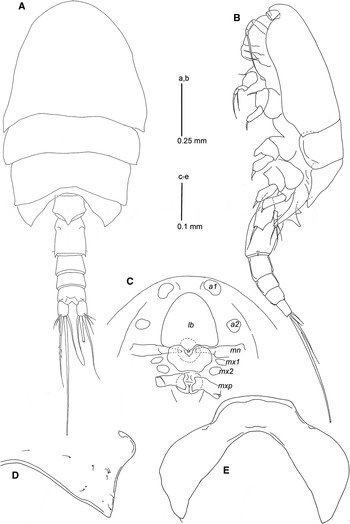
Holotype female of Exrima walteri sp. nov. (A) Habitus, dorsal; (B) habitus, lateral; (C) anterior part of prosome, ventral; (D) right side of tergite of somite bearing swimming leg 3, dorsal; (E) tergite of somite bearing swimming leg 4, dorsal. a1, antennule; a2, antenna; mn, mandible; mx1, maxillule; mx2, maxilla; mxp, maxilliped; lb, labrum.

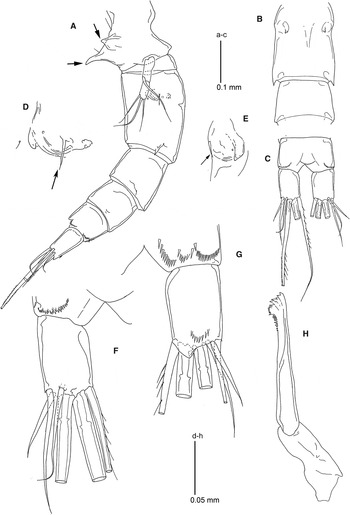
Holotype female of Exrima walteri sp. nov. (A) Urosome, lateral, arrow to ventral and right lateral conical projections; (B) genital double-somite and abdominal somite, dorsal; (C) anal (last abdominal) somites and caudal rami, dorsal; (D) right genital aperture, lateral, arrow to seta of leg 6; (E) left genital aperture, dorsal, arrow to seta of leg 6; (F) left caudal ramus, dorsal; (G) left caudal ramus, ventral; (H) mandible, lateral.

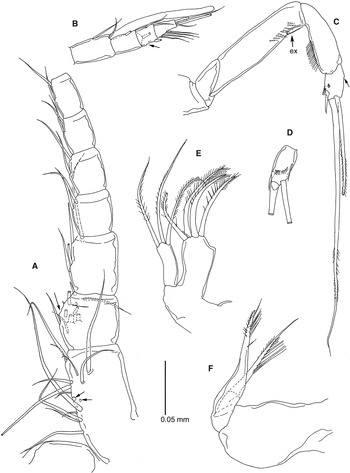
Holotype female of Exrima walteri sp. nov. (A) First 7 segments of antennule, dorsal, arrows to missing setae; (B) distal 4 segments of antennule, dorsal, arrow to missing seta; (C) antenna, arrow to missing seta, ex – exopodal seta; (D) distal endopodal segment of antenna; (E) maxillule; (F) maxilla.

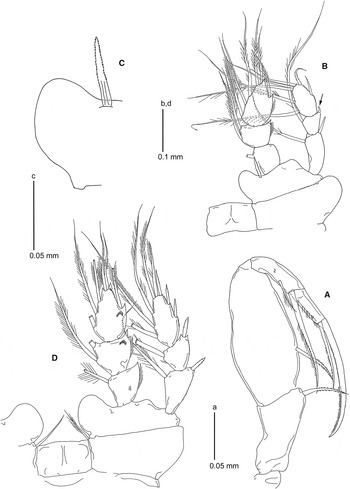
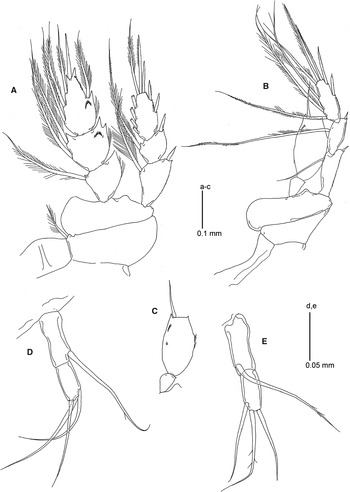
Holotype female of Exrima walteri sp. nov. (A) Maxilliped, posterior; (B) swimming leg 1, anterior, arrow to curved seta; (C) inner seta on basis of leg 1, anterior; (D) swimming leg 2, anterior.

Holotype female of Exrima walteri sp. nov. (A) Swimming leg 3, anterior; (B) swimming leg 4, anterior; (C) endopod of swimming leg 4, anterior; (D) leg 5, lateral; (E) leg 5, dorsal.

TYPE MATERIAL
Holotype adult female (MNHN-Cp2553) dissected and mounted on sealed glycerol slide; paratype adult female (MNHN-Cp7870) preserved in 70% ethanol deposited in the Muséum National d'Histoire Naturelle, Paris (MNHN).
TYPE LOCALITY
East Pacific Rise, site Parigo, 12°48.61′N 103°56.42′W, 10 m to the west and 2 m above the bottom, depth 2625 m. Collected in sediment trap PPS 10 (holotype—trap PPS 10, flacon A10, paratype—trap PPS 10 and flacon A4) deployed during HOPE cruise and recovered during AMISTAD cruise.
ADDITIONAL MATERIAL EXAMINED
East Pacific Rise, cruise PHARE (RV ‘L'Atalante’, remotely operated vehicle (ROV) ‘Victor 6000’): adult female (MNHN Cp7867), dive 167-19, suction sampler 4 (ASPI4), 28 May 2002, site PP-Ph08, 12°49.0760′N 103°56.5660′W, 2623 m; adult female (MNHN Cp7868), dive 167-21, small sampling box 2 (PBT2), 30 May 2002, site PP-Ph09, 12°48.6240′N 103°56.3950′W, 2624 m; 2 adult females (MNHN Cp7869), 164-16, PBT2, 25 May 2002, site PP-Ph12, 12°48.6330′N 103°56.4290′ W, 2623 m. All specimens were preserved in 70% ethanol.
ETYMOLOGY
The specific epithet is derived from the family name of T. Chad Walter at the Smithsonian Institution's National Museum of Natural History, Washington, DC who substantially contributed to the development of digital information on Copepoda.
Holotype female
Body (Figure 1 A, B) cyclopiform, elongate. Total length (body plus caudal ramus), excluding caudal setae, 1.52 mm; greatest width 0.53 mm. Shield of cephalothorax and tergites of following three somites pointed posteriorly (Figure 1 B, D, E). Urosome 5-segmented (Figures 1A, B & 2A–C): anterior somite bearing leg 5, genital double-somite and three abdominal somites (last is the anal somite). Anterior somite with one dorsal and two lateral conical extensions (Figure 2A). Genital double-somite (posterior thoracic somite fused to anterior abdominal somite) with spine-like lateral projections near posterior edge; gonopores lateral on the anterior half of the somite, copulatory pores ventral to the gonopores (Figure 2 A, B, D, E). Anal somite bearing caudal rami ornamented with rows of denticles on ventral and dorsal sides near the posterior edge; anal opening dorsal near the posterior margin.
Rostrum (Figure 1 B, C) rounded, slightly pronounced ventrally, fused with shield of cephalothorax.
Oral cone (Figure 1 B, C) short and robust, its opening formed by labrum and labium.
Caudal ramus (Figure 2 F, G) with six setae and a row of flattened denticles on ventral side near the posterior edge; two lateral setae in distolateral position; innermost terminal seta with denticles on inner side.
Antennule (Figure 3 A, B) 11-segmented. Proximal segment longest with fifteen medial setae of unequal lengths. Segment 2 with twelve medial setae, two setae small. Segment 3 with a pair of setae near mid-length and a pair distally. Segments 4–7 with two setae, one seta near mid-length, second seta near distal edge. Segment 8 with one seta at mid-length and one seta and one aesthetasc near distal edge. Segment 9 with one mid-length and one distal seta; segment 10 with mid-length and distal pair of setae each medially and laterally. Distal segment with four lateral setae and three setae and one aesthetasc terminally. All setae smooth.
Antenna (Figure 3C, D): small coxa without ornamentation, lateral margin of elongate basis with row of slender denticles. Exopod small, 1-segmented, with one smooth terminal seta. Endopod 2-segmented; proximal segment elongate, with row of slender denticles on outer margin, without setae; distal segment short bearing four setae, lateral margin with one seta and a row of denticles, two elongate terminal setae with setules.
Mandible (Figure 2H): gnathobase stylet-like, flattened distally, with terminal teeth of unequal size and a row of small teeth on distal margin.
Maxillule (Figure 3E): coxal endite bearing one short and four stout, long setae; basis with three long setae; all long setae with setules.
Maxilla (Figure 3F): syncoxa flattened, with long seta with setules on coxal endite; basis elongate with apical denticles.
Maxilliped (Figure 4A) 4-segmented, syncoxa and basis each with inner seta with setules. Proximal endopodal segment complex with two very short posterio-proximal and two long unequal posterio-distal setae with setules; distal segment with denticles and two terminal setae, one longer and thicker with serrate inner margin.
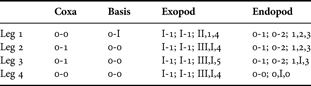
Swimming legs 1–4 (Figures 4B–D & 5A–C) with 3-segmented rami except for leg 4 with 2-segmented endopod (Figure 5C). Margin of basis expanded medially and distally on swimming legs 1–3, and medially in swimming leg 4. Distal endopodal segments of legs 1–4 wider than exopodal, with denticles as shown in figures. Basis of leg 1 armed with stout inner spine-like seta (Figure 4B). Leg 4 (Figure 5B, C): inner seta of proximal segment of exopod smooth; terminal seta of distal endopodal segment near medial edge of broad terminal margin. Formulae for armature of legs in Table 2.
Formula for the armature of legs 1–4 of female of Exrima walteri sp. nov. (Copepoda: Siphonostomatoida: Dirivultidae). Roman numerals indicate spines, Arabic numerals, setae.
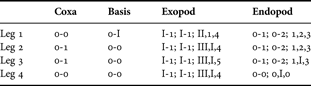
Leg 5 (Figures 1A & 5D, E) 2-segmented, first segment with one lateral seta; second segment with one lateral and two terminal setae.
Leg 6 (Figure 2 D, E): bud on the anterior half of genital double-somite with one lateral seta.
Colour of living specimens unknown.
Egg sacs not observed.
Male
Unknown.
REMARKS
The new species belongs to the genus Exrima that is determined by the combination of the following features partly shown in the newly designed key to the genera of Dirivultidae: female urosome with five abdominal somites including anal somite (Chasmatopontius with three abdominal somites including anal somite); rostrum weakly developed (projecting anteriorly in Dirivultus); caudal ramus with six setae (five setae on Rimipontius); proximal fifteen setae on female antennule on one segment (on two segments in Ceuthoecetes and Nilva); three segments in Chasmatopontius, Stygiopontius and Fissuricola; three or eight segments in Benthoxynus (see Humes, Reference Humes1989a); antennal exopod of female has a simple seta (1-segmented on all other genera); distal antennal endopod with one terminal seta long and slender (modified to claw in Ceuthoecetes, Dirivultus and Nilva); 2-segmented maxilla (3-segmented in Dirivultus or vestigial in Fissuricola) with syncoxa bearing seta on coxal endite (seta absent in Ceuthoecetes, Dirivultus, Nilva, and Rhogobius); endopod of swimming leg 4 is 2-segmented (endopod absent in Humesipontius); setal formula of leg 4 endopod: 0-0; I-0 (0-1; I-1 in Aphotopontius and Rhogobius and 0-0; I-1 in Ceuthoecetes, Dirivultus, Nilva, Scotoecetes, and Stygiopontius and 0-1; I-3 in Fissuricola and 0-0; 0-3 in Chasmatopontius).
The derived features of the new species Exrima walteri sp. nov. that clearly distinguish it from two congeners (E. singula Humes, Reference Humes1987 and E. dolichopus Humes, Reference Humes1987; both from the East Pacific Rise) are: three stout conical extensions (one dorsal and two lateral) on the first urosomite (E. singula and E. dolichopus without extensions); broad distal endopodal segment of swimming leg 4 (simple, cylindrical on E. singula and E. dolichopus).
KEY FOR THE GENERA OF THE DIRIVULTIDAE*
1. Urosome 4-segmented on female, 5-segmented on male . … … … … … … … … … … … … … … … Chasmatopontius
— Urosome 5-segmented on female, 6-segmentedon male … … … … … … … … … … … … . … . 2
2. Endopod of leg 4 absent … … … … … . . Humesipontius
— Endopod 2-segmented … … … … … … … … … . . .3
3. First segment of endopod of leg 4 unarmed (0-0) … … . 4
— First segment of endopod of leg 4 with 1 medial inner seta (0-1) … … … … … … … … … … … … … … … … … … … … 5
4. Second endopodal segment of leg 4 with one terminal spine-like seta (I, 0) … … … … … … … … … … … . 11
— Second endopodal segment of leg 4 with terminal spine-like seta and medial seta (I, 1) … … … … … 7
5. Second endopodal segment of leg 4 with two elements (I, 1 or 1,1) … … … … … … … … … … … … … … … 6
— Second endopodal segment of leg 4 with four elements (I, 3) … … … … … … … … … … … … Fissuricola
6. Coxal endite of maxilla with 1 medial inner seta . … … … … … … … … … … … … … … … … … … . … … .. . . … … … … … … … … … … … … . . Aphotopontius
— Coxal endite of maxilla without media seta . … … … … … … … … … … … … … … … … . Rhogobius
7. Coxal endite of maxilla with a medial inner seta . … … … 8
— Coxal endite of maxilla without 1 medial inner seta . … … … 9
8. Female leg 1 endopod 2-segmented, a terminal seta turned inward … … … … … … … … … … … … Scotoecetes
— Female leg 1 endopod 3-segmented, terminal seta not so turned … … … … … … … … … … . Stygiopontius
9. Genital complex with lateral hump … … … … … . Nilva
— Genital complex without lateral hump … … … … 10
10. Rostral area projecting anteriorly, oral cone with posteriorly directed dentiform spines … … … … … … … … … … … … … … … … … … … … . Dirivultus
— Rostral area not prominent, oral cone without posteriorly directed dentiform spines … … … … … … … … … … … … … … … … … … … …Ceuthoecetes
11. ♀ leg 5 2-segmented; first exopodal segment of leg 3 with medial seta … … … … … … … … … … … … … 12
— ♀ leg 5 a small lobe; first exopodal segment without medial seta … … … … … … … … … Benthoxynus
12. Caudal ramus with six setae … … … … … … . Exrima
— Caudal ramus with five setae … … … … … … … … … … … … … … … … … … … . Rimipontius
*The key is based on the differential diagnoses of genera by Ivanenko & Defaye (Reference Ivanenko, Defaye, Desbruyères, Segonzac and Bright2006a).
TYPE MATERIAL EXAMINED
Paratypes of Aphotopontius atlanteus: 10 adult ♀ in ethanol (USNM 268308), 3 adult ♀ (USNM 1099033) on sealed glycerol slide, Mid-Atlantic Ridge, 37°20′N 32°17′W, site Lucky Strike, 1636 m.
Types of Aphotopontius temperatus: holotype ♀ in ethanol (USNM 285469), 10 paratypes ♀ in ethanol (USNM 285471), 5 paratypes ♀ in ethanol (USNM 1098821) on sealed glycerol slide, Mid-Atlantic Ridge, site Lucky Strike, 37°17′N 32°16′W, 1688 m.
ADDITIONAL MATERIAL EXAMINED
Mid-Atlantic Ridge, 37°N, site Lucky Strike, Tour Eiffel edifice, 1690 m, cruises EXOMAR (July–August 2005; RV ‘L'Atalante’) and MoMARETO (August–September 2006, RV ‘Pourquoi pas?’), ROV ‘Victor 6000’. The copepods were collected by small sampling box (PBT) or suction sampler (ASPI) within faunal assemblages of Bathymodiolus azoricus; temperature varied between 4.8 and 8.8°C (De Busserolles et al., Reference De Busserolles, Sarrazin, Gauthier, Gelinas, Fabri, Sarradin and Desbruyères2009): 11 ♀, 1 ♂, MoMARETO, dive 303, ASPI1; 16 ♀, 1 ♂, 105 copepodids stage V (♀), 1 copepodids stage V (♂), 4 copepodid stage IV, MoMARETO, dive 303, PBT2, chain 1; 1 ♀, 15 ♂, 74 copepodids stage V (♀), 1 copepodids stage V (♂), 2 copepodid stage IV, MoMARETO, dive 303, ASPI7, chain 1; 1 ♀, MoMARETO, dive 303, ASPI8, chain 1; 1 ♀, MoMARETO, dive 303, ASPI6, chain 7; 1 ♀, MoMARETO, dive 303, PBT2, chain 1; 1 ♀, MoMARETO, dive 303, PBT4, chain 8; 1 ♀, MoMARETO, dive 303, ASPI4, chain 6; 2 ♀, MoMARETO, dive 303, PBT3, chain 1; 4 ♀, MoMARETO, dive 303, PBT5, chain 10; 17 ♀, MoMARETO, dive 303, PBT2, chain 1; 21 ♀, MoMARETO, dive 303, PBT1, chain 6; 33 ♀, 11 copepodid stage V (♀), MoMARETO, dive 303, PBT3, chain 1; 37 ♀, 22 copepodids stage V (♀), MoMARETO, dive 303, PBT3, chain 1; 103 ♀, 54 copepodids stage V (♀), 1 copepodid stage IV, MoMARETO, dive 303, PBT1, chain 6; 162 ♀, 11 copepodids stage V (♀), MoMARETO, dive 303, PBT1, chain 6; 37 ♂, MoMARETO, dive 304, ASPI3, chain 4; 1 ♀, MoMARETO, dive 304, ASPI6, chain 2; 8 ♀, MoMARETO, dive 304, ASPI4, chain 4; 1 ♀, MoMARETO, dive 304, ASPI5, chain 2; 2 ♀, MoMARETO, dive 04, PBT2, chain 3; 2 ♀, MoMARETO, dive 304, PBT4, chain 2; 4 ♀, 146 copepodid stage V (♀), 8 copepodid stage IV, MoMARETO, dive 304, PBT1, chain 4; 108 ♀, 22 copepodids stage V (♀), MoMARETO, dive 304, PBT5, chain 10; 313 ♀, 11 copepodid stage IV, MoMARETO, dive 304, PBT2, chain 3; 313 ♀, MoMARETO, dive 304, PBT2, chain 3; 492 ♀, 11 copepodid stage V (♀), MoMARETO, dive 304, PBT1, chain 4; 21 copepodid stage V, 1 copepodid stage IV, MoMARETO, dive 304, PBT4, chain 2; 60 ♂, MoMARETO, dive 305, ASPI2, chain 11; 253 ♀, 134 ♂, MoMARETO, dive 305, ASPI3, chain 5; 13 ♀, MoMARETO, dive 305, PBT3, chain 12; 1 ♀, MoMARETO, dive 305, PBT4, chain 5; 2 ♀, MoMARETO, dive 305, ASPI1, chain 11; 2 ♀, MoMARETO, dive 305, PBT5, chain 11; MoMARETO, dive 305, PBT5, chain 11; 1 ♀, MoMARETO, dive 306, ASPI1, chain 9; 1 ♂, EXOMAR, dive 252, PBT1; 5 ♂, EXOMAR, dive 253, ASPI2, chain 2; 5 ♂, EXOMAR, dive 253, ASPI3, chain 2; 7 ♂, EXOMAR, dive 253, ASPI4, chain 5; 9 ♂, EXOMAR, dive 253, PBT1, chain 5; 1 ♀, 13 ♂, EXOMAR, dive 253, PBT1, chain 2; 22 ♂, MoMARETO, dive 305, PBT2. All specimens were preserved in 70% ethanol and stored in Ifremer.
PREVIOUS REPORTS
Mid-Atlantic Ridge: 37°N, sites Lucky Strike and Menez Gwen (Humes, Reference Humes1996, Reference Humes1997; Humes & Segonzac, Reference Humes and Segonzac1998); 14°N, Logatchev hydrothermal field (Ivanenko et al., Reference Ivanenko, Martínez Arbizu and Stecher2006).
REMARKS
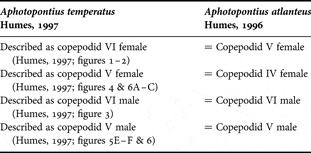
Aphotopontius atlanteus Humes, Reference Humes1996 is found in hydrothermal vent communities throughout the Mid-Atlantic Ridge, and apparently is a widespread species. The adult female of A. atlanteus has an urosome of five apparent somites. Leg 6 is a bud with two setae located laterally in the middle of the second somite (Humes, Reference Humes1996; Figure 5C, D); this location suggests that the genital somite has fused to the anterior abdominal somite to form the genital complex of the adult female. The adult female of A. temperatus has an urosome of five apparent somites but second somite lacks genital openings; leg 6 is a bud with 1 seta located laterally but posteriorly on the second urosomite (Humes, Reference Humes1997; Figure 1B, C). This location of leg 6 and the absence of genital openings suggest that the genital somite has not yet fused with the anterior abdominal somite to form a genital complex. This fusion will take place during the molt to the copepodid VI (adult female). The adult female of A. temperatus appears to be a copepodid V female of A. atlanteus (Table 3).
Reassignment of copepodid stages reported as Aphotopontius temperatus Humes, Reference Humes1997 but now considered A. atlanteus Humes, Reference Humes1996 (Copepoda: Siphonostomatoida: Dirivultidae).

Specimens reported as copepodid V females of A. temperatus have an urosome of 4 apparent somites and also lack genital openings (Humes, Reference Humes1997; Figure 4B–D). The rami of the swimming legs 1–4 on these specimens are 2-segmented (Humes, Reference Humes1997; Figures 4H & 5A–C); leg 6 is a bud with 1 seta located medially and posteriorly on the second somite (Humes, Reference Humes1997; Figure 4C, D). This location, the number of urosomites and the segmentation of swimming leg rami suggest that these specimens are copepodid IV of A. atlanteus (Table 3).
The original description of A. temperatus was supplemented with description of the adult male. The adult male of A. temperatus shows no clear distinctions from the described adult male of A. atlanteus. Specimens reported as copepodid V males of A. temperatus have an urosome of five apparent somites and lack genital openings. The rami of swimming legs 1–4 are 3-segmented; leg 6 is a bud with two setae located medially and posteriorly on the second urosomite. These attributes suggest that the specimens are copepodid V males of A. atlanteus (Table 3).
Aphotopontius temperatus Humes, Reference Humes1997 was considered as suggested without comment on a junior synonym of A. atlanteus by Ivanenko & Defaye (Reference Ivanenko, Defaye, Desbruyères, Segonzac and Bright2006a). The dorsolateral position of leg 6 on females of copepodid stage V, the usual location on most siphonostomatoid copepodid V females, is ventrolateral (Ivanenko et al., Reference Ivanenko, Ferrari and Smurov2001; Ivanenko & Ferrari, Reference Ivanenko and Ferrari2003b; Ferrari & Dahms, Reference Ferrari and Dahms2007), complicates the separation of the female copepodid V and copepodid VI. The presence of genital openings defines copepodid VI females and males of all copepods. The unusual dorsolateral position of the leg 6 on females of copepodid V also is shared with two species of Stygiopontius considered in this paper and appears to be a derived state at least for these two genera of Dirivultidae. Copepodid VI males of A. atlanteus have been observed in copula with copepodid stage V females (V.N.I., personal observations) and this behaviour may lead to the incorrect identification of copepodid stage V females as copepodid stage VI females (Table 3).
Humes, Reference Humes1987: 724–730, figures 48–50, Ivanenko & Defaye, Reference Ivanenko, Defaye, Desbruyères, Segonzac and Bright2006a: 341.
Stygiopontius lumiger Humes, Reference Humes1989b: 112–113, figures 6–8; Ivanenko & Defaye, Reference Ivanenko, Defaye, Desbruyères, Segonzac and Bright2006a: 341.
TYPE MATERIAL EXAMINED
Paratypes of Stygiopontius sentifer: 10 adult ♀ in ethanol (USNM 231973), 4 adult ♀ (USNM 1099012) on sealed glycerol slide, East Pacific Rise, site Clam Acres, 20°50.0′N 109°06.0′W, 2617 m.
Types of Stygiopontius lumiger: holotype ♀ in ethanol (USNM 233776), 10 paratype adult ♀ in ethanol (USNM 233777), 4 paratype ♀ on sealed glycerol slide (USNM 1099008), East Pacific Rise, site Clam Acres, 20°50.0′N 109°06.0′W, 2616 m.
ADDITIONAL MATERIAL EXAMINED
East Pacific Rise, 13°N, cruise PHARE (May 2002 RV ‘L'Atalante’, ROV ‘Victor 6000’). The copepods were collected by small or large sampling boxes (PBT or GBT; respectively) or with a suction sampler (ASPI) and preserved in 70% ethanol: 16 adult ♀ (MNHN Cp7760), 2 adult ♂ (MNHN Cp7766), 1 subadult ♂ of copepodid V (MNHN Cp7768), dive 149, PBT1, site Elsa, 12°48.1420′N 103°56.3090′W, 2621 m; 4 subadult ♀of copepodid V (MNHN Cp7769), dive 149, PBT1, site Elsa, 12°48.1420′N 103°56.3090′W, 2621 m; 10 adult ♀ (MNHN Cp7722), dive 152, PBT3, site PP-Ph01, 12°48.1460′N 103°56.3080′W, 2621 m; 3 adult ♀ (MNHN Cp7732), dive 153, PBT1, site PP-Ph03, 12°49.3460′N 103°56.6390′W, 2621 m; 18 adult ♀ (MNHN Cp7727), dive 154, PBT2, site PP-Ph01, 12°48.1470′N 103°56.3070′W, 2622 m; 1 adult ♀ (MNHN Cp7718), dive 156, ASPI1, site PP-Ph06, 12°48.1690′N 103°56.3430′W, 2622 m; 7 adult ♀ (MNHN Cp7783), dive 156, ASPI3, site PP-Ph06, 12°48.1670′N 103°56.3430′W, 2622 m; 4 adult ♀ (MNHN Cp7724), dive 157, ASPI1, site PP-Ph06, 12°48.1800′N 103°56.3100′W, 2620 m; 3 adult ♀ (MNHN Cp7721), dive 157, ASPI4, site PP-Ph06, 12°48.1800′N 103°56.3100′W, 2620 m; 7 adult ♀ (MNHN Cp7734), dive 157, PBT1, site PP-Ph06, 12°48.1780′N 103°56.3120′W, 2620 m; 10 adult ♀ (MNHN Cp7858), dive 159, PBT1, site PP-Ph05, 12°48.6180′N 103°56.4390′W, 2621 m; 35 adult ♀ (MNHN Cp7729), dive 159, PBT2, site PP-Ph05, 12°48.6150′N 103°56.4390′W, 2621 m; 3 adult ♀ (MNHN Cp7726), dive 160, PBT1, site PP53, 12°48.5570′N 103°56.4170′W, 2623 m; 3 adult ♀ (MNHN Cp7819), dive 161, PBT1, site PP-Ph03, 12°48.0750′N 103°56.2890′W, 2621 m; 3 adult ♀ (MNHN Cp7818), 1 subadult ♀ of copepodid V (MNHN Cp7781),dive 161, PBT2, site PP-Ph03, 12°48.3340′N 103°56.6420′W, 2621 m; 26 adult ♀ (MNHN Cp7797), dive 162, PBT1, site PP-Ph05, 12°48.5860′N 103°56.3920′W, 2622 m; 1 adult ♀ (MNHN Cp7809), dive 164, ASPI2, site PP12, 12°48.6330′N 103°56.4290′W, 2623 m; 1 adult ♀ (MNHN Cp7715), dive 164, PBT1, site PP12, 12°48.6370′N 103°56.4190′W, 2624 m; 6 adult ♀ (MNHN Cp7717), dive 165, ASPI8, site PP-Ph06, 12°48.1790′N 103°56.3080′W, 2621 m; 1 adult ♂ (MNHN Cp7817), dive 166, ASPI1, site PP-Ph08, 12°49.0770′N 103°56.5550′W, 2621 m; 1 adult ♂ (MNHN Cp7751), 6 subadult ♀of copepodid V (MNHN Cp7800), dive 166, ASPI2, site PP55, 12°49.8580′N 103°56.8110′W, 2627 m; 2 adult ♀ (MNHN Cp7763), dive 166, ASPI3, site PP55, 12°49.8590′N 103°56.8110′W, 2626 m; 38 adult ♀ (MNHN Cp7761), 1 adult ♂ (MNHN Cp7762), 1 subadult ♀ of copepodid V (MNHN Cp7772), dive 166, ASPI4, site PP55, 12°49.8600′N 103°56.8080′W, 2627 m; 7 adult ♀ (MNHN Cp7805), dive 166, ASPI5, site PP55, 12°49.8510′N 103°56.8050′W, 2626 m; 3 adult ♀ (MNHN Cp7845), dive 166, ASPI6, site PP55, 12°49.8470′N 103°56.8050′W, 2626 m; 21 adult ♀ (MNHN Cp7810), dive 166, ASPI7, site PP55, 12°49.9940′N 103°56.5970′W, 2627 m; 28 adult ♀ (MNHN Cp7851), 2 adult ♂ (MNHN Cp7853), dive 166, ASPI8, site PP55, 12°49.8540′N 103°56.8050′W, 2627 m; 29 adult ♀ (MNHN Cp7839), 1 subadult ♀of copepodid V (MNHN Cp7847), dive 166, PBT3, site PP55, 12°49.8550′N 103°56.7830′W, 2627 m; 4 adult ♀ (MNHN Cp7798), 1 adult ♂ (MNHN Cp7801), dive 167, ASPI4, site PP-Ph08, 12°49.0760′N 103°56.5660′W, 2623 m; 6 adult ♀ (MNHN Cp7848), 1 adult ♂ (MNHN Cp7850), dive 167, ASPI5, site PP-Ph08, 12°49.0760′N 103°56.5640′W, 2623 m; 1 adult ♀ (MNHN Cp7753), dive 167, ASPI8, site PP-Ph08, 12°49.1920′N 103°56.3270′W, 2621 m; 3 adult ♀ (MNHN Cp7846), dive 167, PBT1, site PP-Ph08, 12°49.0790′N 103°56.5520′W, 2623 m; 23 adult ♀ (MNHN Cp7712, MNHN-Cp7719), dive 168, GBT, site PP-Ph01, 12°48.1520′N 103°56.2660′W, 2620 m; 4 adult ♀ (MNHN Cp7794), 1 adult ♂ (MNHN Cp7825), dive 168, PBT1, site PP-Hot3, 12°48.1450′N 103°56.2670′W, 2624 m; 10 adult ♀ (MNHN Cp7791), 1 adult ♂ (MNHN Cp7793), dive 168, PBT3, site PP-Hot3, 12°48.1430′N 103°56.2650′W, 2624 m; 7 adult ♀ (MNHN Cp7827), dive 169, ASPI4, site PP-Ph05, 12°48.6080′N 103°56.4030′W, 2622 m; 2 adult ♀ (MNHN Cp7828), dive 169, ASPI5, site PP-Ph05, 12°48.6220′N 103°56.3890′ W, 2622 m; 2 adult ♀ (MNHN Cp7830), dive 169, ASPI6, site PP-Ph05, 12°48.6220′N 103°56.3890′W, 2622 m; 2 adult ♀ (MNHN Cp7812), dive 169, ASPI7, site PP-Ph05, 12°48.6180′N 103°56.3970′W, 2622 m; 7 adult ♀ (MNHN Cp7833), dive 169, ASPI8, site PP-Ph05, 12°48.6190′N 103°56.3990′W, 2622 m; 1 adult ♀ (MNHN Cp7773), dive 169 PBT2, site PP-Ph09, 12°48.6240′N 103°56.3950′W, 2624 m; 58 adult ♀ (MNHN Cp7788), 2 ♂ (MNHN Cp7832), dive 169, PBT3, site PP-Ph09, 12°48.6310′N 103°56.3970′W, 2624 m.
LOCALITY REPORTED
East Pacific Rise, 9°N, 13°N and 21°N (Humes Reference Humes1987, Reference Humes1989b; Humes & Segonzac, Reference Humes and Segonzac1998; Ivanenko & Defaye, 2006a).
Humes, Reference Humes1987: 723–724, figures 46–47; Ivanenko & Defaye, Reference Ivanenko, Defaye, Desbruyères, Segonzac and Bright2006a: 341, figure 2.
Stygiopontius bulbisetiger Humes, Reference Humes1996: 641–644, figures 21–22; Ivanenko & Defaye, Reference Ivanenko, Defaye, Desbruyères, Segonzac and Bright2006a: 341.
TYPE MATERIAL EXAMINED
Paratypes of Stygiopontius pectinatus: 10 adult ♀ in ethanol (USNM 231969), 4 adult ♀ (USNM 1098834) on sealed glycerol slide, Mid-Atlantic Ridge, site TAG, 26°08.3′N 44°49.6′W, 3620–3650 m. Types of Stygiopontius bulbisetiger: holotype ♀ in ethanol (USNM 268320), 1 ♀ (USNM 1099005) on sealed glycerol slide, Mid-Atlantic Ridge, site Snake Pit, 23°23′N 44°56′W, 3520 m.
ADDITIONAL MATERIAL EXAMINED
14 adult ♀ from Mid-Atlantic Ridge, cruise EXOMAR (July–August 2005, RV ‘L'Atalante’, ROV ‘Victor 6000’), dive 259, PBT2, 12 August 2005, site TAG, 26°08.2276′N 44°49.5731′W, 3774 m. All specimens were preserved in 70% ethanol and stored in Ifremer.
LOCALITY REPORTED
Marianna Back-Arc Basin (Humes, Reference Humes1990); Mid-Atlantic Ridge: 4°S, 23°N, 26°N and, 29°N (Humes, Reference Humes1987, Reference Humes1996; Ivanenko, Reference Ivanenko1998; Ivanenko et al., Reference Ivanenko, Martínez Arbizu and Stecher2006).
REMARKS
Stygiopontius lumiger Humes, Reference Humes1989b and S. bulbisetiger Humes, Reference Humes1996 known only from females are synonymized respectively with S. sentifer and S. pectinatus as suggested without comment by Ivanenko & Defaye (Reference Ivanenko, Defaye, Desbruyères, Segonzac and Bright2006a). Adult females of S. lumiger and S. bulbisetiger are considered the female copepodid V of S. sentifer and S. pectinatus, respectively. The genital somite of adult females of S. lumiger and S. bulbisetiger lack genital openings and leg 6 is represented by one seta located laterally on the posterior part of the somite. The logic of the analysis follows that for A. atlanteus.
TYPE MATERIAL EXAMINED
Paratype 1 ♀ (USNM 1098800) on sealed glycerol slide, East Pacific Rise, dive 614 (September–November 1991, cruise HERO91, RV ‘Nadir’, manned submersible ‘Nautile’), site Barbecue, 9°50′N 104°17′W, 2505 m.
REMARKS
The species Aphotopontius rapunculus Humes & Segonzac, Reference Humes and Segonzac1998 is here transferred to the genus Rhogobius Humes, Reference Humes1987 because it possesses the hypothesized derived features of this genus: last abdominal somite with lobes at sides of the anal operculum; second segment of the antennal endopod elongate and slender (Ivanenko & Defaye, Reference Ivanenko, Defaye, Desbruyères, Segonzac and Bright2006a). In addition, Rhogobius rapunculus (Humes & Segonzac, Reference Humes and Segonzac1998), as well as its congeners R. contractus and R. pressulus: (1) possesses setal formula of leg 4 endopod (0-1; I) identical to all species of Aphotopontius; and (2) lacks a seta of the coxal endite of the maxilla, an attribute that these species share with all species of Ceuthoecetes, Dirivultus and Nilva, as well as with most copepods of the order Siphonostomatoida (see Mahatma et al., Reference Mahatma, Martínez Arbizu and Ivanenko2008).
NAUPLII AND COPEPODIDS OF DIRIVULTIDAE GEN. SP.
MATERIAL EXAMINED
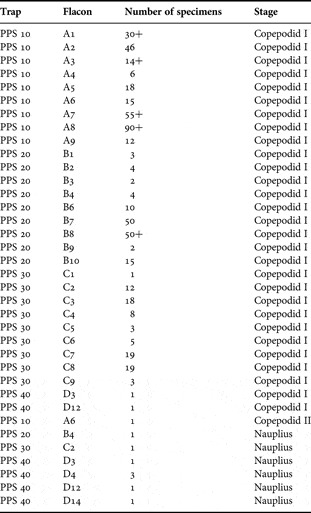
East Pacific Rise, 13°N, sediment trap PPS 10, PPS 20, PPS 30, and PPS 40 deployed during HOPE cruise and recovered during AMISTAD cruise (see Table 1). 516+ copepodids of stage I of Dirivultidae gen. sp. (Copepoda: Siphonostomatoida) in 29 samples obtained by all four sediment traps; 1 copepodid of stage II of Dirivultidae gen. sp. in 1 sample obtained by the sediment trap PPS 10 over Parigo site; 8 nauplii of Dirivultidae gen. sp. in 6 samples obtained by 3 sediment traps: PPS 20, PPS 30 and PPS 40 over sites Genesis and Parigo and seamount ‘Marginal High’ (see Table 4). All specimens were preserved in 70% ethanol and stored in the Muséum National d'Histoire Naturelle, Paris.
Records of subadult copepodid and naupliar stages of Dirivultidae collected in sediment traps at the East Pacific Rise, 13°N. For details of traps' settings see Table 1.

REMARKS
A large number of dirivultid copepodids I and some lecithotrophic nauplii identified as Dirivultidae have been recovered from sediment trap samples from around deep-sea hydrothermal communities of the East Pacific Rise, 13°N. More specimens of dirivultid copepodid I were collected in the sediment traps than any other copepodid stage, including adults, or any other category of invertebrates such as polychaetes, gastropods, amphipods, ostracods, and decapod larvae.
The first record for a dirivultid copepodid I is from the Atlantic Ocean in plankton samples taken over a hydrothermal vent on the Mid-Atlantic Ridge between 2260 and 2280 m at 29°10′N 43° 10′W (Ivanenko, Reference Ivanenko1998). Later lecithotrophic dirivultid nauplii, without labrum or mouth, were hatched in shipboard aquaria from embryo sacs of the female dirivultid Stygiopontius pectinatus Humes, Reference Humes1987 that had been washed from freshly collected specimens of the shrimp Rimicaris exoculata from the Mid-Atlantic Ridge at 5°S (Ivanenko et al., Reference Ivanenko, Martínez Arbizu and Stecher2007). The dirivultid copepodids I were found with a few other juvenile dirivultid copepodid stages and adults of Rimipontius mediospinifer, Stygiopontius cladarus and S. pectinatus. Specimens of copepodid I are characterized by different body lengths, and presumably represent different species of dirivultids. Lecithotrophic nauplii tentatively identified as dirivultids co-occurred with these copepodids.
Specimens of copepodid I and co-occurring nauplii from the East Pacific Rise were found in samples that included several species of adult dirivultids (Exrima walteri sp. nov., Exrima singular, Aphotopontius sp., Stygiopontius sp., Ceuthoecetes sp., Humesipontius arthuri Ivanenko & Ferrari, Reference Ivanenko and Ferrari2003a and Scotoecetes introrsus Humes Reference Humes1987), as well as adult harpacticoids belonging to Tegastidae (Smacigastes sp.) and copepodid I of Cerviniidae, cyclopoids belonging to Cyclopinidae (Barathricola sp.), poecilostomatoids belonging to Oncaeidae (Oncaea cf. praeclara Humes, Reference Humes1988), the mormonilloid Neomormonilla extremata (Ivanenko & Defaye, Reference Ivanenko and Defaye2006b), and adults and copepodid I of Misophriidae (Misophrioida). Remarkably only one copepodid stage 2 and no other subadult stages of Dirivultidae have been observed in the samples collected by the sediment traps. Nauplii were found usually in the sediment traps that were farthest from hydrothermal vents and 50 m above the hydrothermal field. Juvenile copepodids of dirivultids were found in largest numbers in sediment traps that were closest to the hydrothermal field. Our observations and cultivation of shallow water siphonostomatoids suggest that copepodid I of dirivultids may not feed despite possessing a well-developed feeding apparatus if it retains naupliar yolk and moults to copepodid II relatively quickly (Ivanenko et al., Reference Ivanenko, Ferrari and Smurov2001; Ivanenko & Ferrari, Reference Ivanenko and Ferrari2003b). It appears that copepodid I specimens develop from nauplii that occur higher in the water column above the hydrothermal field. The presence of nauplii higher in the water column may happen if females with embryo sacs migrate upward before releasing embryos, although it is also possible that nauplii of dirivultids were insufficiently collected in the sediment traps on which dirivultid copepodid I specimens were found. The absence of juvenile dirivultid copepodids of later stages in the plankton samples over hypothermal fields suggests that copepodid I is either the settlement stage or the stage that associates with sediment flock collected by the sediment traps (Ivanenko et al., Reference Ivanenko, Martínez Arbizu and Stecher2007).
ACKNOWLEDGEMENTS
The authors are indebted to the chief scientists of the cruises HERO91 (chief scientist Daniel Desbruyères), AMISTAD (chief scientist Christian Jeanthon), HOPE99 (chief scientist François Lallier), PHARE (chief scientist Nadine Le Bris), EXOMAR (chief scientist Anne Godfroy), and MoMARETO (chief scientists Jozée Sarrazin and Pierre-Marie Sarradin); the crews of the research vessels ‘Nadir’, ‘L'Atalante’ and ‘Pourquoi Pas?’ and of the manned submersible ‘Nautile’, and the remotely operated vehicle ‘Victor 6000’. The cruises were supported by European programmes AMORES (MAST3 CT 95-0040) and EXOCET/D. Philippe Crassous (Ifremer DEEP) prepared sampling arrays; Patrick Briand (Ifremer DEEP) provided sorted material and data obtained during colonization experiments. This work was supported by grants from the Muséum National d'Histoire Naturelle and Ifremer (France), Smithsonian Institution (USA), the Russian Foundation for Basic Research (09-04-01523-a), and the Ministry of Education and Science of the Russian Federation (02.740.11.0280, Π1291, 02.740.11.0875).