


Introduction
This essay aims to provide a sequel—and a prequel of sorts—to the valuable study published about a decade ago by Inga Kaladze entitled “The Georgian Translation of Vis and Rāmin.” In that article, Kaladze lays out the major thematic features of the text, emphasizes its important place in literary history, both Persian and beyond, and provides an overview of its reception in twentieth-century scholarship, concluding with a note on the thirteenth-century Georgian translation of the poem Visramiani.
Here, I hope to expand our knowledge of Vis and Rāmin on two fronts opened up by Kaladze’s article. First, I will extend her summary of the reception of V&R in the pre-modern Persian tradition, offering a general account of its Nachleben, or afterlife, both in the material and literary sense.Footnote 1 While this topic might seem overly narrow to be of general interest, I believe it is a story worth telling, as it offers a case study through which we can track the practices of literary criticism, selection, and canonization as they evolved over time. More fundamentally, it also invites us to reconsider our working concept of “text,” not as an integral unit to be preserved or forgotten, but a corpus whose parts may be greater than the sum of its whole, so to speak. Following the fortunes of V&R with this concept in mind, we see that it never really “disappears” so much as it is selectively curated along multiple chains of reading, in accordance with the values and interests of its various communities. We might therefore think of our story as an account of the poem’s afterlives—a story of fragments and their generative power.
Following that, I will outline in further detail the most prominent discussions around V&R in modern scholarship. While Kaladze’s study foregrounds the value judgments of twentieth-century critics, usually made on aesthetic or moral grounds, I wish to highlight the capacities in which the poem has been utilized towards the study of literary history, Persianate or otherwise—a question that seems particularly relevant, given her claim that V&R “is one of the first full-fledged examples of a genre of romantic epic that has reached us,” preceding by a century the “European monuments of this genre.”Footnote 2 In what ways has this claim been taken up? Through what lenses has V&R been read, and to what ends? By establishing this groundwork, I hope to offer some ideas about how we might move forward with such a project: if V&R complicates a model of literary history that depends on the movement of single texts, perhaps it can also suggest equally fragmented frameworks of comparative reading that operate beyond the paradigms of translation, transmission, and influence.
“Speech Should Become a Traveler”
Let us begin our study at the moment of the poem’s (re)birth: the year is about 1055 CE; the Seljuk Turks have overthrown the Ghaznavid dynasty and are now pushing westwards in a campaign that will soon penetrate the Byzantine frontier in Anatolia; and Fakhr al-Din Asʿad Gorgāni, a clerk in the service of the Seljuks’ newly installed governor of Isfahan, has just completed his Vis and Rāmin, working from an older “pahlavi” text that had been “compiled by six sages” (ze gerd āvardeh-ye shesh mard-e dānā-st).Footnote 3 His famous prologue, partially cited below, may well be the most scrutinized and analyzed section of the entire work:
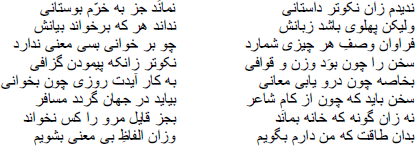
I’ve never seen a finer tale, like nothing but a garden in bloom. But its language is pahlavi, and not everyone who reads it can understand its purport. … It records ample descriptions of every little thing that don’t mean much when you read them. … When speech has rhyme and meter, it is fairer than untempered composition, especially when you find meanings within; [then] when you read, it will benefit you someday. … Once it leaves the poet’s mouth, speech should become a traveler in the world, and not be the kind that stays at home, recited by none but its author. … I’ll tell the story as best I can, and cleanse it of meaningless words.Footnote 4
The most immediately arresting aspect of this passage is of course its tantalizing implication of a Middle Persian source text, long the subject of discussion and debate in modern scholarship.Footnote 5 But what I would like to highlight here is Gorgāni’s modus operandi: as he explains, his main agenda is not preservation but renovation, clearing an old text of its prolix and meaningless elements and rendering it accessible, beautiful, and beneficial to a new generation of readers. Good poetry, he tells us, should become a traveler in the world, where it will be repeated by mouths other than its composer for their pleasure and edification. This image of poetry (sakhon) as a traveler evocatively performs Gorgāni’s expectations of his work: its success is measured not by preservation but by circulation, even if in ways that the original author cannot control or predict. Today, Vis and Rāmin only survives in a handful of manuscripts, leading many scholars to conclude that the poem did not garner much attention (with the important exception of the Caucasus region, where Nezāmi of Ganja lived) and soon fell into obscurity—“a cul-de-sac within Persian culture,” in Davis’ memorable phrase.Footnote 6 As we follow the sources in which V&R is mentioned or cited, however, with attention to their distribution across genre and geography, it appears that the poem had a surprisingly wide circulation in the Persianate world, especially during the initial centuries after its composition; even into the early modern period, traces of its legacy can be found, often along wandering and unexpected avenues.
First Reactions
References to V&R and/or its author begin to surface in the twelfth century, about a hundred years after the poem was completed. The first notice appears in the famous Chahār maqāleh (written circa 550/1155), where the Khorasani critic Nezāmi ʿAruzi names Gorgāni among those poets who immortalized their patron’s name through their verse.Footnote 7 The most suggestive aspect of this citation is that Gorgāni is the only poet on this list who, as far as we know, rose to fame by versifying a romance (rather than panegyric, historical, or didactic material)—perhaps an indication of his contribution to the prestige of the genre as a whole, in an era when the qasideh was still the standard vehicle for establishing one’s reputation as a poet.Footnote 8 Sixty years later, Sadr al-Din Hasan Nezāmi of Neyshapur (fl. 614/1216), a courtier to the kings of Ghur and their Indian clients, included sixty-four lines of V&R in his Tāj al-maʾāser, alongside citations of other major poets like Ferdowsi, ʿOnsori, Farrokhi, Sanāʾi, Masʿud-e Saʿd, and Anvari.Footnote 9 The highest praise for V&R in this period comes out of Lahore, where Mohammad ʿOwfi says of Gorgāni in his Lobāb al-albāb (w. 617/1220):

Fakhr al-Din Gorgāni is among the exemplary poets of the world. His thought, an ocean of pearls of sweet meaning, was the envy of the sea and the deep. His perfection in virtue, beauty in craft, supremacy of intellect, and poetic taste are revealed and made manifest in his composition of the book Vis and Rāmin, into whose mold he has so poured the soul of meaning that the hand of extinction may not touch the garment of that perfection, nor will the scourge of decay find a way to it. Those who assess the pith of virtues cannot appraise that which he has expressed in brilliant descriptions and pearls of simile, and the jewelers of [poetic] artifice are not up to the task of adorning its rival. No information of his poetry besides Vis and Rāmin has come to light, save this one qetʿeh:
I’ve read and recited many poems in my time,
each one in dedication to Seqat al-Molk Shahriyār.
In his service, I was branch green with hope;
that branch grew dry and brought forth no fruit.
He claimed to know poetry without knowing what it is,
proud in his ignorance as he did!
A man more bovine than him I’ve never seen nor heard;
fate made an astonishing mistake in granting him fortune.
My hopes are woe for that ignorant cuckold;
my poems are sorrow for that harlot-spawn.Footnote 10
V&R’s popularity in the subcontinent is further attested by the following (rather ʿajib) episode: in the year 1217, on a sea voyage from Bandar Zaytun (modern-day Zhangzhou), a monk named Kyōsei met three merchants whom he supposed to be Indian, and asked them to write something for him in their own script as a memento for his master. The verses, it turned out, were not Buddhist prayers as Kyōsei had thought, but a robāʿi (author unknown), a verse from Shāhnāmeh, and a verse from V&R: by this twist of fortune, a line from Gorgāni’s poem ended up on the oldest Persian document preserved in Japan!Footnote 11 Emiko Okada, who discovered this attribution, adds that these merchants were not necessarily Iranian, as Persian had by this time become a prominent administrative and literary language on the subcontinent, but the likelihood that they knew this line by heart supports the impression that V&R (or at least certain lines of it) was popular among the general public, not just in literary circles.Footnote 12
Another reference with similar implications is found in Farid al-Din ʿAttār’s (d. 618/1221) Elāhi-nāmeh, which offers a creative reimagining of the moment of V&R’s genesis: the poet “Fakhri” appears as a courteous and loyal servant of Mahmud of Ghazna, but one day he falls head over heels in love with his master’s slave-boy. Torn between passion for the boy and fidelity to his liege, Fakhri delays the moment of consummation (even after receiving the sultan’s blessing to pursue it) until it is too late—by ill fortune and an overturned candle, the boy is burned alive in his bedchamber, while the poet hems and haws outside. Maddened by grief, Fakhri retreats to the wilderness and pours his suffering into the story of V&R as a private act of penance.Footnote 13 While this anecdote has little to do with the lovers Vis and Rāmin themselves (although it does capture in a nutshell some of the prominent thematics of their story, such as illegitimate love, the violence of desire, and the ineffability of loss), it presumes a general knowledge of both the poem and poet among ʿAttār’s Neyshapuri readers. Perhaps more importantly, it also begins the work of turning Gorgāni into something of a literary character himself.Footnote 14 Like the famous story of Mahmud’s cold reception of Ferdowsi’s Shāhnāmeh, such stories can be read as evidence of these poets gaining a certain currency in the popular imagination, due to the fame of their work.Footnote 15
As we turn west, we continue to find examples that attest to a general knowledge and appreciation of Vis and Rāmin and its author among a variety of audiences. In Salghurid Shiraz, Shams-e Qays, the author of the poetic manual al-Moʿjam (written circa 637/1240), names both V&R and Nezāmi’s Khosrow and Shirin as exemplars of the hajaz-e mahzuf meter.Footnote 16 In the same city, Farid al-Din Esfarāyeni (d. after 663/1264) vaunts his own poetry by ranking himself above four authorities in the craft:

He’s unable to describe you, he’s powerless to praise you, he’s too stunned to commend you, astounded as he is by my verse: the first is Mokhtāri of Ghazna, the second is Ferdowsi of Tus, the third is Fakhri of Gorgan, the fourth is the poet of Shirvan [Khāqāni].Footnote 17
Three verses of the poem also appear in Samak-e ʿayyār, a popular romance that circulated in medieval Anatolia and was collected and written down in the twelfth century. Their presence again suggests a general knowledge of Vis and Rāmin in the area; the narrator cites the verses as his hero Khorshidshāh suffers from the pain of separation, an opportune moment to recall the famous lines penned by Vis on that subject.Footnote 18 Meanwhile, in another unexpected turn of fortune, the entirety of V&R was translated into Georgian prose, by one (as tradition has it) Sargis T’mogveli.Footnote 19 While it is uncertain to what extent the text was singled out for its particular literary merits, and how much it might have been caught up in a broader wave of Persophilia at the Bagrationid court—Rust’aveli, for example, describes his Man in the Panther’s Skin as a “Persian tale” (ambazi sparsuli), despite there being no obvious Persian antecedent for his work—it became one of the foundational works of Georgian courtly literature, and Rust’aveli himself compares his lovers to Vis and Rāmin a number of times.Footnote 20
While the story of the poem’s reception is not one of universal acclaim—we are about to encounter some more critical voices—the collection of examples cited above, spanning from Anatolia to India and ranging from tazkereh to manual to a merchant’s memory, suggests that for at least two centuries, Gorgāni’s aspirations were realized: his poem had traveled far and wide, gaining such renown that, as Safā writes, it had become required reading for anyone keen to try their hand at the romance genre.Footnote 21 It does not appear, then, that the poem’s apparently amoral character or descriptions of pre-Islamic customs would ipso facto doom it to infamy and oblivion, as some have suggested.Footnote 22 No doubt that is part of the story;Footnote 23 but I am hesitant to conclude that the sensibilities of readers across such a wide swathe of space and time were universally offended—after all, poets like Rumi and Saʿdi have their obscene moments too, and that has not impacted the enduring popularity of their work.Footnote 24 I would suggest, then, that an additional factor in the story of V&R’s fortunes is the evolution of poetic taste; as we shall see, certain parts of the poem proved very enduring, precisely because they conformed with and indeed anticipated some of these long-term trends.Footnote 25
Critiques, Responses, and a Joke
It is perhaps not surprising that the sharpest critiques of Vis and Rāmin often came from those who most relied on its precedent. The first of such cases is Irānshāh b. Abi al-Khayr’s Bahman-nāmeh, written roughly fifty years after V&R (ca. 485–501/1092–1108).Footnote 26 Though much of the narrative is epic and chivalric, showing affinity with works like the Shāhnāmeh and the Alexander Romance, the first section of the poem recounts the romance between Bahman and Katāyun, with striking parallels with V&R: the heroines face the same problem of an unwanted marriage with a man other than their beloved; a tryst is arranged through the help of the nurse; their secret gets out and political pandemonium ensues; and Katāyun composes a series of letters that at times follow word for word the pattern set by Vis.Footnote 27 Despite these similarities, Katāyun does not get away with her infidelity. Irānshāh thus posits his story as a corrective to Gorgāni's work:
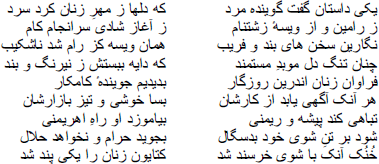
The poet told a story that froze men’s hearts towards women, of Rāmin and infamous Vis: of joy at the beginning and pleasure at the end, with elaborate talk of shackles and shenanigans, when Vis could no longer wait for Rāmin; of sad, helpless Mobad, when the Nurse “bound” him with tricks and spells. I’ve seen so many women these days who pursue their own pleasure, and any woman who learns about their ways, their many joys and bold conduct, will become a deceitful home-wrecker and follow the path of Ahriman. She’ll despise her husband’s body, and seek the forbidden instead of the licit. Praised be the woman who is content with her husband! Katāyun is a lesson for all women.Footnote 28
Another (and far more famous) example of this complex attitude towards Vis and Rāmin is Nezāmi Ganjavi’s Khosrow and Shirin (written circa 576/1180). As in the episode of Katāyun and Bahman, there are many thematic parallels that run between the two poems: both are set in ancient Iran; both are concerned with issues of ethics and morality hashed out among members of the ruling class; and both utilize the vehicle of a love-triangle (or in Nezāmi’s case, something more like a love-hexagon) to explore the tensions and contradictions of private desire and public standing.Footnote 29 Although the basic framework of the plot is derived from the Shāhnāmeh and other chronicles, the manner of its telling suggests that V&R was at the forefront of Nezāmi’s mind: in addition to utilizing the same meter as Gorgāni’s text, he revisits many of its landmark episodes, such as the hero’s unfaithful fling with a mistress, the bed trick, the interpolation of songs and letters, and the dramatic debate between the two lovers as a blizzard swirls about them. The women of K&S seem especially haunted by the memory of Vis’ shame, disgrace, and manifold sufferings: when the couple are first united, Shirin’s aunt urges her to resist Khosrow’s advances until they are married, lest she, like Vis, lose her good name and become infamous in the world (cho Vis az niknāmi dur gardi • be zeshti dar jahān mashhur gardi).Footnote 30 Shirin takes this advice to heart and swears a solemn vow to that effect. Years later, after the tumultuous episodes of Farhād and Shekar have run their course, Khosrow approaches her castle to make amends, but Shirin, though overwhelmed by her feelings for him, reminds herself:

If I don’t let him in now, I won’t be able to bear the wound of separation—but if I acquiesce to passion even a little, I’ll become infamous in the world like Vis.Footnote 31
Thus, even as Khosrow and Shirin draws inspiration from the older text, its characters actively struggle to avoid repeating their predecessors’ mistakes.Footnote 32 Some critics have used this to infer the same antipathy in the poet himself; Vahid Dastgerdi famously writes:
It seems Nezāmi was extremely affected by Gorgāni’s versification of Vis and Rāmin—which is in truth a disgusting fable, a book hostile to propriety, and an enemy of the history of Iran’s moral grandeur—and wanted to replace the defects of that sin and crime with stories of love, chastity, and purity.Footnote 33
Such stark contrasts between the two poets, however, oversimplify both of their complex engagements with the ethics and consequences of desire.Footnote 34 If Vis must die a social death for the sake of love, Shirin must die a literal one; in both cases, “your honor or your life” seems to be the only choice afforded them. Considering the multiple modalities of love can bring further nuance to the comparison: in contrast to Gorgāni’s “love story” (dāstān-e ʿāsheqāneh), Nezāmi introduces his poem as a “book of passion” (havas-nāmeh), such that his tale could be read as an account of the destruction wrought by Khosrow and Shiruy’s havas, overpowering the ʿeshq shown by Shirin and Farhād.Footnote 35 In any case, it seems that Nezāmi does not so much solve the problems raised by Gorgāni as he considers them from another angle, arriving at a similarly tragic (and strikingly unromantic) conclusion: non omnia vincit amor.Footnote 36
Nezāmi’s romances were wildly popular across the Persianate literary world, inspiring hundreds of imitations; the story of Vis and Rāmin, in contrast, would never be retold in Persian.Footnote 37 Nonetheless, its protagonists did find a place among the archetypal ranks of other legendary lovers, especially in the poems of Saʿdi (d. 690/1291) and Khwāju (d. 750/1349)—although they were held in a slightly different regard than couples like Layli and Majnun or Jamil and Buthayna, famous for their superhuman devotion to their chastity.Footnote 38 Along with Khosrow and Shirin (much to the latter’s chagrin, I imagine), Vis and Rāmin were commonly associated with physical passion, with all its implications of social impropriety and spiritual imperfection.Footnote 39 The satirist ʿObayd-e Zākāni (d. 770/1370) defines the cornuto as “a man whose wife reads the story of Vis and Rāmin” (al-quch al-shākhdār ān ke zan-ash qesseh-ye Vis o Rāmin khwānad),Footnote 40 while a hundred years earlier, Jalāl al-Din Rumi (d. 672/1273) exhorts his followers to peruse the old tales for a lesson in mor(t)ality:

Read Vis and Rāmin, read Khosrow and Shirin! See what those fools did in their covetous desire! Lover and beloved are gone; both they and their passion came to nothing.Footnote 41
While the lovers’ place in the popular imagination was thus secure (for better or worse), it does seem that their poem was falling out of circulation. One indication of this comes from Jāmi, who writes in his Bahārestān (w. 892/1487) that Vis and Rāmin, the book that established Gorgāni’s place in the canon, is “lost and unobtainable these days” (dar in ruzegār mahjur o nāyāb).Footnote 42 This might be corroborated by Jāmi’s contemporary, (the admittedly unreliable) Dowlatshāh Samarqandi (d. 913/1507), who twice misattributes the story first to Nezāmi ʿAruzi and then to Nezāmi Ganjavi.Footnote 43 The same circumstances appear to apply in the Islamic west: when the Ottoman sultan Suleiman I ordered his court poet Lāmeʿi (d. 938/1531) to create a Turkish version of the tale, it took an inordinate amount of time for his agents to even procure a copy, and when the poet finally had the manuscript before him, he was galled to find it a “colourless story of feeble versification” and refurbished the narrative with popular topics of his day, such as the classic sufi–qalandar comparison and the Marhumeh/Constance motif, with clear elements of Layli and Majnun and Khosrow and Shirin worked in as well.Footnote 44 Nevertheless, and perhaps thanks to this effort, a fair copy of V&R was preserved in the palatial library at Topkapı.Footnote 45 These reports, alongside other brief notices in the tazkereh tradition, suggest that V&R, though remembered as a canonical work, did not hold much interest for the poets and critics of the early modern era.Footnote 46 Lāmeʿi’s comment about the poem is particularly revealing; while he did erase some of the social taboos of his source (the brother‒sister incest, the adultery), the fact that he did not stop there but revamped the entire story suggests that the bowdlerizations were part of a larger program to transform an old and obsolete text into one that would “amuse and edify” its readers—the same work that Gorgāni had done five centuries prior.Footnote 47 Literary tastes had evolved, and, unlike more prestigious works like the Shāhnāmeh or Nezāmi’s Khamseh, there was little in Gorgāni’s poem to recommend itself for direct imitation or refashioning.
The “Ten Letters” and Other Greatest Hits
There is one important exception to this story. One of V&R’s distinctive features, perhaps building off the innovations of ʿAyyuqi’s Varqeh and Golshāh, is the regular insertion of laments, songs, and letters, interweaving multiple speaking personas into the third-person narrative. Near the end of the story, Vis composes a long letter in ten sections to Rāmin, meditating on the various conditions of love: longing, forbearance, seeking news, supplication, and so on; this became known as the “Ten Letters” (dah-nāmeh) of V&R. These lyric and lyric-like passages, with the “Ten Letters” at their head, fit in well with later interest in fine expression, debate poetry, and the “language of state” (zabān-e hāl), especially in the post-Mongol era. Thus, though V&R as a complete poem left no tradition of imitation or adaption, as did the romances of Nezāmi, a distinct trace of its legacy can be found in the world of letters, lyrics, and literary argument.
An illustrative example of this afterlife is found in the Mahabbat-nāmeh of ʿEmād Faqih (d. 773/1371–72), a contemporary of ʿObayd. This innovative masnavi, also in the hajaz meter, consists of a series of debates between various pairs, such as the moth and the flame or the elephant and the gnat, which invoke the stories of famous lovers to argue their respective cases. In one debate, the magnet chides the iron for its harsh nature (tond-khuʾi), reminding it of how Vis wrote Rāmin the “Ten Letters” when she could not forget her anger at him (ke natvān-ast bord az khāter-ash kin). The iron replies that though Rāmin did indeed speak some harsh words, he repented the following morning and said to her, “If you want, sit down and write; cover up [past] mistakes with Vis’ story” (agar dāri havas benshin o benvis • khatā pushi ze sirat-nāmeh-ye Vis).Footnote 48 ʿEmād’s invocation of the poem, like ʿAttār’s, gives us a sense of its most salient aspects for his contemporary audience: in this debate within a debate, Vis’ letter emerges as the framework through which the lovers’ quarrel is given expression and ultimately resolved. The centrality of this episode, and its abiding presence in popular memory, is visible in numerous other examples, both in the particular verses selected out of V&R by later writers and in a whole sub-genre that was in vogue during ʿEmād’s time.
A survey of the anthologies, prosopographies, and personal notebooks kept by the intelligentsia of the fourteenth century onwards shows that the letters and lyrics of V&R became the most regularly cited and copied portion of the poem until the modern period; whatever else critics might have thought of the story, it seems that the rhetorical beauty of these passages was met with universal acclaim.Footnote 49 This development is evident too when we compare this material against earlier references. For example, the citations of V&R in the Tāj al-maʿāser represent a wide range of scenes in the poem; the letters and lyrics are there, but so too are the erotic gazing at the assembled queens of the realm, the war between Mobad and Viru, Vis’ ordeal by fire, the Devils’ Grotto (eshkaft-e divān), and Rāmin’s triumph over Mobad.Footnote 50 In contrast, the quotation of V&R in the safineh of Abu al-Majd Tabrizi, compiled a century later (721/1321), shows a different aesthetic at work: following some passages from the Shāhnāmeh, we find a contiguous selection of V&R entitled “On Vis’ Writing the ‘Ten Letters’ to Rāmin” (goftār andar nebeshtan-e Vis be Rāmin dah nāmeh), which covers the bulk of Vis’ letters and her subsequent lament.Footnote 51 It is a substantial section of the poem, about 700 lines, and while there is a fair amount of divergence from the T’odua-Gvaxaria edition (pp. 357–402), the core of the text is the same: the lines follow the same sequence, many long passages are repeated verbatim, and there are no glaring lacunae. This suggests that at least this section was popular enough that it continued to be copied in its entirety well into the Ilkhanid period, a time when readers were fond of poetry framed around the exchange of speeches and debates.Footnote 52
Indeed, the “Ten Letters” took on a life of its own in the fourteenth century as a set-piece and spin-off genre, not in direct reference to V&R but using its precedent as a model for other works of debate literature: ʿAtāʾi (ʿOshshāq-nāmeh, w. 680/1281),Footnote 53 Homām-e Tabrizi (Sohbat-nāmeh, w. 684/1285), Owhadi Marāghehʾi (Manteq al-ʿoshshāq, w. 706/1306), Amir Hosayni Heravi (Si-nāmeh, w. 706/1306), Ibn Nasuh (Mahabbat-nāmeh, w. 736/1335),Footnote 54 Rokn al-Din Sāʾen Samnāni (Tohfat al-ʿoshshāq, w. 751/1350), ʿObayd-e Zākāni (ʿOshshāq-nāmeh, w. 751/1350), Shāh Shojāʿ (Rūh al-ʿāsheqin, w. 768/1366), ʿEmād Faqih (Dah-nāmeh, w. 766/1364), Ibn ʿEmād (Rowzat al-mohebbin, w. 794/1392), Hariri (Mahbub al-qolub, w. 800/1397), ʿAyshi (ʿEshrat-nāmeh, w. 812/1405), and at least four additional titles in Turkish all attest to the dah-nāmeh’s widespread popularity.Footnote 55 The “lyric-in-the-romance” performances, too, that are distinctive of V&R and its predecessor Varqeh and Golshāh, also saw renewed interest during this period: Khwāju’s Gowhar-nāmeh (w. 746/1345), Salmān Sāvaji’s (d. 763/1362) Jamshid and Khorshid, and ʿObayd-e Zākāni’s (d. 770/1370) ʿOshshāq-nāmeh make use of this technique.Footnote 56 Elements of V&R also appear in ʿĀref of Ardabil’s Farhād-nāmeh (w. 771/1370), which draws much more from the “ancient” model of love stories than the “modern” style of his contemporaries.Footnote 57
Thus, even as the whole of Vis and Rāmin fell out of general circulation, a certain reduced core, with the “Ten Letters” at its center, continued to be appreciated for its rhetorical brilliance, emotional power, and the many quips and quotables adorning its lines.Footnote 58 Ahmad Amin Rāzi cites forty lines of V&R in his Haft eqlim (w. 1002/1593), of which about half are from the “Ten Letters” and the remainder from other rhetorical highlights extracted from Vis’ laments, Rāmin’s songs, and the narrator’s meditations on the world’s transience.Footnote 59 We find the same curatorial taste at work in Owhadi Balyāni, who in his ʿArafāt al-ʿāsheqin (w. 1024/1615) has nothing but good things to say about Gorgāni, “among the greatest of the ancients and the most praiseworthy of the wise” (az akāber-e qodamā va amājed-e hokamā-st); the first fifty-eight of his cited verses are memorable lines of the “Ten Letters,” presented in consecutive order, followed by assorted verses from the rest of the poem, usually of a didactic or epigrammatic nature.Footnote 60 Other compilers contented themselves with just the proverbial lines: like Owhadi, Jāmi dubbed Gorgāni “one of the exemplary poets of the age” (az amāsel o afāzel-e ruzegār) and included eight quotations that showcase the poet’s eloquence.Footnote 61 Sāʾeb Tabrizi (d. 1087/1676) records seven verses from V&R in his personal notebook (bayāz) with a similar eye for pith and profundity.Footnote 62 The Majmaʿ al-fosahā of Rezā-Qoli Khān Hedāyat (d. 1250/1871) builds on these tendencies: unlike earlier collections, which often kept the sequence of the “Ten Letters” intact, Hedāyat’s compilation could be thought of as an assembly of the poem’s “greatest hits,” in which even two consecutive lines are rare; the majority of the citations are again from Vis’ letters, with additional “singles” from Rāmin’s speeches, his royal testament, and the narrator’s panegyrics thrown in.Footnote 63 These later works demonstrate the extent to which V&R was rearranged, epitomized, and redacted by later readers, with choice lines from the “Letters” and a few dozen others well established in canonical memory.
In short, we have before us a reception history that unfolds as much through fragments as it does through complete texts. In his notice on V&R in the poetic anthology Riyāz al-shoʿarā (w. 1160–61/1747–48), the critic Vāleh Dāghestāni provides us with a fascinating glimpse into how readers in the early modern period might have read the poem through this complex interplay between part and whole, leaving behind as well a valuable snapshot of its material and cultural traces.
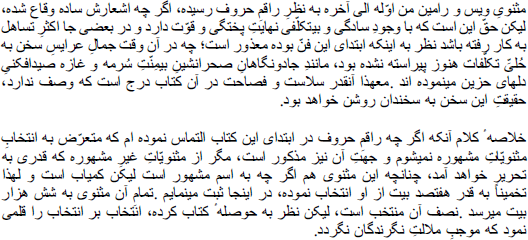
The writer has reviewed the masnavi of Vis and Rāmin from beginning to end, [and] although its verses are simply done, the truth is that, despite this simplicity and lack of ornamentation, it possesses extraordinary power and maturity. Considering that it was the beginning of this art, it’s excusable that it has some deficiencies in some places, for at that time, the beauty of the brides of speech had not yet been adorned by the ornament of artifice; they appeared like bewitching beauties sitting in the desert, ready to trap dejected hearts with no need for rouge or kohl. Nevertheless, so much eloquence and fluency is contained in this book that it cannot be described; the truth of these words will be clear to those who are knowledgeable in the ways of discourse.
To cut to the chase, although the writer confessed at the beginning of this book that he would not trouble to select from famous masnavis (the reason for that is also mentioned), rather that little-known masnavis will be recorded to an extent, as this masnavi too is difficult to obtain (though it is famous in name), I therefore transcribe here about 700 verses selected from it. This poem is 6,000 lines in full. One half of this has been anthologized, but according to the capacity of the present work, a selection of the selection has been pruned so as not to bore its readers.Footnote 64
This passage makes it clear that in Vāleh’s milieu—the Mughal court of Mohammad Shāh (r. 1719–48)—V&R was considered an important and canonical work, and continued to be copied out in full or in long excerpts.Footnote 65 At the same time, these extended excerpts were relatively rare; it was much more common to encounter the poem in anthologized (montakhab) form.Footnote 66 Vāleh therefore takes exception to his usual practice of skipping the famous masnavis to cite 700 of its best lines.Footnote 67 The first half of the quotations are drawn almost entirely from the speeches (maqālāt) between various characters: the Nurse to Vis, Rāmin to the Nurse, the Nurse to Rāmin, Vis to Mobad, and so on. This is followed by excerpts from the story’s “core,” as we found in the safineh of Abu al-Majd: Rāmin’s meeting with Vis in Mobad’s moonlit garden, his subsequent betrayal of her and his marriage to Gol, the “Ten Letters,” and the lovers’ final showdown in the blizzard.Footnote 68 Nearly all of the citations, whether individual lines or connected episodes, focus on the passages of direct speech in the poem, either in the form of letters, lyric songs, soliloquies, or back-and-forth dialogues. Vāleh’s reading of the poem shows an engagement highly conditioned by the aesthetic criteria of his day: with the ascension of the ghazal as the premier poetic form, and the critics’ corresponding interest in rhetorical analysis (sokhan-sanji), early modern readers were more inclined to evaluate and admire the ancients on the basis of their fine expression, rather than, say, the verisimilitude of their characters—an approach entirely different from later critics who read V&R using the novel as their touchstone.Footnote 69
In Review
Looking back at the ground we have covered, we can see that there is more than one story to tell about the Nachleben of Vis and Rāmin. It is clear that the poem traveled far and wide in the first centuries after its composition, with references, responses, criticisms, and translations appearing from Anatolia to India; it is also clear that, by the turn of the fifteenth century, the poem was falling out of circulation, with full copies becoming increasingly rare. When reading it as an integral poem, then, the usual story of V&R’s decline into obscurity, only to be recovered and restored in the twentieth century, is perfectly valid. This narrative, however, obscures other reading practices we have traced in this survey, readings in which fragments and selections of the poem have a staying power of their own, though in venues outside the genre of the romantic epic. From that perspective, the “Ten Letters” emerges as an important poem in its own right, preserved in full or abridged form in numerous anthologies and inspiring a new genre of “letter-poem” masnavis that reached its height in the fourteenth and fifteenth centuries CE. The gnomic, dialogic, and lyrical highlights of V&R also continued to resonate with readers well into the early modern period, who shared and curated these lines in the communal effort of establishing and anthologizing the best of the Persian canon. Even beyond the level of textual citation, Gorgāni’s poem contributed an important archetypal couple to the Persianate literary landscape, whose protagonists could serve as an efficient evocation of the heady sublimities of love. The poem’s ideas, words, and images thus continued to exert their pull on many generations, though perhaps in ways we might not anticipate, jumping across the lines of genre and outside the boundaries of the original text. Such a reception history, tracing the centrifugal ripples and fragmentary detours alongside the circulation of whole texts, might offer us new ways to think of text itself, something that can “travel” of its own accord and adapt to new environments as it wanders.
On another note, this survey suggests an alternative or supplementary factor in the trajectory of V&R’s fortunes. As mentioned before, a common explanation for its general decline is that its scandalous content and pre-Islamic milieu made the text unpalatable to Muslim readers: Minoo Southgate, for example, writes that
Zoroastrian and early Islamic Iran tolerated literature that depicted conduct antithetical to religious mores. … In the late thirteenth century, however, Gurgānī’s work became unpopular because of growing religious fanaticism and was eclipsed by the romances of Nizāmī and to a lesser degree those of Jāmī.Footnote 70
However, it is rare to see the poem as a whole condemned for the way its characters behave; such criticisms exist but, tellingly, they are most explicit in the works that directly succeed (and attempt to supersede) their model. The lovers enjoyed a lingering presence in the popular imagination, invoked for homiletic, humorous, or laudatory ends; that their love was not universally reviled as beyond the pale is amply demonstrated in the widespread popularity of the “Ten Letters,” which continued to be cited, circulated, and imitated in an era when the eloquent articulation of state, so well suited to the ghazal form, was warmly appreciated. Vis and Rāmin may have broken the rules, it seems, but even despite (or because of) their transgression, there was something to admire in their story;Footnote 71 it is not until the nineteenth century, in fact, that the moral objections return, and then often from western critics.Footnote 72 A more persuasive reason for the poem’s decline in circulation is the success and popularity of Nezāmi; I suggest, however, that we read him not only as the driver but also the mirror of broader changes at work. As Vāleh’s comments attest, Gorgāni’s language came across to later readers as simple and antiquated, especially in comparison with Nezāmi’s verses, semantically rich and gleaming with rhetorical polish. Not only, then, did Nezāmi avoid the most socially objectionable aspects of Gorgāni’s poem, but he did so in a style that both staged and anticipated these new aesthetics, producing a classic that rendered V&R a relatively obsolete text, one that in full held little interest for early modern readers.Footnote 73 Nonetheless, the broad strokes of the story and the legend of its author remained known to those familiar with the Persian canon, and V&R continued to be copied from time to time, especially in India, where the many courts and urban centers under Mughal rule attracted waves of talented émigrés from Iran, promoted the study of Persian among local elites, and sponsored the wide-scale collection, preservation, and production of Persian-language books.
The Modern Reception
And so it was in India that Vis and Rāmin came to the attention of European readers. In 1854, Alois Sprenger, digging through the libraries of Calcutta, announced that he had discovered a Persian legend of unmistakable antiquity; a decade later, Captain William Nassau Lees, aided by Munshi Muhammad Ali, used this manuscript to publish the first printed edition of the poem.Footnote 74 Meanwhile, other copies and fragments of V&R were making their way into European hands: an anthology containing Rāmin’s letter renouncing his love of Vis and the beginning of her reply in the “Ten Letters” was taken after the Battle of Ghazni in 1839, winding up in the British Museum; a partial manuscript was brought to the University of Bombay (est. 1857); other Indian copies of the poem came to the Königliche Bibliothek in Berlin and the Bodleian Library at Oxford.Footnote 75 Ten years after Lees’ edition was published, K. H. Graf compared it with the Oxford and Berlin manuscripts and produced a partial translation.Footnote 76 Meanwhile, the copy of V&R belonging to the Ottoman royal library was brought to Paris, possibly by C.-H. Schefer, and would later serve as the basis for a new critical edition, published in 1935 by Mojtabā Minovi.Footnote 77 Sir Oliver Wardrop raised further awareness of the poem when he published his English translation of the Visramiani in 1914, declaring it “one of the oldest novels in the world.”Footnote 78 Despite the growing buzz, the poem was not admitted into the general school curriculum in Pahlavi Iran—perhaps not surprising, considering that it relates the cuckolding and overthrow of the Persian king.Footnote 79
With this new edition out, and curiosities piqued, more and more scholars began to peruse the poem, evincing a wide range of responses; as Kaladze writes, “no other classical monument of Persian literature has given rise to such controversial, incompatible and even mutually exclusive appraisal.”Footnote 80 To put it mildly, many were disappointed by what they found, put off by what Graf called a “certain coarseness of spirit” (eine gewisse Rohheit der Gesinnung) that “repels our finer moral sensibility” (unser feineres sittliches Gefühl abstösst).Footnote 81 Both he and von Stackleberg were troubled by the immorality of the eponymous heroes and their inexplicable triumph over the king, while Nöldeke considered it a poem “the aesthetic value of which I cannot judge much higher than its morals.”Footnote 82 Italo Pizzi was so irritated at V&R that he wrote a furious review of it in his Storia, enumerating for pages “the childish and insipid, smutty and indecent, bizarre and grotesque devices with which this poem so finely adorns itself, showing it a vulgar work, one unworthy of anyone who even remotely deserves the name of poet.”Footnote 83 Gabrieli, aiming for a fairer judgment than that of Pizzi, would only raise the grade from execrable to mediocre, complaining of the poem’s bloated and monotonous plot, mired by the “interminable laments” and “melodramatic declamations” of its marionette-like characters, devoid of depth and interest.Footnote 84
Of course, not everyone shared this view. What Gabrieli criticized, Ethé praised; he wrote admiringly of the poem’s attention to its characters’ inner lives, a feat that would inaugurate the romantic epic genre in Persian literature (although he concluded that Nezāmi is Gorgāni’s superior, due to the morality of his content, the chastity of his sentiment, the gravitas of his language, and the power of his description).Footnote 85 Sādeq Hedāyat agreed that Gorgāni’s main achievement lay in his depictions of interiority and psychology, comparing the poem to Lady Chatterley’s Lover.Footnote 86 What is most interesting to observe in these reactions, both negative and positive, is how they reflect the changing criteria by which V&R was judged. If the aesthetics of the ghazal dominated the early modern appraisal of V&R’s verses, the novel, with its expectations of complex and coherent characters, a unified plot, and social and moral value, had taken its place as the new ideal form. Romantic notions of authorial genius had also taken hold. Foruzānfar writes of Gorgāni:
He does not fret about rhyme or worry about observing the principles of others; he eschews complex sentences and difficult words that do not accord with the sensitive natures and delicate thoughts of lovers and that would lessen the brilliance of amorous sentiments.Footnote 87
This reads in stark contrast to Vāleh’s defense of Gorgāni’s deficiencies, which he attributed to his place at the dawn of the poetic arts; the poem is now a window into the poet’s impassioned frame of mind.
Love it or hate it, the poem’s philological value could not be denied, and scholars continued to work towards an improved critical text. In 1959, Mahjub revised and republished Minovi’s edition, supplementing it with an extensive introduction and detailed indices.Footnote 88 This was followed by a remarkable collaborative effort that took the Georgian Visramiani into account. No one doubted that it would be a valuable resource, but the degree of its importance was only realized when a joint team of Georgian and Iranian scholars put the two manuscript traditions together. A. Gvaxaria and M. T’odua, who headed the project, tell us that the comparison of the Georgian translation with the available Persian manuscripts was enormously beneficial for both texts, correcting hundreds of corruptions in the former and numerous lacunae and misreadings in the latter.Footnote 89 The result was a new edition in 1970 with a full critical apparatus—still the most useful scholarly edition of the poem—to which M. Rowshan, who was also involved in the project, gave a “final polish” (ārāyesh-e nehāʾi) in 1998.Footnote 90 The philological work, of course, goes on: recent articles by Giunashvili, Gvaxaria, Akhiyāni, and Emāmi suggest a number of further emendations on the basis of the Georgian text and the Tāj al-maʾāser.Footnote 91 These new editions and studies have allowed V&R to be used for further research into early New Persian grammar, pronunciation, and morphology.Footnote 92
As good editions of V&R became available, and the theoretical and cultural revolutions of the mid-twentieth century unfolded, a slow but steady proliferation of articles, essays, and book chapters reevaluating the poem from new perspectives have appeared. These various efforts have generally clustered around a number of established themes, sub-conversations that revolve around common points of interest such as history, gender studies, or comparative literature. To conclude this article, then, I will attempt to lay out the major themes of recent scholarship on Vis and Rāmin, and provide a snapshot of the field in its current state. I dare not call this survey exhaustive, for not only do new studies keep appearing, but there are some conversations that have largely been carried out in languages inaccessible to me, Russian in particular (Kaladze’s article is a valuable reference in this regard). Nonetheless, I hope this may offer a reasonably accurate survey of the kinds of questions that have been asked of the text, and the kinds of answers furnished, up to the present day.
Ancient Iran
As the early orientalist excitement over the poem suggests, the longest-established area of academic work on Vis and Rāmin is dedicated to its historical value as an ancient document that, in the words of Vladimir Minorsky, would shed light on “the life and feelings of an epoch which, even in its simplest elements, is still wrapped in uncertainty and darkness.”Footnote 93 It was Minorksy, in his seminal series of articles published from 1946 to 1962, who convincingly argued that V&R dates to the Parthian era, probably the first century CE, and suggested that it belongs to a cycle of stories about the line of Godarz–Giv–Bizhan in a way similar to the Sistani cycle of Sām–Zāl–Rostam.Footnote 94 This theory did have its skeptics: a number of scholars thought of V&R along the same lines as the 1001 Nights/Hazār afsāneh, namely a local legend, possibly of Indian origin (pointing out the similar names of Rāma and Rāmin).Footnote 95 Others argued that the text, whatever its origins, was so radically altered by Gorgāni that it was to all intents and purposes an artifact not of the first century CE but of the eleventh, and is best analyzed as such.Footnote 96 Thus Marijan Molé perceived a clear parallel between the events of the poem and the rise of the Seljuks, so that the two brothers’ rivalry served as a veiled commentary on the faltering relationship between the dynasty’s founders, Toghril and Chaghri.Footnote 97 Though Minorsky wondered what patron would appreciate being associated with either Rāmin or Mobad, the idea of V&R as a political commentary became a standing theme in mid-century Soviet scholarship, running from Bertel’s to Braginskij, Orbeli, and Gafurov, that saw Gorgāni as an anti-establishment or satirical writer.Footnote 98
By and large, however, most scholars accepted the Parthian dating and proceeded accordingly, using the text to study the worldviews, literatures, and social practices of pre-Islamic Iran. An early essay of this kind is an article by Sādeq Hedāyat, in which he sifts apart the Islamic, Zoroastrian, and folkloristic elements of the story.Footnote 99 In more focused studies, Helmer Ringgren analyzes V&R alongside the Shāhnāmeh to distinguish Islamic and pre-Islamic conceptualizations of fate, producing a concordance of passages on the topic in both texts and their Sasanian counterparts; and M. Rahim Shayegan identifies a long-lived “sorcerer-king” archetype in Mobad, going back to the Bisotun inscription and with numerous analogues in Iranian lore.Footnote 100 Khaleghi-Motlagh utilizes V&R in his valuable typology of pre-Islamic Persian literature, placing it alongside Bizhan and Manizheh, Zāl and Rudābeh, and Goshtāsp and Katāyun as representative of the Parthian romance genre (dāstān-e ʿāsheqāneh).Footnote 101 Minoo Southgate turns the topic to social mores; she paints a (perhaps overenthusiastic) picture of a world where women have full autonomy over their affairs and enjoy sex “undeterred by scruples about marital fidelity,” although this reading ignores the moments when Vis is not only castigated, but even castigates herself for her unconventional choices.Footnote 102 Finally, in the early 1990s, C.-C. Kappler wrote three essays examining the poem’s potential reflections of ancient Iranian myth and ritual. The first reads the minstrel’s enigmatic song before the court as an allegory for the sacrifice of the cosmic Bull of Mazdean and Vedic mythology, recasting the poem as one heralding the advent of sacred kingship.Footnote 103 The second rejects the common description of the love affair as “adulterous,” arguing instead that the “true” love in the story is actually that between Vis and her brother Viru, later symbolically displaced onto her milk-brother Rāmin. In breaking up a legitimate marriage, Mobad is the real adulterer; thus it is he who will suffer an ignominious death.Footnote 104 In the final article, Kappler draws from Mazdean concepts about the “pure” and the “mixed” to consider Vis as a goddess-like figure for whom Rāmin must purify himself, a study that contemplates Vis' hybrid angelic-demonic nature, the paradoxes of freedom, and the mysteries of annihilation.Footnote 105 This triad of articles offers (in my view) some very original and thought-provoking explorations of the meta-narratives going on in V&R, and could serve as a valuable starting point for those interested in the story’s symbolic aspects.
In addition to these thematic readings, we have a handful of studies that deal with more technical aspects of the poem. The earliest is G. Morrison’s “Flowers and Witchcraft in the ‘Vīs o Rāmīn’,” which lives up to its title in detailing the many occurrences of these two topoi throughout the poem.Footnote 106 In another article, P. Kunitzsch tackles the tantalizing prospect, suggested by Taqizādeh, that Gorgāni’s famous “Description of the Night” could be used to produce a sky-chart and date the poem with pinpoint accuracy; he concludes that while Gorgāni likely had recourse to a celestial globe or Biruni’s Kitāb al-tafhīm (w. 420/1029), he used this knowledge for rhetorical and not scientific purposes.Footnote 107 Most recently, H.-R. Jayhāni uses the poem to reconstruct the layout of Mobad’s palace and royal gardens, though it remains for others more qualified than myself to judge how this accords with or advances our knowledge of Parthian or Sasanian architecture.Footnote 108
Literary Historiography
Alongside these efforts to use Vis and Rāmin to glean insights into ancient Iranian culture and society, many scholars have weighed in on its role in the history of New Persian literature. Ironically, the poem’s clear importance as one of the first romances or romantic epics in this tradition has proven to be something of a double-edged sword: on one hand, its position at the beginning of the genealogy ensures it a place in any survey of the genre; on the other, its proximity to the romances of Nezāmi inevitably places it under the latter’s shadow. Instances of this narrative are commonplace: E. G. Browne presents V&R as a minor work whose importance (following Ethé) “lies in the fact that with it begins the differentiation of the romantic from the heroic variety of mathnawí”; Bausani, echoing the sentiments of Pizzi and Gabrieli, suggests that the artistically unremarkable poem had received more than its fair share of attention, concluding that its interest, “from the standpoint of the genre’s history [my emphasis], is the introduction of psychological studies of the characters, albeit very rudimentary and incomparable with the dramatic precision we will see in Nezāmi”; Rypka considers it “an insult to Islamic morality and in fact to every other religion,” but nevertheless an important early member of the romantic epic genre; in a more positive tone, Safā credits Gorgāni as one of the “great poets” whose skill and mastery (mahārat o ostādi) founded a significant “school” (maktab, ravesh) of narrative poetry, one that would be brought to its heights by Nezāmi; similar accounts appear in abundance in other Persian-language surveys.Footnote 109 While genre is a powerful tool in literary analysis, it appears here to have strongly conditioned the terms by which we read and study this particular work: by measuring V&R, along with the other early romances, against a standard that would not be established for another century, we set ourselves up to read them in terms of deficiency—how they failed to live up to that standard.Footnote 110 To be clear, I do not mean to say that studies ranking Nezāmi over Gorgāni are intrinsically flawed; there are obvious reasons for the comparison, and Nezāmi’s remarkable talents and central place in the canon are undeniable. But the examples we see above do show how the framing of a particular comparison can implicitly guide the analysis towards a certain range of methods and conclusions, perhaps foreclosing other kinds of comparative reading.
To wit, there is a small number of studies that read V&R laterally against texts that typically fall outside the purview of “romance,” with some interesting results. One example is Ruyāni’s illuminating comparison of V&R and the Bahman-nāmeh;Footnote 111 another is Eslāmi-Nodushan’s comparison with the Shāhnāmeh. “There is no book in the Persian language that is both so close to and so distant from the Shāhnāmeh as Vis and Rāmin,” the latter author begins; and indeed, despite some obvious differences, the similarities are abundant and striking, such as shared attitudes towards wisdom (kherad) and desire (āz), matters of fate and free will, honor versus duty, the importance of oaths, chivalry and kingship, and so on.Footnote 112 Both studies show the benefits gained from reading across the grain of genre rather than alongside it, concurring with Bürgel’s discussion of how various subgenres within the epic (heroic, romantic, didactic, and mystic) can blend and combine in all kinds of ways in any given text.Footnote 113 They also point towards interesting global generic developments we can observe in other literary traditions as well: the gradual transition from epic to romance, the antiquarian turn, and the shift from divine to secular auctoritas have been noted in medieval English, German, Byzantine, and Georgian literatures as well, with suggestive resonances in the Persian.Footnote 114 These thematic and lateral approaches to V&R suggest new ways we may situate this work within intertextual and interdisciplinary conversations, forming lines of inquiry that might not have been apparent from within the vertically oriented model of a generic family tree.
Tristan and Isolde and Comparative Literature
The same lesson may apply to our third node of scholarship, the comparison of Vis and Rāmin and Tristan and Isolde. Readers familiar with the European legend immediately picked up on a number of striking parallels between the two stories, not only in the basic intrigue of a love triangle, but also in specific themes and episodes common to both works: the bed trick; the lovers’ sojourns; the hero’s skill at music, archery, and tricks; his fling with the beloved’s doppelgänger; the role of the go-between; the exchange of tokens; the symbol of the boar; the ordeal by fire.Footnote 115 While many scholars found these parallels intriguing, this was merely enough for them to consider the two works as somewhat analogous to each other in their respective traditions.Footnote 116 In 1911, however, Rudolf Zenker published a study in which he claimed that Vis and Rāmin is not just similar to but indeed the source of the Tristan legend, instigating a debate that persists to this day.Footnote 117 Although a huge amount of ink has been spilled on the topic, the sticking point remains the same: on what basis can we move from similarity to outright dependence? Many scholars hold that we need concrete proof of textual transmission; but the evidence for this, or even of circumstances allowing for it, is thin on the ground.Footnote 118 For others, however, the sheer number of analogous elements is enough to maintain the plausibility of some kind of relationship, circumstantial though it may be.Footnote 119
As in the Gorgāni‒Nezāmi comparison, the framing of the debate proves decisive; in this case, the question of whether or not V&R and T&I are historically linked has dominated the overall contours of the debate. But even if we put the question of influence to one side, that does not exclude the possibility of comparison on thematic and historical bases both greater (genres and systems) and smaller (devices, themes, tropes) than the texts themselves.Footnote 120 It is in this spirit that Peter Dronke includes V&R (however briefly) in his important study of courtly love, which he broadly defines as a “sensibility” or “attitude,” rather than a phenomenon bound to a certain place and time.Footnote 121 This does not mean that the historical context need be disregarded altogether; as Davis' comparisons of Greek and Persian romances demonstrates, we can discern particular habits of writing that are common across the literatures of the region where the two cultures mingled, despite little evidence of direct transmission or translation.Footnote 122 Nor does this network end when we reach the Mediterranean; if anything, the web of interconnections grows ever more dense in that maritime caravan of languages, cultures, and stories on the move. In short, the historical conditions are there to allow V&R, and of course Persian literature more broadly, to be read alongside other neighboring literatures; if not to demonstrate precedence, then to see how it engages with questions of mutual concern.
Literary Studies
Our final group of studies are those that perform sustained readings of the text as an end unto itself, relying on internal evidence and/or closely related texts for their analysis. A classic work in this regard is J. S. Meisami’s Medieval Persian Court Poetry.Footnote 123 Responding to previous scholars, who in her view “focus on the love story to the exclusion of other elements,” Meisami asserts that we need to take the text seriously when it declares its purport: not merely a pleasing tale, but an edifying guide to the great and the wise.Footnote 124 The poem’s characters thus model ideal (and not so ideal) practices for their courtly audience; by following the fortunes of Mobad and Rāmin, readers can obtain knowledge of how to manage both their personal and public lives for the best possible outcome. Meisami’s book remains one of the must-read analyses of V&R (as well as the poems of Nezāmi) in the English language; the only comment I will add, not to criticize but to observe, is a note about how her approach shapes the focal points of her study. “In the broadest terms, Vīs u Rāmīn is an account of the replacement of one sovereign by another,” Meisami asserts;Footnote 125 consequentially, the lover-princes Mobad and Rāmin step into the foreground as the poem’s main protagonists, while Vis—doubtless one of the most dynamic and complex heroines in Persian literature—is frozen into the “pivot,” “beam,” and “point of reference” around which the fortunes of kings revolve.Footnote 126 Thus, while Meisami’s study brilliantly exposes the paradigmatic aspects of V&R, it must do so by flattening the characters, particularly Vis, into emblematic figures that bring the paradigm to life. The door remains open for studies that consider the volatile inner lives of Gorgāni’s characters, who tend to experience crisis precisely at those moments when they find themselves at odds with the ideal roles they are expected to perform.
A number of published works do take up this issue. Henri Massé’s introduction to his French translation of V&R (1959), in addition to painting a general (and highly favorable) overview of the poem, provides some valuable thoughts about the distinctive characteristics of each of the main protagonists; interestingly, he shows a particular sympathy for Mobad, whose character he finds more poignant—in accordance with the poem’s elegiac tone—than pathetic.Footnote 127 Dick Davis offers similar observations in the preface to his English translation of the poem (2009), as well as his entry on it for the Encyclopædia Iranica, where he commends the rich personalities of Vis, “Gorgani’s greatest achievement,” and Mobad, “whose hopeless psychological situation flickers wearily from patience to self-assertion to fury and back again.”Footnote 128 Far more detailed is a standalone article by J.-C. Bürgel, in which he undertakes the complex task of sorting out the various ideas, concepts, and practices of love in the text. His deft analysis reveals a fascinating debate unfolding in the interstice between the story’s characters and the poet-narrator’s commentary, a space in which Nature and the Law, so often presented as one and the same authority, fray apart from each other and demand contradictory modes of righteous action. This tension, in turn, allows the text to delve deep into fundamental ethical questions—what is the best way to live well?—as well as into the psyches of the characters who must grapple with these questions, which are by no means easily (or ever) resolved; I can only second Bürgel’s sensation of a certain ambivalence or anxiety that hangs over the story, even after its apparently happy ending.Footnote 129 The article concludes with a helpful comparison with other erotic-romantic works in Islamic literature to see how they line up with the underlying concepts at work in V&R.
Further studies in this vein have been conducted in Persian. One of the first is an article simply entitled “Vis” by Eslāmi-Nodushan, published in 1956; the title reflects the author’s view that the central figure of the story is none other than the heroine, whom he describes as “possessing flesh, veins, and nerves more than any other woman in Persian literature,” and whose motives, ideals, and principles he analyzes in detail.Footnote 130 Some decades later, two leading scholars elaborated on his points in various ways. Khaleghi-Motlagh carefully documents the normative systems that operate in the poem, showing how they produce in Vis the seeming paradox of a virtuous adulteress,Footnote 131 while Mahjub breaks from conventional wisdom by casting the love affair as a process (a “path,” as he puts it) and not a predetermined given; realizing that Vis is adamantly opposed to hooking up with the ostensible hero, he provides a compelling explication of how the Nurse and Rāmin must wear down her defenses, bit by bit, until she is essentially forced into an affair that she never desired.Footnote 132 Both analyses are refreshingly sensitive to the dynamics of gender inequality in the story, indicating the numerous social pressures acting on Vis of which her male suitors are both free and oblivious. Katāyun Mazdāpur further explores this topic in her monograph Vis' Sin, with in-depth discussions of gender and power not only in V&R but many other Persian romances as well.Footnote 133
Moving beyond these close readings conducted in the traditional sense, Iranian scholarship has seen a dramatic turn towards critical theory. Twenty-five years ago, Mahjub wrote (perhaps tongue-in-cheek) that psychoanalysts would have a field day with the poem; recent publications have proven his words prophetic.Footnote 134 The typical approach I have observed has been to take the conceptual vocabulary from a particular theorist and map it onto the text. Zamānzāda’s Psychoanalysis of the Images of Love in Persian Literature, for example, reads each character in V&R as a symbol of a certain drive; thus Mobad is a symbol of the id, Zard represents the superego, Vis stands for the Electra complex, and so on. Shahru desires her son and therefore enacts the marriage between brother and sister so as to attain him by proxy, while the Nurse likewise arranges the affair between her two surrogate children to assuage her longing for Rāmin.Footnote 135 There are a number of other articles that adopt similar approaches, in which the theories of Freud, Jung, and Allport figure prominently: we learn that Mobad is a child trapped in a man’s body; that Vis’ reaction to men is governed by her sense of emotional security (amniyat-e ʿātefi); that V&R, coming from a more primitive (badavi) society, is better suited for Freudian analysis than Jungian.Footnote 136
Another group of Persian-language studies employ various forms of structuralism to shed further light on Vis and Rāmin. ʿAbdi and Sayyādkuh read the poem through the archetype of Joseph Campbell’s “journey of the hero” in order to produce a number of different “stories” and “endings” from the text, depending on which character assumes the role of the principal; the authors conclude that Vis should be given this honor, as her challenges (due to her gender) are more formidable than those of Rāmin and Mobad.Footnote 137 Another study examines the archetypal figure of the Helper (Vis’ Nurse) in V&R; another of the Obstacle (Mobad); a third analyzes the function of descriptive passages using Genette’s narratological methods.Footnote 138 The most prominent (or at least prolific) scholar in this vein is Masʿud Foruzandeh, who draws heavily from semiotics, (post-)structuralism, stylistics, and linguistics in his work.Footnote 139 His method is largely driven by statistical gathering and analysis: by ranking the frequency and usage of various linguistic features (diction, sound, mood and tense, parts of speech, types of metaphor, and so on), he claims insight into not only the poet’s style (sabk) but also his personal life and world-view. For example, the high frequency of grammatical “deviation” (hanjār-gorizi, in the Formalist sense) and syntactical strategies in V&R produce a lucid, accessible, and cohesive language that draws the reader into an emotional relationship with the characters, particularly Rāmin. On this basis, Foruzandeh concludes that Gorgāni must have experienced a turbulent love affair in his youth, such that Rāmin becomes his representative in the story.Footnote 140 Elsewhere, he proposes three fundamental semiotic “codes” (ramzgān) that underlie the poem’s social ideology: the apparatus of power, religious law, and the experience of love (dastgāh-e siyāsat, shariʿat-e eslāmi, tajrobeh-ye ʿeshq).Footnote 141 Although these conclusions rely on certain assumptions about the relationship between language and subjectivity that not all linguists agree upon, they certainly provide a detailed inventory of Gorgāni’s signature literary techniques, a valuable basis for any subsequent study of Vis and Rāmin from a stylistic angle.
Conclusions
Taken as a whole, this survey of secondary scholarship demonstrates the numerous ways by which Vis and Rāmin can open up new vistas of research in textual analysis, philological study, and literary history. With its roots in antiquity (bearing a suggestive affinity with Hellenistic romances), its position at the early stages of New Persian poetry (out of the fusion with Arabic prosody), and its role in shaping a new generic tradition (with similar cases in Georgian, Byzantine, and western European literatures), V&R is ideally situated for a net cast wide; the broader our scope, the better we may pick up on the ebb and flow of ideas, motifs, and storytelling structures in the ancient and medieval Near East. Kaladze’s situating V&R within the international history of romance is one such line of inquiry, but I expect that others may suggest themselves as we review the many lives the poem has lived.
It is on this last point I would like to linger. As we have seen, the story of V&R’s Nachleben is not fully told if we only follow the diffusion of entire copies of the poem, from which vantage point the poem appears to decline and gradually disappear from the horizon. When we follow its fragments, however, we find that particular sections, lines, and scenes take on afterlives in their own right, generating new kinds of literature and producing new meanings outside the boundaries of its original framework. Literary discourse, sakhon, can thus be traced on multiple levels, anything from an entire story to a single line: as Gorgāni tells us in his evocative preface, it is not so important that the work keeps its original integrity as that it travels beyond the site of its composition, finding new ways to be meaningful for its readers. Such a reading invites us to consider how the fragments—the themes, topoi, topics, scenes, and approaches—might allow us to discern interconnecting tissues below the visible lines of circulation, adaptation, and transmission. It invites us to consider texts in the world not only as they gain in translation, as Damrosch writes, but as they gain in fragmentation.Footnote 142
ORCID
Cameron Cross http://orcid.org/0000-0002-7055-2279


