Sinclair Hood, archaeologist of Minoan Crete and Director of the British School at Athens (BSA) from 1954 to 1962, died on 18 January 2021, a few days short of his 104th birthday. For decades, scholarly acclamation in Crete and the rest of Greece, as in centres of Aegean archaeology across the world, had canonised him and Nikolaos Platon (1909–92) as the doyens of Minoan studies of the second generation after Sir Arthur Evans.
At 103 he celebrated the publication of a work that occupied him for four decades: The Masons’ Marks of Minoan Knossos (Hood Reference Hood and Bendall2020). Edited by Lisa Maria Bendall, it is an achievement that nobody will or can ever repeat. And in his nineties he published a major article on Late Minoan IB pottery from his excavations beside the Royal Road at Knossos (Hood Reference Hood, Brogan and Hallager2011) and the report on his Early Minoan excavations there (Hood and Cadogan Reference Hood and Cadogan2011), which is valuable for being settlement archaeology that is far less known for this period than tomb archaeology. These three studies appeared 72 and 63 years after his first publication in archaeology: a Romano-British excavation on the Berkshire Downs (Hood and Walton Reference Hood and Walton1948).
In the years between, Sinclair produced a polymathic series of articles that asked often heretical questions, or suggested new correlations and explanations, across the cultures of Europe and the Near East from Neolithic times till the Slav invasions of Greece of the sixth and seventh centuries ad (Hood Reference Hood1966a; Reference Hood1970), while concentrating on the prehistory of Crete and the Aegean, and sometimes stepping into the historiography of Aegean archaeology (e.g. Hood Reference Hood1987; Reference Hood2006). His three general books – The Home of the Heroes (Hood Reference Hood1967a), The Minoans (Hood Reference Hood1971) and The Arts in Prehistoric Greece (Hood Reference Hood1978) – encapsulate his broad, generous outlook and his sensitivity to the impact on Minoan and Aegean culture of diverse, and often overlooked, links and connections. Sinclair's wide-ranging, knowledgeable inquisitiveness extended into the history, politics and religion of all periods and places. This must have delighted Gordon Childe, his teacher at the Institute of Archaeology in London, who saw him and his fellow student and lifelong friend Nancy Sandars as his ‘favourite pupils’ (Hughes-Brock Reference Hughes-Brock2020, 110). Her interests were as broad as those of Sinclair and Childe.
Sinclair was a big person, physically and in thought, temperament and behaviour: naturally generous, always open to considering and then supporting new ideas, if heretical so much the better. His drive, energy and stamina were legendary, whether chasing up, and often resolving, a tricky point of archaeological interpretation in the library, or in the field late in the afternoon demanding to tackle one last acropolis before dark. If at times shy and socially diffident, he would soon seem the dominant person in the room, the more so for being quiet, private and listening to others and asking questions. Serious issues and serious people were his bread and butter, strong-mindedness (and, at times, a terrible temper) his way of keeping focussed on whatever was the issue. These ranged from his converting to Rome from the Church of England to whether Linear B really records Greek (which he doubted). With inherited private means from the USA, he was basically an independent archaeologist who worked much of his life with and through the BSA. To many abroad and at home he appeared an archetypal English gentleman scholar. It may be wiser to see him as an archetypal American (scholar) in English (gentleman's) clothing.
*
Martin Sinclair Frankland Hood (known as Sinclair) was born in Ireland on 31 January 1917 at Queenstown (now Cobh), then a British naval base, where his father Lieutenant Commander Martin Arthur Frankland Hood (known as Martin) commanded HMS Bluebell, a minesweeping sloop on patrol duty in the Irish Sea. He and Sinclair's American mother Frances Winants had met before the Great War in Jamaica: such encounters and unions were not unusual in an era when the Royal Navy flew the flag across the world. In 1915 Frances crossed the Atlantic to be a volunteer nurse in Belgium. She and Martin married in June that year in London.
The Hoods were country gentry at Nettleham in Lincolnshire. Martin (1887–1919) was one of four brothers, who had two sisters. Their grandfather, the Reverend William Frankland Hood (1824–64), Sinclair's great-grandfather, was Vicar of Nettleham and husband of Elizabeth Sinclair. As his health was poor, he escaped home duties to lead trips to Egypt, where he bought antiquities, mainly at Luxor. These included the Osiris-Liturgies in a document of around 300 bc known as the Hood-Hearst Papyrus:Footnote 1 William Randolph Hearst bought it when Sothebys sold William Hood's collection in 1924. Another buyer then was Sir Henry Wellcome. Nowadays the objects are widely dispersed.
The son of Elizabeth and William Hood was Sinclair's grandfather, for whom he was named, Sinclair Frankland Hood (1851–97). Dying only slightly older than his father the priest, he did not have to endure the sorrow that the First World War brought to his family. Two of his sons were killed on the Western Front, an officer and a chaplain; another, who had been gassed on the Somme, lived until 1927. And there was Martin Hood, Sinclair's father. His task on HMS Bluebell was to look out for German boats coming to support the Irish nationalists. On Good Friday 1916, just before the Easter Rising in Dublin, he intercepted the SS Aud, formerly the SS Libau but disguised as a Norwegian steamer, which was carrying 20,000 antiquated rifles plus ammunition and some machine guns for the Rising. He took the Aud to Queenstown/Cobh, but her captain scuttled her there to prevent the British from acquiring the cargo. The following year he was declared medically unfit and invalided out of the Navy. He died on 14 May 1919 at the age of 31.
This left the two daughters of the family and their mother. The older one, Grace Mary Hood (Sinclair's Aunt Molly: 1877–1957) (Ferry Reference Ferry1998; Crowfoot Reference Crowfoot, Cohen and Joukowsky2004) became an archaeologist, botanist and expert on textiles. She married John Crowfoot, a civil servant in the Department of Education in Egypt and the Sudan, and, when possible, was there with him. He had once been a Student at the BSA and in the team at Phylakopi on Melos in 1897. On retirement in 1926 he took on the Directorship of the recently established British School of Archaeology at Jerusalem, and excavated in Jerusalem and at Jerash and Samaria; Molly ran the housekeeping, and shared in publishing Samaria. They had four daughters, three of them joining in the excavations: Dorothy (Hodgkin) drawing mosaics at Jerash; Joan (Payne) (Moorey Reference Moorey2003) at Samaria – she later published the lithics of Jericho and was a renowned curator of the Egyptian collections at the Ashmolean Museum – and Diana, who married Graham Rowley, the Arctic archaeologist.
Her four brothers having died from the war, Molly became a strong supporter of the League of Nations and an international approach, and the Labour Party. Her nephew Sinclair, who, although a child, endured the same losses, was a conscientious objector in 1939.
On the American side of Sinclair's family, his mother Frances Ellis Winants (1889–1964) was from a Dutch settler family in New Amsterdam/New York (the ‘old New York’, that Edith Wharton, who was partly of Dutch descent, revered). For several generations they lived and farmed on Staten Island – and turned to shipping. After her great-grandfather drowned in 1828 when his schooner was wrecked off Atlantic City, his son Garret Ellis Winants (1813–90) duly went to sea, and was soon very successful. He took the rubbish of New York to dump as landfill in the marshes of New Jersey (in ‘the Dutch tradition of land reclamation’, Mary Van Dyke points out – he was also an elder in the Dutch Reformed Church); and in the Civil War he had five steamers chartered to the Federal Government to take mail up and down the East Coast. He also invested in property in New York and New Jersey, and gave a hall of residence to Rutgers University. (Completed in 1890, until 1915 Winants Hall was the only dorm at Rutgers. Today it houses some of the administration.)
When Garret Winants and his wife Amanda, Sinclair's great-grandparents, went on a pilgrimage to the Holy Land, they passed Crete twice. Then they went around the world. Their son James, born in 1844, died in 1896 just six years after his father, leaving money to his daughters, Frances and Marjorie. When they were grown up, this let them travel to Europe and the West Indies in the years before the Great War, whereupon they came over as nurses for British soldiers in Belgium. So did their mother in London, but she died there of flu in 1918. Frances lived until 1964, having set up trusts for Sinclair.
*
Martin Hood's death in 1919 left Frances a widow and sole parent in a foreign country, and Sinclair at the age of two as the male in the family, starting on American home life in England – an oxymoron that may be behind his lifelong combination of toughness and diffidence. For Frances’ sister Marjorie the experience was perhaps yet worse. She was a few months married to Lieutenant Commander Frederick Warner, a friend of Martin Hood, when his ship, the destroyer HMS Torrent, ran into a German minefield off Rotterdam and was lost together with two other destroyers on 23 December 1917: a bleak day for the Royal Navy. On 2 May 1918 their son was born: the two cousins grew up together and were close friends. Eventually knighted, and known as Sir Fred Warner, cousin Frederick was to become HM Ambassador in Tokyo (1972–5) and an MEP (1979–84). Earlier, he had been posted in 1958–60 to the British Embassy in Athens, while Sinclair was the Honorary Cultural Attaché: that was the custom for the Director of the BSA for several decades after the War.
Sinclair and his mother lived in London in Culross Street in Mayfair, which she let sometimes, moving to Cornwall. There were also glorious holidays by sea and lakes in New Jersey and Maine with his step-grandfather Dr Lucius Donohoe whom he loved – his grandmother had married again after being widowed. Grandpa Donohoe was Mayor of Bayonne (1931–9) and much involved in the Bayonne Bridge linking Bayonne, NJ and Staten Island, NY: opened by President Roosevelt, it was for a time the longest single-arch bridge in the world. Sinclair also had his other (English) grandmother to visit. Because of ill health, she built a house at San Remo on the Italian Riviera to escape the winter cold of Nettleham Hall in Lincolnshire. All the same she called the new place the Villa Lincolnia.
At eight Sinclair went to Wixenford preparatory school in Berkshire, where Fred Warner also went: both boys were in the school's rugby team in 1930. Alumni included Lord Curzon (Viceroy of India), Lord Alfred Douglas (Oscar Wilde's love), and the historian G.M. Trevelyan. The school was known as a feeder for Eton, but neither cousin went there. For Fred it was the Royal Naval College at Dartmouth. For Sinclair it was Harrow, where he was lucky to be a pupil of E.V.C. Plumptre, known as ‘Plum’, a civilised person, brilliant classics teacher and lifelong friend, who may have introduced him to Minoan and Greek archaeology and, indirectly, to Harrovian archaeologists and antiquaries (Cadogan Reference Cadogan and Dudley2004). Among these were Sir Arthur Evans (1851–1941) (Hood Reference Hood, Cadogan, Hatzaki and Vasilakis2004, 557) and the pioneering scholar of daily life in ancient Egypt Sir John Gardner Wilkinson (1797–1875), whose collection is at the school. In his time there, Sinclair read James Baikie's semi-popular The Sea-Kings of Crete (Baikie Reference Baikie1910). He may also have come upon the irony that Lord Byron (1788–1824) and Lord Elgin (1766–1841), the fellow peer whom Byron denounced, were both Harrovians, as Sir William Jones (1746–94) had been, a scholar of the calibre of Evans, who identified the Indo-European group of languages. But it is unlikely he heard then about Lord William Taylour (1904–89),Footnote 2 who had been at the school 13 years before: a future excavator at Ayios Stephanos in Laconia, Mycenae and (Nestor's) Pylos, he, like Sinclair, turned to archaeology after the Second World War.
Harrow led to Magdalen College, Oxford, for four years (1935–9), a year over par but Sinclair started with Classical Moderations for five terms before switching to Modern History. The choice of Magdalen may result partly from his mother's friendship with Father Basil Jellicoe, a well-connected Magdalen man and dynamic Anglo-Catholic priest and social reformer at St Mary's, Somers Town (near Euston Station), where he led the Magdalen Mission. But also one of Sinclair's uncles, the Reverend Charles Ivo Sinclair Hood, had been at Magdalen – and also led the Magdalen Mission. He went up to Oxford in 1901 and died of wounds in Belgium in 1918.
During his time at Oxford, Sinclair went to Greece and took part in an excavation in 1937 at Dorchester-on-Thames. That same year Fred Warner joined him at Magdalen, after three years at the Royal Naval College and two as a midshipman before he realised the Navy was not the career for him (although he did serve in it during the War). Another cousin at Oxford was Dorothy Crowfoot (1910–94), a Research Fellow at Somerville College from 1933, becoming a Tutorial Fellow in 1936. As Dorothy Hodgkin (Ferry Reference Ferry1998; Dodson Reference Dodson2002), she capped her career in X-ray crystallography with the Nobel Prize for chemistry in 1964 and the Order of Merit in 1965. (She was also a mentor for Sinclair's older daughter Mary when she was at the Oxford High School.) Sinclair got on well with her husband Thomas Hodgkin: both refused to wear morning coats at weddings.
As a conscientious objector, Sinclair was put onto civil support work in the war, fire watching in central London and rescuing people. While staying at the Clergy House of St Alban's Holborn, he was there on the night in 1941 that an incendiary bomb hit the church and it burnt down. But he found also enough quiet time to read all of The Palace of Minos (A.J. Evans Reference Evans1921–35; J. Evans Reference Evans1936), which he had bought. Towards the end of the War, with the encouragement of his mother he worked in an architect's office, where he learnt to draw plans and elevations: that, he said, was invaluable training for archaeology. His daily encounters with bombed London and the Blitz are probably reflected later in his historical interpretations: remaining a pacifist for the rest of his life, he emphasised often how much war was responsible for ancient destruction horizons (a favourite concept of his) rather than earthquakes or other natural disasters – and would urge one to read the Old Testament as more or less contemporary written evidence for the Aegean Bronze Age.
Most importantly, field archaeology began in earnest for Sinclair during the War on the Berkshire Downs: he said in his interview with Nektarios Karadimas later that visiting a long barrow, presumably Wayland's Smithy on those Downs, led him to want to ‘do archaeology’ (Karadimas Reference Karadimas2015a). In October 1944, when a friend pointed out some earthworks beside the Ridgeway at Roden Downs, he and Hilary Walton (Hood and Walton Reference Hood and Walton1948) opened trial trenches that developed into a larger excavation in the summers of 1945–7. They found a site with five periods from Early Iron Age to late Roman (fourth, and perhaps fifth, centuries ad) with an early Roman place for cremations and a late Roman cemetery, dated by coins, where one grave had a lead coffin. In an exemplary report, rich in detail and comparanda, she drew the pottery and he the plans.
Hilary Walton (1916–2004), a lover of Greece, was the younger sister of the novelist Barbara Pym and a neighbour of friends of Sinclair in Berkshire, and had dug at Wroxeter in Shropshire with Kathleen Kenyon (Karadimas Reference Karadimas2015a), who visited Roden Downs and gave help and guidance during the dig and afterwards, ‘and herself undertook the uncovering of the first skeleton’ (Hood and Walton Reference Hood and Walton1948, 25). She would have known Sinclair, or known about him, from having worked with his uncle John Crowfoot at Samaria in Palestine, after which she was one of the authors of the reports together with him and his wife, Sinclair's Aunt Molly. Their daughter, Elizabeth Crowfoot, Sinclair's cousin, also dug at Roden Downs, as did Barbara Pym (although there is no mention of this in the accounts of her: Pym Reference Pym, Holt and Pym1984; Byrne Reference Byrne2021) and Nancy Sandars.
At Roden Downs, Kenyon, as Acting Director of the Institute of Archaeology in London, told Sinclair to come and do a Diploma as soon as he was free. He did so in 1945–6. Then Gordon Childe arrived from Edinburgh in autumn 1946 to be Director of the Institute. If Kenyon exemplified the ruthless logic of stratigraphical excavation, and the ‘Wheeler-Kenyon’ method of digging by 5 m squares, Childe demanded a broad view of prehistory focussing on the few truly major changes in human development: a powerful, exhilarating combination. In Crete, Sinclair passed on the ideas, approaches and methods he learnt from them to two succeeding generations of archaeologists.
*
In 1947 Sinclair left the Institute of Archaeology with his Diploma to come as a Student to the BSA, where John Cook was Director and the Students included Robert Cook, Vincent Desborough, Hugh Plommer and Brian Shefton. Kathleen Kenyon had more or less ordered him to go, ‘in order to teach the British School the methods of excavation that had been developed by Sir Mortimer Wheeler in England’ (Karadimas Reference Karadimas2015a; Reference Karadimas2015b for the French School's adopting Wheeler's ‘squares’ at Argos in 1955).
Starting in southern Greece and Crete, he travelled as much as he could – and continued to do so when Assistant Director and Director of the British School, leading to some criticisms that he was away too much. After a trip to Ionia with the Director, Turkey became a focus, even if he was often seen as a spy. When he saw villagers coming out to arrest him as he was looking for sites, the trick was, he told me, to get up the hill as fast as possible and see what one could and make notes before they caught up with him. After that, he might have to sort things out with the local police. Spurring his travels, I imagine, was trying to identify possible Neolithic or Early Bronze Age population movements from continental Anatolia to maritime Greece – an ex oriente lux type of approach that he would have imbibed from Childe. This theme pops up again and again in his writings for the next 60 years or more.
And there was digging. In 1948 he joined other BSA Students in the School's excavation at Smyrna/Izmir Bayraklı (‘Old Smyrna’) under John Cook, following this by volunteering for Atchana with Sir Leonard Woolley (Woolley Reference Woolley1955), and returning to both sites in 1949 (although he was not officially a Student of the BSA in 1948–9), as well as the long-occupied tell of Coba Hüyük (Chalcolithic–Medieval, but best known for its Syro-Hittite palace) at Sakçagözü in south-east Anatolia with Joan du Plat Taylor. Sinclair drew the pottery and other finds on the spot: his ‘assistance was invaluable’ (du Plat Taylor, Seton Williams and Waechter Reference du Plat Taylor, Seton Williams and Waechter1950, 53).
At Bayraklı one newcomer to digging was John Boardman, who writes: ‘by working beside Sinclair Hood, I discovered what real excavation was about in terms of observation and thorough reporting’ (Boardman Reference Boardman2020, 46) and ‘in fact the best excavating was done by Sinclair Hood, who had worked with Leonard Woolley, and I was lucky to have to start in his trench’ (Boardman Reference Boardman2020, 47). At Atchana, Sinclair had learnt the principles of excavating and recording that became the hallmark of Emporio and Knossos and other BSA excavations for many years to come.
In 1948 while with Woolley he also discovered the tell of Tabara el Akrad, 20 minutes’ walk east of Atchana, and made a small trial at his own expense. A 4.25 m deep, 10 m square sounding followed in 1949, in 12 days producing seven occupation levels from Late Chalcolithic (Pearce Reference Pearce, Marro and Hauptmann2000) to Early Bronze III, with pottery related to Khirbet Kerak ware: an interesting small project, and his first solo excavation report (Hood Reference Hood1951). Later, he travelled again in Ionia, now with Seton Lloyd, who was on his way to take up the Directorship of the new British Institute of Archaeology at Ankara (Lloyd Reference Lloyd1986, 124).
In the autumn of 1949 Sinclair became Assistant Director at the BSA, and the following spring he dug a tomb at Knossos with the BSA's Curator Piet de Jong. A year later they excavated the highly important Final Palatial warrior graves at the Venizeleio, quickly producing a well-known report (Hood and de Jong Reference Hood and de Jong1952) packed with information and comparanda (Hood) and drawings and plans (de Jong), including a discussion of the bronze helmet they found in its European setting. Nobody was better fitted to do this than Sinclair, thanks to his long interest in, and knowledge of, all European prehistory that had begun with Gordon Childe. Much of the success of this report, as of two of his Mycenae reports a year later (Hood Reference Hood1953a; Reference Hood1953b) and his report on another warrior grave at Knossos dug in 1953 (Hood Reference Hood1956), lies in the rich footnotes and the comparanda in the catalogue entries. There was then a limit on the length of the main text in large type for articles in the Annual of the BSA. But Sinclair coped. The secret, he told me, was that there was no limit on the small type sections – say there all you still had to say. The editor could not complain. The Mycenae reports resulted from his joining Alan Wace when he restarted the BSA's excavations there in 1950, which had been suspended in 1939.
This Atchana, Knossos and Mycenae period was splendidly productive for Sinclair, who also managed to study Early and Middle Minoan pottery in the Herakleion Museum and tholos tombs in Euboea and Messenia, where he looked for Minoan connections – with, eventually, an important article in Antiquity (Hood Reference Hood1960b). But he did not ask for reappointment for a third year as Assistant Director at the BSA. This seems to have been unexpected, to judge from the Annual Report (Managing Committee 1951, 4). Why did Sinclair decline a third year? Perhaps he wanted to be freer for work in the field, with less administration in Athens: the Assistant Directorship meant also being the Librarian, a practice that continued into the time of Mervyn Popham (1963–70), if not longer. Had he stayed a third year that could/would have prevented his joining the team in January 1952 for the first season of Kathleen Kenyon's famous, stratigraphically demanding excavations at Jericho, when the British School of Archaeology at Jerusalem ‘resumed active work in Palestine, after a long pause enforced by the Second World War and the ensuing troubles in Palestine’ (Kenyon Reference Kenyon1952, 62).
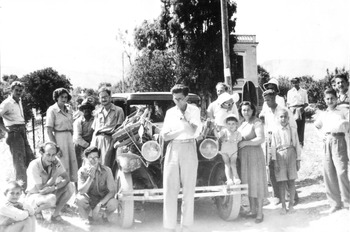
Not being Assistant Director did not prevent Sinclair from starting fieldwork for the BSA in Chios in summer 1952, which led to a diachronic programme that revived the pre-war British interest in the island that, with neighbouring Oinousses, had supplied many members of the Greek ship owning colony in London. Work continued for three more seasons at several sites of different periods at Emporio and elsewhere on Chios with many Students (Fig. 1). John Boardman, the new Assistant Director, led and published the Classical Greek excavations (Boardman Reference Boardman1967; Reference Boardman2020, 56–63; Waterhouse Reference Waterhouse1986, 113–14); Michael Ventris was the architect/surveyor; George Forrest studied the Greek inscriptions; Michael Ballance excavated an early Christian basilica, with G.U.S. Corbett. Living conditions were simple to tough; but it was a success.
Sinclair Hood (standing centre) in Chios, 1952, BSA Photographic Collection, Albums, BSAA6-77.

Sinclair's reports on prehistoric Chios (Hood Reference Hood1981; Reference Hood1982) concentrate on the Neolithic and Early Bronze Age inhabitation evidence and pottery of two caves at Ayio Gala in the north of the island and the Emporio settlement in the south, setting them in their Anatolian and Aegean contexts. (Ayio Gala had been excavated in 1938 by Edith Eccles [Momigliano Reference Momigliano, Cohen and Joukowsky2004; Marinatos Reference Marinatos2015, 201–15] with the help of Lilian [Anne] Jeffery and [Sir] David Hunt, all of them Students of the BSA.) Following the substantial Emporio volumes, Sinclair was elected a Fellow of the British Academy in 1983, 30 years after his election as a Fellow of the Society of Antiquaries. He was also a Vice-President of the BSA, had an honorary doctorate from the University of Athens and was garlanded with a Festschrift: Knossos: A Labyrinth of History. Papers Presented in Honour of Sinclair Hood (Evely, Hughes-Brock and Momigliano Reference Evely, Hughes-Brock and Momigliano1994); and Oxford University established the Sinclair and Rachel Hood Lecturership in Aegean Prehistory at the behest of Malcolm Wiener, who gave generously to funding the post. The first Hood Lecturer was the current Director of the BSA, Professor John Bennet.
The occasion for returning to Chios with the first official BSA excavation in Greece since before the War was the financial (and moral and cultural) support of Philip Argenti, the renowned historian of Chios and a distinguished member of the Greek community of London. The BSA was short of money. He provided funds, at first anonymously, for new research into the early history of his island.
Another donor was the Sunday Times, which financed underwater exploration off Chios (Pope Reference Pope2018, 83–4) as part of the project, and sent Dilys Powell to report. She was the paper's film critic and, of more relevance here, the widow of Humfry Payne (Director of the BSA 1929–36) and well known for her writing on Greece. Her lively account in An Affair of the Heart (Powell Reference Powell1957, 177–249) includes a comparison of dig life at Perachora in the 1930s with the more austere spirit of Emporio 20 years later (233). The diving produced mainly amphorae: ‘It was a start in a form of archaeological investigation now taken for granted and our article on the finds, in BSA 56 [Garnett and Boardman Reference Garnett and Boardman1961], was a landmark in its way’ (Boardman Reference Boardman2020, 62).
Underwater Chios was the summer before Sinclair settled into the Upper House as Director of the BSA, a bachelor until he married in 1957 Rachel Simmons, the daughter of theatrical costumier and artist John Simmons and his wife Margery (née Freeborough), who had been a doctor and pioneer of radiology before marriage. Rachel had read Classics at Cambridge, been a secretary to the writer J.B. Priestley, and volunteered for digging at Emporio. Theirs was a long and happy union. Rachel was a highly intelligent, generous, calm, perspicacious and gentle wife and mother to the family, and loved friend and support to many. Having asked Sinclair to wait a year before she accepted his proposal, aware, presumably, of what an undertaking marriage to him might be, she managed it brilliantly, giving him (and their family) love, confidence, and inner peace when things looked black and/or he had a temper. This could happen at any time, of a devastating intensity to the person (or the company) who had done the wrong thing; but remorse usually followed, especially when Rachel was there to assuage him. They had three children: Martin (b. 1957), Mary (b. 1959) and Dictynna (b. 1962).
At the Old Vicarage at Great Milton (by A.W. Blomfield, 1867), their home from 1965, Rachel created a wonderful garden, taught children in the village school with reading difficulties, and became area coordinator for adult literacy in South Oxfordshire. She also created a gem of a book, Faces of Archaeology in Greece (R. Hood Reference Hood1998) around the caricatures of famous and less-known American, British and Greek archaeologists by Piet de Jong (1887–1967). Piet had been Evans’ last architect at Knossos and was the BSA's Curator there from 1947 to 1952, when he and Sinclair worked together on rescue excavations. A close friend of the Hoods, he left him these cartoons, which Sinclair gave to the Knossos Trust in 1990: in turn, the Trust gave them to the Ashmolean Museum. The depictions are sparkling, and sometimes savage. In publishing them Rachel matched the ironies of Piet's drawings with equally pointed short pen-portraits, deft, kind and tolerant, of his subjects. In the last years of her life Rachel was in the grip of Parkinson's, a misery for her and Sinclair and the children and the many people who loved her. She died in 2016.
*
On becoming Director, Sinclair took the BSA's excavations from Chios to Knossos, introducing – and in effect apprenticing – a new group of Students to his high standards of excavating and recording that became the norm, with each generation of directors introducing modifications, on subsequent BSA excavations (Cadogan Reference Cadogan1994, 57 n. 1; Coldstream Reference Coldstream1994, 105 n. 2; Warren Reference Warren1994, 189 n. 1) and many Archaeological Service and University of Thessaloniki excavations in northern Greece (Stelios Andreou, pers. comm.). Mervyn Popham, who learnt to excavate from Sinclair and came to do so brilliantly (Cadogan Reference Cadogan2003, 345–6, 350), described it as ‘at the time a near revolution in digging techniques’, also praising Sinclair for training ‘a team of expert Cretan workmen with a skilled vasemender as well’ (Popham Reference Popham1994, 89 n. 1). The workmen (Hood and Hood Reference Hood and Hood2000, 212–13) would travel to Lefkandi, Myrtos and Sparta and other BSA excavations and were a magnificent home team support to the dig directors. So was the mender Petros Petrakis, MBE (Hood and Hood Reference Hood and Hood2000, 216–18), who, with his wife Eleni, travelled around Greece even more than the Knossian pickmen. Sinclair was always proud to have appointed him and arranged his training at the Athenian Agora.
The new work at Knossos began in 1955, when Sinclair, George Huxley (then Assistant Director of the BSA) and Nancy Sandars dug 19 tombs of a Minoan cemetery on the Upper Gypsades hill south of the Palace (Hood, Huxley and Sandars Reference Hood, Huxley and Sandars1959), with help from R.W. (‘Squire’) Hutchinson, who had been the Curator at Knossos before and immediately after the War. The report is meticulous and helpful, maintaining the standard of the report on the warrior graves of seven years before (Hood and de Jong Reference Hood and de Jong1952). It includes an incidental remark that is valuable for the history of Knossos: the field with the tombs was newly planted with vines (Hood, Huxley and Sandars Reference Hood, Huxley and Sandars1959, 194) – like many fields around Knossos at that time before Greece joined the European Union. Nowadays nearly all the vines have been replaced by olive trees, thanks to EU subsidies.
Concurrently with the Upper Gypsades excavation, a BSA team continued the underwater archaeology begun in Chios by exploring Roman fish tanks at Chersonisos and Mochlos and other submarine antiquities around Crete. John Leatham led the campaign, and he and Sinclair wrote the report (Leatham and Hood Reference Leatham and Hood1959): Sinclair would have had the ultimate responsibility for the project in the eyes of the Archaeological Service.
In 1956 Sinclair started to reinvestigate the Minoan houses near the Temple Tomb on Lower Gypsades which David Hogarth had found in 1900; and in 1957 he began his diachronic programme of Minoan, and earlier and later, excavations (Hood Reference Hood1961–2; Reference Hood1966b; Hood and Cadogan Reference Hood and Cadogan2011, 1–4), intended for him to test Evans’ Minoan system (A.J. Evans Reference Evans1906) and for others to flesh out the history of Knossos from the Neolithic settlement (J.D. Evans Reference Evans1964; Reference Evans1968; Reference Evans1971; Reference Evans1994; Reference Evans, Isaakidou and Tomkins2008) through the Early Iron Age to the Roman period (e.g. Coldstream Reference Coldstream1973) and even the Byzantine (Frend and Johnston Reference Frend and Johnston1962). Although Sinclair's own excavations beside the Royal Road and in other parts of Knossos on the whole await final publication, his programme clarified or resolved deep uncertainties about Evans’ framework for Bronze Age Crete – for instance by reinstating the validity of Early Minoan III as a separate phase, or showing there was a destruction at Knossos in Late Minoan IB outside the Palace but apparently not in it. It also provided plenty of well-dated specialist evidence to help make a comprehensive account of Knossos through time. Pottery, frescoes, ivory working and stone-vase making all play a part, with enough animal bones to flesh out the faunal, dietary and social history of the longest lived human habitation in the Aegean (and Europe). Following Chios, Sinclair's Knossos also trained the next platoon of BSA excavators.
The principal sites of his programme lay either side of the Royal Road. Royal Road: South (or RRS) was next to the House of the Frescoes, and Royal Road: North (or RRN) next to the complex that Evans called the Armoury or the Arsenal. RRS produced an important Middle Minoan occupation sequence, RRN a Late Minoan IB destruction outside the Palace (Hood Reference Hood, Brogan and Hallager2011), together with an ivory workshop, and a sequence of Early Minoan occupation (Hood and Cadogan Reference Hood and Cadogan2011). In 1959 Jacquetta Hawkes (whose husband J.B. Priestley had employed Rachel Hood as his secretary) visited and wrote about the excavations in The Observer, where the following year, while Sinclair was excavating at Knossos, L.R. Palmer splashed his re-dating of the destruction of the Minoan Palace and its Linear B tablets. The members of the team were then overwhelmed with newspaper cuttings from families at home. Sinclair soon joined the full and frank debate that followed, as did other BSA hands, notably John Boardman and Mervyn Popham.
Sinclair realised too the need for proper storage of the finds, both from his own and other recent excavations as well as those of Evans and others before the War. It meant a building to house them for conservation, study, and safeguarding in perpetuity. What became the Stratigraphical Museum had been stacks of wooden trays in dark, hard-to-access spaces under staircases in the Minoan Palace or rooms closed to visitors until he raised the money to turn the virtual concept inventoried by John Pendlebury and his team in the early 1930s into reality. The present library-like reference collection on open shelves in a self-contained building is the heart of the BSA's Knossos Research Centre – and will soon be expanded in view of its vital function. Generally known as ‘the Strat’, it was built in 1962 on the former tennis court of the Villa Ariadne. In 1966 Joan Evans, Sir Arthur's half-sister (and 42 years younger) and then the immediate past President of the Society of Antiquaries, opened it officially.
There were also the intellectual needs of studying, and trying to understand, such a complicated and long-lived place as Knossos. First came a gazetteer of the find spots across the Knossos valley, whether buildings, big cemeteries or chance finds, of all periods. John Cook had had the idea and the Knossos Survey began in autumn 1952, perhaps with the immediate extra purpose of providing information for transferring the School's holdings at Knossos to the Greek state. The first edition of the Archaeological Survey of the Knossos Area (Hood Reference Hood1958) had 165 entries and cost 17s. 6d. (= 87.5p today). As the War became ever more distant and the pace of excavations, whether research or rescue, increased, a new edition was needed: with 370 entries it came out in 1981 (Hood and Smyth Reference Hood and Smyth1981) and was dedicated to Spyros Vasilakis, a highly skilled senior pickman, who had often walked the Knossos valley and noted its sites with Sinclair, and died the year before publication. His son Andonis would come along with them: a warm friend of many BSA Knossians, Andonis grew up in the only house in Makryteichos, the lower village of Knossos, to have Oxford Classical Texts. He read archaeology at Thessaloniki before joining the Archaeological Service and becoming an Ephor.
Another immediate need was a full stone-by-stone plan of the Palace and surrounding structures: a huge undertaking for a huge site, drawn at 1:100 and reduced to 1:200 for publication. Surveying for The Bronze Age Palace of Knossos: Plan and Sections (Hood and Taylor Reference Hood and Taylor1981) began in 1955, and the plan was largely complete by 1961, the last year of the stratigraphical/chronological programme of excavations. But then came various unexpected delays (Hood and Taylor Reference Hood and Taylor1981, 6), which meant that it was not published until 20 years later.
Sinclair's intense study of the Palace for the plan – and for several contributions to the debate about the date of the Linear B tablets of Knossos (listed in Evely, Hughes-Brock and Momigliano Reference Evely, Hughes-Brock and Momigliano1994, xxi–ii) – resulted in his knowing the Palace and its architectural, chronological and interpretative problems better even, I dare say, than Arthur Evans and his helper Duncan Mackenzie. The problems led to small test excavations in 1973 and 1987 in parts of the Palace to elucidate their stratigraphies and contexts (Hood Reference Hood1994). Some of these still await full publication, but some are published in whole or part (e.g. Momigliano and Hood Reference Momigliano and Hood1994).
At the same time, Sinclair's steady flow of articles on aspects of Knossos other than his excavations continued, relating them to the rest of Minoan Crete and beyond: for a list of these until 1994 see Evely, Hughes-Brock and Momigliano Reference Evely, Hughes-Brock and Momigliano1994, xxi–v; for later articles see the bibliography in Nestor. Topics range from frescoes and iconography – including his collaboration with Mark Cameron in making a catalogue of the frescoes of Knossos that are shown in Evans’ Knossos Fresco Atlas (Cameron and Hood Reference Cameron and Hood1967) – to the meaning and uses of cup-marks (or cupules) (Hood Reference Hood1995; Reference Hood2000a), the chequered story of discovering Knossos (Hood Reference Hood1987), or his heartfelt tribute to Sir Arthur Evans (Hood Reference Hood2003).
For the Greek mainland, his articles on Heinrich Schliemann at Mycenae (Hood Reference Hood1960a; Reference Hood, Korres, Karadimas and Flouda2012), as revealed in three large albums that Schliemann had organised of the photographs, plans and drawings that appear in Mycenae (Schliemann Reference Schliemann1878) or were never published, explain how Sinclair had the luck to buy these ‘Mycenae albums’ in Athens when he was Director of the BSA. Later, he gave them to the Knossos Trust, the charity he established (following the precedent of Lord William Taylour's Mediterranean Archaeological Trust) to support, inter alia, the publication of his excavations at Knossos. The Trust subsequently sold them to the National Library of Scotland, where they are in the John Murray Archive, the firm having been Schliemann's publishers in London.
The magnificent offspring of the plan of the Palace, and the most remarkable achievement of Sinclair's knowledge of every stone, nook and cranny at Knossos, is his catalogue raisoné of The Masons’ Marks of Minoan Knossos – 1223 of them – that was published last year in two volumes (Hood Reference Hood and Bendall2020). Most generously, Lisa Maria Bendall edited them, ensuring the fruition of the project that had begun in 1978. How often one would see Sinclair steaming out of the Taverna, the BSA's Hostel, down to the Palace, all set to record more marks, his scarf-turban billowing behind, the tourists stepping away from the man with a purpose, and his draughtsperson – Jeff Clarke, or his daughter Mary – following more quietly as if to conserve energy to face the skirmishes with the stones in the heat of the Cretan sun. And, as one would expect of Sinclair, this great work is almost as valuable for its comparanda, from the rest of Crete and the Aegean, plus third millennium Egypt and then via the Levant, with a detour to Persia, to the Middle Ages and the masons’ marks of Salisbury Cathedral, as it is for the rich descriptions of the signs at Knossos and the walls they are cut into.
*
A key part of Sinclair's archaeological thinking was his compulsion to delineate context, both horizontal in terms of geography and space, and vertical for time and chronology. They merge, as one sees in his many chronological charts (such as Hood Reference Hood1971, 10; Reference Hood1978, 15): if the chronological context is not right, it is hard to say much about the spatial context – and proper setting – of a place or culture.
Context was also the rationale behind his exploring for archaeological sites throughout Crete, especially in the 1960s. His intention was to revise the lists in The Archaeology of Crete (Pendlebury Reference Pendlebury1939) and ultimately to produce a new edition of that still unsurpassed handbook (Managing Committee 1960, 2). The surveys, happening in the last years of extensive searches for sites before intensive projects became the norm, concentrated on particular areas of the island (Wagstaff Reference Wagstaff2000, 71–2). He took Peter Warren and me on some of his journeys, and Rachel on others (Hood, Warren and Cadogan Reference Hood, Warren and Cadogan1964; Hood Reference Hood1965b; Hood and Warren Reference Hood and Warren1966). Often we camped out, although that could be difficult when curious locals emerged out of the dark to stand around and watch us. Once when the onlookers had been asked to leave, and stayed, Sinclair had the solution. ‘Get undressed’, he said. We did, they went. In the mornings we shaved in the wing mirror of the Jeep with hot water he had boiled up; and I learnt not to fill or wash my cup in the part of a village fountain the animals drink from.
He taught us how to find sites: keep your eyes open the whole time (which is how he spotted from his Jeep a tholos tomb below (sic) the road to Rethymno: Hood Reference Hood1965a); look for farmland, a water source, communications, and concentrations of stones that could come from collapsed buildings; then climb the hill. Go also to the village kafeneio and ask if anyone knows of places with sherds on the ground. He would put the questions in his grammatically correct Greek but with a Harrow-cum-Oxford accent that the Cretans found hard to understand. When Rachel was there, who was often thought to be Greek, they turned to her for help.
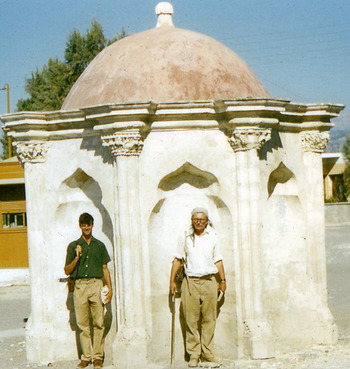
In 1962 we came upon many sites and many surprises: sticking out of a bank in the hinterland of Rethymno was an intact Late Minoan III larnax with its lid still on; on a hill above the south coast, half a Late Minoan IB Marine Style rhyton lay on the ground. For Peter and me, the highlight was Myrtos. After spending the night on the beach (and in the morning the Jeep got stuck in the sand and nearly ended in the sea), we visited the village school, where the schoolmaster Giorgos Dimitrianakis had a small museum. He told us of the Pyrgos hill opposite and showed us his finds. We climbed it and returned, happy, to the village for lunch – whereupon Manolis Daskalakis at the kafeneio told us of another place with sherds, Fournou Koryfi. It was a red letter day for the three of us; for Peter and me the 1962 travels with Sinclair changed our lives (Warren Reference Warren1972; Cadogan Reference Cadogan1977–8) (Fig. 2).
Travelling in Crete, August 1962: Peter Warren (left) and Sinclair Hood (right) at the Ottoman fountain in Ierapetra. Photo by Gerald Cadogan.

From Knossos there were regularly Sunday excursions (ekdromes) to see the country and find sites. In 1964–5 the record was five new ones in a day: three before lunch; then, as we spread the picnic rug, we saw tripod legs from Minoan cooking vessels for the fourth site; and one more in the afternoon. The toughest Sunday excursion ever was in the late 1950s when Sinclair ‘led his Knossos excavation team on a twelve-hour climb from Anoyeia via the Cave of Zeus [the Idaean Cave] to the summit of Mt Ida – and back’ (Sackett Reference Sackett2000, 41). Working with Sinclair, whether digging or studying, Sunday was usually the only day of rest.
*
Besides Knossos and working in Chios on the pottery from Emporio, Sinclair's Directorship was notable for his warm welcome to foreign archaeologists, especially those from behind the Iron Curtain who all, or almost all, had little money and suffered miserable experiences in getting permission to come. This hospitality continued all his life. In return he visited their countries, as well as travelling widely in Greece, and learnt Balkan and European archaeology through and through. In 1958–9, for instance, he was in Spain for three weeks, Czechoslovakia for two, and east Crete for one; in 1960, there was a week on Rhodes and 10 days in Bulgaria, before a few weeks visiting sites in central and west Crete.
Administration was probably his least favourite part of the job, although his Assistant Directors (in succession: John Boardman, William Llewellyn Brown, George Huxley, Philip Sherrard and Hugh Sackett) were there to share the burden. Misunderstandings could occur between the Managing Committee in London (which saw its job as to manage, if not micro-manage) and Athens. The Committee held its meetings on a Tuesday. This meant that the letter of decisions and orders would arrive in the Sunday morning postal delivery ‘just in time to spoil our Sunday ekdromi’, Sinclair lamented. Rachel would urge him not to open the letter until the evening, to no avail. Rage followed. A more palatable part of the administration, however, may have been negotiating with the Ephor of Crete Nikolaos Platon on the details of the transfer of the BSA's holdings at Knossos to the then Kingdom of Greece: he took care to ensure that people from the School could continue to stay on occasion at the Villa Ariadne (while the Taverna, the Hostel at the foot of the Villa drive, became the BSA's headquarters at Knossos).
Being Director came to an end in the summer of 1962. In July, Sinclair, aged 45, left the Upper (Director's) House in the Jeep for the last time as his residence; Peter Warren and I accompanied him. We drove to the Peiraeus, with ahead of us a truck with 32 pieces of luggage. At the port all were craned up onto the foredeck of the boat to Crete. The luggage made a corral round the Jeep, from which Sinclair produced supper (keftedes from the Upper House cook) and safari beds for a better night than usual if sleeping on deck. It was the start of our travels in Crete (Hood, Warren and Cadogan Reference Hood, Warren and Cadogan1964) and for Sinclair the preparation for eight months en famille studying material from his 1957–61 stratigraphical excavations, not as Director of the BSA but its Honorary Curator at Knossos for a year only.
A second long study season followed in 1964–5, when Jeff Clarke came to paint – and do some pot drawing – while his wife Pat drew pottery full time. For Jeff it was the start of a long intimacy with Sinclair. ‘He was a great friend to me, helping me in two difficult periods of my life, almost like a father, and his family welcomed me as family. He was always very generous, and a great patron, buying many of my works’, Jeff says, valuing particularly ‘his quiet understatements about something important that could have gone wrong’ and the way he would be ‘suddenly diffident in conversation, and apologetic, taken by surprise’. Sinclair's Festschrift includes several etchings by Jeff (Clarke Reference Clarke1994).
After the study season Sinclair and Rachel settled in Great Milton, to live, and work, and bring up the children there. In the 1960s the village was not yet known as the site of Raymond Blanc's Manoir aux Quat'Saisons, a short walk from the Old Vicarage. When Blanc moved there from the Oxfam building in Summertown, Oxford, Malcolm Wiener's visits to the Hoods were marked by his welcome invitations to dine down the road.
Archaeology continued: annual (or nearly so) trips to Crete until 2006; stints as Geddes-Harrower Professor at Aberdeen in 1969, and a Guest Scholar at the Getty Museum in 1981–2; a return to excavating in 1974–7 at the request of the BSA's Managing Committee as their representative on Colin Renfrew's excavations at Phylakopi on Melos. His experience was valuable, and he published the Middle Minoan pottery (Hood Reference Hood and Renfrew2007).
The Chios reports (Hood Reference Hood1981; Reference Hood1982) came out in these post-Director years, and articles flowed, not just on Aegean prehistory but also topics such as the enigmatic Tartaria tablets (e.g. Hood Reference Hood1967b), ‘Northern penetration of Greece at the end of the Early Helladic period and contemporary Balkan chronology’ (Hood Reference Hood, Crossland and Birchall1973), and the Slav invasions of the sixth and seventh centuries ad (e.g. Hood Reference Hood1966a; Reference Hood1970). One title, ‘Some exotic pottery from prehistoric Greece’,Footnote 3 could encapsulate his approach and interests. He had an eagle eye for extraneous items in a culture, or specific deposits, as evidence for links, connections and influences, or even population movements and invasions (e.g. Hood Reference Hood and Cadogan1986a). A pacifist, he wrote on war and destruction (e.g. Hood Reference Hood1986b) and empire (e.g. Hood Reference Hood, Hägg and Marinatos1984), issues that had been in his mind from the time of his reports on the warrior graves of Knossos (Hood and de Jong Reference Hood and de Jong1952; Hood Reference Hood1956) and the cavalryman figurine from Mycenae (Hood Reference Hood1953b). And, someone who loved and bought art, he wrote on Minoan frescoes and iconography (e.g. Hood Reference Hood and Sherratt2000b; see also Cameron and Hood Reference Cameron and Hood1967; Hood Reference Hood1978) – and religion.
Religion mattered deeply to Sinclair, Minoan and contemporary. His paper on ‘Religion in Bronze Age Crete’ (Hood Reference Hood2000a) begins with: ‘Religion is perhaps the most ιδιωτικό – personal or private – of all aspects of life, and the most impenetrable – especially in the absence of intelligible written texts, which is the situation in Minoan, if not Mycenaean, Crete.’ This is the clear, forthright approach of a believer who eschewed the woolly agnosticism of ‘ritual’, the word that is so popular among non-believer archaeologists today (if revealing both uncertainty and a desire to appear detached in scholarly judgements). The paper went on to discuss standing stones (baetyls) and cup-marks (or cupules) and their interpretation. In his own journey Sinclair moved from Canterbury to Rome, despite having been churchwarden at Great Milton (where Rachel and he are buried). Part of it was his not accepting the idea of women as priests; but also it was not an unusual progress for Anglo-Catholics. ‘The [Roman] Catholics were saying what I believed, what I was thinking’, he told Jeff Clarke. Thereafter he did not change, just as he never changed the opinion he thought about for years that Linear B is not Greek – which had nothing to do with his friendship with Michael Ventris.
Besides the many articles, Sinclair's three books that are not excavation reports are a valuable part of his scholarly legacy. First was The Home of the Heroes (Hood Reference Hood1967a); then came The Minoans (Hood Reference Hood1971) in the Thames and Hudson Ancient Peoples and Places series; and finally The Arts in Prehistoric Greece (Hood Reference Hood1978), his magnificent contribution to the Pelican History of Art.Footnote 4 All three tackle the important cultural and historical issues inductively in a fresh and inquisitive approach, supported by comprehensive observation of detail, and intriguing, unexpected and undogmatic but long pondered suggestions on ways to interpret what he observes. Sinclair presents his views modestly, with a deep sense of the ifs and buts of explaining material culture without appropriate written texts, and in general of the uncertain probability of his or others’ suggestions. It is exhilarating to read the books again – or for the first time. They, especially the two later ones, are a masterclass in how to look, and how to think, archeologically.
*
Sinclair continued working – and digging in the garden – at the Old Vicarage into his 90s. Afterwards, one might find him dozing in a chair in the sitting room that was primarily Rachel's room, The Times, The Tablet and Private Eye beside him. If getting deaf, he still feasted on print. Later, it was a chair in his bedroom, but he was downstairs last year to celebrate his birthday and the publication of Masons’ Marks. If he was nodding off, archaeological news and memories could focus his mind: ‘tholos’ was an ideal stimulant, I found in telling him of the latest excitements from Nestor's Pylos. When Helen Hughes-Brock, Vasso Fotou and Nicoletta Momigliano came, they wrote messages on a whiteboard. So did the family and the saintly group of carers who looked after him and Rachel in their last years.
An account of a pupilmaster like Sinclair is not easy. He did not talk much about himself, and only once did I hear him mention the good fortune of being the great-grandson of Garret Ellis Winants. But he was generous, and always ready to hear an argument from anybody of any age or experience – and change his mind, at least on archaeological issues. He could at times be surprisingly diffident, but he was never mean or petty; and Cretans honoured him, despite his pronunciation of Greek. He was a great, and demanding, unofficial teacher: Peter Warren and I were lucky to have been his two principal apprentices and see at first hand his intensive study of pottery, trench sections and architectural features as the way to create scintillating reports on fieldwork followed by lively interpretations and conjectures in his articles and general works. One must always keep in mind how much he achieved, especially in our understanding of the Palace of Knossos and its context. While there are excavations that others will be writing up for publication, they will find much of the work already done and the records arranged in meticulous order – as was his correspondence.
The experiences of growing up in two countries, encountering the loss through war of his father and three uncles, and having antiquaries or archaeologists in both the British and American families, all helped shape his intellectual and spiritual journey, endowing him with remarkable energy, stamina and resilience, and a professional – more American than English – determination to do the job (whatever it was) thoroughly. His tempers, often lurking in impatient driving or never taking his foot off the clutch, make sense too as part of his American background: people seem more used to them in the USA than in Britain, where schools (and parents) trained the young to hide their real feelings. All the same, it meant working extra hard for him so as to avoid the occasion for one.
His archaeology, beginning towards the end of World War II, soon showed a concern for big, serious issues that he continued to examine inductively for the rest of his life: religion and war, that had affected him directly; population movements (all too relevant as horrific stories emerged from the War); the exchange of technology and iconography as evidence of links and connections between regions. Stimulated by the excitement of studying with Gordon Childe, he had a wide approach that overran modern national boundaries and saw context in the broadest sense as paramount. He needed to travel, and learn, and take part in as many excavations and study as much pottery as was possible after the War; and Crete was an essential early stop for someone who had read The Palace of Minos during the Blitz. Those years led to Chios and Knossos, to his asking major questions, his emphasis on thinking and re-thinking through the evidence, and realising how hard the answers often were, and still are. May he rest in peace and light perpetual shine upon him.
ACKNOWLEDGEMENTS
I have tried to be accurate, as Sinclair would wish, but there may still be errors for which I apologise. Some details are different from previous accounts and/or the references cited.
I am very grateful to Sinclair and Rachel's children Martin and Dictynna Hood, and Mary Van Dyke, for constant help and encouragement, and to Mary especially for letting me use her fascinating draft memoir Minoan Patchworks: A Cretan Childhood (Van Dyke Reference Van Dykeforthcoming). Without their detailed support and many memories this obituary would not be possible. I have also drawn on Nektarios Karadimas’ interview with Sinclair in 2009, transcribed in 2015 (Karadimas Reference Karadimas2015a; Reference Karadimas2015b). I thank him, and also Stelios Andreou, Lisa Maria Bendall, John Bennet, John Boardman, Diane Bolger, Lucy Cadogan, Jeff Clarke, Nicola Coldstream, Jack Davis, Doniert Evely, Paul Halstead, Eleni Hatzaki, Helen Hughes-Brock, Robert Koehl, Katerina Kopaka, Colin Macdonald, Nicoletta Momigliano, Irene Nikolakopoulou, Andonis Vasilakis, Peter Warren, Todd Whitelaw and Malcolm Wiener for help, advice and information.
Sinclair's Festschrift, Knossos: A Labyrinth of History. Papers Presented in Honour of Sinclair Hood, gives his bibliography up to around 1994: Evely, Hughes-Brock and Momigliano Reference Evely, Hughes-Brock and Momigliano1994, xx–xxv. In the Athens press there were obituaries in Καθημερινή (22 January 2021) and Τα Νέα (26 January 2021), in the London press in The Daily Telegraph (22 March 2021) and The Times (16 March 2021). Excerpts from a short interview (‘In memoriam Sinclair Hood’) in 2005 with Lucy Goodison may be found at <https://independent.academia.edu/LucyGoodison> (accessed September 2021). Peter Warren is preparing an obituary for the Biographical Memoirs of Fellows of the British Academy.