Attention deficit hyperactivity disorder (ADHD) is a heterogeneous disorder characterized by deficits in self-regulation, as manifested in the core behavioral symptoms of inattention and hyperactivity/impulsivity as well as in poor regulation of cognition and emotions (Busch et al., Reference Busch, Biederman, Cohen, Sayer, Monuteaux, Mick and Faraone2002; Nigg, Reference Nigg2005; Shaw, Stringaris, Nigg, & Leibenluft, Reference Shaw, Stringaris, Nigg and Leibenluft2016; Sobanski et al., Reference Sobanski, Banaschewski, Asherson, Buitelaar, Chen, Franke and Faraone2010). ADHD is highly heritable (in the range of 0.56 to 0.84; Larsson, Chang, Onofrio, & Lichtenstein, Reference Larsson, Chang, Onofrio and Lichtenstein2014) but is often not diagnosed until school age (Visser et al., Reference Visser, Danielson, Bitsko, Holbrook, Kogan, Ghandour and Blumberg2014). However, symptoms often emerge during the early years (Kieling et al., Reference Kieling, Kieling, Rohde, Frick, Moffitt, Nigg and Castellanos2010), and there is a need to further the knowledge about early markers of later inattentive and hyperactive/impulsive behavior (Johnson, Gliga, Jones, & Charman, Reference Johnson, Gliga, Jones and Charman2015). A recent study showed that symptoms of ADHD could be detected reliably by parents already at 36 months and by professionals even earlier (Miller, Iosif, Young, Hill, & Ozonoff, Reference Miller, Iosif, Young, Hill and Ozonoff2016). In addition, ADHD symptomatology has showed moderate stability (r ~ .50) across 2, 3, and 4 years of age (Price et al., Reference Price, Simonoff, Asherson, Curran, Kuntsi, Waldman and Plomin2005), and the estimated prevalence of ADHD in a large sample of toddlers at risk for developmental delay was similar to that of older children (Turygin, Matson, & Tureck, Reference Turygin, Matson and Tureck2013). As such, although scarce, a growing body of research suggests that it ought to be possible to reliably study levels of symptomatology already at the age of 36 months. ADHD is a diagnostic category (American Psychiatric Association, 2013), but empirically it has been argued that ADHD is best conceptualized as a dimensional trait (Willcutt et al., Reference Willcutt, Nigg, Pennington, Solanto, Rohde, Tannock and Lahey2012), and that both dichotomous and dimensional measures of ADHD seem to measure a genetically common phenotype (Middeldorp et al., Reference Middeldorp, Hammerschlag, Ouwens, Groen-Blokhuis, St. Pourcain, Greven and Boomsma2016). The progression of ADHD symptoms is as such also possible to study in samples of typically developing children, particularly so when it comes to early markers in infancy when the core symptoms of ADHD are not yet possible to detect.
Needless to say, there have been numerous theoretical attempts to explain the etiological mechanisms underlying the ADHD symptom profile, stressing both intrinsic and extrinsic factors as central for the development of the disorder. One of the most influential accounts is Barkley's hybrid model, emphasizing the contribution of behavioral inhibition and executive functioning (EF) to the disorder (Barkley, Reference Barkley1997; Willcutt, Doyle, Nigg, Faraone, & Pennington, Reference Willcutt, Doyle, Nigg, Faraone and Pennington2005; Willcutt et al., Reference Willcutt, Nigg, Pennington, Solanto, Rohde, Tannock and Lahey2012). Another suggested pathway is temperament, in which reduced levels of temperamental self-regulation (i.e., effortful control) and elevated levels of negative emotionality and/or positive affectivity/surgency have been linked to ADHD (Johnson et al., Reference Johnson, Gliga, Jones and Charman2015; Nigg, Reference Nigg2006; Nigg, Goldsmith, & Sachek, Reference Nigg, Goldsmith and Sachek2004). EF and effortful control are distinct but overlapping constructs that both concern self-regulation (Miyake & Friedman, Reference Miyake and Friedman2012; Rothbart, Posner, & Kieras, Reference Rothbart, Posner, Kieras, McCartney and Phillips2006). Of late, fruitful theoretical attempts have been made to present a general construct of self-regulation that incorporates regulation of cognition, actions, and emotions, distinguishing between bottom-up and top-down regulation (Bridgett, Burt, Edwards, & Deater-Deckard, Reference Bridgett, Burt, Edwards and Deater-Deckard2015; Nigg, Reference Nigg2017). According to these models, EF concerns top-down cognitive regulation, which is key for goal-directed actions (Miyake & Friedman, Reference Miyake and Friedman2012; Nigg, Reference Nigg2017), whereas effortful control is the temperamental equivalent to EF and concerns top-down domain-general self-regulation, that is, regulation of actions, emotions, and cognition (Nigg, Reference Nigg2017). Thus, effortful control shows considerable overlap with both EF (Nigg, Reference Nigg2017) and emotion regulation (Eisenberg & Zhou, Reference Eisenberg, Zhou, Griffin, McCardle and Freund2016; Zhou, Chen, & Main, Reference Zhou, Chen and Main2012), and the variation in terminology, at least in part, originates from different research traditions (Nigg, Reference Nigg2017). In this study, we use the broad term self-regulation when we refer to both temperamental and cognitive aspects of regulation, and the term cognitive regulation for EF-related functions such as inhibition and sustained attention. ADHD is as such a disorder characterized by deficits in various aspects of self-regulation. Further, its symptoms are suggested to be influenced by environmental factors such as parenting, that functions as external regulation of the child's behavior and emotions (Berry, Deater-Deckard, McCartney, Wang, & Petrill, Reference Berry, Deater-Deckard, McCartney, Wang and Petrill2013; Ellis & Nigg, Reference Ellis and Nigg2009; Johnston & Mash, Reference Johnston and Mash2001). When assessing parental influences on child self-regulation, it is of great importance to take other characteristics such as parental self-regulation and child temperament into account, as recursive processes between these characteristics and parenting behavior are to be expected (e.g., Johnston & Mash, Reference Johnston and Mash2001). That is, low parental self-regulation could influence the parent's ability to adequately recognize, interpret, and respond to the infant's signals (Bridgett, Kanya, Rutherford, & Mayes, Reference Bridgett, Kanya, Rutherford and Mayes2017). In addition, being a sensitive parent is more difficult when the child exhibits, for instance, high levels of externalizing problems or negative emotionality (Johnston & Mash, Reference Johnston and Mash2001).
Moreover, main effects might be interesting on their own, but the last decade has spurred an interest in interaction effects between cognitive and social factors (Baer et al., Reference Baer, Schreck, Althoff, Rettew, Harder, Ayer and Hudziak2014). We believe that two different frameworks for understanding interaction effects can be applied to investigate interactions in relation to ADHD symptoms. First, the diathesis-stress model, which posits that genetic or biological vulnerabilities interact with social stressors to create deficits (Goforth, Pham, & Carlson, Reference Goforth, Pham, Carlson, Goldstein and Naglieri2011). Second, the theory of differential susceptibility, which suggests children with certain characteristics or plasticity factors, such as a difficult temperament (e.g., high levels of negative emotionality and/or positive affectivity/surgency), to be more susceptible of both positive and negative aspects of environmental factors such as sensitive parenting (Belsky, Reference Belsky, Ellis and Bjorklund2005; Belsky, Bakermans-Kranenburg, & van IJzendoorn, Reference Belsky, Bakermans-Kranenburg and van IJzendoorn2007; Rochette & Bernier, Reference Rochette and Bernier2016).
Accordingly, multiple reactive and regulatory functions, intrinsic as well as extrinsic, seem to affect the progression of inattentive and hyperactive/impulsive behavior. However, the number of studies investigating the development of these behaviors over time are scarce and most have examined the progression of symptoms at older ages, when the behavioral symptoms are already well manifested (Brocki, Forslund, Frick, & Bohlin, Reference Brocki, Forslund, Frick and Bohlin2017; Johnson et al., Reference Johnson, Gliga, Jones and Charman2015). Consequently, there is a need for research simultaneously including multiple early predictors of behavioral manifestations of ADHD (Johnson et al., Reference Johnson, Gliga, Jones and Charman2015) to examine main and interactive effects in order to identify driving mechanisms (Nigg, Reference Nigg2005). Thus, the aim of the current study was to investigate independent and interactive effects of infant reactive and self-regulatory functions (i.e., inhibition, sustained attention, and temperament) and extrinsic regulation in the form of maternal sensitivity at 10 months, as predictors of later inattentive and hyperactive/impulsive behavior at 36 months, in a typically developing sample.
Inhibition and Sustained Attention in Relation to ADHD
Deficits in cognitive regulation such as poor behavioral inhibition and sustained attention have been emphasized as associated features and etiological predictors of ADHD for decades (Barkley, Reference Barkley1997). As mentioned earlier, the vast majority of previous studies on the topic have examined the relations between these cognitive regulatory processes and behavioral symptoms in preschoolers or school-aged children (Berwid et al., Reference Berwid, Curko Kera, Marks, Santra, Bender and Halperin2005; Brocki, Nyberg, Thorell, & Bohlin, Reference Brocki, Nyberg, Thorell and Bohlin2007; Oosterlaan, Logan, & Sergeant, Reference Oosterlaan, Logan and Sergeant1998; Yong-Liang et al., Reference Yong-Liang, Robaey, Karayanidis, Bourassa, Pelletier and Geoffroy2000). However, a few studies have examined the role of infant inhibition and sustained attention in relation to later ADHD-associated features such as effortful control, EF, and emotion regulation. For instance, inhibition measured with the “don't paradigm” has shown longitudinal positive predictions from 14 months to effortful control at 45 months (Kochanska, Coy, & Murray, Reference Kochanska, Coy and Murray2001) and to EF even 14 years later (Friedman, Miyake, Robinson, & Hewitt, Reference Friedman, Miyake, Robinson and Hewitt2011). Moreover, sustained attention in infancy predicted effortful control and emotion regulation at 33 months (Kochanska, Murray, & Harlan, Reference Kochanska, Murray and Harlan2000), and a cross-sectional study found lower levels of sustained attention in infants at risk for ADHD compared to the control group (Auerbach, Atzaba-Poria, Berger, & Landau, Reference Auerbach, Atzaba-Poria, Berger and Landau2004).
Nevertheless, we are aware of no previous study simultaneously examining inhibition and sustained attention in infancy as predictors of later inattentive and hyperactive/impulsive behavior. In addition, investigating interaction effects between inhibition, sustained attention, and environmental factors such as parenting will provide new insight into the progression of inattentive and hyperactive/impulsive behavior during the early years. Moreover, studying typically developing infants at an age before the core symptoms of ADHD are detectable can further our understanding of developmental psychopathology.
Temperament in Relation to ADHD
Temperament is typically defined as constitutionally based individual differences in reactivity and self-regulation, and encompasses, according to Rothbart's influential account, three broad factors: negative emotionality, positive affectivity/surgency, and effortful control (Rothbart, Ellis, & Posner, Reference Rothbart, Ellis, Posner, Vohs and Baumeiste2013). The first two involve processes of emotional reactivity and are present during the first year of life, while effortful control concerns regulation of emotions and behavior and shows a more protracted development during the early years (Rothbart, Reference Rothbart2007). During the first year of life, this type of temperamental self-regulation is referred to as orienting/regulatory capacity by Rothbart et al. and involves less voluntary aspects of regulatory behaviors, but have shown to be predictive of later effortful control (Putnam, Rothbart, & Gartstein, Reference Putnam, Rothbart and Gartstein2008). As previously mentioned, the typical temperamental pattern for children with ADHD would be low effortful control, and high levels of negative emotionality and positive affectivity/surgency (Johnson et al., Reference Johnson, Gliga, Jones and Charman2015; Ullsperger, Nigg, & Nikolas, Reference Ullsperger, Nigg and Nikolas2016). In line with this proposal Nigg (Reference Nigg2006) suggests that there are two temperamental pathways to ADHD, one with low levels of effortful control and one involving strong approach tendencies (i.e., surgency). Nigg further suggests that low effortful control is primarily related to symptoms of inattention and that high approach is linked to hyperactivity/impulsivity. The relation between negative emotionality and ADHD is more unclear, as a positive association has been found in some studies but not in others, possibly because negative emotionality may be a risk factor for externalizing behaviors in general rather than of ADHD specifically (Nigg, Reference Nigg2006). In addition, it has been argued that temperament is not only a liability factor but also a potentially valid endophenotype or early marker of ADHD (Nigg et al., Reference Nigg, Goldsmith and Sachek2004) that may interact with parenting in shaping its symptoms (Ullsperger et al., Reference Ullsperger, Nigg and Nikolas2016). Here, both the diathesis-stress model and the theory of differential susceptibility suggest children with a difficult temperament to be more susceptible of environmental factors such as sensitive parenting, but with different patterns of associations (Roisman et al., Reference Roisman, Newman, Fraley, Haltigan, Groh and Haydon2012). If temperament constitutes a vulnerability or susceptibility factor for later inattentive and hyperactive/impulsive behavior, one can expect to find interaction effects with environmental factors. However, if early temperament is a marker of later inattentive and hyperactive/impulsive behavior, one would expect main effects of temperament rather than interaction effects.
Maternal Sensitivity in Relation to ADHD
Complementing the research on cognitive and temperamental predictors of symptoms of ADHD, numerous studies have shown that the family environment is important in the progression of this disorder and of associated features such as different aspects of self-regulation (e.g., Bernier, Carlson, & Whipple, Reference Bernier, Carlson and Whipple2010). For instance, self-rated parenting has been linked to clinical ADHD concurrently in school-aged children (Ellis & Nigg, Reference Ellis and Nigg2009), and low maternal warmth and sensitivity predicted later ADHD caseness with control for initial symptom level (Keown, Reference Keown2012). In addition, maternal sensitivity moderated the effects of birth weight on later teacher- and mother-rated ADHD symptoms, in that high levels of warmth seemed to protect children with low birth weight from poor developmental outcome (Tully, Arseneault, Caspi, Moffitt, & Morgan, Reference Tully, Arseneault, Caspi, Moffitt and Morgan2004).
Moreover, maternal sensitivity and autonomy support in infancy predicted cognitive self-regulation in toddlerhood (Bernier et al., Reference Bernier, Carlson and Whipple2010), and greater parental sensitivity at ages 4 to 7 years predicted better attentional control 2 to 3 years later (Belsky, Fearon, & Bell, Reference Belsky, Fearon and Bell2007; Keown, Reference Keown2012). The process by which parenting affects the child is suggested to take place via external regulation of behaviors and emotions, in that soothing, comforting, and monitoring children (Crockenberg & Leerkes, Reference Crockenberg and Leerkes2004) with time aids the development of the child's own emerging intrinsic capacity to self-regulate (Bernier et al., Reference Bernier, Carlson and Whipple2010; Rothbart et al., Reference Rothbart, Posner, Kieras, McCartney and Phillips2006). When the extrinsic regulation is poor or inefficient, it may contribute to higher levels of inattention and hyperactivity/impulsivity (Ullsperger et al., Reference Ullsperger, Nigg and Nikolas2016). Johnston and Mash (Reference Johnston and Mash2001) state in an early review that there is evidence that parenting can impact on the presentation, if not the development, of child ADHD symptoms. However, there is also some evidence that parent behavior can be influenced by child symptomatology (Belsky, Fearon, et al., Reference Belsky, Fearon and Bell2007; Johnston & Mash, Reference Johnston and Mash2001), in that it is more difficult to be a sensitive parent to a child with a difficult temperament. As such, bidirectional influences between the two have been suggested (Kiff, Lengua, & Zalewski, Reference Kiff, Lengua and Zalewski2011; Lifford, Harold, & Thapar, Reference Lifford, Harold and Thapar2007). Consequently, it is important to control for child temperament (e.g., high levels of negative emotionality and/or positive affectivity/surgency) in the relation between maternal sensitivity and inattention and hyperactivity/impulsivity. Moreover, it has been found to be more difficult to be a sensitive parent if one's own ability to self-regulate is deficient (Bridgett et al., Reference Bridgett, Kanya, Rutherford and Mayes2017; Weiss, Hechtman, & Weiss, Reference Weiss, Hechtman and Weiss2000). Thereby, the parent would contribute with both genes and environment, and it is therefore important to add parental self-regulation (i.e., effortful control) as a predictor to control for gene by environment correlations.
Aims
The objective of the present study was to examine early reactive and regulatory predictors of later inattentive and hyperactive/impulsive behavior in a typically developing sample. Specifically, the first aim was to investigate whether cognitive regulation (inhibition and sustained attention), temperament (negative emotionality, positive affectivity/surgency, and orienting/regulatory capacity), and maternal sensitivity (as a measure of extrinsic regulation) at 10 months were related to inattentive and hyperactive/impulsive behavior at 36 months. The second aim was to investigate independent contributions of the predictors. We hypothesized that (a) lower levels of inhibition, sustained attention, orienting/regulatory capacity, and maternal sensitivity (with control for infant negative emotionality, infant positive affectivity/surgency, and maternal effortful control) would be independently related to higher levels of inattentive and hyperactive/impulsive behavior; and (b) higher levels of positive affectivity/surgency would be related to higher levels of hyperactivity/impulsivity independently of the other predictors. Main effects of negative emotionality on later hyperactive and inattentive behaviors were left as an open question.
A third aim was to examine interaction effects between the predictors in relation to inattentive and hyperactive/impulsive behavior to investigate which of the diathesis-stress model or the theory of differential susceptibility would best explain our findings. We hypothesized that (c) poor maternal sensitivity would negatively affect children with poor regulation (i.e., poor temperamental and/or cognitive regulation), and/or high emotionality (i.e., latent diathesis factors) resulting in higher levels of later inattentive and hyperactive/impulsive behaviors. This pattern of results would best fit the diathesis-stress model (Roisman et al., Reference Roisman, Newman, Fraley, Haltigan, Groh and Haydon2012). We also hypothesized that (d) low maternal sensitivity would negatively affect children with poor regulation and high emotionality (i.e., latent plasticity factors) resulting in higher levels of later inattention and hyperactivity/impulsivity behaviors, whereas high maternal sensitivity would positively affect children with poor regulation and high emotionality resulting in lower levels of later inattentive and hyperactive/impulsive behaviors. This pattern of results would best fit the differential susceptibility model, suggesting that children vary in their susceptibility for environmental input “for better” and “for worse” (Belsky, Bakermans-Kranenburg, et al., Reference Belsky, Bakermans-Kranenburg and van IJzendoorn2007).
Method
Participants
One hundred and twelve typically developing children aged 10 months (mean age 10.04 months, SD = 0.24, 59 boys, 52.7%) born in a midsized university town in Sweden participated in the study. These 112 children had data from both 10 and 36 months (mean age 36.40, SD = 1.18) and were part of an original sample of 124 dyads of mothers and infants (65 boys, 52.8%) who signed up for a longitudinal study at 10 months. Thus, the retention rate was 91%. Reasons for not participating in the follow-up were as follows: 1 was impossible to locate, 4 reported lack of time, 4 did not reply, and 2 declined participation for unknown reasons. The recruitment of the sample has been described in detail elsewhere (Frick et al., Reference Frick, Forslund, Fransson, Johansson, Bohlin and Brocki2017). In short, in a first step the infants were recruited by mail via the birth registry of Uppsala, Sweden, with a general question about participating in studies within the Uppsala Child and Baby Lab (~30% response rate). In a second step, families were contacted by mail and phone for this specific study. All 10-month-old infants, except 1, lived with both parents. The level of education among parents was high, with 77.7% of the mothers and 66.1% of the fathers having a college or university degree. In addition, 90.2% of the mothers and 87.5% of the fathers were born in Sweden, and 1.8% of mothers and 5.4% of fathers were born outside of Europe. Mean age for fathers was 34.1 years (SD = 6.1) and for mothers 32.1 years (SD = 5.0). All but 3 children were enrolled in preschool at the age of 36 months; 2 had in-home daycare, and 1 stayed at home with a parent. T tests between completers and noncompleters revealed a significant difference on level of paternal education where the noncompleters had significantly lower level of education, t (120) = –3.26, p = .001. No other differences on background variables or predictors were significant (ps = .19–.91).
Procedure
At 10 months the infants and their mothers visited the lab for assessment of sustained attention, inhibition, and maternal sensitivity. The mothers also filled out questionnaires of infant temperament. At 18 months the mothers filled out questionnaires regarding maternal effortful control. At 36 months parents and teachers rated children's levels of inattention and hyperactivity/impulsivity. Each family received a gift certificate worth approximately $20 for their participation at 10 months, and at 36 months both parents and teachers received a gift certificate worth approximately $10 for filling out and sending in the forms. The tasks and questionnaires used in this study were part of a larger test battery designed to assess various cognitive and emotional processes in infants, and data on some of the predictors have been reported elsewhere (Frick et al., Reference Frick, Forslund, Fransson, Johansson, Bohlin and Brocki2017). The local ethics committee in Uppsala, Sweden, approved the study.
Measures
Inhibition at 10 months
The Prohibition Task (Friedman et al., Reference Friedman, Miyake, Robinson and Hewitt2011) was used to measure simple response inhibition. An attractive glitter wand was placed in front of the child, while the experimenter who sat opposite looked at the child and told him or her, “[child's name], don't touch,” and at the same time shook her head and then looked down in her lap. The trial continued for a maximum of 30 s, starting from the end of the experimenter's instruction until the infant touched the wand. The outcome measure consisted of number of seconds (0–30) that the child could refrain from reaching for the wand. If the infant did not touch the wand he or she received a score of 30. This task has previously been shown to be predictive of later EF (Friedman et al., Reference Friedman, Miyake, Robinson and Hewitt2011). Two independent raters coded 24 randomly selected cases (21.2%). Interrater reliability (intaclass correlation) was ICC = 0.99. Data is missing for one infant on this measure due to a procedural error.
Sustained attention at 10 months
The Task Orientation (Blocks) (Goldsmith & Rothbart, Reference Goldsmith and Rothbart1999) was used to measure sustained attention at 10 months by letting the infants explore three colored blocks of different sizes on their own. Infants sat in a highchair at a table (60 × 120 cm) with the mother approximately 1 m away to the side. The experimenter put the blocks in front of the infant and said “these are for you to play with.” The experimenter instructed the mother to remain neutral, not to comment or play with the infant, and to pick up the blocks if all three fell to the floor. The experimenter then left the room for 3 min. The procedure was filmed, and the amount of time the infant spent looking at and touching the blocks was subsequently coded. Looking time was used as a measure of sustained attention as many infants explored the blocks by throwing them onto the floor, thus preventing manipulation of the blocks but still enabling looking at the toys on the floor. In line with the coding scheme for the task (Goldsmith & Rothbart, Reference Goldsmith and Rothbart1999), the 3-min procedure was divided into three 1-min episodes, each divided into six 10-s epochs, and each epoch was coded on a 4-point scale (0 = does not look at blocks at all, 1 = looks for 1–4 s, 2 = looks for 5–8 s, and 3 = looks for 9–10 s). The mean across the three episodes was used as the independent measure. We have previously shown this task to be predictive of later EF in the current sample (Frick et al., Reference Frick, Forslund, Fransson, Johansson, Bohlin and Brocki2017). Two independent raters coded 18 randomly selected cases (17%). Interrater reliability was ICC = 0.98. Due to a change in procedure (i.e., a switch from large soft blocks that were discovered to be difficult for the infants to grasp, to plastic blocks that were more age appropriate), 11 infants were excluded on this measure.
Infant temperament at 10 months
The three subscales from the Infant Behavior Questionnaire—Very Short Form (Putnam, Helbig, Gartstein, Rothbart, & Leerkes, Reference Putnam, Helbig, Gartstein, Rothbart and Leerkes2014, translated into Swedish by Eric Zander) were used to measure negative emotionality, positive affectivity/surgency, and orienting/regulatory capacity at 10 months. These subscales consist of 12 (negative emotionality and orienting/regulatory capacity) and 13 (positive affectivity/surgency) items, respectively. Mothers estimated how often they had observed certain temperamental behaviors in the infant during the last week, on a 7-point scale ranging from never to always, or does not apply (e.g., “when tired, how often did your baby show distress?” for negative emotionality; “how often during the last week did your baby move quickly toward new objects?” for positive affectivity/surgency; and “when showing the baby something to look at, how often did s/he soothe immediately?” for orienting/regulatory capacity). The Infant Behavior Questionnaire—Very Short Form has been reported to have satisfactory internal consistency and validity (Putnam et al., Reference Putnam, Helbig, Gartstein, Rothbart and Leerkes2014). The respective mean of the scales were used as the independent variables. Cronbach α = 0.80 for negative emotionality, α = 0.68 for positive affectivity/surgency, and α = 0.67 for orienting/regulatory capacity. To achieve the aforementioned α for positive affectivity/surgency two items (“How often did your baby notice the sound of an airplane passing overhead?” and “When placed in an infant seat or car seat, how often did the baby squirm and turn body?”) had to be removed through analysis of scale if item deleted. For positive affectivity/surgency, initially α = 0.51. All but one mother completed this scale.
Maternal sensitivity at 10 months
The Maternal Sensitivity Scales (Ainsworth, Reference Ainsworth1969) were used to assess maternal sensitivity during a semistructured 26-min play session divided into six blocks of various lengths based on procedural guidelines provided by Pederson, Moran, and Bento (Reference Pederson, Moran and Bento2013). In order to elicit a wide spectrum of behaviors relevant for maternal sensitivity, the separate blocks contained different types of dyad requirements (see Frick et al., Reference Frick, Forslund, Fransson, Johansson, Bohlin and Brocki2017, for details): child free play without toys while the mother was occupied with filling out a form; child free play with toys while the mother was occupied; free play together with toys; reading a book together; playing together with a toy too difficult to master for the child; and play together without toys. The procedure was filmed and subsequently coded as a whole on a 9-point scale according to Ainsworth's (Reference Ainsworth1969) global scale of sensitivity versus insensitivity to the infant's signals. The scale concerns the mother's ability to recognize, accurately interpret, and to reply promptly and suitably to the infant's signals. Anchor points with descriptions of maternal behavior are given in the manual: 9 = highly sensitive, 7 = sensitive, 5 = inconsistently sensitive, 3 = insensitive, and 1 = highly insensitive. Two independent raters coded 25 randomly selected cases (22%). Interrater reliability was ICC = 0.74.
Maternal effortful control at 18 months
We used the scale for effortful control from the Adult Temperament Questionnaire (Evans & Rothbart, Reference Evans and Rothbart2007) to assess maternal effortful control. The scale comprises 19 items regarding control of attention, behavior, and impulses and has shown good reliability and construct validity (Evans & Rothbart, Reference Evans and Rothbart2007). Mother's rated how well the items corresponded to her way of being, on a 7-point scale ranging from extremely unlike me to extremely like me (e.g., “I can make myself work on a difficult task even when I don't feel like trying”). Cronbach α = 0.77.
Inattention and hyperactivity/impulsivity at 36 months
The ADHD Rating Scale—5 for Children and Adolescents (DuPaul, Power, Anastopoulos, & Reid, Reference DuPaul, Power, Anastopoulos and Reid2016), based on the criteria for ADHD in the DSM-5 (American Psychiatric Association, 2013), was used to measure levels of inattention and hyperactivity/impulsivity. Parents (n = 112) and teachers (n = 92) rated symptoms on a scale ranging from 0 (never or rarely) to 3 (very often). Nine items concern inattention, and nine items concern hyperactivity/impulsivity. Parent and teacher ratings of levels of inattention and hyperactivity/impulsivity were all significantly and positively correlated (rs .25 to .82) and collapsed into one measure for each domain to reduce the number of variables. Thus, the mean of parent and teacher ratings were used as the measures of inattention and hyperactivity/impulsivity. Cronbach α was 0.81 to 0.90 for the respective scales (parents and teachers separately).
Statistical analyses
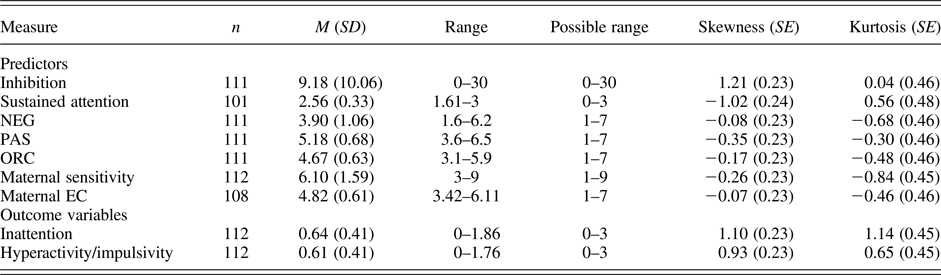
Data were converted to z scores and screened for outliers (>3), which were replaced with the most extreme value that was not an outlier (Tabachnick & Fidell, Reference Tabachnick and Fidell2001). One outlier was found for sustained attention, one for maternal effortful control, three for inattention, and two for hyperactivity/impulsivity. A check for nonnormality (Field, Reference Field2013) showed that several of the measures (inhibition, sustained attention, inattention, and hyperactivity/impulsivity) showed skewness, kurtosis, or both (see Table 1). No significant correlations between any of the measures and infant sex or socioeconomic status (the combined average of the mother's and father's level of education) were found. Therefore sex and socioeconomic status were left out of the final analyses.
Descriptive statistics of all study variables

Note: NEG, negative emotionality; PAS, positive affectivity/surgency; ORC, orienting/regulatory capacity; EC, effortful control. As for units, inhibition was measured in seconds, sustained attention in looking time, maternal sensitivity was coded on a 9-point scale, and NEG, PAS, ORC, maternal EC, inattention, and hyperactivity/impulsivity were rated on Likert scales.
To study bivariate relations we used Pearson correlations when the variables met the criteria for normal distribution and Spearman correlations when data was nonormally distributed. Bivariate correlations were calculated to identify variables to be included in the regression analyses. For the longitudinal correlations, we report both uncorrected and Bonferroni corrected α levels. The Bonferroni corrected α level was calculated as 0.05 / 3 = 0.017, corresponding to the three types of measures used as predictors: cognitive, temperamental, and parental. To assess independent contributions, we used bootstrapped regression analyses (to control for nonnormally distributed data) and included predictors that were significantly or close to significantly (ps < .10) correlated with the outcome variable. In addition, infant negative emotionality, infant positive affectivity/surgency, and maternal effortful control were included as control variables in the regression analyses if they were significantly or close to significantly (ps < .10) correlated with maternal sensitivity. To examine interaction effects, we included an interaction term between maternal sensitivity and each of the intrinsic factors (inhibition, sustained attention, negative emotionality, positive affectivity/surgency, and orienting/regulatory capacity), one at the time, in bootstrapped regression analyses with either inattention or hyperactivity/impulsivity as outcome variable. That is, maternal Sensitivity × Inhibition in relation to the two outcome measures, then Maternal Sensitivity × Sustained Attention in relation to the two outcome measures, and so on. Positive affectivity/surgency was added as a covariate in the analyses due to its marginally significant correlation with maternal sensitivity. In all, 10 moderation analyses were performed. This was conducted using the PROCESS tool made by Andrew Hayes for SPSS (www.afhayes.com).
Results
Descriptive statistics, preliminary analyses, and concurrent correlations
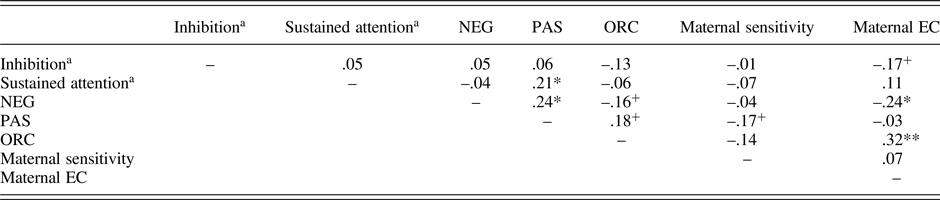
Table 1 presents descriptive statistics for predictors and outcome variables. Table 2 shows concurrent correlations among the predictors, where the only significant correlations were positive correlations between positive affectivity/surgency and sustained attention as well as negative emotionality. In addition, the control variable maternal effortful control was negatively correlated with infant negative emotionality and positively correlated with infant orienting/regulatory capacity.
Concurrent correlations between predictors at 10 months
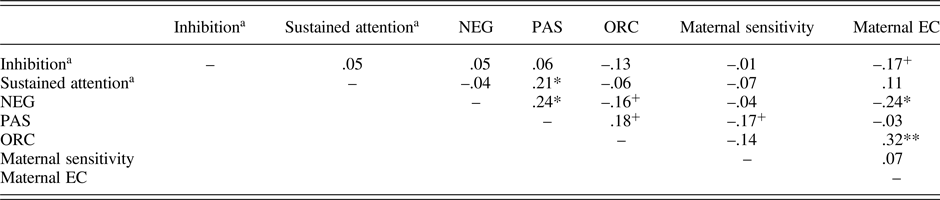
Note: NEG, negative emotionality; PAS, positive affectivity/surgency; ORC, orienting/regulatory capacity; EC, effortful control. aSpearman rho; all other analyses conducted with Pearson correlations. +p < .10, *p < .05, **p < .01, ***p < .001. n = 100–112.
Longitudinal correlations, independent contributions, and interaction effects
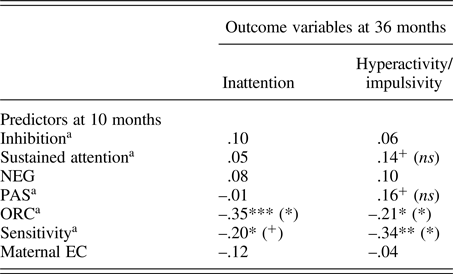
Table 3 describes correlations between predictors and outcome variables. Orienting/regulatory capacity and maternal sensitivity at 10 months were both negatively correlated with inattention and hyperactivity/impulsivity at 36 months at both standard and Bonferroni-corrected levels of significance. Positive affectivity/surgency and sustained attention were marginally positively related to hyperactivity/impulsivity using the standard α level, but nonsignificant using the Bonferroni-corrected α level. No other significant correlations were found.
Longitudinal correlations between predictors at 10 months and outcome variables at 36 months
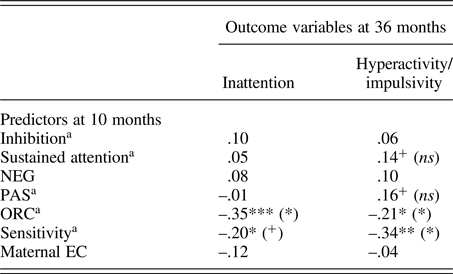
Note: NEG, negative emotionality; PAS, positive affectivity/surgency; ORC, orienting/regulatory capacity; EC, effortful control. All analyses conducted with Spearman rho. aone-tailed tests; all other analyses were two-tailed. +p < .10, *p < .05, **p < .01, ***p < .001. Bonferroni corrected alpha values in parenthesis; *p < .017, +p < .033. n = 97–112.
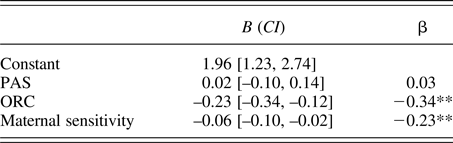
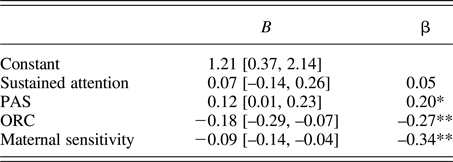
In the next step (see Tables 4 and 5 for results), we examined independent contributions of the significant and marginally significant predictors (ps < .10) to inattention and hyperactivity/impulsivity, by performing two separate bootstrapped regression analysis with orienting/regulatory capacity, positive affectivity/surgency, maternal sensitivity, and sustained attention (for hyperactivity/impulsivity only) entered as simultaneous predictors in each analysis. Positive affectivity/surgency was included as a control variable in the regression regarding inattention due to its marginally significant correlation with maternal sensitivity. There was no need to control for infant negative emotionality and maternal effortful control in the relation between maternal sensitivity and inattention and hyperactivity/impulsivity as they were not correlated with maternal sensitivity. Both orienting/regulatory capacity and maternal sensitivity made independent contributions to inattention and hyperactivity/impulsivity (see Tables 4 and 5), in that higher levels of orienting/regulatory capacity and maternal sensitivity independently contributed to lower levels of inattention and hyperactivity/impulsivity. In addition, positive affectivity/surgency made a significant independent contribution to hyperactivity/impulsivity (see Table 5), in that higher levels of positive affectivity/surgency in infancy contributed to higher levels of hyperactivity/impulsivity at 36 months. In the last step, we performed moderation analyses as described in statistical analyses. No significant interaction effects were found (ps .32–.97).
Linear model of predictors of inattention at 36 months with 95% confidence intervals based on 1,000 bootstrap samples reported in brackets
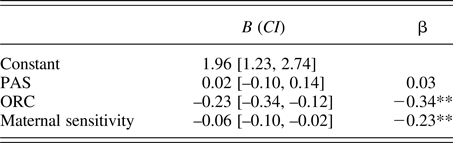
Note: R 2 = .15. PAS, positive affectivity/surgency; ORC, orienting/regulatory capacity. **p < .01. n = 110.
Linear model of predictors of hyperactivity/impulsivity at 36 months, with 95% confidence intervals based on 1,000 bootstrap samples reported in brackets
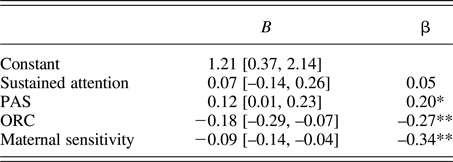
Note: R 2 = .22. PAS, positive affectivity/surgency; ORC, orienting/regulatory capacity. *p < .05, **p < .01. n = 110.
Discussion
In the current study, we simultaneously examined cognitive regulation, temperamental regulation, and maternal sensitivity as infant predictors of inattentive and hyperactive/impulsive behavior at 36 months in a typically developing sample. The results showed that infant orienting/regulatory capacity, an intrinsic temperamental precursor of effortful control, and maternal sensitivity, as extrinsic regulation, at 10 months contributed independently to both inattention and hyperactivity/impulsivity at 36 months. In addition, positive affectivity/surgency made an independent contribution to hyperactivity/impulsivity. These results were in line with our hypotheses, foremost strengthening the dual temperamental pathway model of ADHD symptoms (Nigg, Reference Nigg2006). Moreover, our results also supported previous findings emphasizing that parental care is an important factor in the formation of inattentive and hyperactive/impulsive behavior. However, contrary to our hypotheses, cognitive regulation (i.e., inhibition and sustained attention) was unrelated to levels of inattention and hyperactivity/impulsivity. Further, none of the expected predictions with regard to interaction effects were supported. Thus, we found no support for either the diathesis-stress model or for the theory of differential susceptibility.
Infant reactivity and regulation in relation to inattention and hyperactivity/impulsivity
Our results regarding temperamental predictors of inattentive and hyperactive/impulsive behavior are in line with the dual temperamental pathway model of ADHD, which stresses both reactivity and regulation, as characterized by high levels of positive affectivity/surgency and low effortful control (Nigg, Reference Nigg2006). Consistent with this model, we show that orienting/regulatory capacity, an early intrinsic precursor to effortful control, contributed independently to both inattention and hyperactivity/impulsivity and that positive affectivity/surgency contributed independently to hyperactivity/impulsivity. This adds to a growing body of evidence and extends previous findings by showing that the pattern is present already in infancy and constitutes a valid longitudinal marker of inattention and hyperactivity/impulsivity roughly 2 years later, also in a nonclinical sample. Our findings suggest that temperamental regulation at 10 months, an age before effortful control is fully developed (Rothbart, Reference Rothbart2007), already has predictive validity in relation to inattentive and hyperactive/impulsive behaviors.
Previously it has been discussed whether symptoms of ADHD, at least partly, constitute an extreme end of temperament-based traits, or if early temperament is a possible vulnerability factor for later ADHD that interacts with various stressors to create its symptomatology (Nigg, Reference Nigg2006). If temperament were to constitute a vulnerability factor for later ADHD, we would have expected to find interaction effects. Therefore, our lack of significant interaction effects points toward temperament being a marker of later levels of inattention and hyperactivity/impulsivity rather than a vulnerability factor, at least in this sample. We suggest, in line with earlier studies (Forslund, Brocki, Bohlin, Granqvist, & Eninger, Reference Forslund, Brocki, Bohlin, Granqvist and Eninger2016; Nigg, Reference Nigg2006), that temperamental factors should be taken seriously as possible antecedents to later problems with inattention and hyperactivity/impulsivity.
We assessed inhibition and sustained attention as a measure of early emerging components of cognitive regulation or EF (Garon, Bryson, & Smith, Reference Garon, Bryson and Smith2008) and found no significant association with inattention and hyperactivity/impulsivity at 36 months. Our inhibition task has previously shown predictive value in relation to effortful control and EF (Friedman et al., Reference Friedman, Miyake, Robinson and Hewitt2011; Kochanska et al., Reference Kochanska, Coy and Murray2001). However, these studies assessed inhibition at 14 months, and even though it ought to be possible to measure simple response inhibition at the age of 10 months (Garon et al., Reference Garon, Bryson and Smith2008), the predictive value might not be as stable. This is also in line with the fact that EF is not sufficiently developed until well into toddlerhood (Diamond, Reference Diamond2013) and its early precursors might not be reliable predictors of later symptomatology.
Perhaps more surprising, we found no relation between sustained attention and later inattention or hyperactivity/impulsivity. We believe it is theoretically reasonable to assume infant sustained attention to be related to later inattentive and hyperactive/impulsive behavior. However, to our knowledge, most studies have examined its relationship to ADHD-associated features such as effortful control (Kochanska et al., Reference Kochanska, Murray and Harlan2000), EF (Frick et al., Reference Frick, Forslund, Fransson, Johansson, Bohlin and Brocki2017), or later behavioral measures of sustained attention (Ruff, Lawson, Parrinello, & Weissberg, Reference Ruff, Lawson, Parrinello and Weissberg1990) rather than to core behavioral symptoms of inattention and hyperactivity/impulsivity. Of note, the mean of our measure for sustained attention turned out to be in the high end, suggesting a ceiling effect that may have prevented the hypothesized influence of sustained attention on ADHD symptomatology. Considering that cognitive processes become more consciously controlled around 1 year of age (Garon et al., Reference Garon, Bryson and Smith2008), a more difficult task designed to tax volitional attention might be needed to get variation enough to detect a relation between sustained attention and later inattention and hyperactivity/impulsivity. We suggest a task including distractors to be used, to fully elaborate the role of infant sustained attention on later ADHD symptomatology.
To conclude, on the one hand, our results could be interpreted as being in line with Diamond's reasoning that cognitive abilities, important in ADHD (Barkley, Reference Barkley1997), may not yet be sufficiently developed to markedly shape behavior until the second or third year of life (Diamond, Reference Diamond2013). On the other hand, we believe that future studies including sustained attention tasks taxing volitional attention processes are needed to draw firm conclusions regarding this theoretical claim. In addition, temperament appears to have a longitudinal effect earlier. That is, at 10 months, both reactive and regulatory aspects of temperament seem to be more valid (and perhaps more reliable) markers of later inattention and hyperactivity/impulsivity than cognitive regulatory factors such as inhibition and sustained attention. However, while these findings may hold true for typically developing samples, the pattern may be expressed differently in samples at risk for later ADHD. It is therefore of great importance to replicate the findings in clinical groups.
Maternal sensitivity in relation to inattention and hyperactivity/impulsivity
A growing body of research points to the significance of the family environment in relation to children's inattentive and hyperactive/impulsive behaviors. Some of these studies have been cross sectional (Ullsperger et al., Reference Ullsperger, Nigg and Nikolas2016), some have lacked control for temperamental aspects in the child that could affect parenting (Belsky, Fearon, et al., Reference Belsky, Fearon and Bell2007), and yet others have used self-reports of parenting style (Ellis & Nigg, Reference Ellis and Nigg2009). Our findings indicate that the relation between observed maternal sensitivity and children's subsequent inattentive and hyperactive/impulsive behavior is specific and holds longitudinally, taking negative emotionality, positive affectivity/surgency, and maternal effortful control into account. Thus, it is likely that the relation is not just driven by difficult child temperament or due to shared genetic effects. Consequently, it seems as if low maternal sensitivity can add to behaviors of inattention and hyperactivity/impulsivity also in a group of initially typically developing children. However, it is important to bear in mind that the contribution of maternal sensitivity to inattention was 5% in explained variance, and to hyperactivity/impulsivity 13% in explained variance beyond the other predictors. Thus, we are not suggesting that parenting is causing a disorder but rather that parenting, in this case maternal sensitivity, most likely contributes to levels of inattention and hyperactivity/impulsivity. Maternal sensitivity may as such act as an external regulator of the child that has direct effects on the child's intrinsic regulation and consequently plays a role in the upstream development of symptoms. To put it differently, we find it fortunate that sensitive parenting may improve behavior, and as such, our results are suggesting that sensitive parenting in part enables self-regulation in the child.
In addition, we hypothesized that we would find interaction effects between the intrinsic predictors and maternal sensitivity in line with the diathesis-stress model and the theory of differential susceptibility, but contrary to our expectations based on theory (Belsky, Bakermans-Kranenburg, et al., Reference Belsky, Bakermans-Kranenburg and van IJzendoorn2007; Goforth et al., Reference Goforth, Pham, Carlson, Goldstein and Naglieri2011) and empirical findings (Rochette & Bernier, Reference Rochette and Bernier2016), we did not. We can only speculate as to why this is. One explanation mentioned earlier is that 10 months is too early to assess cognitive risk factors as they are not sufficiently developed to have an impact on behavior at such an early age (Diamond, Reference Diamond2013). Another explanation could be that inhibition and sustained attention in infancy in a group of low-risk infants does not constitute a risk factor, and that the lack of interactions with maternal sensitivity is a valid result. In addition, the average mother in our study was on the sensitive side, and perhaps the distribution of sensitivity scores did not allow us to detect an interaction, in that only a handful of individuals had both high levels of, for instance, negative emotionality and received low maternal sensitivity care. Moreover, the average child in the study had relatively low levels of inattention and hyperactivity/impulsivity. As such, the study might have been underpowered to detect interaction effects in this sample. In addition, even if the lack of interaction effects may hold true for low-risk samples like ours, the pattern may come across differently in high-risk samples. Thus, replication is needed.
Concurrent relations between the predictors
We had no formal hypothesis regarding the concurrent correlations between the predictors, but based on theories, one would expect the regulatory constructs of inhibition, sustained attention, orienting/regulatory capacity, and maternal sensitivity to be positively correlated. However, we failed to find intercorrelations among these measures. At first sight, this might seem surprising. Yet, different aspects of self-regulation are suggested to show disparate developmental trajectories (Garon et al., Reference Garon, Bryson and Smith2008) and may therefore not be temporally correlated in infancy, but later be integrated into the broader construct of self-regulation (Nigg, Reference Nigg2017). This is also in line with previous empirical results that failed to find intercorrelations between early self-regulatory measures (Miller & Marcovitch, Reference Miller and Marcovitch2015; Wiebe, Lukowski, & Bauer, Reference Wiebe, Lukowski and Bauer2010). In addition, low correlations among EF tasks are a common phenomenon also in the adult literature (Friedman & Miyake, Reference Friedman and Miyake2017).
Strengths, limitations, and conclusions
This longitudinal, multifactorial study, addressing intrinsic and extrinsic reactivity and regulation in infancy in relation to later inattentive and hyperactive/impulsive behavior, has some limitations that should be addressed. First and foremost, the sample was typically developing, and even though it has been shown to be valid to study progression of ADHD symptoms in a sample like ours, it is important to replicate the findings in a sample at familial risk for ADHD in order to draw more firm conclusions. Especially relevant are the conclusions regarding the lack of predictive value of early inhibition and sustained attention and the lack of interaction effects call for replication. Second, we have assessed continuous inattentive and hyperactive/impulsive behaviors and not diagnostic outcome. Repeated measures of symptomatology and associated impairment are needed to draw firm conclusions about the stability of symptoms and its predictability of later diagnosis. In addition, even though multiple reporters and observational measures were used, mother's rated temperament as well as levels of inattention and hyperactivity/impulsivity that might have influenced the relation. To at least partially control for this potential reporter effect, combined measures of parent and teacher reports were used for inattention and hyperactivity/impulsivity.
To conclude, this study contributes with new knowledge to the existing literature by showing that temperament in infancy is a promising early marker of ADHD symptomatology. Specifically, we show that regulatory aspects have an effect on both inattentive and hyperactive/impulsive behavior and that positive affectivity/surgency has an independent effect on hyperactivity/impulsivity. In addition, maternal sensitivity seems to be important in the manifestation of children's inattentive and hyperactive/impulsive behavior, possibly as an external regulator of the child's behavior and emotions. We also show that this relation holds when accounting for child emotionality and maternal effortful control. Moreover, our results are in favor of additive effects of temperament and maternal sensitivity rather than of interactive effects on inattentive and hyperactive/impulsive behaviors. In sum, our results provide a first round to be replicated in further studies, preferably including infants at familial risk for ADHD.