


Introduction
The occurrence of various life events that cause negative rumination and discomfort is inevitable and may lead to the emergence of depressive symptoms (Rhoades et al., Reference Rhoades, Kamp Dush, Atkins, Stanley and Markman2011). One of these sources of stress is the end of romantic relationships. The study of break-ups highlights the psychological dynamics of separating with a partner and how it might result in reduced positive affect, as suggested by the current evidence that this condition is highly correlated to depressive symptoms (Verhallen et al., Reference Verhallen, Renken, Marsman and Ter Horst2019).
In young adults, establishing romantic relationships is a critical necessity and part of a developmental milestone, therefore the emergence of issues related to romantic relationships in this stage, particularly break-ups, may have significant repercussions if not managed appropriately (Gilbert and Sifers, Reference Gilbert and Sifers2011). Catastrophic interpretations, negative self-perceptions, low self-esteem and other negative self-views such as self-blame are examples of the various difficulties and disturbances that are dealt with during romantic break-ups (Boelen and Reijintjes, Reference Boelen and Reijntjes2009). Rajabi and Nikpoor (Reference Rajabi and Nikpoor2018) explained that coping strategies aimed at catastrophic thinking, negative self-views and self-criticism are considered highly correlated to the effectiveness of an individual’s coping during romantic separation. Based on these premises, the ability to cope with and process thoughts and emotions effectively following a romantic break-up is crucial for individuals, especially for young adults (Boelen and Reijintjes, Reference Boelen and Reijntjes2009; Creasey and Hesson-McInnis, Reference Creasey and Hesson-McInnis2001).
Based on Beck’s theory (Beck et al., Reference Beck, Rush and Shaw1979), an important target in coping with depression is an individual’s cognitive aspect. Beck’s theory (Beck et al., Reference Beck, Rush and Shaw1979) explained that a vital component in depression is negative thought patterns, particularly in viewing their selves and the world (Cuijpers et al., Reference Cuijpers, Berking, Andersson, Quigley, Kleiboer and Dobson2013). A triadic cognitive process occurs in which fundamental individual beliefs will intensify if not impeded, causing the individual to become more depressed. Perceptions, interpretations and memories of past experiences can be affected by negative biases, causing an individual with depressive symptoms to be more likely to focus on information that is consistent with their negative views. This condition is further interpreted and recollected as a negative event (Kring et al., Reference Kring, Johnson, Davison and Neale2014). Considering this, devising interventions targeted at an individual’s cognition may have far-reaching practical implications. Among existing treatments, cognitive behavioural therapy (CBT) is known to have a solid evidence base for the treatment of depression. CBT targets particular thought patterns that appear as biases, aiming at altering such patterns that will generate more factual and balanced views and thus alleviate depressive symptoms (Dobson and Dobson, Reference Dobson and Dobson2018).
Research has proven the effectiveness of CBT for individuals experiencing depression (Butler et al., Reference Butler, Chapman, Forman and Beck2006; Hollon et al., Reference Hollon, Haman and Brown2002). CBT has been shown to encourage individuals to be more involved in pleasant activities and is also evaluated as an effective treatment for issues relating to irrational thoughts, maladaptive thought patterns and indications of depression (Westbrook et al., Reference Westbrook, Kennerley and Kirk2011). A meta-analysis by Hofman et al. (Reference Hofmann, Asnaani, Vonk, Sawyer and Fang2012) discovered how CBT was a more superior treatment compared with other interventions in treating depression at moderate levels. This therapy can trigger changes in maladaptive thoughts that previously led individuals to emotional distress and problematic behaviours. A study by Cuijpers et al. (Reference Cuijpers, Berking, Andersson, Quigley, Kleiboer and Dobson2013) also found that CBT helped clients to evaluate, challenge and modify their dysfunctional beliefs, and enabled behavioural change as well as improvements in functioning. Dobson and Dobson (Reference Dobson and Dobson2018) further asserted how CBT is proven effective in helping individuals with a depression diagnosis in changing negative views about many areas, including about their selves. However, the treatment based on the Indonesian context, especially with religious and ethnic problems in a romantic relationship before marriage, is limited, and needs further exploration.
The rationale of presenting this case study is to highlight and explore the applicability of CBT on depressive symptoms, to the Indonesian context as the case entailed intra- and interpersonal religious and ethnic conflicts that are deeply tied to the Indonesian culture. This single case study also focuses on details in the treatment process for understanding the client’s difficulties and overcoming them.
Background
(All names have been changed to protect confidentiality). Frank is a 26-year-old male, who is the only child born of Batak, North Sumatera descent, with a strong Batak culture and Christian background. Entering adolescence, Frank grew more uncomfortable in his household and established friendships more often instead. It was also since then he started to have girlfriends and intense romantic relationships. Franks felt that he received more affection from his partner than his parents who had so far yelled at him and never expressed their affection towards him. Although the females he established relations with were always from different ethnic and religious backgrounds, he never made a problem out of it and was instead interested in his partner’s faith. After dating for 2 years with his current girlfriend (Rose), Frank expressed his strong affection and planned on proposing to her, despite their differences.
When Frank and his partner discussed the seriousness of their relationship for marriage, several issues arose, particularly on Frank’s side. The religious difference between them encouraged Frank to consider converting to his partner’s religion. Frank did an exploration of his faith but still needed time to decide and discuss this. Frank also knew that his parents stood firm in believing that Frank as the only male Batak bloodline should not be allowed to marry a woman of different faith and ethnicity. For his family, filled with Batak culture, it is highly regarded to preserve tradition and family names as an identity. According to his parents, conserving the Batak culture by marrying a woman of Batak descent is very important, a tradition that has long been kept by his extended family. Nevertheless, his partner demanded certainty. The religious and ethnic differences, as well as lack of both their parents’ approval for the marriage, caused frequent arguments each time they discussed marriage. Frank often asked his partner to remain patient in allowing him to explore religion while also waiting for their parents’ approval. Despite this, arguments and uncertain conditions over 3 months caused Frank’s partner to decide to end their relationship and leave.
After Frank was left by his partner, he was saddened and hopeless in ever feeling happiness again. Frank lost his motivation to work, lost his appetite and started to self-injure using a razor following their break up. For approximately two months, Frank felt as though his condition had not improved and had thoughts about suicide. He experienced difficulty in moving on from his partner and felt the days ahead would be more unbearable. He then decided to consult a counsellor after receiving advice from his office colleagues. Frank had no record of psychiatric admissions or treatment, familial psychiatric illness, no drug or alcohol abuse, or medical illnesses that may have contributed to the onset or severity of depressive symptoms.
Assessment
Diagnosis
To measure an individual’s psychological distress, the Hopkins Symptom Checklist (HSCL-25) was selected for its established accuracy in measuring distress. The HSCL-25 indicated that Frank experienced relatively high psychological distress, with an average score of 3.04 (above the 1.75 cut-off score), and a high indication of anxiety and depression. When comparing both indicators, it appeared that Frank was manifesting a higher tendency of depression, with an average score of 3.3 (above the 1.75 cut-off score). This was consistent with Frank’s report on how frequently he felt bothered, uneasy, restless, sad and lonely. He also tended to feel excessive worry towards many things and felt that it required much effort to perform. Frank often blamed himself, lost interest in many things, and also felt hopeless about the future. Physiological responses such as tremors, agitation, rapid heartbeat, tension, headaches and dizziness also bothered him in his daily activities that past week.
After measuring psychological distress, a clinical-based interview was conducted to assess his condition. The assessment followed a Structure Clinical Interview DSM-IV (SCID) for major depressive disorder (MDD). According to DSM-5 (American Psychiatric Association, 2013), for the past 2 months Frank had shown episodes of MDD that were (1) daily depressed mood (feeling sad, empty, hopeless), (2) loss of interest in many things almost daily, (3) weight loss without diet attempts, (4) fatigue and loss of energy, (5) feelings of worthlessness and guilt almost daily, (6) difficulty concentrating in doing many things and (7) attempts at self-injury. Many of these symptoms had adversely affected his daily functioning, one of them being absence from work for 7 days.
The above result was also supported by a projective assessment such as the Wartegg Drawing Completion Test (WDCT), a simple and fast personality test that is also able to recognize symptoms of many psychological disorders including depression and suicidal risk (Crisi and Dentale, Reference Crisi and Dentale2016; Daini et al., Reference Daini, Manzo, Pisani and Tancredi2010). The test tried to assess Frank’s characteristics and personality that may have contributed to some problem areas of his life and affected the development of his depressive symptoms. Based on the test, Frank showed a negative self-image, low self-esteem and low motivation. He tended to view himself as small and worthless, and tended to compare himself with his friends. He also had problems in adaptation and social area, due to the feeling of incompetence interacting with others and having a negative view of the world. This also appeared during the interview, when Frank described his relationship with his colleagues. Since high school, he had felt incompatible and needed time to establish a friendship. In facing difficulties, he had a tendency to behave passively and helplessly. Frank also had a hard time finding strategies and alternatives in problem-solving. He often chose to repress his negative feelings during these times, rather than communicating or trying to seek help. These could also be seen during difficult times he had in his romantic relationship, particularly when they argued. He appeared to have difficulty explaining his condition (still exploring religion) and preferred not to reveal this to his partner, when in fact during such conditions his partner needed clarity over this matter. As for his relations with his parents, Frank appeared to repress his unpleasant feeling towards them and limited his interaction, or tried to avoid them. During these relationships, Frank displayed an indication of tension and frustration.
Diagnosis
After the above considerations, Frank was diagnosed with mild MDD.
Differential diagnosis
According to DSM-5 (American Psychiatric Association, 2013), Frank also met some criteria of borderline personality disorder (BPD), such as (1) identity disturbance: unstable self-image or sense of self, (2) feeling of emptiness, and (3) suicidal behaviour, gesture or threats, or self-mutilating behaviour. However, to reach the BPD diagnoses, there should be five (or more) symptoms and Frank did not meet other criteria such as (1) frantic effort to avoid real or imagined abandonment, (2) pattern of unstable and intense interpersonal relationships characterized by alternating between idealization and devaluation, (3) impulsivity in at least two areas that are potentially self-damaging, (4) reactivity of mood, (5) inappropriate, intense anger or difficulty in controlling anger and (6) stress-related paranoid ideation. Thus the diagnosis could not be established.
History
Childhood abuse
Since childhood, Frank had frequently experienced verbal and physical abuse from his parents. He described his parents as rough figures that always forced their will on him, restrained him, and took over his life too much. His mother frequently yelled and micromanaged many aspects of his life, whereas his father hit or threw objects at Frank. He attempted to defend himself once, but it led to more outbursts of anger and forceful emphasis on how a child must obey parents. Whenever Frank expressed a difference in opinion, both parents would negatively judge him. His parents’ behaviour had sparked Frank’s resentment and dislike towards them. As he grew into adolescence, he started to have girlfriends and intense romantic relationships, as he felt that he received more affection from his partner than his parents, who had never expressed their affection towards him. This made him unmotivated and he preferred to spend more time in his room, or go out with his friends and partner than interact with his parents. He currently felt more comfortable living in his own apartment.
Depressive symptoms
Some of Frank’s depressive symptoms first appeared after he graduated from high school, following his break-up with one of his classmates. At that time he felt sad and lost interest in activities for around one week. He also reported weight loss due to loss of appetite. However, this did not last long and he was still able to be productive at university with the help of his friends. This was also the case for his break-up with a girl he met at college – he felt disappointment and deep sadness but was able to overcome it after Rose entered his life and remained the best figure, according to him.
In mid-2019, Frank reported re-emergence of several depressive symptoms following the relationship issues and break up with Rose. The manifested symptoms were more intense and persisted for a longer time frame compared with before. The condition was exacerbated by constraints from both Frank’s and Rose’s parents. On one side, he felt disappointed and sad with Rose who did not appreciate him and left him when he was already willing to make sacrifices for her. On the other hand, he also still had affection for Rose and was willing to seriously continue their relationship for marriage. For the past three weeks, Frank had expressed various complaints relating to his depressive symptoms, as elaborated in the ‘Assessment’ section above.
Course of treatment and progress
Before the treatment started, an intervention addressing Frank’s history of childhood abuse was discussed with Frank, as this is a serious problem and was linked to his core belief and behaviours. However, Frank felt he was not ready to undergo such treatment and preferred to focus on what was going on in his life right now. Explanation regarding the impacts of this past experience on his behaviour in the present was given and understood by Frank. He agreed to pursue treatment using a CBT approach because from the assessment earlier, Frank began to realize there is a thought process that needs to be improved. After agreeing and getting an explanation about CBT treatment, he signed the informed consent.
This CBT treatment course is the result of an adaptation of the cognitive behavioural model developed by Ricardo Muñoz et al. (Reference Muñoz, Miranda and Aguilar-Gaxiola2000) at the Depression Clinic at San Francisco General Hospital, for the treatment of depression. The four goals of this intervention were to decrease depressive symptoms, shorten the time the adolescent is depressed, learn new ways to prevent becoming depressed, and feel more in control. The treatment focused on three parts, i.e. thoughts, activities and connecting with other people to affect mood. The adaptation of this treatment includes the time, which was shortened due to Frank’s health insurance and the local Public Health Center policy, where the treatment was held. Adjustments were also made to the Indonesian culture, using more social interaction context and suggestive techniques in the treatment such as role play and mantras. It is believed to be a more familiar approach as Indonesia has a collectivist culture, emphasizes social interaction daily, and highlights the importance of social bonding (Bątkiewicz, Reference Bątkiewicz2010). Indonesians also have a strong connection with mantras and spells (Saddhono and Hartarta, Reference Saddhono and Hartarta2013). Indonesians, especially North Sumatrans such as Frank, believed that spells have the power to change people’s lives and are part of their life (Peake, Reference Peake2000).
This CBT treatment focused on helping Frank in three areas: first, how thoughts affect mood with a focus on improving a more balanced view by exercising cognitive strategies and counter mantras; second, how activities affect mood with a focus on restoring Frank’s interest in activities, particularly things that bring him a sense of pleasure and achievement using activity planning and scheduling; and third, connecting with other people, focusing on feeling more in control of his life by active engagement in his relationship problem using assertive communication skills and controlling his mood. The intervention was conducted for 3 weeks, with one to two meetings each week.
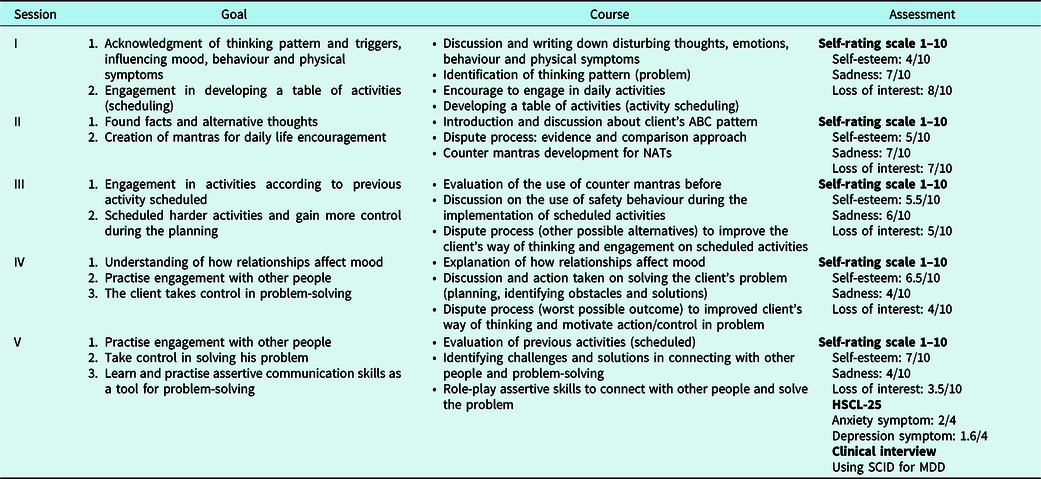
Table 1 summarizes the treatment course. Each session is described below.
Treatment course

Session I
This session was aimed at helping Frank gain an understanding of how thoughts influenced his mood and behavior, and specifically identify the pattern of issues on what triggers or weigh a situation down in a detailed manner. This was done by discussing and writing down various disturbing thoughts, emotions, and displayed behavior, changes, or the existence of physical symptoms when feeling low. This session also eventually attempted to facilitate or encourage Frank to engage in daily activities that could generate a positive mood and become more active in his life, by developing a table of activities enlisting basic and enjoyable activities that Frank gave up since the emergence of his depressive symptoms.
Goals: (1) Frank acknowledged that his thinking pattern (including triggers) influenced his mood, behaviour and physical symptoms. (2) Frank engaged in developing a table of activities for his next week’s schedule
Identification of patterns: listing thoughts, emotions, behaviour, physical symptoms and triggers.
Activity schedule: Frank was encouraged to bounce back and be active again by discussing and making a list of activities that he could do in 2 weeks, including acknowledging difficulties and how to manage it. Frank was given homework to carry out the schedule he made.
Self-rating at the end of session 1: self-esteem, sadness and loss of interest.
Session II
This session was aimed to encourage Frank to become aware of facts and other alternatives (more open) rather than focusing on his negative, irrational and narrow thoughts that affected his mood. Mantras were created together with Frank in this session to help him remember better and easily link with facts (the mantra consists of facts), every time the negative automatic thoughts came out.
Goals: (1) Frank found facts and alternative thoughts; (2) Frank created mantras for his daily life.
ABCD process: Identifying Antecedent (A), Behaviour (B) and Consequence (C) patterns. The session continued with Dispute (D) process to help Frank see evidence, facts and other alternatives related to his negative and irrational beliefs.
Counter mantras for negative automatic thoughts: In order to help Frank establish a powerful way for him to counter his own negative automatic thoughts (NATs) and make him easily link it with facts or evidence, counter mantras were created in this session. Frank was encouraged to make his own mantra for each of his NATs.
Self-rating at the end of session 1: self-esteem, sadness and loss of interest.
Session III
This session focused on evaluating the past week’s activity schedule. This session’s purpose was to encourage Frank to have more control over his life by letting him evaluate his previous activities and plan for harder activities. Evaluation of the previous week carrying out the activities was also discussed to help him find solutions in engaging in daily activities. Dispute and counter mantras were repeated in this session along with mapping all the safety behaviours that Frank had done so far to help him see and overcome the barriers.
Goals: (1) Frank engaged in activities according to previous plan/activity schedule; (2) Frank to schedule harder activities and gain more control during the planning.
Counter mantras for NATs: repetition of counter mantras as in the previous session, were used in this session to help Frank establish a more powerful way to counter his own NATs that were still occurring.
Safety behaviour with Dispute: identification of safety behaviour that contributed to his NAT reappearance and helped him find solutions to break the cycle using the Dispute technique.
Self-rating at the end of session 1: self-esteem, sadness and loss of interest.
Session IV
This session focused on connecting with other people, so Frank could enhance the feeling of having control over his life and current problem. In this session, the therapist explained how relationships could affect mood, and having social support could help giving comfort in difficult situations. Having relationship problems with significant others could affect his mood. Discussion and brainstorming were tried in this session to help Frank find solutions and enhance his feeling of control.
Goals: (1) Understanding of how relationships affect mood; (2) Frank to practise engagement with other people; (3) Frank to take control in solving his relationship problem.
Explanation of how relationships affect mood: explanation about how relationships affect mood and the importance of connecting with other people.
Taking control of the problem
-
Planning on how to communicate
-
Identifying obstacles and consequences
-
Discussion on alternative solutions
Self-rating at the end of session 1: self-esteem, sadness and loss of interest.
Session V
This session still focused on connecting with other people and gaining control over Frank’s life. After identifying challenges and solutions, this session aimed to help Frank practise assertive communication skills in order to face his relationship problem and have more sense of control in his current situation and life problem.
Goals: (1) Frank to practise engagement with other people; (2) Frank to take control in solving his relationship problem; (3) Learning and practising assertive communication skills as a tool.
Role-play on connecting with others: demonstrating and practising assertive communication skills with the counsellor as his speech partner.
Planning: The aim of this was to make him more structured and prepared, so not only have more control but also so he would not be too susceptible to think negatively of himself or his world.
Self-rating at the end of session 1: self-esteem, sadness and loss of interest.
Hopkins Symptom Checklist (HSCL-25) and clinical interview: to check his current distress symptom. Treatment would be ended if Frank reported a score below the cut-off point for depression symptoms and reduction of MDD symptoms.
Frank’s condition and progress
Session I
In the first session, the therapist and Frank tried to identify his thinking pattern and establish an activity schedule. Some challenges were faced during this session, especially during the identification process. After implying some treatment strategies, Frank expressed his feeling of relief and satisfaction, that he was able to see clearly the matters occurring within him.
Identification of problem patterns

Challenges faced
-
Identifying the aspects above took quite some time, up to 45 minutes, as Frank had difficulty expressing the triggers that he had never tried to explore before.
-
So far, he was not interested in listing such thoughts and emotions. He was concerned that these things would make him dwell in his sorrow.
-
He expressed how frightening this process was, given his current mental condition.
Treatment strategies
The counsellor gave Frank time, explained the importance of identification and what it had to do with Frank’s current condition, giving examples, motivating and urging Frank that this process was necessary to be dealt with together.
Activity schedule
Frank was able to promptly express the things he could do, but he felt that the greatest challenge was to start over. The counsellor and Frank reviewed all the activities he could do and split them into several difficulty levels for each week. Frank was urged to take action slowly, where the first week would focus on an activity with the lowest difficulty level, in proportion to his capacity. In the beginning, he was not interested in listing or doing those activities, but the therapist reviewed again his problem pattern above. After that, Frank told the therapist that he could see this as a way of breaking the pattern, so he would do the activities as homework.
Self-rating at the end of session I
Self-esteem scale: 4/10
Sadness scale: 7/10
Loss of interest scale: 8/10
Session II
In this session, the therapist and Frank tried to identify his ABC pattern, continued with the Dispute process, and creation of counter mantras. Challenges occurred in the Dispute process, and Frank felt less enthusiastic and expressed difficulties finding evidence. During counter mantra creation, Frank also expressed his pessimistic feeling about using mantras that he creates on his own. After motivating and giving some treatment strategies, Frank gained some insights about him, especially about his power and self-image.
Antecedent, Behaviour, Consequence (ABC) patterns
A: Partner (Y) ending a serious relationship
B: I am useless, helpless
C: Not knowing what to do, loss of motivation, concern over the future
Dispute (D)
Evidence on how useful he has been throughout his life, including what other people have said about him. Comparison of the number of people who have stated how useful and useless he is.
Challenges faced – ABCD pattern
Frank felt less enthusiastic, tended to ruminate in his beliefs, and had a negative stereotype on changing religion and marrying women outside Batak culture.
Treatment strategies – ABCD pattern
The counsellor motivated Frank, asked him to repeat the evidence he mentioned, provided analogies, and positioned Frank in another person’s perspective.
Frank’s insight – ABCD pattern
-
He feels like he has gone around in circles with his own mind that apparently has a core.
-
It is only he who focuses on his helplessness; only a ratio of 10:1 of his friends stated how he is useless, helpless.
-
Evidence on all the useful things he has done so far, including trying hard on his relationship and conscientiously exploring faith and culture.
Counter mantras for NATs
Helpless or unable to do anything → no evidence
Useless to others → 10:1
Unable to endure all this → I am able to do this
Wishes for sadness to disappear and not knowing what to do → I am processing this
I want to stay in the bedroom → I want to recover
Not understanding self → I am trying to understand
Challenges faced – counter mantra
Feeling pessimistic that the counter mantras will work, as he thinks that the situation has been too long and he frequently forgets to find justification beyond the session setting.
Treatment strategies – counter mantra
The counsellor encouraged Frank to try first and urged him to be more motivated, eased him by asserting that if it fails then an alternative will be sought together and Frank can try again.
Frank’s insight – counter mantra
He would try to balance each thought. He felt more powerful as he was equipped to negate his own thoughts.
Self-rating at the end of session II
Self-esteem scale: 5/10
Sadness scale : 7/10
Loss of interest scale: 7/10
Session III
The session started with a review of the two previous sessions and re-identifying Franks’s disturbing thoughts and feelings. Frank reported that he was able to do all the schedule’s activities and was prepared to enter the next difficulty level entailing a wider variety of activities. Some negative thoughts still bothered him and regressed to the ABC pattern, so the dispute and counter mantras were repeated along with mapping all the safety behaviour that Frank had done so far. Frank appeared more enthusiastic as seen through his proactiveness in answering questions promptly and reported a lower intensity in crying and playing with razors.
Counter mantras for NATs
Helpless or unable to do anything → evidence? I was able to carry out the activity schedule
Useless to others → 10:1, I am useful for myself
Unable to endure all this → I can do this, I am still alive which means I can
Not understanding self → I am trying to understand, I will understand
Safety behavior: reduction of activity – not doing anything
Depressed mood → NAT reappears → loses positive reward → lowered mood reoccurs
Dispute (D)
Alternatives for other possible outcomes. Comparison with people who face similar issues.
Frank’s insight
-
It requires effort to take action in being active, if not, he will remain in the cycle and cause NATs to reemerge. Frank feels motivated to actively contradict NAT, he feels the need to do something.
-
Realizing that his thoughts have been narrow so far and there are other ways to solve the problem
Self-rating at the end of session III
Self-esteem scale: 5.5/10
Sadness scale: 6/10
Loss of interest scale: 5/10
Session IV
In this session, Frank was encouraged to connect with other people and take more control over his life and current problem. This session started with the explanation of how relationships could affect our mood and then discussed how Frank’s current relationship problems with his significant others had affected his mood. After discussion and brainstorming in this session, Frank decided to try and speak with both Rose’s parents regarding his seriousness, including his conversion to Rose’s religion. Consequences and challenges were discussed in this session as well as the planning on how to deal with it.
Explanation on how relationships affect mood
Frank expressed his insight that his unpleasant relationship with his parents since childhood and this current relationship with partner contributed to negative mood.
Challenges faced
Frank felt down and thought that there were too many obstacles and NATs that could rise again. There was also a brief moment of sadness and disappointment towards the current situation and when comparing his past and current self.
Dispute (D)
The worst possible outcome and alternative condition that could appear. Differences between his past and current self.
Frank’s insight
He realized that his thoughts play a role in catastrophizing matters. If the worst outcome does occur, he will still be able to endure it, as this is not the first time he has broken up and not the first time he was obstructed by his parents. He told the therapist that he would focus on his good intentions, to be a better partner. According to Frank, if a person has a good intention, God will help and guide that person during the process. So he should have faith and also think of positive possible outcomes.
Self-rating at the end of session IV
Self-esteem scale: 6.5/10
Sadness scale: 4/10
Loss of interest scale: 4/10
Session V
The session started with a review on the second week’s activity schedule. Frank reported that he met some obstacles but felt capable of resolving them on his own, and when discussing the third week’s schedule, he felt capable of doing things without the counsellor’s assistance.
Role-play on connecting with others
Frank practised his assertiveness skills with the therapist, as if he was speaking with Rose’s parents, his partner and his own parents.
Planning
Future planning for Frank’s objectives and how he could deal with the obstacles was also made. Frank appeared enthusiastic in undergoing it all, seen through his facial expression and smiles, joking with the counsellor, and clearly stating what he wanted. Although he appeared sad when discussing the challenges, Frank was high-spirited enough to state the solutions and alternatives he could do when obstacles occur.
Self-rating at the end of session V
Self-esteem scale: 7/10
Sadness scale: 4/10
Loss of interest scale: 3.5/10
Hopkins Symptom Checklist (HSCL-25) at the end of the session
After the 5-session treatment, Frank was assessed using the HSCL-25 again and followed a clinical interview to check his current distress symptom. Treatment was ended after Frank reported below the cut-off point for depression symptoms and reduction of MDD symptoms during the final clinical interview.
Treatment outcomes
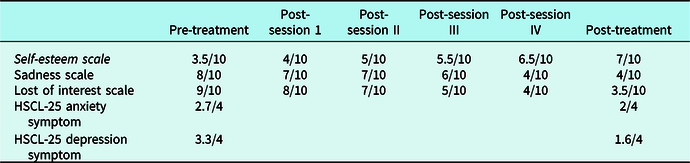
During the first assessment, Frank gave a written account of how he felt helpless, useless and incompetent. He also wrote his thoughts and emotions in each session’s summary; that he felt a deep sadness and hopelessness toward himself. Based on a provided rating scale, he expressed discomfort over his sadness at 8 out of 10 points and loss of interest at 9 of 10 points. He reported that his current condition had shaped low self-esteem, at 3.5 of 10 points. After the CBT was carried out, Frank wrote how he was then able to see the sources of thought patterns and self-perceptions that had so far played an important role in his inability to face issues. In the last session, Frank gave a 4 out of 10 rating regarding his sadness (reduction from 8 to 4). This indicated that Frank started to feel better and the CBT treatment had affected his mood, especially his sadness. A similar thing also occurred to the loss of interest result after treatment. Frank reported a score of 3.5 out of 10 relating to his loss of interests (reduction from 9 to 3.5). This means there was some improvement and he now had more interest in doing things compared with before treatment. On a scale of 1 to 10, after the CBT, Frank wrote that his self-esteem was 7 (an improvement from 3.5 to 7). This means after the treatment, his self-esteem was higher and better. Frank also reported to the therapist that although he knew unpleasant events will exist in the present and future, he felt calmer, as he is now more equipped in finding solutions.
After treatment, the HSCL-25 indicated that Frank experienced relatively normal psychological distress, with an average score of 1.76 (near cut-off of 1.75) and a low indication of anxiety symptoms, with average score of 2, and no significant depression symptoms (score of 1.6, below cut-off point). The post-treatment scores were lower than the pre-treatment scores, especially the depression symptoms. This indicated that his psychological distress was lowered due to the CBT treatment and he had better well-being now. During the clinical interview after session V, Frank also reported reductions of MDD according to DSM-5: (a) low level of feeling worthless and guilt, (b) fatigue and loss of energy, and (c) difficulty concentrating in doing many things during the past week. Frank reported feeling more in control of his thought, mood and problems in his life. See Table 2 for pre- and post-treatment scores.
Pre- and post-treatment
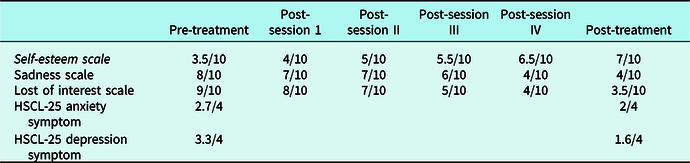
HSCL-25, Hopkins Symptom Checklist-25 cut-off 1.75.
After the sessions ended, the counsellor also asked Frank to express the things he felt he has gained during the whole process. Frank stated that he had counters for when the NATs emerged and felt like he could be more objective in evaluating himself. The sessions encouraged him to decide for himself and have plans for himself, including on his religious beliefs and relationship with his partner. He felt he had benefited from the sessions and could do things independently because these skills would be useful in the future for any given situation. Frank added that although he realized the possibility of many unpleasant events lying ahead, he felt calmer knowing what he could do about them.
Follow-up
The follow-up was done 1 month after the final treatment session. Frank reported how he rarely felt a loss of interest and depressed mood. Regarding his self-conviction, he felt more confident and felt aided by applying his training on triggers, so that he could be more anticipative. His sadness still occasionally emerged because although he was back together with his partner, there were still small arguments related to cultural differences and some religious issues, as Frank is new at it. However, Frank also stated that he felt more in control of his condition and knew what to do when feeling low or problems emerged. Although his partner’s parents still disapproved of their relationship, they were more receptive to Frank. The relationship with his parents was still distant and they had drifted further apart. Despite this, he had been making plans to communicate to them, about his religious change and intention to marry Rose.
Discussion
CBT was a useful treatment for Frank, a patient with depressive symptoms resulting from a break-up caused by religious and ethnic factors. Focusing on thoughts, activities and relationships with others that affected his mood significantly improved his well-being and made him felt more in control of his problem. Several adaptation techniques such as mantras and communication strategies with role-playing were also used in combination with CBT in order to enhance the treatment outcome. The treatment decreased the depressive symptoms, shortened the time, made him learn new ways to overcome problems, and allowed him to feel more in control of his life. Frank was also able to return to productivity and faced challenges in his relationship.
This study is not without several notable limitations. First, this study presents the treatment response of one young adult with depression following a break-up in Indonesia, therefore the generalizability and representativeness to all young adults with similar demographics or backgrounds are limited. Future research replicating this study in a larger sample that also documents mediators and moderators to CBT treatment in the Indonesian context is greatly needed. Second, the assessment relating to his depressive symptoms before the intervention was brief and could be improved with the use of additional instruments to generate a deeper illustration of the problem. Third, the information provided before or after the sessions was entirely from Frank and the counsellor’s interpretation of Frank’s profile, and this increases the risk of bias as it is with most case report methodologies, in which detecting researcher or client-induced bias is very difficult. Additional data from close colleagues, close peers, his partner or family may help validate the counsellor’s observations and interpretations of Frank’s self-report.
Acknowledgements
The authors acknowledge the support they received on this project from the Faculty of Psychology, Universitas Indonesia and Local Public Health Center Sukmajaya, Indonesia.
Financial support
The authors received financial support for the publication of this article from Faculty of Psychology Universitas Indonesia. No financial support was received for the therapy and authorship.
Conflicts of interest
The authors declare no potential conflicts of interest with respect to the research, authorship, and/or publication of this article.
Ethics statement
Informed consent regarding treatment process and publication was given and signed by Frank. The client’s safety and confidentiality were prioritized. The treatment process was supervised by a professional and certified clinical psychologist.
Key practice points
-
(1) CBT treatment is useful for patients with depressive symptoms resulting from break-up.
-
(2) Focusing on thoughts, activities and relationships with others that affected mood significantly improved well-being and control in life.
-
(3) A CBT protocol can be adapted and combined with cultural and religious practice such as mantras and communication strategies in order to enhance the treatment outcome.



Comments
No Comments have been published for this article.