Payment by results in mental health
The first mention of a payment by results (PbR) programme within psychiatry by the UK Department of Health was in 2005 (Department of Health, 2005). The aim was ‘to support NHS modernisation by paying hospitals for the care they provide, rewarding efficiency’. This was to be done by setting agreed tariffs for specific care. A method was proposed to cluster patients into groupings and to base PbR upon pathway costings for each cluster on a per client average. An initially optimistic timescale of setting a mental health tariff by winter 2008 and commencing use by 2009 was aimed for.
It was intended that patient clustering should be based upon need as opposed to diagnosis. As such ICD10 is not overtly used but instead, professionals rate patients using a mental health clustering tool kit (MHCT; Care Pathways and Packages Project, 2011) that is based upon the Health of the Nation Outcome Scale (HoNOS; Wing et al. Reference Wing, Curtis and Beevor1999) and the Summary of Assessment of Risk and Need (SARN; Self et al. Reference Self, Rigby, Leggett and Paxton2008). This approach was pioneered by clinicians whose intention was to ensure patients were in receipt of the most appropriate, needs based, care package. This clinically derived approach has been adopted by the Department of Health as the template for PbR implementation.
HoNOS is an internationally recognised outcome measure that measures health and social functioning outcomes. The aim of HoNOS is to produce a brief measure capable of being completed routinely by clinicians. The first 12 of the 18 items of the MHCT are HoNOS items and they measure four main problem areas: behavioural difficulties, physical and cognitive impairments, symptom severity and social problems.
SARN was developed to aid the process of establishing classification of service users based on their needs so that appropriate service responses could be developed both at the individual and service level. It provides a brief description of the needs of people entering into Mental Health Services for the first time or presenting with a possible need for change in their care or treatment.
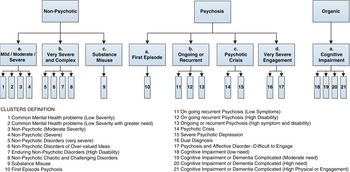
Completion of the MHCT by a professional or team for a patient is performed and then, using guidance, the patient is clustered into one of 21 clusters that are based upon groupings of non-psychotic, psychotic or organic presentations (see Fig. 1). The groupings have subgroups based upon severity, complexity or chronicity. Allocating a patient to a specific cluster is based upon scores or ranges of scores that the patient must score; is expected to score; may score; is unlikely to score on specified ratings from the MHCT. Each cluster has a narrative description of the type of problems that the patient is likely to present and diagnoses that the patient is likely to be labelled with. Also, a short description of any likely impairment, the course of the condition and type of risk is given for each cluster.
Figure 1Colour online. Decision tree for clustering.
Is clustering workable?
Despite apparent comprehensiveness within the above process, the MHCT is likely to cause confusion for some (and thus poor quality of data) without comprehensive and consistent methods of training. Thus a national rollout of training has been implemented and incentives given for organisations able to demonstrate that patients had been clustered into groups. This directive was inducement driven, i.e. incentives given for clustering high percentages of patients and financial implications applied if the targets not met (NHS Confederation, 2011). The process did not take into account the variables, aforementioned confusion and potential risks of not clustering appropriately (given an already tight time scale). The overlap and proximity of description within some clusters may lead to a high likelihood of confusion and inaccurate clustering.
There are explicit statements that clustering (and thus patient pathways and PbR) are not based upon diagnosis but upon need. This is somewhat at odds with the fact that it is stated that HoNOS is not an assessment tool but an outcome measure: it is being used within the MHCT which is itself an assessment of need. Many of the features within HoNOS allude to diagnosis and there are clear statements within the MHCT regarding diagnosis. Thus despite intentions, specific diagnoses are likely to be associated with specific clusters (as they are mentioned within the published clustering guidance). This may dilute clarity of addressing needs in a holistic fashion. Furthermore the clustering model places emphasis on efficient treatment of the specific cluster to give value for money. The aforementioned poor inter-rater reliability could impact negatively upon such attempts at efficiency both for organisations and patient care. A significant example of this difficulty could be within inpatient care: efficiency could only improve within this model by reducing average length of stay for all patients who utilise these treatment mediums. This is no different to current attempts to increase effectiveness, placing emphasis on the model itself to drive efficiency, not efficiency practice or effective stages of care.
Beginnings of improvement in psychiatric intensive care?
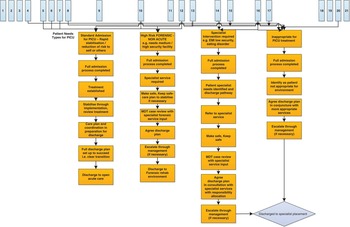
Within emergency psychiatry, PICU and Low Secure services there may well be certain ‘patient clusters’ that are admitted to specific services. For PICU, the most likely are shown in Figure 2. To improve efficiency, one temptation is to define services around clusters. This could lead to more ill defined services that are based upon a tool that has poor inter-rater reliability (NHS Confederation, 2011) and could thus be interpreted in different fashions. Of course, we are not recommending that meeting each patient's need should be strictly based around existing services. However the robust definition of patient need met by PICUs has provided clarity within services and both the National Minimum Standards (Department of Health, 2002) and AIMS-PICU (Dye et al, Reference Dye, Page, Deacon and Metherall2010a) have given a framework from which measurements can be made.
Figure 2Colour online. Payment by results clustering integrated to patients needs types.
Evidence for ideal treatment methodologies within PICUs remain scarce; one comparison between PICUs encompassed practice within seven different PICUs nationally within a variety of different demographies. It concluded that there was significant variation within practice standards and treatment methodologies within psychiatric intensive care (Brown et al. Reference Brown, Chhina and Dye2010; Dye et al. Reference Dye, Brown and Chhina2009). Furthermore, clinical practice also strayed from the accepted National Minimum Standards guidance on PICU provision (Dye et al. Reference Dye, Chhina and Brown2010b). This research was based on admission standards, treatment methodologies, demographic information and discharge processes. The paper went further in stating that accreditation processes (which have now been introduced through AIMS-PICU) would help to standardise treatment and develop an evidence base within this specialist treatment medium. As yet no studies have been undertaken to continue this work; how patient clustering may clarify this is subject to significant debate. Furthermore, the elements of provided care within patient journeys, which are evidenced based, have not been overtly prescribed as a consolidated pathway in PICU, or any other psychiatric treatment medium as part of a patient journey in the implementation of PbR.
Elements (or steps) of care provided are highlighted within this article and the articulated direction of psychiatric intensive care services to systematically improve care is similar to clinical governance. Direct correlation to good assessment processes, effective and rapid treatment and successful discharge planning are therefore naturally implicated in effective psychiatric care pathways. The collective high performance of aspects within patient journeys (i.e. admission, treatment establishment, effective implementation of care and consistent and regular review in addition to a planned and well communicated discharge) are felt to symbiotically translate into efficient care provision.
Clinical processes which contribute directly or indirectly to patient care are a much more accurate way of creating a payment by results model rather than a clustering of presentation severity. Figure 2 clearly illustrates how PbR could confuse (or even limit due to inaccurate funding allocation) patient journeys by the multitude of different ways in which care planning and stages of care (within just the medium of PICU) could become lost in a singular tariff of care which is predetermined before full care is administered. Given the above, we argue that elements and stages of care seem the most accurate way to develop a national evidence base within treatment mediums (and clinical governance) over not only treatment but ideal patient journeys themselves.
Just as provision of PICU is a potential element in the care of a particular cluster of patients, what occurs within a PICU is a collection of elements of care (or clinical stages of patient pathways) that are available to patients, carers etc. To achieve each step within the pathway, the process of Lean can be used to ensure that the care provided for all patients is easy to understand and accessible as well as effective and efficient (Womack & Jones, Reference Womack and Jones2003).
We have previously argued that through patient needs typing based upon differing requirements, lean management techniques can be used to refine the pathways that are developed to meet these needs (Kearney & Dye, Reference Kearney and Dye2010). Examples of steps for three different patient types admitted to PICU were given and we felt that by identifying specific requirements, more appropriate care can be given in a more timely fashion for more well identified patient types (as opposed to vaguely outlined clusters). This could also form the basis of identifying local tariffs more efficiently and accurately within a PbR framework. We have now followed up our original paper with a more detailed example of what could be offered. Although we argued previously that the processes underpinning each step should be agreed locally to define value for each service, PICU is an appropriate place from which to commence this work because of the clearly defined nature of work and the availability of standards within both the pathways and underlying steps. From the original paper we postulated that, based on the clearly defined remit outlined within the National Minimum Standards that there is an ideal patient presentation for PICU; their needs would ideally be met within the treatment medium of PICU. In this paper we outline the processes that could be involved within what was defined Type A ‘Standard admission’ in the original paper.
Within the ‘Standard admission’ there are key stages at which care is progressed. Each of these stages, completed successfully in turn, drives the patient journey. Although each journey needs to be built around the patient within localised demographies in which the PICU provision exists, certain similarities may be seen. Figure 2 outlines the potential variations of patient journey within clusters (which also assumes accuracy of clustering), solely in relation to PICU usage and therefore highlights the inaccuracies of clustering in relation to incorporate treatment mediums and total provision of care. There is a specific emphasis on efficiency that objectively a payment by results model, as it stands to be implemented, would overlook. A block payment for a particular type of clinical presentation does not account for the contribution to overall efficiency (and most importantly, patient care) or the individual efficiency of the clinical journey steps. Although current guidance suggests that PbR can be used to reward efficiency, it is unclear how this would be achieved. A potential solution to this dilemma is inversion of the model, i.e. more needs typing specific to treatment environments. This naturally gives the ability to then identify the steps of care which are taken through the journey of each patient, which would be much more accurate in terms of costing and in terms of individualising care.
A commonly held premise of inpatient admission in modern mental health is that successful discharge needs to be planned for from the minute a patient is admitted in terms of fully addressing need. Yet commonly on admission, accommodation needs are not communicated well from inpatients to community, resulting in significantly longer lengths of stay, reducing efficiency and exposing patients to an acute environment which may no longer be appropriate (increasing chances of deterioration) and for longer than necessary (reducing cost effectiveness). This demonstrates one example of how a simple admission process adhered to consistently can have significant impact on care and successful, efficient discharge.
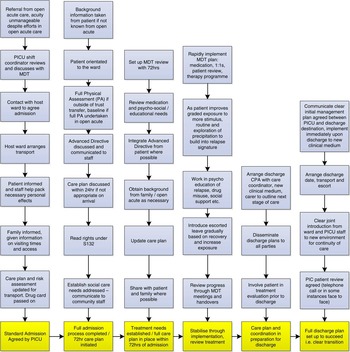
Figure 3 outlines the ideal journey for a standard admission within PICU. This pathway is based on best practice from the National Minimum Standards (Department of Health, 2002) and AIMS-PICU (Cresswell et al. Reference Cresswell, Hinchcliffe and Lemmey2010) including advanced directive usage; early formal assertion of care plan; and rapid treatment implementation in collaboration with stakeholders. The pathway is also clear about requirements of admission and communication cascade upon discharge to ensure a smooth transition to discharge destinations (most likely, given the standard needs type pathway, open acute care). Treatment within psychiatric intensive care can be elongated due to poor communication hence emphasis on communication within the treatment pathway on admission, during treatment and at point of discharge has added benefit for the patient and stakeholders of care. The example is limited as there are further processes implicated within the pathway such as prescription and rapid tranquilisation. What the over arching process does clearly outline are key ingredients which are all necessary to provide high quality and rapid treatment within PICU.
Figure 3Colour online. Overall key stages of a standard PICU admission.
Within a specialist provision such as PICU, tariffs based on admission can be simply incorporated based on national average lengths of stay and therefore emphasise efficiency within treatment and in-depth examination of the quality of steps of care within current psychiatric intensive care local protocols, systems and processes. This would create a benchmark for performance truly based on adherence to good quality practice, not national spread of clustering based on interpretation which may be inaccurate, and would truly create a culture in mental health of value for money or probably most importantly, quality for money.
Health care in the UK (and elsewhere) is currently based on public health information, both demographical and geographical, on given commissioning areas. This can lead to natural gaps in systems as it is a ‘guestimate’. In the future, to predict demand is to be able to commission accurately for areas through high awareness of local need and a wealth of information on historic demand (Womack & Jones, Reference Womack and Jones2003, Kearney & Dye, Reference Kearney and Dye2010). This is one of the key benefits intended through PbR implementation (Department of Health, 2010). Good systems rely on the efficiency of individual steps, not limiting care to particular care clusters, which suggests a push system which is regarded as inefficient (Womack & Jones, Reference Womack and Jones2003; George, Reference George2003; George et al. Reference George, Rolands, Price and Maxey2005). Pull systems have been shown to be infinitely superior in terms of efficiency (George et al. Reference George, Rolands, Price and Maxey2005). Our proposed model shows another way to look at delivery and efficient care by ensuring each care step is scrutinised for its component of care delivery. This inversion of clustering promotes cohesion and echoes into each stage of the patient journey; the patient is led through care by successful completion of previous care components avoiding longer term over or under provision.
Conclusions
Payments by results heralds a new era in mental health in the UK which is geared towards rewarding efficient care; however, efficiency within this model is difficult to define. Emphasis within the clustering has been around accurate identification of symptom prevalence and acuity level, not bespoke care steps within individualised journeys with tariffs. This system suggests engineering in, already established, efficient machinery without due consideration to the sum of its parts overall.
The danger, as such, is that clusters become tariffs and as such cluster numbers become gateways to particular services. The poor inter-rater reliability of clustering and wide spread inconsistency and variance in usage that organisations have faced would have a clear and present danger to patient care and also a financial implication, which should be risk shared whilst not fully addressed (NHS Confederation, 2011).
Whilst there is recognition of scrutiny of quality and efficiency within the NHS, scrutiny of quality could be easily implemented with better usage of clinical governance and systems scrutinisation. This does not allow a dictated journey but necessitates high quality for organisations to be successful. We have outlined one way in which patient journeys within PICU services based upon patient typing and lean methodology can be helpful in both clinical practice and commissioning. We urge policy makers and clinicians alike to consider this.





 You have
Access
Payment by results in mental health
The first mention of a payment by results (PbR) programme within psychiatry by the UK Department of Health was in 2005 (Department of Health, 2005). The aim was ‘to support NHS modernisation by paying hospitals for the care they provide, rewarding efficiency’. This was to be done by setting agreed tariffs for specific care. A method was proposed to cluster patients into groupings and to base PbR upon pathway costings for each cluster on a per client average. An initially optimistic timescale of setting a mental health tariff by winter 2008 and commencing use by 2009 was aimed for.
It was intended that patient clustering should be based upon need as opposed to diagnosis. As such ICD10 is not overtly used but instead, professionals rate patients using a mental health clustering tool kit (MHCT; Care Pathways and Packages Project, 2011) that is based upon the Health of the Nation Outcome Scale (HoNOS; Wing et al. Reference Wing, Curtis and Beevor1999) and the Summary of Assessment of Risk and Need (SARN; Self et al. Reference Self, Rigby, Leggett and Paxton2008). This approach was pioneered by clinicians whose intention was to ensure patients were in receipt of the most appropriate, needs based, care package. This clinically derived approach has been adopted by the Department of Health as the template for PbR implementation.
HoNOS is an internationally recognised outcome measure that measures health and social functioning outcomes. The aim of HoNOS is to produce a brief measure capable of being completed routinely by clinicians. The first 12 of the 18 items of the MHCT are HoNOS items and they measure four main problem areas: behavioural difficulties, physical and cognitive impairments, symptom severity and social problems.
SARN was developed to aid the process of establishing classification of service users based on their needs so that appropriate service responses could be developed both at the individual and service level. It provides a brief description of the needs of people entering into Mental Health Services for the first time or presenting with a possible need for change in their care or treatment.
Completion of the MHCT by a professional or team for a patient is performed and then, using guidance, the patient is clustered into one of 21 clusters that are based upon groupings of non-psychotic, psychotic or organic presentations (see Fig. 1). The groupings have subgroups based upon severity, complexity or chronicity. Allocating a patient to a specific cluster is based upon scores or ranges of scores that the patient must score; is expected to score; may score; is unlikely to score on specified ratings from the MHCT. Each cluster has a narrative description of the type of problems that the patient is likely to present and diagnoses that the patient is likely to be labelled with. Also, a short description of any likely impairment, the course of the condition and type of risk is given for each cluster.
Colour online. Decision tree for clustering.
Is clustering workable?
Despite apparent comprehensiveness within the above process, the MHCT is likely to cause confusion for some (and thus poor quality of data) without comprehensive and consistent methods of training. Thus a national rollout of training has been implemented and incentives given for organisations able to demonstrate that patients had been clustered into groups. This directive was inducement driven, i.e. incentives given for clustering high percentages of patients and financial implications applied if the targets not met (NHS Confederation, 2011). The process did not take into account the variables, aforementioned confusion and potential risks of not clustering appropriately (given an already tight time scale). The overlap and proximity of description within some clusters may lead to a high likelihood of confusion and inaccurate clustering.
There are explicit statements that clustering (and thus patient pathways and PbR) are not based upon diagnosis but upon need. This is somewhat at odds with the fact that it is stated that HoNOS is not an assessment tool but an outcome measure: it is being used within the MHCT which is itself an assessment of need. Many of the features within HoNOS allude to diagnosis and there are clear statements within the MHCT regarding diagnosis. Thus despite intentions, specific diagnoses are likely to be associated with specific clusters (as they are mentioned within the published clustering guidance). This may dilute clarity of addressing needs in a holistic fashion. Furthermore the clustering model places emphasis on efficient treatment of the specific cluster to give value for money. The aforementioned poor inter-rater reliability could impact negatively upon such attempts at efficiency both for organisations and patient care. A significant example of this difficulty could be within inpatient care: efficiency could only improve within this model by reducing average length of stay for all patients who utilise these treatment mediums. This is no different to current attempts to increase effectiveness, placing emphasis on the model itself to drive efficiency, not efficiency practice or effective stages of care.
Beginnings of improvement in psychiatric intensive care?
Within emergency psychiatry, PICU and Low Secure services there may well be certain ‘patient clusters’ that are admitted to specific services. For PICU, the most likely are shown in Figure 2. To improve efficiency, one temptation is to define services around clusters. This could lead to more ill defined services that are based upon a tool that has poor inter-rater reliability (NHS Confederation, 2011) and could thus be interpreted in different fashions. Of course, we are not recommending that meeting each patient's need should be strictly based around existing services. However the robust definition of patient need met by PICUs has provided clarity within services and both the National Minimum Standards (Department of Health, 2002) and AIMS-PICU (Dye et al, Reference Dye, Page, Deacon and Metherall2010a) have given a framework from which measurements can be made.
Colour online. Payment by results clustering integrated to patients needs types.
Evidence for ideal treatment methodologies within PICUs remain scarce; one comparison between PICUs encompassed practice within seven different PICUs nationally within a variety of different demographies. It concluded that there was significant variation within practice standards and treatment methodologies within psychiatric intensive care (Brown et al. Reference Brown, Chhina and Dye2010; Dye et al. Reference Dye, Brown and Chhina2009). Furthermore, clinical practice also strayed from the accepted National Minimum Standards guidance on PICU provision (Dye et al. Reference Dye, Chhina and Brown2010b). This research was based on admission standards, treatment methodologies, demographic information and discharge processes. The paper went further in stating that accreditation processes (which have now been introduced through AIMS-PICU) would help to standardise treatment and develop an evidence base within this specialist treatment medium. As yet no studies have been undertaken to continue this work; how patient clustering may clarify this is subject to significant debate. Furthermore, the elements of provided care within patient journeys, which are evidenced based, have not been overtly prescribed as a consolidated pathway in PICU, or any other psychiatric treatment medium as part of a patient journey in the implementation of PbR.
Elements (or steps) of care provided are highlighted within this article and the articulated direction of psychiatric intensive care services to systematically improve care is similar to clinical governance. Direct correlation to good assessment processes, effective and rapid treatment and successful discharge planning are therefore naturally implicated in effective psychiatric care pathways. The collective high performance of aspects within patient journeys (i.e. admission, treatment establishment, effective implementation of care and consistent and regular review in addition to a planned and well communicated discharge) are felt to symbiotically translate into efficient care provision.
Clinical processes which contribute directly or indirectly to patient care are a much more accurate way of creating a payment by results model rather than a clustering of presentation severity. Figure 2 clearly illustrates how PbR could confuse (or even limit due to inaccurate funding allocation) patient journeys by the multitude of different ways in which care planning and stages of care (within just the medium of PICU) could become lost in a singular tariff of care which is predetermined before full care is administered. Given the above, we argue that elements and stages of care seem the most accurate way to develop a national evidence base within treatment mediums (and clinical governance) over not only treatment but ideal patient journeys themselves.
Just as provision of PICU is a potential element in the care of a particular cluster of patients, what occurs within a PICU is a collection of elements of care (or clinical stages of patient pathways) that are available to patients, carers etc. To achieve each step within the pathway, the process of Lean can be used to ensure that the care provided for all patients is easy to understand and accessible as well as effective and efficient (Womack & Jones, Reference Womack and Jones2003).
We have previously argued that through patient needs typing based upon differing requirements, lean management techniques can be used to refine the pathways that are developed to meet these needs (Kearney & Dye, Reference Kearney and Dye2010). Examples of steps for three different patient types admitted to PICU were given and we felt that by identifying specific requirements, more appropriate care can be given in a more timely fashion for more well identified patient types (as opposed to vaguely outlined clusters). This could also form the basis of identifying local tariffs more efficiently and accurately within a PbR framework. We have now followed up our original paper with a more detailed example of what could be offered. Although we argued previously that the processes underpinning each step should be agreed locally to define value for each service, PICU is an appropriate place from which to commence this work because of the clearly defined nature of work and the availability of standards within both the pathways and underlying steps. From the original paper we postulated that, based on the clearly defined remit outlined within the National Minimum Standards that there is an ideal patient presentation for PICU; their needs would ideally be met within the treatment medium of PICU. In this paper we outline the processes that could be involved within what was defined Type A ‘Standard admission’ in the original paper.
Within the ‘Standard admission’ there are key stages at which care is progressed. Each of these stages, completed successfully in turn, drives the patient journey. Although each journey needs to be built around the patient within localised demographies in which the PICU provision exists, certain similarities may be seen. Figure 2 outlines the potential variations of patient journey within clusters (which also assumes accuracy of clustering), solely in relation to PICU usage and therefore highlights the inaccuracies of clustering in relation to incorporate treatment mediums and total provision of care. There is a specific emphasis on efficiency that objectively a payment by results model, as it stands to be implemented, would overlook. A block payment for a particular type of clinical presentation does not account for the contribution to overall efficiency (and most importantly, patient care) or the individual efficiency of the clinical journey steps. Although current guidance suggests that PbR can be used to reward efficiency, it is unclear how this would be achieved. A potential solution to this dilemma is inversion of the model, i.e. more needs typing specific to treatment environments. This naturally gives the ability to then identify the steps of care which are taken through the journey of each patient, which would be much more accurate in terms of costing and in terms of individualising care.
A commonly held premise of inpatient admission in modern mental health is that successful discharge needs to be planned for from the minute a patient is admitted in terms of fully addressing need. Yet commonly on admission, accommodation needs are not communicated well from inpatients to community, resulting in significantly longer lengths of stay, reducing efficiency and exposing patients to an acute environment which may no longer be appropriate (increasing chances of deterioration) and for longer than necessary (reducing cost effectiveness). This demonstrates one example of how a simple admission process adhered to consistently can have significant impact on care and successful, efficient discharge.
Figure 3 outlines the ideal journey for a standard admission within PICU. This pathway is based on best practice from the National Minimum Standards (Department of Health, 2002) and AIMS-PICU (Cresswell et al. Reference Cresswell, Hinchcliffe and Lemmey2010) including advanced directive usage; early formal assertion of care plan; and rapid treatment implementation in collaboration with stakeholders. The pathway is also clear about requirements of admission and communication cascade upon discharge to ensure a smooth transition to discharge destinations (most likely, given the standard needs type pathway, open acute care). Treatment within psychiatric intensive care can be elongated due to poor communication hence emphasis on communication within the treatment pathway on admission, during treatment and at point of discharge has added benefit for the patient and stakeholders of care. The example is limited as there are further processes implicated within the pathway such as prescription and rapid tranquilisation. What the over arching process does clearly outline are key ingredients which are all necessary to provide high quality and rapid treatment within PICU.
Colour online. Overall key stages of a standard PICU admission.
Within a specialist provision such as PICU, tariffs based on admission can be simply incorporated based on national average lengths of stay and therefore emphasise efficiency within treatment and in-depth examination of the quality of steps of care within current psychiatric intensive care local protocols, systems and processes. This would create a benchmark for performance truly based on adherence to good quality practice, not national spread of clustering based on interpretation which may be inaccurate, and would truly create a culture in mental health of value for money or probably most importantly, quality for money.
Health care in the UK (and elsewhere) is currently based on public health information, both demographical and geographical, on given commissioning areas. This can lead to natural gaps in systems as it is a ‘guestimate’. In the future, to predict demand is to be able to commission accurately for areas through high awareness of local need and a wealth of information on historic demand (Womack & Jones, Reference Womack and Jones2003, Kearney & Dye, Reference Kearney and Dye2010). This is one of the key benefits intended through PbR implementation (Department of Health, 2010). Good systems rely on the efficiency of individual steps, not limiting care to particular care clusters, which suggests a push system which is regarded as inefficient (Womack & Jones, Reference Womack and Jones2003; George, Reference George2003; George et al. Reference George, Rolands, Price and Maxey2005). Pull systems have been shown to be infinitely superior in terms of efficiency (George et al. Reference George, Rolands, Price and Maxey2005). Our proposed model shows another way to look at delivery and efficient care by ensuring each care step is scrutinised for its component of care delivery. This inversion of clustering promotes cohesion and echoes into each stage of the patient journey; the patient is led through care by successful completion of previous care components avoiding longer term over or under provision.
Conclusions
Payments by results heralds a new era in mental health in the UK which is geared towards rewarding efficient care; however, efficiency within this model is difficult to define. Emphasis within the clustering has been around accurate identification of symptom prevalence and acuity level, not bespoke care steps within individualised journeys with tariffs. This system suggests engineering in, already established, efficient machinery without due consideration to the sum of its parts overall.
The danger, as such, is that clusters become tariffs and as such cluster numbers become gateways to particular services. The poor inter-rater reliability of clustering and wide spread inconsistency and variance in usage that organisations have faced would have a clear and present danger to patient care and also a financial implication, which should be risk shared whilst not fully addressed (NHS Confederation, 2011).
Whilst there is recognition of scrutiny of quality and efficiency within the NHS, scrutiny of quality could be easily implemented with better usage of clinical governance and systems scrutinisation. This does not allow a dictated journey but necessitates high quality for organisations to be successful. We have outlined one way in which patient journeys within PICU services based upon patient typing and lean methodology can be helpful in both clinical practice and commissioning. We urge policy makers and clinicians alike to consider this.