INTRODUCTION
Polycarpa kornogi Glémarec & Monniot, C., 1966, was described from specimens collected along the Atlantic southern Brittany coast (Figure 1). It has often been confused with other species of Polycarpa. Vàzquez et al. (Reference Vàzquez, Ramos-Espla and Turon1995) sorted the Polycarpa species of the Atlantic and Mediterranean coasts into four main groups, namely the fibrosa, the pomaria, the gracilis and the bathyal-abyssal group. Polycarpa kornogi belongs to the fibrosa group characterized by a sediment-covered tunic. This species is distinguished from the others belonging to Polycarpa fibrosa sensu lato only by internal characters such as the extremity of the anus, the number of gonads (more than 20–30 on each side in P. kornogi and about 12 in P. fibrosa) and especially the form and structure of the elongated polycarps (Glémarec & Monniot, Reference Glémarec and Monniot1966; Vàzquez et al., Reference Vàzquez, Ramos-Espla and Turon1995).
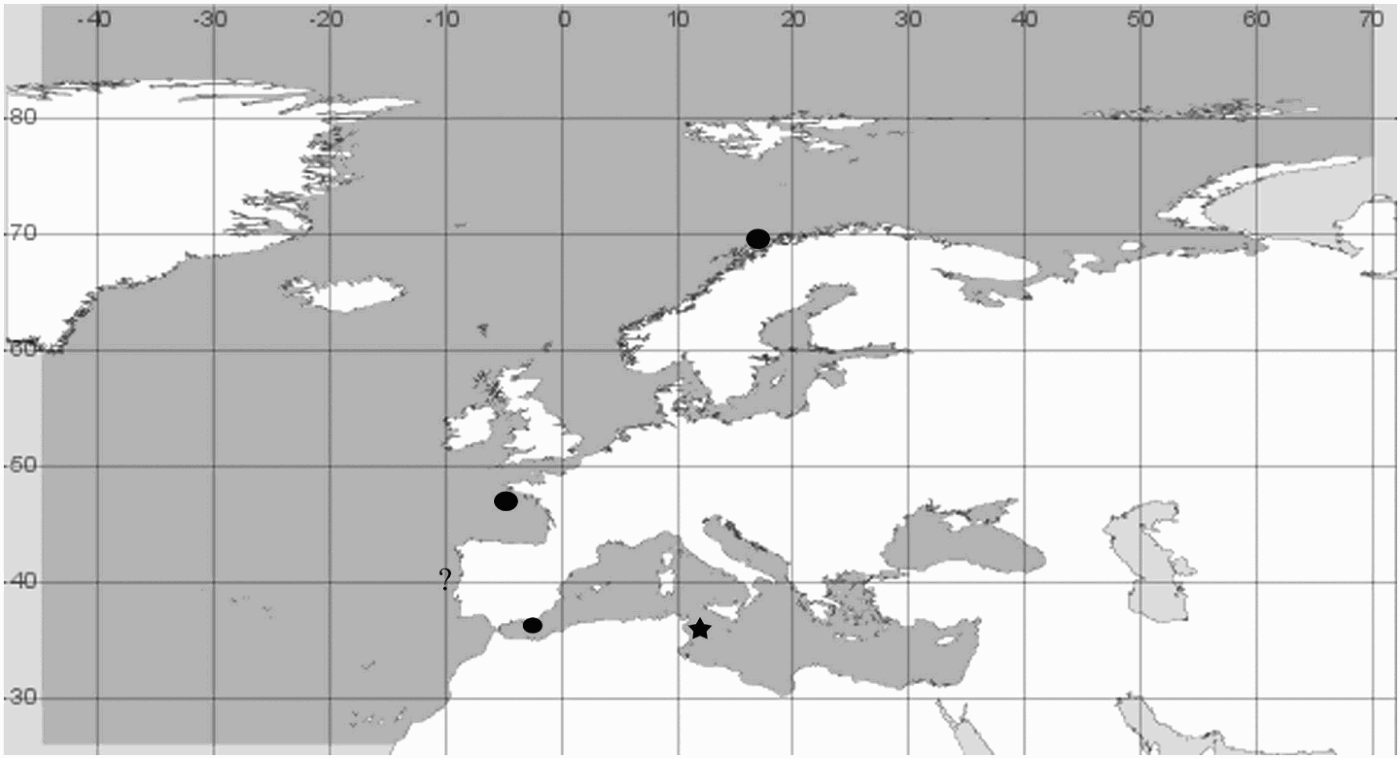
Distribution of Polycarpa kornogi (•) in the Atlantic (along the Brittany and Norwegian coast and (?) possibly Portugal), (★) in the Mediterranean (Iberian Province) and new findings along the Tunisian coast.

This species has also been found along the Norwegian coast at 250 m depth (Monniot & Monniot, Reference Monniot and Monniot1979) (Figure 1). In this paper the occurrence of P. kornogi along the Tunisian coast is reported for the first time.
MATERIALS AND METHODS
Polycarpa kornogi was collected by SCUBA diving along the Gulf of Tunis and more precisely off Sidi Raïs (Figure 1) during an ascidian inventory along the Tunisian coast. Four seasonal campaigns were carried out from January to December 2006. The salinity and water temperature were seasonally recorded using a probe (type WTW microprocessor conductivity Meter LF 196). The samples were collected on Cymodocea nodosa and Posidonia oceanica meadows at depths ranging from 5 to 9 m. The ascidians were anaesthetized with menthol crystals in seawater and then preserved in seawater formalin 5%.
The morphological observations and descriptions were made at the Halieutic resources laboratory of the INAT and were confirmed at the Department of Zoology of the University of Bari in Italy.
RESULTS
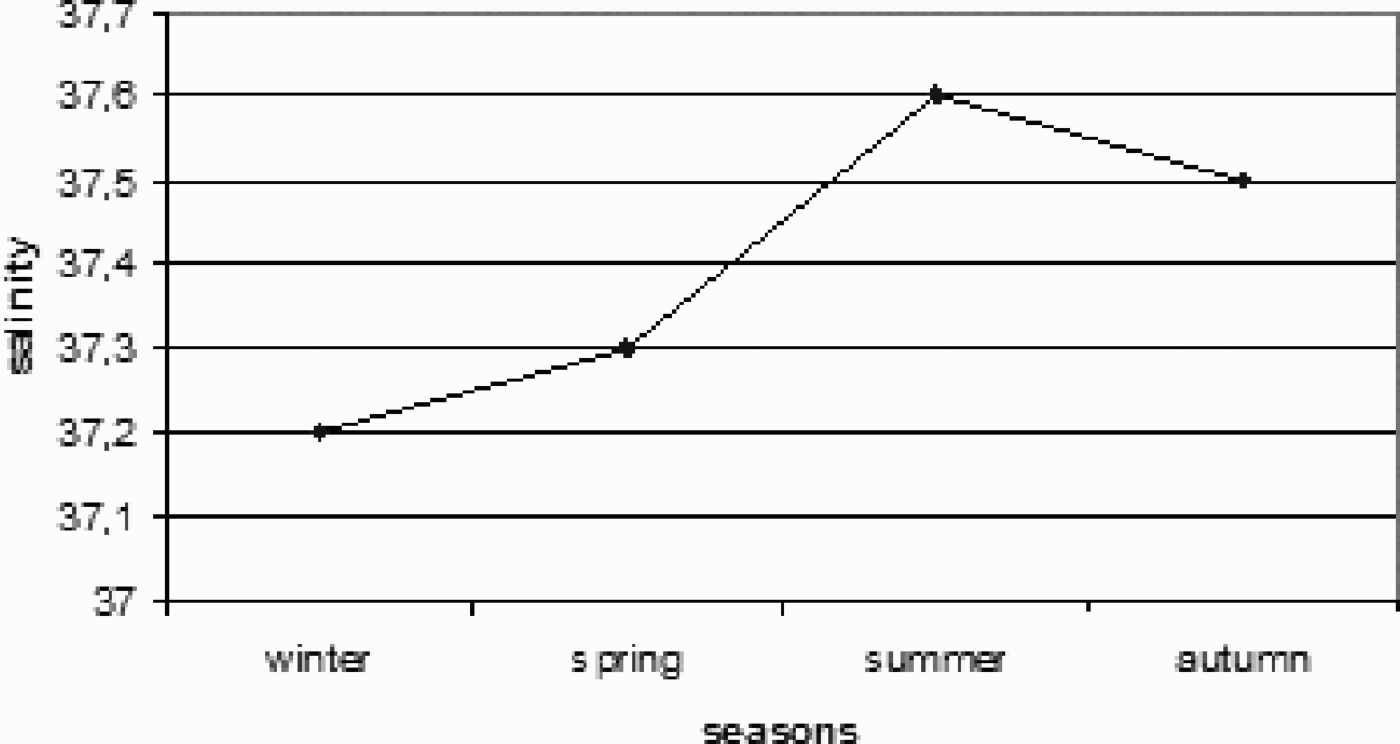
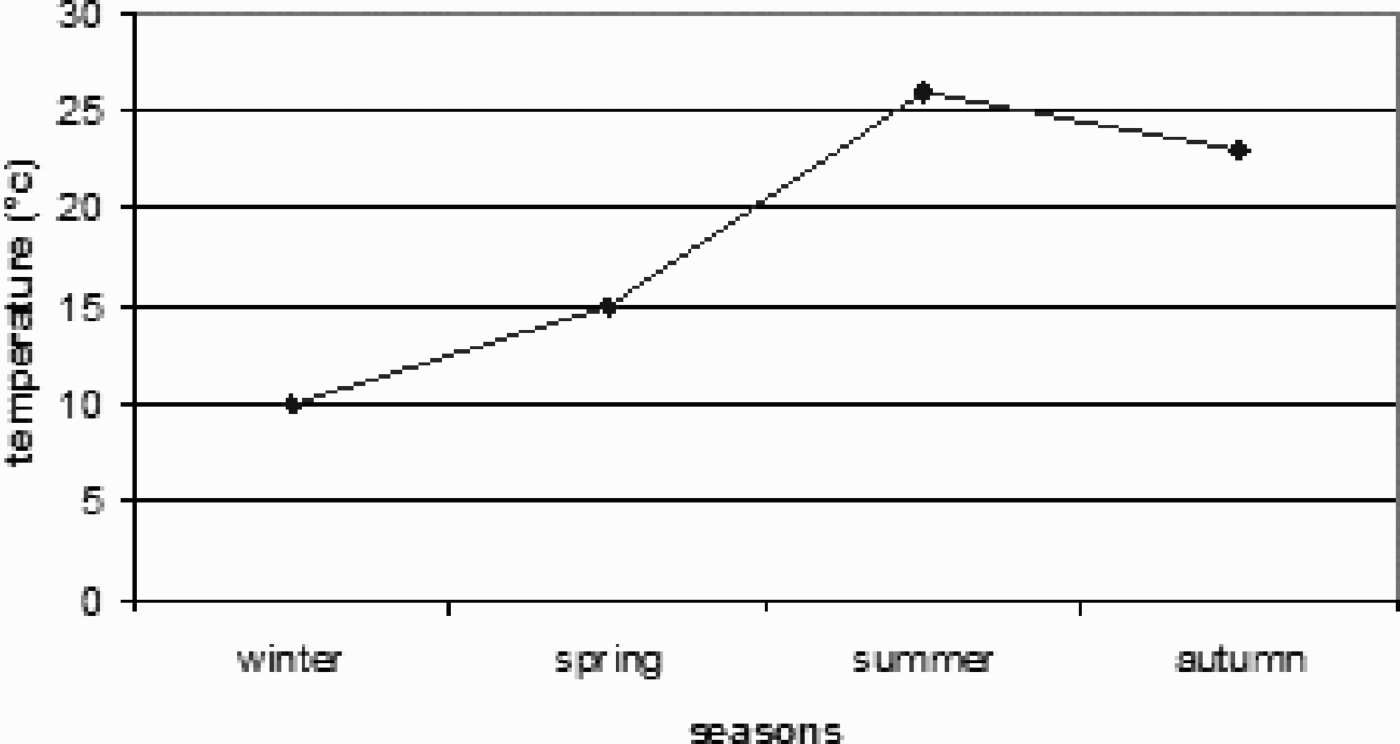
During the period of investigation the salinity ranged from 37.2 psu (January 2006) to 37.6 psu (August 2006) (Figure 2) and the water temperature from 10°C (January 2006) to 26°C (August 2006) (Figure 3).
Seasonal salinity variation recorded in Sidi Raïs between January and December 2006.

Seasonal water temperature variation recorded in Sidi Raïs between January and December 2006.

TAXONOMIC DESCRIPTION
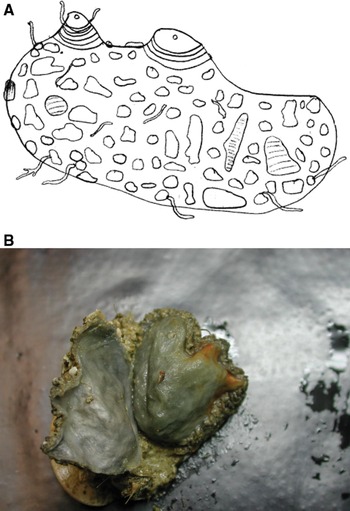
The specimens (10) of Polycarpa kornogi collected in Sidi Raïs have a rough dark-beige tunic completely incrusted with small shells and sand. The body has an elongated form (Figure 4A) with the two siphons close together. The average size is 3 cm in length and 2 cm in height. The tunic is 3 mm thick.
(A) Diagram of Polycarpa kornogi collected in Sidi Raïs; (B) opened specimen, with the sandy tunic, greyish body wall and red siphons.

The body wall inside the tunic is dark-grey with reddish spots around the siphons (Figure 4B). For the specimens of the middle size (2.5–3 cm), the branchial sac has the following formula:
Right: DL-1-15-6-11-1-18-3-9-2-E
Left: DL-0-10-1-8-2-14-1-10-1-E
The irregularity of the stigmata length and number per mesh in the branchial sac is exactly as described and figured by Glémarec & Monniot (1966) (Figure 5).
(A) Internal structure of Polycarpa kornogi (from Glémarec & Monniot, Reference Glémarec and Monniot1966); (B) detail of one gonad.

The siphonal lining has four reddish-orange bands. At the base of the oral siphon, in specimens of middle size, there are 12 long tentacles alternating with smaller. The dorsal tubercle shape is variable from ‘6’ or ‘C’. The gut loop occupies 3/4 of left side. The oesophagus is short and opens into a rectangular stomach with many longitudinal folds. The pyloric caecum is very short, almost not visible in small specimens. The anus has several lobes of different sizes. The cloacal opening is provided with a circular short velum. There are numerous gonads, about 40 on the right and about 30 on the left attached to the body wall. The gonads are elongate composed of 6–8 testicular acini located under or around a cylindrical ovary. The common spermiduct opens near the female gonopore (Figure 5B). Larvae were not observed. The endocarps are located on the body wall among or on the gonads and sometimes in the gut loop.
ECOLOGY
This species was found at depths ranging from 5 to 9 m, on hard substrates, rocks encrusted with algae and on Posidonia oceanica. The site is protected and the water is clear, however, when the winds are strong the water has sediment in suspension and the visibility is diminished. This species was found in Brittany and in the Mediterranean (Monniot & Monniot, 1994) Iberian Province (Turon, Reference Turon1987) at 10 to 75 m depth. Polycarpa kornogi was collected only in the winter and autumn and this species is rare at the site. It may be a new introduction on the Tunisian coast.
Concluding remarks
The European species of Polycarpa have been confused in the literature owing to the existence of several groups of morphologically close species (Vàzquez et al., Reference Vàzquez, Ramos-Espla and Turon1995). Thus, P. kornogi has been confused with P. comata or P. fibrosa; the P. fibrosa found in Portugal by Michaelsen (1911) would be P. kornogi according to Vàzquez et al. (Reference Vàzquez, Ramos-Espla and Turon1995).
The Tunisian specimen of P. kornogi studied agrees with the original description by Glémarec & Monniot (Reference Glémarec and Monniot1966) from Brittany and also the description by Vàzquez et al. (Reference Vàzquez, Ramos-Espla and Turon1995) except for the higher number of gonads. Other differences exist between the Tunisian specimen and the specimens described by Glémarec & Monniot and by Vasquez et al. (1995) and they are the form and the size of species. Indeed, comparing with the original descriptions of Glémarec & Monniot and of Turon (Reference Turon1987), the Tunisian specimen has an elongated form and greater size (the average size was 3 cm in length and 2 cm in width).
Polycarpa comata can be easily distinguished from P. kornogi and P. fibrosa based on the external form. But P. fibrosa resembles P. kornogi except for the number of gonads (12 for P. fibrosa and 30 for P. kornogi) and the elongated form of polycarps for P. kornogi species.
Polycarpa kornogi is a Lusitanian species (Glémarec & Monniot, Reference Glémarec and Monniot1966), whose distribution ranges from the European Atlantic coast in the north and the African Atlantic coast on the level of the Gibraltar Strait in the south.
ACKNOWLEDGEMENTS
Very special thanks are dedicated to Professor Angelo Tursi at the Department of Zoology of the University of Bari for his collaboration. Other thanks are dedicated to the CAR/SPA for their financial support.