Introduction
This paper explores a contentious provision within the Multiemployer Pension Reform Act of 2014 (MPRA) that allows multiemployer plans facing impending insolvency to cut accrued benefits of current workers and retirees to extend the life of the plan. A multiemployer plan is a pension plan negotiated by a union with a group of employers typically in the same industry. These plans typically exist in industries with many small employers who would not ordinarily establish a defined benefit plan on their own, and where it is common for employees move from one employer to another. In total there are currently about 1,400 private sector multiemployer plans in the USA, covering nearly 10.5 million workers and retirees. Private sector multiemployer plans expanded benefits during the stock market boom in the 1990s and then lost substantial assets in the wake of two financial crises after the turn of the century. In addition, many plans are in industries, such as construction, hurt by the prolonged recession, and others face a shrinking pool of active workers. While the great majority of multiemployer plans have responded to these financial pressures by cutting future benefits for active workers and raising employer contribution rates, allowing them to navigate to the relatively secure footing, a significant number of plans could run out of money in the next 20 years.Footnote 1 The Pension Benefit Guaranty Corporation (PBGC), which guarantees pension benefits for insolvent plans, does not have the resources to solve the problem. The question is whether giving distressed plans an additional tool – the ability to cut benefits for existing retirees – would do more good than harm.
The discussion proceeds as follows. The first section provides background on the MPRA. It begins by introducing the law 2013 precursor – a proposal by the Retirement Security Review Commission – and the concerns voiced by some of its opponents. The section concludes by describing key aspects of the law that ultimately passed in 2014 and how it addressed many of the issue raised by detractors to the original proposal. The second section presents the story of the Central States Teamsters (CST) plan because, with just over 400,000 participants, it is one of the largest multiemployer plans facing insolvency and recently applied for, and was subsequently denied, the right to reduce benefits under the new law. The third section presents a two-part analysis – using the CST as the example. The first part uses Monte-Carlo simulations to measure the probability of insolvency if under two scenarios: (1) the plan continues as is without reducing benefits; and (2) the plan reduces accrued benefits similar to that proposed in the CST application. The second part of the analysis measures the welfare of plan participants under the two scenarios. The stochastic analysis shows that the maximum benefit cut allowed under MPRA, approximately a 30% benefit cut on average, gives CST only a 50% probability to remain solvent indefinitely. The welfare analysis shows that, if the plan does indeed remain solvent by reducing benefits, the aggregate welfare of plan participants is greater than if the plan were to continue paying full benefits until insolvency.
The final section of the paper concludes that the law – crafted under the assumption that the federal government – tries to balance competing interests: maintaining the support of active workers; keeping employers from exiting the plans (and attracting new employers), and ensuring that benefits exceed what participants would get under insolvency. However, if CST is any indication, benefit cuts alone will not be sufficient to ensure the solvency of the most troubled multiemployer plans; other approaches may be necessary. While the allowance of benefit cuts under MPRA may not be a complete solution, it has, at the very least, awakened the public to the challenges facing the worst-off multiemployer plans and the tough choices that lay ahead.
The MPRA of 2014
A proposal by the retirement security review commission
In response to the plight of a significant minority of multiemployer plans, the National Coordinating Committee for Multiemployer Plans convened the Retirement Security Review Commission. The Commission's 2013 report (‘Solutions not Bailouts’) proposed, among other things, allowing plans facing insolvency to reduce accrued benefits for current workers and retirees.Footnote 2 The Commission – a group consisting of representatives from multiemployer plans, employers, and unions – and other experts noted that this flexibility was essential because: (1) the most severely troubled plans – given their demographics – will be unable to avoid insolvency using traditional methods; and (2) benefit reductions – to the level of PGBC guarantees – will occur in any case in the event of plan insolvency, and will be more severe if the insolvency occurs after the exhaustion of the PBGC's multiemployer insurance fund.
Recognizing that suspending accrued benefits in the absence of plan insolvency breaks the social contract and violates one of the basic tenets of the Employee Retirement Income Security Act of 1974 (ERISA), the proposal limited the circumstances under which it can be applied. In order to be eligible for benefit suspensions, a severely troubled plan would have to meet three criteria. First, including the impact of any rehabilitation initiative, the plan would be projected to become insolvent within 20 years, and the ratio of inactive participants to active participants would exceed 2 to 1; or the plan would be expected to become insolvent within 15 years. Second, after the benefit suspensions, the plan would be projected to avoid insolvency. Plans not able to forestall insolvency – those in declining industries and with high ratios of retirees to workers – would not be eligible. Third, sponsors and trustees would have to have taken all reasonable measures to improve the plan's funded position and turn to benefit suspensions as a last resort.
Opponents
Not surprisingly, the proposal incited criticism from many unions (including the Teamsters), pension advocacy groups, and others. American Association of Retired Persons (AARP), one of the critics, clearly articulated key concerns in a 2013 congressional testimony responding to the original proposal, which is summarized here.Footnote 3 AARP fundamentally opposed cutting retiree benefits and argued that the Commission too easily dismissed alternatives to cutting accrued benefits and that more protections for participants and beneficiaries were needed before the proposal could be considered as an alternative to insolvency.
AARP highlighted three alternatives to cutting accrued benefits. The first was mergers and alliances, an approach included in the Commission report, whereby troubled and healthy plans could be combined. AARP accepted that funding rules under the Pension Protection Act (PPA) and the PBGC's restrictive interpretation of its authority acted as serious barriers to allowing mergers, but argued that these barriers be eliminated. The second alternative was partitions but AARP – like everyone else – acknowledged that this process would require additional funding for the PBGC. The third alternative was increased funds for the plans and for the PBGC. The AARP mentioned raising PBGC premiums to $120 and/or having participants contribute, say, $120 as well.
AARP then turned its attention to the specific details of the Commission proposal. First, AARP viewed the proposed requirements for enabling benefit suspensions as too vague. The proposal required that insolvency occurs within 20 years, that the cuts restore solvency, and that plan sponsors and trustees exercise due diligence in determining that suspensions are necessary, including having taken all reasonable steps to improve a plan's funded the position. AARP wanted ‘reasonable steps’ spelled out and more specificity in terms of standards and procedures to satisfy the due diligence requirements.
To strengthen protections for participants, AARP recommended modifying the proposal in several ways. First, consideration of the status of retirees must be an explicit factor in the evaluation of due diligence and fairness. Second, the plan should establish a clear priority in how any proposed benefit suspensions would be handled in order to protect retirees and near-retirees. Third, any benefit cuts should also be expressly limited; for example, no cuts to those with benefits of $10,000 or less, or limits on cuts for those of older age. Fourth, while cuts in optional, adjustable, or ‘ancillary’ benefits should come before cuts in core pension benefits, benefits for surviving spouses (the 50% joint and survivor annuity) should not be considered ‘ancillary.’ Fifth, once solvency is achieved, the benefits of retirees are restored first, before any improvement in benefits to active participants.
Finally, since the Commission's proposal was contrary to one of the most central and fundamental tenets of ERISA and, in AARP's view, would be a bad precedent for pension law generally, they wanted it clear that any permitted reductions would be confined only to the unique and difficult circumstances currently faced by multiemployer plans.
The law
In December 2014, the Multiemployer Pension Reform Act (MPRA) was enacted, codifying – in addition to some of the less sensitive items in the Commission's proposal – the contentious provision allowing plans to reduce accrued benefits to stave off insolvency. In order to make use of the tools in the legislation, plans must apply to the Treasury for approval with the presumption that the sponsors and trustees have performed due diligence in the absence of evidence to the contrary.Footnote 4 The Treasury must approve the proposed suspensions, determining that they do indeed keep the plan solvent, that the suspensions are distributed fairly among affected participant populations, and that the most vulnerable segments of the population are protected.
Importantly, the law addressed many of the concerns voiced by opponents of the original proposal. The law includes the three alternatives to benefit cuts that were detailed in the AARP letter – MPRA gives the PBGC greater ability to provide technical and, in some cases, financial assistance to facilitate mergers, expands the use of partitions, and essentially doubles the premiums to the PBGC's multiemployer program. It also includes protections for vulnerable participants – benefits cannot be reduced to less than 110% of the PBGC guarantee, no benefit reductions are allowed for retirees age 80 or older, and only partial benefit reductions for those aged 75–80. Also, to address the statement in the AARP letter about restoring retiree benefits if things improve, the law stipulates that any future improvement of benefits for active workers must be accompanied by restoration of suspensions for retirees.
Central states teamsters
The CST pension fund, which covers roughly 410,000 participants – 70,000 actives and 340,000 retirees, survivors, and deferred vested participants – across the country, is one of the largest multiemployer pension plans.Footnote 5 About 1,800 employers contribute to this fund, the bulk of which are small businesses with less than 50 employees. Although these employers are in a variety of industries, historically they have been concentrated in trucking.Footnote 6 The average benefit for current retirees is just over $15,000 per year. Since 1978, as a result of a consent decree with the DOL, the CST has operated under US District Court and DOL supervision.Footnote 7
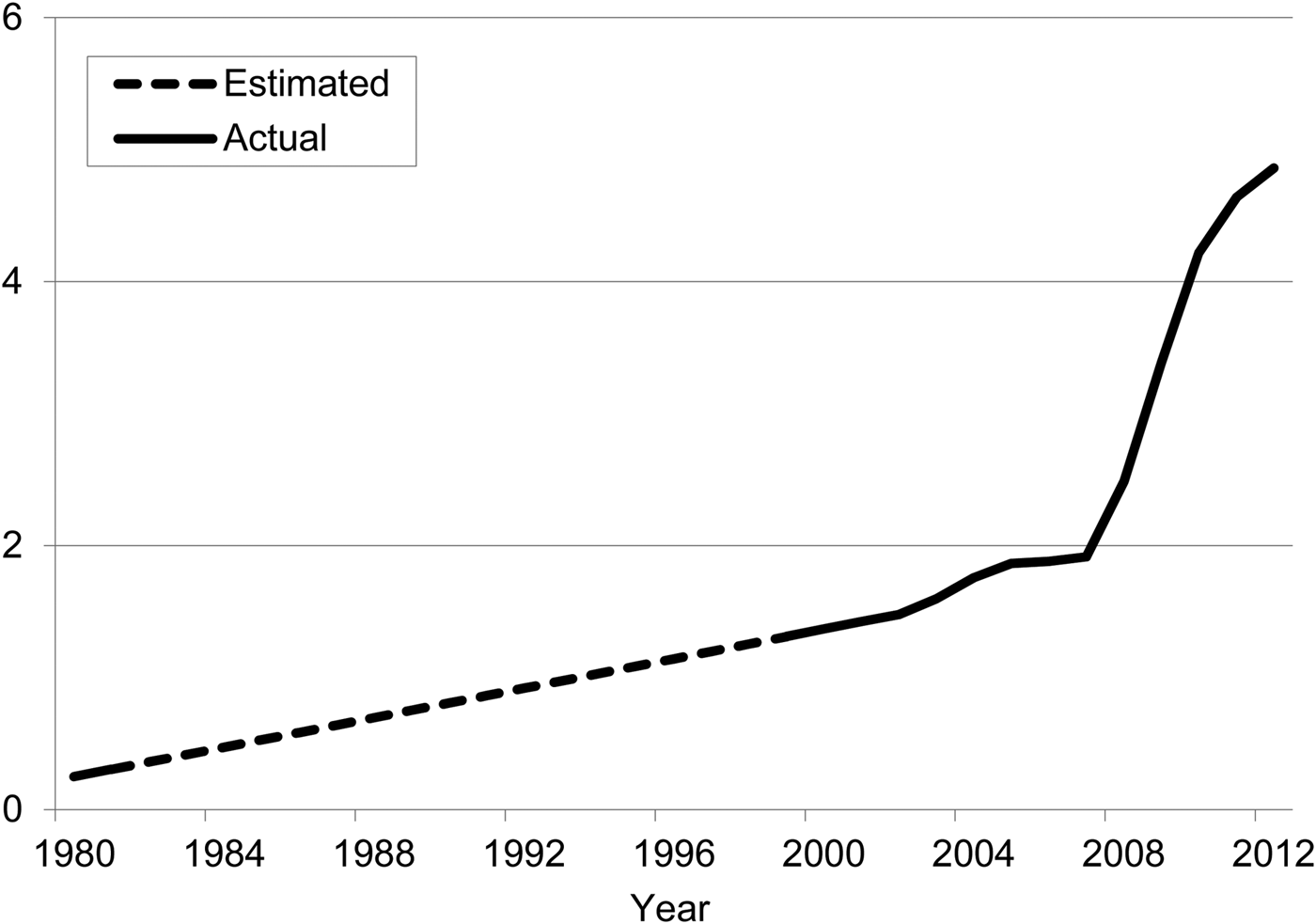
The history of the plan reflects the history of the trucking industry.Footnote 8 In 1980, the plan had one retiree/separated worker for every four active workers; today the ratio has reversed – nearly five retirees/separated workers for each active (see Figure 1). One major reason for this reversal is the increased competition and decreased margins following the deregulation of the trucking industry in the 1980s, which dramatically reduced the number of unionized trucking companies.Footnote 9 The other is the exit of United Parcel Service (UPS) from the plan in 2007.
Ratio of inactive to active participants for central states teamsters, 1980–2012.

Because of the decreasing number of active workers relative to retired/separated participants, benefit payments have exceeded contributions since 1984. During the 1980s and 1990s, investment returns covered this gap, and assets continued to grow. But after the turn of the century, with the bursting of the dot-com bubble, returns turned negative and asset values declined. As a result, the plan started to use principal rather than income to pay benefits, further depleting the asset base. Employers exiting the CST also reduced the plan's revenue base, adding to its funding challenge.Footnote 10
In response to the underfunding, the plan took a number of actions. It froze ‘early out’ benefits and cut the rate of future pension accruals in half. Beginning in 2005, the trustees mandated contribution increases of about 8% per year. In addition, monies allocated for other areas were redirected to the pension fund. These actions increased income and reduced projected liabilities, and in January 2008 the actuaries projected that the plan would be fully funded by 2029.
Then came the collapse of financial markets in 2008, reducing the plan's funded ratio dramatically. Under the PPA of 2006, the CST was certified to be in the ‘critical zone’ and required to adopt a ‘rehabilitation plan.’ The rehabilitation plan raised the early retirement age (to 57) for new retirees and eliminated early retirement benefits for some workers and, on the contribution side, made changes to help retain currently contributing employers.Footnote 11 The plan also included significant increases in the contribution rate through 2027.
Despite these changes and positive investment returns over the last few years, the actuarial funded ratio as of the 2014 valuation was 48.4%; the current ratio was 34.9%.Footnote 12 The plan is projected to become insolvent in the next 10–15 years, the precise date depending on investment and withdrawal experience.Footnote 13 The plan's options are extremely limited.
To avoid insolvency, it would have to earn very high returns each and every year – an unlikely outcome. On the benefit side, additional cuts to future accruals of active workers would merely postpone insolvency, because actives account for only a small portion of the plan's liabilities. Even if the impact on plan solvency were greater, the present value of benefits (PVB) for the average new employee amounts to a paltry .2% annual return on lifetime contributions, leaving little room for further cuts.Footnote 14 On the contribution side, the rate has already doubled and even if it were feasible to maintain an annual 8% increase in contributions, such increases may actually accelerate insolvency by causing employers to withdraw from the plan. Partitioning the plan to transfer the burden of orphaned workers to the PBGC is not currently a viable option. The Create Jobs and Save Benefits Act of 2010 would have broadened the PBGC's authority to partition multiemployer plans. Under the provisions, multiemployer plans facing insolvency would have been able to transfer to a separate plan – backed by the PBGC – both the vested benefits and assets of all orphaned participants, whether through bankruptcy or otherwise. This type of partition would have allowed the CST to avoid insolvency.
Any type of partition legislation would require funding for the PBGC because the agency does not have the resources to take on such an obligation. In fact, the PBGC's own multiemployer insurance fund is projected to be exhausted by 2025 – before the projected insolvency of the CST.Footnote 15
The Create Jobs and Save Benefits Act of 2010 did not pass, and no similar bills have been proposed. In short, the plan does not have any more tools at its disposal.
Central states’ application and the treasury's rejection
On September 25, 2015, the executive director of the CST, Thomas Nyan, submitted an application to the Secretary of the Treasury on behalf of the Board of Trustees for CST requesting approval to reduce benefits under the MPRA. The main purpose of the application was to (1) demonstrate that if no benefit cuts were made, the CST would indeed become insolvent, (2) detail the proposed benefit cuts, and (3) show that the proposed cuts were enough to maintain solvency indefinitely. The application succeeded in all but the third.
On May 6, 2016, the Treasury rejected the CST's application on the grounds that the proposed benefit cuts would not, in fact, maintain insolvency, and that the cuts violated the law's provision for equity across plan members. The Treasury concluded that key assumptions used by actuaries to demonstrate that the proposed cuts would maintain solvency were too long-term in nature and did not appreciate the dependence of the plan's ultimate outcome on CST's near-term investment return and cash flows. Specifically, the investment return assumption as based on a 50-years historical returns and did not take account of more recent relevant economic data that imply returns below historical averages over the next 10 years. And, the assumption regarding the age distribution of new entrants was oversimplified potentially misrepresenting the near-term cash flows.
Quantifying the options for central states
The question for this paper is not whether the plan can truly stave of insolvency through benefit cuts, but whether plan beneficiaries, in the aggregate, would be better or worse off in a world where the CST pays full benefits until going insolvent or in a world where the CST remains solvent but cuts the accrued benefits of all participants. To answer this question requires projecting benefits that will be paid to members of the CST under the current arrangement and under one that reduces accrued benefits for existing workers and retirees. The answer also requires some way to ‘value’ the different arrangements, which means melding the actuarial model of the CST with a welfare analysis.
Modeling CST
Modeling the CST involves projecting annual contributions, benefits, and asset levels. Because these items depend on the number of participants, the first step is to project actives, separators, and retirees in each year. Data used in the modeling exercise primarily come from the plan's January 1, 2014 actuarial report. The report provides the total number of existing participants and the distribution by age and tenure for current active employees. For current separated and retired members, the age distribution is based on the New York State Teamsters plan.Footnote 16 For new employees, the age distribution is assumed to equal that of the current actives with 1 year or less of tenure. We assume that the total number of active participants declines by 1% each year, equivalent to the most recent annual decline in active employment. The annual population of actives, separators, and retirees is projected over time using the plan's age/tenure-specific assumptions for separation, retirement, and mortality.
For contributions, we make the simplifying assumption that the average contribution per active does not change in the future. To project the future contributions in each year, we simply multiply the projected active population in each year by the average annual contribution per active reported in the plan's actuarial valuation.
Future annual benefits paid to existing active workers and new hires are based on their projected tenure at retirement and the plan's benefit formula. For existing separated workers, future benefits are based on their tenure at separation. And for existing retirees, future benefits are equal to the current level of benefit payments reported in the actuarial valuation. This process yields liabilities for existing active workers, separated workers, and retirees that are very close to those reported in the actuarial valuation. To check the accuracy of our model against that of the actuary, we project exhaustion assuming that the plan achieves its actuarially assumed return of 7.5% each year. Under this deterministic approach, we project CST's assets will be exhausted 12 years from the date of the valuation (January 1, 2014), which aligns perfectly with the 2026 exhaustion date reported in the CST's actuarial valuation.
To calculate the smallest reduction in benefits necessary to maintain solvency, benefits are reduced in 1% increments (down to a minimum of 110% of their expected PBGC benefit) until CST is able to remain solvent over a 100-year projection period. Using this method, we find that a 30% benefit reduction, on average, maintains plan solvency. The 30% decrease is very close to the reduction in aggregate benefits paid each year that is reported in the CST application.Footnote 17 However, the average and/or aggregate reductions masks heterogeneity in the cuts. Due to the PBGC limitation, cuts are greater for those with benefits far above the PBGC floor than for those with lower benefits that are closer to the PBGC minimum.
Welfare analysis
Once the benefits pre- and post- cut have been projected for existing actives, separators, and retirees, as well as new hires, the task is to ‘value’ the benefits received. One approach would be to compare the PVB under the status quo with the present value under the proposed reform.Footnote 18 Such a comparison, however, may provide a misleading indication of the effect on the total welfare of plan participants. For welfare, it matters how much people value their benefits. For example, if current retirees have low incomes – and therefore high marginal utilities of consumption – relative to future retirees, then the welfare losses they experience from benefit cuts may exceed the welfare gains of future retirees, and total welfare will decline, even though the total PVB increases. To address this concern, we, therefore, undertake a welfare analysis of the proposed reform.
The welfare analysis assumes that preferences are represented by a conventional constant relative risk aversion utility function with diminishing marginal utility. Specifically, we assume a coefficient of risk aversion of two which lies at the low end of the range reported in the literature.Footnote 19 We assume that the rate of time preference equals 3%.
A few additional assumptions are required to make the welfare calculations. First, we assume that plan members receive Social Security benefits.Footnote 20 Second, if vested members separate from the plan before age 62, they take a second job and retire at age 62, claiming both Social Security and pension benefits at that time.Footnote 21 Third, we disregard consumption funded by any savings that the employees might undertake on their own.Footnote 22
Results
In practice, the success of a 30% benefit cut depends heavily on the investment returns achieved by CST over the projection period. If the plan achieves its assumed return, then solvency is maintained. However, if returns are below 7.5, then the plan may still become insolvent within the projection period. To account for the probability of various investment outcomes, we use a Monte-Carlo simulation to generate a distribution of returns centered on CST's long-term return assumption – 7.5% nominal. The distribution is based on the asset allocation, expected returns, standard deviation included in CST's application.Footnote 23 Selecting the appropriate investment return is not the object of this analysis. Rather, the strategy is to assume that CST's long-term return assumptions and stochastic analysis data are appropriate, simulate the myriad of possible investment experiences based on that information, and then report the probability of various outcomes. However, in light of the Treasury's concern that CST's return assumptions are too optimistic, we also provide results assuming lower average long-term returns.
Likelihood of exhaustion for CST
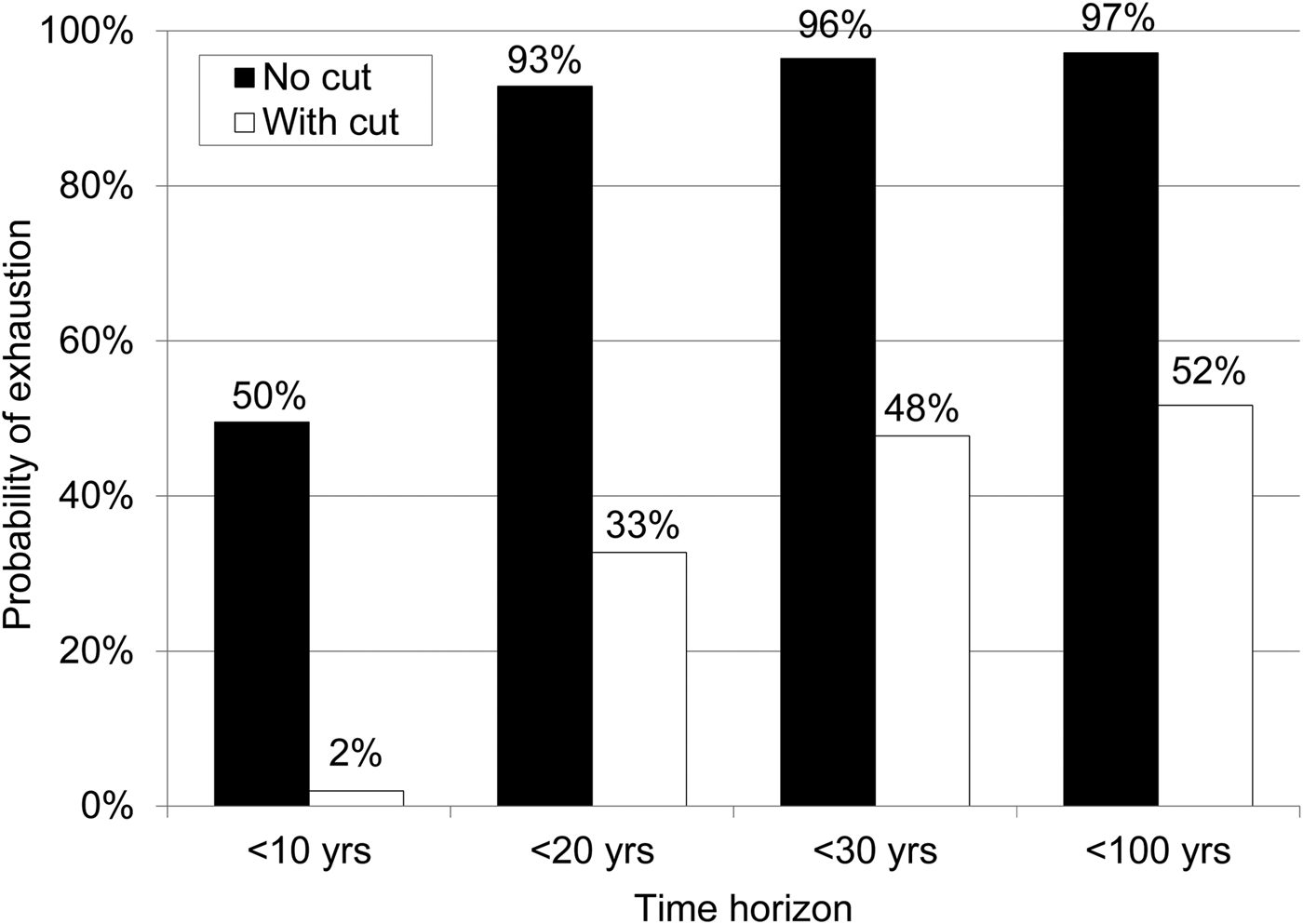
Figure 2 shows the probability of plan exhaustion within various time horizons, with and without the proposed benefit cuts. If no benefit cuts are made, there is nearly a 51% chance that the plan will exhaust its assets in the next 10 years and a 97% chance in the next 30 years. If cuts are made, the chances of the plan exhausting its assets in the next 10 years drop to 6%, and the probability of exhausting assets in the next 30 years is only 52%. Not surprisingly, the probabilities of exhaustion with benefit cuts in this analysis match closely those presented in the stochastic analysis in CST's application.
The probability of exhaustion with and without benefit cuts.

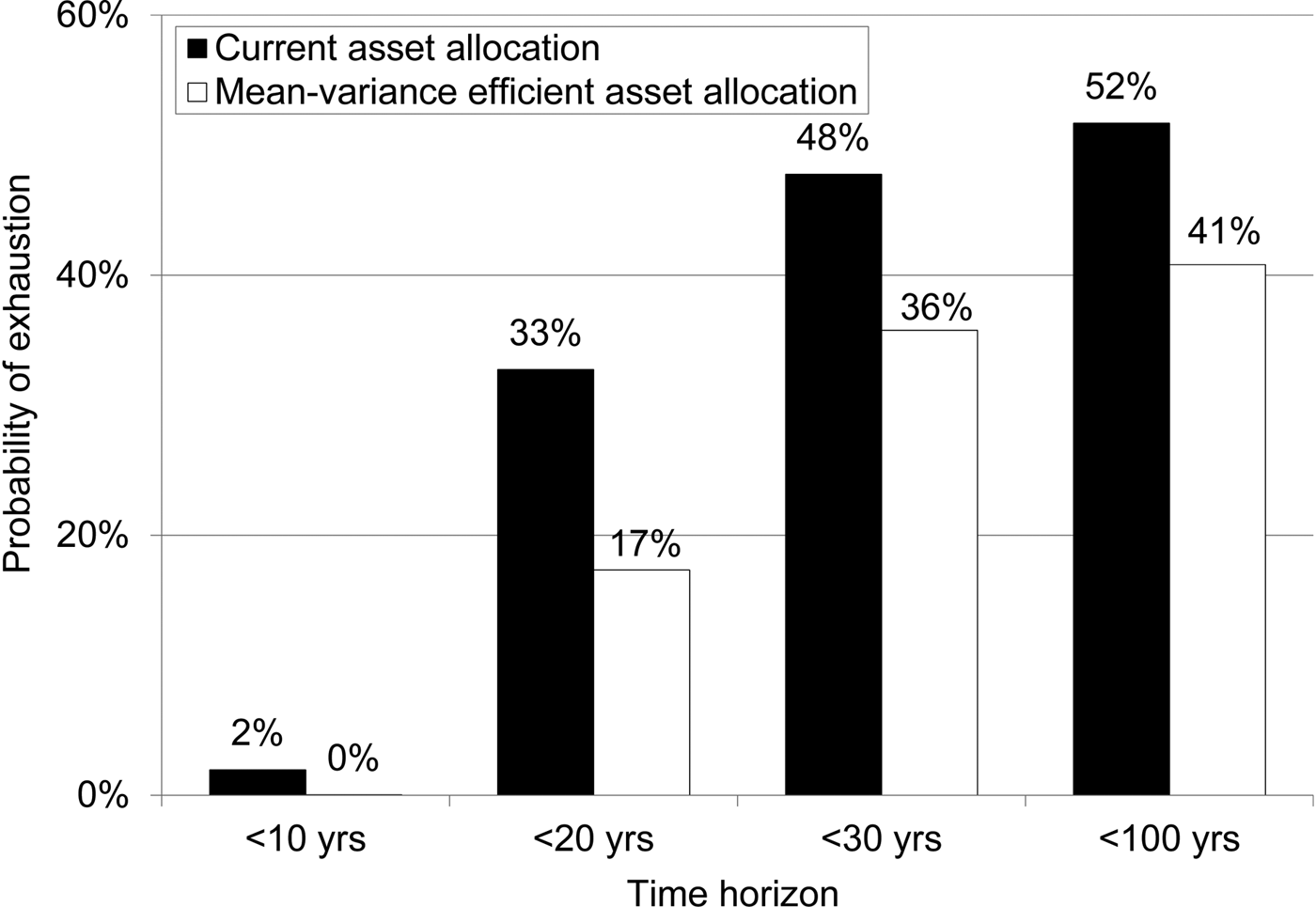
Figure 3 shows the probability of exhaustion after benefit cuts if the plan reallocated its assets to the mean-variance efficient portfolio for a 7.5% mean return.Footnote 24 The probability of exhaustion drops for all time periods when compared with the plan's existing asset allocation. This illustrates the impact of investment risk on the probability of exhaustion—with the same mean return of 7.5%, a drop in the variance (lower investment risk) reduces the likelihood of exhaustion.
The probability of exhaustion with benefit cuts, under the current and mean-variance efficient asset allocation.

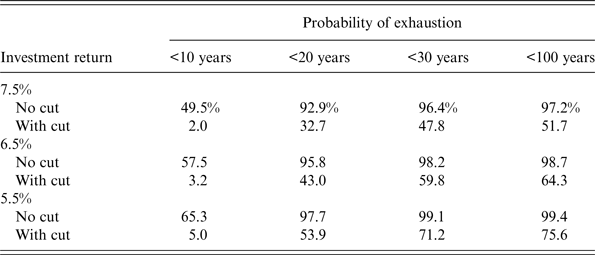
Finally, to address the Treasury's concern regarding CST's assumed rate of return, Table 1 shows the probability of exhaustion assuming a 7.5%, 6.5%, and 5.5% long-term return, on average. With cuts, the probability of long-term solvency – beyond 30 or 100 years – drops by about 10 percentage points for each percentage point drop in the assumed return. Regardless of which investment return assumption is most appropriate, one thing is clear. Using a deterministic approach provides an incomplete assessment of future insolvency. Even under CST's own assumptions, the proposed benefits cuts have just under a 50% chance to maintain solvency indefinitely.
Probability of exhaustion with and without benefit cuts under various return assumptions

Source: Authors’ calculations.
The impact of benefit cuts on various populations of plan members
We measure the impact of benefit cuts in two ways. First, we measure the dollar impact by simply comparing the PVB received by plan members before and after the cuts (assuming the plan remains solvent after cuts). Second, we measure the overall welfare impact of the cuts by ‘valuing’ the change in benefit payouts for each population.
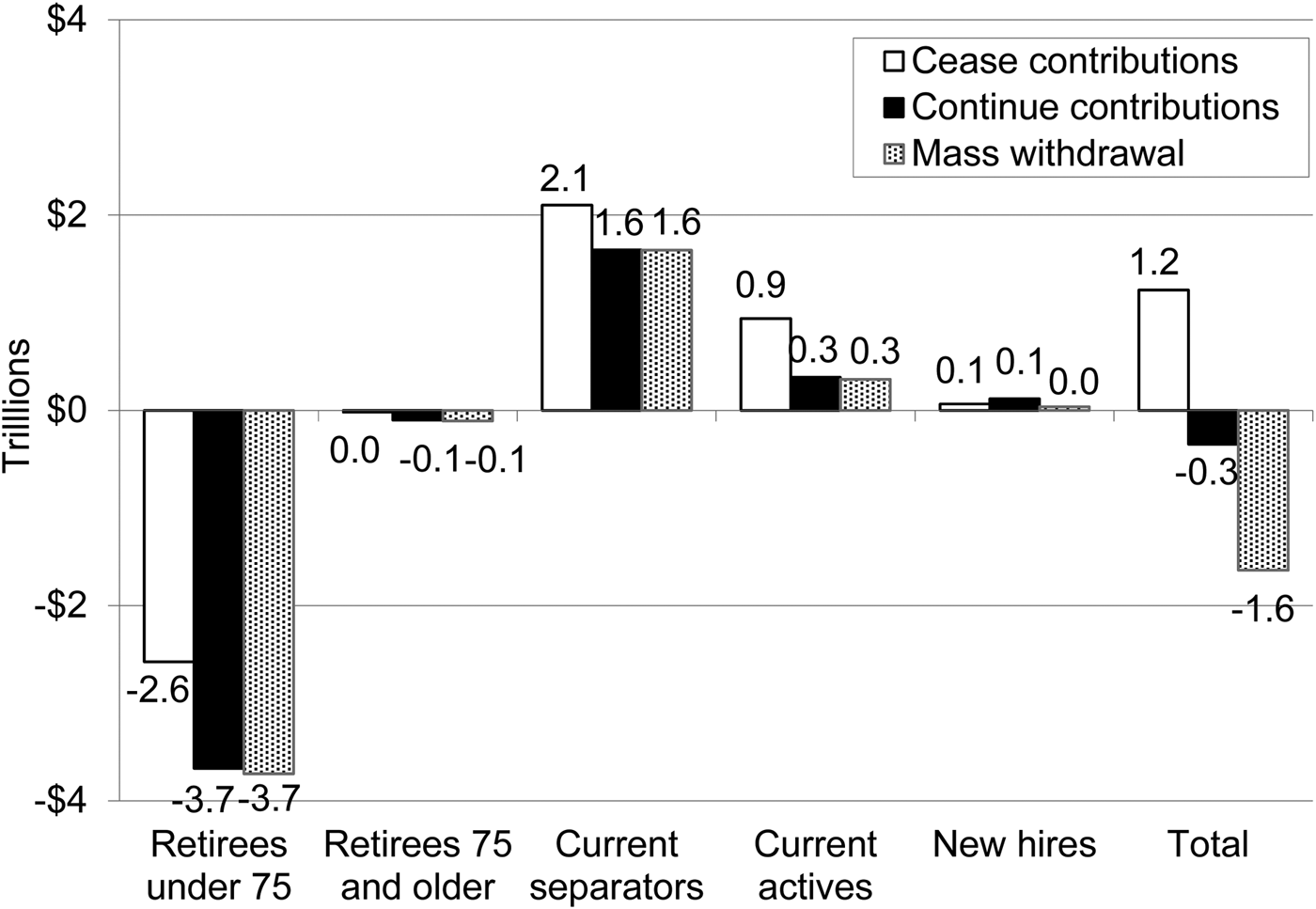
Figure 4 shows the impact of the benefit cut on the PVB for five specific groups at various levels of return: (1) current retirees age 75 and older; (2) current retirees under 75; (3) current separators; (4) current actives; and (5) new hires.Footnote 25 To reflect the fact that the plan invests in risky assets, we discount future benefits at the 7.5% expected a return on those assets.
Median impact of benefit cuts on the present value of benefits under alternative insolvency scenarios, by participant group.

The impact of cuts depends critically on assumptions about plan finances after insolvency. We model the impact under three post-insolvency scenarios. The first scenario assumes that, upon insolvency, the plan closes completely – employers make no further contributions and the plan provides no further benefits to participants. The second scenario assumes that the plan remains open, annual employer contributions continue at historical levels, and that the contributions are immediately distributed to retirees as benefits. In the event that contributions cannot cover promised benefits in a given year, the contributions are apportioned to each retiree based on their proportion of the year's total promised benefits. The third scenario assumes that a mass withdrawal occurs upon insolvency, resulting in all employers leaving the plan. In this scenario, the plan closes to new employees and freezes benefit accruals for all existing participants. To meet the existing liability, employers continue to contribute at historical levels in the form of withdrawal liability payments.Footnote 26 For this scenario, the employers’ annual withdrawal payments are the lesser of the employers’ historical annual contributions or the amount needed to pay benefits owed in that year. In all scenarios, we assume that the PBGC multiemployer insurance fund is exhausted, and participants receive no benefits from the PBGC insurance program.
For all three scenarios, the reforms redistribute benefits similarly across the different participant groups – the expected present value of (mostly younger) retirees’ benefits declines substantially, while the present values of the lifetime benefits payable to current participants and new hires all increase. However, the impact of the reform on the total PVB of the system differs from each scenario. In the first scenario, in which employer contributions cease upon insolvency, the additional years of solvency from the reform bring more money into the system (a net gain in total PVB) and mitigate the losses for retirees. In the second scenario in which employers continue making contributions after insolvency, the additional years of solvency from the reform do not dramatically change the total funds entering the system so the expected PVB compared with the base case remains basically the same. In the mass withdrawal scenario, enacting cuts reduces the overall PVB for plan participants.Footnote 27
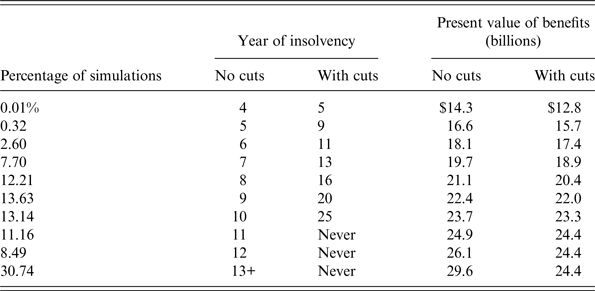
Because the results of the mass withdrawal are a less intuitive, it helps to look more closely at the Monte Carlo simulations for that scenario. Table 2 organizes the results of the simulations according to the year of plan insolvency if no cuts are made. For example, the first row of the table contains the median results for all simulations that resulted in insolvency in the fourth year if no cuts are made. There are two key takeaways from this table. First, in most of the simulations, the benefit cuts do not extend the life of the plan sufficiently to make up for the fact that annual payments are reduced in the early years. Second, if the plan can remain solvent for 11 years or more without cuts (which occurs almost 50% of the time), the total PVB will always be greater than the PVB with cuts, regardless of how long cuts extend the life of the plan. In short, the Monte Carlo analysis clearly shows that it is better – in terms of the total PVB of plan participants – for the plan to continue paying full benefits instead of instituting cuts if insolvency leads to a mass withdrawal.
Summary results of Monte Carlo simulations for the mass withdrawal scenario

Source: Authors’ calculations.
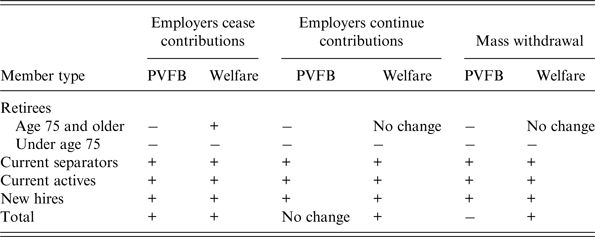
Applying a welfare analysis alters the picture a bit. While older retirees see their benefits decline slightly in net present value terms, their welfare under the new law – in the aggregate – is positive or essentially unchanged (see Table 3). The reason is that older retirees receive smaller but steady benefits, which allows them to better smooth consumption over their lifetimes.
Impact of benefit cuts under various insolvency scenarios

Source: Authors’ calculations.
To get a sense of whether the increase in aggregate welfare is economically meaningful or not, it can be expressed in terms of a lump-sum payment to all participants. The approach is to essentially reduce the benefits of those who enjoy an increase in expected utility under the reform until the total level of expected utility for the population as a whole equals that of the status quo. The present value of these benefits foregone is then distributed among all the participants as a lump sum.Footnote 28 It turns out that the overall welfare gain is equivalent to each participant receiving about $2,040. The magnitude of this ‘extra money’ suggests that the gain in welfare from keeping the plan solvent is significant.
While the results of our CST analysis may be reassuring to proponents of the law, several caveats should be kept in mind. First, although the CST does maintain solvency if it realizes its assumed return, it would be operating with a funded ratio below 50% on average.Footnote 29 Second, the assumed return is 7.5% on average, much higher than the 4% and 5% returns projected by many investment firms such as Bridgewater, Goldman Sachs, and GMO.Footnote 30 Under the plan's own assumptions, there is only a 50% chance of achieving the assumed return. Third, the analysis was applied to only one plan; the effects of the law on other plans may show different patterns.
Conclusion
The MPRA is an effort to save a small, but significant, number of multiemployer plans from insolvency. It was crafted under the assumption that the federal government is not going to rescue the plans directly or provide the PBGC with the funds to partition out orphaned workers or help in other ways. Based on that assumption, the law tries to balance competing interests: maintaining the support of active workers; keeping employers from exiting the plans (and attracting new employers), and ensuring that benefits exceed what participants would get under insolvency.
Our analysis suggests that using widely accepted preference parameters, overall welfare would be higher if the plan remained solvent and provided reduced benefits compared with letting the plan pay full benefits until becoming insolvent – triggering a mass withdrawal. However, a stochastic analysis of returns highlights the sensitivity of sustained solvency to investment performance. The CST, under its own return assumptions, has only about a 50% chance to remain solvent with its proposed cuts. If CST is any indication, benefit cuts alone are not sufficient to secure the solvency of the most troubled multiemployer plans; other approaches may be needed. At the very least, the passage of MPRA has awakened the public to the challenges facing the worst-off multiemployer plans and the tough choices that lay ahead.