Introduction
When an adult parasite parasitizing a definitive host is ingested by a predator, it may survive and parasitize the predator. This phenomenon is called post-cyclic transmission (Nickol, Reference Nickol, Crompton and Nickol1985). A post-cyclic host is a host which accepts fully mature parasites and becomes their new host. It differs from a definitive host, which enables the development of heteroxenous helminth from a certain stage up to attaining its full maturity (Moravec, Reference Moravec1994). This type of transmission could increase the infection opportunity of parasites to various hosts and realize a wide host range as well as a broad distribution area. Post-cyclic parasitism has been experimentally demonstrated only for some acanthocephalans (e.g. Kennedy, Reference Kennedy1999; Rauque et al., Reference Rauque, Semenas and Viozzi2002) and for a cestode, Schyzocotyle acheilognathi (Yamaguti, 1934) (Hansen et al., Reference Hansen, Choudhury and Cole2007). This kind of transmission has also been suggested for some spirurine nematodes that parasitize fish (Moravec, Reference Moravec1994) and occasionally presumed in Digenea (e.g. Platt, Reference Platt2006; Sokolov et al., Reference Sokolov, Gordeev and Lebedeva2016; Akhmetov and Maralbayeva, Reference Akhmetov and Maralbayeva2020). Regarding hemiuroids, the possibility of post-cyclic parasitism has been proposed for Derogenes varicus (Müller, 1784) and for the genera Hemiurus, Lecithochirium and Lecithocladium (Køie, Reference Køie1979; Gibson and Bray, Reference Gibson and Bray1986; Gordeev and Sokolov, Reference Gordeev and Sokolov2020). These suggestions were based mainly on the host records; however, no studies have proved post-cyclic transmission experimentally for digeneans.
Derogenes lacustris Tsuchida, Flores, Viozzi, Rauque et Urabe, 2021 (Digenea: Hemiuroidea: Derogenidae) parasitizes the stomach of freshwater fishes in northwestern Patagonia. This species is widely distributed throughout the Limay River basin and shows a wide definitive host range including multiple fish orders and trophic levels (Tsuchida et al., Reference Tsuchida, Flores, Viozzi, Rauque and Urabe2021a). The following native fishes have been reported as definitive hosts: Galaxias maculatus (Jenyns, 1842), Galaxias platei Steindachner, 1898 (Galaxiidae), Olivaichthys viedmensis (MacDonagh, 1931) (Diplomystidae) and Percichthys trucha (Valenciennes, 1833) (Percichthyidae) (Shimazu et al., Reference Shimazu, Urawa and Coria2000; Tsuchida et al., Reference Tsuchida, Flores, Viozzi, Rauque and Urabe2021a). The following introduced fishes have also been reported as definitive hosts: Oncorhynchus mykiss (Walbaum, 1792), Salmo salar Linnaeus, 1758, Salmo trutta Linnaeus, 1758, and Salvelinus fontinalis (Mitchill, 1814) (Salmonidae) (Shimazu et al., Reference Shimazu, Urawa and Coria2000; Rauque et al., Reference Rauque, Viozzi, Flores, Vega, Waicheim and Salgado-Maldonado2018; Tsuchida et al., Reference Tsuchida, Flores, Viozzi, Rauque and Urabe2021a). Salmonids were introduced from the USA into Patagonian freshwater environments as embryonated eggs at the beginning of the 20th century (Tulián, Reference Tulián1908). They have now established self-sustaining populations and feed heavily on native galaxiids in Patagonia (Pascual et al., Reference Pascual, Macchi, Urbanski, Marcos, Rossi, Novara and Dell'Arciprete2002). It has been suggested that the widespread distribution of G. maculatus in Patagonian lakes may have facilitated the success of salmonid introduction (Macchi et al., Reference Macchi, Pascual and Vigliano2007). Derogenes lacustris is common in both prey and predatory fishes, and its wide distribution and range of host species are similar to those of the acanthocephalan Acanthocephalus tumescens (Linstow, 1896). Acanthocephalus tumescens is widely distributed throughout Andean lakes and parasitizes various species of native and introduced fishes in northwestern Patagonia (e.g. Ortubay et al., Reference Ortubay, Semenas, Úbeda, Quaggiotto and Viozzi1994; Semenas and Trejo, Reference Semenas and Trejo1997; Viozzi et al., Reference Viozzi, Semenas, Brugni and Flores2009; Rauque et al., Reference Rauque, Viozzi, Flores, Vega, Waicheim and Salgado-Maldonado2018); post-cyclic transmission from G. maculatus to O. mykiss has been proved through experimental infection (Rauque et al., Reference Rauque, Semenas and Viozzi2002).
It enables us to infer that D. lacustris is transmitted from G. maculatus to salmonids through predation. Here, the post-cyclic transmission hypothesis is evaluated through experimental infection with D. lacustris from G. maculatus to cultured rainbow trout, O. mykiss.
Materials and methods
Experimental infection
In December 2018 a total of 682 G. maculatus specimens were collected by traps and a seine net from Lake Gutiérrez, Río Negro Province, Argentina (41°10′S, 71°24′W). The infection values for D. lacustris in this sampling were 15.2% prevalence and 1.4 mean intensity. The fish were examined by standard methods (Hoffman, Reference Hoffman1999) and a total of 146 D. lacustris were collected for experimental infection. A total of 15 parasite-free, cultured O. mykiss (26–28 cm in total length) from the National University of Comahue fish farm, were used as post-cyclic hosts. To determine the initial condition (day 0) of the flukes (measurements of body size and organs and the number of eggs), a total of 11 D. lacustris were used, recovered from the stomachs of different specimens of G. maculatus captured at the same site and on the same date.
Each rainbow trout was anaesthetized with benzocaine solution and forced to eat a jelly capsule containing 8–10 flukes; following this they were monitored for vomiting. These fish were fed regularly on pellets and examined at 3, 4, 5 and 14 days post-infection (dpi) to collect the flukes from the stomachs (Table 1).
Summary of experimental infection of Oncorhynchus mykiss with Derogenes lacustris (dpi, days post-infection)

Flukes recovered from G. maculatus (day 0) and O. mykiss (3, 4, 5 and 14 dpi) were counted, fixed in hot 5% formalin solution, stained with carmine and mounted in Canada balsam. The body and organs of flukes were measured under a microscope to evaluate their growth, and eggs in the uterus were counted. The transmission rate was calculated as follows: the number of recovered flukes/the number of supplied flukes.
Statistical analysis
The relationships between fluke body length or organ size (Table 2) and dpi were analysed using ANOVA with Dunnett's test for multiple comparisons. The relationships between the number of eggs in flukes and (a) dpi, (b) fluke body length and (c) dpi and fluke body length, were determined using a generalized linear model (GLM) with a log link function following the Poisson distribution as an error distribution. The best-fitting model was selected using Akaike's information criterion (AIC) (Bozdogan, Reference Bozdogan1987). All statistical analyses were performed using R ver 3.5.0 (R Core Team, 2018), and the significance level was 95%.
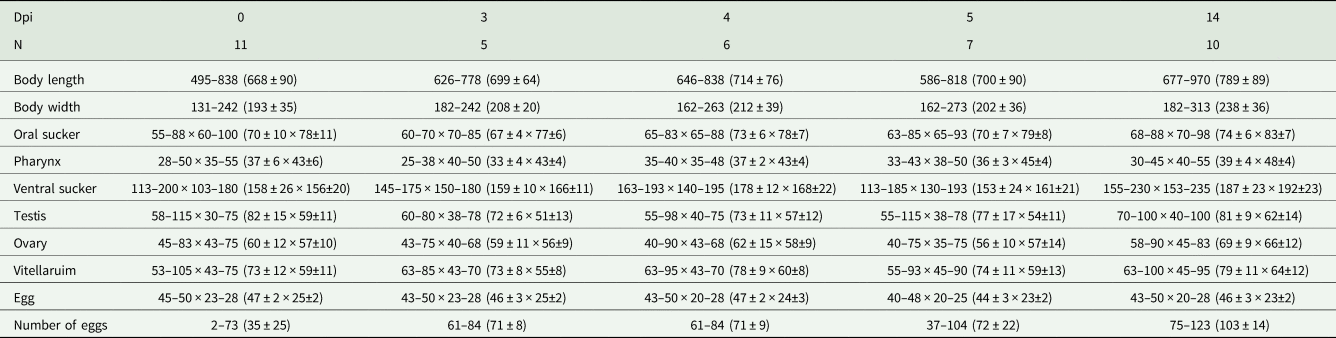
Measurement values of Derogenes lacustris recovered from Galaxias maculatus (0 dpi) and Oncorhynchus mykiss (3–14 dpi) (Min–Max)

Values in micrometres range followed by mean ± standard deviation between parentheses.
Results
Fourteen of the 15 rainbow trout specimens were infected with at least one D. lacustris fluke, and a total of 28 D. lacustris flukes were recovered from the stomachs of the trout (Table 1). Across the experiment, the overall prevalence in the trout was 93.3%, the overall mean intensity was 2.0, and the transmission rate was 19.2%.
The measurements of D. lacustris recovered from G. maculatus (0 dpi) and O. mykiss (3–14 dpi) are shown in Table 2. Dunnett's test showed that the mean body length of D. lacustris was significantly greater at 14 dpi than at 0 dpi (P = 0.0158, Fig. 1). The mean size of the ventral sucker was also significantly larger at 14 dpi than at 0 dpi (P = 0.0213). Mean egg length was significantly smaller at 5 dpi than at 0 dpi (P = 0.0153). No significant associations were found between other organ sizes and dpi.
Relationship between body length and days post-infection (dpi). The different letters (a or b) indicate the significance (P < 0.05) of Dunnett's test.

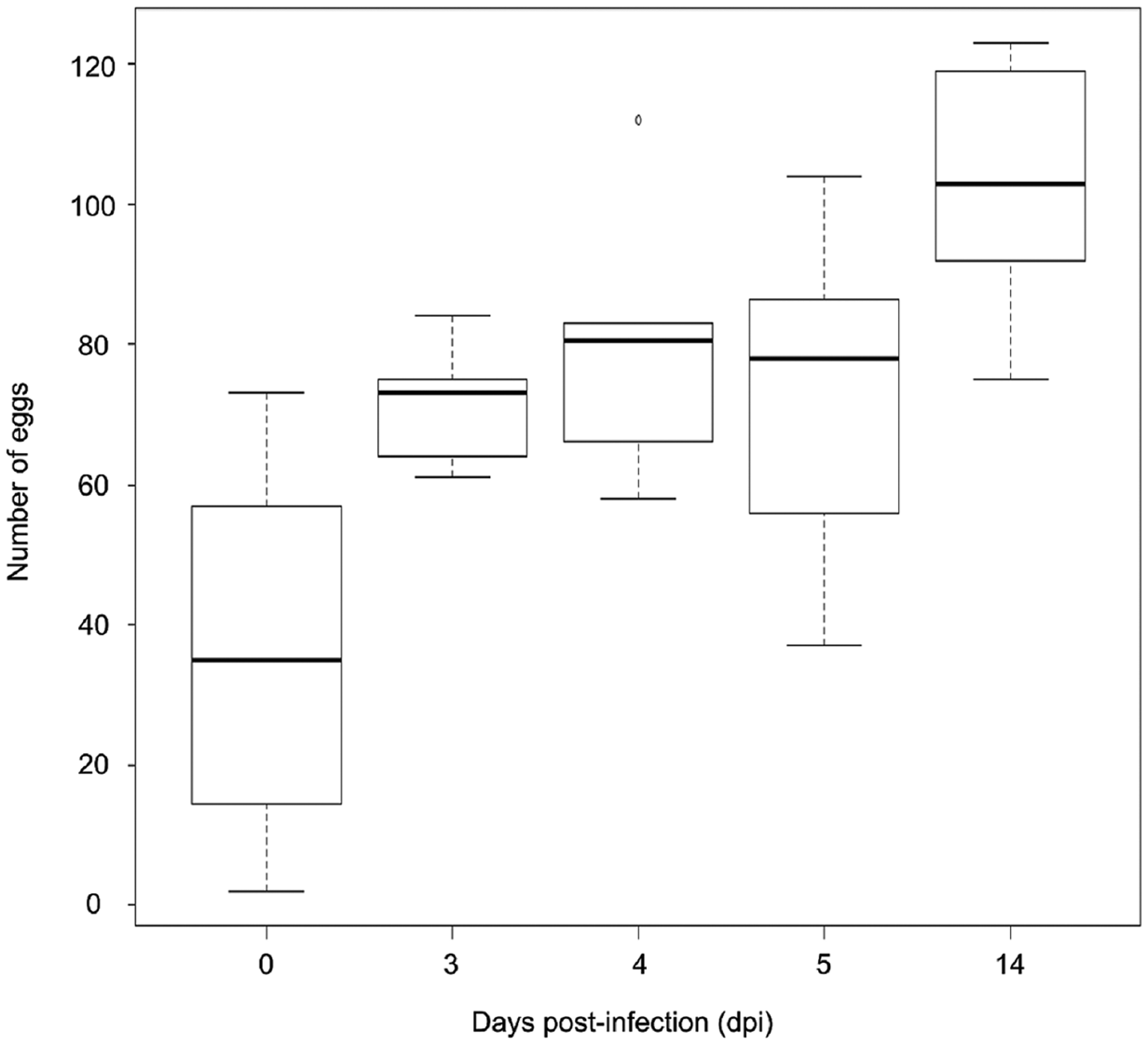
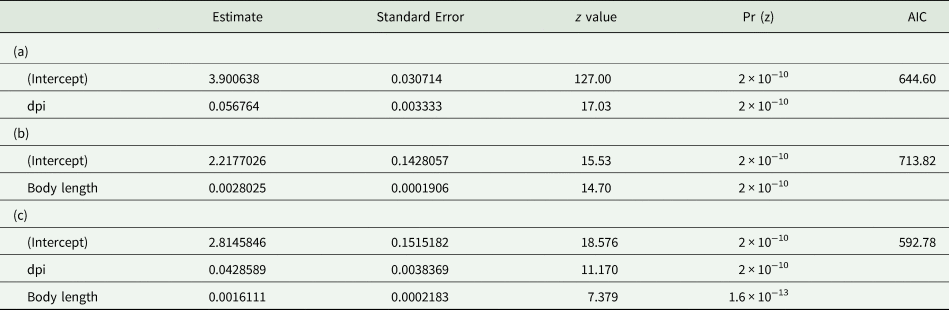
The number of eggs in flukes showed a positive correlation with the dependent variables in all GLM models (Table 3; Fig 2); model (c) was selected as the best-fitting model based on the value of AIC.
Relationship between the number of eggs and days post-infection (dpi).

Result of the GLM for the number of eggs in flukes and (a) days post-infection (dpi), (b) fluke body length, (c) dpi and fluke body length

Discussion
The present study demonstrates that D. lacustris adults can be successfully transmitted from G. maculatus to O. mykiss. After transmission, D. lacustris survives, parasitizes the stomach (normal infection site), increases in body size and produces eggs for at least 2 weeks within O. mykiss. The model selected showed that the number of eggs in D. lacustris was affected by both dpi and fluke body size. The positive correlation between the number of eggs and dpi can be explained by continuous egg production in D. lacustris within the predator. The positive correlation between the number of eggs and body size indicated that the more D. lacustris grew, the more eggs were produced. Furthermore, body size was significantly larger after transmission than that before transmission. Thus, survival within O. mykiss would enable D. lacustris to attain a larger body size and greater reproductive output. These results strongly support the hypothesis that post-cyclic transmission of D. lacustris occurs between G. maculatus and introduced salmonids through predation in Patagonia. This study is the first experimental demonstration of post-cyclic transmission for trematodes.
The life cycle of D. lacustris is unknown. In general, hemiuroids use arthropods, mainly small crustaceans, as second intermediate hosts (e.g. Madhavi, Reference Madhavi1978; Køie, Reference Køie1995; Urabe, Reference Urabe2001; Shimazu et al., Reference Shimazu, Cribb, Miller, Urabe, Ha, Binh and Shed'ko2014). In Lake Gutiérrez, G. maculatus is a dominant planktivorous fish feeding on copepods and cladocerans (Barriga et al., Reference Barriga, Battini, Gracía-Asorey, Carrea, Macchi and Cussac2012). Salmonids heavily consume galaxiids in Patagonia in the adult stage, but they possibly feed on zooplankton in the larval period (Juncos et al., Reference Juncos, Beauchamp and Vigliano2013). Therefore, salmonids could be infected with D. lacustris through both second intermediate hosts and galaxiids, which means that D. lacustris has an additional route to parasitize salmonids by post-cyclic transmission. In nature, the predatory hosts of some helminth were often infected intensely than prey hosts (Moravec, Reference Moravec1994; Kennedy, Reference Kennedy1999). It is also true of D. lacustris; O. mykiss had a higher prevalence and mean intensity than G. maculatus during spring in Lake Gutiérrez (Tsuchida et al., Reference Tsuchida, Flores, Viozzi, Rauque and Urabe2021a). The mean body size of this parasite was also greater in the former than in the latter. Thus, the post-cyclic transmission would potentially provide some positive outcomes for this parasite.
Post-cyclic transmission can help explain both the wide distribution and range of definitive hosts of D. lacustris in northwestern Patagonia. This species has a wider distribution and range of definitive hosts than the other Patagonian derogenids, Thometrema patagonica (Szidat, 1954) and Genarchella pichileufuensis Tsuchida, Urabe, Viozzi, Rauque et Flores, 2021 (Tsuchida et al., Reference Tsuchida, Flores, Viozzi, Rauque and Urabe2021a, Reference Tsuchida, Urabe, Viozzi, Rauque and Flores2021b). Thometrema patagonica has never been reported from salmonids (Lunaschi and Drago, Reference Lunaschi and Drago2000; Tsuchida et al., Reference Tsuchida, Flores, Viozzi, Rauque and Urabe2021a), and G. pichileufuensis has been reported from some salmonids, but they are considered to be an unsuitable host since only immature flukes were found from them (Tsuchida et al., Reference Tsuchida, Urabe, Viozzi, Rauque and Flores2021b). Transmission of this kind contributes to increasing the number of potential definitive hosts of D. lacustris by adding carnivorous fishes through predation on prey fishes. This extended host availability may enable D. lacustris to increase its dispersion ability through the migrations of piscivorous fishes like salmonids.
Post-cyclic transmission is an upward incorporation process, whereby a life history is lengthened by adding a new host at a higher trophic level (Parker et al., Reference Parker, Chubb, Ball and Roberts2003). This evolutionary mechanism leads to a more complex life cycle and higher fecundity for parasites as they attain greater growth and maturity in these hosts (Parker et al., Reference Parker, Ball and Chubb2015). It is possible that following their introduction in Patagonia, introduced salmonids became a valid host for D. lacustris, thus giving rise to more complex life history and higher fecundity in this parasite. The beneficial role of salmonids as post-cyclic hosts has also been observed in the transmission rate of A. tumescens from G. maculatus to O. mykiss (21.8%), which was higher than the rate to native carnivorous fishes like P. trucha (0.9%) and G. platei (2.5%) (Paterson et al., Reference Paterson, Rauque, Fernandez, Townsend, Poulin and Tompkins2013). Salmonids, especially O. mykiss, are also greater predators of galaxiids than P. trucha in Andean Patagonia (Juncos et al., Reference Juncos, Beauchamp and Vigliano2013). In this regard, Rauque et al. (Reference Rauque, Viozzi, Flores, Vega, Waicheim and Salgado-Maldonado2018) suggested that exotic salmonids stand out as hosts which are highly susceptible to infection by the parasites of Patagonian native fish; this leads to an increase in native parasite populations, as observed for A. tumescens (Rauque et al., Reference Rauque, Viozzi and Semenas2003). The rate of experimental transmission of D. lacustris (19.2%) was lower than that registered for A. tumescens transmitted between G. maculatus and O. mykiss in Patagonia (37% in Rauque et al., Reference Rauque, Semenas and Viozzi2002; 21.8% in Paterson et al., Reference Paterson, Rauque, Fernandez, Townsend, Poulin and Tompkins2013).
This study provides the first experimental evidence of post-cyclic transmission in trematodes. The results suggest that post-cyclic parasitism is important for this hemiuroid species as it signifies an increase in suitable hosts and distribution ranges in Argentinean Patagonia. Future studies on native piscivorous fishes as post-cyclic hosts are required for the evaluation of the significance of this transmission in nature.
Acknowledgements
We acknowledge Centro de Salmonicultura de la Universidad Nacional del Comahue for facilitating the care and feeding of the experimental fish. Samples were taken with the permission of the National Park authorities (Permission No. 935). We thank Dr K. Yoshiyama, the University of Shiga Prefecture, for his advice on statistic analysis.
Author contributions
C Rauque, G Viozzi, K Tsuchida and V Flores conducted sampling and experimental infection. All authors wrote the article.
Financial support
This study was funded by CONICET PIP 11220200100203 and a grant from Universidad Nacional del Comahue (B-225).
Conflict of interest
The authors declare there are no conflicts of interest.
Ethical standards
The authors assert that all procedures contributing to this work comply with the ethical standards of the relevant national and institutional guides on the care and use of laboratory animals.