Self-regulation is a core concept within a temperament systems framework and involves the cognitive, physiological, and behavioral processes by which individuals maintain and regulate emotion and motivation in the service of situational adaption (McClelland, Geldhof, Cameron, & Wanless, Reference McClelland, Geldhof, Cameron, Wanless, Overton and Molenaar2015). Children with greater self-regulation skills are able to activate or inhibit emotions, behaviors, or cognitions when required to achieve a goal as well as modulate these processes upon goal achievement (Eisenberg, Hofer, Sulik, & Spinrad, Reference Eisenberg, Hofer, Sulik, Spinrad and Gross2013). Research over the last 20 to 30 years has suggested that the development of self-regulation is a critical task of early childhood, as studies have shown the role of competent self-regulation in supporting psychological adjustment across multiple domains (Eisenberg, Spinrad, & Eggum, Reference Eisenberg, Spinrad and Eggum2010; Propper & Moore, Reference Propper and Moore2006; Sroufe, 1996; Thompson, Reference Thompson1994). Despite having a well-documented basis in heredity, conceptualizations of self-regulation from an ecological approach suggest that the environment plays a critical role in shaping individual differences in self-regulation (Olson & Lunkenheimer, Reference Olson, Lunkenheimer and Sameroff2009; Lengua, Honorado, & Bush, Reference Lengua, Honorado and Bush2007; Lengua et al., Reference Lengua, Kiff, Moran, Zalewski, Thompson, Cortes and Ruberry2014). One of the most prominent environmental factors that influences self-regulation is parenting (e.g., Eisenberg, Zhou, Spinrad, Valiente, Fabes, & Liew, Reference Eisenberg, Zhou, Spinrad, Valiente, Fabes and Liew2005; Spinrad et al., Reference Spinrad, Eisenberg, Gaertner, Popp, Smith, Kupfer and Hofer2007; Taylor, Eisenberg, & Spinrad, Reference Taylor, Eisenberg and Spinrad2015). Towards this, the present study examined how children's experiences with caregiving during the first two years of life may forecast self-regulation through early childhood. In particular, we focus on children's effortful control at 3.5 years of age and their regulation of negative emotions during the transition to school at the age of 5. Furthermore, consistent with differential susceptibility conceptualizations (e.g., Belsky, Reference Belsky, Ellis and Bjorklund2005; Boyce & Ellis, Reference Boyce and Ellis2005; Ellis, Boyce, Belsky, Bakermans-Kranenburg, & Van IJzendoorn, Reference Ellis, Boyce, Belsky, Bakermans-Kranenburg and van IJzendoorn2011), we tested whether children's vagal tone operated as a differential susceptibility factor with respect to the early caregiving environment and regulatory capacities over time.
Domains of Self-Regulation: Effortful Control and Emotion Regulation
Self-regulation is a broad construct, encompassing smaller regulatory systems across multiple domains of functioning. Two of these domains that have received considerable attention in the literature are effortful control and emotion regulation. Effortful control encompasses a constellation of abilities such as attention focusing/shifting, error detection, and the ability to voluntarily inhibit and initiate behavior (Eisenberg et al., Reference Eisenberg, Hofer, Sulik, Spinrad and Gross2013; Eisenberg et al., Reference Eisenberg, Spinrad and Eggum2010; Lengua, Reference Lengua, Maholmes and King2012). Because these skills enable the control of attention and behavior, effortful control allows children to flexibly adapt to situational demands by applying the appropriate amount of control, thus promoting optimal adjustment (Eisenberg et al., Reference Eisenberg, Hofer, Sulik, Spinrad and Gross2013). Developmental growth in the behavioral and cognitive skills involved in effortful control is apparent across infancy and early childhood, with rapid development around 30 to 42 months of age (Posner & Rothbart, Reference Posner and Rothbart2000).
Whereas effortful control is conceptualized as an important component for the regulation of behavior and attention, emotional regulation entails control over emotional arousal. Specifically, prevailing definitions of emotion regulation describe it as the ability to monitor, maintain, and modulate emotional arousal in the service of one's goals (Calkins, Reference Calkins1994; Thompson, Reference Thompson1994). Previous research has demonstrated that substantial changes occur in emotion regulation abilities over the course of development as children's general capacity for self-regulation is emerging (Calkins & Johnson, Reference Calkins and Johnson1998; Kopp, Reference Kopp1989). One period of particular developmental significance for emotion regulation is the transition to school in early childhood (Rim-Kaufman & Pianta, Reference Rimm-Kaufman and Pianta2000). During this time period, children progress from spending most of their time within the home environment to a new assortment of environments/situations involving schooling, peers, and teachers, each of which impose different demands on the child. Specifically, within a school environment, children are expected to meet academic and socialization goals, such as literacy, mathematical fluency, and following rules (Graziano et al., Reference Graziano, Reavis, Keane and Calkins2007). Also around this age, children experience a rise in the number and diversity of peer relationships, so they must manage their emotional arousal in the face of expanding and increasingly challenging social relationships with others from different, possibly conflicting, backgrounds and perspectives (Rubin, Bukowski, Parker, & Bowker, Reference Rubin, Bukowski, Parker, Bowker, Damon and Lerner2008).
It is proposed that emotion regulation skills are critical for children to successfully navigate this transition, particularly their management of negative emotion. Because the challenges surrounding the transition to new environments can often be frustrating or anxiety-provoking, children must learn how to deal with negative emotions as they arise so as not to interrupt their progress towards stage-salient academic and social goals. Moreover, research suggests that children who are not able to manage their negative emotions are more likely to be rejected by their peers (Kuperschmidt & Coie, Reference Kupersmidt and Coie1990; Shields & Cicchetti, Reference Shields and Cicchetti2001; Shields, Ryan, & Cicchetti, Reference Shields, Ryan and Cicchetti2001), their teachers are more likely to avoid them and are less likely to provide them with praise (Shores & Wehby, Reference Shores and Wehby1999). The concept of negative emotion regulation is broad and recent calls have highlighted the importance of examining the regulation of specific emotions (Cole, Reference Cole2014). Given this, the present study examines how early caregiving and children's effortful control are associated with two distinct negative emotions, anger and sadness regulation.
In particular, functionalist perspectives on emotion suggest distinct emotions, each with an adaptive function (Campos, Campos, & Barrett, Reference Campos, Campos and Barrett1989; Cole, Michel, & Teti, Reference Cole, Michel and Teti1994; Zeman, Shipman, & Suveg, Reference Zeman, Shipman and Suveg2002). Within this approach, anger arises when an individual discovers that a personal goal has been blocked or thwarted. In contrast, sadness arises when an appraisal suggests that a goal has been lost or is unattainable. Although empirical work disentangling emotion regulation into specific emotions is less well developed during childhood, recent studies have demonstrated the importance for such an approach (e.g., Tan & Smith, Reference Tan and Smith2018). For example, children may use different regulatory strategies depending upon whether situations evoke sadness or anger (e.g., Dennis & Kelemen, Reference Dennis and Kelemen2009; Waters & Thompson, Reference Waters and Thompson2014; Zimmermann & Iwanski, Reference Zimmermann and Iwanski2014). Further, anger and sadness may have different antecedents (Criss, Morris, Ponce-Garcia, Cui, & Silk, Reference Criss, Morris, Ponce-Garcia, Cui and Silk2016; Cui, Morris, Criss, Houltberg, & Silk, Reference Cui, Morris, Criss, Houltberg and Silk2014), elicit different reactions from others (Walle & Campos, Reference Walle and Campos2012), and have different outcomes (Widen & Russell, Reference Widen and Russell2010).
Conceptual frameworks suggest that effortful control may facilitate children's regulation of negative emotions (e.g., Eisenberg et al., Reference Eisenberg, Spinrad and Eggum2010). In particular, effortful control abilities, such as the modulation of attention and inhibition of undesired thoughts, are proposed to enable children to shift thoughts and attention away from emotionally arousing stimuli and assist in regulation in the context of these situations. According to these frameworks, effortful control may play a role in supporting children's emotional regulation, particularly during the transition to school. Research has provided some preliminary evidence for this possibility (e.g., Conway et al., Reference Conway, McDonough, MacKenzie, Miller, Dayton, Rosenblum and Sameroff2014; Kieras, Tobin, Graziano, & Rothbart, Reference Kieras, Tobin, Graziano and Rothbart2005). Specifically, studies have documented associations between diminished effortful control and internalizing and externalizing problems, both of which reflect difficulties with emotion regulation (e.g. Compas et al., Reference Compas, Jaser, Bettis, Watson, Gruhn, Dunbar and Thigpen2017; Lengua, Bush, Long, Kovacs, & Trancik, Reference Lengua, Bush, Long, Kovacs and Trancik2008; Olson et al., Reference Olson, Sameroff, Kerr, Lopez and Wellman2005, Smith & Day, Reference Smith and Day2018; Valiente, Lemery-Chalfant, & Reiser, Reference Valiente, Lemery-Chalfant and Reiser2007). Furthermore, other work has demonstrated that greater effortful control is linked with better control over positive emotions, such as joy (Conway et al., Reference Conway, McDonough, MacKenzie, Miller, Dayton, Rosenblum and Sameroff2014; Kieras et al., Reference Kieras, Tobin, Graziano and Rothbart2005; Simonds, Kieras, Rueda, & Rothbart, Reference Simonds, Kieras, Rueda and Rothbart2007). Kochanska, Murray, and Harlan [Reference Kochanska, Murray and Harlan2000] demonstrated that effortful control was concurrently associated with children's regulation of anger, suggesting that greater control ability may assist children in regulating negative affect. However, there is little empirical research that has simultaneously tested the possible role of effortful control in associations with specific negative emotions. Therefore, the present study seeks to extend this literature by focusing on the effects of children's effortful control at 3 years of age on the regulation of both anger and sadness at age 5 during the transition to school.
Early Caregiving Sensitivity and Children's Self-Regulation
Early in life, the parent–child relationship is one of the most proximal and influential contexts for socialization and development (Davies & Sturge-Apple, Reference Davies, Sturge-Apple, Lewis and Rudolf2014) and plays a particular role in shaping children's self-regulation skills (Kochanska et al., Reference Kochanska, Murray and Harlan2000). Young children often spend a disproportionate amount of time interacting with their parents versus other socialization agents, and parents tend to exercise disproportionate control over these interactions, as parents manage and organize the contexts children are exposed to and the goals they are to accomplish (Baumrind, Reference Baumrind and Pick1973). Through sensitive and responsive caregiving, parents function as regulators of children's emotional arousal, distress, and reactivity to environmental stimuli and contribute to the early emergence and development of effortful control and emotion regulation skills. In support of this, studies have documented links between maternal warmth and greater effortful control (e.g., Eiden, Edwards, & Leonard, Reference Eiden, Edwards and Leonard2004; Eisenberg et al., Reference Eisenberg, Zhou, Spinrad, Valiente, Fabes and Liew2005; Kochanska, Aksan, and Carlson, Reference Kochanska, Aksan and Carlson2005; Spinrad et al., Reference Spinrad, Eisenberg, Gaertner, Popp, Smith, Kupfer and Hofer2007). In addition, parenting that is harsh and insensitive has been associated with difficulties in effortful control (Chang et al., Reference Chang, Olson, Sameroff and Sexton2011; Karreman, van Tuijl, van Aken, & Dekovic, Reference Karreman, van Tujil, van Aken and Dekovic2008; Kochanska & Knaack, Reference Kochanska and Knaack2003). However, there have been inconsistencies in the nature of the relation between parental sensitive and responsive caregiving and effortful control (e.g., Chang et al., Reference Chang, Olson, Sameroff and Sexton2011; Choe, Lane, Grabell, & Olson, Reference Choe, Lane, Grabell and Olson2013), as well as harsh caregiving and self-regulation (e.g., Abe & Izard, Reference Abe and Izard1999; Karreman et al., Reference Karreman, van Tujil, van Aken and Dekovic2008). Towards explicating the inconsistencies in these relationships, current theories suggest that some children may be differentially susceptible to the effects of parental caregiving on children's self-regulation.
Differential Susceptibility to Early Caregiving
Psychologists have recognized for some time that not all individuals respond similarly to certain aspects of their environment, in particular the early rearing context (e.g., Ellis, Essex, & Boyce, Reference Ellis, Essex and Boyce2005; Conradt, Measelle, & Ablow, Reference Conradt, Measelle and Ablow2013; Kochanska & Kim, Reference Kochanska and Kim2013; Rutter, Moffitt, & Caspi, Reference Rutter, Moffitt and Caspi2006). In particular, the physiological stress-response system has been indicated as an individual characteristic that may differentially influence children's responses to caregiving. One potential biological marker of stress responsivity that has received particular attention is resting vagal tone, a measure of in the autonomic nervous system of parasympathetic dominance over cardiac functioning (ANS; Porges, Doussard-Roosevelt, & Maiti, Reference Porges, Doussard-Roosevelt and Maiti1994). The ANS is composed of the sympathetic (SNS) and parasympathetic (PNS) branches of the nervous system, both of which play a role in autonomic arousal. The SNS has an innervating effect, such that it increases autonomic arousal (Berntson, Cacioppo, & Quigley, Reference Berntson, Cacioppo and Quigley1993). This has the effect of increasing metabolic output in the service of fight/flight behaviors that require energy. Conversely, the PNS has an enervating or deceleratory effect; it inhibits the SNS thereby decreasing metabolic output and maintaining a lower level of autonomic arousal. Thus, the PNS is associated with homeostatic functions such as restoring and preserving energy, as well as rest and relaxation of bodily organs (Berntson et al., Reference Berntson, Cacioppo and Quigley1993; Porges et al., Reference Porges, Doussard-Roosevelt and Maiti1994). The magnitude of the deceleratory influence of the PNS is referred to as vagal tone, as it can be attributed to the vagus—the tenth cranial nerve (Beauchaine, Reference Beauchaine2001). Tonic or resting vagal tone is proposed to reflect an individual's capacity to respond quickly and flexibly to the environment (Marcovitch et al., Reference Marcovitch, Leigh, Calkins, Leerks, O'brien and Blankson2010).
One of the most widely used methods of assessing vagal tone is measuring respiratory sinus arrhythmia (RSA), which functions to index parasympathetic (or vagal) influence over heart rate variability (Hastings & De, Reference Hastings and De2008; Porges, Reference Porges, Dodge and Garber1991). Measurements of RSA are taken from an electrocardiogram and quantified as variability in heart period at the frequency of respiration. In other words, RSA denotes variance in the timing between heart beats (at the frequency of spontaneous respiration) over time and different levels of resting RSA correspond to the degree of vagal control of the heart (Porges et al., Reference Porges, Doussard-Roosevelt and Maiti1994). High resting RSA connotes parasympathetic (vagal) dominance over the heart, which corresponds to a slower heart rate (Applehans & Lueken, Reference Applehans and Lueken2006) and a more calm and restful state (Porges, Reference Porges2011), which is thought to more effectively support self-regulation. On the other hand, low resting RSA connotes a release of parasympathetic dominance over the heart, corresponding to sympathetic dominance and a higher heart rate (due to lack of inhibition of the sinoatrial node) and is proposed to reduce an individual's ability to respond flexibly and adaptively to stressful environmental circumstances (Beauchaine, Reference Beauchaine2001).
Empirical research has provided evidence that the influence of early caregiving on children's development might be moderated by resting RSA. For example, Holochwost, Gariepy, Propper, Mills-Koonce, & Moore (Reference Holochwost, Gariepy, Propper, Mills-Koonce and Moore2014) examined children's RSA as a moderator of the relationship between negative or intrusive parenting and children's attachment. They found that negative or intrusive parenting did not affect children with low RSA (i.e., low stress responsivity), but children with high RSA were more likely to have a disorganized style as levels of negative or intrusive parenting increased. However, there are some inconsistencies in the literature with studies demonstrating that low resting RSA may operate as the moderating factor (Bagner et al., Reference Bagner, Rodríguez, Blake, Linares and Carter2012; Hasting & De, Reference Hastings and De2008). Germane to the present study, Gueron-Sela, Wagner, Propper, Mills-Koonce, Moore, and Cox (Reference Gueron-Sela, Wagner, Propper, Mills-Koonce, Moore and Cox2017) examined the moderating role of resting RSA in the development of executive functions, a domain of children's functioning that is related to effortful control. The findings revealed that associations between sensitive parenting during toddlerhood and children's executive function capacity were evident only for children who had low levels of resting RSA. To build upon this work, the present study examined whether resting RSA moderated associations between early caregiving in the development of effortful control. Given inconsistencies with respect to the locus of the interaction for resting RSA, the present study made no a priori hypotheses regarding whether high or low resting RSA would operate as the moderating factor.
Finally, our ability to document how RSA may moderate the effects of environmental risk factors allows powerful tests of two contrasting models of person by environment interactions. First, the diathesis-stress framework (Monroe & Simons, Reference Monroe and Simons1991) suggests that some individuals are disproportionately more likely to be affected when exposed to environmental adversity, while other individuals are considered to be resilient in the face of risk (Cicchetti, Reference Cicchetti1993; Cicchetti & Garmezy, Reference Cicchetti and Garmezy1993). Thus, central to the diathesis–stress view is the hypothesis that vulnerable and resilient individuals develop differently, principally under conditions of environmental stress. Translated to the present study, a diathesis stress approach would suggest that the moderating effect of RSA on children's effortful control would be most apparent under conditions of maternal insensitive and nonresponsive caregiving. Conversely, RSA would not influence the association between maternal sensitive and responsive caregiving and children's effortful control.
In contrast, the differential susceptibility hypothesis (Belsky & Pluess, Reference Belsky and Pluess2009; Ellis et al., Reference Ellis, Boyce, Belsky, Bakermans-Kranenburg and van IJzendoorn2011), proposes that individual differences in susceptibility to environmental influences result in individual differences in the degree to which people are affected in both negative and supportive contexts. Thus, a differential susceptibility framework proposes that children's resting RSA may operate as a moderating factor in both types of contexts. In other words, depending on their basal RSA, some children may be more vulnerable in the context of lower maternal sensitivity but also would benefit more from greater maternal sensitivity. Taken together, these theoretical frameworks suggest that conflicting findings concerning whether or not caregiving affects children's self-regulation may be due to differences in children's susceptibility to the influence of caregiving.
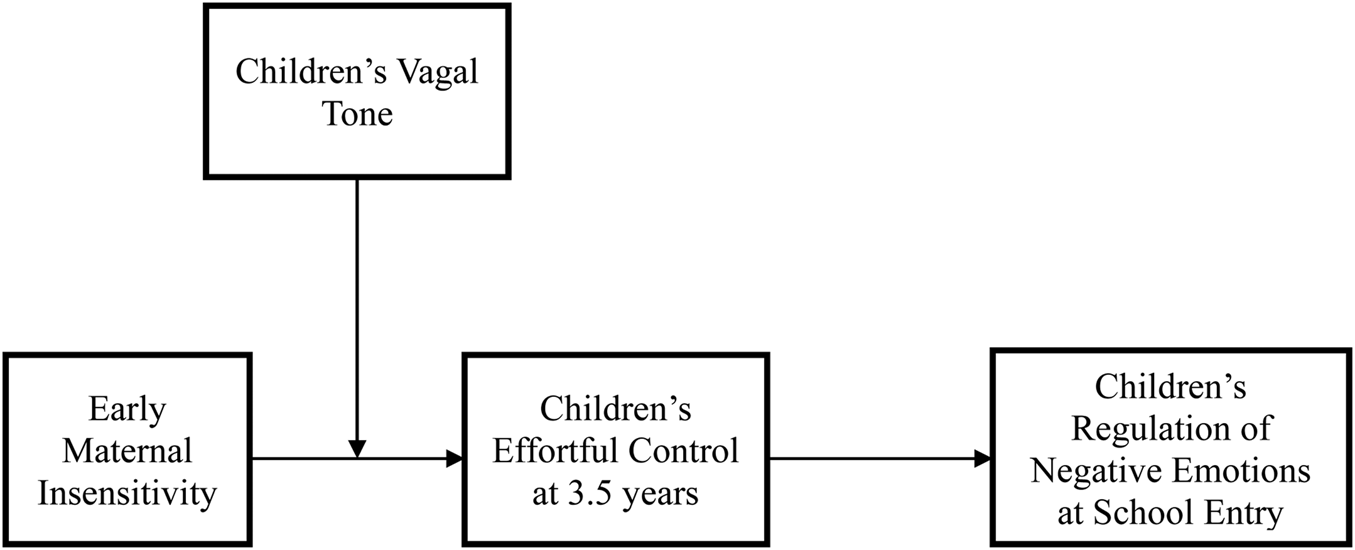
In summary, the present study seeks to test how early caregiving environments affect children's self-regulation (Figure 1). First, we examined whether children's effortful control at age 3.5 predicted children's ability to regulate negative emotions at age 5. In accord with preliminary research suggesting that effortful control may be a cognitive antecedent and component of emotional regulation, we hypothesized that effortful control would predict children's ability to regulate negative emotions for all children, such that greater effortful control would predict greater regulation of both sad and anger emotions. Next, guided by research and theory on early caregiving and children's regulation, we tested whether insensitive caregiving at 18 months was associated with children's effortful control at 3.5 years. In line with a differential susceptibility models, we further examined whether resting vagal tone moderated this direct effect.
Conceptual model of hypothesized study pathways.

Method
Participants
Data for the present research were drawn from a larger NIH-funded multimethod longitudinal study of parenting, self-regulation, and mother–child relationships. The sample consisted of 220 pairs of mothers and their children (51.6% male) from the metropolitan area of a mid-sized city in the northeastern United States. Participant recruitment was conducted in 2 waves; a first round of 139 mother–child dyads were recruited at Wave 1 of the study when children were 18 months of age (mean maternal age = 29.06, SD = 5.45). Then, an additional 81 dyads joined the study at Wave 2, when children were 3.5 years old (Mean maternal age = 31.9, SD = 5.53). The retention rate from Waves 1 & 2 to Wave 3 was 74%. However, 82% of dyads that participated in Wave 2 also participated in Wave 3. A main goal of recruitment was to obtain a racially and socioeconomically diverse sample that was representative of the population from which the sample was drawn. Recruitment criteria were based upon family income and maternal education level. To accomplish this, flyers were posted in community locations such as libraries, daycare centers, and community businesses that were frequented by mothers with young children. Additionally, postings were made on a local parenting internet forum. Finally, mothers were also recruited from the local Women, Infants, and Children (WIC) offices (WIC is a federally-funded public agency that provides assistance to low-income mothers who have or are expecting a child). Families who joined the study at wave one had a yearly income range of $1,200 to $287,000 (before public assistance) with a mean of $55,000 and a median of $40,000. Families who joined the study at the second wave had a yearly income range of $0 to $250,000 (before public assistance) with a mean of $59,879 and a median of $55,000. Using ANOVA, we determined that cohorts did not significantly differ on family income, F (1, 209) = .72, p = .40. The majority of the participants identified themselves as European-American (54% of the mothers and 47% of the children); followed by moderate percentages of African American (23% of the mothers and 23% of the children); Latino (9% of the mothers and 10% of the children; and multiracial (3% of the mothers and 10% of the children). The study was approved by the Institutional Review Board of the University of Rochester (case number: RSRB00021612).
Procedures
The mothers and their children visited the lab for an approximately 2-hr visit at three data collection points: once when the child was 18 months old (Wave 1), once when the child was about 42 months old (Wave 2), and once at 60 months (Wave 3). Children's effortful control was measured by using a questionnaire and an observational paradigm from Wave 2. Data for the children's emotion regulation were collected at Wave 3. Mothers were paid $75 for their participation at Waves 1 & 2 and $100 for participating at Wave 3. At each wave, the children were given a small toy for their participation.
For the present study, parenting data were drawn from a 15-min play and clean up session. Specifically, an experimenter led the mothers and their children into a room in which toys were strewn about. After a 10-min play session with the toys, the mothers were asked to try their best to get their children to pick up all of the toys and place them in a bin in the corner of the room during a 5-min clean-up session. The mothers were instructed to use whatever methods or strategies for getting children to clean up that they would normally use at home. At the end of 5 min, the experimenter re-entered the room and ended the session. The entirety of the clean-up session was videotaped for later observational coding.
Vagal tone data were also collected at Wave 1, using Alive Heart Monitors from Alive Technologies Pty. Ltd. (http://www.alivetec.com/index.htm) to record and store children's ECG signal during a resting session prior to the play session. These ECG monitors included a precordial, two-pole ECG lead that was placed on the children's chests. Data from these leads were transmitted to a portable unit that was worn by the child and were stored on an SD card in that unit. The ECG signal was sampled at 300 Hz and had a voltage range of −2.5 to 2.5 V.
The Snack Delay procedure, adapted from the Laboratory Temperament Assessment Battery (Lab-TAB; Goldsmith, Reilly, Lemery, Longley, & Prescott, Reference Goldsmith, Reilly, Lemery, Longley and Prescott1999), was conducted at Wave 2 as a test of effortful control. For this procedure, an experimenter explained to the child that he/she was going to receive some M&M candies as a snack. However, the experimenter was going to put these candies under a cup and he/she (the child) could not pick up the cup and eat the M&M until the experimenter knocked on the table. There were six trials in which the experimenter placed an M&M under the cup. For each trial, the experimenter waited 5, 10, 0, 20, 0, and 30 seconds, respectively, before knocking on the table. The task was videotaped for later coding of the children's effortful control.
Measures
Age 18 months maternal insensitive parenting
Indices of maternal parenting were assessed by observational coding using two subscales that were designed to assess a range of caregiving behaviors. Observer ratings during the free play and compliance tasks were completed using the Iowa Family Interaction Rating Scales (IFIRS; Melby & Conger, Reference Melby, Conger, Karig and Lindahl2001). The ratings were recorded on 9-point Likert-type scales, ranging from 1 (not characteristic at all) to 9 (mainly characteristic). Harsh caregiving was measured by mother's behaviors that reflect anger, contempt, or harsh rejection of her child. Examples include angry or contemptuous facial expressions, sarcastic tone of voice, and menacing or threatening body posture. Sensitive/child-centeredness assessed the extent to which the mothers displayed an awareness of the child's needs, moods, interests, and capabilities. Sensitive interactions with the child are paced to the child's behavior and mood and are well timed. The parent enforces rules, regulations, and constraints while considering the child's age-appropriate choice, control, or autonomy. This subscale was reverse-coded to retain consistent scaling with harsh caregiving. The intraclass correlation coefficients, which reflect the inter-rater reliability of three independent coders for 25% of the interactions, ranged from .86 to .92 across the four coders across the two interactions.
Age 18 Months Vagal Tone
After each participant visit, ECG data were extracted from the SD card and processed off-line. This involved first creating a file containing interbeat intervals (IBIs) for editing. Then, a discrete time-matched filter was applied to the data, functioning to reduce noise in the IBI signal caused by artifacts (e.g., movement, environmental interference). This filter included a noise detector, which located segments of the IBI signal that were, for the most part, noise-free. Next, those relatively noise-free sections were used to estimate a template of the IBI signal, and this template was correlated with the original IBI signal in order to detect the presence of the true signal within the noisy signal (Chen, Ba, Ignjatovic, Heinzelman, & Sturge-Apple, Reference Chen, Ba, Ignjatovic, Heinzelman and Sturge-Apple2010). This procedure was successful in reducing noise to 10% or below for most subjects’ IBI signals. Data were removed and estimated for subjects whose signal still included above 10% noise after the above procedure.
Vagal tone was measured as RSA by using the IBI series after the noise-reduction filter was applied. The IBI data from a 5-min quiet play episode in which mother and child were alone in a room were used to get a resting measure of the children's RSA. This was calculated by inputting the IBI series into the CMetX program (Allen, Reference Allen2002; Allen, Chambers, & Towers, Reference Allen, Chambers and Towers2007). Specifically, the CMetX program converted the IBI series into a time series via linear interpolation at a sampling rate of 10 Hz. Then, via a band pass filter, the variance of the heart period within the frequency band of 0.24–1.04 Hz (i.e., the band of spontaneous respiration for toddlers; Porges et al., Reference Porges1996) was extracted, and the natural log of this variance provided an estimate of children's average RSA for the resting session.
Age 3.5 Effortful Control
Effortful control was measured via maternal report as well as through observational coding during the Snack Delay task. Mothers reported on children's effortful control through the Child Behavior Questionnaire–Short Form (CBQ: Rothbart, Ahadi, Hershey, & Fisher, Reference Rothbart, Ahadi, Hershey and Fisher2001). Items on the CBQ are rated on a 7-point scale that ranges from 1 (“extremely untrue of your child”) to 7 (“extremely true of your child”). The Effortful Control scale is composed of the attention focusing, inhibitory control, low-intensity pleasure, and perceptual sensitivity subscales of the CBQ, and it includes items like “Can easily stop an activity when told ‘no’” and “When drawing or coloring in a book, shows strong concentration.” The internal consistency of the Effortful Control scale was acceptable (α = .76).
Effortful control was also assessed during the Snack Delay procedure by using the coding manual provided within the Lab-TAB (Goldsmith et al., 1999). Two codes, “Signal” and “Anticipation,” were used in the present study, and they were only coded during trials in which the child had to wait for an M&M (trials 1, 2, 4, and 6). The Signal code is a presence–absence code that indicates whether or not the child waited for the experimenter to knock before eating the M&M (0 = wait, 1 = did not wait). Thus, this code indicates children's ability to follow rules and whether or not they can dampen the prepotent response to eat the M&M as soon as it is placed in front of them. The anticipation code indicates the degree to which children anticipate the availability of the M&Ms through various behavioral indicators. Anticipate was coded on a 3-point scale, with a 1 indicating no anticipation, a 2 indicating some brief anticipation, and a 3 indicating anticipating (picks up snack or plays with snack) for the majority or entirety of the episodes. For both codes, a graduate student coder rated the entirety of the sample (these codes were used in the analyses), and another coder rated 20% of the sample to establish inter-rater reliability. Average reliabilities for both the Signal and Anticipation codes were acceptable (intraclass correlations of r = 1 and r = .76, respectively). Bivariate correlations across the 3 scales ranged from .20 to .49, p < .05. A latent factor consisting of the three scales was calculated and factor scores were saved for use as a manifest variable in model testing and interaction construction.
Age 5 Emotion Regulation
The mothers reported on the Children's Emotion Management Scales (CEMS; Zeman, Shipman, & Penza-Clyve, Reference Zeman, Shipman and Penza-Clyve2001; Zeman et al., Reference Zeman, Shipman and Suveg2002). Specifically, the mothers responded to a series of statements concerning their child's regulation of anger and sadness by indicating how true each statement was of their child (1 = hardly ever, 2 = sometimes, & 3 = often). For the present study, the mothers’ answers on the Emotion Regulation Coping Scale included four items for anger and five items for sadness, such as “My child can stop him/herself from losing his/her temper when he/she is mad,” and “When my child is sad, he/she does something totally different until he/she calms down.” Construct validity (Zeman et al., Reference Zeman, Shipman and Suveg2002) and predictive validity (Zeman et al., Reference Zeman, Shipman and Suveg2002) has been established for the sad and anger versions of the CEMS. Further, the scales for both anger and sadness demonstrated acceptable internal consistency in the present sample (α = .74 and .70, respectively).
Results
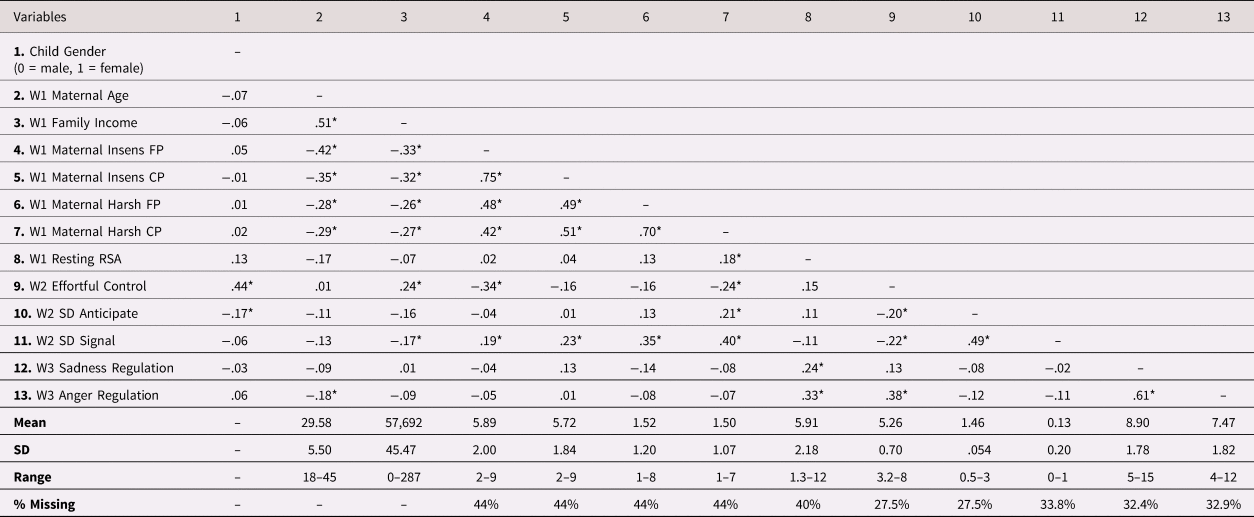
The means, standard deviations, and intercorrelations for the study variables are presented in Table 1. As detailed in the table, the study variables were associated with one another in the expected directions. In order to maximize the sample size, all of the missing data were estimated using full information maximum likelihood (FIML). This strategy is considered acceptable for datasets with up to 50% of the data missing so long as there is no identifiable pattern among the missing data. Little's missing completely at random test (Little, Reference Little1988) established that the missing data had occurred at random, χ2 (173) 193.12, p > .05, suggesting that no patterns in the missing data were associated with additional families in the second wave of data collection or families lost to attrition. The hypotheses for the present study were examined with Mplus 8. Model fit was determined with widely used fit indices, including the comparative fit index (CFI) and the root mean square error of approximation (RMSEA). Manifest variables for child gender, family income, and maternal age were included as covariates in all models.
Intercorrelations, means, ranges, and standard deviations of study variables and covariates. For log-transformed variables, mean, standard deviation and range are reported pretransformation. However, the posttransformation variables were used to determine intercorrelations.

Note: CP = Compliance, FP = Free Play, SD = Snack Delay. *p < .05.
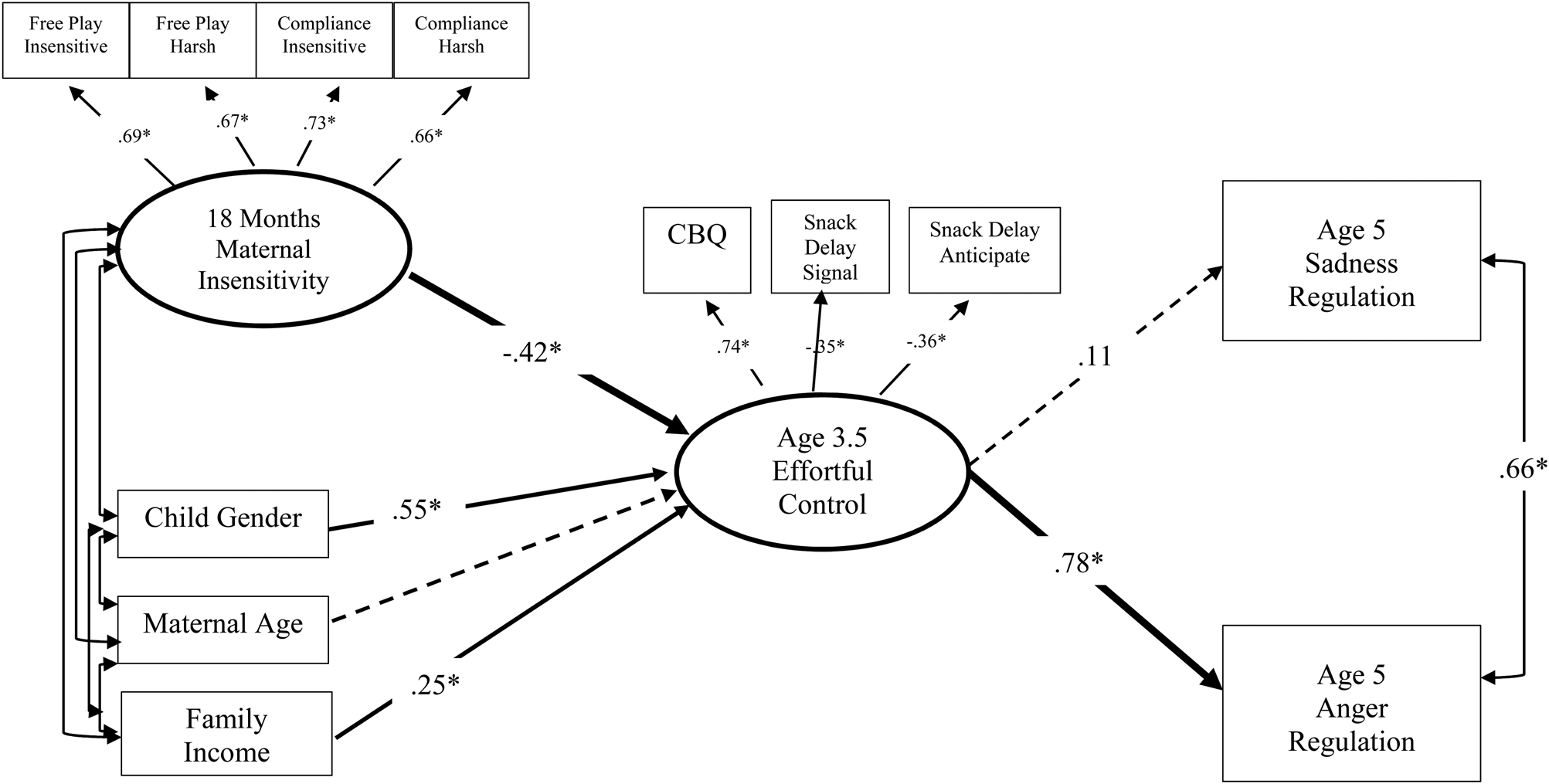
In accordance with the analysis plan, we first tested the direct associations between maternal insensitive caregiving, effortful control, and emotion regulation (Figure 2). The model fit the data well, χ2 (26) = 69.22, p < .05; CFI = .93; RMSEA = .06. The results indicated that maternal insensitive caregiving at 18 months was associated with reduced effortful control at age 3.5, β = −.42, B = −0.17, SE = 0.07, p < .05. Moreover, children's effortful control at age 3.5 was associated with greater ability to regulate anger, β = .77, B = 2.75, SE = 1.33, p < .05, but not sadness, β = .11, B = 0.36, SE = 0.77, p > .05, at age 5. Associations between maternal caregiving and anger and sadness emotion regulation were not significant. However, the significance of the indirect path from maternal insensitive caregiving to children's anger regulation through effortful control was evaluated by computing the confidence interval using the PRODCLIN program (MacKinnon, Fritz, Williams, & Lockwood, Reference Mackinnon, Fritz, Williams and Lockwood2007) via the RMediation web applet (Tofighi & Mackinnon, Reference Tofighi2011). The results indicated that the indirect path was significant, with a point estimate of .05, SE = .01, 95% CI [.02, 1.33]. Given the lack of an association between effortful control and sadness regulation, we did not compute an indirect effect.
Structural equation model for testing associations between early caregiving, effortful control, and emotion regulation. Coefficients represent fully standardized parameter estimates. Solid lines and coefficients with asterisks denote statistically significant relationships (p < .05), while dashed lines denote relationships that were not significant. Curved double-headed arrows correspond to correlations among the exogenous variables.

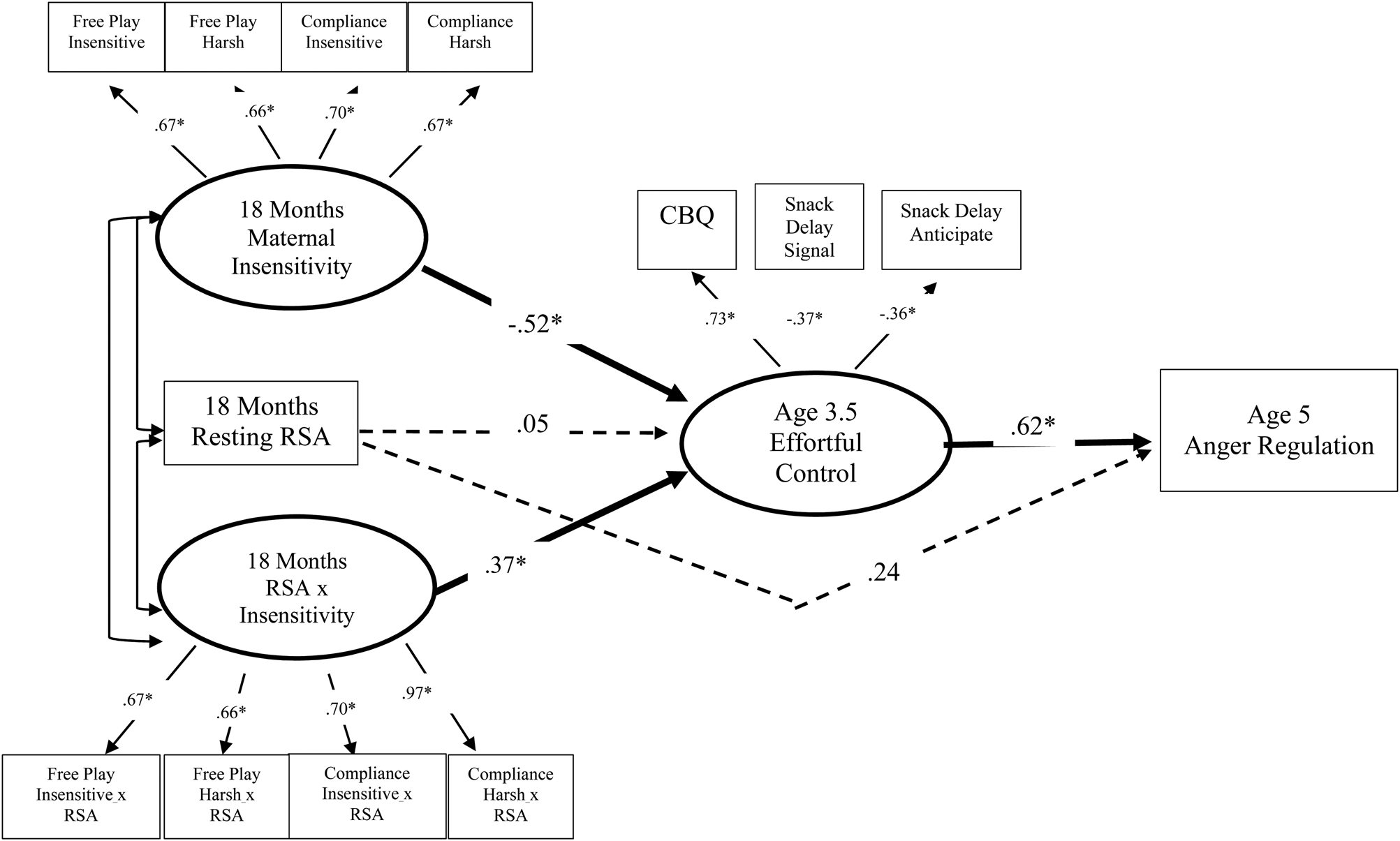
We next tested whether children's resting RSA was a differential susceptibility factor that moderated the effect of early maternal insensitive caregiving on effortful control (Figure 3). To accomplish this, a model was specified that included children's resting RSA at 18 months as well as a latent interaction construct with indicators that were derived by using a mean-centered approach, outlined by Marsh et al. (Reference Marsh, Wen, Hau, Little, Bovaird and Widaman2007). As in our previous models, child gender, family income, and maternal age were included as covariates. We also specified residual covariances between the indicators for the maternal caregiving variable and the related indicators on the latent interaction construct, which resulted in a better model fit. The results indicated that the model fit the data well, χ2 (74) = 122.71, p < .05, χ2/df = 1.65, RMSEA =.05, CFI =.94. The main effect of maternal insensitive caregiving on effortful control remained significant, β = −.52, B = −0.21, SE = 0.09, p < .05, and resting RSA was not a significant predictor, β = .05, B = 0.01, SE = 0.04, p >.05. However, the results showed that the path including the latent variable interaction between maternal insensitive caregiving and RSA on children's effortful control was significant, β = .37, B = 0.06, SE = 0.03, p < .05. We also tested whether the interaction predicted children's anger regulation, however this pathway was not significant and these effects were not explored further. The predictors of interest in the moderated mediation model accounted for 49.6% of the variance in child effortful control, excluding the covariates of child gender, maternal age, and family income.
Structural equation model for testing differential susceptibility at age 18 months. Coefficients represent fully standardized parameter estimates. Solid lines and coefficients with asterisks denote statistically significant relationships (p < .05), while dashed lines denote relationships that were not significant. Curved double-headed arrows correspond to correlations among the exogenous variables. Residual covariances between the indicators of the maternal caregiving variable and the related indicators on the latent interaction construct were modeled.

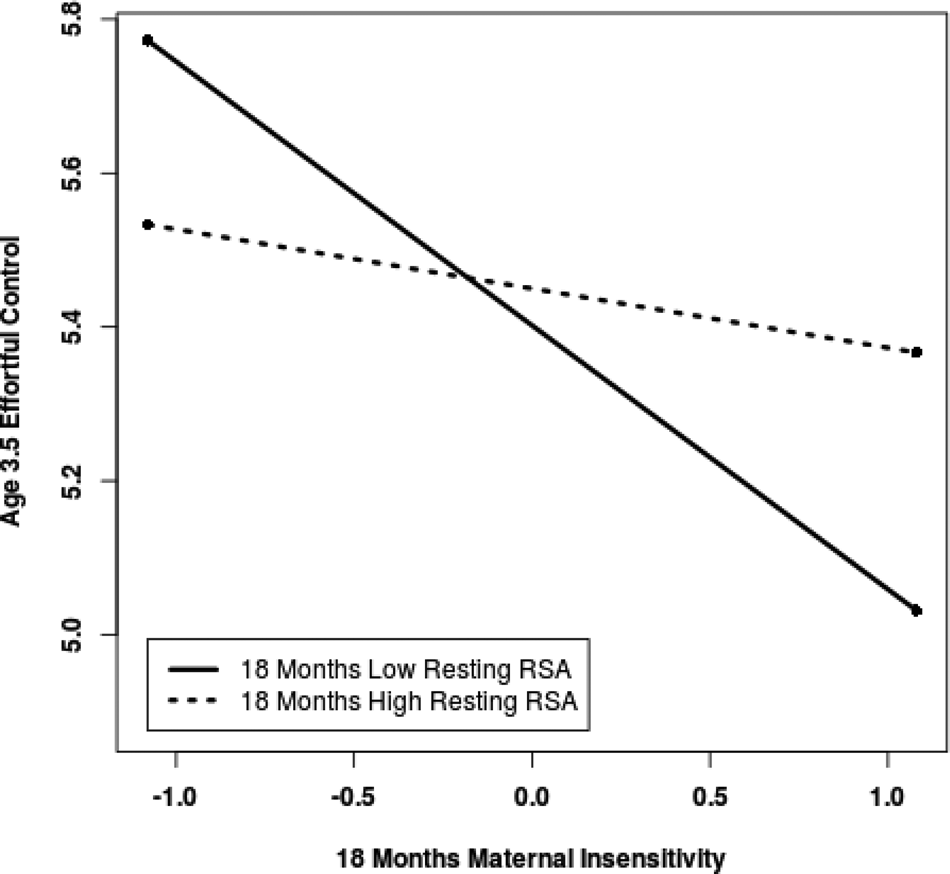
There are two current methods for testing differential susceptibility, each with different assumptions regarding the exploratory (Roisman et al., Reference Roisman, Newman, Fraley, Haltigan, Groh and Haydon2012) or confirmatory (Belsky, Pluess, & Widaman, Reference Belsky, Pluess and Widaman2013) nature of the susceptibility factor. Given inconsistencies with respect to the role of high vs. low resting vagal tone as a susceptibility factor, we elected to adopt Roisman et al.’s (Reference Roisman, Newman, Fraley, Haltigan, Groh and Haydon2012) approach. The moderating effect of RSA was first clarified by graphically plotting and calculating the simple slopes of maternal insensitivity at high (1 SD above the mean) and low (1 SD below the mean) values of RSA. Sensitive tests of differential susceptibility necessitate examining the interaction across a comprehensive range of the proposed predictor. Because maternal insensitivity was a latent variable, factor scores were calculated and saved for plotting and calculations. Due to moderate positive skewness for maternal insensitivity, latent variable parenting scores ranged from -1.14 to 2.20 with a mean of 0 and a standard deviation of 0.72. Although Roisman et al. (Reference Roisman, Newman, Fraley, Haltigan, Groh and Haydon2012) suggest ±2 SD for testing differential susceptibility, generalizing beyond the range of the observed data is not recommended (Sulik et al., Reference Sulik, Eisenberg, Lemery-Chalfant, Spinrad, Silva, Eggum and Stover2012). Therefore, we conducted simple slope plots and analyses at −1.5 SD (−1.08) and +1.5 SD (1.08) from the mean of maternal insensitivity. The graphic plot of the interaction is depicted in Figure 4. Simple slope analyses revealed that maternal insensitivity predicted children's effortful control at low, β = −.34, t = 2.70, p < 0.01, but not high, β = −.08, t = 0.90, p = .37, levels of resting RSA.
Plot of interaction between maternal insensitivity and HRV on effortful control. The dotted line is not significant at p < .05.

To definitively test the viability of the differential susceptibility model in explaining the moderating role of resting RSA, we used three additional statistical tests (Roisman et al., Reference Roisman, Newman, Fraley, Haltigan, Groh and Haydon2012). For the first analysis, the regions of significance (RoS) on X test was conducted to identify regions along the range of the maternal caregiving latent variable for which children's RSA is significantly associated with children's effortful control. Consistent with differential susceptibility, the results indicated that resting RSA was significantly associated with effortful control at both high (+1.5 SD), b = 0.45, p < .001, and low (-1.5 SD), b = −0.36, p < 001, maternal insensitivity. Next, in calculating the proportion of the interaction (PoI) index, we examined the ratio of improved functioning for children with the low resting RSA relative to the overall aggregate of improved and poor outcomes within the + and −1.5 SD range of maternal insensitivity. Values approximating .50 offer strong support for differential susceptibility, while coefficients approaching .00 (and under .16) favor the diathesis-stress model. Second, because PoI indices can vary depending on the range of interest specified for the predictor variable, we also calculated a proportion affected (PA) index. Given our coding of insensitivity, here the PA index is defined as the proportion of children within the hypothesized “for worse” region in differential susceptibility theory or, more precisely, children who were above the point along the maternal insensitivity variable in Figure 2 where the two regression slopes cross. PoI and PA indices approximating .50 and exceeding .16 are regarded as yielding support for differential susceptibility (see Roisman et al., Reference Roisman, Newman, Fraley, Haltigan, Groh and Haydon2012). In support of differential susceptibility, PoI and PA were .59 and .45, respectively.
Discussion
This study made progress toward providing greater specificity within research on the potential developmental antecedents of children's regulation of negative emotions. Specifically, our findings demonstrate that poor or inadequate caregiving environments forecast weak or low effortful control, which in turn may disrupt children's ability to regulate negative emotions (Thompson, Reference Thompson, Lerner and Lamb2015). Moreover, towards delineating a source of individual differences in the influence of early rearing environments on children's self-regulation, we further examined how resting RSA may operate as a susceptibility factor in these pathways. Our results suggest that basal vagal tone early in life may operate as a moderator of the association between early caregiving and children's effortful control in a manner that is “for better” and “for worse” (Ellis et al., Reference Ellis, Boyce, Belsky, Bakermans-Kranenburg and van IJzendoorn2011).
Consistent with previous research, harsh and insensitive caregiving during the early years of childhood was associated with poorer effortful control for children (e.g., Chang et al., Reference Chang, Olson, Sameroff and Sexton2011; Karreman et al., Reference Karreman, van Tujil, van Aken and Dekovic2008; Piotrowski et al., Reference Piotrowski, Lapierre and Linebarger2013; Suor, Sturge-Apple, Davies, & Cicchetti, Reference Suor, Sturge-Apple, Davies and Cicchetti2017). Moreover, our findings suggest that effortful control may operate as an indirect mechanism between early harsh and insensitive parenting and anger regulation. Given that parents provide the most salient context for early development, harsh, over-reactive, and insensitive caregiving may interfere with children's preschool development of the regulatory functions necessary to control over-reactive anger responses. This finding is consistent with work describing contemporaneous associations between these constructs (e.g., Morris et al., Reference Morris, Silk, Morris, Steinberg, Aucoin and Keyes2011) and with recent work documenting the developmental legacy of early maternal sensitivity on children's effortful control and social and academic adjustment to school (Kopystynska, Spinrad, Seay, & Eisenberg, Reference Kopystynska, Spinrad, Seay and Eisenberg2016; Mintz, Hamre, & Hatfield, Reference Mintz, Hamre and Hatfield2011). Indeed, research within this area has led to calls for focusing on early rearing environments and children's effortful control as targets of intervention directed at assisting children with early school adjustment (e.g., Taylor & Spinrad, Reference Taylor and Spinrad2017).
With respect to the associations between our two domains of self-regulation, we found that children's developing effortful control abilities were predictive of later regulation of negative emotion. These finding are consistent with conceptual frameworks in the literature that have proposed that effortful control may facilitate the regulation of emotional arousal and expression (Fox & Calkins, Reference Fox and Calkins2003; Fox, Henderson, Marshall, Nichols, & Ghera, Reference Fox, Henderson, Marshall, Nichols and Ghera2005; Kopp, Reference Kopp1989; Phan, Wager, Taylor, & Liberzon, Reference Phan, Wager, Taylor and Liberzon2002; Ruff & Rothbart, Reference Ruff and Rothbart1996). Although extant research in this area has examined effortful control as an antecedent of positive emotion regulation, much less focus had been devoted to understanding the links between effortful control and regulation of negative emotion. Supporting links between effortful control and negative emotion regulation, the present study found a significant association between effortful control and children's regulation of anger. Specifically, children who demonstrated higher effortful control at age 3 tended to be better at regulating their anger at age 5. To date, links between effortful control and the self-regulation of anger specifically have been understudied, with only one study (Kochanska et al., Reference Kochanska, Murray and Harlan2000) demonstrating an association between greater effortful control and superior regulation of anger. Taken together, our findings suggest that cognitive skills underlying greater effortful control (e.g., attention focusing, inhibitory control, etc.) are important to the regulation of anger. In turn, one downstream outcome of greater anger regulation may be lower aggression or externalizing symptoms (e.g., Roll, Koglin, & Peterman, Reference Röll, Koglin and Petermann2012). Specifically, greater effortful control may allow for the suppression of prepotent emotional responses and redirection of attention away from emotion-eliciting stimuli, thus facilitating the enactment of alternative responses or behavioral strategies that aid in regulation.
In contrast, the present study found no link between children's effortful control at age 3.5 and their regulation of sadness at age 5. Although initially unexpected, this finding is consistent with proposals that effortful control skills may be primarily tied to the regulation of approach-related tendencies such as aggression and reward-related behavior (MacDonald, Reference MacDonald2008). Within these frameworks, anger is considered an approach emotion from the perspective of approach-avoidance motivational systems (Carver, Reference Carver2004; Carver & Harmon-Jones, Reference Carver and Harmon-Jones2009). Thus, in order to regulate or modulate anger, the individual must contend with reward-oriented approach tendencies that may be situationally inappropriate. This would involve strategies that dampen those approach tendencies when they are inappropriate via inhibition or strategies (including problem solving) that use planning and activational control to remove the anger-eliciting blockage of their goal in an appropriate way (Cole, Michel, & Teti, Reference Cole, Michel and Teti1994; Waters & Thompson, Reference Waters and Thompson2014). In contrast, sadness is considered an avoidance-related emotion with the function of promoting goal relinquishment (i.e. avoidance) via deactivation. As such, strategies and skills that help control or counteract these avoidance tendencies are what facilitate regulation during sadness-provoking situations. The measures of effortful control that were used in the present study may have better captured control over approach tendencies more than the control over avoidance tendencies. This could explain the lack of association between effortful control and sadness regulation.
The present study also tested whether associations between early caregiving and the development of effortful control were moderated by children's resting RSA in a manner consistent with differential susceptibility models. Developmental theory has long stressed the role of children's individual differences in affecting their experiences of their context. Specifically, developmental contextualists (Cicchetti & Aber, Reference Cicchetti and Aber1998; Gottlieb, Reference Gottlieb1991) assert that both the organism and the environment provide input for development and it is the interaction of these two inputs that shapes developmental outcomes. Differential susceptibility models are a recent integration of evolutionary thinking within these contextualist approaches, suggesting that physiological systems operate as important individual difference factors.
In the current study, we found that the interaction between resting RSA and maternal caregiving on children's effortful control was consistent with our hypotheses drawn from the differential susceptibility framework. These findings corroborate recent research findings demonstrating the presence of differential susceptibility in the relationship between family adversity and socioemotional outcomes (e.g., Obradović, Bush, Stamperdahl, Adler, & Boyce, Reference Obradović, Bush, Stamperdahl, Adler and Boyce2010; Sturge-Apple, Suor, Davies, Cicchetti, & Rogosch, Reference Sturge-Apple, Suor, Davies, Cicchetti, Skibo and Rogosch2016). It should be noted that some previous studies testing differential susceptibility models with respect to early caregiving and children's development are inconsistent with the findings of the present study (e.g., Holochwost, Volpe, Gueron-Sela, Propper, & Mills-Koonce, Reference Holochwost, Volpe, Gueron-Sela, Propper and Mills-Koonce2018). For example, Gueron-Sela et al. (Reference Gueron-Sela, Wagner, Propper, Mills-Koonce, Moore and Cox2017) found that the moderating effect of children's resting RSA on early caregiving and executive functioning was consistent with the diathesis-stress not the differential susceptibility model. Further, Holochwost et al. (Reference Holochwost, Volpe, Gueron-Sela, Propper and Mills-Koonce2018) found that resting RSA, not parenting, moderated cumulative risk exposure on children's inhibitory control.
Contrasting findings in the literature with respect to the nature of the moderating effect of RSA and child functioning bear mention. In particular, important differences in methodology and study design may underlie the discrepancies in findings. First, consistent with calls to incorporate the range of environmental experience in diathesis-stress analyses, parenting was operationalized along a continuum from sensitive to harsh using two separate indicators in the current study. Thus, casting a wider net, so to speak, may have allowed us to better identify differential susceptibility as opposed to diathesis-stress. Second, differences in developmental timing may also play an important role in terms of explaining discrepancies in the literature. In the current study, we specifically focused on the age of 3.5, which is a developmental period of change in effortful control abilities, so children's plasticity with respect to differential susceptibility to context may be heightened for this domain of development during this period. In future research, a consideration of developmental timing may be critical in understanding whether diathesis stress or differential susceptibility approaches may be operating.
Finally, the current study revealed that differential susceptibility was observed in children with low resting RSA. To date, much of the literature has converged upon the assumption that high resting RSA operates as the susceptibility factor as it reflects sensitivity to context/environmental influences (e.g., Beauchaine, Reference Beauchaine2001). High resting vagal tone has been shown to promote calm concentration (Fabes & Eisenberg, Reference Fabes and Eisenberg1997), and it is thought to reflect readiness to engage with the environment (Beauchaine, Reference Beauchaine2001). However, recent research has demonstrated that low resting vagal tone may operate as a susceptibility factor (e.g., Bagner et al., Reference Bagner, Rodríguez, Blake, Linares and Carter2012; Hasting & De, Reference Hastings and De2008; Gueron-Sela et al., Reference Gueron-Sela, Wagner, Propper, Mills-Koonce, Moore and Cox2017). These discrepancies suggest that the relative role of high or low resting vagal tone in differential susceptibility models may need further refinement. With respect to the current study and the role of low resting RSA, one interpretation may be that given the greater fluctuations or lower regulatory capacity associated with low resting RSA with respect to the environmental milieu may allow for greater plasticity in response to contextual effects. Thus, low resting RSA may function more consistently in modulating children's development in response to parenting and operate as a susceptibility factor. Further, given their reduced ability for self-regulation, children with low resting RSA may be more dependent on caregiving for facilitating these abilities and by extension differential susceptibility to the caregiving environment. Differences between low and high resting RSA as susceptibility factors in previous research may also be a function of the outcome under study. For example, Somers, Jewell, Ibrahim, & Luecken (Reference Somers, Jewell, Hanna Ibrahim and Luecken2018) reported that RSA assessed at 6 weeks of age differentially operated as a susceptibility factor in associations between maternal support and infant behaviors at 1 year of age. Specifically, low resting RSA conferred sensitivity with respect to behavioral competence; however, high resting RSA was more sensitive with respect to behavior problems as an outcome. A full delineation of the differences in the operation of resting vagal tone as a differential susceptibility factor in social and emotional development is beyond the scope of this paper, however it would be informative for future research to determine the locus of differential effects.
Our findings require discussion of the limitations of the current research. First, the present study was unable to control for previous levels of emotion regulation of anger and sadness as well as effortful control in the tested model because earlier measures were not available. Therefore, the present study is only able to predict associations with the level of these constructs at the distinct developmental points that were hypothesized. Future research is needed to determine whether early caregiving and children's resting RSA predict developmental changes in these constructs over the course of toddlerhood and early childhood. Second, another limitation was the exclusive focus on a resting, tonic measure of vagal tone versus also examining task-related changes in vagal tone. More research is needed that examins the role of vagal reactivity (versus resting vagal tone) as a possible factor that might influence children's sensitivity to the effects of early caregiving on children's self-regulation in order to draw any firm conclusions. Finally, maternal caregiving was the sole focus of the current study and our findings may not generalize to fathers, who are understudied in the literature. Evolutionary-developmental models stress the potential unique effects of fathers in shaping children's adaptation to family contexts (e.g., Belsky, Steinberg, & Draper, Reference Belsky, Steinberg and Draper1991; Belsky, Schlomer, & Ellis, Reference Belsky, Schlomer and Ellis2012).
Despite these limitations, the results of this study add to the greater psychological literature in several novel and important ways. First, this study demonstrates how children's resting RSA may operate as a differential susceptibility factor moderating the effect of the environment on children's self-regulation. This knowledge may be useful toward understanding how self-regulation develops, particularly with respect to effortful control and emotion regulation. Second, the current study adds to the self-regulation literature by testing a model of the relationships between two different self-regulatory constructs: effortful control and the regulation of specific negative emotions. Data from this study show that preschool levels of effortful control are predictive of greater anger regulation around the time of school entry, suggesting the possibility that effortful control might provide the cognitive and neuropsychological underpinnings needed for future anger regulation. Finally, this study, to our knowledge, is unique in showing an indirect relationship between maternal insensitivity and children's poorer anger regulation via poorer effortful control. This suggests that early exposure to harsh and insensitive parenting may have lasting effects on children's regulatory functions across the course of early childhood.
Financial Support
This study was supported by the National Institute of Nursing Research (NINR) with a grant that was awarded to Dr. Melissa L. Sturge-Apple. We are incredibly grateful to the children and parents who participated in this project and to the staff and student researchers who helped to make this research possible.