Introduction
Lentil is now an integral part of cropping systems in northern temperate semiarid (prairie) areas of North America, where it is grown in standard crop rotations (Gan et al., Reference Gan, Liu, Cutforth, Wang and Ford2011). Long-term climate forecasts point to increased variability, especially a higher frequency of drought periods that affect crop yield (Sauchyn and Kulshreshtha, Reference Sauchyn, Kulshreshtha, Lemmen, Warren, Lacroix and Bush2008; IPCC, 2013). Maintaining reliable productivity of lentil crops will require the development of genotypes with the ability to allocate roots into deeper soil layers under water-limited conditions. One approach is to evaluate the rooting patterns of genetically accessible lentil crop wild relatives known to have originated in marginal and drought-prone areas (Wong et al., Reference Wong, Gujaria-Verma, Ramsay, Yuan, Caron, Diapari, Vandenberg and Bett2015). These may have root trait phenotypes that provide advantages for maintaining productivity under drought conditions (Gorim and Vandenberg, Reference Gorim and Vandenberg2017a).
Shoots generally drive water uptake through plants but, ultimately, the size, properties and distribution of root systems determine plant access to water and set the limits on shoot function (Comas et al., Reference Comas, Becker, Cruz, Byrne and Dierig2013). Root diameter and the number of root tips play an important role in water uptake during drought (Comas et al., Reference Comas, Becker, Cruz, Byrne and Dierig2013). The root systems of plants can be loosely divided into coarse and fine root categories based on root diameter. Coarse roots anchor and establish the root system architecture, thereby controlling ultimate rooting depth and ability of plants to grow into compacted soil layers (Materechera et al., Reference Materechera, Alston, Kirby and Dexter1992; Comas et al., Reference Comas, Becker, Cruz, Byrne and Dierig2013). Böhm (Reference Böhm1979) and Zobel and Waisel (Reference Zobel and Waisel2010) categorize roots into different diameter classes: very fine (<0.5 mm), fine (0.5–2 mm), small (2.0–5.0 mm), medium (5.0–10 mm), large (10–20 mm) and very large (>20 mm). The properties and distribution of fine and very fine roots are important physiological components for crop plants because they make up the majority of the root surface area and the root length responsible for water and nutrient uptake. They also represent a carbon sink that plays an important role in nutrient cycling (Somma et al., Reference Somma, Hopmans and Clausnitzer1998; Guo et al., Reference Guo, Mitchell and Hendricks2004; Zobel et al., Reference Zobel, Kinraide and Baligar2007; Liu et al., Reference Liu, Gan, Bueckert, Rees and Warkentin2010; Comas et al., Reference Comas, Becker, Cruz, Byrne and Dierig2013; McCormack et al., Reference McCormack, Dickie, Eissenstat, Fahey, Fernandez, Guo, Helmisaari, Hobbie, Iversen, Jackson, Leppälammi-Kujansuu, Norby, Phillips, Pregitzer, Pritchard, Rewald and Zadworny2015). Decreasing root diameter is proposed as a useful trait for increasing plant acquisition of water and productivity under drought conditions for wheat (Triticum aestivum) (Wasson et al., Reference Wasson, Richards, Chatrath, Misra, Prasad, Rebetzke, Kirkegaard, Chistopher and Watt2012).
We previously reported fine root distribution patterns for both cultivated and wild lentil genotypes in soil under fully watered conditions (Gorim and Vandenberg, Reference Gorim and Vandenberg2017b). Although fine root distribution of pulse crops under field conditions has been reported (Gan et al., Reference Gan, Campbell, Janzen, Lemke, Liu, Basnyat and McDonald2009, Reference Gan, Liu, Cutforth, Wang and Ford2011; Liu et al., Reference Liu, Gan, Bueckert, Rees and Warkentin2010), no reports describe fine root distribution patterns in wild lentil species under drought conditions. This information is critical for the development of potential genetic strategies for future breeding of drought-tolerant interspecific lines. This study characterizes the root diameter classes and their distribution in three soil horizons for seven wild lentil genotypes in comparison to cultivated lentil. This information is useful for developing optimal root systems for future lentil breeding.
Materials and methods
Soil materials
The experiment was carried out in soil tubes in the controlled environment facility at the College of Agriculture and Bioresources at the University of Saskatchewan, Canada. A detailed description of the soil type, soil collection site and fertility is provided by Gorim and Vandenberg (Reference Gorim and Vandenberg2017a). The soil was placed into 10 cm diameter × 60 cm length tubes that were divided into three 20 cm subsections corresponding to depths of the A, B and C horizons observed in the field. The A horizon, or topsoil, ranged in depth from 0 to 20 cm, the B horizon from 20 to 40 cm and the C horizon from 40 to 60 cm. The tube subsections were taped together at the junctions and sealed at the bottom with fine mesh to allow drainage and prevent soil loss. The top section of each tube was filled with 1.8 kg of A horizon soil with sufficient space at the top for watering. The middle and bottom tube sections were filled with 2 kg of soil from the B and C horizons, respectively.
Plant materials
The wild lentil species/genotypes (abbreviations in parentheses) considered in this study included Lens orientalis (L. ori.) IG 72643; L. ori. PI 572376; L. tomentosus (L. tom.) IG 72805; L. odemensis (L. ode.) IG 72623; L. lamottei (L. lam.) IG 110813; L. ervoides (L. erv.) L-01-827A; and L. erv. IG 72815. Lens culinaris (L. cul.) Eston, a small green lentil cultivar (Slinkard and Bhatty, Reference Slinkard and Bhatty1979) was the only cultivated genotype included in the experiment. According to Wong et al. (Reference Wong, Gujaria-Verma, Ramsay, Yuan, Caron, Diapari, Vandenberg and Bett2015), L. cul., L. ori. and L. tom. belong to the primary gene pool (GP-1); L. ode. and L. lam. are considered part of the secondary gene pool (GP-2), and L. erv. is in the tertiary gene pool (GP-3). The cultivated lentil Eston has been successfully crossed with all of these specific genotypes except L. lam.
Seeds of wild and cultivated lentil genotypes were scarified, washed in bleach and then pre-germinated in a dark chamber at 22°C. After 3 d, seedlings with radicle lengths >2 cm were transplanted into labelled tubes, and 6 g of rhizobia inoculum (Rhizobium leguminosarum biovar viceae strain 1435 of Nodulator XL SCG; Becker Underwood, Canada) added to the soil surface next to the seedling in each tube. The experiment was a complete randomized block design with eight genotypes (seven wild, one cultivated) and four replicates. The amount of water at 100% of field capacity (FC) for six random unplanted tubes was predetermined. Plants were maintained in soil at 40 and 25% FC by weighing them twice a week; the 40 and 25% values represent moderate and severe drought, respectively. Fully watered plants were grown in soil maintained at 80% FC. Some plants grown at 40% FC were re-watered 8 weeks after sowing (see Gorim and Vandenberg, Reference Gorim and Vandenberg2017a for details), with this referred to as the re-watered treatment. The temperature was set to 21°C d/15°C night with 16 h daylength. Light intensity ranged from 308 to 392 µmol/m2/s1 depending on tube position and plant height. The growth room used T-5 Florescence bulb # 835 (Philips, ON, Canada) and 730 mm Far Red LED light bars (Fluence Bioengineering, Austin, TX, USA). Tube positions within each block were re-randomized at each weighing throughout the experiment to minimize light position effects.
Parameters evaluated
At harvest, the above-ground biomass was cut-off with a pair of scissors. The tape that sealed the joints of the three tube subsections was removed, then a knife used to cut and separate each 20 cm tube section into its respective A, B and C horizons. The soil from each subsection was then gently washed away on a 0.5 mm mesh sieve to minimize the loss of root material. The debris and dead roots were manually removed from the soil, the roots washed and placed in labelled Ziploc® bags. Root traits were measured using WinRHIZO™ commercial software (Regent Instruments Inc., Canada, 2013), which determined total root length (TRL) and the total number of tips (TNT) in each soil horizon. The roots were categorized into three diameter classes: 0–0.5 mm (very fine roots), >0.5 to 2.0 mm (fine roots), and >2.0 to 5.0 mm (small roots). Proportion TRL in Fig. 1 was expressed as
 $${\rm TRL =} \displaystyle{{{\rm TR}{\rm L}_{{\rm class}}} \over {{\rm TR}\hbox{L}_{{\rm total}}}}{ \times} 100\percnt, $$
where TRLclass is the amount of root per root diameter class and TRLtotal is the total amount of root produced.
Proportion of total root length distributed among very fine, fine and small root diameter classes in three soil horizons for Lens culinaris Eston compared with two Lens ervoides genotypes grown under severe drought conditions. Letters denote significant differences at α = 0.05; bars are standard error.

TNT was reported for the B and C horizons only for comparison purposes because the bulk of the roots were observed in these horizons. Least significant differences were calculated to compare genotypes belonging to a given diameter class at a given soil depth with the aid of the SAS 9.4 PROC GLM procedure (Statistical Analysis System, SAS Institute, Cary, NC, USA).
Results
Effects of moisture level on TRL in different soil horizons
Under both drought and re-watered conditions, longer TRLs were observed in the A horizon for all root diameter classes (Figs. 2–4). Under severe drought conditions, distinct differences in TRL were observed between cultivated and wild lentil genotypes as well as within the wild lentil genotypes group in the B and C horizons for all root diameter classes (Figs. 2–4). No differences were observed under moderate drought conditions for very fine and fine root diameter classes between wild and cultivated lentil genotypes in the B and C horizons. Cultivated lentil had either similar or significantly higher TRL compared with wild lentil genotypes in the A horizon (Figs. 2 and 3). In the small root diameter class, however, significant differences between wild and cultivated lentil genotypes were observed under both moderate and severe drought conditions in all soil horizons (Fig. 4(a) and (b)). When plants were re-watered, more TRL was allocated to the B horizon in all root diameter classes, with high variability between and within genotypes.
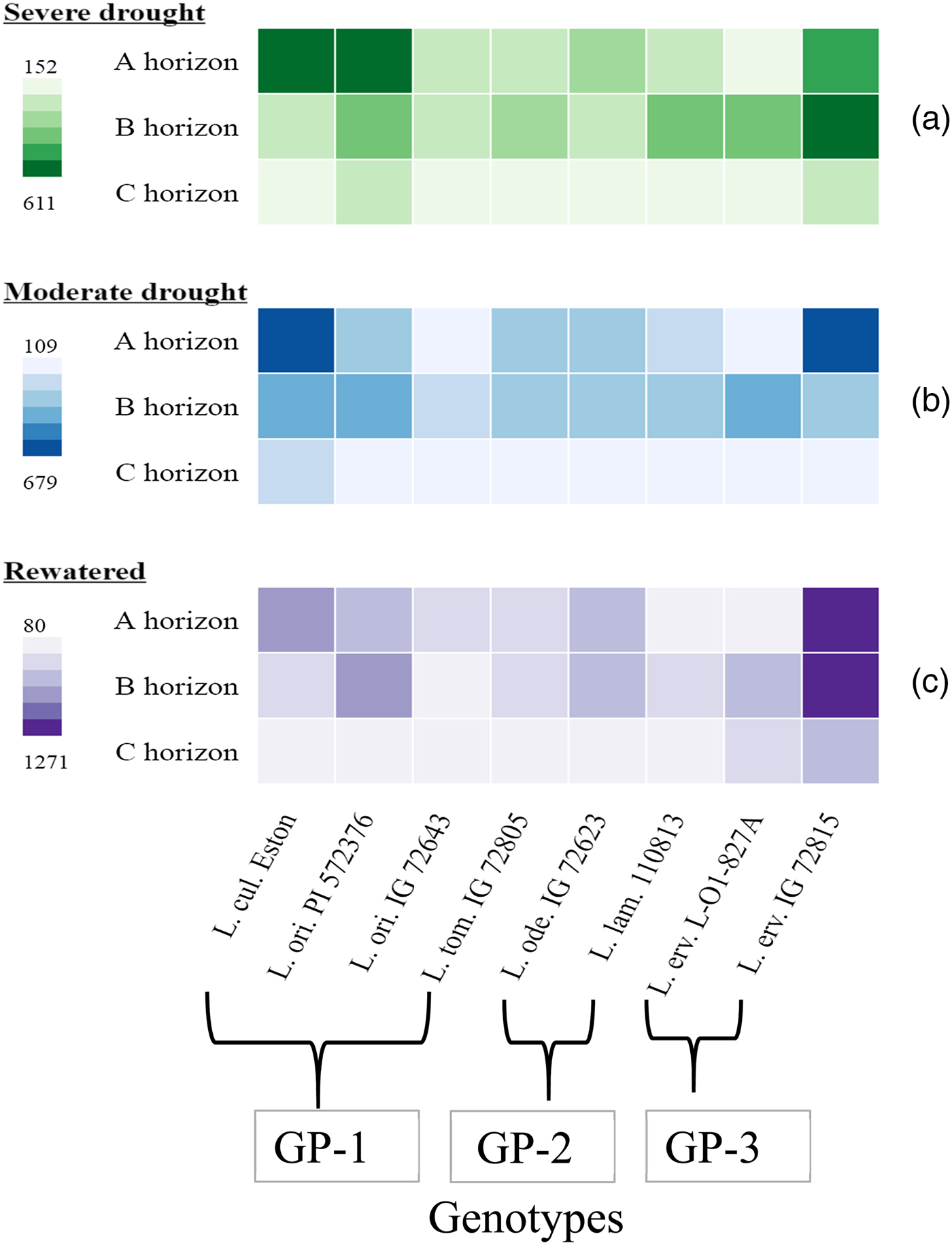
Comparisons of total root length (cm) in the very fine roots diameter class in three soil horizons (A–C) for Lens culinaris Eston and seven wild lentil genotypes grown under three drought conditions. Heat maps were generated using an in-house computer program, with a monochrome colour coding system using lighter to darker colours to represent values from lowest to highest. (GP-1, GP-2 and GP-3 denote genotypes in the primary, secondary and tertiary gene pools of lentil, respectively.)

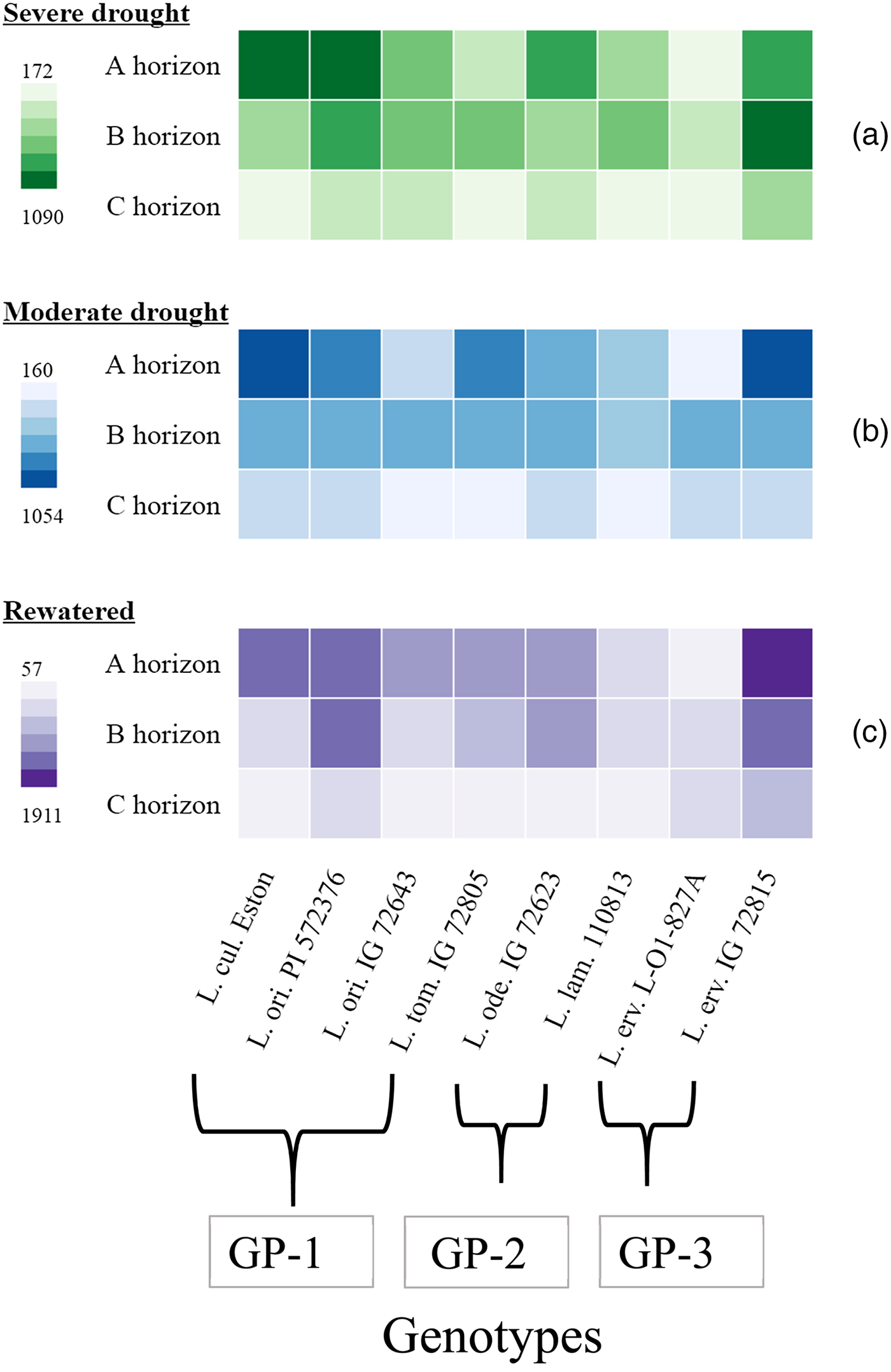
Comparisons of total root length (cm) in the fine roots diameter class in three soil horizons (A–C) in Lens culinaris Eston and seven wild lentil genotypes grown under three drought conditions. Heat maps were generated using an in-house computer program, with a monochrome colour coding system using lighter to darker colours to represent values from lowest to highest. (GP-1, GP-2 and GP-3 denote genotypes in the primary, secondary and tertiary gene pools of lentil, respectively.)

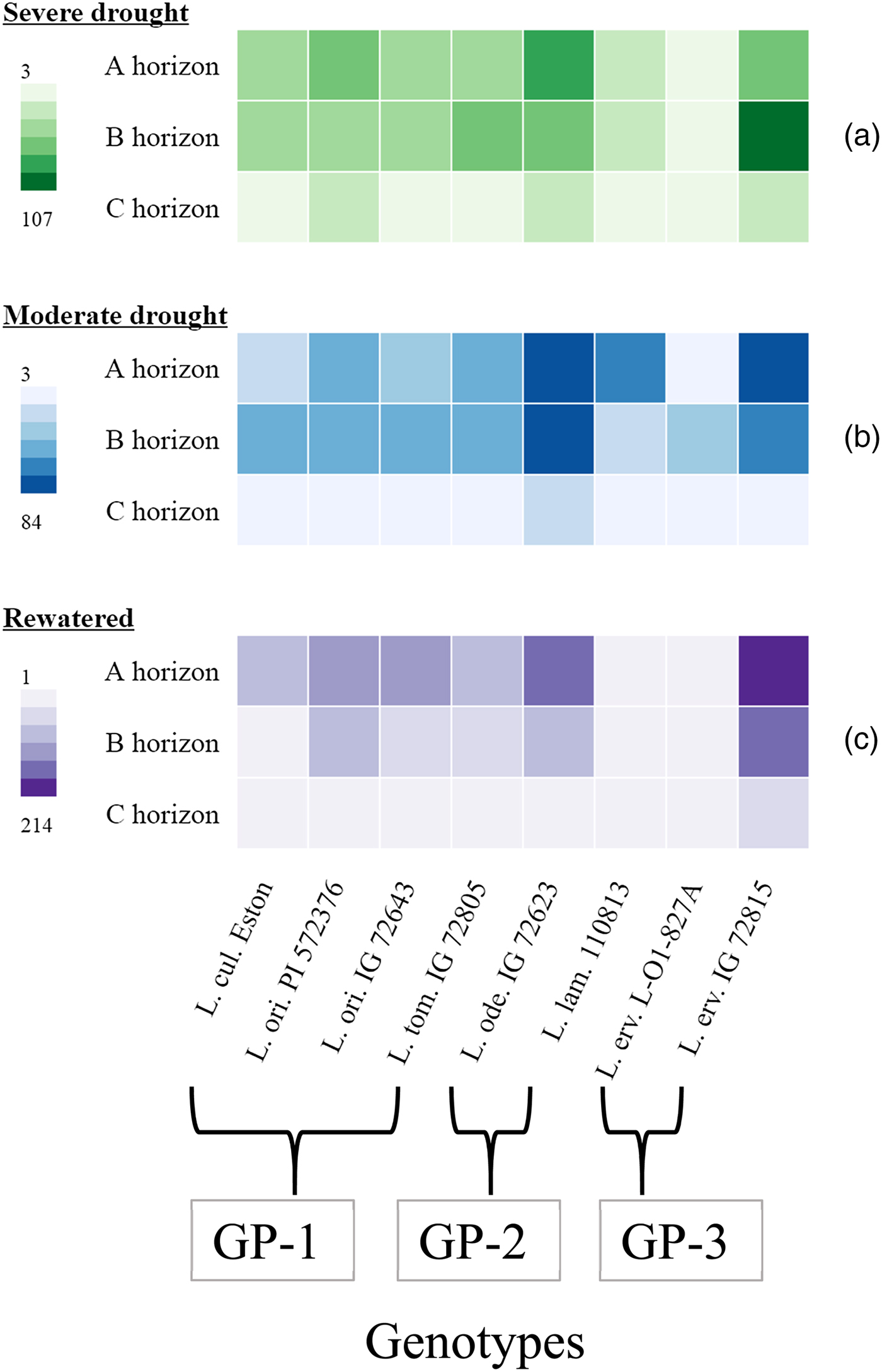
Comparisons of total root length (cm) in the small roots diameter class in three soil horizons (A–C) for Lens culinaris Eston and seven wild lentil genotypes grown under three drought conditions. Heat maps were generated using an in-house computer program, with a monochrome colour coding system using lighter to darker colours to represent values from lowest to highest. (GP-1, GP-2 and GP-3 denote genotypes in the primary, secondary and tertiary gene pools of lentil, respectively.)

Effects in the very fine root diameter class
When grown under severe drought conditions (Fig. 2(a)), L. cul. Eston had either similar or significantly higher TRL in the very fine root diameter class in the A horizon compared with all wild genotypes. In the B horizon, five of the seven wild lentil genotypes had significantly higher TRL compared with L. cul. Eston. Only L. ori. PI 572376 and L. erv. IG 72815 had significantly higher TRL compared with the cultivated lentil genotype in the C horizon. For genotypes in GP-1 grown under severe drought conditions, the TRL in the A horizon of L. cul. Eston was similar to that of L. ori. PI 572376, which was significantly higher than the TRL of the other two wild lentil genotypes; L. ori. PI 572376 had significantly higher TRL in the B and C horizons; and L. tom. IG 72805 had a similar TRL to L. ori. PI 572376 in the B horizon only. In GP-2, the TRL of L. ode. IG 72623 was significantly higher that L. lam IG110813 in the A horizon and vice versa in the B horizon. Similar TRLs were observed in these genotypes in the C horizon. In GP-3, L. erv. IG 72815 had significantly higher TRL in all soil horizons compared with L. erv. L-01-827A.
Under moderate drought conditions (Fig. 2(b)), the TRL in the A and C horizons of L. cul. Eston was significantly higher than all three wild genotypes in GP-1. The TRL of L. cul. Eston and L. ori. PI 572376 were similar in the B horizon while L. ori. IG 72643 had significantly lower TRL in both the A and B horizons compared with the other three genotypes in GP-1. In GP-2, L. ode. IG 72623 had significantly higher TRL in the A horizon compared with L. lam IG110813; and had similar TRL in the B and C horizons. In GP-3, L. erv. IG 72815 had significantly higher TRL in the A horizon compared with L. erv. L-01-827A, but the opposite was true for the B horizon; both had similar TRL in the C horizon.
When plants were re-watered (Fig. 2(c)), L. erv. IG 72815 had significantly higher TRL in all soil horizons compared with all other genotypes. Lens culinaris Eston and L. ori. PI 572376 had significantly higher TRL in the A and B horizons, respectively, compared with the other lentil genotypes in GP-1, and all GP-1 genotypes had similar TRL in the C horizon. For GP-2, L. ode. IG 72623 had a significantly higher TRL in the A and B horizons compared with L. lam IG110813, but these genotypes had similar TRL in the C horizon. In GP-3, L. erv. IG 72815 had significantly higher TRL in all horizons compared with L. erv. L-01-827A.
Effects in the fine root diameter class
Under severe drought conditions (Fig. 3(a)), the TRL in the A horizon of fine roots for genotypes in GP-1 was similar for L. cul. Eston and L. ori. PI 572376; both were significantly higher than the two other genotypes in this GP. In addition, L. ori. IG 72643 had significantly higher TRL compared with L. tom. IG 72805 in this horizon. In the B horizon, all wild lentil genotypes had significantly higher TRL compared with L. cul. Eston; in the C horizon, both L. ori. genotypes had significantly higher TRL compared with the other two genotypes in GP-1. In GP-2, TRL was significantly higher in the A and C horizons for L. ode. IG 72623 and in the B horizon for L. lam IG110813. In GP-3, Lens ervoides IG 72815 had significantly higher TRL in all soil horizons compared with L. erv. L-01-827A.
Under moderate drought conditions (Fig. 3(b)), L. cul. Eston had significantly higher TRL in the A horizon compared with the three wild genotypes in GP-1; L. ori. PI 572376 and L. tom. IG 72805 had similar TRL in this horizon, and this was significantly higher than for L. ori. IG 72643. Similar TRL was observed between genotypes in the B horizon; L. cul. Eston and L. ori. PI 572376 had similar TRL in the C horizon, which was significantly higher than for the other two genotypes in GP-1. In GP-2, L. ode. IG 72623 had significantly higher TRL in all soil horizons compared with L. lam IG110813. In GP-3, L. erv. IG 72815 had significantly higher TRL in the A horizon compared with L. erv. L-01-827A, but similar TRL in the B and C horizons.
When plants were re-watered (Fig. 3(c)), L. erv. IG 72815 had significantly higher TRL in the A horizon compared with L. cul. Eston and all other wild lentil genotypes. Within GP-1, L. cul. Eston had similar TRL to L. ori. PI 572376 in the A horizon, and this was significantly higher than for L. ori. IG 72643 and L. tom. IG 72805. Lens orientalis PI 572376 had significantly higher TRL in the B and C horizons compared with all other genotypes in GP-1. In GP-2, L. ode. IG 72623 had significantly higher TRL in all soil horizons compared with L. lam IG110813, while in GP-3, L. erv. IG 72815 had significantly higher TRL compared with L. erv. L-01-827A in all soil horizons.
Effects in the small root diameter class
Under severe drought conditions (Fig. 4(a)), L. ode. IG 72623 and L. erv. IG 72815 had significantly higher TRL in all horizons compared with all wild genotypes and L. cul. Eston. In GP-1, L. ori. PI 572376 had significantly higher TRL in the A and C horizons compared with all other lentil genotypes, but L. tom. IG 72805 had significantly higher TRL in the B horizon. In GP-2, L. ode. IG 72623 had significantly higher TRL in all soil horizons compared with L. lam. IG 110813; this was also true for L. erv. IG 72815 compared with L. erv. L-01-827A in GP-3. Overall, L. ori. PI 572376, L. ode. IG 72623 and L. erv. IG 72815 were the genotypes that allocated a significant amount of resources into TRL in the C horizon when plants were grown under severe drought conditions.
Under moderate drought conditions (Fig. 4(b)), all wild lentil genotypes except L. erv. L-01-827A allocated more resources into TRL compared with L. cul. Eston. In GP-1, L. ori. PI 572376 and L. tom. IG72805 had similar TRL in the A horizon, which was significantly higher than L. cul. Eston and L. ori. IG 72643. In GP-2, L. ode. IG 72623 had significantly higher TRL in all soil horizons compared with L. lam. IG 110813; this was also the case for L. erv. IG 72815 versus L. erv. L-01-827A in GP-3. Lens odemensis IG 72623 was the only genotype that allocated a significant amount of TRL in the C horizon when plants were grown under moderate drought conditions.
When plants were re-watered (Fig. 4(c)), L. erv. IG 72815, L. ode. IG 72623 and both L. ori. genotypes (PI 572376 and IG 72643) had significantly higher TRL in the A horizon compared with L. cul. Eston and L. tom. IG 72805. In GP-1, L. ori. PI 572376 had significantly higher TRL in the B horizon compared with the other genotypes; all genotypes in this GP had similar TRL in the C horizon. In GP-2, L. ode. IG 72623 had significantly higher TRL in the A and B horizons compared with L. lam. IG 110813; both had similar TRL in the C horizon. In GP-3, L. erv. IG 72815 had significantly higher TRL in all soil horizons compared with L. erv. L-01-827A. Overall, L. erv. IG 72815 was the only genotype across all GPs that allocated a significant amount of TRL in the C horizon when plants were re-watered.
Effects of moisture level on TNT in different soil horizons
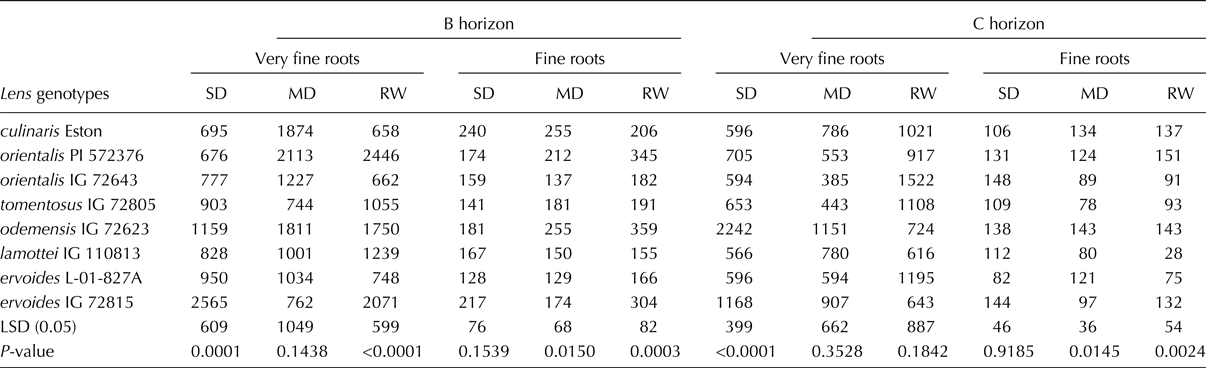
In the B horizon and for the very fine roots diameter class, genotypes in GP-1 had similar TNT when grown under severe and moderate drought conditions; after re-watering, L. ori. PI 572376 had significantly higher TNT compared with the other genotypes. In GP-2, similar TNT values were observed in the very fine root class under all watering regimes. In GP-3, L. erv. IG 72815 had significantly higher TNT in the very fine root class compared with L. erv. L-01-827A when plants were grown under both severe drought and re-watered conditions; these genotypes had similar TNT under moderate drought conditions.
In the B horizon and for the fine root diameter class, genotypes in GP-1 had similar TNT under all moisture levels. Those in GP-2 had similar TNT when plants were grown under both severe and moderate drought, but L. ode. IG 72623 had significantly higher TNT when plants were re-watered compared with L. lam. IG 110813. In GP-3, similar TNT values were observed when plants were grown under both severe and moderate drought conditions; when re-watered, L. erv. IG 72815 had a significantly higher TNT value compared with L. erv. L-01-827A.
In the C horizon and for the very fine root diameter class, genotypes in GP-1 had similar TNT under all moisture levels. For those in GP-2, L. ode. IG 72623 had significantly higher TNT when plants were grown under severe drought conditions compared with L. lam. IG 110813; both had similar TNT under moderate drought and re-watered conditions. Similar TNT values were observed between GP-3 genotypes grown at all moisture levels.
In the C horizon and for the fine root diameter class, similar TNT values were observed among GP-1 and GP-3 genotypes grown under all moisture levels. Similar TNT values were observed in GP-2 genotypes grown under severe drought conditions, but significantly higher TNT were observed in L. ode. IG 72623 compared with L. lam. IG 110813 grown under moderate drought and re-watered conditions.
Discussion
Very fine and fine roots have been extensively studied in terms of carbon allocation in forests and grasslands ecosystems (Norby and Jackson, Reference Norby and Jackson2000). With climate change predictions, focus has shifted to fine roots in cropping systems in an effort to identify plant genotypes with superior ability to extract water under water-limited conditions (Wasson et al., Reference Wasson, Richards, Chatrath, Misra, Prasad, Rebetzke, Kirkegaard, Chistopher and Watt2012; Comas et al., Reference Comas, Becker, Cruz, Byrne and Dierig2013). McCormack et al. (Reference McCormack, Dickie, Eissenstat, Fahey, Fernandez, Guo, Helmisaari, Hobbie, Iversen, Jackson, Leppälammi-Kujansuu, Norby, Phillips, Pregitzer, Pritchard, Rewald and Zadworny2015) propose that the concept of fine roots be either redefined or at least changed to include smaller diameter cut-offs in order to improve the understanding of below-ground contribution of fine roots to terrestrial biosphere processes. By presenting our results in three diameter classes (very fine, fine and small roots), we demonstrate that TRL in different diameter classes in wild and cultivated lentil genotypes differs when plants are grown under different moisture levels. However, we did not carry out a functional classification of roots, reserving this aspect for future studies.
This study demonstrates that wild lentil genotypes are a potential source of diversity in terms of very fine, fine and small root traits that can potentially be introduced into cultivated lentils, making them more plastic with resultant drought-coping strategies. For example, comparing the TRL of both wild and cultivated lentil genotypes under drought conditions across all root diameter classes indicates that L. cul. Eston had its highest TRL concentration in the A horizon. However, even in this horizon, some wild lentil genotypes (specifically L. ori. PI572376, L. ode. IG 72623 and L. erv. IG 72815) had a similar TRL to L. cul. Eston in the very fine and fine root diameter classes when grown under severe and moderate drought conditions (Table 1). Furthermore, the proportion of TRL dedicated to the very fine and fine diameter classes in the A horizon was similar between wild and cultivated lentils genotypes under severe drought conditions (Fig. 1). For this reason, we evaluated differences between these two Lens ervoides parents in the B and C horizons. We observed that L. erv. L-01-827A allocated considerable resources into TRL in the very fine root diameter class compared with both its relative L. erv. IG 72815 and L. cul. Eston in the B horizon and the former in the C horizon (Fig. 1). Whether this increased proportion of TRL in L. erv. L-01-827A translates to increased water and nutrient acquisition from deeper soil layers remains to be determined.
Mean total number of root tips of very fine and fine roots located in the B and C horizons for cultivated and wild lentil genotypes grown under severe drought (SD), moderate drought (MD) and re-watered (RW) conditions

LSD, least significant difference at α = 0.05.
Roots with very fine and fine diameters are known to play a crucial role in water and nutrient uptake, especially under water-limited conditions (Comas et al., Reference Comas, Becker, Cruz, Byrne and Dierig2013). Under severe drought, most wild lentil genotypes (except L. ori. IG 72643 and L. ode. IG 72623) had significantly higher TRL in the very fine root diameter class compared with L. cul. Eston in the B horizon, but L. ori. PI572376, L. lam. IG 110813 and L. erv. IG 72815 had significantly higher TRL in the fine root diameter class compared with L. cul. Eston in same horizon. In the C horizon, two wild lentil genotypes (L. ori. PI572376 and L. erv. IG 72815) had significantly higher TRL in the very fine root diameter class, meanwhile the genotypes L. ori. (PI 572376 and IG 72643), L. erv. IG 72815 and L. ode. IG 72623 had significantly higher TRL in the fine root diameter class; the significantly higher TRL in these wild lentil genotypes makes them potential candidates for introgression under severe drought conditions. Under moderate drought conditions, the TRL in the very fine and fine diameter classes was similar between cultivated and wild lentil genotypes (Figs. 2(b) and 3(b)) and, in some horizons (Fig. 3(b)), L. cul. Eston had significantly higher TRL compared with all wild counterparts.
Small roots can play a role in water and nutrient storage, control rooting depth and the ability to penetrate hard soil cores (Materechera et al., Reference Materechera, Alston, Kirby and Dexter1992). Under severe drought conditions, L. ori. PI572376, L. ode. IG 72623 and L. erv. IG 72815 had significantly higher TRL in the top soil and in the C horizon compared with all other lentil genotypes, which implies they had roots with sufficiently large diameters to conserve moisture and penetrate into deeper soil layers. Under moderate drought conditions, most wild lentil genotypes (except L. erv. L-01-827A) had significantly higher TRL in the small diameter class compared with L. cul. Eston in the A horizon, implying they had more roots with larger diameters compared with their cultivated counterpart and were therefore better established. In the B horizon, L. ode. IG 72623 and L. erv. IG 72815 had significantly higher TRL in the small diameter class, with the former being the only genotype with significantly higher TRL in the C horizon. Therefore, these genotypes would be potential candidates if plant establishment is the target for a breeding programme operating in areas subject to moderate drought conditions. Furthermore, the larger root diameter (Materechera et al., Reference Materechera, Alston, Kirby and Dexter1992), coupled with significantly longer TRL, implies that these wild genotypes have the ability to not only absorb water and nutrients but also penetrate soil pores that otherwise would not be accessible. Another wild lentil genotype for consideration is L. tom. IG 72805. This genotype has roots mostly in the A horizon under fully watered conditions (Gorim and Vandenberg, Reference Gorim and Vandenberg2017b), but under severe drought reallocates significantly more TRL to the very fine and fine root diameter classes in the B horizon compared with L. cul. Eston (Figs. 2(a) and 3(a)). This behaviour makes this genotype a candidate of interest.
Another characteristic of the prairies is the variability of rainfall events from north to south and from one year to another (Sauchyn and Kulshreshtha, Reference Sauchyn, Kulshreshtha, Lemmen, Warren, Lacroix and Bush2008). We attempted to emulate this variability by introducing a re-watered condition after subjecting plants to moderate drought for about 8 weeks. Re-watering greatly increased TRL across all root diameter classes, as evident in the scales of the heat maps for the re-watered treatments compared with moderate drought (Figs. 2–4; e.g. scale of Fig. 2(a) ranges from 109 to 679 but of Fig. 2(b) ranges from 80 to 1271). Our previous study (Gorim and Vandenberg, Reference Gorim and Vandenberg2017b) reports TRL in both cultivated and wild lentil genotypes under fully watered conditions. A comparison of these TRLs to those measured under drought or re-watered conditions indicates lentil genotypes respond differently, with some allocating more resources to the B and/or C horizons. This plasticity could be one of the reasons why lentils are considered more drought tolerant than other legumes such as chickpea (Liu et al., Reference Liu, Gan, Bueckert, Rees and Warkentin2010).
When lentil genotypes were re-watered, the TRL in the very fine root diameter class in L. erv. IG 72815 was significantly higher in all soil horizons compared with all other lentil genotypes. This implies that this genotype produces more very fine roots in response to increased soil moisture and therefore would be a good candidate in situations of drought followed by the return of rain. Re-watering effects on TRL in fine roots of lentil genotypes were different at various soil depths. Lens ervoides IG 72815 had significantly higher TRL in the A and C horizons compared with all other lentil genotypes; in the B horizon, however, others such as L. ori. PI572376, L. tom IG 72805 and L. ode. IG 72623 had significantly higher TRL compared with L. cul. Eston. Lens ervoides L-01-827A also dedicated more TRL to the C rather than A horizon when re-watered. This implies that this genotype, known to respond to drought by employing escape mechanisms (Gorim and Vandenberg, Reference Gorim and Vandenberg2017a), does not exploit the topsoil layer but rather enforces rooting into deeper soil layers under drought or re-watered conditions. This behaviour makes it a good candidate for introgression when groundwater needs to be exploited for plant production.
Genetically related genotypes have been characterized into the same gene pool, implying that crosses between them will more likely result in viable offspring. Our study demonstrates that, among genotypes in GP-1, L. ori. PI 572376 had significantly higher TRL in the very fine and fine root diameter classes in deeper soil layers under severe drought conditions. This suggests that this genotype can be a resource for increasing very fine and fine roots in cultivated lentils through introgression. However, attention should be paid to ensure that plant height is maintained as this genotype is a short plant (Gorim and Vandenberg, Reference Gorim and Vandenberg2017a). Other candidates include L. ode. IG 72623 and L. erv. IG 72815, which belong to GP-2 and GP-3, respectively. The former had significantly higher TRL in the small root diameter class (Fig. 4), implying that it could be a good candidate for introgression in situations where root penetration into deeper soil layers is warranted. Although L. erv. IG 72815 is distantly related to L. cul. Eston, successful introgression has resulted in recombinant inbred lines. These lines are expected to possess superior root lengths in the very fine, fine and small diameter classes; this assessment is the subject of future work.
Another important root trait linked to water absorption is TNT, as tips function as the entry point for not only water but nutrients. Severe drought stress significantly reduced TNT in the very fine root diameter class in the B horizon, except in L. erv. IG 72815 where significant increases were observed. This significant higher number of TNT suggest that this genotype responds to drought by increasing root tip numbers, which is a possible adaptation mechanism in response to increasing soil water deficit. Re-watering resulted in an increased number of root tips in most lentil genotypes.
Conclusion and recommendations
This study demonstrates that the roots of both wild and cultivated lentil genotypes can be categorized based on Böhm (Reference Böhm1979) into very fine, fine and small diameter classes. However, the majority of lentil roots fall into the fine category. Three wild lentil genotypes (L. ori. PI 572376, L. ode. IG 72623 and L. erv. IG 72815) had significantly higher TRL compared with all other genotypes in the very fine, fine and small root diameter classes, with these roots allocated to deeper soil layers. Although these genotypes belong to different GPs, they are potential candidates for introgression that will confer not only abilities for water extraction but also penetration of compact soil layers. Other genotypes of interest are L. erv. L-01-827A and L. tom. IG 72805, both of which invest roots in the B horizon with the latter also possessing trichomes. We recommend that the root traits of recombinant inbred lines resulting from crosses between L. culinaris and these candidate wild lentil genotypes be assessed to determine whether the observed traits are heritable.
Acknowledgements
This research received financial support from Canada's NSERC Industrial Research Chair Program, Saskatchewan Pulse Growers and Global Crop Diversity Trust. The completion of this work was made possible thanks to technical support from the Pulse Crop Field Laboratory crew of the Crop Development Centre, University of Saskatchewan.
Funding
This research received financial support from Canada's NSERC Industrial Research Chair Program (#IRCPG 395994-09), Saskatchewan Pulse Growers (#BRE 1202) and Global Crop Diversity Trust.