1. Introduction
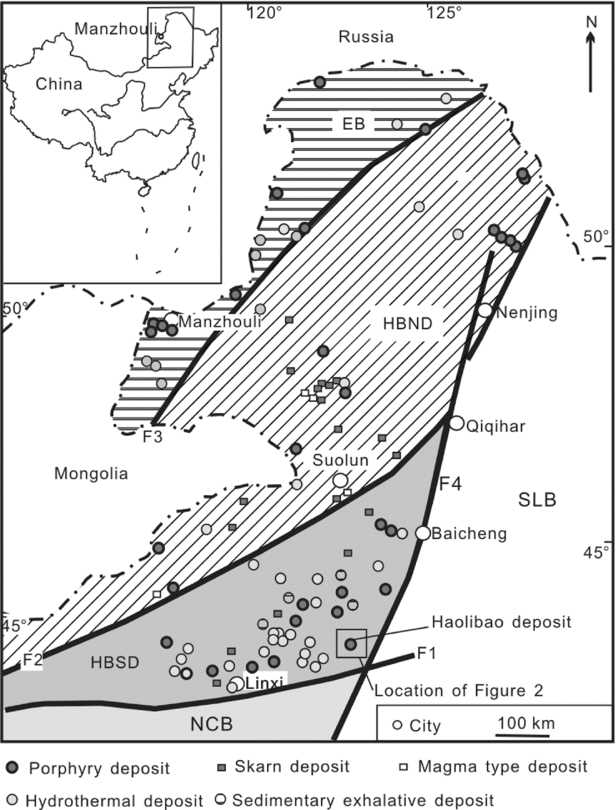
The Da Hinggan Mountains mineral province (DHMP) is one of the important metallogenic belts of China. It contains porphyry, skarn, hydrothermal, magma and sedimentary exhalative metal deposits (Fig. 1). The porphyry, skarn, hydrothermal and magma metal deposits are considered to be Jurassic–Cretaceous based on K–Ar ages, and these metal deposits are thought to be related to Yanshanian magma activity (Rui et al. Reference Rui, Shi and Fang1994; Zhao & Zhang, Reference Zhao and Zhang1997) excluding the Dubaoshan porphyry Cu–Mo deposits (Re–Os isochron age 516 ± 14 Ma) (Zhao et al. Reference Zhao, Bi, Zou, Sun and Du1997). The origin of the sedimentary exhalative metal deposits (e.g. Dajing Cu-polymetal deposit, Huanggang Fe–Sn deposit) is under debate. A few researchers believe that they formed in the DHMP during the Permian (Liu et al. Reference Liu, Ye, Li, Chen and Zhang2001; Ye et al. Reference Ye, Liu, Zhang and Zhang2002), but others think that these sedimentary exhalative metal deposits are also related to the Yanshanian magmatism (Rui et al. Reference Rui, Shi and Fang1994; Zhao & Zhang, Reference Zhao and Zhang1997; Sheng & Fu Reference Sheng and Fu1999; Wang et al. Reference Wang, Hidehiko, Wang and Wang2001, Reference Wang, Qu, Wang, Jiang and Mao2002, Reference Wang, Wang, Wang and Zhu2003). Recent studies show that Permian sedimentary exhalative deposits do indeed exist in the DHMP (Wang et al. Reference Wang, Zhang, Deng and Liu2007; Zeng et al. Reference Zeng, Liu and Liu2007, Reference Zeng, Liu, Yu, Ye and Liu2011; Wang, Reference Wang2008). The Haolibao porphyry Mo–Cu deposit is the first case of a Permian porphyry deposit to be discovered in the DHMP in NE China. The geology, geochronology and especially the tectonic processes for mineralization of this Permian metal deposit have not yet been studied or constrained, despite the fact that such information may provide clues to understanding porphyry mineralization processes and facilitate ore exploration of Permian deposits in the Da Hinggan Mountains or in similar tectonic settings.
Structural units of the Da Hinggan Mountains mineral province showing the location of the major metal ore deposits (modified from BGMR, 1991; Zhao & Zhang, Reference Zhao and Zhang1997). (EB: Erguna Caledonian fold belt; HBND: Hercynian fold belt of the north segment of DHMP; HBSD: Hercynian fold belt of the south segment of the DHMP; NCB: north margin of Caledonian fold belt, the North China Craton; F1: Xilamulun River Fault; F2: Erlian–Hegenshan Fault; F3: Derbugan Fault; F4: Neijiang Fault.)

This paper provides an outline of the geology of the Haolibao porphyry Mo–Cu deposit and focuses on the geochronology of porphyry mineralization. The tectonic controls on mineralization are studied in relation to the close temporal, spatial and genetic relationships between mineralization and Permian magmatism along the Xilamulun River suture of the north margin of the North China Plate. The collision between the North China Plate and Mongolian terranes during the Permian is suggested to explain the magmatism and mineralization within the framework of Palaeo-Asian-Mongolia Ocean tectonics.
2. Geological setting
The DHMP is bounded on the east by the Nenjiang fault and the NE-trending Mesozoic–Cenozoic Songliao Basin and on the west by eastern Mongolia and eastern Russia. The southern boundary of the DHMP is marked by the Xilamulun River fault (Fig. 1). The DHMP is composed of the Erguna Caledonian fold belt, the Hercynian fold belt of the northern DHMP and the Hercynian fold belt of the southern DHMP (Fig. 1). The boundary lines among these tectonic belts are defined by the faults. The DHMP is overlain by Mesozoic volcanics and by volcano-plutonic and sedimentary rocks of the Da Hinggan Mountains volcanic belt.
The Erguna Caledonian fold belt is located along the west Derbugan fault in the NW DHMP (Fig. 1). It is composed of Late Proterozoic metamorphic intermediate-mafic–felsic submarine volcanics and flysch formations, Early Cambrian metamorphic flysch formations and carbonates and Silurian sandstones (Xu et al. Reference Xu, Bian and Wang1998). Extensive granite batholith and dykes intruded the fold belt during the Mesozoic (Xu et al. Reference Xu, Bian and Wang1998).
The Hercynian fold belt in the northern segment of the DHMP is located between the Derbugan and Erlian–Hegenshan faults. The basement rocks of the fold belt are composed of Proterozoic metamorphic rocks, and the fold belt itself is composed of Palaeozoic strata. The Early Palaeozoic strata include carbonates, sandstone and shales, volcanics and flysch formations. The Late Palaeozoic strata include Devonian and Carboniferous marine facies, volcanics, clastics, carbonates and radiolarian-bearing siliceous formations (She et al. Reference She, Li, Li, Zhao, Tan, Zhang, Jin, Dong and Feng2009). Hercynian intrusive rocks are mainly composed of granite, granodiorite, granodiorite porphyry and quartz diorite (Liu et al. Reference Liu, Zhang and Zhang2004).
The Hercynian fold belt in the southern segment of the DHMP is bounded by the Erlian–Hegenshan fault to the north and the Xilamulun River fault to the south (Fig. 1). It is composed of Devonian–Carboniferous ophiolitic mélange, Permian carbonates and clastic formations. The Devonian–Carboniferous ophiolitic mélange is distributed along the Erlian–Hegenshan fault. The ophiolites are mainly composed of metaperidotites (harzburgite and dunite), gabbros and metabasalts and intercalated radiolarian-bearing chert beds (BGMR, 1991). The Permian strata include: (1) the Lower Permian Qingfengshan Formation; (2) the Lower Permian Dashizhai Formation; (3) the Lower Permian Huanggangliang Formation; and (4) the Upper Permian Linxi Formation (BGMR, 1991). The Lower Permian Qingfengshan Formation consists of greywacke and siltstone with tuffaceous intercalation. The Lower Permian Dashizhai Formation consists of submarine lava and tuff (principally andesitic and secondly basaltic) with arenite, characterized by very strong facies change. The Dashizhai volcanic rocks are composed of basalt, basaltic andesite and andesite. The K–Ar ages of whole rocks of the Permian volcanics are between 246 and 277 Ma (Lu et al. Reference Lu, Hao, Duan, Li and Pan2002). The Lower Permian Huanggangliang Formation consists of mix-bedded sandstone and slate with limestone and tuffite. The Upper Permian Linxi Formation consists of terrestrial sandstone, siltstone and mudstone with tuffaceous intercalation.
Mesozoic volcanic rocks and intrusive rocks account for at least 75% of the DHMP area (Shao et al. Reference Shao, Zhang and Mu1998). Volcanic rocks are mainly intermediate felsic, whereas intrusive rocks are mainly granite, granodiorite and granite porphyry emplaced in the shape of batholiths, stock and dykes. Fluviolacustrine sedimentary rocks and coal beds also appear in the Mesozoic basins. The volcanic basins and intrusive bodies are controlled by the faults (Zhao & Zhang, Reference Zhao and Zhang1997; Guo et al. Reference Guo, Fan, Wang and Lin2001).
3. Ore deposit geology
The Haolibao porphyry Mo–Cu deposit is located in the southern segment of the DHMP (Fig. 1). The Mo–Cu ore bodies were discovered during detailed re-examination of the geophysical anomalies in 1974 (Wang & Chen, Reference Wang and Chen1986). Detailed exploration was carried out during 1976–1978. The exploration work revealed that the Haolibao deposit is a buried deposit.
3.a. Geology of the ore area
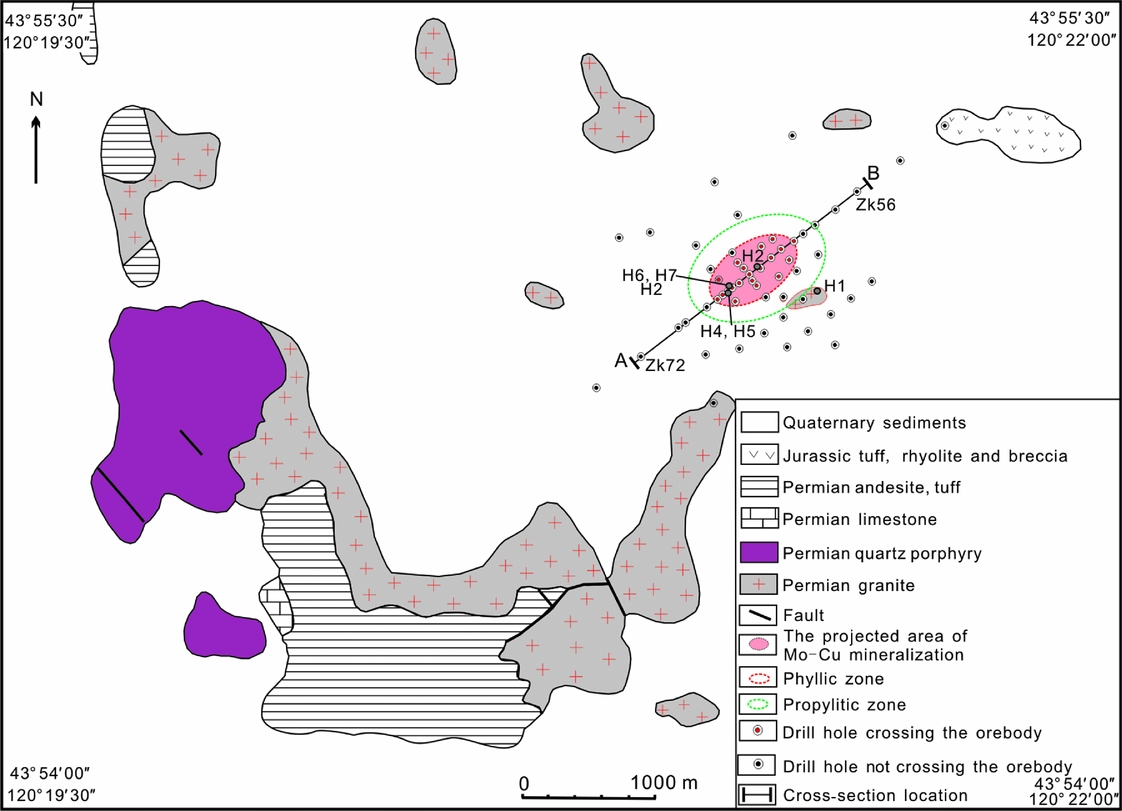
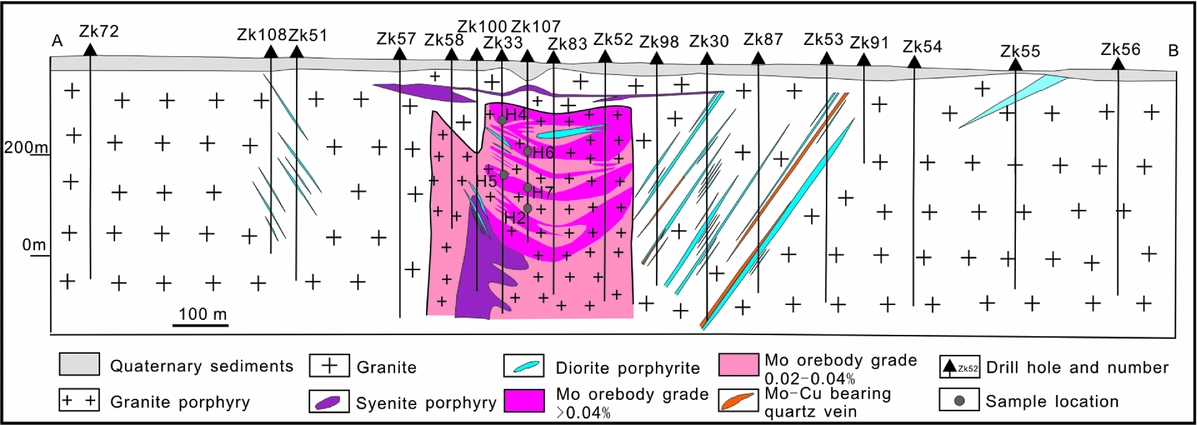
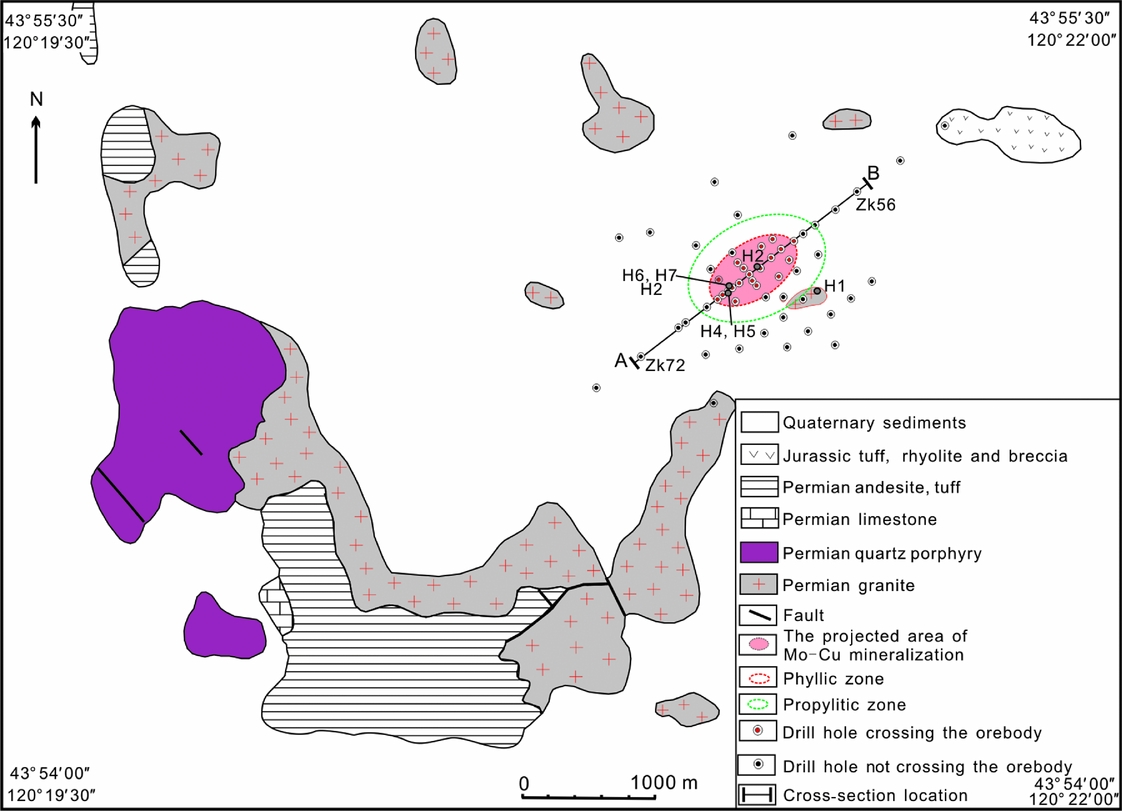
The geology of the Haolibao deposit is characterized by the scattered distribution of Permian strata and plutonic rocks (Fig. 2). Regionally, there are two stratigraphic units of Permian and Jurassic age. The Permian unit comprises low-grade metamorphosed metaclastic rocks (metamorphosed metasandstone, slate and phyllite), volcanic rocks and locally recrystallized limestone. The Jurassic unit consists of tuff, tuff breccia, sandstone, coal bed and shale. The Jurassic volcanic rocks appear locally in the NE Haolibao deposit area (Fig. 2). A large-scale Jurassic granite pluton intruded into the Permian strata and was covered by the Jurassic rocks. The pluton is composed of quartz porphyry, granite and granite porphyry. The granite is composed of 30% quartz, 40% K-feldspar, 25% plagioclase and 5% biotite, with accessory magnetite, apatite and zircon. The granite porphyry intrudes into the granite (Fig. 3). The granite porphyry is typically porphyritic with crystals of quartz, plagioclase and K-feldspar, which commonly represent 20% of the rock. The matrix mineral assemblage includes quartz, K-feldspar and plagioclase, with minor amounts of biotite. Accessory minerals include magnetite, zircon and apatite. Silicification, sericitization and kaolinization are developed in the granite porphyry stock. There are various diorite porphyrite dykes of different widths, varying from several tens of centimetres to several metres, intruding the Jurassic granitic pluton and the Permian strata.
Geological map of the Haolibao deposit (modified from Wang & Chen, Reference Wang and Chen1986). The section line is shown in Figure 3.
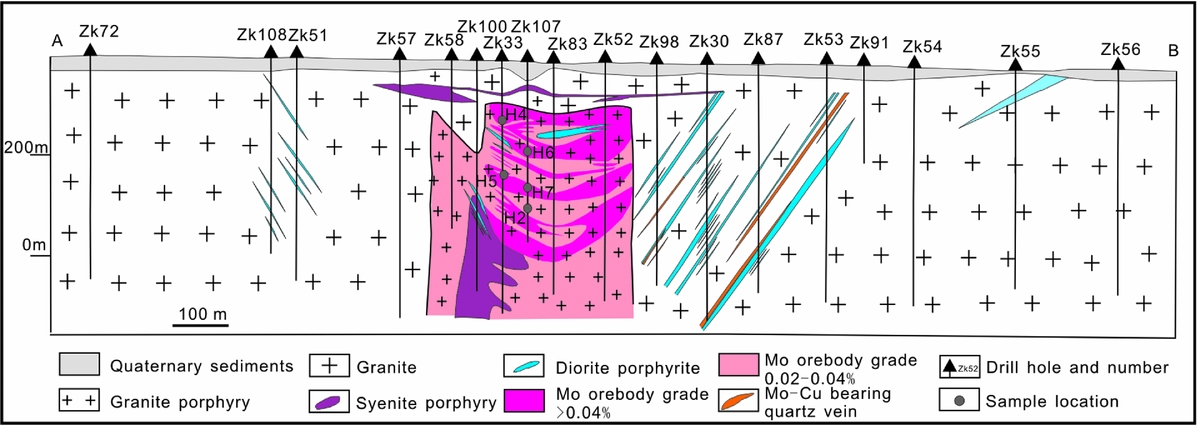
Geological section across the Haolibao deposit (modified from Wang, Reference Wang1979).
3.b. Deposit geology
The Mo–Cu mineralization within the Haolibao deposit is predominantly localized in the buried granite porphyry stock, where the orebodies form stockwork and breccia. Vein-type mineralization is also recognized in the granite (Fig. 3). The host rocks are mainly granite porphyry with minor amounts of granite (Fig. 3). The granite porphyry has been dated by K–Ar methods at 113 Ma (Wang et al. Reference Wang, Wang and Wang2000). The molybdenum grade of the deposit ranges from 0.06% to 0.08% and the copper grade ranges from 0.2% to 1.33% (Shen, Reference Shen2008). Widespread hydrothermal alteration, approximately elliptical in shape in plan view, is recognized at Haolibao (Fig. 2). The stockwork and breccia mineralization mainly occur within the inner phyllic zone, and the vein-type mineralization occurs within the propylitic zone (Wang & Chen, Reference Wang and Chen1986).
3.b.1. Stockwork mineralization
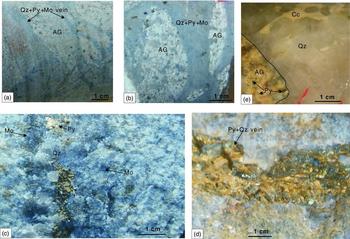
Stockwork mineralization consists of veinlets (Fig. 4a) or networks of quartz, quartz-sulphide and sulphide commonly in the granite porphyry. The width of the veinlets is less than 2 cm. This ore type is characterized by dissemination and veinlets of pyrite, molybdenite and chalcopyrite. The orebodies are predominantly layered and lenticular (Fig. 3). The main layered orebody is 400 m in length and 8–41 m in thickness.
Representative photographs of main mineralization styles and stages: (a) veinlet ore; (b) breccia ore; (c) quartz+molybdenite+pyrite vein of stage 1; (d) coarse pyrite+quartz vein of stage 2; (e) quartz+calcite vein of stage 3. (AG: altered granite porphyry; Py = pyrite; Mo = molybdenite; Qz = quartz; Cc = calcite.)

3.b.2. Breccia mineralization
Breccia mineralization occasionally occurs within cryptoexplosive breccia (Fig. 4b). The clasts consist of granite porphyry with minor amounts of granite. The clast sizes range from a few millimetres to some tens of centimetres with angular, subangular and rounded shapes. Clasts are cemented by a quartz–molybdenite–pyrite–chalcopyrite matrix. There are no clear boundaries among the breccia orebody, veinlet orebody and wallrocks.
3.b.3. Vein mineralization
Vein-type orebodies occur within the granite in the outer part of the porphyry-type mineralization and are hosted by faults (Fig. 3). The orebodies consist of several quartz veins, the largest length of which is c. 400 m, with thicknesses varying from 1.0 to 6.0 m and a dip depth of 500 m. The average copper grades of vein-type orebodies are 0.3–3.6% (Shen, Reference Shen2008). The alteration centred on Mo–Cu-bearing quartz veins includes silification, sericitization and chloritization, and the width of alteration is generally less than 2 m.
3.c. Ore mineralogy
The ore minerals in the stockwork and breccia orebodies are mainly pyrite, molybdenite and chalcopyrite, with minor amounts of magnetite, sphalerite, galena, bornite, chalcosine, stylotypite and magnetite (Shen, Reference Shen2008); those in vein orebodies are chalcopyrite, pyrite and molybdenite, with minor amounts of sphalerite and galena.
Based on the structural, textural and mineralogical relationships of the ores, three hydrothermal stages can be distinguished: (1) a quartz–pyrite–molybdenite–chalcopyrite stage (Fig. 4c); (2) a pyrite–quartz–sphalerite–galena stage (Fig. 4d); and (3) a quartz–calcite–fluorite stage (Fig. 4e). The quartz–pyrite–molybdenite–chalcopyrite stage is the main molybdenum–copper mineralizing stage and is characterized by quartz veinlets and veins with sericitic alteration halos, which are abundant in molybdenite and chalcopyrite. Molybdenite is also abundant as films with no other associated sulphide or gangue minerals. Minor amounts of magnetite appear in this stage. In the pyrite–quartz–sphalerite–galena stage, pyrite–quartz veins and pyrite veinlets are the major products. The pyrite–quartz veinlets often cut the early-stage veinlets or veins. The sulphides are mainly pyrite, with minor amounts of sphalerite and galena. The quartz–calcite–fluorite stage is characterized by carbonate alteration and cuts the early-stage veinlets and altered rocks.
Most of the molybdenite crystals occur as lamina or lamina aggregate and their crystal size is generally from 0.05 to 2 mm. Molybdenite occurs as single laminas or laminated aggregates in veinlets that consist of quartz, pyrite, molybdenite and chalcopyrite and as cement in breccia ores. Pyrite is the predominant sulphide mineral and occurs as euhedral–subhedral dissemination, aggregates or veinlets in the granite porphyry and within quartz veins. Pyrite size ranges from 2 to 5 mm. Chalcopyrite occurs principally as disseminated and veinlet anhedral grains, ranging between 1 and 2 mm in size. It is intergrown mainly with pyrite.
4. Samples and analytical methods
4.a. Samples
Two samples from representative rock types in the Haolibao deposit area were selected for a laser-ablation inductively coupled-plasma mass-spectrometry (LA-ICP-MS) geochronological study. Their locations are shown in Figure 2. Sample H1 is the fresh granite and sample H2 is the altered granite porphyry.
Veined molybdenites were sampled to enable the collection of significant amounts of molybdenite separates for duplicate analyses of a single sample. Four molybdenite samples from the Haolibao deposit were collected in two drill holes (Fig. 3). Two samples (H4 and H5) were from drill hole Zk33 and two samples (H6 and H7) were from drill hole Zk107 (Fig. 3). Microprobe screening of these samples revealed euhedral molybdenite crystals and confirmed the absence of clay intergrowths.
4.b. Analysis
The major intrusive rocks in the ore area were sampled and analysed to determine the times of magma intrusive activities and infer the ore-forming tectonic environment. Zircon grains were separated from two samples of the granite and granite porphyry from the Haolibao deposit (Fig. 2). Every sample is c. 2.5 kg. The samples were crushed, milled, sieved, washed and separated in mineral concentrates using conventional heavy-liquid and Frantz magnetic separators. Zircon grains were then handpicked from the heavy-mineral concentrate at the Langfang Institute of Regional Investigation, Hebei Province. These zircon grains were mounted on epoxy disks, together with the 91500 reference zircon (1065 Ma, uranium content 81×10−6, Wiedenbeck et al. Reference Wiedenbeck, Alle, Corfu, Griffin, Meier, Oberli, Vonquadt, Roddick and Speigel1995), which was used to calibrate U, Th and Pb concentrations. They were polished and photographed in transmitted light and cathodoluminescence (CL). The CL imaging was completed at the Electron Microprobe Laboratory, Institute of Geology and Geophysics, Chinese Academy of Sciences.
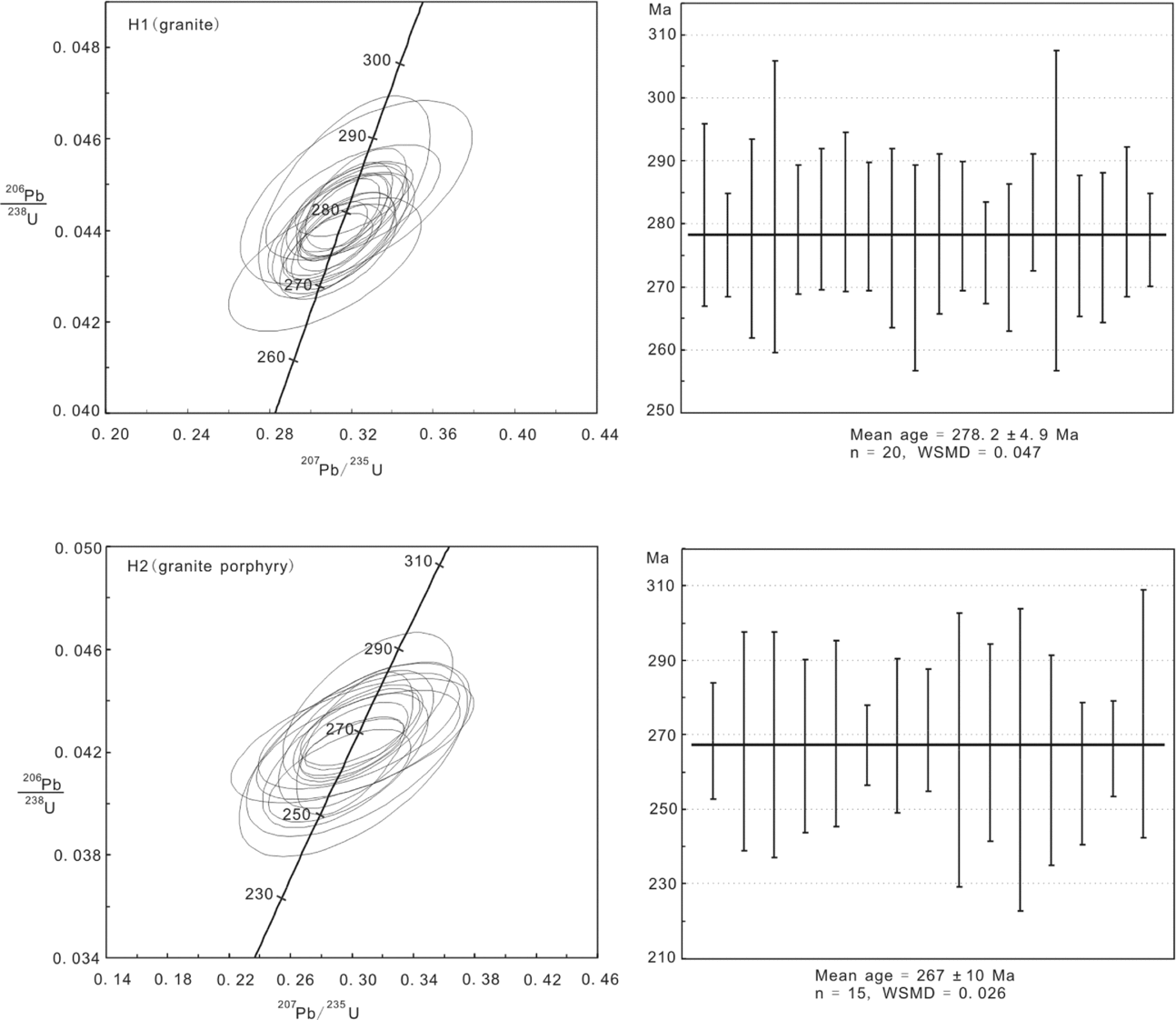
U–Th–Pb analyses were performed using the LA-ICP-MS at the State Key Laboratory of Geological Processes and Mineral Resources, Chinese University of Geosciences. The ICP-MS is an Agilent 7500a (made by Agilent Co., USA), and the laser system is a GeoLas 2005 (made by Lambda Physik Co., Germany). For details of experimental conditions and of the procedures and principles, see Yuan et al. (Reference Yuan, Gao, Liu, Li, Gunther and Wu2004) and Liu et al. (Reference Liu, Hu, Gao, Gunther, Xu, Gao and Chen2008), respectively. The data were processed using the Squid and Isoplot/Ex software of Ludwig (Reference Ludwig2003). The errors in ages listed in Table 1 are cited as 1σ, and the weighted mean ages are quoted at 95% confidence level (Fig. 5).
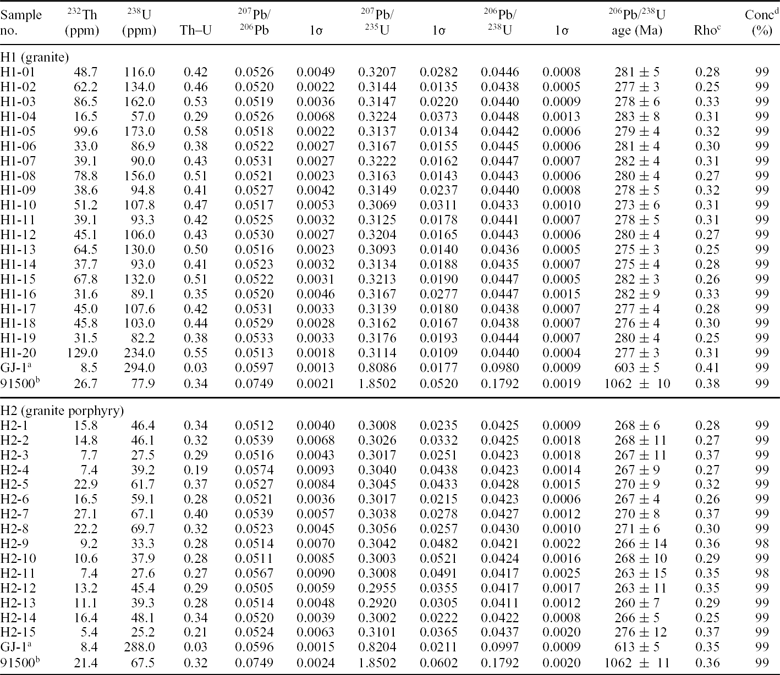
Zircon U–Pb data for the Haolibao granite and granite porphyry

aMean of four analyses; bMean of 10 analyses; cRho the error correlation defined as err 206Pb/238U/err207Pb/235U; dDegree of concordance = (238U/206Pb age×100/207Pb/206Pb age).
Tera–Wasserburg concordia plot and weighted average plot of LA-ICP-MS U–Pb isotope data for granite (H1) and granite porphyry (H2) of the Haolibao Mo–Cu deposit.

Re–Os isotope analyses were performed at the Re–Os Laboratory, National Research Center of Geoanalysis, Chinese Academy of Geological Sciences, Beijing, China. The chemical separation procedure followed that described by Du et al. (Reference Du, He and Yin1995, Reference Du, Wang, Sun, Zhao, Liu, Piestrzynski, Speczik, Pasava and Gize2001) and Shirey & Walker (Reference Shirey and Walker1995). A brief description is given in the following. A Carius tube digestion method was used (Shirey & Walker, Reference Shirey and Walker1995). The weighed sample was loaded in a Carius tube through a long, thin-necked funnel. A mixture of 190Os and 185Re spike solutions, 2 mL of 10 M HCl and 4 mL of 16 M HNO3 was loaded while the bottom part of the tube was frozen at –80 °C to –50 °C in an ethanol–liquid-nitrogen slush. The top was sealed using an oxygen–propane torch. The tube was then placed in a stainless-steel jacket and heated for 24 h at 200 °C. Upon cooling, the bottom part of the tube was kept frozen, the neck of the tube was broken, the contents of the tube were poured into a distillation flask and the residue was washed out with 40 mL of water.
Osmium was separated as OsO4 by distillation at 105–110 °C and was trapped with Milli-Q water. During distillation, the reverse aqua regia acted as the oxidizer. Rhenium was extracted from the residue by acetone in a 5 M NaOH solution (Du et al. Reference Du, He and Yin1995, Reference Du, Wang, Sun, Zhao, Liu, Piestrzynski, Speczik, Pasava and Gize2001). The total procedure blanks are c. 3 pg for Re and c. 0.1 pg for Os, which are far lower than the Re and Os concentrations in the analysed samples. The influence of the blanks on the measurements of the Re and Os isotopic compositions is therefore negligible. The Re–Os isochron is calculated with Isoplot (Ludwig, Reference Ludwig2003). The uncertainty of the Re–Os ages is 2σ.
A Thermo Jarrell Ash (TJA) X-series ICP-MS was used for the determination of Re and Os isotope ratios. Average blanks for the total Carius tube procedure were c. 10 pg Re and c. 1 pg Os. The analytical reliability was tested by duplicate analyses of the molybdenite standard JDC from the Jinduncheng porphyry Mo deposit, Shanxi Province, China (Du et al. Reference Du, Wu, Sun, Wang, Qu, Markey, Stein, Morgan and Malinovoskiy2004). The uncertainty of Re and Os contents includes errors related to weighing of the sample and diluent, calibration of the diluent, fractionation correction of the mass spectrometer and the measurement of isotopic ratios for the test sample. The confidence level is 95%. The uncertainty of the model age includes the uncertainty (1.02%) of the decay constant, with a confidence level of 95%. The average Re–Os age of JDC is 141.4 ± 2 Ma (95% confidence level). The average Re and Os concentrations are 16.97 μg g−1 and 24.93 ng g−1, respectively.
5. Results
5.a. LA-ICP-MS U–Pb age
The zircon LA-ICP-MS data are processed and concordant data are shown in Table 1 and Fig. 5. Zircon grains from the granite (H1) in the deposit area (Table 1) have U and Th contents of 16.5–129 ppm and 57–234 ppm, respectively, with Th/U ratios of 0.29–0.55. The 20 dated grains have an average Th/U ratio of 0.44; these grains show oscillatory zoning throughout each grain and are evidently of igneous origin. The 20 analyses performed on the zircons yield concordant ages, ranging between 273 and 283 Ma (Table 1 and Fig. 5). These analytical values are consistent within the error limit. The 20 analyses gave a weighted mean 206Pb/238U age of 278.2 ± 4.9 Ma (MSWD = 0.047). We interpret this age to be the time of emplacement and crystallization of the granite.
Zircon grains from the granite porphyry (H2) have U and Th contents of 5.4–27.1 ppm and 25.2–69.7 ppm, respectively, with Th/U ratios of 0.19–0.40. The 15 dated grains have an average Th/U ratio of 0.3; these grains also show oscillatory zoning throughout each grain and are also evidently of igneous origin. The 15 analyses on the zircons yield concordant ages, ranging between 260 and 276 Ma. These analyses are also consistent within the error limit. The 15 analyses yield a weighted mean 206Pb/238U age of 267 ± 10 Ma (MSWD = 0.026), which is considered to be representative of the crystallization age of the granite porphyry.
5.b. Re–Os age
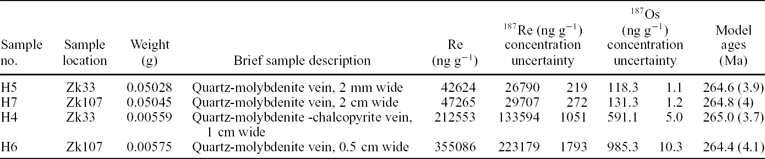
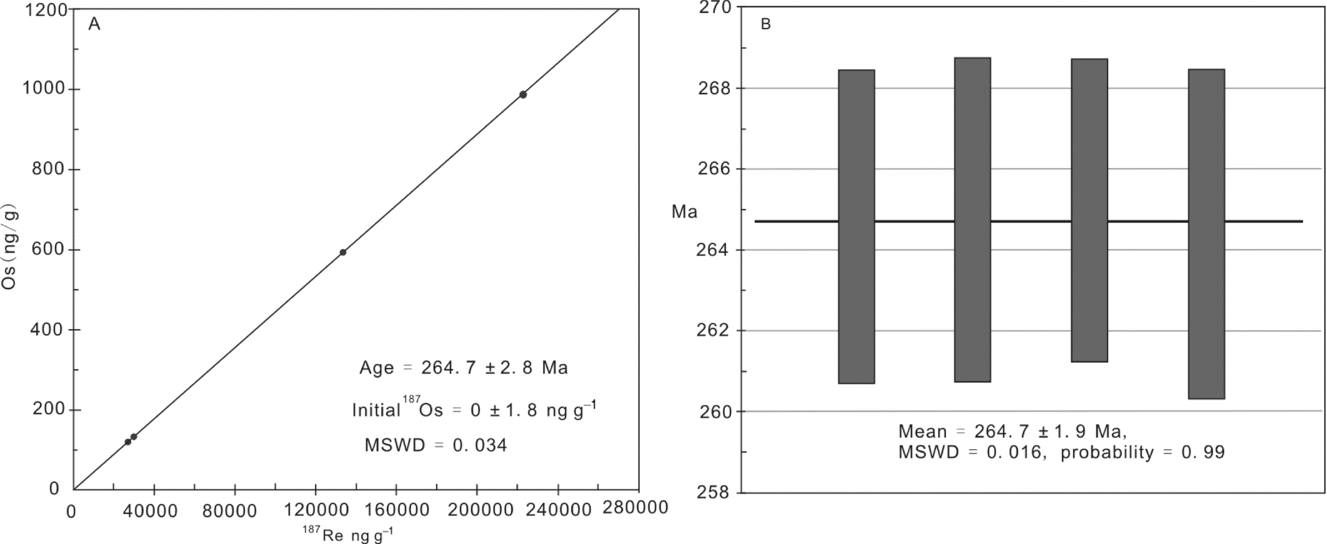
The abundance of Re and Os and the osmium isotopic compositions of the porphyry ores from the Haolibao deposit are shown in Table 2. The Re and Os contents are different. The 187Re and 187Os contents of the ores range from 26.8 to 223.2 μg g−1 and from 118.3 to 985.3 ng g−1, with average values of 103.3 μg g−1 and 456.5 ng g−1, respectively. The Haolibao deposit has medium Re and Os contents. The Re g1 content is less than that in the Siberian porphyry Cu-Mo deposit (where the average value ranges from 164 to 19800 μg g−1) (Berzina et al. Reference Berzina, Sotnikov, Economou-Eliopoulos and Eliopoulos2005) and larger than that in the Mongolian porphyry Mo-Cu deposit (where the average value ranges from 14 to 68 μg g−1) (Berzina et al. Reference Berzina, Sotnikov, Economou-Eliopoulos and Eliopoulos2005). A regression analysis was applied to four analytic data points to yield an isochron age of 264.7 ± 2.8 Ma with an initial 187Os value of 0 ± 1.8 ng g−1 (Fig. 6a). Model ages for ore samples range from 264.4 to 265.0 Ma (Table 2) and the mean age for ore samples is 264.7 ± 1.9 Ma (2σ, MSWD = 0.016) (Fig. 6b). The isochron was calculated by means of the l87Re decay constant of 1.666×10⁻¹¹ a−1 (Smoliar et al. Reference Smoliar, Walker and Morgan1996) and Isoplot software (Ludwig, Reference Ludwig2003). This isochron reflects the ore-forming time of Haolibao deposit.
Re–Os isotope data for molybdenite samples from the Haolibao porphyry Cu–Mo deposit

Enriched 190Os and 185Re were obtained from the Oak Ridge National Laboratory. Decay constant: λ(187Re) = 1.666 × 10⁻¹¹ a−1 (Smoliar et al. Reference Smoliar, Walker and Morgan1996). The uncertainty of the contents of Re and Os includes weighing error of sample and diluent, calibration error of diluent, fractionation correction error of mass spectrum measurement and isotopic ratios measurement error of awaiting test sample. The confidence level is 95%; uncertainty of the model age includes the uncertainty (1.02%) of the decay constant in confidence level (95%). The concentrations of common Os in molybdenite were determined as lower than 0.02 ng g−1 and can be ignored. Model ages for the deposit were calculated by assuming that the initial abundance of 187Os is zero. The numbers within the brackets in the table are measurement errors, and correspond to the last digit of analytical data before the brackets.
Re–Os isochron plot for molybdenite samples from the Haolibao Mo–Cu deposit.

6. Discussion
6.a. Age of mineralization
Previous geochronological studies of the Haolibao deposit reported Cretaceous ages for granites (114–145 Ma) on the basis of K–Ar determinations for whole-rock intrusive bodies (Wang & Chen, Reference Wang and Chen1986). Most authors (Xiao & Yang Reference Xiao and Yang1997; Shen Reference Shen2008; Jia et al. Reference Jia, Wei, Gong and Zhao2011; Zeng et al. Reference Zeng, Liu, Chu, Wang, Sun, Duan and Zhou2012a , Reference Zeng, Liu, Jia, Wan, Yu, Ye and Liu b ) used these ages to infer that the Haolibao Mo–Cu deposit was formed in the late Yanshanian (Cretaceous).
The new Re–Os and U–Pb data presented here provide strong evidence that a Permian magmatic event is responsible for the porphyry intrusion and Mo–Cu mineralization at Haolibao. The consistency of Re–Os ages from four different samples suggests that molybdenite mineralization occurred during a short period of time. The previously reported Cretaceous K–Ar ages (Wang & Chen, Reference Wang and Chen1986) do not reflect ages of primary crystallization or mineralization of the Haolibao deposit. The K–Ar ages probably reflect the influence of later magmatic overprinting that may have caused Ar loss or partial resetting of the K–Ar system. The new Re–Os and U–Pb ages for the Haolibao porphyry Mo–Cu deposit show that this deposit formed during the Permian period, not during the Cretaceous as previously thought. The new age determination for the Haolibao deposit has the important metallogenetic implication that a Permian porphyry metallogenic belt may exist in the southern Da Hinggan Mountains.
6.b. Permian magmatism and Mo mineralization
The zircon U–Pb ages of 278 and 267 Ma for granite and granite porphyry, respectively, from the Haolibao deposit show that the Haolibao intrusive body was emplaced in the Permian. The U–Pb zircon ages of the granite range from 273 ± 6 to 283 ± 8 Ma (Table 1) and give a weighted mean 206Pb/238U age of 278 ± 5 Ma (Fig. 5). The U–Pb zircon ages of the granite porphyry range from 260 ± 7 to 276 ± 12 Ma (Table 1) and yield a weighted mean 206Pb/238U age of 267 ± 10 Ma. The Mo–Cu mineralization at Haolibao occurs within a phyllic zone around the granite porphyry stock as dissemination and veinlets. Model ages of molybdenites change from 264.4 ± 4.1 to 265.0 ± 3.7 Ma (Table 2), overlapping each other within measurement uncertainty. The Re–Os isochron age of molybdenites is 264.7 ± 1.9 Ma. There may be a small interval (about two million years) between the emplacement age of granite porphyry (267 Ma) and the Mo–Cu mineralization age (265 Ma), although these two ages overlap within measurement uncertainty. These age data suggest that the Mo–Cu mineralization was associated with the Haolibao granite porphyry. The main period of ore formation may postdate emplacement of the host pluton by several million years, as is seen in magmatic–hydrothermal systems in other regions of the world (Reynolds et al. Reference Reynolds, Ravenhurst, Zentilli and Lindsay1998; Kendrick et al. Reference Kendrick, Burgess, Pattrick and Turner2001; Selby & Creaser, Reference Selby and Creaser2001).
6.c. Tectonic setting of Mo–Cu mineralization
The mineral deposit system is heterogeneously, but not randomly, distributed in time and space (Meyer, Reference Meyer1988; Berley & Groves, Reference Berley and Groves1992). The mineral distribution is intimately related to the evolution of the Earth, particularly to its progressive cooling and geodynamic evolution from plume-influenced tectonics to modern plate tectonics (Groves et al. Reference Groves, Condie, Goldfarb, Hronsky and Vielreicher2005; Kerrich et al. Reference Kerrich, Goldfarb and Richards2005). Mineral deposit types are generally sensitive indicators of geodynamic environments and other environmental factors (Sillitoe, Reference Sillitoe, Hagemann and Brown2000; Groves & Bierlein, Reference Groves and Bierlein2007; Dill, Reference Dill2010; Groves et al. Reference Groves, Bierlein, Meinert and Hitzman2010). For example, the classic deposit styles of a continental arc environment are porphyry Cu–Au–Mo deposits, as typified by those of the Andes, the North American Cordillera, the Altaids and the SW Pacific (Groves & Bierlein, Reference Groves and Bierlein2007).
Studies of geological features from the Haolibao deposit show that the mineralization mainly occurs as disseminated, stockwork and breccia, all within the top of the granite porphyry stock. The deposit has clear alteration zoning, including a phyllic zone and a prophylitic zone. These features are similar to those of high-temperature deposits in magma arc regions (Cline & Bodnar, Reference Cline and Bodnar1991; Bodnar, Reference Bodnar1994; Seedorf et al. Reference Seedorf, Dilles, Proffett, Einaudi, Zurcher, Stavast, Johnson and Barton2005). The Haolibao deposit therefore might also be formed in a magma arc region.
Many studies have shown that the collision between the Siberian Plate and the North China Plate finished at the end of the Permian (Zhang, Reference Zhang1994; Dobretsov et al. Reference Dobretsov, Berzin and Buslov1995; Windley et al. Reference Windley, Kroner, Guo, Qu, Li and Zhang2002; Xiao et al. Reference Xiao, Windley, Hao and Zhai2003, Reference Xiao, Kroner and Windley2009; Wu et al. Reference Wu, Zhao, Sun, Wilde and Yang2007; Chen et al. Reference Chen, Zhai and Jiang2009; Jian et al. Reference Jian, Liu, Kroner, Windley, Shi, Zhang, Zhang, Miao, Zhang and Tomurhuu2010). Xiao et al. (Reference Xiao, Windley, Hao and Zhai2003) suggested that the Solonker suture records the termination of the Central Asian Orogenic Belt and formed at the end of the Permian. Xiao et al. (Reference Xiao, Kroner and Windley2009) suggested that in Inner Mongolia and adjacent areas two wide accretionary wedges developed along the southern active margin of Siberia and the northern active margin of the North China Craton, and may have lasted until the Middle Triassic. Chen et al. (Reference Chen, Zhai and Jiang2009) suggested that the Palaeo-Asian Ocean closed from west to east along the Solonker suture during the period 260–250 Ma. Jian et al. (Reference Jian, Liu, Kroner, Windley, Shi, Zhang, Zhang, Miao, Zhang and Tomurhuu2010) suggested that the subduction–collision events in this area took place in the Permian. The timing of post-collision magmatism is well constrained as latest Permian to earliest Triassic (255–248 Ma), and the magmatic episode immediately followed complete ocean closure in the Late Permian (260–251 Ma). We define the existence of the Permian granite magmatism (267–278 Ma) along the Xilamulun River suture. Wu et al. (Reference Wu, Sun, Ge, Zhang, Grant, Wilde and Jahn2011) also defined the Permian granite magmatism (273–274 Ma) along the Xilamulun River suture in Linxi. These new pieces of evidence indicate that the final closure of the ocean basin between North China and Mongolian terranes may have began during the Early Permian (278 Ma) and that the Late Permian and Early Triassic magmatism took place in a post-collision tectonic setting. The Haolibao intrusive body and porphyry Mo–Cu deposit therefore formed in a collisional tectonic setting. The collisional tectonic setting also indicates that a Permian porphyry metallogenic belt along the Xilamuun River suture may exist.
7. Conclusion
The granite and granite porphyry from the Haolibao porphyry Mo–Cu deposit have Permian crystallization ages (U–Pb) of 278.2 ± 4.9 and 267 ± 10 Ma, respectively, for the intrusive body and quartz–molybdenite veinlets yield a mineralization age (Re–Os) of 264.7 ± 2.8 Ma. The Mo–Cu mineralization is related to the granite porphyry.
The presence of the Haolibao Permian intrusive body suggests that Permian magmatism took place along the Xilamulun River suture and further provides new evidence for the final closure time of the ocean basin between North China and Mongolian terranes.
The Permian magmatism and porphyry Mo–Cu mineralization of the Haolibao deposit indicate that a Permian porphyry metallogenic belt along the Xilamulun River fault may exist.
Acknowledgements
We thank Alukeerqinqi Bureau of Land and Resources, Chifeng, for assistance with field work. This study was financially supported by the Major State Basic Research Program of China (No. 2013 CB429800) and the National Natural Science Foundation of China (No. 40972065). We also thank Dr Qu Wenjun (National Research Center of Geoanalysis, Chinese Academy of Geological Sciences) for the Re–Os isotope analyses and Dr Dave Selby for his constructive comments.