1 Introduction
The financial soundness of pension systems for state and local government workers has been a topic of much debate. In recent work, Novy-Marx and Rauh (Reference Novy-Marx and Rauh2009, Reference Novy-Marx and Rauh2011) have argued that the use of Government Accounting Standards Board (GASB) rules to discount future benefit payments results in present value measures of liabilities that are too low to reflect the true economic liability faced by state taxpayers. At the same time, a number of states have enacted changes designed to reduce the liabilities associated with their pension systems (Snell, Reference Snell2009, Reference Snell2010). Most of these changes affect new employees only, and hence have no impact on standard liability measures, which do not consider future employees. However, some changes, such as the reductions in the cost-of-living adjustments (COLAs) passed by Colorado and Minnesota this year, do affect existing plan members and hence do affect the economic present value of current state pension liabilities.
In this paper, we examine the present value of state pension liabilities under existing policies and separately under several sets of hypothetical policy measures. In particular, we consider changes to COLAs, full-retirement ages, early-retirement ages, and buyout rates for early retirement.
As we have pointed out before, the key problem with GASB accounting is the discount rate. States discount pension liabilities at an expected return on pension plan assets, and that rate is typically around 8%. Discounting procedures based on the principles of financial economics require discounting at rates that reflect the riskiness of the liabilities (Modigliani and Miller, Reference Modigliani and Miller1958). In the case of state pension liabilities, this principle implies discounting either with a taxable state-specific municipal yield curve, which credits states for the possibility that it could default on pension payments, or with a Treasury yield curve, which presents the benefit payments as default free. We review the evidence from Novy-Marx and Rauh (Reference Novy-Marx and Rauh2011), which shows that even if benefit accruals owing to future service and salary were stopped completely, liabilities as of June 2009 would be $3.2 trillion using taxable muni curves and $4.4 trillion using the Treasury curve. Under the typical actuarial method of recognizing future service and wage increases, liabilities are $3.6 trillion and $5.2 trillion using municipal curves and Treasury curves, respectively.
Turning to policy changes, we find that incremental changes such as 1 percentage point reductions in COLAs or 1-year increases to the retirement age have relatively small effects on total liabilities. Reducing COLAs by a full percentage point reduces liabilities under Treasury discounting by 11%, while raising retirement ages by 1 year reduces them by 3–4%.
We also consider far-reaching measures such as the elimination of COLAs or the implementation of retirement age parameters similar to those used by the private sector or Social Security. These ‘drastic’ actions are less politically viable than more incremental policy measures, and their legality in the context of some state constitutions would be in question. However, even these far-reaching measures do not come anywhere close to eliminating states’ unfunded legacy liabilities. The largest policy changes we consider still leave pension liabilities, even under narrow measures based on the age and service of today's members, around $1.5 trillion more than plan assets under Treasury discounting. Unfunded liabilities are even larger under broader measures that incorporate some portion of future employee wages and service.
Our analysis considers only partial effects. It does not account for equilibrium changes in retirement behavior, and doing so is beyond the scope of this paper. To the extent that benefit reductions impose a wealth shock on employees, employees would respond by working longer, as leisure is generally viewed as a normal good. On the other hand, if the benefit reductions are not fully compensated by increases in other forms of compensation, reducing benefit packages lowers compensation and thus reduces the relative price of leisure. This substitution effect would give employees incentives to work less, but would likely be small. On balance, endogenous changes to retirement behavior have an ambiguous theoretical sign.
Some of the policy options considered in this paper are more politically feasible than others. A number of states have already enacted changes to retirement ages as well as COLAs, but the majority of the changes only apply to new hires. States that have made changes that affect existing workers and retirees are in the minority. Minnesota and Colorado are facing legal challenges over their COLA reductions, which affect all members. Rhode Island has raised retirement ages for all employees who are not yet eligible for retirement benefits, and Iowa has raised the ages for all non-vested employees.
It must be recognized that each state has a unique constitution and an existing body of statutory law that grant different protections to benefits (Brown and Wilcox, Reference Brown and Wilcox2009), so that the feasibility of different measures varies substantially across states. Changes of smaller magnitudes are likely to face fewer challenges than changes of larger magnitudes.
Even some of the incremental options that we examine have only been tested to a limited extent by states. For example, we find that making early retirement actuarially fair reduces total liabilities by 2–5% depending on the discounting procedure. This actuarially fair early retirement (AFER) entails reducing benefits in the event of early retirement such that the present value of benefits equals to the present value of the benefits the employee would have received if they were to delay collecting benefits until the normal retirement age. Vermont has implemented a system where early retirement penalties will be assessed on an actuarial basis for workers below a certain age and service threshold. Iowa Public Employees have moved from 3% to 6% actuarial reductions per year, which goes in the direction of reducing liabilities but still allows early retirement under actuarially generous conditions. We are not aware of any state other than Vermont that has implemented AFER, despite the fact that such changes might well prove politically viable. Generous retirement options may in some cases also actually save the states money. State workers generally enjoy much higher levels of job security than their public sector counterparts. Early retirement incentives can therefore reduce states total liabilities when used to encourage the retirement of employees who may not be fired, but receive total compensation in excess of their marginal revenue product.
The policy options considered here all require that existing plan members participate to varying degrees in bearing the burden of the unfunded legacy liabilities faced by these systems. These changes affect the distribution of the burden among retirees, public employees, and taxpayers. To the extent that the benefits before the changes were truly the property of plan members, the policy options could be viewed as simply transferring wealth from public employees (and in some cases retirees) to taxpayers who are currently liable for the unfunded pension debt.
This paper proceeds as follows. Section 2 discusses the sample and existing measures of state liabilities under various liability concepts. Section 3 outlines the potential policy measures we consider, and discusses some other policy options that are outside of the model. Section 4 explains how the calculations of policy changes are implemented in the context of our model. Section 5 discusses the results for single and multiple (or ‘complex’) policy changes. Section 6 concludes.
2 State pension liabilities
This section describes the sample and reviews the existing work on liability concepts and methodologies for estimating the economic magnitude of these liabilities.
2.1 Sample
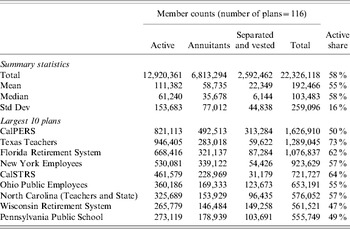
The sample consists of 116 state-sponsored pension funds used in Novy-Marx and Rauh (Reference Novy-Marx and Rauh2009, Reference Novy-Marx and Rauh2011). This is a unique database on 116 state government pension plans built from government reports. It includes all plans with more than $1 billion of assets that are sponsored by state governments, identified using the U.S. Census of Governments. The data on plan liabilities were collected from the Comprehensive Annual Financial Reports (CAFRs) of each plan. Table 1 provides summary statistics on the membership of these plans.
Rediscounting of cash flows under different actuarial accrual concepts and different yield curves requires an estimate of the cash flows themselves. Unfortunately, the state governments do not provide the cash flows that they use to derive the liabilities that they report. To derive estimates of cash flow streams based on the information provided in the CAFRs therefore requires a calibrated model and a series of assumptions. We explain the calibration in section 4. Some of these require additional data, which we explain here.
One required input is a set of matrices that reflect assumptions about salaries, years of service, and separation probabilities by age for active workers. In particular, the calculation requires a vector of salary growth by age, a vector of separation probabilities by age, the distribution of plan participants by age and years of service (an ‘age-service matrix’), and the average wages of employees in each cell. To derive these inputs, we examined the CAFRs of the 10 states with the largest total liabilities and took the assumptions from the reports where they were usable: New York, Illinois, Pennsylvania, Ohio, and Texas.
For retired workers, we employ a distribution of retirees by age and the average annuity benefit in each age category. This information is only sporadically disclosed, but by randomly sampling the CAFRs we obtained an average distribution across 10 plans covering approximately 1.2 million retirees out of the 6.8 million annuitants. The plans that we could find that disclose this information are the Massachusetts Public Employees, Georgia Employees Retirement System, Illinois Teachers Retirement System, Florida Retirement System, Ohio Teachers Retirement System, Tennessee Consolidated Retirement Systems, Pennsylvania School Employees Retirement System, Louisiana State Employee Retirement System, New York State Employee Retirement System, and the Arizona Retirement System.
2.2 Liability concepts
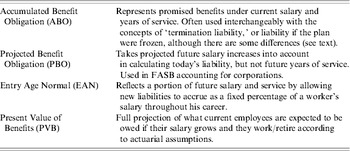
There are four different liability concepts that we consider: Accumulated Benefit Obligation (ABO), Projected Benefit Obligation (PBO), Entry Age Normal (EAN), and Projected Value of Benefits (PVB). In this section, we describe these concepts.
The narrowest measure is the ABO. It reflects benefits already promised and accrued. In other words, even if the pension plans could be completely frozen, states would still contractually owe these benefits. The ABO is not affected by uncertainty about future wages and service, as the cash flows associated with the ABO are based on information known today: plan benefit formulas, current salaries, and current years of service. One source of uncertainty in the ABO is inflation, and in particular the magnitude of COLA adjustments in states where COLAs are linked to official statistics such as CPI inflation.
The ABO is often thought of as a ‘termination liability,’ i.e. the liability that would be owed today even if plans were frozen completely or all workers were fired. In fact, the ABO actually could be somewhat less than a termination liability, as it assumes that an employee does not start taking benefits until his retirement date, which might be later than the full-retirement age. A termination liability assumes that employees will take benefits at the earliest advantageous date, which typically will be earlier than the full-retirement age given the fact that actuarial adjustments for early retirement are generally less than actuarially fair.
If workers receive their marginal product in total compensation (wages plus pension benefits), the ABO is the only concept that should be considered since it measures the benefits that employees have actually earned (Bulow, Reference Bulow1982; Brown and Wilcox, Reference Brown and Wilcox2009). The ABO is a ‘narrow’ measure, in that it does not recognize any future wage increases or future service that employees are expected to provide, even though such wage increases and service are to some extent predictable. Moreover, the ABO obligation is independent of wage risk, which simplifies the valuation.
The three broader measures (PBO, EAN, and PVB) all account to varying extents for the fact that benefits will continue to accrue due to the future salary and/or service of existing workers. They assume that the pension system will not be frozen today and all aim to reflect some portion of actual expected benefits.
The broadest measure, the PVB, represents a discounted present value of the full projection of the cash flows that actuaries expect the state to owe. The PVB method does not credit the state for the fact that it might have some ability to limit benefit accruals. Both the EAN and the PBO recognize a fraction of the PVB. The PBO and the EAN are therefore intermediate measures between the ABO and the PVB.
The PBO accounts fully for expected future wage increases for existing workers, but not expected future service. Mathematically, the PBO formula recognizes the PVB in a way that is prorated by service. Note that FASB accounting for publicly traded corporations requires the calculation of a PBO.
Summary of state-sponsored pension plans

Notes: The top panel summarizes the numbers of individual members in each of three main categories: active workers, annuitants, and those who are vested but no longer in public employment. The sample is the 116 major pension plans sponsored by the 50 U.S. state governments. The bottom panel lists these data for the 10 state-sponsored pension plans that are the largest by total members.
The EAN is broader than the PBO, but not as broad as the PVB. Mathematically, the EAN method recognizes the PVB in proportion to discounted wages earned to date relative to discounted expected lifetime wages. In practice, this procedure accounts for some portion of future benefit accruals due both to wages and future service.
Table 2 summarizes the liability concepts. Further details, including formulas, are provided in Novy-Marx and Rauh (Reference Novy-Marx and Rauh2011). We note that none of these methods account for the expected benefits that will be owed to workers who have not yet been hired.
Description of methods for recognizing accrued liabilities

Notes: This table summarizes the four main methods for recognizing pension liabilities. The methods differ in their treatment of expected future salary increases and service that is yet to be performed. The methods are listed in increasing order of broadness, starting with the method that only reflects current service and salary and ending with the method that reflects a full projection of benefits that are expected to be paid.
2.3 Estimates of liabilities in previous literature
Most estimates of liabilities that are not conducted by economists simply add up the liabilities that are disclosed in the CAFRs. This method ignores two issues. First, it relies strictly on the liability concept that state actuaries choose. In practice, most liabilities in the CAFRs are stated under the EAN method, and it is instructive to be able to calculate liabilities under the other methods, particularly the ABO and the PVB. Second, adding liabilities disclosed in the CAFRs takes as given whatever discount rate the state actuaries have chosen.
As explained in Novy-Marx and Rauh (Reference Novy-Marx and Rauh2009, Reference Novy-Marx and Rauh2011), the discount rate the states use under GASB accounting procedures does not reflect the risk of the liabilities. States discount the liabilities at a flat rate, and usually this rate is very close to 8%. Of the 116 plans in the sample, 54 of them use a flat 8% rate, and 112 use a rate between 7.5% and 8.5%.Footnote 1 States justify their discount rates with the argument that they are discounting liabilities at the expected rate of return on the assets in their pension fund. Such a procedure ignores the risk of the assets completely and treats returns above the risk-free rate as a free lunch.
The state procedures have survived criticism in part because observers have noted that many pension systems have earned average returns of around 8% over the past decades. But again, this assumes that the 8% was obtained without any risk. In fact, these returns were obtained by taking investment risk, and if the assets had not returned 8%, state taxpayers would have been on the hook for additional shortfalls. If systems want to tell their employees that the benefit stream is safer than a portfolio of stocks and bonds, they should discount the cash flows in a way that reflects that safety.
Our approach applies financial economics to public pension liabilities. It assumes that Modigliani and Miller (Reference Modigliani and Miller1958) can be applied to financial streams of payments arising from public pensions, just as it can be applied to financial streams of payments arising from corporate pensions or for that matter from corporate bonds. Novy-Marx and Rauh (Reference Novy-Marx and Rauh2011) employ two primary discounting procedures. The first uses the taxable muni rate, defined as the state-specific (or where unavailable the rating category-specific) municipal yield grossed up for a tax preference on muni debt estimated to be 25%. The second method uses the Treasury yield curve.
Using the muni rate admits and quantifies a probability of default. The liability is a measure that calculates the present value of this defaultable liability from the perspective of the taxpayers under the assumption that the state will default on these payments in the same states of the world as on their general obligation debt and with the same recovery rates. Alternatively, it is the value of the portfolio of state GO bonds the state would need to deliver to the plan to defease the obligation. When assessing the difference in the liability under different policy measures, the comparative statistics quantify how big the shift is in the value of these uncertain payments.
Using the Treasury yield curve values the pension benefits as secure promises. The Treasury valuations begin from the premise that the benefits will be paid. To the extent that they are not paid, there is a transfer from participants to taxpayers. The expected value of these transfers would not only reduce the value of the payments to the participants but also reduce the cost to the taxpayer. The Treasury discounting can therefore be viewed as valuing the benefits as a default-free promise. If state pension systems want to present to their employees the idea that the benefits are default free, they must discount at default-free rates. If a state pension system wanted to contract out the provision of the benefits to an insurer who would make the benefit payments even if the state in the future defaulted on some of its obligations, the insurance company would presumably value the liability at a default-free rate.
All of our methods treat the pension payments such as a bond and assume that the law of one price holds, so that the present value of the pension payments equals the price of the bond. Our approach is therefore equivalent to calculating the market cost of defeasing the pension liabilities. One criticism of this method is the notion that government liabilities are somehow fundamentally different, and that the states should value these liabilities differently than the market. However, the literature on public finance concerned with the so-called social discount rate (see e.g. Baumol, Reference Baumol1968) has generally concluded that the social planner should use a discount rate that is lower than that employed by the market. If this is the case, then market-based measures understate the liability from the point of view of the social planner. The planner's utility function puts more weight on future generations than do current market participants, and thus values payments made far in the future more highly than the market.
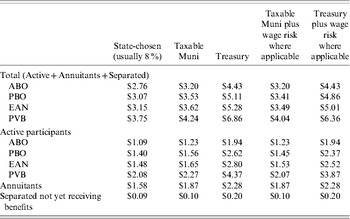
Our measures are summarized in Table 3. Under state-chosen discount rates, the EAN liability is $3.15 trillion at a measurement date of June 2009. This is very close to liabilities one would obtain by simply adding up the latest state disclosures, since most state systems use the EAN method.Footnote 2 Discounting only the cash flows associated with the ABO lowers the liability to $2.76 trillion, whereas discounting the full expected value of cash flows (still under state-chosen rates) results in a liability of $3.75 trillion.
Summary of baseline results from Novy-Marx and Rauh (Reference Novy-Marx and Rauh2011)

Notes: This table reviews and summarizes the baseline results from Novy-Marx and Rauh (Reference Novy-Marx and Rauh2011). Liabilities are measured as of June 2009. The first column shows the present value of liabilities under state-chosen rates. The second column shows liability discounted at taxable muni rates, based on taxable municipal zero-coupon yield curves as of 30 June 2009. The municipal yield curves are state specific where available, otherwise they are matched to the rating categories of the states, and the tax adjustment is done by grossing up yields by 25%. The third column discounts the cash flows using the Treasury zero-coupon yield curve as of 30 June 2009. The fourth column discounts with the taxable muni rate plus a 51 bp salary risk premium, and the last column discounts with the Treasury rate plus a 51 bp salary risk premium. The salary risk premium is only added to the active worker component, and it is also not added to the ABO since the ABO is invariant to future salary growth. See Novy-Marx and Rauh (Reference Novy-Marx and Rauh2011) for further details.
The second and third columns in Table 3 show the results under taxable muni discounting and Treasury discounting, respectively. Under the ABO, taxable muni liabilities are $3.20 trillion and Treasury liabilities are $4.43 trillion. Under the EAN, the most common accrual method used by states, the taxable muni liabilities are $3.62 trillion and the Treasury liabilities are $5.28 trillion. Under the PVB, the taxable muni liabilities are $4.24 trillion and the Treasury liabilities are $6.86 trillion.
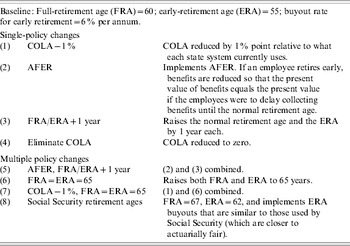
Description of baseline policies and policy changes

As of June 2009, we estimate that states had $1.89 trillion in assets set aside in pension funds dedicated to meet these obligations. Under the ABO, this means that there is a gap between assets and liabilities of $1.31 trillion under taxable muni discounting and $2.54 trillion under Treasury discounting. These statistics suggest that existing assets fall substantially short of the present value of existing promised liabilities.
Furthermore, states have been funding under the EAN accrual method, which sets aside more money earlier in the employee's career than funding under the ABO would, but less money later. It thus seems fair to compare EAN liabilities to existing assets. Under the EAN measure, the unfunded liability in state pension plans is $1.73 trillion under taxable muni discounting and $3.39 trillion under Treasury discounting.
The final two columns apply a 51 bp correction for the possibility that salaries are correlated with market pricing factors over long horizons. Benzoni et al. (Reference Benzoni, Dufresne and Goldstein2007) argue that while the correlation between earnings growth and stock returns is negligible on a short horizon, the correlation is higher on a longer horizon. Lucas and Zeldes (Reference Lucas and Zeldes2006) discuss these effects in the context of corporate pension plans with a model in which the value of human capital and the value of the stock market have positive covariance. The 51 bp correction comes from a simple calibration discussed in Novy-Marx and Rauh (Reference Novy-Marx and Rauh2011). The correction is only applied to active-worker liabilities under the accrual concepts that recognize some future salary or service. It therefore does not affect the ABO at all, and it does not affect the retired or separated worker liabilities. This correlation does not substantially affect inference about the magnitude of liabilities.
An alternative methodology is provided by Biggs (Reference Biggs2010), in which taxpayers’ liability is valued as a put option with a strike price equal to the actuarial liability grossed up at stated discount rates as in Novy-Marx and Rauh (Reference Novy-Marx and Rauh2008). Given how far in the money this put option is, its value is almost equivalent (mechanically) to discounting the liability at the risk-free rate and subtracting off the value of the assets. As noted in Novy-Marx and Rauh (Reference Novy-Marx and Rauh2008), ‘the cost of the [taxpayer] insurance is almost as large as the funding shortfall because the value of the potential overfunding is trivial relative to the potential underfunding’.Footnote 3
3 Potential policy measures
In this section, we discuss the potential policy measures that we consider to try to address shortfalls in state pension funding. Table 4 provides an overview of these measures.
3.1 Full-retirement age
The first policy change that we analyze is an increase in the age of ‘full retirement’, i.e., the age at which a retiree can begin taking payments without incurring a benefit reduction. This change, which does not affect current annuitants, may prove politically feasible although few states have actually raised retirement ages for existing workers. Changes to the retirement age are currently being phased into Social Security. They have also been implemented by some state plans, though at the state level these changes have been written to affect new workers only, and thus have no impact on the pension liabilities of the current work force. The implementation that we consider applies to current as well as future workers, and also applies to the vested separated workers not yet receiving benefits. We model a 1-year increase in the full-retirement age by assuming that participants are eligible to receive full benefits at the age of 61, not 60, and that they are first eligible to receive early retirement with reduced benefits at 56, not 55.
We do not attempt to quantify the impact of this policy change (or any other) on workers retirement behavior. Changes in retirement behavior may have additional effects on the liability as measured by the broader liability concepts (PBO, EAN, and PVB), but would have only a third-order effect on the ABO liability.
3.2 Actuarially fair early retirement or no benefits until full-retirement age
Another policy change affecting the retirement age, which has been less discussed but may be politically feasible, is an adjustment to the rules governing early retirement. Currently, the plans also allow for early retirement on terms that are extremely favorable to plan participants. The most common rules allow a plan participant to begin taking benefits up to 5 years early, by incurring the 6% per year linear reduction in the benefit they receive for each year they retire before the full retirement age, and some plans offer early retirement on terms that are even more generous to plan participants. Because COLAs, which average between 2.5% and 3% per year, do not apply to retirees’ benefits until they are taking payments, the effective cost of early retirement is only a benefit reduction of 3–3.5% per year. That is, a participant can get an extra year of benefits in exchange for a reduction in future benefits of 3–3.5%. This is roughly half the market value of an immediate life annuity for a 60-year-old man, or two-thirds the cost of an immediate joint life annuity for a 60-year-old married couple, suggesting that plans reward each year of early retirement with a ‘gift’ equal to roughly 4–6 months worthy of benefit payments.
AFER involves a benefit reduction formula for early retirement that equates the expected present value of benefits under early and regular retirement. Because AFER means, by definition, that the NPV of expected benefit payments is unaffected by early retirement, the simplest way to consider the impact of AFER on pension liabilities is to assume participants do not retire early, i.e., by setting the early-retirement age equal to the full-retirement age. We assume again that this policy change applies to current as well as future workers, and also the vested separated workers not yet receiving benefits. It of course has no impact on the annuitants.
The cost of the early-retirement option to the employer which is also the value of the early retirement option to the employees does depend on the discount rate. The early-retirement option is particularly valuable under high discount rates, because early retirement gives the employee early, largely undiscounted cash flows in exchange for giving up some later, heavily discounted cash flows. Higher discount rates hardly reduce the value of the benefit of the early cash flows, but greatly reduce the value of the foregone later cash flows, increasing the net benefit of early retirement. We therefore would expect to find an implementation of AFER affecting liabilities more under discount rates that reflect greater degrees of risk.Footnote 4
3.3 COLA reductions
COLA reductions are one of the only policy measures available that have the potential to force current annuitants, as well as current and future workers, to bear some of the burden associated with the current funding situation. This makes them attractive in some ways, because retirees are the biggest beneficiaries of the legacy liabilities, and some feel that they should share some of the costs. They may be difficult to implement politically, however, as legal protections in many states prevent measures that impair the value of pension promises, and public employee unions are especially resistant to measures that damage the claims of their senior membership. In at least two states (Colorado and Minnesota) laws have been passed that entail modest COLA reductions for even current annuitants. These currently face legal challenges, but seem likely to hold up in court, and are popular with taxpayers in the states in which they have been passed.Footnote 5
3.4 Dramatic measures: moving to social security retirement ages
We also consider several more dramatic changes, which shift a greater portion of the legacy liability from taxpayers to plan participants. The first of these involves bringing the rules governing retirement in line with the private sector, by raising the full-retirement age to 65 and making early retirement actuarially fair. The second additionally reduces COLAs by 1% per year. The last considers policy changes that bring the retirement rules closer to those currently governing Social Security, a full-retirement age of 67 and early retirement that is close to actuarially fair.Footnote 6
3.5 Extreme measures: cutting COLAs completely
To our knowledge, no state has eliminated COLAs completely for any plans. At least one state, Georgia, has eliminated COLAs for new workers, with the explicit intent of protecting existing and legacy benefits.Footnote 7 Illinois has capped COLAs at half of CPI for new workers. Such a measure clearly taxes new employees relative to the previous baseline in order to subsidize existing employees and existing retirees. Dramatic COLA reductions are extremely effective in reducing the states’ obligations, because COLAs affect annuitants as well as workers, and increase the states’ liability by roughly a third relative to what they would be in absent COLAs. For this same reason, drastic COLA reductions may be infeasible politically.
3.6 Other measures outside the model
Several states have taken steps over the last 2 years that attempt to address their pension funding shortfalls, using policy changes that are outside the scope of our model. These steps include rules to prevent ‘spiking’ (large end of career salary increases that increase lifetime pension benefits), employee contribution increases, increases in vesting periods, and limits on benefit payments.
Virginia and Rhode Island have increased from 3 to 5 the number of years used to calculate the final average salary (FAS), whereas Georgia, Colorado, and Vermont have capped the increases in salaries that count toward benefit calculations. Colorado, Iowa, Minnesota, Mississippi, Nebraska, New Mexico, Vermont, and Wyoming have increased employee pension contributions both for current and future employees, whereas New Hampshire and Texas have increased these for new employees only. While these increases do not reduce the states’ future pension liabilities, they do divert a portion of workers’ salary into the pension fund, thereby increasing the fund assets and thus improve the funding situation.Footnote 8 Iowa, Minnesota, and Missouri have increased the length of time an employee must work to be eligible for the states’ DB plans. These changes have almost no impact, qualitatively, as workers that separate without vesting tent to be young, and the value of their benefits, had they vested, would have been extremely small anyway because the plans’ COLAs do not apply until retirement. Michigan and Illinois have introduced dollar caps on the FAS that may be used in some plans benefit calculations.
4 Implementation of policy changes in the model
In order to determine the impact of these policy changes on states’ pension liabilities, we forecast each plan's cash flows to plan participants using information from the plans’ CAFRs. We calibrate these so that each plan's liability under its chosen accounting methodology, discounted using its stated discount rate, matches the stated liability in its CAFR. Policy changes are then implemented in this model, and the impact of these changes on the states’ pension liabilities can be quantified under any accounting methodology using any discount rates.
The initial calibration proceeds as in Novy-Marx and Rauh (Reference Novy-Marx and Rauh2011), which provides a more detailed account of the methodology. The first step of this calibration employs our model to forecast each plan's liabilities each year in the future. The model uses plan level information regarding the number of active, retired, and separated workers, as well as the benefit factor (i.e., the fraction of salary which, when multiplied by years of service, determines a participant's initial benefit), COLA and inflation assumption employed by the plan. It also employs assumptions regarding the relative number of employees and average wages by age and years of service (an ‘age-service matrix’), as well as salary growth and separation probabilities by age, and the relative number and average level of benefits for annuitants of each age. The benefit calculations assume a full retirement age of 60, and that younger retirees can start taking benefits up to 5 years early by incurring a linear 6% benefit reduction for each year a participant retires before 60.Footnote 9
Benefits are projected assuming mortality rates from the RP-2000 tables, which are employed by many states. We use the tables’ combined (employee/retired) healthy rates, and assume that participants are evenly divided by gender, that 60% are married at the time they retire to a spouse of the same age, and that plans allow for 50% survivor benefits.
We then calibrate each plan's cash flows by adjusting the average salary level of the employed and the average benefits of the non-active members. They are calibrated to simultaneously match both (1) the plan's stated accounting liability when capitalized at the state-chosen discount rate using the actuarial method (EAN or PUC) employed by the state; and (2) the plan's expected first year cash flow, which we estimate at 107% of the cash flow for the year ending June 2009, based on recent historical cash flow growth.
The model, using the calibrated average salary level of the employed workers and the calibrated average benefits of the non-active members, together with the parameters used in the calibration, serves as our ‘baseline.’ We investigate the impact of each of the different policy changes discussed earlier by altering the parameters employed by the model in a manner consistent with the policy changes, and using it to generate the plans’ new forecast liabilities. These can then be capitalized, under whichever accounting concept we wish to employ, using either the taxable muni yield curve or the Treasury yield curve.
5 Results
The first part of this section considers the policy changes that only affect one pension plan parameter. The second part considers more complex changes that affect multiple dimensions of the system parameters.
5.1 Single-policy changes
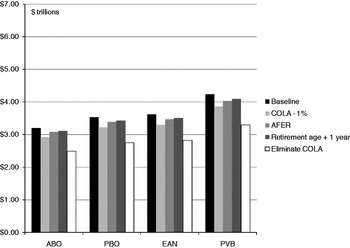
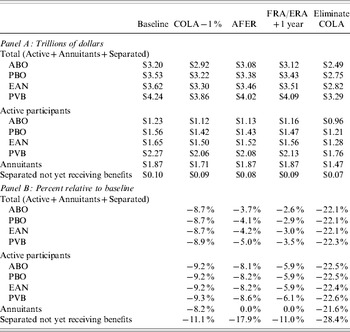
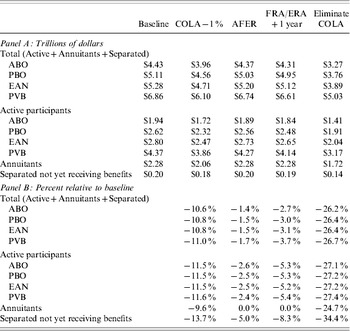
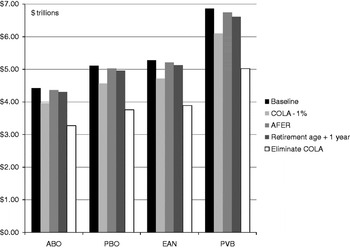
Table 5 shows the effect of single-policy changes under taxable muni discounting. Table 6 shows the effect under Treasury discounting. The first column of each table shows the baseline results without any policy changes, as a point of comparison. Figure 1 shows a graphical representation.
Effects of policy changes on liabilities, evaluated at the taxable muni rate

Single-policy changes under taxable muni discounting

Notes: The table shows total liabilities under the baseline calibration and then under various one-step policy changes, all using taxable muni discounting. The changes presented here are: reducing the COLA by 1%; implementing AFER; raising both the full-and early-retirement ages by one year (FRA/ERA+1 year); and eliminating COLAs completely. Panel A shows results in trillions of dollars, whereas Panel B shows the percent relative to the baseline.
Single-policy changes under treasury discounting

Notes: The table shows total liabilities under the baseline calibration and then under various one-step policy changes, all using Treasury yield curve discounting. The changes presented here are: reducing the COLA by 1%; implementing AFER; raising both the full- and early-retirement ages by one year (FRA/ERA+1 year); and eliminating COLAs completely. Panel A shows results in trillions of dollars, whereas Panel B shows the percent relative to the baseline.
The second columns of Tables 5 and 6 show the effects of a 1 percentage point COLA reduction for all system members (including current retirees) on liabilities under taxable muni and Treasury discounting, respectively. Under taxable muni discounting, the effect on the total ABO is a decrease of $280 billion, of which the annuitant portion is $160 billion or around 60%. Under Treasury discounting, the effect on the total ABO is a decrease of $470 billion, of which the annuitant portion is $220 billion or around 50%.
Overall, a 1 percentage point COLA reduction lowers the liability measures by almost 9% under the taxable muni discounting and by almost 11% under Treasury discounting. The percentage effect is larger for active participants than for annuitants in both cases. COLA reductions have a more immediate effect on annuitants, but this is offset by the fact that COLA reductions will affect current workers on average for a longer time. Current workers have their full retirement ahead of them with decreased COLAs, while current annuitants face only the future part of it with decreased COLAs. Note that reducing COLAs reduces the effective duration of the liabilities.
The third columns of Tables 5 and 6 show the liabilities if AFER is implemented. The first thing to note is that this policy change does not change the annuitant liability at all, since these participants are already retired. Implementing AFER reduces active participant liability by 8–9% under taxable muni discounting, but by only 2–3% under Treasury discounting. The effect on total liabilities is even more muted because of the zero impact on the annuitant liability. Overall, implementing AFER reduces total liabilities by 3–5% under taxable muni discounting but only 1–2% under Treasury discounting.
Implementing AFER would therefore generate lower liabilities under stated discount rates and also under taxable muni rates. But if the pension promises are default-free, implementing AFER does not affect the value of the liability nearly as much. It is instructive to compare these effects to potential changes in the FRA under the ABO accrual method. The generosity of the buyout schedule for early retirement is worth more than a 1/2-year reduction in the FRA under risk-free discounting, but almost one-and–a-half year under taxable muni discounting.
The fourth columns of Tables 5 and 6 show the impact of increasing the retirement ages (both the FRA and the ERA) by 1 year. Relative to the baseline, total liabilities are reduced by around 2–4%. The broader measures (e.g. PVB) are affected more than the narrower measures (e.g. ABO). This policy measure does not affect annuitants, and so the decreases in liabilities are achieved largely at the expense of the current workers. In the next section, we consider the effects of more dramatic retirement age increase.
The final column shows what would happen to liabilities if COLAs were eliminated entirely. The reduction is around 22% under taxable muni discounting and 26% under Treasury discounting. The elimination of COLAs would still leave ABO liabilities at $3.27 trillion under Treasury discounting. The gap between assets and ABO liabilities would still be almost $1.5 trillion, and the gap between assets and EAN liabilities would be $2 trillion.
5.2 Multiple policy changes
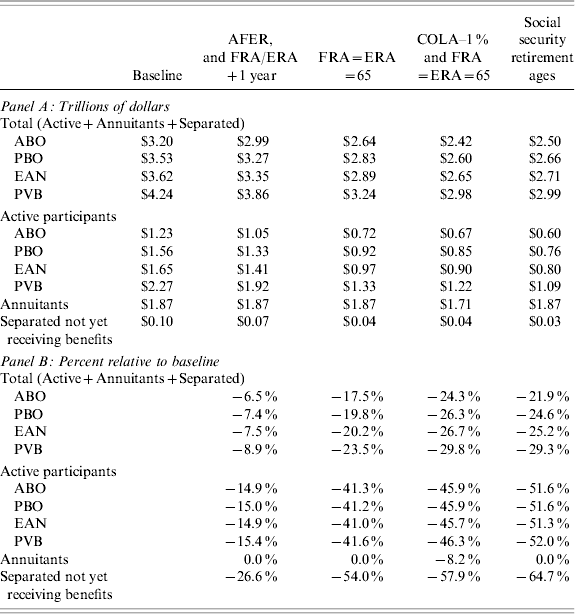
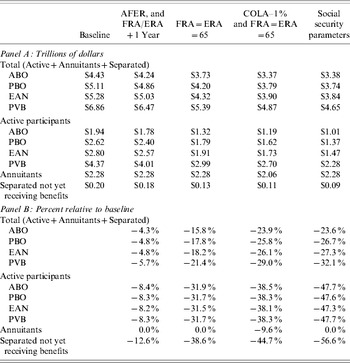
Tables 7 and 8 show the effects of the multiple policy change packages on liabilities, and Figure 2 shows a graphical representation. The effects of both increasing the retirement ages by 1 year and implementing AFER is to reduce liabilities by 6–9% under taxable muni discounting and 4–6% under Treasury discounting. As was the case above, if the pension promises are default free, implementing AFER does not affect the value of the liability as much as under the taxable muni discounting. The effects of combining these two policy changes are slightly larger than the sum of the percentage effects of the two effects separately. This is because of the interaction between the two policy measures.
Effects of policy changes on liabilities, evaluated at the treasury rate

Multiple policy changes under taxable muni discounting
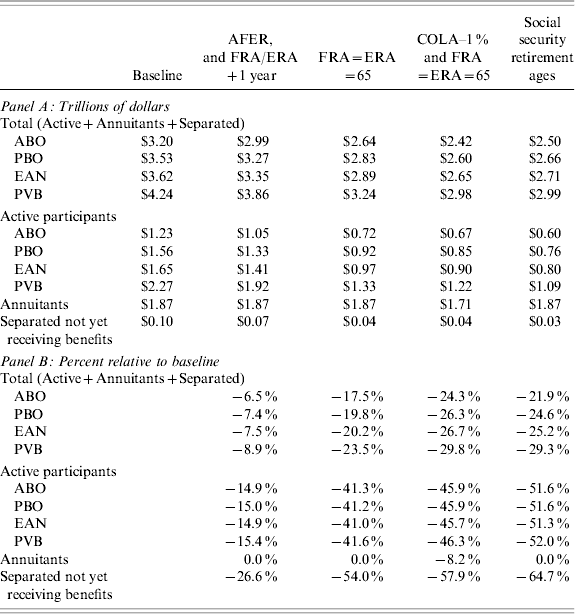
Notes: The table shows total liabilities under the baseline calibration and then under various packages of policy changes, all using taxable muni discounting. AFER stands for actuarially fair early retirement, FRA stands for full retirement age, ERA stands for early retirement age, and COLA stands for cost-of-living adjustment. Our ‘Social Security Retirement Ages’ scenario uses a linear buyout schedule with a buyout rate equal to 6%+COLA. Social Security itself uses a non-linear buyout schedule that is roughly 6% per year but unlike the state plans has COLAs that are (a.) tied to wage growth and b.) apply prior to the date one begins receiving benefits. Panel A shows results in trillions of dollars, while Panel B shows the percent relative to the baseline.
Multiple policy changes under treasury discounting

Notes: The table shows total liabilities under the baseline calibration and then under various packages of policy changes, all using Treasury yield curve discounting. AFER stands for actuarially fair early retirement, FRA stands for full retirement age, ERA stands for early retirement age, and COLA stands for cost-of-living adjustment. Our ‘Social Security Retirement Ages’ scenario uses a linear buyout schedule with a buyout rate equal to 6%+COLA. Social Security itself uses a non-linear buyout schedule that is roughly 6% per year but unlike the state plans has COLAs that are (a) tied to wage growth and (b) apply prior to the date one begins receiving benefits. Panel A shows results in trillions of dollars, whereas Panel B shows the percent relative to the baseline.
Setting the full-retirement age and early-retirement age both to 65 reduces liabilities by 15–24%. The effect is greater under the taxable muni discounting, for the same reasons that introducing AFER is greater under taxable muni discounting. Setting both retirement ages to 65 is equivalent to an increase in the retirement age combined with the introduction of early retirement. Reducing the COLA by 1 percentage point and setting both retirement ages to 65 reduces liabilities by 23–30%. Moving to the Social Security parameters reduces them by 22–31%. In all of these cases, the reduction is greater for the broader measures than for the narrower measures.
All of these policy measures still leave substantial gaps between assets and liabilities. Even under a move to Social Security parameters, which would be the most drastic of these measures, the ABO at Treasury rates is still $3.38 trillion, leaving a gap between assets and liabilities of $1.5 trillion.
6 Conclusions
The notion that the historical equity premium provides a costless solution is incorrect. Even under the most conservative measures, public pension liabilities are currently over $1 trillion larger than plan assets. Using discount rates that actually reflect the promise reveals shortfalls of $2.5 trillion for accumulated benefits only and over $3 trillion for broader measures. This shortfall has to be borne by some party: taxpayers or public employees, be they past, current, or future.
In essence, then, the debate over the solution is over transfers. The current situation is one in which beneficiaries view their benefits as secure promises and taxpayers do not perceive that they will be held accountable for guaranteeing those promises.
Each of the policy changes we consider reflects a reduction in perceived wealth felt by a group of participants. The impacts we measure on states’ unfunded pension liabilities are not trivial. However, our analysis clearly shows that there is no ‘magic bullet’ as far as policy changes are concerned. Even implementing Social Security parameters, and under the relatively narrow accounting of the ABO, the difference between assets and liabilities is still $1.5 trillion. We speculate that taxpayers will likely not succeed in forcing public employees to bear the rest of this gap, and that ultimately taxpayers will have to come up with sums of this magnitude to pay for legacy liabilities. If unfunded liabilities continue to grow, the bailouts could be even larger.
The examination of the impact of policy changes on liabilities in this paper is done in partial equilibrium. We have not modeled any endogenous responses by workers in their retirement behavior. For example, assuming wealth effects dominate substitution effects, workers might be expected to work longer in response to increase in the retirement age. This would further reduce the states’ liabilities, though the effect is small unless the changes encourage workers to delay retirement beyond the full-retirement age.Footnote 10 Conversely, if substitution effects dominate wealth effects encouraging more workers to retire at the first possible retirement date, then the endogenous labor supply response reduces the savings states realize from the policy changes.
It is also important to note that the policy changes we consider might also help improve the funding of new benefit promises made in the future if contribution levels are maintained when such changes are undertaken. However, the approach taken by most states ties the actuarially required contribution to the present value of new benefit promises. As such, if retirement ages and COLAs are made less generous, actuarially required contributions would also decline. Furthermore, as long as GASB standards are used to determine contributions, new benefit promises are almost by definition underfunded at the instant they are granted. Nonetheless, if states were to maintain current contribution levels while making these policy changes, it would have a beneficial impact on the extent to which new promises are funded.
We have assumed that the policy changes we consider can be imposed on workers without being offset by any other changes that might increase the liability. We have not analyzed the plan characteristics that might make the liabilities of some plans more sensitive to these policy changes than others. Finally, we have not modeled any cost savings that early retirement might achieve for states if workers close to retirement are compensated more than their marginal product. These are important avenues for future research.