Background
Children and adolescents with CHD routinely undergo clinical exercise testing, providing detailed cardiopulmonary and musculoskeletal assessment. Reference Cifra, Cordina and Gauthier1 Data from exercise testings are often limited to single-centre cohorts due to the lack of centralised repositories, variations in exercise testing protocols hindering comparability, and the inherent heterogeneity of CHD anatomy and physiology. Reference Teson, Watson and Mays2 Thus, exercise testing research has limited power and generalisability. Furthermore, limited resources exist for developing methodology for conducting and interpreting exercise testings in the CHD population. An inter-institutional education network and registry (hereafter, registry) has the potential to mitigate these challenges through pooling data and expertise across centres. This survey was developed to understand the varied perspectives and concerns of North American clinical paediatric exercise labs regarding participation in a unified exercise registry.
Methods
As described previously, an online survey (REDCap) was administered to 57 centres with clinical paediatric exercise laboratories across North America from 8/24/2024 to 10/5/2025. Reference Teson, Watson and Mays2 Only clinical paediatric exercise laboratories who reported being affiliated with a paediatric cardiology program or shared between a paediatric pulmonology and paediatric cardiology program were included in this analysis (n = 53). An open distribution and convenience sampling approach was distributed to clinical paediatric exercise laboratory members through to: (1) responders from a prior 2019–2020 survey; (2) a list of clinical paediatric exercise laboratory contacts from the Cincinnati Children’s Hospital Medical Center’s Annual Clinical Exercise Testing and Therapeutics Symposium and the Boston Children’s Hospital’s Annual Cardiac Fitness Symposium; (3) the membership of the North American Society for Pediatric Exercise Medicine (NASPEM); (4) the membership of the Pediatric and Congenital Electrophysiology Society; and (5) the PediHeartNet Google group/email recipients. Any clinical paediatric exercise laboratory member could respond to the survey, but survey respondents were required to attest that they had in-depth knowledge of their institution’s clinical paediatric exercise laboratories’ practices, and individual clinical paediatric exercise laboratories were contacted to clarify discrepancies if duplicate responses were received. For the purposes of this study, exercise testing included either exercise stress testing or metabolic cardiopulmonary exercise testing with exercise testing centre volume categories derived from expert consensus. This study was approved as a non-human subjects’ quality improvement project by the Children’s Mercy Kansas City institutional review board. Categorical data were reported as frequencies and percentages, and results were compared across centre volume categories using Pearson’s chi-squared test.
Results
There were 53 qualifying clinical paediatric exercise laboratories that responded across North America including with the survey respondents being comprised of clinical paediatric exercise laboratory medical directors (47.4%), followed by lead exercise physiologists (28.1%), clinical paediatric exercise laboratory administrative directors or a staff level exercise physiologists (both 8.8%), or another exercise-focused physician (7.0%). Respondents represented clinical paediatric exercise laboratories with diverse exercise testing volumes: 24.5% low (0–200 exercise testings/year); 52.8% medium (201–800 exercise testings/year); and 22.6% high (801–2000+ exercise testings/year). 83% of clinical paediatric exercise laboratories perform exercise testings on both adult and paediatric patients.
83% of respondents expressed interest in joining a registry, 17% were unsure, and none declined. Regarding potential benefits of a registry, 90.6% recognised the availability of large databases for research and improving patient care, 83.0% recognised efforts towards standardising practices/procedures between institutions, 62.3% recognised the potential for CPELs to become accredited, and 0% recognised no tangible benefits.
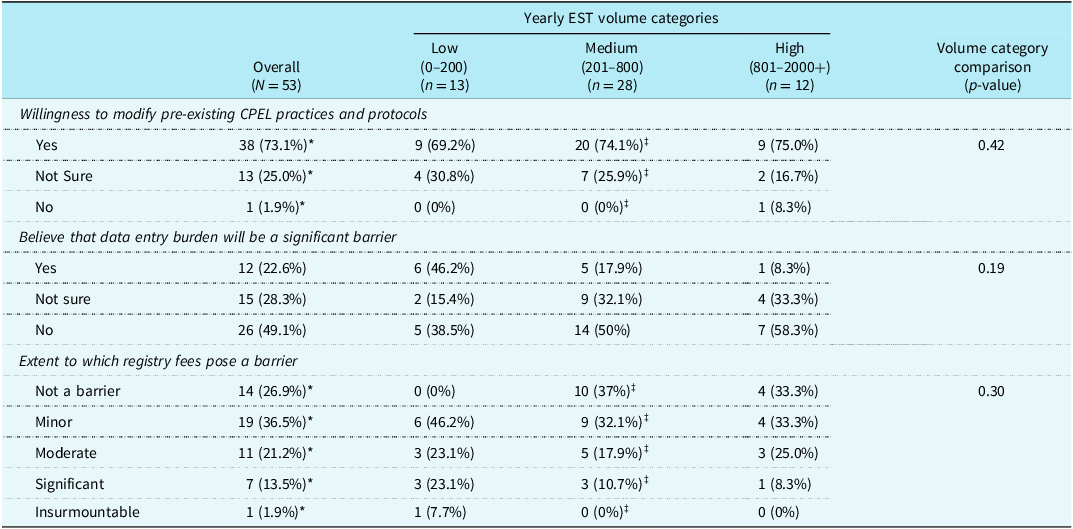
CPELs surveyed were asked if they would be willing to modify some of their practices/protocols to contribute consistent and comparable data (Table 1). There were no differences in willingness to change protocols based on centre exercise testing volume (p = 0.42) or between low-and high-volume centres (p = 0.44). Free text responses described concerns about adding bureaucracy and cost, challenges with obtaining physician or institutional approval, challenges with facility and staffing requirements, and need to ensure flexibility in choosing preferred testing modality and protocol selection.
Perceived barriers to inter-institutional paediatric exercise testing registry

Table 1. Long description
The table presents data on the willingness of CPELs to modify their practices and protocols to contribute consistent and comparable data, categorized by yearly EST volume. It includes responses from 53 CPELs divided into low (0-200), medium (201-800), and high (801-2000+) volume categories. The table has 12 columns and 8 rows, including headers and row labels. The columns are labeled as Overall, Low, Medium, High, and Volume category comparison (p-value). The rows are labeled with different survey questions and responses. Row 1: Willingness to modify pre-existing CPEL practices and protocols, Yes, 38 (73.1 percent), 9 (69.2 percent), 20 (74.1 percent), 9 (75.0 percent), 0.42. Row 2: Willingness to modify pre-existing CPEL practices and protocols, Not Sure, 13 (25.0 percent), 4 (30.8 percent), 7 (25.9 percent), 2 (16.7 percent). Row 3: Willingness to modify pre-existing CPEL practices and protocols, No, 1 (1.9 percent), 0 (0 percent), 0 (0 percent), 1 (8.3 percent). Row 4: Believe that data entry burden will be a significant barrier, Yes, 12 (22.6 percent), 6 (46.2 percent), 5 (17.9 percent), 1 (8.3 percent), 0.19. Row 5: Believe that data entry burden will be a significant barrier, Not sure, 15 (28.3 percent), 2 (15.4 percent), 9 (32.1 percent), 4 (33.3 percent). Row 6: Believe that data entry burden will be a significant barrier, No, 26 (49.1 percent), 5 (38.5 percent), 14 (50 percent), 7 (58.3 percent). Row 7: Extent to which registry fees pose a barrier, Not a barrier, 14 (26.9 percent), 0 (0 percent), 10 (37 percent), 4 (33.3 percent), 0.30. Row 8: Extent to which registry fees pose a barrier, Minor, 19 (36.5 percent), 6 (46.2 percent), 9 (32.1 percent), 4 (33.3 percent). Row 9: Extent to which registry fees pose a barrier, Moderate, 11 (21.2 percent), 3 (23.1 percent), 5 (17.9 percent), 3 (25.0 percent). Row 10: Extent to which registry fees pose a barrier, Significant, 7 (13.5 percent), 3 (23.1 percent), 3 (10.7 percent), 1 (8.3 percent). Row 11: Extent to which registry fees pose a barrier, Insurmountable, 1 (1.9 percent), 1 (7.7 percent), 0 (0 percent), 0 (0 percent).
EST = clinical exercise stress test; CPEL = clinical paediatric exercise laboratory. All data are presented as n (%).
* n = 52; ‡n = 27.
Perceived barriers related to data entry burden and registry fees are shown in Table 1. Over 60% of respondents characterised the potential for network fees being either not a barrier or a minor barrier, >75% reported that data entry burden was not a barrier or unsure (Table 1). There were no differences in perceived barriers related to data entry burden (p = 0.19) or potential for registry fees based (p = 0.30) on centre exercise testing volume or between low-and high-volume centres (p = 0.10 and p = 0.17, respectively).
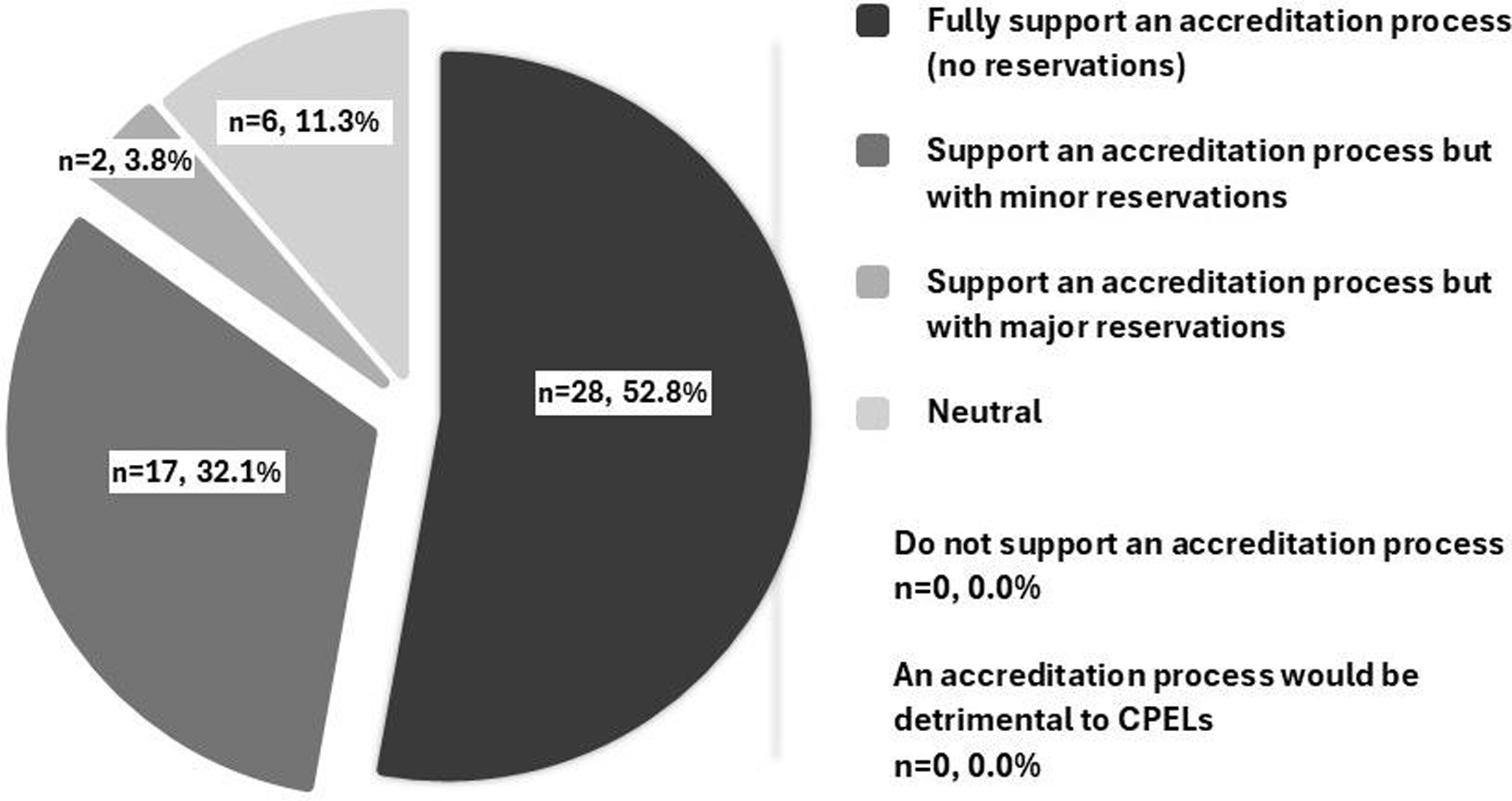
Perspectives on developing a standardised clinical paediatric exercise laboratory accreditation process are shown in Figure 1. 82% of clinical paediatric exercise laboratories support an accreditation process without significant reservations. Free text responses identified concerns about flexibility for institutional protocol and equipment selection and adequate staffing and budgets to complete the accreditation process. There were also concerns about the additional barriers an accreditation process might create for centres starting new programmes. There was a desire for key stakeholders to be included in the development of the accreditation process and a request to ensure equitable access for both United States of America and non-US centres to any potential accreditation process.
Centre perspectives on the development of a standardised paediatric exercise laboratory accreditation process.

Discussion
This is the first survey assessing clinical paediatric exercise laboratory perspectives on developing an exercise testing-focused registry within paediatric cardiology. There was a high (93%) survey response rate with no respondents opposed joining a registry, suggesting the field is broadly ready to move beyond single-center approaches to exercise testing research and practice. The willingness of most centres to modify protocols for standardised data collection indicates that barriers are logistical rather than philosophical. Key design considerations for network development include preserving institutional flexibility for exercise protocol selection, minimising burden of data entry and supporting the application and maintenance of accreditation for institutions with limited resources and ensuring multi-disciplinary input in governance to achieve broad acceptance.
Registries are commonly used to foster advancements in research and improve patient care. In paediatric cardiology, existing registries capturing surgical, intensive care, acute care, and neurodevelopmental data have enabled large-scale investigator-initiated research. Reference Gaies, Cooper and Tabbutt3 In adult cardiology, the FRIEND exercise testing registry has compiled data from over 130,000 exercise testings that generated updated, accurate cardiorespiratory fitness standards to improve adult cardiopulmonary care. Reference Peterman, Arena and Myers4 Data from our survey highlight potential benefits from developing a paediatric and CHD registry, including the development of large databases to conduct research for improving patient care, helping to standardise clinical paediatric exercise laboratory practices/procedures between institutions, and potentially, allowing for a standardised accreditation process. Centres have identified some potential barriers to development of such a database including concerns about data entry burden, which was more recognised among smaller volume centres and highlights the importance of supporting such centres to reduce data entry burden in the future. Notably, larger-volume centres that likely have established protocols were still willing to modify their practices in support of a registry. Overall, there is strong support for developing the first multi-institutional paediatric exercise registry in CHD.
Acknowledgements
The authors would like to acknowledge all the institutions, exercise labs, and personnel who completed this study and made this study possible. We greatly appreciate the support for survey development and data collection by Drs. Kelli Teson and Jessica Watson at Children’s Mercy Kansas City, as well as support for manuscript review by Drs. Adam Powell, Jesse Hansen, William Orr, and Suellen Yin, on behalf of the Pediatric Exercise Data and Analytics Learning (PEDAL) Network.
Financial support
None.
Competing interests
None.
Ethical standards
Not applicable.