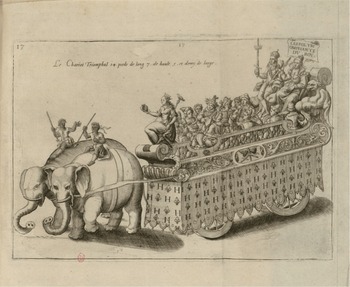
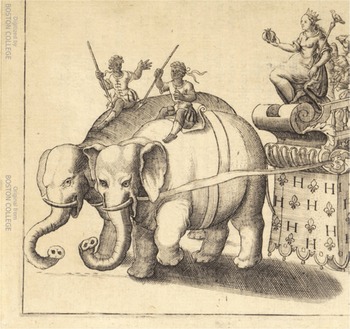
Royal labyrinth of the triumphant Gallic Hercules. Etching by Mathias Greuter, from the book by André Valladier. (From gallica.bnf.fr/Bibliothèque nationale de France)

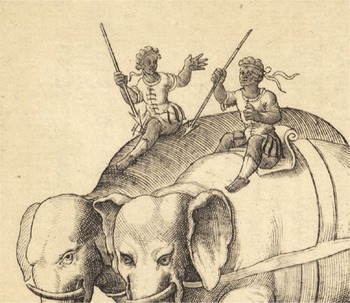
There were no elephants in Avignon on 19 November 1600 when Marie de Medici arrived in the papal city on her way to meet her new husband, King Henri IV, and take the throne as the new Queen of France. In Labyrinthe Royal de l’Hercule Gaulois triomphant… (The Royal Labyrinth of Gallic Hercules, Triumphant), Footnote 1 the official account of Marie’s ceremonial entrée into Avignon and the spectacular allegorical program that the city prepared for the occasion, the text states plainly that though “two of the largest horses” had been “harnessed as elephants, with Trunks & the rest, mounted and driven by two Moors [Mores],” the chariot got held up by the press of the crowd. One of the musicians, concerned the queen would be delayed, “took off the elephant costumes” (garniture d’elephant) (Valladier 1601:16). The chariot arrived on time, albeit with “the elephants having changed into horses” (16). Nothing further is said about the “Mores.” Footnote 2 Nonetheless, for us, as for the readers throughout Europe who participated in this ceremony remotely, asynchronously, by virtue of the document, the elephants do appear. A few fine traces of ink left by the pressure of an engraved copper slab impart the persistent impression of two bulbous bodies — and, more strikingly, coalesce to form piercing elephantine eyes. Arresting the viewer, these eyes concentrate attention; the elephants feel present, as do their two drivers, on whose “bodies” the closely threaded lines of the engraving reify the polysemic signifier “More” by collapsing it into an iconographic tradition that lingers in present-day images of blackface, reinforced by the white bandeaux that, nevertheless, seem to float from the drivers’ heads in a lively wind. Their eyes, too, address us, piercing the carapace of the Moorish “type”; one of them seems to wave. My hand twitches, as if to respond in kind.
The elephants tug a triumphal chariot full of musicians and allegorical figures, including an effigy of the king. Only an effigy, though, because, to the great consternation of Queen Marie and of André Valladier (1565–1638), the French Jesuit who oversaw the ceremony and authored this account, the King wasn’t there, either. However, like the elephants, and not unlike the Mores, he is present by virtue of this document, the eponymous “Gallic Hercules” who appears in portraits and allegorical guises, but also in esoteric symbols, emblems, anagrams, and numerological resonances, all of which are here for the learned reader who can see beyond what is merely visible — or is willing to take the loquacious Valladier at his many words. Thus, Labyrinthe weaves together text, image, and arcane symbolism, marshalling cutting-edge technology and the latest intellectual fashions to create an early modern “virtual reality” in which Henri can be present, even while the text makes his historical absence explicitly clear. The physical absence of Henri and the elephants becomes incidental in light of the multiple, overlapping ways the document invites the reader to experience — and even invent — their presence. As one iteratively rereads and reviews each element, encouraged by Labyrinthe’s codex form and self-referential nature, the experience grows deeper, more familiar, more probable, allowing a willing and able reader to experience a ceremonial entrée that is more probable than the one that actually, perhaps accidentally, took place. Labyrinthe serves as a record of what would have happened, or ought to have, if a crowd had not gotten in the way, or if Henri had not been held up in Savoy by war and (as a very public rumor had it) by his mistress. Yet Labyrinthe is not simply a counterfactual document — it is also a script for a manner of reading, an act of collective invention or discovery by virtue of which the reader feels as if the festival were right before their eyes.
Detail of Royal labyrinth of the triumphant Gallic Hercules. Etching by Mathias Greuter, from the book by André Valladier. (Courtesy of Boston College, Burns Library)

Such “invention” or “discovery” (two translations of the Latin word inventio) is a rhetorical technique for producing the oratorical effect ekphrasis or evidencia. It is a foundation of the oratorical education Valladier and his contemporary readers would have likely shared. Inventio allows an orator to create a verisimilar account of an event, be it a legal case or a historical scene, by bringing in (in-venting) shared tropes or “commonplaces” to elaborate details that may be lacking, or even to replace improbable occurrences with ones an audience or a jury might find more likely. Though often discussed as a compositional technique, the practice is most effective when the orator evokes just enough of a commonplace that the audience can recognize the trope and continue the process of invention or discovery themselves. Footnote 3 Thus understood, inventio bears a close relation to the Aristotelian enthymeme, a type of syllogism specific to rhetoric that prompts the audience to apply an implicit general premise to a specific statement, making it seem like the orator’s conclusion was their own. Each of these rhetorical techniques is contingent upon a shared understanding between the orator (or here, document) and the audience (here, viewer or reader). Collectively, they effect a phenomenological illusion of presence in the sense of uninterrupted flow, as the audience responds fluidly or fluently to the rhetorical cues presented.
As scholars of classical and medieval rhetoric have noted, these rhetorical techniques also approximate the effects of implicit biases regarding gender, race, and their intersectional convergences (see Webb Reference Webb2009; Whitaker Reference Whitaker2019). The ways Labyrinthe invites its audience to invent or discover “race” reveal not only the complex transitions the concept was undergoing at the close of the 16th century, but also the equally complex assumptions that shape how 21st-century readers may approach a performance document of this kind. Labyrinthe appears at a critical juncture in the development of “racial” thought, a moment when a genealogical concept of race based on an individual’s roots (racines) persisted alongside the development of racist thinking based on phenotype, especially skin color. The entire structure of Labyrinthe is devoted to the former, encouraging the audience to “discover” how the illustrious “race” of Henri IV reaches back to the legendary Gallic Hercules (Valladier 1601:2), grounding the legitimacy of the new Bourbon dynasty that Henri founded when he took over the throne from his distant cousin, Henri III, in the midst of a civil war that had left the reputation of the monarchy in shambles. Meanwhile, the image of the Mores reifies an ambiguous textual sign, assigning an illusory African phenotype to a word that could refer to people with dark complexions, to Muslims of any appearance, or an invented iconography that straddles the two. In each case, the audience’s ability and impulse to “invent” race depends on the intermedial assemblage of commonplaces their reading prompts them to draw upon. An educated 16th-century reader would likely be familiar with the trope of Gallic Hercules from emblem books, or more particularly, from the famous triumphal arch that greeted Henri II on his ceremonial entrée into Paris in 1548 and circulated widely in print, implicitly binding Henri’s lineage to the preceding dynasty, as well as ancient legendary roots (C’est l’ordre… 1549: sig. A3). For readers today, on the other hand, the image of the Mores is inextricable from the explicit stereotypes and the implicit legacies of oppression, resistance, and racism that resonate in discursive and performative constructions of Black identity. Without claiming to comprehend the particular experience of any current reader but myself, I wish to highlight a general contrast between reading these elephant drivers as “Mores,” as “Black.” The layered readings Labyrinthe insists upon encourage us to examine how these intertwined identities coexist, co-present in any present-day reading of this document, counteracting the ongoing resistance, especially among French academics, to reading “race” in the seizième siècle. Footnote 4
Like most documents of processional ceremonies, Labyrinthe guides its readers through a progression of allegorical spectacles, which the readers experience in words, images, and, through the sequential turning of pages, with their bodies. Yet along with this processual, syntagmatic movement, the allegories themselves produce readings that concatenate, producing paradigmatic layers or depth. The technology of the codex, and especially the bound printed book, physicalizes this paradigmatic reading, creating literal layers of stacked pages, which the reader can return to, or by following an index, skip to directly — possibly flipping to other books that are co-present in their library or studiolo. By contrast, this article will employ the figure of the progressive, teleological movement of a zoom lens (or two-finger swipe), with extensive allowances for asides (say, new tabs), responding to the habits of 21st-century readership. However, through this artifice, I hope to highlight the historicity of this style of reading (much more than the decoding of textual symbols) in relation to the modes of reading that Valladier performs for and with his audience. I hope that you, too, find reason to double back, scroll ahead, or ctl+F to re-place this sequence, and represent this article as you now — or later — see fit.
(Zoom 1) Presenting the Document
Labyrinthe as Festival and Festival Book
Labyrinthe Royal de l’Hercule Gaulois triomphant is an impressive object. The heft of nearly 250 folio-sized pages bound in unctuous 19th-century leather binding or a wizened cover from centuries prior announce the experience that awaits the attentive reader. In a well-appointed library, where we must go to see most such books as this one, the weight (and the wait) are compounded by the torso-sized foam supports, velveted book-weights, soft lights that bathe the table in inefficient warmth that feels antique, and above all, the knowing glance of the librarian who sets it down, gently, and maybe, checks the spine and breathes, with you, the scent of hundreds-year-old ink as they open to the frontispiece. The title appears within a triumphal arc (arc triumphal), the kind that (in this era) often doubles as a stage (eschaffaud) or what those who wished to signal their humanist credentials began to call a Theatre on which allegorical scenes unfold — not building a narrative, but linking, augmenting, retracing each layer, with another layer above or below that which appears, now, in the present. Footnote 5
As a book, Labyrinthe Royal documents a performance that took place in 1600 CE, in Avignon, a small papal domain surrounded by the Kingdom of France. The performance was an entrée, a processional ceremony honoring a local ruler or a foreign dignitary. French entrées most commonly took place on the first visit of a newly crowned king to each major city in his domain. Literally embodying the political order in the form of a procession, these entrées performatively constituted the political relationship between the city and its new ruler while affirming the continuity of the polity in a transitional moment. For entrées that involve a foreign dignitary (as Marie and Henri, technically, were), the honored guest is often treated as a surrogate for the living monarch, given such sovereign rights as the pardoning of prisoners, or literally standing in the royal stead. Thus, royal entrées embody, quintessentially, what the performance historian Joseph Roach terms “surrogation” — a king embodies the office of his predecessor by literally walking in his place (1996:36–40). Traditionally, the entrée was also a surrogate, a kind of living document that repeated the coronation with specific, local differences, allowing the citizenry to participate in that remote ceremony. The emergence of printed festival books throughout the 16th century complicated the linear temporal logic by which the original coronation was re-presented and verified through the physical appearance of the king within the physical bounds of the city. While in-person ceremonies were hectic, loud, and rushed, the increasingly elaborate documents permitted a reader to witness the ceremony from an idealized perspective, with evocative text and opulent images that gave the reader ample opportunity to examine each spectacle and contemplate its deeper meanings (often with exhaustive explanations from the author). Thus, the documents let the readers themselves act as surrogates, experiencing the document-festivals as the monarchs should have seen them, freed from the accidents of linear time and distorted perspective, and if they wished, with generations of entrées co-present before them.
The entrée into Avignon takes the operations of surrogation to such a labyrinthine extreme that Valladier, as creator of the live ceremony and author of the document, expends hundreds of pages attempting to explicate it. The king, as mentioned above, was not, historically, present, and he never would be King of Papal Avignon. However, Henri IV had never been afforded the luxury of an itinerary of entrées in the cities of his own realm. In the midst of a decades-long civil war, in which Henri had often led his own Protestant Huguenot armies against the Catholic monarchy, Henri took the throne after the assassination of his childless cousin, Henri III, a king who had been deprecated by waves of printed propaganda as a hypocrite, sodomite, and tyrant whose actions stripped him of the royal majesté that gave him divine sanction to rule. Following a furtive coronation at Chartres, in lieu of the traditional Reims, Henri launched parallel military and propaganda campaigns to justify his new dynasty’s right to the throne and drive out the international Catholic League who opposed him, yet Henri only took Paris once he had agreed to (re)convert and support the Papacy.
A decade into his reign, these multiple strains converged in Papal Avignon, where, if all had gone to plan, Henri would enter in triumph, verify his Catholic commitments, and ensure the perpetuity of his dynasty by consummating his marriage to his new wife, Marie. Thus, this ceremony was meant to be a performative repetition of several rituals already performed elsewhere — the coronation, the conversion, and most importantly, the royal marriage, ratifying the heretofore virtual relationship through the co-presence of the King and Queen. As Valladier explains in his preface, he designed Labyrinthe to celebrate the first meeting of Henri and Marie, who had already been married “by proxy” in a lavish ceremony held in Florence, where her uncle (following the royal custom) surrogated as husband. But this consummation was persistently deferred. She had anticipated meeting the King when she arrived at the port city of Marseille, and then at Aix-la-Provence, but at each stop, she was greeted by surrogates who apologized, stating that the king was still in the Alps fighting the Duke of Savoy. Therefore, by the time she reached Avignon, her own status as spouse and queen was held in a kind of liminal state — the performative suspended in anticipation of circumstances that would allow for what the philosopher J.L. Austin would call its “happy” realization (Austin Reference Austin1962). Historically speaking, the situation would be shortly resolved — they met in Lyon and eventually conceived the future Louis XIII. However, what makes Labyrinthe so fascinating is the way it embodies the myriad tensions at play in its historical moment. As a document that both records this performance as a past event while also, using some of the most advanced technologies of the time, attempts to present itself as an experiential surrogate for this performance, Labyrinthe instantiates a performative ritual that has already come to pass, yet whose qualification as “happy” or “unhappy” remains undetermined, awaiting a consummate reader to enter its labyrinth and ratify its allegorical prefigurations.
Allegories bend time, confusing distinctions of presence/absence, present/past by replacing historical, legendary, or conceptual figures in the phenomenal world (and vice-versa). Two types of allegory stand out in Labyrinthe. First, like most 16th-century entrées (and their documents), Labyrinthe comprises a series of spectacles performed (and depicted) on floats or stages, which, in turn, typically double as “triumphal chariots” or “triumphal arches,” respectively. These spectacles feature recognizable figures from the Bible, Roman mythology, or French royal history, along with personified concepts (e.g., “piety” or “victory”). I call them “spectacles” because they challenge an easy reduction to a single medium — live actors might perform alongside life-like sculptures or painted figures, in a frame that intermingles painted marble and papier-mâché with luxurious fabrics and real buildings — any part of which might become animated by machine. Deliberately refusing distinctions among real and represented, animate and animated, these spectacles exist on a continuum with the paper documents that perpetuate them, themselves brought to life by vivacious text, expressive imagery, and/or the affective investment of the viewers.
While these allegorical spectacles are traditionally self-contained, Valladier constructs an overarching allegory that layers multiple temporalities.
The person of the King, his stock & his race [son estoc & sa race], his great deeds and miraculous success form immediately a Gallic Hercules victorious and triumphant. The seven principal incidents and detours of his life, by which, with so many marvels, he has achieved this glory, will furnish the Idea of a septenary Labyrinth composed of seven reverses and detours: represented [effigié] by seven triumphal Arches premised on seven [of] the most significant labors of Hercules that the fables of the Poets have sung with such artifice. (1601:2)
These seven labors, each represented by its own allegorical Arc, create a conceptual unity between Henri’s biography and Hercules’s legendary life (both severely abridged). For those who participated in the live procession, these links appeared as a chronological progression as the parade moved through the city from site to site. Fearful his live audience would not have time to appreciate the surfeit of inscriptions, emblems, and learned imagery that decorated each arc, Valladier notes that at each site, “a Theatre was set up, to show something on the subject, giving them meanwhile the leisure to pause the gaze on the painting and all [that arch’s] appurtenances” (2). The book affords an opportunity to imitate this progress in an idealized form, pausing even further to contemplate the richness of each spectacle, and each allegorical connection — an experience that Valladier supplements with verbose analyses of multilingual anagrams, emblematic imagery, and pseudo-Kabbalistic interpretations of numerical “coincidences” (including the reduction of Hercules’s labors to seven from twelve) that adorn these arches and the passages between them, bolstering his transtemporal, transmedial argument. Footnote 6 However, the reader also has the opportunity to experience the whole progression all at once, immediately or incontinent (literally, out of continuity), in the form of a table of contents, or even more succinctly, in the person of the king. The corporeal king being absent (both at the “live” festival and in the document), each image presents the king as a virtual palimpsest, the visible image resonant with deeper readings, a mask by virtue of which one may perceive his racial origins extending back to his genealogical ancestor and allegorical type; Hercules as one, timeless Idea.
Moreover, blending revisionist history and arcane prognostication, Labyrinthe allows Valladier to allegorize not only what Henri had already accomplished, but also what he would do — specifically (with Marie doing most of this labor) achieve “immortality” by producing an heir before passing through the “Columns of Hercules” to Heaven. However overwrought, the allegorical framework provides a structure that does not merely layer present over past or fuse a recent history onto a mythical tale; rather, the events of Henri’s life “furnish” a unified “Idea” that allows past, present, and future to coexist in a contained space, even if only one stage, or one page may be presented at a time.
Given that Valladier cocreated many of the very figures whose layers of meaning he then painstakingly reveals in the book, a modern reader might see this circular structure as a mind-bending contrivance. Indeed, even Valladier’s contemporaries criticized the contorted prose with which he sought to clarify the meaning of the festival. Footnote 7 However, as in the individual spectacles described above, a well-executed contrivance could double as a virtuosic discovery of truth: suggested by figuration and ratified by the spectators’ affective response. Valladier’s text explicates a process of inventio (discovery/invention) in which the creation of the figurative program is an interpretative act, which the reader can re-instantiate as they reassemble the multilayered Idea in their mind. The enduring importance of this structure, then, lies not in its capacity to predict historical events (Marie did, in fact, give birth to Louis XIII), or even whether its readers gave credence to its construction of the past and/as future, but in the way it codifies history (broadly construed) as a performance that may and must repeat itself, and whose natural repetitions may be revealed through an embodied process of reading that is also, perforce, a cocreation, scripted by the document at hand. This, then, goes without saying for histories that are already performances, like Marie’s entrée into Avignon. Henri’s physical absence on the date of the “live” performance becomes incidental in light of the myriad opportunities he (or any of his subjects or surrogates) will have to assist in its re-presentation by virtue of the book.
Printed festival books like this one allowed readers to view successive ceremonies in disparate parts of the realm at the same time, in the same place, allowing for synchronous comparisons among processional orders, “ephemeral” architecture, allegorical spectacles, and at the material level, the quality of printing and artistry of the books themselves. Moreover, by virtue of these documents, the “same” performance, or the “same” set of performances could take place in multiple locations — the printed document introduced what a postpandemic academic might call a “synchronous or asynchronous option” to the festival program. Importantly, while many contemporary accounts of entrées incorporate rhetorical tropes that emphasize the author’s inability to capture the live event or spectacle in language, many of the more technically virtuosic documents operate as vibrant experiences unto themselves, approaching or even surpassing the live festival, and self-consciously collapsing the distance among several layers of mimesis, from embodied impersonation, to painted or sculpted figures, to woodcut prints or ekphrastic depictions. In one telling example, in the text that follows the Figure des Brisilians, a woodcut depicting a battle of Tupi “Brisilians” staged for Henri II’s 1550 entrée into Rouen, the author states that knowledgeable experts affirmed “the effect of the preceding figure was the certain simulacrum of the truth” (le certain simulacrum de la verité), maintaining a strategic ambiguity about whether the “simulacrum” in question refers to the staged performance or the woodcut on the preceding page, and whether the “verité,” in turn, referred to the live embodiment of Tupi warfare, or the woodcut’s depiction of that same performance (C’est la deduction… 1551: sig. K4r). As if anticipating the writings of Jean Baudrillard, and certainly anticipating Valladier’s Labyrinthe, this earlier document proffers itself to the reader as a surrogate equal if not superior to the external realit(ies) it purports to represent, re-place, and re-perform.
While the theatrical rituals of the rare book library convey a sense of auratic grandeur to this agèd tome, they also emphasize a sensation of historicity that obscures the technical and technological achievements embodied in Labyrinthe’s pages, which like many innovations in “new media” arts, bridge verbal rhetorics, embodied performance, and the visual arts to engage the reader in a complex, cross-temporal, and multisensory experience. In a literal ostentation of “symbolic capital,” the text is printed in an elegant selection of typefaces, representing both the Greek and Latin alphabets. The 12 copperplate engravings executed by Matthias Greuter represent cutting-edge techniques for producing reproducible images in the late 16th century, most notably, techniques of shading. Footnote 8 Trained in Strasbourg, a major center of the European book trade, Greuter employs delicate hatching to create gradations of tone, which in the most elegant turns impart a graceful expressivity to the figures he carves into the copper plate. Only after viewing numerous copies of this book at libraries across Europe and North America does it become clear how tenuous this process can be. Each time the specially prepared plate is coated with specially formulated ink, and the moistened paper is pressed down upon it with such immense weight that the ink can be delicately, precisely absorbed, the plate itself is slightly deformed. Effacing itself in the act of its own reproduction, the engraving anticipates the far more gradual disintegration of the image effected by each opening, each turn of a page, each exposure to ink-damaging light, evincing its “liveness” through its dilated ephemerality (Auslander Reference Auslander1999). Yet without other, far more recent technologies of reproduction, the digital camera and the LCD screen, these changes — the stratigraphy of impressions — would be all but imperceptible.
The technology of instantaneous capture and comparison, suspending the images tenuously in the cloud until each instantiation, preserves a discrete mechanized perception that will never be seen or felt again in the physical world. However, as recent philosophers and affect theorists have persuasively argued, affective impressions remain differently from memories submitted to rational, conscious cognitive processes. They persist less as discrete series of sensory events or physical deformations than as amplitudes, rising and falling, flooded with waves from other sources, other inlets, other tides. Footnote 9 Each time I encounter the image of Greuter’s etching, even in a reproduction like the one you may see on the page that opens this article or the screen on which you are reading it, I am struck by the myriad eyes hailing me from the image, capturing my own gaze, beseeching or demanding my attention. I am reminded that we form a sort of community, these expressive eyes, that reach across time to grab my own, again, and over again, and mine, which return, differently, again and again. It is as if they are lifted from the page, and I, or we, from our seats — aufgehebt, as Hegel would call it, or dépassé, as one of his French translators would (Sève Reference Sève2018). And is it not the iterative return, but the suspension itself that interests us most here, captivates us, breaks through the architectures of page or stage or screen and presents itself? At least, in this regard, this is the question I pose silently to the librarian who gently opens the book, and carefully, for a moment, takes part in the reading. And it is the question I pose with you, here, now.
Detail of Royal labyrinth of the triumphant Gallic Hercules. Etching by Mathias Greuter, from the book by André Valladier. (Courtesy of Boston College, Burns Library)

(Zoom 2) The Allegorical Float
The Genii of the Triumphal Chariot
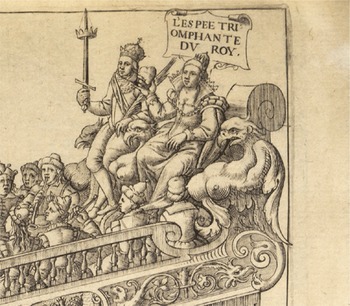
The “chariot” is crowded — 14 musicians and their various instruments squeeze into its tightly packed belly — 14 feet long, 5.5 feet across: 77 square feet in total, minus the space in the front that’s occupied by Juno (Queen of the Gods), their scepter-toting conductor, and even more in the rear that’s held open for a pair of unrecognizable royals and three provocatively voluptuous eagles that flank (and separate) the royal pair. The king, though also absent, is presented in this image in two ways: first in (and as) the sword, and second in (and as) the figure holding it. A cartouche floating behind the queen’s head captions the weapon: “The triumphant sword of the King” (Espee triomphante du Roy). Like many aspects of this image, the viewer cannot say whether the inscription was present at the performance or exists only in this engraving. Still, a contemporary reader would recognize this sword did not simply signify the king. The king’s sword served a crucial role in the funerary and coronation rituals for French monarchs, a metonym (along with the crown that here encircles it) for a crucial aspect of kingship, which transcends the ephemeral bodies that wield it. Indeed, Valladier states that after learning of the king’s absence, he chose not to find a human lookalike for the “peerless” monarch, but to “faire triompher l’epée” — as Herodotus says the Greeks worshipped a scimitar as the “Simulacrum and Image” of the war god Mars, so this sword “was the lively [vive] Image of the King, brave and valiant as the sword” (1601:20).
Only the accompanying text indicates that the figure holding the sword, whose beardless face bears no visible resemblance to the famously goateed Henri, represents the king in another way. The text identifies the figures at the back of the chariot as the Genies du Roy & Royne, their “geniuses,” their jinn. In the pre-Christian religion of Rome, genii were spirits who joined with a person at their birth and accompanied them throughout their lives; with the advent of the empire, these spirits increasingly became conflated with the divine nature of the supreme rulers, the aspect that would persist beyond death and remain present in temples and statuary distributed throughout the empire, believed to replicate the presence of Imperial oversight. Footnote 10 Ernst Kantorowicz’s seminal study, The King’s Two Bodies ([1957] 2016), details how medieval and early modern monarchies conceived of their ruler as having a corporeal body and a corporate or divine one, present even if the physical king were a queen (i.e., Elizabeth I) or decapitated (Charles I of England). Footnote 11 By placing the genius of the king on a “triumphal” chariot, Valladier and Greuter evoke this complex history in which presence is conceived in excess or even in the absence of a physical body. If the king’s body is not here, the sword and the genius nevertheless instantiate his royal majesté and triumphant imperium, giving concrete presence to these virtual, inherently noncorporeal aspects of his kingship. Though the sword is now present only as a word and image, and the genius as an image that is separately described, they instantiate symbols that claim to function as more than signs, not simply indicating something that is absent, but re-presenting it by virtue of their ostentatious appearance. Crucially, as the inclusion of the queen’s genius indicates, the (historical) presence of the person represented does not preclude this mode of re-presentation; the queen sees her “self” doubly — once in the form of her “genius,” and again in the guise of Juno.
This layering of presence and absence, or more specifically of the co-presence of several aspects of a persona that permits a presence and absence to coexist, characterizes the allegorical logic with which Valladier constructs the overall festival program. The presentation of Henri as Hercules does not subsume the myth, nor vice-versa: Henri is not only Hercules, nor is Hercules only Henri. Rather, the teasing out of these connections, like the rearrangement of letters in an anagram to make an intelligible word, reveals a true, or at least verisimilar, connection that is also present in both figures, based on the premise that history cycles through repeatable forms, discernable through the attentive marking of correspondences. To understand this function, a modern reader must accept these correspondences to be not mere contrivances, but evidence discovered within the intricate network of commonplaces through a shared process of inventio. To build a case, forensic orators would elaborate or enliven commonplaces to make the affects, if not the facts of a case present to the jury. Valladier’s invented/discovered “case” reveals not only that Henri has replayed the part of Hercules, but Hercules was always already playing the part of Henri as well (including the part Henri has yet to play). What is at stake is not necessarily a factual correspondence at all, but in the Austinian sense, a performative one. That is, the question is not whether the connection between Hercules and Henri is true or false, but whether it brings a new state of affairs happily into being. In other words, whether there were elephants (there weren’t) or Mores leading the triumphal car, what does this insistently apparent tension, this marked uncertainty do — and how does this performance change with each impression, each reiteration, of the reading?
(Zoom 3) The Presence of the Mores
Performance/History
Valladier explains that there were, in fact, no elephants. But what of the drivers, the ones he calls Mores, the ones depicted astride the bulbous pachyderms? Were there actual Africans present at Marie’s entrée, and did they participate in the festival, riding the costume elephants? Or were they, like their mounts, some more quotidian presence, hidden beneath a “garniture” of cloth or paint? Without external sources, the question is undecidable, and yet, this very undecidability makes posing the question all the more pressing. These figures are a symbol in the guise — or the pose — of an iconic representation: what is behind this image? What reality do we see (or imagine) through it?
On the one hand, records of 16th-century European performances, dances, and games abound with examples of presumably light-skinned performers blackening their faces. These traditions have been especially well documented by scholars of Tudor and Elizabethan England, where a range of practices involved an equal range of material supports and varying levels of verisimilitude. Footnote 12 Popular performances such as mystery plays and Morris dances often involved performers coloring their faces with makeup, likely tallow mixed with various grades of soot (Vaughan Reference Vaughan2005:11), though in the loose genre of provincial cycle plays, Moors were outnumbered by black-painted demons or devils. As Robert Hornback has persuasively argued, scholars have tended to misread this fact as a telling example of how 15th- and 16th-century audiences came to equate blackness, and particularly, black (or blackened) skin as “evil,” while overlooking the ways that theatrical devilry in this period is more intimately tied with foolishness, whether in the guise of ludicrous Lucifers, conniving clowns, or ribald idiots (2007:46). Whether on a devil or a clown, blackness was one among several ostensible disabilities (along with dwarfism or a hunchback) that could signal to the audience who would be the “butt” of the joke (47), though crucially, blackening was also a metatheatrical effect, as when one Lucifer remarks that his misguided sin has left him “smored [smeared]” with soot (in Hornback Reference Hornback2007:49). Far from liberating blackness from the yoke of “evil,” Hornback argues that the identification of blackness with inherent or “natural” foolishness — be it madness, stupidity, or covert sagacity — was a far more pernicious stereotype, easily taken up as a justification for enslaving peoples who were cast not only as misguided (i.e., for choosing a false religion), but entirely without human reason (2007; see also 2018).
Hornback makes a persuasive argument for continuities between black-faced devils and the racist tropes of blackface minstrelsy on the American stage, but a letter by the Humanist Michel de l’Hospital (later tutor to King Francois II) on a rural diablerie — a subgenre straddling sanctimonious mystères and earthy farces — makes clear the abundance of blackened devils on the French stage, while also adding complexity to the question of their reception. In a pedantic missive to the influential Cardinal du Bellay, he mocks a rural pageant for its “most stunning […] Lucifer […] with horns on his forehead, his face slathered in charcoal” (barbouillé de noir charbon) (in Lebègue Reference Lebègue1953:104). Written at the height of Humanist rejection of “medieval” scholasticism (and coinciding with the start of the French Reformation and trading relations with the Tupi of Brazil), l’Hospital’s letter demonstrates how at a time of shifting belief structures, different significations could coexist in the same form; while a peasant might laugh at a devil’s crass jokes while respecting his fearsome evil power, an educated Humanist might laugh at the poor artifice of the devil’s makeup, or maybe, read him as a poor imitation of the black-masked Arlequino, star player of the Italian commedia troupes then flooding the French stage.
Though audiences did not necessarily associate Arlequino’s black mask with African heritage or a racialized phenotype, like the devils, the popularity of this character and their foolish zanni outbursts undoubtedly shaped expectations for how black characters in general would behave, regardless of a given character’s particular history (see Hornback Reference Hornback2007). Unlike the charcoal-painted devils, Arlequinos wore delicately carved masks, a device that, as later visual evidence attests, highlights the presence of a (usually white-skinned) actor beneath the persona (Hornback Reference Hornback2018:48). Sources from Tudor England suggest that elite court performances also used masks in lieu of paint in the representation of characters imagined to be black, particularly those named as Moors. Often made of rich fabrics such as velvet and lace, sometimes augmented by dyed lambswool for “wooly hair” (Vaughan Reference Vaughan2005:11, 27–29), these masks seem to have hung loosely on the face, highlighting artifice over illusion, as the audience sees the character’s black “skin” wavering in front of the performer’s face. Footnote 13 Such doubled presence could have been crucial if the performer in question were, as records show, King Henri VIII or Edward VI (Vaughan Reference Vaughan2005:28). If, as the medieval literary theorist Cord Whitaker remarks, blackness is always “polysemous,” a “mirage” that shimmers over the visual and rhetorical construction of racialized bodies, calling in a framework of presuppositions and, in stark moments, making “whiteness,” too, appear, then the early modern performance of blackness — be it devil, fool, or rich, exotic “King” — manifests this polysemy also through a literal layering, one layer shimmering, while another flashes through (Whitaker Reference Whitaker2019:6–8). The “blackness” cues the audience to “invent” the commonplaces they have come to associate with masked or soot-faced characters, while “discovering” whiteness below, a physical accident that becomes a relational metaphor.
Yet these costly fabrics could also signify through their materiality; so-called sumptuary laws, which restricted expensive fabrics and exotic dyes to the noble classes, meant that a black velvet mask could also signify that the actor was one who could afford and was permitted to wear such fabrics (see Lowe Reference Lowe2005:21; Riello and Rublack Reference Riello and Rublack2019). In France, processional festivals were opportunities to relax some of these rules (analogous to the tradition of Elizabethan nobles lending their clothes to actors in their patronage), but also to display and police them. French festival accounts are fastidious about naming the fabric and colors worn by every member of each parade, details that made wealth and fealty easily legible to their readers. In this vein, the account of the child King Charles IX’s entry into Lyon in 1564 seems to give the most purchase on the historical question of whether there were really dark-skinned people at French festivals — only to snatch the answer away (Discours 1564). The procession begins with a parade of nations, a term that in this context referred to the expatriate communities in cosmopolitan Lyon, emphasizing one’s native place of birth over the longer genealogical connections associated with estoc (stock) or race.
First marched the Luccan Gentlemen, with an estimable magnificence, and in the following manner: Before them were seen six little moorish Pages, very beautiful [petits Pages mores, fort beaux], and with the highest grace, with bare heads, dressed in vests or robes [jupes] in the antique style of a fine crimson satin, adorned with gold trim, each holding a large and rich gold chain intertwined around the body. From this graceful accoutrement, the squared shoulders finished in rich jewels, from which hung sleeves of a rich crepe enriched gracefully with gold. The leggings of these gentle Mores were of black velvet in the Gargas style, and the Boots very sweetly donned [fort mignonnement chaussées] up to the mid-leg. As for the Luccan Gentlemen, their raiment was such: They were dressed in cassocks of fine velvet, wearing robes [robes] of velvet in the same color […] having in each rank two lackeys wearing leggings and doublets of fine white [blanc] taffeta, embroidered and enriched with red [incarnat] and blue silk. (Discours 1564: sig. A4v–Br)
The “Pages mores” here serve a peculiar role, both elevated and aggrandized, and almost fastidiously diminished. While it is impossible to know whether the “live” performance included people with dark-toned skin, or lighter-skinned people wearing makeup, what the reader does comprehend is the wealth they displayed on their bodies, the continuities and the discontinuities between what they wore or bore (porter), and the clothing of the “Gentlemen” of Lucca who followed them. Indeed, in a procession that already performs the social order through an ostentatious display of bodies marching in rank, their presence seems to be almost entirely consumed by their visible shock factor. Beginning the parade, they literally set the tone — bright red satin in a prized “antique” style, but their difference is also clearly marked. Only their leggings connect them with the rest of the Gentlemen who follow — the Luccans (and all the other nations) wear garments of the same black velvet. In fact, these “Pages mores” are the least “black” of the whole parade. Despite their otherness as “Mores,” it is everything but their blackness that marks them, yet this also serves to disorder them, diminishing their primacy despite leading the parade that passes before the king. Their gold chains, binding only their torsos, nonetheless recall the already famous myth of Gallic Hercules, who mastered men with his rhetorical sway, signified by gold chains binding them to his mouth. They are bound without force, bound by the glaring, glinting presence of the chains themselves. They are reduced to the symbolic rhetoric they wear and bear; their bodies are nearly erased. Indeed, even in the language of the description they are made small, “mores” reduced to lowercase adjective (moorish), smaller even than Pages, a role for the youngest of the court. Though praised for their grace and gentility, their littleness is fetishized: they wear their black velvet fort mignonement anticipating the depredations hurled at King Henri III, successor to Charles and predecessor of Henri IV, who was accused of filling his court with mignons (“favorites” or “sweeties”) who indulged his “monstrous” fantasies and his hypocritical displays of piety, such as marching through the street dressed only in unadorned white clothes. Here, these moorish Pages do not even have the job of official signification; this is reserved for the “lackeys,” who themselves are dressed in white, adorned with blue and another kind of red, incarnate, whose name refers to the color of lively, blushing flesh. It is as if to remind the reader, if not the present audience (to whom the distinction would be surely imperceptible) that not all reds, not all flesh and perhaps, not all blacks are the same.
While the signifier “more” here indicates no more about the phenotype of the historical performers than do the Mores described and depicted in Labyrinthe, the fetishizing portrayal does represent a role that many dark-complexioned people in 16th-century Europe were expected — or compelled — to embody. Commerce in enslaved persons flourished throughout the Italian peninsula, including in the Papal States and Florence, and as the art historian Paul Kaplan has argued in his contribution to the seminal project Image of the Black in Western Art, featuring enslaved Africans with strikingly dark skin — especially women — became a kind of fashion at courts in the Italian peninsula, like the one in which Marie de Medici was raised (2010:110–11, see 2005; see also Tognetti Reference Tognetti2005). Thus, even if the roles assigned to Mores and other black characters were frequently incarnated by white performers in black makeup or masks, they were also imposed on and performed by individuals with dark skin. While Labyrinthe is decidedly ambiguous about the actual phenotype of the Mores who performed in Avignon, it nevertheless acts (like Charles’s entry into Lyon) as a kind of script for performances yet to come, shaping expectations of how Mores ought to be seen, their place in the political ordre, how they ought to behave, and, perhaps, how the viewer ought to behave in relation to them.
Still, it is unclear whether knowing the phenotype of the performers would tell the modern reader anything more about their identity. While visual evidence can reveal the historical role of dark-skinned people in the European imaginary at large, including the continuous reinvention of a “Moorish” identity, which is black (in color) and can also be incarnated by someone with dark skin, art historians nonetheless risk conflating phenotypical appearance with anachronistic identities. In short, by seeing someone with a dark complexion as Black, historians interpret their life through the probable lens of what “Black” means in their day.
The legacy of Marie’s distant cousin, Alessandro de Medici (1510–1537), the first Duke of Florence, provides a telling example. Born a bastard but widely assumed to be the son of Gulio de Medici (Pope Clement V) and Simonetta da Collevecchio, a freedwoman of African descent, Alessandro is known by the sobriquet il moro. While some recent authors have sought to explore his identity as the first Black European ruler, other scholars have argued that his “Moorishness” was constructed by later historians, writing at a time when the Triangle Trade had already perverted their readers’ ideas of race, to color him as an irrational tyrant (Fletcher Reference Fletcher2016; Gallucci Reference Gallucci2015; Robey Reference Robey2012). Though they draw on different valences of “blackness,” both the racist historians and their modern antiracist counterparts impose latter-day notions of phenotypical “race” onto an elusive subject, about whom scant contemporary evidence remains. In fact, Moro could refer to African Muslims of Arab or Berber origins as well as sub-Saharan Africans, and French travelers to Africa speak of “black and white Moors” (Mores noir & blanc) (Villamont 1596:263v; see McGrath Reference McGrath2002). However, one piece of visual evidence does attest to the duke’s complex performance of “African” identity. As his heraldic emblem, Alessandro chose a version of Albrecht Dürer’s famous Rhinoceros, appropriating the second most–famous “African” mammal and legendary rival of the elephant (the first). Yet the choice is also notable as a refusal of another heraldic sign, the “Moor’s Head,” whose ostentatious presence will encourage us to look at the elephants and their riders in yet another way.
(Zoom 4) Iconography
Elephants and the Representation of Imperial “Africa”
Deep as we may look, the Greuter etching reveals nothing about the bodies of the real performers, either to historical readers, or to historians reading today. Yet looking at what is present reveals an image composed of other images — sources from multiple iconographic traditions — reworked to fit this novel context. To represent this festival to a broad public throughout the French-speaking world, the engraver drew on the rapidly increasing volume of images circulating through Europe by virtue of new technologies of reproduction — and some older ones as well. Such artistic citation, serving sometimes as a practical expedient, sometimes as deliberate ostentation of the creator’s cultural knowledge, and most often as both, is also a form of inventio. Evoking commonplace imagery provided an opportunity for rhetoricians, verbal or visual, to show their virtuosity by energetically elaborating these tropes to represent them anew. The specificity with which Greuter renders the constituent elements of this visual remix counterbalances the familiarity of the images themselves, making a clear statement to his well-read viewers, while affectively arresting those encountering them for the first time.
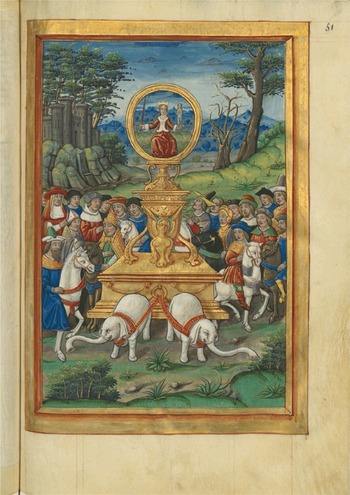
Though the Roman triumph lingers in the present consciousness largely in the form of monumental arches — for example, the Arc de Triomphe, the arch in Washington Square — for a 16th-century reader, as for an ancient Roman, the triumphal chariot held pride of place. Footnote 14 As Renaissance festival creators sought to turn their royal processions into imperial triumphs, many turned to the rich and readily recognizable imagery of I Trionfi by the Florentine poet Petrarch, which recasts the Roman ceremony into an allegorical succession of victory parades by Love, Chastity, Death, Fame, Time, and ultimately Eternity (i.e., Christ). Manuscript illustrators, early printers, and even the creators of the first tarot cards (designed for the game of “Triumphs”) all took on the lush allegories of I Trionfi, settling it firmly in the imaginary of a public with vastly growing access to images. While Roman custom dictated that four white horses pull the chariot of the imperator, Petrarch’s illustrators substituted animals with more visual and cultural resonance; in most of the illustrations, especially in France, the illustrators drafted elephants to draw the chariot for the Triumph of Fame. Footnote 15
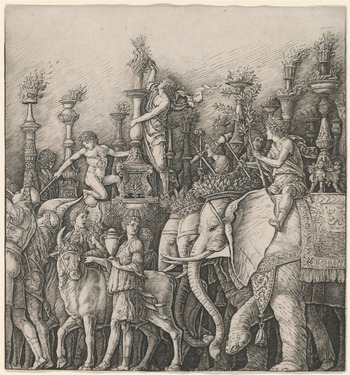
The Triumph of Caesar: The Elephants, c. 1497/1498. Engraving by the workshop of Andrea Mantegna. Andrew W. Mellon Fund, 1976.11.1. (Courtesy of the National Gallery of Art, Washington, DC)

Elephants occupied a unique role in the reimaginings of the Roman triumph in writings, in images, and in civic festivals. The association with fame is no coincidence: elephants played an outsize role in the most celebrated triumphs of ancient Rome — that of Scipio Africanus for his defeat of the Carthaginians, and Julius Caesar’s fourfold triumph, which concluded one phase of the civil war that turned the Roman Republic into an empire (Appian [c.100-162 CE] 1913 2.101). Elephants also had a rich life in medieval bestiaries, whose writers endowed them with fantastic capacities. Moreover, though few had reached Europe since ancient times, elephants, unlike unicorns or winged quadrupeds, abounded in the staid historical literature that eschewed fantastic claims, as well as in the contemporary eyewitness accounts of French and Portuguese mariners who sailed to the “Indies” or stopped on the west African coast en route to Brazil. Footnote 16 Thus, elephants demarcated a shifting boundary between the real and the imaginary, rendered ever more uncertain by the ongoing discovery (in Latin accounts, inventio) of the Americas and the African continent. Thus, for a 16th-century ruler who aspired to imperial status in Europe and (increasingly) abroad, elephants constituted an iconographical and embodied nexus of the ancient imaginary and the contemporary real, concretized in the possibility of reenacting or re-presenting the triumphs of the most prestigious ancient imperators by claiming dominion over (an idea of) Africa in their own right. Indeed, despite Petrarch’s poetic gambit that Time triumphs over Fame as famous deeds recede into forgetfulness, the Humanist project he helped initiate showed that in history, as in allegory, Time’s order might double back, and even the long-buried past may become present anew. Eternity might be the final victor, whether through Christ’s coming (in Petrarch’s poem) or entropic dissolution, but as long as history persists, re-presentation challenges Time’s glory over Fame, again and again.
Detail from Petrarch (Franceso Petrarca), Le Livre des Trium[p]hs de Pétrarque. Trans. Symon Bourgouyn. MS Fr. 12423, Folio 51r. (From gallica.bnf.fr/Bibliothèque nationale de France)

The elephants that appear in Renaissance editions of Petrarch’s poems (and in prior French entries that cite them) pull triumphal chariots of their own accord; by contrast, Greuter’s addition of riders collapses the allegorical references into the world of real history by citing Andre Mantegna’s monumental painting cycle, the Triumphs of Caesar. Designed with a view to archaeological exactitude and governed closely by the accounts of Roman historians, these immense tableaux lined the halls of Mantegna’s patron, the Duke of Mantua, confronting the viewer with a life-size depiction of Caesar’s famous triumph. The paintings entered the canon of French triumphal literature in Blaise de Vigenère’s account of King Henri III’s 1574 entrée into Mantua, as he fled the throne of Poland to claim the throne of France, but educated readers would have already known their imagery (1576). Mantegna invested heavily in new technologies of engraving, and prints from his paintings circulated throughout Europe in at least two editions, certainly reaching Grueter in Strasbourg and/or Papal Avignon. Conforming to his methods, Mantegna provides a much more realistic portrayal of his elephants than most I Trionfi illustrators could, enough to discern them clearly as “African elephants” (in modern parlance), not one of the Asian varieties that have been domesticated. Footnote 17 Mantenga’s elephants do not pull Caesar’s triumphal chariot — they, too, are prisoners of a sort — but they are ridden by two cherubic figures with bandanas — both of whom are visibly white.
Mantegna’s choice to depict these elephant drivers as white children does not derive from a simple assumption that everyone in a Roman triumph would be light-skinned. At least two figures in Mantegna’s triumphal procession have a brown complexion: a horn player among the musicians and another among the “picture bearers” (others with grey or bronzed faces might indicate damage or fading of certain pigments). Neither of these figures appears among the captured prisoners, who would, under Roman law, become slaves. While these gradations of tone do not appear as distinctly in the print versions of the paintings, their presence makes clear both that Mantegna sought to depict a cosmopolitan empire (at least at street level) and that Greuter and/or Valladier made a deliberate choice to “invent” a new racial dynamic within this established tradition. Footnote 18 Since this citation would furnish symbolic capital for the creators only insofar as the audience recognized the source, the inclusion of riders with dark complexions suggests an appeal to a changing notion of “Africa,” one that, along with the elephants, is increasingly separated from Europe and Europeans — increasingly exoticized.
The coat of arms of the former Pope Benedictus XVI. (Screenshot by TDR)

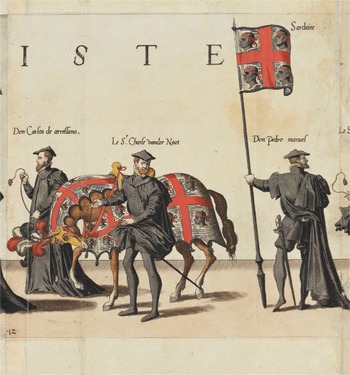
The riders, too, emerge from a complex iconographic tradition, but one only distantly related to triumphal processions and prints; rather, they are invented from the symbolic field of heraldry. Heraldry is an arcane field, replete with obscure symbols and conventionally described in Anglo-Norman, the otherwise defunct creole language of medieval English nobility. However, it is also, in the terminology of Valladier and his contemporaries, an essential marker of race. Valladier expounds at length on the crests of Navarre, the Medici, and the late Emperor Charles V to support his argument that Henri is not only the Gallic Hercules incarnate and Marie his fated wife, but also that Henri has an actual, genealogical connection to Hercules, being of “his stock & his race” (Valladier 1601:2). Though Valladier’s readers would recognize that family trees could be “invented” (in all senses of the word), the move highlights a concept of race intrinsically connected to a direct line of descent, not a classification by present (phenotypical) characteristics. However, it is precisely Greuter’s contrasting invention of heraldry in the case of the Mores that makes the transforming conceptual landscape of race readily apparent.
The traditional flag of Sardinia, featuring four Moors Heads, as it appeared in the printed booklet for Holy Roman Emperor Charles V’s Funeral Procession, 1559. Color may have been added later. Detail from La magnifique et sumptueuse pompe funèbre faite aus obseques et funérailles du trèsgrand et trèsvictorieus empereur Charles cinquième. Folio 15r. (From gallica.bnf.fr/Bibliothèque nationale de France, département Réserve des livres rares, RES-OC-1661)

The white bandanas, which add such a lively touch to Mantegna’s print, also signify, as much as Valladier’s text, these figures’ status as Mores. The “Moor’s head” was a common figure of medieval heraldry, featured to this day in European crests such as that of the former Pope, Cardinal Joseph Ratzinger. While numerous, contradictory accounts exist as to the origin of the figure, two distinct iconographic traditions stand out. One, more prevalent in Germanic lands, features a dark-skinned face in profile, wearing a red crown; the other tradition features a similar profile, with a white (sometimes red) bandeau, variously interpreted as a bandage, bandana, or blindfold. While the Mauren, as these dark-skinned figures are called in modern German, are sometimes linked to the Theban martyr St. Maurice, the heraldic iconography appears to originate during the Reconquista, commemorating a victory of the Christian Kingdom of Aragon over Andalusian “Moorish” armies; the motif spread throughout the Mediterranean and the Italian peninsula as the Spanish Kingdom of Aragon took control of cosmopolitan Sicily and Naples, along with Corsica and Sardinia, whose flags still feature a version of the medieval Aragonese crest. Footnote 19 Despite the myriad variations, the large red lips, wide white eyes, and ink-black “skin” reappear frequently enough for a modern (especially American) reader to recognize, in the most exaggerated cases, an archetype of the racist blackface characters that proliferated in minstrel shows.
The bandana-style heraldic crest also gained prominence in Medici-dominated Florence as the crest for the Pucci family, and in neighboring Milan, through the patronage of Duke Ludovico Maria Sforza (1452–1508), who was nicknamed il Moro, ostensibly because of his dark features (McGrath Reference McGrath2002). As an Italian duke of unchallenged European lineage, he leveraged the sobriquet as a crucial part of his “self-fashioning,” as the influential critic Stephen Greenblatt has termed this particularly Renaissance flavor of performing the self across a variety of media — textual, visual, and enacted on or off the stage (Greenblatt Reference Greenblatt2012). Ludovico’s appropriation of the “Moorish” mantle allowed him to exploit the term’s inherent ambiguity (Arab or Berber African Muslim, or sub-Saharan African). Yet as the artists Ludovico patronized produced works featuring African figures and bandeau-ed “Moor’s heads” across a variety of media, from paintings and sculptures to the frontispieces of books to live performances, they reified the ambiguity of the Moro, often setting solitary African figures in stark contrast to fields of light-skinned ones. Art historian Paul Kaplan argues that the plethora of representations inspired Ludovico’s courtiers to feature enslaved Africans among their retinues, capitalizing on a slave trade that took dark-skinned captives northward via Tunis (in Ifriqiya, the site of ancient Carthage) and Venice, where vendors traded in humans from Africa and Slavic lands whose nonmonotheistic beliefs were used to justify their loss of liberty (2010). While Ludovico and his courtiers may have been building on a trend already growing throughout the Italian polities (possibly evidenced in Mantegna’s triumphal procession), the concrescence shows the slippery edge between representation and reality in the Renaissance court (as) performance. It also forces the viewer to reconsider the temporality of representation at play. While some of the visual and material culture produced in Ludovico’s Milan certainly depicted real individuals from the African continent, and some performances might have utilized their talents, these representations — even the most bluntly stereotypical — also implicated or effectively “pre-presented” real African people. That is, they scripted future realities, in which the image would later be embodied by figures who matched the phenotype it seems to represent — figures who may well have been expected, more or less exactly, to fulfill whatever prejudicial baggage the “type” brought along.
Thinking this way provides a different lens for understanding figurative allegory: the allegorical representation is “true” insofar as it helps to configure the circumstances it seems, to a modern eye, only to describe, or at best, prescribe. Yet the “invented” iconography of Labyrinthe is not only descriptive, or constative, but also performative, changing the state of the world. I do not suggest that Valladier’s allegorical framework caused Marie de Medici to give birth to the future Louis XIII, nor that he or any reader believed it would. But an affectively striking image such as this one may well have influenced the expectations of these readers, shaping the virtual world they anticipated or sought actively to instantiate. In the (disputed) terms of 21st-century cognitive science, it may well have shifted the Bayesian priors that govern a viewer’s probabilistic model of the world (Doya et al. Reference Doya, Shin, Alexandre and Rao2007; O’Reilly et al. Reference O’Reilly, Jbabdi and Behrens2012). Such modelling can easily conflate “artistic” representations (a painting, a performance, the pomp of court) with “real” experiences, insofar as the two are perceived with similar affective weight. In more concrete terms, I suggest that an affectively stirring representation can modify the type of representations one expects to experience in similar contexts, whether or not the context is staged, and will hence necessarily influence future stagings or representations of this event. Greuter’s image restages a composite Petrarchan-Julian triumph with a stereotyped African overlay. The next monumental reinterpretation of Julius Caesar’s triumph, Peter Paul Rubens’s 1630 painting A Roman Triumph, hews closely to Mantegna’s design, allowing the audience to fully appreciate the characteristic expressivity of his Baroque brushwork and the emotionally jarring expressions of his figures; yet the work also suggests a deep impact of Greuter’s work in the presence — literal and affective — of uncannily human elephants and the two dark-skinned, typologically Moorish elephant riders. Rubens paints them with a different demeanor. Both the animals and their drivers have become almost comically incensed, as if swept like fools beyond the reasonable boundaries of the human. But Rubens’s portrayal represents only one reading, influential, but far from final.
(Zoom 5) Representing Humanity
Eyeing an Elephant, Facing a Human
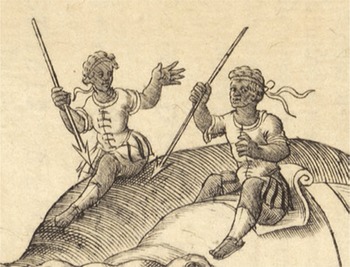
The riders are eye-catching. It is not just the way their cross-hatched complexion contrasts with the other figures or the off-white paper support. They are looking at us. The elephants, too, but the riders address us differently. The first gazes out from the paper support, a touching glance — eye contact. He is first because the composition insists on it. The chariot slopes down from the right, leaving a wide spotlight for the elephant riders to occupy, but all eyes — the other rider’s (Juno) and ours — are on the rider gazing outward. In his famous essay on the social effects of emergent technologies that made art (and the entire visual field) vastly easier to reproduce, Walter Benjamin suggests that something evaporates in the process of reproducing a work of art, or more precisely, by virtue of the very capacity to reproduce it without the intervention of a human hand. He calls this lost quality the “aura” of the work, comprising all the physical traces and well-worn stories that give that work an almost palpable age, an individual narrative, the sense of having been created by an original hand. Benjamin believes this “loss” to be liberating, allowing the masses to break free from the cult of auratic works coopted by the Nazi party in their relentless, racist, pseudoimperial self-fashioning. However, he suggests that in one category of works, an auratic quality persists despite their mechanical reproducibility: portraits. Benjamin states, “In the cult of remembrance of dead or absent loved ones, the cult value of the image finds its last refuge. In the fleeting expression of a human face, the aura beckons from early photographs for the last time” ([1936] 2008:27). There are other geniuses here; their power emanates through the image presenting those who have passed on, or those who have not yet passed by, and may never fully arrive.
Eager to beckon the proletarian future, Benjamin can be forgiven for not anticipating Facetime or the cult of the duckface selfie, but his central insight holds — in an era where a face is virtually infinitely reproduceable, streaming into the cloud in a space of time so slim it seems to be live, a steady gaze seems to transcend the dead space behind the screen, producing the illusion of presence. Such persistent, distributed “presence effects” challenge another of Benjamin’s claims about film — that the aura of the actor playing Macbeth disappears along with the character, when the live spectator is replaced with a camera’s eye (31). Yet far from eliminating this twofold aura, the close-up on a “genius” actor seems to bring the screen itself to life. Indeed, the fact that Benjamin overlooked the propagandic power of photography and motion pictures for augmenting the charismatic aura of the Nazi regime appears to be evidence of Ariella Azoulay’s critique of how Benjamin “succumbed to a chronological historical perspective that ignores the simultaneous character of phenomena, and orders them as sequential” (2001:24).
In an age of vibrant matter, amidst an internet of things planned for obsolescence, readers are perhaps more ready to believe in the liveness of the objects that surround them though, pace several million Baby Yodas, aura seems to be in shorter supply. Still, the Zoom screen that has emblematized Covid-19’s seemingly endless “social distancing” has made many of us keenly attuned to the punctum of a two-dimensional gaze, and perhaps it is the still frame in this digitized engraving, that permits the kind of attention in which the objective world fades away. One may enter a relationship, not with this object (the print, the photograph thereof, its present iteration on a page or screen), but with this anonymous rider, and if our gaze drifts down lower, with these elephants who also, even more poignantly perhaps, seek a seeking eye. Footnote 20 The aura is “a unique phenomenon of distance, no matter how close the object might be,” Benjamin writes, and Azoulay asserts that it is not the object that “loses” its aura, but the site, which is what makes the museum, the gallery, the rare books library (or the Apple store/website) so desperate to maintain a sterile boundary indicating — producing — the reverence due to Art (in Azoulay 2001:22). And fundamentally, the fact that the image is also, very much, here — here to be zoomed and cropped and rotated, here in a way that only a reproducible object (like a photograph, like a print) can be, manipulable and not too precious — makes the perception of an other gaze so striking. While everyone “in” the image is looking at the genius, the genius seems to be looking only out at you. The genius is the impression left on the page by a marked slab of copper, yet the impression left on you (whomever “you” is) opens a possibility that “you” might remember this moment as a brush with humanity; in an admittedly hopeful scenario, you might experience in the face of an Other the aura of a person, and remember the attention you shared.
Detail of Royal labyrinth of the triumphant Gallic Hercules. Etching by Mathias Greuter, from the book by André Valladier. (Courtesy of Boston College, Burns Library)

Pace Benjamin, I do not suggest only a human face can captivate us in this way. The other rider, set higher on the page to effect a simple illusion of distance, reaches up an arm to wave. The gesture is arresting, extending their performance into my presence — extending, perhaps, my present into yours, here, now, on this page. This wave animates a portrait always already playing a stereotype, a gesture whose animacy quickens our own. The wave beckons us to respond, to enter its world. Or, we waver, is it always already waving back, anticipating our gesture before we make it, as we beckon it into our lives, into the contemporary frameworks of structural racism that impress this waving hand (literally) and place it at the juncture between one privileged artist (Greuter) and another body holding TDR, holding a computer, and/or playing at being a 16th-century reader from an office, a bedroom, a café?
Labyrinthe addresses us as a reader it can imagine, even desire — a bourgeois, a nobleperson, Marie herself, or even ideally, Henri, the absent king perfecting the festival through his readerly presence. Here, as in each image, each plate, we are given the perfect perspective, the king’s seat, and there is no crowd to distract from our focused contemplation. Are we not, in some fashion, being hailed as the king, or at least, a virtual surrogate, as spectrally “there” as the epee, as the effigy, the genie? What structural role, more ideological than literary or historical, do we enact, if we wave back? Footnote 21
Perhaps, this wave is neither outward nor back, but out of time, incontinent, suspended like a velvet glove with no hand. This may explain the forced perspective, the casual, almost unanatomical angle: the rider is playing at the stereotype, winking through its costume, signifyin’ something even its creator could not comprehend (Gates [Reference Gates1988] 2014). Wav(er)ing through the veil of time, the pose imposes its own questions: can a single gesture become not simply “polysemous,” but polyperformative? Can a single hand implicate us in different ways, draw us into multiple subject positions, multilayered states of affairs — at the same time?
Detail of Royal labyrinth of the triumphant Gallic Hercules. Etching by Mathias Greuter, from the book by André Valladier. (Courtesy of Boston College, Burns Library)

In the technical language of allegory, which in this instance, is also colloquial speech, the wave is a type of human interaction insisting, across myriad technologies, on its manual reproduction. Challenging the very stereotype from which it was invented, the “Moor’s head” that comes to define “racial” characteristics, this distinctly affecting wave pre-presents an alternative, a figural antitype, a wave connoting (at least at one level of reading) mutual humanity.
(Zoom 6) Index, Finger-Pointing
As Cord Whitaker notes, “race is an interpretive process, and as such it inherently involves the possibility of multiple outcomes” (2019:6). Each time an enthymeme is silently completed, each time we discover an invented commonplace and elaborate it further, an act of interpretation is absorbed in a semblance of uninterrupted presence. Yet here, at certain points, another hand enters, intervenes, presents itself. At the edge of a cheek, an errant mark breaks through the line — a minute error that, if we remark upon it, reminds us that the entire image is but traces of an artists’ handiwork, fine scratches on a burnished plate.
Hatching, the process of using close, parallel lines to create variations of shading or “value,” is an essential technique taught to any student of drawing. For engravers, however, natural gradients are rendered impossible by the medium; hatching, and its complement, cross-hatching, are the only available techniques to create the illusion of tonal gradients — adding dimensionality, shadows, and of course, darker “skin.”
Breaking through its borders, the shaded “skin” exceeds itself. Flashing its artifice, its artificiality, it becomes “present” as it always ever was, a show that is first and foremost about showing itself. In some phenomenological traditions, such a break would also shatter whatever affective relation, whatever suspension-in-belief, is prompted by the uncanny impression of those finely cut eyes, or whatever mutual acknowledgement of humanity is acknowledged in the waving hand. Footnote 22 Yet read out of context, in the present day, Labyrinthe suggests that the awareness of artifice, of constructedness, and above all, a recognition of one’s failure or incapacity to cohere to the boundaries one has artificially inscribed — need not present a “break,” but instead emphasizes the suspension as such, the ambiguity, the ever-present relation between “one” and “you” by virtue of which a collective invention of new realities becomes possible.
Labyrinthe leaves the reader suspended, not in illusion, but in the tension between the accidents of history, on the one hand; and on the other, the probable frame of a world ordered by allegorical types, racialized stereotypes, and a perfect antitype that the reader is also invited to embody — a performative gesture that ratifies this particular construction of an ideal world by virtue of one’s readerly presence — if the gesture is happily performed. I began this article by zooming out, assembling a network of commonplaces and historical references, by virtue of which one may attempt to describe, even to embody, the ideal obliging reader implied by Labyrinthe’s many invitations to participate, to perform, to collaboratively realize the festival that could not take place, even if it ought to have.
Yet, still, you are here, too, remarking that this role was not quite perfectly described. The error, a trace of the “real” breaking through the illusion, allows us to recognize invention as an interpretative act, through which one can make a historical scene grippingly, even intimately present, but which also makes us present as ourselves, replete with the commonplace assumptions we believe we share. Distinguishing “one” from “you” or “I” — the ideal scene from each historical accident — reminds us that our identities, like those we construct with each rereading, are also “types.” By virtue of the trace, the past remains in the present. But the trace is only legible through the evidence of lived experience, always partial, always constructed, and invented in the moment. Yet in each attempt to represent the past, we enter an uncertain suspension among copy, actuality, and imagination. We confront the gaps among type, antitype, and stereotype, and in not quite reconciling the expectation to the facts, we become visible to, and as, ourselves.
The logic of inventio, of Labyrinthe, and of the festival books on which it draws insists that the revelation that an ideal is inherently artificial does not negate its power to produce present belief. Rather, in these moments of errancy, we become present, you and I, as coinventors. In the tension between the ideal and the accident, what becomes present is that even the ideal, the perfect, the antitype is continuously reinscribed. We can reimagine the fixed ideal instead as a weighted probability, capable of absorbing its own failures, but also subject to intervention. Thus, if errancy, error, or accident reminds us of our role as co-inventors, we must recognize that the feeling of presence, fluency, or flow requires a willing suspension in belief. Such presence is possible by virtue of the implicit beliefs and assumptions with which we fill-in, or if I may, feel-in the blanks; never neutral, to accept an invitation to lose ourselves in re-presentation, again and again, may open up unexpected windows to ethical relations across time and space, but also requires, and reinforces our complicity in ideologies that remain unremarked.