Introduction
First described in 1896,Reference Marfan1 Marfan syndrome (MFS, OMIM #154700) is an autosomal dominant disorder that affects the connective tissue of multiple systems, with particular repercussions on the cardiovascular, skeletal, and ocular systems.Reference Loeys, Dietz and Braverman2 Marfan syndrome results from mutations in the FBN1 gene, and its diagnosis is guided by the revised Ghent criteria, which combine clinical, familial, and molecular evidence to differentiate its variants.Reference Loeys, Dietz and Braverman2
Considered a rare disease, Marfan syndrome has an estimated global prevalence of 1 in 5000 or 10,000 individuals.Reference Dietz3 Approximately 75% of cases are inherited, while the remainder occur through spontaneous (de novo) genetic mutations.Reference Dietz3 The broad spectrum of clinical manifestations is one of the main challenges for diagnosis. Symptoms can vary significantly in severity and combination among patients, ranging from major criteria such as aortic dilation, lens dislocation, and molecular evidence of a mutation, to minor criteria such as palatal alterations, skeletal signs of hypermobility, or chest deformities.Reference Loeys, Dietz and Braverman2,Reference Dietz3 Given this variability, early diagnosis and multidisciplinary management are crucial, as they allow for comprehensive monitoring that aims to mitigate complications and improve quality of life.
This case report is uniquely presented from the dual perspective of the authors, the patient’s scientist parents. While some may question this intimate involvement, it is believed to offer an unparalleled lens through which to observe and document the nuances of Marfan syndrome. The pair’s shared scientific background (the mother’s experience in public health research and the father’s training as a philosopher) allowed them to approach this journey with a level of rigour and detail that both consider lacking in other narratives on this topic. This account, therefore, is not merely a scientific document; it is a testament to the family’s journey, love, and hope, and as such, serves as direct consent to share their story.
Therefore, the objective of this case report is to document the clinical journey, management, and development of a three-year-old paediatric patient diagnosed with Marfan syndrome in the uterus, at 24 weeks of pregnancy, offering an integrated perspective that unites the scientific perspective with personal experience.
Case presentation
Perinatal history
This case report focuses on a patient whose pregnancy, though unplanned, was immensely desired. When the baby’s sex was discovered, his mother (a white woman, 31 years old) and father (a white man, 34 years old) named him Antônio, in a premonitory and unintentional tribute to Antoine Marfan, the doctor who described the syndrome that, even before his birth, would be his diagnosis.
Upon discovering the pregnancy, the parents were already aware of the possibility that their baby would be diagnosed with Marfan syndrome. The father, clinically diagnosed with the syndrome at age 32, underwent aortic aneurysm repair surgery that same year. Subsequently, genetic analysis (Supplementary Material) confirmed the presence of a mutation in the FBN1 gene, which, because it was not found in either of his biological parents, was classified as a de novo mutation.
The pregnancy was diagnosed at 7 weeks (August 2021), and the couple began obstetric monitoring and routine examinations. A Level 2 Ultrasound, at 22 weeks and five days of gestation, detected dilation of the ascending aorta (Supplementary Material), which led to a referral for fetal Doppler echocardiography. This examination, performed at 24 weeks, revealed moderate dilation of the ascending aorta, along with mild mitral and tricuspid regurgitation (Supplementary Material). Based on the findings from the examination, the case was classified as neonatal Marfan syndrome, and the couple was referred to the fetal medicine outpatient clinic (Centro de Medicina Fetal) at the Hospital das Clínicas of the Federal University of Minas Gerais to begin high-risk prenatal care.
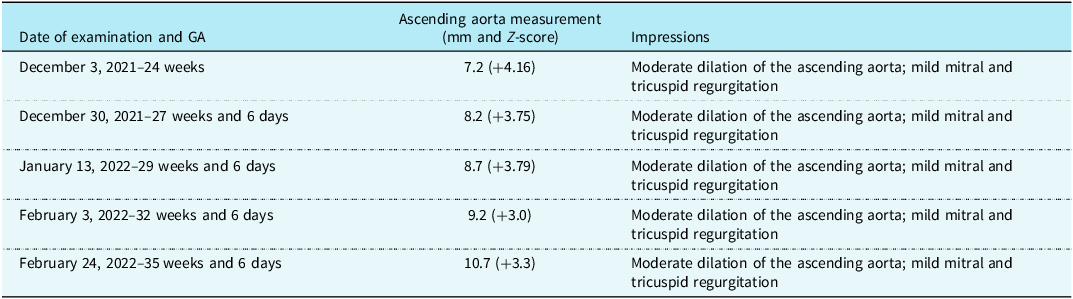
During prenatal care, the follow-up at the clinic focused on observing the evolution of the cardiological findings, with a total of five fetal Doppler echocardiograms being performed. The final report demonstrated a stable status, with no significant progression of ascending aortic dilation (Table 1). All other fetal findings were consistent with expectations for the respective gestational ages.
Evolution of the aorta observed via fetal echocardiogram, from the gestational period, starting at the 24th week

The birth plan was structured to minimise any intervention that could alter the fetus’s heart rate, given his condition. With no contraindications to vaginal delivery, Antônio was born in March 2022, at 38 weeks and 6 days’ gestation, via a natural birth lasting 5 hours. At birth, he weighed 7.065 pounds, measured 20.07 inches, and had a head circumference of 14.17 inches.
In the immediate postpartum period, Antônio did not present any warning signs common to most reports of early-onset Marfan syndrome, such as tachypnoea, tachycardia, cyanosis, or prostration.Reference Koenigsberg, Factor, Cho, Herskowitz, Nitowsky and Morecki4 He was evaluated by the paediatric team and quickly returned to his mother’s arms, beginning breastfeeding within the first hour of life. He remained rooming-in with his mother, without the need for monitoring in a neonatal intensive care unit.
Approximately two hours after birth, while breastfeeding, he showed signs of fatigue, which were initially observed by his mother. Upon evaluation by the paediatric cardiology team, tachycardia and tachypnoea were identified. Initial management consisted of nasal lavage with saline to check for obstruction due to fluid accumulation. This intervention resulted in clinical improvement, and the patient was monitored on a vital signs monitor for approximately 30 minutes.
The main postnatal findings, consistent with Marfan syndrome, were: echocardiogram (ECG) showing mild aortic and pulmonary root dilation (Supplementary Material), funnel chest, downslanting palpebral fissures, and thin, elongated fingers.
Mother and child were discharged 48 hours after birth, exclusively breastfed on demand, without complications, and referred for multidisciplinary follow-up—paediatrics, genetics, and cardiology.
Cardiovascular repercussions
Since leaving the maternity ward, tests indicated that dilation of the ascending aorta was the main symptom requiring monitoring. The Hospital das Clínicas of the Federal University of Minas Gerais team requested a follow-up visit in three months for a new ECG and clinical cardiology evaluation. During this period, the patient’s follow-up continued normally, at the appropriate frequency for newborns, with the referring paediatrician.
Approximately one month after birth, the patient developed cyanosis on the ends of the thumbs on both hands, prompting the parents to seek medical evaluation. The evaluation ruled out any relationship between the finding and heart disease. The parents reported that the patient persistently kept his fists clenched, with his thumbs flexed and sometimes pressing hard, even during sleep. After ruling out an immediate cardiologic warning sign, the procedure was to maintain the follow-up plan, with an ECG performed at three months of age.
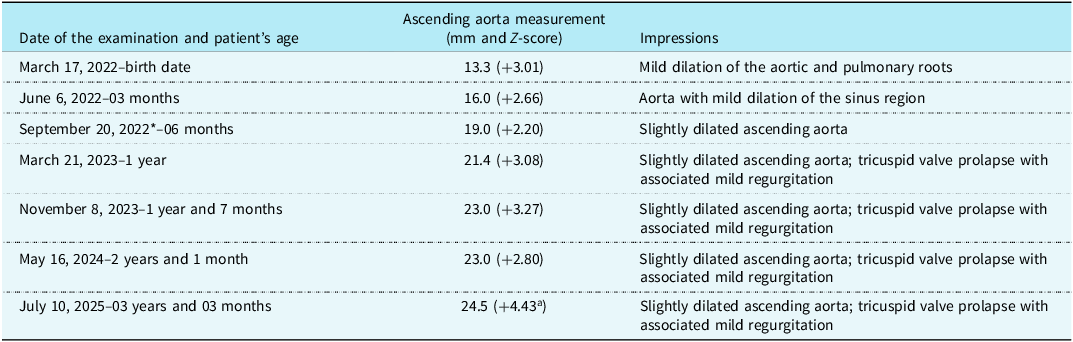
When the ECG was performed at three months of age, when compared with the ECG on the day of birth, progression of aortic dilation was observed. Monitoring was carried out at the frequency recommended by the team, and all ECGs performed to date are described below (Table 2) and can be accessed completely in the Supplementary Material.
Evolution of the aorta observed via echocardiogram in the first year of life
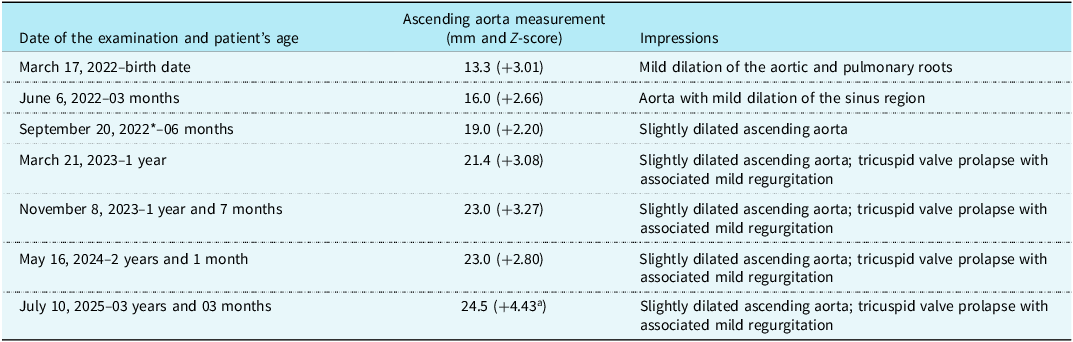
* From that date onward, the examinations began to be conducted at another clinic—supplementary health—due to the difficulty of scheduling through the public health system. Since then, until the present day, the examinations have been conducted by the same professional.
a In this examination, the professional chose to change the Z-score reference, and therefore, the increase was, apparently, abrupt.
During Antônio’s first year of cardiological follow-up, no medications with the potential to reduce haemodynamic stress on the aortic wall were recommended. Although his parents questioned the possibility of pharmacological treatment, the initial recommendation was to wait for the condition to evolve. After consulting specialised literature and identifying that the early use of drugs as a preventive strategy is recommended regardless of age, they sought out new opinions and professionals who were capable of this type of approach. Therefore, when the patient was one year old, therapeutic management with beta-blockers began.
In addition to the ECG, other tests (such as electrocardiogram and 24-hour Holter monitoring) were performed over the years, none of which revealed significant abnormalities.
Use of beta-blocker
In April 2024, the patient began taking atenolol at a dosage of 5 mg in the morning and 5 mg at night. During the first week, two atypical falls were observed while crawling, which were later characterised as transient loss of consciousness. Given the temporal correlation with the initiation of the medication, the dosage was reduced by half to facilitate adaptation. The dosage was gradually adjusted, and currently, Antônio uses 12.5 mg in the morning and 12.5 mg at night, showing good adaptation.
Side effects were also identified and managed. Constipation manifested in the first week of use. After several behavioural management attempts (feeding, hydration) failed, it was necessary to add 10 g of Polyethylene glycol (PEG) 4000 without electrolytes, once daily, a measure that continues to this day. Another side effect observed after starting the medication was tooth demineralisation;Reference Scully5, Reference Aninditha and Maulidya6 which is currently managed with frequent dental follow-up.
Bone and motor repercussions
The first physiotherapy assessment occurred due to acrocyanosis observed during the first month of life. After identifying the issue as mechanical rather than cardiac, the parents sought specialised professional help. This intervention, in addition to seeking to understand and improve the maintenance of clenched hands and flexed thumbs, revealed that the patient had congenital torticollis, cranial asymmetry, delayed motor milestones, and hypotonia. Follow-up continued until the child was two years old, focusing on stretching, muscle strengthening, and motor stimulation.
The greatest difficulties were related to gross motor skills. The patient held his neck firmly at four months, rolled over at nine months, and walked at one year and eight months. His first words were spoken at ten months. At eleven months, he could string two words together, and at one year and two months, he was already holding conversations and forming sentences of two to four words. He currently enjoys activities such as swimming, playing outdoors, cycling, and scootering. Although he still shows signs of hypotonia and ligamentous laxity, with some difficulty climbing stairs without support and a slight imbalance, he performs all these activities independently and adapts naturally.
His first appointment with an orthopaedist was at two years of age, and no worrying signs, such as scoliosis, were found. The funnel chest was classified as mild, with no significant impact on his clinical condition. The specialist suggested an annual follow-up.
Ophthalmological repercussions
The patient’s first ophthalmological evaluation occurred at six months of age, and according to the ophthalmologist’s report, no signs of lens dislocation were observed. Follow-up was scheduled to occur every six months. At two years of age, the patient was diagnosed with 4.5 dioptre astigmatism in his right eye and began wearing corrective lenses. His most recent evaluation, at three years of age, revealed a reduction in dioptres to 2.5.
Dental repercussions
The first dental evaluation was not prompted by specific guidelines related to Marfan syndrome, but rather by the eruption of the patient’s first tooth at seven months of age. Since then, follow-up has been conducted biannually.
Over time, some complications have been observed. The most notable were fractures in the central incisors, which occurred due to atypical tooth loss during the beta-blocker adaptation period. In addition, early tooth cavities were observed, even with no sugar intake, at one year and eleven months of age. This condition was attributed to tooth demineralisation, a complication associated with the medication.
The patient was breastfed on demand, exclusively until six months of age, and supplemental breastfeeding to this day. He was never exposed to artificial devices, such as pacifiers and bottles. From the first evaluation, the paediatric dentist identified a change in the palate that became more evident as a high-arched palate after the development of the deciduous dentition. Although there is no evidence of dental crowding to date, the use of a palatal expander is being considered, since the patient tends to protrude the tongue from the mouth when pronouncing some letters.
General health
The patient’s overall health perception is positive. He is a strong, healthy, and independent child. Despite the repercussions of Marfan syndrome (later confirmed by the molecular test available in the Supplementary Material), his overall development is consistent with what is expected for childhood. Regarding weight-height growth, Antônio maintains a weight percentile around 50 and a height percentile above 90.
The patient rarely gets sick and recovers quickly. When affected by viral infections and fever, even mild ones, he tends to experience heart rate decompensation, resulting in prostration, sudden weakness, and pain. Therefore, in these circumstances, early management with antipyretic medication is recommended. To date, the patient has never required antibiotics or other medications for the treatment of acute conditions.
Discussion
It is important to begin this discussion from the perspective of early diagnosis. Although the term “Neonatal Marfan Syndrome” has historically been used to describe the most severe forms of the condition (and was used to diagnose the patient reported here), the term “Early-Onset Marfan Syndrome” is currently the most recommended.Reference Dietz3 Prenatal diagnosis of the syndrome is rare, with only a few cases documented in the literature. A systematic review published in 2019 illustrates this rarity, reporting that of 54 cases diagnosed as early-onset Marfan syndrome, only 19 had prenatal ultrasound anomalies that could raise diagnostic suspicion.Reference Veiga-Fernández, Joigneau Prieto and Álvarez7 Of these 19, only 3 had a positive family history of Marfan syndrome, and, regarding mortality, only 2 were alive on the date of publication of the article.
This case report, which in some ways challenges existing statistics, highlights the need to address the fact that the journey with Marfan syndrome is challenging and, at times, lonely. From the parental perspective of two scientists, the repercussions of the syndrome are still rarely addressed in the context of the family and the medical team. In the experience described here, many achievements occurred through a combination of luck, the parents’ active search for help, and the privilege of being in a middle-class environment, which favoured access to quality healthcare services. Furthermore, the academic background inherent to scientific life allowed for a critical eye in the search for information, which contributed significantly to the management and understanding of the patient’s condition. Although the family was well informed about the cardiological repercussions and was well supported by the genetics team, signs and symptoms considered “secondary” were not properly addressed. As examples, we can mention the lack of specific guidance on the use of artificial nipples and their impact on orofacial development,Reference Doğramacı and Rossi-Fedele8 the recommendation for an early physiotherapeutic assessment, and the indication for the immediate initiation of preventive medication.
Although much of the success of this journey may be attributed to continuous access to high-quality information provided by academic training, the feelings experienced by scientist parents of a child with early-onset Marfan syndrome, are often ambiguous. On one hand, engagement in science functions as an important empowering tool, allowing a clearer understanding of mechanisms, treatments, and prognoses. On the other hand, this same knowledge can directly exposes families to the pain, uncertainty, and frustration of facing a rare disease whose outcomes, in many cases, not even the best evidence is able to change.
This experience reflects a permanent paradox: while scientific knowledge guides families and gives them a voice, it also highlights the limits of medicine. We therefore advocate for the democratisation of information and open dialogue between families and healthcare teams. The journey with early-onset Marfan syndrome is already challenging enough (and we hope it will be long) for knowledge and decision-making power to remain concentrated on only one side.
In summary, this case report highlights the importance of early diagnosis and access to information for decision-making that favours more positive outcomes in early-onset Marfan syndrome. Although case reports have well-recognised limitations and restricted external validity, they offer important qualitative insights and may provide support and hope for families in similar situations. For rare diseases, case reports are valuable tools for both clinical practice and future research.
Conclusion
For now, this case report concludes, in the hope that the experience of Antônio (a boy of almost 4 years old, 47 inches tall, weighing 39 pounds, with a slightly dilated ascending aorta, mild funnel chest, astigmatism, a lover of music and books, possessing an authentic beauty, a peculiar sense of humour and a great joy for life) can highlight the need and importance of early diagnosis, access to humane health services, and information as tools capable of saving lives.
Supplementary material
The supplementary material for this article can be found at https://doi.org/10.1017/S1047951126111482
Data availability statement
The data that support the findings of this study are available from the corresponding author upon reasonable request.
Acknowledgements
The authors thank everyone involved in this journey, especially Prof. Dr Lucilene Rezende Anastácio, who encouraged us greatly to share our experience.
Financial support
This work did not receive any type of funding.
Competing interests
The authors declare that there are no conflicts of interest, except for potentially biased compliments regarding the patient.
Consent
As the patient’s parents and legal guardians, we provided written informed consent for the publication of this case report. We have made the deliberate decision not to fully anonymize the information, believing that sharing these specific details is important to the case’s integrity and value.