1. Introduction
The collision of continental plates in Late Palaeozoic times led to the Variscan and Alleghanian orogeny and to the assembly of the Pangaea supercontinent. The final stages of the collisional and orogenic processes were associated with, and followed by, voluminous granitic plutonism as well as widespread volcanic activity (e.g. Kryza, Mazur & Oberc-Dziedzic, Reference Kryza, Mazur and Oberc-Dziedzic2004; Ziegler & Dezes, Reference Ziegler, Dezes, Gee and Stephenson2006; Mazur et al. Reference Mazur, Aleksandrowski, Kryza and Oberc-Dziedzic2006, Reference Mazur, Aleksandrowski, Turniak, Awdankiewicz, Kozłowski and Wiszniewska2007; McCann & Kiersnowski, Reference McCann, Kiersnowski and McCann2008; Timmerman, Reference Timmerman and McCann2008; Oberc-Dziedzic et al. Reference Oberc-Dziedzic, Kryza, Pin and Madej2013 a, b). This late- to post-orogenic, large-scale magmatism is genetically linked with extension-related mantle melting (including subduction-modified mantle sources), crustal anatexis and variable differentiation and interaction of mantle and crustal melts. The granitic plutons, sealing active tectonic zones and young sutures, as well as volcanic suites, filling extensional troughs, significantly contributed to the formation and consolidation of the newly generated continental crust. Large volumes of silicic lavas and ignimbrites influenced the palaeoenvironment by changing topography and sedimentation patterns (Geißler, Breitkreuz & Kiersnowski, Reference Geißler, Breitkreuz and Kiersnowski2008) and volcanic gases possibly contributed to climate cooling (Cather et al. Reference Cather, Dunbar, McDowell and Scholle2009).
Critical constraints for geodynamic and petrological models of the Carboniferous to Permian magmatism as well as its palaeoenvironmental significance include age determinations and correlations of various igneous suites across the collisional belt. The Sudetes, located in the eastern part of the Central European Variscides, in a zone strongly affected by regional strike-slip dislocations, expose numerous granitic plutons cropping out in uplifted basement blocks, as well as coeval volcanic suites preserved in the intervening Late Palaeozoic troughs (Fig. 1). In recent years, increasing amounts of new age determinations of the granites, including SHRIMP (sensitive high-resolution ion microprobe) zircon ages, provided more precise data on the Late Palaeozoic evolution of plutonism in the region (Awdankiewicz et al. Reference Awdankiewicz, Awdankiewicz, Kryza and Rodionov2010 a; Oberc-Dziedzic, Kryza & Białek, Reference Oberc-Dziedzic, Kryza and Białek2010; Kryza et al. Reference Kryza, Crowley, Larionov, Pin, Oberc-Dziedzic and Mochnacka2012; Oberc-Dziedzic & Kryza, Reference Oberc-Dziedzic and Kryza2012; Oberc-Dziedzic et al. Reference Oberc-Dziedzic, Kryza, Pin and Madej2013 a, b). However, the Permo-Carboniferous volcanic successions have remained largely undated, hindering more precise correlations both with granites and with similar volcanic suites in the neighbouring segments of the Variscan orogenic belt.
(a) Location of the study area (frame) in the Bohemian Massif in the eastern part of the Variscan Belt of Europe. EFZ – Elbe Fault Zone; ISF – Intra-Sudetic Fault; MGH – Mid-German High; MO – Moldanubian Zone; MS – Moravo-Silesian Zone; MT – Moldanubian Thrust; NP – Northern Phyllite Zone; OFZ – Odra Fault Zone; RH – Rheno-Hercynian Zone; SBF – Sudetic Boundary Fault; SX – Saxo-Thuringian Zone. Large Variscan granitoid plutons indicated with crosses. (b) Geological sketch map of the North-Sudetic Basin (NSB) and adjacent areas (modified from Bossowski, Sawicki & Wroński, Reference Bossowski, Sawicki and Wroński1981; Milewicz, Szałamacha & Szałamacha, Reference Milewicz, Szałamacha and Szałamacha1989). Sampling sites for SHRIMP zircon dating are indicated (for coordinates see Table 1).

This study is focused on the North-Sudetic Basin, a Late Palaeozoic trough hosting a continental volcano-sedimentary succession with an interstratified bimodal volcanic suite. A modified lithostratigraphic scheme of this volcano-sedimentary succession is proposed. Using rhyolites for SHRIMP zircon dating, we put constraints on the timing of volcanism in the basin. The geochronological and stratigraphic evidence provides insights into the interrelationships between tectonic, volcanic and depositional processes during the evolution of the basin. The age of the bimodal volcanic suite of the North-Sudetic Basin is discussed within the context of already published SHRIMP ages of Permian volcanic rocks in Central Europe.
2. Outline of geology
2.a. The Sudetes and the North-Sudetic Basin
The Sudetes are located in the eastern part of the Variscan Belt of Europe, at the northeastern margin of the Bohemian Massif (Fig. 1a). The Variscan orogeny formed the crustal basement, and the late- to post-orogenic tectonic activity, volcanism and contemporaneous vivid erosion and sedimentation shaped the surface mosaic structure of that area (Kryza, Mazur & Oberc-Dziedzic, Reference Kryza, Mazur and Oberc-Dziedzic2004; Mazur et al. Reference Mazur, Aleksandrowski, Kryza and Oberc-Dziedzic2006). The Variscan orogenic processes were diachronous, initiated in some units in the Mid–Late Devonian, and considerably later, around the Early–Late Carboniferous boundary, in other areas. The intense magmatism, including vast granitoid plutonism and bimodal volcanism, occurred in a broad time span, between around 340 and 280 Ma (e.g. Mazur et al. Reference Mazur, Aleksandrowski, Turniak, Awdankiewicz, Kozłowski and Wiszniewska2007), with major events, documented by SHRIMP zircon dating of granitoids, at ~340, 328, 312, 305–300 and 295–280 Ma (Oberc-Dziedzic, Kryza & Białek, Reference Oberc-Dziedzic, Kryza and Białek2010; Kryza et al. Reference Kryza, Crowley, Larionov, Pin, Oberc-Dziedzic and Mochnacka2012; Oberc-Dziedzic & Kryza, Reference Oberc-Dziedzic and Kryza2012; Oberc-Dziedzic et al. Reference Oberc-Dziedzic, Kryza, Pin and Madej2013 a, b and references therein). The onset of intense late-orogenic sedimentation in intramontane basins in this region is dated by biostratigraphic evidence between the Viséan (in the Intra-Sudetic Basin; Turnau, Żelaźniewicz & Franke, Reference Turnau, Żelaźniewicz and Franke2002) and Stephanian (in the North-Sudetic Basin; Milewicz & Górecka, Reference Milewicz and Górecka1965; Górecka, Reference Górecka1970). The mosaic of the basement units in this part of the Bohemian Massif was significantly modified by large-scale strike-slip displacements (Aleksandrowski et al. Reference Aleksandrowski, Kryza, Mazur and Żaba1997).
The North-Sudetic Basin, one of the major post-orogenic basins of that area, is confined between two major fault zones, the Sudetic Boundary Fault in the north and the Intra-Sudetic Fault in the south (Fig. 1). The basin is a WNW-trending depression, with a system of grabens and horsts in the southern and eastern parts. The basin fill comprises the uppermost Carboniferous to Upper Cretaceous deposits, with a major hiatus spanning the Upper Triassic, Jurassic and Lower Cretaceous. The lower part of the basin fill (Upper Carboniferous – Lower Permian) is a continental, volcano-sedimentary succession of, mainly, siliciclastic deposits. The upper part (Upper Permian – Zechstein, Lower Triassic, Upper Cretaceous) comprises various siliciclastic and carbonate deposits as well as evaporites of shallow marine, epicontinental and, partly, continental origin. The maximum total thickness of the basin fill reaches c. 4 km and the mean thickness is c. 2 km (Milewicz, Reference Milewicz1968; Baranowski et al. Reference Baranowski, Haydukiewicz, Kryza, Lorenc, Muszyński, Dolecki and Urbanek1990). The North-Sudetic Basin originated as a late Variscan intramontane trough, related to extensional and wrench tectonics during the late stages of the Variscan orogeny (cf. McCann et al. Reference McCann, Pascal, Timmerman, Krzywiec, López-Gómez, Wetzel, Krawczyk, Rieke, Lamarche, Sundvoll, Gee and Stephenson2006). On a broader scale, the development of the North-Sudetic Basin can also be linked with the evolution of the southeastern part of the extensive Permo-Mesozoic Central European Basin System (Scheck-Wenderoth & Lamarche, Reference Scheck-Wenderoth and Lamarche2005; Ziegler & Dezes, Reference Ziegler, Dezes, Gee and Stephenson2006).
The basement of the North-Sudetic Basin comprises low-grade metamorphic rocks which belong to the Kaczawa Unit (Fig. 1). The latter, together with neighbouring tectonostratigraphic units of the West Sudetes, are considered a part of the Armorican Terrane Assemblage of the Variscan Belt (Mazur et al. Reference Mazur, Aleksandrowski, Kryza and Oberc-Dziedzic2006 and references therein). The Kaczawa Complex is interpreted as a fragment of the Variscan accretionary prism and comprises metasedimentary and metavolcanic rocks with Cambrian to Viséan protolith ages (Baranowski et al. Reference Baranowski, Haydukiewicz, Kryza, Lorenc, Muszyński, Dolecki and Urbanek1990; Kryza & Zalasiewicz, Reference Kryza and Zalasiewicz2008). These rocks underwent deformation and metamorphism, mostly at blueschist to greenschist facies and, locally, at very low-grade metamorphic conditions (Kryza et al. Reference Kryza, Willner, Massonne, Muszynski and Schertl2011), during the Variscan orogeny, between the Late Devonian and the Early Carboniferous. Thus, the hiatus between the North-Sudetic Basin fill and its basement rocks spans, roughly, 20 Ma.
Seismic studies show that the rocks of the Kaczawa Complex make up the uppermost 4–5 km of c. 33–35 km thick Earth's crust of the region. Petrological and SHRIMP studies of a gneiss xenolith in Cenozoic basanite lava erupted through the Kaczawa Complex suggest that the deeper part of the upper crust of that region contains gneisses similar to those exposed in the Góry Sowie Block to the SE (Oberc-Dziedzic, Kryza & Pin, Reference Oberc-Dziedzic, Kryza and Pin2009). The structurally complex middle to lower crustal levels are presumably composed of various crystalline complexes of the Variscan orogenic wedge (Grad et al. Reference Grad, Guterch, Mazur, Keller, Špičák, Hrubcová and Geissler2008 and references therein).
2.b. The Permo-Carboniferous volcano-sedimentary succession of the North-Sudetic Basin
The Permo-Carboniferous volcano-sedimentary succession of the North-Sudetic Basin crops out along the southern and eastern margins of the basin (Fig. 1b). This succession is mainly composed of siliciclastic sedimentary rocks: conglomerates, sandstones and shales, forming four fining-upwards cyclothems, each 300–500 m thick. The three lower, more complete, cyclothems begin with coarse-grained alluvial fan and alluvial sediments and end with fine-grained lacustrine deposits. The fourth cyclothem is mainly made up of sandstones. A major unconformity occurs between the third and fourth cyclothems. These continental deposits, included in the Rotliegendes in the classical subdivision of Central European Permian, are overlain by marine deposits related to the Zechstein transgression (Kozłowski & Parachoniak, Reference Kozłowski and Parachoniak1967; Wojewoda & Mastalerz, Reference Wojewoda and Mastalerz1989; Baranowski et al. Reference Baranowski, Haydukiewicz, Kryza, Lorenc, Muszyński, Dolecki and Urbanek1990; Mastalerz, Reference Mastalerz1990).
According to Wojewoda & Mastalerz (Reference Wojewoda and Mastalerz1989), Mastalerz (Reference Mastalerz1990) and Wagner (Reference Wagner2008), the Permo-Carboniferous succession comprises the Świerzawa, Wielisławka and Bolesławiec formations assigned to the Stephanian – Lower Autunian, Upper Autunian and Saxonian, respectively. Sporomorph assemblages document the age of the lowermost members of the basin fill as Stephanian A–C (Milewicz & Górecka, Reference Milewicz and Górecka1965; Górecka, Reference Górecka1970), which corresponds to the Kasimovian–Gzheklian stages of the Upper Pennsylvanian in the international chronostratigraphic subdivision (ICS, 2012). The Wielisławka Formation is correlated with the Sakmarian Stage, and the Bolesławiec Formation together with the overlying marine Zechstein deposits, is assigned to the Upper Permian – Wuchiapingian Stage (Wagner, Reference Wagner2008; Peryt, Reference Peryt1978 and references therein). Thus, the accumulation of the Świerzawa, Wielisławka and Bolesławiec formations spanned some 50 Ma, including a hiatus of c. 30 Ma between the Wielisławka and Bolesławiec formations.
The Świerzawa Formation, at the base of the basin fill, contains intercalations of tuffaceous sandstones and pebbles of volcanic rocks (Ostromęcki, Reference Ostromęcki1972), possibly indicative of some volcanic activity during the initial phases of basin evolution, or erosion of some older volcanic deposits. However, intercalations of volcanic rocks, a few hundred metres thick, are characteristic of the upper part of the overlying Wielisławka Formation. These Permian volcanic rocks represent a bimodal, mafic-felsic suite with a strong lateral variation of rock assemblages. Mafic rocks are widespread in the west, felsic and less common mafic rocks occur in the central part, and solely felsic rocks occur in the east (Fig. 1b). The mafic volcanic rocks are mainly basaltic andesites and basaltic trachyandesites, which were erupted from fissures and/or small shield volcanoes as lava flows and locally also emplaced as shallow-level subvolcanic intrusions (Milewicz, Reference Milewicz1965; Kozłowski & Parachoniak, Reference Kozłowski and Parachoniak1967; Awdankiewicz, Reference Awdankiewicz2006). The felsic rocks are rhyolites that occur as lava flows, shallow-level intrusive to extrusive bodies, tuffs and other volcaniclastic deposits, as well as minor dykes (Kozłowski & Parachoniak, Reference Kozłowski and Parachoniak1967; Skurzewski, Reference Skurzewski1981; M. Pańczyk, unpub. PhD thesis, Warsaw Univ., 2003; Szczepara & Awdankiewicz, Reference Szczepara and Awdankiewicz2010; Awdankiewicz et al. Reference Awdankiewicz, Awdankiewicz, Kryza and Rodionov2010 b; Szczepara, Reference Szczepara2012).
According to Kozłowski & Parachoniak (Reference Kozłowski and Parachoniak1967), the ‘Rotliegendes eruptive complex’ originated in two cycles: in each cycle, mafic lavas were followed by felsic lavas or tuffs. However, as discussed by Awdankiewicz (Reference Awdankiewicz2006), this concept must be treated with caution, because:
-
(1) volcanic rocks of the ‘first cycle’ comprise small outcrops of very limited extent, being rather related to small-scale and local (sub)volcanic events and not to a basin-scale stage of activity;
-
(2) a vast majority of volcanic rocks belongs to the ‘second cycle’;
-
(3) north of the town of Świerzawa, near the centre of the basin, in the key area where mafic and felsic rocks of the ‘second cycle’ occur in close association, the emplacement sequence was the opposite to that proposed by Kozłowski & Parachoniak (Reference Kozłowski and Parachoniak1967) – the mafic rocks form subvolcanic intrusions that are younger than the associated felsic volcanics.
Tentative lithostratigraphic subdivisions of the volcano-sedimentary succession in the central and eastern parts of the basin are shown in Figure 2. They are partly based on the scheme proposed by Wojewoda & Mastalerz (Reference Wojewoda and Mastalerz1989), but they highlight, in more detail, the relationships between the volcanic rocks, incorporating data from published papers and detailed geological maps (Frąckiewicz, Reference Frąckiewicz1958; Milewicz, Reference Milewicz1965; Kozłowski & Parachoniak, Reference Kozłowski and Parachoniak1967; Skurzewski, Reference Skurzewski1981; Milewicz & Kozdrój, Reference Milewicz and Kozdrój1995), as well as the observations outlined above. The felsic volcanic rocks, which are the main subject of this paper, are further subdivided into a few smaller units, each characterized by a specific geological position, lithology and structure: the Wielisławka, Sędziszowa, Różana and Bolków rhyolites.
Tentative lithostratigraphy of the volcano-sedimentary succession studied: (a) central part, (b) eastern part of the North-Sudetic Basin.

The Wielisławka Rhyolites crop out in the NW part of a horst (the Świerzawa Horst), mainly within the uplifted Lower Palaeozoic metasedimentary rocks of the Kaczawa Complex, but are also in contact (intrusive or tectonic?) with the Lower Autunian deposits in the west. The main lithology is a porphyritic rhyolite, characterized by flow foliation and spectacular columnar joints which define concentric and radial patterns, respectively. Rhyolitic breccias occur in the eastern part of the outcrop (Szczepara, unpub. data). The Wielisławka Rhyolites are interpreted as a subvolcanic intrusion (Jerzmański, Reference Jerzmański1956; Kozłowski & Parachoniak, Reference Kozłowski and Parachoniak1967 and references therein) or a remnant/root of a lava dome (Awdankiewicz et al. Reference Awdankiewicz, Awdankiewicz, Kryza and Rodionov2010 b).
The Sędziszowa Rhyolites comprise a group of small dykes cutting the basement rocks in the Świerzawa Horst south and east of the Wielisławka Rhyolites. According to a cross-section by Zimmermann & Kuhn (Reference Zimmermann and Kühn1918), some of these dykes may project from the Wielisławka Rhyolites. Other dykes, however, are distributed over larger distances from the Wielisławka Rhyolites and are spatially unrelated.
The Różana Rhyolites represent the largest outcrop of silicic rocks in the North-Sudetic Basin, c. 8×3 km in size. These rhyolites occur within Lower Autunian deposits along the northern margin of the Świerzawa Horst, partly in tectonic contact with the latter, and are overlain by Saxonian deposits. Porphyritic, massive rhyolites predominate, but rhyolitic breccias and other volcaniclastic deposits are also found. Spherulitic rhyolites, lithophysae and agates are locally abundant. The Różana Rhyolites can be interpreted as a partly eroded lava flow, or a complex of lava flows (Kozłowski & Parachoniak, Reference Kozłowski and Parachoniak1967; Awdankiewicz et al. Reference Awdankiewicz, Awdankiewicz, Kryza and Rodionov2010 b; Szczepara, Reference Szczepara2012). Near the base of this unit, adjacent to the Świerzawa Horst, mafic volcanic rocks occur as sills/laccoliths with peperitic margins and, further SW, mafic lavas as well as subvolcanic intrusions are found (Awdankiewicz, Reference Awdankiewicz2006).
The Bolków Rhyolites crop out in the easternmost part of the North-Sudetic Basin in a local basin known as the Wolbromek Trough. The Bolków Rhyolites are intercalated in the Lower Autunian sediments and overlain by Saxonian deposits. The main outcrop is a porphyritic, predominantly coherent rhyolite, 100–200 m thick; there are also associated thin veins in adjacent Autunian deposits. To the south and east, c. 10–20 m thick rhyolitic tuffs occur at an equivalent stratigraphic position. Skurzewski (Reference Skurzewski1981) considered the main rhyolite body as a partly eroded extrusion or subvolcanic intrusion, possibly composed of a few smaller units. However, M. Pańczyk (unpub. Ph.D. thesis, Warsaw Univ., 2003) suggested that the rhyolites comprise lavas as well as extremely welded, high-grade ignimbrites.
Limited dating work on the volcanic rocks of the North-Sudetic Basin has been carried out so far. Pańczyk & Bachliński (Reference Pańczyk and Bachliński2004), using the Rb–Sr isochron method, suggested that the emplacement of the rhyolites took place at c. 260 Ma. However, this ‘age’ is apparently too young compared with the stratigraphic position of the volcanic rocks and may rather reflect some disturbance of the Rb–Sr isotopic system, e.g. owing to post-magmatic alteration or some isotopic heterogeneity of the samples. Pękala, Wójtowicz & Michalik (Reference Pękala, Wójtowicz and Michalik2003) dated celadonite from amygdales in altered mafic lavas from Lubiechowa using the K–Ar method. They suggested that the alteration of these rocks spanned a prolonged period of time from 252.5 to 177.5 Ma (Late Permian to Middle Jurassic).
3. Methods
Initially, ten samples of the mafic and felsic volcanic rocks representative of the main eruptive units within the basin were collected for the SHRIMP study. The samples, about 1–3 kg in weight, were crushed and sieved, and the 0.063–0.25 mm heavy fraction separated using the conventional heavy liquid (sodium polytungstate) procedure. Six samples of mafic rocks turned out to be zircon free and thus excluded from further work. Four samples of rhyolites yielded abundant zircons; hand-picked crystals representing various morphological types were mounted in epoxy resin, and the polished sections were used for optical microscopy, cathodoluminescence (CL) imaging and SHRIMP analysis.
The zircons were analysed by means of the Sensitive High-Resolution Ion Microprobe (SHRIMP II) in the Beijing SHRIMP Centre, Chinese Academy of Geological Sciences. The SHRIMP U–Pb analyses were performed by applying a secondary electron multiplier in peak-jumping mode following the procedure described in Williams (Reference Williams, McKibben, Shanks III and Ridley1998). A primary beam of molecular oxygen was employed to bombard zircon in order to sputter secondary ions. The elliptical analytical spots had a size of c. 25×30 μm, and the corresponding ion current was c. 4 nA. The sputtered secondary ions were extracted at 10 kV. A 80 μm wide slit of the secondary ion source, in combination with a 100 μm multiplier slit, allowed mass-resolution of M/ΔM ≥ 5000 (1% valley) so that all the possible isobaric interferences were resolved. Two-minute rastering was employed before each analysis in order to remove the gold coating and possible surface common Pb contamination.
The following ion species were measured in sequence: 196(Zr2O)–204Pb–background (c. 204 AMU)–206Pb–207Pb–208Pb–238U–248ThO–254UO with an integration time ranging from 2 to 20 seconds. Four cycles for each spot were acquired. Each fifth measurement was carried out on the zircon Pb–U standard TEMORA 1 (Black et al. Reference Black, Kamo, Allen, Aleinikoff, Davis, Korsch and Foudoulis2003) with an accepted 206Pb–238U age of 416.75 ± 0.24 Ma. The 91500 zircon with a U concentration of 81.2 ppm and a 206Pb–238U age of 1062.4 ± 0.4 Ma (Wiedenbeck et al. Reference Wiedenbeck, Allé, Corfu, Griffin, Meier, Oberli, Quadt, Roddick and Spiegel1995) was applied as a ‘U-concentration’ standard.
The collected data were then processed with the SQUID v1.12 (Ludwig, Reference Ludwig2005 a) and ISOPLOT/Ex 3.22 (Ludwig, Reference Ludwig2005 b) software, using the decay constants of Steiger & Jäger (Reference Steiger and Jäger1977). The common Pb correction was done using measured 204Pb according to the model of Stacey & Kramers (Reference Stacey and Kramers1975). The ages given in the text, if not additionally specified, are 206Pb–238U dates. The errors in the text and tables are at the 1σ level for individual points, and at the 2σ level in Concordia diagrams.
4. Results
4.a. Sample characteristics
The location of sampling sites for our SHRIMP study, together with the coordinates and sample characteristics, are given in Figure 1 and Table 1. Sample 2 was collected in the western part of the Wielisławka Rhyolites, in a locally well-known ‘Organy Wielisławskie’ quarry, protected as a nature monument because a spectacular system of columnar joints is well exposed there. Sample 891 of the Sędziszowa Rhyolites comes from a small, strongly overgrown quarry in a dyke, south of ‘Organy Wielisławskie’. Sample 775 represents the Różana Rhyolites and was collected in the northwestern, upper part of this unit, near the base of a c. 15 m high cliff where coherent rhyolites interdigitate with autoclastic rhyolitic breccias. Sample 776 is the Bolków Rhyolite from the southern part of the main rhyolite outcrop, from a c. 15 m high cliff exposing massive to platy-jointed rhyolites.
Lithofacial and petrographic characteristics of the rhyolite samples dated by the SHRIMP method. Coordinates of the sampling sites are given.

Afs – alkali feldspar; Bt – biotite; Kfs – K-feldspar; Opq – opaque minerals; Qtz – quartz.
The four samples selected for the SHRIMP study (Table 1) share several main petrographic characteristics, such as modal composition (mainly alkali feldspars, quartz and plagioclase, less abundant biotite and opaques), porphyritic texture (phenocrysts of the same phases as above), microcrystalline groundmass, and significant post-magmatic alteration. The latter includes the replacement of plagioclase by albite and/or kaolinite, replacement of biotite by chlorite, opaques and/or kaolinite, as well as veinlets and streaks of quartz with kaolinite, and abundant pigment of iron oxides/hydroxides in the groundmass. The differences between the samples are relatively small and are mainly in the content and size of phenocrysts, groundmass textures and the degree of replacement of primary igneous phases by post-magmatic minerals.
4.b. Zircon characteristics
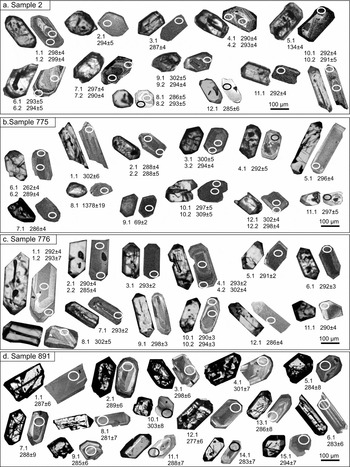
The main characteristics of zircon crystals are quite similar in all four samples studied (Fig. 3). The crystals are mostly normal-prismatic, euhedral, rarely subhedral or rounded; quite a lot are broken, which possibly occurred during separation (e.g. sample 2, grains 6.1, 6.2; sample 775, grain 1.1; sample 776, grain 1.1; sample 891, grain 4.1). Small vacuoles, and less frequently other inclusions, are found in many crystals (sample 776, grains 1.1, 2.1). Some zircons are relatively dark in transmitted light owing to abundant cracks and rusty patches, but several grains are clearer and free of these defects. In CL images, the zircons display variable brightness and often distinct, recurrent, concentric ‘magmatic’ zonation (sample 2, grains 4.2, 8.2, 10.2; sample 775, grain 1.1; sample 776, grains 1.1, 4.1; sample 891, grains 2.1, 6.1, 11.1). Patches and sectors of various CL brightness are less common (sample 2, grain 5.1; sample 775, grains 2.2, 3.2, 6.1; sample 776, grain 6.1). Homogeneous crystals (sample 2, grain 11.1; sample 776, grains 3.1, 12.1; sample 891, grains 1.1, 15.1), as well as those with distinct cores (sample 2, grains 1.1, 9.1; sample 891, grain 7.1) are rare.
Pairs of optical photomicrographs (left) and cathodoluminescence images (right) of zircons with location of analytical points. (a) Sample 2. (b) Sample 775. (c) Sample 776. (d) Sample 891. 206Pb–238U ages and 1σ errors are given.

4.c. SHRIMP zircon study
CL images of the analysed zircons with the location of analytical spots are shown in Figure 3. The spots were mainly located within the oscillatory zoned margins of crystals in order to determine the magmatic age of the crystals and the emplacement age of the host rhyolites. Some spots were also placed in the central parts of the crystals to check the presence of inherited components. The SHRIMP data are given in Table 2. The Concordia diagrams are shown in Figure 4.
SHRIMP data for rhyolite sample 2

Errors are 1-sigma; Pbc and Pb* indicate the common and radiogenic portions, respectively.
Error in Standard calibration was 0.49% (not included in the above-mentioned errors but required when comparing data from different mounts).
(1) Common Pb corrected using measured 204Pb.
SHRIMP data for rhyolite sample 775

Errors are 1-sigma; Pbc and Pb* indicate the common and radiogenic portions, respectively.
Error in Standard calibration was 0.49% (not included in the above-mentioned errors but required when comparing data from different mounts).
(1) Common Pb corrected using measured 204Pb.
SHRIMP data for rhyolite sample 776

Errors are 1-sigma; Pbc and Pb* indicate the common and radiogenic portions, respectively.
Error in Standard calibration was 0.49% (not included in the above-mentioned errors but required when comparing data from different mounts).
(1) Common Pb corrected using measured 204Pb.
SHRIMP data for rhyolite sample 891

Errors are 1-sigma; Pbc and Pb* indicate the common and radiogenic portions, respectively.
Error in Standard calibration was 0.49% (not included in the above-mentioned errors but required when comparing data from different mounts).
(1) Common Pb corrected using measured 204Pb.
Concordia diagrams for the samples dated. (a) Sample 2. (b) Sample 775. (c) Sample 776. (d) Sample 891.

4.c.1. Sample 2 (Wielisławka rhyolite)
In sample 2, 19 spots in 12 crystals were analysed. U and Th contents in 15 spots are low to moderate, between 115 and 572 ppm, and between 87 and 205 ppm, respectively. Three other spots show higher abundances of U (around 1000 ppm) and Th (c. 600 ppm), and one outlier (grain 5.1) is very rich in these elements: c. 2800 ppm and 1800 ppm, respectively. The 206Pbc is mostly below 1%, and only in the U–Th-rich outlier is extremely high, 29.89%. This outlier point, representing a CL-dark rim of a crystal, is strongly discordant and has been excluded from the mean age calculation. Otherwise, the 206Pb–238U ages reveal a single coherent group of 18 analytical points, lacking any significant inheritance and with a mean 206Pb–238U age (Fig. 4a) of 292.8 ± 2.1 Ma (1σ). This age corresponds to the Early Permian – Sakmarian and likely represents the magmatic crystallization age of the main zircon population in the sample studied, and the emplacement age of the Wielisławka Rhyolites.
4.c.2. Sample 775 (Różana rhyolite)
The data for sample 775 represent 18 spots in 13 crystals. U and Th contents range rather widely, between c. 100–1000 ppm and c. 40–640 ppm, respectively. The 206Pbc is mostly below 1.80%, except for single spot 9.1. This grain is very dark in the CL image, and shows extremely high U (6847 ppm) and Th (10508 ppm), and very high 206Pbc of 26.01%. This analytical spot has been excluded from further interpretation. One grain, 8.1, is clearly inherited, having the 207Pb–206Pb age of 1511 ± 23 Ma. Excluding this inherited grain and three other outliers (6.1, 9.1 and 10.2), the remaining 14 spots yield a mean 206Pb–238U age of 294.1 ± 3.1 Ma (Fig. 4b; Early Permian – Sakmarian), which can be interpreted as the crystallization age of the zircons and the emplacement age of the Różana Rhyolites.
4.c.3. Sample 776 (Bolków rhyolite)
In sample 776, 16 spots in 12 crystals were analysed. The U contents range rather widely, from 100 to 855 ppm, whereas the 206Pbc is mostly below 1.71%, except for point 4.1 with an elevated value of 7.12%. The 232Th/238U ratios and 206Pb–238U ages are much more homogeneous, i.e. within the range 0.30–0.81 and 285 to 302 Ma, respectively. The mean 207Pb–206Pb age of the entire group of 16 analyses is 292.4 ± 1.8 Ma (Fig. 4c). This corresponds to the Early Permian (Sakmarian) and is interpreted as the emplacement age of the Bolków Rhyolites.
4.c.4. Sample 891 (Sędziszowa rhyolite)
Fifteen spots in 15 crystals were analysed in sample 891. All the crystals represent a rather homogeneous population, mostly having relatively low U contents of 135–340 ppm (higher values of 450–750 ppm in three grains only) and 232Th/238U ratios ranging from c. 0.2 to 0.8. The 206Pbc is also usually below 1%, but in seven grains slightly higher, reaching a maximum of 2.26% in grain 10.1. The ages of all 15 grains fall in the range between 277 and 303 Ma, overlapping within errors. Three points display relatively high discordance (points 5.1, 9.1 and 11.1); their 206Pb–238U dates are relatively young (between 284 and 288 Ma), but overlap the mean age of the entire population: 287.9 ± 3.5 Ma (Fig. 4d; Early Permian – Artinskian). This age likely represents the emplacement and crystallization age of the Sędziszowa Rhyolites.
5. Discussion
5.a. The age of volcanism in the North-Sudetic Basin and constraints for basin evolution
The SHRIMP results point to the following emplacement ages of the silicic eruptive units of the in Lower Permian Volcanic Complex of the North-Sudetic Basin (206Pb–238U ages, 1σ errors):
-
(1) Sędziszowa Rhyolites (sample 891) – 287.9 ± 3.5 Ma
-
(2) Bolków Rhyolites (sample 776) – 292.4 ± 1.8 Ma
-
(3) Wielisławka Rhyolites (sample 2) – 292.8 ± 2.1 Ma
-
(4) Różana Rhyolites (sample 775) – 294.1 ± 3.1 Ma
The ages of the Bolków, Wielisławka and Różana rhyolites – the major, most voluminous rhyolitic units in Lower Permian Volcanic Complex of the North-Sudetic Basin – are almost identical and indistinguishable within the analytical errors. These results constrain the age of the main stage of rhyolitic volcanism in the North-Sudetic Basin at c. 293 Ma. This age corresponds to the Early Permian – Sakmarian (ICS, 2012) and, considering the stratigraphic position of the Bolków and Różana rhyolites, confirms the assignment of the Wielisławka Formation to the Sakmarian (Wagner, Reference Wagner2008). Using the conventional SHRIMP technique with an error of c. ± 2 Ma, it is not possible to resolve whether the silicic volcanic units were emplaced in rapid succession, e.g. within thousands of years, or in more discrete episodes over a prolonged time period, e.g. of 1–2 Ma. However, the ages obtained, together with geological evidence, suggest that the Wielisławka Rhyolites (largely emplaced in basement rocks of the Stephanian–Autunian succession, in the central part of the basin) can be part of the feeder system for the Różana Rhyolites (lava flows in the overlying Autunian succession). In addition, the age obtained from the Sędziszowa Rhyolites is c. 5 Ma younger, only marginally overlaps the age of the adjacent Różana and Wielisławka rhyolites, and corresponds to the Artinskian. Thus, the Sędziszowa Rhyolites may reflect the youngest, volumetrically minor episode of rhyolitic (sub)volcanism in that area, resulting in the emplacement of a small dyke system.
The two stages of rhyolitic volcanism documented by our SHRIMP data are reminiscent of the ‘two volcanic cycles’ in the North-Sudetic Basin suggested by Kozłowski & Parachoniak (Reference Kozłowski and Parachoniak1967). However, the Wielisławka, Różana and Sędziszowa rhyolites of this study were in fact included into the same, ‘second cycle’, by these authors. Our data do not constrain directly the age of the mafic lavas of the Lower Permian Volcanic Complex of the North-Sudetic Basin. Field relationships, however, suggest that the majority of these mafic rocks were emplaced shortly after the rhyolites, partly as lava flows and partly as shallow-level sills/laccoliths in poorly lithified sediments (Awdankiewicz, Reference Awdankiewicz2006; Szczepara, Reference Szczepara2012). Hoffmann et al. (Reference Hoffmann, Breitkreuz, Breiter, Sergeev, Stanek and Tichomirowa2013) suggested that intermediate to basic volcanism at c. 296 Ma, characteristic of several late Variscan intramontane troughs in the Variscan orogen and especially voluminous in its northern foreland, may be linked to a regional switch from a convergent to a dextral strike-slip regime. It is possible, however, that the relative sequence and timing of silicic and mafic volcanism can also be influenced by local tectonic processes and/or evolution of individual magmatic systems.
The new data on the U–Pb ages of volcanism in the North-Sudetic Basin, together with the litho- and bio-stratigraphic evidence, put some general constraints on the timing of basin evolution. The onset of sedimentation in the basin, estimated at c. 303 Ma (Stephanian A–C), post-dates the metamorphism and deformation of the basement rocks by some 20 Ma. Volcanic activity followed the basin initiation by c. 10 Ma, at 294–292 Ma (the main stage of volcanism), with a minor subsequent stage at c. 287 Ma. This bimodal volcanism can be considered as a culmination of interrelated tectonic, volcanic and sedimentary processes and, at the same time, a termination of the early, rather short-lived but vigorous phase of basin development, strongly controlled by tectonics (cf. Wojewoda & Mastalerz, Reference Wojewoda and Mastalerz1989). This early phase was followed by a prolonged quiescence period of c. 30 Ma, documented by the hiatus above the Wielisławka Formation hosting the volcanic rocks. Continental sedimentation resumed at c. 260–250 Ma (Bolesławiec Formation), soon giving way to marine transgression (Zechstein deposits). Such a scenario is consistent with the waning of tectonic and magmatic activities in this part of the Variscan Belt during the Permian (McCann & Kiersnowski, Reference McCann, Kiersnowski and McCann2008; Timmerman, Reference Timmerman and McCann2008). The dating of post-magmatic minerals in the mafic lavas of the North-Sudetic Basin at c. 253 to 178 Ma (Pękala, Wójtowicz & Michalik, Reference Pękala, Wójtowicz and Michalik2003) seems to reflect the crystallization of the secondary minerals after the burial of volcanic rocks by the younger deposits, in the course of diagenetic processes.
5.b. Regional correlations of volcanic and plutonic suites
In recent years, a number of U–Pb zircon (mostly SHRIMP) ages on the Permo-Carboniferous volcanic rocks of Central Europe were published (Breitkreuz & Kennedy, Reference Breitkreuz and Kennedy1999; Breitkreuz et al. Reference Breitkreuz, Kennedy, Geißler, Ehling, Kopp, Muszynski, Protas and Stouge2007; Nawrocki et al. Reference Nawrocki, Fanning, Lewandowska, Polechońska and Werner2008; Breitkreuz, Ehling & Sergeev, Reference Breitkreuz, Ehling and Sergeev2009; Hoffmann et al. Reference Hoffmann, Breitkreuz, Breiter, Sergeev, Stanek and Tichomirowa2013). A compilation of these results, together with our new data, is shown in Figure 5. Some of the eruptive units included in the compilation may be over-represented resulting in artefacts, e.g. the peak in the histogram at 291–293 Ma seems largely owing to several samples from the Halle Volcanic Complex (14 samples out of the total of 45). As found by Breitkreuz & Kennedy (Reference Breitkreuz and Kennedy1999) and supported by later data, the Late Palaeozoic volcanism spanned (‘flared-up’) across the boundary of Carboniferous and Permian. The compilation (Fig. 5) points to the regional climax of activity in the earliest Permian, between, broadly, 299 and 291 Ma; 78% of samples dated fall in that age range. The Permian volcanism in the North-Sudetic Basin may be correlated with relatively late phases of this volcanic climax. Ages between 291 and 295 Ma, corresponding to the main volcanic stage of the North-Sudetic Basin, are also reported from central Germany (e.g. from the Halle Volcanic Complex), and from the North-Saxon Volcanic Complex and the Döhlen Basin (Breitkreuz, Ehling & Sergeev, Reference Breitkreuz, Ehling and Sergeev2009; Hoffmann et al. Reference Hoffmann, Breitkreuz, Breiter, Sergeev, Stanek and Tichomirowa2013), as well as from some locations in the Polish Basin and the NE German Basin (drillings Daszewo-12, Wysoka Kamieńska-2, Salzwedel 2/64; Breitkreuz et al. Reference Breitkreuz, Kennedy, Geißler, Ehling, Kopp, Muszynski, Protas and Stouge2007), and from the Kraków region (the Zalas laccolith; Nawrocki et al. Reference Nawrocki, Fanning, Lewandowska, Polechońska and Werner2008). On the other hand, preliminary SHRIMP results from the adjacent Intra-Sudetic Basin (Awdankiewicz & Kryza, Reference Awdankiewicz and Kryza2012 and unpub. data) suggest that the main stage of Permian volcanism in the latter basin occurred somewhat later, at c. 290 Ma. Thus, the timing of volcanism even in neighbouring late Variscan intramontane basins may not necessarily have taken place coevally and, on the Central European scale, the spatial variation of ages of the uppermost Carboniferous / lower Permian volcanic rocks does not seem very systematic (cf. fig. 1 in Breitkreuz et al. Reference Breitkreuz, Kennedy, Geißler, Ehling, Kopp, Muszynski, Protas and Stouge2007 and more recent data from Nawrocki et al. Reference Nawrocki, Fanning, Lewandowska, Polechońska and Werner2008; Breitkreuz, Ehling & Sergeev, Reference Breitkreuz, Ehling and Sergeev2009; Hoffman et al. Reference Hoffmann, Breitkreuz, Breiter, Sergeev, Stanek and Tichomirowa2013; this study).
Comparison of the new SHRIMP ages of volcanic rocks from the North-Sudetic Basin with published ages for Stephanian–Permian volcanic rocks from Central Europe: the NE German Basin, the Polish Basin and several eruptive complexes of the Saxo-Thuringian Zone in southeastern Germany (data from: Breitkreuz & Kennedy, Reference Breitkreuz and Kennedy1999; Breitkreuz et al. Reference Breitkreuz, Kennedy, Geißler, Ehling, Kopp, Muszynski, Protas and Stouge2007; Nawrocki et al. Reference Nawrocki, Fanning, Lewandowska, Polechońska and Werner2008; Breitkreuz, Ehling & Sergeev, Reference Breitkreuz, Ehling and Sergeev2009; Hoffman et al. Reference Hoffmann, Breitkreuz, Breiter, Sergeev, Stanek and Tichomirowa2013).

The Variscan orogeny in the Sudetes was accompanied, as elsewhere in the Variscan Belt, by intense and voluminous granitic plutonism. The Sudetic Late Palaeozoic granites have generally been subdivided into two age groups, c. 340–330 Ma and 320–300 Ma (Mazur et al. Reference Mazur, Aleksandrowski, Turniak, Awdankiewicz, Kozłowski and Wiszniewska2007), and new data show that the latest stages of this granitic magmatism extended also into Permian times. The 294–292 Ma volcanic rocks of the North-Sudetic Basin are broadly contemporaneous with some granitoids east of the basin, e.g. in the Strzelin Massif, where the youngest and most voluminous plutonic phase is dated at c. 295 Ma (SHRIMP zircon ages; Oberc-Dziedzic, Kryza & Białek, Reference Oberc-Dziedzic, Kryza and Białek2010; Oberc-Dziedzic et al. Reference Oberc-Dziedzic, Kryza, Pin and Madej2013 b). Comparable ages of c. 298 Ma were also recently determined in the Strzegom-Sobótka Massif (SHRIMP results; Turniak, pers. comm., 2013). The broadly coeval Early Permian plutonic and volcanic events seem to be various expressions of, generally, the same magmatic pulse, related to the late Variscan, post-orogenic extension in the NE part of the Bohemian Massif (Kryza, Mazur & Oberc-Dziedzic, Reference Kryza, Mazur and Oberc-Dziedzic2004; Mazur et al. Reference Mazur, Aleksandrowski, Kryza and Oberc-Dziedzic2006, Reference Mazur, Aleksandrowski, Turniak, Awdankiewicz, Kozłowski and Wiszniewska2007; McCann & Kiersnowski, Reference McCann, Kiersnowski and McCann2008). Similar relationships are also recognized in neighbouring regions, e.g. in the Erzgebirge, where the youngest phases of granitic plutonism were contemporaneous with the basin formation and intrabasinal volcanism (Romer et al. Reference Romer, Förster, Kroner, Müller, Rössler, Rötzler, Seltmann and Wenzel2012).
5.c. The origin of magma and the scarcity of inherited zircon
The voluminous Permian–Carboniferous magmatism in Europe was ultimately sourced in the mantle, as documented in the North-Sudetic Basin by the coeval mafic volcanic rocks associated with the rhyolites (Awdankiewicz, Reference Awdankiewicz2006), by bimodal magmatic suites in other regions (e.g. the Oslo rift; Larsen et al. Reference Larsen, Olaussen, Sundvoll and Heeremans2008), as well as the vast dolerite sill and dyke swarm complexes in the northern foreland of the Variscan orogen: in northern England, southern Sweden and in the North Sea (Heeremans et al. Reference Heeremans, Timmerman, Kirstein, Faleide, Wilson, Neumann, Davies, Timmerman, Heeremans and Larsen2004; Timmerman, Reference Timmerman, Wilson, Neumann, Davies, Timmerman, Heeremans and Larsen2004; Timmerman et al. Reference Timmerman, Heeremans, Kirstein, Larsen, Spencer-Dunworth and Sundvoll2009). The silica-rich volcanic rocks in Central Europe originated owing to differentiation of mantle-derived magmas at shallow lithospheric levels, with variable contribution of crustal components (e.g. Benek et al. Reference Benek, Kramer, McCann, Scheck, Negendank, Korich, Huebsher and Bayer1996; Pietranik et al. Reference Pietranik, Słodczyk, Hawkesworth, Breitkreuz, Storey, Whitehouse and Milke2013). A strong anatectic component in many Permian silica-rich volcanic rocks is documented by abundant inherited zircons (e.g. Breitkreuz & Kennedy, Reference Breitkreuz and Kennedy1999). In this context, a rather specific feature of the Permian rhyolites studied is the scarcity of such inherited zircon grains. Although our study was focused on dating the magmatic, hence young zircons, only a single analysis, out of 68 analysed spots in the four samples from the North-Sudetic Basin, represents a xenocrystic/inherited grain c. 1.4 Ga old (spot 8.1, sample 775). An overview of published SHRIMP data of the Stephanian–Autunian volcanic rocks in Central Europe (Breitkreuz & Kennedy, Reference Breitkreuz and Kennedy1999; Breitkreuz et al. Reference Breitkreuz, Kennedy, Geißler, Ehling, Kopp, Muszynski, Protas and Stouge2007; Breitkreuz, Ehling & Sergeev, Reference Breitkreuz, Ehling and Sergeev2009; Hoffman et al. Reference Hoffmann, Breitkreuz, Breiter, Sergeev, Stanek and Tichomirowa2013) shows that inherited zircons are not observed in 33% of 44 samples analysed using the SHRIMP method. Thus, the scarcity of such zircons in several silicic volcanic units may be attributed to: (1) the lack of significant crustal contribution in some of the rhyolitic magmas, (2) derivation or contribution from zircon-free crustal rocks, or (3) zircon elimination during crustal anatexis due to dissolution in Zr-undersaturated magma. It is difficult to decide what the reason was for the scarcity of inherited zircon in the rhyolites of the North-Sudetic Basin. This feature is even more intriguing when we keep in mind that older zircons are much more abundant in the Variscan granitoids of similar age in this area. To solve these questions we would need more systematic analysis of these rocks, not only of their geochronology, but also of their petrology, geochemistry and isotopic characteristics.
6. Conclusions
(1) Three rhyolite samples representative of the main rhyolitic volcanic units from the Stephanian–Permian volcano-sedimentary succession of the North-Sudetic Basin yielded coherent SHRIMP zircon ages of c. 293 Ma that constrain the Early Permian – Sakmarian age of the rhyolitic volcanism in the eastern part of the Variscan Belt. The fourth sample, dated at 288 ± 4 Ma, represents a volumetrically minor, slightly younger stage of (sub)volcanic activity in Artinskian times. Mafic volcanism in this area shortly followed the eruption of felsic rocks.
(2) The new SHRIMP ages are coherent with the stratigraphic evidence and indicate that the bimodal volcanism terminated the early, short-lived (c. 10–15 Ma) and vigorous stage of basin evolution. This volcanism correlates well with the late phases of the regionally developed main stage of Late Palaeozoic magmatism in Central Europe, constrained by previously published age data at 299–291 Ma. The Permian volcanism, together with coeval granitoid plutonism, can be linked to late Variscan, post-collisional extension.
Acknowledgements
The study was supported from the MNiSW grant N N307 055037 and from the internal grant 1017/S/ING from the University of Wrocław. Kalina Dymna is thanked for the zircon separation. Christoph Breitkreuz and Martin Timmerman are greatly acknowledged for their careful and constructive reviews. Stimulating discussions on the Variscan volcanism have been held during the VENTS Project meetings.