


Introduction
Psychosis is a term used by clinicians to describe a range of conditions characterized by unusual experiences such as hearing voices, delusional beliefs and disturbances to thought and language that cause disruption to normal functioning (Peters, Reference Peters2007). In order to reduce delays to receipt of help and treatment, efforts have been made to increase public awareness and understanding of psychotic illness (Johannssen et al., Reference Johannssen, Larsen, Joa, Melle, Friis, Opjordsmoen, Rund, Simonsen, Vaglum and McGlashan2005) Unfortunately, however, people often present to services in the context of a major breakdown requiring acute admission involving the use of the involuntary detention (Harris et al., Reference Harris, Henry, Harrigan, Purcell, Schwartz, Farrelly, Prosser, Jackson and McGorry2005). Consequently, the nature of the psychotic experiences, and the manner in which services first become involved, often leaves people puzzled as to why it happened to them, and wondering whether it will recur and whether it is beyond their control. Whilst people with psychosis differ in the extent to which they consider these issues (Tait, Birchwood and Trower, Reference Tait, Birchwood and Trower2003), psychosis is very much a condition that demands explanation.
To investigate how people make sense of psychosis, researchers have utilized theoretical models such as the health belief model (Becker and Maimon, Reference Becker, Maimon and Mechanic1983) and the Self Regulation Model (Leventhal, Nerenz and Steele, Reference Leventhal, Nerenz, Steele, Baum and Singer1984; see Lobban, Barrowclough and Jones, Reference Lobban, Barrowclough and Jones2003) which consider the extent to which people recognize they have an illness. These models have shown that understanding of psychosis is linked to coping (Sayer, Ritter and Gournay, Reference Sayer, Ritter and Gournay2000), seeking help (Haley, Drake, Bentall and Lewis, Reference Haley, Drake, Bentall and Lewis2003), engagement with services (Tait et al., Reference Tait, Birchwood and Trower2003), adherence to medication (Corrigan, Reference Corrigan2002) and longer term outcome (Haley et al., Reference Haley, Drake, Bentall and Lewis2003; Lobban, Barrowclough and Jones, Reference Lobban, Barrowclough and Jones2004). However, it is likely that modifications to these models is necessary as people with schizophrenia do not necessarily consider their experiences as separable illnesses and hence do not hold illness beliefs (see Kinderman, Setzu, Lobban and Salmon, Reference Kinderman, Setzu, Lobban and Salmon2006 for a full discussion of these differences).
Understanding how people make sense of their difficulties is also important for services trying to engage with a person. For instance, McCabe and Priebe (Reference McCabe and Priebe2004) found that when service users receiving outpatient care from community mental health teams and clinicians shared an explanatory model of illness, it improved the therapeutic relationship with their keyworker and the level of service user satisfaction. This shared understanding is usually based on the stress vulnerability model (Neuchterlain and Dawson, Reference Nuechterlein and Dawson1984), which is used to describe the antecedents and events leading to the onset of the problems. Therefore, the stress vulnerability model often acts as the model on which to develop an understanding of the onset of psychosis and is commonly incorporated within a cognitive behavioural formulation of the onset of psychosis (Kinderman and Lobban, Reference Kinderman and Lobban2001).
Whilst formulation is considered essential to good therapeutic practice (Butler, Reference Butler1998), it has received comparatively little research (Beiling and Kuyken, Reference Bieling and Kuyken2003). To date only one study has investigated the value of a cognitive behavioural formulation in working with psychosis. Chadwick, Williams and Mackenzie (Reference Chadwick, Williams and Mackenzie2003) employed a single case design to study the value of a formulation developed in a diagram over several sessions and shared in a letter to the client. In and of itself, formulation did not impact on symptoms or therapeutic alliance (as seen by the client). Formulation, whether it is based on a cognitive model or a stress vulnerability model, is not something we do to people, but with them (Butler, Reference Butler1998). Hence, an important first question in understanding how people with psychosis make sense of their experiences is to ask what do people think led to the onset of their difficulties? Moving first hand accounts of the development of psychosis exist (Chadwick, Reference Chadwick2007) and these are valuable in helping understand the specific experience of psychosis. However, we also need to understand common pathways or patterns that are associated with the development of psychosis. From an understanding of these patterns it may be seen that service users’ explanatory models of psychosis are not shared by professionals; however, it is important that they are elicited and respected, as they are likely to play an important part in establishing and maintaining a therapeutic alliance. If their understanding is very different to those of the staff, then we have to recognize this mismatch and use collaborative approaches to help bridge the divide. Consequently, the aim of this study is to determine what people think caused their psychosis.
Method
Design
The present study uses a Q-methodology, which consisted of two main phases. The first was the development of the Q set (i.e. items that capture beliefs about important causes of onset of psychosis) developed on the basis of a systematic literature search, and discussions with a broad range of health professionals and service users. The second phase was the administration of the Q set in the form of the Q sort to people who had experienced psychosis.
The Q sort is especially fruitful in exploratory research (Watts and Stenner, Reference Watts and Stenner2005). Q methodology is a dynamic and participant-friendly tool, as it allows the participants to actively interact with the materials (James and Warner, Reference James and Warner2005) and express their views non-verbally (Jones, Guy and Ormrod, Reference Jones, Guy and Ormrod2003). To explore an emotive and potentially distressing issue, such as the causes of psychotic experiences, the Q method was particularly appropriate.
Phase 1: Development of the Q set
Participants
As Q methodology is employed to explore subjective views it is important to ensure that the Q set is broadly representative of the possible range of views (Watts and Stenner, Reference Watts and Stenner2005). Hence, in keeping with previous research employing the Q Sort method (Flitcroft, James, Freeston and Wood-Mitchell, Reference Flitcroft, James, Freeston and Wood-Mitchell2007), a range of people with views on the causes of psychosis were interviewed (N = 4). This “consultative team” included two individuals from a service user organization with personal experiences of psychosis, a consultant clinical psychologist working within an Early Intervention in Psychosis (EIP) service, and a lay person. Each person was asked what they considered possible causes for psychosis and their answers were recorded by the interviewer. This process was conducted until no further themes were elicited.
Procedure
In addition to the interviews, a systematic search of the relevant literature was undertaken in order to identify potential causes of psychosis. These processes led to the generation of an initial Q set of 165 items, of which by far the majority were produced by the consultative team. A conventional Q set is usually between 40 to 80 items; hence the sample was reduced in a number of stages. First, items judged to be duplicates were removed by the research team (IJ, GD, JS, RD). This reduced the set to 83 items, which were then ranked in order of importance as potential causes of psychosis independently by the consultative team (except the lay person), the research team, and a consultant psychiatrist with experience of working with psychosis. Items that were rated as low importance by all the raters, and were judged to be similar in theme to another higher ranked item, were removed. This process resulted in the final Q set of 58 items, which can be seen in Appendix 1.
Phase 2: The Q sort
Participants
A total of 163 (26% female 74% male, mean age 24.2 years, SD 6.2 years) people were considered for participation. Inclusion criteria were that the person was aged over 16 and in receipt of EIP services. The common entry criterion for services is the presence of psychotic symptomatology for a period of 7 days or more causing distress or disruption. Exclusion criteria for this study included those with organic psychosis or who were unable to give informed consent, or who were detained under the Mental Health Act (which were conditions of ethical approval). The researcher met with each care co-ordinator to discuss people with whom they worked and consider whether they were suitable for the study.
Seventy-three people (45%) were considered suitable and were invited to participate. Ninety people were not considered suitable by the care coordinators who usually stated that the person was not well engaged with services, or was quite unwell and in their view should not be approached. From the 73 approached to participate, 23 (14%) agreed to take part. Two individuals withdrew from the research, resulting in a total of 21 people completing the research task.
Six women (29%) and 15 men (71%) aged between 18 and 38 years (mean 26.0 years, SD 5.8 years) completed the Q sort. The participants did not differ in terms of age (t(161) = 1.4, p = .18) or gender (Chi Square df 1 = 0.08, p = .56) from the larger sample.
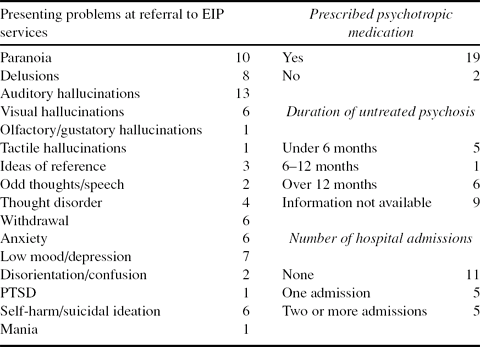
The participants had been in receipt of EIP services for between 3 months and 3 years 7 months (mean 15 months, SD 10 months). Information about their presenting problems at referral to EIP, number of hospital admissions, length of Duration of Untreated Psychosis (DUP) and medication was accessed from their files, and a summary is shown in Table 1. Most participants had been prescribed antipsychotic medication (90%). Nearly half had been admitted into hospital (48%) and were usually in hospital when referred to EIP. Five participants had one admission (24%), with a further five having two or more admissions (24%). For nine participants information about DUP was unavailable or unreliable. For the remaining 12 individuals, five had a DUP under 6 months, for one DUP was between 6 months and a year, and for six it was over 12 months. The most common presenting problems on referral to EIP services were auditory hallucinations and persecutory beliefs, which were present in 62% and 48% of individuals respectively.
Characteristics of sample (N = 21)

Note: The same participant may have more than one presenting problem.
Procedure
Participants expressed their beliefs about the causes for the onset of their psychotic experience by completing a Q sort. Participants read a statement “the cause of my psychosis was” and then considered each of the 58 cards (the Q set) in relation to this statement. They were then asked to consider how significant the cause stated on each card was, in relation to the development of their own psychotic experience. They were asked to sort the cards into three piles: “significant”, “maybe/not sure” and “not significant”. Starting with the “significant” pile, the participants were then instructed to choose three cards, which they considered most significant. The cards were placed on a grid in the form of a quasi-normal distribution, “very significant” and “not at all significant” at the two ends with a more neutral stance expressed in the middle of the grid. The first three significant cards were placed on the Q sort grid at the very significant (+5) end. This was then repeated with the “not significant” pile with participants selecting three cards, which they regarded least significant, and placing them at the −5 end. Most significant and least significant cards were alternately chosen until all cards were sorted. The “maybe/unsure” pile replaced whichever pile ran out of cards first. All the way through the task, participants were given the chance of changing the position of any card(s). Participants were also asked directly if there were any other reasons that they could think of that were not on the Q set that led to them developing psychosis.
Ethical considerations
The study was registered with the host NHS Trust R and D department and was given a favourable opinion by an NHS research ethics committee.
Results
The 21 completed Q sorts were analysed using PQ Method 2.11 (Schmolck, Reference Schmolck2002), a specialist software for the analysis of Q method. The analysis involves each of the sorts being correlated with each other producing a 21 by 21 correlation matrix. A Principal Components Analysis (PCA) revealed six factors, with eigenvalues above 1 and together explained 68% of the variance. These factors were rotated using varimax procedure, which maximizes the degree of association with only one factor. The significance level for rotated factor loadings was set at 0.49, a level that minimized confounding and maximized the number of significant loadings (Watts and Stenner, Reference Watts and Stenner2005).
As can be seen from Table 2, all participants loaded significantly on at least one factor that represents distinct viewpoints of what was most important in the onset of psychosis. In line with standard practice, factors that have only one significant loading (i.e. Factors 3 and 4 in Table 2) were excluded from further analysis. Weightings were calculated for each individual's Q sort according to its relative contribution to that factor. Confounding Q sorts (i.e. sorts that loaded significantly on more than one factor) were excluded from this stage (one Q sort loaded on to Factors 1 and 6). This process produced a factor array for each factor, i.e. showing where each item had been placed in a characteristic exemplar or “best estimate” Q sort for a particular factor.
Rotated factor matrix and defining Q sorts
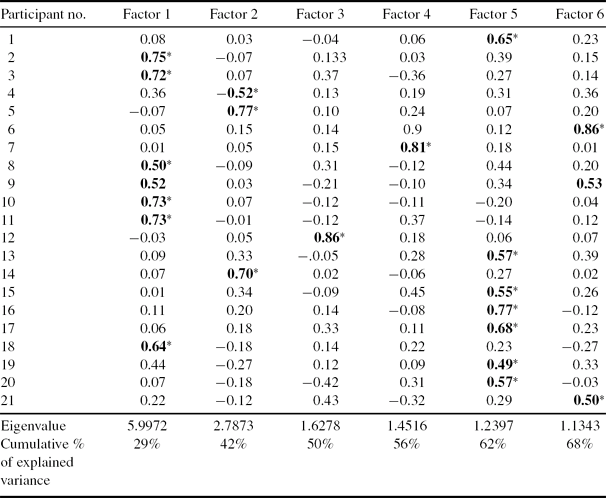
Note: All significant loadings in bold, asterisk demarks loadings that define that factor.
Factor interpretation
Factor 1: The drug related explanation
Six participants loaded on this factor, which explained 29% of the total variance. Respondents perceived their psychotic experiences to be strongly linked with their use of illegal drugs. They emphasized drug use as a poor or maladaptive coping strategy for dealing with low mood and anxiety.
All the Q set statements relating to drug use defined Factor 1, and included the following items (average factor scores for people in this grouping are given in parentheses):
39. I used illegal drugs (other than cannabis) (+5)
40. I used illegal drugs to cope with difficulties (+5)
38. My cannabis use (+5)
41. I used illegal drugs recreationally (+3)
10. My body's reaction to illegal drugs (+3)
Other statements strongly endorsed in this constellation of explanations were:
2. The way I tried to cope with problems, such as bottling my feelings (+4)
37. I lived with the threat of something bad happening (+4)
42. I did not sleep enough (+4)
44. I was depressed (+4)
Factor 2: The adulthood trauma explanation
Factor 2 accounted for 13% of the total variance. Two participants had a significant positive loading on this factor, whilst a third participant loaded significantly but negatively. For participants who loaded onto this factor, they attributed traumatic experiences in adulthood, coupled with a threat of something bad happening as playing a significant role in them developing psychosis. Unease with other people and difficulties within the family were also regarded as important.
Factor 2 was defined by the following statements:
46. I experienced a sexual assault as an adult (+5)
49. I lived with the threat of violence (+4)
51. I experienced emotional abuse in adulthood (+5)
52. I experienced physical abuse in adulthood (+4)
In addition, statements relating to living with threat and unease in social relationships were considered significant:
37. I lived with the threat of something bad happening (+5)
20. Difficulties in family relationships (+4)
29. I do not feel comfortable with other people (+4)
26. I found relationships difficult as an adult (−3)
Participants in this factor rejected drug use as a possible causal explanation. Furthermore, respondents clearly distinguished between abusive experiences in adulthood and childhood, as the latter were not considered relevant to the development of their psychotic experiences.
Factor 3: Personal sensitivity explanation
Loadings on this factor were significant for seven participants and explained 6% of the overall variance (factor 5 in table 2). These participants considered personal characteristics, social anxiety and inability to deal with difficulties as significant in the onset of their psychotic experiences. Problems with depression, sleep deprivation and stress were perceived as important causal factors, as was a change in environment or role. For example, for one participant the onset was associated with his ability to manage starting at university.
Factor 3 was defined by the following factors:
25. I felt that I did not fit in with my peers (+4)
5. I have a pessimistic outlook on life (+3)
2. The way I try to cope with problems, such as bottling my feelings (+5)
29. I do not feel comfortable with other people (+5)
27. I was socially isolated (+2)
45. I was stressed because of recent events (+5)
34. I had changed the place I live and/or work (+3)
43. I felt a pressure to do well (+2)
1. I am emotionally sensitive (+4)
3. I tend to misinterpret situations (+3)
6. I have a tendency to dwell on past experiences/events (+3)
41. I did not sleep enough (+4)
44. I was depressed (+4)
Factor 4: The developmental vulnerability explanation
This factor explained 5% of the total variance and had two significant loadings. This factor reflected the occurrence of key events in the participants’ lives from childhood linked with relationship, social and financial difficulties in adulthood. The respondents on Factor 4 emphasized abusive experiences in childhood (but not sexual abuse).
The following statements defined Factor 4:
23. I was teased/picked on as a child (+5)
13. I experienced physical abuse in childhood (+4)
15. I experienced emotional abuse as a child (+3)
48. As an adult I lost someone I loved (+5)
30. Difficulties in or break-up of an intimate relationship (+5)
7. Certain genes inherited within my family (genetics) (+3)
27. I was socially isolated (+4)
31. My poor housing situation (+4)
32. I had money problems/worries (+4)
Discussion
This study employed Q methodology to understand which factors individuals with first episode psychosis perceived as important in the development of their psychosis. The analysis revealed four factors, which were interpreted and named as “drug related”, “adult trauma”, “personal sensitivity” and “developmental vulnerability” explanations. These findings are consistent with psychosis being a broad umbrella term for a variety of experiences, with different pathways to development (e.g. Bentall, Reference Bentall2007) and share similarities with the clinical subgroups of psychosis proposed by Kingdon and Turkington (Reference Kingdon and Turkington2005).
The results are important in demonstrating that people with psychosis are able to express a view of the cause of their difficulties and that these understandings are compatible with Stress Vulnerability models. This is valuable as it is the basis for psychological formulation of psychosis and is commonly used in cognitive therapy approaches for psychosis (Kingdon and Turkington, Reference Kingdon and Turkington2005).
Encouragingly, some participants enjoyed the Q sort and were pleased to be asked for their views. The Q sort was a user-friendly tool, as all participants were able to complete the task, despite having to consider some potentially distressing statements in the presence of an unfamiliar person. Therefore, the Q sort may be a valuable assessment tool in clinical practice to help understand the individual's explanation of what has happened to them and why, in a non-threatening and collaborative way. Furthermore, the Q sort may allow further reflection by introducing possible causes that the client had not previously considered.
None of the factors reflected a “medical model” of psychosis, supporting the notion that individuals with psychosis favour psychosocial over biomedical explanations of their experiences (Hirschfeld, Smith, Trower and Griffin, Reference Hirschfeld, Smith, Trower and Griffin2005; Lobban et al., Reference Lobban, Barrowclough and Jones2004). Yet many were prescribed and were adherent to medication, indicating that non medical model causal explanations are still compatible with accepting medication. It is also of note that religious and spiritualist explanations, which were identified by research (e.g. Jones et al., Reference Jones, Guy and Ormrod2003) and by the consultative team as a potential explanatory theme, were not considered relevant to participants in this study.
This research is helpful in moving beyond health belief models that emphasize the recognition that one has an illness, to considering how people account for the development of their difficulties. They are both important questions, but the second is particularly important in helping develop psychological formulations of psychosis. For this reason, the Q methodology is particularly helpful in that it “neither tests its participants nor imposes meaning a priori” (Watts and Stenner, Reference Watts and Stenner2005, p. 74, original italics). Hence, it is ideally placed in this preliminary exploratory research as well as for understanding subjective views. This study was specifically interested in learning more about individuals’ own explanations without assessing them against a benchmark of correctness. This appears to be a problem with some of the research examining insight in psychosis, as it requires a person to agree with the clinician in order to be considered insightful.
In addition, these different understandings of psychosis encourage us to consider different treatment options. Participants endorsing the drug related explanation appeared to perceive their use of cannabis and other illegal drugs as a coping strategy to manage their difficulties, including depression. Increasingly, the role of cannabis in particular as a precipitant to psychosis is recognized (Henquet et al., Reference Henquet, Krabbendam, Spauwen, Kaplan, Lieb, Wittchen and Van Os2005). It would seem that for people with this understanding of their difficulties, there is a strong rationale for work to address drug misuse, and improving coping strategies for feelings of low mood, and anxiety.
The second factor indicated adulthood trauma as a significant causal factor for psychosis. Trauma is increasingly recognized as a factor in the development of psychosis but research to date has mainly focused on the link between childhood trauma and psychosis (see Morrison, Frame and Larkin, Reference Morrison, Frame and Larkin2003 for review), though some studies have associated traumatic events in adulthood, such as sexual assault, to psychotic experiences (e.g. Read, Van Os, Morrison and Ross, Reference Read, Van Os, Morrison and Ross2005). In fact, it has been suggested that psychosis and post-traumatic stress disorder (PTSD) may both be on a “spectrum of responses to a traumatic event” (Morrison et al., Reference Morrison, Frame and Larkin2003, p. 338). Given that excellent cognitive behavioural treatments exist for PTSD (e.g. Ehlers and Clark, Reference Ehlers and Clark2000) it may encourage the use of such treatments adapted appropriately to helping people with trauma as the origin of their psychotic experience (Callcott and Turkington, Reference Callcott, Turkington, Kingdon and Turkington2002). As an example of such adaptation that is needed, dissociation appears to be common in people with psychosis and those high on measures of schizotypy (Marzillier and Steel, Reference Marzillier and Steel2007; Mercklebach and Giesbrecht, Reference Merckelbach and Giesbrecht2006) and its role in the development and maintenance of traumatic reactions may require special emphasis in treatment.
Factor 3 highlighted personal characteristics, such as emotional sensitivity, pessimistic and ruminative tendencies as well as social anxiety linked to poor or maladaptive coping strategies as significant in leading to psychosis. Changing environments or roles, such as starting university, were considered important triggers. Clinically, this may require interventions based on enhancing self-efficacy and social skills.
The fourth factor concerns the influence of external events, childhood abuse and psycho-socio-economic stressors in adulthood. Most significance was given to the loss of a loved one in adulthood, which may lead to poorer coping and social isolation. Here approaches for dealing with grief and childhood abuse would seem most valuable.
Of course, it is vital to hold in mind that these explanations are points of view, and that the person may not recognize or may down play important additional factors contributing to their difficulties. For instance, a person may attribute the cause of their psychosis to an adult trauma and not consider that their ongoing substance misuse, which may be seen as a way of coping with the trauma, may actually be serving to help maintain the difficulty. This is the challenge of developing a meaningful psychological formulation in which the person's own experience is married to the model or theory that the therapist brings. This process, done well, allows respect and consideration of the client's views with knowledge and skill of the therapist that may help broaden the understanding and consider other factors that the client has not considered.
Whilst the results of the study are encouraging, there are clearly important limitations to be considered. The first is the issue of representativeness and generalizability of the findings. A great number of people in receipt of EIP services were not included in the study (21 out of 73 people approached completed the study, out of 163 considered). Poor engagement with services was the most common reason for deeming individuals as unsuitable. These people may either not recognize they have had psychotic experiences or hold an explanatory model different to those reported here. The participant information sheet about the study used the term “psychotic experiences”, and this may have deterred some individuals from taking part.
A second limitation is that in the Q set key causal factors may have been omitted (e.g. childbirth, see Sit, Rothschild, Creinin, Hanusa and Wisner, Reference Sit, Rothschild, Creinin, Hanusa and Wisner2007 for review). However, Q methodology acknowledges that no Q sort can ever be complete, as every possible view cannot be included (Watts and Stenner, Reference Watts and Stenner2005).
A further limitation was the absence of measures of current psychotic symptomatology. Whilst potentially informative, no a priori hypotheses were made about levels of current symptoms, and without such there seemed little value in subjecting participants to additional measures. However, to establish whether causal explanations are related to severity and type of symptomatology would be valuable. For example, there is emerging evidence that some hallucinatory experiences are associated with trauma (Hammersley et al., Reference Hammersley, Dias, Todd, Bowen-Jones, Reilly and Bentall2003) and that chronic victimization is associated with paranoia (Janssen et al., Reference Janssen, Hanssen, Bak, Bijl, De Graaf, Vollebergh, McKenzie and Van Os2003).
More broadly, measures of anxiety and mood may well have been informative about patterns of causal explanations. Making sense of psychosis may only be possible with low levels of general arousal or distress. Moreover, attributions about cause, and potential responsibility for the onset of psychosis were not tapped into directly by the Q method but may be associated with different patterns of explanation and may lead to the experience of shame, guilt, and post psychotic depression or anxiety (Michail and Birchwood, Reference Michail and Birchwood2007). Of course what happens to causal explanations of psychosis when a person enters a relapse is important as we may understand things when calm, but reject such an explanation when distressed (Gumley, Reference Gumley2007).
This study focused on individuals with first episode psychosis, whose beliefs are less likely to have been shaped by years of exposure to mental health services. Nevertheless, participants’ views will have been influenced by their involvement with EIP services in which they will often have been socialized to a stress vulnerability model of understanding. However, this possible bias is reduced to some extent by the differential weighting given to each item and the wide range of items offered in the Q set. Even if the results are affected by involvement with EIP services, this would suggest that the explanations offered by these services are acceptable and relevant to some individuals with psychotic experiences. Of course, it is important to note that the prompt for the Q sort was the statement “the cause of my psychosis was. . . .” Clearly, to participate in this study people were willing to accept they had a psychotic breakdown. This may not be the case for all people in contact with services.
It is potentially valuable to understand how these patterns of understanding map on to coping, recovery style and service engagement. In this study, a number of measures were included but were not reported as these were secondary analyses and were underpowered. This is owing to it being an exploratory study in which it was not possible in advance to determine how many factors would be revealed, but these analyses would be useful to do in the future.
Conclusion
The current study demonstrated that Q methodology allows for a collaborative exploration of what individuals with first episode psychosis believe caused the onset of their psychosis. The results demonstrate that individuals hold distinct explanatory models that are compatible with a stress-vulnerability model of psychosis, which is the starting point for developing a formulation.
Acknowledgements
We would like to thank all the participants as well as staff at Newcastle, Northumberland and South of Tyne EIP services. In addition, we would like to acknowledge the contribution of Caroline Young, Jim Davison, Dr Alison Brabban, Dr Alyson Flitcroft, Dr Sally Jones, John Ormrod, Dr Douglas Turkington and Helen Spencer who assisted in the development of this project.
Appendix 1. The Q set
1. I am emotionally sensitive
2. The way I tried to cope with problems, such as bottling my feelings
3. I found it hard to deal with daily demands
4. I tend to misinterpret situations
5. I have a pessimistic outlook on life
6. I have a tendency to dwell on past experiences/events
7. Certain genes inherited within the family (genetics)
8. I suffered a head injury and/or brain damage
9. Complications during or before my birth
10. My body's reaction to illegal drugs
11. There is a chemical imbalance in my brain
12. The way hormonal changes have affected me
13. I experienced physical abuse as a child
14. I experienced sexual abuse as a child
15. I experienced emotional abuse as a child
16. Something traumatic that happened in my childhood
17. I lost my parent/carer(s) in childhood
18. The way I was brought up
19. Unresolved feelings from the past
20. Difficulties in my family relationships
21. It was difficult to separate from my parent/carer(s)
22. It was difficult to change from adolescent to adult
23. I was teased/picked on as a child
24. I was teased/picked on as an adult
25. I felt that I did not fit in with my peers
26. I found relationships difficult as an adult
27. I was socially isolated
28. I was discriminated against (based on class, race, gender, sexuality or disability)
29. I do not feel comfortable with other people
30. Difficulties in or break-up of an intimate relationship
31. My poor housing situation
32. I had money problems/worries
33. Living in an urban environment
34. I had changed the place I live and/or work
35. I lost my job or was unemployed
36. I had a problem with drinking
37. I lived with the threat of something bad happening
38. My cannabis use
39. I used illegal drugs (other than cannabis)
40. I used illegal drugs to cope with difficulties
41. I used illegal drugs recreationally
42. I did not sleep enough
43. I felt a pressure to do well
44. I was depressed
45. I was stressed because of recent events
46. I experienced a sexual assault as an adult
47. I experienced a violent assault as an adult
48. As an adult I lost someone I loved
49. I lived with the threat of violence
50. A traumatic event in adulthood (other than being assaulted)
51. I experienced emotional abuse in adulthood
52. I experienced physical abuse in adulthood
53. I possess a spiritual gift and/or magical powers
54. I am special and/or chosen
55. My involvement in religious cults and/or magical rituals
56. I felt religious pressure put on me
57. The influence of external forces (e.g. God, the devil, spirits)
58. Fate and/or bad luck



Comments
No Comments have been published for this article.