Introduction
Dementia is becoming one of the main causes of disability in developed countries (WHO and ADI, 2012). In 2010, it has been estimated that worldwide, about 35.6 million people 65 years and older had dementia. This number is expected to nearly triple in the next 40 years (Thies and Bleiler, Reference Thies and Bleiler2011), as the prevalence and incidence of dementia increase exponentially with age in older subjects (Jorm and Jolley, Reference Jorm and Jolley1998; Ferri et al., Reference Ferri2005). There is wide consensus that dementia is one of the most burdensome diseases for welfare systems, but establishing the costs incurred by this illness is a complex process (Costa et al., Reference Costa2012).
Previous cost-of-illness studies have used a wide array of methods in an attempt to encompass cost elements, but this has led to heterogeneous findings (Schneider et al., Reference Schneider, Murray, Banerjee and Mann1999; Prince, Reference Prince2004; Jonsson and Wimo, Reference Jonsson and Wimo2009; Hurd et al., Reference Hurd, Martorell, Delavande, Mullen and Langa2013; Leicht et al., Reference Leicht2013). In Europe, healthcare cost estimates of Alzheimer's disease (AD) patients ranged from €6,435 (in France) to €64,426 per patient per year (in the United Kingdom), with a clear trend of increased costs with AD severity (Jonsson and Wimo, Reference Jonsson and Wimo2009). Informal care may account for up to 81% of the total cost for care (Boada et al., Reference Boada1999). The unpaid time of caregivers ranged from $5,655 (mild AD) to $3,506 (severe AD) for supervising their family members and from $9,451 (mild AD) to $36,794 (severe AD) for direct care provision (Hux et al., Reference Hux, O’Brien, Iskedjian, Goeree, Gagnon and Gauthier1998).
It is known that AD cost is highly dependent on the setting of care (community vs. residential vs. hospital). Moreover, it has been estimated that delaying a patient's institutionalization can save US$1,863 per month (Leon et al., Reference Leon, Cheng and Neumann1998). These findings reinforce the importance of studies to inform cost-effective strategies aimed at avoiding institutionalization of AD patients.
Two previous cost-of-illness studies have been carried out in Italy (Cavallo and Fattore, Reference Cavallo and Fattore1997; Trabucchi, Reference Trabucchi1999), however, neither study comprehensively evaluated all cost categories (e.g., costs of medical care, cash-for-care allowances, and families’ out-of-pocket expenditure), nor included data on AD severity. Furthermore, these studies did not investigate patient and caregiver correlates of cost.
The UP-TECH study is a multicenter, randomized controlled clinical trial in Italy, that enrolled 438 AD patient–caregiver dyads into three arms. This clinical trial is investigating whether innovative interventions, such as case management and new technologies can improve the cost-effectiveness of care processes for older people with AD (Chiatti et al., Reference Chiatti2015). The baseline assessment performed on the enrolled patients included an in-depth evaluation of the use of care resources, which allowed a detailed cost-of-illness study. The results can address important gaps in the economic analysis of AD in Italy and represents a valuable opportunity to inform policy.
Methods
The UP-TECH study was extensively described elsewhere (Chiatti et al., Reference Chiatti2013b). Briefly, lists of AD patients were obtained from the Alzheimer's Evaluation Units (AEUs) from five health districts of the Marche Region (Pesaro, Ancona, Macerata, Fermo, San Benedetto del Tronto). Eligible subjects were patients with a diagnosis of AD according to the NIA-AA 2011 criteria (Albert et al., Reference Albert2011; McKhann et al., Reference Mckhann2011), with a Mini-Mental State Examination (MMSE) (Folstein et al., Reference Folstein, Folstein and Mchugh1975) score between 10 and 20, corresponding to moderate stage AD, and assisted at home by at least one family caregiver (although not necessarily living with the caregiver herself/himself). We included only patients with moderate AD as we hypothesized that the impact of the interventions tested could be more evident and cost-effective in this subpopulation (e.g. caregiver burden was not too high at enrollment). An invitation letter was sent to 653 patient-family caregiver dyads retrieved from the AEU lists who met the eligibility criteria, asking them to participate in the research study: at the end of the recruitment, 438 dyads were enrolled in the project, resulting in a response rate of approximately 67% (more methodological details are described in the protocol and the recruitment papers (Chiatti et al., Reference Chiatti2013b; Reference Chiatti2015)). Data have been collected between January 2013 and July 2013. All 438 dyads completed baseline assessment and were included in the present analysis.
The UP-TECH database was integrated through record linkage with the data on hospitalizations from the Regional administrative register of hospital discharges. The study was submitted to the Regional Ethics Committee, which consented to the study being carried out.
Study variables
After obtaining a written informed consent, a trained nurse administered a structured questionnaire, which was a modified version of the InterRAI Contact Assessment (interRAI CA, Ann Arbor, MI, USA) (Hirdes et al., Reference Hirdes2010). Instrumental activities of daily living (IADL)-performance (Barberger-Gateau et al., Reference Barberger-Gateau, Commenges, Gagnon, Letenneur, Sauvel and Dartigues1992) and activities of daily living (ADL)-hierarchy scales (Morris et al., Reference Morris, Fries and Morris1999) were assessed to estimate the level of cognitive and physical performance of the patients. The IADL Involvement Scale, which is based on a sum of seven IADL-related items, produces a scale that ranges from 0 to 48, with higher scores indicating greater difficulty. ADL dependency was summarized using the ADL Hierarchy Scale which ranges from 0 (no impairment) to 6 (total dependence). The caregiver's burden was evaluated by administering the Caregiver Burden Inventory (CBI) scale, developed by Novak and Guest (Reference Novak and Guest1989) and validated in Italy (Marvardi et al., Reference Marvardi2005). The CBI is a multidimensional questionnaire composed of five subscales: time-dependence burden, developmental burden, physical burden, social burden, and emotional burden. Overall, it includes a set of 24 items evaluated using a five-point Likert scale ranging from 0 (not at all) to 4 (very much), which are summed. (Scores can vary from 0 to 96, with higher scores indicating greater caregiver distress). Behavioral disturbances of patients were appraised by asking caregivers if the patient displayed, in the last three days, one or more of the following symptoms: verbal or physical aggression, socially inappropriate behavior, socially inappropriate sexual behavior, and/or wandering.
We used caregivers’ educational attainment and occupation as proxies of dyad socioeconomic status (SES) (Huisman et al., Reference Huisman, Kunst and Mackenbach2003). Educational level was categorized according to the years of formal education completed: no title—primary school (up to 5 years); intermediate (6–8 years); high (9–14 years); university degree or higher (>15 years). Caregivers were grouped into social classes using present occupation, or their last job before retirement (De Lillo and Schizzerotto, Reference De Lillo and Schizzerotto1985; Cardano et al., Reference Cardano, Costa and Demaria2004).
Cost items
Data regarding the use of resources in the six months prior to the first interview (July 2012–December 2012) were gathered by the trained nurses, using an ad hoc developed Resource Use Questionnaire. The following categories of resources were collected: (1) AD-related drugs; (2) other drugs; (3) hospitalizations; (3) visits to the Emergency Department (ED); (4) outpatient visits/exams; (5) social and health interventions provided in the community; (6) care provided by private care workers; (7) hours of informal care provided by the primary and other informal caregivers. In addition, we assessed whether the patient was granted the so-called “indennità di accompagnamento,” the care allowance, provided by the Italian Institute for Pensions (INPS) to the people who have ADL and IADL limitations, and need 24-hour assistance. The explicit aim of the “indennità,” is to provide the patients with supplementary money, in order to fund the purchase of additional care services.
Cost perspectives and costing activity
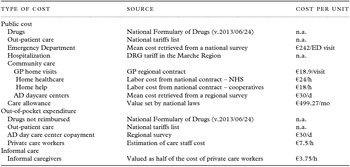
A detailed description of cost categories by perspective is reported in Table 1. The analysis uses three different cost perspectives, and distinguishes among the costs attributable to the public sector (the National Health Service, the Municipalities, and the State), to private families (i.e. out-of-pocket expenditures) and to society as a whole. Each cost item was assigned to the appropriate perspective, and classified either as “public” or “private.” The societal perspective includes both public and private costs and additionally considers the cost of informal care. Cost data were retrieved from official sources when available. In lieu of official sources, the best available data from national and local surveys were used.
Cost categories, by perspective, included in the study

n.a. = not applicable; AD = Alzheimer's disease; DRG = diagnosis related group; ED = Emergency Department; GP = general practitioner; NHS = National Health Service.
Informal caregiving was valuated using a “replacement cost approach” (McDaid, Reference Mcdaid2001), i.e. estimating the cost of replacing informal caregivers’ input with professional assistance. In order to be more conservative in the final estimates (especially as we were not able to distinguish between the hours of supervision and direct care provision, since many families reported 24-hour a day care patterns), we valued the cost of informal caregivers as half of the cost of private care workers, following the approach used by Björkgren et al. (Reference Björkgren, Fries and Shugarman2000) and Poss et al. (Reference Poss, Hirdes, Fries, Mckillop and Chase2008).
We used a specific assumption to deal with the risk of double-counting the resource consumption when the dyad declared, at the same time, that they received the care allowance and declared out-of-pocket expenditure. As the legal rationale of the “indennità” is to fund out-of-pocket care-related expenditure of families, we subtracted its value from the total out-of-pocket expenditure for all those patients receiving the allowance. When the value of the “indennità” was higher than out-of-pocket expenditure (thus hinting that the family uses part of it for other purposes), we replaced negative values with null quantities.
Statistical analyses
Analyses of socio-demographic characteristics of the sample, level of patients’ disease severity, social/educational status, resource consumption, family relationship between patient and caregiver, and caregiving burden were purely descriptive. Regarding the cost analyses, two different approaches were adopted. First, univariate (non-parametric) analyses were performed to compare annual costs, by perspective and patients’ age. In this case, a bootstrap method was used to estimate the confidence intervals of each cost item. Second, a Generalized Linear Model (GLM) was used to study the relation between costs and independent variables (Schwarzkopf et al., Reference Schwarzkopf2012; Lindholm et al., Reference Lindholm, Gustavsson, Jonsson and Wimo2013). Model validation was carried out using the following tests: χ2 for the family chosen; Pearson correlation, Pregibon link, modified Hosmer, and Lemeshow for link function utilized. These tests suggested not to use the out-of-pocket expenditure as a dependent variable, given its excessively skewed distribution. Therefore, we chose to use the sum of public and private costs as a proxy variable to investigate the patterns of out-of-pocket expenditure in the sample.
Results
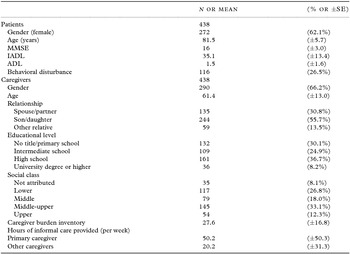
General characteristics of AD patient–caregiver dyads included in the analysis are reported in Table 2. Patients were more frequently women, with a mean age of 81.5 years. Their ADL-hierarchy scale score was 1.5 out of 6, while their IADL performance indicated greater impairment, reaching 35.1 out of 48 on the IADL scale. Caregivers too, were mostly women (66.2%), usually children of the patients (55.7%) or a spouse/partner (30.8%). Only 8.2% of the caregivers had a university or higher degree, 36.7% completed high school, whereas the majority only finished intermediate school (24.9%) or primary school/no title (30.1%). The level of caregiving burden, measured using the CBI, reached an average of 27.6 points (±16.8).
Characteristics of the dyads patient/caregiver in the final sample (n = 438)

ADL = activities of daily living; IADL = instrumental activities of daily living; MMSE = Mini-Mental State Examination; SE = standard error of the mean.
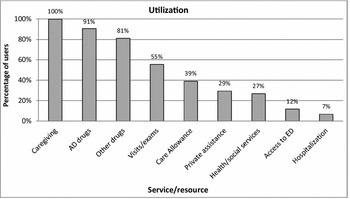
Prevalence of service use by AD patients is reported in Figure 1. As a consequence of the inclusion criteria, all patients relied on family caregiving. Ninety-one percent of the patients used AD-related drugs, composed of antidementia compounds, prescribed by the AEUs, antidepressants, antipsychotics, anxiolytics, and hypnotics/sedatives, and 81% of them used other drugs. Fifty-five percent of the patients reported outpatient visits and exams in the six months prior to the interview, and 29% were assisted by a private care worker. Hospitalizations were somewhat frequent in the sample (7%), as were visits to the Emergency Department (12%).
Frequency of resource use (n = 438)

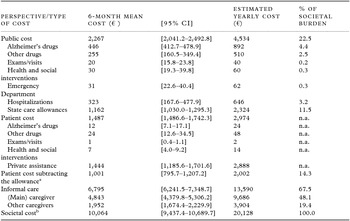
The estimated societal burden of AD patients was about €20,000/yr (Table 3). Out of this, the cost borne by the public sector was €4,534/yr. This value included the cost for direct care services – provided by the NHS and the Municipalities – plus the value of the cash allowances granted by the Italian National Institute of Pensions (INPS). The latter was indeed the largest driver of public cost: 39% of patients received the grant for a total yearly mean cost of €2,324. The other significant driver of public expenditure was prescription drugs for AD and co-morbid diseases, which amounted to €1,402/yr, or almost 1/3 of total public spend. Antidementia drugs were used by approximately 51% of patients, which accounted for the majority of AD drug costs (84%) (see Table S1, available as supplementary material attached to the electronic version of this paper at www.journals.cambridge.org/jid_IPG). The most frequently used drugs for co-morbid diseases were cardiovascular drugs (40.1%; 31.1% cost composition), drugs for the alimentary tract and metabolism (19.7%; 18.2% cost composition), and blood and blood-forming organ medications (17.2%; 25.3% cost composition) (see Table S2, available as supplementary material attached to the electronic version of this paper at www.journals.cambridge.org/jid_IPG).
AD-related costs, by type of cost and perspective (n = 438)

AD = Alzheimer's disease; CI = confidence interval; € = Euro.
aSee the methodological section for details on how the value is computed.
bSocietal cost includes: public cost, patient cost without allowance, and informal care cost.
Out-of-pocket expenditure predominantly concerned the cost of hiring private care workers, while the cost for privately purchased drugs was rather limited (€24 and €48 for Alzheimer and other drugs, respectively).
The largest share of societal burden, however, comprised informal care. Even by valuing the hours of care, provided by family caregivers, at half the rate of the lowest skilled labor (private care workers), the value of the societal burden peaked at €13,590/yr (67.5% of total costs). Forty-seven percent of caregivers (primary + secondary) expended 41–168 h/wk assisting the patient (see Figure S1, available as supplementary material attached to the electronic version of this paper at www.journals.cambridge.org/jid_IPG). Ten percent of households spent >168 h/wk caring for the AD patient, while 33% and 10% of family members spent, respectively, 15–40 and 0–14 h/wk looking after the Alzheimer's patient. The family members who spent the majority of time on caregiving were spouses/partners (70 h/wk) followed by grandchildren (44 h/wk) and children-in-law (30 h/wk) (see Figure S2, available as supplementary material attached to the electronic version of this paper at www.journals.cambridge.org/jid_IPG).
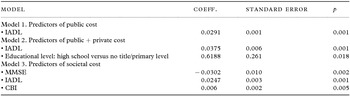
Predictors of total costs are shown in Table 4. IADL dependency was the only significant predictor of public cost. IADL impairment also influenced the consumption of resources when considering the total public and private expenditure. In addition, the sum of public and private expenditure correlated with higher level of education. Again, impaired IADL status was associated with increased societal cost, whereas cognitive impairment was negatively correlated. Among the characteristics of caregivers, only CBI score was associated with increased societal expenditure.
Predictors of total costs (all perspectives; n = 438)

All models are adjusted for characteristics of patients (age, gender, ADL, IADL, and MMSE) and caregivers (age, gender, CBI, statuses, and education level).
ADL = activities of daily living; CBI = Caregiver Burden Inventory; IADL = instrumental activities of daily living; MMSE = Mini-Mental State Examination; Coeff. = correlation coefficient; p = probability; Standard Error = standard error of the mean.
Discussion
Our study sheds light on the overall burden of AD in a population of patients at a moderate stage of the disease. By examining the costs using three different perspectives, the expenditure of the public sector (the State, the Municipalities and the NHS) was relatively low compared to the overall societal burden. The preference of the Italian Welfare State for cash-for-care allowances, instead of direct care services, was clearly reflected by our results (Shutes and Chiatti, Reference Shutes and Chiatti2012). The cost for care allowances overwhelmed the cost for direct care provision. In many cases the total cost of the care subsidy exceeded that of out-of-pocket expenditure by recipients, suggesting that a substantial part of the allowance was spent in other ways. This reinforces the widespread idea, that in Italy, this care subsidy is a form of compensation for carers’ work and complements the income of Italian families. The implications for social policy are indeed relevant and suggest the need for new regulations to increase the accountability of how the care allowance is used.
Prescription drug expenditure accounted for the largest share of the remaining public cost, while the amount of public spending for care services in the community was negligible. Another emerging characteristic was the relevance of the support provided by private care workers (Chiatti et al., Reference Chiatti, Rosa, Melchiorre, Manzoli, Rimland and Lamura2013a), which represented the major driver of out-of-pocket expenditure.
Two previous cost-of-illness studies have been carried out in Italy (Cavallo and Fattore, Reference Cavallo and Fattore1997; Trabucchi, Reference Trabucchi1999), however, neither study assessed the costs of medical care. This reflected the structure of dementia care in the country, which traditionally falls outside of the NHS. Moreover, neither study included information on disease severity, nor were they based on a large sample of AD patients assessed by specifically trained research nurses. Cavallo and Fattore's study was based on a postal survey (Cavallo and Fattore, Reference Cavallo and Fattore1997), while the CoDem study (Trabucchi, Reference Trabucchi1999) included only 103 AD patients. In these two investigations, the level of informal care ranged from 61.6 h/wk (for personal support only) to 124.6 h/wk for patients with severe dementia (a Clinical Dementia Rating score of 3). In our study, the number of hours of informal care provided by the primary caregiver (supervision + direct care) peaked to a mean of 50.2 h/wk, to which must be added an extra 20 h/wk from other informal caregivers.
The importance of informal assistance provided by Italian families, outside of the market, was evident in two ways. First, the value of the social cost peaked at €13,590/yr or 67.5% of total costs. Second, the public expenditure was significantly less than those same patients would incur in residential care. In the Marche Region, where our study is being carried out, the cost for a year spent in institutional care, for a patient with moderate AD, could vary from €12,045 to €14,600, in contrast to €4,534 for public expenditure of patients living at home, observed in our sample (Marche, 2010). The crucial role of informal caregiving is not limited to Italy. In a recent study carried out in Germany, total costs for community-based caring, after adjusting for age, gender, functional status (ADL and IADL), and co-morbidity, were higher than total costs for nursing home-based caring, mainly due to the higher costs of informal care (Konig et al., Reference Konig2014). From a State perspective in the short term, the “convenience” of these care arrangements in the community is apparent, since the alternative, residential care settings, is clearly more burdensome. However, if caregivers are not adequately supported, these savings may be soon offset, given the high burden, stress, and often advanced age of caregivers, which expose them to a higher risk of morbidity and mortality (Vitaliano et al., Reference Vitaliano, Zhang and Scanlan2003). Already the caregivers in our sample population were close to the threshold for anxiety and depression (McDowell, Reference Mcdowell2006; Chiatti et al., Reference Chiatti2015). Studies have determined that these mood disorders were associated with much higher public costs for older people living at home (Vasiliadis et al., Reference Vasiliadis, Dionne, Preville, Gentil, Berbiche and Latimer2013), as well as healthcare costs for older patients (Luppa et al., Reference Luppa, Heinrich, Angermeyer, Konig and Riedel-Heller2008).
In this study, we distinguished the share of cost directly attributable to AD from that which might be associated with other diseases and/or physical dependency. In this regard, previous evidence pointed out that potentially sizeable savings could be achieved by the management of co-morbidities in people with dementia (Knapp et al., Reference Knapp, Iemmi and Romeo2013). We found that a large share of the public costs was related to disease co-morbidities (e.g. drugs and hospitalizations), suggesting the need to specifically target this population, for instance, by improving prescription appropriateness through medication reviews and/or improving the compliance to therapy.
In the regression analysis of cost predictors, functional impairment, rather than cognitive impairment, more consistently predicted the use of resources. (The only exception was the correlation between a higher MMSE score and overall societal burden.) This is in line with previous evidence (Lindholm et al., Reference Lindholm, Gustavsson, Jonsson and Wimo2013), suggesting that IADL dependency is the main driver of care cost among AD patients. We found no socioeconomic correlates of public spending, which is consistent with the mission of the Italian welfare system to universally provide assistance (although the overall level dispensed is relatively small). Conversely, the role of caregiver education suggested the probable association between a higher SES and a higher expenditure for the care of the AD patients. These findings raise the issue of equity of care, since it reveals the additional risk of caregiving burden, for those families with lower financial means. The disadvantages of dyads with a lower educational status will increase as the public support for dementia continues to retrench as a result of the financial crisis in the Mediterranean countries.
Caregiver social class was not significantly correlated with AD burden in the multivariate analysis, once educational attainment was inserted into the models. This suggests that caregiver educational level has a stronger impact in determining the care arrangements of the patients, which may also be connected to the fact that, due to a limitation of the study questionnaire, we could not measure family social class, but only individuals’ social class (Erikson, Reference Erikson1984)
The study has other limitations, which must be considered when appraising its results. First of all, regarding the representativeness of the sample, it has to be mentioned, that at the present time, no data are available regarding the prevalence of AD in the Marche Region and the characteristics of the population of caregivers. This is a major issue for the Regional Government, which the UP-TECH project is actually trying to address. However, the 67% recruitment response rate achieved on the lists of the AEU patients (which include all patients of the Region with a diagnosis of AD) and the large size of the sample (n = 438 patient–caregiver dyads), make us optimistic regarding the latter's representativeness of Marche's population of patients with moderate AD, living in the community, with at least one family caregiver. The characteristics of the UP-TECH sample are indeed consistent with those of the samples enrolled by other studies (both RCTs and cross-sectional studies) targeting patients with dementia (Coon et al., Reference Coon, Thompson, Steffen, Sorocco and Gallagher-Thompson2003; Sink et al., Reference Sink, Covinsky, Barnes, Newcomer and Yaffe2006; Black et al., Reference Black, Johnston, Rabins, Morrison, Lyketsos and Samus2013) and those with moderate AD (Wisniewski et al., Reference Wisniewski2003; Belle et al., Reference Belle2006). In these studies, the caregivers had a very similar age and gender composition, while the dementia patients had a comparable profile in terms of age, gender, MMSE score, and ADL and IADL dependency. A second potential limitation of the paper refers to the inclusion criteria of our study population, i.e., patients with moderate AD, with at least one family caregiver. This implies that those patients without a family caregiver – although their number should be relatively small in the Italian population – were not included in the analysis. A third limitation relates to the lack of conventional measures of AD symptom gravity, such as the NPI (Cummings, Reference Cummings1997) and the Behave-AD (Reisberg et al., Reference Reisberg, Auer and Monteiro1996), in the UP-TECH study. However, we tried to address this by using the caregivers’ reports of behavioral disturbances, which is a very common proxy in the health economic analysis of AD cost (Jonsson and Wimo, Reference Jonsson and Wimo2009). Last but not least, for some cost items, we could not use the actual price, but had to rely on an estimate from either surveys or the cost of labor set by the national employment contracts. Even with these limitations, our up-to-date study is one of the most realistic carried out in Italy, as it is based on a comprehensive and reliable collection of data, following an intensive training of nurse assessors and a continuous monitoring of a large number of patients.
Conflict of interest
None.
Description of authors’ roles
CC contributed to the statistical analysis and interpretation; the conception, development and writing of the paper. GF contributed to the statistical analysis and interpretation; the development and writing of the paper. JMR contributed to the conception, development, and writing of the paper. FD contributed to the statistical analysis and interpretation; the development and writing of the paper. FB contributed to the execution of the study; data preparation; critical comments on paper drafts. LC provided critical comments on paper drafts; critical review of paper drafts. FM contributed to the execution of the study; management of participant recruitment; supervision of data collection; data preparation; critical review of paper drafts. AC provided critical comments on paper drafts; critical review of paper drafts. FL supervised the data collection and provided critical comments on paper drafts.
Acknowledgments
This work was supported by the Marche Region under the Special Fund for Dependency Care managed by the Italian Ministry of Welfare (“Il progetto UPTECH è realizzato dalla Regione Marche in collaborazione e con il contributo dell’INRCA Ancona attraverso il finanziamento del Fondo Nazionale non Autosufficienza, 2010”).
Supplementary Material
To view supplementary material for this article, please visit http://dx.doi.10.1017/S104161021500040X