Days before the US Food and Drug Administration (FDA) announced its August 2024 decision rejecting Lykos Therapeutics’ marketing application for midomafetamine (MDMA) plus psychotherapy to treat post-traumatic stress disorder (PTSD), 80 members of Congress signed bipartisan letters encouraging the drug’s approval. Although these letters formalistically acknowledged that FDA’s decision should be evidence-based, they nonetheless argued that “our Veterans can no longer wait.” 1 FDA — which at the time was operating under the Biden Administration — held its ground against the political pressure, ultimately agreeing with its outside advisory committee that the available evidence was insufficient to demonstrate MDMA’s safety and effectiveness. 2
Shortly before his appointment as Secretary of Health and Human Services under President Trump, Robert F. Kennedy, Jr. characterized FDA as engaged in “aggressive suppression of psychedelics” 3 — and he has since promised to change the agency’s course. 4 Political support for psychedelic medicines has only grown under Kennedy’s “Make America Healthy Again” agenda. 5 Beyond FDA and the national stage, several state and local jurisdictions have decriminalized and legalized certain psychedelics in recent years, in some cases establishing programs for regulated access.Reference Marks 6 Others have devoted funding to psychedelic research, for example, with Texas most recently authorizing $50 million in state funds to study ibogaine with the hope of leveraging additional private investments and retaining a financial stake in revenues from the drug’s development. 7
These initiatives have been spurred by growing enthusiasm for the promise of psychedelic medicines to offer relief for a variety of mental health concerns. So far, however, the evidence and magnitude of demonstrated benefit have trailed substantial psychedelic “hype.”Reference Yaden, Potash and Griffiths 8 Against this backdrop, how should US policymakers responsibly consider the growing demand for psychedelic medicines among communities with serious unmet mental health needs, including veterans and other trauma survivors facing PTSD,Reference Zaretsky 9 those struggling with severe depressionReference Raison 10 or addiction, 11 and terminally ill patients experiencing existential distress,Reference Rosenbaum 12 among many others?
There is often a political — and human — inclination to respond to patient desperation by prioritizing speed over certainty. Yet it is important to hold these factors in balance. Here, we outline several existing options that might enable US patients to access psychedelic medicines prior to each drug’s marketing approval by FDA, evaluating the comparative benefits and drawbacks of these approaches in relation to the need for rigorous evidence and caution around use of unproven psychedelic drugs by those seeking therapeutic benefit. Recognizing FDA approval as the ideal path for psychedelics intended for medical use (as opposed to recreational or spiritual use) and drawing on lessons from medical marijuana, we encourage policymakers to increase support for psychedelic research, reject approaches that could inhibit that research, explore improvements to FDA’s existing pre-approval access pathway, and above all, avoid the specter or reality of politically motivated FDA approval of psychedelic medicines.
The Current Status of Psychedelic Medicines
When a pair of recent Phase 3 trials of MDMA-assisted psychotherapy for PTSD yielded positive results,Reference Mitchell and Mitchell 13 many predicted that FDA approval would soon follow. However, concerns about unblinding, inclusion of investigators and patients with strong prior beliefs about MDMA’s benefits, potentially biased reporting of benefits and harms, insufficient safety data, and difficulty parsing the influence of the drug versus the associated psychotherapy led FDA to conclude that available data did not support approval of Lykos’ application. The agency instead requested that Lykos conduct another Phase 3 trial to further assess safety and effectiveness, 14 a result that disappointed many. Some commentators criticized FDA and its advisors, for example, claiming they lacked sufficient expertise, imposed unreasonable standards, or deviated from considerations directly relevant to safety and effectiveness, while others placed blame on the company for failing to generate the highest quality trial data. 15 Importantly, FDA’s rejection of the initial Lykos MDMA application has not been received as a death knell for the possibility of future psychedelic approvals but rather as offering lessons for other developers. 16
We are currently at a critical moment in the so-called “psychedelic renaissance.” 17 There is growing support for the notion that psychedelics — a debated definitional category including classic psychedelics that work on serotonin receptors, such as psilocybin and lysergic acid diethylamide (LSD), and non-classic psychedelics that work on other neurotransmitters, such as MDMA and ketamine — may offer therapeutic benefit. Several psychedelic compounds are in mid- to late-stage testing for a variety of psychiatric indications, including depression, PTSD, anxiety, obsessive-compulsive disorder, anorexia nervosa, and others. To date, however, esketamine is the only drug with psychedelic-type effects that has secured FDA approval for psychiatric use, with two depression indications — but its approval has been criticized for weak evidence and marginal clinical benefit.Reference Turner 18 In addition, ketamine is FDA-approved as an anesthetic, allowing clinicians to legally offer it “off-label” for psychiatric conditions, leading to a growing number of for-profit clinics and telemedicine providers, alongside concerns about inadequate supervision, overuse, addiction, and inflated claims. 19
A recent review of adverse events in studies of classic psychedelics found that these drugs are generally well-tolerated in carefully monitored clinical and research settings,Reference Hinkle 20 with robust informed consent, judicious patient selection, and close clinician oversight and follow-up. Another review similarly concluded that the medical risks of classic psychedelics are often minimal, with most reported adverse effects not observed in regulated or medical contexts.Reference Schlag, Aday, Salam, Neill and Nutt 21 However, safety in other contexts is less clear, especially as trials typically exclude those at risk for bipolar disorder, psychosis, suicidality, or certain physical conditions, including seizure disorders and cardiovascular conditions, all of which increase patient risk for poor outcomes.Reference Smith, Sisti and Appelbaum 22 Psychological effects can be influenced by user mindset and physical setting, as well as care before and after psychedelic use, which can be challenging to standardize and regulate.Reference McGuire 23 FDA has also raised questions about psychedelic abuse potential. 24 Overall, current evidence suggests that psychedelics can be used safely but — like most medicines — are not risk-free.Reference Goldy 25
Meanwhile, experts have described the treatment potential of psychedelics as “real” but possibly “less impressive than expected,” 26 with effect sizes that may be comparable to conventional mood disorder treatments.Reference Meling 27 For example, Compass Pathways, which may be the next psychedelic sponsor to submit a marketing application to FDA, reported in June 2025 that its synthetic psilocybin drug for treatment resistant depression (TRD) met its Phase 3 endpoint, reducing depression severity at 6 weeks by 3.6 points on a clinical rating scale. This result was reported to be clinically meaningful but was perhaps smaller than hoped, leading to a substantial drop in the company’s stock prices. 28 However, another recently reported result, from Beckley Psytech’s Phase 2 study of its 5-MeO-DMT formulation for TRD, indicated a more substantial 11.1 to 12.1 point decrease on the same scale at 29 days. 29 Thus, while psychedelics appear promising and worthy of further study, many important questions remain.Reference Humphreys 30
The Value of FDA Approval
FDA approval is the optimal access mechanism for any product intended for medical use. By law, approval requires demonstration of a drug’s safety and effectiveness through adequate and well-controlled clinical investigations, 31 compelling companies to produce the evidence necessary to guide treatment decisions — and, importantly, to justify insurance coverage for treatments likely to be unaffordable to most patients paying out-of-pocket. In addition, FDA-regulated drugs must meet rigorous quality control standards and cannot be marketed with false or misleading claims. 32 For psychedelics, FDA approval could offer the further benefit of legally enforceable requirements for post-market studies to promote understanding of long-term safety in broader populations. 33 FDA approval also could be paired with Risk Evaluation and Mitigation Strategies (REMS), which impose constraints on approved drugs, for example, to establish safe parameters for assisted therapy and limit off-label use. 34
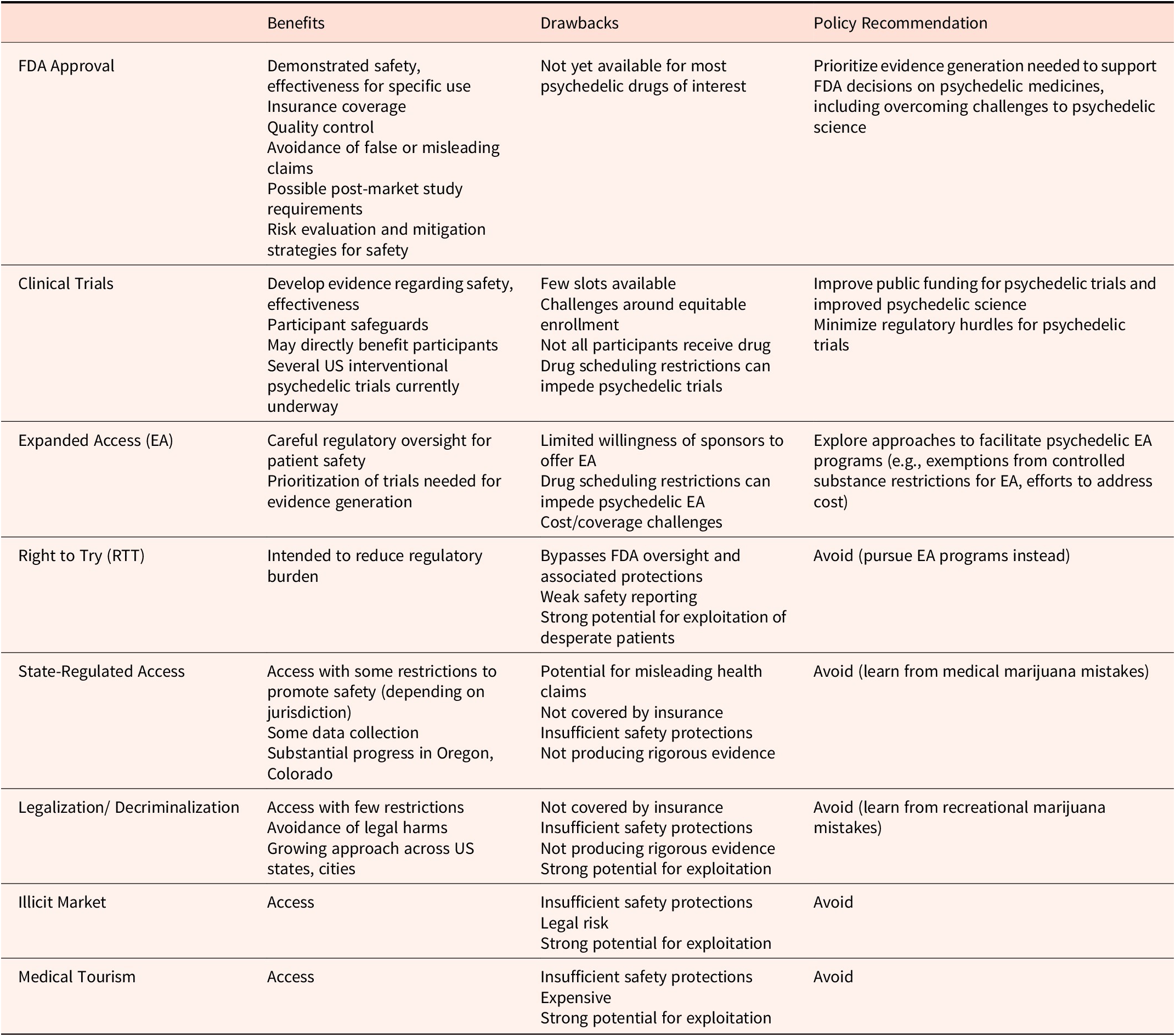
Given these benefits, those pursuing psychedelic medicines — both companies and patients — should aim for FDA approval over all other potential access mechanisms, prioritizing the collection of rigorous evidence needed to prove safety and effectiveness. Yet, as is often the case for individuals facing serious or life-threatening conditions, some patients suffering with unmet psychiatric needs feel they cannot wait, often expressing a heightened tolerance for risk and uncertainty. One response to these patients would be to rush FDA approval before the science is clear. Another would be to uncompromisingly withhold legal access to psychedelic medicines in the US until the science supports FDA approval. Neither of these extremes is ideal. Between them are several existing access options across the legal spectrum, each with a different array of benefits and risks, as described below and in Table 1. As federal and state policymakers assess this landscape, they must balance the need for evidence, the importance of patient safeguards, and the desire for speed.
Evaluating Policy Options for Access to Psychedelic Medicines

The Landscape of Pre-Approval Psychedelic Access
Trial Participation
Like other promising investigational drugs, one option for psychedelic access before FDA approval is enrolling in a clinical trial,Reference Lynch and Bateman-House 35 with several companies currently pursuing various psychedelic compounds in Phase 2 and 3 studies. 36 Trials offer important protections for participants, including institutional review board (IRB) oversight, rigorous consent requirements, and safety monitoring. In addition, well-designed trials produce critical data about unproven products, while sometimes offering the possibility of direct participant benefit. However, trials are typically small, with strict eligibility criteria, inevitably leaving interested patients out. They can also be burdensome to participate in and geographically limited, concentrated especially in the urban areas that host most academic medical centers, leading to a variety of inequities. Moreover, trials ideally involve randomization and a control group, such that not all participants receive the investigational intervention, often to their disappointment. Consequently, psychedelic access via clinical trials will remain inherently limited, even as the field of psychedelic research grows.
Expanded Access and Right to Try
With the help of their clinicians, patients alternatively might seek psychedelics through the Expanded Access or “Right to Try” legal pathways. 37 Both pathways allow patients with serious conditions to access unapproved drugs when they are unable to participate in trials and lack other treatment options, assuming they can secure physician agreement and convince companies to provide access. However, Expanded Access is preferable to Right to Try because it requires FDA authorization based on assurance of non-interference with clinical trials and other aspects of product development essential to bringing new drugs to market. Expanded Access also requires that FDA engage in careful risk/benefit assessment of requests to access unapproved medicines; this regulatory oversight is important for patient protection and may include specific requirements to minimize risk. 38 In contrast, Right to Try problematically bypasses FDA sign-off in favor of physician and company discretion, increasing the chances of desperate patients being misled or otherwise harmed by unscrupulous or incompetent actors.Reference Folkers, Chapman and Redman 39 Such exploitation is a common concern in the context of stem cell therapies and alternative medicines,Reference Snyder 40 for example, and is also salient for psychedelics. Importantly, Right to Try also has less rigorous safety monitoring and reporting requirements compared to those applicable to Expanded Access.
Although FDA almost always approves Expanded Access requests once appropriate safeguards are in place, 41 companies often decline them for reasons including capacity and cost, given prohibitions on profiting from unapproved drugs (although charging direct costs is permitted), 42 alongside regulatory obligations to Expanded Access patients. Other company concerns sometimes include limited drug supply, worry about patient safety outside trials, and potential impact on approval should adverse events occur. Additionally, Expanded Access does not override restrictions applicable to Schedule I drugs under the federal Controlled Substances Act (nor does Right to Try 43), which can make use of this pathway more burdensome for psychedelics than other drugs.Reference Nutt, King and Nichols 44 Importantly, current drug scheduling also poses a challenge for psychedelic research.
To our knowledge, only two sponsors (Johnson & Johnson for esketamine 45 and the Multidisciplinary Association for Psychedelic Studies/Lykos for MDMA 46) have offered psychedelic Expanded Access programs in the US. Others, including Compass Pathways, have declined to do so, pointing to the priority of running “rigorous, large-scale clinical trials to generate robust data,” as well as concerns about risk to patients and jeopardizing clinical development. 47 However, even Compass has indicated theoretical openness to offering pre-approval access in the future based on “the strength of the clinical data, the benefit-risk profile, the impact on the clinical development programme, the phase of development, and the probability and timing of regulatory approval.” 48
With effort to address relevant barriers, Expanded Access could become an appropriate, limited access mechanism for individuals and groups of US patients seeking psychedelics before FDA approval. Similar approaches underway elsewhere in the world may be instructive. For example, the Swiss Federal Office for Public Health issues exemption permits to therapists on a case-by-case basis allowing them to treat patients in limited circumstances using LSD, MDMA, and psilocybin combined with psychotherapy.Reference Aicher, Schmid and Gasser 49 In addition, Canada has taken steps to make its Special Access Program (SAP) — an analogue to Expanded Access that allows manufacturers to sell an unapproved drug to health care practitioners under special circumstances — more amenable to use for psychedelic medicines by issuing a “class exemption” to cover some SAP authorizations for psilocybin and MDMA. 50 Since these drugs are controlled substances in Canada, as in the US, the class exemption avoids practitioners having to seek burdensome individual exceptions from scheduling restrictions, even as Health Canada continues to review the SAP requests case-by-case. A similar approach could be reasonable in the US.Reference Richard, Garcia-Romeu and Henningfield 51 Critically, Health Canada emphasizes that SAP authorizations are only granted for patients with serious conditions for whom conventional treatments are unsuitable, further explaining that they are not intended to “promote or encourage the early use of drugs[;] conduct research[;] or bypass the clinical trial or drug review process[.]” 52 These are critical regulatory limits needed to ensure that exceptional pre-approval access does not swallow the rule of requiring that medicines be demonstrated safe and effective before marketing.
In contrast, Australia’s approach seems to fall on the other side of this important line. Since 2023, Australia’s Therapeutic Goods Administration (TGA) has allowed psychiatrists to prescribe two unapproved psychedelic drugs for specific indications — MDMA for PTSD and psilocybin for TRD, both down-scheduled from “prohibited substances” to “controlled drugs” for this purpose — under its Authorized Prescriber Scheme. 53 Participating psychiatrists must secure both authorized prescriber status from the TGA and approval from a human research ethics committee 54 for use of these psychedelic substances for eligible patients under their care, which may include protective measures such as patient selection and treatment protocols, monitoring expectations, and training and governance requirements. Maintenance of the authorized prescriber status also requires frequent reporting and renewal. 55
While these are important safeguards for patients treated under this scheme,Reference Nutt 56 apparently missing are critical protections and incentives for rigorous clinical research. As such, Australia’s approach veers beyond exceptional Expanded Access and looks more like an abdication of regulatory responsibility, allowing potentially widespread use of medicines that have not yet met the legal or scientific evidentiary standard for marketing approval. Importantly, the concern is not necessarily the number of patients who may be treated with psychedelics under this approach, as Expanded Access can also be made available to intermediate or widespread treatment populations in the US. It is instead the lack of attention to prioritizing research and eventual product approval on the standards applicable to other medicines. As a group of Australian experts concluded, “[w]hile down-scheduling…may help with the administration of clinical trials, this does not appear to be the motivation behind the TGA decision. Instead, it seems the TGA has yielded to pressure from the public and lobby groups to increase access to these experimental treatments, outside of clinical trials.”Reference Rossell 57 Moreover, although a “clinical quality data registry” has been established to monitor patient outcomes, with plans for registry data to “be published on a regular basis in the public domain,” 58 the variables and potential biases associated with this “real-world evidence” raise important challenges for regulatory use. Ultimately, key ethical conditions for pre-approval access, including inability of patients to participate in a relevant trial and broader avoidance of interference with clinical development, are missing from the Australian model.
Concerns that this approach might crowd out efforts to achieve traditional marketing approval may be unintentionally mitigated, however, given the high cost of psychedelic treatment under the authorized prescriber scheme, which is estimated to range from $15,000 to more than $23,500 for a standard course of treatment and is not covered by insurance. 59 This price tag has slowed uptake in Australia and reflects a broader challenge for pre-approval access, even under appropriate constraints such as those present for Expanded Access. Insurers, public and private, appropriately refuse coverage for unproven treatments and companies may be unwilling or unable to provide psychedelic drugs free of charge, let alone associated psychotherapy where indicated. Cost is therefore a major unresolved hurdle to the Expanded Access pathway, for psychedelics and other drugs alike.Reference Folkers, Bateman-House and Robertson 60
Jurisdictional and Other Approaches
Beyond Expanded Access, state and local jurisdictional efforts to provide psychedelic access are gaining momentum in the US, bypassing FDA regulations and other federal prohibitions. Oregon and Colorado have led the way, legalizing supervised use of psilocybin and other psychedelics through licensed programs not limited to clinical practitioners.Reference Marks 61 Oregon has tried to somewhat avoid medicalized language, with its law referring to “service centers,” 62 but these licensed centers have adopted medicalized names referencing “wellness” and “healing.” Meanwhile Colorado has more explicitly blurred the lines with legal references to “natural medicine access” and “healing centers.” 63 In both cases, the public is likely to mistakenly and problematically assume that drugs received through these government-authorized programs have proven medical benefit. In addition, neither the psychedelic drugs nor associated services are covered by insurance under these schemes, raising the same affordability challenge noted above. The costs of a single legal psilocybin session in Oregon is estimated to range from $1,000-$3,000, 64 far cheaper than the Australian estimate but still out of reach for many Americans, especially if adding travel costs from out of state.
Most importantly, these state programs have been criticized as lacking adequate safety protections, including risk screening, monitoring, and uniform oversight by medical professionals, 65 a major deviation from the protections associated with Expanded Access and the conditions described in the literature as offering confidence in psychedelic safety. Another obvious challenge is that state and local access efforts are not designed to produce rigorous scientific evidence. Oregon’s program, for example, requires aggregated information about “client” demographics, services provided, and adverse reactions, none of which can substitute for controlled trials examining the safety and efficacy of psychedelic medicines. 66
Given these concerns about regulated programs, broader decriminalization and legalization approaches with even less oversight and attention to clinical effectiveness cannot be recommended as sound access policies for psychedelic medicines.Reference Siegel, Smith and Sisti 67 (There are, however, strong justice-based and harm-reduction reasons to eliminate certain drug penalties.Reference Earp 68) Relying on the illicit market or medical tourism, i.e., seeking access in foreign jurisdictions where a particular drug may be legal, are also undesirable paths for patients in need of treatment. In these contexts, baseline concerns about uncertain clinical benefit and risk are compounded by concerns regarding legal risk and potential exploitation of vulnerable individuals through pricey, unregulated “psychedelic retreats”Reference Nietzke-Spruill 69 and unsupported medical claims.
Learning from Marijuana
As policymakers evaluate approaches to psychedelic medicines, aspects of the marijuana experience offer a cautionary tale. Although FDA has not approved cannabis for any indication, it has approved cannabis-derived and synthetic cannabis-related products based on controlled trials that supported precise dosing instructions and insurance coverage. 70 In contrast — and in direct contradiction of FDA’s Congressional mandate to ensure that medicines available on the American market have been demonstrated safe and effective — most US states now permit the sale and use of “medical” marijuana for several qualifying conditions, few of which have scientific support.Reference Stains, Incze, Kelley and Singer 71 While the federal government has exercised enforcement discretion to focus on criminal networks involved in the illicit marijuana trade, 72 state approaches leave much to be desired. Quality control is often inadequate and data collection on safety, long-term effects, and drug interactions remains sparse. In addition to various structural challenges to marijuana research,Reference Cooper 73 marijuana purveyors have little incentive to conduct (and investors have little reason to support) trials, since they can profit without them. Ultimately, patients have been left to rely on non-clinical dispensary workers for anecdotal advice, as even their clinicians have little information with which to guide them. Legalization of marijuana for recreational purposes has resulted in even more use with fewer restrictions, leading to increasing reports of serious harm from a drug that users typically consider safe but is now more potent than ever.Reference Jayawardhana 74 Similar public health challenges must be avoided in the push for psychedelic access, especially given the added complexity of ensuring that psychedelics are combined with psychotherapy when needed to achieve therapeutic benefit.
Policy Prescription
In addition to a vast history of human psychedelic use for a range of purposes, 75 there is growing evidence that some psychedelics can offer therapeutic benefit for some indications. However, given the variability of both mental health conditions and conditions of psychedelic use, systematic research remains critical for establishing the safety and effectiveness of particular psychedelic medicines for particular indications. Increasingly urgent and high-level calls for psychedelic access in the US therefore must not be allowed to override the need for rigorous evidence to inform medical use, especially not as the field stands at the precipice of securing that evidence in many domains. To balance these tensions between speed, need, and certainty, policymakers should take several steps — and fastidiously avoid others.
First, it is imperative that policymakers not rush FDA approval of any psychedelic medicine before its safety and effectiveness are sufficiently demonstrated. Yet there is reason for concern on this front. Testifying before Congress in June 2025, Secretary Kennedy told lawmakers that psychedelics have a “tremendous advantage if given in a clinical setting and we are working very hard to make sure that happens within 12 months[,]” 76 seeming to establish an arbitrary date for approval based on a preconceived notion about the safety and effectiveness of an entire drug class without regard to a specific indication. FDA’s current commissioner, Martin Makary, also has made optimistic statements about psychedelic approval, promising “expeditious and rapid review” and emphasizing the need to listen to doctors and patients who describe positive experiences, especially given the lack of good treatment options for traumatic brain injury and PTSD. 77 Makary, however, has been more circumspect in his positivity, offering some caveats: “I’m not saying [psychedelics are] effective. I’m not saying the evidence is strong…. [But] we don’t get in the way with red tape. We want to do proper independent evaluations, but we’ve got to do it quickly…. this is a top priority for this FDA and this administration.” 78
Indeed, speed can be appropriate for promising drugs and, to this end, FDA has made use of existing tools such as “breakthrough therapy” designation and “priority review” to facilitate psychedelic development and timely regulatory decisions. 79 But promises of speed should never impede careful, expert review of complex data needed to ensure confidence in FDA’s decisions. 80 Similarly, protecting the independence of FDA’s scientific review is critical, such that political appointees like Kennedy and Makary should avoid both direct and indirect interference with review of specific drug applications, including through the pressure of public commentary; instead, they should reserve their role for broad policy guidance and managing scientific disagreements through established dispute resolution procedures.Reference Lynch, Joffe and McCoy 81 Unfortunately, there have been several troubling recent examples of political appointees at FDA overruling scientific reviewers or threatening to do so in politically charged areas, such as COVID vaccines, 82 giving reason for concern that Makary’s caveats may be only lip service. Approving a drug to achieve political goals is equally concerning to rejecting or limiting an application, as both cases threaten the public’s ability to trust that drugs approved by FDA have been demonstrated safe and effective.
At the same time, it is appropriate to ensure that FDA is not unduly inhibiting psychedelic access by applying unreasonable approval standards that are either inappropriate for psychedelic medicines or inconsistent with what is required for other drugs. For example, although unblinding is a substantial concern for psychedelic trials (a cartoon highly circulated in the psychedelic community shows a group of people seated on a couch watching a circle of naked people dancing, with the caption “So I’m guessing we’re in the placebo group” 83), this concern is common to psychiatric medication trials more broadly, including stimulants, benzodiazepines, antidepressants, and antipsychotics.Reference Barnett, Mauney and King 84 While emphasizing that the legal “substantial evidence standard for establishing effectiveness of psychedelic drugs is the same as for all other drugs,” FDA’s 2023 draft guidance addressing considerations for clinical investigations of psychedelic drugs offers several suggestions to mitigate the unblinding challenge. 85 For example, the guidance suggests using complementary trial designs across study phases, e.g., a trial using different psychedelic doses without placebo plus a trial using placebo, as well as ways to isolate the impact of associated psychotherapy, e.g., factorial trial designs and using distinct therapists for in-session monitoring and post-session therapy. In addition, FDA’s recent hiring of the former chief medical officer at the Usona Institute, a prominent psychedelic research institute, as Deputy Director of the Center for Drug Evaluation and Research should help provide the agency with a realistic understanding of appropriate standards for psychedelic medicines. 86 Future efforts should also ensure appropriate expertise on advisory committees engaged to consider psychedelic applications. 87
Second, on the research front, policymakers must prioritize backing the generation of evidence needed to support legitimate FDA approval — and equally important, the evidence needed to determine when and which psychedelic drugs are not safe and effective. Accordingly, Congress and the Drug Enforcement Administration (DEA) should follow through on recent initiatives to reschedule psychedelics to facilitate clinical trials.Reference Marks and Shachar 88 Congress, federal agencies, and where possible, state governments also should continue to increase funding for psychedelic research, especially in areas likely to lack sufficient private investment, such as early-stage studies (given high risk of failure) and studies of naturally occurring psychedelics (given ineligibility for patent protection). 89 In addition, the National Institutes of Health (NIH) and other funders should support both traditional scientific and “ELSI” (ethical, legal, and social issues) research to address challenges to rigorous psychedelic trials and safe administration, including efforts to mitigate unblinding such as through innovative active placebos and creative trial design,Reference Aday and Aday 90 avoid biases around expected benefit, and protect vulnerable patients.Reference van Elk and Fried 91 At the same time, state and local policymakers should resist legalization initiatives that risk inhibiting research goals and exploiting vulnerable individuals seeking therapeutic benefit.
Finally, while research proceeds toward FDA marketing approval, Congress, NIH, FDA, states, and companies should explore avenues to support use of the Expanded Access pathway for psychedelics, given the careful balance that approach offers between access, evidence development, and regulatory and clinical oversight. This could range from basic efforts to improve awareness of Expanded Access among patients and providers to novel incentives for industry to initiate and fund psychedelic Expanded Access programs, such as greater opportunities for participating sponsors to engage with FDA on their drug development plans or eligibility for voucher programs intended to speed review, 92 as well as clarity around whether and when Expanded Access data can be used to support approval or insurance coverage.Reference Polak, van Rosmalen and Uyl – de Groot 93 Additional initiatives might follow the Canadian example of granting blanket exemptions from burdensome controlled substance requirements for clinicians offering Expanded Access to psychedelics, as well as exploring opportunities for clinicians to pursue Expanded Access without requiring a separate pharmaceutical sponsor, especially for plant-based psychedelic drugs that may be accessible without company involvement. For Expanded Access to serve as a true opportunity for patient access, existing hurdles must be overcome, especially around funding constraints. However, recognizing that Expanded Access drugs remain unproven, it is essential to avoid this exceptional pathway morphing into a broad substitute for regulatory approval.
Conclusion
When psychedelics are being pursued for medical use, they should be regulated like other medicines. US policymakers and the public may need a reminder of this basic yet important point, especially when understandably moved by patient need. As is true for other medicines, limited pre-approval access, such as Expanded Access, may be appropriate with careful safeguards. However, the primary goal should be development of sound evidence that permits patients, clinicians, regulators, and payers to discern whether and which psychedelic drugs work, for which patients, and under what conditions. Although optimism and excitement are reasonable, the Trump administration should continue to advance FDA’s earlier efforts to hold psychedelics to rigorous approval standards rather than treating them as a magic bullet.
Disclosures
Holly Fernandez Lynch receives funding from the Greenwall Foundation for a study regarding IRB oversight of psychedelic research and is a paid member of the Advisory Council for the OPEN Foundation’s Advanced Education in Psychedelic Therapy Program. She also reports an honorarium and travel costs from Eli Lilly for a 2024 lecture on FDA approval standards, unrelated to this article. She is an unpaid member of the NYU Grossman School of Medicine Compassionate Use and Preapproval Access Working Group (CUPA) and an unpaid collaborator at the Hub at Oxford for Psychedelic Ethics (HOPE). She is also the President of the Board of Directors of the American Society of Law, Medicine & Ethics, which publishes this journal. Alison Bateman-House chairs CUPA, chaired Johnson & Johnson’s Compassionate Use committee for Spravato (esketamine), and receives funding from Johnson & Johnson.