With his poll numbers plummeting, many Venezuelans are wondering whether Maduro will keep his job and what tricks he’ll need to pull to do so. One thing is clear: Whatever he does, the country’s Supreme Court will be there to rubber-stamp it.
—Pedro Rosas, “How Venezuela’s Supreme Court Triggered One of the Biggest Political Crises in the Country’s History,” Vox, May 1, 2017Imagine a leader who wants to mitigate the risks of losing power. Under standard theories of democracy, such leaders should work hard to please their citizens by delivering on their campaign promises, encouraging economic prosperity, providing basic security, and the like. And, to the extent that citizens value democratic institutions and the rule of law, a leader who wishes to remain in power should respect the limits that institutions, such as independent courts, place on their power. This is one version of how liberal democracies become self-enforcing (Weingast Reference Weingast1997).
Yet, we can also imagine a leader who wants to remain in office but chooses a very different path. This leader may also be fairly elected but then clings to power by undermining other liberal democratic institutions (Ginsburg and Huq Reference Ginsburg and Huq2018; Levitsky and Ziblatt Reference Levitsky and Ziblatt2018). When it comes to the courts, this leader appreciates the value of friendly judges willing to rubber-stamp policies that violate the constitution. But more importantly, she also comes to rely on the court to exercise forbearance for transgressions committed by the president’s supporters while also deploying the full extent of the law’s power to harass the president’s opponents (Corrales Reference Corrales2015). The larger the threat of losing office, and the more a leader believes the court can help ameliorate that risk, the more attractive capturing and weaponizing the court becomes. Under this scenario, it is the fear of political instability that fundamentally drives judicial instability.
The idea that strongmen (or would-be strongmen) beget weak courts is well known. Writing about Latin America, Guillermo O’Donnell (Reference O’Donnell1994) coined the term “delegative democracy” to characterize popularly elected presidents who refuse to countenance checks on their power. Yet although O’Donnell certainly notes the quixotic nature of presidential power, he does not link the vicissitudes of power to the president’s desire to control the courts. Nor does the more general insulation theory of judicial independence recognize this sort of dynamic. Indeed, according to this familiar logic, it is precisely when presidents fear losing power to their opponents that they will seek to tie their successor’s hands by imbuing courts with independence (Ramseyer and Rosenbluth Reference Ramseyer and McCall Rosenbluth1993; Ramseyer Reference Ramseyer1994; Ramseyer and Rasmusen Reference Ramseyer and Rasmusen1997; Ginsburg Reference Ginsburg2002; Finkel Reference Finkel2008; Epperly Reference Epperly2013, Reference Epperly2018).
Turning the insulation logic on its head, this article builds on work by Aydın (Reference Aydın2013), Popova (Reference Popova2010), and Helmke (Reference Helmke2017) to explore how politicians’ uncertainty about their future is precisely what motivates judicial manipulation. Whereas Aydın (Reference Aydın2013) emphasizes the absence of public backlash against judicial manipulation, the key idea developed by Popova (Reference Popova2010) and extended by Helmke (Reference Helmke2017) hinges on the recognition that in developing democracies politicians’ fate is partly endogenous to who controls the courts.Footnote 1 Thus, if capturing the court can help to extend the incumbent’s political life span, then the calculus shifts from one in which an insecure incumbent promotes judicial independence as a means of limiting the next government to one in which the incumbent instead subjugates the current court in order shore up her own government.
The remainder of this article draws on the specific political-institutional context of contemporary Latin America to further develop and test this “kill or be killed” logic of judicial manipulation. Precisely because Latin America has continued to experience enormous variation in both presidential and judicial instability, the region offers an especially rich natural laboratory for developing this approach. From Peru in the 1990s under Alberto Fujimori to Venezuela in 2015 under Maduro, embattled presidents have recognized the importance of controlling the courts to cling to power. In the former case, Fujimori neutralized the opposition by carrying out an autogolpe that closed both the legislature and the Supreme Court. Six years later, judges who opposed Fujimori’s third reelection bid were duly impeached, and the Constitutional Tribunal was rendered inquorate (Kenney Reference Kenney2004; Helmke Reference Helmke2017). More than 25 years later, Venezuela’s embattled president, Nicolás Maduro, carried out a slightly different version of the same playbook. Shortly before the new opposition legislature was seated in 2015, Maduro packed an already loyal court with 13 new members. After striking down multiple pieces of opposition legislation, in 2017 the court then launched its own coup by dissolving the opposition-led National Assembly and temporarily seizing the legislature’s powers. In the midst of mass protests and international outcry, Maduro then forced the court to recant; subsequently, the court banned the opposition from the 2018 presidential elections and continued to jail political opponents and business executives in oil and banking (Reuters Reference Reuters2018).
Elsewhere, and often under the doublespeak of “protecting” human rights, loyal judges in countries such as Nicaragua, Honduras, and Bolivia have shredded constitutional term limits, enabling incumbent presidents to remain in power, while also green-lighting investigations of the political opposition. Meanwhile, in Ecuador, judges have been repeatedly drawn into executive-legislative battles over the president’s fate. Under President Gutiérrez for instance, the president blatantly used the Supreme Court as a bargaining chip to cling to power. Facing a series of mounting criminal charges in 2004, Gutiérrez replaced all 31 judges on the Supreme Court as part of a quid pro quo deal whereby the new Court would drop existing charges against the leader of the Ecuadorian Roldosist Party (PRE), former President Abdalá Bucaram, in exchange for the PRE blocking attempts to impeach Gutiérrez. In this case, however, the plan backfired spectacularly, and Gutiérrez was swiftly removed from power.
The remainder of the article unfolds as follows. We first elaborate the survivalist theory of judicial instability and propose three core testable hypotheses. Combining available data from Helmke (Reference Helmke2017) on interbranch crises in Latin America between 1985 and 2008 with existing data on international commodity prices from Gruss and Kebhaj (Reference Gruss and Kebhaj2019), we then present both original correlational and causal evidence supportive of our arguments. Finally, we conclude by charting the broader normative and theoretical implications of our argument.
The Drive to Survive: Theory and Hypotheses
Latin American presidents are notoriously eager to stay in power but notoriously bad at keeping it. In country after country, presidents have sought to overturn term limits, yet many often fail to even complete their full term in office. Since the mid-1980s and the return of democratically elected governments, the threat of military coups has declined, but roughly a third of all Latin American leaders have faced serious challenges to their grip on office either by legislatures invoking constitutional mechanisms to remove them, by protesters taking to the streets, or by some combination of both.Footnote 2 Often succeeded by the very political opponents who helped remove them from power, such presidents not only stand to lose the considerable spoils of their office, but many must then confront the grim choice of either a lifetime of posttenure prosecutions or political exile (Carey Reference Carey2009; also see Helmke et al. Reference Helmke, Jeong, Kim and Ozturk2019).
Whereas much of the literature on this “new pattern of instability” in the region has concentrated on identifying the specific factors that put presidents at risk (Carey Reference Carey, Domínguez and Shifter2003; Hinojosa and Pérez-Liñán Reference Hinojosa, Pérez-Liñán, Baumgartner and Kada2003; Valenzuela Reference Valenzuela2004; Hochstetler Reference Hochstetler2006; Negretto Reference Negretto2006; Pérez-Liñán Reference Pérez-Liñán2007; Kim and Bahry Reference Kim and Bahry2008; Lehoucq Reference Lehoucq2008; Hochstetler and Edwards Reference Hochstetler and Edwards2009; Helmke Reference Helmke2010; Llanos and Marsteintredet Reference Llanos, Marsteintredet, Llanos and Marsteintredet2010), considerably less attention has been paid to understanding how presidents might seek to ameliorate such risk while they are in power. To fill this gap, this article builds on the intuitively appealing proposition that presidents will respond to such nonelectoral office insecurity not by instantiating institutional constraints on their successors but by removing institutional constraints on themselves.
To help fix ideas, consider the logic of judicial independence as a simple cost-benefit analysis from the perspective of the incumbent.Footnote 3 According to the conventional insulation approach, the decision to create (or maintain) independent courts hinges largely on how much incumbents are willing to tolerate the present cost of having a court that constrains their ability to shape policy versus the benefits of having a court that also constrains any future opposition government from doing so. As long as incumbents do not discount the future too heavily, those who fear losing power to the opposition will be more inclined to imbue courts with independence (Ramseyer Reference Ramseyer1994; Hirschl Reference Hirschl2000; Ginsburg Reference Ginsburg2003; Magalhães Reference Magalhães2003; Stephenson Reference Stephenson2003; Finkel Reference Finkel2008; Epperly Reference Epperly2013, Reference Epperly2018). Additional factors such as the legitimacy costs an incumbent government may suffer from manipulating a judiciary that enjoys public support help to further tilt the balance toward maintaining the court’s independence (Vanberg Reference Vanberg2001, Reference Vanberg2015; Staton Reference Staton2006).
But if exerting control over courts can itself affect the probability of the current incumbent remaining in power, then the incumbent’s incentives for complying with an independent court under political uncertainty clearly shift. Most importantly, from the standpoint of an embattled incumbent president, the decision over whether to constrain the court no longer simply revolves around the desire to set (or legitimate) policy writ large but instead becomes primarily about how the court can help her to survive in office. By targeting political enemies, rewarding allies or exercising forbearance toward them, and sanctioning laws that enable executives to tilt the electoral playing field in their favor, executives can deploy loyal judges to effectively weaponize the law to their advantage. As such, the basic trade-off identified in the insulation literature now shifts from simply considering present versus future policy constraints in light of the chances of an opposition party coming to power, to a scenario in which maintaining an independent court itself increases the incumbent’s own chances of becoming the losing party. Thus, the more office insecurity the incumbent president faces, the greater the countervailing incentives to capture the court to help her to maintain her office.Footnote 4
Across Latin America there are numerous examples of presidents facing just this sort of calculus. For example, in 1992, a newly reshuffled Venezuelan Supreme Court composed of relatively independent judges sanctioned an investigation into accusations of corruption against the embattled president Carlos Andrés Pérez and thus paved the way for his suspension and subsequent removal from office (Pérez-Liñán Reference Pérez-Liñán2007, 158; Sanchez Urribarri Reference Sanchez Urribarri2011). By contrast, under the presidency of Hugo Chávez, who was both well aware of his predecessor’s fate and who faced the specter of removal from the very beginning of his controversial presidency, the judiciary was immediately “reformed” with the explicit goal of consolidating the president’s grip on power. Starting in 1999 with the Chavista-controlled Constituent Assembly’s decision to dissolve the Supreme Court and replace it with a new Supreme Tribunal of Justice, the government sought to create a politically loyal court that would not only support Chávez’s policies but also help him to repel attempts to eject the leader from power. In a context in which the public had good reasons to believe that the courts were part of a discredited elite, Chávez could (and did) pitch moves such as keeping newly appointed judges under provisional status or removing judges viewed as loyal to the opposition as part of his broader efforts to end corruption and enhance popular democracy.
Although judges supported the administration against some efforts at threatening Chávez’s grip on power, such as the decision against the military generals charged with the 2002 coup attempt against Chávez, the courts were not entirely subjugated to the regime in its first few years (Sanchez Urribarri Reference Sanchez Urribarri2011). Most notably, the Court’s bold decision against the National Assembly’s refusal to fill the National Electoral Council, which enabled the 2004 recall referendum against Chávez to go forward, sparked a new wave of judicial turmoil and executive manipulation of the courts in 2003. Subsequently, the freshly packed Chávista court went on to issue a series of progovernment judicial decisions, which both helped the president further consolidate power over the electoral process and cleared the path for prosecuting political opponents (Sanchez Urribarri Reference Sanchez Urribarri2011).
Bolivian president Evo Morales provides another case in point. Coming on the heels of a decade of political instability that saw the ouster (or attempted ouster) of multiple predecessors, in 2005 Morales quickly realized that he needed to take control over the courts to help thwart challenges to his policies and his grip on office. As Castagnola and Pérez-Liñán (Reference Castagnola, Pérez-Liñán, Helmke and Ríos-Figueroa2011) describe, almost immediately after Morales took office, justices on both the Supreme Court and the Constitutional Tribunal were pressured to tender their resignations. By successively purging the opposition’s judiciary, Morales ultimately succeeded in foreclosing one of the opposition’s most important tools for challenging his efforts to control the Constituent Assembly.
More than a decade later, Morales’s control over the courts continued to pay off. Following his narrow defeat in a 2016 popular referendum on whether to lift the two-term limit on the presidency as established by the 2009 Bolivian Constitution, the Constitutional Court extended Morales’s political future by overturning the results and ruling that term limits violated human rights. Standing for reelection in 2019, Morales was ultimately forced to resign in the wake of mass protests following allegations of electoral fraud, in which his opponent’s 10-percentage-point lead was mysteriously reversed 24 hours after election officials stopped releasing information (New York Times 2019). One year later, however, the Movement for Socialism party regained power, and the courts are actively pursuing charges against the interim opposition government led by Jeanine Áñez (New York Times 2021).
In sum, in both the Venezuelan and Bolivian cases, presidents entered office with good reasons to fear that the opposition posed a significant risk of unseating them early, as well as good reasons to infer that courts under their control could be used in a myriad of ways to help them to thwart such efforts. In both cases, presidents moved early and effectively to tilt the judiciary in their favor. In so doing, they gained an ally that helped them to either block ex ante or punish ex post any number of attempts by the opposition to force them out of office early.
While such illustrative examples help establish the plausibility of our argument, we contend that if the drive-to-survive logic accounts for broader patterns of judicial manipulation by Latin American leaders, then the same factors that have previously been shown to systematically elevate the risk of presidential instability can also help us to predict attempts at judicial manipulation across the region more generally. Thus, returning to the extant literature on the “new” presidential instability in Latin America (Carey Reference Carey, Domínguez and Shifter2003; Hinojosa and Pérez-Liñán Reference Hinojosa, Pérez-Liñán, Baumgartner and Kada2003; Valenzuela Reference Valenzuela2004; Hochstetler Reference Hochstetler2006; Negretto Reference Negretto2006; Pérez-Liñán Reference Pérez-Liñán2007; Kim and Bahry Reference Kim and Bahry2008; Lehoucq Reference Lehoucq2008; Hochstetler and Edwards Reference Hochstetler and Edwards2009; Helmke Reference Helmke2010, Reference Helmke2017; Llanos and Marsteintredet Reference Llanos, Marsteintredet, Llanos and Marsteintredet2010), the remainder of this section considers specifically how past presidential crises, presidential powers, and protest—each of which increases the risk of premature presidential exit in Latin America—translate into testable hypotheses about the conditions under which presidents seeking to survive are more likely to manipulate courts.
Past Presidential Crises
A signal fact about contemporary Latin American politics is that presidential crises tend to repeat. Most countries in the region have either experienced multiple bouts of presidential instability (e.g., Ecuador, Bolivia, Peru, Paraguay, Argentina, Brazil, Nicaragua) or none at all (e.g., Costa Rica, Uruguay, El Salvador). While we can never fully capture an incumbent leader’s actual perceptions of risk, qualitative evidence suggests that previous bouts of presidential instability in a given country strongly influence subsequent leaders’ beliefs about the looming threats to remaining in power. In both of the cases outlined above, for example, presidents entered office in an environment in which previous occupants had been unseated from power early—in Chávez’s case, one such attempt came from the successor himself.
Former Ecuadorian president Rafael Correa provides another yet another example of past presidential instability appearing to heavily shape leaders’ assessment of their own risk. In the decade preceding his election, no elected president had successfully completed his term in office. According to observers, Correa was determined not to let the same fate befall him. As the former president Rosalia Arteaga, who herself had been deposed by Congress after holding the presidency a mere 3 days, described, “He [Correa] was so afraid of being overthrown, that was his biggest fear, because he didn’t have anyone in Congress. One thing I have to give Correa, he has a great ability… . The congressional tribunal was perfectly managed, a person who did not have even one representative, achieves this” (quoted in Helmke Reference Helmke2017, 124). More generally, assuming that presidents succeeding administrations in which previous presidents have been ousted prematurely from power also tend to have an inflated perception of their own vulnerability, our theory suggests that they should be that much more prone to counterbalance such risk by manipulating the courts. Stated as a testable hypothesis, we thus posit this:
Hypothesis 1. All else equal, a president that comes to power after her predecessors (i.e., past elected presidents) have been prematurely ousted from power will be more likely to manipulate the courts than a president whose predecessors have completed their terms.
De Jure Presidential Powers
Whereas scholars of Latin American politics have long argued that constitutionally powerful presidents are particularly prone to regime instability (Shugart and Carey Reference Shugart and Carey1992), recent research has also shown that the new form of presidential instability, in which executives face early or forced removal at the hands of the legislature, is also largely conditional on the president’s formal constitutional powers (Helmke Reference Helmke2017). Specifically, presidents with greater constitutional powers who face an opposition-controlled legislature constitute a new so-called difficult combination for governmental stability. Tapping into the familiar idea that constitutions that raise the stakes of winning and losing office breed instability (Przeworski Reference Przeworski1991; Weingast Reference Weingast1997; Mittal and Weingast Reference Mittal and Weingast2013), Helmke (Reference Helmke2017) shows that minority presidents with the power to rule unilaterally are more likely to be prematurely ousted than presidents who are forced to compromise with their legislative opponents. Thus, contrary to standard delegative democracy arguments (O’Donnell Reference O’Donnell1994; Larkins Reference Larkins1998), presidents who already have substantial formal powers are more inclined to try to eliminate preemptively additional checks and balances precisely because such constitutional powers put a bigger target on their backs. This leads to the second testable hypothesis:
Hypothesis 2. All else equal, presidents with strong de jure powers will be more likely to manipulate the courts than presidents who lack such formal constitutional powers.
Protests
Since the end of the Cold War, mass protests—rather than military coups—have been a key determinant in forced presidential exits (Pérez-Liñán Reference Pérez-Liñán2007; Kim and Bahry Reference Kim and Bahry2008; Hochstetler and Edwards Reference Hochstetler and Edwards2009; Álvarez and Marsteintredet Reference Álvarez, Marsteintredet, Llanos and Marsteintredet2010; Helmke Reference Helmke2017). Triggered by controversial economic policies and corruption scandals over the last 4 decades, millions of Latin Americans have taken to the streets to demand their president’s ouster. Quantitative analyses of early or forced presidential exits have largely confirmed the importance of protests as a core destabilizing factor for Latin American leaders (Kim and Bahry Reference Kim and Bahry2008; Hochstetler and Edwards Reference Hochstetler and Edwards2009; Helmke Reference Helmke2017). For example, Hochstetler (Reference Hochstetler2006) argues that in many instances such protests made the difference in whether a congressional challenge to remove a sitting president was successful or not. In her discussion of Brazil in 1992, she notes that “the driving force of the fear of punishment from voters was especially evident in Collor’s impeachment in Brazil, where looming subnational elections sealed his fate. Members of Congress not only voted to impeach, but hurried to do so before the election” (409). More than 2 decades later, Brazilian president Dilma Rousseff’s impeachment in 2016 was also preceded by some of the largest protests of the era.
Unlike past presidential crises and de jure powers, of course, protests pose a more emergent risk to incumbent presidents. In other words, whereas the other two risk factors for presidential instability are relatively fixed (and presumably known by incumbents upon taking office), protests can easily take presidents by surprise. And, as we know from examples like Gutiérrez in Ecuador, countering such threats with blatant judicial manipulation can sometimes badly backfire. Nevertheless, we argue that as long as protests do not immediately unseat the president, those imperiled leaders that manage to stay in power will be more likely to take the gamble to counteract further risk by shifting the institutional context in their favor through manipulating courts. This is stated as our third testable hypothesis:
Hypothesis 3. All else equal, a president facing mass antigovernmental protests will be more likely to manipulate the courts than one who does not.
Explaining Judicial Crises in Latin America: Testing the Survivalist Logic
To explore whether the empirical patterns of judicial manipulation are consistent with the three core hypotheses gleaned from the survivalist logic, we draw on Helmke’s Inter-branch Crisis in Latin American (ICLA) data set (Reference Helmke2017). These data span 18 Latin American countries (Argentina, Bolivia, Brazil, Chile, Colombia, Costa Rica, the Dominican Republic, Ecuador, El Salvador, Guatemala, Honduras, Mexico, Nicaragua, Panama, Paraguay, Peru, Uruguay, and Venezuela) over a period of 24 years (1985–2008). The unit of analysis consists of the administration-country-year. Altogether, this generates 474 observations.
Judicial Crises
For each observation, the data set identifies whether a given administration launched a judicial crisis during that year. To be coded as a judicial crisis, the institutional composition of at least one of the country’s peak courts must be under threat by the executive. Such threats may involve altering the composition of the high court either through constitutional means, such as impeachment or court-packing, by less formal methods, such as pressuring judges to resign, or a mix of both, as occurred in Argentina under Carlos Menem, Venezuela under Chávez, and Bolivia under Evo Morales.
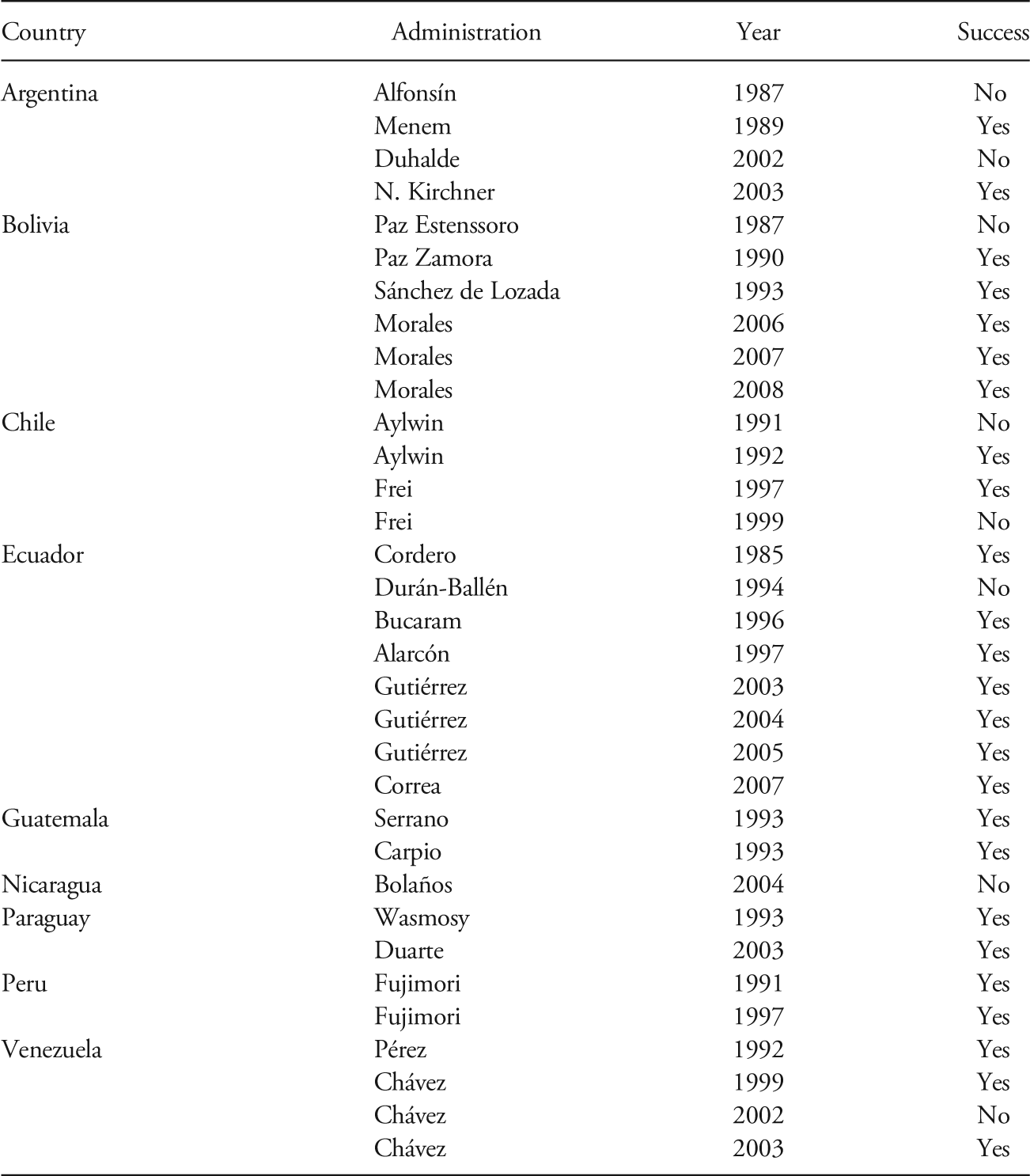
Based on these selection criteria, table 1 lists the 33 judicial crises that occurred in the region between 1985 and 2008 by country and administration, as well as the year in which the president first publicly initiated the process of judicial manipulation. Of these attempts, fully 25 succeed in altering the court’s composition in the government’s favor or in rendering an opposition court inquorate. Altogether about a third of all administrations engaged in judicial manipulation (33 instances out of 111 administrations), which constitutes about 7% of all observations in the ICLA data set (33 of 474).
Judicial Crises in Latin America, 1985–2008

Independent Variables
Testing the survivalist logic systematically demands measuring the risk of presidential instability. Building on our discussion of how presidential instability might be best proxied for in Latin America, we thus create the following three measures as our key independent variables: past presidential crises, presidential powers, and protests. The first, Past Presidential Crises, is based on information contained in the ICLA data set on presidential crises. Specifically, for each administration, we construct a count variable for the number of previously elected presidents in that country that were forced out of power early. The variable ranges from 0 for cases such as administrations in Chile post-1990 to 8 past crises in Ecuador for administrations post-2006.Footnote 5
Our second independent variable, Presidential Power, measures the extent of de jure presidential powers relative to the legislature using Alemán and Tsebelis’s (Reference Alemán and Tsebelis2005) comprehensive cross-national coding of the president’s formal institutional powers.Footnote 6 The variable ranges from a low score of 18 for Mexico, a country widely considered to have one of the weakest constitutional presidencies (cf. Weldon Reference Weldon, Mainwaring and Shugart1997), to a high score of 33 for Ecuador, a country commonly viewed as having one of the strongest constitutional presidencies in Latin America (cf. Mainwaring and Shugart Reference Mainwaring and Shugart1997).
Our third independent variable, Mass Protests, is based on Banks and Wilson’s (Reference Banks and Wilson2017) annual measure of antigovernmental demonstrations, which they define as “any peaceful public gathering of at least 100 people for the primary purpose of displaying or voicing their opposition to government policies or authority, excluding demonstrations of a distinctly anti-foreign nature.”Footnote 7 While only a fraction of such antigovernmental protests culminate in explicit demands of “que se vaya” (the president must go), note that the emergent nature of the threat of ouster that we are trying to capture is arguably present in any mass antigovernmental protest. For, as Aytaç and Stokes (Reference Aytaç and Stokes2020) note, “inchoate protests often begin with very specific complaints, but grow to have broader meaning and to embrace broader demands.” “Sparks,” as they evocatively put it, regularly become “conflagrations.” Thus, while including only the subset of protests aimed explicitly at executive removal may be appropriate for estimating whether such protests lead to actual presidential ousters (cf. Kim and Bahry Reference Kim and Bahry2008; Hochstetler and Edwards Reference Hochstetler and Edwards2009), for our purposes using the more inclusive Banks and Wilson measure of all antigovernmental protests better reflects the broader concept of presidential risk of removal that we are seeking to tap.Footnote 8
A more challenging problem posed by our measure of protests involves analyzing their timing and sequence relative to when executives launched their attempts at judicial manipulation. In some cases—for example, Nicaragua in 2004 under Bolaños—protests clearly preceded attempts at judicial manipulation. In other cases, however, in which both protests and judicial manipulation occurred in fits and starts, such as Venezuela in 2002–4, the sequence was more convoluted. And, as we have described in Ecuador in 2004 under Gutiérrez, in some cases judicial manipulation may itself have sparked protests.
To deal with the potential problem of endogeneity raised by our third measure, we thus construct an instrumental variable for protests based on commodity price information from Gruss and Kebhaj (Reference Gruss and Kebhaj2019), which consists of the change in the international price of individual commodities weighted for each country. Building on Campello and Zucco Jr.’s research design (Campello and Zucco Reference Campello and Zucco2016; Zucco and Campello Reference Zucco and Campello2020), we exploit the fact that international commodity prices originate exogenously and thus independently from any of our core variables. We wager that because falling commodity prices nevertheless harm a country’s domestic economy, they should independently increase citizens’ likelihood of protesting against the government. Having identified a purely exogenous trigger of antigovernmental protests, we can then use this information to reestimate the causal impact of protests on judicial manipulation under the key exclusionary assumption that fluctuations in international commodity prices only bear on a leader’s decision to manipulate the courts through our purported mechanism of elevating the political risk of removal (i.e., protests) a leader faces.
Controls
We also include four additional control variables: Divided Government, Judicial Trust, Term Year, and Previous Judicial Manipulation. Standard spatial models predict that courts necessarily face the greatest threat of manipulation when the president’s party controls the legislature and the government is unified (Ferejohn and Weingast Reference Ferejohn and Weingast1992; Gely and Spiller Reference Gely and Spiller1992; Epstein and Knight Reference Epstein and Knight1997). By contrast, accounts of the origins of presidential insecurity argue that presidents are themselves under the greatest threat when the government is divided (e.g., Valenzuela Reference Valenzuela2004; Kim and Bahry Reference Kim and Bahry2008; but also see Helmke Reference Helmke2017). Taken together, if presidential risk affects judicial manipulation through the survivalist mechanism, then the effect of divided government potentially cuts both ways: it simultaneously increases the president’s need to engage in judicial manipulation, just as it limits her capacity to do so. To assess whether either effect dominates or the result is null, we create the dummy variable, Divided Government, which indicates whether the president’s party lacks the majority of seats in the lower chamber of Congress.Footnote 9
The second control variable, Judicial Trust, allows us to account for at least some of the costs of manipulating the courts by tapping into what Vanberg (Reference Vanberg2015) has broadly characterized as the exogenous approach toward explaining judicial authority. In this well-known line of research, politicians avoid manipulation or any other assaults on judicial independence not because of the benefits independent courts bestow but because of the costs politicians might incur from the public were they to violate it. Building on this basic supposition, a large comparative judicial political literature contends that courts that enjoy such legitimacy are relatively safer from political attacks than courts that do not (Gibson, Caldeira, and Baird Reference Gibson, Caldeira and Baird1998; Epstein, Knight, and Shvetsova Reference Epstein, Knight and Shvetsova2001; Vanberg Reference Vanberg2001, Reference Vanberg2004; Staton Reference Staton2006, Reference Staton2010). Here, we control for this influence by constructing the lagged variable Judicial Trust from the available LatinoBarometro public opinion surveys.Footnote 10
To the extent that court-packing is part of a leader’s survival strategy to ameliorate risk, it makes sense that, once presidents become aware of such risk, they will be motivated to pack courts preventively, that is, before the tables turn against them. For example, as we saw in the cases of Venezuela and Bolivia, presidents who enter office in an institutional environment that has been marked by previous bouts of instability were prone to move swiftly against courts, thus taking advantage of their popularity and shrouding their moves as part of anticorruption or antielite reforms (cf. Varol Reference Varol2014; Levitsky and Ziblatt Reference Levitsky and Ziblatt2018). By contrast, leaders who lack the capacity to move preemptively may be forced to react by manipulating courts only once the threat to their security in office becomes fully manifest (e.g., in the midst of accelerating protests against their government).
To assess systematically whether the survivalist logic tends to be preemptive or reactive, we construct the variable Term Year, which captures the number of years since the start of each administration’s term in office. To the extent that the preemptive logic dominates, we expect a negative relationship between Term Year and attempts at judicial manipulation. Finally, to control for the alternative hypothesis that successors will simply be more likely to manipulate courts if their predecessors have done so, regardless of their own insecurity, we also include the variable Previous Judicial Manipulation, coded as 1 for administrations that inherit a court manipulated by their predecessor and 0 otherwise.
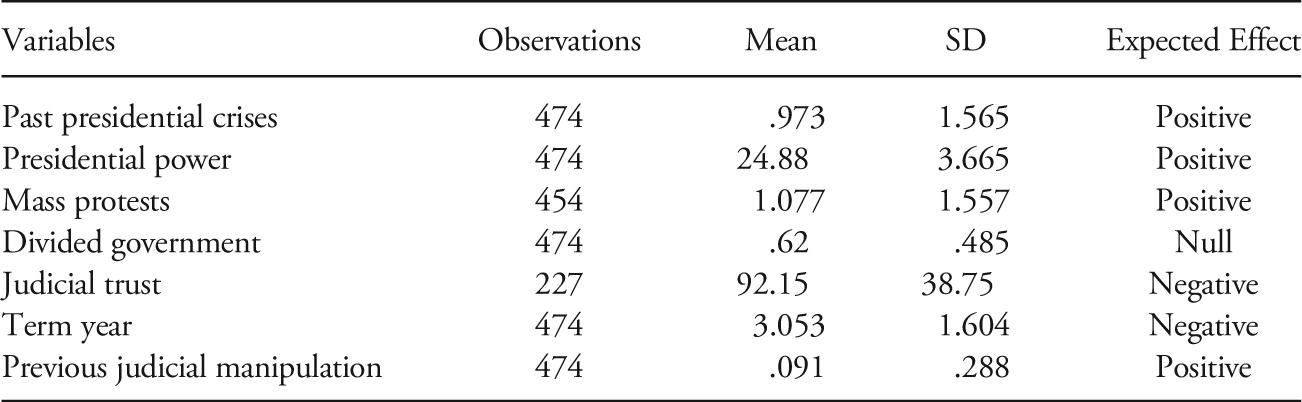
Table 2 provides descriptive statistics for our main independent variables and controls, as well as their expected effects on the likelihood of judicial manipulation. To summarize, the survivalist logic we have outlined in this section suggests that each of the main risk factors for presidential ousters, captured by the variables Past Presidential Crises, Mass Protests, and Presidential Power, should be positively correlated with the probability of presidential attempts to reconfigure courts in their favor. Our approach further suggests that because divided government decreases a president’s capacity to successfully remake courts just as it increases her desire to do so, the overall effects of divided government on judicial crises driven by the survivalist logic may be null. To the extent that presidents also factor in additional costs of judicial manipulation, such as public backlash, we expect higher levels of judicial trust to reduce manipulation. Moreover, all else equal, presidents following a preemptive survivalist strategy should seek to manipulate courts as early as they can. Thus, if anything, term year should exert a negative effect on judicial crises. Finally, we control for the alternative possibility that any previous manipulation of the judiciary by the administration’s predecessor may drive incumbents to try to remake the courts.
Risk Factors, Controls, and Their Expected Effects on the Likelihood of Judicial Manipulation

Observational Results
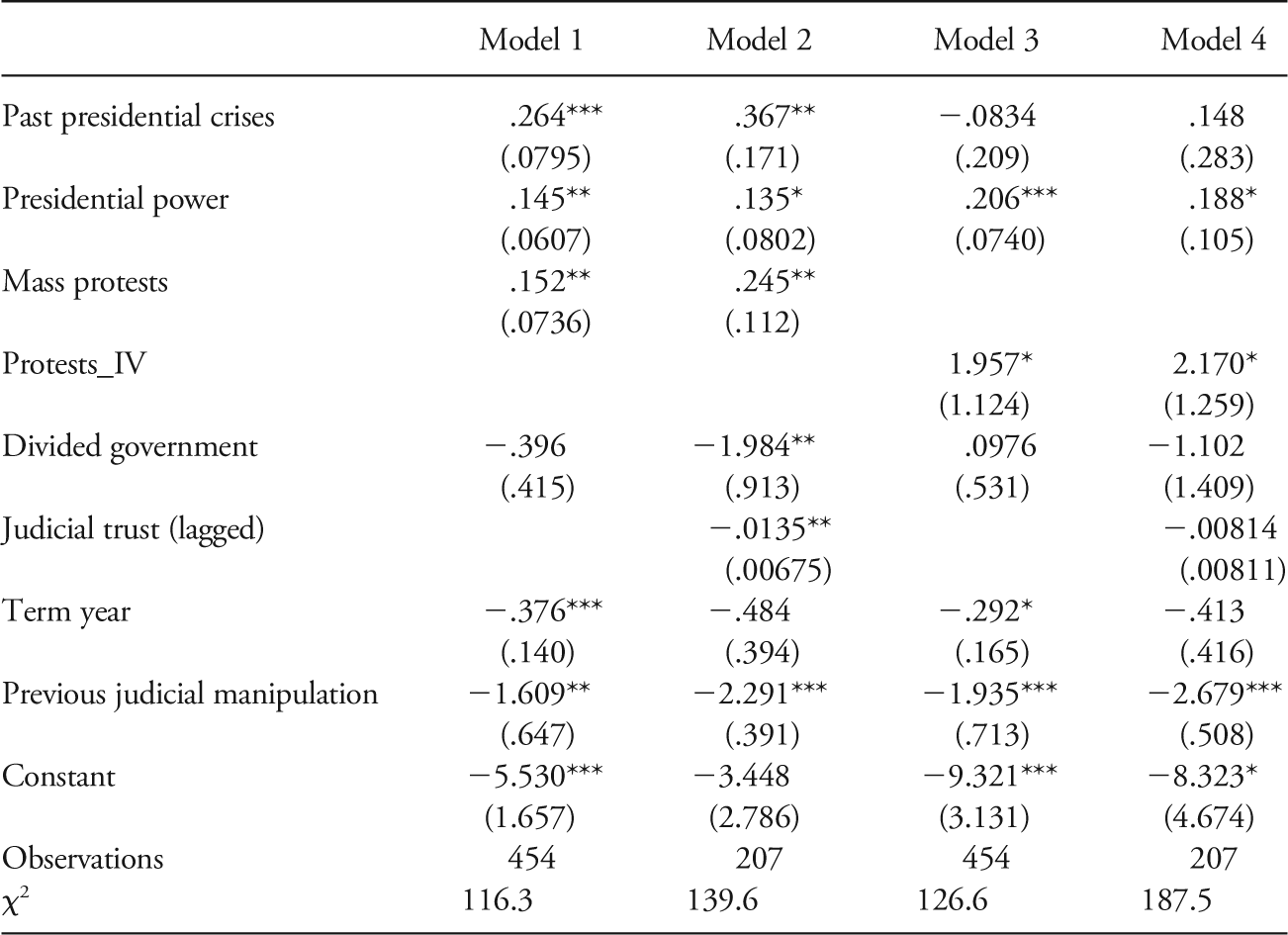
We begin with an analysis of our baseline logit model (model 1 in table 3), which regresses judicial manipulation on the four key risk variables—Mass Protests, Past Presidential Crises, Presidential Power, and Divided Government—as well as controls for term and previous judicial manipulation.Footnote 11 The results comport with each of the three core hypotheses derived from the survivalist framework. Specifically, we find that past presidential crises, presidential power, and mass protests all significantly increase the likelihood of a judicial crisis. Holding each of the other independent variables at their means, the marginal effects are substantial. For example, among administrations in which no predecessors faced a presidential crisis, the likelihood of judicial manipulation is around 4% and rises to over 30% for administrations in which multiple predecessors were prematurely ousted. Likewise, increasing the president’s formal powers from the lowest level (e.g., Mexico) to the highest (e.g., Ecuador) raises the odds of judicial manipulation from around 2% to 13%. Meanwhile, in the absence of mass protests the likelihood of judicial manipulation is about 4%, whereas when mass protests are at their peak the likelihood of judicial manipulation climbs to 14%.
Correlates and Effects of Presidential Instability on Judicial Instability

Note.—Standard errors in parentheses. Models 1 and 2 are logit regressions with standard errors clustered at country level. Models 3 and 4 present the second-stage results of instrumental variable estimations. See table A1 for the first-stage results.
* p < .10.
** p < .05.
*** p < .01.
Model 2 (table 3) incorporates the third control, Judicial Trust (lagged), for which we have data for less than half of the observations (207/454). Despite having fewer cases, the results for our core independent variables, Mass Protests, Past Presidential Crises, and Presidential Power, remain intact.
With respect to our several control variables, the findings in models 1 and 2 are mixed. Notice that while in model 1 the effects of divided government are null, the coefficient for Divided Government in model 2 is negative and significant, which is evidence at least partly in favor of the standard separation-of-powers model. Meanwhile, fully in line with the standard exogenous approach to judicial independence, public confidence in Latin American courts does appear to exert a shield-like protection against manipulation. This result is all the more interesting in light of recent experimental evidence suggesting that publics are willing to punish candidates who compromise judicial independence, but only up to a certain point (Carey et al. Reference Carey, Clayton, Helmke, Nyhan, Sanders and Stokes2018; Driscoll and Nelson Reference Driscoll and Nelson2019; Graham and Svolik Reference Graham and Svolik2019). Here, however, politicians appear to act as though the constraints of public support matter.
With respect to the timing of judicial manipulation, we find only partial support for the idea that attempts to curb the court are less likely over the course of the president’s term. Model 1 is indeed consistent with a kind of preemptive strike logic in which leaders manipulate courts as quickly as they can; however, the results are not robust in model 2. We interpret this as weak evidence that presidents who are capable of acting proactively to mitigate latent risk (made apparent by such factors as previous crises and extensive presidential powers) do so, but there is also a substantial portion of leaders who simply end up launching judicial crises reactively (say, once antigovernmental protests are underway). Most Latin American leaders, in other words, tend to operate more like Evo Morales and Hugo Chávez than Lucio Gutiérrez when it comes to the sequence of judicial manipulation (i.e., capturing courts early before the threat against them becomes fully manifest), but certainly not all follow this trajectory.
Nor is there any support for the intuition that manipulation is primarily retaliatory. In fact, the coefficient for Previous Judicial Manipulation indicates just the opposite: courts that were manipulated by the previous administration are, in fact, less likely to be manipulated by the subsequent administration.Footnote 12
Instrumental Variable Results
To address the limits of our observational data and, specifically, to mitigate concerns that antigovernmental protests may be endogenous to judicial manipulation or that protests and judicial manipulation are caused by some additional factor that we have not modeled (i.e., omitted-variable bias), we conclude by analyzing our instrumental variable approach based on international commodity prices.
The first-stage model (see table A1) thus regresses the level of antigovernmental protests on international commodity prices keyed and weighted to each country’s basket of exports and other control variables. The results of the first-stage estimation indicate that the instrumental variable is indeed statistically significant and thus supports our identification strategy. Our second-stage results are displayed in models 3 and 4 (table 3). Consistent with our expectations, protests (Protests_IV) have the expected positive effect on judicial manipulation. Substantively, we find that when the second-stage protest variable is at its lowest value, the likelihood of judicial manipulation is around 0.5%. Holding all other variables at their means and increasing the protest variable to its highest level causes the probability of judicial manipulation to jump to just over 27%. Meanwhile, the effects of presidential power remain robust in both specifications, although note that the effects of past presidential crises and judicial trust disappear. Attempts at previous judicial manipulation by the previous administration continue to significantly depress the likelihood of a judicial crisis, whereas the negative effects of timing within an administration are again only significant for the full universe of cases (i.e., the coefficients for Term Year in model 3 vs. model 4).
Discussion
Most theories of judicial politics are built around explaining the puzzle of judicial independence. This article instead theorizes explicitly about the conditions under which politicians are prone to manipulate their courts. Because courts can partly endogenously shape politicians’ fate at the hands of legislative opponents, we argue that greater political insecurity leads presidents to gut judicial independence, not shore it up. Using available systematic data on interbranch crises in contemporary Latin America, the empirical evidence is largely consistent with this new approach. Specifically, each of the three core hypotheses linking presidential insecurity to judicial instability is largely borne out in the standard regression analysis and further bolstered by our instrumental variable analysis.
More generally, this article suggests two sets of broader implications. First, by recognizing that institutional crises are interconnected, this article cuts against the prior tendency in the literature to treat these phenomena along parallel tracks, with one literature on presidential crises and another on judicial politics. Rather, constitutional hardball in all of its manifestations should be studied under a unified theoretical framework (Helmke Reference Helmke2017; Ginsburg and Huq Reference Ginsburg and Huq2018; Levitsky and Ziblatt Reference Levitsky and Ziblatt2018). In this spirit, this article explores one way in which political instability (or its anticipation) cascades across institutions and over time. In the particular historical and institutional context of Latin America, we have seen that the new form of institutional instability that supposedly leaves regimes intact but elected presidents vulnerable to premature ousters (cf. Pérez-Liñán Reference Pérez-Liñán2007) also threatens the very institutions that safeguard basic individual and human rights. As such, the reassuring claims that this new type of instability is not about regime change is not quite right: coups may be a thing of the past, but the piecemeal process of democratic erosion is certainly at work. When courts are captured, political enemies are jailed, protesters are killed, and the press is stripped of its ability to hold governments accountable (cf. Ginsburg and Huq Reference Ginsburg and Huq2018; Levitsky and Ziblatt Reference Levitsky and Ziblatt2018).
Of course, neither presidential insecurity nor judicial manipulation is limited to contemporary Latin America. And while the specific proxies we have identified for operationalizing executive insecurity in that region may not automatically extend to other settings (e.g., parliamentary systems), the basic intuition that raising the stakes of winning and losing office may trigger democratically elected leaders to manipulate courts to tighten their grip on power potentially applies to other regions experiencing democratic erosion. As is widely known, would-be autocrats such as Hungary’s Viktor Orbán and Poland’s Andrzej Duda have cemented their hold on power largely by capturing previously independent courts as early into their tenures as possible (see Ginsburg and Huq Reference Ginsburg and Huq2018; Kovács and Scheppele Reference Kovács and Scheppele2018). In such contexts, previous crises and presidential powers are surely less relevant triggers than, say, hyperpolarization and partisan degradation (see Ginsburg and Huq Reference Ginsburg and Huq2018), but the overarching logic of politicians’ mitigating intolerable losses by manipulating courts that allow them to endogenously boost their security in power remains.
Second, the theoretical story developed here also potentially dovetails with the literature on strategic judicial decision-making. Scholars, for example, have argued that institutional instability prompts judges to strategically defect from weak governments in order to curry favor with incoming governments (Helmke Reference Helmke2002, Reference Helmke2005). If this is right, it makes all the more sense for vulnerable governments to try to manipulate courts when and where they can. This is so for at least two reasons. First, as we have argued here, seizing control over the court may help tilt the playing field in favor of the incumbent, thus endogenously lowering the chances that she will be weakened. But second, the more judges are viewed as pure cronies, the less plausible strategic defection itself becomes. In other words, under some conditions, it may be that governments actually benefit from having judges who are unable to signal their independence. Similar to the trade-off dictators face between creating loyal versus competent militaries to balance the dual threats of coups and civil wars (cf. Paine Reference Paine2021), the survivalist approach we have outlined for executives could be extended to explore both judicial selection and judicial decision-making under the shadow of presidential risk. Such theory building remains a task for future research.