INTRODUCTION
Research on gelatinous zooplankton in Norway dates back to 1776 (Kramp & Damas, Reference Kramp and Damas1925), yet ctenophores received scant attention until Mnemiopsis leidyi A. Agassiz, 1865 was recorded in late 2005 in Oslofjorden and in the following year near Bergen (Hansson, Reference Hansson2006; Oliveira, Reference Oliveira2007). In an extensive report on the zooplankton in Trondheimsfjorden, 1963–1966, ctenophores were accorded a brief mention: ‘Beroe cucumis Fabricius occurred frequently at all stations at all depths. Pleurobracia pileus occurred occasionally’, though they ‘were often damaged during the haul and of the more fragile species only gelatinous material was retained’ (Strømgren, Reference Strømgren1973: 118). In zooplankton samples collected with 50 and 200 μm mesh nets at five stations along the Hardangerfjord between April 27 and 4 May 1992, ‘only an occasional ctenophore’ was found (Pagès et al., Reference Pagès, Gonzalez and Gonzalez1996: 71). A visual investigation of zooplankton in four western Norwegian fjords in the summer of 1996 identified the vertical distribution of some lobate ctenophores, ‘probably Bolinopsis infundibulum’ (Gorsky et al., Reference Gorsky, Flood, Youngbluth, Picheral and Grisoni2000: 131). Swanberg & Båmstedt (Reference Swanberg and Båmstedt1991: 508) tentatively refer to Beroe in the Barents Sea: ‘There appear to be two forms or species of Beroe in the area; one, which we believe to be B. gracilis… . while the other, B. cucumis?’ Seasonal patterns of Bolinopsis infundibulum (O.F. Müller, 1776), P. pileus (O.F. Müller, 1776) and Beroe sp. in 2003 were described from fjords in the Bergen area: that year Beroe sp. dominated samples from June to October in Korsfjorden, and to a lesser degree in May–June and September in Fanafjorden (Hosia & Båmstedt, Reference Hosia and Båmstedt2007). A recent study of cyddipids from Svalbard recorded Mertensia ovum (Fabricius, 1780) co-occuring with Euplokamis sp. and a yet-unidentified mertensiid-like species, though no Beroe spp. (Majaneva & Majaneva, Reference Majaneva and Majaneva2013). A couple of studies examined the trophic and functional ecology of the ctenophores P. pileus, Bolinopsis infundibulum and Beroe cucumis (Falkenhaug & Stabell, Reference Falkenhaug and Stabell1996; Båmstedt, Reference Båmstedt1998; Sørnes & Aksnes, Reference Sørnes and Aksnes2004).
The type locality of Beroe gracilis Künne, 1939 is Helgoland, Germany (Künne, Reference Künne1939). It is common in the North Sea and has been recorded from the coastal waters of north-west Europe (Künne, Reference Künne1939; Greve, Reference Greve1975; Greve et al. Reference Greve, Stockner, Fulton and Mackie1976; Adema, Reference Adema1982; Muller, Reference Muller2004), Skagerrak, (Hansson, Reference Hansson2006; Hosia et al., Reference Hosia, Titelman, Hansson and Haraldsson2011), Kerteminde Harbour and Limfjorden, Denmark (Riisgård & Goldstein, Reference Riisgård and Goldstein2014; Shiganova et al., Reference Shiganova, Riisgård, Ghabooli and Tendal2014b), as well as the Bahamas (Wrobel & Mills, Reference Wrobel and Mills2003), the north-eastern Pacific (Mills & Haddock, Reference Mills, Haddock and Carlton2007) and from the central Chilean coast (Oliveira et al., Reference Oliveira, Feliú and Palma2014). However, its presence off the Norwegian coast had not been recorded before.
This article describes a bloom of ctenophores observed in September 2014 at Arboretet, south-western Norway and at Flødevigen, near Arendal, on the south coast of Norway, and the first record of Beroe gracilis in Norwegian coastal waters.
MATERIAL AND METHODS
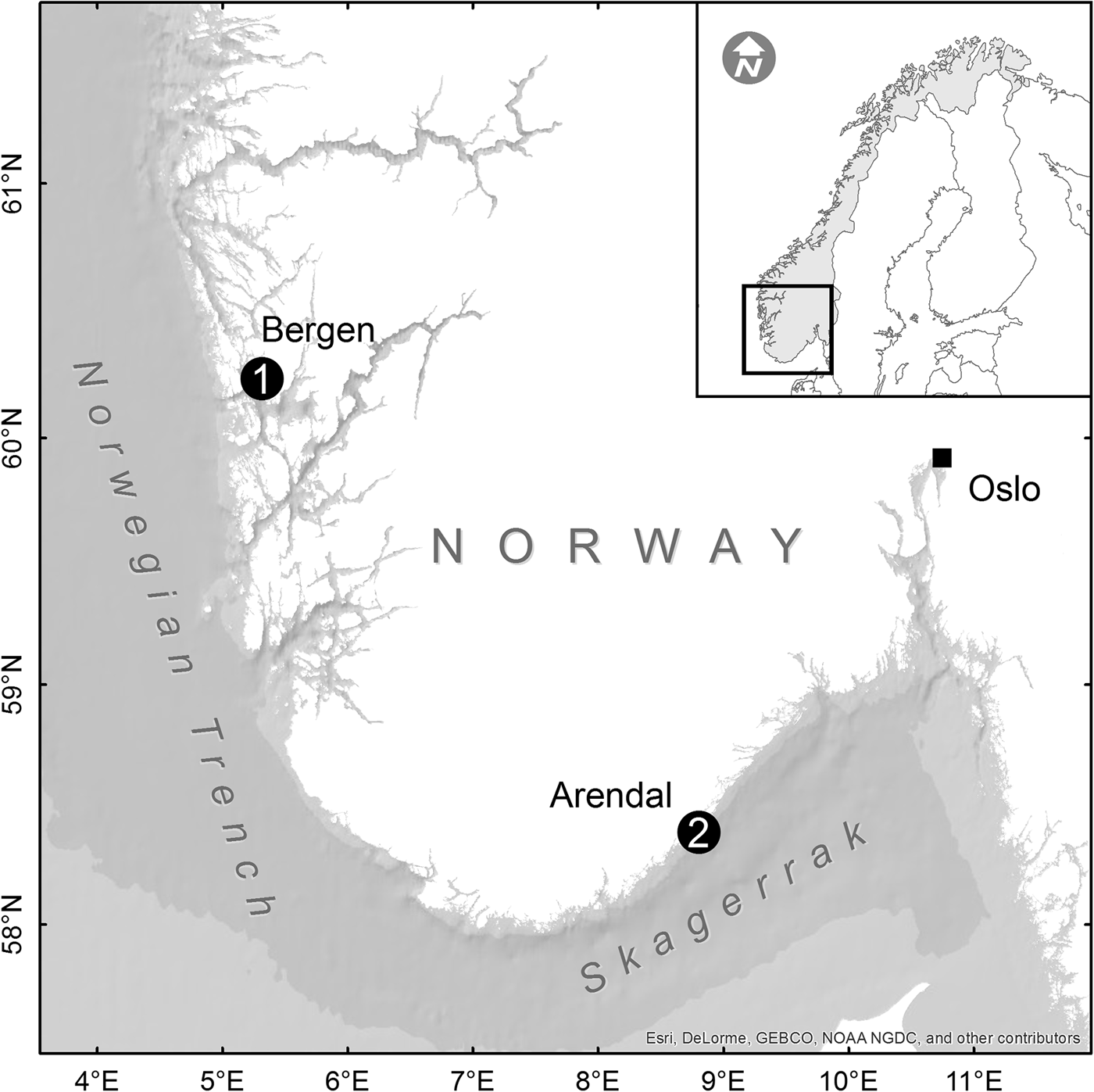
The salinity and temperature at Arboretet (60°25′72″N 05°27′01″E) and Flødevigen (58°25′35″N 08°45′18″E) (Figure 1) were measured with SAIV SD204 CTD and with an Aanderaa Conductivity Sensor 4120, respectively. The surface water temperature at Raunefjorden, near Arboretet, measured on 17 September 2014, was 16.5°C, and the salinity was 30.37. The surface water temperature at Flødevigen, measured on 12 September 2014, was 17°C, and the salinity varied between 18 and 25, over 24 h. The salinity in this bay may vary due to heavy rainfall, a nearby freshwater outlet or winds pushing surface water outwards to be replaced by the inflow of deeper, more saline water.
Southern Norway, with bloom sighting locations: 1. Arboretet (60°25′72″N 05°27′01″E); 2. Flødevigen (58°25′35″N 08°45′18″E).

Eleven specimens of Beroe gracilis were carefully lifted by means of a hand-held glass from the upper 20 cm layer off Arboretet on September 19 and photographed using a Canon PowerShot D30, Zoom lens 5 times IS (Figure 2).
Beroe gracilis (Künne, Reference Künne1939). Norway, Arboretet, 19 September 2014, total length 23 mm (photograph by H. Ringvold).
To confirm the identity of Beroe gracilis, we analysed a portion of the 18S ribosomal DNA (rDNA) gene from three specimens of Beroe gracilis collected off Arboretet on September 19 and frozen, as well as a single specimen of Beroe cucumis collected from Flødevigen, on September 12. DNA was extracted using a combination of Qiagen's DNeasy kit (Qiagen Nordic, Helsinki, Finland) and Zymo's Genomic DNA clean and concentrator kit (Zymo Research Europe, Freiburg, Germany). The 18S rDNA gene was amplified using the universal primers 18S-F: 5′-ACCTGGTTGATCCTGCCA-3′ and 18S-R: 5′-TGATCCTTCYGCAGGTTCAC-3′ (Medlin et al., Reference Medlin, Elwood, Stickel and Sogin1988). Amplification was performed in 20 μl reactions consisting of 1 U DreamTaq DNA polymerase, 1X DreamTaq Buffer, 2.5 mM MgCl2, (Thermo Fisher Scientific, Waltham, MA, USA), 0.2 mM dNTPs, 0.005% bovine serum albumin (Sigma Aldrich Finland, Helsinki), 0.5 μM each primer (TAG Copenhagen, Denmark) and approximately 100 ng DNA template. Thermocycling conditions included an initial denaturation at 95°C for 3 min followed by 30 cycles of 95°C for 30 s, 55°C for 2 min, and 72°C for 3 min, after which there was a final extension at 72°C for 7 min. Thermocycling reactions were performed in a BioRad C1000 thermocycler (Bio Rad Laboratories, Carlsbad, CA, USA). The amplified products were cleaned using Exo I and FastSAP (Fisher Scientific, Waltham, MA, USA). Then, they were sequenced in the forward direction using an Applied Biosystems’ BigDye® Terminator V3.1 kit, separated on an ABI 3130xl Genetic Analyser and visualized using Sequencing Analysis v.6 software (all from Life Technologies, Thermo Fisher Scientific, Waltham, MA, USA).
RESULTS
On September 7, two specimens of Beroe gracilis were observed in Arboretet, near a freshwater outlet in the middle tidal zone, in addition to several small and damaged individuals of Mnemiopsis leidyi, a few Bolinopsis infundibulum and a great number of Pleurobracia pileus. On September 13–14, one specimen of Beroe gracilis was observed amidst a bloom of Mnemiopsis leidyi in Flødevigen. The abundance of M. leidyi at the time was estimated to be 20 ind. m−3 (fide Dr Tone Falkenhaug, Institute of Marine Research, Norway, http://www.nrk.no/nyheter/1.11925246, viewed 10 September 2014), though the lead author (H. Ringvold) observed patchy concentrations estimated to be up to 100 ind. m−3 comprising adult and juvenile M. leidyi and P. pileus, as well as a single specimen of Beroe cucumis. On September 18, a bloom of M. leidyi was sighted off Arboretet, with concentrations estimated to be 8–10 ind. m−3, where several Pleurobracia pileus specimens were also recorded. On September 19, a mixed bloom of M. leidyi (8 ind. m−3), Pleurobracia pileus (3 ind. m−3) and Beroe gracilis (1 ind. m−3) were observed off Arboretet, as well as two specimens of Beroe cucumis.
The 2014 bloom of M. leidyi was first observed in Flødevigen, near Arendal, on the south coast of Norway and a week later in Arboretet, Bergen, south-western Norway. We consider the bloom to be a single event, notwithstanding the geographic distance between the sites. It has been shown that toxic algal blooms that had first been recorded in Skagerrak spread with the Norwegian coastal current (Prymnesium polylepsi (Manton & Parke) Edvardsen, Eikrem & Probert, 2011, in Edvardsen et al., Reference Edvardsen, Eikrem, Throndsen, Sáez, Probert and Medlin2011; fide Dahl et al., Reference Dahl, Lindahl, Paasche and Throndsen1989). Similarly, Beroe gracilis may have spread with the prevailing current along the Norwegian coast.
In summary, five ctenophore species were identified in our survey: the invasive M. leidyi and the native Prymnesium pileus, Bolinopsis infundibulum, Beroe cucumis, in addition to Beroe gracilis, which had not been recorded before in Norwegian waters. The identity of Beroe gracilis was confirmed with molecular data. Sequencing yielded a 587 bp fragment of the 18S rDNA gene. The sequences were identical to each other and shared 99.8% identity with a known sequence of Beroe gracilis available in GenBank (AF293696.1). Only a 451 bp fragment of the 18S rDNA sequence could be reliably scored from the sample of Beroe cucumis, which was 99.8% identical to sequences of Beroe cucumis in GenBank (AF293695.1 and AF293699.1). As noted by Podar et al. (Reference Podar, Haddock, Sogin and Harbison2001), there is very low variability in the 18S rDNA sequence among different ctenophore species, and in the gene region we sequenced, Beroe gracilis differs from Beroe cucumis at only three sites. The sequences we obtained showed the same three differences as in the published sequences. The sequences reported in this paper have been deposited in the Nucleotide Sequence Database (GenBank Accession numbers: Beroe gracilis KP334109, Beroe cucumis KP334108).
Fully developed specimens of Beroe gracilis have a slender cylindrical body, are milky or pale pink in colour and may reach 30 mm in length, though the total length of our specimens was approximately 23 mm. The body is moderately compressed. The eight meridional canals have few diverticulae and they extend inwards toward the stomodeum rather than in the plane of the body surface. Ciliary comb rows, equal in length, extend from the aboral pole to about three quarters of the distance towards the mouth. The aboral pole is fringed with a row of branched papillae on the polar plate (Künne, Reference Künne1939).
Examination of the photographs of five specimens of Beroe gracilis showed that they were all heavily parasitized, and roughly 30–40 parasites were counted on each specimen, which were situated mostly on the 2/3 rear end (Figure 2).
DISCUSSION
Beroe gracilis is well known from the North Sea and adjacent waters, as well as the Barents Sea, but surprisingly it has not been recorded before from Norway. This report is the first documentation of the species’ presence in Norwegian waters, although, it is likely not a new species to the area, but one that has been previously overlooked. Similarly, it was recently recorded from Kerteminde Harbour, Denmark, where it may have been ‘present for years, misidentified as young stages of B. cucumis’ (Shiganova et al., Reference Shiganova, Legendre, Kazmin and Nival2014a, Reference Shiganova, Riisgård, Ghabooli and Tendalb: 5). Scientific records of Ctenophora are sparse due to the high temporal and spatial variation in ctenophore populations, poor sampling and preservation methodologies and limited search effort, even in countries such as Norway, which have a rich tradition of marine research (i.e. the marine biological research station at Flødevigen, established in 1882, and in Bergen, near Arboretet, in 1892). The arrival of Mnemiopsis leidyi in Norwegian waters was followed by its inclusion among the ‘High Risk’ nonindigenous species on the ‘2007 Norwegian Black List’, though ‘it is uncertain what impact it will have in Norwegian waters’ (Gederaas et al., Reference Gederaas, Salvesen and Viken2007: 71). The 2008 killing of farmed fish in Norway, http://www.nrk.no/hordaland/denne-har-tatt-livet-av-tusener-1.6241751, helped raise awareness of the importance of comb jellies to the environmental and economic viability of the marine ecosystem.
Alien ctenophores were unknown in Nordic waters until late 2005, when the highly invasive M. leidyi was first recorded in the Oslofjorden (Oliveira, Reference Oliveira2007), and subsequently found in Skagerrak, Kattegat and the Baltic Sea (Hansson, Reference Hansson2006; Javidpour et al., Reference Javidpour, Sommer and Shiganova2006, Kube et al., Reference Kube, Postel, Honnef and Augustin2007). As gelatinous plankton plays a pivotal role in marine food webs and elemental fluxes, M. leidyi's potential impact on the trophodynamics of the Norwegian fjords should be of major concern, since commercially important populations may be affected. Notably, our finding of Beroe gracilis in a M. leidyi bloom indicates that there may be significant interactions between native and invasive ctenophore fauna. For example, predation among gelatinous zooplankton is well documented and may play a major role in regulating populations, e.g. Beroe ovata and M. leidyi (Finenko et al., Reference Finenko, Romanova, Abolmasova, Anninsky, Svetlichny, Hubareva, Bat and Kideys2003; Shiganova et al., Reference Shiganova, Dumont, Mikaelyan, Glazov, Bulgakova, Musaeva, Sorokin, Pautova, Mirzoyan, Studenikina, Dumont, Shiganova and Niermann2004, Reference Shiganova, Legendre, Kazmin and Nival2014a). Predation by scyphomedusans such as the Atlantic sea nettle, Chrysaora quinquecirrha (Desor, 1848), the compass jellyfish, Chrysaora hysoscella (Linnaeus, 1767), the lion's mane jellyfish, Cyanea capillata (Linnaeus, 1758) and Pelagia noctiluca (Forsskål, 1775) on M. leidyi have been experimentally quantified (Purcell & Cowan, Reference Purcell and Cowan1995; Hosia & Titelman, Reference Hosia and Titelman2011; Tilves et al., Reference Tilves, Purcell, Marambio, Canepa, Olariaga and Fuentes2012). A recent study also experimentally quantified predation rates and interrelationships between Beroe gracilis and M. leidyi of different sizes: Beroe gracilis fed on smaller M. leidyi but only partially consumed larger specimens, whereas, the latter fed on young Beroe gracilis. The experiment suggested a minor Beroe gracilis predation impact on the M. leidyi population (Hosia et al., Reference Hosia, Titelman, Hansson and Haraldsson2011).
Changes in distributions and abundances of ctenophores are plausibly linked to increasing temperatures, which may impact the ecosystem in ways we neither expect nor understand, and which may be more significant than their obvious economic impacts (Greve, Reference Greve1981; Schlüter et al., Reference Schlüter, Merico, Reginatto, Boersma, Wiltshire and Greve2010; Dinasquet et al., Reference Dinasquet, Titelman, Møller, Setälä, Granhag, Andersen, Båmstedt, Haraldsson, Hosia, Katajisto, Kragh, Kuparinen, Schrøter, Søndergaard, Tiselius and Riemann2012). Already, the seasonal localized blooms and longer-term persistence of M. leidyi may indicate that under favourable conditions it may constitute a potential threat to fisheries through resource competition with fishes (CIESM, Reference Pitois and Shiganova2015) that may bring about changes in the structure and function of the ecosystem in Norwegian waters. The establishment of a coordinated regional monitoring programme of gelatinous plankton is needed.
ACKNOWLEDGEMENTS
The authors thank Professor Dr Anders Hobæk at The Norwegian Institute for Water Research (NIVA) for his kind help, Engineer Knut Tomas Holden Sørlie at the University of Bergen/Espegrend Marine Biological Station and Dr Jon Albretsen at IMR for hydrographic data, Ms Trude Hauge Thangstad for preparing the map and Mr Oz Rittner, the Steinhardt National Natural History Museum and Research Centre, Tel Aviv University, for editing the photograph. Sincere thanks to the librarians at the American Museum of Natural History, New York, USA. The research leading to these results has received partial funding from the European Community's Seventh Framework Programme (FP7/2007–2013) for the projects Vectors of Change in Oceans and Seas Marine Life, Impact on Economic Sectors (VECTORS).