The late 1980s were watershed years for the theory and practice of language syllabus and curriculum design.Footnote 1 Syllabus was displacing method as a way of conceptualizing language teaching and learning. Communication as the basis for teaching and learning languages had begun to take hold around the world. Dubin & Olshtain's (Reference Dubin and Olshtain1986) Course design provided guidelines for developing a curriculum based on communicative goals, and Yalden's (Reference Yalden1987) Principles of course design for language teaching advocated a proportional approach that balanced focus on form with focus on communication. In 1987, the journal Language Teaching published a seminal two-part article on contemporary paradigms in syllabus design (Breen Reference Breen1987). Breen outlined a paradigm shift from syllabus design as the pre-packaging of language content to be learned, to a view of syllabus as negotiated classroom tasks in which the boundaries between the what of language and the how of acquisition were blurred. The frame of reference drew on changing views of language, its acquisition, and the social processes within the language classroom. In 1989, Richard Johnson, editor of the ground-breaking volume, The second language curriculum (R. K. Johnson Reference Johnson and Johnson1989), called for a coherent approach to language curriculum development, one in which planning, implementation and evaluation decisions were consistent and interdependent, rather than undertaken in a lockstep or piecemeal approach.Footnote 2
Since the late 1980s, examples of coherent approaches to language curriculum development have been described and documented (Brown Reference Brown1995; Markee Reference Markee1997). In these examples the curriculum development processes of situation analysis, needs analysis, formulation of aims or goals, syllabus design, materials development, assessment and evaluation are carried out in a systematic and mutually responsive way. Brown (Reference Brown1995) illustrates his ‘systematic approach’ to curriculum with two extensive case studies. Markee's Reference Graves and Lopriore1997 volume on curriculum innovation examines what contributes to successful innovation and why many fail. Graves (Reference Graves1996) and Murphy & Bird (Reference Murphy and Byrd2001) provide specific teacher accounts of how teachers plan, teach and evaluate courses. Richards (Reference Richards2001) provides both a history of curriculum design in language teaching and a systematic overview of curriculum development processes. Hall & Hewings' Reference Hall and Hewings2001 volume brings together seminal and foundational articles on aspects of curriculum design such as syllabus, materials design and evaluation.
One of the most important curriculum publications in the last decade is the Council of Europe's Common European Framework of Reference (Council of Europe 2001) that seeks to provide descriptions that apply to competence in all languages across all levels. More recently, the US based international organization, TESOL, has published a Language Curriculum Development series of which I am series editor. The series brings together accounts of language curriculum development and renewal for both school-age learners and adults written by teachers, curriculum and materials developers, teacher educators and program administrators from over twenty countries. Many of the examples of practice used in this review to illustrate principles and practices of curriculum are from the series.
A review of developments in language curriculum must navigate the chicken and egg relationship of curriculum theorizing on the one hand, and educational practice on the other. Do new theories create new curricular possibilities in the classroom or are theories attempts to explain and make sense of practice and experience? The answer is yes to both: they have a symbiotic relationship. As such, the terms curriculum, program, course and syllabus can be used in either a concrete or abstract sense. They refer to something concrete when they are used to describe specific examples of practice. They are abstract when they are used to describe theories or views about how they should be conceptualized. For example, a learner-centered curriculum could refer to an example of a curriculum or a conceptualization of a curriculum. In order to highlight this relationship, examples of practice will be used as much as possible throughout the review to illustrate or illuminate the theories.
This review will examine curriculum from both a contextual perspective – how curriculum is shaped by the multiple contexts in which it is situated – and a classroom perspective – how the classroom context shapes what is possible in a language curriculum. It is not the aim of this review to account for every type of curriculum innovation and all the processes and elements involved in such innovations. The aforementioned sources all provide valuable perspectives on language curriculum. Rather, the review will attempt to theorize curriculum in ways that could be considered congruent with postmodern, sociocultural, emergent views of curriculum and education (Pinar Reference Pinar2003), views the author shares.
1. Defining curriculum
1.1 Curriculum is a set of processes
Curriculum involves planning what is to be taught/learned, implementing it and evaluating it. According to Richards (Reference Richards2001: 2), language curriculum development is ‘an interrelated set of processes that focuses on designing, revising, implementing and evaluating language programs’. Similarly, according to Hall & Hewings (2001: 1), language curriculum covers ‘all the issues relating to the planning, implementation and evaluation of a series of language learning events conceived as a coherent whole with a specified purpose’. While these definitions are straightforward, curriculum processes are hardly neutral. As Jackson (Reference Jackson and Jackson1992b) has argued, a definition of curriculum is not simply a starting point for discussion, it is also the product of someone's reasoning about what education is, whom it should serve and how. Thus, a definition will ‘serve the interests of some, but not all’ (Jackson Reference Jackson and Jackson1992b: 21). We therefore need to be clear about who conducts the processes, who conceives the whole, for what purposes, and in which contexts. We also need to understand the relationship among the processes.
1.2 The SPECIALIST approach to curriculum
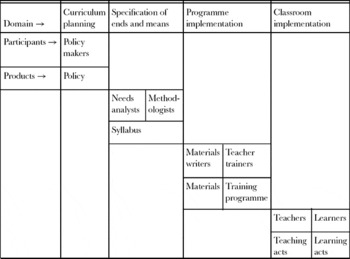
Curriculum is not a top-down process, although hierarchical approaches to curriculum may make it appear so. In hierarchical approaches, a curriculum is a plan for what is to be taught and teachers, through instruction, implement the plan. In the US, for example, there has long been a separation between ‘curriculum’ and ‘instruction’. Table 1, adapted from R. K. Johnson (Reference Johnson and Johnson1989b), depicts planning and implementation in a specialist curriculum. It encompasses four main domains: curriculum planning, specification of ends and means, programme implementation and classroom implementation. In the first three domains there are specialists responsible for decision-making and for producing curriculum products. In the last domain, classroom implementation, teachers and learners, through their actions, implement the received curriculum. These four domains can also be viewed as stages that follow each other in a linear fashion.
Curriculum decision making in the ‘specialist approach’. Adapted from R. K. Johnson (Reference Johnson1989a: 13).

Table 1 identifies key stakeholders, along with the processes and products that are part of planning a curriculum on a large scale, as is the case for a school curriculum. Each of the stages or domains plays an important role in shaping the curriculum. Each of the products is both a curriculum resource and a curriculum constraint. Policy gives direction to a curriculum, but also sets parameters that limit it. A syllabus and materials may organize and facilitate a curriculum, but they also constrain classroom practice. Table 1 makes clear that developing and implementing a curriculum is no small task, especially given that most curriculums are developed on the back of an existing curriculum and so the linearity of the process is idealized and does not represent the way most curriculum development efforts unfold (Brown Reference Brown1995).
1.3 Problems with the specialist approach
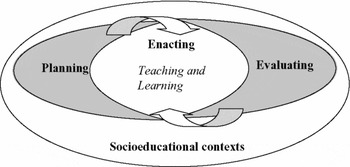
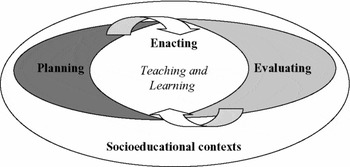
Figure 1 has been adapted from the original to visually highlight fundamental problems in the specialist approach or view of curriculum. The first is the potential for lack of alignment between each stage and a resulting lack of coherence in the curriculum. By alignment I mean the agreement among persons with a common cause so that, for example, policy is formulated in such a way that it informs and facilitates needs analysis, needs analysis is conducted in such a way that it informs and facilitates development of methodology and so on. The lack of alignment may result in a mismatch between domains and thus contribute to a lack of coherence in the curriculum (R. K. Johnson Reference Johnson and Johnson1989b.) In the specialist approach, the potential for mismatch is great because each different group of people performs different curricular functions, uses different discourses, and produces different curricular products. They operate from different beliefs and assumptions (Goff Reference Goff1998). Each product is ‘handed off’ to the next group. Thus each successive group uses and interprets the previous product in its own way – if it is used at all. Markee (Reference Markee1997: 13) describes a curriculum development project in the Sudan, in which ‘Like so many other artifacts of aid work, these materials soon gathered dust on some cupboard shelf’. Wenger (Reference Wenger1998) provides a useful way to understand this situation. He defines learning as a symbiotic process of participation, i.e. activity, and reification, i.e. product. In each of the stages above, the people involved participate in a process that results in a product, the reification of the process. Syllabus designers work together to create a product, the syllabus. However, Wenger points out that people who did not participate in producing a product that they are expected to use will interpret it according to their own beliefs, understandings and needs. If these processes are to be more closely allied, there must be liaising (Markee Reference Markee1997) in which at each successive stage there is communication among participants about what has been produced and why and/or there must be overlap of personnel, for example, an administrator who is also involved in needs analysis. Otherwise, it is like the game of telephone that children play – the initial message gets transformed at each stage along the way so that the final message is often completely different from the original one.
Curriculum as a dynamic system (adapted from Graves Reference Graves and McKay2006a).

The second fundamental problem is that by putting the classroom at the end of the chain of decisions, it positions teachers – and learners – as recipients and implementers of received wisdom, rather than decision-makers in their own right. The specialist view of curriculum is congruent with the fidelity perspective on curriculum implementation (Snyder, Bolin & Zumwalt Reference Burns and de Silva Joyce1992) in which experts plan a curriculum that teachers are expected to faithfully implement. If there are problems in the implementation, the fault is seen to be with teachers because they were not faithful to the curriculum, not with the curriculum and those who designed it. As Widdowson (Reference Widdowson, Howatt and Widdowson2004: 369) puts it, ‘[t]he usual way of looking at this disparity in the past has been to see actual practice as a constraint on the effective implementation of the proposals of expert opinion which needs to be overcome’. As a result, educational authorities blame teachers for resisting curricular innovation and teachers complain that educational authorities are out of touch with the reality of the classroom. However, as all curriculum decisions are made at a remove from the classroom in the specialist approach, there is only a tenuous link with the end users. As a result, the curriculum reified in the materials is often not realistic for the classroom. The curriculum as it is implemented appears to have little relation to the one planned. It is unclear who is conceiving the whole and keeping the purpose in mind.
One way to remedy the problem with mismatches is to build in evaluation so that initial problems in implementation can be addressed. However, a third problem in the specialist approach is that, unless evaluation is built in at each stage – which it generally is not – (Hargreaves Reference Hargreaves and Johnson1989; Kiely & Rea-Dickens Reference Kiely and Rea-Dickins2005) there is usually no room for evaluation of the curriculum once it is implemented in the classroom. Especially for large-scale curriculum projects so much time and effort is put into the creation of syllabuses, materials and tests that there is a reluctance to go back and change what has been invested in. Given the separation between the people, the processes and the products in the traditional view, it is no wonder that the ‘central problem of curriculum study is the gap between our ideas and aspirations and our attempt to operationalise them’ (Stenhouse Reference Stenhouse1975: 3). For example, I am currently involved in a national curriculum development project. An initial evaluation of English language policy documents, textbooks, assessments and classroom teaching indicated that the content of new textbooks based on the new policy was overly ambitious for what teachers could accomplish in the classroom. In centralized curriculums such as this one, textbooks are the de facto curriculum (McGrath Reference McGrath2002). Assessments based on the textbooks (and produced in a different department) did not always test what had actually been taught. At present, in a pilot project, curriculum developers are working with a group of Inspectors, who, in turn, are working with teachers, to develop a set of principles that can form the basis of a shared discourse about learning and teaching.
1.4 A different definition of curriculum
This article is constructed around a different view of curriculum, one that retains the three core processes of curriculum – planning, implementing and evaluating – but renames the middle one enacting to reflect the agency of teachers and learners in the classroom. The term and concept of curriculum enactment can be traced from Barnes (Reference Barnes1976) to Eisner (Reference Eisner1985: 302), who described the curriculum as events shaped by the purposes and cross-purposes of teacher, student, subject matter and classroom ‘occurring in time more truly than it exists in space’. Snyder et al. (Reference Snyder, Bolin, Zumwalt and Jackson1992) define curriculum enactment as the educational experiences jointly created by students and teacher in the classroom. In this view of curriculum, enactment – the teaching and learning processes that happen in the classroom – is at the heart of education. Planning and evaluating are both directed at the classroom and are closely allied with it. The three processes that make up curriculum are embedded in social and educational contexts that determine their purpose and scope.
The reasoning behind this view is that without enactment, there is no curriculum. A curriculum cannot exist before it is enacted. Or, put another way, curriculum must be enacted to exist. One cannot claim to have a curriculum without teaching and learning experiences. Curriculum plans, policies, syllabuses, and materials are not ‘the curriculum’. We may (as is common in the US) refer to them as ‘the curriculum’, but as reifications of planning processes (in Wenger's sense), they will be interpreted differently through different enactments. They are products whose purpose is to guide and support teaching and learning.
In this view, curriculum is a complex, dynamic system ‘where everything is interconnected, nonlinearity and adaptation is the norm’ (Larsen-Freeman & Freeman in press). The processes of planning, enacting and evaluating are interrelated and dynamic, not sequential. They move back and forth to inform and influence each other. Classroom enactment shapes planning and vice versa. Planning shapes evaluation and vice versa. The aim of evaluation is to improve teaching and learning, not just to measure it. Further, these processes are embedded in specific social and educational contexts and are carried out by people in these contexts. The enacted curriculum is always local. Finally, and centrally, teachers, as the orchestrators of enactment, are crucial to a successful curriculum.
The view of curriculum that informs this article is captured in Figure 1.
2. Curriculum enactment
2.1 Enactment happens within and in relationship to context
In their research on curriculum implementation, Snyder et al. (Reference Snyder, Bolin, Zumwalt and Jackson1992) identified three perspectives: the fidelity perspective, the mutual adaptation perspective and the curriculum enactment perspective. Both the fidelity and mutual adaptation perspective view the curriculum as an entity produced by experts to be implemented by teachers through instruction. In the fidelity model, curriculum innovation is viewed as a technology – change occurs when new behaviors and organizational patterns are taken up; the task of educational reform is to find efficient ways to do this. Fidelity research looks at the degree to which something has been implemented as planned, the match between design and outcome, irrespective of how it has been implemented. The mutual adaptation perspective, on the other hand, is concerned with how a curriculum is adapted during the implementation process by both curriculum developers and teachers. Mutual adaptation research ‘tends to see curriculum knowledge as one facet of a larger, complex social system that cannot be taken for granted. Who initiates curriculum knowledge is secondary in importance to understanding the constellation of factors that influence any innovation or change, whether from within or without the school’ (Snyder et al. Reference Snyder, Bolin, Zumwalt and Jackson1992: 412).
The curriculum enactment perspective is concerned with how ‘curriculum is shaped through the evolving constructs of teacher and students’ (ibid: 404). Externally created syllabuses and materials are viewed as tools that students and teacher use as they construct the enacted experience of the classroom. It views the process of enactment as one of growth for both teachers and learners. Research in curriculum enactment is concerned with classroom experiences and how the participants create them, the effect of externally created materials, policies, and participant characteristics on those experiences, and the effects of the experiences on the participants themselves. It is concerned with both the trustworthiness of teachers and learners to enact a curriculum with desirable outcomes and how to empower them to do so. In curriculum enactment, what happens in classrooms is the core of curriculum. What happens in classrooms is the evolving relationship between teacher, learners and subject matter.
2.2 Context is more than place
An enactment perspective focuses our attention on the classroom as where/when the language curriculum happens. However, a classroom is not an isolated environment; it is embedded in specific, complex and overlapping cultural, social, educational and political contexts. (These will hereafter be compressed into the term socioeducational contexts.) Contexts are more than physical places, they are communities of people, enmeshed in social systems that operate according to tacit and explicit norms, hierarchies and values (Freeman & Johnson Reference Freeman and Johnson1998; Graves forthcoming). These systems are relational, overlapping and dynamic. In a similar vein, in their discussion of language policy and planning, Ramanathan & Morgan (Reference Ramanathan and Morgan2007: 459) state that ‘our individual and collective existences do not occur in pristine spaces within which we place individuals, institutions and policies, but inside a fluid set of social relations with emergent possibilities for change’. A language curriculum is planned, enacted and evaluated in multiple contexts. As depicted in Figure 2, the contexts of a language curriculum include the educational institution in which the curriculum is enacted, the larger community the institution is a part of, the provincial, and the national political context, and, increasingly, the global context (Pinar Reference Pinar2003; Smith Reference Smith2003; Graddol Reference Graddol2005). The classroom, where curriculum is enacted, is itself a sociocultural context with its own social systems, norms and values. Figure 2 foregrounds the classroom as the context of enactment, embedded in the encircling contexts. I shall argue that the relationship between socioeducational contexts and language are defining features of how language curriculums are planned, enacted and evaluated and that the relationship makes the subject matter of a language curriculum unique.
Socioeducational contexts of a language curriculum.

2.3 Contexts provide a way to analyze all language curriculums
The field of language teaching is vast and diffuse – it spans the geopolitical world and potentially, all languages in the world. English undeniably occupies a unique place in this field because of its dominant global role and its status as the most commonly taught additional language in the world (Graddol Reference Graddol2005). There have been distinct strands of curriculum development research for English and languages other than English, divisions between those strands (Canagarajah Reference Canagarajah2006), as well as attempts to unite these strands, such as the Common European Framework of Reference (Council of Europe 2001). One dilemma in writing about curriculum in language teaching is how to bridge what is being done with so called ‘foreign languages’ and what is being done in the field of English language teaching. Within the field of English teaching, there have also been a number of distinctions, such as the one between EFL (English as a foreign language) and ESL (English as a second language) or EAL (English as an additional language); between ESP (English for Specific Purposes), EAP (English for Academic Purposes) and English for general purposes. However, because in many contexts the teaching of English is like the teaching of other languages, it makes sense to find a way to address these similarities. If we look at language learning in terms of the contexts in which it is learned, it gives us a way to consider all language teaching. In the discussion that follows, I will use the term target language to refer to the language that is the focus of the curriculum rather than the dichotomous ‘foreign’ or ‘second’ language.
2.4 Two kinds of contexts, two different approaches
Language curriculums differ according to the relationship between language inside the classroom and language outside the classroom. Broadly speaking, two kinds of context shape two different approaches to language curriculum. These contexts are distinguished by both the places in which and the purposes for which the learners are studying a language. The first are target language(tl)-removed contexts. These are contexts in which a language is learned in classrooms that are removed or separate from the contexts in which the target language is used. The second are target language(tl)-embedded contexts. These are contexts in which a language is learned either within or closely connected with a ‘context of use’, a surrounding context in which the target language is used. The distinction is not watertight and cannot account for every permutation of language learning, notably immersion programs in schools and tertiary institutions in countries like Turkey where some universities have made English the medium of instruction and thus the language of the educational institution (Kirkgöz Reference Kirkgöz and Rice2007). Nevertheless, the distinction is meant to serve as a heuristic for analyzing language curriculums today.
2.5 TL-removed contexts
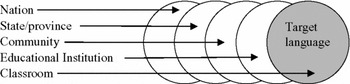
TL-removed contexts include foreign languages in schools, e.g. Japanese in an American secondary school, or English in a Japanese secondary school; foreign languages in universities, e.g. English in a French university, and French in an Australian university, and foreign languages in adult community programs, e.g. Italian at a community center in Denmark. For example, a fifteen-year-old American who studies Japanese in a secondary school in Los Angeles is studying in a TL-removed context. She does not have a context of use for the target language since Japanese is not commonly used or spoken by most people in the school, community, state and nation. Figure 3, depicts TL-removed contexts, contexts in which the language used in the circles encircling the classroom is different from the target language.
Target language-removed contexts.

In these contexts, especially in schools, language is a subject in itself, like science or history. Larsen-Freeman & Freeman (in press) have termed this a subject language, that is ‘a language that has been designated as subject matter within a school curriculum and therefore has certain teaching practices and learning expectations associated with it’. The purposes for learning a language in TL-removed contexts are varied, but the thrust is to learn language to communicate, to improve one's economic prospects, to expand one's horizons both literally and figuratively, and/or to be a global citizen. The classroom context is shaped by national and local educational policies. Regarding policy for teaching foreign languages in the US, for example, Magnan (Reference Magnan2007: 249) writes: ‘As a nation, we have multiple goals for language learning: the ability to communicate with peoples of other cultures, to understand and be sensitive to cultural difference, and to analyze critically content and ideas from other nations’. Although the student in Los Angeles may at some point meet Japanese speakers or visit Japan, the ability to communicate, to understand and be sensitive to cultural difference will (or will not) be developed within the classroom context.
Similarly, in Japan, the goal of the Ministry of Education for junior high school graduates who are studying English is to ‘conduct basic communication with regard to areas such as greetings, responses, or topics relating to daily life’ and the goal for senior high school is for students to be able to ‘conduct normal communication with regards to topics, for example, related to daily life’ (Japan MEXT 2007). However, the expectation of parents and students (and everyone else) that high school will prepare students for college entrance examinations exerts a strong influence on the language curriculum. A fifteen-year-old Japanese high school student in Osaka will likely have few opportunities outside of the classroom to conduct normal communication with regards to topics related to daily life and few opportunities inside the classroom to do so. What matters is not how well the student is able to conduct basic communication, but how well she is able to pass a test (Sato & Takahashi Reference Sato and Takahashi2003).
Because of its status as the global lingua franca, the reasons for learning English are more layered. ‘For children living in the 21st century, it is essential for them to acquire communication abilities in English as a common international language. . . . In addition, English abilities are important in terms of linking our country with the rest of the world, obtaining the world's understanding and trust, enhancing our international presence and further developing our nation’ (Japan MEXT 2007). English is thus the language of two-way access. In the example of Japan, English is the medium through which Japanese can communicate with non-Japanese; it is also an important medium through which others can learn from and about Japan.
Much of the research on language learning in TL-embedded contexts has been on the teaching of English in the so-called inner circle (Kachru Reference Kachru1986) countries of Australia, Britain, New Zealand, Canada and the US. (This inner circle is not to be confused with the inner circle of the classroom in Figure 3.) These contexts include local schools in which the learners are usually immigrants or refugees, universities in which adults learn English for academic purposes, community programs and workplace programs for adult immigrants. The purposes for learning English in these contexts are to be able to participate and succeed in academic, community and professional settings. For school-age learners this means being able to participate in ‘mainstream’ classes and fulfill the requirements for graduation. At the tertiary level it is to matriculate or take courses in institutions of higher education or to conduct research in one's disciplinary area. For adult learners in community programs it is to learn literacy, acculturation, academic and workplace skills. For professionals in the workplace it is to conduct work in English.
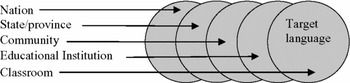
In target-language embedded contexts, as depicted in Figure 4, the language used in the outer circles in which the learners seek to participate is the same as the one being learned in the classroom. The outer circles here are broadly construed, because in each of the countries there is tremendous linguistic diversity, and thriving communities for each language. English predominates because of its status as the language of the dominant discourse, and thus of power and access.
Target language-embedded contexts.

For example, a fifteen-year-old Turkish student in a high school in the US may be designated an ‘English language learner’ (ELL) because she does not have sufficient English skills to participate on her own in other subject classes. She may have special classes or tutorials that help her improve her language skills or she may be placed in regular subject classes and have assistance from a language specialist (increasingly, she may be placed in regular subject classes where the subject teacher is expected to accommodate her learning needs.)
The relationship between the target language (English) and the socioeducational contexts of school, community, state and nation is markedly different from the relationship between target language and socioeducational contexts in TL-removed contexts. The Turkish student is not learning a language that is a subject like history or science, as her fifteen-year-old counterpart in Japan is; she is simultaneously learning English and learning history and science in English and through English (Gibbons Reference Gibbons and McKay2006). For this student, ‘the construction of content or subject knowledge must progress hand in hand with the development of English’ (ibid: 215). What matters is not whether she will be able to pass an examination on English, but whether she can pass an examination on history or science and do so in English.
While the Turkish student is simultaneously learning language, academic discourse and subject content, her teacher must figure out how to help her learn all three. In the US, beginning in 2001, policies at the national level, the so-called No Child Left Behind Act (NCLB), require that schools demonstrate adequate yearly progress on national tests in order to receive federal funding. English language learners came into the limelight since they, too, must be accounted for in these tests. As a result, just as in the UK (Franson & Vazquez Reference Franson, Vazquez and McKay2006), English language learners were assessed on the same subject matter as their ‘mainstream’ counterparts. In schools where there is a separate curriculum to help English language learners transition to ‘mainstream’ classes, language teachers must now account for several sets of standards in planning a curriculum. For example, Dupuis (forthcoming) describes the factors she needed to take into account when designing a curriculum for secondary school learners in a high school in a state in the Northeastern US:
Federal, state and local requirements for all learners:
1) Requirements for all students under the No Child Left Behind Act (NCLB)
2) State-driven standards
3) Local assessment systems and their benchmark standards
4) Content benchmarks within local school units or departments or programs(e.g., Language Arts, Social Studies, Math, Science, Technology)
Specific requirements of English language learners:
5) Standards for conducting assessments for English language learners, like the newly implemented standards for measuring academic English as well as academic content
6) Construction of individual student profiles that match needs
7) Assumptions, linguistic paradigms, and mental models for so-called best practices
8) Action research for effective content design for ELLs
The resources available:
9) Staffing, resources, program structures and schedules
Dupuis' list graphically illustrates the way in which the outer circles of nation, state, community and school all influence the way in which the curriculum is shaped and enacted by our example student and teacher.
Language is a key feature in each of the contexts – school, community and state – in which the curriculum is embedded. According to van Lier (Reference van Lier2004: 1):
In our educational systems, language does the educating, language organizes the educational activities, and language supervises, controls and evaluates the educational processes. And language, in a significant sense, creates education, perpetuates it, and reproduces it.
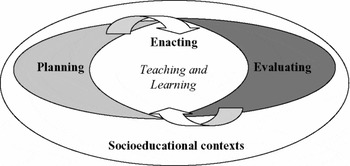
Enactment of a language curriculum is unique and differs from other subject curriculums because of the relationship between classroom content (language) and the surrounding socioeducational contexts. This relationship can be exploited – or not – as a connection in curriculum. The two broad categories of TL-embedded and TL-removed contexts are often represented as a dichotomy, e.g. ESL/EFL or ‘foreign’ language. Instead, one could say that the two contexts differ both in the way they define language in terms of its usefulness – what can be done with it, or the projected value to learners of the curriculum content – and its use – what a student can do with it, or the actual value that learners can/do make of content. Determining what will be useful in a language classroom has, for some time, depended on how language is ‘packaged’ so that it can be taught. This brings us to planning (Figure 5).
Planning in curriculum as a dynamic system (adapted from Graves Reference Graves and McKay2006a).

3. Planning a language curriculum
3.1 A brief history of syllabus design as efforts to package language as subject matter
The history of curriculum planning in language teaching represents a gradual shift from an emphasis on syllabus describing or prescribing the content of lessons (what) and the methods of teaching (how) to an understanding of the capacities and contributions of the learners and teacher, the range and implications of purposes for learning language and the role of context in shaping those purposes. These shifts have, in turn, redefined both what and how. Richards (Reference Richards2001) characterizes this shift as one from a preoccupation with syllabus – what should be taught and in what order, to the emergence of curricular planning.
The term ‘syllabus’ has a range of meanings. In the ‘narrow’ sense (Nunan Reference Nunan1988) it means the specification of the content of a course and the order in which that content will be taught. In language teaching, in the broad sense, it has come to mean a specific way to conceptualize what language is and how language is learned so that materials can be selected or prepared for the classroom. Thus we have the grammatical syllabus or the notional/functional syllabus. This broader meaning of syllabus is a term more widely used in literature and materials published by British and Australian language specialists. In the US, the terms instruction or curriculum, e.g. ‘content-based instruction’ or ‘skills-based curriculum’ are more commonly used.
The focus on syllabus has not been a matter of deliberately ignoring the larger picture. Rather, it is a problem of subject matter. Language is a ubiquitous tool, not ipso facto a subject matter. Human beings learn to speak (or sign) at least a first language without classroom instruction. Language then becomes a means of life learning, if not the means. In order to teach language we need to turn it into a subject matter, to package it so that it can be taught. The focus on syllabus represents the attempts of applied linguists and practitioners in language teaching to conceptualize language so that it can be packaged as subject matter. As such, a review of syllabus types closely parallels the salient preoccupations of the field of language teaching over time. Indeed, much of the literature on curriculum in language teaching includes or is built around a discussion of syllabus types (e.g. Breen Reference Breen1987; Nunan Reference Nunan1988; Stern Reference Stern1992; Brown Reference Brown1995; Markee Reference Markee1997; Feez Reference Feez1998). A review of syllabus types provides a lens through which to understand some of the major developments in applied linguistics in the last three decades.
In the first of his seminal two-part article on syllabus design in language teaching, Breen (Reference Breen1987) examined the three major types of syllabuses prevalent at that time: formal (or grammatical), functional and task-based. Both the functional and the task-based syllabuses represented a significant departure from the formal syllabus. As has been well-documented (e.g. van Ek Reference van Ek1975; Nunan Reference Nunan1988; Howatt Reference Howatt2004) the notional/functional syllabus (Wilkins Reference Wilkins1976) conceptualized language in terms of the communicative purposes (or functions) for which it is used in a given context. In order to develop a functional syllabus, one needed to find out the ways in which learners would use language and what they would do with it, e.g. to persuade, to obtain information and so on. Thus, needs analysis became an important feature of syllabus design. Needs analysis was not a necessary step in preparing a formal syllabus since the point of departure was the structure of the language, which did not change (in prescriptive grammars), while in the functional syllabus, the focus was on the purposes for which the learners would use the language, which would vary according to the learners' needs.
The formal, or grammatical, syllabus is arguably the easiest way to package language as a subject-language for a variety of reasons. It is, at least in traditional grammars, a self-contained system governed by a set of rules. It can thus be packaged, taught and tested. Importantly, teachers can master it as a subject matter and thereby fulfill their roles as experts in the classroom. The formal syllabus has a strong theory of language, but not a strong theory of learning. As such, it meshes well with what might be called the default view of learning as the individual, cumulative acquisition of discrete subject matter and the traditional conduit model of teaching (Reddy Reference Reddy and Ortony1978) in which the teacher transmits knowledge to the students. It is a good example of a synthetic syllabus (Wilkins Reference Wilkins1976), which is made up of individual parts that are synthesized into wholes. Wilkins intended the functional syllabus as an analytic syllabus in which learners are presented with holistic examples of language, which they analyze in order to induce the constituent parts. Ironically, the functional syllabus, as it was taken up in many language classrooms, was also a synthetic syllabus. Learners learned inventories of functions that they were expected to apply outside the classroom. The functional and formal syllabuses have also been called product-oriented syllabuses (Nunan Reference Nunan1988), as learning is supposed to result in a product – a set of knowledge and skills. For both the functional and the formal syllabus, classroom activities are thus a means towards the end of learning language.
process-oriented syllabuses, of which task-based learning is the most well-known, take the opposite stance: classroom activities are not the means that result in the learning of language, rather, language is the means for accomplishing classroom activities. These activities, or tasks, require learners to engage in an interactive meaning-making process with each other using whatever linguistic resources they can pool together. Selection of tasks is based on an analysis of actual tasks a person undertakes as well as learning tasks to enable learners to surmount difficulties in communication tasks (Breen Reference Breen1987). Thus, their participation in the tasks is the catalyst for language learning. Overall proficiency is achieved through the micro-proficiency acquired during tasks. The procedural syllabus (Prabhu Reference Prabhu1987) is a type of process-oriented/task-based syllabus developed for school-age learners in India. In this approach, there was no pre-selected language to be taught. Instead, in the classroom, the learners focused exclusively on problem-solving tasks that required them to use cognitive reasoning skills such as using a railway timetable to make decisions about which train to take.
Later syllabus types include the skills-based syllabus (Brown Reference Brown1995), the lexical syllabus (Willis Reference Willis1990) and the discourse syllabus (McCarthy & Carter Reference McCarthy and Carter2001). The skills-based syllabus is an outgrowth of the proficiency movement in the US (Omaggio-Hadley Reference Omaggio-Hadley2000) and is closely linked with the work of actfl (The American Council on Teaching Foreign Languages). actfl devised their proficiency guidelines in terms of the skills of speaking, listening, reading and writing (Hall Reference Hall, Phillips and Terry1998). The lexical syllabus (Willis Reference Willis1990) drew on initial research into language corpora to use pragmatically useful lexical items, language chunks, and extended texts as the basis for learning. Students learn large amounts of vocabulary and their attention is directed to the chunks of text, rather than to grammatical patterns or isolated vocabulary (Lewis Reference Lewis2001). In the discourse syllabus (McCarthy & Carter Reference McCarthy and Carter2001) discourse is not simply a dimension of communicative competence but the superordinate competence that depends on or subsumes the other competences in Canale & Swain's (Reference Canale and Swain1980) model: socio-linguistic competence, strategic competence and linguistic competence. Classroom tasks need to provide learners with opportunities to exercise the full range of discourse strategies including those related to genre, coherence, politeness, planning, convergence and repair.
More recently, language curriculum design has used both genre and content as the focus of the syllabus. In adult education, particularly in Australia, the text-based syllabus (Feez Reference Feez1998) or genre-approach (Feez Reference Feez2001) uses the Hallidayan notions of genre or text as the organizing principle of the syllabus. It views language as whole texts (spoken and written) that are embedded in social contexts, created and used by people to achieve social purposes. The texts used in a curriculum are selected according to learners' needs and the social contexts they want to participate in (Burns, Joyce & Gollin Reference Burns, Joyce and Gollin1996). In both EAP and ESP, genre, in the sense of how discipline-specific texts are constructed (Swales Reference Swales2000) has been a focus of the language syllabus. Learners analyze the features of texts and master their production for their own purposes. University and school-based curriculums in TL-embedded contexts have a long history of using content other than language as a basis for the curriculum (Snow & Brinton Reference Snow and Brinton1997; Stoller Reference Stoller2002) either by choice or out of necessity. In a content-based syllabus, language becomes the means not only for carrying out tasks or using skills, but for learning new content.
3.2 Beyond syllabus
The syllabus types that represent various developments in the field of language teaching provide specific ways to think about language in terms of what to teach and how to teach it. They provide a rich matrix of possibilities to draw from when ‘conceptualizing content’ (Graves Reference Graves2001). However, just as syllabus types at one time replaced methods as a way of framing language teaching and learning, we are in what might be called a post-syllabus phase. Although planners and/or practitioners make use of notional-functional, task-based or content-based frameworks, the complexity of learning languages in classrooms is such that no one approach can be fully responsive to learners' needs. The challenge is how to identify an organizational structure as a basis for making principled decisions about what and how to teach.
This is not a simple or a clean task because it requires synthesizing the massive amounts of information gathered through needs assessments, meetings with program administrators and colleagues, review of policy documents and other activities. At the same time, in identifying the organizational structure of the course, course developers have to take into account logistical constraints, the expectations of the educational system in which the course will be offered, explicit and implicit teaching policies, the course developers' own beliefs about teaching and learning, and their degree of professional experience. (Snow & Kamhi-Stein Reference Snow and Kamhi-Stein2006: 9)
3.3 An example of conceptual integration: the Georgetown University Department of German
Georgetown University's German department has grappled with all the issues identified by Snow & Kamhi-Stein in redesigning its curriculum. Between 1997 and 2000 members of the department redesigned its four-year undergraduate curriculum from an aggregation of separate courses to an integrated, content and genre-based approach across levels. Courses cover a range of content, unified by an exploration of genres common to different content. For example, a course on sports and a course on the EU economy both explore the interview genre, using a Hallidayan genre framework (Rinner & Weigert Reference Rinner, Weigert, Byrnes, Weger-Guntharp and Sprang2006). Attention to content and attention to language thus go hand in hand. Through such analysis, students learn both new content and the ways in which language is a system of meaning-making. They are challenged to ‘critically explore their own assumptions, ways of knowing, judgment and decision making’ (Georgetown University Department of German 2007). An advantage of this approach for faculty members trained in literature, is the ‘long standing use of genre in literary analysis’ (Rinner & Weigert Reference Rinner, Weigert, Byrnes, Weger-Guntharp and Sprang2006: 140). One aim of the approach is for learners to achieve advanced-level competency through the attention to balanced language development over the four years and a coherent curricular progression within the departments' offerings.
3.4 The role of needs analysis
Needs analysis has been closely linked to curriculum planning in language teaching because the findings of the analysis serve as the input into the design of the syllabus (Long Reference Long2005). Needs analysis, in a narrow sense, is analysis of information about what the learners already know and know how to do and what they need to know and know how to do so that the curriculum can bridge the gap (Graves Reference Graves2000). Its purpose is to collect information to develop a profile of the language needs of a group of learners in order to make decisions about the goals and content of the course or curriculum (Richards Reference Richards2001). However, needs analysis is an imperfect, messy process for a number of reasons. One reason is that learners' needs are determined not just by learners and teachers or needs analysts, but by a variety of stakeholders (e.g. parents, funders, educational authorities) who have different and sometimes conflicting views. Reconciling those views within the affordances and constraints of the various contexts in order to develop a realistic profile suggests that context analysis and needs analysis go hand in hand.
A second reason is that the kind of information gathered is driven by the conception of language of the curriculum planners. For example, in a text-based syllabus, the texts are selected in relation to the kinds of texts learners will need to access (Feez Reference Feez2001). If task is the organizing principle of the syllabus, needs analysis will focus on tasks, or on how language is used in discourse communities learners want to be a part of (Long Reference Long2005). The conception of language will be both a lens through which to interpret needs and a set of blinders that limit that vision. For example, in using task or text as the basis for needs analysis, there is an assump-tion, implicit or explicit, that there are discourse communities learners want to be a part of.
Third, learners in TL-embedded contexts and TL-removed contexts have divergent needs. In the early work on ESP, Hutchinson & Waters (Reference Hutchinson and Waters1986) made a useful distinction between target needs and learning needs. They defined target needs as ‘what the learner needs to do in the target situation’ and learning needs as ‘what the learner needs to do in order to learn’ (Hutchinson & Waters Reference Hutchinson and Waters1986: 54). They developed a framework for target needs analysis that sought to answer the questions: Why is the language needed? How will the language be used? What will the content areas be? Who will the learner use the language with? Where will the language be used? When will the language be used? The answers to these questions provided the basis for determining what should be taught. Learning needs, on the other hand, sought to answer questions such as: Who are the learners? Why are the learners taking the course? How do the learners want to learn? The answers to these questions helped to devise motivating activities that engaged learners in acquiring the target skills.
The notion of target needs presumes that a given group of learners will be using the language in places and at times with people for certain purposes, i.e. that there is a context of use for the language; therefore, the information about target needs can serve to shape the goals of the curriculum – what learners should know and be able to do. The presence or absence of target needs is a crucial way in which curriculum planning differs in TL-embedded and TL-removed contexts. Learners in TL-embedded contexts have target needs while those in TL-removed contexts do not, unless a context of use is created or imagined.
3.5 Needs analysis in TL-embedded contexts
The needs of a learner in a target-language embedded context are defined on the one hand by the types of discourse communities they seek to participate in, and, on the other, by the discourse communities from which they come. Discourse communities are characterized by specific literacy practices and social practices. The more clearly defined the discourse community, the easier to determine needs, set goals, design materials and so on. For English for academic or disciplinary purposes, whether at the primary, secondary or tertiary level there are clearly defined discourse communities. However, the discourse communities from which the learners come are equally important in determining needs and goals and designing appropriate materials. A persistent question in needs analysis today, particularly in the case of English, is the extent to which learners are expected to conform to the practices of target language discourse communities and the extent to which their own language and discourse practices are valued. Benesch (Reference Benesch1996) challenges the assumption that it is only the learners who must adapt to the requirements of the target discourse community and not the other way around. For example, one of the central tenets for the developers of a curriculum for Indigenous adult learners in the Alice Springs region of Australia was to ‘include using the students' cultural artifacts and tools where possible, drawing on their prior knowledge and previous experiences’ (Bainbridge & Oldfield Reference Bainbridge and Oldfield2007: 19). The design and landscaping of a garden according to Indigenous practices became the organizing principle of the curriculum and the focus of language learning and literacy practices. The developers (ibid: 19) point out that ‘[t]his approach allows shared meanings to develop between cultures and allows Indigenous and shared discourses to emerge as it provides access to dominant discourses’ (Jordon Reference Jordon2002).
Another example at the tertiary level illustrates the way in which language needs, if too narrowly defined, will not be sufficient for developing a curriculum that meets the complex needs of learners. Woodrow (Reference Woodrow, Snow and Kamhi-Stein2006) describes the needs of international graduate students in the Faculty of Education and Social Work at the University of Sydney. Both students and academic staff and faculty were consulted in order to determine the academic needs of the students. Their major needs had to do with writing. A language-focused view of literacy would suggest they need to improve their English. The reality is that academic literacy comprises not only sufficient language, but knowledge of subject matter content, academic study skills, and
in particular, the ‘academic discourse community’ (Braine Reference Braine2002: 60) or sociocultural aspects of being a student in an academic milieu. Students need to acquire a range of academic literacies that in the case of international graduate students from non-English speaking backgrounds, are markedly different from their previous literacy experiences. (Woodrow Reference Woodrow, Snow and Kamhi-Stein2006: 201)
Some of the differences included cultural expectations of how to develop a critical analysis and the ways to build an argument using, but not plagiarizing, the work of others that were at odds with the academic background of some of the students. In order to become successful members of an academic discourse community, students needed to be aware of its sociocultural and literacy norms and conventions. The course that was developed combined skills and explored, from a socioliterate perspective, the theoretical aspects of writing in university settings. The students thus investigated the discourse community they sought to participate in and used the processes they were investigating to do it to ‘unpack the complex sets of discourses, identities, values and requirements they need to negotiate in order to achieve their goals’ (ibid: 217).
3.6 Needs analysis in TL-removed contexts
In TL-removed contexts, where target needs are deferred, unclear or non-existent, and target language discourse communities seemingly unavailable, needs analysis focuses on the needs of learners within the classroom and the classroom itself as a discourse community. For example, the findings of a needs analysis in a university in Korea (Potts & Park Reference Potts, Park and Rice2007) reveal a set of issues quite different from those in the two Australian examples. Prior to the Asian economic crisis in 1997 a post-secondary degree virtually guaranteed employment in Korea. Since 1997 English proficiency can be the make or break factor in being hired. For universities, ensuring that graduates get jobs means ensuring that their English proficiency increases as a result of study at the university. The university's Language Education Center, where Park was the program director and Potts the academic director, undertook a multifaceted needs analysis that included surveys of faculty, interviews with key personnel, and a survey of the students' current study habits. Additionally, in order to ‘open a space for meaningful student involvement’ in expressing their needs (Potts & Park Reference Potts, Park and Rice2007: 181), a group of fourth-year education students were trained to conduct focus groups with students (in Korean). They used a set of questions prepared by the Academic coordinator in English, which they had recast in Korean so as to be pragmatically appropriate. The major finding from the focus groups was that students wanted to be able to talk. ‘They had studied English in public school for 6 (now 10) years and achieved grades that allowed them to enter the most prestigious post-secondary institution in the region, but they could not talk. While they struggled to define what they meant by talk or who they might talk to or with, they came to the lec to improve their ability to talk’ (ibid: 193). Students were also asked to comment on the existing curriculum. The findings showed a need to set and monitor realistic expectations, to be able to meaningfully measure language learning progress and to achieve greater alignment across the levels of the core curriculum.
The point I wish to take up is that in all their years of English study, they had not learned how to talk. I have earlier referred to the influence that the examination system exerts in the Japanese context. The same holds true in Korea. Nevertheless, there should still be the possibility for learners to emerge from their years of study with some ability to communicate in English. What prevents this from happening? It is not only the contexts that surround the classroom. In the university described above, the curriculum was based on a coursebook series that was considered one of the best communicative series at the time. Why weren't they learning to talk? To answer this we need to turn to the classroom because the classroom itself is a curricular space that shapes and constrains enactment of the curriculum.
4. The classroom as the context of enactment
In the second part of his review, Breen (Reference Breen1987: 159) wrote that a ‘syllabus can only have, at best, an indirect influence upon actual language learning. It is mediated by teaching and the encircling classroom context within which instruction is only one element’. He points out that there appear to be so many variables that intervene between the planning of a syllabus and the learning that is supposed to be shaped by the plan as to make the original plan irrelevant. Widdowson (Reference Widdowson, Howatt and Widdowson2004: 369) puts it more strongly: ‘There is then always a gap between the different movements in the development of ELT . . . and what actually goes on in classrooms. The actuality of classroom practice is for the most part unrecorded, and indeed to a large extent unaffected by the shifts of thinking that have been charted here’. The inevitable question is then whether a syllabus is ‘actually effective at all?’ (Breen Reference Breen1987).
Breen went on to propose a fourth kind of syllabus, the process syllabus. The process syllabus is not a syllabus in the traditional sense of describing what should be taught and in what order. Rather, it is a stance toward teaching and learning in which the teacher invites learners to negotiate all or a range of aspects of their learning, from choice of topics and tasks to how they will be assessed (Breen & Littlejohn Reference Breen and Littlejohn2000). As such, it connects the notion of syllabus with its enactment in the classroom by the learners and teacher. It foregrounds learner agency and decision-making as essential parts of classroom learning. Breen & Littlejohn's edited volume provides examples of the process syllabus enacted in a range of contexts at the primary, secondary and tertiary level. The process syllabus, while shifting our focus to the learners and their capacities as decision-makers, nevertheless leaves out the wider frame of the socioeducational contexts in which classrooms exist and the way those contexts shape classrooms as social practices where the norm is for learners to make very few decisions. If enactment in classrooms is the core of curriculum then we need to understand how classrooms work as loci of learning – or, more to the point, why they don't work. Are they transitional spaces in which to implement an externally created curriculum or are they curricular spaces in their own right?
4.1 Classrooms as unique social environments
The idea that for curriculum development one should look to the classroom is not new. In their early work on communicative syllabus design Breen & Candlin (Reference Breen and Candlin2001: 16) wrote ‘We are easily tempted to excuse the classroom as an artificial or synthetic language learning context – as distinct from some natural or authentic environment. . . . the classroom itself is a unique social environment with its own human activities and its own conventions governing these activities’ (emphasis added – KG). What are the characteristics of this unique environment, the human activities and conventions that govern them? From a social theory perspective, (e.g. Lave & Wenger Reference Lave and Wenger1991; Engeström Reference Engeström, Carlgren, Handal and Vaage1994; Wenger Reference Wenger1998; Wells Reference Wells1999) most classrooms are structured around a view of learning as acquisition of knowledge, not as participation in knowledge-making communities (Sfard Reference Sfard1998). In such classrooms, teacher and learner roles are clearly divided and mutually exclusive. The teacher is the leader, the learners are followers. The space of the classroom is organized in a specific way with students sitting in chairs or at desks, the teacher at the front or moving around (try finding a picture of a classroom on the Internet that doesn't show desks in rows). Specific tools used are books, notebooks, pen and paper (or laptops) and so on. Teachers are knowers/providers of knowledge, learners are recipients of this knowledge. Teachers (are expected to) control the tools, knowledge and activity in the classroom. Learners (are expected to) gain knowledge the teacher/book provides. Thus, learner agency and teacher agency are both constrained by the social context of the classroom (van Lier Reference van Lier2007).
The way language is used in the classroom is distinct from the discourse in other social practices. Typically, the teacher uses some version of the IRF discourse structure (initiate, respond, follow-up) to control who speaks to whom, when and, often, about what (Sinclair & Coulthard Reference Sinclair and Coulthard1975; Cazden Reference Cazden1988; Wells Reference Wells1999). What gets talked about is bounded by what is appropriate in a classroom (K. Johnson Reference Johnson1995). There is ‘official’ discourse (subject-matter related) and ‘unofficial discourse’ (other related).
Classrooms present particular challenges as contexts for language learning. Classrooms function around language – depending on their proficiency, learners who normally can participate in the discourse of other classrooms, become limited and disempowered. It is natural for learners to use the first language, when there are others who speak it. It is, at least at the beginning levels of proficiency, unnatural to use the target language. Because of the nature and structure of classroom discourse, learners generally have few opportunities to use language, unless they are able to work with each other. Any activities other than academic activities are always simulated. Classrooms are composed of ‘peers’ and a teacher. Opportunities for using the language with more competent ‘others’ are few to non-existent in the classroom. Most classrooms, despite their intended purpose of preparing learners for life outside the classroom, are insulated practices that do not have reciprocal connections with life outside (Lave & Wenger Reference Lave and Wenger1991; Matus & McCarthy Reference Matus and McCarthy2003). In other words, what is done in the classroom usually stays in the classroom. For the curriculum to succeed in preparing learners for using the target language in and out of the classroom, it needs to address these challenges in some way. To do this, we need to redefine the classroom as a curricular space.
4.2 Redefining classrooms as learning communities
Communities of practice and ecologies are two ways that the classroom as a curricular space has been reconceptualized. Both view classrooms as learning communities. In communities of practice (Wenger Reference Wenger1998), knowledge and expertise are distributed among participants, so that each participant has something to contribute and something to learn. In the classroom, participants are thus at various points both teachers and learners. Knowledge is co-produced by the participants as they engage in the practice. Participants have a joint purpose, which they pursue and negotiate together. They engage in a repertoire of activities that are both routine and improvised. They use both real and symbolic tools to do their work. As members of the practice, learners exercise their agency in order to keep the practice going.
The notion of distributed knowledge or expertise is central to the idea of a community of practice and is a feature of virtually all such communities except most classrooms. Soccer teams and orchestras are two examples of communities of practice in which the practice depends on the distribution of knowledge and expertise (Graves Reference Graves2006b). Academic communities outside the classroom are also a type of community of practice. ‘Distributed expertise is a central facet of authentic communities of scientific practice – hence the need to share knowledge among scientists via papers, conferences, electronic mail and other means’ (Brown et al. Reference Brown, Ash, Rutherford, Nakagawa, Gordon, Campione and Salomon1993: 224). In the primary classroom that Brown and her colleagues studied, children each chose an area to ‘major’ in and teach the others, as part of the larger expertise of the community. A salient feature of that community (and other such learning communities) is the way in which learners are cognitively challenged and engaged.
Mok, Chow & Wong (Reference Mok, Chow, Wong and McKay2006) describe the introduction of a literature-based curriculum at the secondary level in a Hong Kong school. They point out that in the examination-oriented education system of Hong Kong, most ESL teachers adhere to the textbook because otherwise, ‘students and parents will consider that teachers are not doing their jobs properly . . . Many teachers have become dissatisfied with this approach, which does not seem to enhance learning; in many instances, students are bored and become disaffected with classroom learning’ (Mok et al. Reference Mok, Chow, Wong and McKay2006: 60f.). The introduction of literature was seen as a way to enhance the creativity of teacher and learners. In one example, students rewrote the story of Dr. Jekyll and Mr. Hyde into a dramatic script.
Students acted out a chosen scene in groups, which gave them opportunities to understand the story and characters in depth. Reading aloud and participating in dramatized reading boosted their confidence in their speaking, listening and communication skills. The group activity also created a sense of shared ownership as students collectively investigated characters, generated original ideas, explored the subtext, and communicated thoughts and feelings. (ibid: 71)
This example is consistent with the characteristics of communities of practice described earlier.
In a classroom as an ecology (van Lier Reference van Lier and Lantolf2000, Reference van Lier2004, Reference van Lier2007), learning is not a system of ‘inputs’ which individual learners convert into ‘output’. Rather, the environment provides affordances or opportunities for meaningful action. Therefore the learners' activities and participation are structured ‘so that access is available and engagement encouraged’ (van Lier Reference van Lier and Lantolf2000: 253). Learners are seen as a heterogenous group in which each member has something to say to each other and to the teacher (van Lier Reference van Lier2007). In the ecological perspective, the curriculum does not start out by specifying and sequencing material, but with ‘the activities, needs and emergent purposes of the learner. On the basis of activities and emergent needs, the teacher makes resources available in the environment, and guides the learner's perception and action towards an array of affordances that can further his or her goals’ (ibid: 8).
Another example from Hong Kong illustrates the application of both ecological and communities of practice notions to curriculum planning. Tsui (Reference Tsui2005) contrasts the type of curriculum planning questions consistent with a syllabus-driven, cognitive-processing model with questions consistent with a communities of practice/ecology-focused model. Formerly, she and the primary school teachers she worked with would have asked such questions as:
What linguistic items do we want to teach?
How do we represent these items in the form of tasks or activities?
How do we get learners to use the target items to complete the task or activities, either individually or in pairs/groups?
Are there any gaps between the target language structures/functions and those produced by the students?
They now ask questions such as these:
What opportunities are afforded for learners to participate in meaning making?
What kind of shared understanding needs to be established among the learners?
What kind of participation framework is being set up and what are the role configurations for the group and for the individual learner over time?
What opportunities have been created by learners in the process of participation?
The former types of questions are more concerned with how specific ‘inputs’ become observable ‘output’ rather than with ways in which learners are themselves creators of meaning and collaborators in understanding and extending it.
Classrooms reconceived as learning communities or as ecologies are consistent with an enactment view in which ‘curriculum is shaped through the evolving constructs of teacher and students’ and in which ‘externally created materials provide tools for teachers and learners to use as they co-construct their experience’ (Snyder et al. Reference Snyder, Bolin, Zumwalt and Jackson1992: 404). In curriculum enactment, the relationship between teaching and learning is not a causal one, i.e. teaching does not cause learning (Freeman Reference Freeman, Gieve and Miller2006). Rather, it is a relationship in which the teacher's role is to set up structures and processes that will provide tools for learners to become actively engaged with each other, the language and their learning. The relationship between teacher and learner is collegial (Allwright Reference Allwright2003), thus allowing them to contribute to and co-construct a community of practice.
4.3 Communities beyond the classroom
Magnan (Reference Magnan2007) points out that Hymes' original definition of communicative competence was the ability to participate in a community by being able to communicate within it. The emphasis was on language in context used for a purpose, not just language for its own sake. In TL-embedded contexts where classrooms are embedded in or connected to such communities, it is possible to provide learners with opportunities for developing such competence by making explicit links with the target communities (although this is not always the norm). Magnan asks whether, in the absence of such target communities, the classroom can provide that kind of community, especially a monolingual classroom (which are the norm in TL-removed contexts) where students talk only with each other. ‘Given that our individual students are members of cultures other than the target ones, and their community is the foreign classroom, can we truly offer them entrance into foreign communities of practice?’ (Magnan Reference Magnan2007: 252). Another way to ask the question is ‘What kinds of communities are available or can we create so that learners have opportunities to interact meaningfully with others in the language?’ Current curriculum practice suggests that, in addition to the language classroom itself, there are three such communities or contexts of use: real, virtual and imagined.
4.4 Real communities beyond the classroom
Legutke pioneered efforts to use project work to create contexts of use outside the classroom by having German learners of English interview travelers at the Frankfurt airport (Legutke & Thomas Reference Legutke and Thomas1991; Legutke Reference Legutke, Davison, Crew and Hung2001). Knox (Reference Knox2007) describes a similar effort in Thailand, in which Thai students studying English for Specific Purposes (tourism) interviewed tourists at Bangkok International Airport. Learners used language in purposeful, meaningful and holistic ways to ‘develop their questionnaires, collect the data, and finally report in English, creating a tangible English language project’ (ibid: 126). Students were given responsibility for forming their own groups, deciding on what to ask about, developing the interview questions, approaching the tourists and interviewing them, writing up the data and deciding on the form of report, and assessing their own and their peers' work. ‘These requirements provided the learners with a real stake in the curriculum and gave them the power and responsibility that comes with determining the direction of one's own learning’ (ibid: 123). In subsequent years, based on feedback from learners, the interviews were not restricted to the airport and learners decided whom they wanted to interview and where. This example illustrates the way in which engagement with communities outside the classroom can create contexts of use that allow for meaningful language use and learning.
4.5 Virtual communities
Technology and the Internet have provided limitless possibilities for creating virtual communities. For example, Clavijo, Hine & Quintero (forthcoming) describe a project managed by a university in Scotland and a university in Colombia. The project linked English language learners in Colombia and Chile with Spanish language learners in Canada and Scotland. Through personal and group blogs and video, students communicated with each other in a virtual forum. In addition to self-introductions, topics were negotiated with the teacher/facilitators and included music, cultural events and natural disasters. Students researched topics and posted information, examples and pictures. They responded to each other's posts, contributing humorous as well as probing comments and questions, such as whether violent music has negative psychological effects and should be restricted or whether personal choice is more important. Clavijo et al. point out that using technology in this way gives learners who might not have the economic means to travel access to worldwide communities. The ubiquity of English, in particular, on the Internet, in the media and in popular culture, suggests that there is a de facto virtual community for all language learners. However, for such resources to become viable communities for classroom learners, they need to be explicitly tapped. Setting up virtual communities is one way to tap these resources.
4.6 Imagined communities
Norton, drawing on Wenger's work (Reference Wenger1998) on modes of participation (or non-participation) in communities of practice, suggested that the adult learners she studied belonged to imagined communities that transcended the realm of the classroom (Norton Reference Norton and Breen2000). One such imagined community is described by Yashima (Reference Yashima2007). A high school in Japan developed a Model UN as part of its English curriculum. The Model UN serves as an imagined international community in which groups of learners represent different nations. They tackle a real problem such as child labor. Each ‘nation’ researches the problem, creates resolutions and presents them. The resolutions are then discussed and voted on. In this process, learners take different roles and support each other in different ways. According to Yashima, as learners visualized their English-using selves more clearly, their focus of learning became clearer and learning English became an integrated part of their self concept.
What is striking about these communities – in the classroom, real, virtual and imagined, is the opportunities they provide for learners to set goals, take on multiple roles, collaborate and undertake cognitively challenging work. Rather than the constrictive verbs usually associated with learners in traditional modes of education (e.g. listen, follow, respond, answer, repeat, etc.), they become active (e.g. research, investigate, create, analyze, decide, etc.). The teacher's role in classrooms that are learning communities is to provide the structures to support and direct learners' work. Rather than the directive verbs usually associated with teachers (e.g. explain, ask, tell, control, lead), the verbs are facilitative (e.g. provide, monitor, listen, respond).
The purpose of students' talk is not to simulate activities in contexts of use, but to investigate, explore and analyze content. They use appropriate conceptual tools and structures. Language is rich and relevant, both in the content and in the process. A theme running through current curriculum design is the role of learners as discourse, genre and corpus analysts, either of their own, or of others (e.g. Murphey Reference Murphey2001; Burton & Daroon Reference Burton, Daroon, Burton and Clennell2003; Gunn Reference Gunn2003; Kirkgöz Reference Kirkgöz, Snow and Kamhi-Stein2006; McAndrew Reference McAndrew2007). Language becomes the content itself, as well as the means through which to understand it.
4.7 The teacher's role as catalyst for curriculum change
The teacher is the person with the most powerful role in the classroom. The initial structuring of learning communities depends on the teacher's using her agency to change the relationships and roles in the classroom. To do so, teachers may face an array of obstacles. She may face resistance from learners (and parents) who expect her to provide answers and guide them to success on exams. There may be lack of support by fellow teachers and other administrators. There may be pressure to adhere to methods and materials. There may also be her own discomfort with a seeming diminishment of authority and expertise – a teacher's identity is defined by her expertise in subject matter, i.e. as a math teacher, a professor of physics, a lecturer in English. Wu (Reference Wu2002) quotes a teacher at a university in China who had changed from a form-focused approach to a task-based approach:
In the past, I prepared my lesson and I knew what I was going to say and to do. I also knew what students were supposed to do in class. Everything was under my control. I felt comfortable, confident and secure. Now, students are speaking, and discussing in class. I am sitting at the back of the classroom, looking at them, listening to them, and making comments at the end. I don't have much to do in class now. I think I should do something, but I don't know what to do. They control everything. I feel that I have lost my authority in class. I became uncomfortable, unconfident and insecure. (Wu Reference Wu2002: 169)
He then quotes a student's description of his experience of the class:
And therefore it appears that some teachers sit in the classroom in the same manner as the students do, and end up by giving some trivial comments after the students' presentation. Compared with the students, whose work increases enormously, the teachers' workload decreases enormously. I am not feeling an imbalance psychologically, but wondering: Does student-centredness mean insignificance or even non-existence of the teacher's role? (Wu Reference Wu2002: 170)
These reflections capture some of the difficulty teachers, in particular, may negotiate when making changes that require a relinquishment of some of their traditional authority. It is not simply a matter of sharing control of the classroom, but a loss of identity.
Cammerata (Reference Cammerata2006) found that foreign language teachers in the US faced similar difficulties when they tried to introduce a content-based approach in their classrooms. The new approach called into question their role and expertise: was their expertise in the content or in the language? They were reluctant to give up their existing subject-matter expertise (grammar, notional/functional), especially because it required them to not only develop expertise in an area of content, but also to figure out how to mesh language development with content learning. Some teachers in the study distinguished themselves from ‘immersion’ teachers who were expected to teach content in the language, while the subject matter they were supposed to teach was the language itself. They felt that in their case, the content was pasted on. Furthermore, high school teachers' lives are very full and there is little time to do the kind of preparation content-based instruction requires.
Accounts such as these underscore the importance of preparing and supporting teachers in curriculum innovation, rather than making teacher training the last thing done before introducing any kind of change. In the specialist view of curriculum depicted in Table 1 above, teacher training is, indeed, the last thing done before classroom implementation (if it is done at all). Zappa-Holman describes such a situation in Argentina when a new policy promoted a shift from a traditional grammar-based curriculum to a curriculum that focused on communication and content:
[N]ot enough consideration seems to have been given to the human and material resources available to implement the policy, curricular and institutional modifications, thus imposing on the teachers the formidable task of operationalizing these changes while leaving them to grapple with a number of challenges, some of which revealed deeply rooted structural problems in the social fabric of the country. (Zappa-Holman Reference Zappa-Holman2007: 620)
The traditional center-to-periphery model in which ‘managers, whose authority is derived from their position in the hierarchy, determine changes centrally and then pass them on to teachers to implement’ (Carroll Reference Carroll and Carroll2008b: 4) is inconsistent with an enactment view of curriculum. In the enactment view, the key to curriculum success is teacher development and involvement. This was one of Stenhouse's central arguments (Reference Stenhouse1975) and has been taken up by others (e.g. Fullan Reference Fullan1993; Graves Reference Graves1996; Markee Reference Markee1997; Hargreaves et al. Reference Hargreaves, Moore and Manning2001; Mackenzie Reference MacKenzie and Mackenzie2002; McKay Reference McKay and McKay2006b). This argument has also been taken up most recently in the TESOL Quarterly special issue (2007) on language policy and planning. ‘The involvement of teachers in educational change is vital to its success, especially if the change is complex and is to affect many settings over long periods of time (Hargreaves Reference Hargreaves1994, cited in McKay Reference McKay and McKay2006b: 3). Involving teachers at each stage of curriculum planning and evaluation is essential for curriculum development and innovation.
5. Evaluation
5.1 Integrated views of curriculum evaluation
At the beginning of this article, evaluation was introduced as being directed at teaching and learning and closely allied with them (Figure 6). According to Stenhouse (Reference Stenhouse1975), if the purpose of evaluation is to improve the curriculum, then it needs to be integrated into the pedagogic process, not separated from it. Integration results in shared understandings among stakeholders about how to evaluate the curriculum and about the processes of teaching and learning themselves. Richard Johnson's coherent curriculum called for ‘mutually consistent and complementary decision making throughout the process of development and evaluation’ (R. K. Johnson Reference Johnson and Johnson1989b: xi). In the coherent curriculum, all stakeholders are aware of decisions being made, and contribute to each stage in some way, but specialists have ultimate responsibility for making decisions. In this way there is accountability at each stage. Evaluation is seen not as a stage in itself, but, is ‘a result of a further set of decisions built into curriculum planning and implemented at each of the subsequent stages of development’ (ibid: 20).
Evaluation in curriculum as a dynamic system (adapted from Graves Reference Graves and McKay2006a).

According to Rea-Dickins & Germaine (Reference Rea-Dickins and Germaine1998: 12), early approaches to evaluation focused on ‘measurable outcomes in relation to pre-ordained objectives and implied a positivistic approach’. The counter-approach advocated by Stenhouse (Reference Stenhouse1975) and others was one of ‘curriculum-focused inquiry grounded in professional practice of an illuminative, responsive and developmental rather than recommendatory nature’ (Rea-Dickins & Germaine Reference Rea-Dickins and Germaine1998: 12). Llluminative evaluation seeks to understand how the curriculum works (Richards Reference Richards2001). It focuses on the implemented curriculum, or ‘the learning milieu as a network of cultural, social, institutional and psychological variables’ (Kiely & Rea-Dickins Reference Kiely and Rea-Dickins2005: 33). developmental evaluation is a collaborative process among stakeholders that seeks to investigate practice and improve it. ‘A central feature of this type of evaluation is stakeholder participation, i.e. the engagement of professionals, in the critique of the curricular practices leading to action in the form of collaboratively refining classroom procedures. Evaluation may thus be action-oriented and supportive of programme and curriculum development goals’ (Rea-Dickins & Germaine Reference Rea-Dickins and Germaine1998: 13). Action-oriented, developmental evaluation is dynamic – it is not a set of figures or documents, but a set of activities. It is ‘the process of interaction that dynamically relates to people, processes and things that make up a language program in a process of mutual enlightment, adaptation and betterment’ (Pennington Reference Pennington, Li and James1998, cited in Kiely & Rea-Dickins Reference Kiely and Rea-Dickins2005: 42).
This view of evaluation is congruent with the enactment view of curriculum depicted in Figure 6. The focus of planning is to gather information about learners' needs, set goals for their learning, create materials and so on. The aim is for curriculum content to be useful for the learner. However, it isn't until the curriculum is enacted that the content becomes of actual value to the learners through what they can do with it. Assessment helps to determine that value. Assessment is concerned with documenting over time the learners' progress and achievement in meeting the curricular goals. As such, assessment bridges planning – assessment is planned for, enactment – assessment is integrated into classroom practice, and evaluation – the results of assessment provide important data for determining the effectiveness of the curriculum. For assessment to be integrated into classroom practice, it needs to be part of the learning experience in ways that enable learners to see their progress and achievement. Performance assessments, portfolio assessments, and learner self-assessments are all ways that assessment has been integrated into instruction (Bailey Reference Bailey1998; Murphey Reference Murphey2001; Sato & Takahashi 2002; Basturkman Reference Basturkman2003; Goodman Reference Goodman2003; Lopriore Reference Lopriore2004). The Common European Framework of Reference (Council of Europe 2001) provides a valuable self-assessment tool through its ‘can do statements’ that define competence in terms of what learners are able to do with respect to the language.
5.2 An example from Turkey
Kirkgöz (Reference Kirkgöz and Rice2007) discusses a two-year curriculum renewal project at her university in Turkey. She describes students as ‘prospective members of their future English-medium academic discourse communities, which will require them to read specialized professional literature, follow lectures, hold discussions, and conduct laboratory experiments’ in English (2007: 136). A comprehensive needs analysis that sought a wide range of input from administrators, teachers and students (both those who were in and those who had finished the language program) found that students were unprepared both in terms of English and in terms of disciplinary knowledge to enter and adjust to the discourse community of their department. The needs identified were for more challenging instructional materials that focused on disciplinary content, more focus on productive skills, more autonomy and help with acculturation to their target academic discourse community.
The curriculum renewal process involved the active engagement and cooperation of participants through the life of the curriculum (R. K. Johnson Reference Johnson and Johnson1989a). Teachers' input and involvement were sought at each step, needs analysis, goal setting, materials selection and adaptation, development of units of work and integration of portfolios into assessment. Materials selection proved to be problematic since no published materials fulfilled the needs of their particular learners. However, teachers agreed on a course book to be supplemented with appropriate content materials.
Ongoing evaluation took place throughout the development and initial curriculum enactment. Communication was crucial to this ongoing evaluation. Kirkgöz describes the flow of communication as both horizontal and vertical: ‘The horizontal flow, which involved teacher-to-teacher communication, took place in weekly meetings also attended by one member each of the curriculum committee and the testing unit, who needed to be informed about the teachers' concerns in their respective areas’ (2007: 151). Vertical communication involved weekly meetings to follow up on the meetings with the teachers and involved members of the curriculum committee responsible for materials production and the testing committee. Five months after full implementation of the project, teachers were interviewed about the in-service training they had received, the new course books, the portfolio and the extent to which they felt supported by the administration. Although teachers found they had to supplement the course book, their involvement in choosing it contributed to their willingness to adapt it. Tomlinson (Reference Tomlinson1998: 343) underscores the importance of teacher involvement in materials development: ‘[F]or any materials to contribute positively to teacher development they must not be imposed, they must invite and facilitate reflection, evaluation and adaptation by the teachers, and they must involve teachers in the development and trialling of the materials’. Kirkgöz (Reference Kirkgöz and Rice2007: 151) reports that teachers valued the added ‘professionalism’ to their teaching. One teacher commented, ‘I felt myself valued. Since it is us, the teachers who put these new ideas into practice, I really appreciated my opinion being consulted in goal setting’.
6. Conclusion and directions for further research
6.1 Successful curriculum development and innovation is bottom up and top down
Teacher involvement is critical to the success of a curriculum, but teachers cannot alone and on their own create and sustain it. Both research and practice emphasize the importance of top–down and bottom–up processes as essential for curriculum development and innovation (e.g. Markee Reference Markee1997; Stoller Reference Stoller, Christison and Stoller1997; Wu Reference Wu2002; Rice Reference Rice and Rice2007b). According to Rice (Reference Rice and Rice2007b: 6), ‘[t]he most important factor researchers point out is that lasting innovation cannot be imposed by a higher authority. Bottom-up participation in the change process of all stakeholders, especially faculty and students, is of vital importance’. She goes on to point out that support from higher administration is vitally important and that if the head of the educational institution is committed to change, then chances of success are increased. Burns & de Silva Joyce (Reference Burns and de Silva Joyce2007b: 6) build on Markee's research that shows that ‘in any attempt to promote innovation in educational contexts, the participants involved potentially play different kinds of social roles that define their relationships with others’. These roles include adopters, implementers, suppliers, change agents or resisters.
Given the multiplicity of roles and responsibilities at all levels, developing a shared discourse among decision-makers and stakeholders is also critical for a coherent curriculum. This is one reason the Common European Framework of Reference (Council of Europe 2001) has had such an impact, not only in Europe, but also in Latin America and in Northern Africa. By framing language in terms of competence, and providing descriptors of all levels and modes of language competence, it provides a common language for those involved in large-scale curriculum development, enactment and evaluation to talk about language curriculum. The CEFR has conceptual limitations, but it is also a flexible tool that can be adapted by those who use it (Morrow Reference Morrow2004).
Finally, successful curriculum planning, enactment and evaluation processes depend on collaboration and mutual responsiveness among participants. All of the examples cited in this review involved, indeed depended on, some form of collaboration between administrators and curriculum planners or teachers and curriculum planners or teachers and learners or teachers and teacher educators.
6.2 Promising directions, future research
One promising direction is the development of language teacher education programs in which pre- and in-service teachers develop their target language abilities through the study and experience of innovative curricula (de Abreu e Lima et al. Reference de Abreu-e-Lima, de Oliveira, Augusto-Navarro and Carroll2008). Language teacher education is no different from other education in its seeming imperviousness to change (Graves forthcoming). Moraes describes this situation eloquently in her description of the relation between schooling and teacher education:
Our curriculum was based on a positivistic, fragmented and alienated conception of science . . . pedagogical work resumed itself in the traditional, obsolete view of quiet, silent, passive classes, with students working individually, facing one another's nape, and memorizing concepts that had no connection with their lives or even their remotest interests . . . The majority of our public school teachers had their formation in the same fragmented, alienated individualized curriculum they are now supposed to abandon. (Moraes Reference Moraes2003: 205f.)
How many language teachers have studied a series of disconnected courses focused on decontextualized knowledge, in rows in lecture halls. De Abreu-e-Lima, de Oliveira & Augusto-Navarro (Reference de Abreu-e-Lima, de Oliveira, Augusto-Navarro and Carroll2008) describe their struggle to change this situation by having the language teachers in training experience the pedagogy they are being trained to practice.
In addition to teacher educators' ‘practicing what they preach’ in their own curriculum practices, there is a similar need for teacher educators to work collaboratively with teachers to introduce innovation into the curriculum. Teacher educators have much to learn from teachers by spending time in their classrooms and teachers have much to learn from teacher educators by ‘thinking together’ about curriculum practice. Many of the examples cited in this review (e.g. Tsui Reference Tsui2005; Mok et al. Reference Mok, Chow, Wong and McKay2006) are examples of teacher educator and teacher collaboration for curriculum change. Action research is a well-established avenue for teachers to undertake their own curriculum research (Burns Reference Burns1999).
A third avenue of research is practitioner research of curriculum practices in collaboration with learners. Exploratory practice, in which teachers and learners work on ‘puzzles’ that are mutually interesting to them, is one such avenue (Allwright & Hanks in press). In one example from Allwright & Hanks, a Brazilian state school teacher describes the way in which her learners investigated why their English language education was not preparing them for life outside the classroom. They interviewed people in the tourist area of Rio in which they lived to find out how they actually used English. Based on their findings, they negotiated changes with their teacher to focus more on speaking and less on reading. Good evaluation and needs analysis also provide avenues for learners to express their views on curriculum.
We do not lack for innovation in language curriculum. Rather, the challenge is to create conditions for these innovations to take root where the traditional approaches hold sway (Holliday Reference Holliday1994; Li Reference Li2001). This requires a greater focus on how to change the discourse and culture of the classroom in ways that acknowledge and build on existing norms rather than uproot and supplant them (Kramsch Reference Kramsch1993; Hall Reference Hall, Phillips and Terry1998; Tsui Reference Tsui2005). In the absence of institution-wide efforts to ‘re-vision’ language teaching, it falls to individual teachers to be change agents in course design and implementation, a daunting task, given the complexity of the classroom (Allwright Reference Allwright2005). The task ahead is to support teachers and learners in enacting a curriculum that develops learners' language capacities, cognitive abilities, and creativity as they pursue their goals.
Acknowledgements
The author would like to acknowledge Donald Freeman, Carol Rodgers and Claire Stanley for their critical and constructive responses to earlier versions of the article, as well as the helpful comments from the reviewers.
Kathleen Graves is Professor of Second Language Teacher Education at the School for International Training (SIT) in Brattleboro, Vermont, USA. She is the editor/author of two books on language course design and has co-authored two EFL series. She is a former chair of the TESOL Publications Committee and is the series editor of TESOL's Language Curriculum Development series, which aims to provide world-wide examples of language curriculum practice.