1 Introduction
The role of the public and private sectors in the provision of social insurance has been a topic of long debate in the area of public policy. State provision of social security has been justified on the grounds of paternalism and market failures that preclude the market from providing adequate coverage.Footnote 1 However, the same reasons can be used in many cases to justify mandatory provision of these services by the market.Footnote 2 While this policy solves market failures that would otherwise imply lower than optimal provision of this insurance, the optimal design of such a market is still open to question.
When provision of social insurance is entrusted to the market, this market should meet all the characteristics to function properly and bring an adequate service, providing universal coverage at low cost. To achieve such objectives, the design of the market could consist of competition in the field, such as a retail market, or competition for the field through an auction mechanism. For example in Chile, pension fund management is organized as a retail market, where exclusive business companies compete for members, while the administration of unemployment insurance individual accounts was adjudicated to a single provider for a ten-year period through a public auction.Footnote 3
Economists have gathered substantial evidence about decentralized and deregulated markets that fail because of reasons such as asymmetric information or externalities. In many cases, the response is not to regulate the existing market or to switch to state provision, but to change the design of the market in order to achieve its efficient operation. When this is the case, public policy falls in the realm of market design, a relatively new endeavor for economists.Footnote 4 This paper can be seen as a case study of market design for the Disability and Survivors Insurance in Chile, presenting the reasons why such a policy option was implemented. This discussion also sheds light on the optimal design of disability and survivors pensions in the context of privatized mandatory pension systems, such as the ones implemented in Latin America and Eastern Europe since the nineties.
As part of the mandatory private pension system based on individual capitalization introduced in Chile in 1981, members are covered against disability and death risk by an insurance policy. This insurance provides financing for the defined benefit pensions that arise once a person is declared disabled or dies, the latter being paid to surviving beneficiaries.
Since the beginning of the system, the law established that each pension fund manager (a sole purpose public company called AFP) must hire this insurance with an insurance company through a periodic public bidding process. Therefore, AFPs hire this service on behalf of their members, and the question to be addressed here is whether this hiring process should be decentralized, at the AFP level, or centralized, at the system level.
Initially, contracts between AFPs and insurance companies were based on a fixed premium, where the insurance company bears the risk involved in the covered population (members of the hiring AFP). However, by 1988, AFPs began changing the structure of the contracts, introducing adjustment mechanisms whenever the actual costs in the period were higher or lower than the agreed premium. In doing so, AFPs were now assuming the disability and survival risk of their members. Since contracts still had a maximum premium over which no further adjustments were made, insurance companies ended up bearing just this upper tail risk, acting in practice as a reinsurance provider. An additional reinsurance is provided by the fact that the AFP can increase its fees to cover historic increases in the cost of disability and survivors pensions, transferring back the risk to current and future members of the pension system.
As we will see later in more detail, this way of organizing the insurance system led to several market inefficiencies that required some amendment by the authority. Among the problems detected was the influence of these contracts in the competition at the AFP system, the regulatory arbitrage that emerged, and equity considerations. Based on this diagnosis, the government designed a centralized auction mechanism in which all AFPs would jointly hire the Disability and Survivorship Insurance for all members in the system. This document describes the inefficiencies and negative externalities that developed from the free organization of the market for D&S insurance that motivated the government to introduce the centralized auction mechanism. It also describes the challenges faced when designing a competitive and successful centralized auction for this product, where success is defined as achieving full coverage at the lowest possible price.
2 A brief description of the Chilean pension system
In 1981, Chile replaced a state-run pay-as-you-go (PAYG) pension system with a mandatory individual capitalization and defined contribution (DC) pension system, managed by sole purpose public companies called AFP. Each new worker from May 1981 had to incorporate to this new system, while members of the old system could move to the new one or stay in the old one. All dependent workers must contribute 10% of their monthly salaries to an individual account. Resources are invested in financial instruments that build up the pension fund portfolio. The rate of return of this portfolio is the return accrued to each individual account.
Members may obtain an old age pension once they reach legal retirement age, set at 65 years of age for men and 60 for women. Members can also obtain an early retirement pension if their balance is enough to finance a pension with at least a 70% replacement rate that is higher than 150% of the minimum pension. Old age and early retirement pensions are financed by the balance at time of retirement. With this balance, members may purchase a life annuity provided by insurance companies or opt for a Programmed Withdrawal calculated by the AFP according to a regulated formula. This latter option allows the member to maintain her resources managed by the AFP and generate bequests. However, the financial and longevity risks are borne by the member in this option. Lump sum payments are severely restricted.
Members can freely choose AFP at any time, in other words there is free movement of members among them. The market is organized as a retail market where AFPs attract members through marketing campaigns, advertising, and sales agents' efforts.
AFPs charge fees that they set freely to finance their management. The fee structure is defined by law and it has changed over time. At the beginning of the system, AFPs were allowed to charge fees over assets, a fixed fee discounted from the account balance and a proportional fee based on the individual's monthly salary. Since AFPs cannot discriminate among their members, they must apply the same fee structure to all their members. In 1988, fees over assets were eliminated and AFPs could only charge whenever a contribution was made, to avoid depleting the account balance. In 2008, the fixed fee was eliminated, making the proportional fee charged on contributions the only one available. The cost of the disability and survivorship insurance is financed through the fees charged by AFPs to their members. Currently the level of the proportional fee is around 2.6% of monthly salary on average. Although the amount which is devoted to the D&S insurance is not charged separately, roughly half of that proportional fee is required to finance the cost of this insurance.
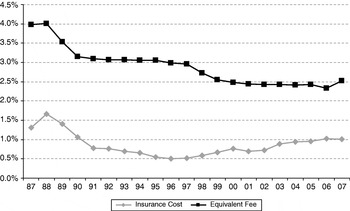
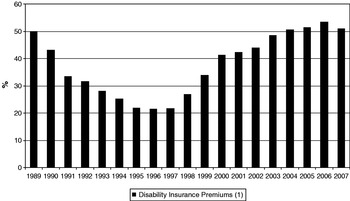
The evolution over time of fees and insurance costs represented as a proportion of total salaries is shown in Figure 1. Although insurance costs have increased since 1990, total equivalent fees have declined. This may indicate that the margins over insurance costs have declined. However, this evolution goes hand in hand with the increased incidence of insurance cost as a proportion of total operational costs, as can be seen in Figure 2.
Insurance premium rate and total fees as % of total salaries

Disability Insurance Premiums as % of total operational costs

2.1 The Disability and Survivors InsuranceFootnote 5
Since the beginning of the 1990s, several countries in the region adopted pension reforms similar to the one implemented in Chile in 1981, by introducing a defined contribution individual capitalization privately managed component into their systems. Many of these systems incorporate coverage for disability and death contingencies occurring before retirement. However, the organization of the system differs in these countries. For example in Mexico coverage is provided by the national social security institute (IMSS), while in the Dominican Republic a unique contract must be signed between all the AFPs and the insurance companies, which has to be approved by the National Social Security Commission. This diversity in the organization of the system allows for an international comparison that is beyond the scope of this paper. However, the lessons learned from the case of Chile might become useful reference points that may shed light on the optimal design and regulation of disability and survivors coverage, especially when contrasted with the experience from other countries with similar pension systems, but different organization of their D&S insurance scheme.
In the case of Chile, the law stipulates that members who die or become disabled before legal retirement age generate a survivors or a disability pension respectively. The amount of this pension is set as 70% of the average salary for the last ten years before the event. In case of partial disability, this amount is reduced to 50%. In case of survival of more than one beneficiary, they receive a percentage of the pension as determined by law. For example, the widow receives 60% and each child younger than 18 (or 24, if still studying) receives 15% of the pension.
These ‘defined benefit’ pensions are financed with the accumulated balance in the individual account, plus the resources paid through the insurance contract. The difference between the necessary capital to pay the pension and the balance available at the time of the disability or death event is called the ‘additional contribution’ and is one of the main cost components of the disability and survivors insurance. This insurance also finances the temporary pensions that are paid to individuals declared partially disabled in the three-year period prior to their reevaluation. If the result of the reevaluation is to revoke the disability qualification, the D&S Insurance must pay a ‘contribution’ equivalent to what the member would have contributed to his or her individual account in the three-year period. In addition, whenever a benefit claim is made, insurance companies are notified in order to make an initial reserve in case the person is found disabled and they have to pay the insurance cost. This reserve takes into account the probability that the disability claim is accepted and is made at historical average cost of claims.
Members who are covered by this insurance correspond to the ones that contributed the last month or those who have contributed to the system at least six months in the 12 months prior to the last contribution if it was made at most one year before the event. As of September 2008, covered individuals represented 65% of all members to the system, as observed in Table 1.
Pension system participation as of September 2008

Disability qualifications are carried out by specialized Medical Commissions with presence all over the national territory. Medical staff of the commissions are hired by the supervisory authority, while all the administrative costs of running the commissions are financed by the AFPs. All medical commissions apply the same technical guidelines to determine the degree of disability. These guidelines are elaborated by medical doctors representing the supervisory authority, the AFPs, the insurance companies, and the Schools of Medicine of Universities recognized by the State.
Once the member is evaluated, the regional medical commission emits a resolution on his or her degree of disability. If the resolution states that the person has lost between 50% and 66% of his or her general capacity to generate income, the person is declared partially disabled. If the person has lost more than 66% of income generation capacity, she is declared totally disabled. This resolution can be appealed by the member or by the insurance company against a Central Medical Commission that serves as a final instance tribunal. Insurance companies have a representative in the Regional Medical Commissions that acts as a medical observer of the qualification process, has voice but no voting rights in the Commision, and advises companies in the appeals process. In practice, there is a centrally organized system of medical observers that is run by the AFPs, given that they have the incentives to keep insurance costs low. Since October 2008, members can also have a medical observer that represents their case, but has no voting rights at the Regional Medical Commission.
Before October 2008, all disability decisions were subject to a reevaluation after three years. In the three-year period, temporary pensions are paid and at least 30% of the individual's balance is locked-in in order to pay the definitive pension. Since experience showed that almost all total disability declarations were confirmed at the reevaluationFootnote 6 (and in more than a few cases beneficiaries died in the three-year period), after October 2008 the reevaluation is required only for partially disabled individuals.
3 Organization of the disability and survivorship insurance
In order to fulfill their legal obligation, each AFP organizes a public auction process in which they choose the insurance company that will cover the disability and survivorship costs of their members during the next period. Each contract can be signed for a specific period or it can be open-ended and subject to renegotiation.
The typical structure of a contract gives little room for price competition. AFPs typically propose a provisional premium, over which cost adjustments are made periodically, e.g. every six months or every year. When actual costs in the period are lower than the provisional premium, the difference is returned to the AFP. When actual costs are higher, AFPs transfer the difference to the insurance company. This overpayment is usually done until a maximum premium is reached, over which the insurance company bears the risk. This maximum premium can be offered by the insurance company in the auction mechanism. The periodicity with which cost adjustments are made generates the possibility of financial returns over the provisional premiums collected. These returns can be an additional income source, either to the AFP or the insurance company. Insurance companies can also offer different participations on these returns to the AFP. Finally, insurance companies also charge a fixed fee over the period of the contract to finance their management. This fixed fee can also be offered in a typical auction. The AFP takes into account the combination of all these factors, plus the proposed term of the contract, which can also be variable and offered by the insurance company, when deciding the adjudication of the auction. Therefore, the process is more a collection of offers than a true price auction mechanism.
The reason why the typical contract evolved into this shape may be found in the special characteristics of the market being served. AFPs soon recognized that it was easier for them to control costs, since members asking for any benefit, in particular a disability pension, had to contact their AFP as a first step to claim the benefit.Footnote 7 AFPs may have used this first step in the process to filter-out unwanted claimants and preclude them from entering into the disability qualification process, which is carried out by specialized Medical Commissions administratively ran by the AFP Association and staffed with medical doctors hired by the regulatory agency. Another control mechanism may have been the fact that whenever insurance costs go up, AFPs may adjust their fees and transfer the costs back to their members. Therefore, no insurance premium is needed, since fees may be adjusted to reflect cost increases.
An additional factor adds other ingredients to the typical process. Over time the emergence of financial conglomerates have increased participation in the economy of AFPs and insurance companies that belong to the same economic group or have common controllers. Currently four out of the five AFPs operating in the market are related in some form to an insurance company. This, in turn, has resulted in the auctions carried out by AFPs usually ending up with the insurance company belonging to the same group acquiring the Disability and Survivorship Insurance contract. In these cases, given the multi-variable characteristic of the offers made by insurance companies, it is difficult to assess whether the result is efficient or not. The same phenomenon has been observed in other similar systems, such as Argentina or Colombia. Argentina decided in 2007 to organize the system on a solidarity basis, financed by all system members without the participation of insurance companies. According to Bertin (Reference Bertín2008), in all the annual auctions since the beginning of the decade only the company related to the AFP participated in the process, despite the great dispersion in insurance premia, which was not explained by differences in observed individual characteristics or differences on coverage across AFPs. In these circumstances, the contract becomes a transfer pricing mechanism between two entities of the same group.
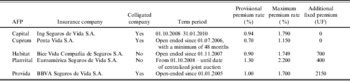
Table 2 shows the main features of current D&S insurance contracts in the market. Notice the heterogeneity, especially with respect to the maximum premium agreed. The highest value of this premium is double that of the lowest; that is, great heterogeneity exists as to the level at which the insurance company provides effective risk coverage in different AFPs. Besides this fact, the operation of the D&S insurance contracts under the design they acquired over time, imposes several negative externalities and perverse incentives that we analyze in the following section.
Structure of D&S insurance contracts, October 2008

4 Distortions arising from the market provision of the disability and survivorship insurance
4.1 The incentive to control costs and cream-skim the market
As described earlier, in a system with provisional premiums and cost adjustments between each AFP and its corresponding insurance company, the AFP ends up bearing the full cost of the disability and survivorship insurance up to the maximum premium, when the insurance company provides reinsurance. When this cost component is relatively small, it is easier for AFPs to absorb the cost and transfer any cost increase to members through higher fees. However, in Chile D&S insurance has increased its importance in total costs over time, currently representing up to 50% of AFPs total operational costs (as shown in Figure 2). Given this, AFPs have strong incentives to control these costs and have in their hands a number of strategies to do so, some of them we could qualify as positive and some as negative. A positive manner with which the AFP could seek to control costs is through monitoring the qualification process, which for example would limit fraud or decrease the rate of mistakes in the grades of disability that are granted. This will lessen the likelihood of granting benefits to someone who does not present a true case of disability.Footnote 8 However, the AFP may also try to discourage the use of the disability pension, trying to block the benefit claim or offering applicants alternative products also provided by the AFP, such as an early retirement pension. This strategy would be negative from the standpoint of the system if it prevents people who actually have the right to receive a disability pension to even submit to the qualifying process, thus generating allocation inefficiency.
Additionally, AFPs can engage in a strategy of selecting members.Footnote 9 Cream skimming is possible in these markets because, although in theory members are free to choose any AFP and they cannot deny affiliation, in practice switching is highly determined by marketing efforts and the active strategies of sales agents, as shown in Berstein and Cabrita (Reference Berstein and Cabrita2007) for Chile, Berdejo et al. (Reference Berdejo, Galarza and Nagamine2006) in the case of Peru, and Calderón et al. (Reference Calderón-Colín, Domínguez and Schwartz2008) for Mexico, among other empirical studies.
Given that the cost of insurance depends on the characteristic of members of each AFP, they will seek to identify those members who are less risky, as the youngest or the ones with higher income. This gives an incentive to each AFP to try to skim affiliates, a practice that may be privately profitable, but at the system level is not efficient because it is a zero-sum game, where someone's gain is equivalent to the loss of some others. Under this strategy, real costs are incurred in the form of marketing or sales efforts to try to skim members, thus generating negative externalities in the system.
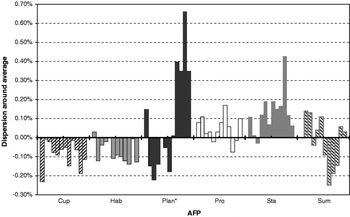
Figure 3 shows the persistence in D&S insurance cost as a percentage of contributed income by AFPs in the period between 1996 and 2007. It can be observed that two AFPs have lower than average insurance costs over the whole period. The other two appear with above-average costs almost every year in the period. Interestingly, the two AFPs that change positions went through merger processes within the period. The one that goes from above average to below average cost merged with a bank owned AFP in 1998 (and thus acquired most of its clients), while the one that moved in the other direction merged with an AFP originally created by the teachers union of the country.
Dispersion in D&S insurance cost by AFP (1996–2007)

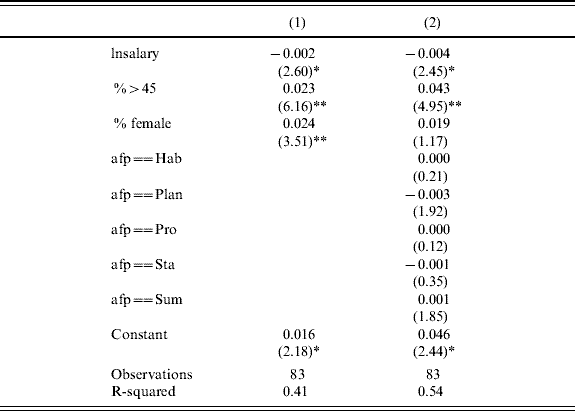
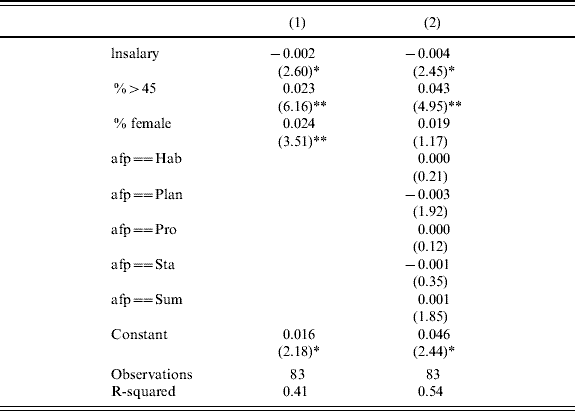
To check if systematic differences are due to differences in the characteristics of members of each AFP a simple regression was run, with the insurance cost as a percentage of total contributed salaries as the dependent variable and the percentage of female members, members older than 45 years of age, and average monthly salaries of members as independent variables. Results of this estimation using data from six AFPs over a 14-year period are shown in Table 3. Column (1) shows that lower salaries, higher proportion of older individuals, and higher proportion of female members are associated with higher insurance costs at the AFP level. When controlling for AFP fixed effects, the correlation with the gender share disappears. However, no AFP fixed effect is found to be significant. This suggests that persisting differences in insurance costs by AFPs are not due to inherent differences among them, but are due to differences in their members' characteristics. These results also support the notion that, in order to save D&S insurance costs, AFPs have a strong incentive to attract high-income and younger individuals.
Regression results of AFP D&S insurance cost on members' characteristics
Notes: Absolute value of t-statistics in parentheses.
* significant at 5%; ** significant at 1%.
4.2 The D&S insurance as a barrier to entry
The AFP industry is currently characterized by high levels of return over equity over a period of more than ten years without any entry of new firms (see Reyes and Castro, Reference Reyes and Castro2008). This is typical of a market with low contestability and suggests the existence of barriers to entry that need to be eliminated for the market to act more competitively. The way the D&S insurance is organized can become a barrier to entry for new AFPs that may reinforce the effect that other sources of entry barriers have on the system. In this sense, the joint provision of D&S insurance and pension fund management services by the same company can be seen as a special case of bundling that acts as an entry barrier, as in Nalebuff (Reference Nalebuff2004). In his model, a company that has market power in two goods can, by bundling them together, make it harder for a company with only one of these goods to enter the market. In our case, bundling is legally required and a company entering the AFP market has two options: provide the disability and survivors risk coverage service by itself or outsource it to an insurance company.
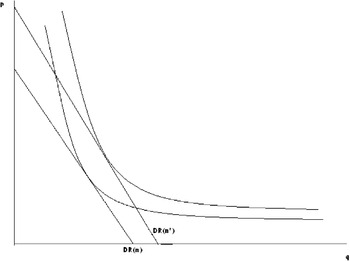
The in-house provision of this service implies that the cost structure must absorb the relevant costs of providing it. Suppose realistically that the cost structure of the pension fund and account management present economies of scale and that the cost of providing D&S insurance is proportional on the number of members. In this case, the typical cost structure will look like the following
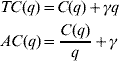
That is the average cost curve vertically and in parallel increases in the amount of γ, with respect to a cost curve of a similar firm that would not need to provide this insurance. In a model of monopolistic competition,Footnote 10 this implies that the equilibrium number of firms offering pension fund management services is lower when insurance is bundled than when it is not, and that the number of firms decreases as the importance of the D&S insurance cost (given by γ in this example) increases. Figure 4 illustrates this equilibrium. When insurance is bundled the equilibrium number of firms in the market is n′, which is lower than the equilibrium number of firms when the insurance is not bundled (n), as can be seen by the level of the respective residual demands (DR).
Monopolistic competition equilibrium with and without bundled provision of D&S Insurance

Furthermore, if a new AFP chooses the in-house provision of risk coverage, it would have to cover the disability and survivorship pensions from its own resources, which could be unaffordable. Consider that in this case the inflow of members comes from individuals currently saving with other AFPs or they are new members. Although the accumulated balance acts as a deductible when a disability or death event occurs in the first case, the contribution fees have been paid mostly to the previous AFP, but the receiving AFP would have to cover the disability and survivors pensions of its new members having received a limited inflow of insurance premiums included in its fees.
The same would be a factor in order to hire this insurance with an insurance company that would cover the risk, but in this case the entrant faces a further disadvantage. Since the insurance contract must be signed before the new AFP starts operation, there is no data about the characteristics of its potential members and therefore the entrant faces even more uncertainty about what will be the cost of insurance compared with an AFP that has history. This makes the exercise of pricing the insurance contract more challenging for any insurance company willing to cover the risks implicit in the pool of eventual members of the new AFP and it becomes more difficult to hire this insurance, especially if it represents an important share of its costs.Footnote 11
4.3 Equity considerations and cross-subsidies
The organization and operation of this insurance gives raise to the existence of cross subsidies, in particular, for example, from women to men. Women tend to live longer and tend to present less disability claims. Therefore, their costs in terms of both survivors and disability pensions are lower. Other cross-subsidies exist from young to older people and in general from healthier to less healthy individuals.Footnote 12 But the main characteristic of these cross subsidies when the system is decentralized is that they all occur within the same AFP. Given that the insurance cost depends on the characteristics of the members of the specific AFP that provides the coverage, the cost paid by a single individual will depend on the characteristics of the other members that belong to the same AFP. Since members' profiles vary from one AFP to another, in part as a result of their marketing efforts, the amount of cross-subsidies paid also vary. For example, a woman in a high cost AFP may be subsidizing her male counterparts more than a woman in a low cost AFP.
The fact that coverage is provided at the AFP level also implies that the eventual risk pooling that could be obtained is not perfect. In this case, risk is not efficiently allocated in the system.
4.4 Transparency and regulatory arbitrage
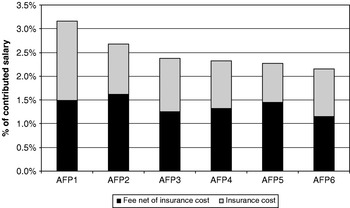
The fact that the insurance cost is included in the fees charged by each AFP reduces the visibility of this variable. As insurance premiums are part of the AFP costs, it is necessary to analyze the balance sheet of each AFP in order to adequately compare the true cost (net of insurance payments) that each AFP represents.Footnote 13 Doing so, we find some surprises, as can be seen in Figure 5. In particular, one AFP that seems especially expensive in the system ceases to appear that way when we take into account fees net of D&S insurance costs. As discussed earlier, in this case the apparently expensive AFP appears that way because the profile of its members, low income and relatively older individuals, makes the D&S insurance cost excessively high as compared with the system average. Also notice that net fees are more homogenous across AFPs than total fees, which include insurance costs. This distortion adds difficulty if a member tries to compare fees between different AFPs when deciding if choosing to switch from one AFP to another, thus reducing price competition among them. As a result, price information is not perfectly disseminated in the AFP market.
Total fees vs. fees net of insurance cost by AFP (2006)

Another problem we observe is that when the AFPs begin to self-insure the part of the risk that is not catastrophic, they are in fact acting as an insurance company. However, from the regulatory point of view, they are not regulated or supervised as such: no technical reserves, minimum risk-related capital, solvency buffers, or actuarial models are required. This may be characterized as regulatory arbitrage, if bypassing such regulation gives them a certain cost advantage over how an insurance company would operate.
4.5 Main lessons from the Chilean case
The following chart summarizes the findings in terms of distortions introduced by the decentralized and free contracting organization of the D&S insurance over the years in Chile.
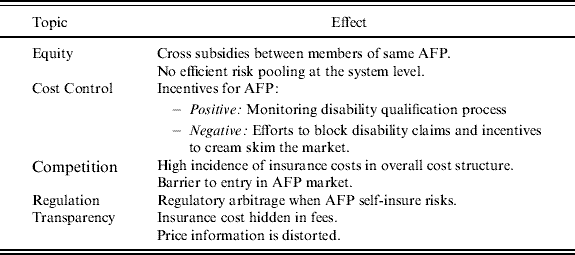
This diagnosis shows that any design of the organization of this type of social insurance should be able to create conditions that improve competition, efficiency, equity, and transparency of the system as a whole. All these goals could be achieved if the insurance premium is determined for the system as a whole and is independent of the AFP of membership. A unique system-wide premium allows for achieving the maximum possible risk pooling and eliminates the incentives for AFPs to cream-skim the market or block disability claims. It is also more transparent since it allows AFPs to inform their fees net of insurance cost and this cost does not distort price comparison across Pension Fund Managers. A disadvantage of the unique price is that since each AFP does not face the full cost of a disability claim, incentives to control costs (through positive practices) are reduced.
If the unique price is achieved through a mechanism that separates the provision of this insurance from other services provided by the AFP, coverage of disability and survivors pensions cease to act as a barrier of entry into the AFP market. This could become more important as privatized pension systems mature, since experience shows that the market tends to concentrate in a few providers and the incidence of disability and survivors cost increase as the covered population ages.
Furthermore, if the actual coverage of disability and survivorship risks is done by an insurance company, the appropriate regulation is effectively in place. However, insurance companies charge a premium to provide this risk coverage. In countries were the insurance market is not competitive or sufficiently developed, this policy option may be too expensive for members and it may be worthwhile to find an alternative mechanism to cover these risks.
Three alternative ways to organize the provision of this system-wide unique-premium insurance are envisaged: state provision (as in Mexico), a system-wide mutual provision by all AFPs (as implemented in Argentina in 2008), or a system-wide insurance contract between all AFPs and one or more insurance companies (as it exists in the Dominican Republic). The main difference among the two market based alternatives is who bears the risk. In the mutual AFP provision, current and future members bear the risk, while fees are set at the level that allows exact coverage of costs. Ceteris paribus, this could imply a cheaper system than when insurance companies bear the risk. However, under mutual provision by AFPs, the incentives to control costs could be weaker and operational costs could be higher, resulting in a more expensive system overall. Generally speaking, the interplay between the risk sharing properties, cost control incentives, operational costs, and risk premium involved in these alternatives should guide the choice of design that implements the desired Disability and Survivors Pension System. Since these features may vary in different contexts (for example due to capacity built at the state operator, development of the insurance market, etc.), different countries may well choose diverse design alternatives.
In the case of Chile, considering that the insurance market is sufficiently developed and that Insurance companies have been involved in the system (although not providing full risk coverage), the regulation decided to design a Disability and Survivors Insurance in which there is a single system-wide premium rate and where the risk coverage will be provided by insurance companies, instead of the AFPs themselves. This generates the challenge as how to achieve efficiently such a system. The next section provides the details about the policy options adopted with this objective.
5 Basic features of the proposed centralized auction mechanism
In order to implement the system, the law mandates the AFPs to jointly hire this insurance contract through a public auction mechanism, where the contracts will be assigned to the best offers. The price of this insurance will be determined as a fixed premium rate over monthly salaries. No cost adjustments or experience rating mechanisms with retroactive effects are allowed. The law stipulates that the insurance contract may be awarded to more than one company, with the objective to mitigate systemic risk.Footnote 14 It also establishes a mechanism for separating insurance costs between men and women, which was proposed by the Presidential Advisory Council for Pension Reform.Footnote 15 In order to implement the cost separation by gender, separate auctions will be made to provide coverage for male and female participants of the pension system.
In addition, the system of medical observers, now managed by the Association of AFP, would be directly controlled by the companies awarded with insurance contracts, in order to oversee the disability qualification process.
The price obtained through the auction mechanism could be decomposed in three parts: the actuarially fair cost of the insurance provision, the risk premium demanded by insurance companies in order to effectively cover risk, and a surplus. The ideal outcome of the auction would be that price paid by members is as close to the actuarially fair cost as possible. In order to achieve this, both the risk premium and any other surplus should be as low as possible. The strategy chosen in order to limit the risk premium is for the authority and AFPs to disseminate as much information as possible on characteristics of pension system members, their evolution over time and all the relevant information that would allow insurance companies participating in the auction process to make more precise estimations on the cost of this insurance. Any other surplus beyond the risk premium could be attributed to the lack of competition in the auction process. Therefore, the remaining challenge is to design an auction process that is as competitive as possible.
The Pensions and Insurance supervisory agencies jointly developed secondary regulation which establishes the mechanism and procedures under which AFPs must carry out the auction process.Footnote 16 The objective of this regulation was to design an auction process that would allow full coverage of disability and survivors events in the system at the lowest possible price.
Klemperer (Reference Klemperer2002) stresses that the most important considerations in practical auction design are discouraging collusive, entry-deterring, and predatory behavior. If successful, this would lead to a competitive mechanism for resource allocation. In the case of D&S insurance, at least three features outstand as important when designing the auction: the definition of the covered population (object to be allocated in the auction), designing the auction mechanism and the determination of the resulting price.
5.1 The object of the D&S insurance auction
The object for which insurance companies will present bids in this auction is the coverage of all disability and survivors events in the system. Since this service can be provided by more than one insurance company at the same time, the question is how to assign different portions of this coverage to be offered in the auction process. One alternative is that this assignment could be an endogenous result of the auction itself. In this alternative, companies would make offers for both the proportion of coverage they would be willing to assume and the price they would request for doing so. The insurance would be provided by the companies that offered the lowest bids until completing 100% of coverage. However, a big disadvantage of this alternative is that it facilitates collusion since the available number of strategies is infinite. Whatever the number of interested companies, a collusive agreement would be easier to sustain in this alternative. For this reason, the authority opted to request the fractioning of coverage into groups of pre-defined size.
In order to design these fractions, it was found more in accordance with the logic of the system to define them as the proportion of total costs incurred in terms of survivors or disability claims. That is, groups would not be composed of specific members that would be covered by a specific insurance company, but each member would be covered by all participating companies in the proportion allocated through the bidding process. In the auction then, each company would offer for the number of portions they were willing to cover and the price. The result of the auction would be a mechanism of coinsurance, under which each insurance company covers a proportion of all events and receives the corresponding proportion of all premiums collected.
In order to achieve competition, the ideal number of fractions would be such that at least one company looses in the auction process. In this way, as suggested by Klemperer (Reference Klemperer2002) and proposed by Saavedra and Willington (Reference Saavedra and Wellington2008), collusion is made significantly more costly. However, in the case of D&S insurance, there exists a trade-off between the number of portions and their size. If insurance companies face some kind of scale restriction as to how big a share of the population they are able to cover,Footnote 17 trying to diminish the number of packages in order to have less than the number of participating firms, may force some firms out of the bidding process. On the contrary, diminishing the size of proportions may not be enough to compensate for their increased number. Therefore, in this case, finding a balance trying to define the number of packages following the ‘n−1’ rule is not trivial. However, if this balance is not achieved, collusion is also complicated since firms would need to agree on how to allocate shares of pre-defined size among them, thus reducing the number of strategies available, and facilitating deviation from the collusive agreement. The exact number of packages is defined by AFPs when they call the auction process.
In a setting with a few big packages, given the scale restrictions faced by insurance companies, there is the risk that only big and experienced companies could participate. Participation of smaller companies could be desirable in order to increase competition. A mechanism that would allow small firms to participate for big packages is to authorize them to form a consortium to make joint offers. However, consortia may also be used by firms to sustain a collusive agreement and would not foster competition if firms that would have otherwise participated separately use a consortium to present a joint bid. In order to make the option of forming a consortium attractive just for small firms, the regulation limited the number of firms in each consortium to a maximum of two and the maximum offer to be made by a consortium could not represent more than 20% of the coverage being auctioned. In addition, any firm participating in a consortium is not allowed to make separate offers on its own.
5.2 The auction mechanism
Klemperer (Reference Klemperer2002) argues that ascending bids are more subject to collusive behavior since early stages could be used to send signals among participants. Sealed-bid auctions are more protected against collusion since deviation from the agreement is always possible when making the offer. In addition, they also attract more competitors, since weaker bidders have more chances to win the auction, given that stronger bidders cannot outbid them. This enhanced competition would allow this mechanism to obtain a lower price.
As an alternative, Klemperer (Reference Klemperer2002) advocates the use of a two-stage auction process, a hybrid ‘Anglo-Dutch’ auction. A first stage ascending auction (descending in the case of D&S insurance) sequentially calls prices and participating firms declare their willingness to accept the price. This process stops when there are n+1 interested firms, where n is the number of homogenous objects being offered (The predefined size packages in our case). A second-stage sealed bid auction is run among the outstanding firms with a reserve price set as the last price called in the first stage. This design captures the best features of both, with the first stage disseminating information about the value of the object and the second deterring collusion and encouraging participation in the process.
Saavedra and Willington (Reference Saavedra and Wellington2008) proposed an adapted version of this mechanism to the case of D&S insurance in Chile. However, closer examination of this proposal led to the conclusion that its implementation would face practical problems in this case. The multi-object nature of the D&S insurance contracts, in which separate auctions had to be carried out at least for men and women, complicates the mechanism. Furthermore, in order to accommodate participation of insurance companies of different sizes, the authors proposed the definition of packages of different volumes. The possibility of making offers for a combination of packages by gender and size would have given added difficulty to the auction mechanism. In this regard, there was the risk that the mechanism would be seen as too complex by insurance companies and could discourage them from participating in the process. Furthermore, given the characteristics of the insurance market in Chile, it was viewed that the information disseminated in the first stage would not be as relevant to encourage participation. The most likely scenario, regardless of the auction design, is that insurance companies with some experience in the provision of D&S insurance would participate and there is little room beyond a couple of additional companies to increase participation in the auction.
In the end, the regulation established a simple sealed-bid auction mechanism to be carried out. This mechanism is more familiar to participants as the usual practice in many auction processes carried out in Chile. In part to supplement the information that could have been made public through the first-stage ascending auction, the regulation also requires the elaboration of two independent studies that would give estimates of the actuarially fair cost of the D&S insurance and its projection over the contract period. Both measures are intended to attract participation into a competitive process.
5.3 Determination of price
As mentioned earlier, a single price paid by all members of the same gender has to result from the auction mechanism. However, as a result of the bidding process, different packages could be assigned at different asking prices. One alternative is to set a uniform price, defining it at the level of the (highest) marginal price that was accepted in the auction. In this way all infra-marginal bidders receive a surplus between their asking price and the uniform price. Alternatively, the auction could be assigned with a discriminatory price, where each winning bidder receives its asking price and the price paid by members is set as the average resulting price. Although the strategic incentives imposed by each mechanism implies that the resulting price should be expected to be the same, such as when comparing a second price auction with a first price one, the incentives for collusion that emerge in a uniform price auction make it more advisable to design a discriminatory price system. In this way, the price obtained by each winning bidder is determined only by their own bid and not by someone else's, which would give incentives to try to fix that marginal bid and share the market. In addition, the uniform price mechanism faces the disadvantage of revealing the surplus obtained by an insurance company providing coverage for this social insurance, which could be subject to political risk or negative public opinion.
5.4 Results from the first auction process
In April 2009, the five AFPs in the market launched the process for the first joint auction to hire the coverage of disability and survivors insurance. They developed the auction rules following the regulation discussed earlier. In this process, the coverage for men was divided into seven groups and the coverage for women into four. Insurance companies participating on their own could present bids for up to three portions, with at most two of the same sex. Joint bids from insurance companies participating in co-insurance could be for up to one portion of each sex. As part of the process, the AFPs hired two independent studies to determine the projected cost of the survivor and disability pensions, given the modification introduced by the recent reform. Using different methodologies, these studies arrived at similar conclusions. The actuarially fair cost of this insurance could be expected to rise up to 1.64% for men, while adding a risk premium the expected premium for this group could reach up to 1.8%. Based on these results and given that more pessimistic scenarios showed even higher figures, the rules set a reserve price (maximum premium) at 2.3% of monthly salaries for both men and women.
Given the economic crisis, the scenario surrounding the first auction was of important uncertainty. There was uncertainty about the evolution of variables that affect the cost of this insurance during the contract period, such as interest rates and pension fund returns. There was also uncertainty about the evolution of claims and disability cases that would be approved after institutional changes imposed by the pension reform on the way Medical Commissions work and in a year of increased unemployment. These considerations gave rise to certain concerns about the participation in the auction by insurance companies, how competitive the process could be and how binding the reserve price would be. Despite these concerns, the process turned out to be successful.
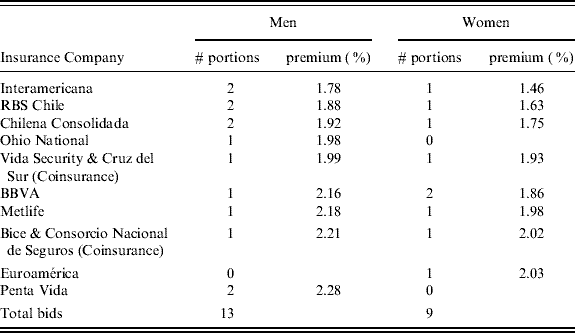
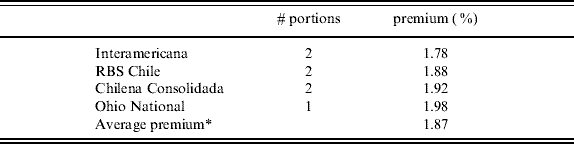
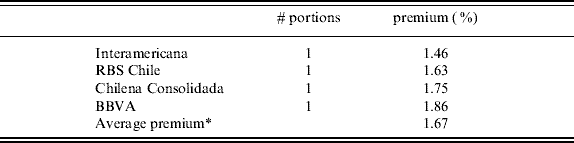
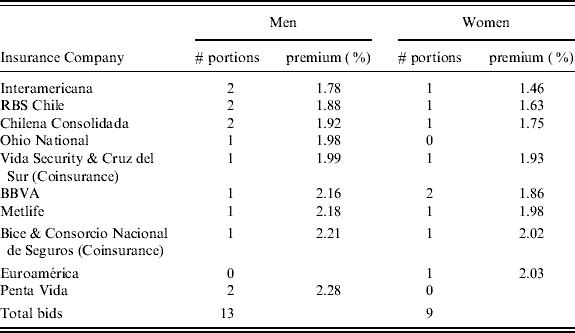
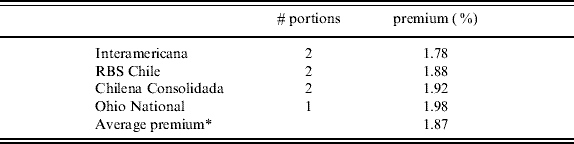
A total of ten bids were presented by 12 insurance companies participating in the process, representing 13 portions of coverage for men and nine for women, more than enough to cover the whole population, as can be seen in Table 4. In fact, five insurance companies ended up providing the service, while the remaining seven were not assigned any contracts. This is evidence of a highly competitive auction, resulting from the auction design where the number of packages is predefined, implying that the risk of staying out of the market is realized if bids are not aggressive enough. The results of this first process are presented in Table 5. The average premium resulting from the accepted bids is 1.87% for men and 1.67% for women, very much in line with previous estimates and way lower than the maximum premium of 2.3% set in the auction. This evidence points to a competitive process, even in the face of a scenario full of uncertainties regarding the evolution of the insurance costs after the pension reform, the economic crisis faced during the year, and the fact that it was the first time this process took place. It is fair to expect that given this experience and when many of these uncertainties clear, future processes should be even more competitive.
Results from the first auction process: received bids
Results from the first auction process: accepted bids by gender:
Accepted Bids: Men
Accepted Bids: Women
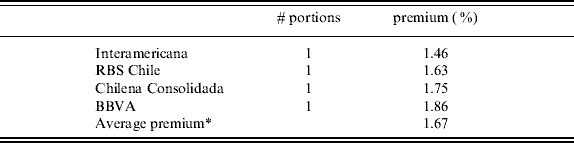
Note: * Due to operational restrictions, the average premium was truncated at the first two decimal numbers. The premium charged by insurance companies must be corrected accordingly using a proportional rule.
6 Conclusions
The evolution of the decentralized market provision of the disability and survivors insurance in the mandatory private pension system in Chile shows interesting features in terms of the distortions and externalities that could arise in the market provision of social security. These externalities distorted the level of competition that could prevail in the AFP system, a market that already features high concentration and weak price competition between providers,Footnote 18 characteristics that are shared across similar systems in different countries. When this insurance is part of the operational costs incurred by AFPs, they face strong incentives to control these costs. The characteristics of the market allow them to develop cream-skimming strategies that may be profitable at the individual firm level, but that are inefficient at the system level. The Chilean experience shows that these issues become more important as the system evolves, pension system knowledge and involvement among members remain low, and the covered population ages.
When this insurance is provided at the AFP level, efficient risk pooling may not be achieved and cross subsidies emerge among members of the same AFP, but two identical members at different AFPs may end up facing different insurance costs, depending on the risk profile of all other members at the same AFP. The high incidence as a share of costs of this insurance becomes a heavy weight for AFPs in the market and new AFPs find it difficult to hire this insurance, given that no history of their members' profile is available. Furthermore, when the risk is covered by the AFP itself, regulatory arbitrage arises and price comparison is distorted by the differential incidence that the D&S insurance costs has on fees across different AFPs.
A centralized auction mechanism through which the D&S insurance would be awarded to insurance companies offering the lowest premiums solves the previous problems. Since there is a unique price at the system level, only differentiated by gender, perverse cost control incentives and negative externalities generated at the AFP system are eliminated. Since new AFPs can join existing contracts, the insurance ceases to represent a barrier to entry in the AFP market and transparency is achieved by setting an insurance price through a competitive process, allowing price competition in the AFP market to act on the basis of fees net of insurance costs. In addition, risk coverage is provided by entities specialized in that service and regulated accordingly.
However, a centralized auction gives raise to new challenges in order to achieve a competitive process through which insurance contracts will be assigned. Competition in this process is needed so that the price charged for this insurance is as close as possible to its actuarially fair price. For this purpose, the auction design needs to attract participation and discourage collusive behavior. For these reasons, the authorities have regulated an auction with the following characteristics:
• There will be a predefined number of packages calculated as proportions of coverage in each gender group. AFPs must announce this number when calling the tender.
• Insurance companies will participate in a sealed bid auction, making offers consisting of the maximum number of packages they are willing to cover and their asking price. Offers can be independently made by gender.
• Consortia formed by a maximum of two insurance companies will be allowed to present bids for packages that do not represent more than 20% of total coverage. Any insurance company participating in a consortium cannot present other bids separately.
• Insurance contracts in each gender group will be assigned to the lowest prices that allow for achieving 100% coverage.
• The single premium rate paid by members of the same gender will be calculated as the weighted average of asking prices of winning bidders in each gender group. The weights will be given by the proportion of coverage assigned to the corresponding winning bid.
The predefinition of portions and the sealed bid mechanism discourage collusion, while the participation of limited consortiums allows entrance of small companies into the market, fostering competition. The sealed bid also encourages entrance by weaker bidders, since they have better chances of acquiring part of the contract than in an ascending auction. The discriminatory price also discourages collusive behavior and may be seen as fairer in the eyes of public opinion. The objective of this design was to set the groundwork for a competitive auction mechanism, which was implemented jointly by all AFPs for the first time in April 2009. The successful result of this process provides new evidence about the practical implementation of this innovative design and its potential for becoming a new alternative for providing disability and survivors coverage in mandatory pension systems with individual accounts.