Introduction
The study of radical left parties (RLPs) has made significant progress. Above all, the very presence and acceleration of this literature in the past decade denotes a widely held conviction that RLPs constitute a distinct group (or family) that, albeit its internal variations, has solid common denominators, as well as clear differences with other commonly perceived party families, including the other two main ones of the left – social democratic parties (SDPs) and green parties (GPs) (Marks and Wilson, Reference Marks and Wilson2000; see also Camia and Caramani, Reference Camia and Caramani2012; Bale and Dunphy, 2011; March, Reference March2011; March and Rommerskirchen, Reference March and Rommerskirchen2015). RLP ideology is thus widely held to travel across borders. But can the same be said in regard to the societal level as well? Group-level theories, theorizations, and analyses are much less convincing if they do not account for the behaviour of the individuals that comprise or support the groups (see Olson, 1965). In this vein, a noticeable gap remains in the study of the European radical left; so far little has been done to explore similarities and differences between RLPs and other traditionally perceived party families of the left at the societal level.
Do radical left party supporters (RLPSs) form a relatively homogeneous and distinct group within national electorates, in terms of their socio-political attitudes and socio-demographic characteristics, in the same way that their preferred parties are believed to do at the political level? What kind of group-specific party appeals, if any, characterize RLPSs? In this article, we explore intra-left similarities and differences at the level of party supporters by testing hypotheses that address the aforementioned questions. Using logistic and multinomial regressions of data drawn from the fourth round (2008) of the European Social Survey (ESS), for five West European countries – Finland, France, Germany, Sweden, and The Netherlands – our investigation compares the socio-demographic characteristics and attitudes of RLPSs to those of social democratic party supporters (SDPSs) and green party supporters (GPSs).
The significance of structural characteristics is tested by including a range of socio-demographic factors in the analysis. Attitudes are modelled on a three-dimensional space: the two main axes upon which social and political divisions in Western Europe are structured – the economic left-right and new politics – as well as an axis of political trust. In methodological terms, our investigation employs a revised view of political and social conflict in Western Europe. First, political trust, a much neglected issue in cleavage research, is incorporated into the analysis in response to the documentation of social and political divides around it, including on the left. Second, the economic left-right axis is operationalized by distinguishing between three dimensions related to particular cognitive operations in interpreting issues of social egalitarianism and economic redistribution.
Our conceptual point of departure is that we focus on party supporters and not voters. We are interested in those citizens who identify closely with left parties. Although vote choice has been used unremittingly to explore the developmental aspects of European party systems, studying the characteristics of voters cannot reveal much about parties’ core constituencies. By contrast, party support is more indicative of parties’ core constituencies.Footnote 1 Much of what we know about the soundness of the party family perspective, and most importantly its sociological aspect, is therefore more likely to depend on whether the supporters (and not all the voters) of specific party families form a distinct social group in terms of attitudes and socio-demographic characteristics or not.
Theoretical framework
Social divides in Western Europe: competing claims
A strain of literature within cleavage research contends that the positions of political parties on various issues reflect deep and lasting attitudinal and structural fault lines, which are based on social conflict; a full cleavage embodies both social (attitudinal and socio-demographic) and political divides (see Bartolini and Mair, Reference Bartolini and Mair1990: 215; Deegan-Krause, Reference Deegan-Krause2007).
There are now various studies that consider several aspects of cleavage politics empirically significant (e.g. Elff, Reference Elff2007; Camia and Caramani, Reference Camia and Caramani2012). Cleavages and party ideologies are seen as simultaneous to a great extent and this simultaneity is seen as having persisted over time. But cleavage politics are also treated as largely ‘travelling’; put differently, the reflection of political conflict in social divides is considered to be cross-national and characterized by similar patterns across Western Europe (Elff, Reference Elff2007; Camia and Caramani, Reference Camia and Caramani2012). Overall, families are seen as intrinsically linked to social groups. Party families are cross-country groupings of parties, categorized predominantly on the basis of their ideology, and by extension, their links to cleavages (Von Beyme, Reference Von Beyme1985: 29–158; Mair and Mudde, Reference Mair and Mudde1998: 225–226). By implication, party families, despite the various nuances of their individual countries and member parties, have a cross-country societal extension.
On the other hand, a wide array of evidence documents a decrease in the role of traditional, attitudinal, and socio-demographic characteristics for electoral behaviour. The result is a cross-country de-alignment or intense realignment of traditional links between social groups and political actors. In this vein, vote choice is increasingly determined by short-term factors unrelated to issues and structural divides (Knutsen, Reference Knutsen2006; Franklin et al., Reference Franklin, Mackie and Valen2009; Van der Brug, Reference Van der Brug2010). Consequently, the confidence that European parties and party families (including that of RLPs) have an ideologically and/or structurally cohesive group of supporters has been called into question. At best, there appears to be striking variation in the fundamental conflicts within societies, coupled with cross-country differences in the types of issues that dominate the political agenda (e.g. Knutsen and Scarborough, Reference Knutsen and Scarbrough1995; Henjak, Reference Henjak2010).
But debates as to whether cleavage politics matter are intertwined with disagreements as to if the (limited or otherwise) structuration of politics is based mostly on attitudes or socio-demographics. These discussions remain unsettled, yet most cleavage approaches stress the attitudinal dimension. Even the body of research which is convinced that structural factors continue to play a non-negligible role, for example arguing the continuing relevance of class or class-related variables (e.g. Evans et al., Reference Evans1999; Elff, Reference Elff2007; Evans and De Graaf, Reference Evans and De Graaf2013), documents significant variability across West European countries and does concede an overall decline. Moreover, attitudes have increasingly come to be seen as independent from structures (see Deegan-Krause, Reference Deegan-Krause2007; Bornschier, 2009). Knutsen and Scarborough (Reference Knutsen and Scarbrough1995), for example, argued that even economic-related attitudes became increasingly devoid of their structural roots and explained party choice much better than socio-demographic characteristics (see also Tóka, Reference Tóka1998).
An important warning has to be borne in mind nevertheless: at least some of the apparent independence of attitudes and political choices from structures may ‘simply reflect the shift to new and little-studied structural categories’ (Deegan-Krause, Reference Deegan-Krause2007: 17). Along with changes in technology, economic development, occupational stratification, and the access to information, certain social groups lose their causal weight as determinants of attitudes and political conflict, while others become more impactful. While structural divides are neither immutable nor enough by themselves to freeze party systems into place, at least some basic divisions are often thought to underlie most political conflicts (Bornschier, 2009: 8–10).
A revised view of ideologies and structures in Western Europe
Which are the main ideological axes and structural divides that cleavage research recognizes as the most important in Western Europe today? It has gradually become clear from the literature that at least two fundamental dimensions of conflict can be used to disaggregate the general left-right scale: an economic left-right and a new politics dimension – the former involves conflict over economic issues and the latter relates to societal and moral paradigms (e.g. Kitschelt, Reference Kitschelt1994; Dalton, 2009; Kriesi, Reference Kriesi2010).
The economic left-right dimension was initially approached as the identity-related element of divisions based on class (Lipset and Rokkan, Reference Lipset and Rokkan1967). Independent of the significance attributed to any underlying structures, however, attitudinal disagreements over the distribution of resources in society are the defining characteristic of the economic left-right axis. This axis is conceived as a conflict related to social egalitarianism and economic redistribution, also embodying a stance on the issue of welfare provision by the government. Differences in perceptions of inequality stem from different opinions about whether it is the efforts and ability of individuals that condition the distribution of wealth or, alternatively, luck, political power, systemic factors, or illegitimate activities and morals. In turn, these lead to specific attitudes and policy preferences (Alesina and Angeletos, Reference Alesina and Angeletos2005). When people believe that wealth distribution is the product of effort and talent, they might view inequality as a just and inevitable trait of social organization. By contrast, people seeing inequality as something unnatural and related to social organization itself might be more inclined to support egalitarianism and changes in the distribution of wealth in society (Alesina and Angeletos, Reference Alesina and Angeletos2005).
Still, when analyzing the economic left-right axis, there is a general tendency to be unspecific, in so far as the axis’s generality, and therefore the various viewpoints of concern, are on many occasions not taken into consideration. Common values can be shared by individuals with different ideological mindsets, but when it comes to these values’ realization in practice, then pragmatism is more likely to set in for the moderates. Common values that are abstract entail a different process of attitude formation from that entailed in stances about policies and the practicality of arrangements within the context of a given reality. Acknowledging social injustice and arguing that something could in principle be done about it, does not necessarily include the belief that it is politically or economically desirable, or even feasible, to remedy that injustice in any way theoretically possible, especially when that belief is expressed with reference to specific government policies (for political psychology experiments that lend support to this argument, see Mitchel and Tetlock, Reference Mitchell and Tetlock2009: 134).
From this perspective, there is theoretical ground to assert that the attitudes of an individual (as well as those of a party) on the economic left-right axis may differ depending on whether the issue at hand concerns a government action or a desired goal, or simply abstract values. In the light of an established tradition in political psychology that dates back to Tetlock’s (Reference Tetlock1986) value pluralism model, this may be so, because policy decisions on given issues activate conflicting values. How these policy decisions are seen through will depend on which of the conflicting values prevails and to what extent. It is thus important to realize that people support polices because of combinations of underlying value commitments and that those value commitments might not always be the same (just as people with similar values might support different policies because of other value commitments).
Turning to the new politics axis, this came into use soon after Inglehart’s (1977) elaborate study of post-industrial societies. Since then, it has been extensively argued that value-based divides relating to post-materialist issues cross-cut the older distributional conflicts that characterized earlier decades (see Flanagan, Reference Flanagan1987; Kitschelt, Reference Kitschelt1994; Inglehart, Reference Inglehart1997; Kriesi, Reference Kriesi2010). The result is a soft kind of realignment, as defined by the establishment of new links between social groups and new or established political parties; without, however, old links being weakened to the extent that they are completely replaced by the new ones. Consequently, the attitudinal space of European mass publics has been altered and the agenda of European parties and states redefined. New parties emerging across Europe take a side on the traditional cleavages and come to constitute a new family (of GPs). Established party families that were based on older cleavages (RLPS and SDPs, among others), take a side on the newly appearing issues. The responses that these issues provoke, especially by the radical right, cause the axis to evolve by incorporating new content (see Kriesi, Reference Kriesi1998; Bornschier, 2009).
The new politics axis concerns the conflict between individual liberty and choice on the one hand and authority on the other; the distinction between inclusive or exclusive conceptions of community; and the differentiation of environmentalist attitudes and more materialist ones. These three components, although they need not always be in alignment with one another, have come to define what was first conceived as a materialism/post-materialism divide in much of Western Europe, in the sense that they tap into issues that are contested in this particular region (see Evans, Reference Evans2010).
Yet, a third bundle of issues – political trust – also merits consideration according to our revised view of ideologies and structures in Western Europe. Political trust is considered to express confidence in the workings of aspects of the political order. More specifically, political trust denotes attitudes towards the intentions and outcomes/actions of political institutions and leaders. Certainly, this set of issues has never been regarded as constituting a cleavage in West European countries. On the contrary, it has been treated as a cause of lessening party identification and thus also as a sign of cleavage decline (Dalton, Reference Dalton1999). Nevertheless, there are strong indications of a three-dimensional space of conflict where political trust is emerging as a newly formed issue of division at both the political and social level.
At the political level, the division concerning political trust is underpinned by the distinction between protest/opposition and mainstream parties (Sartori, Reference Sartori1976). Scholars have suggested that the former are different than their mainstream competitors in a number of ways: institutional behaviour, programmatic appeals, strategies within the party system and towards the voters, and the expectations their core constituencies have of them. What is of relevance here concerns programmatic appeals. While protest and opposition parties generally tend to have non-centrist or ‘extreme’ ideologies on all issues (see Adams et al., Reference Adams, Clark, Ezrow and Garrett2006), they also share a critical stance on ‘conventional politics’ and more generally what they conceive as the dominant practices of the political establishment. Radical right parties, for example, frequently employ rhetoric that presents modern democracy as tarnished by corruption and untrustworthy political elites (e.g. Rydgren, Reference Rydgren2005). RLPs (and GPs) are usually smaller opposition parties, whereas SDPs tend to be more established parties, more often playing a role in government. In actual fact, there are noteworthy and historical differences between the three left party families’ outlooks on representation in capitalism. Although the reasons and the degree of doing so differs, both RLPs and radical right parties ‘contrapose the political elite against citizens, on the one hand, and against themselves, on the other’ (Schedler, Reference Schedler1996). Indicatively, dissatisfaction with the mainstream parties and the political system appears to be an important driver of voting for both radical right (e.g. Rydgren, Reference Rydgren2005; Ford and Goodwin, Reference Ford and Goodwin2010) and RLPs (Campbell, Reference Campbell, Converse, Miller and Stokes2012).
Turning to structural factors, a large body of research is convinced that these continue to play a role in Western Europe. For example, studies by Evans et al. (Reference Evans1999), Elff (Reference Elff2007), and Evans and De Graaf (Reference Evans and De Graaf2013) argued for the continuing relevance of class or class-related variables, suggesting that declines in overall loyalty within class groups could be reversed by changes in party strategies (see also Enyedi, Reference Enyedi2008). Other scholarly enquiries emphasized the impact of specific occupational categories, such as unemployment, or of personal financial situations as reflected in levels of economic security. It is apparent that these can have an effect on value change (Abramson et al., Reference Abramson, Ellis and Inglehart1997) or in particular, attitudes towards the welfare state and immigration (Henjak, Reference Henjak2010).
Further, since the 1990s and in parallel with the widely assumed weakening of class-related characteristics, the significance of non-class structural variables, such as those of age and gender has been especially emphasized. Although competing explanations have been articulated for each of these three’s effect on attitudes (ranging from the cultural aspect of globalization to the relations between political protest and generational change), the dominant view sees more libertarian and redistributionist values as resting upon such variables (Kriesi, Reference Kriesi1998; Knutsen, Reference Knutsen2004).
Attitudes, structures and RLP support: a set of hypotheses
Based on the foregoing, we can settle on what attitudes and structures to test for, but we cannot theorize coherently on the West European radical left. Towards this purpose, a more nuanced and historical understanding of intra-left divisions and realignments is pertinent. Generally speaking, we would expect that RLPSs differ from either or both SDPSs and GPSs, by being more ‘radical’, more ‘moderate’, or undifferentiated depending on the attitudinal or structural divide in question.
RLPs have diachronically shared a distinctly critical view of the capitalist system and especially neoliberalism (see March, Reference March2011). They are the inheritors of an ideology (communism) that emerged from the splits in SDPs across Europe in the early 1920s. These splits in turn crystallized the communist–socialist division on the left part of the class cleavage – over the centrality of the communist party, the role of the Soviet Union, the nature of capitalism, and the issue of reformism vs. revolution more broadly (Eley, Reference Eley2002).
GPs have traditionally followed a broadly leftist culture oriented towards redistribution (Muller-Rommel, Reference Müller-Rommel1989: 8). However, the Greens’ leftism has always embodied a distinctive brand of liberal thinking and individualism (Dunphy, Reference Dunphy2004; March and Mudde, Reference March and Mudde2005, conclusions), and a view of social equality that pays less attention to class antagonism and more to the welfare provisions for excluded groups, such as immigrants (Dohetry, 2002: 67–69, cited in Dolezal, Reference Dolezal2010: 542).
Historically speaking, personal freedom, motivation, initiative, and certain other values have been as important as social equality for both social democratic and ecological thought where liberalism has exerted a strong influence. On the contrary, they have often been sacrificed or interpreted in non-liberal terms in the communist and radical left tradition, largely based on a more structuralist view of human nature (Vassalo and Wilcox, 2006). This basic difference between the morphologies of distinct left-wing ideologies can serve as the starting point of understanding how the supporters of party families with similar values but different policy assessments and policy proposals diverge in their attitudes.
While both the radical leftists and the moderate leftists may share the same commitment to social equality, a discussion on whether to implement a particular policy in order to help the poor or regarding the costs and benefits of a particular measure can activate a conflict between social equality and other values. This conflict is likely to be resolved differently by the radical leftists than by the moderate leftists, because each group exhibits a different commitment to these other values (see Braithwaite, Reference Braithwaite1994) – the radical leftists are more likely to have greater allegiance to social equality, whereas the moderate leftists are more likely to have dual allegiances. Hence, each group is likely to respond in a different way to the proposal to increase taxes or the perceived negative impact of higher taxes. Our first hypothesis is premised on these insights and so addresses three aspects of the economic left-right axis that can be considered to increase its importance as a set of attitudinal variables:
Hypothesis 1 RLPSs have more ‘radical’ positions than SDPSs and GPSs in what concerns government action and desired goals but not in terms of abstract values.
On new politics issues, it can be posited that differences exist between the RLPs and SDPs on the one hand and the Greens on the other, while no clear pattern of distinctions emerges between the centre-left and radical left. Post-materialist issues have been assimilated well into the programmes of SDPs (Lipset, Reference Lipset2001) and certain RLPs (see March and Mudde, Reference March and Mudde2005), partly due to the pressures of green competition on the left flanks of party systems. But they are a flagship matter only for the Greens, whose libertarianism, alternative thinking in respect to culture and the community, and environmentalism place them quite far to the ‘radical’ side of the new politics axis, despite change and evolution in their ranks (Burchell, Reference Burchell2002; Dunphy, Reference Dunphy2004: conclusions). Environmental values, especially, are a pertinent characteristic of green politics (Dolezal, Reference Dolezal2010: 541). On the whole, we would expect RLPSs to differ from GPSs on new politics issues by being more ‘moderate’ in their attitudes, as new politics issues are a more consistent and salient matter for the Greens. We hence hypothesize:
Hypothesis 2 RLPSs take more ‘moderate’ attitudes on the new politics axis than GPSs.
In what concerns trust, RLPs have diachronically criticized the workings of representation in capitalism, initially rejecting representative democracy as driven by capitalist exploitation (Eley, Reference Eley2002). More recently, they have argued that neoliberalism dilutes further the legitimacy of political institutions. This is a position held by virtually all RLPs with reference to both the national and EU arenas (Dunphy, Reference Dunphy2004; March and Mudde, Reference March and Mudde2005). Similarly, GPs have tended to focus on the dilution of the participatory and deliberative aspects of democracy and favour less bureaucracy, more deliberation, more decentralization, and more grassroots participation than that supplied by liberal institutions and established parties (Burchell, Reference Burchell2002). Political trust is a crucial topic of the post-materialist cleavage that spawned these GPs in the 1970s and 1980s; the rise of this cleavage was connected to the declining support for political institutions (Inglehart, Reference Inglehart1997).
By contrast, Social Democrats cannot be said to have formulated an elaborate critique of political institutions in contemporary democracies. From the time of Bernstein, political institutions in capitalism were seen, at the very least, as potentially progressive and as the main arena on which class struggle had to concentrate (Eley, Reference Eley2002). With time, this perception and political strategy has become more pronounced, as SDPs increasingly focussed on the electoral arena and its institutions (Moschonas, Reference Moschonas2002). Our third hypothesis is thus based on an issue highlighted frequently in the comparative historical literature on the left, but much neglected in cleavage research:
Hypothesis 3 RLPSs exhibit more distrust than SDPSs.
In what concerns the left, certain historical nuances concerning the relationship between attitudes and socio-demographics need to be addressed. RLPs mostly emphasize class divides, opposition to neoliberalism, redistribution, and the need for a strong welfare state. As such, they can be expected as more likely to attract supporters with less economic well-being than SDPs and GPs, as well as the unemployed, because the latter are associated with insecurity (Lipset, Reference Lipset1981). Accordingly, communist parties’ electoral decline was explained by the diminishment of the traditional lower strata (see Waller and Fennema, Reference Waller and Fennemma1988).
Still, no differences may exist between RLPSs and SDPSs in terms of class or class-related components, as the weakening of working class support for left-wing parties has not been a phenomenon affecting only the Social Democrats but also the communists (before they even refounded themselves into parties where Marxism–Leninism is one current among many and almost never the dominant one) (Nieuwbeerta, 1996). Even appeals to the welfare state, principally aimed at the decommodification of labour, are no longer a sufficient attraction for the lower strata of society (Houtman et al., Reference Houtman, Achterberg and Derks2008). Moreover, neither the modern radical left (March, Reference March2011), nor the traditional communist parties (Ramiro, Reference Ramiro2003) have relied only on working class support. It has been often the case that support from the middle classes outweighed that by the working class, or both oscillated significantly (Ramiro, Reference Ramiro2003).
Unemployment, of course, has been on the rise since the 1970s. Yet, in spite of the conviction that the unemployed espouse more materialist values (Inglehart and Abramson, Reference Inglehart and Abramson1994), associated with the non-green left more than they are with the Greens, their more conservative stances in relation to immigration issues (Henjak, Reference Henjak2010) should counterbalance their tendency to support RLPs.
The few structural differences that can be reasonably assumed to exist today between the supporters of different left parties concern education and age. These are less likely between RLPSs and SDPSs, as both groups exhibit significant cross-country variation among young supporters, as well as different programmatic and political strategies towards youth (see Merkel et al., Reference Merkel, Petring, Hankes and Egle2008; Striethorst, Reference Striethorst2011). It is the GPs’ post-materialist outlooks that can be thought to attract less traditionalized forms of thinking that are partly the result of more education and a younger age (see Dolezal, Reference Dolezal2010). Therefore, GPs can be considered as the main poles of attraction for younger and more educated supporters (who are usually located in the middle or even higher social classes). In contrast, the ‘gender issue’ is invariably present in the appeals of all three left party families (see Caul, Reference Caul1999) and female voters tend to support left parties in general, not favouring any specific strain of left-wing thought or practice, and choosing a party depending on which value or policy (environment, peace, social care) they prioritize (Knutsen, Reference Knutsen2004: 198–200). Similarly, religion – that is religious denomination and whether one ascribes to a religion or not – cannot be assumed to condition party identity on the left. Overall, the effect of religion on party choice has diminished and although it has increased in recent years, it matters in particular for voting for Christian Democratic parties and Conservative parties (Van de Brug et al., 2009). It is against this background that we raise the following hypotheses:
Hypothesis 4 There are no significant differences between RLPSs and SDPSs and GPSs in terms of economic well-being.
Hypothesis 5 RLPSs are less educated and older than GPSs.
Hypothesis 6 RLPs are not supported by women more than SDPs and GPs are.
Hypothesis 7 RLPSs do not differ from SDPSs and GPSs in terms of religion.
Data and method
Data
We have chosen to employ data from the ESS for two reasons. The ESS includes a party identification variable, which allows us to study party supporters and not simply voters. Crucially, the wording of the relevant question in the ESS includes the option of not identifying with any political party (Johnston, Reference Johnston1992), thereby avoiding the encouragement of some respondents with no clear party identification to name the party they were voting for at the time. Moreover, the ESS includes a second question on party identification that is methodologically useful: it asks respondents how closely they feel to the party they listed in the previous question. By including in our samples only those respondents who answered the party support question with ‘very close’ or ‘quite close’, we increase the validity of our conceptualization of ‘party supporter’, as a core affiliate of the party.
Lastly, the fourth round of the ESS allows us to capture more effectively and efficiently than in other rounds, the left-right dimension, as it includes a questionnaire related to economic redistribution and egalitarianism. Based on the bundle of questions included in the fourth round of the ESS, we achieve a more nuanced conceptualization of the left-right axis that is based on the aforementioned theoretical distinctions rooted in political psychology (see online Appendices 1 and 2).
Our country selection includes Finland, France, Germany, The Netherlands, and Sweden, in which all three kinds of left-wing political parties (RLPs, SDPs, and GPs) have a significant presence and therefore, sample sizes for left party supporters in the ESS data set are satisfactory. Our selection of countries, all of which are West European, also responds to the pronounced differences between Eastern and Western Europe concerning the attitudinal aspects of cleavages (Enyedi, Reference Enyedi2008).
Operationalization of the ideological axes
We used specific questions from the ‘welfare attitudes’ theme, which was only used once, in the fourth round of the ESS survey. The variables/questions used for each axis and component are reported in online Appendix 2.
The economic left-right axis: We operationalized three components, each reflecting a distinct cognitive operation to the issue of redistribution: (a) one related to the perceived role of social benefits and its impact on the society – the ‘idealistic’ component; (b) one related to the perceived impact of social benefits and state intervention in the economy – the ‘pragmatist’ component; (c) one related to the desired actions by the government in order to facilitate economic redistribution – the ‘government actions’ component.
Underlying our approach to the operationalization of the left-right orientation of the respondents is the assumption that the second and third of the three components, while referring to distinct approaches towards economic redistribution, are more related between them than they are with the first component.
The new politics axis: We operationalized authoritarianism as a combination of preferences for authoritarian teaching styles and harsher sentences for those breaking the law. Our choice of questions is in line with Enyedi’s argument that authoritarianism ‘unites political goals with psychological dispositions, providing political orientation with non-political anchors’ (2005: 702). Nationalism is captured by two questions referring to attitudes towards immigrants’ impact on the country’s cultural life and on whether immigrants make a country better or worse to live in.Footnote 2 Attitudes towards the environment are captured by the respective question regarding care about nature and the environment.
Political trust: Questions that include parliament, parties, and politicians are sufficient for capturing political trust, as they address the two main types of political institutions, as well as the issue of leaders, not simply as individuals, but also as institutionally embedded agents of the political game.
Measurement models for the three axes
We used multi-group confirmatory factor analysis in order to investigate the configural and the metric equivalence of our models across countries (Steenkamp and Baumgartner, Reference Steenkamp and Baumgartner1998). Metric equivalence requires that the loadings of the factors in the measurement model are invariant across countries and is a strong indication that the cross-cultural equality of the scale intervals on which the latent concept is gauged holds.Footnote 3
The measurement model for the left-right axis is presented in Figure 1. All indices were suggesting a desirable model-data fit (see online Appendix 3, Note 1). The results confirm the innovative nature of our operationalization of the left-right axis. The pragmatist and government action components have substantial correlation between them, while at the same time they are not correlated to the idealistic component. This validates our initial assumption that attitude formation on abstract values related to the economic left-right axis entails a different thinking process to attitude formation on left-right practical matters.
The measurement model for the economic left-right axis (unstandardized values).

We also investigated the metric equivalence of the model for all the countries of the sample using a multi-group analysis (see online Appendix 3, Note 2). All goodness of fit indices were satisfactory for the purposes of this study so we concluded that we established both configural and metric equivalence.
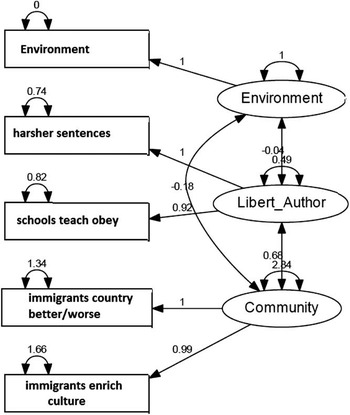
The measurement model for the new politics axis is presented in Figure 2. All indices suggested a desirable model-data fit (see online Appendix 3, Note 3). We also investigated the metric equivalence of the model for all the countries of the sample using a multi-group analysis. The results confirmed the metric equivalence of the model (see online Appendix 3, Note 4).
The measurement model for the new politics axis (unstandardized values).

The political trust axis consists of the three questions which were discussed above. The Cronbach’s α for the five countries of the sample ranged from 0.84 to 0.90, which is appropriate for all practical intents and purposes of this study.
Socio-demographic (independent) variables
Seven socio-demographic variables are used as covariates in the logistic regressions: age, occupation (and unemployment), gender, education, income, and religion. Age was measured in years whereas gender was used as dichotomous variable. The combination of education, income, and occupation are used in this study as proxies of social class. Education was modelled as an ordinal variable (1=primary education, 2=lower secondary, 3=upper secondary, 4=post-secondary and tertiary) and included in all regression models as a Helmert contrast (reference category is ‘primary education’). Total household income was included in the models under the heading ‘total income bands’ and was treated as an interval variable where higher values suggested higher income (treating the variable as ordinal did not practically change the results). We modelled occupation type and unemployment as values of a single categorical variable: those at work were modelled as ‘employees’ or ‘managers’ to distinguish between having jobs of different social status; the rest were categorized as ‘housework’, ‘in education’, ‘retired’, or ‘unemployed’. due to the relatively smaller sample size, it was not possible to perfectly match the elaborate occupation coding of other researchers (e.g. Dolezal, Reference Dolezal2010). Still, the inclusion of this variable (i.e. occupation type), in combination with the variables of income and education, allow us to explore further the significance of structural factors such as social class.
Finally, following the example of Dolezal (Reference Dolezal2010), we modelled Religion as a categorical variable and compared the two traditional groups (i.e. Catholics and Protestants) with the other respondents (i.e. those not being members of any church, including the very small number of respondents who belonged to other religions).
Results
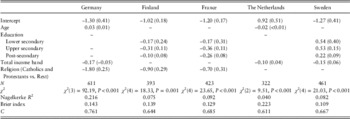
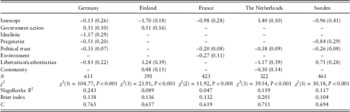
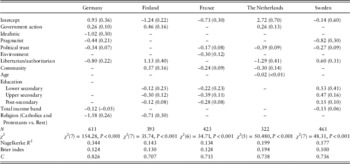
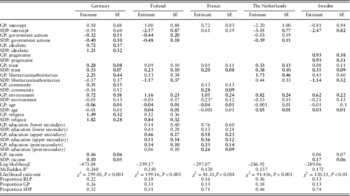
Overall, 447 respondents said that they felt closer to RLP, whereas 1763 respondents said that they felt closer to one of the other parties. We present separate models for the structural and the attitudinal independent variables (Tables 1 and 2). Table 3 combines both sets of variables, allowing us to evaluate the net effect of each of the variables in the model. In Tables 1–3, the dependent variable is ‘Feel closer to RLP/Feel closer to GP or SDP’. In all tables (including Table 4 later on), only the statistically significant independent variables are presented.
Coefficients of logistic regression models with party as the dependent variable (radical left party=1, social democratic party, and green party=0) (only for the structural variables)

Standard errors are presented in parentheses.
Coefficients of logistic regression models with party as the dependent variable (radical left party=1, social democratic party, and green party=0) (only for the attitudinal variables)

Standard errors are presented in parentheses.
Coefficients of logistic regression models with party as the dependent variable (radical left party=1, social democratic party, and green party=0) (all variables)

Standard errors are presented in parentheses.
Coefficients of multinomial regression models [radical left party (RLP) is the reference category]

SDP=social democratic party; GP=green party.
Marginally statistically insignificant coefficients (e.g. 0.053) are denoted by an asterisk.
Statistically significant results in bold.
Table 1 suggests important patterns that attest to clear structural differences between RLPSs and the supporters of the other two party families. Income and education have a significant contribution in the models. Income is significant in three countries (Germany, The Netherlands, and Sweden) and education is also significant in three countries (Finland, France, and Sweden). Higher income is related to a lower probability for respondents to feel closer to RLP parties. For example, in Germany, respondents who rated their total household income on the 10th (highest income) rather than on the first (lowest income) level, were almost 80% less likely to give a positive response for RLP. The respective probabilities for the Netherlands and Sweden were ~60 and 75%.
Respondents who were more educated were also less likely to feel closer to an RLP party in Finland and France, but in Sweden, more educated people were more likely to feel closer to RLP parties. For example, in France, people who have completed upper secondary education are 30% less likely to feel closer to an RLP party but in Sweden, those who completed upper secondary education are 70% more likely to feel closer to an RLP party.
Interestingly, religion seems to play the most important role in the model: in Germany, the group of Catholics and Protestants were almost 85% less likely to feel closer to RLP (the probabilities for Finland and France were 60 and 50%, respectively). Religion alone, when added as a last predictor in the model, accounted for most of the pseudo R 2; in Germany, for example, adding religion as a third (last) explanatory variable increases the pseudo R 2 from 0.07 to 0.22.
Table 2 suggests important patterns that attest to clear attitudinal differences between RLPSs and the supporters of the other two party families. Political trust, albeit neglected in the relevant literature, emerges as the most prominent explanatory variable. It is significant in all the countries – but Finland – and is negatively related to feeling closer to an RLP party (more trusting individuals are less likely to feel closer to RLP parties). In the Netherlands, a respondent with the minimum level of political trust (no trust at all) is 98% less likely to feel closer to an RLP party compared with a respondent with the maximum level of political trust (complete trust). Similar (but smaller), effects were recorded for Germany, Finland, and Sweden.
The libertarian/authoritarian axis also emerged as a significant explanatory variable for all the countries but France. The coefficient of the axis had a positive sign for Finland and Sweden and negative sign for Germany and the Netherlands. In Germany and the Netherlands, more libertarian people (less authoritarian) are less likely to feel close to an RLP party. However, in Finland and Sweden, more libertarian people are more likely to feel closer to an RLP party. In Germany and Finland, people who desire a more active involvement of the government are more likely to feel close to an RLP party.
Table 3 combines the structural and the attitudinal independent variables. The addition of the attitudinal variables in the models of Table 1 increases both the pseudo R 2 and the classification indices substantially. For Germany, the Nagelkerke R 2 increases from 0.216 to 0.344; for the Netherlands, the R 2 increases from 0.040 to 0.199. This clearly suggests that the attitudinal variables contribute significantly to the explanation of feeling closer to an RLP party, over and above the contribution of the structural variables. Still, in many cases, the structural variables remain statistically significant. For example, Religion remains statistically significant for Germany and Finland, and education remains statistically significant for Finland, France, and Sweden.
In Table 4, the dependent variable is treated as a trichotomous variable which can take the values ‘RLPSs’, ‘SDPSs’, and ‘GPSs’. RLPSs were used as the reference category, so the differences between RLPSs and SDPSs and between RLPSs and GPSs were modelled per country. This is an important analysis because it allows us to model the differences between RLPs and GPs and between RLPs and SDPs. These differences cannot be shown with the simpler, binary models presented in Tables 1–3.
The three components of the left-right axis matter to different extents and in different ways. Attitudes related to government action are associated with RLP support in three countries in terms of RLPSs–SDPSs comparisons; individuals with more positive attitudes towards government actions are less likely to feel closer to an SDP rather than an RLP party. Attitudes regarding abstract values matter only in Germany (more idealistic individuals are more likely to feel closer to the SDP or the GP rather than to the RLP) where an Eastern–Western ideological divide partly structures competition on the left (Campbell, Reference Campbell, Converse, Miller and Stokes2012). Attitudes on the ‘pragmatist’ component of the economic left-right axis matter only in Sweden, where the issue of ‘more benefits’ and an EU-related erosion of the welfare state is the main ideological weapon of the left party. The nature of the relation is such that more pragmatist individuals are less likely to feel closer to RLPs (compared with GPs and SDPs).
Two out of three components of the new politics axis have no patterned significance for RLPSs–GPSs comparisons. Statistically significant differences between RLPSs and GPSs in terms of the liberty/authority and community exist in only two countries. More libertarian individuals are more likely to feel closer to GP rather than RLP in Germany and the Netherlands. On the contrary, more libertarian people are more likely to feel closer to the RLP rather than the SDP in Finland and Sweden. Individuals who are more pro-community (more nationalistic and less pro-immigrants) are more likely to feel closer to the GP rather than the RLP in Germany and more likely to feel closer to the SDP rather than the RLP in France. But attitudes towards the environment are strikingly significant across all five countries in terms of RLPSs–GPSs comparisons; the more pro-environmental attitudes one has, the less likely that one will support the radical left compared with the Greens. As originally formulated, RLPSs–SDPSs differences on the new politics axis are less significant.
The economic left-right issues that matter distinguish RLPSs from SDPSs through a positive relation between attitudes to government actions and RLP support. This finding coheres entirely with the relevant literature’s dominant argument that RLPs are predominantly and cross-nationally the main adherents of a fight against neoliberalism, especially as practiced by contemporary social democracy. This is so, in a similar way, that GPs are predominantly and cross-nationally the main adherents of environment-friendly policies.
Crucially, political trust stands out as a differentiating trait between RLPSs and SDPSs. It has a statistically significant contribution in the model for all countries in RLPSs–SDPSs comparisons and for two countries in RLPSs–GPSs comparisons. The point is that the more distrustful towards political institutions one is, the more likely that one will support the radical left compared with the SDPs or GPs.
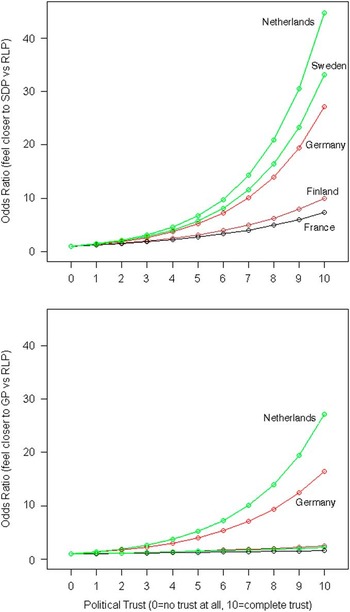
Figure 3 visualizes the odds of an individual to support SDP rather than RLP (top figure) and the odds to support GP rather than RLP (bottom figure). The expectation is that very trustful individuals (i.e. scoring 9 or 10 on the trust scale) have 40 times larger odds to support SDP compared with RLP in the Netherlands. The results are similar for Sweden and Germany, although the odds ratio is somewhat smaller compared with the Netherlands. Similarly, more trustful individuals (i.e. scoring 9 or 10 on the trust scale) in the Netherlands and in Germany have 30 and 20 times larger odds to support GP compared with RLP. In order to exclude the possibility of an endogeneity problem – that the respondents for these parties distrust the institutions because their own parties are not included in them – we consider the trust–SDP relationship in the five countries as a method for cross-checking our results on trust. As in all five countries both the radical left and the Social Democrats were in opposition in 2007 (when the ESS data were collected), it seems highly unlikely that RLPSs’ lack of trust compared with SDPSs’ was caused by their absence from government.
The odds ratio to feel closer to social democratic party (SDP) (top figure) or green party (GP) (bottom figure) rather than the radical left party (estimates derived from Table 4).

Age has a statistically significant contribution in three countries as regards RLPSs–SDPSs comparisons and in three countries as regards RLPSs–GPSs comparisons. For RLPSs–GPSs, older people are more likely to feel closer to RLP; however, as regards the RLPSs–SDPSs comparisons, older people are more likely to feel closer to SDP. Religion is significant in Germany and Finland; in the former, Catholics and Protestants feel closer to GPs and SDPs rather than RLPs and in the latter they feel closer to SDPs rather than RLPs. Education is significant in Finland and France where more educated individuals are more likely to support SDPs and GPs.
Moreover, income is now not important in most countries; its coefficient is significant in Germany for RLPSs–SDPSs and RLPSs–GPSs comparisons, and in Sweden for RLPSs–SDPSs comparisons (wealthier individuals are less likely to feel closer to RLP). Gender does not contribute at all towards differentiating between RLPSs and the other parties’ supporters. It has not been found to be statistically significant in any of the countries studied. Unemployment and type of occupation (e.g. managerial position or simply a low-level employee) are not significant in any of the countries.
To sum up this section, rarely do RLPSs differ from both GPSs and SDPSs on the same variables. The general expectation that RLPSs differ from SDPSs or GPSs depending on the issue divide in question is clearly vindicated. In addition, all three attitudinal axes embody significant distinctions in terms of either RLPSs–GPSs or RLPSs–SDPSs comparisons. Socio-demographic characteristics seem to be less important – compared with the attitudinal variables – for the most part.
Conclusions
Our findings provide considerable support for all but the fourth hypothesis, suggesting that left party families across Western Europe do reflect certain lines of division in society, albeit with qualifications. RLPSs have more ‘radical’ positions than SDPSs and GPSs in what concerns government action and desired goals but not in terms of abstract values; RLPSs take more ‘moderate’ attitudes on the new politics axis than GPSs; RLPSs exhibit more distrust than SDPSs; albeit not fully, RLPSs are less educated and older than GPSs; RLPs are not supported by women more than SDPs and GPs; RLPSs do not differ from SDPSs and GPSs in terms of religion. To appreciate these demarcations and qualifications, it is useful to briefly contextualize the cross-country patterns that emerge and consider the ways in which they contribute to the better understanding of RLPs and refine cleavage research.
On all three axes of conflict tested RLPSs exhibit differences from either SDPSs or GPSs. The analysis provides important evidence that our threefold distinction within the context of the economic left-right axis that is based on the differentiation between ideals and their effects on reality has an empirical face. As expected, these components differently influence the likelihood of supporting an RLP, especially compared with the likelihood of supporting an SDP. RLPSs are generally more ‘radical’ than SDPSs on the government’s actions but not the idealism or pragmatism component of the left-right axis (expect in Germany and Sweden, respectively). From a methodological viewpoint, the broadness of the economic left-right axis as traditionally constructed in most related studies may be missing the detail needed to qualify the cleavage decline that is often detected. By extension, taking note of the cognition processes entailed in attitude formation on issues of the economic left-right axis may help future studies pinpoint various attitudinal nuances in the processes of alignment and realignment.
Nevertheless, the main differences between RLPSs and SDPSs are with regard mostly to political trust. RLPSs exhibit more distrust than SDPSs. The importance of political trust revealed in this study may signify the gradual emergence of a third axis of ideological conflict in society. When this division came into being, and how durable it is likely to be, still remains to be explored, but the fact of the matter is that RLPs have a socially entrenched opportunity structure which they can exploit further.
Lastly, attitudes towards the environment are the main separating line between RLPSs and GPSs. Whereas the new politics axis as a whole plays a limited role in RLP support, RLPSs appear to attribute less significance to pro-environmental positions than GPSs. The older divisions that brought to life and sustained the new politics cleavage on the left now appear to concern only the environment at the societal level.
In so far as there appears to be cleavage-based support within the left, the attitudinal element is considerably more important than the structural one. The relatively negligible partisan relevance of socio-demographic characteristics makes evident that political conflicts within the left are rooted in ideological divides and have little to do with structural categories. In retrospect, we are inclined to argue that the enduring presence of distinct party families on the left must not be understood to reflect structural currents in society.
Future research on the radical left, and the left more broadly, can seek to understand those aspects of left party support that cannot be captured by considerations grounded in traditional cleavage theory. One way forward would be to extend the search into areas currently receiving little attention, such as the personal credentials of party leaders or (dis)satisfaction with the economy. An additional avenue would be to consider if, and in what manner, dynamics at the political level lead to attitudinal and structural variation among left party supporters.
Acknowledgements
The authors thank Antonis Ellinas and the anonymous referees for useful comments on previous drafts. In the original stages of the research, G. C. also benefited from discussions with Hideko Matsuo, Geert Loosveldt, Jaak Billiet, and Bart Meuleman during a research visit at the Centrum voor Sociologisch Onderzoek (CeSO), K.U. Leuven.
Supplementary Material
To view supplementary materials for this article, please visit http://dx.doi.org/doi:10.1017/S1755773915000429