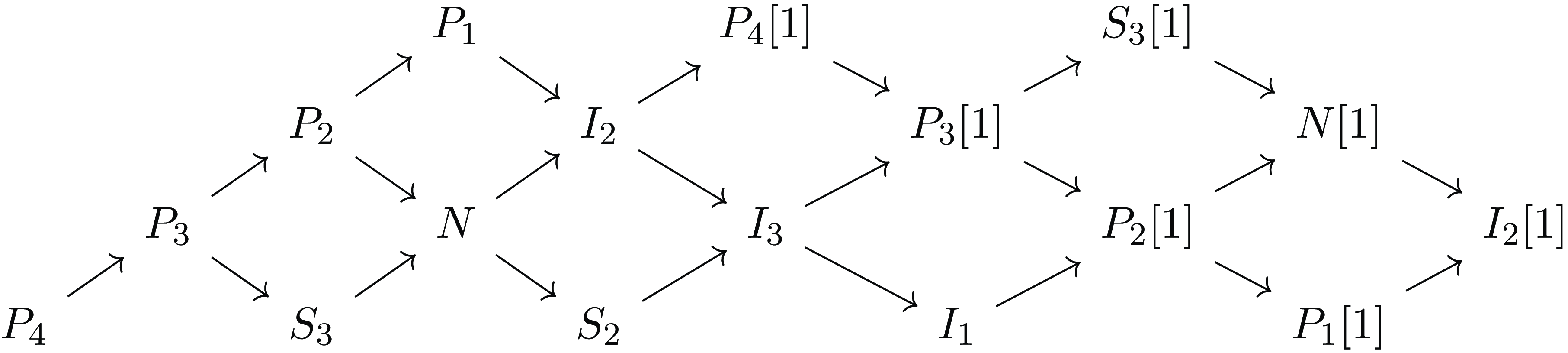
1. Introduction
In groundbreaking work, Cline–Parshall–Scott [Reference Cline, Parshall and Scott18] proved that there is a one-to-one correspondence between equivalence classes of highest weight categories with finitely many simple objects and Morita equivalence classes of quasi-hereditary algebras (see [Reference Cline, Parshall and Scott18, Thm. 3.6]). Consequently, a strong connection between representation theory of Lie algebras and that of finite-dimensional algebras was established. Indeed, since then highest weight categories have attracted large interest in representation theory (see e.g. [Reference Bellamy and Thiel5, Reference Bezrukavnikov and Etingof10, Reference Coulembier21, Reference Doty23, Reference Guay29]). Another very interesting result in [Reference Cline, Parshall and Scott18] was the Brauer-Humphreys reciprocity theorem [Reference Cline, Parshall and Scott18, Thm. 3.11], which is an instance of the Jordan-Hölder phenomenon. Using the dimensions of some
 $\operatorname {Hom}\nolimits$
-spaces, it was shown that the number of times an object
 $A_{\lambda }$
appears as a composition factor in a good filtration of a filtered object
 $I_{\lambda }$
is independent of the chosen good filtration. A similar result is obtained in [Reference Cline, Parshall and Scott19, Thm. 3.4.7] using ranks of bilinear forms. Only later was a more general proof of why these multiplicities are independent of a chosen filtration in module categories given by Erdmann–Sáenz [Reference Erdmann and Sáenz27]. One of the main aims of our article is to extend this approach and, in particular, study length and the Jordan-Hölder property in extriangulated categories.
The notion of a stratifying system was introduced in [Reference Erdmann and Sáenz27] for module categories, providing a way to generate examples of standardly stratified algebras in the sense of Xi [Reference Xi60] (see also [Reference Ágoston, Happel, Lukács and Unger3, Reference Cline, Parshall and Scott19, Reference Dlab and Ringel22]). These algebras generalise quasi-hereditary algebras, which were introduced by Scott [Reference Scott51]. Similar systems for certain exact categories had already been considered in [Reference Brüstle and Hille15, Lem. 2.3], and the notion of a stratifying system has also been developed by Mendoza–Santiago [Reference Mendoza and Santiago44] and Santiago [Reference Santiago50] for triangulated and exact categories, respectively. Building on this work and generalising several results, we study stratifying systems in the realm of extriangulated categories. Independently, Adachi–Tsukamoto [Reference Adachi and Tsukamoto2] have recently investigated similar concepts in the extriangulated setting, namely those of mixed standardisable sets; see Remark 4.6.
Extriangulated categories were defined by Nakaoka–Palu [Reference Nakaoka and Palu45], and unify exact and triangulated frameworks. Suppose
 $({\mathcal{A}},{\mathbb{E}},{\mathfrak{s}})$
is an Artin extriangulated category (see Definition 4.1). Recall that
 $({\mathcal{A}},{\mathbb{E}},{\mathfrak{s}})$
being extriangulated means that
 $\mathcal{A}$
is an additive category and that
 ${\mathbb{E}}\colon {\mathcal{A}}^{\mathrm{op}} \times {\mathcal{A}} \to {\operatorname {\mathsf{Ab}}\nolimits }$
is a biadditive functor to the category of abelian groups. Given an element
 $\delta \in {\mathbb{E}}(C,A)$
, the realisation
 $\mathfrak{s}$
assigns to
 $\delta$
an equivalence class
 of a pair of composable morphisms in
 $\mathcal{A}$
. This is denoted by the extriangle
 In Section 2.1, we recall the basics and a recent characterisation of extriangulated categories with a weakly idempotent complete underlying additive category; see Proposition 2.5.
We call a set
 $\Phi = \{\Phi _{i}\}_{i=1}^{n}$
of indecomposable objects of
 $\mathcal{A}$
an
 $\mathbb{E}$
-stratifying system if it satisfies some
 $\operatorname {Hom}\nolimits$
- and
 $\mathbb{E}$
-orthogonality; see Definition 4.3. Given such a collection of objects, it is natural to consider the full subcategory
 ${\mathcal{F}}(\Phi )$
of
 $\mathcal{A}$
consisting of the
 $\Phi$
-filtered objects, that is the objects
 $M\in {\mathcal{A}}$
admitting a
 $\Phi$
-filtration

in
 $({\mathcal{A}},{\mathbb{E}},{\mathfrak{s}})$
, with
 $\Phi _{j_{i}} \in \Phi$
for
 $1\,{\leqslant}\, i\,{\leqslant}\, t$
. The objects
 $\Phi _{j_{i}}$
in the filtration can sometimes be thought of as “composition factors”; see Corollary 3.8. Studying filtered objects has a long tradition in module categories (e.g. [Reference Conde20, Reference Koenig, Külshammer and Ovsienko39, Reference Ringel48]), and in particular one notices that a filtration by simple modules is the same as a composition series. Filtrations of objects also appear in triangulated [Reference Bridgeland12, Reference Mendoza and Santiago44], exact [Reference Santiago50], and extriangulated [Reference Zhou61] categories. A categorical perspective on the module case has been taken by Bodzenta–Bondal [Reference Bodzenta and Bondal11] recently.
It is shown by Zhou [Reference Zhou61] that
 ${\mathcal{F}}(\Phi )$
is extension-closed in
 $({\mathcal{A}},{\mathbb{E}},{\mathfrak{s}})$
(see Remark 2.11 (iii)). Since extension-closed subcategories of exact categories are again exact, we see that
 ${\mathcal{F}}(\Phi )$
would inherit an exact structure if
 $({\mathcal{A}},{\mathbb{E}},{\mathfrak{s}})$
were exact. Thus, the subcategories of
 $\Phi$
-filtered objects studied in [Reference Santiago50] are again exact. Furthermore, the systems considered in [Reference Mendoza and Santiago44] for triangulated categories and in [Reference Adachi and Tsukamoto2] for the extriangulated case are required to satisfy a condition that implies that
 ${\mathcal{F}}(\Phi )$
is an exact category; see the discussion in Remark 4.6. The reason for this somewhat strong restriction might be because extension-closed subcategories of triangulated categories are not necessarily triangulated. But this is where the utility of extriangulated category theory becomes especially apparent: extension-closed subcategories of triangulated categories are always extriangulated (see Example 2.4). Thus, for an
 $\mathbb{E}$
-stratifying system
 $\Phi$
in the extriangulated category
 $({\mathcal{A}},{\mathbb{E}},{\mathfrak{s}})$
, we have that
 ${\mathcal{F}}(\Phi )$
inherits an extriangulated structure, which we denote by
 $({\mathcal{F}}(\Phi ), {\left .{\mathbb{E}} \right |_{{\mathcal{F}}(\Phi )}},{\left .{\mathfrak{s}} \right |_{{\mathcal{F}}(\Phi )}})$
. Moreover, our axioms for
 $\Phi$
do not imply
 ${\mathcal{F}}(\Phi )$
is exact in general; see Section 5 for examples.
When
 $\Phi$
is an
 $\mathbb{E}$
-stratifying system, the elements of
 $\Phi = \{\Phi _{i}\}_{i=1}^{n}$
behave like simple objects in the subcategory
 ${\mathcal{F}}(\Phi )$
. Motivated by concepts used in [Reference Erdmann and Sáenz27, Reference Lanzilotta, Marcos, Mendoza and Sáenz42, Reference Mendoza and Santiago44, Reference Santiago50], we introduce projective
 $\mathbb{E}$
-stratifying systems which adds the data of projective-like objects in
 ${\mathcal{F}}(\Phi )$
. A projective
 $\mathbb{E}$
-stratifying system is a pair
 $(\Phi ,Q)$
, where
 $\Phi$
is an
 $\mathbb{E}$
-stratifying system and
 $Q = \{Q_{i}\}_{i=1}^{n}$
is a set of indecomposables in
 $\mathcal{A}$
that are
 $\left .{\mathbb{E}} \right |_{{\mathcal{F}}(\Phi )}$
-projective in
 ${\mathcal{F}}(\Phi )$
, such that for each
 $i$
there is an extriangle
 satisfying some axioms (see Definition 4.8 for more details). The morphism
 $q_{i}$
then behaves like a projective cover of
 $\Phi _{i}$
in
 ${\mathcal{F}}(\Phi )$
. If each
 $q_{i}$
is right minimal, then we call
 $(\Phi ,Q)$
a minimal projective
 $\mathbb{E}$
-stratifying system. We show the following.
Theorem A.
(Theorem
4.13
) Let
 $\Phi$
be an
 $\mathbb{E}$
-stratifying system in an Artin extriangulated category
 $({\mathcal{A}},{\mathbb{E}},{\mathfrak{s}})$
. Then there is a set
 $Q$
of objects in
 ${\mathcal{F}}(\Phi )$
, such that
 $(\Phi ,Q)$
is a minimal
 $\mathbb{E}$
-projective system.
Another core notion we consider in this article is the Jordan-Hölder property for filtrations; see Definition 3.1. Suppose
 $\Lambda$
is an arbitrary algebra, and that
 $\Phi$
is part of a projective stratifying system in the category of finite length left modules over
 $\Lambda$
. Using the dual of [Reference Erdmann and Sáenz27, Lem. 1.4], it can be seen that the subcategory
 ${\mathcal{F}}(\Phi )$
has the Jordan-Hölder property on
 $\Phi$
-filtrations. That is, any two
 $\Phi$
-filtrations for an object
 $M\in {\mathcal{F}}(\Phi )$
are equivalent, that is have the same length and the same “composition factors”, up to permutation and isomorphism. Analogous phenomena occur for projective stratifying systems in the triangulated [Reference Mendoza and Santiago44, Prop. 5.11] and exact [Reference Santiago50, Prop. 6.5] settings. The Jordan-Hölder property has been well studied for abelian categories, because the idea of length behaves nicely in this context. Indeed, if an object in an abelian category has a composition series, then all such composition series are equivalent and, in particular, have the same length. For a general exact category
 $({\mathcal{A}},{\mathcal{E}})$
, the idea of length relative to the exact structure
 $\mathcal{E}$
has been studied in [Reference Brüstle, Hassoun, Langford and Roy13, Reference Enomoto25]. It seems, however, that this kind of length is much better behaved when
 $({\mathcal{A}},{\mathcal{E}})$
is Jordan-Hölder, where one imposes that any two
 $\mathcal{E}$
-composition series of an object must be equivalent (see [Reference Brüstle, Hassoun and Tattar14, Def. 5.1]); compare, for example, [Reference Brüstle, Hassoun, Langford and Roy13, Thm. 6.6] and [Reference Brüstle, Hassoun and Tattar14, Cor. 7.2].
Given a projective
 $\mathbb{E}$
-stratifying system
 $(\Phi ,Q)$
in
 $({\mathcal{A}},{\mathbb{E}},{\mathfrak{s}})$
, we would like to show that
 ${\mathcal{F}}(\Phi )$
is (in some sense) a Jordan-Hölder extriangulated category. Such a notion would apply to triangulated categories as well. Unfortunately, the idea of length, and hence composition series, in a triangulated category is problematic due to the existence of triangles of the form
 (see the discussion in Section 3.2 following Definition 3.5). This could be a major reason why the Jordan-Hölder property has only very recently been discussed in the general context of extriangulated categories; see Wang–Wei–Zhang–Zhang [Reference Wang, Wei, Zhang and Zhang59], also Remark 3.2. In order to relate the Jordan-Hölder property on
 $\Phi$
-filtrations in
 ${\mathcal{F}}(\Phi )$
to the functor
 $\left .{\mathbb{E}} \right |_{{\mathcal{F}}(\Phi )}$
, we introduce and discuss
 $({\mathbb{E}},{\mathfrak{s}})$
-subobjects,
 $({\mathbb{E}},{\mathfrak{s}})$
-simple objects and
 $({\mathbb{E}},{\mathfrak{s}})$
-composition series; see Section 3. We call an extriangulated category
 $({\mathcal{A}},{\mathbb{E}},{\mathfrak{s}})$
Jordan-Hölder if it has the Jordan-Hölder property on
 $({\mathbb{E}},{\mathfrak{s}})$
-composition series, and length if each object admits an
 $({\mathbb{E}},{\mathfrak{s}})$
-composition series; see Definition 3.1. Our second main result is the following.
Theorem B.
(Corollary
4.18
) Suppose
 $(\Phi ,Q)$
is a minimal
 $\mathbb{E}$
-projective system in an Artin extriangulated category
 $({\mathcal{A}},{\mathbb{E}},{\mathfrak{s}})$
, such that
 ${\mathcal{A}}(Q_{i},-)$
is left exact on
 $({\mathcal{F}}(\Phi ),{\left .{\mathbb{E}} \right |_{{\mathcal{F}}(\Phi )}},{\left .{\mathfrak{s}} \right |_{{\mathcal{F}}(\Phi )}})$
for each
 $Q_{i}\in Q$
. Then
 $({\mathcal{F}}(\Phi ), {\left .{\mathbb{E}} \right |_{{\mathcal{F}}(\Phi )}},{\left .{\mathfrak{s}} \right |_{{\mathcal{F}}(\Phi )}})$
is length and Jordan-Hölder.
The final key notions we use are the Grothendieck group and monoid. Suppose
 $({\mathcal{A}},{\mathcal{E}})$
is a skeletally small, exact category. The Jordan-Hölder property is closely linked to the Grothendieck group
 $K_{0}({\mathcal{A}},{\mathcal{E}})$
of
 $({\mathcal{A}},{\mathcal{E}})$
: it is straightforward to check that if
 $({\mathcal{A}},{\mathcal{E}})$
is a Jordan-Hölder, length exact category, then
 $K_{0}({\mathcal{A}},{\mathcal{E}})$
is a free abelian group. However, the converse is not true; see [Reference Enomoto25, Exam. B]. This prompted Enomoto to study a related categorical invariant: the Grothendieck monoid
 $M({\mathcal{A}},{\mathcal{E}})$
of
 $({\mathcal{A}},{\mathcal{E}})$
as introduced in [Reference Berenstein and Greenstein9, Sec. 2.3]. It was shown that
 $({\mathcal{A}},{\mathcal{E}})$
is a Jordan-Hölder, length exact category if and only if
 $M({\mathcal{A}},{\mathcal{E}})$
is a free monoid (see [Reference Enomoto25, Thm. 4.12]). Following Berenstein–Greenstein [Reference Berenstein and Greenstein9], we extend the notion of a Grothendieck monoid to the extriangulated setting (see Definition 3.11); see also independent work of Enomoto–Saito [Reference Enomoto and Saito26]. We then characterise the Jordan-Hölder property for extriangulated categories in terms of the Grothendieck monoid, which is our final main result. We refer the reader to Section 3 for unexplained terms.
Theorem C. (Theorem 3.19) The following are equivalent for a skeletally small, weakly idempotent complete extriangulated category
 $({\mathcal{A}},{\mathbb{E}},{\mathfrak{s}})$
.
-
(i) The extriangulated category
 $({\mathcal{A}},{\mathbb{E}},{\mathfrak{s}})$
is length and Jordan-Hölder.
-
(ii) The Grothendieck monoid of
$({\mathcal{A}},{\mathbb{E}},{\mathfrak{s}})$
is free with basis in bijection with isoclasses of
$({\mathbb{E}}, {\mathfrak{s}})$
-simple objects. -
(iii) The Grothendieck group of
$({\mathcal{A}},{\mathbb{E}},{\mathfrak{s}})$
is free with basis in bijection with isoclasses of
$({\mathbb{E}}, {\mathfrak{s}})$
-simple objects.


In Section 5, we explore some examples. In particular, there are examples of projective stratifying systems in extriangulated categories that are not projective stratifying systems in exact or triangulated categories. We also give examples of Jordan-Hölder extriangulated categories: one arising from a stratifying system and one that does not. Furthermore, Enomoto–Saito [Reference Enomoto and Saito26] recently asked if a skeletally small extriangulated category is exact if and only if it has a reduced Grothendieck monoid, and we give an explicit counterexample; see Example 5.2 and Remark 5.3.
2. Preliminaries
2.1. Extriangulated categories
Extriangulated categories were introduced in [Reference Nakaoka and Palu45] as simultaneous generalisations of exact and triangulated categories. In this section, we recall some details of these categories and useful terminology, but for further details we refer the reader to [Reference Nakaoka and Palu45, Sec. 2]. We denote the category of all abelian groups by
 $\operatorname {\mathsf{Ab}}\nolimits$
.
Definition 2.1.
An extriangulated category is a triplet
 $({\mathcal{A}}, \mathbb{E}, {\mathfrak{s}})$
, where
 $\mathcal{A}$
is an additive category,
 $\mathbb{E}\colon {\mathcal{A}}^{\mathrm{op}} \times {\mathcal{A}} \to {\operatorname {\mathsf{Ab}}\nolimits }$
is a biadditive functor, and
 $\mathfrak{s}$
is an additive realisation of
 $\mathbb{E}$
(see [Reference Nakaoka and Palu45, Def. 2.10]), such that axioms (ET3), (ET3)
 $^{{op}}$
, (ET4) and (ET4)
 $^{{op}}$
as stated in [45, Def. 2.12] are all satisfied.
Suppose
 $({\mathcal{A}},{\mathbb{E}},{\mathfrak{s}})$
is an extriangulated category. For all pairs of objects
 $A,C\in {\mathcal{A}}$
, an element
 $\delta \in \mathbb{E}(C,A)$
is called an extension. The realisation
 $\mathfrak{s}$
(see [Reference Nakaoka and Palu45, Def. 2.9]) assigns to each extension
 $\delta \in \mathbb{E}(C,A)$
an equivalence class

where
-
(i)
is a sequence of composable morphisms in
$\mathcal{A}$
; and -
(ii) sequences
and in
$\mathcal{A}$
are said to be equivalent if there is an isomorphism
$g\colon B\to B'$
such that the diagram(2.2)commutes (see [Reference Nakaoka and Palu45, Def. 2.7]).
 is a sequence of composable morphisms in

 and
 in


Let
 $\delta \in \mathbb{E}(C,A)$
be an extension. If (2.1) holds, then
 $a$
(resp.
 $b$
) is called an inflation (resp. deflation), and the pair
 is called an extriangle. Moreover, this is denoted by the diagram
 . Given morphisms
 $x\colon A\to X$
and
 $z\colon Z\to C$
, we obtain new extensions
 $x_{*}\delta \,:\!= {\mathbb{E}}(C,x)(\delta )$
and
 $x^{*}\delta \,:\!= {\mathbb{E}}(z,A)(\delta )$
. If
 $\varepsilon \in {\mathbb{E}}(C',A')$
is an extension, then a morphism of extensions is a pair
 $(f,h)$
, where
 $f\colon A\to A'$
and
 $h\colon C\to C'$
are morphisms in
 $\mathcal{A}$
, such that
 $f_{*}\delta = h^{*}\varepsilon$
. By a morphism of extriangles, we mean a commutative diagram

where
 $(f,h)\colon \delta \to \varepsilon$
is a morphism of extensions.
It follows from Yoneda’s Lemma that there is a natural transformation
 $\delta ^{\sharp }\colon {\mathcal{A}}(A,-) \Rightarrow {\mathbb{E}}(C,-)$
given by
 $(\delta ^{\sharp })_{X}(x) \,:\!= x_{*}\delta = \mathbb{E}(C,x)(\delta )\in \mathbb{E}(C,X)$
for a morphism
 $x\colon A\to X$
. There is a dually defined natural transformation
 $ \delta _{\sharp }\colon {\mathcal{A}}(-,C) \Rightarrow {\mathbb{E}}(-,A)$
(see [Reference Nakaoka and Palu45, Def. 3.1]). More importantly, these fit into the exact sequences

and

in
 $\operatorname {\mathsf{Ab}}\nolimits$
for each
 $Z\in {\mathcal{A}}$
(see [Reference Nakaoka and Palu45, Cor. 3.12]).
We recall some typical examples of extriangulated categories.
Example 2.2.
[Reference Nakaoka and Palu45, Prop. 3.22] Suppose
 $\mathcal{A}$
is a triangulated category with suspension functor
 $[<xref ref-type="bibr" rid="ref1">1</xref>]$
. Then the triplet
 $({\mathcal{A}},{\mathbb{E}},{\mathfrak{s}})$
is an extriangulated category, where:
-
(i)
${\mathbb{E}}(-,-) = {\mathcal{A}}(-,-[<xref ref-type="bibr" rid="ref1">1</xref>])$
; and
-
(ii) for
$\delta \in {\mathbb{E}}(C,A) = {\mathcal{A}}(C,A[<xref ref-type="bibr" rid="ref1">1</xref>])$
, the realisation
$\mathfrak{s}$
is defined as follows: we complete
$\delta$
to a triangle , then set


 , then set

Example 2.3.
[Reference Nakaoka and Palu45, Exam. 2.13] Suppose
 $\mathcal{A}$
, equipped with a class
 $\mathcal{E}$
of short exact sequences, is an exact category. Let
 $A,C\in {\mathcal{A}}$
, and set
 ${\mathbb{E}}(C,A) \,:\!= \operatorname {Ext}\nolimits _{{\mathcal{E}}}(C,A)$
to be the collection of all sequences in
 $\mathcal{E}$
of the form
 modulo the equivalence relation defined in Definition 2.1 (ii). In order to define a functor
 ${\mathbb{E}} = \operatorname {Ext}\nolimits _{{\mathcal{E}}} \colon {\mathcal{A}}^{\mathrm{op}}\times {\mathcal{A}} \to {\operatorname {\mathsf{Ab}}\nolimits }$
, we must assume here that
 ${\mathbb{E}}(C,A)$
is a set for all
 $A,C$
. This is the case, for example, when
 $\mathcal{A}$
is skeletally small, or when
 $\mathcal{A}$
has enough projectives or enough injectives. With this set-theoretic assumption, we can use the existence of pushouts of inflations, pullbacks of deflations, and the Baer sum to ensure
 $\mathbb{E}$
is a biadditive functor. The realisation
 $\mathfrak{s}$
is canonical: if
 is an extension set
 ${\mathfrak{s}}(\delta ) = \delta$
. It follows that
 $({\mathcal{A}},{\mathbb{E}},{\mathfrak{s}})$
is an extriangulated category.
We recall some notation from [Reference Liu and Nakaoka43, Def. 1.17]. For any two classes
 $\mathcal{X}$
,
 $\mathcal{Y}$
of objects of
 $\mathcal{A}$
, we denote by
 ${\mathcal{X}} \ast \mathcal{Y}$
the class of all objects
 $A$
in
 $\mathcal{A}$
for which there exists an extriangle

with
 $X \in {\mathcal{X}}$
and
 $Y \in \mathcal{Y}$
. We consider
 ${\mathcal{X}} \ast \mathcal{Y}$
as a full subcategory of
 $\mathcal{A}$
. Note also that the
 $\ast$
operation is associative: for classes
 $\mathcal{X}$
,
 $\mathcal{Y}$
and
 $\mathcal{Z}$
of objects of
 $\mathcal{A}$
, we have
 $({\mathcal{X}} \ast \mathcal{Y}) \ast \mathcal{Z} = {\mathcal{X}} \ast (\mathcal{Y} \ast \mathcal{Z})$
; see [Reference Zhou61, Lem. 3.9]. Lastly, a full additive subcategory
 ${\mathcal{X}}\,\subseteq\, {\mathcal{A}}$
that is closed under isomorphisms is called extension-closed if
 ${\mathcal{X}} \ast {\mathcal{X}} \subseteq {\mathcal{X}}$
.
Example 2.4.
It was shown in [Reference Nakaoka and Palu45] that an extension-closed subcategory
 $\mathcal{B}$
of an extriangulated category
 $({\mathcal{A}},{\mathbb{E}},{\mathfrak{s}})$
is again extriangulated; see [Reference Nakaoka and Palu45, Def. 2.17, Rem. 2.18]. Define
 $\left .{\mathbb{E}} \right |_{{\mathcal{B}}}$
to be the restriction of
 $\mathbb{E}$
to
 ${\mathcal{B}}^{\mathrm{op}}\times {\mathcal{B}}$
. Since
 $\mathcal{B}$
is extension-closed, then we can restrict the realisation
 $\mathfrak{s}$
to
 $\left .{\mathbb{E}} \right |_{{\mathcal{B}}}$
in order to obtain an additive realisation
 $\left .{\mathfrak{s}} \right |_{{\mathcal{B}}}$
of
 $\left .{\mathbb{E}} \right |_{{\mathcal{B}}}$
. In this way,
 $({\mathcal{B}}, {\left .{\mathbb{E}} \right |_{{\mathcal{B}}}},{\left .{\mathfrak{s}} \right |_{{\mathcal{B}}}})$
is an extriangulated category.
A prominent example of this latter kind is discussed in [Reference Padrol, Palu, Pilaud and Plamondon46, Sec. 4.6]: Let
 $\Lambda$
be an Artin algebra. The homotopy category
 $K^b(\operatorname {\mathsf{proj}}\nolimits \Lambda )$
of bounded complexes of finitely generated projective modules over
 $\Lambda$
is a triangulated category and hence extriangulated. The full subcategory
 ${\mathcal{A}} = K^{[-1,0]}(\operatorname {\mathsf{\!proj}}\nolimits \Lambda )$
of complexes concentrated in degrees
 $-1$
and
 $0$
is extension-closed, thus an extriangulated category.
In the sequel, we will often concern ourselves with extriangulated categories
 $({\mathcal{A}}, \mathbb{E}, {\mathfrak{s}})$
whose underlying additive category
 $\mathcal{A}$
is Krull-Schmidt, that is, each object in
 $\mathcal{A}$
decomposes into a finite direct sum of indecomposable objects having local endomorphism rings and that this decomposition is unique up to isomorphism and permutation of summands. It follows from [Reference Krause40, Cor. 4.4] that every Krull-Schmidt category is weakly idempotent complete, that is, every retraction admits a kernel. One may think of a weakly idempotent complete category as one that contains complements of direct summands that already exist in the category; see [Reference Henrard and van Roosmalen32, Appx. A] or [Reference Klapproth, Msapato and Shah38, Sec. 2], for more discussion. Note that any triangulated category is weakly idempotent complete.
We close this subsection with several results that will be useful in later sections. The first is a characterisation of weakly idempotent completeness through the lens of extriangulated category theory. For this, we recall a certain condition defined in [Reference Nakaoka and Palu45, Cond. 5.8]. An extriangulated category
 $({\mathcal{A}},{\mathbb{E}},{\mathfrak{s}})$
is said to satisfy the (WIC) condition if, for composable morphisms
 $f,g$
, we have
 $gf$
is an inflation (resp. deflation) implies
 $f$
is an inflation (resp.
 $g$
is a deflation). The characterisation combines a result that appears in the PhD thesis [Reference Tattar56] of the fourth author and a result of Klapproth [Reference Klapproth37].
Proposition 2.5.
Let
 $({\mathcal{A}}, {\mathbb{E}}, {\mathfrak{s}})$
be an extriangulated category. Then the following statements are equivalent.
-
(i)
$\mathcal{A}$
is weakly idempotent complete.
-
(ii) Every retraction in
$\mathcal{A}$
is a deflation in
$({\mathcal{A}}, {\mathbb{E}}, {\mathfrak{s}})$
. -
(iii) Every section in
$\mathcal{A}$
is an inflation in
$({\mathcal{A}}, {\mathbb{E}}, {\mathfrak{s}})$
. -
(iv)
$({\mathcal{A}}, {\mathbb{E}}, {\mathfrak{s}})$
satisfies (WIC).


Proof.
(i)
 $\Rightarrow$
(ii) Let
 $r\,:\, B \to C$
be a retraction with corresponding section
 $s\colon C \to B$
(so that
 $rs= \mathrm{id}_{C}$
) and let
 $k\colon K \to B$
be a kernel of
 $r$
, which exists by assumption. It follows that
 $(k \ s)\,\colon K\oplus C \to B$
is an isomorphism (see [Reference Bühler16, Rem. 7.4]). Then we have a commutative diagram

which is an equivalence of composable morphisms (see (2.2)). Our claim follows since the upper sequence is always an extriangle [Reference Nakaoka and Palu45, Rem. 2.11].
(ii)
 $\Rightarrow$
(i) Let
 $r\colon B \to C$
be a retraction and suppose that there is an extriangle
 in
 $({\mathcal{A}}, {\mathbb{E}}, {\mathfrak{s}})$
. Note that this already implies
 $x$
is a weak kernel of
 $r$
by [Reference Nakaoka and Palu45, Prop. 3.3(2)]. Let
 $s\colon C \to B$
be a morphism in
 $\mathcal{A}$
with
 $rs=\mathrm{id}_{C}$
. Then we apply (ET3) to obtain the morphism

of extriangles. By the commutativity of the right hand square, we have that
 $ (0 \ c) = r (x \ s) = (0 \, \,\mathrm{id}_{C})$
, whence
 $c = \mathrm{id}_{C}$
. It follows from [Reference Nakaoka and Palu45, Cor. 3.6] that
 $(x \ s) \colon A \oplus C \to B$
is an isomorphism, and we deduce that
 $x$
is a monomorphism as the composite of two monomorphisms. Thus,
 $x$
is a kernel of
 $r$
.
The equivalence of (i) and (iii) is similar. The equivalence of (i) and (iv) is [Reference Klapproth37, Prop. 2.7].
The following definition is a special case of [Reference Klapproth, Msapato and Shah38, Def. 4.31].
Definition 2.6.
An extriangulated category
 $({\mathcal{A}}, {\mathbb{E}}, {\mathfrak{s}})$
is called weakly idempotent complete if the underlying additive category
 $\mathcal{A}$
is weakly idempotent complete in the usual sense, and hence
 $({\mathcal{A}}, {\mathbb{E}}, {\mathfrak{s}})$
satisfies the equivalent conditions from Proposition
2.5
.
For the remaining technical results, we recall the additive structure in the category of extriangles. Let
 $A,A',C,C'$
be objects of an extriangulated category
 $({\mathcal{A}},{\mathbb{E}},{\mathfrak{s}})$
. We denote by
 ${}_{A}0_{C}$
the split extension (i.e. the abelian group identity) in
 ${\mathbb{E}}(C,A)$
. Let
 $\delta \in {\mathbb{E}}(C,A)$
and
 $\delta '\in {\mathbb{E}}(C',A')$
be any extensions. Following [Reference Nakaoka and Palu45, Def. 2.6], we use the notation
 $\delta \oplus \delta '$
for the extension in
 ${\mathbb{E}}(C\oplus C',A\oplus A')$
corresponding to the element
 $(\delta ,0,0,\delta ')$
under the natural isomorphism
 \begin{equation} {\mathbb{E}}(C\oplus C',A\oplus A') \cong {\mathbb{E}}(C,A) \oplus {\mathbb{E}}(C,A') \oplus {\mathbb{E}}(C',A) \oplus {\mathbb{E}}(C',A'). \end{equation}
The category of
 $\mathbb{E}$
-extensions
 ${\mathbb{E}}\operatorname {-Ext}\nolimits ({\mathcal{A}})$
has as its objects all the
 $\mathbb{E}$
-extensions, and as its morphisms the morphisms of extensions in the usual sense; see [Reference Nakaoka and Palu45, Sec. 2.1]. It can be shown that
 ${\mathbb{E}}\operatorname {-Ext}\nolimits ({\mathcal{A}})$
is an additive category with this direct sum of extensions; see [Reference Bennett-Tennenhaus, Haugland, Sandøy and Shah6, Prop. 3.2]. Furthermore, this operation induces an additive structure on the category of extriangles (see [Reference Herschend, Liu and Nakaoka33, Rem. 2.14, Prop. 3.3]) as follows. If
 and
 are extriangles, then their direct sum is given by
 The following lemmas yield a generalised version of [Reference Adachi and Tsukamoto2, Lem. 2.2] to the weakly idempotent complete setting.
Lemma 2.7.
Let
 $({\mathcal{A}}, {\mathbb{E}}, {\mathfrak{s}})$
be a weakly idempotent complete extriangulated category. Then any extriangle of the form

is isomorphic to

where there is an isomorphism
 $(x \ s) \colon B_{1} \oplus A' \overset {\cong }{\longrightarrow }A$
.
Proof.
Since
 $(0 \ b_{2}) = b_{2}\circ (0 \ \mathrm{id}_{B_{2}})$
is a deflation, we know that
 $b_{2}$
is a deflation by (WIC) as
 $({\mathcal{A}}, {\mathbb{E}}, {\mathfrak{s}})$
is weakly idempotent complete (see Proposition 2.5). Thus, there is an extriangle of the form
 Taking the direct sum with
 and applying (ET
 $3)^{\mathrm{op}}$
, there is a morphism of extriangles

where
 $(x,s)$
is an isomorphism by [Reference Nakaoka and Palu45, Cor. 3.6]. By commutativity of the diagram above, we see
 $a = a_{2}s$
and we are done.
Lemma 2.8.
Let
 $({\mathcal{A}}, {\mathbb{E}}, {\mathfrak{s}})$
be a weakly idempotent complete extriangulated category. Then any extriangle of the form

is isomorphic to 
Proof.
Since
 $\mathfrak{s}$
is an additive realisation, we know that
 $ (0 \ \mathrm{id}_{C_{2}}) \colon C_{1}\oplus C_{2} \to C_{2}$
is a deflation. Since
 $(0 \ g_{2}) = (0 \ \mathrm{id}_{C_{2}}) \circ \begin{pmatrix}g_{1} \quad 0\\ 0 \quad g_{2}\end{pmatrix}$
is the composition of deflations, it is a deflation itself by [Reference Nakaoka and Palu45, Rem. 2.16]. Like in the proof of Lemma 2.7, it then follows that
 $g_{2}$
is a deflation and we have an extriangle of the form
 By symmetry, we also have an extriangle
 . Using (ET
 $3)^{\mathrm{op}}$
and [Reference Nakaoka and Palu45, Cor. 3.6], we obtain an isomorphism of extriangles

which completes the proof.
The last result of this subsection is an analogue of [Reference Iyama and Yoshino34, Prop. 2.1] for a Krull-Schmidt extriangulated category, which was first shown in [Reference Adachi and Tsukamoto2, Lem. 2.5(2)]. We include full details of the proof for convenience.
Lemma 2.9.
Let
 $({\mathcal{A}}, {\mathbb{E}}, {\mathfrak{s}})$
be a Krull-Schmidt extriangulated category Suppose
 ${\mathcal{X}}, \mathcal{Y}$
are subcategories of
 $\mathcal{A}$
that are closed under direct summands. If
 ${\mathcal{A}}({\mathcal{X}}, \mathcal{Y}) = 0$
, then
 ${\mathcal{X}} \ast \mathcal{Y}$
is closed under direct summands.
Proof.
Assume that
 $Z \,:\!= Z_{1} \oplus Z_{2} \in {\mathcal{X}} \ast \mathcal{Y}$
. Since
 $Z\in {\mathcal{X}}\ast \mathcal{Y}$
, there is an extriangle

where
 $X\in {\mathcal{X}}$
and
 $Y\in \mathcal{Y}$
. Note that
 $f$
is a right
 $\mathcal{X}$
-approximation of
 $Z$
since
 ${\mathcal{A}}({\mathcal{X}},\mathcal{Y}) = 0$
.
If
 $f=0$
, then by the dual of Lemma 2.7, we have that (2.4) is isomorphic to

where
 $Z_{1} \oplus Y' \cong Y$
. We see that
 $Z_{1}\in \mathcal{Y}$
because
 $\mathcal{Y}$
is closed under direct summands. By symmetry, we also have
 $Z_{2}\in \mathcal{Y}$
. Noting that
 $\mathcal{Y}\subseteq {\mathcal{X}}\ast \mathcal{Y}$
concludes the case when
 $f=0$
.
Thus, now assume
 $f\neq 0$
. By [Reference Krause and Saorín41, Cor. 1.4], we may assume that
 $f$
is of the form
 $ (f' \ f'') \colon X'\oplus X'' \to Z$
, where
 $f'\neq 0$
is right minimal and
 $f''=0$
. So, as
 $f = (f' \ 0 )$
and
 $\begin{pmatrix}\mathrm{id}_{X'}\\ 0 \end{pmatrix}\colon X' \to X'\oplus X''$
are inflations, we see that
 $f' = f\circ \begin{pmatrix}\mathrm{id}_{X'} \\ 0\end{pmatrix}$
is an inflation by [Reference Nakaoka and Palu45, Rem. 2.16]. Furthermore, since
 $\mathcal{X}$
is closed under direct summands, we have
 $X'\in {\mathcal{X}}$
and
 $f'\colon X'\to Z$
is a minimal right
 $\mathcal{X}$
-approximation of
 $Z$
. Moreover, we have that there is an extriangle

where
 $Y'$
is a direct summand of
 $Y$
and hence
 $Y'\in \mathcal{Y}$
.
Note that the compositions
 $(\mathrm{id}_{Z_{1}} \ 0) \circ f' \colon X'\to Z_{1}$
and
 $(0 \ \mathrm{id}_{Z_{2}}) \circ f' \colon X'\to Z_{2}$
are both right
 $\mathcal{X}$
-approximations. First, assume
 $(\mathrm{id}_{Z_{1}}\,\,0) \, f' = 0$
. Then we may apply the dual of Lemma 2.7 to (2.5) to obtain an extriangle
 where
 $Z_{1} \oplus Y'' \cong Y'$
. In this case, we see that
 $Z_{1}\in \mathcal{Y}$
and
 $Z_{2}\in {\mathcal{X}}\ast \mathcal{Y}$
, and we are done. By symmetry, we are also done if
 $(0 \ \mathrm{id}_{Z_{2}}) f' = 0$
.
Therefore, assume now that both
 $(\mathrm{id}_{Z_{1}} \ 0) f'$
and
 $(0 \ \mathrm{id}_{Z_{2}}) f'$
are non-zero. In particular, we may take minimal right
 $\mathcal{X}$
-approximations
 $f_{1}\colon X_{1} \to Z_{1}$
and
 $f_{2}\colon X_{2} \to Z_{2}$
of
 $Z_{1}$
and
 $Z_{2}$
, respectively. This yields a minimal right
 $\mathcal{X}$
-approximation
 $f_{1}\oplus f_{2} \colon X_{1} \oplus X_{2} \to Z_{1}\oplus Z_{2}$
of
 $Z = Z_{1} \oplus Z_{2}$
. (Indeed, since
 $\mathcal{A}$
is Krull-Schmidt, by [Reference Krause and Saorín41, Cor. 1.4] there is a direct sum decomposition of
 $X_1 \oplus X_2 \cong A \oplus B$
such that
 $\left .(f_1 \oplus f_2) \right |_{A}$
is right minimal and
 ${\left .(f_1 \oplus f_2) \right |_{B}} = 0$
, so if
 $B \neq 0$
then this would contradicts the minimality of
 $f_1$
or
 $f_2$
.) This implies
 $f_{1}\oplus f_{2}$
is isomorphic to
 $f'$
by uniqueness of minimal approximations (see e.g. [Reference Auslander and Reiten4, Prop. 2.2]), and hence,
 $f_{1}\oplus f_{2}$
is an inflation. Using Lemma 2.8, we see that there are extriangles

where
 $Y_{1} \oplus Y_{2} \cong Y'$
. As
 $\mathcal{Y}$
is closed under direct summands, this implies
 $Z_{i}\in {\mathcal{X}}\ast \mathcal{Y}$
for
 $i=1,2$
.
2.2. Filtered objects
For this subsection, let
 $({\mathcal{A}},{\mathbb{E}},{\mathfrak{s}})$
denote an extriangulated category and let
 $\mathcal{X}$
be a (possibly empty) class of objects of
 $\mathcal{A}$
. We discuss the notion of
 $\mathcal{X}$
-filtered objects in
 $({\mathcal{A}},{\mathbb{E}},{\mathfrak{s}})$
as introduced in [Reference Zhou61], which generalises the corresponding notion for exact and triangulated categories found in [Reference Santiago50] and [Reference Mendoza and Santiago44], respectively.
Definition 2.10.
Let
 $M\in {\mathcal{A}}$
be an object. An
 $\mathcal{X}$
-filtration of
 $M$
is a sequence
 $\xi = (\xi _{0},\xi _{1},\ldots ,\xi _{t})$
of extriangles
 with
 $M_{-1} = M_{0} = X_{0} = 0$
,
 $M_{t} = M$
, and
 $X_{i} \in {\mathcal{X}}$
for all
 $1\,{\leqslant }\, i\,{\leqslant}\, t$
. We call
 $t$
the length of
 $\xi$
and such an
 $\mathcal{X}$
-filtration of
 $M$
is depicted as follows.

We say
 $M$
is
 $\mathcal{X}$
-filtered if it admits an
 $\mathcal{X}$
-filtration. We denote by
 ${\mathcal{F}}({\mathcal{X}})$
the full subcategory of
 $\mathcal{A}$
formed by all
 $\mathcal{X}$
-filtered objects of
 $\mathcal{A}$
.
Remark 2.11. Let us make some observations about Definition 2.10 .
-
(i) Any object
$M$
which has an
$\mathcal{X}$
-filtration of length
$t= 0$
is a zero object.
-
(ii) If
${\mathcal{X}} = \emptyset$
is empty, then we have that
${\mathcal{F}}({\mathcal{X}}) = \{0\}$
. -
(iii) The subcategory
${\mathcal{F}}({\mathcal{X}})$
is the smallest extension-closed subcategory of
$({\mathcal{A}}, {\mathbb{E}},{\mathfrak{s}})$
containing
$\mathcal{X}$
[Reference Zhou61, Lem. 3.2]. It follows from Example
2.4
that
$({\mathcal{F}}({\mathcal{X}}), {\left .{\mathbb{E}} \right |_{{\mathcal{F}}({\mathcal{X}})}},{\left .{\mathfrak{s}} \right |_{{\mathcal{F}}({\mathcal{X}})}})$
is an extriangulated category. In fact, it is an extriangulated subcategory of
$({\mathcal{A}}, {\mathbb{E}},{\mathfrak{s}})$
in the sense of Haugland [Reference Haugland30, Def. 3.7] and the canonical inclusion functor
${\mathcal{F}}({\mathcal{X}}) \hookrightarrow {\mathcal{A}}$
forms part of an extriangulated functor as defined in [Reference Bennett-Tennenhaus and Shah7, Def. 2.32].
-
(iv) The objects
$X_{1},\ldots ,X_{t}$
in
(2.6)
can be thought of as “composition factors” of
$M$
with respect to this specific
$\mathcal{X}$
-filtration, and we refer to them as the
$\mathcal{X}$
-factors or just the factors. However, it is not clear that these are unique up to isomorphism and permutation, that is that
${\mathcal{F}}({\mathcal{X}})$
has the Jordan-Hölder property. We show in Section
4
that
${\mathcal{F}}({\mathcal{X}})$
satisfies the Jordan-Hölder property whenever
$\mathcal{X}$
forms part of what we call a projective
$\mathbb{E}$
-stratifying system satisfying some mild assumption (see Theorem
4.17
).


Given subcategories
 $\mathcal{Y}$
and
 $\mathcal{Z}$
of
 $\mathcal{A}$
, we use the notation
 ${\mathcal{A}}(\mathcal{Y},\mathcal{Z}) = 0$
to mean
 ${\mathcal{A}}(Y,Z) = 0$
for all
 $Y\in \mathcal{Y}$
and
 $Z\in \mathcal{Z}$
. Similar notation is defined analogously. We use the following extriangulated version of [Reference Mendoza and Santiago44, Lem. 4.3] several times.
Lemma 2.12.
[Reference Zhou61, Lem. 3.3] Let
 $\mathcal{Y}$
and
 $\mathcal{Z}$
be full subcategories of
 $({\mathcal{A}},{\mathbb{E}},{\mathfrak{s}})$
.
-
(i) If
${\mathcal{A}}(\mathcal{Y},\mathcal{Z}) = 0$
, then
${\mathcal{A}}({\mathcal{F}}(\mathcal{Y}),{\mathcal{F}}(\mathcal{Z})) = 0$
. -
(ii) If
${\mathbb{E}}(\mathcal{Y},\mathcal{Z}) = 0$
, then
${\mathbb{E}}({\mathcal{F}}(\mathcal{Y}),{\mathcal{F}}(\mathcal{Z})) = 0$
.


3. The Grothendieck monoid and the Jordan-Hölder property
For an exact category, a characterisation of the Jordan-Hölder property in terms of Grothendieck monoids is given in [Reference Enomoto25, Sec. 4.3]. Our goal in this section is to prove an analogue for extriangulated categories. In Subsection 3.1, we motivate and define fundamental notions we will work with, and in Subsection 3.2, we introduce and study the Grothendieck monoid of an extriangulated category. This allows us to characterise the length Jordan-Hölder extriangulated categories using the language of Grothendieck monoids in Subsection 3.3. As noted in the introduction, some notions have been introduced independently in [Reference Enomoto and Saito26, Reference Wang, Wei, Zhang and Zhang59].
3.1. Jordan-Hölder extriangulated categories
To discuss some version of the Jordan-Hölder property for extriangulated categories, we need a notion of length. Following ideas from the triangulated and exact cases, Zhou [Reference Zhou61, Sec. 3] defines a length on an object
 $M\in {\mathcal{F}}({\mathcal{X}})$
with respect to the class of objects
 $\mathcal{X}$
in an extriangulated category
 $({\mathcal{A}},{\mathbb{E}},{\mathfrak{s}})$
; see also [Reference Mendoza and Santiago44, Sec. 4], [Reference Santiago50, Sec. 5]. The
 $\mathcal{X}$
-length
 $\ell _{{\mathcal{X}}}(M)$
of
 $M$
is defined to be the minimum of the set
 \begin{equation*} \left \{ t\in \mathbb{N} \,|\, \exists {\mathcal{X}}\text{-filtration } (\xi _{1},\ldots ,\xi _{t}) \text{ of } M \right \}. \end{equation*}
We note that there are parallels between the definition of
 $\mathcal{X}$
-length and the dimension of a triangulated category as defined in [Reference Rouquier49, Def. 3.2].
There is an immediate limitation of the
 $\mathcal{X}$
-length: it depends entirely on the class of objects
 ${\mathcal{X}}\subseteq {\mathcal{A}}$
. Indeed, if we take
 ${\mathcal{X}} = {\mathcal{A}}$
, then every non-zero object has
 $\mathcal{X}$
-length one – even
 $\ell _{{\mathcal{X}}}(M) = \ell _{{\mathcal{X}}}(M\oplus M)$
– which is not desirable. This illustrates the need to define a length which depends only on the extriangulated structure. In this paper, we will show that if the class
 $\mathcal{X}$
satisfies some conditions, then one may define a sensible
 $\mathcal{X}$
-length on the subcategory of
 $\mathcal{X}$
-filtered objects.
Throughout this subsection, let
 $({\mathcal{A}},{\mathbb{E}},{\mathfrak{s}})$
denote an extriangulated category. Part of the following definition generalises [Reference Brüstle, Hassoun, Langford and Roy13, Defs. 3.1, 3.3].
Definition 3.1.
-
(i) For objects
$A,B\in {\mathcal{A}}$
, we say that
$A$
is an
$({\mathbb{E}},{\mathfrak{s}})$
-subobject of
$B$
if there is an extriangle of the form
in
$({\mathcal{A}},{\mathbb{E}},{\mathfrak{s}})$
. -
(ii) A non-zero object
$S\in {\mathcal{A}}$
is called
$({\mathbb{E}},{\mathfrak{s}})$
-simple if, whenever there is an extriangle ,either
$a$
= 0 or
$a$
is an isomorphism.
-
(iii) We denote by
${\operatorname {\mathsf{Sim}}\nolimits }({\mathcal{A}},{\mathbb{E}},{\mathfrak{s}})$
the class of all
$({\mathbb{E}},{\mathfrak{s}})$
-simple objects of
$({\mathcal{A}},{\mathbb{E}},{\mathfrak{s}})$
. We call an
${\operatorname {\mathsf{Sim}}\nolimits }({\mathcal{A}},{\mathbb{E}},{\mathfrak{s}})$
-filtration (in the sense of Definition
2.10
) of an object
$M \in ({\mathcal{A}},{\mathbb{E}},{\mathfrak{s}})$
an
$({\mathbb{E}},{\mathfrak{s}})$
-composition series. Note these are finite by definition.
-
(iv) We say that
$({\mathcal{A}},{\mathbb{E}},{\mathfrak{s}})$
is a length extriangulated category if each object
$M\in {\mathcal{A}}$
has an
$({\mathbb{E}},{\mathfrak{s}})$
-composition series and the set of lengths of all
$({\mathbb{E}},{\mathfrak{s}})$
-composition series of
$M$
is bounded.
-
(v) We call two
$({\mathbb{E}},{\mathfrak{s}})$
-composition series
$(\xi _{0},\ldots ,\xi _{t})$
and
$(\xi '_{0},\ldots ,\xi '_{s})$
of an object equivalent if
$s=t$
and, up to a permutation of indices, the
$({\mathbb{E}},{\mathfrak{s}})$
-simple factors are isomorphic. We say
$({\mathcal{A}},{\mathbb{E}},{\mathfrak{s}})$
is a Jordan-Hölder extriangulated category if, for each object
$M\in {\mathcal{A}}$
, any two
$({\mathbb{E}},{\mathfrak{s}})$
-composition series of
$M$
are equivalent.


 in


 ,either


Remark 3.2.
Our definition of a simple object with respect to the extriangulated structure
 $({\mathbb{E}},{\mathfrak{s}})$
is more general than what is called ‘simple’ in [Reference Wang, Wei, Zhang and Zhang59, Sec. 3]. Indeed, our version allows for extriangles of the form
 ,which are commonplace in triangulated categories. However, both versions recover the notion of a simple object in an abelian category or in an exact category.
Accordingly, an
 $({\mathbb{E}},{\mathfrak{s}})$
-composition series (in the sense of Definition
3.1
) is more general than a ‘composition series’ in the sense of Wang–Wei–Zhang–Zhang. An extriangulated category is Jordan-Hölder and length in our sense if and only if it satisfies the ‘Jordan-Hölder property’ defined in [Reference Wang, Wei, Zhang and Zhang59, Def. 3.1] if one chooses
 $\mathcal{X}$
to be the collection of
 $({\mathbb{E}},{\mathfrak{s}})$
-simple objects.
Example 3.3.
Suppose
 $({\mathcal{A}},{\mathbb{E}},{\mathfrak{s}})$
is an abelian category. Then the notions defined in Definition
3.1
are equivalent to the classical ones for
 $\mathcal{A}$
. That is, an object in
 $\mathcal{A}$
is simple if and only if it is
 $({\mathbb{E}},{\mathfrak{s}})$
-simple, etc.
Example 3.4.
Suppose
 $({\mathcal{A}},{\mathbb{E}},{\mathfrak{s}})$
is an exact category
 $({\mathcal{A}},\mathscr{E})$
. Then the notions in Definition
3.1
(i)– (ii) agree with those defined in [Reference Brüstle, Hassoun, Langford and Roy13, Defs. 3.1, 3.3].
Since we cannot formally call a zero object in an additive category simple, we make the following definition.
Definition 3.5.
We say that a zero object
 $0\in {\mathcal{A}}$
is
 $({\mathbb{E}}, {\mathfrak{s}})$
-simple-like if, whenever there is an extriangle
 ,the
 $({\mathbb{E}},{\mathfrak{s}})$
-inflation
 $a$
is an isomorphism (equivalently,
 $A= 0$
).
Asking that
 $0$
is
 $({\mathbb{E}},{\mathfrak{s}})$
-simple-like is necessary for a length extriangulated category to have the Jordan-Hölder property (see Definition 3.1). Indeed, suppose that there is an extriangle
 in
 $({\mathcal{A}},{\mathbb{E}},{\mathfrak{s}})$
with
 $X \not \cong 0$
. For example, take
 $({\mathcal{A}},{\mathbb{E}},{\mathfrak{s}})$
to be a non-zero triangulated category (or an extension-closed subcategory thereof large enough to contain
 $X$
and
 $X[<xref ref-type="bibr" rid="ref1">1</xref>]$
), so that
 $Y \cong X[<xref ref-type="bibr" rid="ref1">1</xref>]$
. One obtains arbitrarily long filtrations

of
 $X$
by non-isomorphisms, which is an obstruction to the Jordan-Hölder property.
The following observation is due to Carlo Klapproth; it identifies a sufficiency condition for the zero object to be simple-like.
Proposition 3.6.
If
 $({\mathcal{A}},{\mathbb{E}},{\mathfrak{s}})$
has an
 $({\mathbb{E}},{\mathfrak{s}})$
-simple object
 $S$
, then
 $0$
must be
 $({\mathbb{E}},{\mathfrak{s}})$
-simple-like.
Proof.
Assume there is an extriangle  in
 $\mathcal{A}$
. Since
 is also an extriangle, we obtain the direct sum

As
 $S$
is
 $({\mathbb{E}},{\mathfrak{s}})$
-simple, the morphism
 $(0 \;\;\; \mathrm{id}_{S})$
is either zero or an isomorphism. It cannot be zero because
 $S$
is non-zero, and hence we have an isomorphism
 $(0 \;\; \mathrm{id}_{S}) \colon A\oplus S \to S$
. This implies there is a morphism
 $\begin{pmatrix}x\\y\end{pmatrix} \,\colon S \to A\oplus S$
, such that
 $\begin{pmatrix}\mathrm{id}_{A} \quad 0 \\ 0 \quad \mathrm{id}_{S}\end{pmatrix} = \begin{pmatrix}x \\ y \end{pmatrix} (0 \;\; \mathrm{id}_{S}) = \begin{pmatrix}0 \;\;\; x \\0 \;\;\; y\end{pmatrix}$
. Thus,
 $\mathrm{id}_{A} = 0$
and hence
 $A= 0$
. Therefore,
 $0$
is
 $({\mathbb{E}},{\mathfrak{s}})$
-simple-like.
The zero object being
 $({\mathbb{E}},{\mathfrak{s}})$
-simple-like has some nice consequences on the
 $({\mathbb{E}},{\mathfrak{s}})$
-simple objects in
 $\mathcal{A}$
and on the Grothendieck monoid. First, we see that
 $({\mathbb{E}},{\mathfrak{s}})$
-simples satisfy a stronger property that resembles the classical definition in an abelian category.
Lemma 3.7.
Suppose
 $({\mathcal{A}},{\mathbb{E}},{\mathfrak{s}})$
is weakly idempotent complete. The following are equivalent for a non-zero object
 $S\in {\mathcal{A}}$
.
-
(i)
$S$
is
$({\mathbb{E}},{\mathfrak{s}})$
-simple.
-
(ii) For each extriangle
, we have either
$A = 0$
or
$a$
is an isomorphism.
-
(iii) There does not exist an extriangle
with both
$A$
and
$C$
non-zero. That is,
$S$
is ‘simple’ in the sense of [Reference Wang, Wei, Zhang and Zhang59].


 , we have either


 with both


Proof. It is clear that (ii) implies (i).
(i)
 $\Rightarrow$
(ii): Suppose
 $S\neq 0$
is
 $({\mathbb{E}},{\mathfrak{s}})$
-simple and let

be an extriangle in
 $({\mathcal{A}},{\mathbb{E}},{\mathfrak{s}})$
. If
 $a$
is an isomorphism, then we are done, so suppose that
 $a=0$
. From the dual of Lemma 2.7, we deduce that (3.1) is isomorphic to the direct sum of two extriangles, with one of the form
 and the other of the form
 . Since
 $0$
is
 $({\mathbb{E}},{\mathfrak{s}})$
-simple-like by Proposition 3.6, we must have that
 $A=0$
.
(ii)
 $\Rightarrow$
(iii) : If there were an extriangle
 with both
 $A$
and
 $C$
non-zero, then
 $a$
would be an isomorphism by (ii) and
 $C$
would be zero, a contradiction.
(iii)
 $\Rightarrow$
(ii): Suppose
 is an extriangle. By (iii), either
 $A=0$
or
 $C=0$
. In the former, we are done immediately. The latter implies
 $a$
is an isomorphism, and we are also done.
Corollary 3.8.
Suppose
 $({\mathcal{A}},{\mathbb{E}},{\mathfrak{s}})$
is weakly idempotent complete. Let
 $\mathcal{X}$
be a class of non-zero objects of
 $\mathcal{A}$
. Then each
 $({\left .{\mathbb{E}} \right |_{{\mathcal{F}}({\mathcal{X}})}},{\left .{\mathfrak{s}} \right |_{{\mathcal{F}}({\mathcal{X}})}})$
-simple object
 $M\in {\mathcal{F}}({\mathcal{X}})$
is isomorphic to an object in
 $\mathcal{X}$
.
Proof.
If (2.6) is an
 $\mathcal{X}$
-filtration of
 $M\in {\mathcal{A}}$
, then we have
 $t\,{\geqslant }\,1$
and that there is an extriangle
 in
 ${\mathcal{F}}({\mathcal{X}})$
with
 $X_{t}\in {\mathcal{X}}$
. We deduce that
 $M_{t-1} = 0$
or that
 $a$
is an isomorphism by Lemma 3.7. The latter implies that
 $X_{t}$
is a zero object, which is contrary to our assumption on
 $\mathcal{X}$
. Thus, we see that
 $M_{t-1} = 0$
and hence
 $M\cong X_{t}$
.
The converse to Corollary 3.8 fails in general as
 $\mathcal{X}$
can contain redundancy, in the sense that it may contain the direct sum of two other objects already in
 $\mathcal{X}$
.
Proposition 3.9.
Suppose
 $({\mathcal{A}},{\mathbb{E}},{\mathfrak{s}})$
is weakly idempotent complete. The following are equivalent for an object
 $M\in {\mathcal{A}}$
.
-
(i)
$M$
is
$({\mathbb{E}},{\mathfrak{s}})$
-simple.
-
(ii)
$M$
has an
$({\mathbb{E}},{\mathfrak{s}})$
-composition series and every
$({\mathbb{E}},{\mathfrak{s}})$
-composition series of
$M$
has length
$1$
.


Proof.
(i)
 $\Rightarrow$
(ii): Suppose
 $\xi = (\xi _{0},\xi _{1},\ldots ,\xi _{t})$
from (2.6) is an
 $({\mathbb{E}},{\mathfrak{s}})$
-composition series of
 $M$
. If
 $t=0$
, then
 $M=0$
which is a contradiction. If
 $t=1$
, then we are done. Now assume for contradiction that
 $t\,{\geqslant }\, 2$
. From the
 $({\mathbb{E}},{\mathfrak{s}})$
-composition series
 $\xi$
, we see that there is an extriangle
 with
 $X_{t}$
an
 $({\mathbb{E}},{\mathfrak{s}})$
-simple. Since we are supposing
 $M$
is
 $({\mathbb{E}},{\mathfrak{s}})$
-simple, we have that
 $M_{t-1}$
is zero or
 $a$
is an isomorphism by Lemma 3.7. The latter would imply
 $X_{t} = 0$
, which is impossible, so we must have
 $M_{t-1}=0$
. In particular, we see that we have an extriangle
 , so
 $M_{t-2}$
is forced to be the zero object as
 $0$
is
 $({\mathbb{E}},{\mathfrak{s}})$
-simple-like by Proposition 3.6. This implies that
 $X_{t-1} = 0$
, which is a contradiction so
 $t \ngeqslant\, 2$
.
(ii)
 $\Rightarrow$
(i): By assumption,
 $M$
has an
 $({\mathbb{E}},{\mathfrak{s}})$
-composition series of length
 $1$
. That is, there is an
 ${\operatorname {\mathsf{Sim}}\nolimits }({\mathcal{A}},{\mathbb{E}},{\mathfrak{s}})$
-filtration of the form

in which
 $X_{1}$
is
 $({\mathbb{E}},{\mathfrak{s}})$
-simple. In particular,
 $M \cong X_{1}$
and
 $M$
is
 $({\mathbb{E}},{\mathfrak{s}})$
-simple.
3.2. The Grothendieck monoid of an extriangulated category
For the remainder of this section, we work under the following setup.
Setup 3.10.
By
 $({\mathcal{A}},{\mathbb{E}},{\mathfrak{s}})$
we denote a skeletally small, extriangulated category.
The Grothendieck group of a certain extriangulated category was first considered in [Reference Padrol, Palu, Pilaud and Plamondon46]. The Grothendieck group
 $K_{0}({\mathcal{A}},{\mathbb{E}},{\mathfrak{s}})$
of
 $({\mathcal{A}},{\mathbb{E}},{\mathfrak{s}})$
is defined analogously to the case of exact categories or triangulated categories [Reference Zhu and Zhuang62, Sec. 4] (also [Reference Haugland30, Def. 4.1]): let
 $F({\mathcal{A}})$
denote the free abelian group generated by the isomorphism classes
 $[X]$
of all objects
 $X \in {\mathcal{A}}$
, then the Grothendieck group
 $K_{0}({\mathcal{A}},{\mathbb{E}},{\mathfrak{s}})$
is defined as the quotient of
 $F({\mathcal{A}})$
by the subgroup generated by each relation
 $ [X] + [Z] - [Y]$
whenever
 is an extriangle.
Although the Grothendieck group is a suitable categorical invariant for, for example, skeletally small, abelian, length categories, it is not quite sensitive enough for arbitrary skeletally small, exact categories. Indeed, the methods employed in [Reference Berenstein and Greenstein9] and [Reference Enomoto25] to study filtrations in an exact category use the Grothendieck monoid associated with the exact structure. We explain the corresponding idea for extriangulated categories. These concepts were formulated independently in [Reference Enomoto and Saito26, Sec. 2.2] in order to, amongst other things, classify certain (e.g. Serre) subcategories of an extriangulated category.
All monoids considered here are commutative, with identity
 $0$
and additive notation. We denote the set of isomorphism classes of objects of
 $\mathcal{A}$
by
 $\operatorname {Iso}\nolimits {\mathcal{A}}$
. We say a function
 $f\colon \operatorname {Iso}\nolimits {\mathcal{A}} \to \Gamma$
to some monoid
 $\Gamma$
is additive on extriangles if
 $f[<xref ref-type="bibr" rid="ref0">0</xref>]=0$
and
 $f[Y]=f[X]+f[Z]$
for every extriangle
 (see also [Reference Jørgensen and Shah36, Def. 3.3]).
Definition 3.11.
The Grothendieck monoid of a skeletally small, extriangulated category
 $({\mathcal{A}},{\mathbb{E}},{\mathfrak{s}})$
is a monoid
 ${\mathcal{M}}({\mathcal{A}},{\mathbb{E}},{\mathfrak{s}})$
together with a map
 $q \colon \operatorname {Iso}\nolimits {\mathcal{A}} \to {\mathcal{M}}({\mathcal{A}},{\mathbb{E}},{\mathfrak{s}})$
which is additive on extriangles, such that: every function
 $f\colon \operatorname {Iso}\nolimits {\mathcal{A}} \to \Gamma$
to a monoid
 $\Gamma$
that is additive on extriangles factors uniquely through
 $q$
.
The existence of
 ${\mathcal{M}}({\mathcal{A}},{\mathbb{E}},{\mathfrak{s}})$
can be shown like in [Reference Enomoto25, Prop. 3.3] or [Reference Berenstein and Greenstein9, Sec. 2.3] as follows. First, the set
 $\operatorname {Iso}\nolimits {\mathcal{A}}$
becomes a monoid under the operation
 $ [X] + [Y] = [X\oplus Y]$
. Note that this implies that
 $[<xref ref-type="bibr" rid="ref0">0</xref>]$
is the identity element of the monoid. Then, by [Reference Grillet28, p. 14], there is a monoid congruence (see [Reference Enomoto25, Def. A.5]), denoted
 $\approx$
, on
 $\operatorname {Iso}\nolimits {\mathcal{A}}$
generated by the binary relation
 $\sim$
, where we have
 $ [Y] \sim [X] + [Z]$
whenever
 is an extriangle in
 $({\mathcal{A}},{\mathbb{E}},{\mathfrak{s}})$
. It is then clear that
 $ {\mathcal{M}}({\mathcal{A}},{\mathbb{E}},{\mathfrak{s}}) \,:\!= \operatorname {Iso}\nolimits {\mathcal{A}} / \approx$
is a monoid with the properties of Definition 3.11. Note that every element
 $a\in {\mathcal{M}}({\mathcal{A}},{\mathbb{E}},{\mathfrak{s}})$
is a finite sum of elements from
 $\operatorname {Iso}\nolimits {\mathcal{A}}$
, and so the monoid operation implies
 $a = [A]$
for some
 $A\in {\mathcal{A}}$
. Furthermore, the Grothendieck group
 $K_{0}({\mathcal{A}},{\mathbb{E}},{\mathfrak{s}})$
of
 $({\mathcal{A}},{\mathbb{E}},{\mathfrak{s}})$
can be realised as the group completion of the Grothendieck monoid
 ${\mathcal{M}}({\mathcal{A}},{\mathbb{E}},{\mathfrak{s}})$
(see [Reference Enomoto25, Def. A.10, Prop. 3.9]). We refer the reader to [Reference Berenstein and Greenstein9, Reference Enomoto25] for several properties of the Grothendieck monoid for exact categories.
Definition 3.12.
Let
 $\mathcal{M}$
be a monoid.
-
(i)
$\mathcal{M}$
is reduced if
$x +y =0$
implies
$x =y = 0$
in
$\mathcal{M}$
for all
$x, y \in {\mathcal{M}}$
. -
(ii) A non-zero element
$0\neq a \in {\mathcal{M}}$
is an atom if
$a = x+y$
implies that
$x=0$
or
$y=0$
for all
$x, y \in {\mathcal{M}}$
. By
${\operatorname {\mathsf{Atom}}\nolimits }({\mathcal{M}})$
we denote the set of all atoms of
$\mathcal{M}$
.


In order to relate Definition 3.5 to whether the monoid
 ${\mathcal{M}}({\mathcal{A}},{\mathbb{E}},{\mathfrak{s}})$
is reduced, we will use the
 $\mathcal{X}$
-filtration defined in Subsection 2.2 with
 ${\mathcal{X}} = {\mathcal{A}}$
. These are the analogues of the ‘inflation series’ introduced in [Reference Enomoto25, p. 11]. If
 is an extriangle, then we will use the notation
 to indicate that
 $a$
is an inflation.
Definition 3.13.
Let
 $A,B,M,M'$
be objects of
 $\mathcal{A}$
.
-
(i) By an
$({\mathbb{E}},{\mathfrak{s}})$
-inflation series from
$A$
to
$B$
, we mean a sequence of inflations of the form
(3.2)where, for each
$i = 1, \ldots , t$
, there is an extriangle
with
$X_{i} \neq 0$
. We suggestively write
$M_{i}/M_{i-1}$
for the object
$X_{i}$
. -
(ii) If
$A=0$
, then an
$({\mathbb{E}},{\mathfrak{s}})$
-inflation series from
$A$
to
$B$
is called more simply an
$({\mathbb{E}},{\mathfrak{s}})$
-inflation series of
$B$
. In particular,
$({\mathbb{E}},{\mathfrak{s}})$
-inflation series of
$B$
correspond to
$\mathcal{A}$
-filtrations of
$B$
in the sense of Definition
2.10
with the extra condition that the factors
$X_{i}$
are non-zero for all
$1\,{\leqslant }\, i \,{\leqslant }\, t$
. -
(iii) Suppose
and
are
$({\mathbb{E}},{\mathfrak{s}})$
-inflation series of
$M$
and
$M'$
, respectively. We call them isomorphic if
$s=t$
and there is a permutation
$\sigma \in \operatorname {Sym}\nolimits ({n})$
such that
$M_{i}/M_{i-1}$
and
$M'_{\sigma (i)}/M'_{\sigma (i-1)}$
are isomorphic for all
$1\,{\leqslant } \,i\,{\leqslant }\, t$
.


 with


 and
 are


With this terminology in place, one can check the proof of [Reference Enomoto25, Prop. 3.4] carries over to our setting, which yields the following.
Proposition 3.14.
For objects
 $M,M'\in {\mathcal{A}}$
, we have
 $[M]=[M']$
in
 ${\mathcal{M}}({\mathcal{A}},{\mathbb{E}},{\mathfrak{s}})$
if and only if there exists a sequence of objects
 $ M = A_{0}, A_{1}, \ldots , A_{n} = M'$
in
 $\mathcal{A}$
such that
 $A_{i-1}$
and
 $A_{i}$
have isomorphic
 $({\mathbb{E}},{\mathfrak{s}})$
-inflation series for each
 $1\,{\leqslant } \,i\,{\leqslant }\, n$
.
Remark 3.15.
We note that ‘having isomorphic
 $({\mathbb{E}},{\mathfrak{s}})$
-inflation series’ is not a transitive relation. That is, even if
 $ M = A_{0}, A_{1}, \ldots , A_{n} = M'$
are objects of
 $\mathcal{A}$
with
 $A_{i-1}$
and
 $A_{i}$
having isomorphic
 $({\mathbb{E}},{\mathfrak{s}})$
-inflation series for each
 $1\,{\leqslant }\, i\,{\leqslant }\, n$
, this does not a priori imply
 $M$
and
 $M'$
have isomorphic
 $({\mathbb{E}},{\mathfrak{s}})$
-inflation series. Indeed, suppose
 $({\mathcal{A}},{\mathbb{E}},{\mathfrak{s}})$
is a triangulated with objects
 $X,Y$
such that
 $X\ncong Y$
. Then there are triangles
 ,
 and
 , and similar ones involving
 $Y$
. These triangles can be used to show that
 $0$
and
 $X\oplus X[1]$
have isomorphic
 $({\mathbb{E}},{\mathfrak{s}})$
-inflation series, and similarly that
 $0$
and
 $Y\oplus Y[1]$
have isomorphic
 $({\mathbb{E}},{\mathfrak{s}})$
-inflation series. However, one cannot a priori deduce that
 $X\oplus X[1]$
and
 $Y\oplus Y[1]$
have isomorphic
 $({\mathbb{E}},{\mathfrak{s}})$
-inflation series.
Proposition 3.16.
Suppose
 $0$
is
 $({\mathbb{E}},{\mathfrak{s}})$
-simple-like. Then the following statements hold.
-
(i)
$[M]=[0]$
in
${\mathcal{M}}({\mathcal{A}},{\mathbb{E}},{\mathfrak{s}})$
if and only if
$M\cong 0$
in
$\mathcal{A}$
. -
(ii)
${\mathcal{M}}({\mathcal{A}},{\mathbb{E}},{\mathfrak{s}})$
is reduced.
-
(iii) If
$({\mathcal{A}},{\mathbb{E}},{\mathfrak{s}})$
is weakly idempotent complete, then there is a bijection as follows.


Proof.
(i) If
 $M\cong 0$
, then
 $[M]=[0]$
in
 $\operatorname {Iso}\nolimits {\mathcal{A}}$
and hence also in
 ${\mathcal{M}}({\mathcal{A}},{\mathbb{E}},{\mathfrak{s}})$
. Conversely, assume
 $[M]=[0]$
in
 ${\mathcal{M}}({\mathcal{A}},{\mathbb{E}},{\mathfrak{s}})$
. By Proposition 3.14 there is a sequence of objects
 $ 0 = A_{0}, A_{1}, \ldots , A_{n} = M$
in
 $\mathcal{A}$
such that
 $A_{i-1}$
and
 $A_{i}$
have isomorphic
 $({\mathbb{E}},{\mathfrak{s}})$
-inflation series for each
 $1\,{\leqslant }\, i\,{\leqslant }\,n$
. Since
 $0$
is
 $({\mathbb{E}},{\mathfrak{s}})$
-simple-like, any
 $({\mathbb{E}},{\mathfrak{s}})$
-inflation series
 of
 $0$
has
 $M_{i}/M_{i-1} = 0$
for all
 $1\,{\leqslant }\, i\,{\leqslant }\, t$
. Since
 $A_{1}$
has an
 $({\mathbb{E}},{\mathfrak{s}})$
-inflation series isomorphic to one of
 $0$
, it has an
 $({\mathbb{E}},{\mathfrak{s}})$
-inflation series
 in which
 $M^{1}_{i}/M^{1}_{i-1} = 0$
for all
 $1\,{\leqslant } \,i\,{\leqslant }\, t_{1}$
. This implies,
 $0 = M^{1}_{0}\cong M^{1}_{1}\cong \cdots \cong M^{1}_{t_{1}} = A_{1}$
. Continuing in this way, we see that
 $M = A_{n} \cong 0$
.
(ii) Assume
 $[X] + [Y] = [0]$
for some
 $X,Y\in {\mathcal{A}}$
. Thus,
 $[X\oplus Y] = [0]$
, so by part (i) we have
 $X\oplus Y\cong 0$
. Thus,
 $X\cong 0\cong Y$
, whence
 $[X]=[0]$
and
 $[Y]=[0]$
by (i).
(iii) In light of Proposition 3.14, Lemma 3.7 and part (i), one may carefully recycle the argument of [Reference Enomoto25, Prop. 3.6] to our setting. See also [Reference Berenstein and Greenstein9, Lem. 5.3].
3.3. A characterisation of length Jordan-Hölder extriangulated categories
We still assume Setup 3.10. We need one last lemma and definition before proving our main result (see Theorem 3.19) of this section. The lemma follows from the proof of [Reference Wang, Wei and Zhang58, Lem. 2.7].
Lemma 3.17.
Suppose  is an extriangle in
 $({\mathcal{A}},{\mathbb{E}},{\mathfrak{s}})$
. For each
 $({\mathbb{E}},{\mathfrak{s}})$
-inflation series of
 $C$
, there exists an
 $({\mathbb{E}},{\mathfrak{s}})$
-inflation series
(3.2)
from
 $A$
to
 $B$
with the same factors up to isomorphism such that
 $f_{t-1}f_{t-2}\cdots f_{0} = f$
. In particular, given
 $\mathcal{X}$
-filtrations of
 $A$
and
 $C$
of lengths
 $u$
and
 $v$
, respectively, one may construct an
 $\mathcal{X}$
-filtration of
 $B$
of length
 $u+v$
with the same
 $\mathcal{X}$
-factors up to isomorphism.
Definition 3.18 ([Reference Enomoto25], Def. A.16). Let
 $\mathcal{M}$
be a monoid. A monoid homomorphism
 $\nu \colon {\mathcal{M}}\to \mathbb{N}$
is called length-like if
 $\nu (x) = 0$
implies that
 $x=0$
for all
 $x\in {\mathcal{M}}$
.
The next result and its proof are heavily inspired by [Reference Enomoto25, Thm. 4.9].
Theorem 3.19.
Let
 $({\mathcal{A}},{\mathbb{E}},{\mathfrak{s}})$
be a skeletally small, weakly idempotent complete extriangulated category. Then the following conditions are equivalent.
-
(i) The extriangulated category
$({\mathcal{A}},{\mathbb{E}},{\mathfrak{s}})$
is length and Jordan-Hölder.
-
(ii) The Grothendieck monoid
${\mathcal{M}}({\mathcal{A}},{\mathbb{E}},{\mathfrak{s}})$
is free with basis the image of
${\operatorname {\mathsf{Sim}}\nolimits }({\mathcal{A}},{\mathbb{E}},{\mathfrak{s}})$
. -
(iii) The Grothendieck group
$K_{0}({\mathcal{A}},{\mathbb{E}},{\mathfrak{s}})$
is free with basis the image of
${\operatorname {\mathsf{Sim}}\nolimits }({\mathcal{A}},{\mathbb{E}},{\mathfrak{s}})$
.


Proof.
In light of Proposition 3.16, the equivalence of (ii) and (iii) follows from [Reference Enomoto25, Thm. A.20]. Thus, it suffices to prove (i)
 $\Leftrightarrow$
(ii). Furthermore, if
 $\mathcal{A}$
has no
 $({\mathbb{E}},{\mathfrak{s}})$
-simple objects, then we observe that (i) and (ii) are trivially equivalent because it forces
 $\mathcal{A}$
to be zero in these equivalent cases. Thus, we also assume
 $\mathcal{A}$
has at least one
 $({\mathbb{E}},{\mathfrak{s}})$
-simple object in the following. In particular, by Proposition 3.6, we know that
 $0$
is
 $({\mathbb{E}},{\mathfrak{s}})$
-simple-like.
(i)
 $\Rightarrow$
(ii): By Proposition 3.16 (iii), we have
 ${\operatorname {\mathsf{Atom}}\nolimits }( {\mathcal{M}}({\mathcal{A}},{\mathbb{E}},{\mathfrak{s}}) ) = \left \{[S] \,|\, S\in {\operatorname {\mathsf{Sim}}\nolimits }({\mathcal{A}},{\mathbb{E}},{\mathfrak{s}}) \right \}$
. The remainder of the argument is as in the proof of
 $(1)\Rightarrow (2)$
of [Reference Enomoto25, Thm. 4.9], using Lemma 3.17 in place of [Reference Enomoto25, Prop. 2.5(2)].
(ii)
 $\Rightarrow$
(i): By Proposition 3.16, we have that
 ${\mathcal{M}}({\mathcal{A}},{\mathbb{E}},{\mathfrak{s}})$
is reduced and again the equality
 ${\operatorname {\mathsf{Atom}}\nolimits }( {\mathcal{M}}({\mathcal{A}},{\mathbb{E}},{\mathfrak{s}}) ) = \left \{[S] \,|\, S\in {\operatorname {\mathsf{Sim}}\nolimits }({\mathcal{A}},{\mathbb{E}},{\mathfrak{s}}) \right \}$
. Since
 ${\mathcal{M}}({\mathcal{A}},{\mathbb{E}},{\mathfrak{s}})$
is free, and hence factorial [Reference Enomoto25, Prop. A.9], we have that there is a length-like function
 $\nu \colon {\mathcal{M}}({\mathcal{A}},{\mathbb{E}},{\mathfrak{s}}) \to \mathbb{N}$
satisfying
 $\nu ([S]) = 1$
for each
 $[S]\in {\operatorname {\mathsf{Atom}}\nolimits }( {\mathcal{M}}({\mathcal{A}},{\mathbb{E}},{\mathfrak{s}}) )$
by [Reference Enomoto25, Lem. A.18].
To show each
 $M\in {\mathcal{A}}$
admits an
 $({\mathbb{E}},{\mathfrak{s}})$
-composition series, we induct on
 $\nu ([M])\in \mathbb{N}$
. Since
 $\nu$
is length-like and
 $0$
is
 $({\mathbb{E}},{\mathfrak{s}})$
-simple-like, we have that
 $\nu ([M]) = 0$
if and only if
 $[M] = 0$
in
 ${\mathcal{M}}({\mathcal{A}},{\mathbb{E}},{\mathfrak{s}})$
. In this case,
 $M$
has an
 $({\mathbb{E}},{\mathfrak{s}})$
-composition series of length
 $0$
. Assume
 $\nu ([M]) = 1$
. We claim that this implies
 $M$
is
 $({\mathbb{E}},{\mathfrak{s}})$
-simple. To this end, suppose there is an extriangle
 . Then
 $1 = \nu ([M]) = \nu ([A]) + \nu ([C])$
since
 $\nu$
is a monoid homomorphism. Therefore,
 $\nu ([A]) = 0$
or
 $\nu ([C]) = 0$
, which implies
 $A\cong 0$
or
 $C\cong 0$
, and hence that
 $M$
is
 $({\mathbb{E}},{\mathfrak{s}})$
-simple. Now suppose
 $\nu ([M]) \gt 1$
and that the claim holds for objects
 $Y$
with
 $\nu ([Y])\lt \nu ([M])$
. If
 $M$
were
 $({\mathbb{E}},{\mathfrak{s}})$
-simple, then we would have that
 $[M]$
is an atom and
 $\nu ([M]) = 1$
, which is not possible. So there exists an extriangle
 with
 $A$
and
 $C$
both non-zero and, in particular,
 $\nu ([A]),\nu ([C])\,{\geqslant }\, 1$
. Since
 $\nu ([M]) = \nu ([A]) + \nu ([C])$
and
 $\nu$
takes values in
 $\mathbb{N}$
, we see that
 $\nu ([A]),\nu ([C]) \lt \nu ([M])$
. Hence,
 $A$
and
 $C$
both admit an
 $({\mathbb{E}},{\mathfrak{s}})$
-composition series. Then we may apply Lemma 3.17 (with
 ${\mathcal{X}} = {\operatorname {\mathsf{Sim}}\nolimits }({\mathcal{A}},{\mathbb{E}},{\mathfrak{s}})$
) to obtain an
 $({\mathbb{E}},{\mathfrak{s}})$
-composition series of
 $M$
.
Now we show
 $({\mathcal{A}},{\mathbb{E}},{\mathfrak{s}})$
is a length extriangulated category. So suppose (2.6) is an
 $({\mathbb{E}},{\mathfrak{s}})$
-composition series of
 $M$
. Then
 $\nu ([M]) = \nu ([X_{1}]) + \cdots + \nu ([X_{t}]) = t$
as each
 $X_{i}$
is
 $({\mathbb{E}},{\mathfrak{s}})$
-simple. In particular, each
 $({\mathbb{E}},{\mathfrak{s}})$
-composition series of
 $M$
is of finite length
 $\nu ([M])\in \mathbb{N}$
.
To see that
 $({\mathcal{A}},{\mathbb{E}},{\mathfrak{s}})$
is Jordan-Hölder, let
 $(\xi _{1},\ldots ,\xi _{t})$
and
 $(\xi '_{1},\ldots ,\xi '_{s})$
be two
 $({\mathbb{E}},{\mathfrak{s}})$
-composition series of
 $M\in {\mathcal{A}}$
. Since
 ${\mathcal{M}}({\mathcal{A}},{\mathbb{E}},{\mathfrak{s}})$
is a free monoid, we must have that
 $s=t$
and there is a permutation
 $\sigma \in \operatorname {Sym}\nolimits ({n})$
such that
 $[X_{i}] = [X'_{\sigma (i)}]$
. It follows that
 $X_{i} \cong X'_{\sigma (i)}$
by Proposition 3.16 (iii).
4. Stratifying systems
In this section, we define stratifying systems in the extriangulated setting (see Definition 4.3). We show that under mild assumptions, the extriangulated category
 ${\mathcal{F}}(\Phi )$
of filtered objects induced by an
 $\mathbb{E}$
-stratifying system
 $\Phi$
has the Jordan-Hölder property (see Theorem 4.17). Along the way, we also show that each
 $\mathbb{E}$
-stratifying system can be completed to a projective
 $\mathbb{E}$
-stratifying system, and hence,
 ${\mathcal{F}}(\Phi )$
has enough relative projectives (see Theorem 4.13), laying the groundwork for future study. For examples of the notions and results we present in this section, we refer the reader to Section 5.
Suppose
 $R$
is a commutative Artinian ring. We say that the extriangulated category
 $({\mathcal{A}},{\mathbb{E}},{\mathfrak{s}})$
is
 $R$
-linear if
 $\mathcal{A}$
is
 $R$
-linear in the usual sense and, moreover, if
 ${\mathbb{E}}(C,A)$
is an
 $R$
-module for all
 $A,C\in {\mathcal{A}}$
such that
 $\mathbb{E}$
is
 $R$
-bilinear. If
 $({\mathcal{A}},{\mathbb{E}},{\mathfrak{s}})$
is
 $R$
-linear, then we say it is
 $\mathbb{E}$
-finite if
 ${\mathbb{E}}(C,A)$
is a finite length
 $R$
-module for all
 $A,C\in {\mathcal{A}}$
.
Definition 4.1.
[Reference Zhou61, Def. 2.10] Suppose
 $R$
is a commutative Artinian ring. An
 $R$
-linear extriangulated category
 $({\mathcal{A}},{\mathbb{E}},{\mathfrak{s}})$
is called an Artin
 $R$
-linear extriangulated category if
 $\mathcal{A}$
is idempotent complete and
 $\operatorname {Hom}\nolimits$
-finite (over
 $R$
), and
 $({\mathcal{A}},{\mathbb{E}},{\mathfrak{s}})$
is
 $\mathbb{E}$
-finite.
By [Reference Shah53, Thm. 6.1], an Artin
 $R$
-linear extriangulated category is Krull-Schmidt (and hence also weakly idempotent complete, see Subsection 2.1). For the remainder of Section 4, we work in the following context.
Setup 4.2.
We assume
 $R$
is a commutative Artinian ring and that
 $({\mathcal{A}},{\mathbb{E}},{\mathfrak{s}})$
is an Artin
 $R$
-linear extriangulated category.
4.1.
$\mathbb{E}$
-stratifying systems

Our first main definition of this section is as follows, and it initiates our study of stratifying systems in extriangulated categories.
Definition 4.3.
Suppose
 $\Phi = \{ \Phi _{i} \}_{i=1}^{n} = \{\Phi _{1}, \ldots , \Phi _{n} \}$
is a finite collection of indecomposable objects of
 $\mathcal{A}$
. We call
 $\Phi$
an
 $\mathbb{E}$
-stratifying system (in
 $({\mathcal{A}},{\mathbb{E}},{\mathfrak{s}})$
) if:
-
(S1)
${\mathcal{A}}(\Phi _{j},\Phi _{i}) =0$
whenever
$j \gt i$
; and
-
(S2)
${\mathbb{E}}(\Phi _{j},\Phi _{i}) =0$
whenever
$j\, {\geqslant }\,i$
.


Given an
 $\mathbb{E}$
-stratifying system
 $\Phi$
in
 $\mathcal{A}$
, we will study the extriangulated subcategory
 ${\mathcal{F}}(\Phi )$
of
 $\Phi$
-filtered objects of
 $\mathcal{A}$
. We can immediately prove that
 ${\mathcal{F}}(\Phi )$
has a ‘weak’ Harder-Narasimhan filtration property [Reference Chen17, Reference Harder and Narasimhan31, Reference Reineke47, Reference Tattar55, Reference Treffinger57]. For a collection
 $\Psi$
of indecomposable objects of
 $\mathcal{A}$
, we denote by
 $\operatorname {\mathsf{add}}\nolimits \Psi$
the full subcategory of
 $\mathcal{A}$
given by taking the closure of
 $\Psi$
under direct sums and isomorphisms.
Proposition 4.4.
Let
 $\Phi = \{ \Phi _{i} \}_{i=1}^{n}$
be a finite collection of indecomposable objects of
 $\mathcal{A}$
satisfying (S2). The following statements hold.
-
(i) For each
$1\,{\leqslant }\, i\, {\leqslant }\, n$
, we have
${\mathcal{F}}(\Phi _{i}) = \operatorname {\mathsf{add}}\nolimits \Phi _{i}$
is closed under direct summands.
-
(ii) Let
$X \in {\mathcal{F}}(\Phi )$
. Then for all
$\Phi$
-filtrations
$(\xi _{0}, \xi _{1}, \ldots , \xi _{t})$
(4.1)of
$X$
, there exists a
$\Phi$
-filtration
$(\xi '_0, \xi '_1, \ldots , \xi '_t)$
of the same length with the same
$\Phi$
-factors
$\Phi _{j'_1},\ldots ,\Phi _{j'_t}$
but re-ordered so that
$j'_{1}\, {\geqslant }\, j'_{2}\, {\geqslant }\, \ldots\, {\geqslant }\, j'_{t}$
. Moreover,
(4.2)
\begin{equation} {\mathcal{F}}(\Phi ) = {\mathcal{F}}(\Phi _{n}) \ast {\mathcal{F}}(\Phi _{n-1}) \ast \ldots \ast {\mathcal{F}}(\Phi _1) = \operatorname {\mathsf{add}}\nolimits \Phi _{n} \ast \operatorname {\mathsf{add}}\nolimits \Phi _{n-1} \ast \cdots \ast \operatorname {\mathsf{add}}\nolimits \Phi _{1}. \end{equation}


Proof.
(i): It follows from (S2) that
 ${\mathcal{F}}(\Phi _{i}) = \operatorname {\mathsf{add}}\nolimits \Phi _{i}$
for each
 $1\,{\leqslant }\, i\, {\leqslant }\, n$
, and
 $\operatorname {\mathsf{add}}\nolimits \Phi _{i}$
is clearly closed under direct summands.
(ii): For
 $t=0,1$
, there is nothing to show. Thus, suppose
 $t\,{\geqslant }\, 2$
. If
 $j_{1} \,{\geqslant }\, j_{2} \,{\geqslant }\, \ldots \,{\geqslant }\, j_{t}$
, then we are done. Otherwise, let
 $s\in \{1,\ldots ,t-1\}$
be the largest integer such that
 $j_{s} \lt j_{s+1}$
. Applying (ET
 $4$
) to the extriangles
 $\xi _{s}$
and
 $\xi _{s+1}$
yields

Since
 $\Phi$
satisfies (S2), we have
 ${\mathbb{E}}(\Phi _{j_{s+1}}, \Phi _{j_{s}})=0$
, and thus
 $\delta = {}_{\Phi _{j_{s}}}0_{\Phi _{j_{s+1}}}\!$
. Without loss of generality, we may assume
 $E = \Phi _{j_{s+1}} \oplus \Phi _{j_{s}}$
. We now apply (ET
 $4)^{\mathrm{op}}$
to
 $\eta$
and
 ${}_{\Phi _{j_{s}}}0_{\Phi _{j_{s+1}}}$
to obtain

Now replace
 $\xi _{s}$
and
 $\xi _{s+1}$
by
 $\xi '_s$
and
 $\xi '_{s+1}$
, respectively. Note that this yields a
 $\Phi$
-filtration
 $(\xi _{0}, \ldots , \xi _{s-1}, \xi '_{s}, \xi '_{s+1}, \xi _{s+2}, \ldots , \xi _{t})$
, which has exactly the same
 $\Phi$
-factors as
 $(\xi _{0}, \xi _{1}, \ldots , \xi _{t})$
just with
 $\Phi _{j_{s}}$
and
 $\Phi _{j_{s}+1}$
switched. By repeating this process we obtain the desired
 $\Phi$
-filtration of
 $X$
.
For the last assertion, note that the
 $\Phi$
-filtration
 $(\xi '_0, \xi '_1, \ldots , \xi '_t)$
implies
 $X\in \operatorname {\mathsf{add}}\nolimits \Phi _{j'_1} \ast \cdots \ast \operatorname {\mathsf{add}}\nolimits \Phi _{j'_t}$
with
 $j'_{1} \,{\geqslant }\, j'_{2} \,{\geqslant }\, \ldots \,{\geqslant }\, j'_{t}$
. Therefore, for any
 $X\in {\mathcal{F}}(\Phi )$
, we have
 $X\in \operatorname {\mathsf{add}}\nolimits \Phi _{n} \ast \ldots \ast \operatorname {\mathsf{add}}\nolimits \Phi _1$
since each
 $\operatorname {\mathsf{add}}\nolimits \Phi _{i}$
is extension-closed by (S2). Equation (4.2) then follows from (i).
Corollary 4.5.
Let
 $\Phi = \{ \Phi _{i} \}_{i=1}^{n}$
be an
 $\mathbb{E}$
-stratifying system in
 $({\mathcal{A}},{\mathbb{E}},{\mathfrak{s}})$
. Then
 ${\mathcal{F}}(\Phi )$
is closed under direct summands.
Proof.
By Proposition 4.4, we have
 ${\mathcal{F}}(\Phi ) = \operatorname {\mathsf{add}}\nolimits \Phi _{n} \ast \cdots \ast \operatorname {\mathsf{add}}\nolimits \Phi _{1}$
and that each
 $\operatorname {\mathsf{add}}\nolimits (\Phi _{i})$
is closed under direct summands. By (S1) we have
 ${\mathcal{A}}(\operatorname {\mathsf{add}}\nolimits \Phi _{i}, \operatorname {\mathsf{add}}\nolimits \Phi _{j}) = 0$
for all
 $i \gt j$
. Thus,
 ${\mathcal{F}}(\Phi )$
is closed under direct summands by Lemma 2.9.
We close this subsection by comparing our notion of
 $\mathbb{E}$
-stratifying system with those in other contexts in the literature already.
Remark 4.6.
Let
 $\Phi = \{ \Phi _{i} \}_{i=1}^{n}$
be a collection of indecomposable objects of
 $\mathcal{A}$
.
-
(i) Suppose that
$({\mathcal{A}},{\mathbb{E}},{\mathfrak{s}})$
is a triangulated category with shift functor
$[1]$
. Then
$\Phi$
is a
$\Theta$
-system in the sense of [Reference Mendoza and Santiago44, Def. 5.1] if it satisfies the axioms (S1), (S2) and also
-
(S3)
${\mathcal{A}}(\Phi _{i}, \Phi _{j} [-1]) = 0 \text{ for all } 1\, {\leqslant }\, i,j\, {\leqslant }\, n.$
We note that although it is not assumed that
$\Phi _{i}$
is indecomposable for all
$1\,{\leqslant }\, i \,{\leqslant }\, n$
in [Reference Mendoza and Santiago44], if
$\Phi$
is a
$\Theta$
-system then it follows from [Reference Mendoza and Santiago44, Thm. 5.9, Prop. 6.2] that each
$\Phi _{i}$
is indeed indecomposable. Therefore, Definition
4.3
is more general than [Reference Mendoza and Santiago44, Def. 5.1]; see Section
5
. Furthermore, (S3) implies that the subcategory
${\mathcal{F}}(\Phi )$
is an exact category by [Reference Dyer24, Thm. 1]. Thus, in some sense, the investigation of
$\Theta$
-systems in [Reference Mendoza and Santiago44] is a study of exact subcategories of triangulated categories. Such subcategories have been of interest classically (e.g. [Reference Beĭlinson, Bernstein and Deligne8]), as well as attracted attention recently (e.g. [Reference Jørgensen35], [Reference Bennett-Tennenhaus, Haugland, Sandøy and Shah6, Exam. 5.6]).
-
-
(ii) Suppose that
$({\mathcal{A}},{\mathbb{E}},{\mathfrak{s}})$
is an exact category
$({\mathcal{A}},{\mathcal{E}})$
. Then
$\Phi$
is an
$\operatorname {Ext}\nolimits _{{\mathcal{E}}}$
-system in the sense of [Reference Santiago50, Def. 6.1] if and only if the axioms (S1) and (S2) are satisfied. Therefore, in the exact setting, the notions of an
$\mathbb{E}$
-stratifying system and an
$\operatorname {Ext}\nolimits _{{\mathcal{E}}}$
-system coincide.
-
(iii) Independently, Adachi–Tsukamoto [Reference Adachi and Tsukamoto2] have recently investigated similar concepts in the extriangulated setting, namely those of mixed standardisable sets and mixed (bi)stratifying systems, which generalise work of Dlab–Ringel [Reference Dlab and Ringel22], [Reference Erdmann and Sáenz27] and the works discussed above. In [Reference Adachi and Tsukamoto2], when working in an extriangulated category
$({\mathcal{A}}, {\mathbb{E}}, {\mathfrak{s}})$
equipped with a negative first extension structure
${\mathbb{E}}^{-1}$
in the sense of [Reference Adachi, Enomoto and Tsukamoto1], the authors define and study sets of objects
$\Phi = \{\Phi _{1}, \ldots , \Phi _{n}\}$
that satisfy similar axioms to those of our
$\mathbb{E}$
-stratifying systems and crucially one more condition, namely that
${\mathbb{E}}^{-1}(\Phi , \Phi )=0$
. This extra assumption implies that
${\mathcal{F}}(\Phi )$
is an exact category. Thus, the notions we discuss in this paper are more general, but this extra condition is perfectly suitable for the purposes of [Reference Adachi and Tsukamoto2].


4.2. Projective
$\mathbb{E}$
-stratifying systems

In this subsection, we discuss projective objects relative to an
 $\mathbb{E}$
-stratifying system. Our main result here is that each
 $\mathbb{E}$
-stratifying system can be extended to a projective
 $\mathbb{E}$
-stratifying system (see Definition 4.8 and Theorem 4.13). We still assume Setup 4.2.
Notation 4.7.
If
 $\Phi = \{\Phi _{i}\}_{i=1}^{n}$
is an
 $\mathbb{E}$
-stratifying system and
 $i_{0}\in \{1,\ldots ,n\}$
, then we denote the subset
 $\left \{\Phi _{j} \,|\, j \gt i_{0} \right \}$
by
 $\Phi _{j\gt i_{0}}$
. We define other subsets (e.g.
 $ \Phi _{j{\leqslant } i_{0}} \,:\!= \left \{ \Phi _{j} \,|\, j \,{\leqslant } \,i_{0} \right \}$
) of
 $\Phi$
in a similar way.
Our second key definition of Section 4 is the following.
Definition 4.8.
A projective
 $\mathbb{E}$
-stratifying system (in
 $({\mathcal{A}},{\mathbb{E}},{\mathfrak{s}})$
) is a pair
 $(\Phi ,Q)$
, where
 $\Phi = \{ \Phi _{i} \}_{i=1}^{n}$
is an
 $\mathbb{E}$
-stratifying system and
 $ Q = \{ Q_{i} \}_{i=1}^{n} = \{Q_{1},\ldots , Q_{n}\}$
is a set of objects of
 $\mathcal{A}$
, satisfying the following conditions.
-
(PS1)
${\mathbb{E}}(Q_{i},\Phi _{j}) = 0$
for all
$1\,{\leqslant }\, i,j\, {\leqslant }\, n$
. -
(PS2) For each
$1\,{\leqslant }\, i\, {\leqslant }\, n$
, there exists an extriangle
(4.3)iin
$({\mathcal{A}},{\mathbb{E}},{\mathfrak{s}})$
with
$K_{i}$
in
${\mathcal{F}}(\Phi _{j\gt i})$
.


We say that a projective
 $\mathbb{E}$
-stratifying system
 $(\Phi ,Q) = (\{\Phi _{i}\}_{i=1}^{n},\{Q_{i}\}_{i=1}^{n})$
is minimal if, for each
 $1\,{\leqslant }\, i\, {\leqslant }\, n$
, the morphism
 $q_{i}$
in the extriangle (4.3)
i
is right minimal.
Remark 4.9.
Let
 $(\Phi ,Q) = (\{\Phi _{i}\}_{i=1}^{n},\{Q_{i}\}_{i=1}^{n})$
be a projective
 $\mathbb{E}$
-stratifying system.
-
(i) Since
$\Phi _{j\gt n} = \emptyset$
and
${\mathcal{F}}(\emptyset ) = \{0\}$
(see Remark
2.11
(ii)), we have that
$K_{n} = 0$
and so
$q_{n}\colon Q_{n} \overset {\cong }{\longrightarrow } \Phi _{n}$
is a non-zero isomorphism as
$\Phi _{n} \neq 0$
. -
(ii) In contrast to the triangulated [Reference Mendoza and Santiago44] and exact [Reference Santiago50] cases, we allow the possibility that
$Q_{i} \cong 0$
for
$i\lt n$
; see Example
5.4
. -
(iii) Since
$K_{i}$
and
$\Phi _{i}$
lie in the extension-closed subcategory
${\mathcal{F}}(\Phi _{j\,{\geqslant }\, i})\subseteq {\mathcal{F}}(\Phi )$
(see Remark
2.11
(iii)), we have
$Q_{i}\in {\mathcal{F}}(\Phi _{j\,{\geqslant }\, i})\subseteq {\mathcal{F}}(\Phi )$
also. Thus, each extriangle (4.3)
i
from (PS2) is an extriangle in
$({\mathcal{F}}(\Phi ),{\left .{\mathbb{E}} \right |_{{\mathcal{F}}(\Phi )}},{\left .{\mathfrak{s}} \right |_{{\mathcal{F}}(\Phi )}})$
. -
(iv) An
${\mathbb{E}}'$
-projective object
$P$
in an extriangulated category
$({\mathcal{A}}',{\mathbb{E}}',{\mathfrak{s}}')$
is an object that satisfies
${\mathbb{E}}'(P,A)=0$
for all
$A\in {\mathcal{A}}'$
; see [Reference Nakaoka and Palu45, Def. 3.23, Prop. 3.24]. We denote the full subcategory of
$\mathcal{A}$
consisting of all objects that are projective relative to
${\mathcal{F}}(\Phi )$
as
Thus, the class of objects
\begin{equation*} \mathcal{P}(\Phi ) \,:\!= \left \{ Z \in {\mathcal{A}} \,|\, {\mathbb{E}}(Z, X) = 0 \text{ for all } X \in {\mathcal{F}}(\Phi ) \right \}. \end{equation*}
$\mathcal{P}(\Phi ) \cap {\mathcal{F}}(\Phi )$
is the collection of all
$\left .{\mathbb{E}} \right |_{{\mathcal{F}}(\Phi )}$
-projective objects in
$({\mathcal{F}}(\Phi ),{\left .{\mathbb{E}} \right |_{{\mathcal{F}}(\Phi )}},{\left .{\mathfrak{s}} \right |_{{\mathcal{F}}(\Phi )}})$
. It is also easy to verify that
$q_{i}\colon Q_{i} \to \Phi _{i}$
is a right
$\mathcal{P}(\Phi )$
-approximation of
$\Phi _{i}$
since
$K_{i}\in {\mathcal{F}}(\Phi )$
. Condition (PS1) tells us that each
$Q_{i}$
is
$\left .{\mathbb{E}} \right |_{{\mathcal{F}}(\Phi )}$
-projective in
$({\mathcal{F}}(\Phi ),{\left .{\mathbb{E}} \right |_{{\mathcal{F}}(\Phi )}},{\left .{\mathfrak{s}} \right |_{{\mathcal{F}}(\Phi )}})$
by Lemma
2.12
(ii), i.e.
$Q_{i}\in \mathcal{P}(\Phi )\cap {\mathcal{F}}(\Phi )$
.


Continuing from Remark 4.6, let us compare Definition 4.8 with the versions in the literature for triangulated and exact categories.
Remark 4.10.
Let
 $(\Phi ,Q) = (\{\Phi _{i}\}_{i=1}^{n},\{Q_{i}\}_{i=1}^{n})$
be a pair of sets of indecomposable objects of
 $\mathcal{A}$
.
-
(i) Suppose that
$({\mathcal{A}},{\mathbb{E}},{\mathfrak{s}})$
is a triangulated category with shift functor
$[1]$
. Then
$(\Phi , Q)$
is a projective
$\Theta$
-system in the sense of [Reference Mendoza and Santiago44, Def. 5.2] if
$\Phi$
is a
$\Theta$
-system and axioms equivalent to (PS1) and (PS2) are satisfied. It follows from the discussion in Remark
4.6
(i) that our projective
$\mathbb{E}$
-stratifying systems do indeed generalise projective
$\Theta$
-systems in this setting.
-
(ii) Suppose that
$({\mathcal{A}},{\mathbb{E}},{\mathfrak{s}})$
is an exact category
$({\mathcal{A}},{\mathcal{E}})$
. Then
$(\Phi , Q)$
is a projective
$\operatorname {Ext}\nolimits _{{\mathcal{E}}}$
-system in the sense of [Reference Santiago50, Def. 6.2] if and only if
$\Phi$
is an
$\mathbb{E}$
-stratifying system and the axioms (PS1) and (PS2) are satisfied. Hence, for exact categories, the notions of projective
$\mathbb{E}$
-stratifying system and projective
$\operatorname {Ext}\nolimits _{{\mathcal{E}}}$
-system coincide.


The next lemma provides an analogue for an extriangulated category of the ‘universal extension’ in a module category [Reference Skowroński and Yamagata54, Lem. VIII.2.4]. It is due to [Reference Zhou61, Lem. 2.12]; note, however, that there is a typo in that statement. The proof of [Reference Mendoza and Santiago44, Lem. 3.4] readily translates over. However, we remark that the additivity of the category of
 $\mathbb{E}$
-extensions
 $\mathbb{E}$
-
 $\operatorname {Ext}\nolimits ({\mathcal{A}})$
(see Subsection 2.1) is needed for this proof.
Recall that
 $R$
is a commutative Artinian ring. We denote the length of an
 $R$
-module
 $X$
by
 $\ell _{{R}}(X)$
.
Lemma 4.11.
Assume
 $A,C\in {\mathcal{A}}$
with
 $0 \lt l\,:\!= \ell _{{R}}({\mathbb{E}}(C,A)) \lt \infty$
. Then there exists an extriangle
 , such that
 $\eta \neq 0$
and
 $\eta _{A}^{\sharp }\colon {\mathcal{A}}(A^{\oplus l},A) \to {\mathbb{E}}(C,A)$
is surjective. Furthermore, if
 ${\mathbb{E}}(A,A)=0$
, then
 ${\mathbb{E}}(B,A)=0$
.
Recall that an extriangulated category
 $({\mathcal{A}}',{\mathbb{E}}',{\mathfrak{s}}')$
has enough
 ${\mathbb{E}}'$
-projectives if for each
 $X\in {\mathcal{A}}'$
there is an extriangle
 in
 $({\mathcal{A}}',{\mathbb{E}}',{\mathfrak{s}}')$
where
 $P$
is
 ${\mathbb{E}}'$
-projective (see [Reference Nakaoka and Palu45, Def. 3.25]). Compare the next result with [Reference Mendoza and Santiago44, Lems. 4.12, 4.13].
Proposition 4.12.
Suppose
 $\Phi = \{\Phi _{i}\}_{i=1}^{n}$
is an
 $\mathbb{E}$
-stratifying system. Then for each
 $X \in {\mathcal{A}}$
, there exists an extriangle
 with
 $A \in {\mathcal{F}}(\Phi )$
and
 $B \in \mathcal{P}(\Phi )$
. In particular, the extriangulated category
 $({\mathcal{F}}(\Phi ),{\left .{\mathbb{E}} \right |_{{\mathcal{F}}(\Phi )}},{\left .{\mathfrak{s}} \right |_{{\mathcal{F}}(\Phi )}})$
has enough
 $\left .{\mathbb{E}} \right |_{{\mathcal{F}}(\Phi )}$
-projectives.
Proof.
We will construct extriangles  with
 $0\, {\leqslant }\, j\, {\leqslant } \,r$
for some
 $r\in \{0,\ldots ,n\}$
dependent on
 $X$
, such that
 $m_{j} \,{\geqslant }\, 0$
, and:
-
(1)
$1\,{\leqslant }\, a_{j} \,{\leqslant }\, n$
is minimal such that
${\mathbb{E}}(X_{j},\Phi _{a_{j}}^{\oplus m_{j}}) \neq 0$
and
${\mathbb{E}}(X_{j},\Phi _{s}) = 0$
for all
$s\lt a_{j}$
; -
(2)
$a_{j+1}\gt a_{j}$
for
$0\,{\leqslant }\, j\, {\leqslant }\, r-1$
; and -
(3)
${\mathbb{E}}(X_{r+1}, \Phi ) = 0$
.


Set
 $X_{0}\,:\!= X$
. If
 ${\mathbb{E}}(X_{0},\Phi ) = 0$
, then take
 $\delta _{0}$
to be the extriangle
 and stop with
 $X_{1} \,:\!= X_{0} = X$
. Else, take
 $a_{0} \in \{1,\ldots , n\}$
to be minimal such that
 ${\mathbb{E}}(X_{0},\Phi _{a_{0}}) \neq 0$
. Apply Lemma 4.11 to obtain a non-split extriangle
 such that
 $(\delta _{0}^{\sharp })_{\Phi _{a_{0}}} \colon {\mathcal{A}}(\Phi _{a_{0}}^{\oplus m_{0}}, \Phi _{a_{0}}) \to {\mathbb{E}}(X, \Phi _{a_{0}})$
is surjective.
If
 ${\mathbb{E}}(X_{1},\Phi ) = 0$
, then we are done with
 $r=0$
. Else, set
 \begin{equation*} a_{1} \,:\!= \text{min}\left \{ 1\, {\leqslant }\, s \,{\leqslant }\, n \,|\, {\mathbb{E}}(X_{1},\Phi _{s}) \neq 0\text{ and } {\mathbb{E}}(X_{1}, \Phi _{s'}) =0 \;\; \forall s' \lt s \right \}. \end{equation*}
There is an extriangle  such that
 $(\delta _{1}^{\sharp })_{\Phi _{a_{1}}} \colon {\mathcal{A}}(\Phi _{a_{1}}^{\oplus m_{1}}, \Phi _{a_{1}}) \to {\mathbb{E}}(X_{1}, \Phi _{a_{1}})$
is surjective by Lemma 4.11.
Assume for contradiction that
 $a_{1} \,{\leqslant }\, a_{0}$
. The extriangle
 $\delta _{0}$
induces an exact sequence

If
 $a_{1} \lt a_{0}$
, then
 ${\mathbb{E}}(X_{0}, \Phi _{a_{1}}) = 0$
by the minimality of
 $a_{0}$
and
 ${\mathbb{E}}(\Phi _{a_{0}}^{\oplus m_{0}}, \Phi _{a_{1}}) = 0$
by (S2). If
 $a_{1} =a_{0}$
, then we would still have
 ${\mathbb{E}}(\Phi _{a_{0}}^{\oplus m_{0}}, \Phi _{a_{1}}) = 0$
by (S2), and now also that
 ${\mathbb{E}}(y_{1}, \Phi _{a_{1}}) = 0$
since
 $(\delta _{0}^{\sharp })_{\Phi _{a_{1}}} = (\delta _{0}^{\sharp })_{\Phi _{a_{0}}}$
is surjective. In either case, we deduce that
 ${\mathbb{E}}(X_{1}, \Phi _{a_{1}}) = 0$
, which is a contradiction, so we must have
 $a_{1} \gt a_{0}$
.
Then we can repeatedly apply the above argument to construct the desired extriangles, noting that this process will terminate since
 $\{1,\ldots ,n\}$
is finite. Lastly, by repeatedly applying (ET4
 $)^{\mathrm{op}}$
to the deflations
 $y_{j}$
, we obtain an extriangle
 with
 $y\,:\!= y_{1}y_{2}\ldots y_{r+1}$
,
 $A \in {\mathcal{F}}(\Phi _{j\,{\geqslant }\, a_{0}}) \subseteq {\mathcal{F}}(\Phi )$
and
 ${\mathbb{E}}(X_{r+1},\Phi ) = 0$
.
The last assertion follows from
 ${\mathcal{F}}(\Phi )$
being extension-closed in
 $({\mathcal{A}},{\mathbb{E}},{\mathfrak{s}})$
, noting that if
 $X\in {\mathcal{F}}(\Phi )$
then
 $X_{r+1}$
must also lie in
 ${\mathcal{F}}(\Phi )$
.
We are now in position to prove that each
 $\mathbb{E}$
-stratifying system is always part of a minimal projective one. This is the main result of this subsection.
Theorem 4.13.
Let
 $\Phi = \{\Phi _{i}\}_{i=1}^{n}$
be an
 $\mathbb{E}$
-stratifying system. Then there exists a set
 $Q = \{Q_{i}\}_{i=1}^{n}$
of objects of
 $\mathcal{A}$
, unique up to isomorphism, such that
 $(\Phi , Q)$
is a minimal projective
 $\mathbb{E}$
-stratifying system.
Proof.
We first show that each
 $\mathbb{E}$
-stratifying system
 $\Phi = \{\Phi _{i}\}_{i=1}^{n}$
is part of a projective one. Then we will show that we may refine this projective
 $\mathbb{E}$
-stratifying system to a minimal one. Apply Proposition 4.12 to
 $\Phi _{1},\Phi _{2},\ldots ,\Phi _{n}$
in that order to obtain a sequence of objects
 $Q_{1},Q_{2},\ldots ,Q_{n}$
. Thus, for each
 $1\,{\leqslant }\, i \,{\leqslant }\, n$
, we have an extriangle

with
 $Q_{i}$
projective in
 $({\mathcal{F}}(\Phi ),{\left .{\mathbb{E}} \right |_{{\mathcal{F}}(\Phi )}},{\left .{\mathfrak{s}} \right |_{{\mathcal{F}}(\Phi )}})$
. Furthermore, the fact that
 $K_{i}$
lies in
 ${\mathcal{F}}(\Phi _{j\gt i})$
is a consequence of the construction of
 $a_{0}$
in the proof of Proposition 4.12, noting that (S2) implies
 $i \lt a_{0}$
. Moreover, with
 $Q \,:\!= \{Q_{i}\}_{i=1}^{n}$
, the pair
 $(\Phi , Q)$
is a projective
 $\mathbb{E}$
-stratifying system.
We now show that, for each
 $i \in \{1, \ldots , n\}$
, we may take the morphism
 $q_{i}$
in (4.4) to be right minimal. If
 $q_{i} = 0$
is zero, then by Lemma 2.7 we have that (4.4) is isomorphic to

where
 $K'_{i} \oplus Q_{i}\cong K_{i}$
. Note that the morphism
 $q'_{i} \colon 0\to \Phi _{i}$
is a monomorphism and hence right minimal. Thus, in this case, we can replace
 $\eta _i$
by
 $\eta _i'$
, noting that
 $K_{i}' \in {\mathcal{F}}(\Phi _{j\gt i})$
as
 ${\mathcal{F}}(\Phi _{j\gt i})$
is closed under direct summands by Corollary 4.5.
Now suppose
 $q_{i}$
is non-zero. Since
 $\mathcal{A}$
is a Krull-Schmidt category and
 $q_{i}$
is a right
 $\mathcal{P}(\Phi )$
-approximation of
 $\Phi _{i}$
(see Remark 4.9(iv)), there is a direct sum decomposition
 $Q_{i} \cong Q'_{i} \oplus P$
such that
 $q'_{i}\,:\!= {\left . q_{i} \right |_{Q'_{i}}} \neq 0$
is right minimal and
 ${\left . q_{i} \right |_{P}} = 0$
by [Reference Krause and Saorín41, Cor. 1.4]. Again by Lemma 2.7, we have that (4.4) is isomorphic to

and we replace
 $\eta _i$
by
 $\eta _i'$
as before.
Thus, we have obtained a minimal
 $\mathbb{E}$
-projective system
 $(\Phi ,Q') = (\{\Phi _{i}\}_{i=1}^{n},\{Q'_{i}\}_{i=1}^{n})$
. Since we now have that
 $q'_{i}\colon Q'_{i} \to \Phi _{i}$
is a minimal right
 $\mathcal{P}(\Phi )$
-approximation of
 $\Phi _{i}$
(see Remark 4.9(iv)), we deduce that
 $Q'_{i}$
is uniquely determined up to isomorphism.
4.3. The Jordan-Hölder property and projective
$\mathbb{E}$
-stratifying systems

In this subsection, we identify a sufficient condition for a minimal projective
 $\mathbb{E}$
-stratifying system to give rise to a Jordan-Hölder extriangulated category (see Definition 3.1 (v)). We need two preliminary lemmas.
Lemma 4.14.
Let
 $(\Phi ,Q) = (\{\Phi _{i}\}_{i=1}^{n},\{Q_{i}\}_{i=1}^{n})$
be a projective
 $\mathbb{E}$
-stratifying system. If
 $i\gt j$
, then
 ${\mathcal{A}}(Q_{i},\Phi _{j})=0$
.
Proof.
The extriangle (4.3)
i
induces an exact sequence  . If
 $i\gt j$
, then
 ${\mathcal{A}}(\Phi _{i},\Phi _{j})=0$
by (S1). Furthermore,
 ${\mathcal{A}}(K_{i},\Phi _{j})=0$
using that
 $K_{i}\in {\mathcal{F}}(\Phi _{l\gt i})$
, where
 $l\gt i\gt j$
, and (S1) and Lemma 2.12 (i). Hence,
 ${\mathcal{A}}(Q_{i},\Phi _{j})=0$
.
For the next lemma, we need some terminology first.
Definition 4.15.
Suppose
 $({\mathcal{A}}',{\mathbb{E}}',{\mathfrak{s}}')$
is an extriangulated category and that
 $F\colon {\mathcal{A}}' \to {\operatorname {\mathsf{Ab}}\nolimits }$
is an additive, covariant functor. We call
 $F$
left exact on
 $({\mathcal{A}}',{\mathbb{E}}',{\mathfrak{s}}')$
if, for each extriangle
 in
 $\mathcal{A}$
, the sequence
 is exact in
 $\operatorname {\mathsf{Ab}}\nolimits$
. Being right exact on
 $({\mathcal{A}}',{\mathbb{E}}',{\mathfrak{s}}')$
is defined dually. Lastly, we say that
 $F$
is exact on
 $({\mathcal{A}}',{\mathbb{E}}',{\mathfrak{s}}')$
if
 $F$
is both left and right exact on
 $({\mathcal{A}}',{\mathbb{E}}',{\mathfrak{s}}')$
.
Note here that if we equip
 $\operatorname {\mathsf{Ab}}\nolimits$
with its canonical extriangulated structure given that it is an abelian category, then an additive, covariant functor
 $F\colon {\mathcal{A}}' \to {\operatorname {\mathsf{Ab}}\nolimits }$
is exact on
 $({\mathcal{A}}',{\mathbb{E}}',{\mathfrak{s}}')$
in the sense above if and only if it is part of an extriangulated functor in the sense of [Reference Bennett-Tennenhaus and Shah7, Def. 2.32].
Lemma 4.16.
Let
 $(\Phi , Q) = (\{\Phi _{i}\}_{i=1}^{n},\{Q_{i}\}_{i=1}^{n})$
be a minimal projective
 $\mathbb{E}$
-stratifying system. If
 ${\mathcal{A}}(Q_{i},-)$
is left exact on
 $({\mathcal{F}}(\Phi ),{\left .{\mathbb{E}} \right |_{{\mathcal{F}}(\Phi )}},{\left .{\mathfrak{s}} \right |_{{\mathcal{F}}(\Phi )}})$
for each
 $1\, {\leqslant }\, i\, {\leqslant }\, n$
, then in the extriangles (4.3)
i
each
 $q_{i}\colon Q_{i}\to \Phi _{i}$
is non-zero.
Proof.
By Remark 4.9 (i), we have that
 $q_{n}\colon Q_n \to \Phi _{n}$
is a non-zero isomorphism. We now proceed by induction. Thus, fix
 $i\lt n$
and suppose that
 $q_j$
is non-zero for all
 $j\in \{ i+1,\ldots , n \}$
. Assume for contradiction that
 $q_{i}\colon Q_{i}\to \Phi _{i}$
is zero, which implies
 $Q_{i} = 0$
as
 $q_{i}$
is right minimal by assumption on
 $(\Phi , Q)$
. Since
 $K_{i} \in {\mathcal{F}}(\Phi _{j\gt i})$
, by Proposition 4.4, we know there is a
 $\Phi _{j\gt i}$
-filtration
 $(\xi _{0}, \xi _{1}, \ldots , \xi _{t})$
of
 $X = K_{i}$
as in (4.1), with
 $n\,{\geqslant }\, j_{1}\,{\geqslant }\, j_{2}\,{\geqslant }\,\ldots ,\,{\geqslant }\, j_{t} \gt i$
.
Let
 $k\in \{ i+1,\ldots , n \}$
be arbitrary. We shall show that
 ${\mathcal{A}}(Q_k, X_{l}) = 0$
for all
 $0\,{\leqslant }\, l\, {\leqslant }\, t$
. Applying
 ${\mathcal{A}}(Q_k, -)$
to the extriangle (4.3)
i
, we see that
 ${\mathcal{A}}(Q_k, X_{t}) = {\mathcal{A}}(Q_k, K_{i}) = 0$
as
 $Q_{i} = 0$
. Applying
 ${\mathcal{A}}(Q_k, -)$
to
 $\xi _{t}$
we conclude that
 ${\mathcal{A}}(Q_k, X_{t-1}) =0$
also. Continuing in this way we see that
 ${\mathcal{A}}(Q_k, \Phi _{j_{1}}) = {\mathcal{A}}(Q_k, X_{1}) = 0$
.
However, this contradicts that
 $q_{j_{1}}$
is non-zero. Therefore, we must have that
 $t=0$
and hence
 $K_{i} = 0$
. From this, we see that
 $\Phi _{i} = 0$
, which is our desired contradiction, so that
 $q_{i}\neq 0$
.
We are now in place to present our main result for this subsection, the proof of which follows the classical triangular matrix argument that is used in [Reference Erdmann and Sáenz27, Lem. 1.4], [Reference Mendoza and Santiago44, Prop. 5.11] and [Reference Santiago50, Prop. 6.5].
Theorem 4.17.
Let
 $(\Phi , Q) = (\{\Phi _{i}\}_{i=1}^{n},\{Q_{i}\}_{i=1}^{n})$
be a minimal projective
 $\mathbb{E}$
-stratifying system and suppose that
 ${\mathcal{A}}(Q_{i},-)$
is left exact on
 $({\mathcal{F}}(\Phi ),{\left .{\mathbb{E}} \right |_{{\mathcal{F}}(\Phi )}},{\left .{\mathfrak{s}} \right |_{{\mathcal{F}}(\Phi )}})$
for each
 $1\, {\leqslant }\, i\, {\leqslant }\, n$
. Then the Jordan-Hölder property holds for
 $\Phi$
-filtrations; that is, any two
 $\Phi$
-filtrations of an object
 $M\in {\mathcal{A}}$
have the same length and the same
 $\Phi$
-factors, up to isomorphism and permutation.
Proof.
Let
 $M\in {\mathcal{F}}(\Phi )$
be arbitrary, and let
 $\xi = (\xi _{0},\ldots ,\xi _{t})$
be a
 $\Phi$
-filtration of
 $M$
as in (2.6). We apply the functor
 ${\mathcal{A}}(Q_{i}, -)$
to each extriangle
 $\xi _{l}$
, for
 $l = 0,\ldots , t$
, which gives a short exact sequence

using also that
 $Q_{i} \in \mathcal{P}(\Phi )$
and that
 ${\mathcal{A}}(Q_{i},-)$
is left exact on
 ${\mathcal{F}}(\Phi )$
by assumption. Recall that under our assumptions, each
 $\operatorname {Hom}\nolimits$
-set in
 $\mathcal{A}$
is a finite length
 $R$
-module. Thus, taking lengths as
 $R$
-modules yields an equation
 \begin{equation} \ell _{{R}}({\mathcal{A}}(Q_{i},M_{l}) ) = \ell _{{R}}({\mathcal{A}}(Q_{i},M_{l-1}) )+ \ell _{{R}}({\mathcal{A}}(Q_{i},\Phi _{j_{l}})) \end{equation}
for each
 $1\,{\leqslant }\, l\, {\leqslant }\, t$
.
Denote by
 $D = (d_{ij})$
the
 $n \times n$
-matrix with entries
 $ d_{ij} \,:\!= \ell _{{R}}({\mathcal{A}}(Q_{i},\Phi _{j})).$
By Lemma 4.16, we have that
 $q_{i} \neq 0$
and so
 $d_{ii}\neq 0$
for each
 $1\,{\leqslant } \,i \,{\leqslant }\, n$
. Moreover,
 $d_{ij} = 0$
for
 $i\gt j$
by Lemma 4.14. Thus,
 $D$
is an upper triangular matrix with non-zero diagonal entries and, hence,
 $D$
is invertible.
Further, define
 $c_{i}(X) \,:\!= \ell _{{R}}({\mathcal{A}}(Q_{i},X))$
for
 $X\in {\mathcal{F}}(\Phi )$
, and denote by
 $m_{j} \,:\!= [M \,:\, \Phi _{j}]_{\xi }$
the multiplicity of
 $\Phi _{j}$
in the
 $\Phi$
-filtration
 $\xi$
of
 $M$
, that is, the number of indices
 $l$
where
 $j_{l}=j$
. We claim that the following equation holds for each
 $i\in \{1,\ldots ,n\}$
:
 \begin{equation} c_{i}(M) = \sum _{j=1}^{n} d_{ij} m_{j}. \end{equation}
Indeed, from the equations (4.5) l , we obtain
 \begin{align*} c_{i}(M) &= c_{i}(M_{t}) \\ &= \ell _{{R}}({\mathcal{A}}(Q_{i},M_{t-1}) ) + \ell _{{R}}({\mathcal{A}}(Q_{i},\Phi _{j_{t}}))\\ &= c_{i}(M_{t-1}) + d_{ij_{t}} \\ & \hspace {6pt} \vdots \\ &= d_{ij_{1}} + \cdots + d_{ij_{t}}, \end{align*}
With
 $ \underline {c} \,:\!= ( c_{1}(M), c_{2}(M) , \cdots , c_{n}(M))^{T}$
and
 $ \underline {m} \,:\!= ( m_{1}, m_{2},\ldots , m_{n})^{T}$
, the equations (4.6)
i
yield the matrix equation
 $ D \underline {m} = \underline {c}.$
Since
 $D$
is invertible, we obtain
 $ \underline {m} = D^{-1} \underline {c}.$
The right-hand side is independent of the chosen
 $\Phi$
-filtration
 $\xi$
of
 $M$
, and thus the multiplicities
 $m_{j}$
of the
 $\Phi$
-factors
 $\Phi _{j}$
depend only on
 $M$
. In particular, this implies that any
 $\Phi$
-filtration of
 $M$
will have length
 $\sum _{j=1}^{n}m_{j}$
, with
 $\Phi _{j}$
appearing precisely
 $m_{j}$
times.
Corollary 4.18.
Let
 $(\Phi , Q) = (\{\Phi _{i}\}_{i=1}^{n},\{Q_{i}\}_{i=1}^{n})$
be a minimal projective
 $\mathbb{E}$
-stratifying system and suppose that
 ${\mathcal{A}}(Q_{i},-)$
is left exact on
 $({\mathcal{F}}(\Phi ),{\left .{\mathbb{E}} \right |_{{\mathcal{F}}(\Phi )}},{\left .{\mathfrak{s}} \right |_{{\mathcal{F}}(\Phi )}})$
for each
 $1 \,{\leqslant }\, i \,{\leqslant }\, n$
. Then, up to isomorphism, the collection of
 $({\left .{\mathbb{E}} \right |_{{\mathcal{F}}(\Phi )}},{\left .{\mathfrak{s}} \right |_{{\mathcal{F}}(\Phi )}})$
-simple objects is precisely the set
 $\Phi$
, and hence
 $({\mathcal{F}}(\Phi ),{\left .{\mathbb{E}} \right |_{{\mathcal{F}}(\Phi )}},{\left .{\mathfrak{s}} \right |_{{\mathcal{F}}(\Phi )}})$
is a length and Jordan-Hölder extriangulated category.
Proof.
By Corollary 3.8, we know any
 $({\left .{\mathbb{E}} \right |_{{\mathcal{F}}(\Phi )}},{\left .{\mathfrak{s}} \right |_{{\mathcal{F}}(\Phi )}})$
-simple object is isomorphic to an object in
 $\Phi$
. For the converse, we will use Lemma 3.7. Thus, fix
 $i\in \left \{1,\ldots ,n \right \}$
and assume there is an extriangle
 . We must show
 $A=0$
or
 $C=0$
. Choose a
 $\Phi$
-filtration of
 $A$
(resp.
 $C$
) of length say
 $u$
(resp.
 $v$
). By Lemma 3.17, we can construct a
 $\Phi$
-filtration of
 $\Phi _{i}$
of length
 $u+v$
. On the other hand,
 $\Phi _{i}$
has the
 $\Phi$
-filtration
 $( {}_{0}0_{0}, {}_{0}0_{\Phi _{i}} )$
of length
 $1$
. But, by Theorem 4.17, we know the Jordan-Hölder property holds for
 $\Phi$
-filtrations, so we must have
 $u + v = 1$
. Thus, either
 $u=0$
and
 $A=0$
, or
 $v=0$
and
 $C=0$
. Hence,
 $\Phi _{i}$
is an
 $({\left .{\mathbb{E}} \right |_{{\mathcal{F}}(\Phi )}},{\left .{\mathfrak{s}} \right |_{{\mathcal{F}}(\Phi )}})$
-simple object.
Each object in
 ${\mathcal{F}}(\Phi )$
has a
 $\Phi$
-filtration by definition. We have just shown it is an
 $({\left .{\mathbb{E}} \right |_{{\mathcal{F}}(\Phi )}},{\left .{\mathfrak{s}} \right |_{{\mathcal{F}}(\Phi )}})$
-composition series, so
 $({\mathcal{F}}(\Phi ),{\left .{\mathbb{E}} \right |_{{\mathcal{F}}(\Phi )}},{\left .{\mathfrak{s}} \right |_{{\mathcal{F}}(\Phi )}})$
is length. It is Jordan-Hölder by Theorem 4.17.
Remark 4.19. We give some examples of situations where the conditions of Theorem 4.17 hold.
-
(i) Clearly, the condition that
${\mathcal{A}}(X, -)$
is left exact on
${\mathcal{F}}(\Phi )$
for all
$X \in {\mathcal{F}}(\Phi )$
is sufficient for Theorem
4.17
. Therefore, in light of Remarks
4.6
and
4.10
, a projective
$\Theta$
-system in a triangulated category and an
$\operatorname {Ext}\nolimits _{{\mathcal{E}}}$
-system in an exact category give rise to an exact category
${\mathcal{F}}(\Phi )$
with the Jordan-Hölder property, when the underlying category satisfies Setup
4.2
. -
(ii) If
$\mathcal{A}$
is equipped with a negative first extension structure
${\mathbb{E}}^{-1}$
in the sense of [Reference Adachi, Enomoto and Tsukamoto1], then the condition of
${\mathcal{A}}(Q_{i}, -)$
being left exact on
${\mathcal{F}}(\Phi )$
is equivalent to
${\mathbb{E}}^{-1}(Q_{i}, -)$
being right exact on
${\mathcal{F}}(\Phi )$
. Alternatively,
${\left .{\mathbb{E}}^{-1}(Q_{i}, -) \right |_{{\mathcal{F}}(\Phi )}} = 0$
gives a sufficient condition for the left exactness of
$\left .{\mathcal{A}}(Q_{i},-) \right |_{{\mathcal{F}}(\Phi )}$
.


Lastly, we comment on the dual of the theory introduced in this section.
Remark 4.20.
By dualising the concepts and results of this section, we have that each
 $\mathbb{E}$
-stratifying system is part of an injective
 $\mathbb{E}$
-stratifying system for which, under dual assumptions, the Jordan-Hölder property holds for
 $\Phi$
-filtrations. The definition of an extriangulated category is self-dual [Reference Nakaoka and Palu45, Caution 2.20]. In other words, if
 $({\mathcal{A}},{\mathbb{E}},{\mathfrak{s}})$
is an extriangulated category, then
 $({\mathcal{A}}^{\mathrm{op}},{\mathbb{E}}^{\mathrm{op}},{\mathfrak{s}}^{\mathrm{op}})$
is extriangulated where
 ${\mathbb{E}}^{\mathrm{op}}$
and
 ${\mathfrak{s}}^{\mathrm{op}}$
are defined in the obvious way. In light of this, one may define an injective
 $\mathbb{E}$
-stratifying system in
 $({\mathcal{A}},{\mathbb{E}},{\mathfrak{s}})$
as a pair
 $(\Phi ,Q) = (\{\Phi _{i}\}_{i=1}^{n},\{Q_{i}\}_{i=1}^{n})$
of sets of indecomposable objects of
 $\mathcal{A}$
such that
 $(\Phi ^{\mathrm{op}}, Q^{\mathrm{op}})$
is a projective
 ${\mathbb{E}}^{\mathrm{op}}$
-stratifying system in
 $({\mathcal{A}}^{\mathrm{op}},{\mathbb{E}}^{\mathrm{op}},{\mathfrak{s}}^{\mathrm{op}})$
. Note that in
 $({\mathcal{A}}^{\mathrm{op}},{\mathbb{E}}^{\mathrm{op}},{\mathfrak{s}}^{\mathrm{op}})$
the axioms of a projective
 ${\mathbb{E}}^{\mathrm{op}}$
-stratifying system are considered with respect to the usual ordering of
 $\mathbb{N}^{\mathrm{op}}$
.
5. Examples
This section contains examples of the theory we developed in the earlier sections. We work under the following setup.
Setup 5.1.
Let
 $k$
be an algebraically closed field. The following examples come from the bounded derived category of the path algebra
 $kQ$
, where
 $Q$
is the linearly oriented Dynkin quiver
 $1\to 2\to 3\to 4$
. We denote by
 $\mathcal{C}$
the bounded derived category
 $D^{b}({kQ}\operatorname {-\,\mathsf{mod}}\nolimits )$
of the category of finite-dimensional left
 $kQ$
-modules with shift functor
 $[1]$
. We will refer to the portion of the Auslander-Reiten quiver of
 $\mathcal{C}$
shown in Figure 1 in these examples.
Lastly, we let
 $\mathcal{A}$
denote some full subcategory of
 $\mathcal{C}$
that is extension-closed, closed under direct summands, and contains the indecomposable objects depicted in Figure
1
. It follows that
 $\mathcal{A}$
admits an extriangulated structure, say
 $({\mathbb{E}},{\mathfrak{s}})$
, which is inherited from the triangulated structure of
 $\mathcal{C}$
. Further,
 $({\mathcal{A}},{\mathbb{E}},{\mathfrak{s}})$
is an Artin
 $k$
-linear extriangulated category. Unless
 ${\mathcal{A}}={\mathcal{C}}$
, then
 $\mathcal{A}$
will not be closed under the shift functor
 $[1]$
of
 $\mathcal{C}$
and so will not be a triangulated category with the inherited structure.
In the examples in this section, when we say ‘
 $({\left .{\mathbb{E}} \right |_{{\mathcal{F}}(\Phi )}},{\left .{\mathfrak{s}} \right |_{{\mathcal{F}}(\Phi )}})$
-subobject’ we mean
 $({\left .{\mathbb{E}} \right |_{{\mathcal{F}}(\Phi )}},{\left .{\mathfrak{s}} \right |_{{\mathcal{F}}(\Phi )}})$
-subobject up to isomorphism. The examples we give are not exact categories and are thus not covered under the theory developed in [Reference Mendoza and Santiago44] or that in [Reference Santiago50].
Example 5.2.
Let
 $\Phi = \{ \Phi _{i} \}_{i=1}^{3}$
where
 $\Phi _{1} \,:\!= S_{2}$
,
 $\Phi _{2} \,:\!= P_{3}$
and
 $\Phi _{3} \,:\!= S_{3}[1]$
. It follows that
 ${\mathcal{F}}(\Phi ) = \operatorname {\mathsf{add}}\nolimits \left \{\Phi _{1},\Phi _{2},\Phi _{3},P_{2} \right \}$
.

Set
 $Q = \{ Q_{i} \}_{i=1}^{3}$
where
 $Q_{1} \,:\!= P_{2}, Q_{2} \,:\!= \Phi _{2}, Q_{3} \,:\!= \Phi _{3}$
. Notice that the only indecomposable extriangle in
 $({\mathcal{F}}(\Phi ), {\left .{\mathbb{E}} \right |_{{\mathcal{F}}(\Phi )}},{\left .{\mathfrak{s}} \right |_{{\mathcal{F}}(\Phi )}})$
is
 , where
 $q_{1}$
is a non-zero morphism. Let
 $\eta _{i} = {}_{0}0_{\Phi _{i}}$
so that
 $q_{i} = \mathrm{id}_{\Phi _{i}}$
for
 $i=2,3$
. Using this and Figure
1
, one easily checks that
 $(\Phi , Q)$
is a minimal projective
 $\mathbb{E}$
-stratifying system.
Segment of the Auslander-Reiten quiver of
 $\mathcal{C}$
.

We claim that
 $({\mathcal{F}}(\Phi ), {\left .{\mathbb{E}} \right |_{{\mathcal{F}}(\Phi )}},{\left .{\mathfrak{s}} \right |_{{\mathcal{F}}(\Phi )}})$
is a Jordan-Hölder extriangulated category that is not an exact category. It is straightforward to see that
 ${\mathcal{A}}(Q_{i}, -)$
is left exact on
 $({\mathcal{F}}(\Phi ), {\left .{\mathbb{E}} \right |_{{\mathcal{F}}(\Phi )}},{\left .{\mathfrak{s}} \right |_{{\mathcal{F}}(\Phi )}})$
for all
 $1\,{\leqslant }\, i \,{\leqslant }\, 3$
by checking left exactness on the (up to isomorphism) single indecomposable extriangle. Therefore, by Corollary
4.18
, the category
 $({\mathcal{F}}(\Phi ), {\left .{\mathbb{E}} \right |_{{\mathcal{F}}(\Phi )}},{\left .{\mathfrak{s}} \right |_{{\mathcal{F}}(\Phi )}})$
has the Jordan-Hölder property with
 $({\left .{\mathbb{E}} \right |_{{\mathcal{F}}(\Phi )}},{\left .{\mathfrak{s}} \right |_{{\mathcal{F}}(\Phi )}})$
-simple objects
 $\Phi _{1}, \Phi _{2}, \Phi _{3}$
. To see that
 $({\mathcal{F}}(\Phi ), {\left .{\mathbb{E}} \right |_{{\mathcal{F}}(\Phi )}},{\left .{\mathfrak{s}} \right |_{{\mathcal{F}}(\Phi )}})$
is not exact, observe that the deflation
 $q_{1}\colon P_{2} \to S_{2}$
is not an epimorphism. Indeed, let
 $y\colon S_{2} \to S_{3}[1]$
be a non-zero map, then
 $yq_{1}=0$
.
Remark 5.3.
In a preliminary version of [Reference Enomoto and Saito26], it was asked if a skeletally small extriangulated category is exact if and only if it has a reduced Grothendieck monoid.
Footnote
1
The category
 $({\mathcal{F}}(\Phi ), {\left .{\mathbb{E}} \right |_{{\mathcal{F}}(\Phi )}},{\left .{\mathfrak{s}} \right |_{{\mathcal{F}}(\Phi )}})$
in Example
5.2
above provides a negative answer. Indeed,
 $0$
is
 $({\left .{\mathbb{E}} \right |_{{\mathcal{F}}(\Phi )}},{\left .{\mathfrak{s}} \right |_{{\mathcal{F}}(\Phi )}})$
-simple-like, so the Grothendieck monoid
 ${\mathcal{M}}({\mathcal{F}}(\Phi ), {\left .{\mathbb{E}} \right |_{{\mathcal{F}}(\Phi )}},{\left .{\mathfrak{s}} \right |_{{\mathcal{F}}(\Phi )}})$
is reduced by Proposition
3.16
(ii), but
 $({\mathcal{F}}(\Phi ), {\left .{\mathbb{E}} \right |_{{\mathcal{F}}(\Phi )}},{\left .{\mathfrak{s}} \right |_{{\mathcal{F}}(\Phi )}})$
is not an exact category as it has a deflation that is not an epimorphism. The authors thank Haruhisa Enomoto and Shunya Saito for bringing this to their attention.
Example 5.4.
Let
 $\Phi = \{ \Phi _{i} \}_{i=1}^{3}$
where
 $\Phi _{1} \,:\!= P_{2}[1]$
,
 $\Phi _{2} \,:\!= S_{2}$
and
 $\Phi _{3} \,:\!= P_{3}$
. It follows that
 ${\mathcal{F}}(\Phi ) = \operatorname {\mathsf{add}}\nolimits \left \{\Phi _{1},\Phi _{2},\Phi _{3}, P_{2}, P_{3}[1] \right \}$
.

Set
 $Q = \{ Q_{i} \}_{i=1}^{3}$
where
 $Q_{1} \,:\!= 0$
,
 $Q_{2}\,:\!= P_{2}$
,
 $Q_{3}\,:\!= \Phi _{3}$
. We have the extriangles
 and
 , and we put
 $\eta _{3} = {}_{0}0_{\Phi _{3}}$
. It is straightforward to verify that
 $(\Phi , Q)$
is a minimal projective
 $\mathbb{E}$
-stratifying system.
We claim that
 $({\mathcal{F}}(\Phi ), {\left .{\mathbb{E}} \right |_{{\mathcal{F}}(\Phi )}},{\left .{\mathfrak{s}} \right |_{{\mathcal{F}}(\Phi )}})$
is not Jordan-Hölder and also not an exact category. Both claims follow from the existence of the extriangle
 in
 $({\mathcal{F}}(\Phi ), {\left .{\mathbb{E}} \right |_{{\mathcal{F}}(\Phi )}},{\left .{\mathfrak{s}} \right |_{{\mathcal{F}}(\Phi )}})$
. This extriangle is clearly not a short exact sequence and thus
 $({\mathcal{F}}(\Phi ), {\left .{\mathbb{E}} \right |_{{\mathcal{F}}(\Phi )}},{\left .{\mathfrak{s}} \right |_{{\mathcal{F}}(\Phi )}})$
is not an exact category. Furthermore, as we discussed in Section
3
, this extriangle allows for infinitely many filtrations of
 $P_{3}$
of different lengths – an obstruction to the Jordan-Hölder property. Thus, by Corollary
4.18
, as
 $(\Phi , Q)$
is a minimal projective
 $\mathbb{E}$
-stratifying system, we must have that
 ${\mathcal{A}}(Q_{i},-)$
is not left exact on
 $({\mathcal{F}}(\Phi ), {\left .{\mathbb{E}} \right |_{{\mathcal{F}}(\Phi )}},{\left .{\mathfrak{s}} \right |_{{\mathcal{F}}(\Phi )}})$
for some
 $i$
. Indeed,
 ${\mathcal{A}}(Q_{3},-)$
is not left exact as seen using the extriangle

In our final example, we show that the left exactness condition of Corollary 4.18 is not necessary for
 $({\mathcal{F}}(\Phi ), {\left .{\mathbb{E}} \right |_{{\mathcal{F}}(\Phi )}},{\left .{\mathfrak{s}} \right |_{{\mathcal{F}}(\Phi )}})$
to be Jordan-Hölder.
Example 5.5.
Let
 $\Phi = \{ \Phi _{i} \}_{i=1}^{3}$
where
 $\Phi _{1} \,:\!= N[1]$
,
 $\Phi _{2} \,:\!= S_{2}$
and
 $\Phi _{3} \,:\!= P_{3}$
. It follows that
 ${\mathcal{F}}(\Phi ) = \operatorname {\mathsf{add}}\nolimits \left \{\Phi _{1},\Phi _{2},\Phi _{3}, P_{2}, S_{3}[1] \right \}$
.

Set
 $Q = \{ Q_{i} \}_{i=1}^{3}$
where
 $ Q_{1} \,:\!= S_{3}[1], Q_{2} \,:\!= P_{2}, Q_{3} \,:\!= \Phi _{3}$
. We have the extriangles


where
 $k_{1},k_{2},q_{1},q_{2},q_{3}$
are all right minimal.
We claim that
 $(\Phi , Q)$
is a minimal projective
 $\mathbb{E}$
-stratifying system, that
 $({\mathcal{F}}(\Phi ), {\left .{\mathbb{E}} \right |_{{\mathcal{F}}(\Phi )}},{\left .{\mathfrak{s}} \right |_{{\mathcal{F}}(\Phi )}})$
is Jordan-Hölder but not exact, and that
 ${\mathcal{A}}(Q_{2}, -)$
is not left exact on
 $({\mathcal{F}}(\Phi ), {\left .{\mathbb{E}} \right |_{{\mathcal{F}}(\Phi )}},{\left .{\mathfrak{s}} \right |_{{\mathcal{F}}(\Phi )}})$
. As in previous examples, one may verify (S1), (S2), (PS1) hold using Figure
1
. The only indecomposable extriangles (up to isomorphism) in
 $({\mathcal{F}}(\Phi ), {\left .{\mathbb{E}} \right |_{{\mathcal{F}}(\Phi )}},{\left .{\mathfrak{s}} \right |_{{\mathcal{F}}(\Phi )}})$
are the extriangles (
5.1
) and (
5.2
). Although each
 $q_{i}$
is non-zero for
 $i=1,2,3$
, the hypotheses of Corollary
4.18
are not fully satisfied since the functor
 $ {\mathcal{A}}(Q_{2},-) = {\mathcal{A}}(P_{2},-)$
is not left exact on
 $({\mathcal{F}}(\Phi ), {\left .{\mathbb{E}} \right |_{{\mathcal{F}}(\Phi )}},{\left .{\mathfrak{s}} \right |_{{\mathcal{F}}(\Phi )}})$
. Nevertheless,
 $({\mathcal{F}}(\Phi ), {\left .{\mathbb{E}} \right |_{{\mathcal{F}}(\Phi )}},{\left .{\mathfrak{s}} \right |_{{\mathcal{F}}(\Phi )}})$
enjoys the Jordan-Hölder property, which we can verify. Since the only extriangles in
 $({\mathcal{F}}(\Phi ), {\left .{\mathbb{E}} \right |_{{\mathcal{F}}(\Phi )}},{\left .{\mathfrak{s}} \right |_{{\mathcal{F}}(\Phi )}})$
with decomposable middle terms are split extriangles, we only have to concern ourselves with indecomposable objects. Of these, only
 $P_{2}$
and
 $S_{3}[1]$
are not
 $({\left .{\mathbb{E}} \right |_{{\mathcal{F}}(\Phi )}},{\left .{\mathfrak{s}} \right |_{{\mathcal{F}}(\Phi )}})$
-simple, but they each have a unique
 $({\left .{\mathbb{E}} \right |_{{\mathcal{F}}(\Phi )}},{\left .{\mathfrak{s}} \right |_{{\mathcal{F}}(\Phi )}})$
-subobject. In both cases, the
 $({\left .{\mathbb{E}} \right |_{{\mathcal{F}}(\Phi )}},{\left .{\mathfrak{s}} \right |_{{\mathcal{F}}(\Phi )}})$
-subobject is
 $({\left .{\mathbb{E}} \right |_{{\mathcal{F}}(\Phi )}},{\left .{\mathfrak{s}} \right |_{{\mathcal{F}}(\Phi )}})$
-simple and the Jordan-Hölder property follows.
Lastly, we note that the deflation
 $q_{2}$
is not an epimorphism, because
 $k_{1}q_{2} = 0$
but
 $k_{1}\neq 0$
. Hence,
 $({\mathcal{F}}(\Phi ), {\left .{\mathbb{E}} \right |_{{\mathcal{F}}(\Phi )}},{\left .{\mathfrak{s}} \right |_{{\mathcal{F}}(\Phi )}})$
is not an exact category.
Acknowledgements
We thank Mikhail Gorsky for interesting discussions. We are very grateful to Carlo Klapproth for bringing Proposition 3.6 to their attention, which simplified several results including Theorem 3.19. We are also grateful to Haruhisa Enomoto and Shunya Saito for email communications, which led to Remark 5.3. We thank an anonymous referee whose comments led to several improvements to the paper, especially to a stronger Corollary 4.18. We also thank a second referee for a careful reading of the paper and spotting several typos.
The first author was supported by NSERC of Canada. The third author gratefully acknowledges support from: the Danish National Research Foundation (grant DNRF156); the Independent Research Fund Denmark (grant 1026-00050B); the Aarhus University Research Foundation (grant AUFF-F-2020-7-16); the Engineering and Physical Sciences Research Council (grant EP/P016014/1); and the London Mathematical Society with support from Heilbronn Institute for Mathematical Research (grant ECF-1920-57).