1 Introduction
The Sound materials of the Nivkh language project (Shiraishi & Lok 2002–14) publishes data from Nivkh (formerly known as Gilyak), a linguistic isolate spoken by approximately 50 speakers on the lower reaches of the Amur River and on the island of Sakhalin, in the Russian Far East. The project focuses on the dialect of Nivkh spoken on western Sakhalin, which was first described in Shiraishi (Reference Shiraishi2006) and which differs in sometimes interesting ways from the better-documented continental Amur dialects (for descriptions of these dialects see Kreinovich Reference Kreinovich1937, Panfilov Reference Panfilov1962, Gruzdeva Reference Gruzdeva1998 and Mattissen Reference Mattissen2003). Recordings are transcribed with the aid of a native speaker and then translated into Russian, English and Japanese.Footnote 1 So far, about ten hours of recordings have been published, containing everyday conversations and recitations of folk tales and songs.
This paper examines one aspect of Nivkh phonology, palatalisation. Previous descriptions disagree on whether Nivkh has palatalised consonants. Linguists such as Kreinovich (Reference Kreinovich1934: 190) and Panfilov (Reference Panfilov1962: 9) observe that all Nivkh consonants except /t tʰ/ undergo palatalisation before the front vowels /i/ and /e/, whereas early phonetic work does not note any palatalisation in this environment (Zinder & Matusevich Reference Zinder and Matusevich1937). Our own fieldwork shows that palatalisation before /i/ and /e/ is dependent on speakers' age. However, our data also show that there is another context in which consonants are consistently palatalised, viz. before /e/ preceding a uvular consonant (/q χ ʁ/), e.g. /pʰeq/→[pʰʲ q] ‘chicken’. As far as we are aware, this conditioning environment has not been previously observed in the literature on palatalisation. It is not included in the typological overviews in Bhat (Reference Bhat, Greenberg, Ferguson and Moravcsik1978) and Bateman (Reference Bateman2007), for example.Footnote 2
Our aim in this paper is to investigate the phonetics and phonology of Nivkh palatalisation in more detail, based on data taken from Shiraishi & Lok (2002–14) and from our own fieldwork. §2 provides relevant sociolinguistic and phonological background. §3 establishes the precise conditions under which palatalisation occurs, and §4 addresses the more fundamental question of whether we are correct in calling the process palatalisation. The answer to this question is not straightforward. While there is phonological and orthographic evidence that Nivkh speakers treat consonants before /e/–uvular sequences as palatalised, the phonetic data is less conclusive. Our fieldwork recordings do not offer any clear indication of a raised F2 in the CV transition, which has been shown to be a major acoustic correlate of Russian palatalised stops (Kochetov Reference Kochetov2002). However, we do find a steep and consistent drop in F2 throughout the realisation of pre-uvular /e/ (as well as a robust raising of F1). While this is an expected acoustic effect of the transition from the advanced dorsal target of the vowel to the retracted dorsal/radical target of the uvular consonant, F2 lowering in vowels has also been shown to be a correlate of preceding palatalised stops in Russian (Bondarko Reference Bondarko1977, Kochetov Reference Kochetov2002).
The parallel between pre-uvular retraction and palatalisation leads us to suggest a scenario in which palatalisation is the result of a perceptually motivated reanalysis by Nivkh speakers, whereby the palatality of /e/ has come to be associated with the preceding consonant and the vowel has a lowered and retracted reflex, i.e. [pʰʲq] or [pʰʲɐq]. In this scenario, pre-uvular lowering created the appropriate conditions for palatalisation to occur.
2 Background
2.1 Sociolinguistic background
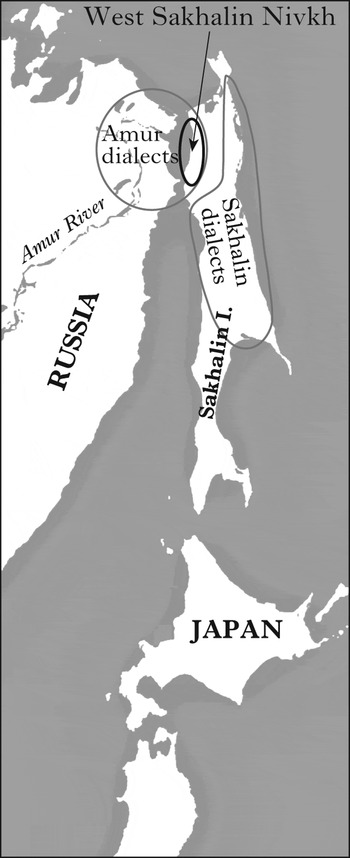
Nivkh has two dialect groups. The Amur dialects are spoken in villages located along the lower reaches of the Amur River and on the west coast of northern Sakhalin. The Sakhalin dialects are spoken in all other parts of Sakhalin (see Fig. 1). Both dialect groups consist of a number of subdialects. Our focus is on the West Sakhalin dialect of Nivkh, which forms part of the Amur dialect group. West Sakhalin Nivkh is spoken in a number of villages on the west coast of northern Sakhalin, and is closely related to the dialects spoken along the Amur River. West Sakhalin Nivkh is the Amur dialect for which most audio recordings are available. Recordings of other dialects are by and large confined to recitations of folk tales and songs.
The Nivkh language area.

Nivkh is seriously endangered. In 2000, UNESCO classified the language as ‘nearly extinct’ (Janhunen & Salminen Reference Janhunen and Salminen2000). There are currently about 50 speakers.Footnote 3 None of them are monolingual, as language shift to Russian is complete. The oldest speakers (born before 1930) speak imperfect Russian, with a strong Nivkh accent. Our fieldwork data show that these speakers display palatalisation in the context of /e/ preceding a uvular consonant but in no other contexts, and that they depalatalise Russian palatalised consonants. Younger speakers (born between 1930 and 1946) speak fluent Russian, but display the same pattern of palatalisation as the older speakers. The youngest speakers (born after 1946) display a less restricted pattern of palatalisation, where, aside from the context just mentioned, all consonants except /t tʰ/ have palatalised allophones before /i e/.Footnote 4 The same pattern is found in other dialects (see Pukhta Reference Pukhta2002, Tangiku Reference Tangiku, Shiohara and Kodama2006, personal communication).Footnote 5Shiraishi (Reference Shiraishi2006: 24) provides a telling example from a conversation between an older speaker (ON) and a younger speaker (VI) of West Sakhalin Nivkh, shown in (1).
(1)


Notice in (1) that the older speaker does not palatalise the initial fricative and that the younger speaker addresses her in Russian, and apparently does not know the Nivkh word for ‘crow’.
It seems likely that the less restricted distribution of palatalised consonants in younger speakers is due to the influence of Russian, where palatalisation is pervasive. However, palatalisation before /e/ preceding a uvular appears to predate the time of Russian contact. One piece of evidence for this can be found in a document from 1810 written by the Japanese explorer Rinzo Mamiya, who transcribes the Nivkh form /kʰeqal/ ‘Udeghe (the name of a Tungusic tribe)’ as  , i.e. as [kʲakkaɾa]. The possible link with RTR harmony in Mongolian (see note 2) also suggests a greater time depth.
2.2 Phonological background
Our overview of Nivkh phonology is based on the description of West Sakhalin Nivkh in Shiraishi (Reference Shiraishi2006) and Shiraishi & Lok (2002–14), supplemented by our own fieldwork data.
Our database contains 637 monosyllabic and 335 disyllabic roots. Native Nivkh roots are maximally disyllabic, with stress fixed on the initial syllable. Roots are subject to a number of phonotactic restrictions that do not concern us here. For discussion of these, see Shiraishi (Reference Shiraishi2006) and Shiraishi & Botma (Reference Shiraishi and Botma2012).
Nivkh has a six-vowel system, as in (2a), and the consonant inventory in (2b).Footnote 6
(2)
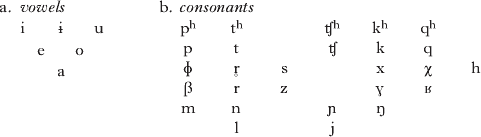
We will have little to say here about the manner and laryngeal properties of the consonants, except to note that Nivkh has a phonetic aspiration contrast in stops which is mirrored by a voicing contrast in fricatives (/ r/ pattern as fricatives with respect to their laryngeal properties). Shiraishi provides a number of arguments for treating these distinctions as involving a single phonological contrast. Phonation is contrastive in root-initial position, but suspended in other environments, where obstruent voicing is determined by the phonetic context.
Obstruents contrast at five oral places of articulation. Velars and uvulars contrast in the context of a preceding or following /a/ or /o/ only (3a), and marginally in the context of a preceding /e/ (3b), where /e/–uvular sequences trigger palatalisation.Footnote 7
(3)
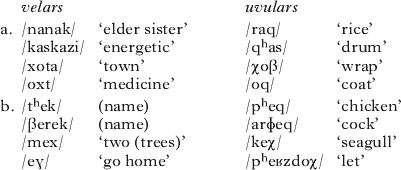
The reason for the marginal contrast between velars and uvulars is the restricted distribution of the latter. /qʰ/ is limited to the initial position of roots. None of the uvulars can occur with a preceding or following high vowel, or with a following /e/. /e/ preceding a uvular is lowered and retracted, sometimes to the point where there is neutralisation with /a/, so that a form like /pʰeq/ in (3b) is variably realised as [pʰʲq] or [pʰʲɐq] (see also §4).
(4) gives an overview of the attested vowel–uvular sequences in West Sakhalin Nivkh.
(4)
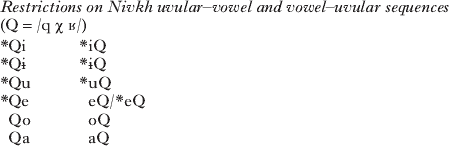
The co-occurrence restrictions on vowels and uvulars are symmetrical for speakers who neutralise the contrast between /e/ and /a/ before /q χ ʁ/. For such speakers, uvulars co-occur with /a/ and /o/ only.
3 Palatalisation in West Sakhalin Nivkh
We now consider the distribution of palatalisation in West Sakhalin Nivkh, focusing on the dialect of older speakers. As noted, our data are taken from Shiraishi & Lok (2002–14) and from recordings made by the second author during three fieldwork trips, in 2011, 2012 and 2013. Shiraishi & Lok's fieldwork transcriptions are consistent with our auditory impression of the data.
3.1 Distribution of palatalised consonants
Inspection of the fieldwork data suggests that older speakers of West Sakhalin Nivkh consistently palatalise consonants before a sequence of /e/ and /q χ ʁ/. The palatalisation is clearly audible, and is consistently reflected in Nivkh orthography. Nivkh speakers use the Cyrillic alphabet, with some additional symbols to represent non-Russian sounds, as in (5). For a discussion of Nivkh writing practices, see Shiraishi & Botma (to appear).
(5)
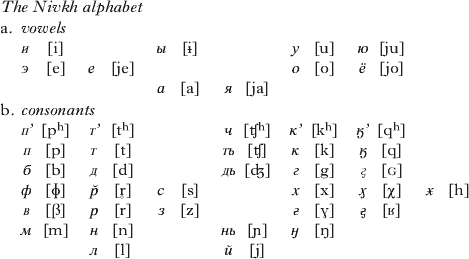
Representative examples of palatalised forms are given in (6) (some of them repeated from (3b)), along with their orthographic representation by Nivkh speakers.Footnote 8 More extensive orthographic data is given in Appendix A.
(6)
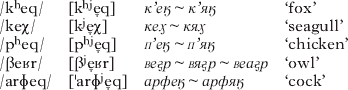
The forms in (6) show that speakers mark palatalisation in the same way as it is marked in Russian, viz. by using the iotated variants е я (i.e. /je ja/) instead of э а.Footnote 9 The variable spelling of these forms reflects the realisation of the vowel, which is variably lowered and retracted under the influence of the following uvular. The form веа р, from Pukhta (Reference Pukhta2002), is especially interesting, since it reflects the gradual diphthongisation of /e/ that we also observe in our phonetic data (see §4.2). Palatalisation is not marked in forms in which /e/ is initial or preceded by /h/, as in (7), despite the fact that the realisation of the vowel appears to be similar to that in the forms in (6).
(7)

We return to this issue in §4.3.
Palatalisation is restricted to word-internal domains. The forms in (8) show that it does not occur across a morpheme boundary.
(8)

Palatalisation does apply across syllable boundaries if no morphological boundary is present. While almost all the /e/–uvular sequences in our corpus are tautosyllabic, there are two forms where /e/ and the uvular consonant belong to different syllables, given in (9).
(9)

Palatalisation appears to occur in both stressed and unstressed syllables, although our corpus contains just one clear example of a disyllabic form whose second syllable ends in /e/ and a following uvular consonant, given in (6), and repeated in (10a).Footnote 10
(10)
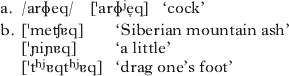
There are three other potential examples of palatalisation in unstressed position, given in (10b). It is not clear, however, whether the first two forms contain an underlying /a/, or whether this vowel is an allophone of /e/. The problem here is that /ʧ/ and /ɲ/ are not affected by palatalisation, which is likely due to them already having primary palatal place. We discuss this, and the reduplicated form [ˈtʰʲɐqtʰʲɐq], in more detail below.
Turning now to the segmental triggers and targets, palatalisation occurs in the context of /e/ and a following uvular consonant only. The forms in (11) show that palatalisation is not found before other consonants, including velars.
(11)

While Nivkh has no regular productive alternations between velars and uvulars, our corpus contains two instances of morphologically related pairs. The first is the name /tʰek/ and the reduplicated verb form /tʰeqtʰeq/ ‘drag one's foot’, from which /tʰek/ is derived. The verb form is realised with two palatalised consonants followed by lowered /e/, i.e. as [ˈtʰʲɐqtʰʲɐq], and the name with a non-palatalised [t] and front-mid [e], i.e. as [tʰek].Footnote 11 The other velar–uvular alternation is found in [mʲqr] ‘two (neutral)’ and [mex] ‘two (trees)’, where the numeral used for counting trees is not palatalised. These forms corroborate our observation that palatalisation is triggered by uvulars but not velars.
The segmental targets of palatalisation are given in (12), which lists the attested palatalised allophones of Nivkh consonants.
(12)
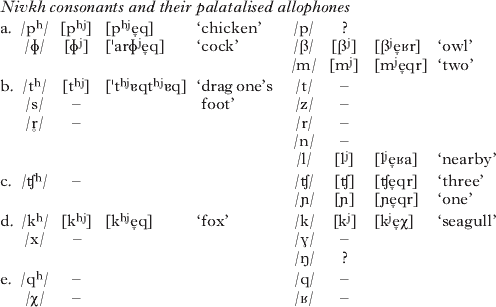
The gaps indicated with a question mark appear to be accidental, and may be attributable to the size of our corpus. We suspect that this is the reason for the absence of [pʲ], and perhaps [ŋʲ]. The other gaps seem to be principled. First, we have already seen, in (3), that uvulars do not occur before /e/. Second, the lack of palatalised /x ɣ/ and /s z r/ is due to their (near) absence in root-initial position; see Jakobson (Reference Jakobson1957) for a diachronic account of this.
Of the remaining coronals, /n/ does not occur before /e/ (or /i/). This presumably reflects a historical palatalisation process which has led to the merger of /n ɲ/ before front vowels, where only /ɲ/ is found. As far as we can ascertain, the phonetic realisation of /ɲ/ before /e/–uvular sequences does not differ from its realisation in other contexts. In (12), we have listed /ɲ/ as a target, on the assumption that palatalisation here applies vacuously, though nothing crucial hinges on this. We make the same assumption for the palatal affricate /ʧ/, whose realisation also appears to be unaffected by palatalising contexts.
More interestingly, /t tʰ/ generally fail to palatalise, both before /e/–uvular sequences (as in /teʁ/ ‘(the wind) blows’, which is realised with a lowered vowel but without palatalisation, i.e. as [tʁ]) and, for younger speakers, also before /i e/. The two exceptions to this appear to be [ˈtʰʲɐqtʰʲɐq], discussed above, and [ˈtʰʲestʰʲestʰʲes] ‘jumping and hopping’ (cf. Shiraishi Reference Shiraishi2006: 23). Both these forms are sound-symbolic (reduplication is pervasive in sound-symbolic words), which might explain their irregular phonotactics.Footnote 12
The fact that Nivkh /t tʰ/ normally resist palatalisation is likely due to their being apical. The typological survey in Hall (Reference Hall2000) shows that palatalised apicals are exceedingly rare in languages of the world, no doubt because such sounds involve a combination of a primary apical and a secondary laminal articulation. Hall (Reference Hall2000: 22) observes that apicals typically shift to laminal under palatalisation, although he notes that there are some cases where apicals fail to palatalise, e.g. in the Lewis dialect of Scots Gaelic. We suggest that Nivkh is another example of this. Perhaps the reason why Nivkh does not display a shift from apical to laminal is that the resulting sounds would be too similar to /ʧ ʧʰ/.Footnote 13 We suspect that a shift from apical to laminal did occur in /n/, which set the stage for the subsequent neutralisation of /n/ and /ɲ/ before /i e/.
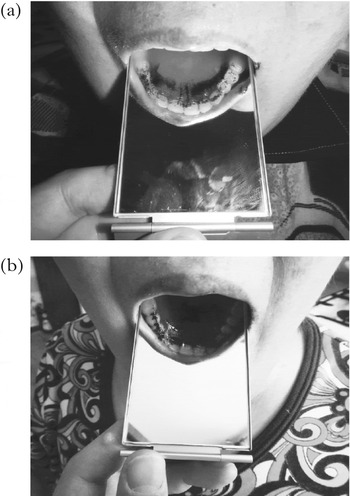
The apical realisation of /t tʰ/ in West Sakhalin Nivkh was verified by means of a palatography experiment (cf. Ladefoged Reference Ladefoged2003: 36–42) carried out by the second author in March 2013. The subject in the experiment (speaker ZL) consistently realised /t tʰ/ with a smaller area of contact than /ʧ ʧʰ/, suggesting that the former have an apical articulation. Representative palatograms of /t/ and /ʧ/ are given in Fig. 2.Footnote 14 This result ties in with early phonetic sources, where Nivkh /t tʰ/ are described as apical (Zinder & Matusevich Reference Zinder and Matusevich1937: 114), as well as with phonological evidence: /tʰ t/ are paired with the apical rhotics / r/ in consonant mutation (see Shiraishi Reference Shiraishi2006: 86–88).
Representative palatograms of (a) /t/ and (b) /ʧ/ (speaker ZL).

3.2 Discussion
Having outlined the context in which palatalisation occurs, we turn now to the question of whether ‘palatalisation’ is in fact the appropriate term for the phenomenon under investigation. Our answer to this question will come in two parts. First, in this section, we argue that there are indeed reasonable phonological grounds for calling the process palatalisation. In §4, we will show that the issue is rather less clear from a phonetic perspective, though we will see that there is some acoustic evidence for the presence of palatalisation, mainly in the vowel following the consonant.
Phonologically, support for palatalisation comes from evidence that the initial part of the ongliding diphthong in forms like [pʰʲq] functions as a secondary articulation of the initial consonant – or in other words, that it forms part of the syllable onset rather than the nucleus.Footnote 15 There are a number of arguments for this. First, treating the onglide as part of the nucleus would violate the phonotactics of Nivkh, given that diphthongs in native words are very marginal in closed syllables, and invariably falling rather than raising (e.g. /lɨi/ ‘to kill a bear’, /qoi/ ‘larch’).Footnote 16 In addition, the data in §3.1 show that palatalisation is not a low-level phonetic effect that applies across the board. Rather, it is sensitive to morphological boundaries, and its application is restricted to certain segments; see (12). These segmental restrictions would be difficult to account for if the palatality were located in the nucleus, given that co-occurrence restrictions between onsets and nuclei are on the whole much rarer than restrictions within onsets. Finally, to the extent that orthography reflects phonological structure, palatalisation appears to be psychologically real for Nivkh speakers.
3.4 Phonetic correlates of West Sakhalin Nivkh palatalisation
We saw in §3.2 that there are reasonable phonological grounds for treating the ongliding diphthong in forms like [pʰʲq] as a secondary articulation of the consonant. However, we have not so far addressed the question of whether such an interpretation is also supported by the phonetic characteristics of the sounds in question. To what extent is it phonetically justified to refer to the initial part of the vocalic sequence as palatalisation? The aim of this section is to throw some more light on this issue. We do so by first considering the correlates of pre-uvular lowering (which we go on to claim is the diachronic origin of palatalisation), before moving on to the correlates of palatalisation itself.
4.1 Methodological background
A total of five Nivkh speakers were recorded, four female (speakers ZL, OK, VT, GL) and one male (speaker LI). All of the speakers grew up on the west coast of northern Sakhalin. They acquired West Sakhalin Nivkh as their first language and speak Russian on a daily basis. The speakers were asked to translate the target words from Russian, produce them in a carrier sentence (/tɨʧ …/ ‘This is a …’) and write them down in Nivkh orthography (see Appendix A for the orthographic representations). The recordings were made using a Sony PCM-D50 portable digital recorder with built-in microphones. The resulting sound files were sampled at 48 kHz, 24 bit.
The speakers produced a total of 213 tokens, from a total of eleven relevant types. In addition to forms with /e/–uvular sequences (/pʰeq/ ‘chicken’, /kʰeq/ ‘fox’, /keχ/ ‘seagull’, /arΦeq/ ‘cock’, /tʰeqtʰeq/ ‘drag one's foot’, /eʁz/ ‘think, worry’), the target words included /tʰek/ ‘name’, /iΦ/ ‘he’, /i/ ‘say’, /kʰe/ ‘fishnet’ and /haq/ ‘hat’, so as to allow comparison between pre-uvular /e/ and ‘canonical’ /i/ and /e/, and between pre-uvular /e/ and pre-uvular /a/.
Using Praat (Boersma & Weenink Reference Boersma and Weenink2011), the target words were extracted from the carrier sentence and saved as separate files. Formant measurements were used to characterise the vowels (default settings: time step: 0·0; maximum number of formants: 5; maximum formant: 5500 Hz; window length: 25 ms; dynamic range: 30 dB). Measurements were restricted to F1 and F2, as these are the main acoustic correlates of vowel quality (see e.g. Deterding Reference Deterding1997). Tokens with too much background noise (n=16), abnormally long or short vowels (n=25) or mispronunciations (n=2) were discarded.Footnote 17
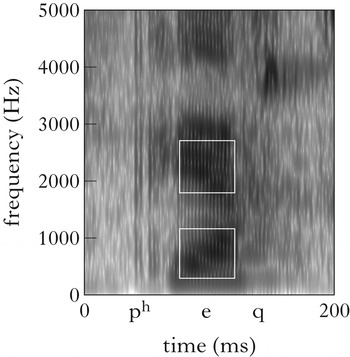
Figure 3 shows a sample spectrogram of an extracted token (/pʰeq/), and is representative of the /e/–uvular tokens in our corpus: the vowel is diphthongised, with a gradual raising of F1 (signalling pre-uvular lowering) and a gradual lowering of F2 (signalling both retraction and palatalisation). We discuss each of these effects in turn below.
Spectrogram of /pʰeq/ ‘chicken’ (speaker ZL). The lower boxed area shows gradual raising of F1; the upper boxed area gradual lowering of F2.

4.2 Phonetic correlates of pre-uvular lowering and retraction
4.2.1 Background
We start our investigation by examining some of the articulatory properties of uvulars. Uvulars are frequently described as having the back of the tongue as active articulator (see e.g. Ladefoged Reference Ladefoged1993, Ladefoged & Maddieson Reference Ladefoged and Maddieson1996). However, Catford (Reference Catford1977: 160) observes that what he calls ‘dorso-uvulars’ involve the dorsal or radical surface of the tongue against the extreme end of the soft palate, including the uvula (cf. also Abercrombie Reference Abercrombie1967: 51), while Shahin (Reference Shahin2002: 24), citing Fujimura (Reference Fujimura, Kingston and Beckman1990), observes that uvulars always involve pharyngealisation, ‘presumably due to the proximity of the tongue back and root’.
These observations are consistent with the phonological patterning of uvulars. In some languages, uvulars pattern as retracted velars. In others, uvulars pattern with pharyngeals in tongue-root harmony, suggesting that they are specified for a pharyngeal component, e.g. the feature [RTR] (Elorrieta Reference Elorrieta1991, Trigo Reference Trigo1991). Phonetically, uvulars involve retraction of both the tongue dorsum and root, with the relative magnitude of these gestures differing from language to language, giving rise to potentially different phonological effects. This ties in with the observation that, cross-linguistically, uvulars effect both lowering and retraction of neighbouring vowels (see e.g. McCarthy Reference McCarthy and Keating1994, Ladefoged & Maddieson Reference Ladefoged and Maddieson1996).
To determine the effect of Nivkh uvulars on preceding /e/ (and /a/), F1 and F2 values were measured at 20% and 80% of the vowel's duration. (Vowel duration was established on the basis of visual inspection of the waveforms and spectrograms.) The measurement at 20% was chosen to ensure that any effect on the vowel was likely to be an anticipatory effect of the following uvular consonant, and not due to the formant transitions associated with the preceding consonant.
4.2.2 Results
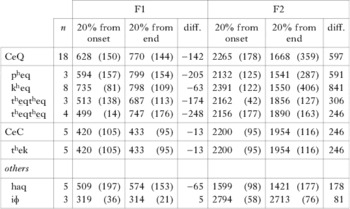
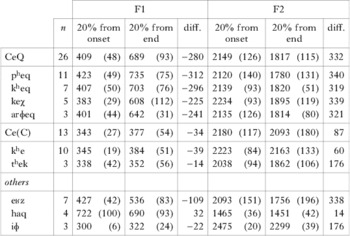
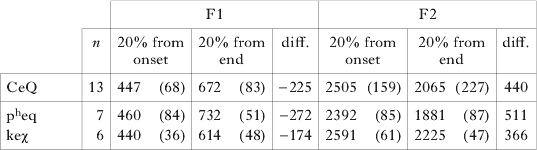
The results for each of the five speakers are given in the tables in Appendix B. Inspection of the data allows us to make a number of observations. First, at both measurement points the range of F1 variation for pre-uvular /e/ is much more extensive than for /e/ in other contexts. For example, the mean F1 range of /e/ in ZL's pre-uvular (CeQ) tokens (n=14) is 214 Hz, but only 64 Hz in non-uvular (Ce(C))tokens (n=12). The other speakers display the same pattern. In addition, ZL's pre-uvular /e/ is on average also lower than /e/ in other contexts. For example, at 80% of the vowel's duration the mean F1 value in pre-uvular tokens is 752 Hz, but only 475 Hz in other tokens with /e/. Here, too, the same pattern is observed in other speakers.
The measurements further show that in some speakers' tokens the highest F1 value of pre-uvular /e/ is close to that of pre-uvular /a/. This is most conspicuous for LI, whose mean F1 value (at 80% of the vowel's duration) in his pre-uvular tokens is nearly identical to that in pre-uvular /a/ in his /haq/ tokens (689 vs. 690 Hz). Although more data is required, this suggests that speakers sometimes display neutralisation of /e/ and /a/ before uvulars.
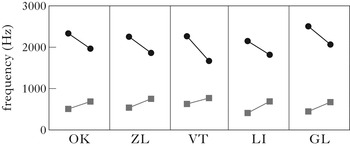
Pre-uvular lowering of /e/ is on the whole quite variable. For example, the F1 difference between the two measurement points in VT's /kʰeq/ tokens is 63 Hz, and that in OK's /pʰeq/ tokens only 49 Hz. VT has a high F1 at 20% of the vowel's duration (735 Hz), and so realises the vowel as low throughout. OK's pre-uvular /e/ is on average relatively low at the beginning of the vowel (622 Hz) and also ends relatively low (671 Hz). However, despite this variability, the data show a robust raising effect of the uvular consonant on the F1 of a preceding /e/, which is consistent across speakers (see Fig. 4).Footnote 18
F1 (grey) and F2 (black) plots of the means of realisations by each of the five speakers of pre-uvular /e/ tokens at 20% and 80% of the vowel's duration.

Finally, the data show that lowering is more extensive before stops than before fricatives.Footnote 19 This is the case for all speakers (except VT, for whom no fricative tokens are available). For example, the average F1 at 80% of ZL's /pʰeq/ and /kʰeq/ tokens is 790 Hz and 743 Hz respectively, but only 681 Hz for her /keχ/ tokens.
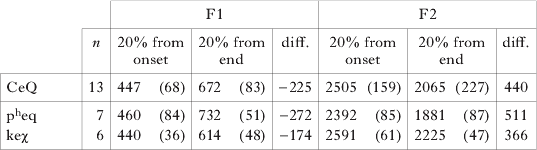
The effect on F2 that we observe is quite consistent. Inspection of the data reveals that pre-uvular /e/ displays a steep and consistent drop in F2. For most of the tokens in our corpus, the mean drop is more than 300 Hz. For example, the mean F2 difference in GL's /pʰeq/ tokens is 511 Hz, while that in VT's /pʰeq/ tokens is 591 Hz, and as much as 841 Hz in her /kʰeq/ tokens. The F1 and F2 plots for each of the five speakers are given in Fig. 4.
As noted above, we take the lowering of F2 to reflect the retraction of the front vowel in anticipation of the following uvular consonant. At the same time, however, a lowered F2 is also one of the acoustic correlates of palatalisation (as is a raised F1). We discuss this parallel between palatalisation and retraction in §4.3.
4.2.3 Discussion
The variability that we observe in pre-uvular lowering of /e/ suggests that this phenomenon does not lend itself to a categorical phonological interpretation. Rather, we suggest that it is best modelled in terms of gestural representations as used in Articulatory Phonology (see Browman & Goldstein Reference Browman and Goldstein1986, Reference Browman and Goldstein1992; also Gick & Wilson Reference Gick, Wilson, Goldstein, Whalen and Best2006). From the perspective of this approach, the advanced tongue position of /e/ and the retracted tongue position of /q χ ʁ/ present a gestural conflict. Gick & Wilson examine a number of such conflicts, and observe that languages ‘resolve’ them in different ways. One strategy is vowel laxing. According to Walsh Dickey (Reference Walsh Dickey1997), this has occurred in Pittsburgh English, where laxing of /i/ before ‘dark’ /l/ has neutralised the contrast between pairs like feel and fill, both of which are realised as [fiɫ]. In Gick & Wilson's view, laxing resolves the articulatory conflict by reducing or removing the advanced dorso-lingual target of the vowel (see also Botma et al. Reference Botma, Smakman and Sebregts2012).Footnote 20
Another strategy that languages use to resolve conflicting dorsal/radical gestures is vowel excrescence (for this term, see Levin Reference Levin1987, Hall Reference Hall2006 and Botma et al. Reference Botma, Ewen and van der Torre2008). This is found in many varieties of English, where the realisation of words like feel and (in rhotic dialects) fire results in the percept of an intervening schwa, giving listeners the impression of an extra syllable or half-syllable, i.e. [fiəɫ] and [faiəɺ] (Lavoie & Cohn Reference Lavoie, Cohn, Ohala, Hasegawa, Ohala, Granville and Bailey1999). In Gick & Wilson's terms, the excrescent vowel signals that the advanced target of the vowel and the retracted target of the consonant are both ‘faithfully’ achieved. According to this interpretation, excrescence is the automatic result of a sequence of two conflicting and achieved gestural targets: an advanced target for [i] and a retracted target for [ɫ]. The acoustic result of the transition between the targets is essentially a retracted vowel (something whose percept might be schwa, or some other neutral central or back vowel), and presumably a longer duration.
Gick & Wilson propose a similar analysis for sequences of a high front vowel and a uvular consonant. For example, the Nuu-chah-nulth realisation of /iq/ as [iəq], with an excrescent schwa, is the automatic result of achieving both the advanced target for /i/ and the retracted target for /q/. We suggest that the same general scenario obtains for Nivkh sequences of /e/ and a following /q χ ʁ/. Conversely, the co-occurrence restriction in Nivkh between /i ɨ u/ and /q χ ʁ/ (see (4)) suggests that historically, the gestural target of high vowels was reduced in anticipation of the retracted target of the following uvular consonant.
4.3 Phonetic correlates of palatalisation
4.3.1 Background
Articulatorily, palatalisation involves the superimposition of an [i]-like gesture of the tongue on the primary gesture of a consonant (see e.g. Derkach Reference Derkach, Fant and Tatham1975, Ladefoged & Maddieson Reference Ladefoged and Maddieson1996, Bateman Reference Bateman2007). Acoustically, we therefore expect the formant properties to approach those of a canonical [i] at the CV transition, viz. a low F1 and a high F2. In addition, two other acoustic correlates have been identified in the literature on Russian palatalisation: (i) a longer and stronger release burst in palatalised stops than in plain stops, and (ii) a high F2 at the onset of the CV transition, with subsequent F2 lowering during the realisation of the vowel (Halle Reference Halle1959, Bondarko Reference Bondarko1977, Kochetov Reference Kochetov2002, Reference Kochetov2004).
4.3.2 Results
Our data do not provide clear-cut evidence for the three correlates mentioned above. First, on the basis of our data, it is hard to evaluate whether palatalised stops in Nivkh have a longer and stronger release burst. The waveforms perhaps indicate that the palatalised tokens are slightly stronger, but they do not appear to be longer.
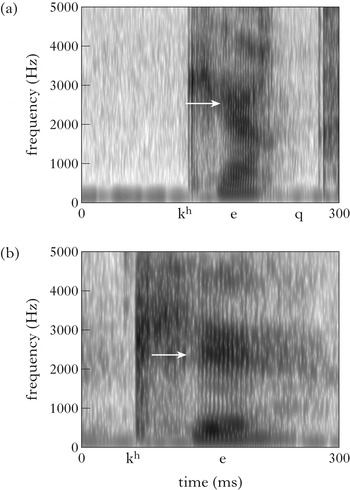
Second, our data do not show a consistently high F2 at the onset of the CV transition. The main problem here is that the majority of tokens with /e/–uvular sequences contain initial aspirated stops. The strong release burst of these sounds makes it difficult to obtain reliable formant measurements. However, there is some indication that at the point of consonantal release, ZL has a higher F2 (by roughly 100 Hz) in her /kʰeq/ tokens (mean=2476 Hz, SD=57, n=2) than in her /kʰe/ tokens (mean=2364 Hz, SD=32, n=4). This is shown in the tokens in Figs 5a and b, where the F2 of pre-uvular /e/ in the CV transition is 172 Hz higher than that of ‘canonical’ /e/.
Spectrograms of (a) /kʰeq/ ‘fox’ and (b) /kʰe/ ‘fishnet’ (speaker ZL). Arrows denote F2 at the point of release (2533 Hz for pre-uvular /e/, 2361 Hz for ‘canonical’ /e/).

None of the /e/–uvular tokens in our corpus have F2 values at the beginning of the vowel that are in the region of those of ‘canonical’ [i], in forms like /iΦ/ ‘he’. Our informal observations (based on Fig. 5) suggest that they are intermediate between those of canonical [e] and [i]. We believe that this makes them liable to be perceived as palatalisation by listeners.
Although more data is clearly needed, we suspect that the acoustic characteristics of the CV transition do contribute to the perception of palatalisation. The reason has to do with words containing an /e/–uvular sequence without an initial (oral) consonant, e.g. [ ʁz] ‘think, worry’; see (7). Apparently, these words are not perceived by Nivkh speakers as having palatal colouring (recall that palatalisation is not reflected in the spelling of these words), despite the fact that the formant properties of the vocalic sequence are very similar to those in forms like /pʰeq/ (see Appendix B). This might suggest that the CV transition contains information that allows Nivkh speakers to distinguish between palatalised and non-palatalised forms.
By far the clearest correlate of palatalisation in our data is the steep and consistent drop in F2 throughout the realisation of /e/. Of course, we have already seen that this is (also) the acoustic effect of the transition from the advanced target of the vowel to the retracted target of /q χ ʁ/: the effect of a uvular consonant on a preceding vowel is similar to the effect of a palatalised consonant on a following vowel.Footnote 21 We believe that this parallel between pre-uvular retraction and palatalisation is important, since it explains why palatalisation has emerged before an /e/ preceding a uvular consonant: it is the result of a perceptually motivated reanalysis on the part of Nivkh speakers. We discuss this reanalysis in more detail in §4.3.3.
4.3.3 Discussion
In the preceding sections, we considered both lowering/retraction and palatalisation, arguing that the former are articulatorily motivated and the latter perceptually motivated. However, we have so far not been explicit about how the two phenomena are related to each other. In this section, we offer what we believe is a plausible diachronic development. We argue that although lowering and retraction create the appropriate conditions for palatalisation to take place, this does not imply a causal relationship between the two. Rather, the Nivkh facts support an approach in which palatalisation is a listener-oriented change that results from the misanalysis of the palatality of /e/ as a property of the preceding consonant. That such a misanalysis should have occurred is not surprising, given the phonetic context of the affected vowel.
For the sake of clarity, we identify three phonetically natural phases in the development of palatalisation, illustrated in (13) for the form [pʰʲq] (←/pʰeq/).
(13)

We describe each of these phases in more detail below.
Phase 1: First, if the advanced target of /e/ and the retracted target of /q/ (and of /χ ʁ/) are both achieved, /e/ is likely to undergo diphthongisation. The phonetic result of this is a diphthong whose second element is both lower and more retracted, i.e. [].
Phase 2: Ongliding diphthongs like [] are unstable sounds. Not only is the height difference between the two elements relatively small, but the second element is also more sonorous, and hence perceptually more salient, than the first. For this reason, it is not unlikely that [] is subject to ‘prominence dissimilation’ (for this term, see e.g. Downing Reference Downing, van Oostendorp and de Weijer2005), so that the more salient portion becomes more salient still, thereby further increasing the difference in prominence between [e] and []. Furthermore, the lack of raising diphthongs in the Nivkh lexicon is likely to add systemic pressure against [].
Phase 3: The reduced and shortened initial portion of the diphthong (transcribed as [

]) is likely to be misperceived as palatalisation, leading to reanalysis on the part of listeners, with [pʰ

q] interpreted as [pʰʲq]. The result is that the palatality is now perceived as forming part of the preceding consonant. As we have seen, this has in some cases led to a vocalic onset whose quality is higher than ‘canonical’ [e], and closer to [i].
Stating the changes in this way should not be taken to mean that they are ordered (so that the first feeds the second, and the second feeds the third), or indeed that they should be viewed as independent from each other. Rather, the phases should be seen as an integrated complex of developments, whose origin lies in the articulatory conflict between the front vowel and the uvular consonant, and whose outcome is the result of perceptually driven reanalysis.
Our account of Nivkh palatalisation as a listener-oriented process is consistent with the view on sound change in the work of Ohala (e.g. Reference Ohala, Breivik and Jahr1989, Reference Ohala and Jones1993, Reference Ohala, Joseph and Janda2005) and Blevins (Reference Blevins2004), where the role of the listener is central. Specifically, palatalisation seems to be an example of what Blevins (Reference Blevins2004: 32) calls ‘chance’: a scenario in which a phonetic signal is ‘intrinsically phonologically ambiguous, and the listener associates a phonological form with the utterance which differs from the phonological form in the speaker's grammar’.
Our account is also in line with Ohala's idea that sound change is not teleological, i.e. not geared towards articulatory or perceptual simplification, or to a simpler grammar (see e.g. Ohala Reference Ohala and Jones1993). For example, we are not claiming that palatalisation serves to maintain the perceptual salience of the front vowel, or that it serves to make the palatality of /e/ easier to perceive. Nor are we claiming that palatalisation is a speaker-oriented change which serves to enhance the contrast between final uvulars and velars – a contrast whose functional load is very low in any case.Footnote 22 Instead, we view palatalisation as being the result of ‘chance’: in the diachronic scenario that we propose, lowering creates the phonetic conditions in which palatalisation is a possible, but not a necessary, change.
Are palatalisation and lowering perhaps optimising in some other dimension? To conclude this section, we discuss (and reject) one such possibility in connection with another aspect of Ohala's and Blevins' approach, viz. the claim that variation is a prerequisite for change (a claim first made in Weinreich et al. Reference Weinreich, Labov, Herzog, Lehmann and Malkiel1968). As we have seen, the effect of /q χ ʁ/ on /e/ is variable. However, we should not rule out the possibility that this variability is indicative of an ongoing change in which speakers exhibit gradual lowering of /e/, perhaps to the point where /e/ will merge with /a/ before uvulars. (As we have seen, there are some indications of this in our fieldwork recordings.) On the basis of our data, it is unfortunately impossible to establish whether we are dealing with a change in progress. For this we would have to conduct a longitudinal study, on a larger scale than the study presented here. However, the small number of remaining Nivkh speakers and their advanced age make this unfeasible.
It is nevertheless interesting to consider once more the effect of a merger of pre-uvular /e/ and /a/. The palatality, which historically was part of the vowel, would then be an exclusive property of the consonant, while /q χ ʁ/ would co-occur with a preceding /a/ or /o/ only – a phonotactic pattern which mirrors that of vowels following uvulars. (14a), repeated from (4), lists the current restrictions on Nivkh uvular–vowel and vowel–uvular sequences, while (14b) shows that pre-uvular lowering of /e/ to /a/ would lead to a fully symmetrical pattern of co-occurrence restrictions.
(14)
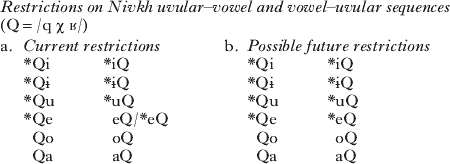
The symmetrical pattern in (14b) arguably simplifies the grammar, but this does not mean that the gradual lowering of /e/ is a goal-directed strategy towards this pattern. We prefer to view the creation of such patterns as an emergent property of change, not its desired result.
5 Summary and conclusion
This paper has offered a description and analysis of palatalisation in West Sakhalin Nivkh, a process that affects consonants before /e/ preceding a uvular consonant. We believe that there are good grounds for analysing the targeted consonants before /e/–uvular sequences as being phonologically palatalised. The process is conditioned by both morphological and segmental factors, and the alternative analysis (in which the palatality is part of an ongliding diphthong) violates the phonotactic regularities that govern native Nivkh words. Phonetically, matters are less clear. We find no clear-cut evidence for palatalisation in the release burst, nor do we find a consistently raised F2 in the transition from the initial consonant to pre-uvular /e/. However, what we do find is a consistent and steep fall of F2 (as well as a raised F1) in the vowel following the consonant – the same effect that is observed for front vowels preceding a uvular consonant. This parallel suggests that palatalisation results from a reanalysis by Nivkh speakers, whereby the palatality of /e/ has come to be associated with the preceding consonant.
Our interpretation of the Nivkh facts involves an interplay of articulatory and perceptual factors, and proposes a division of labour between the two. Articulatory factors play a role in the transition from /e/ to /q χ ʁ/, a sequence which contains an advanced target for the vowel and a retracted target for the uvular. As we might expect, such transitions are subject to speaker variation, though this does not prohibit them from becoming phonologised at some future time. The Nivkh data are perhaps suggestive of a change in progress in which /e/ undergoes a gradual merger with /a/ before uvulars. If so, we are witnessing a shift from a contrast in vowel quality (/e/ vs. /a/) to a contrast between plain and palatalised stops. Perceptual factors play a role in speakers' reanalysis of an ongliding diphthong as a sequence of a palatalised consonant and a lowered and retracted front vowel. Reference to perceptual factors is crucial: an articulatory account of Nivkh palatalisation can capture the diphthongisation of /e/ before uvulars, but cannot readily explain the emergence of palatalisation on the consonant preceding /e/.
Appendix A
Orthographic representation of Nivkh words with /e/–uvular sequences (from Pukhta 2002, Savel'eva & Taksami 1970 (S&T) and speakers GL, ZL and OK).

Appendix B
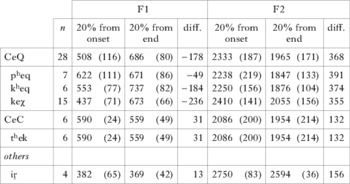
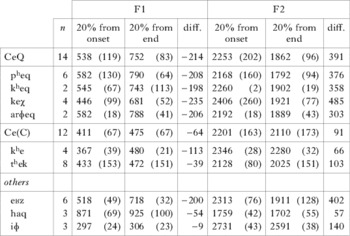
Formant measurements indicating gradual lowering and retraction of pre-uvular /e/ (Q = uvular consonant; C = any other consonant).
Speaker OK (female, born 1946). Mean formant values (Hz) and standard deviations (in parentheses).
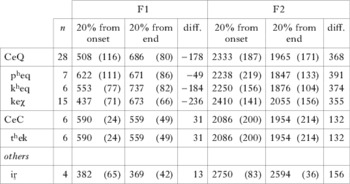
Speaker ZL (female, born 1946). Mean formant values (Hz) and standard deviations (in parentheses).

Speaker VT (female, born 1941). Mean formant values (Hz) and standard deviations (in parentheses). Values in the two rows with / tʰeqtʰeq / refer to the underlined vowel in each case.

Speaker LI (male, born 1942). Mean formant values (Hz) and standard deviations (in parentheses).

Speaker GL (female, born 1946). Mean formant values (Hz) and standard deviations (in parentheses).