Throughout Western Europe, there is ample evidence of dramatic changes in the religious landscape in the recent decades. Despite variations across countries, the overall trend shows a steady decline in citizens' degree of religious practices since the 1960s (e.g., Jagodzinski and Dobbelaere Reference Jagodzinski, Dobbelaere, van Deth and Scarbrough1995; Norris and Inglehart Reference Norris and Inglehart2004; Voyé Reference Voyé1999). Switzerland is no exception in this respect. From the early 1960s to the end of the 1990s, the number of non-practicing Christians has evolved from a little over a quarter of the population to almost half of the individuals (Campiche et al. Reference Campiche, Dubach, Bovay, Krüggeler and Voll1992, 74; Campiche Reference Campiche2004, 42). Affiliation to the official churches has also been decreasing as the proportion of people without any religious confession has grown from 1.1% in 1970 to 11% of the population in 2000 (Bovay Reference Bovay2004, 11).
These trends show a substantial decline in institutionalized religion, which refers to people's sense of belonging to the church as an institution. They are in line with secularization theory that posits a decline of the social relevance of religion (e.g., Berger Reference Berger1967; Bruce Reference Bruce2002; Martin Reference Martin1978; Wilson Reference Wilson1982). However, there are also signs that point to a change in religion. Proponents of the religious individualization thesis (e.g., Hervieu-Léger Reference Hervieu-Léger1999; Luckmann Reference Luckmann1967) argue that a decline in religious practices is not necessarily synonymous with a decline in religious beliefs. According to this perspective, traditional Christian religiosity centered on the church is making way for more privatized and individualized forms of religiosity that develop outside of the authority of religious institutions (e.g., Davie Reference Davie1994; Hervieu-Léger Reference Hervieu-Léger2003). Indeed, the empirical evidence regarding the spiritual dimension of religion, which focuses on what individuals believe, reveals an increase over the last decades in the proportion of people expressing spiritual concerns (Norris and Inglehart Reference Norris and Inglehart2004, 74–75).
Recent studies of religiosity in Switzerland tend to corroborate the trend toward a privatization and individualization of religious beliefs. The decade between 1989 and 1999 has seen a drastic increase in the number of “inclusive Christians,” who combine the Christian doctrine with beliefs borrowed from other religious traditions, and of “non-Christian believers” who reject the tenets of the Christian faith but do believe in a transcendent force (Campiche Reference Campiche2004, 115–121).Footnote 1
In sum, it appears that the religious landscape of Western Europe is experiencing a double transformation since the late 1960s. On the one hand, individuals' sense of belonging to the church is declining; on the other hand, the spiritual dimension of religion is changing with the rise of so-called “unchurched” or post-traditional forms of religiosity (Davie Reference Davie2000, Reference Davie2002).
The rare studies of the influence of religion on political attitudes have only very partially accounted for the transformation of the religious landscape in Western Europe. A classic typology of religiosity typically combines an indicator of people's church attendance with their church affiliation (e.g., Geissbühler Reference Geissbühler1999). Such indicators might prove satisfactory to capture the institutional dimension of religion. However, they leave out its spiritual dimension by failing to measure whether and what respondents believe. As long as the official churches dominated the religious landscape, one could assume a certain degree of homogeneity in people's religious beliefs, and a fair amount of congruence between their sense of belonging to the church and their beliefs. However, with the growth of post-traditional forms of religiosity, religiosity is likely to differ across individuals not only with respect to varying levels of religious practices but also with respect to a diversity of beliefs.
In this article, we develop a more complete and accurate categorization of religiosity that accounts for both dimensions of religiosity, that is belonging (institutionalized religion), and believing (spirituality). Combining two indicators of people's religious belonging and two indicators of their personal beliefs, we propose a two-dimensional typology of religiosity.Footnote 2 This typology captures both the traditional forms of religiosity that are characterized by a strong sense of belonging to the established churches and the post-traditional forms that are marked by more individualized beliefs.
Based on this typology, we study whether and how different categories of religiosity affect individuals' political attitudes on the two main lines of division structuring the Swiss political space, which is the cultural “libertarian versus authoritarian” division and the economic “free market versus state intervention” division (e.g., Kitschelt Reference Kitschelt1994; Kriesi et al. Reference Kriesi, Edgar Grande, Martin Dolezal and Frey2006).
This article is structured as follows. The next section presents in some more details the main transformations of the religious landscape in the last decades. Then, we introduce our typology of religiosity and highlight its implications for political attitudes on the economic and cultural lines of conflict. The data used to operationalize the typology, and to test the research hypotheses are presented thereafter. Next, we offer empirical evidence on the scope of changes in religiosity in Switzerland, and examine to which extent political attitudes differ in relationship to religiosity. The last section synthesizes our main findings and discusses the importance of a two-dimensional typology of religiosity.
AN EVOLVING RELIGIOUS LANDSCAPE: DECLINE AND CHANGE
There is a widespread agreement among theologians, sociologists of religion, and historians that the religious landscape of Western Europe has experienced tremendous changes in the last decades. While there appears to be a consensus regarding the decline in institutionalized religion, the evolution of religious beliefs across time is hotly contested. This dispute finds its expression in an on-going and intense debate between proponents of secularization theory (e.g., Berger Reference Berger1967; Bruce Reference Bruce2002; Martin Reference Martin1978) and advocates of the religious individualization thesis (e.g., Hervieu-Léger Reference Hervieu-Léger1999; Luckmann Reference Luckmann1967).Footnote 3
In the perspective of secularization theory, the process of modernization is negatively correlated with the vitality of religion (Pollack and Pickel Reference Pollack and Pickel2007, 604). Modernization results in a growing rationalization of the different domains of society that develop increasingly according to their own logic and are more and more distinct from each other (Stolz Reference Stolz2007, 10). Thus, secularization consists of a process in which “religion gradually loses the encompassing and important role which it had in traditional society” (Halman and Draulans Reference Halman and Draulans2006, 265). As a consequence, the importance of religion for the operation of non-religious institutions such as those of the state and the economy weakens. At the individual level, secularization is manifested in “… a decline in the extent to which people engage in religious practices, display beliefs of a religious kind, and conduct other aspects of their lives in a manner informed by such beliefs” (Bruce Reference Bruce2002, 3). In sum, secularization theory predicts a decline in the importance of religious practices and beliefs as a consequence of modernization.
Proponents of the religious individualization thesis (e.g., Hervieu-Léger Reference Hervieu-Léger1999; Luckmann Reference Luckmann1967), on the other hand, make a clear distinction between “church” and “religion” (Pollack and Pickel Reference Pollack and Pickel2007, 604). In their perspective, and in line with secularization theory, modernization is expected to negatively affect traditional churches and church-related behaviors. However, this decline in institutionalized religion does not mean that individuals are becoming less religious. On the contrary, one is likely to witness a rise in individual religiosity (Pollack and Pickel Reference Pollack and Pickel2007, 604).
The individualization thesis goes back to Luckmann's (1967) work on the emergence of “invisible religion.” According to Luckmann (Reference Luckmann1967; Reference Luckmann2003), as a consequence of modernization, the church has lost its monopoly on the production of world-views. Individuals are thus confronted with a plurality of world-views from which they can build their own private system of beliefs in an autonomous fashion. Traditional Christian beliefs shaped by the authority of the church give way to “more “invisible” and “privatized” forms of religion that are characterized by an emphasis on self-expression, self-actualization, and individual freedom” (Houtman and Mascini Reference Houtman and Mascini2002, 458).
These so-called post-traditional forms of religiosity can be of two kinds. First, they can develop inside of the Christian faith but outside of the churches leading to believing without belonging (Davie Reference Davie1994, Reference Davie2002; Hervieu-Léger Reference Hervieu-Léger1999). In this perspective, “as the institutional disciplines decline, belief not only persists, but becomes increasingly personal, detached and heterogeneous” (Davie Reference Davie2002, 8). Second, they can take the form of alternative types of religion or “spirituality” outside of the Christian realm. What we will refer to as post-Christian spirituality has emerged in the counter-culture of the 1960s and has become a central element of the “New Age” movement of the 1980s (Houtman and Aupers Reference Houtman and Aupers2007, 306). Despite their fragmented and heterogeneous character, post-Christian spiritualities share a common dogma of “self spirituality”: significance and identity are not given by “authoritative sources, located outside of the self (e.g., the answers offered by science and the Christian churches)” but by “an “internal” source, located in the self's deeper layers” (Houtman and Aupers Reference Houtman and Aupers2007, 307; Heelas Reference Heelas1996; Heelas and Woodhead Reference Heelas and Woodhead2005).
The differential evolution of religious practices and religious beliefs pleads for a dual conception of religiosity that accounts for both its institutional and spiritual dimensions.
HOW TO MEASURE RELIGIOSITY: A TWO-DIMENSIONAL TYPOLOGY
While a dual conception of religiosity is quite common in the sociology of religion (e.g., Halman and Draulans Reference Halman and Draulans2006; Glendinning and Bruce Reference Glendinning and Bruce2006), research on the influence of religion on political behavior usually relies on a uni-dimensional typology that only measures people's attachment to institutionalized religion. Research on Swiss political behavior constitutes no exception in this respect. Findings on the political influence of religiosity are clearly in line with theories of secularization and stress the declining relevance of religion for political preferences. While historically religion has played a central role in Switzerland by shaping the Swiss party system along confessional divisions among cantons (e.g., Klöti Reference Klöti, Kriesi, Linder and Klöti1998; Kriesi Reference Kriesi1998), its effect on party choice has constantly declined since the 1970s, and is quite weak in the most recent elections, except for the vote for the Christian-Democratic Party (e.g., Hug and Trechsel Reference Hug, Trechsel, Hug and Sciarini2002; Lachat Reference Lachat2007; Nabholz Reference Nabholz, Kriesi, Linder and Klöti1998; Trechsel Reference Trechsel1995). The few studies on the influence of religion on political attitudes confirm the attenuation of confessional differences and point to a possible replacement of the confessional cleavage by a cleavage in religious practice (Geissbühler Reference Geissbühler1999).
To capture both religious decline and religious change, we propose a more encompassing typology of religiosity that combines both dimensions of religiosity that is belonging (institutionalized religion) and believing (spirituality).
The institutional dimension of religion focuses on individuals' sense of belonging to the church, and comprises two main facets. We are first interested in the extent to which people are involved in the church, meaning that they attend services, participate in the activities of the church, and consider themselves a member of the community. In addition to these “objective” signs of belonging, people's attachment to the church (or remoteness from it) can also be expressed by less visible means: the second aspect of the institutional dimension focuses thus on people's subjective assessment of established churches, that is, on their (positive or negative) opinions about them, on their level of confidence in them, or in their degree of satisfaction with them. Contrarily to what is usually done in classic typologies of religiosity, we do not include church affiliation in our conceptualization of institutional religion. Based on existing empirical evidence, it is doubtful that church affiliation still reflects people's sense of belonging to a church, at least not in the Swiss context, where constantly high levels of religious affiliation (Bovay Reference Bovay2004) tend to be a reflection of traditions or social convenience rather than a real connection to one of the official churches (Campiche Reference Campiche2004, 38).
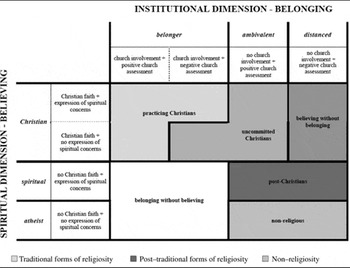
On this basis, one can differentiate between three types of relationships to the church as an institution (see Table 1). Individuals who are regularly involved in the established churches are considered belongers, irrespective of their subjective assessment of the church; given that regular church involvement requires a strong commitment from people, we assume that these individuals still display a solid relationship to the institutionalized church, even though they might not have a positive assessment of the churches in general. The second type consists of individuals who are more ambivalent toward the church in the sense that they are not regularly involved but do not overtly reject the church (they do not have a negative assessment of the institution). Finally, a third type comprises people who have taken their distance from the church as an institution both objectively by not being involved and subjectively by having a negative judgment.
Typology of religiosity based on the institutional (belonging) and spiritual dimensions (believing) of religiosity

The spiritual dimension of religiosity focuses on individuals' personal religious beliefs. In this perspective, we draw two main distinctions. The first distinction deals with people's relationship to the spiritual sphere: we are interested in assessing to which extent people express spiritual or religious beliefs in transcendence, irrespective of the type of transcendence (a godly power, supernatural energies, or any kind of superior force). Given our focus on Christianity, the second aspect of the spiritual dimension directly focuses on individuals' relationship to the Christian faith: in this case, our typology draws a distinction between people who share the main tenets of the Christian faith (belief in the God of Jesus Christ, and in the Bible) and the ones who do not, no matter whether they express other types of religious beliefs or not.
We distinguish among three types of beliefs (see Table 1). The first type of beliefs is characterized by its Christian obedience; what is determinant here is people's belief in the Christian tenets, irrespective whether they additionally express spiritual concerns or not. The second type is summarized under the generic term spiritual and includes individuals who express religious or spiritual beliefs that are not of Christian inspiration. Finally, the last type is defined as atheist and groups people who do not express any religious or spiritual beliefs.
Of course, these distinctions are much too crude to accurately reflect the current diversity and richness of individuals' personal beliefs. On this basis, we can only distinguish among individuals who hold Christian beliefs, those who hold other types of religious beliefs, and those who do not hold beliefs of any kind. In particular, we do not adequately capture the various forms of post-Christian spiritualities that cover a very heterogeneous set of beliefs such as holism, esotericism, or New Age, to only mention a few examples. The choice of this simple categorization is however motivated first by a practical concern about the operationalization of our typology; indeed, most political surveys only include a very limited set of indicators of individuals' religious beliefs that do not permit to go further in the measure of the spiritual dimension. Second, from a theoretical viewpoint, we expect the distinction between Christian beliefs and other types of beliefs to be more relevant to the understanding of political attitudes than a more subtle differentiation among various types of post-Christian spirituality (see next section).
The combination of the different types of “belonging” and “believing” can be clustered into six groups. The first three groups belong to the traditional forms of religiosity that develop either within the official Christian churches (for the practicing Christians and the belongers without believing) or at least not in opposition to them (for the uncommitted Christians).
The first group consists of practicing Christians, namely individuals who “belong” on the institutional dimension, and are of Christian obedience on the spiritual dimension. There is however one exception to this categorization: individuals who are regularly involved in the church, have Christian beliefs but have a negative assessment of the church, and do not express spiritual concerns, are not considered practicing Christians, although they are “belongers” and have Christian beliefs. Given that they are ambivalent regarding both their sense of belonging and their beliefs, we think that it is more accurate to categorize them as uncommitted Christians (see next category).
Second, so-called uncommitted Christians are characterized by their Christian beliefs and their ambivalence on the institutional dimension; they have a weaker sense of belonging than the previous category since they are not regularly involved in the church, but they still have a positive assessment of the churches, contrarily to the individuals who believe but do not belong (see below).
The last group in the traditional forms of religiosity includes individuals who belong but do not believe. People in this group are characterized by a strong sense of belonging on the institutional dimension (regular church involvement) but they do not believe in the Christian tenets, either because they hold other types of religious beliefs (for the spiritual type) or because they are non-religious (for the atheist type). This group is likely to consist of people who remain close to the church by tradition or social conformity but without sharing the religious beliefs that usually go with the sense of belonging.
These traditional forms of religiosity stand in contrast to what we call post-traditional forms of religiosity that are characterized by their rejection of the authority of institutionalized churches. We differentiate between two groups of post-traditional believers. First, believers without belonging display beliefs of Christian inspiration but their faith develops outside of the institutionalized churches from which they have taken their distance. For this category, Christian beliefs and the absence of a sense of institutional belonging constitute the key features.
The second group consists of individuals who manifest the same distance with regard to the official churches as believers without belonging but who express spiritual beliefs that are not of Christian inspiration. Since we do not go further in the exploration of the types of beliefs held by these individuals, we refer to this group by the generic label post-Christians. We also include in this category people who express spiritual beliefs that are not Christian, but are ambivalent with respect to their sense of institutional belonging, since they are not involved in the church but still have a positive assessment of it.Footnote 4
Non-religious people constitute our last group. Individuals in this group are characterized by their ambivalence or distance from the church on the institutional dimension and their absence of any kind of religious beliefs. Absences of religious beliefs and of church involvement are the decisive features for fitting in this group so that both individuals who have a positive or a negative assessment of the church fall into this category.
This two-dimensional typology allows for a more nuanced categorization of religiosity than a classic typology accounting only for the institutional dimension of religion. In fact, the lack of inclusion of religious beliefs leads to group in a single category individual with very different forms of religiosity. Based on a classic typology, a non-practicing Christian might be, as common wisdom would suggest, an individual who believes in the main tenets of the Christian faith but only goes to church on specific occasions such as weddings, funerals or, important celebrations. However, a post-Christian, a believer without belonging, or even a non-religious person would fall in the same category as long as they did not bother to get rid of their church affiliation. In other words, the mere focus on church affiliation and church attendance no longer accurately reflects the current richness and diversity of forms of religiosity.
FORMS OF RELIGIOSITY AND POLITICAL ATTITUDES
Having proposed a two-dimensional typology of religiosity, we now turn to the question of the influence of these various forms of religiosity on political attitudes. As shown by different authors (Kitschelt Reference Kitschelt1994; Kriesi et al. Reference Kriesi, Edgar Grande, Martin Dolezal and Frey2006), the political landscape in Western European countries is structured along two main dimensions of political values. The first dimension consists of the classic economic opposition between free market economy (capitalism) and state interventionism (socialism). The second dimension of conflict is cultural and opposes defenders of libertarian values emphasizing individual freedom to proponents of authoritarian values stressing social compliance (e.g., Kitschelt Reference Kitschelt1994).
Differences in religiosity are assumed to have little influence on individuals' attitudes on the economic axis. Both theorists of secularization and proponents of religious individualization agree that modernization has resulted in a growing differentiation and autonomization of the different domains of society, resulting in the loss of religion's overarching and dominant character (e.g., Bruce Reference Bruce2002; Luckmann Reference Luckmann1967). In particular, the functioning of the state and the economy has been gradually freed from the influence of religious institutions (Bruce Reference Bruce2002, 3). In addition, according to a recent study by Campiche (Reference Campiche2004, 198), a majority of the population and especially the economic circles consider that the churches are not competent in the economic sphere. Thus, we assume that there will be no significant relationship between citizens' religiosity and their preferences for an economic system ruled by the laws of the market or by state intervention.
Our expectations are more nuanced with regard to attitudes on the cultural axis of conflict between libertarian and authoritarian values. Following Bornschier (forthcoming), we differentiate among three dimensions of the cultural divide, namely attitudes towards cultural liberalism, cultural diversity, and opening up of the country. The last two sets of attitudes are expected to be relatively immune from the influence of religiosity, given that these issues lie largely outside of the current sphere of influence of the church. The cultural liberalism dimension for its part taps issues related to morality and ethics that have been traditionally addressed by the church; as a consequence, people's preferences on this dimension are more likely to vary depending on the different types of religiosity.
More specifically, we expect differences in the degree of cultural liberalism to be primarily driven by individuals' sense of belonging to the church, and secondarily by the types of beliefs they hold. With respect to the “belonging” dimension, one can differentiate between traditional forms of religiosity that are characterized by their acceptance — or at least the absence of rejection — of the authority of established churches, and post-traditional forms of religiosity that have developed outside and are distanced from religious institutions. We believe this difference in attitudes toward religious institutions to be relevant for explaining individuals' preferences on the cultural liberalism axis. Post-traditional believers (believers without belonging, post-Christians) stress the importance of individual freedom, of independence from religious institutions, of the development of their own belief systems unconstrained by the authority of established churches (Luckmann Reference Luckmann1967; Heelas and Woodhead Reference Heelas and Woodhead2005). This emphasis on liberty and autonomy is expected to be reflected in a preference for libertarian values that favor “creative self-fulfillment” and “self-determination” (Kitschelt Reference Kitschelt1994, 17). By contrast, traditional believers (practicing Christians, uncommitted Christians, belongers without believing) are likely to be more influenced by the authority of the churches, a trait that is susceptible to foster “compliance with established norms and practices” (Kitschelt Reference Kitschelt1994, 29). As a consequence, they are expected to adopt more authoritarian values that “favor social compliance” and “standards of social rectitude adopted upon the command of a higher authority” (Kitschelt Reference Kitschelt1994, 17).
In addition, we also expect differences in attitudes according to the spiritual dimension of religious beliefs. Among traditional believers, this preference for more authoritarian values is likely to be especially marked for practicing Christians who have the closest connection with the institutionalized churches both with respect to their degree of belonging (that is greater than the ones of uncommitted Christians) and with respect to their beliefs (that are coherent with their institutional attachment contrarily to the ones of people who belong without believing). Among post-traditional believers, we expect post-Christians to be more culturally liberal than believers who don't belong. Although both are characterized by their remoteness from institutionalized churches, individuals who believe without belonging are still of Christian obedience and are, as such, likely to be more influenced by the messages from the church than post-Christians who have taken their distance both from the church as an institution and from the Christian doctrine. Finally, the greatest degree of cultural liberalism is expected from non-religious individuals whose convictions are independent from the authority of the church and immune to the influence of religious messages.
DATA AND OPERATIONALIZATION
In order to study the evolving religious landscape and its implications for political attitudes, we use data from the 1989, 1996, and 2007 waves of the World Value Survey (WVS) in Switzerland. As emphasized before, our main variable of interest, religiosity consists of an institutional and a spiritual dimension (see Table 1). The institutional dimension of religious belonging is fairly well captured by the questions asked in the WVS. Its first aspect, church involvement, is measured by frequency of church attendance, religious practice constituting a noticeable sign of people's objective involvement in the church. Individuals who go to church at least once a month are coded 1, while the others are coded 0. The second aspect, people's subjective assessment of the church, is measured by their degree of confidence in the churches, which allows us to differentiate between people who trust the church as an institution, and individuals who have taken their distance from it. Individuals who have a lot or quite a lot of confidence are coded 1, others are coded 0.
The spiritual dimension of religious believing is much more difficult to measure. Like most surveys that are not explicitly focused on religiosity, the WVS contains no questions that directly ask people about their belief in a Christian God or in various forms of post-Christian spiritualities.Footnote 5 Despite these limitations, we think that the available indicators allow for a satisfactory, albeit crude instrument to discriminate between Christian and other forms of religious beliefs (for a similar approach using WVS, see also Houtman and Aupers Reference Houtman and Aupers2007, 310). The first aspect of the believing dimension, that is, people's relationship to the spiritual sphere, is measured by an individual's self-assessment of his/her own religiosity. Individuals who consider themselves religious are coded 1, while the others are coded 0. Unfortunately, this question only deals with religious beliefs and does not allow us to single out individuals who describe themselves as spiritual. People's relationship to the Christian faith, the second aspect of believing, is measured by a question asking people about the importance of God in their personal life,Footnote 6 individuals answering that God is important or quite important in their lives are coded 1, the others are coded 0.
In order to study the political significance of different types of religiosity, we analyze how they relate to political attitudes along the two main axes of political competition in Switzerland. The economic conflict line is measured by two dimensions resulting from a factor analysis that we performed on five economic indicators available in the WVS. The first dimension refers to economic liberalism and is captured by three questions asking respondents whether more firms should be privatized, whether government should take more responsibility for citizens, and whether competition is good or harmful. The second dimension pertains to income equality and is based on two questions asking whether incomes should be made more equal, and whether income differences should persist as an incentive for economic prosperity. All variables have been recoded in order to attribute higher values to traditional preferences of the political right and lower values to classic positions of the political left.
The cultural dimension consists of three dimensions (Bornschier forthcoming): cultural liberalism, cultural diversity, and opening up of the country. The first dimension is tapped by a battery of questions asking respondents whether homosexuality, prostitution, abortion, divorce, euthanasia, and suicide are justifiable behaviors or not. The cultural diversity element is measured by three items asking whether employers should give priority to Swiss people if jobs are scarce, whether Switzerland should provide equal chances for immigrants or better chances for Swiss people, and which immigration policy is preferred by respondents. The last dimension, opening up of the country, is based on two items measuring confidence in the European Union and the United Nations, and a more general question asking whether Switzerland should open itself to the outside or whether it should preserve its traditions. The results of a factor analysis confirming the clustering in three dimensions are used to measure each separate dimension.
In addition, we control for the effect of a number of classic control variables (gender, age, education, income, and urbanity). Furthermore, in line with other studies of the influence of religion on political preferences (Geissbühler Reference Geissbühler1999), we control for possible differences in attitudes between Catholics and Protestants.
For lack of data on almost all indicators of the economic and cultural conflict lines in the first wave of the WVS, our analysis of the impact of different forms of religiosity on political attitudes is restricted to the 2007 wave.
EVOLUTION OF THE RELIGIOUS LANDSCAPE
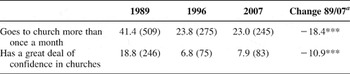
We first study the evolution of religious practices and beliefs in Switzerland during the past 20 years. Table 2 shows a strong decline in the institutional dimension of religion.
Evolution of institutionalized religion, 1989–2007 (in %, N within parentheses)

Level of significance: ***p < 0.001, atwo-tailed Z-test.
Both indicators of belonging show that the Swiss increasingly free themselves from official forms of religion and established religious authorities. With respect to their degree of involvement in the churches, it appears that the number of regular churchgoers has sharply declined over the years. In 2007, less than a quarter of the population attends religious services more than once a month while most Swiss only go to church on special occasions such as weddings, baptisms, or funerals. The declining rate of participation in organized religion is accompanied by a loss of confidence in the churches: in 2007, only 8% of the Swiss — less than half as many as in 1989 — declare to fully trust them. Interestingly enough, this tremendous weakening of institutionalized religion is especially pronounced among Catholics. Whereas Catholics scored much higher on both indicators of religious belonging than Protestants at the end of the 1980s, differences between the two denominations have since significantly decreased (as in the case of church attendance) or even completely disappeared (as in the case of confidence in the churches).
The waning importance of institutionalized religion lends some support to theories of secularization, but does not necessarily mean that the Swiss have become less religious. Table 3 shows how the spiritual dimension of religiosity (believing) has evolved over the years.
Evolution of religious beliefs, 1989–2007 (in %, N within parentheses)

Levels of significance: n.s. not significant, **p < 0.01, atwo-tailed Z-test.
Parallel to the decline in institutionalized religion, Switzerland has also witnessed a weakening of religious beliefs over the past 20 years. In fact, we find a significant decrease, rather than an increase, in the self-assessment of religiosity (from 73% in 1989 to 65% in 2007). The proportion of individuals who declare themselves as religious remains however at a relatively high level, especially in international comparison.Footnote 7 Furthermore, people's attachment to the Christian faith, measured by the significance of God in their personal lives, remains constantly high over the years. Most interestingly, among people without denomination, the proportion of those who consider God very important in their personal life has doubled over the years and reaches 21% in 2007. This result underlines that “believing” and “belonging” do not necessarily evolve in parallel. In contrast to the British case (Davie Reference Davie1994), religious practices and religious beliefs are both declining in Switzerland, but the latter appear to be more resistant to change than the former. While we witness a sharp decline in church attendance and people's level of confidence in the churches, religious beliefs are more stable and erode to a lesser extent. As predicted by the religious individualization thesis, many Swiss have kept their Christian faith — especially their belief in God — but turned away from the official churches.
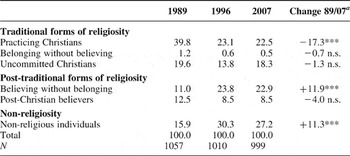
This differential evolution of religious beliefs and practices suggests that forms of post-traditional religiosity and non-religiosity have gained significance over time. Table 4 yields empirical evidence in this respect.
Evolution of different forms of religiosity, 1989–2007 (in %)

Levels of significance: n.s. not significant, ***p < 0.001. Cramer's V: 0.181***, atwo-tailed Z-test.
Indeed, traditional forms of religiosity have steadily declined from 1989 to 2007 in Switzerland and have given way to the rise of post-traditional religiosity and, especially, non-religiosity. Most noticeably, the proportion of practicing Christians, who believe in the main tenets of the Christian faith, and are strongly involved in the church, drastically decreases over time (−17.3%). Whereas practicing Christians were by far the single most important category of religiosity in 1989, they have by now been outnumbered by non-religious people and individuals who “believe without belonging”. While the spread of non-religiosity lends support to the secularization theory and shows a parallel decline in the institutional and spiritual dimensions of religion among growing segments of the population, the increasing number of believers who do not belong points to religious change and a growing importance of post-traditional forms of religiosity, as predicted by the religious individualization thesis. In fact, the group of people who believe without belonging has doubled since 1989 and represents almost a quarter of the population in 2007. Hence, there is a significant and growing part of the Swiss population who identifies with Christian beliefs while questioning the relevance of institutionalized religion. In Switzerland, religious change however does not seem to translate into alternative forms of religion outside the Christian realm. Post-Christian spirituality appears to be a limited phenomenon in the Swiss case and there is no evidence for a spread of this form of religiosity in recent years. If anything, the number of post-Christian believers tends to decrease over the years (from 12.5% in 1989 to 8.5% in 2007). In the Swiss context, though, post-traditional forms of religiosity seem to mainly develop within the Christian faith, although some caution is in order due to the lack of appropriate data and poor measurement of post-Christian spirituality.
In sum, there is clear evidence of the changing religious landscape in Switzerland: while the erosion of traditional Christians and the concomitant rise of non-religious individuals are indicative of religious decline, the growing importance of “believing without belonging” points to religious change.
THE IMPACT OF RELIGIOSITY ON POLITICAL ATTITUDES
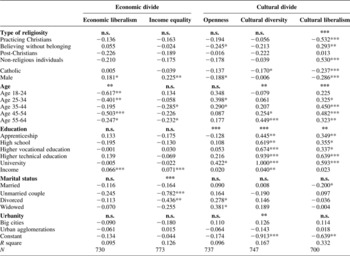
Having shown the evolution of religiosity in Switzerland since 1989, we now turn to the consequences of the various forms of religiosity for political attitudes on the two main conflict lines structuring the political space in Switzerland (see table 5).Footnote 8
Determinants of attitudes with regard to the economic and cultural conflict lines in the Swiss political space, 2007 (OLS regressions, unstandardized coefficients; data weighted according to the linguistic regions)

Levels of significance: ***p < 0.001, **p < 0.01, *p < 0.05.
Reference categories: uncommitted Christians, female, other religion, age 65+, compulsory school, single, countryside.
The two first columns in Table 5 display the influence of religiosity on the economic dimension of conflict captured here by preferences for economic liberalism and income equality. In line with our expectations, religion does not matter for political attitudes on the economic dimension of the Swiss political space. Preferences for economic liberalism and income equality are independent from the types of religiosity, and confession does not play a role either.
By contrast, our two-dimensional typology of religiosity unfolds its full importance when it comes to attitudes on the cultural dimension of the political space. In line with our expectations, religiosity has no importance as far as cultural diversity and international openness is concerned, but clearly matters for individuals' preferences on cultural liberalism, that is questioned on which the established churches traditionally have a strong influence. Indeed, followers of traditional forms of religiosity, especially practicing Christians, are less permissive on morality issues than post-traditional believers and non-religious persons. In line with other studies (Geissbühler Reference Geissbühler1999), we can say that the religious cleavage is of lasting significance for some political attitudes. In addition, our findings underline that the traditional distinction in studies of political behavior between practicing and non-practicing individuals does not tell the whole story and misses an important element of religiosity. Although the sharpest differences in attitudes on morality issues emerge between practicing Christians and non-religious individuals, we also observe differences between uncommitted Christians and believers who don't belong. In other words, a simple dichotomy between practicing and non-practicing people, which groups uncommitted Christians, persons who believe without belonging and non-religious individuals in a single category of non-practicing Christians, would have passed over the differences in their moral attitudes. However, we show that moral permissiveness gradually increases as one moves from practicing Christians to non-religious individuals.
As expected, differences in the degree of cultural liberalism are primarily driven by an individual's sense of religious belonging. Indeed, what distinguishes post-traditional believers and non-religious individuals from uncommitted Christians is their distrust in the official churches. Their emphasis on more privatized forms of religion or, in the case of non-religious people, on complete independence from religious belief systems and traditional precepts of the churches is apparently conducive to the development of libertarian values, which stress self-fulfillment and self-determination (Kitschelt Reference Kitschelt1994, 17).Footnote 9
In addition, it is worth noting that church affiliation continues to play an independent role for political attitudes on issues of cultural liberalism. Not surprisingly, Catholics are less liberal on moral issues than Protestants and people without a denomination. On questions of acceptable moral behavior, the confessional cleavage thus continues to matter.
Wrapping up, we see that differences in forms of religiosity affect people's political attitudes on cultural liberalism. Especially the differences in the attitudes of various groups of non-practicing Christians (uncommitted Christians, believers without belonging, non-religious individuals) clearly underline the usefulness of a two-dimensional typology of religiosity, which categorizes people according to their degree of belonging to the church and their religious beliefs.
DISCUSSION
This article has highlighted the double transformation of the religious landscape that has taken place across Western European countries since the 1960s. This evolution characterized by religious decline and religious change highlights the dual nature of religiosity that consists of an institutional and a spiritual dimension that do not necessarily evolve similarly; while the institutional dimension focuses on people's degree of attachment to the church (belonging), the spiritual dimension deals with people's religious beliefs (believing). The dual nature of religiosity casts some doubts on the pertinence of classic typologies of religion that are commonly used in studies of political behavior, and only focus on the institutional dimension of religion. To overcome this shortcoming, we have developed a more comprehensive typology of religiosity that differentiates among individuals with respect both to their relationship to the church (institutional dimension) and to their religious beliefs (spiritual dimension). The use of a more subtle categorization of religiosity permits us to highlight two main findings.
First, our typology sheds some light on the evolution of the Swiss religious landscape over the almost 20 years covered by the WVS. These results show that it is misleading to reduce the evolution of religion in Switzerland to mere secularization. In line with other studies (Campiche Reference Campiche2004; Campiche et al. Reference Campiche, Dubach, Bovay, Krüggeler and Voll1992), our findings show indeed a trend toward secularization that is manifest in the decline in the numbers of traditional Christians, and in the rise of non-religious individuals. However, secularization is not the entire story. One also sees a significant increase in the number of individuals who still believe but no longer belong. This finding supports the idea of an evolution of Christian religiosity toward unchurched religion (Davie Reference Davie2000, Reference Davie2002). In other words, institutionalized religion appears to erode but this does not mean that religiosity disappears. In Switzerland, the rise in more privatized forms of religiosity appears to be limited to the kinds that develop within the Christian faith. Post-Christian forms of religiosity, in the wake of New Age movements, have rather seen a decline in their followers over the years. This result needs nevertheless to be taken with some caution, given the crudeness of the available indicators.
Second, the use of a more subtle categorization of religiosity is not without any relevance for the study of political attitudes. Differences in forms of religiosity clearly affect citizens' preferences on cultural liberalism, one of the dimensions of the “libertarian-authoritarian” axis of political conflict. With the exception of post-Christians, our findings support our research hypothesis: individuals who believe without belonging as well as non-religious people are significantly more permissive on issues related to cultural liberalism than followers of institutionalized forms of religiosity. These results underscore first the continuing relevance of religious preferences for the formation of selected political attitudes. Second, they point to the importance of a more refined categorization of religiosity. Our typology reveals significant differences among “uncommitted Christians,” “believers without belonging,” and “non-religious individuals.” These nuances are lost in a classic typology in which, based on their confession and their religious practice, most of these individuals would be grouped in the single category of “non-practicing Christians.”
In conclusion, this article constitutes a first attempt at drawing the consequences of the transformation of religiosity for the study of political behavior. As discussed above, the data at our disposal only allows for a crude measure of religious beliefs. The presence of significant effects of religiosity on political attitudes, in spite of the weaknesses in the operationalization of one of the central dimensions of our study, underlines the importance of taking religious change seriously, at least as seriously as religious decline.