Introduction
The green lacewing, Chrysoperla carnea (Stephens) (Neuroptera: Chrysopidae) larva is an important predator of a variety of soft-bodied arthropods, such as aphids, scale insects, leafhoppers, whiteflies, thrips, and mites, as well as eggs and small larvae of Coleoptera and Lepidoptera (Muma Reference Muma1959; Ridgway and Murphy Reference Ridgway and Murphy1984; Ulhaq et al. Reference Ulhaq, Sattar, Salihah, Farid, Usman and Khattak2006) and hence it is reared for inoculative and inundative release as a biological control agent (Ulhaq et al. Reference Ulhaq, Sattar, Salihah, Farid, Usman and Khattak2006). Since pests with a high rate of reproduction and mobility are harder to control by biological control alone it can be improved by incorporating selective insecticides (Liu and Chen Reference Liu and Chen2001). Insecticides suitable for use in an integrated pest management (IPM) strategy should have low toxicity to natural enemies (Elzen Reference Elzen1989; Purcell et al. Reference Purcell, Stark and Messing1994) and should also be evaluated for possible negative effects on feeding capacity (voracity) and predator efficiency (McMurtry Reference McMurtry1982). Endosulfan has been reported as harmless to the development of C. carnea (Carvalho et al. Reference Carvalho, Bezerra, Souza and Carvalho2003; Nasreen et al. Reference Nasreen, Mustafa and Ashfaq2003; Golmohammadi et al. Reference Golmohammadi, Hejazi, Iranipour and Mohammadi2009) but little is known about its effect on predator behaviour.
Functional response is one of the characteristics of predatory efficiency of a species (Sabelis Reference Sabelis1985), a key factor in the population dynamics of predator-prey systems (Schenk and Bacher Reference Schenk and Bacher2002), and can serve as index to determine if a predator is capable of regulating prey density (Murdoch and Oaten Reference Murdoch and Oaten1975). The objective of this study was to determine the toxicological effects of endosulfan on the predatory efficiency of C. carnea larvae on eggs of tobacco budworm, Heliothis virescens (Fabricius) (Lepidoptera: Noctuidae) and fall armyworm, Spodoptera frugiperda (Smith) (Lepidoptera: Noctuidae).
Materials and methods
Test insects
Eggs of green lacewing C. carnea were obtained from an established colony at Universidad Autónoma Agraria Antonio Narro and the Reproduction Center of Beneficial Insects of Saltillo, Coahuila, Mexico. Lacewing larvae that hatched were fed with eggs of the grain moth, Sitotroga cerealella Olivier (Lepidoptera: Gelechiidae), and the different instars were reared and maintained under controlled conditions (Arredondo Reference Arredondo2004). The larvae of H. virescens were obtained from the United States Department of Agriculture (USDA, Stoneville, Mississippi, United States of America) laboratory and S. frugiperda larvae were collected from corn fields at Matamoros, Coahuila, Mexico. Larvae of both prey species were reared on artificial diet type fall armyworm (Southland Product Inc. Lake Village, Arkansas, United States of America) and adults were provided 20% sugar solution in water. Insects were maintained at 25±5 °C, 55±15% relative humidity, and 14:10 light: dark hour photoperiod.
Bioassays
The effect of endosulfan exposure on the predatory efficiency of C. carnea was tested by first exposing larvae to endosulfan, followed by observing their predation on a test prey species (H. virescens and S. frugiperda were tested separately) and comparing the results to those of an untreated control group of C. carnea larvae. A tank mix of commercial Endosulfan (Agrosulfan 35% CE) was combined with water in a hand sprayer to obtain a dosage of 2622 ppm that would mimic a field rate (Croft Reference Croft1990) of 1.75±0.25 mg/cm2 when sprayed on a petri dish. Six hundred C. carnea larvae (200 instar 1, 200 instar 2, 200 instar 3) were exposed to 1.75±0.25 mg/cm2 endosulfan in petri dishes; with absorbent paper in the bottom (60 dishes, each containing 10 C. carnea larvae) and another 600 larvae (200 each of instar 1, instar 2, instar 3) were exposed to water without insecticide.
The pretreated C. carnea larvae were then individually placed in petri dishes and left unfed for 24 hours. The predation treatments consisted of exposing an individual larva to one of seven prey egg densities (5, 10, 20, 40, 60, 80, or 100). Each egg density was replicated 10 times for each of the three instars of C. carnea and for each prey species (H. virescens or S. frugiperda); i.e., a total of 420 predator larvae were used in the bioassays, 70 per instar per prey species. The functional response of predator was evaluated 24 hours after exposure to the eggs.
Statistical analysis
The parameters of the functional response of prey consumed for H. virescens and S. frugiperda were determined using Holling’s (Reference Holling1959) disc equation:
 $${\rm Na=\,}\'{a} \,{\rm Tt}\,{\rm No}/({\rm 1}{\plus}\'{a} \,{\rm Th}\,{\rm No})$$
where Na is the number of prey consumed per unit time, Tt the time total of exposure (one day), No the number of prey offered to the predator at the beginning of the experiment, Th the handling time for each prey captured, and á the attack rate of the prey. The latter parameters of á and Th were derived from:
 $${\rm Na/No=\,}\'{a} \,{\rm Tt}{\minus}\'{a} \,{\rm Th}\,{\rm Na}$$
where á=β0 and Th=β1/á
β0 is the intercept and β1 is the slope of the model.
The χ2 test (α=0.5) was used to determine the reliability of Holling model results (Zar Reference Zar2010). Using the parameter Th, total handling time (Tht) (Rocha and Redaelli Reference da and Redaelli2004), searching time (Ts) (Juliano and Williams Reference Juliano and Williams1987; Rocha and Redaelli Reference da and Redaelli2004) and search efficiency (E) (Rocha and Redaelli Reference da and Redaelli2004) were obtained using the following equations: Tht=Th×Na, Ts=Tt−Tht, and E=Na/No.
The Real (Reference Real1977) model was used as an indicator of the Holling model accuracy. The Jack-Knife method was used to estimate the standard deviation at a 95% confidence interval for the attack rate and handling time (Meyer et al. Reference Meyer, Ingersoll, McDonald and Boyce1986).
For each prey species, predator instar, and treatment (endosulfan-exposed versus checks), a χ2 goodness of fit test was used to compare the observed values of number of prey consumed with those expected from the Holling Type II model.
To evaluate the effect of the insecticide exposure on predation, data for number of prey consumed were subject to an analysis of variance (ANOVA) and the Tukey test separately (P<0.05) for each instar of the predator and each prey species, using PROC ANOVA in SAS statistical software (SAS Institute 2002). Variances were tested for homogeneity using Bartlett’s (Reference Bartlett1947) method and data transformed by the method of Box and Cox (Reference Box and Cox1964) (H. virescens instar 2=X 0.5; S. frugiperda instar 3=X 0.4) when necessary to ensure equal variances.
The experiments consisted of two treatments (endosulfan and check), seven egg densities, and 10 replicates of each treatment-prey density combination, for each prey species.
Results and discussion
Effect of endosulfan treatment on rate of predation and functional response
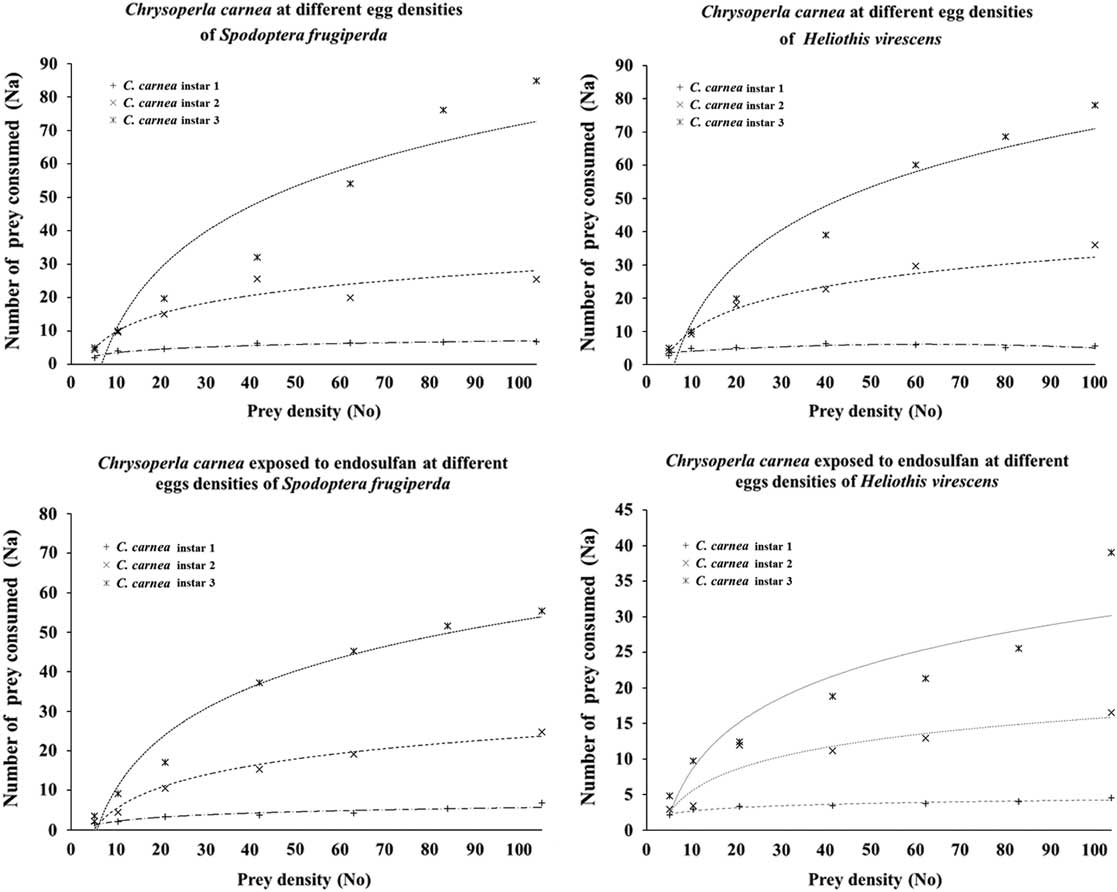
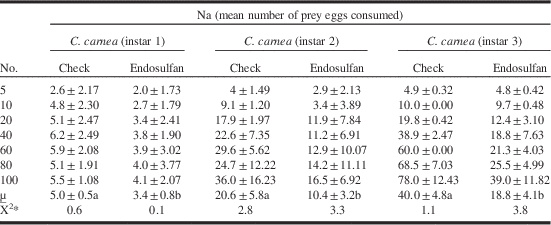
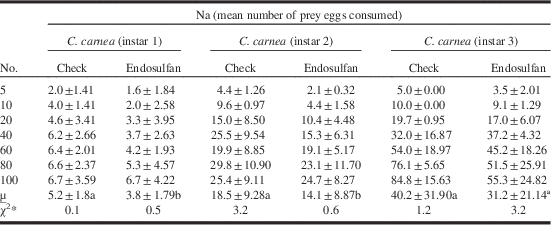
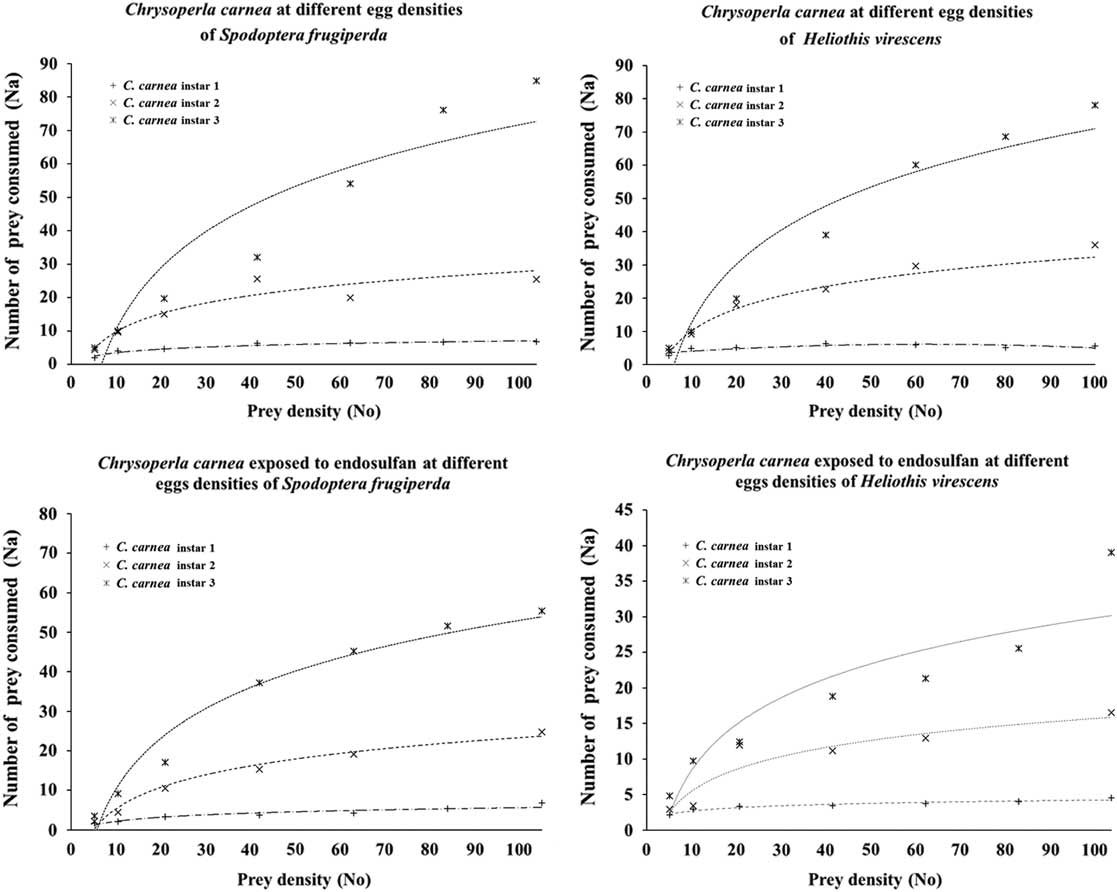
The number of eggs of both prey species consumed by C. carnea larvae in 24 hours increased with egg density, most notably for instar 2 and instar 3 larvae (Fig. 1). Larvae of C. carnea exposed to endosulfan consumed significantly fewer eggs of both prey species than did unexposed larvae, with the exception of instar 3 predation on the eggs of S. frugiperda (Tables 1 and 2) (H. virescens: instar 1: F=15.91, df=1, 138, P<0.0001; instar 2: F=32.35, df=1, 138, P<0.0001; instar 3: F=34.36, df=1, 138, P<0.0001; S. frugiperda instar 1: F=6.35, df=1,138 P=0.012; instar 2: F=5.54, df=1,138, P=0.02; instar 3: F=1.78; df=1,138, P=0.18.). The relationship between number of prey consumed versus prey density fit that predicted by Holling’s type II functional response for all three instars and both prey species, regardless of endosulfan treatment (Fig. 1, Tables 2, 3; χ2 goodness of fit test P<0.05). Similarly, a type II response was observed for C. carnea instars 1–3 larvae preying on eggs of Phthorimaea operculella (Zeller) (Lepidoptera: Gelechiidae) (Hany et al. Reference Hany, Ateff and Sayed2010) and for C. carnea instar 1 and instar 2 larvae preying on eggs and instar 1 larvae of Helicoverpa armigera (Hübner) (Lepidoptera: Noctuidae) (Hassanpour et al. Reference Hassanpour, Mohaghegh, Iranipour, Nouri-Ganbalani and Enkegaard2011).
Functional response of Chrysoperla carnea larvae to different egg densities of Spodoptera frugiperda and Heliothis virescens exposed to endosulfan.
Mean number (±SE) of Heliothis virescens eggs consumed in 24 hours by individual Chrysoperla carnea larvae of either instar 1, instar 2, or instar 3 when eggs were exposed at densities of 5 to 100 eggs per larva, after exposure of C. carnea larvae to endosulfan.

Notes: No.=Prey density. µ=Mean number of prey consumed. Means for each instar followed by the same letter (a, b) do not differ (Tukey P<0.05).
* χ2 goodness-of-fit test comparing observed versus expected values for Holling type II functional response (df=6, χ2=12.59, P<0.05).
Mean number (±SE) of Spodoptera frugiperda eggs consumed in 24 hours by individual Chrysoperla carnea larvae of either instar 1, instar 2, or instar 3 when eggs were exposed at densities of 5 to 100 eggs per larva, after exposure of C. carnea larvae to endosulfan.
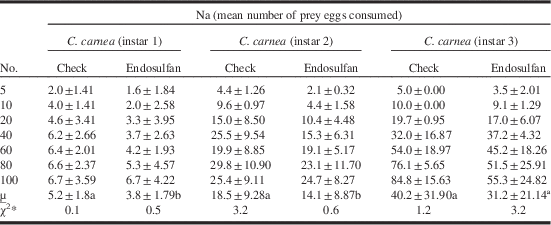
Notes: No.=Prey density. µ=Mean number of prey consumed. Means for each instar followed by the same letter (a, b) do not differ (Tukey P<0.05).
* χ2 goodness-of-fit test comparing observed versus expected values for Holling type II functional response (df=6, χ2=12.59, P<0.05).
Similar results were reported by Dastjerdi et al. (Reference Dastjerdi, Hejazi, Ganbalani and Saber2009) studying the effects of various insecticides on functional response of Habrobracon hebetor Say (Hymenoptera: Braconidae) to different densities of the last instar of Anagasta kuehniella (Zeller) (Lepidoptera: Pyralidae). Claver et al. (Reference Claver, Ravichandran, Khan and Ambrose2003), on the other hand, studied the functional response of Acanthaspis pedestris Stål (Hemiptera: Reduviidae) to larvae of Corcyra cephalonica (Stainton) (Lepidoptera: Pyralidae) in the presence of cypermethrin and recorded an abnormal behaviour with the increase in insecticide concentration, with a negative effect on predatory capacity and an alteration in functional response, which changed from type II to IV.
Ambrose et al. (Reference Ambrose, Rajan and Raja2010), reported a reduction in predation by the reduviid bug, Rhynocoris marginatus (Fabricius) (Hemiptera: Reduviidae) on larvae of C. cephalonica exposed to chlorpyrifos and cypermethrin. Řezáč et al. (Reference Řezáč, Pekár and Stará2010), found reduced predation of Philodromus cespitum (Walckenaer) (Araneae: Philodromidae) on Drosophila melanogaster Meigen (Diptera: Drosophilidae) exposed to spinosad, azadirachtin, and diflubenzuron insecticides.
Functional response parameters
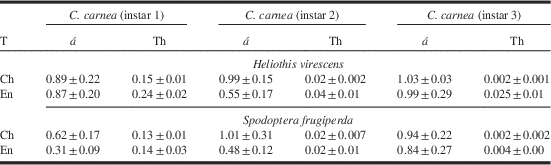
The attack rate (á) of all three instars of C. carnea on the eggs of S. frugiperda and H. virescens decreased in the endosulfan treated group compared with the check (Table 3), indicating that the insecticide negatively affected the predation by C. carnea. Handling time (Th) of each prey species was longer in individuals treated with endosulfan when compared with the non-treated check, with the exception of instar 2 preying on S. frugiperda (Table 3). In the presence of endosulfan, the predator generally required more time to “handle” the prey, which is an aggregate variable that includes identifying, pursuing, capturing, consuming, and digesting the prey. Claver et al. (Reference Claver, Ravichandran, Khan and Ambrose2003) observed that exposure to cypermethrin increased handling time of A. pedestris when preying on C. cephalonica Similarly, Dastjerdi et al. (Reference Dastjerdi, Hejazi, Ganbalani and Saber2009), noted that profenofos, thiodicarb, hexaflumuron, and spinosad insecticides produced a longer handling time in the functional response of H. hebetor on A. kuehniella.
Functional response parameters of endosulfan exposed larvae of Chrysoperla carnea to the eggs of Heliothis virescens and Spodoptera frugiperda at seven densities in 24 hours.
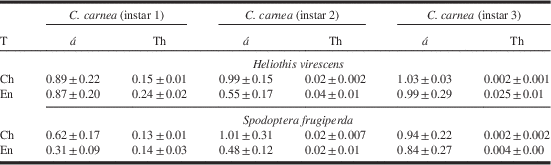
Note: T, treatment; Ch, check; En, endosulfan; á, attack rate; Th, handling time. The standard deviation was estimated with the Jack-Knife method at a 95% confidence level for a′ and Th.
Total handling time (Tht) increased and searching time (Ts) decreased with increasing prey density, indicating predator density-dependence (Rocha and Redaelli Reference da and Redaelli2004). This type of response is required for a predator to be able to effectively control insect pests (Schenk and Bacher Reference Schenk and Bacher2002).
In general, it was found that the efficiency of the predator was lower in the endosulfan treated group than in the non-treated group; endosulfan-treated C. carnea had prolonged handling time (Th), decreased attack rate (á), and therefore reduced searching time (Ts) as well as reduced search efficiency (E).
In conclusion, functional response of C. carnea does not change when exposed to endosulfan, but functional response parameters are affected by this insecticide, reducing its predatory efficiency, suggesting endosulfan is not compatible with this predator in an IPM system.