INTRODUCTION
Most amphibian species with biphasic life cycles have terrestrial adults and aquatic eggs and larvae (Altig & McDiarmid Reference ALTIG, MCDIARMID, McDiarmid and Altig1999). The persistence of local populations of these species requires adults to migrate, potentially multiple times and considerable distances, between terrestrial foraging or over-wintering habitats and aquatic breeding sites to complete their life cycle (Russell et al. Reference RUSSELL, BAUER, JOHNSON and Elewa2005, Semlitsch Reference SEMLITSCH2008, Todd et al. Reference TODD, LUHRING, ROTHERMEL and GIBBONS2009). Knowledge of migration between habitats is necessary to understand ecological interactions, population dynamics and the selective pressures that affect local populations, as well as to develop effective conservation and management strategies (Semlitsch Reference SEMLITSCH2008). Habitat use by frogs in general is poorly understood (Lemckert Reference LEMCKERT2004), and habitat split, defined as anthropogenic disconnection of foraging and breeding habitats, has been implicated as a cause of amphibian declines (Becker et al. Reference BECKER, FONSECA, HADDAD, BATISTA and PRADO2007).
Previous studies have found that amphibian migration usually occurs in a non-random manner, with individuals entering and exiting breeding sites at the same place and using certain habitats and migratory routes (Marty et al. Reference MARTY, ANGELIBERT, GIANI and JOLY2005, Rittenhouse & Semlitsch Reference RITTENHOUSE and SEMLITSCH2006). However, most studies of migration orientation in amphibians have focused on annual breeders with prolonged breeding (sensu Wells Reference WELLS1977) extended over more than 1 mo and several months (or more) between breeding events. In contrast, reproduction in the red-bellied toads of southern South America (Melanophryniscus, Bufonidae) is explosive (sensu Wells Reference WELLS1977), being concentrated in bursts of breeding activity over a few days when many individuals simultaneously migrate to temporary pools or streams during and immediately following intense rains (Achaval & Olmos Reference ACHAVAL and OLMOS2007, Garcia & Vinciprova Reference GARCIA, VINCIPROVA, Fontana, Bencke and Reis2003, Kwet & Di-Bernardo Reference KWET and DI-BERNARDO1999). Aspects of the migration of a few other species with explosive breeding have been studied (Sinsch Reference SINSCH1988, Todd et al. Reference TODD, LUHRING, ROTHERMEL and GIBBONS2009), but the ecology of species of Melanophryniscus is poorly known and there are no studies of their migration.
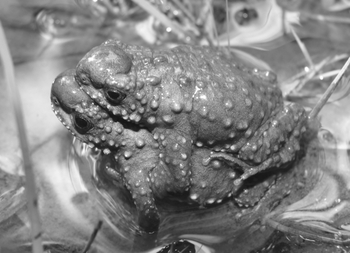
The Brazilian red-bellied toad Melanophryniscus cambaraensis (Figure 1) differs from previously studied explosive breeders in that it reproduces aseasonally. That is, despite inhabiting a subtropical region characterized by well-defined seasons, explosive breeding events occur repeatedly at irregular intervals over the course of the entire year. Other species in this region breed seasonally, with seasonal reproductive activity explained by photoperiod and not variation in temperature, rainfall or air humidity (Both et al. Reference BOTH, KAEFER, SANTOS and CECHIN2008). We have observed explosive-breeding events in M. cambaraensis in October, December, January, February and August, and breeding has been recorded in all remaining months by numerous workers (Garcia & Vinciprova Reference GARCIA, VINCIPROVA, Fontana, Bencke and Reis2003, P. Garcia, unpubl. data; P. Colombo, pers. comm.; A. Samir, pers. comm.). As in other species that form explosive-breeding aggregations, males of M. cambaraensis exhibit many of the typical strategies of scramble competition (Wells Reference WELLS2007), including intense male combats and struggles to possess females and displace amplectant males (V. Z. Caorsi, R. R. Santos & T. Grant, unpubl. data).
A breeding pair of Melanophryniscus cambaraensis (snout–vent length approximately 35 mm) at the study site.

In light of the differences between the breeding biology of Melanophryniscus cambaraensis and previously studied species, we undertook a study of the migration of one of the two known populations of this species. The aim of this paper is to document the directional orientation of pre- and post-reproductive migration. Specifically, we tested (1) if the direction of migration occurred in a random or non-random manner and if certain angles were used more frequently than others and (2) whether there were differences in entry and exit points between pre- and post-reproductive migrations and between males and females.
METHODS
Study site
Melanophryniscus cambaraensis is a small (c. 35 mm snout–vent length), vulnerable (Garcia & Vinciprova Reference GARCIA, VINCIPROVA, Fontana, Bencke and Reis2003) species endemic to the subtropical south-eastern Araucaria Plateau in the Campos de Cima da Serra micro-region of Rio Grande do Sul state, Brazil. Only two isolated populations of this species have been discovered, each known from single localities separated by approximately 50 km in the municipalities of Cambará do Sul and São Francisco de Paula in Rio Grande do Sul state, Brazil (Garcia & Vinciprova Reference GARCIA, VINCIPROVA, Fontana, Bencke and Reis2003). We studied the São Francisco de Paula population, which is restricted to the Floresta Nacional de São Francisco de Paula (FLONA). The native mixed ombrophilous (high-rainfall) forest is dominated by Araucaria angustifolia (Sonego et al. Reference SONEGO, BACKES and SOUZA2007) and covers about 56% of the 1607-ha area of the FLONA, the remainder being composed of planted Araucaria angustifolia, Pinus spp. and Eucalyptus spp. (Bonatti et al. Reference BONATTI, MARCZWSKI, REBELATO, SILVEIRA, CAMPELLO, RODRIGUES, GUERRA and HARTZ2006). Temperatures range from −3–18 °C in the cold season and 18.3–27 °C in the warm season, and an annual average of 14.5 °C. The region has high levels of rainfall in all months, with average monthly precipitation of more than 200 mm for all months of the year (Buriol et al. Reference BURIOL, ESTEFANEL, GRACIOLI, CHAGAS and FONTINELI2009) and average annual precipitation of more than 2200 mm (Backes et al. Reference BACKES, FELIPE and VIOLA2005).
We collected data from October 2008 to February 2009 at a temporary stream formed by heavy rainfall (29°25′41.3″S, 50°23′44.5″W, 866 m asl). The breeding site (Figure 2a) is approximately 20 m long and 4 m wide and is located at the edge of a small dirt road on a rocky outcrop partially covered by a thin layer of topsoil and vegetation dominated by grasses (Poaceae) and herbs (Eryngium sp.). Except for the dirt road, the area around the stream is composed of forest (planted Araucaria angustifolia), with shrubs and sedges (Cyperaceae) covering the few metres between the temporary stream and the forest proper. This is the only locality in the municipality of São Francisco de Paula where Melanophryniscus cambaraensis is known to breed.
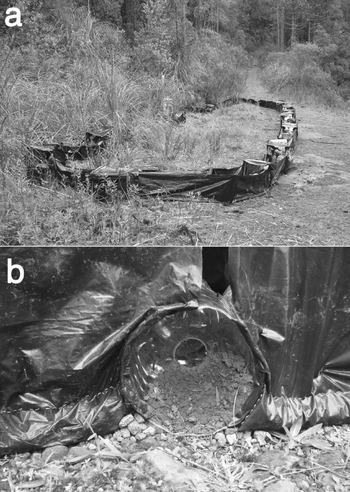
Method of data collection at the Melanophryniscus cambaraensis breeding site. Layout of drift fences and funnel traps (a). The breeding site was completely enclosed with two plastic sheets and funnel traps facing inwards and outwards were distributed around the fences. Note dirt road adjacent to the breeding site. Close-up showing fence and funnel trap design (b). To hold the fence tightly to the rocky substrate, we weighted the base of the fence by folding over and stapling the lower edge of the plastic sheets and filling the resulting pocket with soil and small rocks. We inserted soil and rocks next to the funnel traps to seal spaces in the fence and placed soil on the floor of the funnel to facilitate toad entry.

Data collection
We completely enclosed the breeding site in one inner and one outer drift fence composed of durable plastic sheets approximately 51 m long and 40 cm high (Figures 2a, 3). The solid rock substrate of the breeding site made it impossible to bury the base of the fences or dig holes for pitfall traps. Instead, we held the fences flush to the ground by folding over and stapling the base of the plastic sheet to form a pocket that we filled with soil and small rocks to weigh down the base of the fence (Figure 2b). This allowed the fence to be flexible enough to follow the contour of the surface while also maintaining tight contact with the ground. To hold the fence upright, we built U-shaped supports from wooden stakes that we held in place with heavy rocks and bags of soil. We constructed funnel traps from 5-L plastic bottles by cutting off the top third of each bottle and inserting it, inverted, into the base of the bottle (Figure 2b). To provide protection from sun and rain, we fixed black plastic sheets over each pair of funnels.
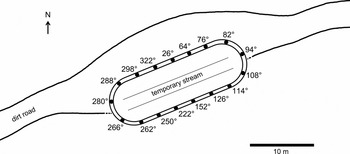
Schematic map showing arrangement of drift fences and funnel traps around the temporary stream where Melanophryniscus cambaraensis form explosive breeding aggregations. The areas on both sides of the road are composed of planted Araucaria angustifolia forest.

We installed pairs of funnel traps (one facing inwards, the other outwards) at 3 m intervals around the entire circumference of the fences, totalling 34 funnels (17 facing each way). We assumed that all individuals caught in the outward-facing traps were in pre-reproductive migration and all individuals caught in the inward-facing traps were in post-reproductive migration. To determine the angular position of the traps, we measured the angle of each pair of traps from the centre of the reproductive site with a compass.
We monitored traps continuously from October 2008 to February 2009 (127 nights), checking them at least twice per day. All captured individuals were photographed and marked by toe-clipping, the most common technique for marking anurans (Ferner Reference FERNER2007). We determined sex by examining secondary sex characteristics. Adult males possess a conspicuous brown nuptial pad on fingers I and II, which is absent in females. Also, males occasionally emitted a release call when handled, which was never emitted by females, and females tend to be slightly larger than males. After processing, individuals were released on the opposite side of the fence.
Data analysis
We used Rao's spacing test (Rao Reference RAO1976) to determine if the distributions of entry and exit angles were significantly different from a uniform distribution. This test has greater power to detect departures from uniformity for data with multiple modes and wide angular dispersion than Rayleigh's or Watson's U2 tests (Bergin Reference BERGIN1991). We grouped data by sex and direction of migration (pre-reproduction and post-reproduction). To compare distributions between sexes and between pre- and post-reproductive migrations, we used a multi-response permutation procedure (MRPP) for circular distributions. This procedure compares the treatment groups, similar to analysis of variance, based on distance functions.
Studies of migration often sample the same individuals in multiple migration events. These pseudoreplicate captures may bias results to reflect individual propensities for particular orientations (Dodd & Cade Reference DODD and CADE1998). Therefore, for statistical analysis we included only a single, randomly selected capture datum per individual per direction (i.e. each individual could have at most two data points, one entering and another exiting the breeding site). We considered P < 0.05 to indicate significant departure of the observed data from the null distribution. We performed all analyses using the BLOSSOM software package (version W2008.04.02, Cade & Richards Reference CADE and RICHARDS2005), as in previous studies of amphibian orientation (Dodd & Cade Reference DODD and CADE1998, Marty et al. Reference MARTY, ANGELIBERT, GIANI and JOLY2005). We visualized circular distributions using the Oriana 3.0 software package (version 3.0, Kovach Computing Services, Pentraeth, Isle of Anglesey, Wales, UK).
RESULTS
Summary of capture data
In 5 mo of field work we observed explosive breeding events in all months except November, which was exceptionally dry and had only two captures. In total, we obtained 333 captures (181 male, 152 female), corresponding to 126 individuals (48 males, 78 females). Of the 333 captures, 139 were pseudoreplicate captures (i.e. repeated captures of the same individual migrating in the same direction). Individual pseudoreplicate capture rates were much greater for males than females. We captured 75% of males two or more times in pre- and/or post-reproductive migration (pseudoreplicate captures per individual: maximum = 9, mean = 2.0, mode = 1), compared to only 33% of females (pseudoreplicate captures per individual: maximum = 4, mean = 0.54, mode = 0). We did not capture any juveniles of Melanophryniscus cambaraensis entering or exiting the breeding site.
Statistical analyses
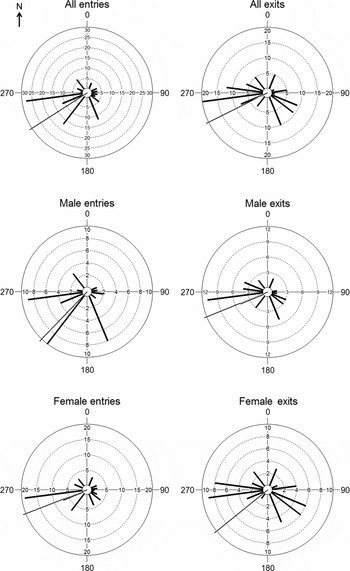
Exclusion of pseudoreplicates reduced the number of captures from 333 to 192, corresponding to 97 (40 male, 57 female) in pre-reproductive migration and 95 (44 male, 51 female) in post-reproductive migration. A different random sample of captures did not alter our findings. The observed directional orientation of migration was significantly different from expected under a uniform distribution, regardless of gender (P < 0.001 for all tests; Figure 4).
Circular histograms showing the frequency and mean vector for the directional orientation of pre- and post-reproductive migration in Melanophryniscus cambaraensis, excluding pseudoreplicate captures. The observed data were significantly different from expected under a uniform distribution for both pre- and post-reproductive migration, regardless of gender (Rao's spacing test, all P < 0.001).

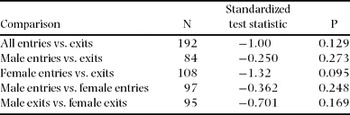
Males and females entered and exited the breeding site around the entire circumference, but approximately half of the entries and exits were made through the south-east (126° and 152°, 17.5% entries and 20% exits) and west (250°, 262° and 266°, 40.2% entries and 29.5% exits), and approximately 9% of entries and 8% of exits were made through the north-west (298° and 322°). We also observed some entries through the south-west (222°, 17%) and some departures to the west (280°, 12.6%) and east (108°, 8.4%). None of the secondary tests comparing pre- and post-reproductive migration and sexes was significant (all P > 0.05; Table 1).
Comparison of the directional orientation of male and female Melanophryniscus cambaraensis in pre- and post-reproductive migration using a multi-response permutation procedure (MRPP) for circular distributions. Entry and exit refer to pre- and post-reproductive captures, respectively.

DISCUSSION
Although the aim of the present study was only to address the orientation of migration, our results indicate clear differences between the reproductive dynamics of males and females in this population of Melanophryniscus cambaraensis. As indicated by the different rates at which individual males and females were repeatedly captured migrating in the same direction (i.e. individual pseudoreplicate capture rates), males participate in more breeding events than females. Most males were recaptured migrating in the same direction at least twice, whereas most females were never recaptured migrating in the same direction.
Todd et al. (Reference TODD, LUHRING, ROTHERMEL and GIBBONS2009) found that Scaphiopus holbrookii migrated indiscriminately through forested and clearcut habitats, which suggests uniform directional orientation. They explained this by noting that S. holbrookii breeds for only a few days in torrential rains when physiological risks of moving through clearcuts would be minimal. In contrast, for Melanophryniscus cambaraensis, the directional orientation of both males and females in pre- and post-reproductive migration was significantly different from expected under a uniform distribution, despite exhibiting the same reproductive characteristics as S. holbrookii. By eliminating pseudoreplicate captures we ensured that this result was a population-level pattern and not the result of bias introduced by a subset of individuals that migrated more frequently than others. There were no significant differences between male and female entry or exit points, which, combined with the non-random orientation detected for both sexes, suggests that both sexes follow the same routes of entry and exit.
Several studies have related non-random orientation of migration with habitat characteristics, finding that individuals of some species preferentially migrate between breeding sites and forested areas (Jehle & Arntzen Reference JEHLE and ARNTZEN2000, Malmgren Reference MALMGREN2002, Marty et al. Reference MARTY, ANGELIBERT, GIANI and JOLY2005, Rittenhouse & Semlitsch Reference RITTENHOUSE and SEMLITSCH2006, Todd et al. Reference TODD, LUHRING, ROTHERMEL and GIBBONS2009, Vasconcelos & Calhoun Reference VASCONCELOS and CALHOUN2004, Walston & Mullin Reference WALSTON and MULLIN2008). This does not appear to be a determining factor for this population of Melanophryniscus cambaraensis because the breeding site is completely surrounded by homogeneous planted Araucaria angustifolia forest that is occupied by this species.
We did not explicitly test explanations for the non-random directional orientation of Melanophryniscus cambaraensis. However, as part of our larger study of migration in this species we placed drift fences and pitfall traps in the forest surrounding the breeding site and found 85% of male individuals and 58% of female individuals exclusively in the forest south-east of the temporary stream, adjacent to the points with the greatest frequency of captures. Given the apparent homogeneity of the surrounding forest, we suggest that this may be due to the road that separates the breeding site from the forest to the north-west. In light of the explosive breeding of this species, it is unlikely that the road represents a significant barrier to adult movement (Todd et al. Reference TODD, LUHRING, ROTHERMEL and GIBBONS2009). We captured five individuals (1 male, 4 females) in the forest on both sides, which demonstrates that adults are capable of crossing the road. Instead, we suggest the road may affect juvenile dispersal from the breeding site by either increasing the mortality of juveniles that attempt to cross the road through greater desiccation and/or predation or acting as a deterrent to dispersal (i.e. juveniles avoid crossing the road), with adults migrating to and from the forest they dispersed into as juveniles. This hypothesis is consistent with the findings of Walston & Mullin (Reference WALSTON and MULLIN2008) that juveniles of several amphibian species rely on direct environmental cues to guide non-random orientation when dispersing from breeding ponds to forest.
In this paper we presented the results of the first study of migration orientation in an aseasonal, explosive-breeding amphibian. This is also the first detailed study of the migration of a Brazilian species of amphibian. Brazil has the richest amphibian fauna in the world, with species occurring in both strongly seasonal subtropical environments and more stable tropical environments. Brazilian amphibians also exhibit a vast diversity of reproductive modes and mating strategies (Haddad & Prado Reference HADDAD and PRADO2005), and we expect that patterns of migration will vary considerably across lineages and habitats. Given the importance of migration in amphibian ecology and evolution (Semlitsch Reference SEMLITSCH2008) and the recent suggestion that the anthropogenic disruption of amphibian migration may be an important cause of amphibian declines (Becker et al. Reference BECKER, FONSECA, HADDAD, BATISTA and PRADO2007), detailed studies of migration are a promising and important area of research on Brazilian amphibians.
ACKNOWLEDGEMENTS
This study was authorized by the Instituto Brasileiro do Meio Ambiente e dos Recursos Naturais Renováveis under license number 17288-1 and was supported by grants from the Conselho Nacional de Desenvolvimento Científico e Tecnológico (Procs. 305473/2008-5 and 476789/2009–5 to TG and a Master's fellowship to RRS) and Fundação de Amparo à Pesquisa do Estado de São Paulo (Proc. 2008/50928–1). We are grateful to Patrick Colombo and Ralph Saporito for advice on the design and implementation of this study, and to Camila Both for assistance and guidance on data analysis. Edenice Brandão Ávila de Souza and the personnel at the Floresta Nacional de São Francisco de Paula supported all aspects of our field work. Finally, we express our gratitude to the many individuals who helped with trap installation and data collection. Ralph Saporito and two anonymous reviewers provided helpful suggestions that improved the manuscript.