Introduction
Non-consensual treatment represents one of the main issues in clinical psychiatry and mental health care due to practical, juridical, ethical and deontological implications. Despite several attempts aimed at reducing or abolishing coercive treatments, clinicians still deem involuntary psychiatric treatments necessary at least as a last resort option in some cases. The juridical requirements for non-consensual treatment vary among democratic states. In several countries, involuntary psychiatric treatment criteria are linked to an evaluation of patients’ dangerousness for self or others (Steinert et al. Reference Steinert, Noorthoorn and Mulder2014), while in others the focus is on the severity of the disease and the need for a treatment, which must be also refused by the patient (Carabellese et al. Reference Carabellese, Taratufolo, Candelli, Grattagliano and La Tegola2012); some countries (e.g., Denmark, Finland, Greece, Ireland, UK, Portugal) provide both criteria. Summarising, two types of Mental Health regulations criteria for involuntary commitment exist: (a) those requiring mental illness and danger (b) those requiring mental illness and need for-treatment (Dressing & Salize, Reference Dressing and Salize2004).
As in Spain and Sweden, the legal regulation concerning involuntary psychiatric hospitalisation in Italy does not rely upon dangerousness nor on a capacity-based criterion. Specifically, three conditions are required: (1) the patient is suffering from ‘psychic alterations’ that need immediate treatment; (2) the patient refuses treatment; and (3) the patient cannot be adequately treated by other non-hospital-based means. This procedure allows both compulsory admission and treatment of patients, while in other countries (e.g., the Mental Health Act of England and Wales) involuntary hospitalisation and involuntary treatment are regulated by distinct procedures. In Italy, two medical certificates are required (proposal and confirmation), the decision is issued by the city mayor and further verified by a judge. Maximum length of initial placement is 7 days, but it can be extended upon motivated medical decision certifying the persistence of the three criteria.
Among European Union Member States considerable inconsistency among different legislative and procedural details for compulsory admission has been pointed out (Dressing & Salize, Reference Dressing and Salize2004), as well as the need for cross-national harmonisation of regulations. Moreover, is acknowledged that current mental health regulations might lack compliance with the principles of autonomy and self-determination of patients, and are inconsistent with the UN Convention on the Rights of Persons with Disabilities 2006 (CRPD) (Szmukler & Kelly, Reference Szmukler and Kelly2016). For such reasons a so-called ‘Fusion Law’ based on assessment of patient's decision-making capacity (DMC) and patients’ best interest has been proposed (Szmukler et al. Reference Szmukler, Daw and Callard2014).
Beyond differences in the legal framework for involuntary commitment, the abilities required for giving a valid informed consent/dissent to treatment are well recognised, and specific reliable clinical tools to measure such abilities exist (Appelbaum, Reference Appelbaum2007). An increasing number of studies proved the existence of a significant variability in psychiatric patients’ capacity to give informed consent also in acute psychiatric inpatient settings. Initial results from a single-centre study from our group unexpectedly showed that non-consensual psychiatric patients under a need for treatment-based regulation might preserve treatment decision-making abilities (Mandarelli et al. Reference Mandarelli, Tarsitani, Parmigiani, Polselli, Frati, Biondi and Ferracuti2014). Such data prompted us to further verify those results ina a larger sample from different centres.
It is noteworthy that the diagnosis of a mental disorder is not a definite correlate of reduced or compromised mental capacity. Psychiatric inpatients do not necessarily perform poorer than medical inpatients in informed consent decision-making measures (Lepping et al. Reference Lepping, Stanly and Turner2015), while significant within group variability has emerged in both group of patients (Raymont et al. Reference Raymont, Bingley, Buchanan, David, Hayward, Wessely and Hotopf2004; Palmer et al. Reference Palmer, Dunn, Appelbaum, Mudaliar, Thal, Henry, Golshan and Jeste2005; Candia & Barba, Reference Candia and Barba2011; Owen et al. Reference Owen, Szmukler, Richardson, David, Raymont, Freyenhagen, Martin and Hotopf2013). Specific clinical characteristics are most often associated with lack or impaired capacity to consent to treatment (Aydin Er et al. Reference Aydin Er, Sehiralti and Aker2013); among these are excitement and positive symptoms (Cairns et al. Reference Cairns, Maddock, Buchanan, David, Hayward, Richardson, Szmukler and Hotopf2005; Howe et al. Reference Howe, Foister, Jenkins, Skene, Copolov and Keks2005; Owen et al. Reference Owen, Richardson, David, Szmukler, Hayward and Hotopf2008; Mandarelli et al. Reference Mandarelli, Tarsitani, Parmigiani, Polselli, Frati, Biondi and Ferracuti2014), cognitive dysfunction (Palmer et al, Reference Palmer, Dunn, Appelbaum and Jeste2004; Palmer & Jeste, Reference Palmer and Jeste2006; Parmigiani et al. Reference Parmigiani, Mandarelli, Dacquino, Pompili, Lelli Chiesa and Ferracuti2016), impaired executive functioning (Mandarelli et al. Reference Mandarelli, Parmigiani, Tarsitani, Frati, Biondi and Ferracuti2012), impaired metacognition (Koren et al. Reference Koren, Poyurovsky, Seidman, Goldsmith, Wenger and Klein2005).
Patients affected by mental disorders in acute phase are at greater risk of incapacity, as are those treated involuntarily (Howe et al. Reference Howe, Foister, Jenkins, Skene, Copolov and Keks2005; Fraguas et al. Reference Fraguas, García-Solano, Chapela, Terán, de la Peña and Calcedo-Barba2007; Okai et al. Reference Okai, Owen, McGuire, Singh, Churchill and Hotopf2007; Owen et al. Reference Owen, Richardson, David, Szmukler, Hayward and Hotopf2008; Kallert et al. Reference Kallert, Glöckner and Schützwohl2008; Catanesi et al. Reference Catanesi, Carabellese, Candelli, La Tegola and Taratufolo2010; Mandarelli et al. Reference Mandarelli, Tarsitani, Parmigiani, Polselli, Frati, Biondi and Ferracuti2014). Little is known about the neurophysiological underpinnings of treatment-related decision-making, while an introductory fMRI study showed activation of specific brain areas during a clinical-research decision-making task (Eyler et al. Reference Eyler, Olsen, Nayak, Mirzakhanian, Brown and Jeste2007).
Despite these advances, research has not yet explained the actual degree of impairment of mental capacity to consent to treatment in those psychiatric patients who are involuntarily hospitalised and/or treated due to an acute mental disorder. Nor have scholars yet explained the role played by psychopathological, diagnostic and social features in this particularly vulnerable population. The two distinct legal prerequisites underlying involuntary treatment of people with mental disorders i.e., need for treatment or dangerousness also merit consideration as concerning capacity evaluations. It is conceivable that the evaluation of patients’ capacity to consent/dissent to treatment is more relevant in legal systems based on the need for treatment than in those based on dangerousness as a legal criterion for involuntary commitment.
We designed this multi-centre study to investigate acute non-consensual psychiatric patients’ treatment DMC in a representative sample from three distinct Italian regions. We identified patients with high or low treatment DMC. We also analysed to what extent diagnostic features and psychiatric symptoms are associated with mental capacity to consent to treatment.
Method
Participants
Patients were recruited among those consecutively involuntarily admitted to any of three adult psychiatric wards (Sant'Andrea Hospital, Rome; Azienda Ospedaliera, Perugia; Policlinico di Bari Hospital Giovanni XXIII, Bari) between June 2012 and April 2013. The study sites are in Central and Southern Italy and the psychiatric wards are situated in general hospitals. A study doctor who synthetically disclosed the study aims initially approached the patients, those who accepted to participate received full disclosure of the study aims and procedures and gave written informed consent. Subjects were interviewed within 3 days from admission. Patients were diagnosed with the DSM-IV-TR criteria. Twenty-nine per cent of consecutively admitted patients refused to participate overall.
The recruited subjects were involuntarily hospitalised due to an acute mental disorder and the need for a treatment, which they refused. Two physicians that, according to the Italian law did not explicitly take into account acute danger for self or others decided involuntary psychiatric hospitalisation and treatment. One of the evaluating physicians was always a psychiatrist. No forensic patients are present in this study as the Italian civil commitment procedure is specifically aimed only at clinical populations.
Since more than 85% of patients suffered from schizophrenia spectrum disorders (SSD) or bipolar disorders (BD) we conducted sub-analyses by comparing these two groups of patients. The study was approved by the Institutional Review Board the University of Rome, the University of Bari and the University of Perugia.
Measurement of treatment DMC
Capacity to consent to treatment was assessed through the MacArthur Competence Assessment Tool for Treatment (MacCAT-T), a semi-structured interview, which investigates the four facets of informed consent patients’ decisional capacity (Grisso et al. Reference Grisso, Appelbaum and Hill-Fotouhi1997). The MacCAT-T proved reliable in measuring mental capacity in patients with severe mental disorders in acute psychiatric inpatient settings (Howe et al. Reference Howe, Foister, Jenkins, Skene, Copolov and Keks2005; Owen et al. Reference Owen, Richardson, David, Szmukler, Hayward and Hotopf2008; Mandarelli et al. Reference Mandarelli, Tarsitani, Parmigiani, Polselli, Frati, Biondi and Ferracuti2014).
The first MacCAT-T subscale is understanding of the disclosed information and pertains to the assessment of patients’ capacity to comprehend, retain and repeat information on his/her diagnosis, treatment and relative risks and benefits, as well as treatment alternatives. The understanding subscale ranges from 0 to 6, with higher scores indicating better understanding. The appreciating subscale assesses the patients’ ability to acknowledge his/her diagnosis as well as the usefulness of treatment, and ranges from 0 to 4. Those patients who recognise the disclosed diagnostic features and agree with the potential usefulness of the proposed treatment obtain higher scores. The reasoning subscale evaluates patients’ ability to manipulate treatment-related information in a rational and logical way. The scoring of reasoning subscale entails the physician evaluation of patients’ ability to process treatment information in a consequential and comparative way, as well as the ability of the patient to deduce consequence of treatment or non-treatment in real life (range 0–8). MacCAT-T reasoning scoring relies mainly on formal aspects of decision-making and being in contrast with the doctors’ opinion does not necessarily implies a low score at this subscale (e.g., a patient who rationally refuses a medication due to its previous side effects). Finally, the expressing a choice subscale focuses on the ability of the patient to declare his/her choice in a clear and consistent way (range 0–2).
Prior to administering the MacCAT-T treatment information was collected by a study doctor by consulting the treating staff and carefully reviewing patients’ case notes and medicine prescriptions. The MacCAT-T interview focused on patients’ current treatment, which comprised first-generation antipsychotics (52% of patients), second-generation antipsychotics (57%), antiepileptic drugs used as mood stabilisers or lithium carbonate (50%), long-acting injectable antipsychotics (6%). The prescribed medicines were decided by the treating staff.
The study doctors who performed the interview had been trained to administer the MacCAT-T within a larger programme involving DMC evaluation and had a mean inter-rater reliability of 0.8 (CI 95% 0.71–0.85). During the MacCAT-T administration, each patient was invited to discuss no treatment or no hospitalisation as a possible alternative to his/her current treatment. Despite the choice of no treatment resulting in a low score in appreciation, those involuntarily committed patients who rationally explained their reasons for refusing treatment could have obtained good scores on reasoning.
The MacCAT-T manual does not provide a total score neither a cut-off to define when a patient should be considered competent or incompetent. Some MacCAT-T cut-off have been proposed (Kim et al. Reference Kim, Appelbaum, Swan, Stroup, McEvoy, Goff, Jeste, Lamberti, Leibovici and Caine2007; Mandarelli et al. Reference Mandarelli, Tarsitani, Parmigiani, Polselli, Frati, Biondi and Ferracuti2014; Lepping et al. Reference Lepping, Stanly and Turner2015). In the present study, we wanted to identify patients with definitely good treatment DMC. We therefore chose to classify patients by using a cautious method by which they were considered to have high treatment DMC when they scored >75% on the first three MacCAT-T subscales and the maximum score at expressing a choice (i.e., understanding ≥4.5, appreciating ≥3, reasoning ≥6, expressing a choice = 2).
Clinical and cognitive assessment
The 24-item Brief Psychiatric Rating Scale (BPRS, version 4.0) assessed current psychiatric symptoms severity (Ventura et al. Reference Ventura, Lukoff, Nuechterlein, Liberman, Green and Shaner1993). The scale comprises 24 items investigating the main psychiatric signs and symptoms. Each item is rated on a 7-point Likert scale ranging from 1 (not present) to 7 (extremely severe). Trained psychiatry residents conducted clinical interviews for BPRS scoring. Training sessions included analysis of videotaped clinical interviews and supervision by one of the authors (G.M.). Consistency among observers was good (ICC = 0.84).
Cognitive functioning was assessed with the Mini Mental State Examination (MMSE) (Folstein et al. Reference Folstein, Folstein and Mchugh1975), a screening tool for cognitive functioning that showed associations with reduced or impaired treatment decision-making.
Statistical analysis
Data were analysed using the Statistical Package for Social Sciences version 17.0. All statistical tests were 2-tailed with an alpha value set at 0.05. The chi-square (χ 2) test or Fisher's exact test was used for comparisons between categorical variables. Pearson correlation coefficient was used to investigate associations among continuous variables. Independent sample t test was used to compare continuous variables between SSD and BD patients.
Results
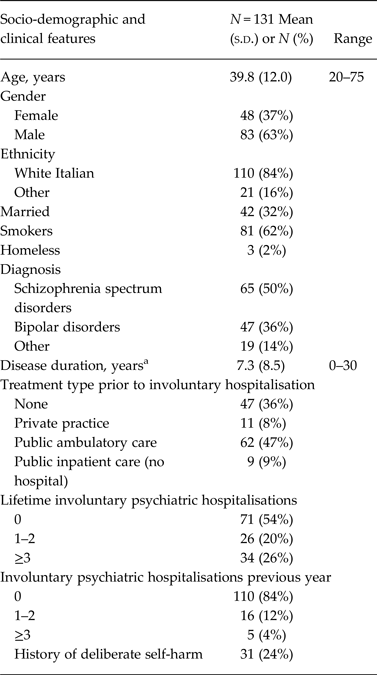
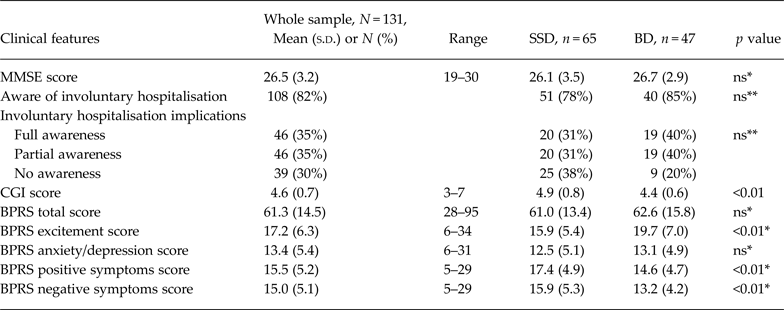
Socio-demographic characteristics of 131 involuntarily hospitalised patients are shown in Table 1. Fifty per cent (n = 65) of the recruited patients suffered from schizophrenia spectrum and other psychotic disorders, 36% (n = 47) BD, 14% (n = 19) other disorders mostly borderline personality disorder. Mean (26.5) and median (28) MMSE total score were in the normal range and no differences emerged between SSD and BD patients (Table 2). Twenty-seven per cent of patients (n = 35, 57% SSD, 29% BD) had a MMSE score <24, suggesting the presence of cognitive impairment.
Socio-demographic characteristics of involuntarily hospitalised and treated patients

a Note. n = 35 values are missing.
Clinical characteristics of involuntarily hospitalised and treated patients

SSD, Schizophrenia spectrum disorders; BD, bipolar disorders; MMSE, Mini Mental State Examination total score; CGI, Clinical Global Impressions baseline; BPRS, Brief Psychiatric Rating Scale v.4.0.
*p values by independent sample t test; **p values by χ 2. Involuntary hospitalisation implications scores were obtained by asking and analysing patients’ beliefs prior to the MacCAT-T interview.
An early preliminary evaluation of patients’ awareness of involuntary hospitalisation implications, prior to the MacCAT-T interview, showed almost one-third of patients disclosing no knowledge about involuntary hospitalisation reasons and implications (Table 2). Independent sample t test disclosed higher positive and negative symptoms and lower excitement in the SSD group of patients than in BD (p < 0.01) (Table 2).
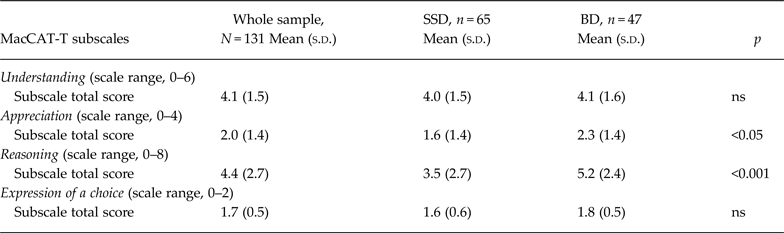
Mental capacity ratings for the 131 involuntarily hospitalised patients showed that patients affected by BD scored generally better than those affected by SSDs in MacCAT-T appreciation total score (p < 0.05) and reasoning total score (p < 0.01) (Table 3). In the whole sample, the presence of positive symptoms was associated with poorer capacity to appreciate (r = −0.24; p < 0.01) and reason (r = −0.27; p < 0.01) about own treatment (Table 4). Negative symptoms were associated with poorer understanding of treatment (r = −0.23; p < 0.01) (Table 4) Those patients who presented anxiety and depressive symptoms scored higher on MacCAT-T appreciating (r = 0.22; p < 0.05) and reasoning (r = 0.20; p < 0.05) (Table 4).
Capacity ratings of involuntarily hospitalised and treated patients

MacCAT-T, MacArthur Competence Assessment Tool for Treatment, higher scores correspond to better treatment decision-making abilities. SSD, schizophrenia spectrum disorders; BD, bipolar disorders. p values by independent sample t test.
Correlations between clinical features and capacity ratings in involuntarily hospitalised and treated patients (n = 131)

MacCAT-T, MacArthur Competence Assessment Tool for Treatment; MMSE, Mini Mental State Examination total score; p values by Pearson's correlation coefficient. **p < 0.01; *p < 0.05.
To investigate possible differences between SSD and BD we conducted two separate correlation sub-analyses. Poorer cognitive functioning, as measured by MMSE, negatively affected MacCAT-T understanding in patients affected by schizophrenia spectrum disorder, but not in those affected by bipolar disorder (SSD r = 0.37; p < 0.01; BD r = −0.01; p = 0.9). Poorer MacCAT-T reasoning was associated with more manic symptoms in the BD group of patients but not in the SSD group (BD r = −0.32; p < 0.05; SSD r = 0.03; p = 0.8).
Twenty-two per cent (n = 29) of the 131 recruited patients showed high treatment DMC as defined by having scored higher than 75% of understanding, appreciating and reasoning MacCAT-T subscales maximum sores and 2 at expressing a choice (Table 5). The remaining involuntarily hospitalised patients were considered to have low treatment DMC. The χ 2 disclosed that 32% of BD patients had high treatment DMC compared with 9% of SSD patients (p < 0.001) (Table 5).
Good v. poor treatment DMC among diagnostic groups on involuntarily hospitalised and treated patients

DMC, decision-making capacity. Patients were classified as having high DMC if they scored over 75% of every MacCAT-T subscale range (i.e., understanding > 4, appreciating > 3, reasoning > 6 and expressing a choice = 2). The differences in distribution among diagnostic groups are significant as disclosed by χ 2 (p < 0.001).
Discussion
Our multi-centre study on a sample of 131 acute non-forensic involuntarily hospitalised and treated patients extends the few existing data on patients’ treatment DMC in coercive psychiatric settings. The MacCAT-T proved feasible as we observed that the interview was generally well tolerated and not time-consuming. The results we report here contribute to provide useful information to understand the degree of impairment in mental capacity to provide consent/dissent to treatment in those psychiatric patients who are involuntarily hospitalised and/or treated due to an acute mental disorder.
A significant variability in acute psychiatric inpatients’ degree of impairment in treatment DMC emerged, a result deserving further attention. Decisional impairment was a common but not always unavoidable characteristic of patients compulsorily admitted to the acute psychiatric inpatient units, which is in line with previous initial research on smaller samples from single centres (Cairns et al. Reference Cairns, Maddock, Buchanan, David, Hayward, Richardson, Szmukler and Hotopf2005; Owen et al. Reference Owen, Richardson, David, Szmukler, Hayward and Hotopf2008; Mandarelli et al. Reference Mandarelli, Tarsitani, Parmigiani, Polselli, Frati, Biondi and Ferracuti2014).
The result of a poorer treatment DMC in patients affected by schizophrenia spectrum disorder compared with patients affected by bipolar disorder questions existing data indicating a minor role for diagnoses rather than symptoms. For example, Palmer et al. (Reference Palmer, Dunn, Depp, Eyler and Jeste2007) found no differences between long-term illness outpatients affected by bipolar disorder and long-term illness outpatients affected by schizophrenia in competence to consent to research, as measured through the MacCAT-CR. Howe et al. (Reference Howe, Foister, Jenkins, Skene, Copolov and Keks2005) found no differences in MacCAT-T scores between acute psychiatric patients affected by schizophrenia, schizoaffective and bipolar disorder (manic/mixed phase). The results we report here otherwise suggest that schizophrenia spectrum disorder patients are at greater risk of impaired treatment DMC in acute coercive psychiatric settings.
Greater impairment of treatment DMC was associated with positive symptoms severity in the sample overall, acute mania in BD patients, and cognitive impairment in SSD patients. The result of no association between cognitive functioning and treatment DMC in the BD group of patients must be read in the light of the good MMSE scores they obtained. We hypothesise that where present, cognitive dysfunction would also show association with treatment DMC in acutely hospitalised involuntary psychiatric patients affected by BD. Further studies conducted with subtler neuropsychological assessment tools are also needed to better understand the complex relationship between cognition and treatment DMC. We chose here the MMSE mainly due to its feasibility in an acute psychiatric setting.
In the present study, 22% of the 131 patients scored >75% on every MacCAT-T subscale and were classified as having high treatment DMC. The percentage of patients with high treatment DMC reached 32% among BD patients and 42% among other diagnoses (n = 4 Borderline Personality Disorder, n = 1 Adjustment Disorder with Mixed Disturbance of Emotion and Conduct, n = 1 Major Depressive Disorder, n = 1 Alcohol Dependence, n = 1 Obsessive Compulsive Disorder). Such patients presented an almost complete understanding and appreciating of their clinical condition, as well as of the risks and benefits of their treatment (or no treatment), an adequate capacity to reason about their therapy and to express a choice (i.e., no hospitalisation/treatment) in a clear and consistent way.
This result is surprising and has implications for researchers, clinical psychiatrists, and policymakers as it seems to imply that under the Italian mental health regulation a capable patients’ refusal of treatment can be override for reasons that are not of immediate understanding and deserve further consideration. Non-consensual psychiatric treatment in Italy relies mainly on the presence of a severe acute mental illness and refusal of necessary treatment. A possible explanation would be the implicit application of a ‘best interest’ criterion in which capable patients’ refusal was override in their interest. Nonetheless this would contrast with the principle of autonomy and with a ‘Fusion Law’ which requires lack of capacity and best interest criteria for non-consensual treatment. Another possible explanation is that physician decision-making included a danger criterion, even though the Italian law does not provide it, for example in case of actual suicide risk. Finally, we should consider that patients’ treatment DMC could vary fast in acute psychiatric settings. Even though we assessed patients within 3 days from admission, it could be possible that treatment DMC had significantly improved due to hospitalisation and to pharmacological treatment. Therefore, the patients’ DMC level assessed during this study could have been different from the one displayed when physicians decided involuntary admission. This hypothesis deserves future studies aimed at investigating rapid changes in treatment DMC in acute inpatients since it would have implications also under a capacity-based mental health legislation.
The validity of legal regulations for involuntary commitment in vulnerable populations should be tested in real-word procedures. In our opinion, when involuntary procedures are based on the need for treatment criterion, the evaluation of capacity to consent/dissent should be routinely performed also in acute psychiatric settings. As is the case of psychiatric symptoms severity, the treatment DMC should be conceived as clinical variable, which clinicians can measure to guide clinical decisions (e.g., involuntary hospitalisation v. acceptance of patient refusal).
Acknowledgements
The authors would like to thank the patients for their cooperation.
Financial support
This research received no specific grant from any funding agency, commercial or not-for-profit sectors.
Conflict of interest
None.
Ethical standards
The authors assert that all procedures contributing to this work comply with the ethical standards of the relevant national and institutional committees on human experimentation and with the Helsinki Declaration of 1975, as revised in 2008.
Availability of data and materials
The study dataset is available at https://www.dropbox.com/s/v6b6f64uj7g1367/TSO%20multicentrico%20-%20Data.xls?dl=0