


How dangerous was work in Victorian and Edwardian Britain? In terms of the risks of dying at the workplace, some trades such as mining and chemicals were clearly more “dangerous” than others. While we have good information on mortality in these dangerous trades, we know relatively little about the majority of workers who neither labored in the mines nor were exposed to noxious substances at the workplace. However, mortality in the workplace is not the only important issue; morbidity at work and longevity afterward are key areas of research that have received little attention previously. Given the amount of time individuals spent at work and the growing importance of occupations in sectors other than manufacturing, this gap in knowledge is significant if we are to understand the relationships between work, health, and longevity during this period. It is the central argument of this article that paying more attention to work will aid with understanding patterns of adult mortality in Britain, albeit at the cost of requiring considerably more effort to establish the data on which to base such investigations.
In this article, we use a dataset relating to the longevity of postal workers post-retirement to examine how work affected survival after people left postal employment. As we shall see, much depended on whether an individual was healthy enough to reach retirement age, or if they had to retire early due to a medical condition that prevented them from performing their duties. By addressing these topics, this article provides novel insights into the social determinants of adult life expectancy in the United Kingdom from the mid-nineteenth to mid-twentieth centuries.
Previous historical research on occupation-specific mortality in the UK for this period is limited and has tended to look either at mortality while working or at the mortality of workers and retired individuals from a given occupation together (Haines Reference Haines, Schofield, Reher and Bideau1991; Woods Reference Woods2000: 210–40). Occupational mortality in the United Kingdom data was recorded in the Registrar General’s reports from the 1850s onward. It was broken down by age, but not always by working status. Sometimes, for the older age categories, only those still working were included, but in other years the figures were given for working and retired individuals in an occupation. Using this information, William Farr first drew attention to differential mortality rates in specific occupations, noting, for example, that there was an exceptionally high rate of mortality for Victorian clerks on account of the “generally close and ill-ventilated” rooms in which they worked – not unlike the conditions that many indoor postal workers experienced (Farr Reference Farr1885: 401). But Farr, like others at the time and since, did not consider what happened to workers after they retired. This focus reflects the long-standing interest of the General Register Office’s interest in the effect of work on health (Higgs Reference Higgs1991), but that interest made no real distinction between death in and after work. The Registrar General’s occupational mortality tables provide no information on when people retired, how long they had worked in a given occupation, whether they had migrated post- or pre-retirement, or whether they had worked at all during retirement. These factors, added to the well-known difficulties of unpicking environmental from occupational factors, mean that much remains unknown about the relationships between work, retirement, and mortality in this period (Woods Reference Woods2000: 203–4).
Occupation could affect mortality in two broad ways. First, directly through the risks associated with a given occupation. In some cases, these risks could be dramatic and deadly, such as in mining or railway work where accidents and industrial diseases, such as pneumoconiosis, were common. (Benson Reference Benson1974; Esbester Reference Esbester2020; Turner and Blackie Reference Turner and Blackie2018); in others, the effects were more quotidian but still dangerous, such as the heightened mortality suffered by nineteenth-century physicians (Woods Reference Woods1996). These risks were not only associated with particular kinds of work but also with specific workplaces. Again, the danger of mines, factories, or railway yards is clear, but issues surrounding ventilation, lighting, and so on were important in all manner of other workplaces, whether these were commercial offices, homes, workshops, or retail stores (Harrison Reference Harrison1996: 106–36). Second, effects could be mediated through the income, wealth, and social standing associated with given occupations. Here, higher income meant workers could afford more salubrious residences, a better diet and superior healthcare with each aspect contributing to improved health outcomes, or they could use their social position to improve their local environment (Prest Reference Prest1990: 139–49; Trainor Reference Trainor1993: 231–84). In this regard, it is hard to distinguish between precisely what was an “occupational” effect and what was an “environmental” one. Despite these problems, Woods found negative, and positive, occupational effects on adult health, although he tended to suggest such effects were less substantial than environmental ones (Woods Reference Woods2000: 242–4). However, his reliance on aggregate data means that questions remain, notably about the balance between in-work and post-work mortality.
The evidence we use to address these questions comes from information contained in the pension records of postal workers in the United Kingdom. This includes details provided by doctors employed by the Post Office concerning the medical conditions that forced individual workers to retire, and this can then be linked to their date of death to provide additional information about longevity. This linkage then allows us to assess survival rates differentiated by the cause of retirement as well as occupation, place of work, and other determinants of health. Using this evidence, we then demonstrate that the type of postal work undertaken had a substantial impact on workers’ lives after retirement. There was considerable variation within the postal workforce, with employees in different occupations faring better or worse depending on the risks to which they were exposed. These risks were partly related to their occupation and partly to their working environment. Some of the Post Office’s workplaces were decidedly healthier than others: a rural postman, for example, faced different risks than a telegraphist working a night shift in London. Postal workers were aware of these issues, for example, the 1906 Select Committee on Post Office Servants heard voluminous testimony about the unhealthy nature of many indoor workplaces, citing the lack of fresh air, poor illumination, and copious amounts of dust (Parliamentary Papers 1906). For these reasons, in relation to health and longevity, we argue that work mattered, not just during an employee’s working life but even in the period of their retirement.
These data provide one of the first quantitative studies of the impact of retirement on health for this period. The emergence of retirement as a new stage of life has received considerable attention from political, social, and cultural historians (Hannah Reference Hannah1986; Thane Reference Thane2000). In contrast, relatively little has been written on the demographic impacts of this new life cycle stage. The 1859 Superannuation Act entitled all civil servants who had served for 10 years or more to a pension based on their final salary. This provided hundreds of thousands of workers with the opportunity to potentially leave the labor force and continue to retain an independent income, something which had previously only been possible for a relatively small section of society (McIlvenna et al. Reference McIlvenna, Brown and Green2020). This article examines one aspect of the health impacts of this development; namely, whether or not the type of work performed before retirement had an impact on survival after retirement.
Beginning with a description of the data and the method by which death dates were obtained for the sample of postal workers used here, we assess the extent to which those workers were representative of other postal retirees. The next section examines the Kaplan–Meier survival curves of workers with differing causes of retirement. We then move onto the question of what factors affected the chances of a worker retiring sick, given the distinct difference in survival seen between medical retirees and those who reached retirement age. Then we separately model the effect of occupation on survival time for medical retirees and those who reached retirement age to show the importance of different forms of work and different causes of retirement on survival.
Postal worker pensions data
The data used in this article are a subset of a larger database of 26,500 UK postal workers who retired between 1860 and 1908 for whom we know their date of death. These data are derived from the pension application forms submitted to the British Treasury by the Post Office when a worker retired. As part of the Civil Service, postal workers were eligible for pensions from 1859 onward. Workers who had served for 10 or more years could apply for a pension either when they reached retirement age (60 until 1892 when compulsory retirement at 65 years of age was introduced), or when they had a medical condition that prevented them from working. The retirement age policy was not uniformly implemented; even after 1892 there were 150 male postal pensioners whose forms record them retiring because they had reached retirement age who were, nevertheless, older than 65 years of age, and 47 of these were older than 70 years of age at retirement. If a worker had been employed by the Post Office for less than 10 years, they could apply for a gratuity, a one-off payment.
Where a worker could no longer perform their duties because of ill health, the need for retirement was certified by a doctor to minimize fraudulent claims (McIlvenna et al. Reference McIlvenna, Brown and Green2020; Marley Reference Marley2025). This information was then summarized in the pension form, albeit usually using only one or two words to describe the condition. This cause of retirement was specific until midway through 1900; after that date medical retiree forms just report “ill health” as a cause of retirement.
The data on death dates for this article derive from a set of Parliamentary Papers that recorded when a pension was granted and when that pension ceased. In most cases, the pension ceased because the recipient had died. The list of pensions ceased were published until 1909, with the final list including pensioners who had retired, at the latest, in 1902. These papers, therefore, allow us to trace the post-retirement survival of a sample of those granted pensions who retired between 1860 and 1902, and who died between 1860 and 1909. However, in order to examine the relation between specific causes of retirement and subsequent survival, we restrict our sample to those retiring before 1900. Between 1860 and 1902, 18,689 postal workers retired. Of those, 15,731 workers retired before 1900. There are entries in the lists of pensions granted for 11,093 of these workers, and the list of pensions ceased provide dates of death for 6,129 of those postal workers, comprising 39 percent of the 1860–1899 retirees and 55 percent of those appearing in the pensions granted lists. These individuals, identified through the Parliamentary Papers, each had a pension application form held at the Postal Museum that provides additional information on their careers and health to that given in the published lists: notably, their cause of retirement, their final salary, and more detailed information on occupation and places of work. The two sources were linked based on retirement date, name, occupation, and location, and this allowed a high linkage rate, only 0.8 percent of people listed in the Parliamentary Papers as receiving a pension could not be linked to a pension application form.
The use of just the Parliamentary Paper lists of pensions granted and ceased introduces several important biases that need to be taken into account when analyzing these data and which lead us to reduce the sample further. First, as noted above, there were two main types of retirees in this period, pensioners and gratuitants. Just over 96 percent of those recorded in the lists of pensions ceased were awarded pensions rather than gratuities. This is because the lists were published because the Treasury was interested in the ongoing expenses incurred by the Treasury for the Civil Service pension scheme, so one-off gratuities were of little interest. Consequently, a substantial number of retirees are not included in the lists of pensions granted and ceased: only 74 percent of workers who retired between 1860 and 1899 received pensions, 20 percent were awarded gratuities, with the remaining 6 percent receiving various other forms of compensation. This means that pensioners are over-represented in the survival data compared to the total population of postal retirees; this imparts various other biases because some workers were more likely than others to receive pensions. The most important impact is that very few death dates of female workers are known; 13 percent of all retirees between 1860 and 1899 were female, whereas the lists of pensions ceased give death dates for only 287 female postal workers. For this reason, this article considers only male pensioner survival.
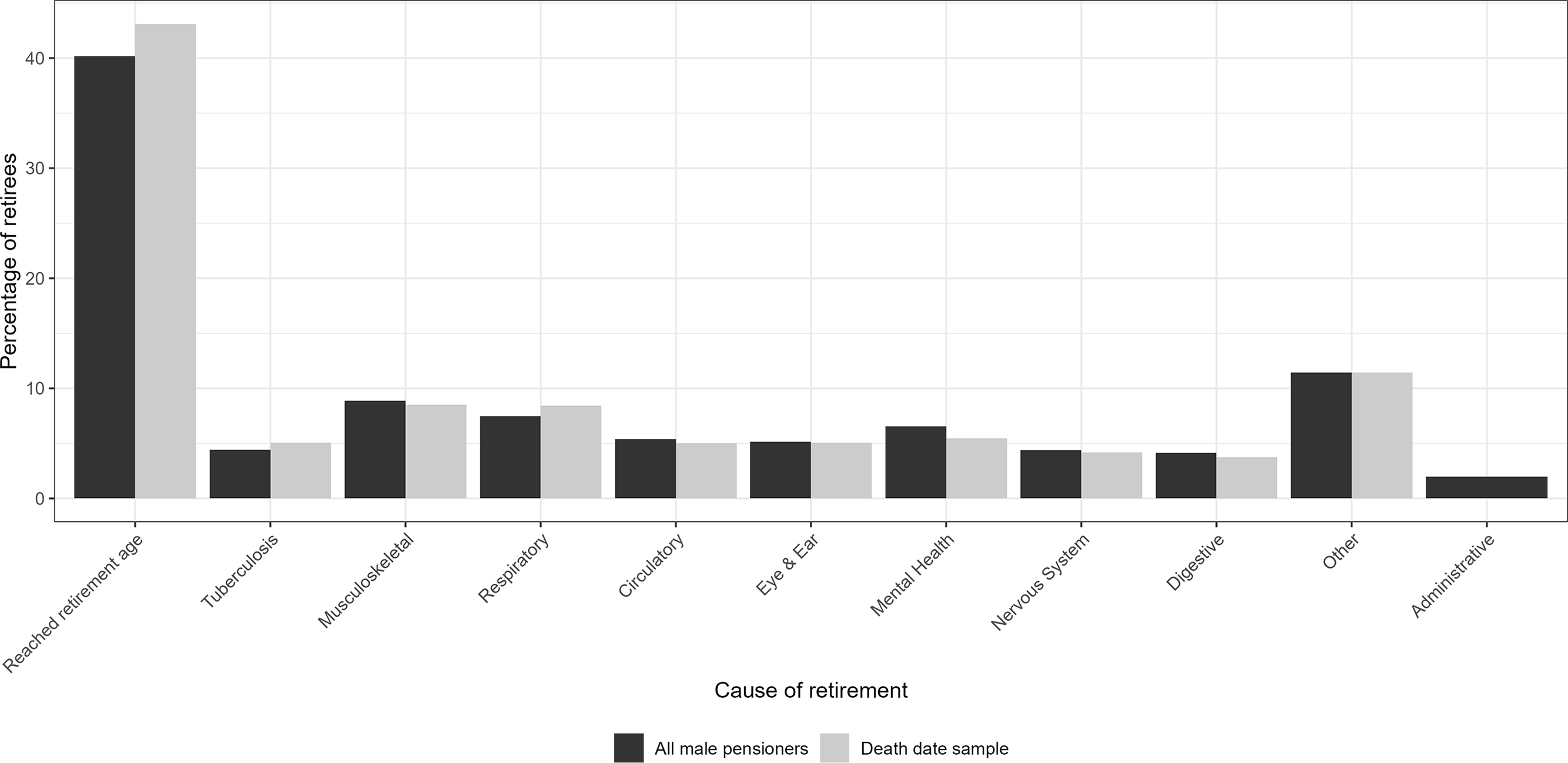
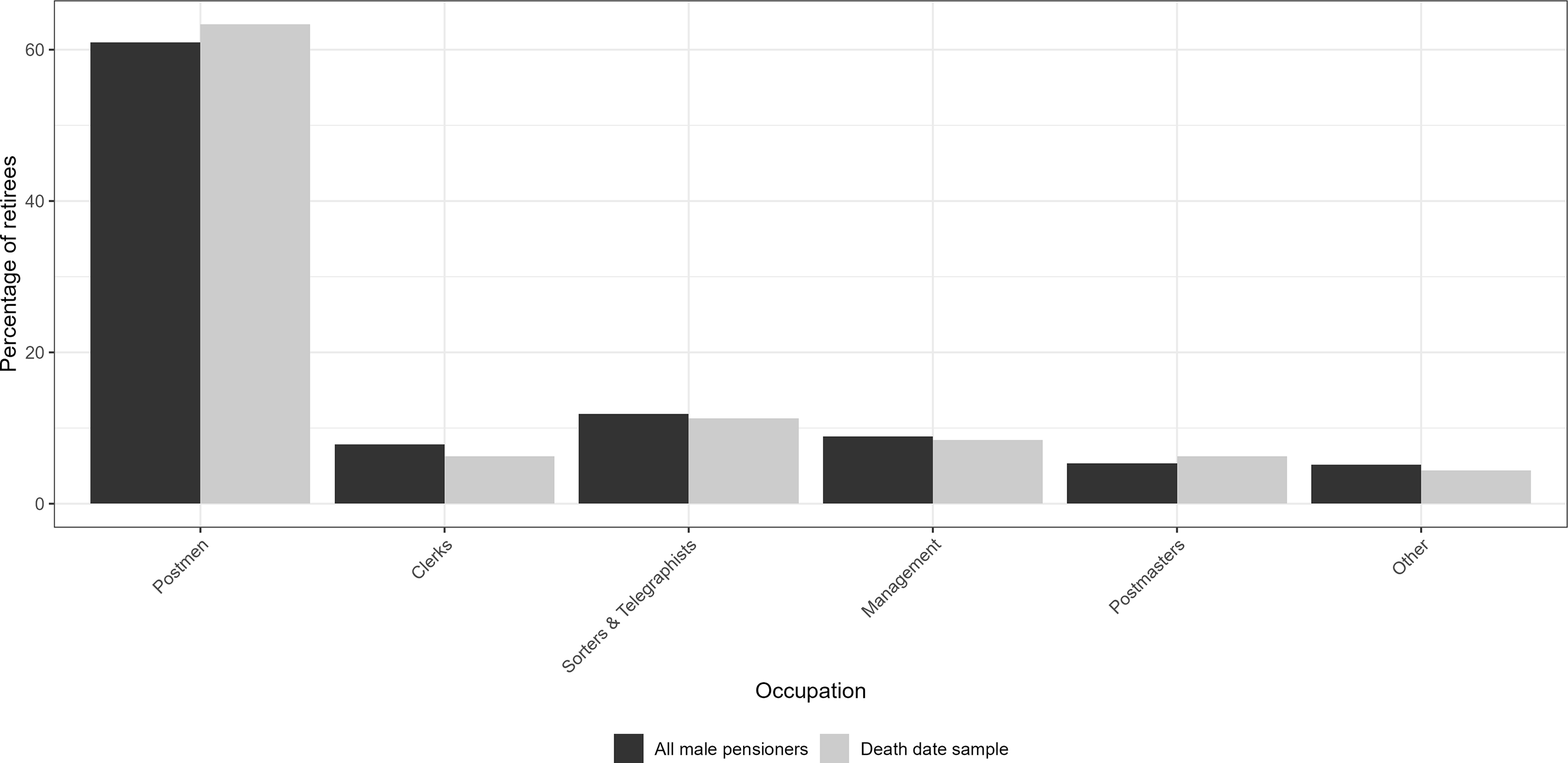
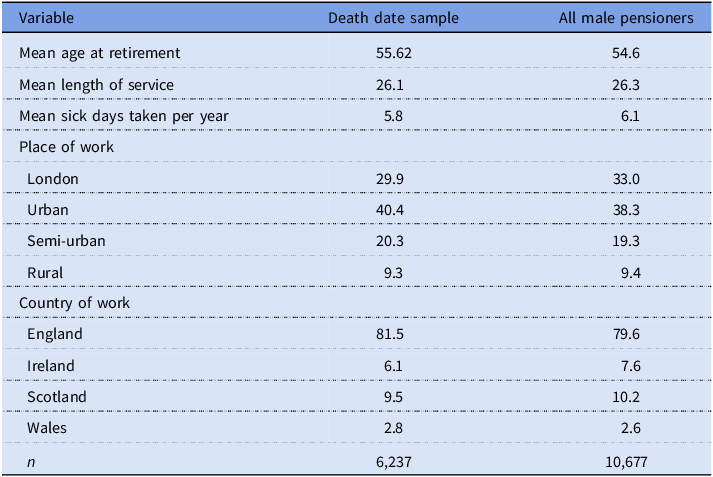
There are other ways in which bias is introduced as a result of the nature of the data. Figure 1, Figure 2, and Table 1 compare various characteristics of the death date sample and the whole population of male postal workers who retired with a pension. These figures and table show the sample of male pensioners whose death date is known are highly similar to the general population of male postal pensioners. There are small differences in the place of work, mean sick days taken, and some of the occupations. The most notable difference is the slightly higher share of workers in the death date sample who retired because they reached retirement age, 43 percent in the death date sample compared to 37 percent among all male pensioners. However, if we use all pensioners who appeared in the lists of pensions granted and treat those missing from the lists of pensions ceased as censored, then all these small differences reduce or disappear entirely. The share of pensioners reaching retirement age, for example, falls to 40 percent. Overall, then, the sample of workers whose death date is known to us were generally representative of male postal workers who received a pension and should allow us to speak about their mortality experience.
Cause of retirement for death date sample and all male postal pensioners, 1860–1899.
Source: Smith et al. (Reference Smith, Green, Newman, McIlvenna, Marley, Preger, Chick, Brown and Shelton2025).

Occupations of death date sample and all male postal pensioners, 1860–1899.
Source: Smith et al. (Reference Smith, Green, Newman, McIlvenna, Marley, Preger, Chick, Brown and Shelton2025).

Comparison of death date sample and all male postal pensioners, 1860–1899

Table 1 Long description
A table comparing characteristics of death date sample and all male postal pensioners. The table has 12 rows and 3 columns. The columns are labeled 'Variable', 'Death date sample', and 'All male pensioners'. The rows are labeled with different variables such as 'Mean age at retirement', 'Mean length of service', 'Mean sick days taken per year', 'Place of work', and 'Country of work'. The 'Place of work' and 'Country of work' rows have subcategories with corresponding percentages. Notable trends include slight differences in mean age at retirement, mean sick days taken per year, and place of work between the death date sample and all male pensioners.
Source: Smith et al. (Reference Smith, Green, Newman, McIlvenna, Marley, Preger, Chick, Brown and Shelton2025).
Note: mean days off per year calculated as the total number of sick days taken, divided by the total number of years of exposure for that group.
Having restricted our sample to just those workers who appear in the lists of pensions granted, and removed women from that sample, we are left with 9,514 male pensioners retiring between 1860 and 1899. Of those, we have the death date of 6,237; of the remaining 3,317, 40 had their pension stopped for a different reason, such as committing a felony. The 40 whose pension was stopped for reasons other than death have been dropped from our sample, given they may have died at any point between their retirement date and the end of our study period in 1909. This leaves 3,277 pensioners who do not have a known death date and are therefore right-censored in our sample because their death date occurred after the censoring date (Klein and Moeschberger Reference Klein and Moeschberger1997: 55–82). For these workers, we mark them as censored with their age in 1909 taken as the age at the end of the study. There are some workers for whom this imputes to them an implausible age at death. For example, James Callan, a messenger from Biggar in Lanark who retired in 1862 at the age of 73 years of age, does not appear in the lists of pensions ceased so has an unknown death date. If 1909 is taken as the censoring date, this imputes an age of death for Callan of 120. Given that there were only 5 men aged over 100 years reported in the 1911 Census of Scotland (Parliamentary Papers 1913: 226), such an age is implausible. There were 382 such cases, for whom the Post Office must have not known about their death, or the pension was ceased but not reported in the published lists. This is a substantial share of those pensioners with unknown death dates, 12 percent. These individuals were assigned an age at censoring based on a survival curve calculated from the pensioners with known death dates. Appendix 1 in Supplementary Material discusses these uncertain ages in more detail and demonstrates why the survival-curve-based imputation was adopted.
In addition to being right-censored, these data are also left truncated because they all enter the data at different points in time, namely when they retired. Therefore, each individual needs to have survived long enough to, first, join the Post Office and, second, reach the moment of retirement. This, consequently, introduces an element of selection into the data at two points. Much of these selection biases cannot be observed in our data: we have no information on workers who did not succeed in joining the Post Office, and we have no data on workers who left postal employment for reasons other than retirement, namely those who resigned early or were dismissed. The first issue means that comparisons between these data and the health of the general population are difficult. The second necessitates caution in terms of contextualizing our comments on the effect of postal employment on health. However, dismissals were relatively rare, in 1899–1900, for example, 915 postal workers were dismissed on disciplinary grounds, comprising 0.5 percent of all postal workers (Postmaster General Report 1900: 19). The number of resignations is harder to evaluate as the Post Office did not publish data on this topic until after our period. However, evidence before the 1906 Select Committee on Post Office Servants reveals that the share of postal workers resigning had dropped considerably between the 1870s and the 1900s: in 1874 between 3 and 9 percent of sorting clerks and telegraphists in London and the six largest other towns resigned, but by 1904 this had fallen to between 0.2 and 1.1 percent (Parliamentary Paper 1906: Appendix 1, p. 4). These data, therefore, are likely a good guide to the impact of postal work on permanent male employees in this period. However, formally we can only examine the mortality experience of such workers conditional on them retiring.
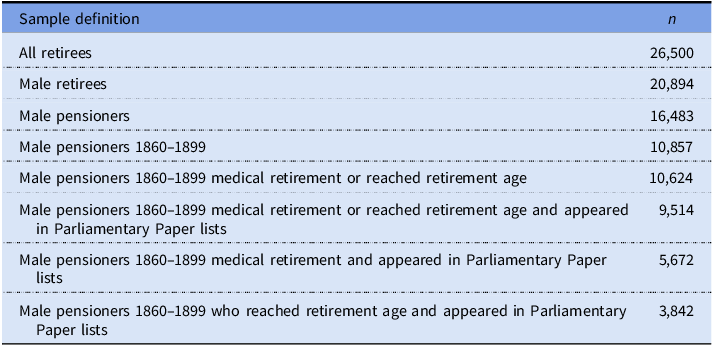
The sample used in this article, therefore, are male pensioners who retired between 1860 and 1899 for either medical reasons or because they reached retirement age. At times both medical and non-medical retirees are examined together and at others they are considered separately. Table 2 summarizes how the sample used in this article relate to the whole population of Post Office retirees.
Size and characteristics of the samples used

Table 2 Long description
A table with 8 rows and 2 columns. The columns are labeled 'Sample definition' and 'n'. The rows list different categories of retirees and their corresponding sample sizes. The categories include all retirees, male retirees, male pensioners, male pensioners from 1860-1899, male pensioners from 1860-1899 with medical retirement or reached retirement age, male pensioners from 1860-1899 with medical retirement or reached retirement age and appeared in Parliamentary Paper lists, male pensioners from 1860-1899 with medical retirement and appeared in Parliamentary Paper lists, and male pensioners from 1860-1899 who reached retirement age and appeared in Parliamentary Paper lists. The sample sizes range from 3,842 to 26,500.
Source: Smith et al. (Reference Smith, Green, Newman, McIlvenna, Marley, Preger, Chick, Brown and Shelton2025).
The causes of retirement
A key factor in interpreting the relationship between sickness and survival rates is the reason for retirement in the first place and, in particular, the medical causes of retirement. The data on the characteristics of retirees are taken from the Post Office pension retirement forms, which have been digitized in their entirety for the years from 1860 to 1908 (Smith et al. Reference Smith, Green, McIlvenna and Shelton2026a). These forms include, among other things, the causes of retirement, which in many cases were medical conditions that prevented a worker from performing their duties to the satisfaction of the Post Office. However, interpreting the information requires an understanding of the reasons for making a diagnosis of ill health and the factors that influenced that decision.
The Post Office and the UK Treasury were keen to maintain a healthy and efficient workforce and provided generous amounts of sick pay for certified absence of up to a year (Smith et al. Reference Smith, Green, Newman, Chick, McIlvenna, Marley, Preger, Brown and Shelton2026a). However, if a worker was unlikely to recover, or they had a poor record of sick leave, they were encouraged to retire. At the same time, the Post Office authorities were keen to reject fraudulent claims, which both robbed them of an able-bodied worker and imposed an ongoing cost on the Treasury. Therefore, the causes of retirement were not diagnoses as such, but rather medically certified statements provided by a Post Office Medical Officer required in a bureaucratic process designed to maintain a healthy and efficient workforce. Thus, the medical information contained in these causes was markedly different from other sources of morbidity in this period, such as hospital registers, as they are fundamentally about the inability to work rather than a description of an “objective” sickness or condition that necessarily required medical attention.
The causes of retirement noted in the pension forms share many of the same issues long associated with historical causes of death such as a focus on symptoms rather than underlying conditions, changing medical knowledge, variation in practice from doctor to doctor, and the fundamental difficulty of summarizing an individual’s medical history in a single, short phrase entered on a form to be used when assessing a claim for a pension. However, there are several important differences between what was entered on the pension form compared to the information included on a death certificate. First, the worker was alive at the time the cause of retirement was assigned. This means that the cause ascertained was the result of some kind of negotiation between patient and doctor. These postal workers could describe symptoms, recount history, or request certain treatments, all of which could not necessarily be done in relation to noting causes of death. The opportunity for the patient to describe their condition may have improved the accuracy of this medical process, although it may also have exacerbated the tendency often observed in cause of death sources to avoid socially stigmatized diagnoses such as alcoholism, or sexually transmitted infections (Hardy Reference Hardy1994: 479, 487, 489–90; Szreter Reference Szreter2014: 510–3).
Second, the Post Office had a substantial medical service which grew over the course of our period (Marley Reference Marley2025). The Post Office first appointed a permanent Chief Medical Officer to its London headquarters in 1855 and in the years that followed full-time doctors were appointed to attend the workforce in some of the other large cities. From 1870, part-time doctors, many of whom were local general practitioners, were appointed to attend provincial offices with 40 or more staff and in 1876 this limit was lowered to 20 employees (POST 64/1:155, 226). By the start of the twentieth century, in addition to a relatively small number of permanently employed doctors, including a female doctor to cater for the large number of women in the workforce, the Post Office was employing more than 1,800 doctors on a part-time basis to provide medical care for their staff, evaluate the fitness of new applicants, and certify sick leave and medical retirements (Post Office Chief Medical Officer 1904: 5). This service provided free medical attendance to workers earning less than £150 a year. However, not every worker was employed at an office with a Medical Officer, and so some had no access to this service. For those who did have such access, however, the doctor who certified their medical retirement had likely seen them for several years and thus had a good knowledge of their medical history (Marley Reference Marley2025). Again, this degree of interaction between subject and physician was not always true of cause of death data, when the certifying physician may never have seen the deceased before or may not have attended them for some months or even years (Williams Reference Williams1996: 61–2). This familiarity was likely to have improved the quality of the medical information provided in the pension application forms relative to that found in other historical medical sources.
Third, the ability to work is inevitably a more malleable and subjective concept than death. There is some variation in how death has been defined over time, but it is nevertheless a more stable concept than sickness (Veatch and Ross Reference Veatch and Friedman Ross2016). Given the focus on work, the cause of retirement data contained many kinds of conditions not often seen in cause of death data. For example, mental health disorders appear far more frequently in the Post Office data than in civil registration death data. Most notably for our purposes, the impact of a given medical condition on someone’s ability to work depended on their occupation: postmen could not deliver mail with sore legs, but clerks could still undertake their work. This means that some causes of retirement are closely associated with certain occupations; for example, 69 percent of musculoskeletal causes of retirement were found in retiring postmen and women, accounting for 20 percent of all postmen/women medical retirements. Among medically retiring clerks, 26 percent retired for mental health reasons, making up 19 percent of all mental health medical retirements. This is all complicated by the fact that different occupations exposed workers to different levels of risk and to different illnesses and injuries. For example, postal workers in engineering roles made up just 2.5 percent of all retirees between 1860 and 1903, but they accounted for 5.5 percent of all injury-related retirements, and injury was the most common cause of retirement for engineering workers, making up 11.5 percent of all retirements from that occupation. It is likely that this was partly because injuries made it hard to perform the duties required of a telegraph lineman or a postal factory hand, but it was also because they were exposed to far greater risk of injury working with machinery or at height. For this reason, we need to bear in mind the occupational as well as the medical context of retirements.
In this article, we have used a simple classification scheme to organize the information provided on cause of retirement. For non-medical causes, these are classified into broad categories based on the type of retirement reason given. The most common was having reached retirement age, but there are some workers who resigned, or who left the Post Office following administrative changes, such as the reorganization of departments in the 1870s and 1880s. For medical causes, the conditions themselves were first assigned ICD10h codes (Reid et al. Reference Reid, Garrett, Maltesdotter and Murkens2025) and then classified according to the area of the body affected, such as respiratory conditions, or musculoskeletal conditions, with tuberculosis included as a separate category as it was a particularly common cause of retirement and, as we shall see below, had a distinctive impact on survival.
Survival post-retirement
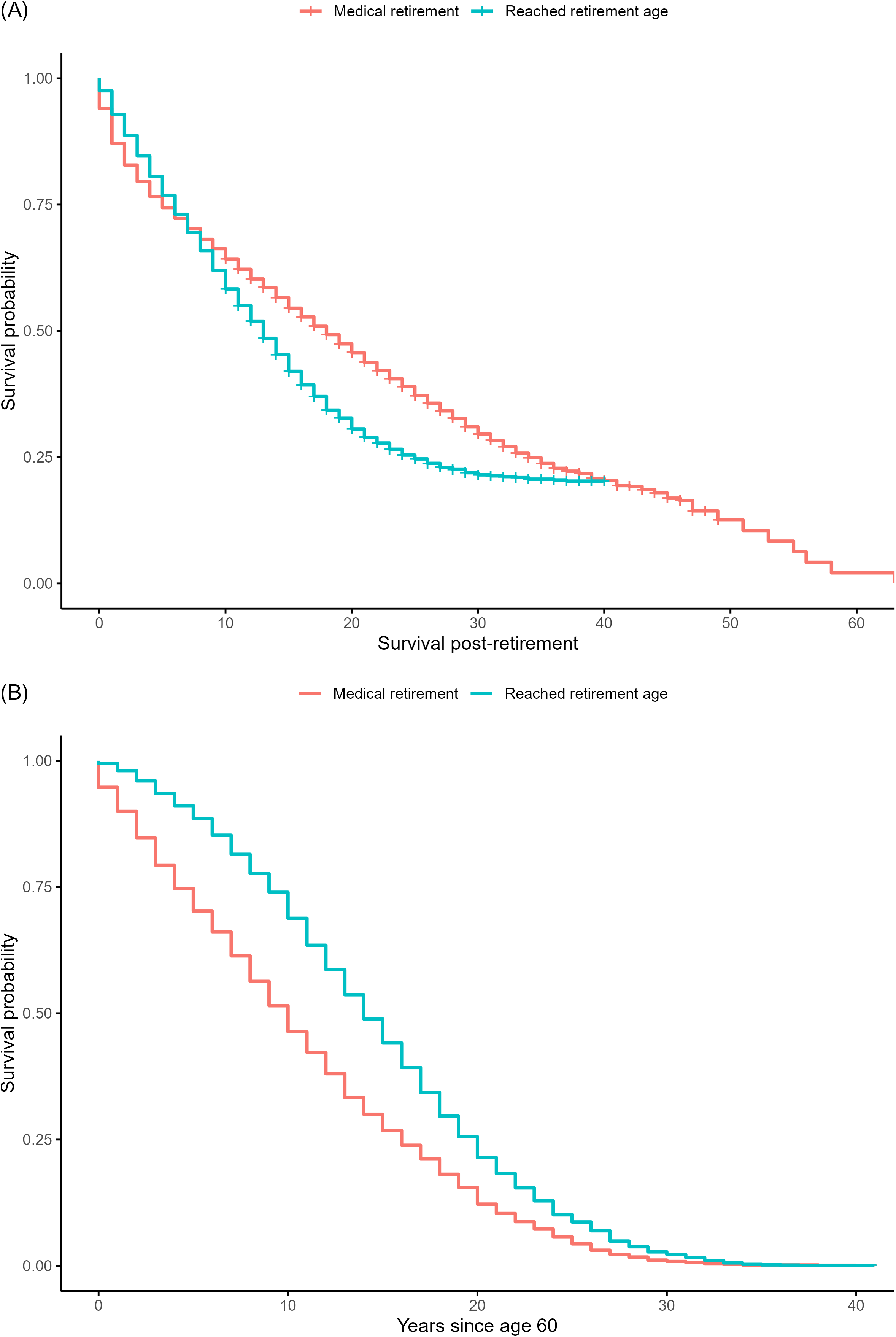
Figure 3 shows the Kaplan–Meier survival curves for those postal workers in our data who reached retirement age compared to those who retired for medical reasons. As an individual had to reach 60 or 65 years of age to retire on age grounds, survival in retirement is strongly impacted by age at retirement. Therefore, Figure 3 shows two different curves. First, Figure 3A shows survival time post-retirement on the x axis in years. Figure 3B uses attained age as the x axis, showing survival conditional on making it to age 60 years of age. Figure 3A shows an initial survival advantage among non-medical retirees that disappears around six to eight years after retirement. However, this likely understates the advantage of those who reached retirement age, given that the impact of biological aging on survival chances will be greater for that group. Figure 3B accounts for this by using age as the x axis and shows a clear advantage for those postal workers who were able to work until reaching retirement age over those who had to retire owing to a medical condition that prevented them from performing their duties. Given the difference in survival probabilities for medical and non-medical retirees, and the difficulties of analysis introduced by the impact of age on survival, we must first understand the determinants of medical retirement before moving onto examining the impact of postal employment on mortality.
(A) Post-retirement survival of male postal pensioners, 1860–1902 by cause of retirement. (B) Survival post-age 60 of male postal pensioners, 1860–1902 by cause of retirement.
Source: Smith et al. (Reference Smith, Green, Newman, McIlvenna, Marley, Preger, Chick, Brown and Shelton2025).

Medical and non-medical retirement
We have seen from the preceding Kaplan–Meier curves that whether a worker retired for medical reasons had an impact on their survival chances post-retirement. Those who avoided medical retirement had, by administrative necessity, reached at least 60 years of age in our sample. Given the impact of biological age on mortality, this rule complicates any effort to measure the impact of postal work on mortality as the patterns we see in survival modeling may simply be driven by different age distributions of different groups within our sample. The first stage in understanding how postal work affected employees’ survival chances involves understanding what factors led to an individual reaching retirement age and avoiding medical retirement.
In order to answer this question, a logistic regression was run with medical retirement as the outcome variable. There are several variables that we might, a priori, think had an impact on whether or not an individual retired sick. First, the length of time they worked for the Post Office. If work had a negative impact on health, then longer service might lead to worse long-term health outcomes. However, the Post Office’s medical retirement policy may have counteracted this by removing individuals prone to ill health earlier in their career than those who rarely suffered from conditions that prevented them from working, meaning longer-serving workers may be, on average, healthier. This also introduces possible endogeneity into the data, as many pensioners with short service periods had them because they retired early, rather than short service leading to medical retirement. Consequently, we use the age at which an individual started work instead of service length to examine the impact of career time, as it is related to potential length of service (starting work for the Post Office later in life necessarily reduced how long you could serve) and it is fixed before retirement, helping with the close relation between service length and medical retirement. Second, occupation could have been a factor for two reasons: the type of work may have impacted an individual’s health to a greater or lesser extent; or, because medical retirement was determined by the ability to work, the likelihood of retiring sick was in part determined by the kind of work done.
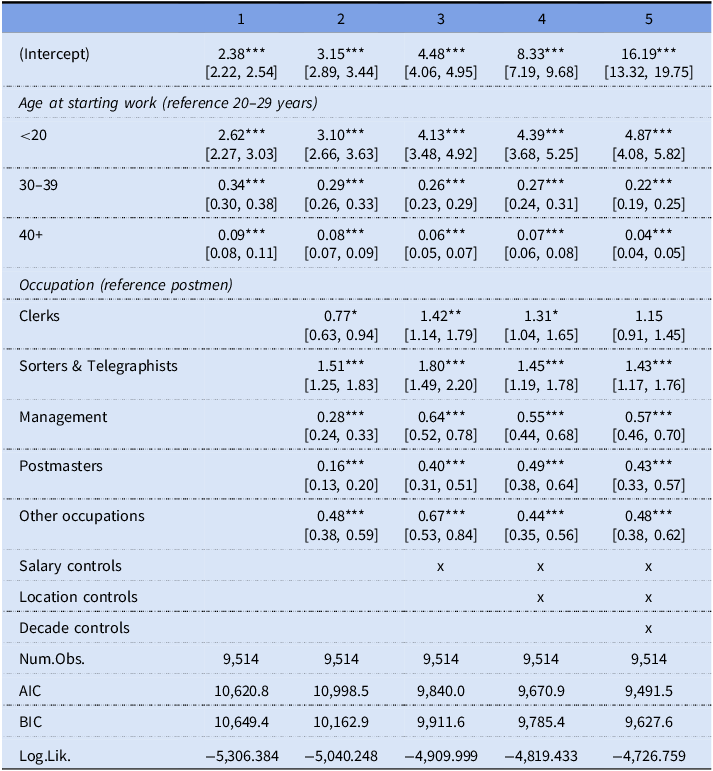
Other socioeconomic, administrative, and environmental factors may have had an impact. Therefore, we progressively add in controls for final salary, location of work (both at the country and the settlement type level), and decade of retirement.Footnote 1 Table 3 shows the output of five models progressively adding in these variables. This table reports the odds ratio that shows the effect of each covariate on the odds of an individual taking medical retirement. Where the value is greater than 1, that variable in question increased the odds of medical retirement; where it is less than 1, it decreased the odds.
Logistic regression models of the odds of medical retirement, male postal pensioners, 1860–1899

Table 3 Long description
A table comparing logistic regression models of the odds of medical retirement for male postal pensioners from 1860 to 1899. The table has 12 rows and 5 columns. Column headers are labeled 1, 2, 3, 4, and 5. Row labels include Intercept, Age at starting work, Occupation, Salary controls, Location controls, Decade controls, Num.Obs., AIC, BIC, and Log.Lik. Each row provides odds ratios and confidence intervals for different variables affecting medical retirement. The table shows how different factors like age at starting work, occupation, and additional controls influence the odds of medical retirement.
Source: Smith et al. (Reference Smith, Green, Newman, McIlvenna, Marley, Preger, Chick, Brown and Shelton2025).
Notes: Odds ratios are reported; 95% confidence intervals are given in square brackets. Other occupations are a mix of small occupation groups: accounting, engineering, maintenance, and transport. Salary is the final salary for each worker expressed in 100s of pounds.
+ p < .1, *p < .05, **p < .01, ***p < .001.
The results in Table 3 show that as age at starting work increased, the odds of retiring for medical reasons fell. As controls were added, the effects for the under 20s and those who started between 30 and 39 years old strengthened; those for the oldest starters remained similar. This party reflects older workers simply being closer to age at which you could retire without medical reason, and certainly this accounts for the very strong result for those who were 40 years or older when they started work. However, the effect was still strong for workers who started employment in their 30s and so had to serve for 20–30 years before they could retire, suggesting that longer periods of service may have had a negative effect on health, raised the chance that a medical retirement might occur, or simply increased the amount of time an individual was at risk of developing a condition that prevented them from working.
The occupation results show that sorters and telegraphists had greater odds of retiring for medical reasons than postmen. These odds varied as additional controls were added, albeit their strength of the effect fell once geographical and decadal controls were added. Clerks show a similar result, once controls for salary and geography were added, the decadal controls removed the statistical significance. Pensioners in management roles and postmasters were less likely to retire for medical reasons than postmen, and again the effect was consistent across the models, even when the significance is partly attenuated. The results for the “other” occupation category are hard to interpret, mainly because that group of occupations is a heterogenous one where we would expect uncertain results.
These outcomes are consistent with the nature of different occupations in the Post Office. Clerks, sorters, and telegraphists were all indoor-focused occupations, whose workspaces were often cramped and poorly ventilated, involving a variety of working patterns associated with poor health outcomes such as shift work (including split shifts), or high-intensity work, which was combined with little autonomy in the case of sorting and telegraphy. These are also occupations in which it was likely harder to continue working while ill, again due to the particularities of the working conditions. In contrast, management and postmasters had considerable autonomy, giving them an advantage over the indoor occupations, and did not need to carry heavy loads considerable distances, as postmen did. These results are consistent with the impact of occupation on sick leave seen elsewhere, where again sorters, telegraphists, and clerks had worse health outcomes than postmen, and postmasters had better outcomes (Smith et al. Reference Smith, Green, Newman, Chick, McIlvenna, Marley, Preger, Brown and Shelton2026a). Given these results, and the difference in various measures of survival shown in Figure 3A and 3B, it is necessary to model the survival of medical retirees separately from the survival of those workers who reached retirement age without a medical condition requiring early retirement.
Survival curves for medical retirees
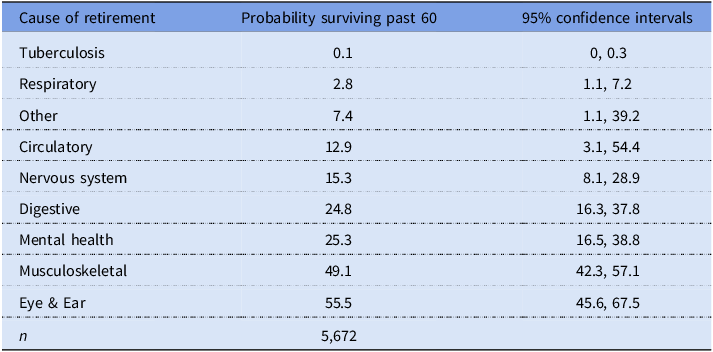
The preceding analysis has shown the differing post-retirement trajectories experienced by medical retirees and those who reached retirement age. However, there was considerable variation within the medical retirees by cause of retirement. The probabilities of surviving past age 60 for each cause of retirement category are given in Table 4. Figure 4A then shows the survival curves for the five retirement cause categories with the worst post-60 survival probabilities, and Figure 4B the remaining four.
Probability of surviving past age 60 by cause of retirement category, male postal pensioners, 1860–1899

Table 4 Long description
A table comparing the probability of surviving past age 60 by cause of retirement for male postal pensioners. The table has 11 rows and 3 columns. The columns are labeled 'Cause of retirement', 'Probability surviving past 60', and '95% confidence intervals'. The rows list different causes of retirement and their corresponding probabilities and confidence intervals. Row 1: Tuberculosis, 0.1, 0, 0.3. Row 2: Respiratory, 2.8, 1.1, 7.2. Row 3: Other, 7.4, 1.1, 39.2. Row 4: Circulatory, 12.9, 3.1, 54.4. Row 5: Nervous system, 15.3, 8.1, 28.9. Row 6: Digestive, 24.8, 16.3, 37.8. Row 7: Mental health, 25.3, 16.5, 38.8. Row 8: Musculoskeletal, 49.1, 42.3, 57.1. Row 9: Eye & Ear, 55.5, 45.6, 67.5. Row 10: n, 5,672.
Source: Smith et al. (Reference Smith, Green, Newman, McIlvenna, Marley, Preger, Chick, Brown and Shelton2025).
(A) Survival curves for male medical retirees by cause of retirement category, five worst post-60 survival probabilities, 1860–1899. (B) Survival curves for male medical retirees by cause of retirement category, four best post-60 survival probabilities, 1860–1899.
Source: Smith et al. (Reference Smith, Green, Newman, McIlvenna, Marley, Preger, Chick, Brown and Shelton2025).

In each figure, the first curves are calculated using retirement age as the start time and time at death/censoring for the stop time. This means pensioners only enter the risk set upon retirement; consequently, it presents the most extreme representation of the survival chances for some retirement causes. For example, the risk set for tuberculosis retirees at young ages is dominated by pensioners with low survival times. However, it has the advantage of taking biological age into account as well as dealing with the problem of delayed entry and possible immortal time bias. The second set of curves in each figure show the same data but with time since retirement on the x axis. In these, the impact of different ages at retirement is ignored, but the post-retirement trajectory of each cause can be examined. This tends to increase survival probabilities, although the relative position of each cause is similar. However, there are some notable differences. Mental health and digestive conditions have similar curves to the other less severe conditions when time since retirement is used as the x axis, but worse survival probabilities than those causes when attained age is used. This suggests that these conditions do not have worse post-retirement survival trajectories, but this masks the impact that these conditions have at younger ages, where they can reduce survival chances more so than the other less severe causes.
The figures show a substantial disadvantage for workers who retired due to having tuberculosis and, to a lesser extent, respiratory conditions. The “other” category includes a mix of individuals with conditions that had substantial mortality disadvantages, such as infectious diseases and neoplasms, and vague terms, such as “general debility,” so the curve is hard to interpret. Among the remaining causes, workers retiring with circulatory or nervous system disorders had the worst survival probabilities, followed by mental health and digestive retirees, with a substantial gap then to those pensioners retiring owing to eye and ear issues, or musculoskeletal conditions.
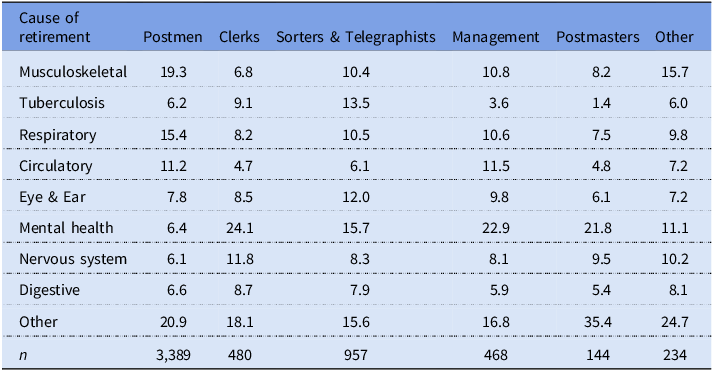
These different causes of retirement were not uniformly distributed throughout the Post Office workforce. Table 5 shows the causes of retirement of these male medical retirees broken down by their occupations. There are clear associations between some occupations and some causes of retirement. Many of these are associated with the work performed by a given occupation and the conditions in which it was performed; for example, the high rate of tuberculosis and respiratory conditions among sorters and telegraphists reflects their work in cramped, poorly ventilated offices. However, the ability to perform their duties must also have played a role in this distribution; thus, musculoskeletal conditions are more common among postmen not only because they were at greater risk of such conditions, owing to walking long distances with heavy sacks of mail, but also because musculoskeletal issues were more likely to permanently prevent a postman returning to work. To unravel these various factors, we need to move beyond Kaplan–Meier curves and model the data.
Distribution of causes of retirement within occupations, male postal medical retirees, 1860–1899 (%)

Table 5 Long description
A table comparing causes of retirement across different occupations in the postal service. The table has 10 rows and 7 columns. The columns are labeled Postmen, Clerks, Sorters & Telegraphists, Management, Postmasters, and Other. The rows are labeled with different causes of retirement: Musculoskeletal, Tuberculosis, Respiratory, Circulatory, Eye & Ear, Mental health, Nervous system, Digestive, and Other. Each cell contains a percentage value representing the distribution of each cause of retirement within the respective occupation. The table shows that musculoskeletal issues are most prevalent among postmen and those categorized as other, while mental health issues are most prevalent among clerks and management. Tuberculosis is notably high among sorters & telegraphists.
Source: Smith et al. (Reference Smith, Green, Newman, McIlvenna, Marley, Preger, Chick, Brown and Shelton2025).
Modeling the determinants of survival – medical retirees
When modeling survival probabilities, the definition of survival time used can have a substantial impact on the outcome. In our case, we only directly observe postal workers once they retired. As such, we cannot directly model the impact of postal work on lifespan because we are missing those workers who did not receive a pension, whether they resigned, worked for fewer than 10 years and so only received a gratuity, or died while employed by the Post Office. Instead, we can examine what factors affected survival probabilities conditional on receiving a pension.
Additionally, as noted above, the age at which an individual entered our sample is partly a consequence of whether they retired for medical reasons or survived long enough to reach retirement age. If we specify our survival model with age at retirement as the start time and age at death/censoring as the stop time, we are assuming that the entry to the sample and subsequent survival time are independent. However, this is not the case in our sample, where some earlier entrants had worse survival times than later ones, as suggested in the survival curves shown in Figure 4A and 4B. Consequently, we specify two models here. First, a model with attained age as the timescale and delayed entry accounted for by using age at retirement as a start time and exit as the age at death/censoring. Second, a model of attained age at death/censoring, but with age at retirement included as a covariate rather than used to define delayed entry. The first model takes account of when people entered the sample but assumes risk at younger ages is constant between the observed and as yet unobserved; the second model treats all individuals as being observed from the same origin time. In the first model, an individual retiring at the age of 40 years is only included in the risk set once they have a real risk of dying; in the second model, they are included from age 0 years so contribute to the risk set at ages 0–39 years but are effectively immortal because if they died before age 40 years then they would not appear in our data (Suissa Reference Suissa2007). This biases the survival probabilities given in the second model upward. We include it here only to evaluate the extent to which non-independent left truncation is a problem in the first model. The first model we will refer to as the “delayed entry model” and the second as the “retirement-age-adjusted model.”
The data on medical retirees is, as the crossing survival curves shown in Figure 4A and 4B suggest, not characterized by proportional hazards. This can be confirmed by the plots of Schoenfeld residuals of a Cox’s Proportional Hazard model using the same data given in Appendix 2 in Supplementary Material. To deal with these non-proportional hazards, we have used a flexible parametric model as suggested by Royston and Parmar (Royston and Parmar Reference Royston and Parmar2002; Royston and Lambert Reference Royston and Lambert2011). Cox models do not directly estimate the baseline hazard function, namely how the risk of the event in question occurring changes over time when all covariates are at zero or their reference levels. As the baseline hazard function is unspecified in Cox models, it is allowed to vary with time and thus the effect of any covariate is independent of time, hence the need for proportional hazards (Cox Reference Cox1972; Collett Reference Collett2015: 57–60). In a flexible parametric model, in contrast, the baseline hazard function is modeled as a spline function of time and covariate effects are allowed to interact with the same type of spline function. Thus, the underlying mortality risk can vary with time, an important advantage for such models given the importance of biological age to mortality, and the impact of a covariate can also vary with time, meaning the proportional hazards assumption is relaxed (Lambert and Royston Reference Lambert and Royston2009; Ng et al. Reference Ng, Kornas, Sutradhar, Wodchis and Rosella2018).
When using flexible parametric models, it is first necessary to establish the number of knots for the restricted cubic spline used to estimate the baseline hazard function and then to add in additional interactions with the spline for any time-dependent covariates. Splines are smooth curves created by joining together smaller simpler curves. These smaller curves are estimated between different points on the x axis, split by points called “knots.” In the case of flexible parametric models, we use restricted cubic splines; these use cubic polynomials to fit the curves between each knot, and they are considered “restricted” because the start and end of the curve have to be linear (Lambert and Royston Reference Lambert and Royston2009: 267; Collett Reference Collett2015: 259–62). This approach allows the baseline hazard function to vary over time, as between each pair of knots a different polynomial is estimated, allowing the baseline hazard function to vary smoothly over time. To determine the appropriate number of knots, a series of models were estimated using retirement age and age at death/censoring as the start and stop times, and covariates for length of service, cause of retirement, occupation, decade of retirement, urban classification, country, and final salary with different numbers of knots for both the baseline hazard function and the time-varying hazards. These were estimated in R using the package rstpm2, where the number of knots is controlled by specifying the baseline degrees of freedom, with the package then placing the knots automatically. Models were evaluated using AIC, which showed that for the delayed entry model a model with four baseline degrees of freedom with time-varying effects for length of service (2 degrees of freedom), and 1 degree of freedom for tuberculosis and respiratory as causes of retirement provided the best fit while allowing clear interpretation. For the second model, the model adjusted for retirement age, the same process suggests a model with the same specification as the first model but with additional time-varying effects for age at retirement (2 degrees of freedom). The results of these different specifications and the AIC values used to evaluate them can be seen in Appendix 3 in Supplementary Material.
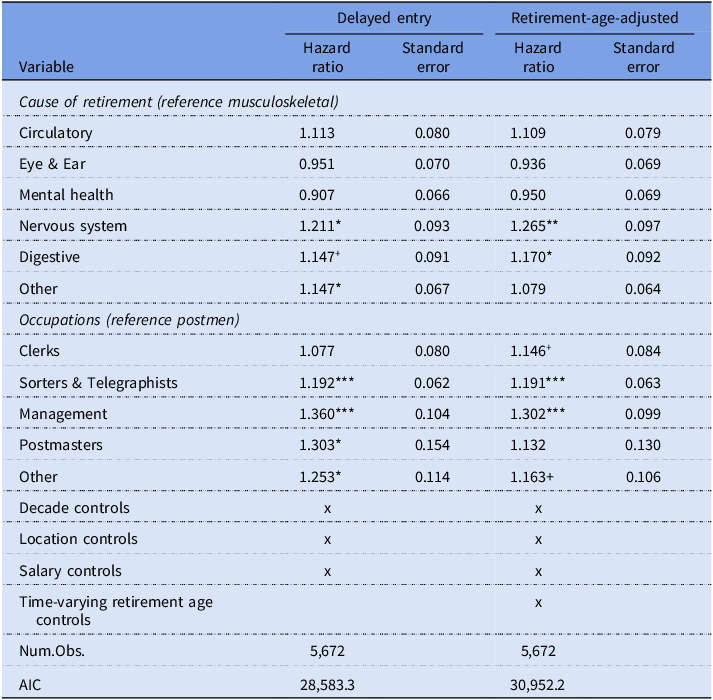
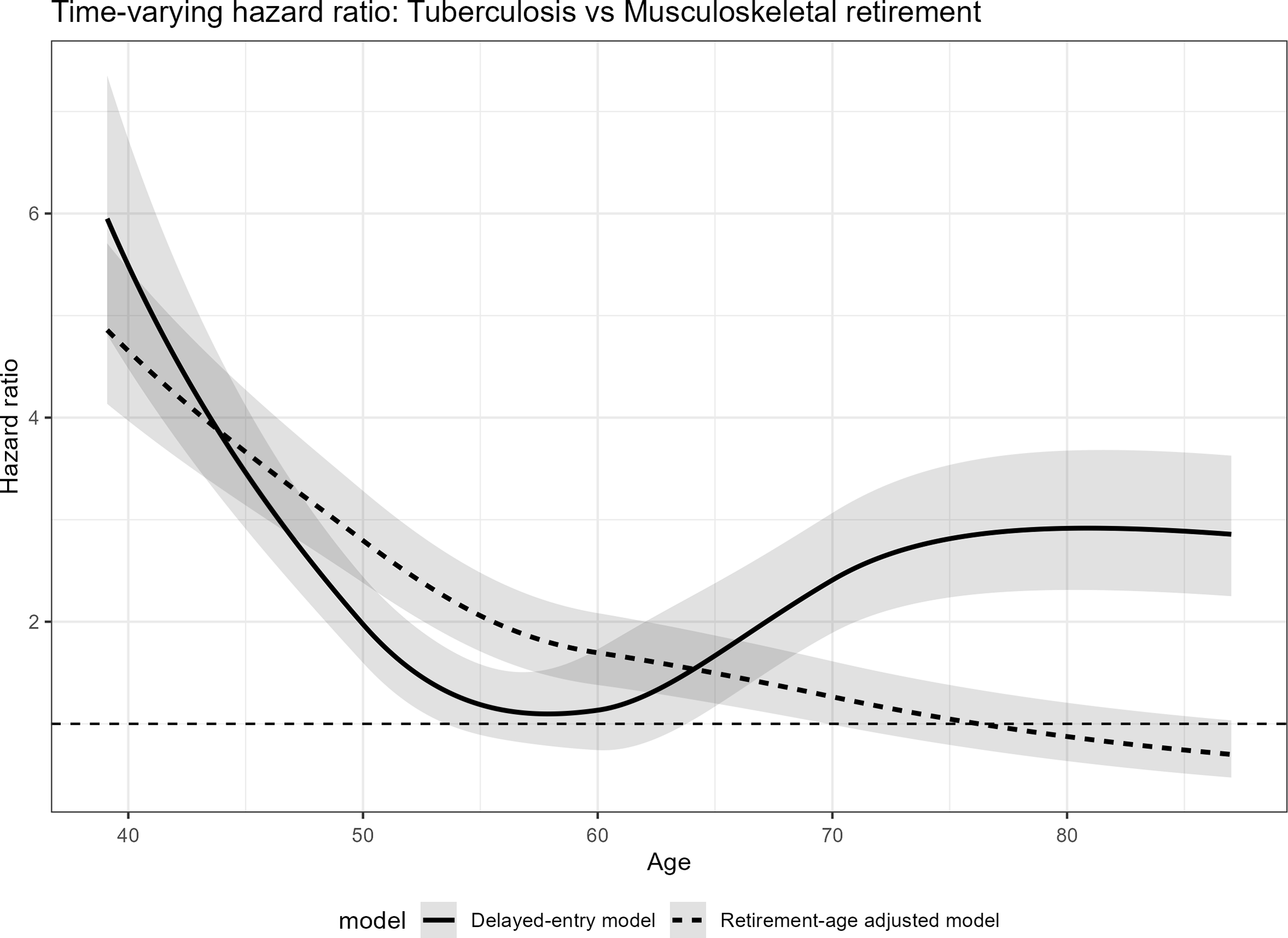
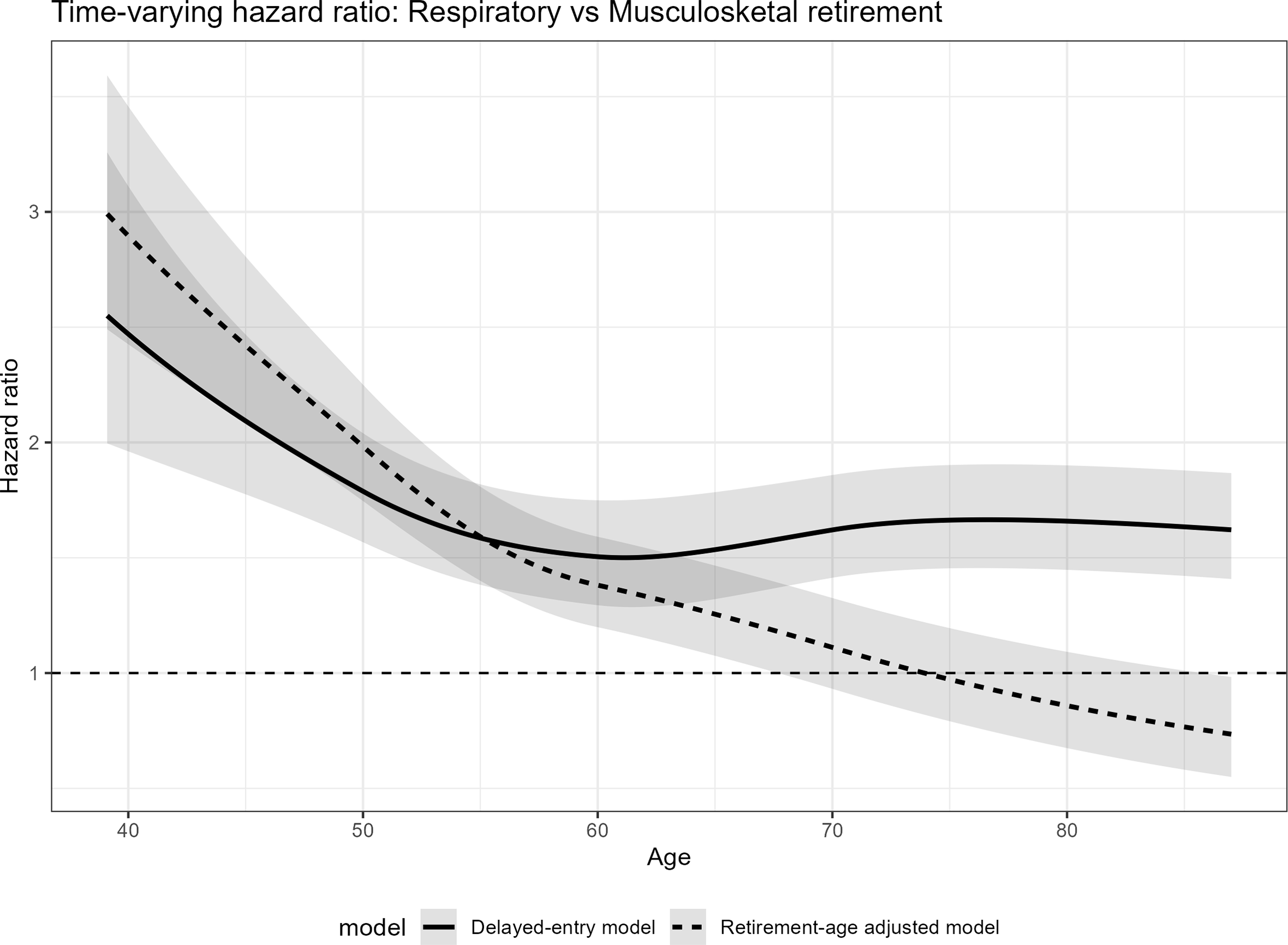
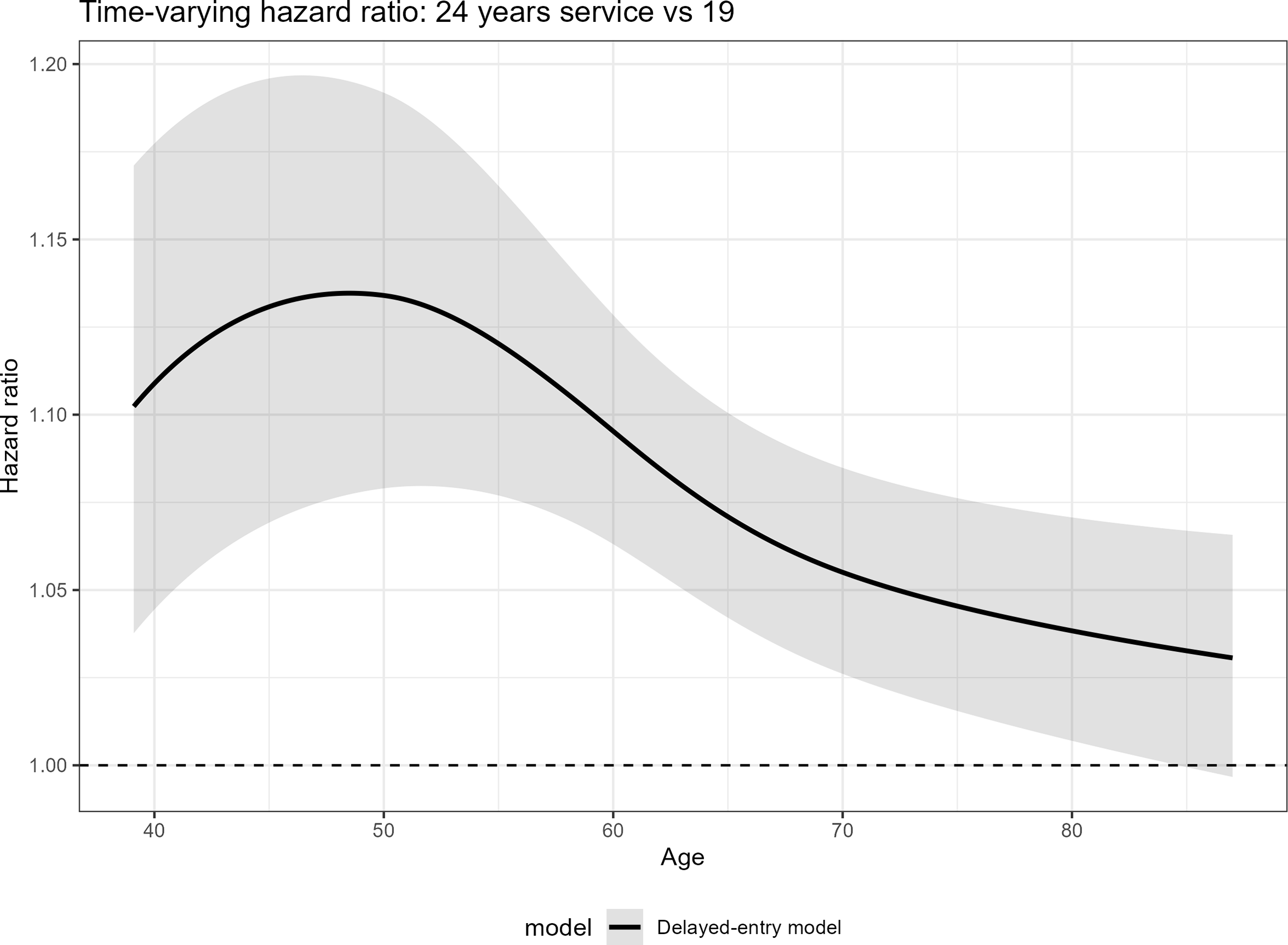
The coefficients produced by the two models for the time-varying effects are not straightforward to interpret and so are reported in full in Appendix 4 in Supplementary Material. Table 6, instead, reports the hazard ratios for all the non-time-varying effects, and Figures 5 and 6 show the time-varying hazard ratios from both models for tuberculosis and respiratory conditions as causes of retirement. Figure 7 gives the time-varying hazard ratio for length of service from the delayed entry model; this effect was not statistically significant in the retirement-age-adjusted model. These figures are generated using an example pensioner from our data, with the variable in question artificially changed for each plot. For these plots, Alfred Bolus was used: he was a London-based postman who retired in 1881 aged 39 after nineteen years’ service; his cause of retirement was given as “Rupture and chronic rheumatism,” categorized here as musculoskeletal issue. In Figures 5 and 6, his survival is compared to a theoretical individual with the same characteristics but who retired with tuberculosis or a respiratory condition. In Figure 7, his real length of service is compared to someone retiring after 24 years’ service. On each figure, a dotted line at 1 indicates when a variable’s effect changed from beneficial to detrimental.
Hazard ratios for male postal pensioners retiring for medical reasons, 1860–1899, time-invariant effects only

Table 6 Long description
A table with 12 rows and 4 columns comparing hazard ratios for male postal pensioners retiring for medical reasons. The columns are labeled 'Variable', 'Delayed entry Hazard ratio', 'Delayed entry Standard error', 'Retirement-age-adjusted Hazard ratio', and 'Retirement-age-adjusted Standard error'. The table is divided into two main sections: Cause of retirement and Occupations. Each section has multiple rows with specific causes or occupations listed. The hazard ratios and standard errors are provided for both delayed entry and retirement-age-adjusted models. Notable trends include higher hazard ratios for certain causes like the nervous system and digestive issues, as well as for specific occupations like management and postmasters. The table also includes controls for decade, location, salary, and time-varying retirement age. The number of observations is 5,672, and the AIC values are 28,583.3 for delayed entry and 30,952.2 for retirement-age-adjusted.
Source: Smith et al. (Reference Smith, Green, Newman, McIlvenna, Marley, Preger, Chick, Brown and Shelton2025).
+ p < .1, *p < .05, **p < .01, ***p < .001.
Predicted hazard ratio for a postman retiring due to tuberculosis compared to one retiring due to a musculoskeletal condition; delayed entry and retirement-age-adjusted models.
Source: Smith et al. (Reference Smith, Green, Newman, McIlvenna, Marley, Preger, Chick, Brown and Shelton2025).

Predicted hazard ratio for a postman retiring due to a respiratory condition compared to one retiring due to a musculoskeletal condition; delayed entry and retirement-age-adjusted models.
Source: Smith et al. (Reference Smith, Green, Newman, McIlvenna, Marley, Preger, Chick, Brown and Shelton2025).

Predicted hazard ratio for a postman retiring after 24 years’ service compared to one retiring after 19 years’ service. Delayed entry model only.
Source: Smith et al. (Reference Smith, Green, Newman, McIlvenna, Marley, Preger, Chick, Brown and Shelton2025).

Table 6 shows consistent results for both the delayed entry and retirement-age-adjusted models. This suggests that these non-time-varying hazards were relatively unaffected by changes in how the sample was specified. The table shows that retirees with nervous system, digestive, and “other” complaints all had higher risks of dying at a given age than a pensioner retiring with a musculoskeletal condition. We might have expected circulatory retirees to have a statistically significant higher hazard ratio; however, this group included conditions such as varicose veins, which have important life- and work-limiting effects, but are not associated with high mortality risks. The occupation effects are substantial, and it should be noted that these are conditional on cause of retirement; different occupations had different chances of retiring from a given cause deriving from different risk of exposure and varying ability to work with a condition, as seen in Table 5. The delayed entry model showed significant mortality disadvantages for all occupational groups compared to postmen, apart from clerks. This result suggests that office work and, particularly, work that was high pressure and involved shift work, such as sorting, telegraphy, and management, had a negative impact on health outcomes.
Figure 5 shows the time-varying hazard associated with retiring with tuberculosis as opposed to a musculoskeletal condition. For both models, we see a substantial disadvantage for tubercular retirees, as we might expect. As the pensioner aged, the mortality disadvantage experienced by tubercular retirees fell, reflecting the impact of biological age on mortality. However, the results for the two models diverge as the pensioners reached their late fifties. For the delayed entry model, the hazard ratio began to rise again, whereas for the retirement-age-adjusted model the ratio continued to fall. This reflects the small number of tuberculosis retirees in these ages. There were only 47 pensioners retiring after the age of 50 years due to tuberculosis, and the low probability of surviving past age 60 years with tuberculosis as a cause of retirement, as seen in Table 4 previously. Consequently, the model and the predicted hazard ratio in Figure 5 are particularly sensitive to changes in the risk set. However, the important conclusion is that the impact of retiring with tuberculosis was most acute at younger ages, a disadvantage that was slowly eroded by the impact of biological aging. Figure 6 shows a similar, albeit less severe, pattern for postal workers retiring with respiratory conditions. In both cases, we see, therefore, substantial mortality disadvantages for pensioners with tuberculosis or respiratory conditions, even when controlling for other characteristics. These disadvantages attenuated over time but may have never disappeared.
Figure 7 shows that the impact of service length varied with age. Longer service was always associated with a higher risk of death, but this disadvantage initially increased, before declining. This suggests that it did not just matter what kind of work someone did but also for how long they performed that labor. This effect remained modestly important even at older ages when we might expect the impact of work to have been eclipsed by the impact of biological age. That this covariate was not statistically significant in the retirement-age-adjusted model suggests that the impact of service time was sensitive to the left-truncation issue raised above, where short lengths of service were indicative of medical retirement and perhaps also conditions with poor survival chances.
Modeling the determinants of survival – reaching retirement age
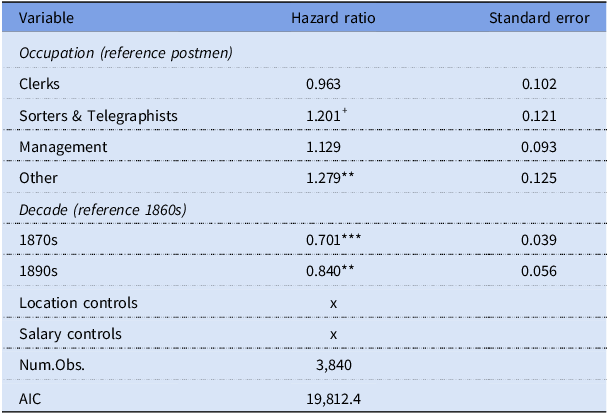
We turn now to those postal workers who reached retirement age before leaving the Post Office’s employ. There are 3,840 of these from the period 1860–1899. As with the medical retirees, the Schoenfeld residuals from a Cox’s Proportional Hazard model reveals non-proportional hazards, see Appendix 2 in Supplementary Material. Given the age structure of these pensioners, each being at least 60 years old, the issue around non-independent left truncation is substantially less important than for the medical retirees. As such, only a single model has been reported here, taking age at retirement as the start time and age at death/censoring as the stop time. However, we also give the results of the same model but restricted to only workers retiring between the ages of 60 and 65 years in Appendix 6 in Supplementary Material as a robustness check. Restricting the sample used in this way leads to only minor changes in the model outcomes, suggesting that the results reported here are not distorted by the age at which individuals entered the sample.
As above, a Royston–Parmar flexible parametric model was used. Once again, AIC values were used to decide which variables to model as time-varying hazards and how to model the baseline hazard (see Appendix 5 in Supplementary Material). For this model, seven degrees of freedom were used for the baseline knots, three degrees of freedom for retiring in the 1880s, two degrees of freedom for pensioners retiring in Ireland, and one degree of freedom for both length of service and retiring as a postmaster. Again, given the existence of time-variant variables, the full output is reported in Appendix 6 in Supplementary Material, while we report the time-invariant hazard ratios in Table 7, and the statistically significant time-variant hazards in Figures 8–10. The results for the 1880s decade variable were time-varying but not significant and so are only reported in Appendix 4 in Supplementary Material. As above these effects are predicted for a given postal worker, this time George Wood, an auxiliary letter carrier, who retired in 1861, aged 61 after 24 years’ service.
Hazard ratios for male postal pensioners retiring having reached retirement age, 1860–1899, time-invariant effects only

Table 7 Long description
A table comparing hazard ratios for male postal pensioners by occupation and decade. The table has 10 rows and 3 columns. The columns are labeled Variable, Hazard ratio, and Standard error. The Variable column includes categories like Occupation and Decade, with specific entries such as Clerks, Sorters & Telegraphists, Management, Other, 1870s, and 1890s. The Hazard ratio and Standard error columns provide corresponding numerical values for each variable. Notable entries include hazard ratios of 0.963 for Clerks, 1.201 for Sorters & Telegraphists, and 0.701 for the 1870s decade. The table also includes controls for Location and Salary, and provides the number of observations (3,840) and the AIC value (19,812.4).
Source: Smith et al. (Reference Smith, Green, Newman, McIlvenna, Marley, Preger, Chick, Brown and Shelton2025).
+ p < .1, *p < .05, **p < .01, ***p < .001.
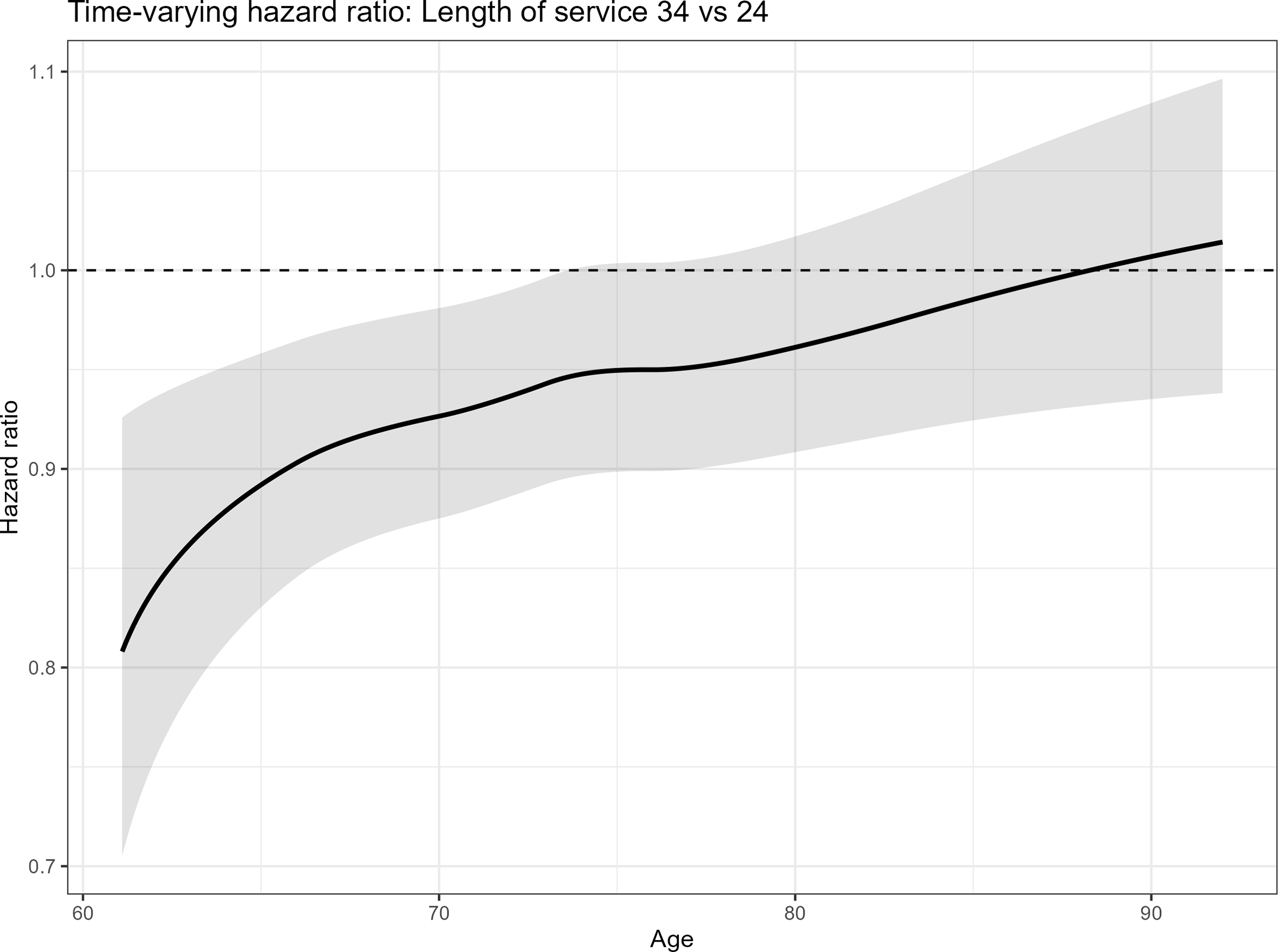
Predicted hazard ratio for a postman who reached retirement age after 34 years’ service compared to one with 24 years’ service.
Source: Smith et al. (Reference Smith, Green, Newman, McIlvenna, Marley, Preger, Chick, Brown and Shelton2025).

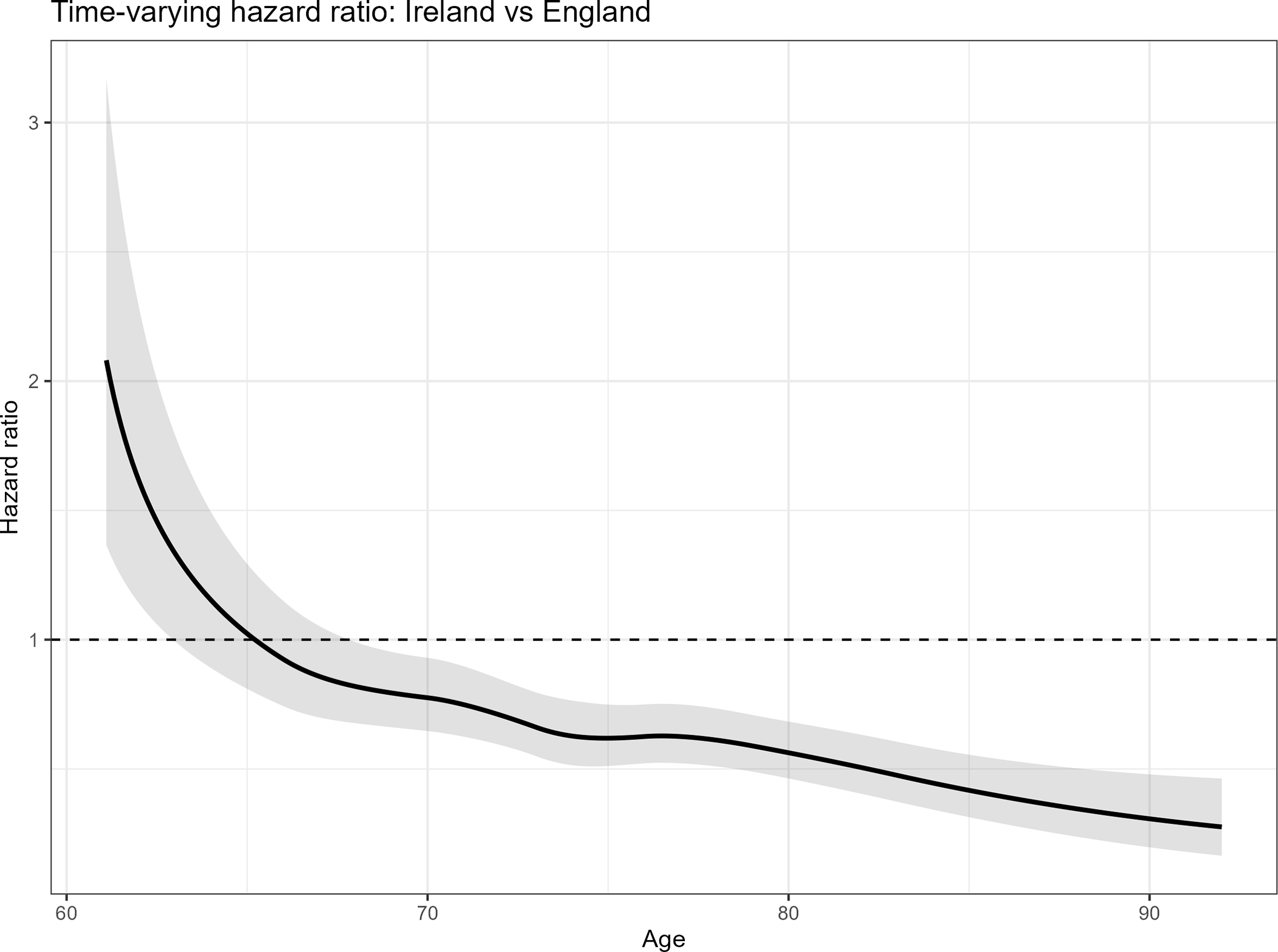
Predicted hazard ratio for a postman who retired after working in Ireland compared to one who had worked in England.
Source: Smith et al. (Reference Smith, Green, Newman, McIlvenna, Marley, Preger, Chick, Brown and Shelton2025).

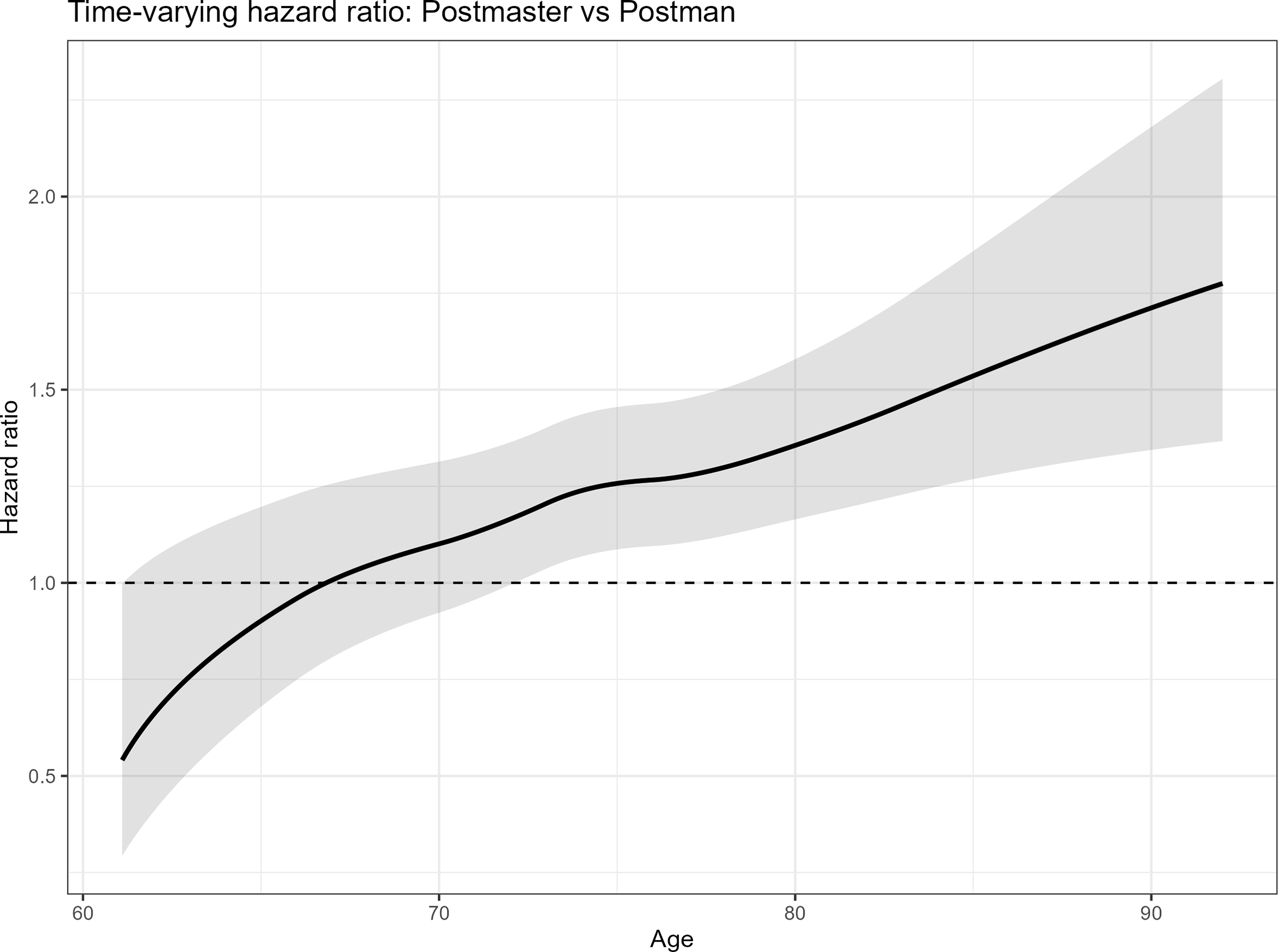
Predicted hazard ratio for a postmaster who reached retirement age compared to a postman who reached retirement age.
Source: Smith et al. (Reference Smith, Green, Newman, McIlvenna, Marley, Preger, Chick, Brown and Shelton2025).

Turning first to the constant effects shown in Table 7, the occupation effects are minor. Only the mixed occupational grouping had a strong difference in the hazard of dying compared to postmen. Given all these individuals are retiring after 60 years of age, we would expect the association between aging and mortality risk to reduce work-specific effects. The decade results show that workers retiring later in the century had lower risk of dying at a given age, and this was also true for the time-varying hazards calculated for those retiring in the 1880s, albeit those results were not statistically significant. This fits with the general fall in adult mortality rates across the period.
Figure 8 shows the hazard ratio for a worker retiring after 34 years’ service compared to one who served 24 years. In contrast to those pensioners who retired for medical reasons, this shows that at earlier ages the longer-serving worker had a lower risk of dying at a given age, but that this advantage disappeared in their late 80s. This, along with the lack of occupational effects discussed above, is suggestive of a healthy worker effect, whereby even among those workers who avoided medical retirement, those who remained in work longer were healthier (Yi and Sung Reference Yi and Sung1999). It is unclear, however, whether healthy workers remained at work for longer, or if remaining at work encouraged better health.
Figure 9 compares the hazard of dying at a given age for a worker who retired in Ireland to one who retired in England. It shows an initially higher risk of dying for Irish pensioners, but that this disadvantage decreased with age, becoming a mortality advantage after age 65 years of age. Life expectancy at birth for men was higher in Ireland than England and Wales in this period, and 35–64 male mortality rates were lower in Ireland until the mid-twentieth century (Fitzgerald Reference Fitzgerald, Biagini and Daly2017: 15; Hall Reference Hall2013: 441), so this changing result suggests that the impact of postal work was sufficient to overcome existing mortality advantages, the implications of this suggestion will require further research.
The one occupation with a significant impact on the hazard of dying was postmaster, where, as Figure 10 shows, such workers had a lower risk of dying than retired postmen until their later 60s. As an occupation, being a postmaster was substantially different from all other postal occupations, involving considered autonomy as workers, but they also tended to work longer for the Post Office and retire at older ages than other postal workers. The mean age at retirement of postmasters in this sample was 67 and the median was 66, around the age at which the mortality advantage seen in Figure 10 reversed, suggesting that most postmasters did not experience the initial health advantage suggested by Figure 10.
Discussion
The analysis above has shown postal work impacting the health of employees of the Post Office in various ways. First, Table 3 showed various kinds of postal work increasing the odds of an individual having to retire early due to a medical condition. The likelihood of being able to continue working while suffering from a given condition varied between occupations in the Post Office, but this is unlikely to explain the entire effect shown in Table 3. This impression is strengthened by the varying survival times shown in Figures 3A and B, and Figures 4A and B, where cause of retirement had a substantial impact on survival probabilities. If the occupation effect on odds of medical retirement shown in Table 3 was entirely driven by occupation-specific ability to work while sick, we would not see the different cause-specific survival probabilities. Instead, it seems likely that different kinds of postal work exposed employees to different levels of risk: clerk, sorters, telegraphists, and management were all exposed to higher risks of respiratory disease, through indoor working, for example, which translated into higher odds of medical retirement, and consequently worse survival post-retirement.
The impact of occupation on survival of medical retirees, shown in Table 6, stands even once cause of retirement was controlled for along with place and country of work, final salary, and date of retirement. Again, this points to a substantive effect of work on the health of male postal workers. In the absence of a comparable set of data on other workers’ survival probabilities, it is hard to generalize about the impact of postal work compared to other kinds of work, but we can see different kinds of postal work having an impact on health, with most jobs in the Post Office leading to worse outcomes when compared to postmen. This impact seems to disappear when we examine those workers who reached retirement age having avoided medical retirement, as shown in Table 7. This apparent healthy worker effect cannot be fully explained with the current approach and data. Some of it will have been due to factors outside of postal work: scarring from childhood, environmental factors not captured with our location controls, personal habits, and other aspects all contributed to giving some workers a greater susceptibility to medical retirement and consequent mortality disadvantages. However, some of it likely derives from the differential impact of postal work on health, suggested by the results reported in Table 3 where different occupations had different odds of retiring sick.
Length of service, another marker of the impact of work on pensioner health, had contrasting results for medical pensioners and those who reached retirement age. For those workers who made it to retirement age, increased length of service tended to have a protective effect until late in life, reducing the hazard of dying at younger ages compared to individuals who had worked for the Post Office for shorter periods. For medical retirees, however, longer periods of service increased the chance of dying, albeit the size of the effect varied by age. As with the occupation results, this is suggestive of a process whereby those with poor survival chances were being selected into the pensioner population earlier in their careers. Once again, however, it is unclear the extent to which these were workers with pre-existing conditions or frailty. The Post Office did require workers to pass a medical examination prior to appointment, which covered an applicant’s family medical history and a physical examination, and this may have meant the health of postal appointees was somewhat better than the general population. However, standards were not consistently implemented, and not all medical conditions could be checked for or predicted (Marley Reference Marley2025: 166–202). Table 3 shows that the odds of medical retirement were higher for groups with more intensive jobs and worse working conditions: postmen, sorters, telegraphists, clerks, and less likely for occupations with greater autonomy over their work and less physically demanding roles: postmasters and management. Furthermore, medical retirement was common for postal workers; in the period covered by this article, the percentage of retirees leaving for medical reasons in each year only dropped below 50 percent twice between 1860 and 1899. These factors do not mean that the worse hazard ratios seen for medical retirees were not related to existing frailty, but they do suggest that such issues cannot wholly explain the mortality disadvantage and that postal work must have had a negative impact on worker health.
The cause of retirement effects reported in Table 6 and Figures 5 and 6 show several significant differences in survival. Cause of retirement was related to occupation, as suggested by Table 5, not just in terms of differential impacts of conditions on the ability of employees to perform their duties but also in terms of differential exposure to risk. In this way, then, postal employment impacted health through the cause of retirement. The results for tuberculosis are particularly notable; for workers retiring with tuberculosis, the median survival time was just one year. It is unclear from these data whether workers with tuberculosis as their cause of retirement were newly infected, had previously successfully concealed their infection, or been previously misdiagnosed with a different condition. However, the short period of post-retirement survival for most tuberculosis retirees fits with what we know about the timing of the final phases of tuberculosis deaths in this period, for example, in Skye the typical final illness was reported on death certificates as between 18 months and two years (Reid and Garrett Reference Reid and Garrettt2018: 127). Unsurprisingly, given these substantial mortality risks, both postal workers and the management of the Post Office were greatly concerned about tuberculosis (Newman Reference Newman2021: 20–52).
Conclusion
Much existing work on historic mortality has, by necessity, been restricted to considering environmental, social, and economic factors as reported at the time of death; however, this article has shown how a longer-term perspective can enrich our understanding of mortality patterns, such as examining the long-term impact of changing exposure to infectious diseases (Costa Reference Costa2003). Furthermore, by emphasizing the importance of type of work, and by moving beyond the “dangerous” trades to consider the kinds of occupations that were becoming increasingly common in industrialized and urbanized societies, our findings have important implications for interpreting the various factors that influenced adult health in our period.
This article has examined the impact of postal work on the health of pensioners by considering their survival post-retirement. The results have been mixed; it is clear that for workers who had to retire for medical reasons, occupation and length of service, two key markers of work’s impact on health, had significant negative effects on the hazard of dying at a given age. For those workers who reached retirement age, however, such impacts were either not significant or had a protective effect, as was the case with length of service. This is suggestive of a healthy worker effect, whereby medical retirement acted to remove workers with poor survival chances from the workforce. Whether this was driven by existing frailties that were missed by the Post Office at the moment of appointment or by the impact of postal work on health is at present unclear. However, the incidence of medical retirement and other aspects of the data, along with what we know about working conditions in this period, suggest that pre-existing frailties cannot explain the entirety of this effect.
Working conditions in the nineteenth-century United Kingdom Post Office were demanding, both in relation to the physical requirements of moving mail and messages, the amount of time spent at work, and the demands made on workers associated with shift work and irregular hours. It is a difficult task to identify the relationships between work and health in the present day, let alone the past, particularly for occupations that have few obvious risks attached. To do so requires, first, accurate diagnoses of ill health and, second, the ability to adjust for confounding variables such as age, gender, and place.
The models discussed above show that occupation had an impact on the survival of workers even after they had stopped working. Most studies of historical occupational health have tended to focus on death while at work, especially in the “dangerous trades,” for the simple reason that it is difficult and time-consuming to trace workers once they left the labor market or changed job. Our pensions data allow us for the first time to consider the long-term impacts of occupation on health in the UK in this period. The results suggest that occupation and cause of retirement could have substantial effects on the risk of dying. Conditions such as tuberculosis and respiratory diseases led to substantially increased risks of dying at a younger age than other causes. Furthermore, we control, as far as possible, for additional socioeconomic effects and environmental variation, and yet we still see significant differences between different causes, suggesting that the distribution of causes seen in Table 5 did not just reflect the capacity of different occupations to return to work with given conditions, but instead real differential impacts of various causes of ill health on longer-term survival. In other words, it was not that postmen could return to work with nervous system problems, while clerks had to retire being unable to continue their duties; instead, it was a real difference in distribution of causes of retirement by occupation. However, the significance of the occupation hazard ratios given in Table 6 suggest that work could also have an impact through other channels than the worker’s specific cause of retirement. We might speculate that different forms of postal work, even where it did not lead to a retirement-inducing medical issue, caused health issues that were serious enough to create a hierarchy of healthier and unhealthier occupations within the Post Office. Without similar data on other occupations and sectors, it remains difficult to establish the precise causal impact of postal work, as we cannot know how these workers might have fared if they had never worked for the Post Office, but such work could be possible in the future.
Supplementary material
The supplementary material for this article can be found at https://doi.org/10.1017/ssh.2026.10145
Acknowledgments
This work was funded by the Wellcome Trust under grant 217755/Z/19/Z “Addressing Health: Morbidity, Mortality and Occupational Health in the Victorian and Edwardian Post Office.” Thanks are due to attendees at the European Social Science History Conference in Gothenburg 2023 who commented on an early version of this work and to the anonymous reviewers whose comments substantially improved this article.



 Open access

