INTRODUCTION
Carrot (Daucus carota), with remarkably high levels of vitamin A and other nutrients in the edible taproot, is an important horticultural crop and comprises a significant part of the horticultural market. New requirements on horticultural crops, such as enhanced resistance to pest and disease (Gilligan Reference Gilligan2008) as well as enhanced tolerance to abiotic stresses (Tuba & Lichtenthaler Reference Tuba and Lichtenthaler2007), can be provided by genetic engineering techniques (Campbell et al. Reference Campbell, Fitzgerald and Ronald2002; Park & Chen Reference Park and Chen2006). In recent years, transgenic carrot plants with herbicide and disease tolerance (Chen & Punja Reference Chen and Punja2002), salt tolerance (Han & Hwang Reference Han and Hwang2003) and pharmaceutical value (Imani et al. Reference Imani, Berting, Nitsche, Schaefer, Gerlich and Neumann2002; Mikschofsky Reference Mikschofsky2006) have been developed. There are several methods for the genetic transformation of carrots: direct DNA transfer (Fromm et al. Reference Fromm, Taylor and Walbot1985; Droege et al. Reference Droege, Broer and Puehler1992), transformation using Agrobacterium rhizogenes (Tepfer Reference Tepfer1984; Baranski et al. Reference Baranski, Klocke and Schumann2006) and the transfer of DNA by Agrobacterium tumefaciens (Van Sluys et al. Reference Van Sluys, Tempe and Fedoroff1987), which is now the most widely used method. Different carrot tissues, such as roots (Baranski et al. Reference Baranski, Klocke and Schumann2006), hypocotyls (Thomas et al. Reference Thomas, Guiltinan, Bustos, Thomas and Nessler1989), petioles (Pawlicki et al. Reference Pawlicki, Sangwan and Sangwan-Norrell1992) and meristemic suspension cells (Imani et al. Reference Imani, Berting, Nitsche, Schaefer, Gerlich and Neumann2002) have successfully been used for transformation procedures. However, one of the most crucial steps in the application of transgenic carrots is the transfer of in vitro-transformed and generated carrot plantlets to soil. The proportion of acclimatized plants to soil is mostly around 0·2 (Gilbert et al. Reference Gilbert, Zhang and Punja1996; Hardegger & Sturm Reference Hardegger and Sturm1998). Such a low rate of transfer severely hinders the development of well-grown transgenic carrot lines in vivo. Since only a few plants of the large number of transformed plant lines show high expression levels, it appears that many of the rare, highly expressing carrot plants die during their adaptation to in vivo conditions. The aim of the present study was to increase the proportion of transgenic carrot plantlets generated by somatic embryogenesis acclimatized to soil.
Several reports have confirmed a low conversion of somatic embryos to adult plants (Soh et al. Reference Soh, Cho and Lee1996). As a consequence, various strategies to enhance production and germination of somatic embryos have been developed, such as temporary starvation in tissue cultures of D. carota (Lee et al. Reference Lee, Cho and Soh2001) and variations in encapsulation procedures (Timbert et al. Reference Timbert, Barbotin and Thomas1996). However, these methods only focus on the enhancement of plant development in vitro, whereas the soil cultivation of these plants has not been taken into consideration. The transfer of transgenic carrots to soil is essential for analysing transgene expression in the taproot and, moreover, for the commercial application of transgenic carrot plants to agriculture. The present paper demonstrates a significant enhancement of the soil adaptation of transgenic carrot plants by optimizing soil substrates, carrot cultivars and culture conditions. In order to identify the optimal procedure for soil adaptation of transgenic carrot lines established in vitro, plants at different stages of cultivation were transferred to soil and studied: (i) plants germinated from seed in vitro, (ii) plantlets developed from somatic embryos and (iii) transgenic plantlets developed from embryos harbouring the nptII and vp60 genes.
MATERIALS AND METHODS
Plant material and culture conditions
Surface sterilization and germination of seeds
MSCC, Callus induction medium based on MS with 4·5 μm 2,4-dichlorophenoxy acetic acid (2,4-D).
Seeds of the carrot cultivars Nantaise 2, Rotin, Rote Riesen 2 and Lobbericher Gelbe Futtermoehre were purchased from the Chrestensen Company (N. L. Chrestensen, Erfurter Samen- und Pflanzenzucht GmbH, Witterdaer Weg 699092 Erfurt). Seeds were soaked in water for 7 h before surface-sterilization in 30 g calcium hypochloride/litre for 10 min and 0·80 v/v ethanol for 5 min. Afterwards, they were rinsed eight times with sterile water. Seeds were germinated for 10 days on half strength Murashige & Skoog (Reference Murashige and Skoog1962) medium (hereafter MS) with 30 g sucrose/litre and 8 g agarose/litre in growth chambers at 24°C/18°C with a 16 h/8 h light/dark cycle.
Explant isolation and callus production
In order to induce callus formation, excised fragments (10 mm) of carrot petioles (10 day-old germinated seedlings under light/dark conditions as described above) were cultivated in callus induction medium with half strength MS with 4·5 μm 2,4-D, 20 g sucrose/l, 1 g casein hydrolysate/l and 8 g agarose/l (hereafter MSCC) in the dark at 24°C. Explants were sub-cultured in MSCC every 4 weeks.
Plant regeneration and cultivation
For plant regeneration via somatic embryogenesis, callus material was placed in a thin layer on half strength MS solid medium and cultivated in growth chambers at 24°C/18°C with a 16 h/8 h light/dark cycle. Regenerated plantlets were isolated, cultivated in vitro until they were approximately 100–120 mm and transferred into soil.
Plant transformation
Agrobacterium tumefaciens strain LBA4404, containing the binary plasmid pLH9000 (Hausmann & Töpfer Reference Hausmann and Töpfer1999) carrying a synthetic coding sequence of the VP60 structural protein of rabbit haemorrhagic disease virus (RHDV) (Schirrmeier et al. Reference Schirrmeier, Reimann, Kollner and Granzow1999), driven by the CaMV 35S promoter, was used for carrot transformation (Imani et al. Reference Imani, Berting, Nitsche, Schaefer, Gerlich and Neumann2002). Briefly, suspension cells were synchronized using FDU (0·1 μm) for 24 h and afterwards transformed with LBA4404-35Svp60 by simultaneously adding 10 μm thymidine and 100 μm acetosyringone. After 48 h of cocultivation, suspension cells were placed in a thin layer on MS solid medium without further growth regulators with 500 μg cefotaxime/ml and 100 μg kanamycin/ml. For plant regeneration via somatic embryogenesis, plates were cultivated in growth chambers at 24°C/18°C with a 16 h/8 h light/dark cycle. Afterwards somatic embryos were transferred on MS solid medium with 500 μg cefotaxime/ml and 100 μg kanamycin/ml in plant jars and cultivated in growth chambers at 24°C/18°C with a 16 h/8 h light/dark cycle.
Soil material and transfer conditions
Soil substrates
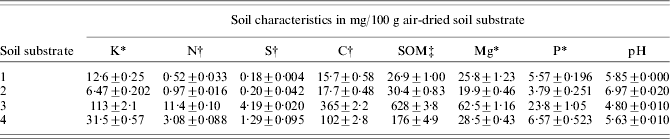
Four soil substrates (Table 1) were prepared as follows: soil substrate 1: sandy loamy soil with 0·25 peat (w/w) (Rostocker Humus und Erden GmbH, Am Moor 1, 18190 Gubkow, No. 4007667672027) and 0·25 compost (w/w) (Rostocker Humus und Erden GmbH, Am Moor 1, 18190 Gubkow, No. 4007667672020); soil substrate 2: soil substrate 1 with 0·50 sand (w/w); soil substrate 3: customary potting soil (Patzer GmbH&CoKG); and soil substrate 4: soil substrate 3 with 0·50 sand (w/w).
Characteristics of soil substrates (±s.d.)
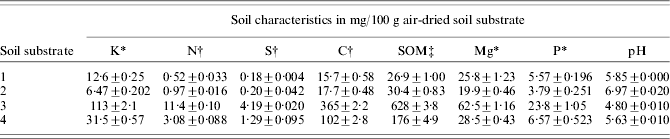
* The plant-availability of the elements potassium, magnesium and phosphorus were analysed by double lactate assay (DL).
† The elements carbon, nitrogen and sulphur were analysed using CNS (Vario EL).
‡ SOM, soil organic matter.
Transfer of in vitro cultivated carrot plantlets to soil
Seed-derived, somatic embryo-derived and transgenic (somatic embryo-derived) plantlets of an average size of 100–120 mm were transferred to soil and cultivated in a greenhouse (16 h/8 h light/dark cycle, 55% humidity). Each plantlet was watered with 40 ml. In order to reduce water stress during the change of environmental conditions, the plantlets were completely covered with thin light-permeable plastic beakers. After 6 days of cultivation in soil, the plastic beakers were canted to 45° to allow air circulation and the plants were watered again with 40 ml. In the following 14 days plants were watered weekly with 50 ml, after which time the plastic beakers were removed. In the following 8 weeks plants were watered weekly with 50–70 ml. On the 70th day of cultivation in soil, the number of developed and well-growing plants was counted, and the proportions of acclimatized plants in soil were calculated.
Statistical methods
The proportion of transferred plants depending on soil substrates and carrot cultivars were analysed by contingency tables. To test statistical significance, the Fisher's exact test for 2×2 tables and the chi-square test for other cases of contingence tables were used. A P-value of P⩽0·05 (two-sided) was considered significant. The analysis was carried out with SPSS 10.1 and applied the condition that the expected frequency of any cell was greater than four.
RESULTS
The soil substrate has an important influence on the development of moisture-sensitive carrot plantlets derived from in vitro cultures. Carrots prefer fertile sandy loam with an optimal pH of 5·5–7·5. However, to the best of the authors' knowledge, no investigations into the optimal soil conditions for carrots and in vitro generated carrot plantlets have been described. In previous experiments, only two of 20 transgenic carrot plantlets of the cultivar Lobbericher Gelbe Futtermoehre survived in soil (proportion of 0·10) and they continued their development when transferred at a size of 60 mm to soil substrate 1 (Table 1) and covered for 2 weeks with thin light-permeable plastic beakers. The proportion of acclimatized plantlets to soil of the cultivar Rote Riesen was lower (about 0·09). The present authors have sought to improve this transfer process and tested four different soil substrates, varying in sand content, their content of important micro and macro elements, and pH (Table 1). In order to minimize the influence of carrot cultivar on soil adaptation, the study was limited to the cultivars already listed above. By selecting a random group of carrot cultivars, the influence of the cultivar was eliminated in this study.
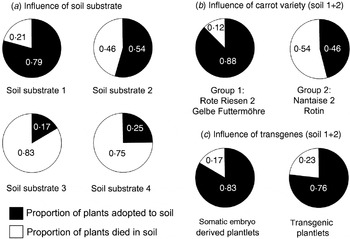
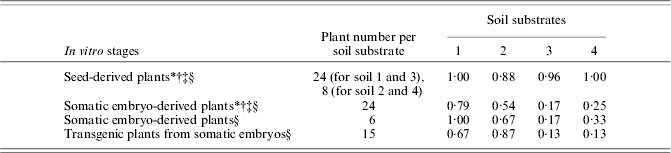
No differences were observed between the four cultivars during in vitro cultivation, somatic embryogenesis and plant regeneration (data not shown). Soil substrate had no impact on the cultivation of seed-derived carrot plantlets: nearly all plants transferred continued to develop in soil up to the 70th day of cultivation (Tables 2 and 4). In contrast, plantlets derived from somatic embryos and the transgenic plants, exhibited a lower proportion of successfully transferred plants. Significant differences were observed between different soil substrates in the ability to support adaptation to in vivo conditions. Soil substrates 1 and 2, which contained a lower amount of macro and micro elements, supported significantly higher numbers of plant survivors (Tables 2 and 4) than substrates 3 and 4 (Table 1; P<0·001). For somatic embryo germinants, the difference in the proportion of transferred plants for soil substrates 1 and 2 was not statistically significant (P=0·125), however the difference in proportion between soil substrates 1 and 3 as well as 1 and 4 were significant (P<0·001; Fig. 1a).
Demonstration of soil transfer and soil adaptation of somatic embryo-derived carrot plantlets. (a) Proportion of acclimatized plants to soil (survivors) of somatic embryo-derived carrot plantlets (Rote Riesen 2, Nantaise 2, Rotin and Lobbericher Gelbe Futtermoehre) in four different soil substrates (see Table 1) with n=24. Proportion of survivors in soil substrates 1 and 2 are not significantly different (P=0·125); proportion of survivors in soil substrates 1 and 3, as well as 1 and 4, are significantly different (P<0·001). (b) Proportion of acclimatized plants to soil (survivors) of somatic embryo-derived carrot plantlets of two groups of different carrot cultivars into soil substrates 1 and 2. Group 1 (Rote Riesen and Lobbericher Gelbe Futtermoehre) and group 2 (Nantaise 2 and Rotin) with n=24 showed significant differences (P=0·005) in the number of survivors in soil. (c) Proportion of acclimatized plants to soil (survivors) of somatic embryo-derived carrot plantlets Lobbericher Gelbe Futtermoehre (n=12) and transgenic carrot plantlets Lobbericher Gelbe Futtermoehre developed by somatic embryogenesis (n=30) into soil substrates 1 and 2.

Proportion of acclimatized in vitro carrot plants to different soil substrates (see Table 1)
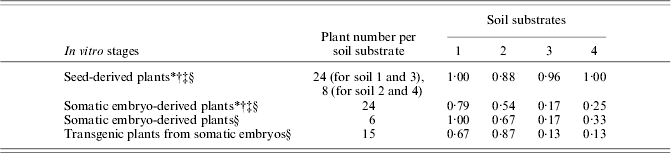
* Daucus carota, cultivar Rote Riesen 2.
† D. carota, cultivar Nantaise 2.
‡ D. carota, cultivar Rotin.
§ D. carota, cultivar Lobbericher Gelbe Futtermoehre.
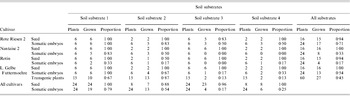
The ability of the four cultivars to transfer from in vitro to soil was analysed. Again, the proportions of seed-derived in vitro plantlets of each of the four cultivars to acclimatize to soil were not significantly different from one another. However, the plantlets developed from the somatic embryos showed remarkably different transfer proportions depending on the cultivar (Tables 3 and 4). The cultivar Rote Riesen 2 had the highest proportion of survivors in soil and Rotin the least. The cultivars Rote Riesen 2 and Lobbericher Gelbe Futtermoehre demonstrated reasonable transfer to soil after in vitro generation of somatic embryos.
Proportion of acclimatized in vitro cultivated carrot cultivars to soil (average of four different soil substrates)

Detailed proportions of acclimatized in vitro cultivated carrot plants of four different carrot varieties to different soil substrates (see Table 1)
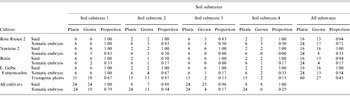
Soil substrates 1 and 2 were the focus for the statistical analysis. However, due to the small number of plants used per cultivar and the number of survivors, statistical conditions were not fulfilled. Therefore, the four cultivars were divided into two groups according to their characteristics in the transfer process: cultivar Rote Riesen 2 and Lobbericher Gelbe Futtermoehre in one group, and cultivars Nantaise 2 and Rotin in the second group. There was a significant difference (P<0·005) between these two groups of cultivars (Fig. 1b).
Finally, an analysis was made of the influence of the transformation procedure on adaptation to in vivo conditions. Because the cultivars Rote Riesen 2 and Lobbericher Gelbe Futtermoehre were better able to adapt to in vivo conditions, these cultivars were selected to investigate the influence of the transgenes on the transfer process. Unfortunately, transgenic meristematic cell lines of the carrot cultivar Rote Riesen 2, which demonstrated the highest transfer proportion to soil for somatic embryo-derived plants, did not develop a sufficient number of transgenic plantlets for further investigation. It is assumed that somaclonal mutations manifested during sub-cultivation of transgenic meristematic cells of the cultivar Rote Riesen 2 and prevented development of plants. However, 60 transgenic carrot plants of the cultivar Lobbericher Gelbe Futtermoehre were regenerated from two transgenic cell lines via somatic embryogenesis and were able to be analysed further. Plants generated by somatic embryogenesis had comparable proportions of acclimatized plants to soil, whether or not they possessed a transgene (Table 2). The transfer and adaptation to soil of transgenic carrot lines (Lobbericher Gelbe Futtermoehre/35Svp60) was not reduced by the presence of the transgenes nptII and vp60 (Fig. 1c).
DISCUSSION
As recommended by textbooks (Kaufmann Reference Kaufmann, Keller, Hanus and Heyland1999), carrots prefer sandy and loamy soil substrates. However, soil substrate 2, with a high sand content and neutral pH, did not support the somatic embryo-derived plantlets after transfer to soil. Interestingly, soil substrates 3 and 4, with a higher content of essential macro and micro elements, showed a large reduction in well-growing carrot plants derived from somatic embryos. Unfortunately, most of the published work on carrot transformation and subsequent transfer to soil does not describe the soil substrate used for the analysis (Gilbert et al. Reference Gilbert, Zhang and Punja1996; Hardegger & Sturm Reference Hardegger and Sturm1998; Takaichi & Oeda Reference Takaichi and Oeda2000). Interestingly, Soil mix 4 (Sunshine, Surrey, British Columbia), containing 0·55–0·60 Canadian Sphagnum peat moss, has been used successfully to generate herbicide- and disease-tolerant carrot plants in soil (Chen & Punja Reference Chen and Punja2002). However, because detailed information about the transfer procedure and number of survivors of transgenic plants were not reported (Chen & Punja Reference Chen and Punja2002), it is not possible to analyse properly the effect of the soil substrate on transfer in that work, or compare the data with that presented in the current study.
Similar to the reported high influence of cultivar on transformation rate (Thomas et al. Reference Thomas, Guiltinan, Bustos, Thomas and Nessler1989; Pawlicki et al. Reference Pawlicki, Sangwan and Sangwan-Norrell1992; Gilbert et al. Reference Gilbert, Zhang and Punja1996; Hardegger & Sturm Reference Hardegger and Sturm1998; Takaichi & Oeda Reference Takaichi and Oeda2000), a high and significant difference was observed between cultivars in the transfer and adaptation performance of somatic embryo derived carrot plantlets to soil. Previously, Mikschofsky (Reference Mikschofsky2006) had demonstrated that all four cultivars tested performed well during transformation. As demonstrated in the present work, the transgenes themselves did not further interfere with plant fitness within the acclimatization to soil. Generally the process of somatic embryogenesis causes insufficient plantlet development and difficulty during the in vivo adaptation process of transgenic carrots and not as result of the transgenic insertion. One possibility is that the roots of somatically developed plantlets are thinner and more interwoven, as compared to seed-germinated in vitro cultivated carrot plants. Consequently, these plantlets are harmed more by mechanical stress during the transfer process and cannot adjust to the higher suction power present in the soil. This process of development may also make the plants more susceptible to frequent fungal infections.
In conclusion, the present study documents an increase up to 0·87 in acclimatized transgenic plants after transfer to soil, which is more than triple the previous published transfer proportions of 0·2 (Gilbert et al. Reference Gilbert, Zhang and Punja1996; Hardegger & Sturm Reference Hardegger and Sturm1998). Indeed, the soil adaptation procedure presented here for transgenic lines of the cultivar Lobbericher Gelbe Futtermoehre gave nine-fold higher success than has been previously reported (Mikschofsky Reference Mikschofsky2006). Even though further analyses are required to confirm documented proportions of soil-acclimatized carrot plants, the achievement of a high number of survivors of transgenic carrot plants in soil enables the study of large numbers of transgenic plants and roots in soil and supports the application of transgenic carrots in agriculture.
The authors thank Dr Andre Schlichting, Uta Grunzel and Britta Balz for soil analyses. Special thanks are due to Kerstin Schmidt and Joerg Schmidtke for the support in statistical analysis. This research was supported by grants from the Bundesministerium fuer Bildung und Forschung (BMBF, No. 0312744).