Dilated cardiomyopathy, a myocardial disorder characterised by a dilated left ventricular chamber and systolic dysfunction, is the most common form of cardiomyopathy in children.Reference Tsirka, Trinkaus and Chen1 According to the Paediatric Cardiomyopathy Registry, it is a rare disease affecting 1.13 per 100,000 children.Reference Arola, Jokinen and Ruuskanen2–Reference Towbin, Lowe and Colan4 It has a constant annual incidence, varying from 0.57 to 0.74 per 100,000 children.Reference Towbin, Lowe and Colan4 The mortality is high, being 30% at 1 year and ranging from 36% to 66% at 5 years.Reference Towbin, Lowe and Colan4
Various clinical, radiographic, and echocardiographic parameters – such as age, functional class at diagnosis, cardiothoracic ratio, left ventricular fractional shortening, and the degree of mitral insufficiency – have been identified by several authors as risk factors of morbidity and mortality.Reference Towbin, Lowe and Colan4, Reference Burch, Siddiqi, Celermajer, Scott, Bull and Deanfield5 However, these indices have a poor prognostic capability, and thus medical treatment is still aimed at treating congestion or low cardiac output.
In adults with cardiac failure, haematological anomalies – such as anaemia,Reference Mitchell6, Reference Hogenhuis, Voos and Jaarsma7 neutropenia, lymphopenia,Reference Berry, Norrir, Hogg, Brent, Stevenson and McMurray8, Reference Huehnergarth, Mozaffarian and Sullivan9 increased blood levels of C-reactive protein,Reference Kardys, Knetsch and Bleumink10, Reference Rosen, Cushman and Nasir11 and ureaReference Hogenhuis, Voos and Jaarsma7, Reference Kazory12, Reference Aronson, Mittleman and Burger13 – are sensitive predictor factors of morbidity and mortality. Haematological abnormalities are frequently found in children with dilated cardiomyopathy and cardiac failure; however, they are generally attributed to concomitant morbidity, such as renal insufficiency, malnutrition, or infections.
There are no data on the prevalence of haematological anomalies in children with idiopathic dilated cardiomyopathy and their possible impact on prognosis. The aim of this study was to evaluate the prevalence and the prognostic value of haematological abnormalities in a series of 218 consecutive children with idiopathic dilated cardiomyopathy.
Materials and methods
From January, 1990 to December, 2009, we sampled 218 consecutive children with a first diagnosis of idiopathic dilated cardiomyopathy at Necker Enfants Malades, Paris.
Dilated cardiomyopathy was defined as a dilated left ventricular chamber – more than 2 standard deviations – and depressed systolic function, with fractional shortening less than 25%. We included patients only with idiopathic dilated cardiomyopathy, in the age group of 0–16 years.
Exclusion criteria included dilated cardiomyopathy of known and treatable origin, due to neuromuscular disorders, associated with malformation syndrome, due to inborn errors of metabolism, due to Kawasaki disease, or toxic dilated cardiomyopathy. Patients with concomitant infection, fever, or those having received a blood transfusion during the month preceding the diagnosis of dilated cardiomyopathy were also not included. Only blood tests at diagnosis, all performed at the laboratory of Necker Enfants Malades, were taken into consideration, which included haemoglobin, blood cell count, coagulation state, hepatic and renal function, carbon-reactive protein, lactates, sodium, potassium, and blood gas analysis.
Liver insufficiency was defined as blood levels of glutamic oxaloacetic transaminase over 110 international units per litre, of glutamic pyruvic transaminase over 30 international units per litre, of bilirubin over 20 millimoles per litre, associated with International Normalised Ratio over 1.4, prothrombin time less than 80%, coagulation time over 150%, and factor V less than 80%. Renal insufficiency was defined as blood levels of urea over 8 millimoles per litre, of creatinin over 90 millimoles per litre, and of potassium over 4 millimoles per litre. Metabolic acidosis was defined as pH less than 7.2, base excess over −10, and lactates over 2.5 millimoles per litre.
The duration of follow-up was defined as the period between the diagnosis of dilated cardiomyopathy and the occurrence of death or cardiac transplantation. In our institution, patients were put in a waiting list for cardiac transplantation when they had at least two episodes of congestive cardiac failure or low cardiac output with the need for inotropic support. They were put in an urgent list when they needed mechanical ventilation or extracorporeal circulation.Reference Canter, Shaddy and Bernstein14
Statistical analysis
Continuous variables were presented as mean plus or minus standard deviation or as median value and range. Categorical variables were presented as frequency and percentage. Relationships between categorical variables were tested using the chi-square test or the Fisher exact test, when appropriate. Relationships between continuous and categorical variables were tested using the Student t test or the Wilcoxon signed-rank test, when appropriate. Correlations between the different biological variables were assessed using the Pearson correlation coefficient r. Event-free survival was the time interval between the date of diagnosis and the date of death, the date of cardiac transplantation or the date of last follow-up. Survival distributions were examined using the Kaplan–Meier test. Risk factors for death or cardiac transplantation were identified using the log-rank test. A two-sided p-value of 0.05 or less was considered statistically significant. A p-value less than 0.05 at univariate analysis was retained to enter a multivariate Cox proportional hazard regression model aimed to identify potential predictive factors of death or cardiac transplantation. All statistical tests were bilateral. The assumption of proportionality was tested using the Schoenfield residuals. A procedure of model selection was applied utilising the Akaike information criteria associated with a Bootstrap approach.Reference Austin and Tu15 To evaluate a possible non-linear relationship between continuous predictors and survival, we have applied cubic spline functions.Reference Harrell, Lee and Pollock16 As a sensitive analysis to identify cut-off values for predictors, we used the Classification and Regression Tree analysis, which is a technique based on recursive partitioning analysis. Unlike multivariable logistic regression, it is suited to the generation of clinical decision trees.
All analyses were performed using the R version 2.11.0 statistical package. The study was approved by the local ethics committee. The parents of the children gave their written consent for the study.
Results
Descriptive analysis
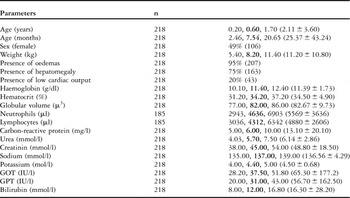
Table 1 shows the descriptive analysis of clinical and biological characteristics of patients at the time of diagnosis. No child had severe malnutrition (less than 2 standard deviations) at diagnosis.
Descriptive analysis of the whole population.

GOT = glutamic oxaloacetic transaminase; GPT = glutamic pyruvic transaminase
n is the number of non-missing values
a, b, c represent the lower, median, and upper quartile for continuous variables
(x ± s) represents mean ± 1 standard deviation
Numbers after percent are frequencies
Mean cardiothoracic ratio was 0.64 plus or minus 0.06. Arrhythmias and conduction anomalies were relatively rare. There was one patient with ventricular tachycardia, three with ventricular ectopic beats, six with supraventricular arrhythmias, and one patient with grade 1 atrioventricular block. The mean left ventricular end-diastolic diameter, expressed as a z-value, was 3.74 plus or minus 1.20; and over 4 in 87 patients (40%). Median fractional shortening was 15%, ranging from 5% to 25%, and lower than 20% in 142 patients (65%). Moderate-to-severe mitral regurgitation was found in 68 patients (31%).
The median age at diagnosis was 0.6 years, ranging from 1 day to 15.8 years. The median number of new cases per year was 12, ranging from 2 to 20 years. No child had severe malnutrition. Increased blood levels of urea – over 8 millimoles per litre, C-reactive protein – over 10 milligrams per litre, and decreased blood levels of haemoglobin – less than 10 grams per decilitre – and sodium – over 135 millimoles per litre – were found in 20%, 24%, 24%, and 24% of patients, respectively. Anaemia was found in 54% of patients who died or underwent cardiac transplantation. Neutropenia and lymphopenia were found in only 7% and 2% of patients. Liver insufficiency was found in three patients, renal insufficiency in three, and metabolic acidosis in five patients.
Table 2 shows the descriptive analysis associated with the log-rank test. Age at diagnosis – less than 6 months, blood levels of urea – over 8 millimoles per litre, blood levels of C-reactive protein – over 10 milligrams per litre, and haemoglobin levels – less than 10 grams per decilitre were associated with the occurrence of death or cardiac transplantation, whereas sodium levels – less than 135 millimoles per litre – were not. There was no correlation between blood levels of haemoglobin and urea (p = 0.2) or creatinin (p = 0.1), ruling out a possible effect of impaired renal function on haemoglobin levels. We did not find the physiological linear relationship between the age at diagnosis and haemoglobin levels (p = 0.6).
Descriptive analysis, baseline parameters, and prognostic factors of death or cardiac transplantation at univariate analysis – log-rank test.

CRP = carbon-reactive protein; IQ = lower quartile; Median = median quartile; IIIQ = upper quartile for continuous variables
Follow-up
Patients were followed up for a median period of 2.65 years, ranging from 0 to 17.2 years. The median number of hospitalisations per patient due to cardiac failure was 1, ranging from 1 to 9. A total of 87 patients were hospitalised at least two times for relapse of cardiac failure. Cerebral events occurred in four patients. Death occurred in 56 patients at a median interval of 0.2 years, ranging from 0 to 8.7years, from diagnosis. Within 12 months from diagnosis, 47 patients (84%) died; a total of 61 patients were put on a waiting list for cardiac transplantation, which was performed in only 25 patients at a median interval of 0.5 years, ranging from 0 to 2.2 years, from diagnosis. In all, 18 patients died on a waiting list for cardiac transplantation. The mean age of transplanted patients was 28 plus or minus 48 months. Of the 25 transplanted patients, 15 were younger than 1 year of age.
Death was due to refractory cardiac failure in 42 patients, due to sudden death in 13, due to ventricular arrhythmia in three patients, and from a cerebral event under extracorporeal circulation in one patient.
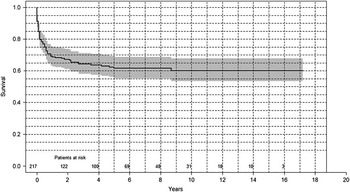
Figure 1 shows the survival curve for the whole cohort. Event-free survival was 68% (95% confidence interval, 63–75%) at 1 year and 62% (95% confidence interval, 56–69%) at 5 years. Approximately 84% of the deaths occurred within 12 months from diagnosis.
Survival curve of the whole study cohort. Event-free survival at 1 and 5 years was 68% (95% confidence interval, 63–75%) and 62% (95% confidence interval, 56–69%).

Prognostic factors
Tables 3 and 4 show the results of multivariate analysis. Cox models without selection (Table 3) show that blood levels of haemoglobin are highly predictive of a poor outcome, whereas the predictor power of increased blood levels of carbon-reactive protein is lower. Akaike information criteria selection confirms the strong prognostic value of blood levels of haemoglobin, does not confirm the prognostic value of blood levels of carbon-reactive protein, and shows a low predictor power for increased blood levels of urea (Table 4). An increment of haemoglobin blood levels by 2.3 grams (I–III quartile) decreases the risk of negative outcome by 50%. An increment of urea blood levels by 3.47 grams (I–III quartile) increases the risk of negative outcome by 130%. We did not find a predictive role for very low fractional shortening or severe left ventricular dilatation.
Prognostic factors of death or cardiac transplantation at multivariate analysis: Cox model without selection.

CI = confidence interval; CRP = carbon-reactive protein; HR = hazard ratio
Prognostic factors of death or cardiac transplantation at multivariate analysis: Cox model after AIC selection.

AIC = Akaike information criteria; CI = confidence interval; HR = hazard ratio; IQ = lower quartile; IIIQ = upper quartile for continuous variables
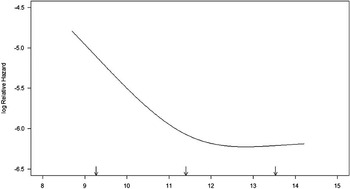
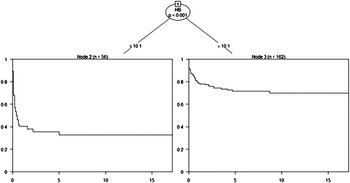
In Figure 2, cubic spline for haemoglobin levels shows that the positive role of haemoglobin on survival is not linear for values less than 12 grams per decilitre and that it is null for values over 12 grams per decilitre. Classification and Regression Tree analysis confirms that only blood levels of haemoglobin are predictors of poor outcome (Fig 3) and shows that the survival probability at 5 years is only 36% in patients with haemoglobin levels less than 10 grams per decilitre and higher than 70% in patients with haemoglobin levels over 10 grams per decilitre.
Relationship between haemoglobin and survival (log Relative Hazard). Cubic spline functions showed that the positive role of haemoglobin on survival was linear for values less than 12 grams per decilitre and null for values over 12 grams per decilitre.

Classification tree for blood levels of haemoglobin, C-reactive protein, and urea. Only haemoglobin is a predictor of survival in this model. The survival probability at 5 years is 36% in patients with haemoglobin levels less than 10 grams per decilitre and higher than 70% in patients with haemoglobin levels over 10 grams per decilitre.

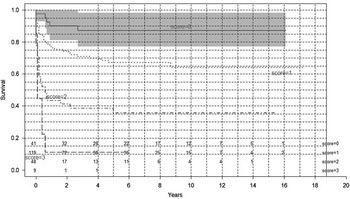
We then tried to establish cut-off values for variables associated with poor outcome. An adaptive index model for risk stratification attributes a score of 1 for haemoglobin values lower than 10.2 grams per decilitre, or urea levels higher than 8.8 millimoles per litre, or age at diagnosis younger than 18 months. In an effort to enhance the clinical applicability of these results, a prediction model of death or transplantation was derived. Figure 4 shows a plot of prediction scores versus probability of adverse events.
Prediction model based on adaptive index models for risk stratification. The survival probability at 2 years decreased for 90% (score 0) to 10% (score 3).

Discussion
Our study shows for the first time, that in children with idiopathic dilated cardiomyopathy anaemia is very frequent; it is not related to renal insufficiency and is a strong independent prognostic factor of early death or transplantation.
Although in adults with cardiac failure the presence of haematological anomalies has been known for 30 years,Reference Mitchell6–Reference Kardys, Knetsch and Bleumink10 their existence has not been investigated in children. The prevalence of anaemia in adults with cardiac failure varies from 4% to 55%. Haemoglobin levels are associated with brain natriuretic peptide levels, but are not associated with erythropoietin levels, or with severity of renal insufficiency.Reference Hogenhuis, Voos and Jaarsma7 These anaemic patients often have lymphopenia, that is, in 8 out of 10, which is also a prognostic factor of early mortality.Reference Huehnergarth, Mozaffarian and Sullivan9, Reference Kardys, Knetsch and Bleumink10
In our series, anaemia was present in one-fourth of the patients, and it was a powerful and independent risk factor of early death or transplantation. Univariate, multivariate, Classification and Regression Tree analysis, all indicated that haemoglobin levels were related to survival. Cubic spline functions showed the non-linearity of the relation haemoglobin versus survival for haemoglobin levels inferior to 12 grams per decilitre. The presence of anaemia was not related to age or increased levels of urea, ruling out a secondary effect of renal insufficiency on haematopoiesis. Even if multivariate analysis showed that increasing haemoglobin levels by 1 gram improved the survival probability by 36%, we do not know whether the treatment of anaemia would improve the survival of patients at risk or whether the presence of anaemia only reflects the severity of the disease. Anaemia was not related to neutropenia or lymphopenia, ruling out a global depressive effect on bone marrow by circulating cytokines in children with dilated cardiomyopathy, as it has been suggested in adults with cardiac failure.Reference Valgimigli, Ceconi and Malagutti17 However, neutropenia and lymphopenia were rare events in our study cohort, probably because of the fact that the duration of the disease in our patients was much shorter that life expectancy of adults with cardiac failure.
No studies have investigated the possible activation of inflammatory indices or the presence of initial renal dysfunction in children with cardiac failure. Even if in our series children with concomitant infection or fever were excluded and overt renal insufficiency was rare, increased blood levels of C-reactive protein and urea were found in a large percentage of patients.Reference Windram, Loh, Rigby, Hanning, Clark and Cleland18 Children with either increased blood levels of urea or carbon-reactive protein had a poorer survival compared with children with normal urea or carbon-reactive protein. However, C-reactive protein was a predictor of poor outcome only at univariate analysis, whereas multivariate analysis showed that only serum urea was a significant predictor of long-term survival.
A major difference between children and adults with cardiac failure is the duration of the disease, which can be extremely short in children.Reference Akagi, Benson, Lightfoot, Chin, Wilson and Freedom19, Reference Ciszewski, Bilinska and Lubiszewska20 Our study cohort was very young, with 63% of patients younger than 1 year of age and 83% younger than 3 years. Death was very frequent and occurred early after the diagnosis. In addition, the majority of deaths occurred in young patients in whom, because of the lack of organs, cardiac transplantation is a remote possibility. Only a minority of patients were transplanted and a large number died on a waiting list. Of the 81 children who died or had cardiac transplantation, 68 were younger than 18 months of age. The survival probability reported in our series was lower than that published by other authors.Reference Towbin, Lowe and Colan4 In one of the first studies on children with dilated cardiomyopathy, the authors, concerned by the high mortality rate of this population, proposed an aggressive treatment of the disease.Reference Friedman, Moak and Garson21 In other series, including older children, survival was generally higher.Reference Daubeney, Nugent and Chondros22, Reference Matitiau, Perez-Atayde and Sanders23 Similar to us, several authors observed that the majority of deaths occurred between 2 months and 2 years after diagnosis.Reference Matitiau, Perez-Atayde and Sanders23, Reference Lewis24 Thus, in children it is extremely important to identify those at risk in order to start an aggressive medical treatment, possibly treating anaemia and/or immediately putting them on a waiting list for transplantation.
Many authors have tried to identify predictors of poor outcome in children with dilated cardiomyopathy for 20 years. However, these studies provide variable findings. Severity of dysfunction has been found to be predictive of outcome in some studies,Reference Redfield, Gersh, Bailey and Rodeheffer25 but not in others.Reference Kimball, Daniels, Meyer, Schwartz and Kaplan26 Similarly, the presence of arrhythmia has and has not been associated with a greater risk of death.Reference Redfield, Gersh, Bailey and Rodeheffer25 Younger age at presentation has been reported to be associated with both a better outcomeReference Burch, Siddiqi, Celermajer, Scott, Bull and Deanfield5 and a worse outcome,Reference Redfield, Gersh, Bailey and Rodeheffer25 or to bear no relation to outcome.Reference Kimball, Daniels, Meyer, Schwartz and Kaplan26 Symptoms appear to provide poor prognostic capability because even asymptomatic patients with incidental discovery of dilated cardiomyopathy can have a poor prognosis.Reference Redfield, Gersh, Bailey and Rodeheffer25 In addition, it can be extremely difficult to evaluate symptoms in children less than 2 years of age, who are too young to undergo a cardiopulmonary test or other tests requiring collaboration. We identified a cluster of haematological anomalies that, unlike clinical, radiological, or echocardiographic parameters, could be a useful and simple tool for risk stratification in children with cardiac failure. The cut-off limits for haemoglobin, urea, and C-reactive protein were similar to the reported normal values. The prediction score used in our series showed that the survival probability was extremely different in low- and high-risk patients.
The major limitation of our study is its retrospective nature. To avoid bias due to the length of the study, we restricted inclusion criteria to a single disease associated with cardiac failure and limited our analysis to blood test performed in the same centre and available in the majority of patients. We considered only blood tests at first diagnosis, in order to avoid the bias due to the medical treatment. We used multiple statistic tests to strengthen our results. However, our predictor model, to be validated, should be applied to prospective studies.
In conclusion, as in adult patients, cardiac failure due to idiopathic dilated cardiomyopathy in children is accompanied by haematological abnormalities that constitute sensible risk factors of early death or transplantation. Anaemia is highly predictive of early death and should be aggressively treated in order to possibly improve the prognosis of patients at risk. The utilisation of a stratification score might provide a better identification of patients at risk and should allow to optimise medical treatment or offer the possibility of cardiac transplantation to patients with higher risk. In fact, when the diagnosis of dilated cardiomyopathy is made in a child, there is limited time for medical treatment before clinical deterioration or death occurs.
Acknowledgement
We thank Isabelle Szezepanski for her assistance during the collection of data.