Introduction
Childhood maltreatment, which mainly includes physical, sexual and emotional abuse and neglect, is common worldwide with pediatric prevalence rates of 13–36% (Lim, Howells, Radua, & Rubia, Reference Lim, Howells, Radua and Rubia2020). These adverse early-life experiences involved bio-psycho-social mediators and moderators (Sideli et al., Reference Sideli, Murray, Schimmenti, Corso, La Barbera, Trotta and Fisher2020), and have been suggested to be closely related with cognitive decline, attention impairment, emotional dysregulation, and reward anticipation disorder (Hart et al., Reference Hart, Lim, Mehta, Simmons, Mirza and Rubia2018; Lim et al., Reference Lim, Hart, Mehta, Simmons, Mirza and Rubia2016), and may even increase the risks of suffering from mental illness, such as posttraumatic stress disorder (PTSD) (Daniels, Lamke, Gaebler, Walter, and Scheel, Reference Daniels, Lamke, Gaebler, Walter and Scheel2013), major depressive disorder (MDD) (Goltermann et al. Reference Goltermann, Winter, Meinert, Sindermann, Lemke, Leehr and Hahn2022; Guo et al. Reference Guo, Liu, Liu, Wang, Dong, Lu and Li2022; Haidl et al. Reference Haidl, Hedderich, Rosen, Kaiser, Seves, Lichtenstein and Koutsouleris2021), borderline personality disorder (Herzog, Kube, & Fassbinder, Reference Herzog, Kube and Fassbinder2022), schizophrenia (Cancel, Dallel, Zine, El-Hage, & Fakra, Reference Cancel, Dallel, Zine, El-Hage and Fakra2019; D'Andrea et al., Reference D'Andrea, Lal, Tosato, Gayer-Anderson, Jongsma, Stilo and Morgan2022; Sideli et al., Reference Sideli, Murray, Schimmenti, Corso, La Barbera, Trotta and Fisher2020), substance abuse (Hughes et al., Reference Hughes, Bellis, Hardcastle, Sethi, Butchart, Mikton and Dunne2017), eating disorders (Cascino et al., Reference Cascino, Canna, Russo, Monaco, Esposito, Di Salle and Monteleone2022; Luo et al., Reference Luo, Zhang, Huang, Zheng, Kanen, Zhao and Consortium2020), as well as functional somatic and visceral pain syndromes (Chandan et al., Reference Chandan, Keerthy, Zemedikun, Okoth, Gokhale, Raza and Nirantharakumar2020). Neurobiology changes of the brain might underlie the occurrence of the above symptoms. The human brain is a highly plastic organ, regulated by genes, but also shaped by environmental factors (Lim, Radua, & Rubia, Reference Lim, Radua and Rubia2014). Translational animal model also disclosed certain effects of early life adversity on neurodevelopment, indicating the susceptibility of brain structure (Aksić et al., Reference Aksić, Radonjić, Aleksić, Jevtić, Marković, Petronijević and Filipović2013; Penninck et al., Reference Penninck, Ibrahim, Artiges, Gorgievski, Desrivieres, Farley and Consortium2021; Waters & Gould, Reference Waters and Gould2022). Early interventions were meaningful for preventing the psychosocial impairment of childhood maltreatment. For example, previous evidence has proven that non-pharmacological treatments such as enhancing exercise were effective both in reducing mortality and treating depressive symptoms related with childhood maltreatment (Belvederi Murri et al., Reference Belvederi Murri, Ekkekakis, Magagnoli, Zampogna, Cattedra, Capobianco and Amore2018; Recchia et al., Reference Recchia, Bernal, Fong, Wong, Chung, Chan and Siu2023). Understanding the effects of early environmental adversity on the developing brain and providing perspectives for early interventions were of great importance.
Emerging evidence suggests that early-life adversities alter trajectories of neurodevelopment to affect sensory systems, network architecture and circuit (Teicher, Samson, Anderson, & Ohashi, Reference Teicher, Samson, Anderson and Ohashi2016), on the neural basis of changing the number of neurons, glial cells, dendrites, and synapses, myelination, and influencing neurotransmitter and growth factor activity (Praag, Kempermann, & Gage, Reference Praag, Kempermann and Gage2000). Advances in neuroimaging techniques such as magnetic resonance imaging (MRI) have made it possible to detect neurobiological characteristics in childhood maltreatment-exposed individuals with noninvasive ways. One of the most prominent neuroanatomical differences between maltreated individuals and unexposed controls was microstructural abnormalities in gray matter (GM), including cortical thickness (CTh) and GM volume (GMV) (Hakamata, Suzuki, Kobashikawa, & Hori, Reference Hakamata, Suzuki, Kobashikawa and Hori2022; Teicher et al., Reference Teicher, Samson, Anderson and Ohashi2016). Neural plasticity due to childhood experience is significant, with GM being less heritable and more susceptible to early-life stress than white matter (WM) (Lim et al., Reference Lim, Radua and Rubia2014). Moreover, the surface-based morphometry (SBM) approach served as a vital supplement of voxel-based morphometry (VBM) in the investigation of GM, has unique advantages in exploring the pathological mechanism of neurodevelopmental disorders (Winkler et al., Reference Winkler, Kochunov, Blangero, Almasy, Zilles, Fox and Glahn2010). CTh is considered a heritable and relatively stable structural brain characteristic distinct from GMV (Panizzon et al., Reference Panizzon, Fennema-Notestine, Eyler, Jernigan, Prom-Wormley, Neale and Kremen2009). Its measurement avoids part of the volume effect which may lead to inaccurate estimation of brain volume, and it provides a direct quantitative indicator (mm), rather than a qualitative indicator of cortical morphology (Fischl, Reference Fischl2012). As the cerebral cortex develops rapidly during childhood, detailed measurement of CTh can provide key information about cortical maturation with regional changes in development process (Li et al., Reference Li, Zhao, Chen, Long, Dai, Huang and Gong2020; Winkler et al., Reference Winkler, Kochunov, Blangero, Almasy, Zilles, Fox and Glahn2010).
Most neuroimaging studies have utilized a region of interest (ROI) analysis approach, primarily estimating within the brain area chosen in advance (Lim et al., Reference Lim, Radua and Rubia2014). The prefrontal cortex (PFC), hippocampus and amygdala were most frequently assessed in childhood maltreatment (Paquola, Bennett, & Lagopoulos, Reference Paquola, Bennett and Lagopoulos2016), which might miss some important information about other brain regions. By comparison, a whole-brain approach can explore alterations throughout the brain to avoid selection bias (Hakamata et al., Reference Hakamata, Suzuki, Kobashikawa and Hori2022). A lately published large sample study performed whole-brain vertex-wise SBM in adolescent and adult females with interpersonal violence exposure, and found CTh in the median cingulate cortex was negatively related to early-life trauma in both age groups (Ross, Sartin-Tarm, Letkiewicz, Crombie, & Cisler, Reference Ross, Sartin-Tarm, Letkiewicz, Crombie and Cisler2021). GMV studies achieved by VBM were more widely used, and brain areas involved with memory processing, socio-affective regulation, and executive control, such as the PFC, superior temporal gyrus (STG), hippocampus, anterior cingulate cortex (ACC), and limbic system were frequently reported (Cancel et al., Reference Cancel, Dallel, Zine, El-Hage and Fakra2019; Lim et al., Reference Lim, Radua and Rubia2014; Pollok et al., Reference Pollok, Kaiser, Kraaijenvanger, Monninger, Brandeis, Banaschewski and Holz2022). Functional MRI (fMRI) and diffusion tensor imaging (DTI) studies have yielded similar and complex findings (Hakamata et al., Reference Hakamata, Suzuki, Kobashikawa and Hori2022; Lim et al., Reference Lim, Howells, Radua and Rubia2020; Teicher et al., Reference Teicher, Samson, Anderson and Ohashi2016), further confirms the multi-dimensional effects of childhood trauma on the brain development. Disturbance of above regions were also considered to have strong associations with the development of a psychiatric illness. Besides, alterations of the brain morphology and disturbances in neural activities might also occur in healthy people without any psychiatric disorders but exposed to childhood maltreatment (Everaerd et al., Reference Everaerd, Klumpers, Zwiers, Guadalupe, Franke, van Oostrom and Tendolkar2016; Fan et al., Reference Fan, Liu, Xia, Gao, Meng, Han and Zhu2022; Lu et al., Reference Lu, Gao, Wei, Wu, Liao, Ding and Li2013; Tomoda, Navalta, Polcari, Sadato, & Teicher, Reference Tomoda, Navalta, Polcari, Sadato and Teicher2009a). Therefore, understanding how maltreatment would affect brain microstructures is of crucial significance to prevent, pre-empt or treat the mental health consequences of early-life abuse and neglect.
Up to now, existing neuroimaging findings of childhood maltreatment were largely inconsistent. The inconsistency of investigation outcomes might be related with the heterogenous cohort demographics, definition of childhood trauma, data collection approaches, and analytical methods. In order to solve the heterogeneity of findings from distinct studies, the coordinate-based meta-analysis (CBMA) emerged as powerful means to comprehensively synthesize the neuroimaging discoveries that were found in a variety of research (Albajes-Eizagirre & Radua, Reference Albajes-Eizagirre and Radua2018). This method is also able to distinguish between false results and replicable results, and summarize and integrate large amounts of data across studies (Muller et al., Reference Muller, Cieslik, Laird, Fox, Radua, Mataix-Cols and Eickhoff2018). Therefore, the CBMA program is capable of alleviating the impact of research heterogeneity, determining reliable results, and discovering the potential impact of demographic characteristics on neuroimaging. A recent meta-analysis of effects of early-life adversities on GM was conducted using coordinate-based anatomical likelihood estimation (ALE). This study revealed the impacts of early-life trauma on GMV lied in the right hippocampus and amygdala and the left inferior frontal gyrus, age-specific effects for the right amygdala and hippocampus in children and adolescents, and maltreatment-specific effects for the right ACC in adults (Pollok et al., Reference Pollok, Kaiser, Kraaijenvanger, Monninger, Brandeis, Banaschewski and Holz2022). However, it is a pity that this work failed to include SBM analysis as the number of studies of CTh was insufficient than recommended for ALE (n < 17) (Eickhoff et al., Reference Eickhoff, Nichols, Laird, Hoffstaedter, Amunts, Fox and Eickhoff2016). Unlike ALE, the requirements for sample size are less strict for the seed-based d mapping (SDM) software (minimum of 10 datasets) (Hu et al., Reference Hu, Zhang, Bu, Li, Gao, Lu and Gong2020; Muller et al., Reference Muller, Cieslik, Laird, Fox, Radua, Mataix-Cols and Eickhoff2018; Radua & Mataix-Cols, Reference Radua and Mataix-Cols2009), and the algorithm also considers null results in a meta-analysis. A range of neuropsychiatric studies have applied this approach in the investigations of CTh and VBM (Li et al., Reference Li, Zhao, Chen, Long, Dai, Huang and Gong2020, Reference Li, Zhang, Zhao, Li, Kemp, Wu and Gong2022; Shen et al., Reference Shen, Zhang, Fan, Ping, Yu, Xu and Zhou2022; Wang et al., Reference Wang, Luo, Tian, Cheng, Qiu, Wang and Jia2019; Zhao et al., Reference Zhao, Zhang, Shah, Li, Sweeney, Li and Gong2022; Zhu et al., Reference Zhu, Zhao, Wen, Li, Pan, Fu and Gong2022). By utilizing the SDM methods, one meta-analysis of VBM revealed that individuals exposed to childhood maltreatment exhibited decreased GMV in orbitofrontal cortex (OFC) limbic-temporal regions and inferior frontal cortex that mediate top-down affect and cognitive control, respectively; and in the left sensorimotor cortex that mediates sensory functions (Lim et al., Reference Lim, Radua and Rubia2014). Another meta-analysis focusing on adults with childhood trauma experience demonstrated the most robust findings of the whole-brain VBM were reductions of GM in the right dorsolateral PFC and right hippocampus (Paquola et al., Reference Paquola, Bennett and Lagopoulos2016). These findings extended our knowledge of the effects of childhood maltreatment on microstructural brain abnormalities. However, these two studies both performed about seven years ago. As far as we are concerned, an updated and comprehensive meta-analysis containing both SBM and VBM studies is in need.
The purpose of this current CBMA is to identify the most noticeable and robust CTh and GMV alterations in individuals with a history of childhood trauma. The potential associations between clinical characteristics (average age, IQ, onset age of childhood maltreatment, as well as duration of maltreatment) and reported structural alterations were also explored by employing the meta-regression method. Additionally, we also intended to perform sub-group analyses of different age groups (youths v. adults). According to previous structural MRI (sMRI) studies (Maier et al., Reference Maier, Gieling, Heinen-Ludwig, Stefan, Schultz, Gunturkun and Scheele2020; Opel et al., Reference Opel, Zwanzger, Redlich, Grotegerd, Dohm, Arolt and Dannlowski2016; Paquola et al., Reference Paquola, Bennett and Lagopoulos2016; Pollok et al., Reference Pollok, Kaiser, Kraaijenvanger, Monninger, Brandeis, Banaschewski and Holz2022), we assumed that individuals with childhood maltreatment experience would exhibit anatomical alterations in core brain areas such as the cingulate cortex and frontal gyrus.
Methods
Search strategy and selection criteria
The protocol of this present CBMA has been recorded in PROSPERO (http://www.crd.york.ac.uk/PROSPERO) (registration number: CRD42022342543). This meta-analysis was implemented in accordance with the Preferred Reporting Standards for Systematic Reviews and Meta-Analyses (PRISMA) (Liberati et al., Reference Liberati, Altman, Tetzlaff, Mulrow, Gotzsche, Ioannidis and Moher2009; Moher, Liberati, Tetzlaff, Altman, & Group, Reference Moher, Liberati, Tetzlaff, Altman and Group2009a, Reference Moher, Liberati, Tetzlaff, Altman and Group2009b). Relevant literatures were obtained from the PubMed and Web of Science databases published (or ‘in press’) until 30 September 2022. We applied (‘childhood maltreatment’ or ‘childhood trauma’ or ‘child abuse’ or ‘early stress’ or ‘early-life trauma’ or ‘childhood adversities’) and (‘cortical thickness’ or ‘cortical thinning’ or ‘thickness’ or ‘FreeSurfer’ or ‘VBM’ or ‘voxel-based morphometry’ or ‘voxel-wise’ or ‘morphometry’ or ‘gray matter’) as the keywords in this present meta-analysis. In addition, in order to prevent omission, the reference lists of the included articles were manually reviewed.
Study selection strategy
We included studies that meet these specifications: (1) original research written in English and published in journals with peer review; (2) applied the SBM or VBM approach to explore CTh or GMV differences; (3) provided a comparison between individuals with and without childhood maltreatment experience or reporting the main effects of childhood maltreatment regarding CTh or GMV alterations in whole-brain assessments; (4) provided the coordinates of significant clusters in Montreal Neurological Institute (MNI) or Talairach space; (5) used a statistical threshold. The exclusion standards were as below: (1) case reports, reviews, meta-analyses, and theoretical papers; (2) there was no straight comparison between groups or no main effect of childhood maltreatment was reported; (3) limited to ROI analysis; (4) the peak coordinates were not available.
Quality evaluation and data acquisition
Following rules for neuroimaging meta-analyses promoted by Müller and colleagues (Muller et al., Reference Muller, Cieslik, Laird, Fox, Radua, Mataix-Cols and Eickhoff2018), two authors (W.Y. and S.J.) independently searched the literatures, evaluated the quality of the retrieved articles, recorded and cross-checked the data from qualified studies. The following data were extracted for each research: first author, cohort size, demographics (age, gender, IQ), onset age of childhood maltreatment, duration of maltreatment, maltreatment types, and comorbid disorders. The data for SDM estimation was also collected, including the coordinates of primary findings and effect size values (e.g. t statistics, Z score, and p value).
SDM meta-analysis
We performed the meta-analysis applying the SDM program v5.15 (Albajes-Eizagirre, Solanes, Vieta, & Radua, Reference Albajes-Eizagirre, Solanes, Vieta and Radua2019; Radua & Mataix-Cols, Reference Radua and Mataix-Cols2009) (http://www.sdmproject.com) to compare regional CTh and GMV alterations in individuals with a history of childhood maltreatment compared to those unexposed comparison subjects. A recent mask created by FreeSurfer was utilized to achieve the meta-analysis of CTh investigations (Li et al., Reference Li, Zhao, Chen, Long, Dai, Huang and Gong2020). Our present analyses were conducted in terms of the standardized SDM tutorial and previous meta-analytic studies.
The SDM algorithm does not simply evaluate the probability of the peak, but uses the effect size, combines the notified peak coordinates obtained from the dataset with the statistical parameters, and reestablishes the traditional map of the effect size between groups (Radua et al., Reference Radua, Mataix-Cols, Phillips, El-Hage, Kronhaus, Cardoner and Surguladze2012). The details of the SDM procedures have been described elsewhere (Li et al., Reference Li, Zhang, Zhao, Li, Kemp, Wu and Gong2022; Qiu & Wang, Reference Qiu and Wang2021; Tian et al., Reference Tian, Diao, Yang, Wang, Roberts, Feng and Jia2020; Zhao et al., Reference Zhao, Zhang, Shah, Li, Sweeney, Li and Gong2022; Zhu et al., Reference Zhu, Zhao, Wen, Li, Pan, Fu and Gong2022), and we summarized as below: (1) The peak coordinates from each dataset were obtained at the t statistic level (Z- or p values for substantial clusters were switched to t statistics utilizing the SDM online converter); (2) the peak coordinates for each study were regenerated using a standard MNI map of the effect size of variances in CTh or GMV by means of an anisotropic Gaussian kernel (Radua et al., Reference Radua, Rubia, Canales-Rodríguez, Pomarol-Clotet, Fusar-Poli and Mataix-Cols2014). The default 20 mm full width at half maximum and GMV templates were employed to control false positive findings. The cortical mask was utilized for CTh studies while the GM mask was used for VBM studies; (3) the SDM approach conducted a random-effects evaluation to create the mean map, merging the data from all involved research and displaying both positive and negative variances on the identical map. Along with Radua et al. (Radua et al. Reference Radua, Mataix-Cols, Phillips, El-Hage, Kronhaus, Cardoner and Surguladze2012), an uncorrected p value of 0.005 when employing the SDM program is equal to a corrected p value of 0.025. The default thresholds were applied here: uncorrected p value < 0.005, peak height threshold Z = 1.00, and cluster size threshold = 10 voxels. The BrainNet Viewer program (Xia, Wang, & He, Reference Xia, Wang and He2013) (https://www.nitrc.org/projects/bnv/) implemented in MATLAB was employed to display the CTh findings. The GMV results were displayed using the MRIcron program which is attached to the SDM software.
Jackknife sensitivity analysis
A systematic whole-brain voxel-based jackknife sensitivity examination was then performed to assess the robustness and repeatability of the results. This procedure involved with repeating the primary evaluation n times (n = the number of datasets included), removing one research at a time to detect whether the results persisted detectable. The finding is considered highly reliable if a brain region is preserved in a significant way after applying jackknife sensitivity in all or most research groups (Radua & Mataix-Cols, Reference Radua and Mataix-Cols2009; Tang et al., Reference Tang, Wang, Liu, Chau, Chan, Chu and Wing2022).
Subgroup meta-analysis
The pooled meta-analysis of all included research was first conducted. Subsequently, in order to investigate the typical effects of childhood maltreatment on GM morphology for a more rigorous perspective, we re-ran the meta-analysis in studies containing only healthy participants with childhood trauma experience, together with studies which reported the main effect of childhood maltreatment. Then, we intended to perform subgroup meta-analyses of samples including only adults or youths who had childhood maltreatment experience to provide a more comprehensive perspective.
Meta-regression analysis
To explore potential correlations between the average age, IQ, onset age of childhood maltreatment, as well as duration of maltreatment, the meta-regression analysis was further performed. In line with previous meta-analyses and SDM developers' guidelines, the potential effect of relevant sociodemographic and clinical variables is examined by means of simple linear regression, weighted by the squared root of the sample size and restricted to only predict possible SDM values (i.e. from −1 to 1) in the observed range of values of the variable (Radua & Mataix-Cols, Reference Radua and Mataix-Cols2009). The probability cut-off was restricted to p < 0.0005 so as to reduce the detection of spurious relations. The meta-regression analyses were also conducted in the subgroups. These procedures were only carried out in regions recognized in the primary impact.
Results
Sample characteristics of the included studies
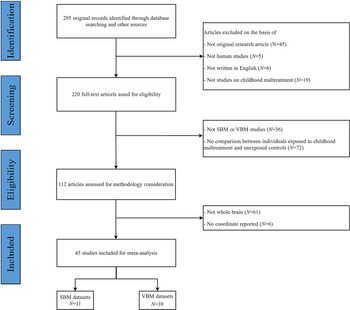
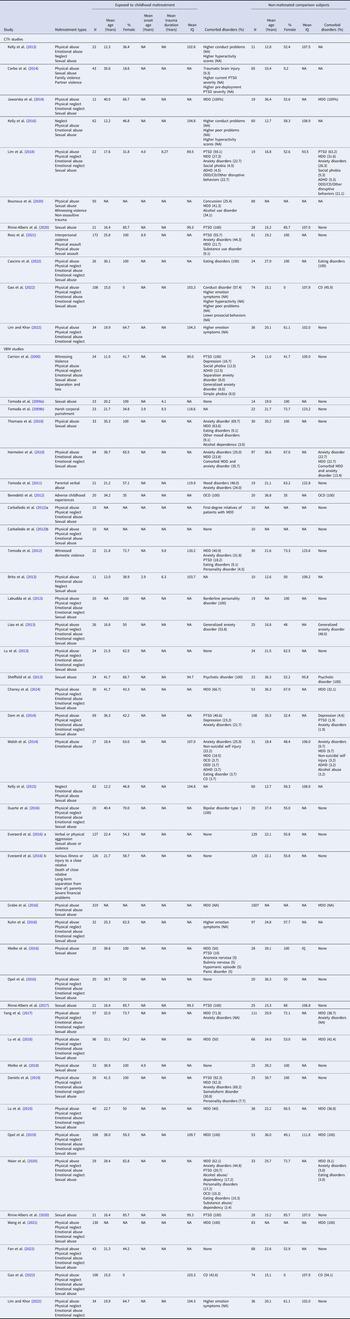
A total of 295 records were identified through database searches. Forty-five studies were eligible for inclusion, of which eight were CTh studies based on SBM (Bounoua, Miglin, Spielberg, & Sadeh, Reference Bounoua, Miglin, Spielberg and Sadeh2020; Cascino et al., Reference Cascino, Canna, Russo, Monaco, Esposito, Di Salle and Monteleone2022; Corbo et al., Reference Corbo, Salat, Amick, Leritz, Milberg and McGlinchey2014; Jaworska et al., Reference Jaworska, MacMaster, Gaxiola, Cortese, Goodyear and Ramasubbu2014; Kelly et al., Reference Kelly, Viding, Wallace, Schaer, Brito, Robustelli and McCrory2013, Reference Kelly, Viding, Puetz, Palmer, Samuel and McCrory2016; Lim et al., Reference Lim, Hart, Mehta, Worker, Simmons, Mirza and Rubia2018; Ross et al., Reference Ross, Sartin-Tarm, Letkiewicz, Crombie and Cisler2021), 34 were GMV studies based on VBM (Benedetti et al., Reference Benedetti, Poletti, Radaelli, Pozzi, Giacosa, Ruffini and Smeraldi2012; Brito et al., Reference Brito, Viding, Sebastian, Kelly, Mechelli, Maris and McCrory2013; Carballedo et al., Reference Carballedo, Lisiecka, Fagan, Saleh, Ferguson, Connolly and Frodl2012; Carrion et al., Reference Carrion, Weems, Watson, Eliez, Menon and Reiss2009; Chaney et al., Reference Chaney, Carballedo, Amico, Fagan, Skokauskas, Meaney and Frodl2014; Dam, Rando, Potenza, Tuit, & Sinha, Reference Dam, Rando, Potenza, Tuit and Sinha2014; Daniels et al., Reference Daniels, Schulz, Schellong, Han, Rottstadt, Diers and Croy2019; Duarte et al., Reference Duarte, Neves Mde, Albuquerque, de Souza-Duran, Busatto and Correa2016; Everaerd et al., Reference Everaerd, Klumpers, Zwiers, Guadalupe, Franke, van Oostrom and Tendolkar2016; Fan et al., Reference Fan, Liu, Xia, Gao, Meng, Han and Zhu2022; Grabe et al., Reference Grabe, Wittfeld, Van der Auwera, Janowitz, Hegenscheid, Habes and Hosten2016; Harmelen et al., Reference Harmelen, Tol, Wee, Veltman, Aleman, Spinhoven and Elzinga2010; Kelly et al., Reference Kelly, Viding, Puetz, Palmer, Mechelli, Pingault and McCrory2015; Kuhn et al., Reference Kuhn, Scharfenort, Schumann, Schiele, Munsterkotter, Deckert and Lonsdorf2016; Labudda et al., Reference Labudda, Kreisel, Beblo, Mertens, Kurlandchikov, Bien and Woermann2013; Liao et al., Reference Liao, Yang, Zhang, He, Song, Jiang and Li2013; Lu et al., Reference Lu, Gao, Wei, Wu, Liao, Ding and Li2013, Reference Lu, Guo, Sun, Dong, Zhao, Liao and Li2018, Reference Lu, Xu, Cao, Yin, Gao, Wang and Xu2019; Maier et al., Reference Maier, Gieling, Heinen-Ludwig, Stefan, Schultz, Gunturkun and Scheele2020; Mielke et al., Reference Mielke, Neukel, Bertsch, Reck, Mohler and Herpertz2016, Reference Mielke, Neukel, Bertsch, Reck, Mohler and Herpertz2018; Opel et al., Reference Opel, Zwanzger, Redlich, Grotegerd, Dohm, Arolt and Dannlowski2016, Reference Opel, Redlich, Repple, Kaehler, Grotegerd, Dohm and Dannlowski2019; Rinne-Albers et al., Reference Rinne-Albers, Pannekoek, van Hoof, van Lang, Lamers-Winkelman, Rombouts and Vermeiren2017; Sheffield, Williams, Woodward, & Heckers, Reference Sheffield, Williams, Woodward and Heckers2013; Thomaes et al., Reference Thomaes, Dorrepaal, Draijer, Ruiter, Balkom, Smit and Veltman2010; Tomoda et al., Reference Tomoda, Navalta, Polcari, Sadato and Teicher2009a, Reference Tomoda, Suzuki, Rabi, Sheu, Polcari and Teicher2009b, Reference Tomoda, Sheu, Rabi, Suzuki, Navalta, Polcari and Teicher2011; Tomoda, Polcari, Anderson, & Teicher, Reference Tomoda, Polcari, Anderson and Teicher2012; Walsh et al., Reference Walsh, Dalgleish, Lombardo, Dunn, Harmelen, Ban and Goodyer2014; Wang et al., Reference Wang, Kang, Zhang, Guo, Wang, Zong and Liu2021; Yang et al., Reference Yang, Cheng, Mo, Bai, Shen, Liu and Xu2017), and 3 conducted both SBM and VBM analyses (Gao et al., Reference Gao, Jiang, Ming, Zhang, Ma, Wu and Yao2022; Lim & Khor, Reference Lim and Khor2022; Rinne-Albers et al., Reference Rinne-Albers, Boateng, van der Werff, Lamers-Winkelman, Rombouts, Vermeiren and van der Wee2020). Among the VBM studies, two study both included two subgroups (Carballedo et al., Reference Carballedo, Lisiecka, Fagan, Saleh, Ferguson, Connolly and Frodl2012; Everaerd et al., Reference Everaerd, Klumpers, Zwiers, Guadalupe, Franke, van Oostrom and Tendolkar2016). Thus, these two researches contained two datasets, respectively. Finally, our sample consisted of 2550 individuals exposed to childhood maltreatment and 3739 unexposed comparison subjects, along with 120 coordinates derived from 50 datasets. The diagram of the categorization and characteristics of the research studies were illustrated in Fig. 1. Table 1 shows the detailed medical and demographic information of all involved studies.
Flow diagram for the identification and exclusion of studies.

Demographic and clinical characteristics of the studies included in the meta-analysis

ADHD, attention deficit hyperactivity disorder; CD, conduct disorder; CTh, cortical thickness; MDD, major depression disorder; NA, not available; OCD, obsessive compulsive disorder; ODD, oppositional defiant disorder; PTSD, post-traumatic stress disorder; VBM, voxel-based morphometry.
Pooled meta-analysis
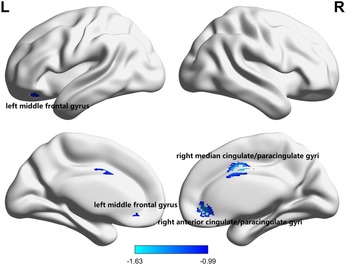
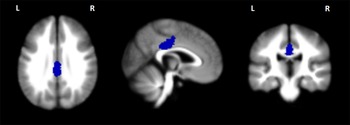
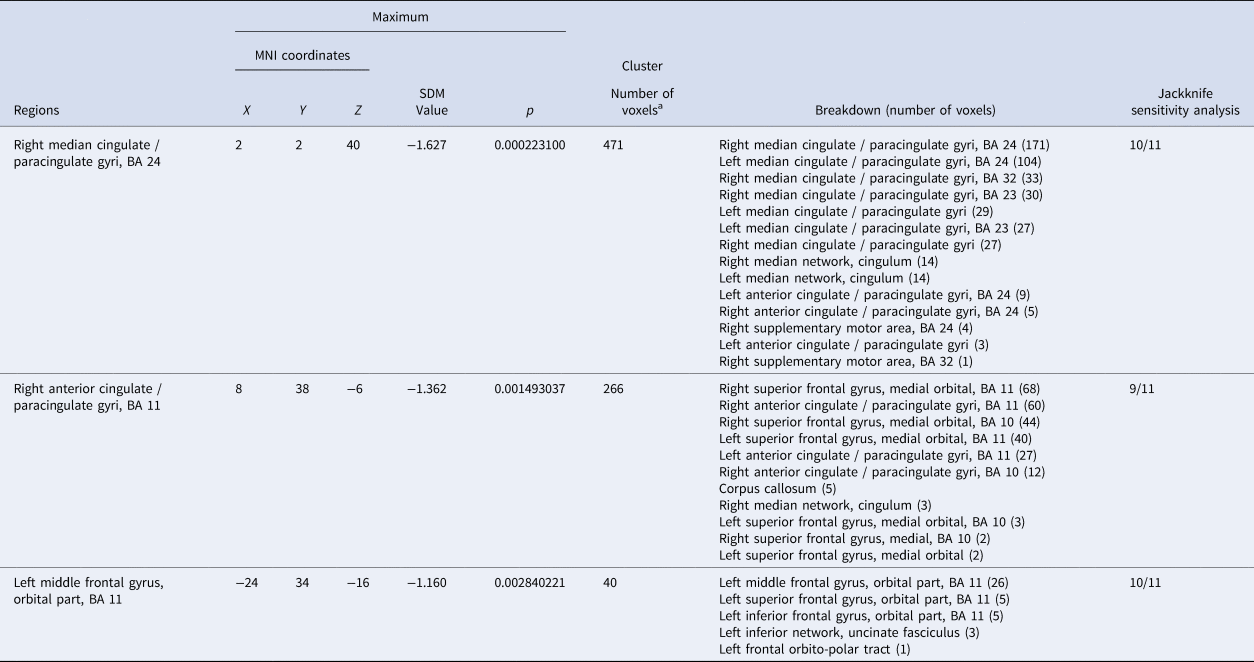
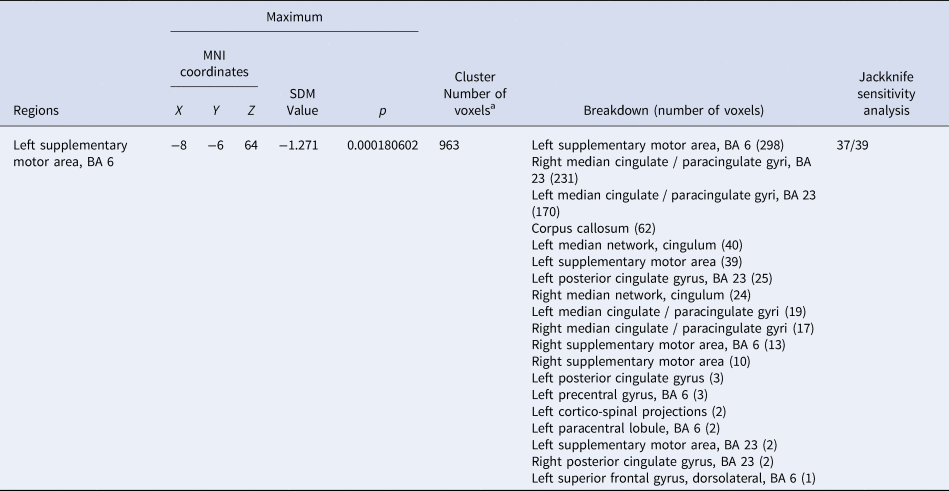
Individuals with childhood maltreatment experience exhibited significantly decreased CTh in three clusters compared with unexposed controls, including the right median cingulate/paracingulate gyri, the right anterior cingulate/paracingulate gyri, and the left middle frontal gyrus (Fig. 2, Table 2). Similarly, meta-analysis of VBM studies revealed significant GMV reductions lied in the left supplementary motor area (SMA), and the breakdown results also demonstrated right median cingulate/paracingulate gyri, left median cingulate/paracingulate gyri, and some other adjacent brain areas (Fig. 3, Table 3). No increased CTh or GMV were found in the maltreated individuals.
Regional cortical thickness alterations in in individuals exposed to childhood maltreatment compared with unexposed comparison subjects. Significant clusters are exhibited using BrainNet Viewer.

Regions showing GMV reductions in the left supplementary motor area in axial, sagittal, and coronal views. Significant clusters are overlaid on MRIcron template for Windows for display purposes only.

Decreased cortical thickness in individuals exposed to childhood maltreatment compared with unexposed comparison subjects

BA, Brodmann area; MNI, Montreal Neurological Institute; SDM, seed-based d mapping.
a All voxels with p < 0.005.
Reduced gray matter volume in participants exposed to childhood maltreatment compared with unexposed comparison subjects

BA, Brodmann area; MNI, Montreal Neurological Institute; SDM, seed-based d mapping.
a All voxels with p < 0.005.
Jackknife sensitivity analysis
The jackknife sensitivity analyses of the whole brain detected the CTh thinning in the right median cingulate/paracingulate gyri and the left middle frontal gyrus were replicated throughout all but one combination of the datasets, while the reduced CTh in the right anterior cingulate/paracingulate maintained within 9 of 11 datasets (Table 2). Besides, decreased GMV in the left SMA were repeatable in 37 of 39 datasets. These indicated that the results were highly reliable and reproducible.
Subgroup meta-analysis
Considering the SBM literatures were not enough, and VBM studies in pure healthy (without comorbidities) participants with childhood maltreatment experience were also insufficient (minimum of 10 datasets recommended for SDM meta-analyses) (Hu et al., Reference Hu, Zhang, Bu, Li, Gao, Lu and Gong2020; Muller et al., Reference Muller, Cieslik, Laird, Fox, Radua, Mataix-Cols and Eickhoff2018), only VBM studies containing healthy participants with childhood trauma experience together with studies which reported the main effect of childhood maltreatment were included (n = 17). The main effects of childhood maltreatment experience were significantly reduced GMV in the left median cingulate/paracingulate gyri, and the breakdown results mainly included bilateral median cingulate/paracingulate gyri and the left SMA. These results were quite overlapped with the pooled voxel-based meta-analysis findings. The detailed results were presented in online Supplementary Table S1 and Fig. S1 in our Supplementary Material. Meta-analysis of VBM studies in adult participants with childhood maltreatment revealed GMV reductions in the left SMA and left parahippocampal gyrus compared with unexposed comparison subjects (online Supplementary Table S2 in the online Supplementary Material). This was basically consistent with the pooled meta-analyses results. However, we failed to conduct the subgroup meta-analyses for the VBM studies in youths exposed to childhood maltreatment, or studies applying SBM approaches in either youths or adults, due to the inadequate datasets.
Meta-regression analysis
With a stringent threshold of p < 0.0005, the meta-regression analyses found that altered CTh in the right median cingulate/paracingulate gyri had a negative correlation with the average age. Besides, GMV in the left SMA was also inversely associated with the average age (Table 4). No other CTh or GMV changes were found to be related with clinical characteristics. The meta-regression of VBM studies in adult subgroup also identified coincident SMA volume alterations negatively correlated with the average age (online Supplementary Table S3 in the Supplementary Material).
Correlation between brain morphology changes and age in participants exposed to childhood maltreatment revealed by meta-regression analyses

CTh, cortical thickness; MNI, Montreal Neurological Institute; SDM, seed-based d mapping; VBM, voxel-based morphometry.
a All voxels with p < 0.0005.
Discussion
This present CBMA identified that individuals with childhood maltreatment experience demonstrated significantly CTh decreases in the right median cingulate/paracingulate gyri, the right anterior cingulate/paracingulate gyri, and the left middle frontal gyrus. Meanwhile, significant GMV reductions mainly lied in the left SMA, as well as some adjacent brain areas such as bilateral median cingulate/paracingulate gyri. No greater regions were found for either CTh or GMV. The jackknife sensitivity and heterogeneity evaluations revealed that these outcomes were highly reliable. In addition, several neural morphology changes were associated with the average age of the maltreated individuals. Adults with childhood maltreatment exhibited decreased GMV in the left SMA and the left parahippocampal gyrus. It is noteworthy that the brain regions of thinned CTh and reduced GMV were quite overlapped. Our current meta-analysis provided a more comprehensive perspective of the altered GM microarchitectures in childhood maltreatment, including both CTh and GMV findings, and enhanced our understandings of the impact of childhood maltreatment on neurodevelopment.
The predominant manifestations of the microstructural brain abnormalities were decreased CTh and GMV in our results, reflecting unidirectional disruptions of the GM. Atrophy of GM might be related with the main progressive histopathological disorders, including defective neuronal overgrowth or relocation, neurogenesis inhibition, dendritic branching reduction cell density, and microcolumn alterations in the cerebral cortex (Hadjikhani, Joseph, Snyder, & Tager-Flusberg, Reference Hadjikhani, Joseph, Snyder and Tager-Flusberg2006; Hakamata et al., Reference Hakamata, Suzuki, Kobashikawa and Hori2022), which would interfere with the normal neurodevelopmental process. Especially, the median cingulate/paracingulate gyri revealed overlapped abnormalities in both CTh and GMV findings in our meta-analysis. This brain area belongs to the limbic system, and is critical for integrating emotional processes, and the formation and regulation of pain sensation (Huang, Zhang, Li, Shang, & Yang, Reference Huang, Zhang, Li, Shang and Yang2022). Altered GMV in the median cingulate/paracingulate gyri has been reported in a range of VBM studies in individuals with early-life adversities (Harmelen et al., Reference Harmelen, Tol, Wee, Veltman, Aleman, Spinhoven and Elzinga2010; Lu et al., Reference Lu, Gao, Wei, Wu, Liao, Ding and Li2013; Maier et al., Reference Maier, Gieling, Heinen-Ludwig, Stefan, Schultz, Gunturkun and Scheele2020; Opel et al., Reference Opel, Zwanzger, Redlich, Grotegerd, Dohm, Arolt and Dannlowski2016), indicating a susceptible neural plasticity of this region. Moreover, the median cingulate/paracingulate gyri is also believed to be related with high risks of MDD (Opel et al., Reference Opel, Zwanzger, Redlich, Grotegerd, Dohm, Arolt and Dannlowski2016), as well as cognitive decline in mild cognitive impairment patients (Ma et al., Reference Ma, Huang, Zhong, Zheng, Li, Yao and Wang2022), which might account for the phenomenon that individuals with an exposure to early-life trauma are more likely to suffer from affective disorders. A former SBM research reported CTh in the median cingulate was inversely related to early-life trauma in both adolescents and adults, such that individuals with severer trauma demonstrated lower CTh in this region (Ross et al., Reference Ross, Sartin-Tarm, Letkiewicz, Crombie and Cisler2021). Taken together, the median cingulate/paracingulate gyri morphology changes might be one of the most prominent structural neuroimaging features of childhood maltreatment.
Disrupted anterior cingulate structure is one of the most consistent findings in healthy maltreated cohorts as well as child abuse-related psychiatric disorders (Lim et al., Reference Lim, Radua and Rubia2014; Paquola et al., Reference Paquola, Bennett and Lagopoulos2016; Pollok et al., Reference Pollok, Kaiser, Kraaijenvanger, Monninger, Brandeis, Banaschewski and Holz2022; Teicher et al., Reference Teicher, Samson, Anderson and Ohashi2016). Thinner CTh and smaller GMV in this region have been detected in individuals exposed to childhood maltreatment (Cascino et al., Reference Cascino, Canna, Russo, Monaco, Esposito, Di Salle and Monteleone2022; Kelly et al., Reference Kelly, Viding, Wallace, Schaer, Brito, Robustelli and McCrory2013, Reference Kelly, Viding, Puetz, Palmer, Samuel and McCrory2016; Paquola et al., Reference Paquola, Bennett and Lagopoulos2016; Rinne-Albers et al., Reference Rinne-Albers, Pannekoek, van Hoof, van Lang, Lamers-Winkelman, Rombouts and Vermeiren2017). Previous resting-state fMRI studies further confirmed the crucial effects of early-life trauma on anterior cingulate. Negative correlations between maltreatment severity and resting-state functional connectivity between anterior cingulate functions and other cortical regions have been reported (Birn, Patriat, Phillips, Germain, & Herringa, Reference Birn, Patriat, Phillips, Germain and Herringa2014; Herringa et al., Reference Herringa, Birn, Ruttle, Burghy, Stodola, Davidson and Essex2013). Also, the anterior cingulate/paracingulate gyri are associated with evaluative mechanisms and reappraisal of emotional stimuli in MDD patients with childhood maltreatment experience revealed by fMRI studies (Nagy et al., Reference Nagy, Kurtos, Nemeth, Perlaki, Csernela, Lakner and Simon2021). Moreover, the middle frontal gyrus was found to be influenced by childhood maltreatment revealed by our meta-analysis results of SBM studies. CTh and GMV reductions were constantly found in this region by sMRI studies (Cascino et al., Reference Cascino, Canna, Russo, Monaco, Esposito, Di Salle and Monteleone2022; Corbo et al., Reference Corbo, Salat, Amick, Leritz, Milberg and McGlinchey2014; Dannlowski et al., Reference Dannlowski, Kugel, Grotegerd, Redlich, Opel, Dohm and Baune2016; Opel et al., Reference Opel, Zwanzger, Redlich, Grotegerd, Dohm, Arolt and Dannlowski2016; Tyborowska et al., Reference Tyborowska, Volman, Niermann, Pouwels, Smeekens, Cillessen and Roelofs2018). The middle frontal gyrus, together with the anterior cingulate, as well as the temporoparietal junction, the superior temporal sulcus and the temporal poles, constitute the anatomical and functional basis of the social cognition (Amodio & Frith, Reference Amodio and Frith2006). Previous resting-state fMRI studies reported maltreatment-associated altered connectivity between the amygdala and dorsolateral frontal areas in depressive patients (Goltermann et al., Reference Goltermann, Winter, Meinert, Sindermann, Lemke, Leehr and Hahn2022). Considering that the anterior cingulate and frontal gyrus involves in regulating emotions and monitoring cognitive and motor responses during potential conflict situations (Etkin, Egner, & Kalisch, Reference Etkin, Egner and Kalisch2011; Teicher et al., Reference Teicher, Samson, Anderson and Ohashi2016), our CTh results highlighted the effects of childhood maltreatment on these regions, and might underlie the potential susceptibility of PTSD and affective symptoms. The frontal CTh is also considered to be one of the most susceptible neuroanatomical structures to early stress revealed by rat models (Spivey et al., Reference Spivey, Shumake, Colorado, Conejo-Jimenez, Gonzalez-Pardo and Gonzalez-Lima2009). CTh could be served as a feature to examine the effects of childhood trauma on brain structure.
In addition to the aforementioned CTh alterations, the left SMA exhibited decreased GMV in maltreated individuals. The SMA has connections with the limbic system, basal ganglia, cerebellum, thalamus, contralateral SMA, superior parietal lobe, as well as portions of the frontal lobes (Bozkurt et al., Reference Bozkurt, Yagmurlu, Middlebrooks, Karadag, Ovalioglu, Jagadeesan and Grande2016). This area has drawn attentions because of a series of clinical deficits caused by its resection or damage, including abnormal motor integration, recognition of movement and thinking, memory storage, language production, conflict resolution, intention of action (Bozkurt et al., Reference Bozkurt, Yagmurlu, Middlebrooks, Karadag, Ovalioglu, Jagadeesan and Grande2016; Coull, Vidal, Nazarian, & Macar, Reference Coull, Vidal, Nazarian and Macar2004; Kennerley, Sakai, & Rushworth, Reference Kennerley, Sakai and Rushworth2004; Mayka, Corcos, Leurgans, & Vaillancourt, Reference Mayka, Corcos, Leurgans and Vaillancourt2006). The SMA also presented emotion and memory-related neural activity changes in people with a history of childhood trauma (Elton, Smitherman, Young, & Kilts, Reference Elton, Smitherman, Young and Kilts2015; Lim et al., Reference Lim, Hart, Mehta, Simmons, Mirza and Rubia2015; Ma et al., Reference Ma, Zhang, Zhang, Su, Yan, Tan and Yue2021; Olsavsky, Stoddard, Erhart, Tribble, & Kim, Reference Olsavsky, Stoddard, Erhart, Tribble and Kim2021). The left parahippocampal gyrus revealed GMV reductions solely in the adult sample in our results. This is in accord with the former meta-analysis and an amount of VBM studies (Lim et al., Reference Lim, Radua and Rubia2014; Pollok et al., Reference Pollok, Kaiser, Kraaijenvanger, Monninger, Brandeis, Banaschewski and Holz2022). The parahippocampal gyrus plays important roles in scene identification, spatial navigation, and memory encoding as well as recovery (Aminoff, Kveraga, & Bar, Reference Aminoff, Kveraga and Bar2013). Evidence also indicated that the hippocampus is vulnerable to the neurotoxic effects of excessive glucocorticoid levels, which often related to high levels underlying chronic stress (Lu et al., Reference Lu, Guo, Sun, Dong, Zhao, Liao and Li2018). Regional GM atrophy in this region might explain early-life stress-related episodic memory and emotion regulation disturbances in adults with childhood maltreatment experience. Notably, the subgroup meta-analysis which contained VBM studies in healthy participants with childhood maltreatment experience together with studies that reported the main effect of childhood maltreatment identified significant GMV decreases in bilateral median cingulate/paracingulate gyri and the left SMA. This further confirmed the reliability and stability of our findings.
Age-related brain morphological changes located in the CTh in right median cingulate/paracingulate gyri, and GMV in the left SMA. With age increasing, the alterations in GM structure will deteriorate further. This is basically consistent with the developmental brain charts across the human lifespan (Bethlehem et al., Reference Bethlehem, Seidlitz, White, Vogel, Anderson, Adamson and Alexander-Bloch2022; Colich, Rosen, Williams, & McLaughlin, Reference Colich, Rosen, Williams and McLaughlin2020). The SMA volume alterations were negatively correlated with the average age in both pooled meta-analysis and in the adult subgroup. Considering the vital roles of the SMA in emotion regulation and executive function (Kennerley et al., Reference Kennerley, Sakai and Rushworth2004; Ma et al., Reference Ma, Zhang, Zhang, Su, Yan, Tan and Yue2021), with the growth of age, older childhood maltreatment sufferers might be more likely to perform emotional and cognitive problems. Interestingly, these regression results might also be consistent with our subgroup analyses findings that the adult subjects with childhood maltreatment exhibited more prominent neural abnormalities than the pooled sample. Early biophysical and molecular processes strongly influence life-long neurodevelopmental trajectories and susceptibility to psychiatric disorders (Bethlehem et al., Reference Bethlehem, Seidlitz, White, Vogel, Anderson, Adamson and Alexander-Bloch2022), while the maltreated brain is more vulnerable and susceptible (Busso et al., Reference Busso, McLaughlin, Brueck, Peverill, Gold and Sheridan2017). This suggests the importance and urgency of early intervention to prevent accelerated decline of brain structures in individuals exposed to childhood maltreatment. One possible practical implication of these results is that psychologist might recommend sMRI scans on individuals with a history of childhood maltreatment as early as possible, aiming to examine the atrophic degree of the median cingulate/paracingulate gyri and SMA. With timely and effective intervention such as psychological counseling and physical exercise, the progression of these structural deficits might be reversed, or at least be postponed.
There are several limitations to be noted. First, like other CBMA methods, SDM relies on the coordinates of published articles rather than original neuroimaging, which will weaken its accuracy to some extent. Second, our statistical methods cannot eliminate the heterogeneity of data collection parameters and demographic data in the included studies. Third, due to the lack of sample size and original clinical variables, and limited by the algorithm of the SDM software, we were not capable of conducting more subgroup meta-analyses or meta-regression analyses such as special investigations in youths exposed to childhood maltreatment, structural changes of specific major brain systems, the effects of various maltreatment types, or the correlation analyses of CTQ and brain imaging. Fourth, some other important information such as the stress severity/intensity or frequency of the participants, socioeconomic status, child or parental education level were not available in most of the included literatures. This study would be much more valuable if above factors could be explored. Last but not least, only cross-sectional designs were included in this meta-analysis. Longitudinal neurodevelopmental features would surely bring more perspectives to understand the impacts of early-life trauma on brain morphology.
In conclusion, this current research explored the effects of childhood maltreatment on CTh and GMV microstructures by performing a CBMA. The median cingulate/paracingulate gyri exhibited overlapped deficits in both CTh and GMV findings, indicating a robust and characteristic neuroimaging feature of childhood trauma. We also demonstrated regional cortical thinning in the right anterior cingulate/paracingulate gyri and the left middle frontal gyrus, as well as GMV reductions in the left SMA. The effects of childhood maltreatment on the human brain predominantly involved in cognitive functions, socio-affective functioning and stress regulation. The neuroanatomical abnormalities revealed by our current meta-analysis enhanced the understanding of neuropathological changes induced by childhood maltreatment, and might uncover the neurobiology of childhood maltreatment-related mental diseases. Our findings could also bring vital inspirations for building the neuroimaging biomarkers of childhood maltreatment for early interventions in future clinical applications.
Supplementary material
The supplementary material for this article can be found at https://doi.org/10.1017/S0033291723000661
Acknowledgments
This study was supported by the Medical and Health Science and Technology Development Plan of Shandong Province (202003061210), the Key Research and Development Plan of Jining City (2021YXNS024), the Cultivation Plan of High-level Scientific Research Projects of Jining Medical University (JYGC2021KJ006), the National Natural Science Foundation of China (81901358), the Natural Science Foundation of Shandong Province (ZR2019BH001 and ZR2021YQ55), the Young Taishan Scholars of Shandong Province (tsqn201909146), the Postgraduate Education and Teaching Reform Research Project of Shandong Province (SDYJG19212), and the Supporting Fund for Teachers' Research of Jining Medical University (600903001).
Conflict of interest
The authors declare no competing interests.