INTRODUCTION
Non-timber forest products (NTFPs) have played an important, longstanding role in traditional forest livelihoods and sustainable forest management (Belcher et al. Reference Belcher, Ruíz-Pérez and Achdiawan2005; Ahenkan & Boon Reference Ahenkan and Boon2010). Although their efficacy in conserving forests and improving local livelihoods is hotly contested (Salafsky & Wollenberg Reference Salafsky and Wollenberg2000; Arnold & Ruiz-Pérez Reference Arnold and Ruiz-Pérez2001; Kusters et al. Reference Kusters, Achdiawan, Belcher and Pérez2006), the appealing notion that NTFPs can sustain economies of traditional peoples while protecting forests precipitated a new land tenure model in Brazil, generically termed ‘extractive reserves’. These government-owned conservation units are specifically designated for sustainable natural resource extraction by traditional forest residents (Allegretti Reference Allegretti and Anderson1990). More than two decades after the creation of the first reserves in 1990, federal and state governments have established 85 Extractive Reserves and 19 conceptually similar Sustainable Development Reserves in the Brazilian Amazon alone, comprising approximately 25 million ha of tropical ecosystems (ICMBio [Chico Mendes Institute for Biodiversity Conservation] 2011). This attractive model has resonated globally and become so widespread that it gave rise to a new protected area designation of Protected Area with Sustainable Use of Natural Resources (IUCN [International Union for the Conservation of Nature] 2012).
While federal and/or state designation imparts clear definition of the external reserve boundary, the internal spaces of the polygon present a range of ecological and socioeconomic characteristics (Ankersen & Barnes Reference Ankersen, Barnes, Zarin, Putz, Schmink and Alavalapati2004). Resource use can vary widely, even at a small scale, because of the socioeconomic, demographic and ecological variability between residents who are often geographically dispersed (Belcher et al. Reference Belcher, Ruíz-Pérez and Achdiawan2005; Mahapatra et al. Reference Mahapatra, Albers and Robinson2005; Newton et al. Reference Newton, Endo and Peres2011). This heterogeneity is matched by that of the NTFPs available for harvest, including types of NTFPs exploited, intensity and frequency of harvest, and relative contribution of those products to user welfare (Cavendish Reference Cavendish2000; Janse & Ottitsch Reference Janse and Ottitsch2005). However, few studies have integrated resource heterogeneity, such as quality and availability, with the socioeconomic aspects related to them (although see Takasaki et al. Reference Takasaki, Barham and Coomes2010; Newton et al. Reference Newton, Endo and Peres2011).
Brazil nut (Bertholletia excelsa), a large canopy-emergent species that occurs in non-flooded Amazonian forests (Mori & Prance Reference Mori and Prance1990), has played a key role in reconciling development and conservation in many Brazilian extractive reserves because of its basin-wide distribution, significance in global markets, and potential for sustainable use and forest conservation (Assies Reference Assies1997; Wadt et al. Reference Wadt, Kainer, Staudhammer and Serrano2008). Brazil nut recruitment ultimately depends on agoutis (Dasyprocta spp.), a rodent that gnaws open the woody fruits and disperses and scatterhoards the seeds (Peres & Baider Reference Peres and Baider1997). Brazil nut tree densities vary considerably throughout the Amazon, but, in some parts of Brazil, Bolivia and Peru, this species accounts for a large proportion of total tree basal area, making nut collection commercially profitable (Zuidema Reference Zuidema2003). Brazil nuts are harvested almost entirely from wild trees in old-growth forests, and constitute one of the few economically important NTFPs that generate significant cash for the rural poor (Escobal & Aldana Reference Escobal and Aldana2003; Stoian Reference Stoian2005).
Despite international and domestic investments applied to extractive reserves and their NTFP resources such as Brazil nut, resident livelihoods are dynamic and may still switch to alternatives, such as cattle ranching and intensive agriculture, which may compromise conservation goals (Salisbury & Schmink Reference Salisbury and Schmink2007; Gomes Reference Gomes2009). Several factors drive these changes, including a lack of attention to the likely variation in distribution and quality of natural resources across a reserve, coupled with disregard for the accompanying variation in how reserve residents might invest and depend on the products derived from these resources.
Early socioeconomic analyses of the Riozinho do Anfrísio Extractive Reserve (RDAER) (Rocha et al. Reference Rocha, Silva, Carvalho and Salgado2005) highlighted the importance of Brazil nut for resident income and livelihoods, using this species/product to define reserve production system typologies; however, Brazil nut use and management in light of Reserve goals has not been adequately evaluated to date. We ask whether Brazil nut heterogeneity affects household income and to what extent its benefits extend to all residents within RDAER. More specifically, we ask: (1) how does Brazil nut stand quality (tree density and distribution, tree characteristics and fruit production) vary within RDAER, (2) how do Brazil nut tree access and management practices vary within RDAER, and (3) how do this Brazil nut socioecological variation and differences in household characteristics affect forest-based household income derived from Brazil nuts?
Our study takes into account potential variation in Brazil nut quality, access and income generation across the reserve. Our work also provides insights into the importance of integrating internal socioecological heterogeneity within conservation units, where external boundaries are well-defined but internal spaces are not as well understood.
METHODS
Study area
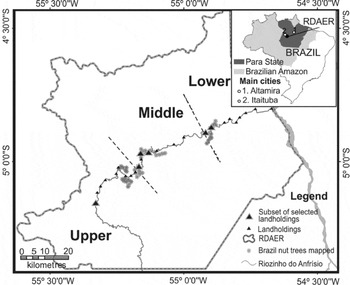
The centre of the RDAER reserve (55° 07.183′ W and 04° 57.602′ S) is located c. 400 km from the town of Altamira in the Brazilian Amazonian state of Pará (Fig. 1). Created by presidential decree in 2004, RDAER encompasses 736 430 ha of mature old-growth forest and hosts 26 households, that is 26 extended families living on the same landholding (c. 300 people; Barros et al. Reference Barros, Varela, Pereira and Vicente2012). RDAER is commonly divided into the Upper, Middle and Lower regions, based mainly on the geographical distribution of landholdings along Riozinho do Anfrísio River (Fig. 1), which are self-recognized by Reserve residents and commonly adopted by support agencies. The forest-dwelling families are relatively isolated, depending on household geographic location, with varying degrees of access to the nearest towns of Itaituba (by foot and ground transportation) and Altamira (by river). Most have restricted access to modern health care and education services. They practise subsistence agriculture and have collected Brazil nuts for decades for both home use and cash income, becoming the most important forest product of the RDAER region when rubber exploitation declined dramatically between 1945 and 1974 (Rocha et al. Reference Rocha, Silva, Carvalho and Salgado2005). Each RDAER household has uncontested rights to Brazil nut trees and other natural resources within their landholding. RDAER families depend on itinerant river traders to sell their production and acquire goods that are not locally produced. Even though these traders often manipulate product prices and foster dependency, they also are historically important providers of information and market access.
Distribution of family landholdings (small triangles), subset of six selected family landholdings (bigger triangles), and Brazil nut stands mapped (asterisks) along the three Riozinho do Anfrísio Extractive Reserve (RDAER) regions, Lower, Middle and Upper, located in the Brazilian Amazonian state of Pará Source: adapted from Fundação Viver Produzir e Preservar map in Rocha et al. (Reference Rocha, Silva, Carvalho and Salgado2005)

Data collection
We conducted a livelihood survey, structured interviews, and Brazil nut inventories from 2008 to 2010. The livelihood survey, adapted from the Centre for International Forestry Research Poverty and Environment Network (CIFOR PEN 2008, version 4.4), was administered once in 2010 to the heads (always males) of 23 of the total 26 households (85%); when possible, other household members also participated in discussions. We recorded general household characteristics such as time of residence, household size, age and schooling of the head of household, and calculated a household dependency ratio (household consumers: household producers). Total household income was quantified as: all forest and agricultural products sold, traded or consumed based on their local market value; wage labour; social benefits from government; and other minor sources of external economic support (such as mining). Forest products included both unprocessed forest products (mainly Brazil nuts, copaíba, andiroba, rubber and fish) and processed ones (baskets, canoes and paddles). Agricultural products quantified were mainly manioc, but also chickens. With this detailed information we calculated total household income and the proportion sourced from Brazil nuts. Income is from 2009 and presented in Brazilian reais (US$ 1 ≅ 2.043 Brazilian reais, 31 December 2012).
Within the 23 households, structured interviews that focused on Brazil nut tree access and management practices were applied to 24 adults, representing 95% of all landholders in the Reserve. Tree access was defined by two variables: the walking time (minutes) to reach the closest and the second closest Brazil nut stands most frequently harvested. To understand management, we selected seven Brazil nut management practices frequently adopted by other Amazonian communities (Duchelle et al. Reference Duchelle, Kainer and Wadt2013), and asked if they practised these activities in their stands: (1) clearing of Brazil nut trails, (2) use of fire underneath individual trees to facilitate harvest, (3) enrichment plantings, (4) clearing around seedlings and saplings, (5) purposefully protecting seedlings and saplings, (6) liana cutting, and (7) washing nuts after harvest. Finally, we also asked the number of times harvesters returned to their trees within the same collection season.
Brazil nut inventories were conducted on a subset of six RDAER landholdings (Fig. 1), using an initial regional stratification to ensure representation by households across the length of the Riozinho do Anfrísio River (two in the Lower, three in the Middle, and one in the Upper region). All Brazil nut trees ≥ 50 cm dbh (diameter breast height), a diameter cut-off at which Brazil nut trees are assumed to be reproductively mature (Kainer et al. Reference Kainer, Wadt and Staudhammer2007), in the most frequently harvested stands of each household were geo-referenced (latitude, longitude and altitude) using a Garmin geographic positioning system (GPS) map 60CSx unit. Dbh was measured using a steel diameter tape.
Subsequently, we sampled a subset of these active stands where Brazil nuts were currently collected, as well as nearby unharvested forest areas. To sample active stands, we randomly selected one Brazil nut trail previously mapped within each of the six landholdings, and then, within that trail, measured 25 Brazil nut trees ≥ 50 cm dbh; hereafter referred to as trail trees. Where Brazil nut densities were high, we randomly sub-sampled trees, targeting a sub-sample rate of at least 25 trees measured for each trail; however, actual sub-sampling rates varied between 27 and 38 trees per trail. Where fewer than 25 trees were found, we included an additional trail, except in the upper river, where access issues did not allow us to sample more than 18 trees. To sample forest areas where Brazil nuts were not harvested, one transect (2500 m × 40 m = 10 ha) was installed within each of the six landholdings. Potential transect start points were marked every 50 m when walking the active Brazil nut trail. One of these GPS points was then randomly selected, and then one of eight possible geographical directions was randomly selected for transect direction. If overlap between the potential unharvested transect and an active Brazil nut trail existed, then the opposite transect direction was tested, and if overlap still existed, then a completely new direction was randomly selected. Within each unharvested transect, all Brazil nut trees ≥ 10 cm dbh, hereafter referred to as transect trees, were mapped, measured and used to calculate Brazil nut densities.
Brazil nut tree characteristics and fruit production data were collected for all randomly sub-sampled trees ≥ 50 cm in both active trails and unharvested transects; liana load, crown form and crown position each being scored independently using four categories (Kainer et al. Reference Kainer, Wadt and Staudhammer2007). Fruit production was measured as counted fruit production (number of fruits found below the tree crown area at the end of February after fruit fall, yet before nut harvest) and reported fruit production. Counted fruit production provides a robust estimate of number of fruits produced given that, in 20 trees studied, only 5.2% of fruits remained in the crown or were removed by agoutis by harvest time (L.H.O Wadt, unpublished data in Staudhammer et al. Reference Staudhammer, Wadt and Kainer2013). We assumed no agouti population differences between RDAER Brazil nut stands sampled, since Reserve residents reported that they do not hunt agoutis because they are not a preferred game species. To ensure that all counts were accurate, only trees whose crowns did not overlap with other Brazil nut trees were sampled for counted fruit production. Reported fruit production was that reported by the household head (average amount of Brazil nuts harvested per year in terms of number of boxes: 1 box ≅ 22 kg) and this variable was also collected for each trail tree mapped on active trails.
Data analysis
We initially generated descriptive statistics for Brazil nut stand quality, access to Brazil nut stands and management practices performed, household characteristics, income from Brazil nuts, forest-based income and total household income. Brazil nut stand quality in this study was defined using measured Brazil nut biological data (population density, tree dbh, liana loads, crown form, crown position and counted fruit production) and the reported variable, Brazil nut fruit production.
We then calculated Pearson's correlation coefficients for all pairs of measured variables and performed several statistical analyses, as described in the following sections, to evaluate how different variables explained Brazil nut stand quality, access to Brazil nut trees, management practices, household characteristics and household income derived from Brazil nut heterogeneity within RDAER. Considering that Brazil nut inventories were performed on a subset of households, and that structured interviews and livelihood surveys were conducted on approximately 85% of RDAER households, we estimated different statistical models, detailed below, for ecological data (Brazil nut stand quality) versus socioeconomic data (tree access and management, household characteristics and income variation). These models were tested using various independent (predictor) variables and combinations thereof, and residual analyses were used to check model validity. All data analyses were performed with SAS statistical software, version 9.2 (SAS 2004), with significance defined at p < 0.05.
Brazil nut stand quality
Models of Brazil nut stand quality, characterizing Brazil nut density, dbh, liana load, crown form, and counted and reported fruit production were estimated from the subset of households in which we collected Brazil nut inventory data. Since almost all of the randomly selected trees were in crown position 1 (dominant), no model could be fit for this stand quality variable. Models were fit to test RDAER internal variability of Brazil nut stand quality for trees ≥ 50cm dbh with three predictor variables. First, we created a continuous ‘tree distance’ variable based on the location of each inventoried Brazil nut tree encountered in both trails and transects relative to the Riozinho do Anfrísio River mouth. The other predictor variables were ‘tree location type’, a categorical variable distinguishing trees on existing collection trails versus a random transect, and tree altitude (m above sea level). By creating these predictor variables we intended to capture Brazil nut spatial heterogeneity within the reserve at three levels: (1) geographical location in relation to Riozinho do Anfrísio River, providing a spatial continuum related to RDAER stratification (Lower to Upper river); (2) harvested versus unharvested areas; and (3) a vertical direction using altitude.
A multivariate analysis, such as MANOVA, which could simultaneously test the relationship of the five response variables to the set of independent variables would be preferred; however, this method does not allow for missing variables. Since reported fruit production was only collected on trails, we could not perform MANOVA on all variables. Moreover, only a small (c. 10%) set of the available tree observations was complete for the four remaining variables. Therefore, we opted for five separate univariate models. Mixed models were estimated to characterize each of the Brazil nut stand quality variables, including a random effect to account for possible spatial autocorrelation among trees sampled within the same trails. For dbh, density and both fruit production variables, we estimated linear mixed models with the SAS procedure PROC MIXED, whereas for liana load and crown position, a generalized linear mixed model with multinomial response was fitted via the procedure PROC GLIMIX. Reported and counted Brazil nut fruit production variables were square root transformed to meet statistical assumptions.
Brazil nut tree access and management, household characteristics and income
Data for Brazil nut tree access, management practices, household characteristics, income from Brazil nuts, forest-based income and the total household income were collected in 23 of 26 total households along the entire length of the RDAER. Because of incomplete observations, we used univariate methods to test assumptions about the RDAER. For continuous variables (tree access, household characteristics, income from Brazil nuts, forest-based income and the total household income), we estimated separate general linear models, with the original regional stratification of RDAER as our predictor variable. To appropriately account for the high proportion of the RDAER households surveyed, variance estimates were adjusted with a finite population correction procedure via the SAS procedure PROC SURVEYREG. To determine if Brazil nut management practices described by seven categorical variables varied by region, we performed univariate Chi-Square tests using the SAS procedure PROC FREQ.
RESULTS
Brazil nut stand quality
Density and dbh distribution
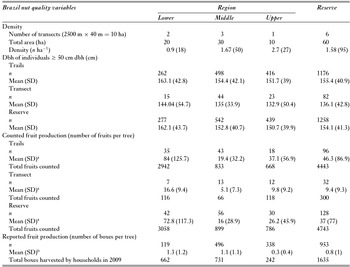
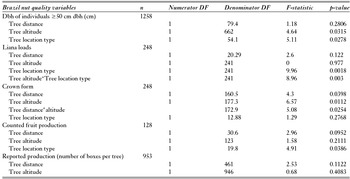
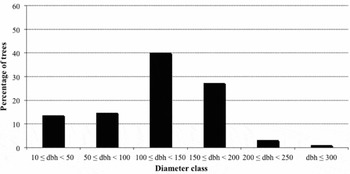
The size distribution of randomly selected trees from unharvested transects was roughly bell-shaped (Fig. 2), and the Reserve-level Brazil nut density (individuals ≥ 10 cm dbh) was 1.58 individuals ha−1 (Table 1). Trail trees had greater diameters than transect trees (Table 1), a result that was confirmed by the mixed model for dbh as a function of location type and altitude (Table 2), indicating that Brazil nut harvesters tend to avoid slopes while harvesting this NTFP.
Descriptive statistics of Brazil nut density, diameter at breast height (dbh), and counted and reported fruit production in the three Riozinho do Anfrísio Extractive Reserve regions and at the reserve level. aNumber of fruits counted per tree. bNumber of average boxes harvested per tree, as reported by households.

Best-fit models of Brazil nut quality in Riozinho do Anfrísio Extractive Reserve. A general linear mixed model was estimated for tree diameter at breast height (dbh), counted and reported fruit production, and a generalized linear mixed model with multinomial response was estimated for liana loads and crown form.

Diameter class distribution of Brazil nut trees from unharvested transects in Riozinho do Anfrísio Extractive Reserve.

Tree characteristics
Models of tree characteristics based on 248 individuals ≥ 50 cm dbh encountered in trails and transects indicated that liana loads were significantly different by tree location type (Table 2); trees on trails, frequented by residents who seasonally collect Brazil nuts, had fewer lianas than those located on rarely-visited transects. Trail trees, which tended to be at slightly lower altitudes than transect trees, tended to present crowns with more limited liana coverage than that of transect trees (Table 2).
Crown form was significantly different by altitude and distance (Table 2); these two effects also significantly interacted, such that trees located further from the river mouth and in higher altitudes presented poorer crown forms than trees located in lower altitudes and closer to the mouth of the Riozinho do Anfrísio River. We also observed that trees in the Lower and Middle regions tended to have better crown forms (97% and 93% in the ‘good’ and ‘tolerable’ categories combined, respectively) than those in the Upper region (76%).
Reported and counted fruit production
Reported fruit production based on 953 trail trees (≥ 50 cm dbh) suggested that Lower and Middle households harvested roughly 2.7 to 3.0 times more Brazil nuts than Upper region households (Table 1). Production numbers, however, were extremely variable, and our best fit model did not detect a statistically significant effect of distance from the mouth of the Riozinho do Anfrísio River on reported production (Table 2).
Counted fruit production, based on a smaller sample of 128 trees ≥ 50 cm dbh in six trails and six transects, was marginally explained by tree distance (Table 2). Upper region trees produced the fewest fruits (Table 1), however, these counts were similar to those in Middle region, and both regions were over three times lower than total counted fruits in the Lower region. Tree location type (transect versus trail trees) also predicted counted fruit production (Table 2), with mean counted fruits higher on trails than transects across all regions (Table 1).
Reported and counted fruit production of 72 individual trees were positively correlated (Spearman rs = 0.541; p < 0.001). Although counted fruit production in the Middle region was similar to that in the Upper and far inferior to the Lower, Middle residents reported harvesting a slightly larger number of boxes than Lower residents and three times more boxes than Upper region residents (Table 1).
Brazil nut tree access and management practices
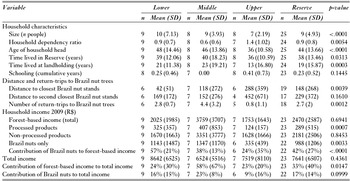
Distance (in minutes) from each landholding to their closest Brazil nut stand was significantly different between regions (Table 3). Lower and Middle households had better access to their trees than Upper residents. On average, the closest Brazil nut stands for residents in these regions were less than one and two hours away respectively, while those in the Upper region walked an average of almost five hours to reach their closest stands (Table 3). Indeed, Upper region residents also lived almost three times further from their second closest Brazil nut stands than residents in the other two regions.
Descriptive statistics of household characteristics, forest-based income, income sourced from Brazil nuts and the total household income in Riozinho do Anfrísio Extractive Reserve; p-values denote the significance of regional differences.

Among the Brazil nut management practices studied, only liana cutting differed significantly by region (p = 0.0052). While almost half of the residents in the Lower region and six out of seven Middle region residents performed this task, no Upper region harvesters cut lianas. Overall, the most frequently performed management practices were clearing of Brazil nut trails and washing of harvested nuts, the latter required by local buyers. The number of return visits to harvest Brazil nuts in the same season differed significantly by region (Table 3), Middle region households returned an average of 4.4 times, Lower households returned an average of 2.8 times, while Upper households only averaged 0.8 times.
Household characteristics and income
All regional household characteristics, except schooling, differed by region (Table 3). Average household size decreased from the Lower to the Upper region. Upper households presented other distinctly different characteristics from their counterparts in the other two regions. Household heads were younger and had resided less time in the Reserve and in their current landholding. They also had a higher household dependency ratio, meaning the ratio of consumers to producers in the households of that region was higher than in the other two regions.
Total household income was not significantly different by region, but various forest-related income variables were (Table 3). Middle households (versus Lower and Upper households) had a higher proportion of their total income from forest resources (58% versus 24% and 23%, respectively), and tended to have a higher proportion from Brazil nuts; for example, the Brazil nut proportion of total forest income for Middle residents was almost three times higher (23%) than that in the Upper region (9%). Both Middle and Lower households, however, earned more income from Brazil nuts than Upper households, over four and three times more, respectively.
DISCUSSION
Brazil nut resource distribution and accessibility
We did not detect significant differences in mean dbh nor Brazil nut densities as a function of distance from the mouth of the river. RDAER Brazil nut tree densities (Peres & Baider Reference Peres and Baider1997; Wadt et al. Reference Wadt, Kainer and Gomes-Silva2005) and dbh distributions (Zuidema & Boot Reference Zuidema and Boot2002; Peres et al. Reference Peres, Baider, Zuidema, Wadt, Kainer, Gomes-Silva, Salomão, Simões, Franciosi, Valverde, Shepard, Kanashiro, Coventry, Yu, Watkinson and Freckleton2003) were similar to those in other Amazon regions. However, average dbh in RDAER (
 ${\rm \bar x}$
= 136.1 ± 42.8 cm) was higher than in other extractive reserves or indigenous lands (Peres & Baider Reference Peres and Baider1997; Wadt et al. Reference Wadt, Kainer and Gomes-Silva2005), but similar to some Peres et al. (Reference Peres, Baider, Zuidema, Wadt, Kainer, Gomes-Silva, Salomão, Simões, Franciosi, Valverde, Shepard, Kanashiro, Coventry, Yu, Watkinson and Freckleton2003) populations. This latter study speculates that Brazil nut populations characterized by average dbh > 100 cm and low frequency of juvenile trees may be overexploited and signal potential recruitment failure. In our RDAER populations, however, juveniles (10 ≤ dbh < 50) are well represented, and we do not believe that contemporary overexploitation explains our dbh distributions, but rather a possible combination of past land-use patterns and natural disturbances. Brazil nut regeneration depends on canopy openings, such as forest gaps, large-scale blow downs (Peres & Baider Reference Peres and Baider1997) and shifting cultivation (Cotta et al. Reference Cotta, Kainer, Wadt and Staudhammer2008). The prevalence of large-diameter trees, such as in RDAER, can be a consequence of an intense past human occupation, followed by drastic depopulation and the accompanying absence of shifting cultivation (Scoles & Gribel Reference Scoles and Gribel2011). The rich areas of terra preta (black soil) and babaçu (Orbignya speciosa [Mart.] Barb. Rodr.) in the RDAER region suggest past presence of pre-Colombian societies (Pires & Prance Reference Pires and Prance1985; MMA [Ministry of Environment] 2003). While the region gradually repopulated following the 16th- and 17th-century collapse of indigenous populations, human densities declined again to current dramatically low levels (c. 0.0004 ha−1) (Velasquez et al. Reference Velasquez, Ramos, Maretti, Feitosa, Souza and Schwartzman2006), following the 20th century rubber bust. Further studies of Brazil nut population structure would be necessary to test these explanatory hypotheses of population dynamics. Although our density data suggested fairly even distributions of the Brazil nut resource, Upper residents travelled c. 5 hours by canoe to reach their stands, while Lower and Middle region residents travelled less than two. This significant difference in stand proximity and access obliged Upper households to temporarily camp near their stands, returning as quickly as possible to their original landholdings to avoid crop and other household losses. In contrast, residents with good access, particularly those in the Middle region, returned to their trees significantly more often than residents of other regions.
Fruit production and management investments
Fruit production is the ecologically-driven parameter of greatest importance for thousands of people who depend economically on Brazil nut. Understanding production heterogeneity is essential to understanding the potential of Brazil nut to support families and identify where management investments could improve household welfare. Within RDAER, differences in counted fruit production (number of fruits per tree) can be explained by individual Brazil nut tree characteristics, as well as management practices. Trees located at trails were less encumbered by lianas, which can be explained by the cutting of lianas on those trees, a practice that seems to enhance production (Kainer et al. Reference Kainer, Wadt, Gomes-Silva and Capanu2006) and is easily carried out since trail trees are visited and harvested annually. In contrast, transect trees in unharvested areas were, by definition, not systematically visited. These trees had significantly greater liana loads, perhaps partially explaining the reduced fruit production of transect trees. Additionally, liana cutting varied significantly by region. Upper residents did not cut lianas, while over 80% in the Middle region and over 40% in the Lower region did. Linked, crown form was significantly poorer as distance from the mouth of river increased. Trees with greater liana loads are much more likely to have poor crown forms (Kainer et al. Reference Kainer, Wadt, Gomes-Silva and Capanu2006) and, correspondingly, liana cutting gradually improves crown form (Kainer et al. Reference Kainer, Wadt and Staudhammer2007). We ascribe the highly significant negative correlation between tree altitude and reported fruit production (and less significant correlation with counted fruit production) to transect versus trail trees, rather than directly to altitude. Trail trees were at lower altitudes than transect trees, an expected result since harvesters favour trees of easy access, avoiding the sundry hills and ravines. Nonetheless, investments in new trails by residents to include previously untapped reproductively mature trees into their routine annual harvests could enhance yields substantially. As in other reserves, Brazil nut stands are inherited, and resident families tend to concentrate harvests on trails worked by their ancestors and/or previous landholders, such that visited trees may be relatively old and tending toward senescence. Indeed, RDAER trees in active trails, which presented significantly greater diameters than unharvested transect trees (
${\rm \bar x}$
= 155.4 ± 40. 9 cm versus
${\rm \bar x}$
= 136.1 ± 42.8 cm dbh), may not all be the best producers. RDAER harvesters expressed concern about gradual production declines in these trees, and Kainer et al. (Reference Kainer, Wadt and Staudhammer2007) reported that peak Brazil nut production is in mid-diameter ranges (100 cm ≤ dbh < 150) in their study region, although the RDAER population presents larger trees generally.
Overall, trees in the Lower region produced over three times more counted fruits than the other two regions (3058 versus 899 and 786 total fruits), and our Brazil nut stand quality model suggested that the further a tree was located from the river mouth, the greater the tendency to produce fewer fruits. Additionally, reserve residents collectively and emphatically agreed with these results. Still, the seemingly greater fruit production in the Lower region did not translate into reports of higher numbers of nut sales. Middle region residents sold over three times more boxes of nuts than those in the Upper (and Lower) regions. This seemingly contradictory result can be explained. While Brazil nut counted fruit production is more biologically-controlled (number of fruits counted per tree), reported fruit production better reflects the biological condition of Brazil nut stands plus management. For example, Brazil nut reported production (number of boxes harvested per tree) depends on the effort invested by harvesters (namely liana cutting and number of times returned to each tree to collect fruits in the harvest season). Although respondent recall can be inaccurate, reported production was gathered within Bernard's (Reference Bernard2000) suggested six months after event occurrence (nut sales), and we found a statistically significant correlation (Spearman rs = 0.541; p < 0.001; n = 72) between counted and reported fruit production.
Household characteristics also influence engagement and reliance on forest products by resident communities (Pattanayak & Sills Reference Pattanayak and Sills2001; Coomes et al. Reference Coomes, Barham and Takasaki2004; Newton et al. Reference Newton, Endo and Peres2011). Household size was significantly larger in the Lower and Middle regions and the number of boxes harvested was approximately three times greater than in the Upper region. Like Newton et al.'s (Reference Newton, Endo and Peres2011) palm fruits, Brazil nut extraction is a labour-consuming activity, and the number of economically active household members directly affects amount of nuts (or palm fruits) harvested and income sourced. Upper households had the lowest number of producers to consumers and four times less Brazil nut income than Middle residents. Upper household heads also were significantly younger, and had lived less time at the Reserve and in their landholding, two additional factors that lead to less accumulated forest knowledge and reduced NTFP investment (Pattanayak & Sills Reference Pattanayak and Sills2001). Finally, Middle residents, those most invested in Brazil nut, reported no formal schooling, mirroring other studies that linked NTFP collection with minimal formal education (Shone & Caviglia-Harris Reference Shone and Caviglia-Harris2006; te Velde et al. Reference te Velde, Rushton, Schreckenberg, Marshall, Edouard, Newton and Arancibia2006). Jointly, these findings emphasize that household characteristics were associated with Brazil nut use, management and its contribution to household income in RDAER.
Brazil nut variation and household income
The importance of NTFPs for income and livelihood improvements of forest peoples is well documented (Shackleton & Shackleton Reference Shackleton and Shackleton2004; Vedeld et al. Reference Vedeld, Angelsen, Bojö, Sjaastad and Berg2007; Maske et al. Reference Maske, Mungole, Kamble, Chaturvedi and Chaturvedi2011). Yet studies have also shown that a large degree of community-level variation exists in relation to the types and frequency of engagement in activities for income generation (Belcher et al. Reference Belcher, Ruíz-Pérez and Achdiawan2005; Mahapatra et al. Reference Mahapatra, Albers and Robinson2005; Newton et al. Reference Newton, Endo and Peres2011). In RDAER, Brazil nut income and its contribution to forest-based income varied significantly by region; Middle residents garnered the highest proportion of income sourced from forest resources, with Brazil nut contribution playing a central role, largely due to the combined ecological and social heterogeneity observed across the length of the Reserve. NTFPs, however, are not the sole source of income available to residents of extractive reserves, and Brazil nut discrepancies by region may be partially explained by differential household access to other sources of income. McElwee (Reference McElwee2008) found that forest people with less access to income from government or wage labour were more dependent on forest products. Duchelle et al. (Reference Duchelle, Cronkleton, Kainer, Guanacoma and Gezan2011) similarly found that mainly due to limited income options, forest residents in Bolivia invested more and relied more on Brazil nut harvests than their Brazilian neighbours. Likewise in our study, the more isolated Middle households relied most on forest products. Lower region residents were well-connected via river to the population centre of Altamira during the entire year, and Upper residents could reach the town of Itaituba in 2–3 days when they lacked such river connection during the low-water season.
CONSERVATION IMPLICATIONS
Extractive reserves have been promoted as a successful model to reconcile conservation and development goals that take into account the diversified sociocultural use of natural resources by Amazonian societies (Schwartzman Reference Schwartzman1991; Allegretti Reference Allegretti2002). Their future viability depends on both socioeconomic and ecological sustainability. Most extractive reserves present a highly complex socioecological system and a bundle of shared rights that drive the use of natural resources, and consequently determine livelihood strategies of reserve residents (Ankersen & Barnes Reference Ankersen, Barnes, Zarin, Putz, Schmink and Alavalapati2004; Cronkleton et al. Reference Cronkleton, Bray and Medina2011). However, when establishment and management plans are formulated for such a conservation unit, implementation agencies tend to regard it as a homogeneous entity, assuming that all residents have similar access to and reliance on traditional NTFPs; the socioecological heterogeneity related to natural resources use is typically neglected (Cardoso Reference Cardoso2002).
If Brazil nut and other important cash-generating NTFPs are to be used as a tool to guarantee the long-term viability of RDAER and other Brazilian extractive reserves, conservation policies and projects need to take into account the ecological and socioeconomic heterogeneity surrounding these forest products in these complex multi-use polygons. Putting more effort on site-specific and detailed assessments of the forest products used by the different groups of reserve residents is sorely needed. Our findings also highlight that despite the marked differences in access to Brazil nuts by region, total cash income varied little spatially. Just as important, more efforts should focus on the fact that residents can access other income-generating activities that variably support or undermine conservation efforts (Salisbury & Schmink Reference Salisbury and Schmink2007; Gomes Reference Gomes2009). Reserve residents who are well aware of internal variation should be allotted a greater role in assessments, planning, implementation and rulemaking (Cardoso Reference Cardoso2002; Cunha Reference Cunha2010; Cronkleton et al. Reference Cronkleton, Bray and Medina2011; Persha et al. Reference Persha, Agrawal and Chhatre2011). This would incorporate relevant heterogeneity dimensions into reserve management and governance, and could improve forest livelihoods and biodiversity conservation in these increasingly common conservation units.
ACKNOWLEDGEMENTS
This study was funded by the Program for Studies in Tropical Conservation through the Compton Foundation, Rufford Small Grant, Botany in Action Program, and USAID-ICRAF Linkages. We acknowledge Oséias Costa Santos and Galvanda Queiróz Galvão for their valuable help in data collection. We thank the Amazon Environmental Research Institute (IPAM), the Fundação Viver Produzir and Preservar (FVPP), and the Chico Mendes Institute for Biodiversity Conservation (ICMBio) for their logistical support. We are grateful to Ane Alencar for making Figure 1, and James Colee for statistical contributions. Finally, we thank RDAER residents, especially the Brazil nut harvesters, for helping us to understand the socioecological dynamics related to this important forest product.