Introduction
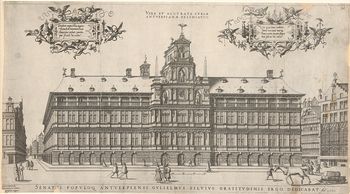
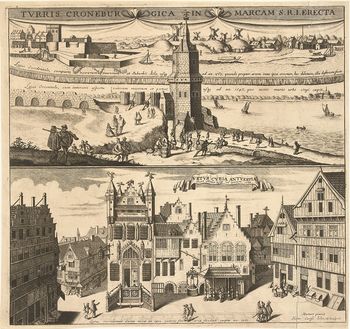
In 1561, the members of the Antwerp City Council laid the foundation stone of their new town hall, which had been designed to reflect the town's recently gained commercial importance (see Figure 1). Antwerp had already been an important fair town during the fourteenth and fifteenth centuries, but when it replaced Bruges as a central gateway city for international trade in the 1490s it experienced a spectacular economic expansion.Footnote 1 Over the course of a few decades, the town was transformed from a medium-sized Brabantine town into the leading metropolis of the Burgundian–Habsburg Netherlands. By the 1530s, the city had a permanent market – as opposed to the intermittent fairs of earlier times – and it functioned as the commercial capital of western Europe. As the city attracted an increasing number of merchants, the town's population exploded from c. 10,000 inhabitants in 1400 to no less than 100,000 around the middle of the sixteenth century, making Antwerp one of the biggest cities north of the Alps.Footnote 2 The replacement of the old Gothic town hall (see Figure 2) with a much larger building in the architectural style of the Renaissance is a tangible testimony to this transition.Footnote 3 This new town hall was intended to proclaim the political and economic importance of the town and of the men who governed it. Yet, some historians have argued that these men, the members of the city council, or magistracy (magistraat), were not as involved in the economic and demographic changes as might be expected. If this is true, then Antwerp challenges a narrative currently endorsed in the historiography, in which the political elites of pre-industrial commercial centres were increasingly recruited from the merchant class.
New Renaissance town hall of Antwerp, ‘Stadhuis Antwerpen’, by Cornelis de Hooghe, 1565 (Rijksmusuem Amsterdam, http://hdl.handle.net/10934/RM0001.COLLECT.124585)

Old Gothic town hall of Antwerp, detail from ‘Gezicht op de Kroonenburg en het Oude stadhuis van Antwerpen’, by Hendrik Causé, seventeenth century (Rijksmuseum Amsterdam, http://hdl.handle.net/10934/RM0001.collect.91407)

This article will therefore analyse the evolution of the profile of office-holders in the Antwerp City Council from the first signs of its economic and demographic rise around 1400 to its heyday around 1550. The aim is to determine whether Antwerp fits into the general trend towards oligarchy in European towns in the early modern era,Footnote 4 or whether it did in fact open up the city council to the merchant class, a trend observed in other gateway cities.Footnote 5 As a rule, the political elites of these gateway cities – the towns that functioned as hubs for long-distance trade – became more ‘open’ in the wake of economic expansion.Footnote 6 For France and Spain, the obvious examples of gateway cities are Lyon and Seville. In both cases, as the town emerged as a hotspot for international trade the city council became populated by merchants.Footnote 7 A similar trend can be observed in the Low Countries. Bruges, the gateway city of this region from the thirteenth to the fifteenth century, was largely dominated by individuals whose revenues came from trade, either directly (e.g. merchants) or indirectly (e.g. brokers).Footnote 8 Amsterdam, which functioned as the gateway city of the Netherlands in the seventeenth century, was also ruled by merchants.Footnote 9 In contrast, the merchant community of Antwerp was largely absent from the city council.Footnote 10 Antwerp is thus relevant to ongoing debates about pre-modern elites, because this city apparently presents a very different trajectory to that shown by other gateway cities.
What is beyond doubt is that the formal composition of the office-holders saw little change during the ‘Golden Age’ of Antwerp. During the fifteenth century, the city council consisted of 12 aldermen, a number that was increased to 16 aldermen in 1490. From 1409 onwards, two mayors joined the city council. The ‘external mayor’ (buitenburgemeester), who could not be selected from among the aldermen, became the more important figure as he represented the city's interests beyond its borders, for example at the princely court. The ‘internal mayor’ (binnenburgemeester), chosen from among the aldermen, was responsible for the city's internal affairs. Each year this city council changed: half of the aldermen were replaced and half were retained. This new bench of aldermen then selected the two new mayors. The aldermen and the two mayors were jointly responsible for the day-to-day governing of the city. The decision as to which of the aldermen should stay on and which should be replaced was made by the duke of Brabant, lord of Antwerp. Until 1477, the duke was free to choose who would serve as replacements (see Figure 3).Footnote 11 Subsequently, the duke was obliged to select the replacements from a list of candidates proposed by the city council in office and the ward masters (wijkmeesters, representatives of the poorterij Footnote 12).Footnote 13
Diagram of the election process of the Antwerp City Council between 1477 and 1555

Candidates for the city council had to meet certain requirements. First, the candidate had to be of legitimate birth, at least 25 years old, born in the duchy of Brabant, a citizen of Antwerp for at least a year and a day, and not living in adultery. Second, the ten derdalven lede rule prohibited aldermen from serving on the same bench as their father, grandfather, brother(s) or cousin(s). This rule prevented the city council from becoming monopolized by a few families. The third and final constraint was that members of craft guilds were prohibited from serving on the city council. So in contrast to the situation in many large towns in the Southern Low Countries, Antwerp's growing community of craftsmen were unable to gain permanent representation in the city council.Footnote 14 Except for a short-lived period of co-rule between the craft guilds and poorterij (1477 to 1486) after the so-called Quaeye Werelt (Angry World revolt), the craft guilds were excluded from power.Footnote 15 As a result, city governance remained concentrated in the hands of members of the poorterij.Footnote 16 However, whether the profile of these members changed in Antwerp's Golden Age is still a subject of debate.
While the nature, causes and timing of Antwerp's economic expansion between c. 1400 and c. 1550 have been the subject of a continuous research tradition that stretches back to the seminal work of Herman van der Wee in the 1960s,Footnote 17 the impact of the town's transformation on the political elite has received far less attention. Current theories on Antwerp's exceptional trajectory in elite formation proceed from the exploratory research of An Kint for the period 1490–1560 and Koen Wouters for 1520–55.Footnote 18 Both historians agree that there were a surprisingly small number of merchants in the Antwerp City Council, but they present diametrically opposed interpretations of the impact of the economic and demographic growth on the composition of the city council. According to Kint, economic growth triggered a radical change in the composition of the city council such that, while merchants were perhaps not included in the city council, the ‘traditional markers of political participation, such as ancestry and endogamy, gradually gave way to new indicators, such as university training’.Footnote 19 The inclusion of more university-trained men would have allowed the city council to cope with the city's new function as an arena for increasingly complex commercial transactions that involved business partners from nearly every corner of Europe. In contrast, Wouters refutes Kint's claims in that he stresses the continuing importance of endogamy and kinship relations within a ‘patriciate’. Although some newcomers entered the city council between 1520 and 1555, Wouters sees the Golden Age of Antwerp as a period of social and political continuity. The city council, he claims, continued to be dominated by the same political dynasties as those that had been in power since the fourteenth and fifteenth centuries. He therefore labels the political elite of Antwerp an ‘open oligarchy’.Footnote 20 As Kint's research has so far been unpublished, it is Wouters’ interpretation that dominates the historiography on Antwerp's Golden Age. Yet, since neither Kint nor Wouters compared their results with the pre-growth period, both claims remain highly hypothetical.Footnote 21 Also, their research was hampered by the absence of in-depth studies on Antwerp's merchant communities, which have only recently become available. In what follows, I revisit the question of whether Antwerp constitutes an exception to the established pattern of elite formation in gateway cities, and, if so, why.
I focus on the social composition of the Antwerp City Council and how this evolved over time. An analysis covering the period from the beginning of Antwerp's commercial expansion around 1400 to the city's apogee around 1550Footnote 22 can reveal whether or not the political elite of Antwerp's Golden Age had the same social configuration as its medieval predecessors. The following parameters are key: (1) family tradition and kinship ties in urban politics, (2) economic background (merchant or not) and (3) academic training. An analysis of these parameters will help to situate the case of Antwerp in the current discussions on urban elite formation and shed light on the question: does Antwerp fit into the general trend towards oligarchy in European towns in the early modern era or, on the contrary, did it open up its city council to the merchant class?
Urban politics: a family affair
The best point of departure is to assess whether the Antwerp political elite was a ‘patriciate’, i.e. a group of intermarried families with a near-hereditary claim to power, or a more fluid group that accepted a constant inflow of new families with diverse social backgrounds. To answer this question, I reconstructed the composition of the city council during the period of economic growth and the preceding period. Each year, the new make-up of the Antwerp City Council was recorded in the registers of aldermen (schepenregisters) and the book of aldermen (wethoudersboek).Footnote 23 Thanks to these sources, I have a complete list of all the men (hereafter called office-holders) who held the 2,177 seats available in the city council between 1400 and 1549.Footnote 24 A wide range of other published and unpublished research provided information on the socio-economic background and family ties of this political elite.Footnote 25
To assess how the social composition of the Antwerp City Council evolved, I divided the 150-year period under study into five time cohorts of 30 years. While the first two cohorts (1400–29 and 1430–59) cover a phase of modest demographic and economic growth, the third (1460–89) includes the short-lived experiment of corporate participation in urban government (1477–86). The last two time cohorts encompass Antwerp's Golden Age. They roughly correspond to the first phase of economic growth (1490–1519), during which Antwerp took over the role of Bruges as a gateway city and the second phase (1520–49), when the city evolved from a fair town into a major commercial and financial centre that was crucial to the Low Countries as well as western Europe as a whole.
I charted which families comprised the city's political elite (hereafter called ‘political families’), how long they were active in the city council, how many mandates they held and how they were inter-related. Following the definition commonly accepted in previous research, I defined a family as all the individuals with a common last name. As a consequence, these ‘families’ are more comparable to patrilineal lineages than to households, as even among the elite most households consisted of the nuclear family. While this choice was a pragmatic one, the reconstruction of family relations and family trees confirms that these individuals with a common last name can be linked to one another through kinship ties.Footnote 26 Moreover, recent research on the importance of the extended family for elites and middling groups in fifteenth- and sixteenth-century Brabant reveals that this choice to study lineages also mirrors social mores: urban elites, just like the rural nobility, tended to identify themselves as patrilineal families (geslachten).Footnote 27 That is not to say that the concept of the extended family was static: some of the leading political dynasties stemmed from the same family tree, but then renamed their branch after becoming alienated from the main branch or after gaining an important possession, such as a seigneurie. The Van Liere family, for example, disassociated itself from the Van Immerseele family.Footnote 28 However, this rarely happened and, barring a certain plasticity in the way the geslachten defined themselves, the patrilineal family is the unit of analysis that best matches how contemporaries analysed the social fabric of urban politics.
The reconstruction of the Antwerp political elite of 1400–1550 is summarized in Table 1 and Figure 4, which show the inflow and outflow of families in the city council. First and foremost, this reveals that the social renewal over time was substantial. While the number of families that held the available seats on the bench of aldermen remained quite stable over time – usually some 50 to 60 families for each time cohort – the families that constituted the Antwerp political elite in 1520–49 were in the main not those that ruled the city in 1400–29.Footnote 29 Of the 57 families providing an alderman between 1520 and 1549, only 16 could retrace their political activities to before 1460.
Inflow and outflow of politically active families in the Antwerp City Council, 1400–1549
Source: CGA.

Inflow and outflow of politically active families in the Antwerp City Council, 1400–1549

Source: CGA.
There are three causes of this constant process of social renewal. The first was a lack of male heirs. As a rule, only three out of five marriages yielded an adult son and politics was a men-only affair.Footnote 30 The Van der Elst family, for example, became extinct in the male line. Another reason why families disappeared from the city council was migration.Footnote 31 For example, Adriaen van Doren, who was an alderman in Antwerp, moved to Breda and became a mayor there.Footnote 32 On the other hand, migration sometimes led to the inflow of new families, particularly if their members had enjoyed political careers in their town of origin. Jan van Gottignies, for instance, entered the Antwerp City Council in 1514 and was a member of an influential family of aldermen from Mechelen.Footnote 33 A third reason why a political career could end was a dwindling family fortune.Footnote 34 As a result of these factors, each year a number of families disappeared from the political scene and were replaced by new families in the city council. So the Antwerp political elite was in constant social flux. The concept of a ‘patriciate’, as in a stable group of families that rule a town over an extended period, therefore does not apply to the political elite of Antwerp. However, it does describe a nucleus of prominent families within this elite.
The claim by Koen Wouters that the sixteenth-century elite was simply a continuation of a ‘medieval’ social configuration is based on an atypical and select group of families. The tendency to regard the Antwerp political elite as a ‘patriciate’ is understandable, insofar as there certainly were true ‘political dynasties’ that were exceptionally powerful, some of which were remarkably long-lived. Table 2 shows the nine leading political dynasties that held more than 25 per cent of all mandates. It is to these dynastic families that Wouters referred when he stated that the city council remained under the control of a ‘patriciate’ that had governed Antwerp since the fourteenth century. Undoubtedly, many of these families did have a long-standing tradition of urban politics. Members of the families Van Halmale, Van der Elst, Van Berchem, Van Ranst and Schoyte became aldermen in Antwerp as early as the fourteenth century. The political power of the families Drake and Van den Werve even stretches back to the thirteenth century.Footnote 35 The accumulated political capital and experience – insofar as it was transferred from one generation to the next – must have been a great advantage to the new generations of these families that wanted to start a political career. If nothing else, it must have endowed these families with considerable prestige. Only the powerful Van Liere family was a late bloomer. The family's first urban politician took up office in 1465 and the Van Lieres then proceeded to generate an almost continuous stream of office-holders until 1538, thereby joining the ranks of the town's main political dynasties.
Leading political dynasties in the Antwerp City Council, 1400–1549

Source: CGA.
Yet, the influence of these political dynasties, however great when observed over the long term, fluctuated greatly over time. The Van der Elst family, for example, belonged to the leading dynasties at the beginning of the fifteenth century, as it was the family with the most mandates between 1400 and 1429, but its political weight gradually declined and the family disappeared from the scene in the 1520s. In contrast, the number of seats on the bench of aldermen held by the Van Halmale, Drake and Van Berchem families was quite modest at the beginning of the fifteenth century, but the figure rose spectacularly so that by the 1490s they belonged to the top five most important political families. The one family whose political fortunes never wavered was the Van den Werve family. They managed to maintain a dominant position in the city council throughout the entire period, as they delivered at least one office-holder to the city council in 119 of the 150 years under investigation. In comparison to the other leading political dynasties, however, the constant presence of the Van den Werve family in the Antwerp City Council is the exception, not the rule. More importantly, the political dynasties only formed a small segment of the 162 different families that provided at least one alderman to the city council between 1400 and 1550. Although the political dynasties discussed above enjoyed almost constant representation in the city council, this was not the case for the majority of the other families, which were frequently replaced.
Nevertheless, the political elite of Antwerp did remain stable over time, albeit in a different way to that claimed by Wouters. First, the number of families comprising the political elite fluctuated only slightly over time. In the course of the fifteenth century, the number of political families (see Table 1) decreased from 59 to 51, with an exceptional peak of 67 in the 1460–89 cohort because this includes the period of co-rule by the craft guilds and the poorterij (1477–85). This short-lived expansion of political power led to the inflow of 26 craft guild families, which were quickly ejected again.Footnote 36 Consequently, the number of political families fell to its lower pre-1477 level, with 50 families. During the second phase of Antwerp's economic growth, the political elite expanded again to almost reach the level of the early fifteenth century.
Another finding is that throughout the 150-year period under investigation, the internal power balance within the political elite remained stable, as revealed by Figure 5. This Lorenz curve shows, for each of the five time cohorts, all the families with at least one mandate hierarchically ordered from low to high in a cumulative way according to the number of offices they held. As a rule, the top 7 and 18 per cent of the political families held respectively 25 and 50 per cent of all offices. By contrast, the bottom 18 per cent of all families barely held 3 per cent. Only the 1520–49 cohort has a slightly different division of mandates as more families held only one or two offices. This observation calls into question current speculations that the sixteenth-century elite configurations were a continuation of the period before 1520. These results also show that, despite the explosion in Antwerp's population from 10,000 to 100,000 inhabitants and the increase in the number of seats in the city council from 12 to 16, the social basis of the political elite did not expand. In fact, the political elite became a more exclusive group in urban society.
Lorenz curve of the distribution of all offices in the Antwerp City Council, 1400–1549
Source: CGA.

The number of families comprising the political elite remained stable and the internal balance of power stayed the same not because the city council was the preserve of a limited number of political dynasties, but because the families that left the political arena were constantly replaced by new families. The majority of these new families did not have a long-standing family tradition of politics. Only 32 of the 162 political families had three or more representatives in the city council in the period between 1400 and 1549. Moreover, no fewer than 100 of the 162 families had to be content with a single representative, who in most cases only held a few mandates. This begs the question whether such families would define themselves as ‘political dynasties’. The family looms large in the historical analysis of urban political elites, and rightly so, but this has deflected attention from those talented individuals who also made their mark in urban politics. Some of these individuals became leading figures. Jan van der Ryt, for example, held 12 offices between 1436 and 1446. Another notable example is Cornelis van Spangen, who entered the city council in 1529 and made it to the top almost immediately. The most spectacular example in this respect is Gabriël Triapeyn, who held no fewer than 24 offices between 1504 and 1546.
Yet, while aspiring individuals without political antecedents were not barred from office, the path to political prominence seems to have been through the established political dynasties. This is suggested by the observation that two of the three newcomers mentioned had married into leading aldermen families. Jan van der Ryt married Lysbeth van Rythoven, whose family had participated in the Antwerp City Council since the fourteenth century.Footnote 37 Cornelis van Spangen married Marie van Immerseele, so becoming the son-in-law of Willem van Immerseele and Marie Drake.Footnote 38 In contrast, Gabriël Triapeyn married Martine Petitpos, of whom little is known except that she did not belong to the political elite. Strikingly, Gabriël Triapeyn is the only office-holder who managed to accumulate a considerable number of offices without any known ties to a leading family. He is therefore considered a mystery.Footnote 39 In contrast, there are countless examples of men who made their way into politics through the family of their wives or mothers. Jacob van Brimeu, for example, married Anna van den Werve in 1530 and just a year later he was elected an alderman. In the case of the Van der Dilft family, it took a generation before its members entered the city council. Jan van der Dilft had five children (see Figure 6), four of whom married into an established political family, while one went into a convent.Footnote 40 Subsequently, three of Jan van der Dilft's grandchildren became aldermen: Jan van der Dilft junior, Godevaert van der Dilft and Jan van der Elst. While more research is needed to reveal the full importance, complexity and function of marriage and kinship relations, these examples clearly suggest that marriage into a political dynasty was the most effective way to gain a seat in the city council, both during Antwerp's economic growth and in the pre-growth phase.
Family tree of the children and grandchildren of Jan van der Dilft and Margeriete van Wyckhuus
Note: bold = members of established political families, italic and underlined = members of the city council, dashed line = natural child.
Source: CGA.

Advantageous marriages were not only important for individuals or families that aspired to the city council. Established political dynasties also frequently married into other prominent political lineages. As shown by Figure 6, all four children of Thomas van der Elst married into established political families. The Drake family was closely affiliated to several politically active families, such as the Van den Werve, Van Berchem, Van Liere, Colenzone, Colibrant, Van Immerseele, Pot and Noyts families. The Van den Werve family, in turn, had marital ties to at least 10 other families that had provided aldermen for at least three generations.Footnote 41 Widows of office-holders frequently went on to marry other office-holders. Reynere van Ursel, for example, was married twice: first to Katline Swalen, the widow of alderman Willem de Moelnere, and then to Marie de Maech, widow of alderman Peter van der Voort.Footnote 42 Successful political careers were apparently embedded in a complex network of kinship relations. Endogamy seems to have been the norm throughout the period under discussion.
With the exception of Gabriël Triapeyn, discussed earlier, newcomers to the city council reached out to established families. This reveals that the established political families controlled who joined their ranks to a large extent. The concept of an ‘open oligarchy’ is and remains therefore a suitable way to label the political elite of Antwerp. However, the question remains as to what was the profile of these new families, and whether historians have been correct to claim that the Antwerp political elite was remarkable because of the absence of significant numbers of merchants among the aldermen.
Merchants: an apolitical party
Thanks to recent research, we can revisit the role of merchants in the Antwerp City Council, at least for the first half of the sixteenth century.Footnote 43 Besides earlier publications, I have used the lists of the men who paid the 1 per cent tax on exports from the Southern Low Countries (1544–45) and the list of those who paid the 2 per cent tax on trade with the Iberian Peninsula (1552–54) to determine whether the corpus of aldermen between 1400 and 1550 overlapped that of the merchant community that flocked to this emerging gateway city. My analysis confirms that Antwerp challenges current interpretations of pre-modern elite formation: despite the unprecedented economic growth and the fact that the wealthiest families in town were merchants (the fortunes of the most successful merchants often far surpassed those of political dynasties), few of the families newly recruited into the city council had a commercial background. Only 14 of the office-holders of the 152 office-holders who were active in the period 1490–1549 were involved in trade, and they belonged to 11 families.Footnote 44 These 14 merchants held only 5.5 per cent of the available seats during this period. This tallies well with the similar estimate of Guido Marnef for 1550–66. He found 7 merchants who held 13 per cent of the available offices.Footnote 45 Although there was a modest upward trend in the number of merchants involved in the city council, they never formed more than a small minority. Antwerp thus contrasts sharply with comparable gateway cities such as Lyon, Bruges and Seville, where a select group of rich merchants pushed aside the fifteenth-century political elite and took control over urban policies.
Antwerp's exceptional trajectory is not easily explained, but the cause seems to lie with the merchants, rather than an entrenched elite. While established political dynasties did not engage in commerce themselves to any great extent, they did not tend to snub merchants with political aspirations. Of the 14 merchant-aldermen, at least six were married into an established political family. The Spanish merchant-banker and alderman Jan de Haro, for example, was married to Marie van den Werve.Footnote 46 Ambrosius Tucher was of German descent and he married into the Van Ursele family, whose political roots went back to the early fifteenth century.Footnote 47 The families of the political elite were also happy to set up marriages with merchants who did not take up a position in the city council. Alderman Joos Drake, for example, arranged for two of his daughters to marry merchants, but neither of them started a career in politics.Footnote 48 Some political families even turned to trade. For example, one of the 14 merchant-aldermen came from the Van Immerseele family, which had a long-standing tradition in urban politics.Footnote 49 In a similar vein, the Van der Heyden family, which had been involved in urban politics since the 1420s, delivered four merchant-aldermen between 1490 and 1549. Unfortunately, it is unclear whether the family was already involved in trade in the fifteenth century. Two other aldermen, Joos Hoon and Joos Mannaert, were the sons of craftsmen-aldermen who participated in the city council between 1477 and 1486.Footnote 50 Given that the established political families were willing to create marital alliances with the town's commercial elite or occasionally ventured into commercial activities themselves, it seems that it was the merchants who chose to refrain from politics.
The reasons behind this choice go beyond the scope of this article, but the current body of scholarship provides some lines of enquiry that deserve rigorous scrutiny. According to Jeroen Puttevils, merchants preferred not to participate in the city council because it would have distracted them from their commercial activities, and in any case the town was already delivering the policies they wanted.Footnote 51 Yet, this begs the question of why trade in Antwerp was considered to be more time-consuming than in, say, Lyon or Bruges. One possible answer is that the elites of fifteenth-century Bruges were more interested in ‘passive trade’ (i.e. commerce with the foreign merchants that came to Bruges), whereas in sixteenth-century Antwerp, local merchants were more committed to ‘active trade’ (i.e. a business model that implied travelling abroad). Yet, the commercial elite of seventeenth-century Amsterdam also engaged in active trade and were still committed to urban politics. Another possibility, suggested by Oscar Gelderblom, is that Antwerp's institutional arrangements for trade had become so efficient by the sixteenth century that merchants did not need access to political power to defend their interests. Yet, a comparison with seventeenth-century Amsterdam shows that although Amsterdam's commercial institutions were more advanced than those of Antwerp, the merchants there did dominate the urban political scene.Footnote 52 Last but not least, Kint has suggested that while the merchants in other gateway cities did feel the need to participate in urban governance, Antwerp's merchants did not because they could effectively influence the city's policies from the sidelines.Footnote 53 So the merchant community of Antwerp may have been able to communicate their wishes and complaints through an exceptionally broad range of formal and informal channels without having to take up a time-consuming political office. To test this hypothesis, research is needed to establish whether the aldermen in Antwerp were much more tightly embedded in the social fabric than in other cities.Footnote 54
Education and elite formation
So far, I have argued that the political elite of Antwerp was indeed different from that in other gateway cities, in that they remained separate from the commercial sphere, and while the precise causes of this are as yet unclear, this setup was certainly no mere relic of medieval times. This unusual arrangement was sustained despite a constant and intensive process of social renewal. What then of the hypothesis that the political elite changed because of a growing commitment to legal training? Such a trend would seem logical. A political career involved more than just accumulating mandates and the corresponding social prestige. Besides administrative duties, an alderman also had a legislative function. The bench of aldermen functioned as a law court and administered justice in civil and criminal cases.Footnote 55 Moreover, in contrast to most commercial centres, Antwerp did not have a specialized merchant court.Footnote 56 The importance of the city council's legal function is clearly illustrated by the complaints filed by the city's merchants about the backlog of the local court during the period of co-rule. As the craftsmen-aldermen did not have the knowledge to serve as judges, the duke of Burgundy, the then ruler of Antwerp, had a perfect excuse to remove them from the city council. In the following years, the range and complexity of the (voluntary) jurisprudence in Antwerp increased because of its growing importance as a commercial centre and the burgeoning bureaucratization that coincided with the rise of the Burgundian–Habsburg state in the fifteenth and sixteenth centuries.Footnote 57 Did all this have any effect on the educational profile of the families that comprised the political elite of Antwerp?
In the lists used for the renewal of the city council, some of the office-holders are called meester (master), which refers to an academic title (when someone had both a noble title and an academic title, only the former was mentioned).Footnote 58 I have cross-checked these references with the study of Hilde De Ridder-Symoens, which investigated all students from the Antwerp elite who were enrolled at various European universities between 1430 and 1580. However, although the title meester indicates that the individual in question was considered, at least by his peers, to have received university training, the data on enrolment should be approached with caution. First, the matriculation registers used by De Ridder-Symoens for her research are only rarely preserved as a continuous series. Secondly, the information on a particular student is often scarce, so that it is not always possible to ascertain whether homonymous students and aldermen were indeed one and the same person, not least because prominent families often passed down the same first names from one generation to the next. Finally, students were only enrolled once at a university, so it is often unclear whether they actually obtained an academic title and in which subject.Footnote 59 For these reasons, I have opted to show two curves in Figure 7. One represents the percentage of office-holders who were called meester in the registers of aldermen and the other shows the sum of these office-holders with the office-holders who appeared in the matriculation registers but did not have the title meester in the registers of aldermen. Figure 7 thus presents an overview of the minimum number of academically trained office-holders in the city council.
The relative number of office-holders with the title meester and/or an enrolment at a university, 1400–1549
Source: CGA.

The first meesters to enter the city council in the fifteenth century were Jan van Halmale and Geert de Wilde in 1431 and in 1434, respectively. Jan van Halmale was awarded his licentiate in law at the University of Bologna, where he was enrolled in 1421.Footnote 60 It is unclear where Geert de Wilde studied, but he became a barber-surgeon.Footnote 61 These men are very early examples, as the number of academically trained office-holders only increased from the late 1440s onwards, rising sharply again during the 1460s. This upward trend was briefly interrupted by the co-rule by the craft guilds and the poorterij in 1477–86, but picked up spectacularly after 1490.Footnote 62
This increase in the number of university-trained office-holders was down to two different groups. On the one hand, several leading political families started to invest in an academic education for their children. In particular, the Van Halmale, Van Berchem, Van den Werve and Van Liere families became increasingly ‘university-minded’ at the turn of the sixteenth century. Other families, like the De Schermere family, already had a long tradition of sending their children to university. The Drake family does not seem to have attached great importance to academic training for its own children, but allied itself with families that did. Katline Drake, for example, married the famous Antwerp humanist Pieter Gillis. Another member of the Drake family married Cornelis van der Noot, who came from a family that so excelled in legal training that several of its members became councillors in the Council of Brabant, the highest law court in the duchy of Brabant.Footnote 63 On the other hand, there was an increasing number of newcomers to the city council who had an academic background. Established political families also welcomed newcomers with university training: the heiress of the Van der Moelen family, for example, married Philips de Cottereau, who had studied in Leuven.Footnote 64 Moreover, some office-holders who were certainly university-trained made it into the city council without having any obvious connections to the established families. Jacob Houtappel, for example, became an alderman in 1542 and held this office almost continuously until at least 1560. He was married to Catherine van den Bogaerde, who did not belong to a political dynasty.Footnote 65 An academic degree, therefore, seems to have helped him.
These observations seem to validate An Kint's claim that an academic background became increasingly important for a political career as Antwerp transformed into a commercial and financial centre. Yet, a more nuanced interpretation is needed. Wouters has already pointed out that several of the top office-holders between 1520 and 1555 did not have an academic background. Indeed, focusing on the top officers – those that between them held 33 per cent of the offices – reveals that 50 per cent of them were university-trained for the period 1490–1519, while the figure for 1520–49 was 33 per cent. Clearly, these figures warn against a linear extrapolation in which the entire political community becomes progressively more academically trained.
Even though most office-holders seem to have opted for the law faculty, the question remains whether or not the appeal of academic degrees to (aspiring) urban politicians related to aldermen requiring improved skills to fulfil their legal duties. Most court cases in Antwerp revolved around local or mercantile customary law and not around Roman or canon law, which were taught at university. Legal expertise in customary law was acquired not by university training but by informal training. Legal knowledge was generally passed down from father to son, or acquired while serving in a position such as a princely bailiff.Footnote 66 Tellingly, in cities such as Ghent or Leiden, the aldermen also administered justice, but with far fewer university-trained office-holders than in Antwerp.Footnote 67 The only city council where the level of academically trained office-holders was comparable to that of Antwerp was that of the university town of Leuven. According to De Ridder-Symoens, the high number of academically trained office-holders in Antwerp can be explained by the town's position as a commercial hub, its corresponding wealth (needed for studying as university training was expensive) and its role as a centre of humanism.Footnote 68
These factors suggest that the biggest advantage was not the specific professional profile an individual acquired by studying at university, but the distinction and social networks that came with the training. As the population of Antwerp grew during the period under investigation, so did the group of wealthy citizens, who were mainly merchants. In fact, the political elite was not the wealthiest group in the city, as indicated by the voluntary loan of 1552 and the obligatory loan of 1574 – the only fiscal records available for this period.Footnote 69 While a university education provided the political elite with a new way of delineating boundaries between itself and the rest of urban society, it also offered good opportunities for creating or extending social networks and for recruiting new members.
Conclusion
The office-holders who ruled Antwerp in 1550 governed a totally different city from that governed by those in power in 1400. Antwerp was a small town in 1400, but by 1550 it had developed into Europe's commercial hotspot. Nevertheless, the internal power balance of Antwerp's political elite changed very little during this period of intense transformation. Similarly, the number of families constituting the political elite fluctuated only slightly. Yet, this apparent continuity conceals significant changes. First, it conceals a trend towards oligarchy since the number of families holding the majority of seats in the city council remained almost constant over the period under study. Secondly, this group of families conceals a process of renewal. Antwerp's political elite was characterized by the constant replacement of a large number of families by new ones. This does not mean, however, that kinship ties were unimportant. More research is necessary to determine the role of marriage and kinship ties in acquiring political power, but such ties could clearly pave the way for someone who aspired to a political career. As a consequence, the established political families were able to exert considerable control over who joined their ranks. Thirdly, the political influence that individual families exerted in the Antwerp City Council fluctuated over time. Even the few families that withstood the test of time and belonged to the political elite throughout the 150 years under study witnessed periods of success and periods of decline. In sum, the political elite of Antwerp cannot be described as a ‘patriciate’, as it did not consist of a group of families that ruled the town from the earliest time.
Yet, despite this process of constant renewal, the economic profile of Antwerp's political elite seems to have changed very little during this time of spectacular economic growth. Craft guilds had no formal representation in the city council, except for the period of co-rule from 1477 to 1486. Some of the sons and grandsons of craftsmen were able to enter the city council in the first half of the sixteenth century, but their numbers were negligible. At the same time, some merchants joined the city council, but they were few in number and their commitment to politics was clearly limited. The city council, therefore, remained in the hands of members of the poorterij, who lived as rentiers and increasingly defined themselves as specialists in law and administration, as shown by their growing interest in academic degrees. Yet, this political elite, which was not directly involved in trade, pursued trade-friendly economic policies. These office-holders probably had informal ties with the merchant community, so merchants had a channel for communicating their wishes and complaints. As a result, the merchants of Antwerp, in contrast to their colleagues in other gateway cities, did not feel the need to enter the city council formally and thereby stop or scale down their commercial activities.
Therefore, although Antwerp's demographic and economic growth did have an impact on the political elite, the change took a different form from that in, say, Seville or Bruges. Having merchants in control of the city and its policies was apparently not a prerequisite to becoming a successful gateway city. It is possible that there existed a network of as yet hidden ties between the political and the economic elite, which made a direct overlap between these two groups unnecessary. More research is necessary to uncover any such ties, which may explain the unusual mix of continuity and change in Antwerp's political elite and the city's distinctive trajectory in pre-modern urban elite formation.