Introduction
By the 1840s, government compradorsFootnote 1 had emerged as influential communication intermediaries between the colonial government and the local Chinese community in Hong Kong. However, by the mid-1860s, the significance of government compradors was overshadowed by the reformation of the employment system for Chinese staff in the colonial government and the rise of the alternative, socio-economic intermediary elites in Hong Kong, including company compradors. Colonial government organizations formally employed several compradors and individual colonial officials employed house compradors who occasionally supported their employers’ services to the government. These compradors’ functions differed from those of the compradors employed by foreign firms because they possessed the authority to intervene directly in the lives of the Chinese residents of Hong Kong. Despite their position of authority, the majority of compradors in official institutions did not become merchant-elites or representative figures of the Chinese community, but compradors working in major foreign firms had done so by the late nineteenth century.Footnote 2 One factor that caused the decline of government compradors was their insufficient credibility as intermediary elites in representing the local Chinese community.
This study will attempt to shed light on one of the key phases of the evolution of the comprador system of Hong Kong: the rise and fall of government compradors in the formative period of the colony. To do this, the article explores the functions of a number of compradors who served both the colonial government and individual government officials. Compradors have been generally regarded as economic intermediaries serving foreign companies in the treaty port world of nineteenth-century China.Footnote 3 Yet, an important gap in earlier studies is the scarcity of research that explores the role of compradors working for foreign officials. As in Hong Kong, compradors worked for foreign officials in nineteenth-century China:Footnote 4 the British consulate in Shanghai employed a comprador in 1869 whose duties included collecting fees, assessing the value of Chinese coins, and supervising the other Chinese staff. The Shanghai Municipal Council employed at least one comprador in the 1880s.Footnote 5 In 1936, the North China Herald reported on the Pon family who had served the Shanghai Municipal Council for more than 75 years, since the formative period of the foreign settlement in Shanghai.Footnote 6
The insufficiency of research on compradors in the public sector results partly from the smaller number of compradors in official service than existed in the private sector. Apart from Shanghai, there is no record of a comprador in the Chinese staff lists of British consulates in China in 1869.Footnote 7 There may have been unrecorded compradors working with British and other foreign officials in China, but details of their activities are shadowy. In the case of Hong Kong, it is possible to trace and shed light on the number of ‘official’ compradors serving the institutions of the colonial government and colonial officials throughout the nineteenth century. By studying the relationship between government compradors and colonial officials, this research suggests the existence of a different comprador system to the one currently understood by scholars.Footnote 8 It also indicates that the comprador system in the treaty port world, consisting of foreign firms and commercial intermediaries, was not established immediately after the abolition of the licensed comprador system in 1842.
Because of the limited availability of primary materials written in Chinese, this research draws mainly on official records, correspondence, and newspapers in English. Although records on the ‘official’ compradors are patchy and quite incomplete, it is possible, to some extent, to trace several compradors’ services to the colonial government as well as their socio-economic activities. These official documents suggest that the British military, Post Office, and colonial Treasury employed various types of compradors. The compradors’ duties varied within each institution, and this will be explored in the first half of this article. The services of the house compradors hired by colonial officials are not well recorded in official documents, in part because of their vague position within the colonial government. They were not directly employed by the colonial government, but frequently assisted in their principals’ work concerning Chinese matters as well as providing housekeeping services.
Because of their ambiguous position, house compradors were susceptible to corruption. It was not difficult for a house comprador to turn to corruption because his activities were overseen only by his principal. It was worse if the foreign employer himself was corrupt—then no one could put a stop to the comprador's malfeasance. As Christopher Munn mentions, the corruption of colonial officials, from low- to high-ranking, was one of the serious social issues experienced in Hong Kong in the first two decades of the colony.Footnote 9 In effect, abuses of authority by house compradors working with high-ranking officials in judicial and police sectors caught public attention in the 1850s. These cases of corruption and extortion in which the compradors played key roles were recorded in newspapers and colonial office records. Utilizing these materials, the second half of this article outlines the general duties of house compradors as well as the roles they played in extortion and corruption cases. Subsequent sections analyse the factors leading to the decline of government compradors, with specific focus on the transformation of the employment system of colonial officials and Chinese workers, lack of public support for government compradors, the rise of other Chinese political intermediaries from the 1860s onwards, and government compradors’ interaction with company compradors. This article illuminates the symbiotic, sometimes corrupt, relationship between colonial officials and Chinese intermediaries in Hong Kong from the 1840s to the 1850s.
The emergence of government compradors
The compradors employed by colonial officials and government institutions fulfilled a key function in assisting the British administration of the Chinese community in Hong Kong from the 1840s to the 1850s. Before moving to an exploration of government compradors, this section briefly sketches the core structure of the colonial government in order to clarify the duties of the compradors serving high-ranking officials and colonial organizations.
The structure of the colonial government and compradors’ duties evolved steadily throughout the nineteenth century. At the beginning, in 1841, the colonial government consisted of institutions run by the governor, the chief magistrate, and the harbour-master. The General Post Office and the jail were established in the same year.Footnote 10 William Caine, the first chief magistrate, was responsible for both the police and the jail from April 1841,Footnote 11 and William Pedder was appointed harbour-master in August of that year.Footnote 12 The Chinese Repository recorded that the land officer and surveyor were appointed by February 1842.Footnote 13 The colonial treasurer and the chief justice were appointed in 1842 and 1843 respectively. In 1844, the attorney general and register general's offices were created.Footnote 14 In addition, British troops had been housed in Hong Kong ever since the First Opium War. By 1846, the colonial government included the offices of the colonial surgeon and the surveyor general.Footnote 15
Thereafter, additional organizations and branches were set up as required, but the main institutions remained the same. In 1876, the authorities in the colonial government were the governor, the colonial secretary, the colonial treasurer, the auditor general, the surveyor general, the chief magistrate, the harbour-master, and the register general. The Supreme Court was also established by this time.Footnote 16 These organizations of the colonial government employed both foreign and Chinese staff, including compradors. Specifically, records are available on the compradors serving the commissariat in the British Army and Navy, the Treasury, and the Post Office. Details of the compradors in these institutions are explored below to shed light on how Chinese intermediaries supported both the establishment of these core institutions and the management system for them.
Before the First Opium War, the compradors’ main role was to supply provisions to foreigners visiting Canton. In 1830s Canton the compradors were required to obtain licences to conduct their business with foreigners from Qing officials. Although this licensed comprador system was dissolved when the Treaty of Nanking was signed in 1842, foreign officials and businessmen continued to hire compradors.Footnote 17 A new comprador system started developing in the 1840s in the port cities of China, including Hong Kong. Early government compradors inherited the primary function of supplying provisions. The British Navy employed provision purveyors during the First Opium War and, in that vein, the commissariat department of the colonial government hired compradors after 1841. However, there were also compradors who supported the colonial government's Chinese portion of administrative work and who were deeply involved in the public work of the colonial government. Multiple receipts from colonial accounts suggest that in the early 1840s, several compradors were responsible for business transactions between colonial officials and Chinese external service providers, including merchants, contractors, and carpenters.Footnote 18 A Treasury comprador was an economically and politically influential figure in the Chinese community based on his position as an agent of the colonial government. Post Office compradors supported the establishment of the British postal service network in Hong Kong and Shanghai, and compradors more generally supported the establishment and consolidation of British official institutions and their services in Hong Kong in its formative years.
A number of unlicensed compradors procured provisions for British expeditions during the disturbances of the First Opium War. One of them was Bu Dingbang, also known as Poon Neen or Poo Ting Poon, who served the British commissariat from as early as 1840 and accompanied the British expedition to the eastern coast of China. However, he was arrested by Qing officials at Zhoushan (舟山) when he went inland to purchase bullocks for the British troops. He was sent to Ningbo (寧波) in Zhejiang (浙江) province and executed there.Footnote 19 The commissariat hired several local compradors and provision purveyors like Bu Dingbang during the war and continued to do so after 1842. Although the ‘Blue Books’Footnote 20 of Hong Kong did not formally record the employment of commissariat compradors, it is certain that the British troops continued to employ compradors. In the late 1840s, the China Mail reported a court case related to an Army commissariat comprador: in July 1849, 12 bakers employed by the comprador on behalf of the Army commissariat were prosecuted for manslaughter.Footnote 21 At the select committee on the mortality of troops in China, held on 4 June 1866, a royal engineer responded to questions about the colonial government Hong Kong's comprador system by stating, ‘it is used to a certain degree in the Commissariat’.Footnote 22 Since the earliest years of the colony, the compradors had worked for the commissariat of the British troops in Hong Kong.
The abovementioned incident of manslaughter and the court case reveal the extent of government compradors’ influence and power, which could affect the daily lives of the Chinese citizens. On 21 June 1849, a Chinese man died after a quarrel between more than ten ‘coolies’, hired by the commissariat comprador, and cooks of the 95th regiment. Cheong-ayee, a cook from the regiment, came to the commissariat to collect wood and complained that it was wet, which triggered the fighting. The comprador's employees were armed with ‘billets of wood’, while the cooks of the 95th regiment were armed with ‘bamboo’. Cheong-ayee went to the police to report the incident. When he returned to the scene of fighting accompanied by constables, they found one of his colleagues dead. It was alleged that the commissariat comprador employed a number of Chinese staff of ‘rowdy’ character. Before the trial, two witnesses for the prosecution consulted Tepo (a semi-official Chinese elder nominated by the colonial government, Dibao 地保) of Canton Bazaar about whether they should try to extort several hundred dollars from the comprador, in return for not appearing in court.Footnote 23 When the jury asked the witnesses why did not directly address the comprador in court, they stated that they were ‘afraid to speak to the comprador’.Footnote 24 This case suggests that to some extent government compradors were recognized as influential figures by Chinese residents.
In addition to the commissariat, another indispensable department of the colonial government was the Treasury Office. It also employed a comprador named Chow Aaon (Cao Ya'an 曹亞安, alias Cho'On, Tsoo Aoan, Cho Yune-choong, Cho Wing-chow) in the 1840s and 1850s. One of the most influential and controversial compradors in the colonial government, he represents their indispensability for the colonial government as well as the excessive authority that accrued to them because of their deep involvement in the colonial government's financial work.
Chow served the colonial government from 1843 and 1857, but his career working with foreigners started much earlier than that. In 1834, he worked at the British Office of the Superintendent of Trade in Macau. It is thought that he worked with the British in Macau as a chapel servant in 1840 and 1841, and subsequently moved to Hong Kong after the First Opium War.Footnote 25 In 1843 and 1844, Chow worked as a comprador managing multiple business transactions between the colonial government and Chinese merchants and contractors.Footnote 26 In 1847, his annual salary was about $32 for his service to the General Department, which consisted of ‘servants employed about the Government and Chief Superintendent's Office’.Footnote 27 The duty of the Treasury comprador was to support other staff in the office. Chow was responsible for eight other Chinese staff, including a shroff (currency-examiner and exchanger), a gardener, a messenger, and a porter. He earned extra profit—about £20 annually—from his work in the chief superintendent's establishment.Footnote 28 In addition to his work as a comprador, Chow was able to earn income from sideline businesses, including the management of real estate and pawn shops.
Chow's position in the government was controversial. Charles May, a British police officer, claimed that Chow was ‘a cunning, lying, well-informed Chinaman’, who nevertheless managed to become indispensable to the government. He was notorious for his involvement in government extortion and corruption. In particular, he collaborated with other house compradors employed by officials working in the judicial and legal sectors, which will be explored in the latter part of this article. After he retired from government in 1857, Chow was able to live on income from his sideline ventures.Footnote 29 Drawing on connections and information that he obtained through his work in the colonial government, Chow succeeded in various businesses. He left a fortune valued at $50,000 when he died in in Macau in 1874.Footnote 30 After Chow's retirement, there was no successor for his position. The ‘Blue Books’, issued after 1857 did not record the appointment of a new Treasury comprador. As such, it appears likely that the Treasury office ceased hiring compradors after 1857. However, it is possible that Chinese clerks and shroffs continued to support the financial transactions of the colonial government.
Aside from Chow, the organizations of the colonial government employed various compradors who dealt with provision procurement and business transactions in the early 1840s. In 1843, the police establishment employed a comprador named Mok Shing (Mo Sheng 莫勝 or Mo Yasheng 莫亞勝) whose main duties were to supply provisions and assist in a diverse range of activities for the foreign and Chinese staff of the police establishment. For instance, Mok received payment for the cost of providing food for prisoners, oil for the prison guardroom, large black books, and baskets for prisoners of the colonial government.Footnote 31
The troops also temporarily employed compradors. In July 1843, two office compradors, Ahow and Ayung, supported the supervision by British military personnel of ordnance, barracks building for the troops, and repairing of barracks and the Engineering Department.Footnote 32 In 1843, another comprador, Achun (Yasong 亞松), worked for a postage and boat-hiring service to and from Canton.Footnote 33 In the same year, he also purchased furniture for the government house such as carpets and shelves for records.Footnote 34 The colonial government began hiring compradors primarily to support the building of colonial institutions. Chinese contractors, carpenters, and sellers of daily necessities provided a diverse range of services to the colonial government during the construction of the colony in the early 1840s.Footnote 35 Both the Chinese workers and the colonial officials required intermediaries because of differences in language and business practices. As a result, the colonial government employed compradors as a temporary emergency measure to complete the establishment of the institutions of the colonial government. However, the Post Office employed compradors for a longer period than other official organizations.
The General Post Office was one of the rare institutions that hired compradors throughout the nineteenth century. Unlike the compradors employed by the Commissariat and the Treasury, the duties of compradors in the Post Office were clarified and well-controlled through a seniority-based wage and lifetime employment system. The General Post Office (shuxinguan 書信館) was established immediately after the British occupation of Hong Kong in 1841,Footnote 36 after which it continued to hire compradors, with at least one being employed there from the 1840s to the 1860s.Footnote 37 The Post Report for 1865 recorded the staff in the Post Office, including the postmaster general, his assistant, a chargetaker, sorters, a comprador, ten ‘coolies’, and five boatmen.Footnote 38 Of these, the comprador was in the highest position.
Chun Mau Yung, a comprador who worked in the Post Office in Shanghai in 1912, had started working in the Hong Kong Post Office in 1863 as a messenger. He became a shroff in 1869 and a comprador in 1901. Claud Severn, the acting administrator of Hong Kong, stated that Chun Mau Yung had an ‘excellent character’ and worked ‘in a most exemplary manner’,Footnote 39 although details of his work are unknown. Man Fook Tin (Meng Futian 孟福田), a native of Panyu prefecture in Guangzhou, started working in the colonial government as early as 1861.Footnote 40 A decade later, in December 1871, he had reached the highest position of the Chinese staff in the Post Office.Footnote 41 The compradors were selected from among the Chinese staff, which enabled the Post Office to establish a trustworthy relationship between the foreign staff and the compradors there.
Governor George William Des Vœux's letter to Lord Nutsford dated 10 January 1890 concerning the payment of a pension to a comprador, Ching Tsun, is a good example of the seniority-based wage and long-term employment system enjoyed by the Post Office compradors. Ching Tsun rose through the hierarchy of Chinese staff in the Post Office, as did Chun and Man. According to Des Vœux's letter, Ching Tsun entered the service of the Post Office on 1 December 1866 as a messenger. At that time, his salary was $72. In July 1864, he was promoted to postman, with an annual income of $84, which increased to $96 in 1871. On 6 December 1871, he became a shroff, with a salary of $216, and finally became a comprador on 14 February 1876, with a salary of $360. Ching Tsun was recognized as a credible comprador by the authorities of the government. The governor wrote that his predecessor introduced Ching Tsun as ‘the most useful man in the Post Office’ in 1875. Although the comprador's work was harsh, Ching Tsun was able to handle it and he sometimes worked until late in the night. Surprisingly, he declined the offer of a salary increase to go along with an increase in his responsibility (which he accepted). In 1890, at the age of 56, Ching Tsun retired from the government, having served the Post Office for 24 years.Footnote 42
The cases of Chun, Man, and Tsun also highlight the stability of the comprador system in the Post Office. They were likely to have had long careers in the Post Office before they reached the position of comprador. In the nineteenth century, colonial officials generally considered the Post Office compradors to be reliable. This is partly because it was able to internally select and employ credible compradors from its staff, which may be one reason the Post Office employed compradors longer than other institutions. Moreover, in order to establish an inter-regional postal network in China, it may have been necessary for the Post Office to employ compradors for the long term. The construction of the administrative buildings and their management system was completed quickly, while the construction of a postal service network in China required much longer development. As Chun Mau Yung worked in both Hong Kong and Shanghai for nearly 49 years, the Post Office clearly needed intermediaries who supported the long-term and evolving project of constructing the Anglo-Chinese postal system.Footnote 43
Overall, the colonial government depended on the work of the compradors for the establishment and management of fledging administrative organizations. Many of the compradors were responsible for obtaining provisions as well as supporting business deals between the official institutions and external Chinese workers and merchants. Being responsible for these key works, which was indispensable for the colonial government, some of the compradors, including the commissariat compradors and the Treasury comprador, became economically and socially influential figures. The Post Office established its own unique and stable employment system for compradors. Government compradors therefore supported the establishment of the British colonial structure related to military activities, policing, finance administration, and the formation of the postal network in Hong Kong. Furthermore, compradors employed personally by colonial officials were involved in the work of the colonial government by supporting their principals’ duties.
Relationship with colonial officials
In nineteenth-century Hong Kong, the majority of foreign officials employed a house comprador along with other Chinese staff, including cooks, houseboys, ‘coolies’, and boatmen for their daily needs.Footnote 44 Chisholm Anstey, the attorney general of Hong Kong, was famous for his efforts to eliminate the corruption in which some of the high-ranking officials and the compradors were implicated. However, it was inevitable that even he employed a comprador. The Times correspondent G. Wingrove Cooke describes his travel to Macau with Anstey and his comprador in 1857.Footnote 45 Anstey's comprador, who was a native of Macau, guided, guarded, and supported his principal during his stay there. The house compradors who served high-ranking officials established close relationship with their principals and occasionally supported their employers’ duties in the colonial government. Furthermore, they and their employers were often involved in corruption together. The participation of these types of compradors was not usually recorded in official documents, despite their involvement in their principals’ work. Some reports on the court cases in which the compradors appeared are available, and these reports make it possible to illuminate their socio-economic activities between the 1840s to the 1850s. The following section examines the part played by the house compradors and their principals in well-known corruption cases in Hong Kong. However, it should be noted that there may have been a greater number of ethical compradors who were not recorded in these documents.
One representative of compradors in positions of authority was Lo Een-teen (Luo Jiantian 羅見田), alias Lo Yun Suey and Lo Chong. Lo was the comprador to William Caine, who was chief magistrate in the 1840s.Footnote 46 During that time, utilizing Caine's authority, Lo and the Treasury comprador Chow Aaon extorted bribes from Chinese leaseholders and franchise holders in the public markets of Hong Kong. After 1841, the government owned the public markets, which were located near the Upper and Lower Bazaars in the city of Victoria.Footnote 47 In 1844, Sir John Davis, the second governor, resolved to sell the market franchise to the public to obtain revenue for the government. The short-term market franchise and lease on premises were granted to private individuals on a bidding basis. At the end of the 1840s, stakeholders in the market area were mostly Chinese merchants.Footnote 48 These Chinese stakeholders included Chow Aaon and Lo Een-teen. Utilizing their position as government employees, the two extorted money from leaseholders and applicants for market franchises. In 1845, Lo demanded that Wei Aqui (Wei Yagui 韋亞貴) pay an extra $150 per month on top of market rent to secure the renewal of his market licence. Wei Aqui agreed to pay the fee and prepaid the sum of $1,000 for July to August 1845.Footnote 49 However, Wei Aqui did not manage to complete the payment of cumshaw (a gift of money) to Lo before his death, leaving about $1,300 unpaid. Therefore, Wei Aqui's younger brother, Wei Afoon (Wei Yakuan 韋亞寛), an overseer of the Central Market, became responsible for paying the remaining cumshaw.Footnote 50 In June 1847, Wei Afoon made several payments to Lo, with one payment of $200 being made to Lo in the comprador's room in Caine's house.Footnote 51 Due to financial difficulties, sometimes Afoon had to reduce the amount of a payment.
When Afoon refused to make a payment, Lo threatened to report it to his principal. Wei Afoon stated, ‘Lo-Een-Teen has told me that the money which I have paid him from the market was for Major Caine's use. He always said every time he talked to me.’Footnote 52 Whether Caine knew about Lo's extortion or not, it appears that Lo used Caine's authority to collect bribes from leaseholders in the market area. Chow Aaon was also involved in collecting the money. In July 1847, Wei Afoon stated to William Tarrant, a staff member in the surveyor general's office and a passionate investigator into extortion, that he paid $100 monthly to Lo and Chow, who functioned as ‘go-betweens’ in the extortion system.Footnote 53 Collaborating with and drawing on the authority of his principal and the Treasury comprador, Chow was able to extort bribes from Chinese property owners who required official support from the colonial government for their business.
Controlling communication between the colonial officials and local Chinese businessmen enabled government compradors to increase their authority. Another well-known extortion case related to the market licensing system was Chow Aaon's collection of bribes from Tam Choy in 1847. Tam Achoy was one of the monopolists of the market area of Hong Kong. When he applied to Colonial Secretary Caine for a market licence in March 1847, Chow supported the process of the application and suggested that Tam pay cumshaw to Caine to secure the lease at a lower rate. According to Tarrant's account at the extortion inquiry, Tam was required to pay $500. Footnote 54
Tam did not pay the money, following Tarrant's advice. The latter promised Tam that Cleverly, the surveyor general, would grant a ten-year lease at a much lower price than $500 per annum. Therefore, Tam did not pay the bribe to Chow, but the outcome was not very successful. Tam was only able to obtain a shorter and more expensive one-year lease for about $1,200 per annum.Footnote 55 Many of the new Chinese settlers in Hong Kong did not sufficiently understand the administrative system of the colonial government, and it was difficult for them to directly communicate with the colonial officials. Therefore, compradors like Chow and Lo were able to dominate and sometimes manipulate the communication between British authorities and local Chinese businessmen.
It was not easy for newly dispatched colonial officials to supervise their house compradors because they did not have sufficient knowledge of the administration system of the colonial government, which opened the door to extortion. Shay-Afoo, a comprador working for the attorney general, Paul Ivy Sterling, extorted money from Chinese residents by passing himself off as the chief justice's comprador.Footnote 56 In 1844, Shay falsely arrested Sheang-ahoy and his cook Mok-aying in order to extort money from them. On 22 October, policemen arrested Sheang and Mok on the charge of robbing a man at Sheang's shop in Aberdeen. The policemen ordered them to come to see Shay to return the money to the robbed person. They went to Shay's house in Victoria, where the two were forced to sign a paper promising to return the stolen money. Shay styled himself the chief justice's comprador and threatened to beat Sheang if he did not sign the paper.
Sheng was also informed that he should go to the Supreme Court, not to William Caine, who was the chief magistrate at that time, if he had further enquiries. In the Supreme Court, Henry Sirr, the first barrister of Hong Kong, was Shay's counsel. A witness produced by Sirr told a different story. According to the witness, the shop owner and cook went to Shay's house of their own free will and offered to return the stolen money to avoid imprisonment. Shay agreed to let them stay in his house so that they would not violate curfew, and this was not a detention. Eventually, Shay was acquitted, while the other three policemen were sentenced to a month in jail.Footnote 57 This case reveals the existence of corruption within both the judicial and police system in early Hong Kong, as Shay was able to collaborate with police officers to conduct extortion.
Shay was employed by Paul Ivy Sterling, who had arrived in Hong Kong three months before the incident.Footnote 58 As a newcomer to Hong Kong, it may have been difficult for him to oversee and control his comprador's activities. On the other hand, Shay understood the system of corruption and extortion in the colonial government well and recognized that the chief justice's comprador had both the authority to make an arrest and the power to extort money from Chinese residents. Sterling might not have permitted his compradors to commit extortion, but several colonial officials were certainly part of the extortion system.
The system was underpinned by a mutually collaborative relationship between colonial officials and government compradors. While several officials were keen to investigate and uncover the extortion system maintained by colonial officials and their intermediaries, their efforts were not very effective as a result of other colonial officials’ reluctance to combat corruption. For instance, Tarrant's investigation into market extortion did not greatly affect the later careers of the compradors and officials involved. Based on Tarrant's accusation in July 1847, Lo and Chow's extortion cases were investigated and enquiries were held by the government. However, due to the absence of Lo Een-teen, who was reported to have left Hong Kong, the progress of the investigation was slow. Eventually Campbell, the acting attorney general and a friend of Caine's, concluded that there were no legal grounds for the case. To make matters worse, Tarrant was sued for defaming Caine and he was discharged from his work in the government.Footnote 59 Lo escaped to Canton for years after the enquiry, but he returned to Hong Kong and was again working for Caine as a comprador as early as 1849. After his retirement, Lo even received a pension from Caine.Footnote 60 It seems Lo was still an influential Chinese businessman in the late 1850s. Thomas Chisholm Anstey recorded that Lo ran several businesses in Hong Kong and Canton during that period.Footnote 61 Government compradors’ commercial activities, corrupt or not, were often silently permitted if not actively supported by their foreign principals.
For instance, in the mid-1850s, the collaborative relationship between a high-ranking colonial official and his comprador regarding commercial activities in Hong Kong drew public attention. The colonial official was Daniel Richard Caldwell, register general and Protector of Chinese inhabitants, and his house comprador was Lai Sze Kai.Footnote 62 Lai Sze Kai was not involved in Caldwell's duties in the government but in his sideline businesses. Lai served Caldwell during the 1850s, but he ceased his service in 1856 when Caldwell was appointed to the register general. Although Caldwell was known as an important intermediary between the foreign and Chinese communities, he was frequently suspected and accused of connections with gang-related Chinese interests. In 1858, Anstey, the attorney general, made accusations against Caldwell about his connection with Ma-chow Wong, a Chinese merchant who was arrested and charged with being in league with pirates. Anstey made 19 charges against Caldwell, one of which related to Lai's imprisonment for his debt (Lai was suspected of paying the bail of Ma-chow Wong, which constituted his debt). Lai Sze Kai was called to the witness stand in the enquiry led by the Governor Bowring in early June 1858. According to his testimony, Lai supported Caldwell and Ma-chow Wong's business of small coastal steamers between 1855 and 1856. During that period, Caldwell was not working for the government, and he ran a business protecting ships from pirates, with Ma-chow Wong's collaboration. In 1858, after he had ceased working for Caldwell, Lai made his living by managing properties. He managed a shop with Low Ateem, a pharmacist and doctor who took care of Caldwell's children, and owned a shop on Stanley Street.Footnote 63 One of the witnesses stated that Lai supplied shipping provisions to crews on the steamship, and therefore the witness recognized Lai as ship comprador rather than house comprador.Footnote 64 That Lai could be regarded as either a ship or house comprador suggests the demarcation line between the two types of compradors had become vague. Given the multiple services Lai provided to Caldwell, it is better to regard Lai as Caldwell's business partner and assistant.
Although Lai did not work for Caldwell as a comprador after the latter returned to the service of the colonial government, he maintained a constructive relationship with Caldwell for his own business. For instance, he collected rent on houses owned and managed by Caldwell and his wife, Mary Ayou Caldwell, maintained a close relationship with them, and collaborated in their property investment businesses. When he worked as a comprador to Caldwell, Lai was able to establish extensive personal connections through which to conduct his property business. By 1858, Caldwell had sold his four houses to Lum Ateen. Some of them were let to Lai for $50 per month, and Lai sublet them for $57.Footnote 65
Lai still had contact with Mary Ayou Caldwell; he introduced a Chinese house owner, Leong Atai, to Mrs Caldwell to arrange the sale of Leong's house. Lai and Caldwell maintained a trusting relationship after 1857. For instance, in February 1858, Lai went to see Caldwell to make a rent payment for Lum Ateen's lot. Lai asked Caldwell to provide a note to Lum so that Lai would be able to take money from the Treasury. Caldwell suggested that Lai give the $50 rent directly to him, and that he would pay the money to Lum. Lai established partnerships with other Chinese intermediaries working around Caldwell. However, Lai's business was risky. He insisted that he was imprisoned for six to seven days as a result of his partner's debt, rather than from providing bail for Ma-Chow Wong in 1857.Footnote 66 It was beneficial for Lai to become Caldwell's comprador in order to expand his property management business. In return, Caldwell was able to conduct his own business because Lai was flexible and assisted Caldwell in his work in a variety of ways.Footnote 67
The symbiotic relationship between colonial officials and compradors can be further observed in the case of Ow A Hoong and William Thomas Bridges, an attorney barrister, who worked together for several years until early May 1858. In the early 1850s Bridges was the acting attorney and by the late 1850s, the acting colonial secretary.Footnote 68 Ow supported Bridges in his business undertakings with Chinese customers as well as the services he provided to the colonial government. Bridges was known for his strong connection with the Chinese community, which enabled him to make huge profits from various businesses in the colony, including in the opium trade and land speculations.Footnote 69 In March 1858 Governor Bowring issued an ordinance on the opium monopoly which granted a licence to Chun Taikwong, a Christian convert, whose tendered bid was $7,075 dollars.Footnote 70 Before this, Bridges was suspected of receiving a bribe from an opium monopolist.Footnote 71 Concerning this matter, The Friend of China alleged that Bridges had indirectly received a bribe as a retaining fee, and the issue garnered public attention.Footnote 72 From the end of April, court cases were held to examine the matter.Footnote 73 During the enquiries, the mutually profitable relationship between Bridges and his comprador came to light.
According to the testimonials received, Bridges’ comprador supported his work in the colonial government and functioned as an intermediary between Bridges and his Chinese clients. In March 1858, Ow informed Bridges’ Chinese client, Chun Taikwong, of the price of a retainer and collected $400 from him.Footnote 74 Before Chun was given the monopoly, he did not meet Bridges directly: rather, the comprador mediated their communication. Ow was sent to Chun to bring him to sign a bond at the government office. At the same time, he was also sent to Caldwell to bring Yeong Achew, who had been acquainted with Ow for ten years, as surety.
Both Ow and Chun were familiar with Caldwell. Chun seems to have worked with Caldwell before 1858 and went to see Caldwell to confirm that his name was not on the list of the interpreters in the Supreme Court—if this had been the case, he would not have been able to obtain the monopoly. During the enquiries, Ow mentioned that he himself was interested in the grant of the opium monopoly and that he held one share out of eight or ten in a firm called ‘Tai-Foong’, one of the applicants. Ow stated that he had stopped providing services to Bridges about two weeks before the commission commenced on 17 May, and he insisted that thereafter he had not communicated with Bridges. After he stopped providing services to Bridges, Ow stayed in Macau for a month, from the middle of April. When he returned to Hong Kong in early May, Bridges discharged him due to his long absence.Footnote 75 However, as Ow had worked with Bridges for several years, this discharge seems rather sudden. It is possible that Ow acted as a collector of bribes on behalf of Bridges.
It should be noted that the position of comprador itself was not necessarily a profitable one when compared with other Chinese staff positions in the colonial government, such as interpreters, writers, ‘coolies’, and police officers, as their salaries were not as high. In 1845, the annual salary of the comprador in the surveyor general's office was set at the lowest grade in the office, likely to have been less than £40, while middle-ranking officials, such as a clerk and a bookkeeper in the office, earned more than £200.Footnote 76 In the same year, different types of Chinese staff in the public sector earned similar salaries to the compradors.Footnote 77 Of itself, the comprador's salary was not lucrative, which could be because they were expected to receive a commission from their involvement in business deals between foreign officials and Chinese merchants, and therefore could be one of the reasons why they engaged in external businesses and corruption-related activities.
The case of Wong A-tong, who was the chief justice's comprador in the 1850s, demonstrates the kind of commercial activities in which the house compradors of colonial officials engaged.Footnote 78 John Walter Hulme was the chief justice of Hong Kong from 1844 to 1860, and was believed to be Wong's employer.Footnote 79 In addition to his work for the chief justice, Wong conducted a business that provided Chinese servants to European residents. By doing this, he took between 15 and 20 per cent of the servants’ salaries as a commission fee.Footnote 80 Wong also worked with other merchants and compradors in Hong Kong. In 1856, Wong mediated a trade of flour between Sing Long Hong, a Chinese firm, and Woochoon, a comprador.Footnote 81 This shows that it was common for government compradors to manage external businesses as well. However, the cases of the compradors of Caldwell and Bridges indicate that their collaborative external commercial activities were sometimes related to corruption and extortion.
The career of Tong Achik, also known as Tong Mow-chee, shows the colonial government's failure to nurture and secure credible Chinese employees. In the late 1840s Achik worked at the Magistrate Court in Hong Kong as an interpreter, with an annual salary of £125.Footnote 82 John Davis appointed Achik as a replacement interpreter for Caldwell in the Magistrate Court in January 1848 when the latter was reappointed to a different service for the colonial government with a reduced annual salary of £312.Footnote 83 Although Achik was stepping into Calwell's former position, his salary was less than half of Caldwell's reduced salary. In 1851, Achik was dismissed from his work at the Magistrate Court, as his translation credentials were questionable and he was suspected of collaboration with pirates.Footnote 84 Tong Achik later became a comprador to Jardine, Matheson & Co., which was one of the largest trading firms in East Asia during that period in the late nineteenth century in Shanghai.Footnote 85 The low wages and the proliferation of corruption in the magistracy increased Achik's vulnerability to corruption. Given that Tong Mow-chee eventually became an effective comprador to Jardine, Matheson & Co., it is possible to say that the colonial government's employment system with regard to its Chinese staff was inherently problematic.
Another possible reason why the colonial government could not secure respectable compradors is that, from the inception of the colony, colonial officials were reluctant to explicitly define and regulate their duties. On 21 June 1841, John Robert Morrison forwarded an order concerning the employment of a comprador from Charles Elliot, the chief superintendent, to Caine, the chief magistrate. The letter states,
You are authorized to engage a Chinese Compradore for the service of the magistracy, at the rate of from $15 to £20, wages per mensem.
You are permitted to engage a crew of and land forces your arrival at Hong Kong.Footnote 86
As can be seen, Morrison and Elliot did not provide Caine with detailed regulations and instructions regarding the employment of the comprador working for the magistracy. Throughout the nineteenth century, the colonial government continued to fail to formulate a coherent and cohesive policy and regulations regarding this issue. Colonial reports explaining the compradors’ duties were scarce. Colonial officials only began to examine what the compradors’ duties were after their involvement in corruption or defalcation cases caught public attention from the late 1840s to the early 1860s.Footnote 87 The lack of employment polices and the Chinese staff's low wages hindered the formation of credible groups of Chinese intermediaries serving the colonial government in the 1840s and 1850s.
In the first two decades of the colony, government compradors acted as indispensable official intermediaries and contributed to the construction of official institutions and the establishment of British public services. While supporting the colonial officials’ works, they established close ties with their foreign principals and their in-depth involvement in official work provided them with authority derived from their position as the dominant communication conduit between the colonial government and local Chinese residents. Both the compradors and the colonial officials were keen to make a profit from their work for the colonial government and their sideline businesses; the symbiotic relationship between the two led to systematic corruption and extortion. A lack of clear rules on the employment of the compradors and the low salaries earned by Chinese employees also hindered any efforts that the government did make to formulate a credible comprador system. The symbiotic, mutually profitable system was investigated in the 1850s. The devaluation of the compradors’ credibility promoted their decline in social significance during that period.
The decline of government compradors
By the end of the 1850s government compradors had become less significant in Hong Kong society. After 1860, the number of records on government compradors in newspapers and official documents decreases.Footnote 88 The social importance of the government compradors faded, and the term ‘comprador’ came to refer to ‘the wealthy, influential, and semi-independent manager-intermediaries’ working in large foreign firms rather than the compradors in the public sector.Footnote 89 With the limited primary sources available, it is possible to determine three main causes for the decline of government compradors: the reformation of the colonial government's employment system, government compradors’ lack of social credibility as representatives of the Chinese community, and, related to that, the emergence of external mercantile intermediaries, especially, by the late 1860s, of the company compradors.Footnote 90
Throughout the nineteenth century, the institutions of the colonial government gradually abolished the position of comprador while appointing a greater variety and number of Chinese staff. This reflected the British officials’ accumulation of knowledge about the Chinese community in Hong Kong and decades of experience of working with them. By 1860, the colonial officials learned what kind of Chinese workers were required for the smooth administration of the colony, and demand for compradors—flexible intermediaries providing a variety of services to the officials—decreased. The compradors’ duties became fragmented and were inherited by a variety of Chinese staff. In 1847, Governor John Francis Davis suggested to Earl Grey that the positions of the comprador and two chain-bearers in the Chief Magistrate's Department be abolished, because the ‘provisions for the convicts were now obtained by contract’. Instead of employing a comprador, Davis was authorized to employ a Chinese shroff for £10 per month, cheaper than employing a comprador.Footnote 91 Davis stated that a number of external purveyors had procured provisions for the prisoners in Victoria Gaol since the late 1840s. Their main duty was serving provisions to the jail based on a yearly contract. Contract documents demonstrate that multiple purveyors were employed by the jail at a time. In 1848, Lang Akhuw (Liang Qiu 梁球), Tang Atim (Tang Tian 唐添), and Tang Aming (Tang Tian 唐寧) were suppliers of provisions to the jail for a year, listed in the contract as, for instance, ‘wood, oil, lamp-wick and soap’.Footnote 92 In this way, the work of the compradors was gradually taken over by other internal and external Chinese workers of the colonial government.
This trend of reducing the numbers of compradors in the government continued to the end of the nineteenth century. In 1897, Governor William Robinson wrote to Joseph Chamberlain about the resignation of Cheng-Chung, a comprador who worked in the Police Works Department. Chan Ashing, a former foreman in the Ordinance Store Department, was recommended as his successor. The director of Public Works who had recommended Chan Ashing suggested that the new officer be called ‘head store keeper’ rather than ‘comprador’ because the latter title sounded like a ‘misnomer’ for the position.Footnote 93 By this time the Police Works Department had clarified the kind of Chinese staff they needed, and therefore they did not need to utilize the makeshift term ‘comprador’ any longer. In this manner, the position of comprador in the colonial government was dissolved, and different kinds of Chinese staff were employed or sometimes the title ‘comprador’ was changed to a different one.Footnote 94 The reform of the colonial government's employment system also enabled the reduction of the number of government compradors.
The governor, Sir Hercules Robinson, led the reformation of the administrative system of the Chinese community, which reduced the number of colonial officials who had employed influential government compradors. In August 1860, Robinson organized a Civil Service Abuses Enquiry, which again investigated Caldwell's works and which eventually led to his dismissal from government service.Footnote 95 Caine had already retired in 1859 and Bridges had left the colony in 1861. The retirement of the early generation of colonial officials who had underpinned the Anglo-Chinese extortion system caused the decline of government compradors associated with them.Footnote 96 Moreover, Robinson introduced the Hong Kong Cadet Scheme, which aimed to produce colonial officials who could act as mediators between the government and the Chinese populace. Under the scheme, young British administrative recruits studied Chinese language and received administrative training before their dispatch to Hong Kong.Footnote 97 From 1862, the colonial government started employing the trained cadets who were generally effective as interpreters and mediators, and who had a degree of knowledge of Chinese language, culture, and society. One of their representatives was Cecil Clementi Smith, who was a student interpreter in Hong Kong in 1862 and later became colonial treasurer there.Footnote 98 In this way, by the early 1860s the colonial government had reduced its dependence on Chinese intermediaries for communication with local Chinese citizens, which also contributed to the reduction of the number of compradors in the colonial government.
Another possible cause of the decline of the numbers of government compradors was their inability to secure social positions in Hong Kong. Everett Stonequist argues that the ‘marginal man’ who belongs to two opposing ethnicities and cultures is vulnerable to rejection and scorn from the both sides. Those people in marginal positions, for instance Eurasians, constantly experience isolation and insecurity, and therefore they are eager to engage in public benevolent activities to obtain ‘social recognition’ and ‘social approval’.Footnote 99 Late nineteenth-century company compradors recognized their vulnerability and therefore actively participated in public activities to strengthen their social status in Hong Kong. For instance, Robert Hotung, a comprador to Jardine, Matheson & Co., was engaged in several public projects, including the establishment of the University of Hong Kong and the Kowloon British School.Footnote 100 He was also an administrator of Queen Victoria's Diamond Jubilee Fund and the South African War Fund.Footnote 101 In a similar manner, prominent company compradors attempted to style themselves as public benefactors.Footnote 102
Chinese merchants, property owners, and contractors (for example, Tam Achoy) took leading roles in the Chinese community through their involvement in public issues. However, influential government compradors like Chow Aaon and Lo Een-Teen were not eager to participate in public activities in Hong Kong in the 1840s.Footnote 103 In addition, the recurrent scandals and government compradors’ involvement in extortion and corruption damaged their validity and decreased their ability to function as intermediary elites advancing the interests of the Chinese community in Hong Kong.
Furthermore, the rise of company compradors and other commercial and intellectual elites enabled the colonial government to outsource the streamlining of communication between colonial officials and Chinese citizens to intermediaries. These intellectual and mercantile elites emerged during the late 1850s due to the influx of well-to-do Chinese merchants escaping the devastation in South China caused by the Taiping Rebellion.Footnote 104
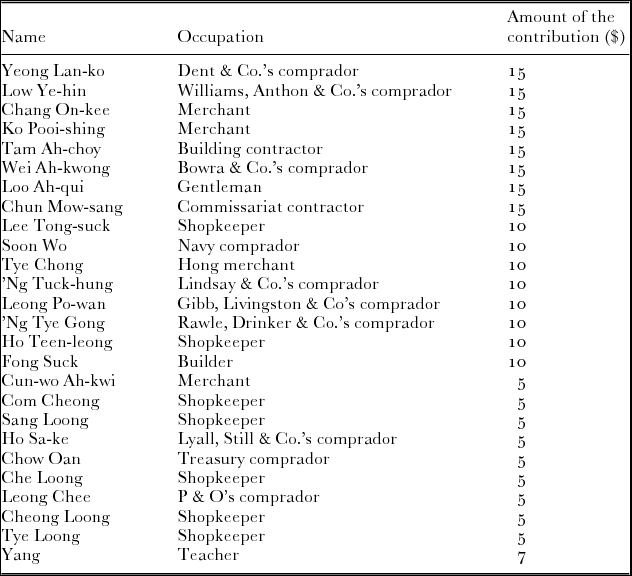
In the early 1850s, a few government compradors, including Chow Aaon, were engaged in the establishment of the Chinese hospital. Table 1 shows a list of subscribers in 1852, which suggests the rise of company compradors in Hong Kong at the same time that government compradors were becoming a minority. The table lists eight company compradors but only three government compradors. In the early 1850s prominent merchants, including company compradors, became representative figures of the Chinese community. In this way, the British increased the number of credible British intermediaries and began drawing on external intermediary elites for the governance of the Chinese community during the 1860s. This shift overall reduced the colonial government's reliance on government compradors.
A list of subscribers for the establishment of a Chinese hospital, 1852.

Source: China Mail, 23 September 1852, p. 154.
However, the rise of Chinese intermediary elites outside of the colonial institutions did not mean the integration of the British and Chinese communities in Hong Kong. The British held separation policies regarding the Chinese and foreign communities in Hong Kong from the early 1840s up to the middle of 1940. Although the government did not strictly apply this segregation policy, it was common for the Chinese and the British to live in different locations. However, in the 1870s well-to-do Chinese merchants started establishing their houses in the eastern district, thereby moving into European residential areas.Footnote 105 Incensed by the Chinese encroachment, the colonial government applied legal segregation policies from the late 1880s onwards. The European District Preservation Ordinance and the Peak Preservation Ordinance were enacted in 1888 and 1904 respectively.Footnote 106 The British policy of separation and detachment from the Chinese communities held firm between the 1860s and the 1880s. By replacing government compradors with external Chinese middlemen, the colonial officials were able to reduce their direct communication with lower class Chinese residents in Hong Kong. The Chinese intermediary elites who were committee members of Tung Wah Hospital, Po Leung Kuk, and the District Watch Force were bridges between the Chinese and British communities. At the same time, however, they were effective gatekeepers between the two communities.
The survival of government compradors, 1860s–1870s
The decline of government compradors did not result in the complete abolition of the comprador system in the colonial government. Although they were less significant in Hong Kong society, some of them continued to work for colonial institutions. Working with company compradors, some advanced their commercial activities and their social credibility. For instance, guarantors of the Post Office compradors included notable company compradors’ names. In 1860, Fung Achew (Feng Daozhao 馮道照) was engaged at the Post Office as a comprador and Ng Tuk-hang (Wu Deheng 吳德衡), a comprador to Lindsay & Co., stood surety for him.Footnote 107 The guarantor of Mang Fook Liu, a shroff of the Post Office in the 1870s, was Tsoi King Nam, a comprador to Jardine, Matheson & Co., who paid the latter $1,000 for the security bond.Footnote 108 Security bonds from well-known company compradors had the effect of increasing the reliability of the Post Office compradors and other Chinese staff. This contributed to the maintenance of the stable comprador system at the Post Office in latter half of the nineteenth century. For government compradors, networking with company compradors was key to surviving the decline.
In the 1860s and the 1870s, Pedro Leung Hing Kee, a commissariat comprador, acted like a company comprador and was successful in Hong Kong's commercial world. Hing Kee, alias Pang Ahim and Pang A Yim (Peng Yan 彭炎), became more than a purveyor of provisions. He was a notable commissariat comprador in the 1870s. He was well known for running various private businesses in addition to his position as a comprador,Footnote 109 and by the 1870s, Hing Kee was a well-to-do entrepreneur and property owner in Hong Kong. In February 1870, he owned 50 shares in Saigon & Straits S.S. Co. Ltd,Footnote 110 and when Fletcher's Buildings on the Queen's Road East caught fire on the night of 12 March 1876, Hing Kee was using a portion of the building.Footnote 111 Hing Kee seems to have been responsible for the management of the godown (warehouse), but it is not certain whether he was using the building for his own business purposes or for his service to the commissariat. Hing Kee invested heavily in property and land, and succeeded in its management in the same manner as company compradors.Footnote 112 The exceptional prosperity of Hing Kee was possible because he emulated the commercial activities of the company compradors.
Conclusion
Overall, the colonial government employed compradors and depended on them to deal with economic, social, and political communication with Chinese residents in Hong Kong from the 1840s to the 1850s. During the formative years of the colony, it was not easy for colonial officials to determine what work was necessary for the administration of the Chinese community, and therefore they employed compradors who could flexibly conduct work to establish colonial organizations. To put it simply, the colonial government had two systems to employ compradors: an official institution could employ a comprador or an individual civil servant could personally employ a comprador. The functions of these compradors included supplying provisions, overseeing Chinese staff, assisting their principals in their duties for the colonial government, and assisting in the external commercial activities of their principals. Working in the colonial government provided the compradors with the knowledge and network to run side businesses such as land and property investment. In this way, government compradors emerged as official intermediaries between the colonial government and Chinese society in Hong Kong during the 1840s.
However, the colonial government reduced its dependence on the compradors in the 1850s and 1860s. The involvement of official compradors in the corruption of the colonial government posed a problem. The unhealthy relationship between the compradors and their principals was problematized inside and outside of officialdom and the employment system for Chinese and foreign staff was reformed to reduce the problem. The government introduced a more effective employment system by educating and hiring British intermediaries. By allocating tasks previously performed by compradors to other positions, the colonial government reduced the number of compradors in its employ. At the same time, mercantile elites, which included company compradors, formulated a semi-official organization and an alternative system for the administration of the Chinese community, which was in operation by the late 1860s. These mercantile and intellectual elites obtained broader public support than government compradors, as the latter's credibility was often called into question because of their involvement in extortion and corruption, in collaboration with high-ranking colonial officials. In effect, the colonial government began to draw on external Chinese social organizations such as the Tung Wah Hospital for mediating social issues between the Chinese and British communities instead of directly hiring Chinese intermediaries. As a result, the authority of government compradors had fully declined by the late 1860s, and the colonial government was able to outsource their functions to Chinese mediators instead of directly employing and supervising compradors in its institutions.