Ethnic diversity married to a heightened consciousness of race, language, religion, or group culture poses challenges to national unity.1
By celebrating “difference,” identity politics raises questions about what defines us as a nation. Immigration is the engine of increased diversity in contemporary nation-states. By stimulating a steady influx of immigrants from Latin America and Asia with high fertility rates, the Immigration and Nationality Act of 1965 has transformed the ethnic composition of the United States. Increased assertiveness about group identities in the aftermath of the civil rights movement and increased immigration has crushed the “liberal expectancy” that modernization would overcome the divisiveness of ethnic ties.2Glazer and Moynihan 1975.
What are the consequences for the country's sense of social solidarity and common identity? The burgeoning literature on this topic can be divided into two camps: the gloomy Cassandras who worry about the creation of a balkanized “alien” nation and the sanguine Pollyannas who say that we've been here before and that the experiences of today's immigrants will resemble those of their European predecessors in the American melting pot.3
The latest entry in this debate is Samuel Huntington's highly publicized and much reviewed Who are We? Challenges to America's National Identity. Huntington leans strongly to the Cassandra end of the continuum. He believes that American national identity is undergoing destabilizing changes with threatening implications for America's national cohesion and capacity to articulate and achieve collective goals. And he believes immigration from Mexico is the main, though not the only, source of the threat.
Huntington states that American identity is defined not by race or ethnicity but by the fusion of its democratic political creed and an “Anglo-Protestant” culture that combines the English language, religious commitment, individualism, a strong work ethic, and a sense of obligation “to try and create a heaven on earth.”4
Huntington 2004a, 32.
Huntington delineates three specific threats to American national identity. As already noted, “the single most immediate and most serious challenge to America's traditional identity comes from the immense and continuing immigration from Latin America, especially from Mexico.” The sheer extent of immigration and high birth rates among Latinos who share a language and religion and who are concentrated in the country's southwest region close to their country of origin means they will not assimilate like their European predecessors or Asian contemporaries. Huntington's somber worst case scenario for the future is that America will split into two de facto nations: an English-speaking “Anglo-America” and a Spanish-speaking “Mexamerica” that, like Quebec in Canada, regards itself as a distinct society.5
Immigration aside, identity politics and cultural relativism are a second threat, fueling a systematic assault on the “Anglo-Protestant” culture by rejecting individualism in the name of group rights. Finally, Huntington argues that declining patriotism among the leading bureaucratic, business, and intellectual elites in the United States is a challenge to the country's historic sense of its own uniqueness. The growing adherence of these groups to cosmopolitan values downplaying the significance and validity of national loyalty conflicts with the traditional patriotism of the overwhelming majority of the general public, thereby undermining political trust and cohesion.
Huntington's critics charge that it is wrong to claim Anglo-Protestant culture as the core of American national identity. Even if this were once true, American values and customs have evolved as the country's population has changed. In Nathan Glazer's phrase, “origins are overtaken by subsequent events.” A second line of criticism largely accepts Huntington's characterization of American identity, but challenges the pessimistic prediction about the adaptability and assimilation of Hispanic immigrants.6
And if today's immigrants are moving to embrace fundamental American customs and values, then the vision of a culture clash along ethnic lines is overdrawn, if not wholly unfounded.Our purpose is an empirical investigation of Huntington's prognosis regarding the assimilation of Hispanic immigrants. As Peter Skerry (2005) points out, Huntington's critics ignore the fact that Huntington bases his argument about the corrosive effects of Mexican immigration on testable ideas about the interplay of cultural, structural, and political factors.7
Skerry 2005.
Huntington 2004b, chapter 11.
What Is Assimilation?
To assimilate means to become similar to. This definition leaves open the questions of who is being made similar to whom, with regard to what, and how. In the context of immigration, assimilation means the creation of greater homogeneity in society through the attenuation of ethnic differences. Change can be in more than one direction, of course, and many commentators on the American melting pot argue that its cultural content changes as new words become part of the common lexicon and new traditions penetrate mainstream popular culture. Huntington himself distinguishes between the melting pot and tomato soup metaphors for American society. In the former case, immigrants change American culture by diluting the original ingredients in the pot; in the latter, the tomato taste continues to dominate even as new spices are sprinkled in. His preferred model of assimilation entails adoption of the “American” way of life—learning English; adhering to the Anglo-Protestant culture of religious commitment, individualism, and the work ethic; and identifying oneself psychologically as a patriotic American. Although he refers briefly to structural assimilation—the large-scale entry of native minorities and immigrants into the main economic and social institutions of the “host” society through education, economic mobility, and intermarriage—Huntington's focus is cultural and political assimilation.9
Gordon 1964.
If assimilation means the erosion of ethnic differences, then by any definition it is a process that occurs over time. The standard “straight line” hypothesis predicts that successive immigrant generations, whatever their national origins, will increasingly resemble the native-born Americans of European, or, in Huntington's case, Anglo-Protestant origin, who are the presumed carriers of mainstream national values.10
In other words, assimilated third-generation Hispanic Americans should be more similar to native-born whites than to recent immigrants from Latin America, and the same should be true for individuals with ancestry from Asia, Africa, Eastern Europe, and so forth. Huntington's claim is that the assimilation of people of Mexican ancestry will be substantially less widespread and slower than for individuals from other nations. If Huntington is right, then when Americans of Hispanic and other origins are compared, even among the second and third generations the Hispanics should be less likely to be monolingual in English, less committed to the individualist ethos of self-reliance and hard work, less likely to identify themselves as Americans, and less patriotic.Huntington's Theory of Mexican Exceptionalism
Although large-scale immigration of individuals from different cultures is an obvious challenge to the sense of shared identity that is the foundation of nationhood, America has faced this challenge before and successfully absorbed diverse groups of newcomers. Huntington, however, emphasizes the contingency of cultural change as it applies to the future trajectory of Mexican immigrants. Assimilation, in the sense of the attenuation of distinctions based on ethnicity or natural origin, is not inevitable. Patterns of communication and socialization affect assimilation, and the relative weight of pro and anti-assimilation forces—cultural, structural, and political—might vary across groups and over time.
To begin, the cultural similarity between an immigrant group and the mainstream should affect the ease and speed of assimilation. Huntington posits a wide gulf between the dominant values of an individualistic, Protestant America and a family-centered, Catholic Mexico. But even if this cultural divergence exists, it resembles the value conflict between immigrants from Catholic Italy and Anglo-Protestants a century ago, and that conflict seemingly was dissolved by assimilation. So why should Huntington believe that Mexican immigrants will deviate from this historical pattern?
One important reason he offers is that today's immigrant wave is much less diverse than in the past. More than half of today's immigrants come from Spanish-speaking countries and so arguably have less of an incentive to learn English than the polyglot immigrants who rubbed shoulders in the cities a century ago. And Huntington identifies a number of additional structural factors that influence the persistence of cultural differences and impede political assimilation:
- Immigrants come from a contiguous country, making it easier to travel back and forth and retain ties to their country of origin;
- The persistence of the migratory flow provides continuous inputs of traditional values and customs;
- A large number of illegal Mexican immigrants are unwilling or unable to participate in mainstream social and political institutions;
- The concentration of Hispanic immigration in enclaves near the
Mexican border reinforces the capacity to sustain a social and economic
life conducted in Spanish.11
Huntington 2004b, 222–230.
Huntington thus posits a negative relationship between the persistence of ethnic enclaves and assimilation. The concentration of Mexican immigrants in enclaves near the border will facilitate the maintenance of the Spanish language and traditional “Mexican” values, as will the increased availability of newspapers and television in that language, school segregation, and the dominance of ethnically homogeneous friendships. On the other hand, dispersion, residential mobility, and contact with other ethnic groups enhance the need to learn English as well as new norms and values.
Politics—laws, institutions, and practices—influence the costs and benefits, and therefore the ease, of assimilation. The Americanization movement of the early twentieth century expedited assimilation by insisting on English-only education. The restrictive immigration laws of 1921 and 1924 also made assimilation more likely by interrupting the inflow of people still rooted in their original cultures. On the other hand, formal and informal discrimination both impede structural assimilation and undermine the desire of immigrants to identify with the host country. In this regard, the passage and enforcement of civil rights legislation were forces for assimilation.12
Alba and Nee 2003, 54.
Huntington argues that current political trends are, on balance, hostile to assimilation. The incentive to naturalize is reduced by laws and court decisions that have diminished the legal and welfare benefits of citizenship. The official policy of turning a blind eye to dual citizenship allows immigrants to divide their political attention and loyalties. Bilingual education and a multicultural curriculum mean that public schools are no longer promoting national identity or patriotism.13
Huntington 2004b, 202–203.
Ibid., 219, 230.
Huntington's analysis implicitly rests on a theory of how incentives and patterns of social contacts, cross-ethnic interactions, and communication flows influence value change. While many critics simply dismiss his argument as wrong-headed, the underlying presuppositions are plausibly grounded in social psychology and resemble those laid out by Karl Deutsch in his seminal Nationalism and Social Communication.15
Deutsch 1953.
Salins 1997.
Data and Method
The most recent information from the U.S. Census largely confirms Huntington's portrayal of the pattern of immigration into the United States. Growth in the Hispanic population accounts for almost half of the country's total population growth, and about one in seven individuals now claim Hispanic ethnicity.17
U.S. Census Bureau Press Release, June 9, 2005.
Skerry 2005, 87.
In light of these trends, testing Huntington's views about the political implications of Mexican immigration is more relevant than ever, but is it feasible? Data limitations present one formidable obstacle. Empirical analysis of Huntington's assertions sometimes entails comparing Mexican immigrants to other Hispanic newcomers, sometimes to contemporary migrants from Asia and elsewhere, and sometimes to earlier European immigrants in the nineteenth and twentieth centuries. U.S. Census data are a logical source for these comparisons, but the Census only provides indicators of language use, as well as measures of structural assimilation such as occupation, residential context, education, and intermarriage. No political variables are included. Moreover, Census definitions of ethnicity have shifted over time, and, even more significantly, recent Censuses do not permit disaggregation of the population into more than two full immigrant generations (the first and all subsequent generations), a necessity for the study of assimilation over time. Public opinion surveys are a potential source of evidence about cultural and political assimilation, but as yet there exists neither an extended time series nor samples that include large enough numbers of the relevant immigrant groups to enable one to track and compare trajectories of assimilation.
Knowledge about the implications of today's immigration for the future of American national identity can only derive from knowledge of generations to come. The second and third generation immigrants in current surveys are not the offspring of the immigrants fully exposed to the demographic, economic, and political forces to which Huntington assigns causal significance. Solid inferences about the future and about trends over time cannot be based on cross-sectional data. Huntington could always, and not unfairly, discount evidence of assimilation now by saying that he is talking about now plus thirty years. And even if one established that the grandchildren of late twentieth century Latino immigrants did not replicate the behavior of their historical counterparts whose families migrated a hundred years earlier, it would be unclear whether this was because the first generation of the two sets of immigrants differed in values and other resources or because of differences in the economic, technological, or political environment. Jennifer Hochschild adds that prediction in this domain is “a fool's game” because the future will be partly controlled by unforeseeable policy choices.19
Hochschild 2005, 81.
Nevertheless, some bets are safer than others. Another forty-year interruption in the flow of immigrants like the one beginning in the 1920s is unlikely to occur. Due to ethnic differences in age and family size, the growth in the Hispanic portion of the population should continue even if new policies stem the tide of Mexican immigration. And there is no sign that the official embrace of cultural diversity as an ideal is loosening. This suggests that the ceteris paribus assumption required in projecting the future from contemporary data has some merit. In particular, evidence about the relatively young component of the current second generation of Latino immigrants, those thirty and under at the turn of the twenty-first century, should have probative value given that this group was socialized during the period of massive Mexican immigration and political multiculturalism that has animated Huntington's anxieties.
Accordingly, we rely on evidence from the Pew Hispanic Center's Latino Surveys conducted in 2002 and 2004, the Washington Post/Kaiser Family Foundation/Harvard University Latino Survey conducted in 1999, the American National Election Studies (ANES), the 1994 General Social Survey (GSS), and the Los Angeles County Social Surveys (LACSS) conducted by UCLA from 1994 through 2002. The 2002 Kaiser/Pew Latino Survey and the 2004 Pew National Survey of Hispanics: Politics and Civic Participation are both national random-digit dialed (RDD) telephone surveys of Latinos 18 and older, highly stratified with geographically disproportionate oversamples. The surveys were administered in either English or Spanish, at the discretion of the respondent. The Hispanic samples are broken down by country of origin and include 2,929 Hispanic respondents in 2002 and 2,288 in 2004. The 2002 survey includes a comparison sample of 1,008 non-Hispanic whites and 171 black respondents. The Washington Post/Kaiser/Harvard Latino Survey was conducted by the ICR Survey Research Group and is a stratified, disproportionate RDD national sample of adults 18 and over. Respondents included approximately 2,500 whites, 550 blacks, 60 Asians, and 1,010 Latinos. The well-known NES and GSS are national surveys conducted by the Center for Political Studies at the University of Michigan and the National Opinion Research Center at the University of Chicago respectively.
The continuing salience of ethnicity in Los Angeles, an extraordinarily diverse community, makes the LACSS particularly useful for studying the interplay between national and ethnic identities. Perhaps most importantly, Los Angeles County is a population center in the area of the country where Huntington fears anti-assimilation pressures are strongest.20
However, only the 1994 and 2000 LACSS surveys had interviews conducted in both Spanish and English, so the pooled sample largely excludes the linguistically unassimilated. The distribution of responses probably is affected by this sampling problem, but the consistent evidence from both national and local data regarding the trajectory of preferences across immigrant generations makes us confident about the results regarding the process of assimilation.
Forever English?
Notwithstanding Churchill's quip that the United States and England are two countries separated by a common language, learning English has always been a marker of belonging to America. Indeed, the combination of ethnic heterogeneity and linguistic homogeneity distinguishes the American experience with immigration. Until now, the vast majority of third generation immigrants, whatever their country of origin, have become monolingual in English, and language use has been widely regarded as essential for social acceptance and economic mobility whether one advocates “thin” or “thick” assimilation.21
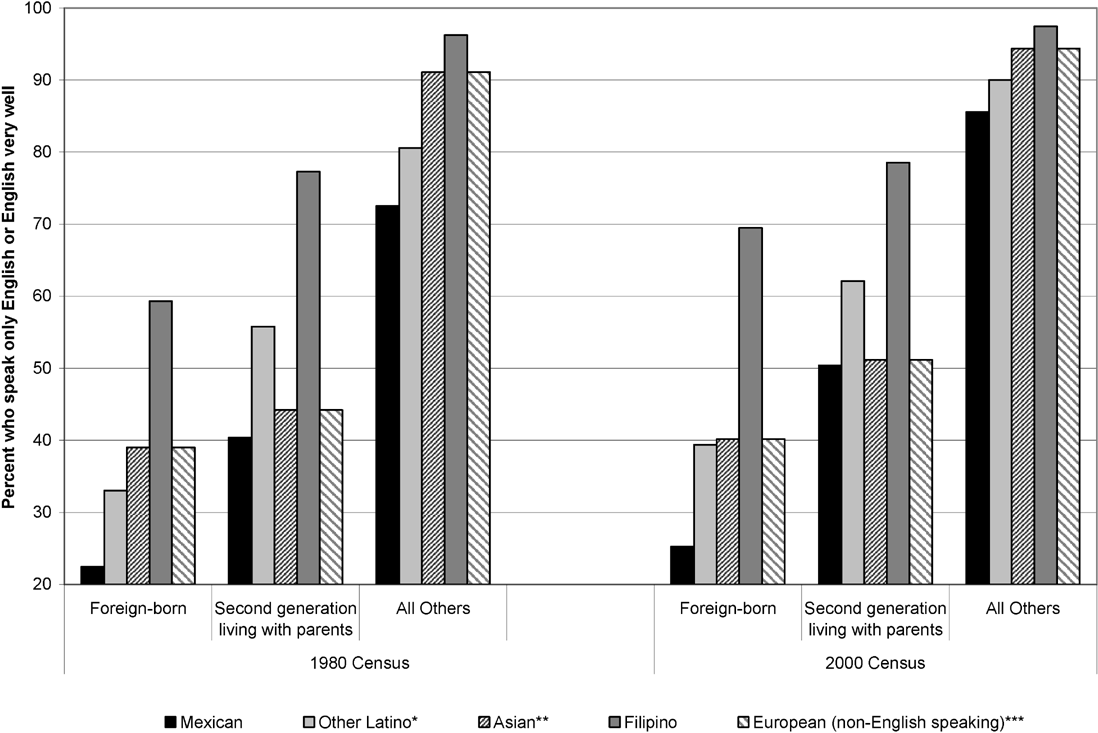
Huntington acknowledges that Hispanic immigrants generally learn English. What concerns him is the continued use of Spanish, particularly in areas bordering Mexico. He worries that the ongoing influx of Spanish speakers and the emergence of bilingual enclaves will undermine America's cultural and political unity.What is the evidence regarding language use and the political implications of bilingualism? Recent U.S. Censuses ask people whether they speak only English at home. Those who say they speak another language are then asked how well they speak English. Figure 1 reports the proportions who either speak only English or speak English very well in the 1980 and 2000 Censuses, with residents grouped both by their ancestral country of origin and whether they are foreign-born, native-born living with immigrant parent, or native-born living outside an immigrant household. Immigrants and their offspring from English-speaking countries such as Australia, Canada, Ireland, Great Britain, Jamaica, and India are omitted from the analysis.

Linguistic assimilation of Mexican and other immigrants
Bars indicate the percentages who speak only English at home or who speak English “very well.”
“All Others” indicates all respondents of a given ancestry who are neither foreign-born nor of the second generation living with immigrant parents.
*Other Latino includes those of South American, Puerto Rican, and Cuban ancestry.
**Asian includes those of Chinese, Japanese, Korean, and Vietnamese ancestry. Indians were excluded due to the extremely high English proficiency among first-generation immigrants.
***European (non-English speaking) includes those of German, Italian, Polish, and Russian ancestry.
Source: Integrated Public Use Microdata Series, 1980 and 2000 Census 1\% samples.
Both the 1980 and 2000 Census data show that knowledge of English is much lower among residents born in Mexico than among any other immigrant group. In the 2000 Census, only 24 percent of Mexican immigrants say they speak only English or speak English very well, compared to 39 percent of other Hispanic immigrants and 40 percent of immigrants from China, Korea, Japan, or Vietnam. However, the children of Mexican immigrants learn English quickly. In the 2000 Census, 50 percent of the native-born living in households of Mexican-born immigrants either spoke only English or spoke English very well. This intergenerational rate of linguistic assimilation among the offspring of Mexican immigrants surpassed that of every other immigrant group. And ethnic differences in English-speaking ability continue to diminish between generations. When one compares those in the “all other” category in figure 1, a group that includes both adult second generation immigrants and third or fourth generation immigrants, the gap between people of Mexican ancestry and others is very small: 86 percent of those with families originally from Mexico speak only English or speak English very well, compared to 94 percent of people of Asian origin.
Moreover, the data from the 1980 and 2000 Censuses are virtually identical. Indeed, contra Huntington, the pace of linguistic assimilation among recent Mexican immigrants seems to be more rapid than in the past. The 25 percent increase in English-speaking ability between Mexican immigrants and their native-born offspring living at home reported in the 2000 Census is seven percent greater than the equivalent generational change reported in 1980. Two decades of steady, large-scale immigration in a geographically concentrated area has not slowed the rate of linguistic assimilation among those of Mexican ancestry. Mexican immigrants may know less English than newcomers from other countries when they arrive in the United States, but the trajectory of their progeny's assimilation resembles that of their European predecessors of a century ago, and their rate of linguistic assimilation is on par with or greater than those of other contemporary immigrant groups.
The 2002 and 2004 Pew National Survey of Latinos contained a battery of questions about language use. These surveys also permit a more refined differentiation between first, second, and third generation residents than is possible with Census data. To measure language use, we constructed a Language Dominance Index based upon four questions asking how comfortable respondents felt both reading and speaking English and Spanish, respectively.22
The following four questions were used to construct the language dominance measure: 1) “Would you say you can carry on a conversation in Spanish, both understanding and speaking—very well, pretty well, just a little, or not at all?” 2) “Would you say you can read a newspaper or book in Spanish—very well, pretty well, just a little, or not at all?” 3) “Would you say you can carry on a conversation in English, both understanding and speaking—very well, pretty well, just a little, or not at all?” 4) “Would you say you can read a newspaper or book in English—very well, pretty well, just a little or not at all?”
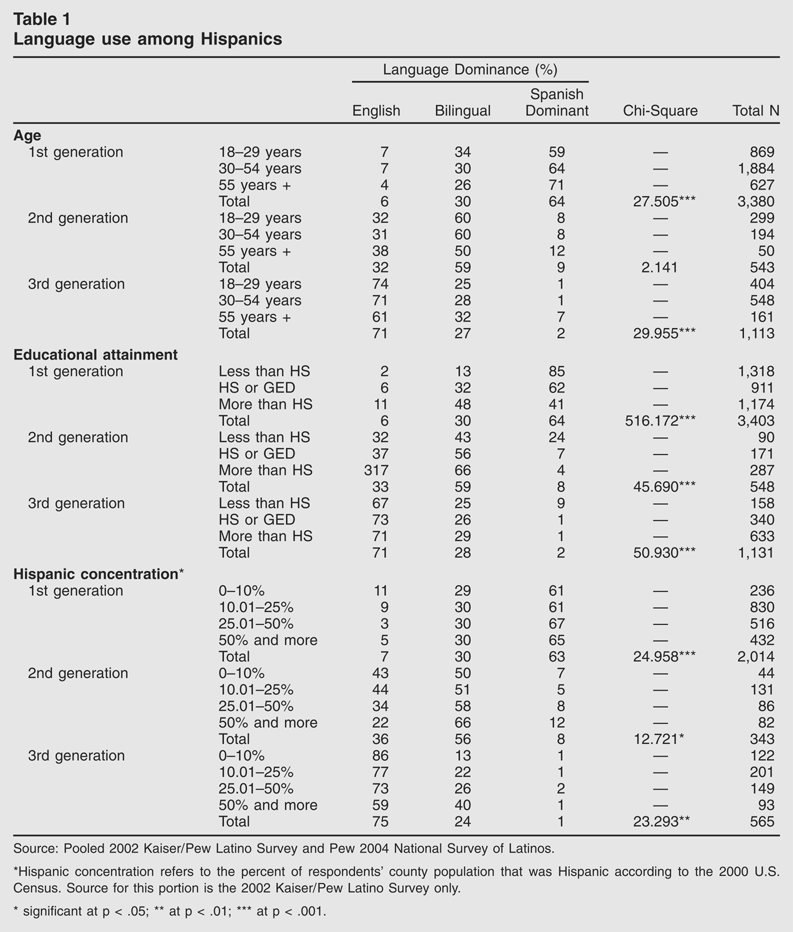
Table 1 describes the pattern of language use among Hispanics, grouped by age, education, and residential context within generations. The dominant finding is the linguistic assimilation of Hispanic immigrants from one generation to the next, regardless of age, educational attainment, or the ethnic makeup of their residential environment.23
An earlier version of this article (Citrin, Lerman, and Murakami 2004) reported virtually identical results with other indicators of language use, including “speaking only English at home,” language of interview, and having children who speak “only English” with their friends.
Language use among Hispanics

Huntington correctly predicted that living in a community with a high concentration of other Hispanics makes it easier for third generation immigrants to retain knowledge of Spanish. In the third generation, virtually no one is Spanish dominant regardless of where they live. However, 40 percent of third generation Hispanics living in counties with more than 50 percent Hispanic residents are bilingual, compared to 13 percent of their counterparts living in counties with less than 10 percent Hispanics.
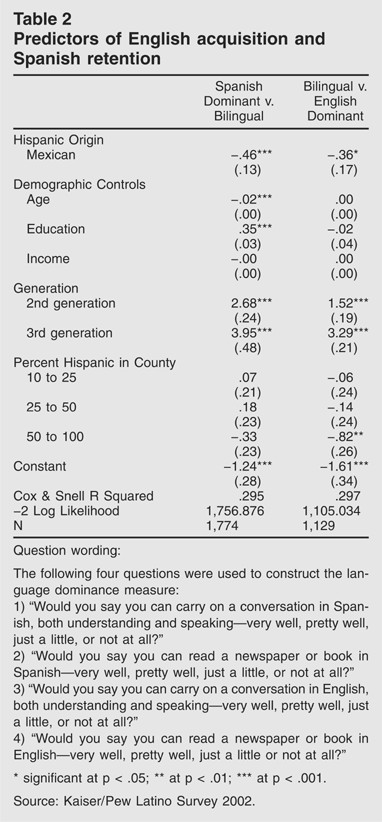
Learning English is virtually inevitable for the children and grandchildren of immigrants. On the other hand, retaining one's “original” language may be a separate phenomenon with different underpinnings. To analyze and compare the determinants of the two processes more rigorously, we conducted multivariate analyses of the 2002 Pew sample of Hispanic respondents. Two separate equations are estimated and the results reported in table 2. The first (column 1 in table 2) estimates the effects of various background factors on being bilingual rather than Spanish dominant; the second (column 2) of being English dominant rather than bilingual. Because the dependent variables are dichotomous, logistic regression models are estimated. The predictors in these models are age, education, and income and their inclusion helps control for variation in some of the factors that affect initial knowledge of English as well as later opportunities and ability to learn it. To estimate generational effects, dummy variables for being in the second or third generation are included (first generation is the excluded category). To test Huntington's suggestion that Mexican immigration is unique, we add a dummy variable for being of Mexican ancestry (vis-à-vis other Hispanics). If he is correct, then it should yield a negative and statistically significant coefficient, signifying that Mexicans do use English less than Hispanics from other countries. Residential context (the percentage of the population in the respondent's county that is Hispanic, assessed by dummy variables with less than 10 percent Hispanic as the baseline category) is included as a predictor in the model to determine whether the concentration of Hispanics in ethnic enclaves diminishes the probability of learning English or facilitates the retention of Spanish among people who can speak English.
Predictors of English acquisition and Spanish retention

The coefficients in the first column of table 2 are additional evidence that the dominant use of Spanish by Hispanics declines rapidly from one generation to the next. Controlling for age, education, income, and residential context, second and third generation Hispanics are much more likely than immigrants to speak English well. The elderly are more likely than younger Hispanics to speak Spanish, while more formal education is a major factor in feeling comfortable speaking and reading English. The significant coefficient for the Mexican dummy variable confirms that those of Mexican ancestry are more likely to be Spanish dominant than Hispanics from other countries. Finally, the fact that the coefficients for the residential context dummy variables all are statistically insignificant indicates that the process of learning English is unaffected by the number of Spanish speakers in one's residential environment. The background of the Hispanic residents matter, but even so, English acquisition is pervasive.
The results for the equation estimating the likelihood of being bilingual rather than monolingual in English are somewhat different (see column 2 in table 2). Second and third generation Hispanics are much less likely to retain use of Spanish than immigrants, as is well known, and the loss of Spanish-speaking ability is unaffected by the age, education, or income of these cohorts. Bilingualism is more widespread among Hispanics of Mexican ancestry. However, residential context only fosters retention of Spanish among Hispanics living in counties where more than half the population is of like ethnicity, and this group comprises only 13 percent of the nation's Hispanic population (as calculated from 2000 Census data). The integration of Hispanic immigrants into the American mainstream, a process enhanced by their growing geographic dispersion, seems to diminish the proportion of those fluent in Spanish.
Attitudes toward language policy as well as current patterns of language use are relevant for assessing the future status of English in American society. If support for Spanish acquiring the status of an official language becomes widespread as Hispanic immigration continues to grow, for example, Huntington's specter of a Quebec-like Mexamerica gains some credence. Prior research predictably shows that Hispanics are more hostile than other ethnic groups towards “English-only” policies.25
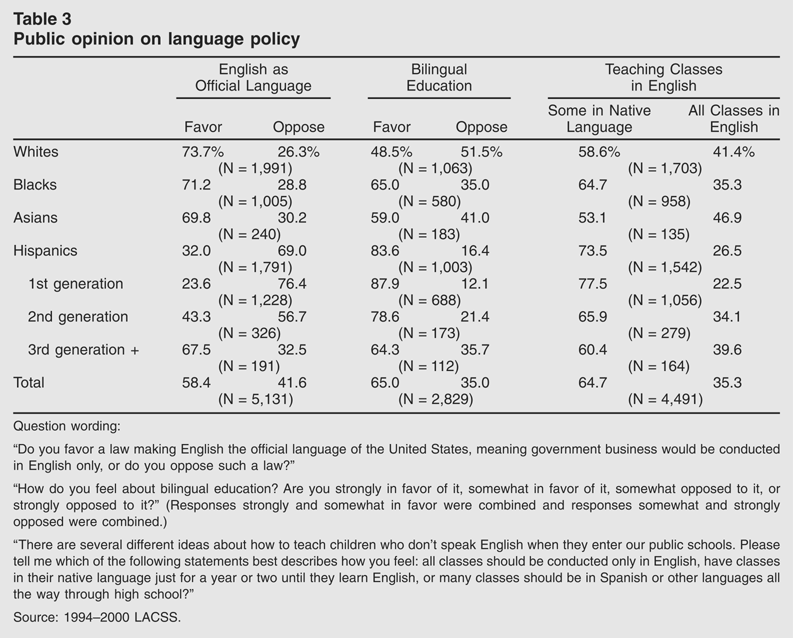
Support for bilingualism in education and other government programs provide an opportunity to express a psychological attachment to their ethnic roots. This symbolic dimension of language policy preferences brings one closer to the cultural values, attachments, and identifications of primary concern to Huntington. On the other hand, linguistic minorities generally accept that English is the country's common language and that learning English is essential for getting ahead economically in the United States.The Los Angeles County Social Surveys (LACSS) from 1994–2000 asked three questions about language policy: whether or not English should be the official language of the United States, the degree of support for bilingual education, and whether or not classes in public schools should all be taught only in English or not (see table 3). Pooling these surveys permits comparison of the policy preferences of Hispanics, both immigrants and native-born, with those of whites, blacks, and Asians. In addition, the vast majority of Hispanic respondents in the LACSS are of Mexican ancestry, the group of most concern to Huntington.
Public opinion on language policy

The results reveal both significant ethnic differences and the potency of assimilative forces. Hispanics, by far more than any other group, oppose declaring English as the official language of the country, favor bilingual education, and believe that at least some classes should be taught in a student's native language. However, these positions find their strongest support among first generation immigrants. By the third generation, Hispanics' preferences on these issues more closely resemble those of whites and blacks than those of first generation Hispanic immigrants. Particularly striking is the finding that third-generation Hispanics are slightly more likely to oppose bilingual education and believe that all classes should be taught in English than are blacks with no particular attachment to Spanish or any other foreign language.
Because the pooled LACSS sample includes relatively few respondents interviewed in Spanish, these results probably are skewed in the direction of support for according symbolic status to English.26
We also note that the number of Asians in the sample is small and all were interviewed in English, so although most Asian respondents in the LACSS were foreign-born they were linguistically assimilated and perhaps more exposed to dominant political rhetoric than the Asian community as a whole.
Citrin, Wong, and Duff 2001.
The incentives to assimilate by learning and using English remain intact for the current wave of Hispanic immigrants despite its unprecedented volume, uninterrupted flow, and geographic concentration. The process of linguistic assimilation conceivably could be interrupted, but the data available now suggest that the rise of a self-sufficient sub-population speaking mainly Spanish—the fuel for the fire that Huntington fears may consume American national identity—is not a serious threat, and that the privileged status of English as the country's sole common language remains secure.
Identity Choice: National, Ethnic, or Both?
Huntington writes “the ultimate criterion of allegiance is the extent to which immigrants identify with the United States as a country … and correspondingly reject loyalties to other countries and their values” (2004b: 241). Like other nationalists, he insists on the priority of identity with the nation over all other foci of affiliation. Along these lines, the British politician Norman Tebbitt proposed the “cricket test” for national identity, proclaiming that the failure of British citizens of South Asian or West Indian origin to cheer for the English team when it played India, Pakistan, or Jamaica meant that their strongest identification was with their country of origin and not their physical and political home.28
Fisher 1990.
Chavez 1998.
Sen 2000.
How Americans balance their national and ethnic identities is at the core of the ongoing debate over whether the American melting pot is “working” or can “work again.”31
Barone 2001.
The 2002 Pew Latino Survey asked respondents if they preferred to describe themselves primarily as someone from their country of ancestry, such as Mexico, as a Latino/Hispanic, or as an American.32
The context in which this self-description was demanded is not specified in the survey question.
Huntington 2004b, 256.
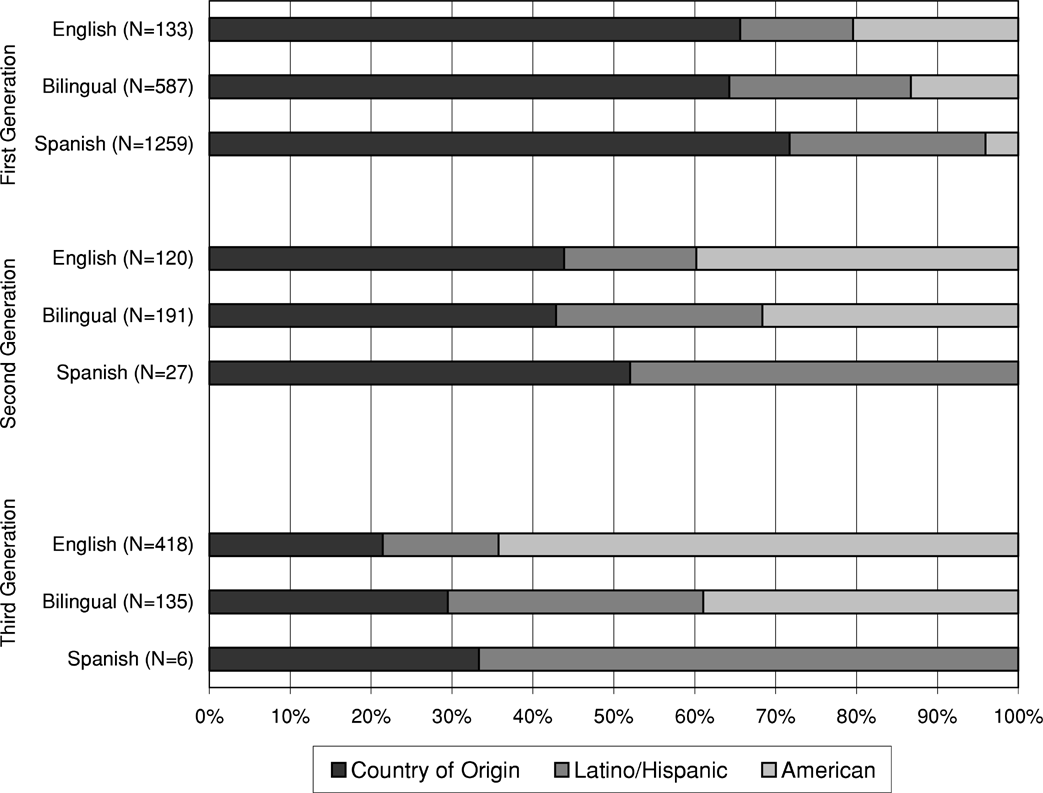
Figure 2 shows that in each Hispanic immigrant generation, speaking English increases the tendency to identify oneself as an American. Even in the third generation, the small number of respondents whose primary language is Spanish chose to describe themselves as either “Latino/Hispanic” (66 percent) or in terms of their country of ancestry (33 percent). The failure to become comfortable speaking English does seem to correlate with a failure to adopt a purely “American” identity. Since most native-born Hispanics do know English well, however, the behavior of bilingual respondents is a more relevant test of Huntington's argument about the long-term impact of Hispanic immigration on American national identity. In this regard, figure 2 provides a reassuring result. Bilingual respondents are more similar to English-speaking than Spanish-speaking Hispanics. By the third generation, bilingual Latinos prefer an American identity to either of the other two identity choices. This result remains unchanged in a regression analysis that includes age, income, education, residential context, and language use as predictors of self-identification.34
For reasons of space, these data are not reported but will be made available by the authors on request.

Linguistic assimilation of Mexican and other immigrants
Bars indicate the percentages who speak only English at home or who speak English “very well.”
“All Others” indicates all respondents of a given ancestry who are neither foreign-born nor of the second generation living with immigrant parents.
*Other Latino includes those of South American, Puerto Rican, and Cuban ancestry.
**Asian includes those of Chinese, Japanese, Korean, and Vietnamese ancestry. Indians were excluded due to the extremely high English proficiency among first-generation immigrants.
***European (non-English speaking) includes those of German, Italian, Polish, and Russian ancestry.
Source: Integrated Public Use Microdata Series, 1980 and 2000 Census 1\% samples.
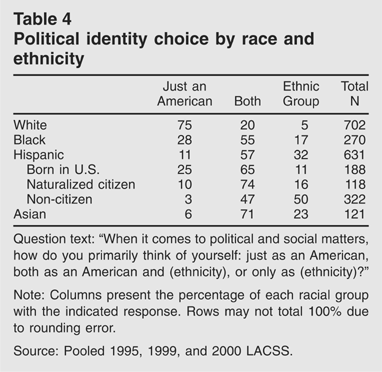
The large number of Hispanic respondents preferring to label themselves as Latino/Hispanic can be viewed as partial support for Huntington's concern. Still, the meaning of this question is ambiguous, as it could easily be interpreted as asking for a census classification rather than an emotional affiliation. Another, more explicitly political measure of identity choice is the LACSS question, “When you think of social and political issues, do you think of yourself mainly as a member of a particular ethnic, racial, or nationality group, or do you think of yourself as just an American?” The 1995, 1999, and 2000 LACSS surveys expanded this dichotomous choice by asking people who first said they thought of themselves as “just American” this follow-up: “Which of the following is most true for you: just an American or both American and (ethnicity)?”
As table 4 shows, given this opportunity to adopt a hyphenated identify, most whites do not take it: 75 percent of them continued to call themselves “just an American” and only 20 percent, most of whom are immigrants, shifted to the “both” category. By contrast, only a minority of blacks (28 percent) did not budge from the “just an American” identity. Among African-Americans, what W.E.B. Dubois called the double consciousness of being American and black is the modal identity choice: 55 percent of black respondents choose the hyphenated, or “both” response category as their preferred self-identification.35
Dubois 1903.
Political identity choice by race and ethnicity

The contrast between blacks and the other two ethnic minorities is largely explained by differences in immigrant status. Among the native-born Hispanics, an American identity (25 percent) far outstrips a purely ethnic identity (11 percent). The opposite holds for those who are non-citizens: a purely ethnic identity is far more common (50 percent) than American identity (3 percent). Once again, assimilation is ongoing, and the immigrant status of Hispanics and Asians is far more important in determining how they balance their national and ethnic identities than is their position in a supposedly rigid American racial and ethnic hierarchy. The more integrated into American society by virtue of nativity, citizenship, or time spent in the United States, the less likely one is to identity in purely ethnic terms.36
Again, we note that the predominance of linguistically assimilated Hispanic and Asian respondents are affecting these frequencies, but the conclusion remains that each succeeding generation is less likely to identify in purely ethnic terms.
Patriotism
The core meaning of patriotism is simply the love of one's country. The foundations of this diffuse emotional attachment and how it is expressed may vary among people who agree on the importance of their national identity. We do not venture here into the thicket of terms developed to distinguish among variants of patriotism and instead focus only on affective identification, using survey items that ask about love for and pride in America as well as a leading national symbol, the flag.
Table 5 reports the results from the American National Election Study (NES) and LACSS surveys. The evidence of pervasive patriotism and emotional attachment to symbols of nationhood is clear. In the 2002 NES conducted a year after 9/11, 91 percent of the sample said their love for the United States was either “extremely” or “very” strong, up from 89 percent ten years earlier. A slightly lower proportion in 2002, 85 percent, said they felt extremely or very proud when they saw the American flag, an increase of six percent from 1992. In 2004, despite partisan differences over the war in Iraq, overall evidence indicates strong patriotic sentiment among whites, blacks, and Hispanics. Patriotism is less widespread and intense among blacks than whites, but the NES results (although admittedly based on a relatively small number of Hispanic citizens) confirm the finding of the National Latino Election Study conducted in 1989: adjusting for background factors and English-speaking, patriotism among Hispanics, including the foreign-born, is as high as among white Americans.
Patriotism by race and ethnicity

The LACSS surveys also asked questions about love of country, pride in America, and feelings about the flag, and pooling responses from these surveys provides evidence about the political assimilation of recent immigrants lacking in the national data. As in the nation as a whole, patriotism is the predominant outlook in Los Angeles County: 94 percent of the survey respondents there either agreed or strongly agreed that they “loved” the United States, and 79 percent said they found “the sight of the American flag moving.” In the pooled 1994 and 1997 LACSS samples, 69 percent of the respondents said they felt extremely or very proud to “be an American.” While this proportion is substantially lower than the 86 percent giving this answer in a 1994 General Social Survey (GSS) national sample, the difference is partially due to the presence of numerous recent Hispanic and Asian immigrants in the Los Angeles samples. For these respondents, who are not American citizens, reference to “being an American” is ambiguous at best, so it is not surprising that only 35 percent of Hispanic non-citizens expressed pride in this status compared to 79 percent of native-born Hispanics. The question “would you be proud to be an American?” might have elicited quite a different answer. The data in table 5 make it clear that the psychological incorporation of immigrants is ongoing. Native-born Hispanics express the same level of attachment to the United States as whites and the patriotic outlook of naturalized Hispanics in the Los Angeles samples is similar to that of those born in the United States.
Even clearer evidence of the development of a strong national identity among the offspring of recent immigrants comes from the multivariate regression analyses of scores on a Patriotism Index constructed from answers to the LACSS questions about finding the American flag moving and love for America.37
Again the results of this analysis are not included for reasons of space but will be provided upon request.
Do Strong National and Ethnic Identities Collide?
In the limited case of an ethnically homogeneous society, nationality and ethnicity completely overlap, and the possibility that national and ethnic identities clash is moot. They are one and the same, so patriotism and feeling close to your own ethic group are bound to go together. Japan is Japanese, so the idea of a loyal, but hyphenated Japanese identity has no meaning there.
In ethnically diverse societies, however, the matter of reconciling one's national and ethnic identities is more complex. The civic nation envisions a common identity founded on political ideals as the best guarantor of national unity. Accordingly, France today is insisting on imposing the republican values of egalitarianism and secularism on an increasingly diverse society by banning religious symbols such as the Islamic veil, Jewish yarmulke, or Christian cross from being worn in public schools. The French mock the American advocates of multiculturalism for pandering to ethnic diversity in a way that undermines the meanings of nationality and citizenship.
Huntington shares the French anxieties about the risks of institutionalizing diversity, suggesting that giving in to identity politics, as expressed in demands for a “muscular version” of cultural differences, will mean the erosion of patriotism and feelings of national solidarity among minority groups. Those who share this view predict and fear that strong ethnic identifications and attachment to the nation will clash rather than reinforce one another. The implication for nationalists is to stress the importance of cultural unity and the value of assimilation. Strong multiculturalists similarly envisage a negative association between national and ethnic identities among minorities, but they welcome the outcome, arguing that cultural assimilation, culminating with the offspring of immigrants identifying with mainstream Americans, is a form of subordination that must be resisted.
An alternative possibility, however, is that most Americans, whatever their ethnic background, endorse the motto of e pluribus unum and the idea of sharing a common culture that evolves as newcomers add elements of their cultural heritage to the American way of life. Even if their own immigrant roots are in the distant past and attachment to their culture heritage has faded away, Americans might still acknowledge that an egalitarian “festival multiculturalism”—the acceptance of growing diversity in song, food, dance, and cultural heroes—helps define America's identity as a nation of immigrants. In this pluralistic version of the melting pot, ethnic allegiances and patriotism are complementary rather than competing identities.
There is evidence that most Americans regard cultural assimilation and cultural pluralism as mutually compatible. The 1999 Harvard/Kaiser/Washington Post Latino Survey asked respondents in all ethnic groups how important it is “for different racial and ethnic groups to change so that they blend into the larger society, as in the idea of a melting pot of cultures” and “for different racial and ethnic groups to maintain their distinct cultures.” The dominant outlook is that both acculturation and preserving a distinct ethnic heritage are important. Among Hispanics as a whole, 78 percent opted for the value of both assimilation and pluralism. Language use is unrelated to this outlook. In fact, Spanish-dominant respondents were more likely than the English-dominant to agree to the importance of “blending in” as well as maintaining one's distinct cultures. There also is very little variation between generational categories, with 79 percent of foreign-born Hispanics expressing this viewpoint, versus 76 percent of the native-born. A large majority of both whites (68 percent) and blacks (75 percent) agree with this position. While this is not direct evidence of acculturation, it is noteworthy that the value of participating in a common culture is widely accepted by Hispanic immigrants.
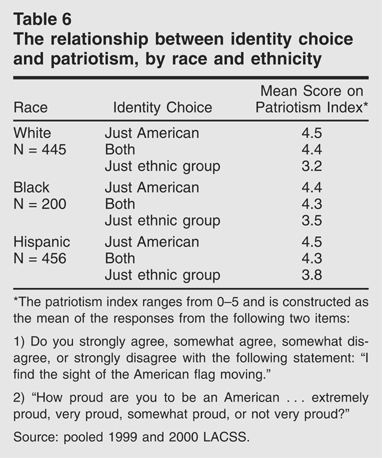
To explore further whether national and ethnic identities collide, table 6 presents the relationship between patriotism and identity choice. The data from Asian respondents in the LACSS are omitted due to the paucity of cases. Table 6 presents a simple cross-tabulation between the tripartite identity choice item and mean scores on a Patriotism Index created from two items: 1) Do you strongly agree, somewhat agree, somewhat disagree, or strongly disagree with the following statement: “I find the sight of the American flag moving,” and 2) “How proud are you to be an American … extremely proud, very proud, somewhat proud, or not very proud?” In all three ethnic groups, those identifying themselves as Americans have the highest patriotism scores. However, the difference between the “just American” and “both” groups is very small and the main gap in the level of patriotism is between these groups and respondents who define themselves in purely ethnic terms.
The relationship between identity choice and patriotism, by race and ethnicity

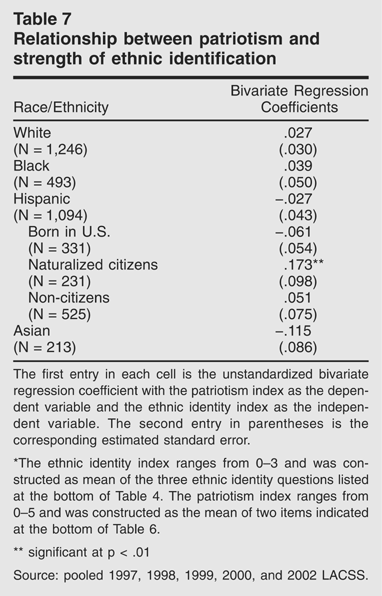
Further evidence that national and ethnic identities are not irreconcilable is shown in a summary Ethnic Identity Index based on questions about how often one thinks of oneself as a member of one's ethnic group; how close one feels to others in one's ethnic group; and how strongly one identities with others in one's ethnic group. This measure of ethnic identification is statistically unrelated to patriotism. As table 7 shows, in the LACSS data, when the Patriotism Index is regressed on the Ethnic Identity Index the unstandardized regression coefficients are statistically insignificant among whites, blacks, and Hispanics. The only nuance is that among naturalized Hispanic immigrants there is a modest, positive relationship between patriotism and ethnic identification. The fact that the hyphenated identity chosen by most minority group members in the United States does not collide with patriotism but is instead quite compatible with a strong “love of country” should assuage Huntington's deepest worry. If the generational trends in linguistic assimilation and self-identification described here persist—and this is an important if—then the present pattern of immigration is not a dire challenge to American national identity.
Relationship between patriotism and strength of ethnic identification

The Anglo-Protestant Ethic
Huntington asserts that declining acceptance of the “Anglo-Protestant Ethic” is a major challenge to traditional national identity and identifies the failure of recent Hispanic immigrants to adhere to this cultural foundation as a cause of this challenge. For Huntington, American culture is not a malleable collection of various cultural influences, as the melting pot model of multiculturalism would suggest, but rather a reflection of the culture established by those who originally settled the country. He states that if the country had been settled not by seventeenth- and eighteenth-century British Protestants but by “French, Spanish, or Portuguese Catholics” America would have a culture more akin to “Quebec, Mexico or Brazil.”38
Huntington 2004b, 59.
Ibid., 40.
The 2002 Pew Hispanic Survey asks several questions about religious beliefs. Contrary to Huntington's suggestion that Hispanics do not possess the same “religious commitment” as other Americans, these data reveal no major ethnic differences. Sixty-one percent of whites and 79 percent of blacks, when asked, respond that religion is either “very important” or the “most important” thing in life. The Hispanic sample falls between the two, ranging from 70 percent in the first generation to 65 percent in third generation Hispanics. The same pattern holds for church attendance, another measure of religiosity. Blacks (29 percent) are more likely to attend church more than once a week than whites (16 percent). Hispanics as a whole appear to attend church about as often as white respondents, with those of Mexican ancestry slightly more likely than whites or others to report going to church at least once a week. Because most Hispanics are Catholics, it is possible that their religious background and commitment might undermine rather than reinforce attachment to American symbols and values. However, extensive comparisons of identity choice, patriotism, and language use among both Hispanic and other Catholics and Protestants (not shown) consistently found no major differences. In fact, national data from both the NES and GSS confirm Huntington's observation that religion and patriotism go together. And there is no evidence that Hispanic immigrants and their offspring are quicker to abandon either God or country than other Americans.
There is a surprising lack of evidence comparing the basic values and work ethic of immigrants and other Americans. The 2002 Pew survey includes several questions regarding the value of work, but their meaning is ambiguous. For example, respondents were asked whether “you can be more successful in American workplaces if you … [are] willing to work long hours at the expense of your personal life.” Forty-seven percent of whites said that they agreed with this statement, compared to 39 percent of blacks and 27 percent of Hispanics. Whether this is an opinion about the willingness to work or about the likelihood of hard work paying off is unclear. Among Hispanics, however, the belief that working hard at the expense of family would help one get ahead was strongly related to immigrant status. Only 21 percent of immigrants agreed with the statement, compared to 40 percent of third generation Hispanics. On the other hand, when asked whether success at work in America comes from doing “what is best for yourself rather than what is best for others,” arguably an indicator of belief in the virtue of self-interest, Hispanics were more likely to agree than whites by a margin of 59 percent to 30 percent. Among Hispanics, immigrants were by far the most likely to agree, conforming in this way to the stereotypical “hard working immigrant.”
The absence of evidence regarding the values of Hispanics suggests that looking at how others, including employers, regard the reliability and competence of immigrant workers could be informative. The 1990 GSS asked a national sample to compare the work ethic of whites, blacks, and Hispanics. White respondents describe whites as more hardworking than either Hispanics or blacks, with blacks the most likely to be characterized as lazy. Interestingly, residential context appears to matter in predicting these attitudes, but in a complex way. The larger the proportion of blacks living in a respondent's state, the lazier blacks are perceived to be. The inverse holds for images of Hispanics, though: the more Hispanics in one's state, the more hard-working whites consider members of this ethnic group.40
Fox 2004.
Additional evidence comes from data regarding the opinions of employers. One study suggests that employers prefer to hire whites, but will prefer Hispanic to black employees.41
Kirschenman and Neckerman 1991.
Waldinger 1997.
An Early Balance Sheet
What has this preliminary test of Samuel Huntington's projection revealed? Before answering, several important caveats should be noted. First, as mentioned at the outset, cross-sectional data about the present cannot provide definitive answers about the trajectory of assimilation in the future. A further difficulty is that even the ability to look backward and consider how closely the assimilation of contemporary Hispanic immigrants is replicating the pattern of change among the European and East Asian immigrants of the early twentieth century is impossible due to the absence of survey data and the shifting categorizations of ethnicity employed by the U.S. Census. Language use is the one domain where comparison with the past is possible, and here the evidence is that the traditional march by successive generations toward monolingualism in English is recurring. Even here, however, the balance of forces that tilts toward assimilation rather than group difference may change in the context of demographic and political trends we cannot anticipate.
Another important caveat is that much of the evidence reported here excludes consideration of illegal immigrants who mainly come from Mexico. The number of illegal immigrants is difficult to estimate, but this group clearly comprises a significant segment of Mexican immigrants. Illegal immigrants are less educated, more likely to work in agriculture and other low-wage jobs, more likely to speak Spanish, and more likely to live in ethnic enclaves. In short, illegal immigrants are less likely than other immigrants or native-born Hispanics to become integrated into mainstream society or to view themselves as members of the American political community. Their under-representation in this study of Hispanics means that we have overestimated the extent of linguistic and political assimilation of first-generation immigrants. At the same time, given the disengagement of illegal immigrants from participation in American politics, their presence may not register much on the kinds of changes in national identity and national policy that Huntington is projecting.
As noted earlier, the evidence presented here clearly establishes that the acquisition of English and the loss of Spanish occur rapidly beginning with the second generation of Hispanic immigrants. While the initial level of English-speaking is lower among Mexican than other immigrants, the rate of linguistic assimilation between generations is at parity if not more rapid for this group. Moreover, whereas residential concentration in ethnic enclaves contributes to the retention of Spanish, this does not slow the learning of English, and bilingual Hispanics are more similar in their political self-concept to English-dominant than Spanish-dominant Hispanics.
While data allowing us to test the extent to which Hispanic immigrants are adopting what Huntington calls the “Anglo-Protestant Ethic” are limited, in terms of both professed importance of religion and church attendance, Hispanics appear to be no more or less religious than whites. Nor do they exhibit a lower commitment to the importance of working hard to get ahead.
Huntington contrasts several future scenarios for the United States, with a culturally unified nation committed to revitalizing the melting pot and reaffirming the traditional creed and “Anglo-Protestant ethic” as one possibility, and a bifurcated nation with English-speaking and Spanish-speaking entities confronting each other much as the two Canadian “solitudes” as another.43
MacLennan 1945.
Patriotic sentiment among Hispanics is pervasive. While blacks and non-citizen Hispanics express slightly less patriotism than whites, after adjusting for differences in age and education native-born Hispanics actually evidenced higher levels of patriotism. And neither a tendency to refer to oneself as a Hispanic-American rather than “just an American” nor a strong sense of ethnic identification diminished expressions of patriotism. National and ethnic identities are not on an unavoidable collision course.
The theory underlying Huntington's image of challenges to American identity presumes strong connections among the structural, cultural, and political dimensions of immigrant assimilation. Clearly, these relationships are not iron-clad; American blacks remain to some extent structurally unassimilated despite their linguistic and cultural assimilation. Huntington shares the fears of scholars such as Alejandro Portes and Richard Rumbaut that the mismatch between the skills and education of Hispanic immigrants and the demands of the American economy may result in “segmented” rather than “straight-line” assimilation, with lower status groups in the second and third generations remaining socially and culturally isolated.44
Portes and Rumbaut 2001.
Things may change, but the balance of evidence available at present suggests that Mexican immigration is not the threat to American national identity that Huntington and others assert. Huntington may be on firmer ground in pointing to diminishing nationalism and patriotism among the country's academic, business and media elites, including their Anglo-Protestant segment. Ironically, then, to the extent that assimilation is the acceptance of the values of the dominant groups in society as one is exposed to the messages of social institutions like schools, colleges, and the mass media, the impact of globalization and the embrace of multiculturalism among elites might ultimately mean that Americanization may no longer include commitment to the ideal of “one nation, after all.”45
Wolfe 1999.