Introduction
Dementia leads to progressive decline in cognitive function, including memory, language, executive function, perceptual-motor, and social cognition (Sorrell, Reference Sorrell2013). Patients with early cognitive impairment (ECI), comprising early dementia and mild cognitive impairment (MCI), face the prospect of progressive cognitive decline that impairs their ability to make informed and autonomous decisions for themselves on healthcare, financial, and personal matters.
Advance Care Planning (ACP) is a process that facilitates decision making on future care and helps patients with chronic or terminal illnesses make known their wishes before they lose their ability to do so (Triplett et al., Reference Triplett2008). Prior to engaging in ACP, a patient may be unaware of its importance or relevance. With education and counseling, patients may understand better the relevance of ACP and desire to initiate ACP. In the process of ACP, the patient may identify and legally appoint a proxy decision maker who is familiar with his wishes and preferences (Lee, Reference Lee2014) to make decisions on his behalf in the event he loses mental capacity.
Past research has suggested valuable benefits of ACP for patients with dementia. As dementia causes progressive loss in patients’ mental capacity (Burgener et al., Reference Burgener, Yang, Gilbert and Marsh-Yant2008), patients may reach a state in which they may be unable to express their preferences with regards to medical care (Hirschman et al., Reference Hirschman, Kapo and Karlawish2008). Patients’ inability to communicate healthcare choices at the time when decisions are needed may add to the stress of family members or caregivers (Hirschman et al., Reference Hirschman, Kapo and Karlawish2008). Guided by the patient's known preferences, family members are less likely to struggle with decision making, which in turn, reduces their stress and improves family satisfaction (Sampson et al., Reference Sampson2011). In addition, a systematic review of ACP in patients with dementia or cognitive impairment found that ACP improved documentation of preferences of care and reduced inappropriate hospital admissions and interventions (Robinson et al., Reference Robinson2012).
Despite the advantages of ACP in empowering decision making and promoting person-centered care, acceptance remains poor. The uptake of ACP in patients with dementia or cognitive impairment ranges from 3.0% to 58.0% (van der Steen et al., Reference van der Steen2014), depending on the setting which may be nursing homes, home care, ambulatory care, or general practitioner clinics. The factors contributing to poor uptake of ACP in patients with dementia remain poorly understood.
In a sample of 30 patients with Alzheimer's disease and their family members in the USA, two important barriers to ACP were attributed to family caregivers (Hirschman et al., Reference Hirschman, Kapo and Karlawish2008). These included passive avoidance – family members did not acknowledge the importance of ACP nor the need for discussion, as well as active avoidance – caregivers avoided the topic altogether, especially when it was difficult to broach the topic with patients. Exploration into reasons for non-uptake of ACP in a predominantly Chinese pool of patients with ECI produced insightful findings. Some patients adopted a passive and disinterested stance toward discussions about future care plans while others were in denial of their illness and perceived ACP as irrelevant (Cheong et al., Reference Cheong, Fisher, Goh, Ng, Koh and Yap2015). Systematic reviews (van der Steen et al., Reference van der Steen2014) have identified predominantly family factors behind initiation of ACP discussions, but did not identify factors leading up to and contributing to completion or non-completion of advance care plans.
In view of a dearth of published research on ACP completion rates and the factors that predict the outcome, we conducted a prospective study to determine factors related to completion or non-completion of ACP in patients with ECI at a memory clinic of a tertiary hospital. We adopted both quantitative and qualitative research methods.
Methods
Participants
A total of 158 patients were recruited from the memory clinic of a tertiary hospital in Singapore. Ethics approval for the study was obtained from Domain-Specific Review Board of the National Healthcare Group. The inclusion criteria included a diagnosis of ECI (MCI or early dementia), Global Clinical Dementia Rating (GCDR) of 0.5 or 1, having at least “fair (3)” to “good (4)” insight based on the Guidelines for the Rating of Awareness Deficits (GRAD). Diagnosis of dementia was based on the Diagnostic and Statistical Manual of Mental Disorders IV (American Psychiatric Association & American Psychiatric, 2013) while the Consensus Criteria (Winblad et al., Reference Winblad2004) was used for MCI diagnosis. Patients who already had ACP were excluded.
Materials
Global clinical dementia rating (GCDR)
The GCDR (Morris, Reference Morris1993) assesses global mental dementia severity based on combined scores of cognitive, social, and functional aspects of the patient by a clinician. An overall score is obtained that ranges from 0 to 3 (0 = normal, 0.5 = questionable dementia, 1 = mild, 2 = moderate, 3 = severe dementia).
Guidelines for the rating of awareness deficits (GRAD)
The GRAD scale (Verhey et al., Reference Verhey, Rozendaal, Ponds and Jolles1993) uses a semi-structured interview to assess the patient's degree of awareness of his cognitive deficits by comparing the patient's and caregiver's accounts of patient's memory and other cognitive functions. Impaired awareness is defined as the absence of knowledge or recognition of cognitive deficits and its impact. It is rated on a four-point scale, ranging from 4 (intact), 3 (mildly disturbed), 2 (moderately disturbed) to 1 (absent).
Mini-mental examination state (MMSE)
The Mini-Mental State Examination (MMSE) is a 30-point test that systematically assesses five domains of cognitive function: orientation, registration, attention and arithmetic, recall and language. It is established to be an effective screening tool for older adults’ mental capacity, with high inter-rater reliability (0.88) and test–retest reliability (0.98) (Folstein et al., Reference Folstein, Folstein and McHugh1975).
Procedures
Consecutive patients with ECI underwent an introductory psycho-education session on the purpose and importance of ACP by trained counselors as part of an on-going ECI counseling program in the memory clinic. The introductory psycho-education session was conducted by counselors who were medical social workers with formal training and certification by a local ACP training program, which is modeled after the Respecting Choices program in the USA. The counselors followed a protocol to elicit patient's goals, values, and beliefs and their understanding of dementia. The counselors explained to patient and family members the process and benefits of ACP.
Patients who expressed willingness to have further ACP discussions had further sessions arranged for them. The ACP could be in the form of formal documentation of values, wishes, and beliefs that would inform future decision making, or formal identification and appointment of proxy decision makers. Their decisions and accompanying reasons for completion of ACP were documented in the case records by the counselors.
All patients continued to see their physicians in the memory clinic for regular reviews and those who had initially declined further conversations on ACP would be paced along and reminded of the relevance of ACP whenever the physician deemed appropriate. We followed each patient for up to 12 months to determine if the patients had completed ACP.
As we wanted to better understand why some patients did not eventually make advance care plans even though they had expressed willingness to engage in further discussion sessions about ACP after the introductory psycho-education session, we followed-up with a careful review of their clinical notes for up to one year. We examined the reports of various healthcare professionals including doctors, nurses, counselors, and ACP facilitators. We also extracted verbatim qualitative comments by the clinician that were of relevance to ACP from the reports.
All verbatim comments from the reports were checked for accuracy and subjected to a thematic analysis. Two researchers independently examined the words and phrases that repeatedly appeared in the descriptive comments of the clinical notes. We attempted to look for patterns presented by these recurrent words and phrases, and made connections to derive emergent themes. We compared codes and discussed differences to reach consensus on a coding system. When in doubt, we checked with a senior consultant geriatrician to ensure we understood the meaning and perspectives represented by the comments, so as not to be influenced by the researchers’ own agenda and bias. As the amount of qualitative comments was not extensive, the coding was done manually and not assisted by any computer software.
Data analysis
Using the statistical software SPSS V22.0, univariate analysis by χ 2 test and multivariate analysis by logistic regression was performed to determine the association between socio-demographic factors including age, gender, race, marital status, education, dementia stage by GCDR, and MMSE scores with completion of ACP.
The clinical records were reviewed and subjected to a content analysis to uncover possible reasons that could explain why ACP did not materialize for some patients. Qualitative comments were regrouped under themes with sub-headings and scrutinized to uncover common themes across the clinical records.
Results
We enrolled 158 participants aged between 45 years and 94 years old (M age = 76.2 years, SD = 7.25), including 96 females (60.8%) and 62 males (39.2%). Majority were Chinese (89.9%), had been married or still married (94.9%) and about half received less than secondary/high school education (54.4%). The mean score for the MMSE was 20.96 (SD = 3.61).
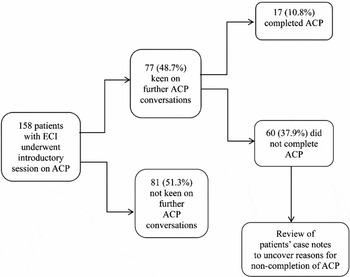
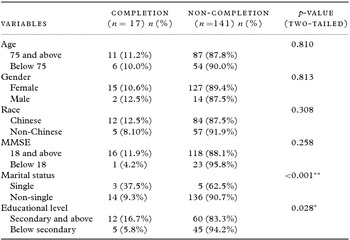
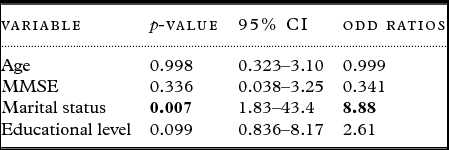
Seventy-seven patients were initially willing to consider further conversations on ACP but only 17 (10.6%) eventually completed advance care plans at one-year (Figure 1). Table 1 summarizes the participants’ characteristics and results from univariate analysis. Pearson's χ 2 test (α = 0.05) indicated significant associations between marital status and educational level toward completion of ACP. Table 2 shows the results of the logistic regression model that incorporated age, marital status, educational level, and MMSE, which revealed that patients who were single (never married) were 8.88 times more likely to complete ACP than those who had ever been married (p = 0.007). Age (p = 0.998), gender (p = 0.308), race (p = 0.813), education (p = 0.099), and MMSE score (p = 0.336) were not significantly associated with completion of advance care plans.
Flow chart of the study process.

Univariate analysis for factors associated with completion and non-completion of ACP

Note: *Indicates p-value of < 0.05, **Indicates p-value of < 0.01
Output from logistic regression on factors associated with completion of ACP

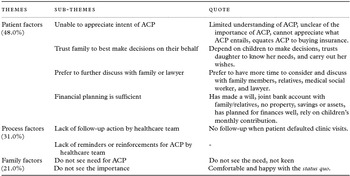
Content analysis of the clinical records revealed three main themes that accounted for eventual failure to complete advance care plans: patient factors (48.0%), process factors (31.0%), and family factors (21.0%). As regards patient factors, it was documented in clinical notes that the patients “had limited understanding of ACP” or were “unable to appreciate what ACP entails.” These were categorized under the sub-theme “unable to appreciate intent of ACP.” Patients also expressed their “trust in family members to make decisions” and “carry out (patients’) wishes,” or stated a preference “to further discuss with family members or lawyer” on ACP. More significantly, many case notes recorded a sense of financial security among patients who did not complete ACP. This was evidenced by expressing they had completed a will or set up a joint account with a trusted family member. On the other end, patients who claimed to “have no property” to plan for and only “relied on children's monthly contribution” for their living expenses also did not complete advance care plans as they failed to appreciate the need for ACP beyond financial concerns. These factors were categorized under the sub-theme “financial planning is sufficient.” Further details on patient factors are outlined in Table 3.
Content analysis of medical records to understand reasons for non-completion of ACP

As regards process factors, if there was no further mention of ACP discussion with the patient in the clinical notes despite initial documentation of the intention to follow-up during the introductory session, the descriptor “lack of follow up by healthcare team” was applied. The descriptor “lack of reminders or reinforcements to the patients by the healthcare team” was applied when a member of the healthcare team documented the intention for another team member to follow-up on ACP-related issues but no further reminders or reinforcements were reflected in the clinical notes. Typically, this occurred after the introductory session where the counselor indicated the need for the patient's attending nurse or physician to revisit ACP but no follow-up action ensued.
Lastly, the clinical records also reflected the influence of family related factors in completion of advance care plans. The factors found to impede ACP included “do not see need for ACP” and “do not see the importance.”
Discussion
Although ACP has been promoted for over a decade as a means to uphold patients’ autonomy, rates of completion of advance directives have been generally modest. The same can be said of ACP in people with dementia. A study conducted in a university memory clinic in the USA showed that only 39.0% of patients with ECI completed ACP (Garand et al., Reference Garand, Dew, Lingler and DeKosky2011). Our study, one of few studies exploring ACP in the Asian context, again highlights the issue with just 10.6% of patients with ECI completing advance care plans. The problems with ACP have been raised and can revolve around the changing nature of patients’ preferences, personal identity, and the continuity between one's former and present selves, as well as the influence of family members (Fagerlin and Schneider, Reference Fagerlin and Schneider2004). Importantly, while advance directives are meant to reduce the need for deliberation in end of life decisions, such decisions are often the outcome of thoughtful discussions involving medical professionals, patients, and families. It would thus seem inappropriate and perhaps unfair to patients to engage them in such complex decisions when the event is remote and the circumstances presented only hypothetical (Spranzi and Fournier, Reference Spranzi and Fournier2016).
The main finding of our study was the high likelihood of patients who never married completing advance care plans compared to their married counterparts. There was no similar association of other demographic factors such as age, gender, race, and education or cognitive status (MMSE) with completion of advance directives. Intuitively, we could surmise that as singles had no immediate family members to depend on, they were more attuned to the importance and relevance of planning ahead. Singles may have been accustomed to making decisions independently, so ACP may sit well with their need to exercise control over all aspects of their lives. This quote from a patient in the paper by Fournier et al. (Reference Fournier, Berthiau, Kempf and d'Haussy2013) is relevant: “The ultimate decisions should not belong to doctors, they are strangers. That is the reason why I wrote advance directives; and I did so because I am alone, there is nobody around anymore.”
Furthermore, when examining how persons with cognitive impairment made decisions on health and daily care (Smebye et al., Reference Smebye, Kirkevold and Engedal2012), the researchers noted that few made decisions independently. Rather, patients primarily relied on shared decision making with family members as they did not trust their own judgment for complex decisions with consequences. As awareness of their own cognitive disabilities and fear of making wrong decisions increased, patients with cognitive impairments also tended to delegate decisions and authority to trusted others such as family members. With progressive decline in cognitive function, the patients’ self-attributed roles and powers in decision making could diminish. This may lead to increased reliance on close associates, usually family members, for decision making and therefore moderating the value and importance of ACP in married individuals compared to singles.
Although close to half (48.7%) of the patients were open to conversations about ACP initially, only 10.6% eventually completed advance directives. We sought to better understand the reasons by examining the patients’ clinical records. Thematic analysis identified three main factors that can account for the low rates of eventual completion of advance care plans, namely, patient factors (48.0%), family factors (21.0%), and process factors (31.0%). Patient factors included limited understanding of the concept of ACP, deferring decision making to the family, and perception that financial issues had been sorted out. Indeed, an earlier study (Tay et al., Reference Tay, Davison, Jin and Yap2015) had found that education and cognitive function, in particular executive function, have significant bearings on the receptiveness of patients to ACP. Moreover, univariate analysis in this study did show a significant association between higher education levels and increased probability of completion of advance directives. Additionally, some patients see the need for future planning primarily in terms of managing finances. Thus, if informal or formal means of financial planning had been undertaken, there is little urgency and need for planning in the other areas of personal welfare and end-of-life matters. It is therefore important to help patients recognize that ACP goes beyond financial planning and this needs to be introduced in the earliest instance possible to capitalize on the narrow window of opportunity while they may still have adequate mental capacity to appreciate the issues.
The study highlights the importance of the family in making care decisions for the patient. As depicted in Table 3, patients trust their families to make decisions on their behalf and prefer to discuss with the family about the need for ACP. Lack of support from the family emerged as a reason for non-completion of advance care plans while the absence of the family, seen in those who never married, was associated with an increased likelihood of ACP completion. Family-oriented decision making is typical in Asian settings (Campos et al., Reference Campos, Ullman, Aguilera and Dunkel Schetter2014). Familism affects relationships in such a way that the collective needs of family are considered more essential than those of any of the individual members. An underlying principle of familism is the belief that family is in the best position to offer the right decisions according to a member's dependency and need. When the collective values are not receptive toward ACP and the family is prioritized over the individual, it is less likely that the patient will see the relevance of making autonomous advance care plans. As a result, in families where familism prevails, the value and relevance of ACP can be diminished. Another family factor that impeded ACP completion was the reluctance to discuss the issues pertaining to end of life which are viewed as taboo. This phenomenon is not uncommon in the Asian context and has been described in a previous study in our population (Cheong et al., Reference Cheong, Fisher, Goh, Ng, Koh and Yap2015). Given the inherent complexities in ACP with yet the desire to uphold autonomous decision making, the cognitive limitations of patient with ECI, and the importance of familism in the Asian context, engaging these patients in a limited form of ACP which prioritizes family engagement by empowering trusted family members as proxy decision makers could present a viable way forward.
Lapses in operational processes contributed significantly to low ACP completion as well. Given the challenges that already abound in promoting ACP, processes should be optimized to facilitate people with ECI to make advance care plans. The problems could be narrowed down to inadequate communication between care team members. Putting in place team-based interdisciplinary care whereby team members meet regularly to discuss about the patients they care for may bridge this gap. In addition, building information technology enabled alerts and reminders can serve as useful aids for doctors, nurses, and case managers who provide continuing care for the patients to pace along with them and bring up ACP whenever appropriate. To this end, there is a need to train healthcare professionals to be more effective advocates for ACP. Lastly, a standardized way to document and track the process from initiation of discussions on ACP to the eventual completion of advance directives can help ensure that patients are not lost to follow-up.
Some limitations of the study should be mentioned. First, content analysis was based on retrospective review of the medical records which were mostly hand written entries of medical staff. Apart from the inherent issues with interpretation, clarity, completeness, and accuracy of these records, if compared to purposeful audio transcripts of the encounters between patient and healthcare professionals during conversations about ACP, the latter evidently better captures the granularity of information and subtleties surrounding the matter. Second, the medical staff may not have been uniform in their approach to engaging the patients on ACP, this would lend an added layer of variability to the outcome. Third, as the study was conducted in an Asian population which is predominantly Chinese, the results may not be generalizable to other populations given the differing cultural factors affecting end of life decision making. Nevertheless, being primarily an evaluation study of an on-going ACP initiative based in a memory clinic, the study has provided useful insights into the factors influencing the completion of ACP, especially the barriers encountered.
Conclusion
Our study has shown that advance care plans are actualized in only a minority of patients with ECI, and unmarried patients are more likely to do so compared to married patients who may delegate decision making to family members. In order to facilitate autonomous decision making in the context of patients with ECI and a society that embraces collective decision making within the family, ACP which entails family involvement by entrusting family members as proxy decision makers can attain the middle ground needed on this issue. Streamlining operational processes will only aid in efforts to do this better.
Conflict of interest
None.
Description of authors’ roles
Tong Jen Lo formulated the research question, collected and interpreted the data, and wrote the paper. Ngoc Huong Lien Ha designed and performed the statistical analyses, and wrote the paper. Chong Jin Ng assisted with interpreting the data and revised the paper. Gabriel Tan collected data and revised the paper. Hui Mien Koh collected data. Philip Lin Kiat Yap conceptualized the study, supervised data collection and analyses, interpreted the data, and revised the paper.