ECOLOGY AND ITS ROLE IN SOCIETY
The discipline of ecology, which emerged as a science at the beginning of the 20th century, has from its inception drawn on methods and concepts from other disciplines as it developed and defined itself. Initially concerned with the study of the distribution, interaction and abundance of organisms in their natural (namely non-human) environments, ecology was rarely concerned with human society and treated people as an uninvolved ‘ecological audience’ (Lowe et al. Reference Lowe, Whitman and Phillipson2009). But, by the middle of the 20th century, a growing awareness of environmental problems, such as human population growth, pesticides and pollutants, had prompted ecologists to consider their role in society and call for a more applied ecology. In one of the earliest applied ecology editorials, Bunting and Wynne-Edwards (Reference Bunting and Wynne-Edwards1964) argued that applied ecology ‘employed in situations of economic and social interest to mankind’ could play an important role in society with ‘thinking and methods [that could] more than ever before contribute to the progress of mankind’. This view of the central role of ecology in the management of ecosystems and their natural resources, and in stemming the ever increasing list of environmental problems, was commonly expressed in several foundational editorials in major ecology journals up until the 1980s (Lowe et al. Reference Lowe, Whitman and Phillipson2009). During this period humans and their activities were seen as external factors (‘ecological agents’; Lowe et al. Reference Lowe, Whitman and Phillipson2009) in the management of natural, as well as semi-natural ecosystems.
By the end of the 20th century, the scale of environmental problems and the seemingly minimal influence of ecology on these problems had forced ecologists to reconsider ecology's place and role in society (Lubchenco Reference Lubchenco1998; Daily & Ehrlich Reference Daily and Ehrlich1999; Ludwig et al. Reference Ludwig, Mangel and Haddad2001; Meffe et al. Reference Meffe, Ehrenfeld and Noss2006; Wu Reference Wu2006). In what Lowe et al. (Reference Lowe, Whitman and Phillipson2009) termed the ‘changing conceptualization of the human dimension’, this period saw a shift in ecologists’ perceptions of people from one of ‘ecological agents’ to ‘ecological subjects or objects’. This recognition that humans are not external agents in the study and management of ecosystems, but rather an integral part of complex adaptive social-ecological systems (Carpenter & Folke Reference Carpenter and Folke2006) played a major role in changing ecology's course and place in society. Ecologists began to recognize not only the complex role that human forces play in structuring the Earth's ecosystems (Vitousek et al. Reference Vitousek, Mooney, Lubechenco and Melillo1997; Redman Reference Redman1999), but also the fact that ecosystem management and conservation are ‘primarily not about biology but about people and the choices they make’ (Balmford & Cowling Reference Balmford and Cowling2006). Management interventions or actions are not ecological, but are the product of human decisions and are ultimately human behaviours or changes in human behaviour (Mascia et al. Reference Mascia, Brosius, Dobson, Forbes, Horowitz, McKean and Turner2003; Fox et al. Reference Fox, Christian, Nordby, Pergams, Peterson and Pyke2006).
In this process of transforming ecology's perception of the human dimension and ecology's role in society, the emergence of the concept of ecosystem services has the potential to play a fundamental role. Ecosystem services are the benefits that people obtain from ecosystems and include a wide range of benefits from products like food and timber, through to regulating and supporting functions which produce clean water and air, stable climates, fertile soils and disease control. They also include cultural services associated with aesthetic, spiritual and recreational values (MA [Millennium Ecosystem Assessment] 2003). While the notion of human dependence on ecosystems stretches back several millennia, it was only in the middle of the 20th century that this dependence gained recognition through the work of authors like Aldo Leopold. The explicit recognition of ecosystem services is more recent and dates from the 1970s and 1980s (Mooney & Ehrlich Reference Mooney, Ehrlich and Daily1997). The publication of Daily's (Reference Daily1997) Nature's Services, Costanza et al.'s (Reference Costanza, d'Arge, de Groot, Farber, Grasso, Hannon, Limburg, Naeem, O'Neil, Paruelo, Raskin, Sutton and can den Belt1997) paper on the value of ecosystem services in Nature and the advent of the United Nations Millennium Ecosystem Assessment in 2000 (MA 2003) marked the beginning of mainstream ecosystem service science. The concepts encapsulated by ecosystem services enable ecologists to conceptualize a more integrated picture of the links between people and ecosystems, and between their science, other disciplines and society. Furthermore there is the potential for ecosystem services and their ongoing provision to present a common challenge for many disciplines and sectors of society, encourage engagement and the development of a shared language, as well as a respect for the value added by all knowledge areas (Le Maitre et al. Reference Le Maitre, Milton, Jarmain, Colvin, Saayman and Vlok2007).
As ecology and its role in society evolve, so too must its relationships with other disciplines and its interactions with people and processes outside of the domain of science (Ludwig et al. Reference Ludwig, Mangel and Haddad2001). In this way, ecosystem services could potentially help bridge divergent worldviews, epistemologies (or knowledge systems) and approaches entrenched in individual disciplines and sectors of society as they integrate ecosystems and humans. Despite many excellent reviews on how ecology must and could become interdisciplinary, and the establishment of some interdisciplinary research agendas (for example special issues by Turner & Carpenter Reference Turner and Carpenter1999; Satake & Iwasa Reference Satake and Iwasa2009; Phillipson et al. Reference Phillipson, Lowe and Bullock2009) it is not clear how far ecology has come in developing relationships with other disciplines, how far it still needs to go and whether ecosystem services have been a useful concept in this development. These questions form the basis of this review, which aims to evaluate the interdisciplinary progress made by ecologists, investigate how the emergence of the ecosystem service concept contributed to this progress and provide some thoughts on future directions in ecology. This is a global review of the history of ecology and ecosystem service research. The review is not intended to be exhaustive and rather relies on the special issues mentioned above, several recent reviews on ecosystem services, and other pertinent literature and editorials, to examine the interdisciplinary progress of ecology, with a particular focus on the role of ecosystem services in this transition. It should be noted that our review relies largely on English language North American and European journals and as such provides a biased view of ecology, a bias we return to in our conclusions.
BRIDGING DISCIPLINARY DIVIDES
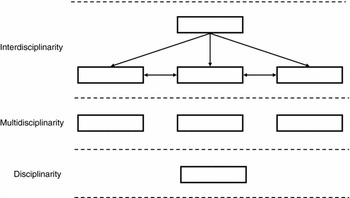
When it comes to bridging disciplines many terms are used, including multidisciplinarity, interdisciplinarity and, more recently, transdisciplinarity. In this review, we use the definitions of Lengwiler (Reference Lengwiler2006) and Max-Neef (Reference Max-Neef2005), particularly the latter's continuum of the discipline (Fig. 1). Disciplinarity is about the mono-discipline and represents specialisation in isolation. Multidisciplinarity is the next step along the discipline continuum and represents more than one discipline being studied or applied without actually integrating the disciplines. Lengwiler (Reference Lengwiler2006) distinguished between multidisciplinarity as cooperation with a low degree of exchange between the disciplines, and interdisciplinarity as cross-disciplinary cooperation feeding back into disciplinary knowledge. Jantsch (Reference Jantsch1972) and Max-Neef (Reference Max-Neef2005) depicted interdisciplinarity as being organized at two levels where the higher level interdiscipline coordinates and gives a purpose to the lower level disciplines. Max Neef (Reference Max-Neef2005) provided the example of medicine, which becomes interdisciplinary as it gives a purpose to the lower level disciplines of biology, chemistry and psychology.
The continuum of the discipline depicting the specialization in isolation of disciplinarity, disciplinary cooperation with a low degree of exchange in multidisciplinarity and interdisciplinarity as cooperation with a feedback into disciplinary growth, where the higher level discipline defines the purpose of the underlying disciplines. Reprinted from Max-Neef (Reference Max-Neef2005) with permission from Elsevier.

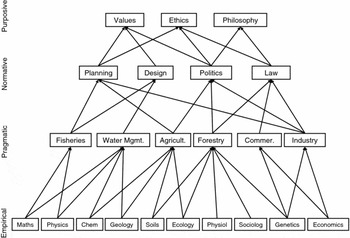
In conducting this review we move beyond an assessment which lists all of the disciplines with which ecology engages and instead use the hierarchy of knowledge conceptualized by Jantsch (Reference Jantsch1972) in his work on restructuring the education and innovation system at universities. Jantsch (Reference Jantsch1972) ordered knowledge into a hierarchy of four levels: purposive (values), normative (social systems design), pragmatic (physical technology, social and natural ecology) and empirical (physical inanimate world, physical animate world and [human] physical world). Empirical disciplines at the base of the hierarchy describe what exists, those at the pragmatic level describe what is possible, those at the normative level describe what is wanted and the top purposive level deals with disciplines which describe what is desirable.
Jantsch (Reference Jantsch1972) presented this hierarchy to illustrate what a truly interdisciplinary system of knowledge and innovation would look like. He rejected the division of the disciplines, a division which assumes that by empirical observation and logic a mechanistic understanding of the world could be developed. Instead he argued that within a purposive (human action rather than mechanistic) system this division becomes meaningless and should be replaced with interdisciplinarity as an organizing principle. Interdisciplinarity constitutes a two-level coordination of scientific disciplines, a coordination which changes the concepts, structures and aims of the scientific disciplines at both hierarchical levels (Fig. 1). In this hierarchy, disciplines (interdisciplines) at each level are informed by disciplines at underlying levels, but at the same time coordinate, restructure and give purpose to the underlying disciplines. Interdisciplinarity organizes science to an end by linking two levels of the hierarchy with the aim of coordination under a common viewpoint or purpose; this purpose or axiomatic is introduced from the higher level.
Jantsch (Reference Jantsch1972) moved beyond two-level interdisciplinary coordination to an ultimate degree of coordination which he termed transdisciplinarity. Transdisciplinarity coordinates all disciplines and interdisciplines in the knowledge hierarchy on the basis of an overall purpose introduced from the purposive level down. Changes in this overall purpose result in changes in the transdisciplinary concepts and principles of the knowledge hierarchy. He used the example of changes in the overall purpose of the knowledge system from a system that values ‘progress’ to one that values ‘ecological balance’ to indicate the totally different knowledge system implied. Jantsch (Reference Jantsch1972) pointed out that the need to recognize a purpose or unambiguous direction for scientific and organizational efforts represents a major challenge to the way knowledge systems are currently structured and managed. This need requires a focus on the top levels of the knowledge hierarchy in the search for and inclusion of values and norms into the research process.
The knowledge hierarchy has formed the basis of recent developments in transdisciplinary concepts and approaches in sustainability research. Max-Neef (Reference Max-Neef2005) used the hierarchy in his foundations of transdisciplinarity and added to it by exploring realms of reality, complexity and modes of reasoning, while Hadorn et al. (Reference Hadorn, Bradley, Pohl, Rist and Wiesmann2006) explored its implications for sustainability research and added to it the importance of stakeholders in civil society in driving bottom-up transdisciplinary research; a research process which shifts from a simple process providing a solution, to a social process resolving a problem through the participation and mutual learning of stakeholders. Horlick-Jones & Sime (Reference Horlick-Jones and Sime2004) also pointed out that transdisciplinary collaboration forges linkages between scientific disciplines, as well as beyond, forming bridges between different knowledge spheres. Transdisciplinary approaches are better able to tackle complexity and the fragmentation of knowledge, work with local contexts and uncertainty, and promote close collaboration and communication during all phases (Abel & Stepp Reference Abel and Stepp2003; Horlick-Jones & Sime Reference Horlick-Jones and Sime2004; Lawrence & Depres Reference Lawrence and Despres2004). They are action oriented, making linkages between science and practice while generating knowledge on societal problems and their solutions (Liu et al. Reference Liu, Costanza, Farber and Troy2010). A transdisciplinary approach is therefore a more integrated one, where the boundaries between disciplines and between science and society become more permeable.
We use Max Neef's (Reference Max-Neef2005) version of Jantsch's (Reference Jantsch1972) hierarchy (Fig. 2), together with principles and descriptions from Max-Neef (Reference Max-Neef2005), Hadorn et al. (Reference Hadorn, Bradley, Pohl, Rist and Wiesmann2006) and others, to describe what would be required to make ecology inter- and even trans-disciplinary, as well as the progress made by ecology in meeting these requirements. We attempt to distinguish the role that the concept of ecosystem services has played in moving ecology along this disciplinary continuum from monodisciplinary to transdisciplinary, and discuss some future directions for ecology at each level.
The knowledge hierarchy of Jantsch (Reference Jantsch1972) (as depicted by Max Neef Reference Max-Neef2005). Agricult. = Agriculture, Commer. = Commerce, Mgmt = Management, Chem = Chemistry, Physiol. = Physiology, Sociol. = Sociology. Empirical disciplines at the base of the hierarchy describe what exists, those at the pragmatic level describe what can be done, those at the normative level describe what is wanted, and the top purposive level deals with disciplines that describe what is desirable. Reprinted from Max-Neef (Reference Max-Neef2005) with permission from Elsevier.

Empirical level
The empirical level includes the basic life, earth, social and human sciences which use logic as their organizing language and usually claim objectivity (Jantsch Reference Jantsch1972). At this level ecology owes its existence to a long history of multidisciplinary cooperation between several empirical disciplines, especially those from the life and earth sciences (such as soil science, biology, maths, biogeography, physics and physiology; Fig. 2). Originally cooperation was within the biological disciplines, as early ecologists focused on the distribution, interaction and abundance of organisms, but, with the emergence of the field of applied ecology, the disciplinary focus widened to include more of the life and earth sciences. For example, the editorial of the first issue of the Journal of Applied Ecology, published in 1964, pointed to new applied ecology frontiers of land use, natural resource management, energy and water balances of vegetation, and the physiological base of plant competition in crops (Bunting & Wynne-Edwards Reference Bunting and Wynne-Edwards1964). However, despite the mention of other disciplines and the use of the words ‘economic’ and ‘social’ in several such early editorials, the discipline of ecology remained firmly entrenched in the natural sciences at this time.
The 1970s saw ecology making its first forays outside of the natural sciences into the social sciences, collaborating with economists (Mangel et al. Reference Mangel, Talbot, Meffe, Agardy, Alverson, Barlow, Botkin, Budowski, Clark, Cooke, Crozier, Dayton, Elder, Fowler, Funtowicz, Giske, Hofman, Holt, Kellert, Kimball, Ludwig, Magnusson, Malayang, Mann, Norse, Northridge, Perrin, Perrings, Peterman, Rabb, Regier, Reynolds, Sherman, Sissenwine, Smith, Starfield, Taylor, Tillman, Toft, Twiss, Wilen and Young1996; Ropke Reference Ropke2004). As Lowe et al. (Reference Lowe, Whitman and Phillipson2009) suggested, it was perhaps similarities in some economists’ focus on scarce resources, intellectual heritage and positivist quantitative perspectives, as well as their close links to government, which made collaboration possible and desirable. Through social processes within the researcher community, this alliance between ecology and economics grew and strengthened and, by the late 1980s, the field of ecological economics was well developed and recognized (Ropke Reference Ropke2004). More recently there has been some evidence of ecology's broader engagement of the social sciences, including psychology (Saunders et al. Reference Saunders, Brook and Myers2006; Kumar & Kumar Reference Kumar and Kumar2008), anthropology (Drew & Henne Reference Drew and Henne2006; Caillon & Degeorges Reference Caillon and Degeorges2007) and sociology (Gragson & Grove Reference Gragson and Grove2006; Andersen Reference Andersen2008). These interactions not only contributed to the development of ecology, but also provided direction to many other disciplines at the empirical level. One such important contribution has been the introduction of concepts of complex systems, which have proved useful in several natural and social sciences (for example see Abel & Stepp Reference Abel and Stepp2003).
At the empirical level, modern day ecology is currently well integrated with many disciplines from both the natural and the social sciences, although interactions with the social sciences are less common and often foundational (Carpenter & Turner Reference Carpenter and Turner2007). Furthermore, ecology has moved beyond simple multidisciplinary cooperation with other sciences and now engages with the natural and social sciences in a way that grows ecology, as well as the disciplines with which it interacts, resulting in an interdisciplinary science and approach that is greater than the sum of its disciplinary parts (Scheffer et al. Reference Scheffer, Brock and Westley2000; Hodgson et al. Reference Hodgson, Maltby, Paetzold and Phillips2007). Jantsch (Reference Jantsch1972) indicated that the four hierarchical levels (Fig. 2) were further subdivided into a ‘fine-structure of hierarchical sub-levels’ and hence the notion of interdisciplinary coordination can operate within each of the four levels as well as between. Thus ecology can be said to represent an empirical interdiscipline, shaping and being shaped by many empirical disciplines. This progress may be a result of what Phillipson et al. (Reference Phillipson, Lowe and Bullock2009) referred to as ecology's ‘portmanteau’ research and education approach, which is broad and externally focused, and results in the training of ecologists with cross-disciplinary aspirations (cross-disciplinary is a neutral term referring to engagements between ecological and social scientists without specifying whether the engagement is multi-, inter- or transdisciplinary).
Much of the progress made by ecology in integrating the life and earth sciences predates the introduction of ecosystem service concepts into mainstream ecology. But ecosystem service concepts appear to have played a role in fostering links and engagement with the social sciences. Liu et al. (Reference Liu, Costanza, Farber and Troy2010) highlighted the pivotal role that ecosystem services and their valuation played in fostering interdisciplinary research between ecologists and economists, bridging language, methodologies and other disciplinary differences. The concept of ecosystem services, which was created in an attempt to build a common language for ecologists and economists, has increasingly been used by these disciplines, as well as other science disciplines (such as law and business) (Liu et al. Reference Liu, Costanza, Farber and Troy2010). While some of the earlier studies that engaged with the social sciences occurred before the advent of ecosystem services, more recent social-ecological studies refer to the concepts of ecosystem services explicitly or implicitly by mentioning the links between people and nature. Such studies (for example Kumar & Kumar Reference Kumar and Kumar2008) appear to have gone through an alteration of disciplinary aims, concepts and structures that Jantsch (Reference Jantsch1972) considered to be the results of true interdisciplinary coordination, moving away from the assumption of the central role of ecology with an external human element to one that adopts a social-ecological, complex systems approach to problem solving (Abel & Stepp Reference Abel and Stepp2003).
In determining a way forward for ecology at this empirical level, some recent reviews on future research needs for managing ecosystem services are helpful (Kremen & Ostfeld Reference Kremen and Ostfeld2005; MA 2005b; Carpenter et al. Reference Carpenter, De Fries, Dietz, Mooney, Polasky, Reid and Scholes2006, Reference Carpenter, Mooney, Agard, Capistrano, DeFries, Diaz, Dietz, Duraiappah, Oteng-Yeboah, Pereira, Perrings, Reid, Sarukhan, Scholes and Whyte2009; Nicolson et al. Reference Nicholson, Mace, Armsworth, Atkinson, Buckle, Clements, Ewers, Fa, Gardner, Gibbons, Grenyer, Metcalfe, Mourato, Muuls, Osborn, Reuman, Watson and Milner-Gulland2009). These reviews highlight the need for more research into the social-ecological interactions and processes in systems, non-linear and threshold effects, uncertainty assessment and communication, resilience, trade-offs and cross-scale effects. They also indicate the need for an evidence base to test and replace current assumptions and explore uncertainties. In all reviews, emphasis is made of the need for this research to be strongly interdisciplinary across the natural and social sciences in order to provide useful and credible answers.
Pragmatic level
The pragmatic level includes applied or sectoral interdisciplines like forestry, engineering and architecture, which are informed by the underlying empirical disciplines, while at the same time providing them with direction and coordination (Fig. 2; Max Neef Reference Max-Neef2005). This level uses the language of cybernetics, the science of regulation and control, as its organizing language (Jantsch Reference Jantsch1972). The vertical cooperation and co-ordination required by the pragmatic interdisciplines demands close collaboration between empirical and pragmatic level practitioners, equivalent to an interdisciplinary research programme of universities, research institutions and sectoral agencies jointly generating knowledge and understanding.
At this level ecology has for some time displayed strong links to the sectoral disciplines associated with renewable resource management, such as forestry, crop production, fisheries, grazing and wildlife, as well as water management (Bunting & Wynne-Edwards Reference Bunting and Wynne-Edwards1964; Castilla Reference Castilla2000; Ormerod & Watkinson Reference Ormerod and Watkinson2000; Ormerod Reference Ormerod2003; Kessler & Thomas Reference Kessler and Thomas2006). Initially these links were mostly upwards, as ecology saw itself as the basis and centre of resource management (Bunting & Wynne-Edwards Reference Bunting and Wynne-Edwards1964; Ehrenfeld Reference Ehrenfeld1987), informing and shaping the sectors without necessarily altering itself. This resulted in substantial changes in resource management from a single species sustained yield approach to a more integrated ecosystem management that focused on sustainability and acknowledged complexity (Kessler & Thomas Reference Kessler and Thomas2006). Subsequently, ecology's changing conceptualization of the human dimension and the urgency of environmental problems, opened it up to downward influences by the pragmatic disciplines and to a redefinition of its role, outlook and relationships with other disciplines (Ludwig et al. Reference Ludwig, Mangel and Haddad2001; Rose & Cowan Reference Rose and Cowan2003). The evolution of applied ecology, conservation biology, restoration ecology and landscape ecology owe a lot to the natural resource disciplines of forestry, water management, fisheries and agriculture, which provided much of the impetus and foundations for their development (Kessler & Thomas Reference Kessler and Thomas2006; Wu Reference Wu2006; Lowe et al. Reference Lowe, Whitman and Phillipson2009).
The links between ecology and service sectors like engineering, industry and commerce are less evident. These pragmatic disciplines were originally seen by ecologists as external factors posing a threat to the pristine environments that were their chief concern (Lowe et al. Reference Lowe, Whitman and Phillipson2009). At the same time these sectors were largely suspicious of the environmental movement and politicized ecology, perceptions which resulted in very little interaction between the levels. This disconnect reflects Jantsch's (Reference Jantsch1972) argument that interdisciplinary cooperation and coordination rely on a common purpose and viewpoint, which in the case of ecology and the service sectors was clearly absent. At the turn of the last century, ecologists began to recognize that paying the same amount of attention to the drivers behind human action and the pragmatic sectors, as had traditionally been paid to the drivers behind the biological and geological processes which have shaped the earth, would promote their understanding of ecosystem dynamics and management (Carpenter & Folke Reference Carpenter and Folke2006). Similarly the sectoral disciplines began to incorporate the knowledge and learning in ecology in the development of new pragmatic disciplines including industrial ecology, environmental security, life cycle assessment and sustainable engineering (Allenby Reference Allenby2006; Von Hauff & Wilderer Reference von Hauff and Wilderer2008).
While integration and coordination between ecology and the pragmatic disciplines is only in its early phases, the introduction of ecosystem service concepts has helped to make the links clearer and stronger (Tscharntke et al. Reference Tscharntke, Klein, Kruess, Steffan-Dewenter and Thies2005; Lovell & Jonhston Reference Lovell and Johnston2009). The MA report to business and industry (MA 2005a), the International Risk Governance Council (URL http://www.irgc.org/) and other such initiatives represent substantial changes in ecological approach and communication, and the response by business and industry (MA 2005c), as well as the disciplinary developments listed above reflect modifications in the usual industrial and business approaches to ecological issues. In this way ecosystem services are helping to move ecology beyond simple multidisciplinary interactions with the pragmatic level to interdisciplinary engagements with a common viewpoint or purpose.
For ecology to become interdisciplinary and transdisciplinary, it is important to strengthen the interactions between ecology and the pragmatic disciplines through coordinated and interdisciplinary research involving ecologists, natural resource managers, production and industrial sectors, as well as service sectors. This will not only ensure the mainstreaming of ecological knowledge and approaches into the pragmatic disciplines, but will also help ecology refocus and develop itself to be more useful and effective in the management of resources and sectors.
Furthermore, an examination of the knowledge hierarchy (Fig. 2) highlights that it is not only ecology that needs transformation at the empirical level; other natural and social empirical disciplines also need direction and coordination from the pragmatic disciplines. Kessler and Thomas (Reference Kessler and Thomas2006) highlighted the complex social issues faced by natural resource managers who are increasingly called on to consider ecological, social and economic values in their decisions. This is true for all sectors at the pragmatic level managing and interacting with complex systems and their natural, human and social elements (Abel & Stepp Reference Abel and Stepp2003). A closer interaction of the pragmatic and empirical disciplines directed by a common goal will aid in ensuring that social, ecological and economic knowledge, which is relevant and ready for use by the pragmatic disciplines, is produced.
Normative level
The normative level uses planning as its organizing language and deals with the design of social systems including policy, planning and law. Jantsch (Reference Jantsch1972) said that it is at this level that humans shape their own and the Earth's future, highlighting the slow or absent development of disciplinary frameworks at this level, frameworks which would help link pragmatic disciplines (and sectors) with the normative planning level.
Interactions of ecology with the normative disciplines are infrequent and often limited to discussions of how ecology should interact, rather than demonstrations of how it already does interact (for example Theobald et al. Reference Theobald, Hobbs, Bearly, Zack, Shenk and Riebsame2000; Cowling et al. Reference Cowling, Egoh, Knight, O'Farrell, Reyers, Rouget, Roux, Welz and Wilhelm-Rechman2008). Roux et al. (Reference Roux, Ashton, Nel and MacKay2008) reported on a case where conservation and aquatic sector scientists engaged with resource managers and policy makers from the water, biodiversity and agriculture sectors to develop a national goal and cross-sector policy objectives for the conservation of freshwater ecosystems. From these studies it is clear that ecology has a role to play in informing policy and planning particularly around land-use. Land-use planning refers to the allocation of land, water, resources, facilities and services with a view to securing human well-being. Cowling et al. (Reference Cowling, Egoh, Knight, O'Farrell, Reyers, Rouget, Roux, Welz and Wilhelm-Rechman2008) emphasized that land-use planning provides a window of opportunity for the mainstreaming of ecological knowledge and data into the activities of organizations responsible for land and resource management. Theobald et al. (Reference Theobald, Hobbs, Bearly, Zack, Shenk and Riebsame2000, Reference Theobald, Spies, Kline, Maxwell, Hobbs and Dale2005) provided commentary on the importance of ecologists in supporting local land-use planning. Their work in the USA highlighted four challenges: the scale mismatch between the land-use planning process and ecological processes, the need for interdisciplinary research to identify the best ways to provide ecological support to local land-use planning, the need for a comprehensive land-use framework, and finally the need for environmental indicators. Cowling et al. (Reference Cowling, Egoh, Knight, O'Farrell, Reyers, Rouget, Roux, Welz and Wilhelm-Rechman2008) found that ecological knowledge must be partnered with social and economic knowledge of the system, as well as with a stakeholder engaged social process of planning and management within the pragmatic and normative environments.
These needs reflect the requirements of interdisciplinary coordination between the normative and pragmatic levels (Fig. 2), needs which cannot be met by a simple one-way flow of advice from ecologists to land-use planners. Land-use planning relies on the pragmatic disciplines for data, knowledge and support in the development of well informed and effective land-use plans, policies and laws, and in turn it should direct how the pragmatic disciplines conduct their work in order to make it useful in the land-use planning process. This direction, like that between the pragmatic and empirical levels, requires close collaboration between the levels, facilitated by joint projects and appointments, co-funding arrangements and learning networks. As Jantsch (Reference Jantsch1972) indicated, frameworks for these types of interactions are however largely absent, although recent work in the field of ecosystem service management (for example Cowling et al. Reference Cowling, Egoh, Knight, O'Farrell, Reyers, Rouget, Roux, Welz and Wilhelm-Rechman2008) present a possible normative framework that should be explored.
Both Cowling et al. (Reference Cowling, Egoh, Knight, O'Farrell, Reyers, Rouget, Roux, Welz and Wilhelm-Rechman2008) and Theobald et al. (Reference Theobald, Spies, Kline, Maxwell, Hobbs and Dale2005) identified the weakness of the links between ecology, the pragmatic disciplines and the normative land-use planning environment. These weak links are potentially the result of the absence of a strong integrated land-use planning and policy environment (Reyers et al. Reference Reyers, Roux, Cowling, Ginsburg, Nel and O’ Farrell2010). Land-use planning involves multiple sectors, each with their own plans and mandates, often operating at multiple scales. In these cases, resource and capacity constraints, as well as insufficient engagement of all pragmatic sectors, falls short of the demands of the cross-cutting cooperative governance required for integrated land-use planning. Much effort is required (most of it from outside the usual domain of ecology) to strengthen and integrate informed and effective land use if any ecological knowledge is to have a long lasting effect.
Ecosystem services appear to offer a mechanism, common language and joint goal for this close collaboration. Steffen (Reference Steffen2009) identified the potential of ecosystem services as a bridge between science (empirical, pragmatic) and decision making (normative). Cowling et al. (Reference Cowling, Egoh, Knight, O'Farrell, Reyers, Rouget, Roux, Welz and Wilhelm-Rechman2008) and Liu et al. (Reference Liu, Costanza, Farber and Troy2010) highlighted the role that ecosystem service valuation could play in informing normative processes of land-use planning and policy if it is carefully combined with stakeholder engagement and a thorough understanding of the problems and social context of land-use planning and policy. More broadly, ecological economics, with its underlying normative elements of justice and nature (Faber Reference Faber2008) and its ability to inform trade-offs in cost–benefit analyses (Turner et al. Reference Turner, Paavola, Cooper, Forber, Jessamy and Georgiou2003), could also be useful in linking ecology more strongly with normative land-use planning processes.
In addition to the need for a strong and healthy collaborative land-use planning environment, recent reviews have highlighted the need for more research in the pragmatic areas of ecosystem governance, adaptive management, policy assessment and economic instruments (Carpenter et al. Reference Carpenter, De Fries, Dietz, Mooney, Polasky, Reid and Scholes2006, Reference Carpenter, Mooney, Agard, Capistrano, DeFries, Diaz, Dietz, Duraiappah, Oteng-Yeboah, Pereira, Perrings, Reid, Sarukhan, Scholes and Whyte2009; Nicolson et al. Reference Nicholson, Mace, Armsworth, Atkinson, Buckle, Clements, Ewers, Fa, Gardner, Gibbons, Grenyer, Metcalfe, Mourato, Muuls, Osborn, Reuman, Watson and Milner-Gulland2009). While these research themes have a clear need for ecologists, they cannot be tackled without an interdisciplinary cooperation with disciplines from the empirical, pragmatic and normative environments. Furthermore, the need to learn from existing pragmatic programmes and policies is highlighted as a key future direction for science. In such adaptive learning and management, policies become hypotheses and management actions become the experiments to test those hypotheses (Folke et al. Reference Folke, Hahn, Olsson and Norberg2005). Steffen (Reference Steffen2009) also suggested a shift from the post facto assessment of project success or failure to an approach which embeds research into the policy and management process, namely an adaptive management approach. These future research and management directions point to the need to move beyond the two-level interdisciplinary interaction to a multi-level interaction of ecology with the empirical, pragmatic and normative environments; a move beyond the monodisciplinary or interdisciplinary approaches, to one which is truly transdisciplinary (Lawrence & Depres Reference Lawrence and Despres2004; Max-Neef Reference Max-Neef2005; Hadorn et al. Reference Hadorn, Bradley, Pohl, Rist and Wiesmann2006).
Purposive level
The purposive level, also referred to as the level of meaning, is the final level of the knowledge hierarchy. It introduces values into the interdisciplinary structuring of the normative disciplines below. Jantsch (Reference Jantsch1972) said that the organizing language at this level should be anthropology at its most profound. He differentiates here between this profound anthropology, referring to the science of creating an anthropomorphic world where humans can survive changing environments, and the modern anthropology of his time, which focused on empirical behavioural science.
The influence of the purposive level on the normative environment and thus on the underlying pragmatic and empirical disciplines is evident when many national decision and policy processes are considered. In the case of South Africa (a situation with which we are most familiar, but not a unique situation globally), social equity is the top political priority, resulting in national values which are focused on growing the country's economy, creating jobs and alleviating poverty. This priority is critical, however these values (further emphasized by business and industry's influence) are largely short term, growth focused and see the environment and its regulations as a constraint rather than an aid. These priorities feed down into the normative level determining policy and decisions, into the pragmatic level determining resources and influence, and finally into the empirical level driving research funding, priorities and training.
Jantsch (Reference Jantsch1972) found this overall purpose or value level to be pervasive; changes at this level imply a totally different knowledge system at all underlying levels. He considered that understanding and direction at this level represented major challenges in the way knowledge systems are currently structured and managed. This challenge requires a focus on the top level of the knowledge hierarchy in the search for and inclusion of values and norms into the research process.
As these national values are often directly at odds with the values held by ecologists, Ludwig et al. (Reference Ludwig, Mangel and Haddad2001) found that a lack of understanding at this level often resulted in lack of trust, lack of weighting of scientific advice and misunderstandings in interactions between ecologists and policy processes. Recently there has been some progress in ecologists’ appreciation and understanding of the value level and value transfer (for example Ehrlich & Levin, Reference Ehrlich and Levin2005; van Wyk et al. Reference van Wyk, Roux, Drackner and McCool2008; Wilson Reference Wilson2008). Ecology has made some attempts to understand and interact with the purposive disciplines of values, ethics and philosophy, but these are often limited to areas associated with the ethics of animal rights (May Reference May2004), conservation advocacy (Noss Reference Noss1996), or ecological ethics (Tisdell Reference Tisdell1989; Norton Reference Norton2008). The field of ecological economics is an area where ecologists have perhaps had most interaction with the purposive level, tapping into society's’ ‘intuitive notion of economic value’’ (Costanza & Faber Reference Costanza and Farber2002). The concept of ecosystem services, which arose from this interaction of ecology and economics, has presented a seemingly powerful interface for ecologists to deal with the mismatch between their values and national values and link more strongly with the purposive level in expressing the links between ecosystems and human well-being and prosperous economies.
Recent publications emphasize the view of the value of ecosystem services in making ecology a more equal player in national and international policy processes (Costanza et al. Reference Costanza, d'Arge, de Groot, Farber, Grasso, Hannon, Limburg, Naeem, O'Neil, Paruelo, Raskin, Sutton and can den Belt1997, Reference Costanza, Fisher, Ali, Beer, Bond, Boumans, Danigelis, Dickinson, Elliott, Farley, Gayer, Glenn, Hudspeth, Mahoney, McCahill, McIntosh, Reed, Rizvi, Rizzo, Simpatico and Snapp2007; De Groot et al. Reference De Groot, Wilson and Boumans2002; Reid Reference Reid2006; Egoh et al. Reference Egoh, Rouget, Reyers, Knight, Cowling, van Jaarsveld and Welz2007; Blignaut & Aronson Reference Blignaut and Aronson2008; Lovell & Johnston Reference Lovell and Johnston2009; Daily et al. Reference Daily, Polasky, Goldstein, Kareiva, Mooney, Pejchar, Ricketts, Salzman and Shallenberger2009; Termorshuizen & Opdam Reference Termorshuizen and Opdam2009; Wendland et al. Reference Wendland, Honzák, Portela, Vitale, Rubinoff and Randrianarisoa2010). It is however important to note that the majority of these positive views come from the disciplines of ecology and ecological economics from Western science, and are focused on capitalist systems and values where economics has long played a major role in assigning values and shaping social systems. These views might therefore not hold in other disciplines or in other non-capitalist societies or, in fact, for all ecologists (see Serafy Reference Serafy1998; McCauley Reference McCauley2006; Redford & Adams Reference Redford and Adams2009). These forays into the purposive disciplines have therefore not helped many ecologists to understand some of the alternative value systems and processes of value transfer.
TOWARDS A TRANSDISCIPLINARY ECOLOGY
Ecology has made good progress in finding a pathway to an interdisciplinary dialogue between the natural and social sciences and sectors. Well-integrated with empirical and pragmatic disciplines from the natural and social sciences, ecology now coordinates much research and training at these two levels redefining disciplines as it redefines itself. Close collaborations, for example interdisciplinary and inter sectoral research programmes, have facilitated this progress and should be further expanded at the pragmatic level to ensure an interdisciplinary flow of knowledge and approaches between ecology, the empirical and the pragmatic disciplines.
However progress at the normative and purposive levels has been less positive. We propose that if ecology is to be useful and relevant in solving today's complex environmental problems, then it will need to move beyond the interdisciplinary collaboration of the empirical and pragmatic, to a truly transdisciplinary collaboration involving the normative and purposive as well (Lawrence & Depres Reference Lawrence and Despres2004; Max-Neef Reference Max-Neef2005; Hadorn et al. Reference Hadorn, Bradley, Pohl, Rist and Wiesmann2006). At the normative level, the absence of collaborative frameworks and planning instruments is a major gap if ecology is to influence decisions, policies and plans at this level. Some recent developments in conservation (Knight et al. Reference Knight, Cowling and Campbell2006) and ecosystem service management frameworks (Cowling et al. Reference Cowling, Egoh, Knight, O'Farrell, Reyers, Rouget, Roux, Welz and Wilhelm-Rechman2008) provide some direction for ecology at this level. These operational frameworks illustrate how a transdisciplinary approach ensures that empirical research and pragmatic assessment processes are linked to and directed by the normative land-use planning processes. With a strong focus on stakeholder collaboration, the frameworks aim to institutionalize biodiversity conservation and ecosystem service management in land-use planning policies and activities.
Ecology's minimal interactions with the purposive level represent a second major obstacle on the path to transdisciplinarity. This not only means that ecology must start engaging with the purposive disciplines of philosophy, ethics and theology, but ecological research itself must become a social process dealing with values and norms of both society and science (Hadorn et al. Reference Hadorn, Bradley, Pohl, Rist and Wiesmann2006). Recognizing that natural scientists are not as objective as they may think they are is an important step in ensuring sound and influential scientific inputs into policy processes (Ludwig et al. Reference Ludwig, Mangel and Haddad2001). Ludwig et al. (Reference Ludwig, Mangel and Haddad2001) recommended changes to the methods commonly used by ecologists making inputs into policy, including setting up more diverse advisory panels including social scientists and using consensus-based methods. Ludwig et al. (Reference Ludwig, Mangel and Haddad2001) stated that ‘once we admit that environmental problems may reflect our own culture and attitudes as much as a scientific or technical problem, we have greater scope for possible responses’. Problem solving in the context of transdisciplinarity creates the need to make explicit the values and norms in society and science, as well as the need to ensure the attribution of meaning to scientific knowledge (Hadorn et al. Reference Hadorn, Bradley, Pohl, Rist and Wiesmann2006).
Lowe et al. (Reference Lowe, Whitman and Phillipson2009) raised a cautionary flag to ecologists in their attempts to bridge disciplines and transcend boundaries by highlighting the potential pitfalls of remaining in the realms of ecological science and relying on ‘naïve borrowings’ of terms and methods from the social sciences. They recommended the actual engagement of social scientists in intensive inter- and transdisciplinary work. O'Farrell and Anderson (Reference O'Farrell and Anderson2010) called for the creation of situation-specific, learning organizations aimed at facilitating information flows and knowledge sharing while entrenching transdisciplinary approaches.
A number of authors have raised concerns around the challenges, as well as the trade-offs and sacrifices associated with becoming inter- and transdisciplinary scientists (Tress et al. Reference Tress, Tress and Fry2005; Fox et al. Reference Fox, Christian, Nordby, Pergams, Peterson and Pyke2006; Cowling et al. Reference Cowling, Egoh, Knight, O'Farrell, Reyers, Rouget, Roux, Welz and Wilhelm-Rechman2008). This review supports many of these concerns; however, it also highlights some progress made in overcoming these challenges. An example would be the large number of inter- and transdisciplinary publications, reviews, special issues and journals available to this review (see Cowling et al. Reference Cowling, Egoh, Knight, O'Farrell, Reyers, Rouget, Roux, Welz and Wilhelm-Rechman2008; Carpenter et al. Reference Carpenter, Mooney, Agard, Capistrano, DeFries, Diaz, Dietz, Duraiappah, Oteng-Yeboah, Pereira, Perrings, Reid, Sarukhan, Scholes and Whyte2009; Nicolson et al. Reference Nicholson, Mace, Armsworth, Atkinson, Buckle, Clements, Ewers, Fa, Gardner, Gibbons, Grenyer, Metcalfe, Mourato, Muuls, Osborn, Reuman, Watson and Milner-Gulland2009), illustrating that the frequently expressed concern that disciplinary journals are usually more prestigious and have higher impact factors than interdisciplinary ones is perhaps no longer valid. Similarly the concern that grants and funding schemes favour single discipline applications also appears less valid considering the numbers of interdisciplinary research programmes encountered in this review. Recent announcements from the European Union's 7th Framework Programme and the Ecosystem Services and Poverty Alleviation Programme of the Natural Environment Research Council (NERC), the Economic and Social Research Council (ESRC) and the Department for International Development (DFID) are also positive examples of explicitly interdisciplinary research programmes and funds. This is not to say that it will be an easy transition for ecologists to make. The interactions and collaborations required, especially at the normative and purposive levels, will require time, patience, tolerance, trust, learning, understanding (not necessarily agreement) and leadership; not always present in the basic requirements or training of scientists.
In addition to the progress and challenges of transdisciplinary ecology, this review aimed to explore how the emergence of the ecosystem service concept has contributed to progress in ecology. Here we have found that ecosystem services have done much to speed ecology's progress through the empirical and pragmatic levels and have provided a useful concept and framework for interactions at the normative level, although this usefulness requires further examination, application and evidence in order to develop useful and relevant tools, plans and policies at the normative level. However, Hodgson et al. (Reference Hodgson, Maltby, Paetzold and Phillips2007) raised some cautionary notes about the role of ecosystem services in engaging across disciplines, highlighting that the concept itself could be more divisive than integrative in efforts to engage the ecological with the social. They showed that the emphasis on ‘nature’ intrinsic to the concept of ecosystems services is a key element in constructing this divide (Hodgson et al. Reference Hodgson, Maltby, Paetzold and Phillips2007). The idea behind ecosystem services is that ‘nature provides’ thus setting nature apart from society and establishing an ontological divide. Some work defining and classifying ecosystems goes so far as to distinguish natural from semi-natural (and possibly non-natural) systems (for example De Groot et al. Reference De Groot, Wilson and Boumans2002), further supporting this divide abstracting humans from the picture. Furthermore, the Western ecological origin of the ecosystem service concept (and the role of nature) ignores other cultures which may not acknowledge nature as a distinct category.
At the purposive level, ecosystem services have helped to make some values explicit in the work of ecologists and allowed ecologists to potentially tap into values outside of the usual ‘ecocentric’ value domain. The review has emphasized the critical role that the alliance between ecology and economics has played in facilitating ecology's interaction with normative and purposive disciplines. In fact, it is from this alliance that the concept of ecosystem services largely springs (Ropke Reference Ropke2004). It is important to recognize and remember these origins when exploring the contribution that ecosystem services can make to a joint ecology-society debate and to the formulation and execution of policy (Ludwig et al. Reference Ludwig, Mangel and Haddad2001). As Hodgson et al. Reference Hodgson, Maltby, Paetzold and Phillips(2007) indicated, the emergence of the ecosystem services concept was: ‘at once an attempt to give voice to ecological concerns within an economically focused global market, as well as a (largely) Western attempt to account for the ecology of the globe’. While ecosystem service concepts certainly introduce values into the science and practice of ecology, these values are currently mostly economic and utilitarian, and thus not inclusive of all values, disciplines and cultures (Ludwig et al. Reference Ludwig, Mangel and Haddad2001; Reid Reference Reid2006; Kumar & Kumar Reference Kumar and Kumar2008).
Hodgson et al. (Reference Hodgson, Maltby, Paetzold and Phillips2007) argued that ecosystem services are not yet commonly agreed objects, lacking clear definitions and identities, and are instead ‘epistemic’ objects with unresolved forms and functions appearing in ‘different guises depending on the context of use’. This lack of immutability is supported by the continuing debate around definitions, utility and validity of the ecosystem service concept (Boyd & Banzhaf Reference Boyd and Banzhaf2007; Costanza Reference Costanza2008;) and also presents opportunities for freedom in thinking, conceptualization and research (Faber Reference Faber2008). As these epistemic objects are agreed upon, defined and made more permanent, there is a need to ensure that they live up to their promise of leading society to more sustainable futures. It is this process of making ecosystem services a commonly agreed object that offers opportunities for ecologists to engage more collaboratively, working together with natural and social scientists, exploring the world and effecting change (Hodgson et al. Reference Hodgson, Maltby, Paetzold and Phillips2007), and responding to societal problems rather than becoming ‘another bandwagon driven by technological sophistication and characterized by societal irrelevance’ (Cowling et al. Reference Cowling, Egoh, Knight, O'Farrell, Reyers, Rouget, Roux, Welz and Wilhelm-Rechman2008).
Some recent work has demonstrated how this might be achieved in ecological and ecosystem service research. Raymond et al. (Reference Raymond, Bryan, MacDonald, Cast, Strathearn, Grandgirard and Kalivas2009) developed a framework that can engage local communities in the identification and valuation processes at local scales. Kumar and Kumar (Reference Kumar and Kumar2008) suggested the inclusion of psychological and cultural dimensions in efforts to value ecosystem services. They also recommended debates on environmental ethics, tools of social enquiry and human rationality, as well as a focus on social relations and a discourse beyond utilitarianism. This aligns well with the suggestions of Ramadier (Reference Ramadier2004) who pointed out that transdisciplinarity requires that scientists be able to step back from their methods, realities and points of view in recognizing and confronting different realities. There is thus a need at all times to remain mindful of the epistemological foundations of concepts and approaches, and the need to go beyond economics and the natural/ culture distinction (Hodgson et al. Reference Hodgson, Maltby, Paetzold and Phillips2007).
Whatever the correct approach(es) or concept(s) turn out to be, the evolution of norms and values, likened to the spreading of diseases, appears to take place through ‘infectious transfer mediated by webs of contact and influence’ (Ehrlich & Levin Reference Ehrlich and Levin2005). So perhaps a good place to start in developing a transdisciplinary ecology is through a broader interaction and engagement with ideas, literature, people and contexts. In this way ecologists can not only better ‘infect’ other scientists and policy makers with their ideas, values and norms (Robinson Reference Robinson2006), but they too may become enriched and empowered by an understanding and appreciation of alternative epistemologies.