Introduction
Aelurostrongylus abstrusus Railliet, 1898 (Strongylida, Angiostrongylidae) is the most common and widespread feline lungworm that affects the respiratory system of domestic cats (Anderson, Reference Anderson2000; Giannelli et al., Reference Giannelli, Capelli and Joachim2017) and occasionally wild felids (Gonzàlez et al., Reference Gonzàlez, Carbonell, Urios and Rozhnov2007; Szczesna et al., Reference Szczesna, Popiołek, Schmidt and Kowalczyk2008; Di Cesare et al., Reference Di Cesare, Laiacona, Iorio, Marangi and Menegotto2016; Veronesi et al., Reference Veronesi, Traversa and Lepri2016). The species has been reported in several geographical areas, featured by different environmental and climatic conditions. In particular, A. abstrusus has been reported in tropical areas (such as Africa or South America) (Cardillo et al., Reference Cardillo, Clemente, Pasqualetti, Borrás, Rosa and Ribicich2014; Lajas et al., Reference Lajas, Alho, Gomes, Begg, Begg, Waiti, Otranto, Almeida and Madeira De Carvalho2015; Di Cesare et al., Reference Di Cesare, Laiacona, Iorio, Marangi and Menegotto2016) as well as temperate (Traversa et al., Reference Traversa, Di Cesare and Conboy2010; Diakou et al., Reference Diakou, Di Cesare, Barros, Morelli, Halos, Beugnet and Traversa2015; Giannelli et al., Reference Giannelli, Brianti and Varcasia2015, Reference Giannelli, Capelli and Joachim2017) and cold regions such as Denmark and Russia (Gonzàlez et al., Reference Gonzàlez, Carbonell, Urios and Rozhnov2007; Olsen et al., Reference Olsen, Willesen, Pipper and Mejer2015). This parasite has an indirect life cycle that involves a gastropod as intermediate host (Gerichter, Reference Gerichter1949; Anderson, Reference Anderson2000) and several species of snails and slugs have been suggested as suitable intermediate hosts (Hobmaier & Hobmaier, Reference Hobmaier and Hobmaier1935; Jeżewski et al., Reference Jeżewski, Buńkowska-Gawlik, Hildebrand, Perec-Matysiak and Laskowski2013). Cornu aspersum (syn Helix aspersa), one of the most common land snails in the world (Ansart et al., Reference Ansart, Guiller and Madec2009), is a well-known intermediate host of A. abstrusus in both natural and experimental conditions (Hobmaier & Hobmaier, Reference Hobmaier and Hobmaier1935; Di Cesare et al., Reference Di Cesare, Crisi, Di Giulio, Veronesi, Frangipane di Regalbono, Talone and Traversa2013; Giannelli et al., Reference Giannelli, Ramos, Annoscia, Di Cesare, Colella, Brianti, Dantas-Torres, Mutafchiev and Otranto2014; Napoli et al., Reference Napoli, Falsone, Gaglio, Colella, Otranto, Giannetto and Brianti2016).
To date, many studies have been conducted on A. abstrusus biology (Gerichter, Reference Gerichter1949; Anderson, Reference Anderson2000), epidemiology (Giannelli et al., Reference Giannelli, Capelli and Joachim2017), transmission (Cameron, Reference Cameron1927; Hobmaier & Hobmaier, Reference Hobmaier and Hobmaier1935; Gerichter, Reference Gerichter1949; Anderson, Reference Anderson2000; Jeżewski et al., Reference Jeżewski, Buńkowska-Gawlik, Hildebrand, Perec-Matysiak and Laskowski2013; Cardillo et al., Reference Cardillo, Clemente, Pasqualetti, Borrás, Rosa and Ribicich2014; Colella et al., Reference Colella, Giannelli, Brianti, Ramos, Cantacessi, Dantas-Torres and Otranto2015; Giannelli et al., Reference Giannelli, Brianti and Varcasia2015; Falsone et al., Reference Falsone, Colella, Napoli, Brianti and Otranto2017) and on its development in the intermediate hosts (Di Cesare et al., Reference Di Cesare, Crisi, Di Giulio, Veronesi, Frangipane di Regalbono, Talone and Traversa2013; Giannelli et al., Reference Giannelli, Ramos, Annoscia, Di Cesare, Colella, Brianti, Dantas-Torres, Mutafchiev and Otranto2014).
Though the effect of environmental variables on the survival and distribution of gastropods is well studied (Daguzan, Reference Daguzan1980; Ansart et al., Reference Ansart, Guiller and Madec2009), scanty information is available on the influence of environmental temperature on the survival of A. abstrusus. Temperature variations in the parasite extra-host phase may influence the evolvement of the biological cycle and this aspect is worthy of investigation for a better understanding of the epidemiology and dynamics of transmission.
Some authors have studied the effect of different temperatures on the vitality of Troglostrongylus brevior (Ramos et al., Reference Ramos, Giannelli, Dantas-Torres, Brianti and Otranto2013), demonstrating that the survival of first-stage larvae (L1s) is negatively correlated with temperature, and suggested that the infection of intermediate hosts, in the Mediterranean area, may occur mainly in winter/spring. Another study has investigated the survival of A. abstrusus L1s in faeces at +21–24°C and +4°C for a three-month period, demonstrating that larvae can survive up to 60 days at +4°C (Gökpinar & Yildiz, Reference Gökpinar and Yildiz2010). However, no information is available on the survival of A. abstrusus L1s exposed to a wide range of temperatures, as well as on the capability of L1s exposed to different temperatures to moult into the infective third stage (L3s) in the snail intermediate host.
Therefore, the aim of the present study is to get in-depth information on the survival of A. abstrusus L1s exposed to different temperatures, either in faeces or in water, and to assess the capability of L1s stored in water to develop into L3s in the infected snails. The results obtained in the current study provide new insight into the biology of A. abstrusus, demonstrating how the temperatures at which L1s of the parasite are exposed could significantly influence lifecycle evolvement.
Materials and methods
Larval collection and identification
Aelurostrongylus abstrusus L1s were obtained from a naturally infected cat donor. The donor, a two-year-old European shorthair cat, was referred to the veterinary teaching hospital (University of Messina, Italy) with a cough and dyspnoea. Its owner was informed of the purpose of the present study and signed an appropriate informed consent form. The faeces emitted, in two consecutive days, by the donor cat were homogenized and divided into two aliquots. In particular, the collected samples were put together in a glass baker and gently homogenized with a spatula in order to have a uniform sample. The faeces were also analysed by Baermann technique (Hendrix, Reference Hendrix1998), the larvae identified at species level by morphometrical keys (Gerichter, Reference Gerichter1949; Brianti et al., Reference Brianti, Gaglio, Giannetto, Annoscia, Latrofa, Dantas-Torres, Traversa and Otranto2012, Reference Brianti, Giannetto, Dantas-Torres and Otranto2014) and the parasitic load, calculated as the mean of three different Baermann extractions (please see "Survival of L1s in water" section), estimated as 1050 (±85) L1s per gram.
Survival of L1s in faeces
One aliquot of the faeces (~100 g) was divided into 48 subsamples of ~2 g each by the mean of a precision laboratory scale and individually stored in plastic vials. Four groups, F1–F4, composed of 12 randomly selected vials, were formed, and vials were stored in darkness at different controlled temperatures according to group: −20°C ± 1 (F1); +4°C ± 1 (F2); +14 ± 1°C (F3); and +28 ± 1°C (F4). The temperatures were monitored and registered daily using thermo-hygrometer data loggers.
A randomly selected vial from each group was analysed every seven days by Baermann technique and the sediment microscopically observed to assess presence of motile L1s not subject to degenerative phenomena. The observation of each group continued until no L1s were observed, or if only dead L1s were present, in two consecutive controls. In particular, each larva retrieved was microscopically observed for 10 s, and accounted for as alive if showing active movements and/or no degenerations of the larval body. L1s were considered degenerate when alterations of the external cuticolae (i.e. bleebs) and/or when pathological alterations of the internal structures were observed. The number of dead and live A. abstrusus L1s in each sample were registered. The ratio between the number of dead L1s and total number of larvae observed in the sample (expressed as mortality rate) was calculated for each follow-up.
Survival of L1s in water
The second aliquot of faeces (~200 g) was processed by Baermann technique; briefly, the faecal sample was placed on double-layered gauze, the sample was settled into a glass funnel filled with 400 ml of tap water and examined after 24 h. The solution was poured into eight 50 ml falcon tubes and centrifuged at 1678×g for 5 min; the supernatant was removed by means of a disposable Pasteur pipette and the sediment of the different tubes was suspended in a single vial. The A. abstrusus L1s extracted were concentrated by centrifuging at 1678×g for 5 min and re-suspended in 200 ml tap water. One hundred and thirty-six vials were filled with about 1560 L1s each (~1.5 ml of suspension for each vial) and randomly assigned, 34 vials per group, to the four groups W1–W4. The vials were closed and stored at 70 ± 5% of Relative humidity (R.H.), in a dark environment at different temperatures, according to groups: −20°C (W1); +4°C (W2); +14 ± 1°C (W3); and +28°C (W4). Every seven days from the beginning of the study, until two consecutive negative controls were produced, the following would be carried out: briefly, one vial from each group was randomly selected, gently mixed and 30 different aliquots of 10 µl were collected and placed on a microscope slide, which was divided into ten squares of 1.50 × 1.25 cm (i.e. a 10 µl aliquot for each square) and observed under a light microscope. Each microscope field was observed for 10 s, larvae retrieved in the squares were counted and categorized as alive or dead, as described above, and the mortality rate was calculated at each time point.
Development of L1s in snails
In order to evaluate the capability of A. abstrusus L1s, stored in water at different temperatures, to develop into L3s, five specimens of C. aspersum snails, for each of the four groups (W1–W4), were infected at the beginning of the study and every 21 days until enough live L1s to generate the infective dose to infest the snails were detected. In particular, every 21 days, five infective doses of 100 µl, containing about 300 motile L1s each, were collected from the vials of the four groups (W1–W4) and injected into the muscular foot of the snails, as described elsewhere (Napoli et al., Reference Napoli, Falsone, Gaglio, Colella, Otranto, Giannetto and Brianti2016). After infection, the snails were kept in plastic vivaria according to group, at +20 ± 3°C (80 ± 5% RH and 16:8 light:dark cycle), and fed ad libitum with fresh vegetables. Eighteen days post infection, the snails were sacrificed, the shell removed and the whole body of the snails processed through peptic digestion (Giannelli et al., Reference Giannelli, Ramos, Annoscia, Di Cesare, Colella, Brianti, Dantas-Torres, Mutafchiev and Otranto2014). For each digestion, the recovery rate, corresponding to the ratio between the number of retrieved L3s and the amount of administered L1s, was calculated. All the recovered L3s were observed and classified at species level using morphometrical keys (Di Cesare et al., Reference Di Cesare, Crisi, Di Giulio, Veronesi, Frangipane di Regalbono, Talone and Traversa2013; Giannelli et al., Reference Giannelli, Ramos, Annoscia, Di Cesare, Colella, Brianti, Dantas-Torres, Mutafchiev and Otranto2014). Before the beginning of the study, the absence of natural nematode infections in the snails used for the experiment was assessed by dissecting and digesting five randomly selected snails.
Data analysis
Two-way analysis of variance (ANOVA) for repeated measures was applied in order to evaluate the effect of temperature and time on the mortality rate of A. abstrusus L1s stored in faeces or water.
The same statistical analysis was performed to assess differences in the recovery rate of L3s. When significant differences were found, Bonferroni's post-hoc comparison was applied.
Significance was set for values of P < 0.05. Statistical analyses were performed using GraphPad Prism version 6.00 (GraphPad Software, San Diego, CA, USA).
Results
Aelurostrongylus abstrusus L1s kept in faeces remained live for a longer period (i.e. 56 days) when stored at +4°C (F2 group) than at other temperatures, i.e. 21, 14 and seven days, at −20 ± 1°C (F1), +14 ± 1°C (F3) and +28 ± 1°C (F4), respectively. The mortality rates of larvae stored in faeces on the last dates that larvae were recovered were 0.93 for group F1, 0.66 for group F2, and 0.24 and 0.40 for groups F3 and F4 respectively. However, no statistically significant effect of temperature (P = 0.08) and time (P = 0.11) was found in the mortality rates of L1s kept in faeces and stored at different temperatures.
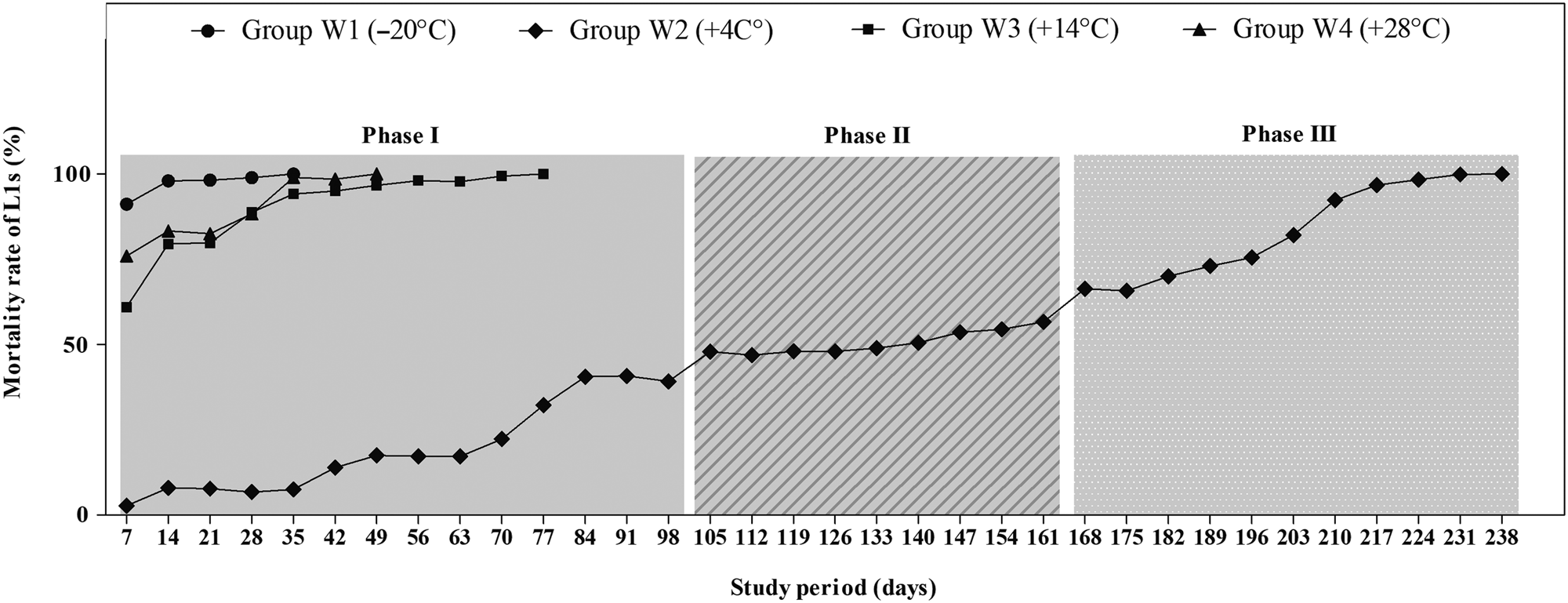
The L1s kept in water at +4 ± 1°C (W2) remained alive for 231 days, while larvae remained viable for a shorter period of time when stored at other temperatures, i.e. 70, 42 and 28 days in groups W3 (+14 ± 1°C), W4 (+28 ± 1°C) and W1 (−20 ± 1°C), respectively (fig. 1). From study day 7 to 77, the mortality rate of L1s stored at +4°C (W2) was statistically significantly lower compared to that of larvae stored at −20°C (W1), +28°C (W4) and +14 ± 1°C (W3) (P < 0.01, P < 0.05 and P < 0.05, respectively). From day 77 to 231 of the study, live L1s were detected only in group W2. A statistically significant effect of time on the mortality rate of L1s maintained in water was found in group W2 (P < 0.01). The mortality rates of L1s stored in water at +4° ± 1°C exhibited three different phases: the first phase (up to study day 98) featured by an increasing trend in L1 mortality; the second phase (from study day 105 to 161) was characterized by a steady state of the mortality rate; and the third phase (up to study day 231) was defined by when the L1s showed, again, an increase in mortality rate (fig. 1).
Mortality rates of Aelurostrongylus abstrusus first-stage larvae (L1s) in the 30 different aliquots stored in water at different temperatures. Three different phases of the mortality rates of A. abstrusus are presented: phase I (up to study day 98), defined by an increasing trend in L1 mortality rate; phase II (from study day 105 to 161), characterized by a slower L1 mortality rate; phase III (from study day 168 to 231), defined by an increase in L1 mortality rate.

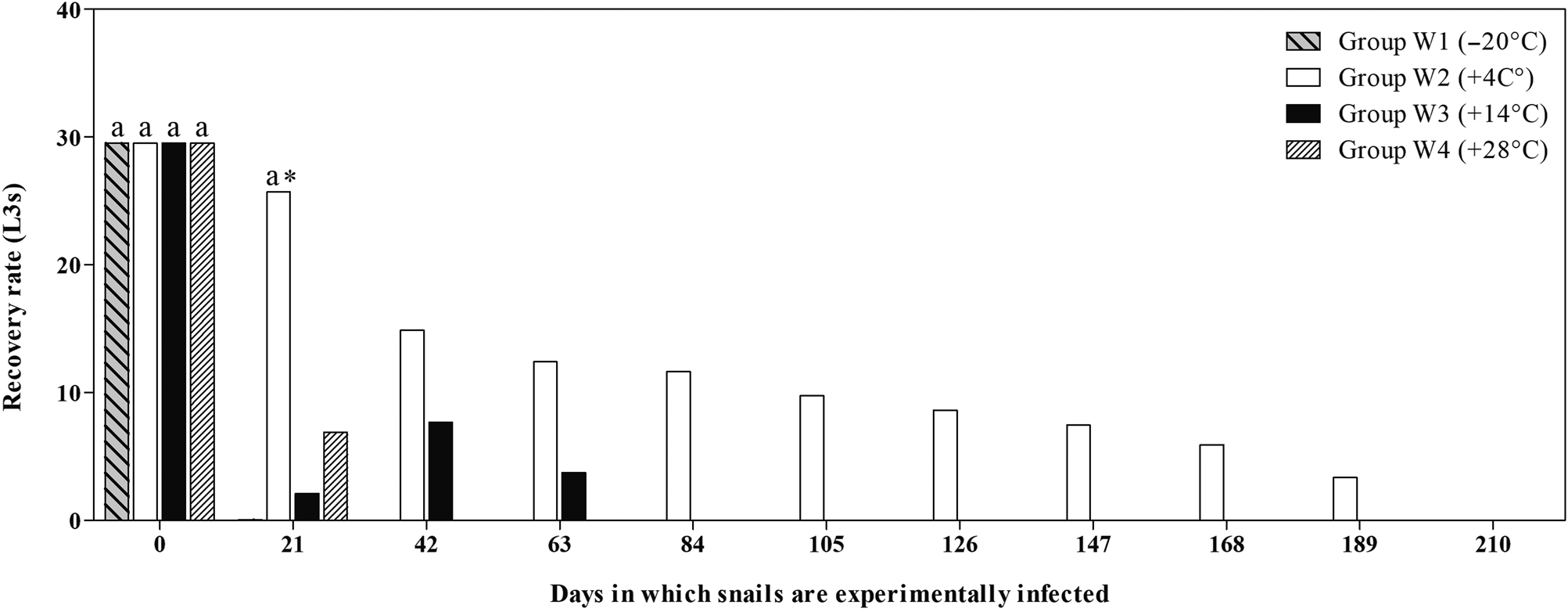
The artificial infection of C. aspersum snails was successfully performed and none of the infected snails died during the period of study; all the observed L3s were classified as A. abstrusus. The temperature at which L1s were stored significantly influenced the recovery rate of L3s in infected snails (P < 0.001). The recovery rate after 21 days of L1s being stored was higher in group W2 (+4°C) than in the other groups (fig. 2). The L1s of groups W1 and W4 lost the capability to develop into the infective stage after 21 days of storage, while those of group W3 developed into L3s until 63 days of storage and those of group W2 preserved the ability to moult into L3s up to 189 days of storage.
Recovery rate of Aelurostrongylus abstrusus L3s found in experimentally infected Cornu aspersum snails, using an infective dose containing about 300 motile A. abstrusus first-stage larvae stored in water at different temperatures. *Significant effect of temperature (P < 0.001) vs groups W1, W3 and W4. aSignificant effect of time (P < 0.01) vs all time points.

Discussion
The present study provides new insight into the biology of A. abstrusus in the extra-host phase of the life cycle. According to the data presented herein, temperatures at which the larvae of A. abstrusus are exposed in the extra-host phase could significantly influence the evolvement of the life cycle.
At all tested temperatures, A. abstrusus L1s remained vital for a longer period in water rather than in faeces, as previously observed by Hamilton & McCaw (Reference Hamilton and McCaw1967) for A. abstrusus and by Ramos et al. (Reference Ramos, Giannelli, Dantas-Torres, Brianti and Otranto2013) for T. brevior. This finding suggests that the aquatic medium itself constitutes an optimal microhabitat for A. abstrusus L1s in laboratory conditions. To establish if this finding is also valid in natural conditions is not an easy task; in fact, in the external environment, the A. abstrusus L1s are exposed to other abiotic (i.e. solar radiation and UV rays) and biotic (i.e. bacteria, phages and other nematodes) stressors that could impair the survival of this nematode. However, it has been stated that the main constraints for the survival of nematode larvae in the extra-host phase are humidity (Gibbs, Reference Gibbs1982) and the environmental temperatures. Moreover, as observed for other parasites such as Stongyloides ratti, moving away from the faeces enhances their probability of finding a host (Viney & Lok, Reference Viney and Lok2015).
As already observed for other parasites, such as T. brevior, Angiostrongylus vasorum and Crenosoma vulpis (Croll & Al-Hadithi, Reference Croll and Al-Hadithi1972; Jeffery et al., Reference Jeffery, Lankester, McGrath and Whitney2004; Morgen et al., Reference Morgen, Jeffeires, Krajewski, Ward and Shaw2009; Ferdushy et al., Reference Ferdushy, Kapel, Webster, Al-Sabi and Grønvold2010; Ramos et al., Reference Ramos, Giannelli, Dantas-Torres, Brianti and Otranto2013), a reduction of the temperature, to some extent, creates favourable conditions for the survival of L1s; however, freezing temperatures can adversely affect larval survival. Conversely, it has been suggested that high temperatures (>24°C) negatively impact on the survival time of L1s of metastrongyloids (Hamilton & McCaw, Reference Hamilton and McCaw1967; Gökpinar & Yildiz, Reference Gökpinar and Yildiz2010; Ramos et al., Reference Ramos, Giannelli, Dantas-Torres, Brianti and Otranto2013). The lower mortality rate observed for L1s of groups W2 and F2 could be related with the metabolic activity of the larvae. In fact, the metabolism of nematodes decreases under unfavourable conditions to avoid energy waste as an adaptive response, while larvae are more active and increase the consumption of energy under temperatures favourable for survival (McSorley, Reference McSorley2003). Worthy of note, in the present study, the mortality rate of L1s kept in water at −20 ± 1°C, +14 ± 1°C and +28 ± 1°C followed a faster, more constant trend, and the number of live L1s was reduced by more than 80% in a few weeks; conversely, L1s stored in water at +4° ± 1°C showed a slower mortality rate in which three different phases can be identified. The first phase (up to study day 98) is defined by an increasing trend in larvae mortality, likely as a result of natural ‘selection’ caused by the thermal stressor. The second phase (from study day 105 to 161) is characterized by a slower mortality rate. Indeed, it has been demonstrated that larval activity is minimal under constant environmental conditions, and greater activity is elicited by external stimuli, such as an increase in environmental temperature and/or change in light intensity (Croll & Al-Hadithi, Reference Croll and Al-Hadithi1972; Gibbs, Reference Gibbs1982). In the third phase (up to study day 231), L1s showed, again, an increase in mortality rate, likely because of the depletion of energy stores (fig. 1).
From data presented herein, the L1s of A. abstrusus seem to be more resistant to temperature variations; in fact, when exposed to relatively high temperatures (+28 ± 1°C), L1s of A. abstrusus remained live for a period four times longer than that of T. brevior stored at +26°C. Similarly, L1s of A. abstrusus stored at +4°C remained alive for a period two times longer than that of T. brevior kept under similar conditions (Ramos et al., Reference Ramos, Giannelli, Dantas-Torres, Brianti and Otranto2013). Therefore, the greater capability of L1s of A. abstrusus to adapt to different temperatures, inferred by the results of the present study, may explain the wider distribution of this species, compared to other feline lungworms.
The environmental temperatures to which L1s are exposed not only influence the lifespan of survival but also their capability to moult into the infective stage following the infection of the intermediate host. It has been demonstrated that the optimum condition for the development of the larvae in the mollusc is about +18–30°C (Gerichter, Reference Gerichter1949; Di Cesare et al., Reference Di Cesare, Crisi, Di Giulio, Veronesi, Frangipane di Regalbono, Talone and Traversa2013). In the present study, all the infected snails were maintained under similar conditions; therefore, the differences observed in the recovery rate should be attributed exclusively to the different temperatures at which L1s were exposed before being injected into the snails.
Although the recovery rate of all groups showed a decreasing trend throughout the study period, L1s of groups W2 (+4 ± 1°C) and W3 (+14 ± 1°C) maintained the capability to moult into L3s for a longer period compared to those belonging to the other groups, and snails infected with L1s of group W2 showed a higher recovery rate for a longer period.
This finding, along with that of the survival of L1s, suggests that A. abstrusus has a good ability to overcome thermal stressors and temperature variations up to a period of more than six months.
Acknowledgement
The authors thank Dr Rosa Di Salvo for providing useful inputs and suggestions for the design and analysis of the study.
Financial support
This research received no specific grant from any funding agency, commercial or not-for-profit sectors.
Conflicts of interest
None.