INTRODUCTION
Maize (Zea mays)-wheat (Triticum aestivum) is the third most important cropping system after rice (Oryza sativa)-wheat (RW) and rice-rice in India, and is grown on about 1.13 million ha each year (Yadav and Subba Rao, Reference Yadav and Subba Rao2001). Continuous RW cropping in the Indo-Gangetic plains (IGP) of northwest India has resulted in a number of ecological and other problems such as development of hardpan, low input use efficiency including water, and emergence of insects-pests, as well as environmental pollution through emission of greenhouse gases. Furthermore, there is great concern about groundwater depletion in large areas where the RW system prevails in most of northwest India (Ambast et al., Reference Ambast, Tyagi and Raul2006; Hira, Reference Hira2009; Rodell et al., Reference Rodell, Velicogna and Famiglietti2009). To meet the ever-increasing food and fibre needs of an increasing population, it is imperative to improve irrigation water productivity to ensure sustainable agriculture in northwest India. In the irrigated areas, replacement of RW with maize–wheat will greatly reduce the amount of irrigation water used, with many benefits (Humphreys et al., Reference Humphreys, Kukal, Christen, Hira, Balwinder-Singh and Sharma2010). Maize, a crop with high yield and market potential, fits well into RW systems by replacing rice. By 2020 the demand for maize in developing countries will surpass the demand for both wheat and rice (due to high population pressure) and to meet this rising demand, higher maize production is necessary (Srinivasan et al., Reference Srinivasan, Zaidi, Prasanna, Gonzalez and Lesnick2004).
Tillage, water and nutrients are the most crucial monetary inputs for crop production. The conventional practice of excessive tillage, involving 6–8 tillage operations for maize and wheat, consumes a high proportion (25–30%) of the total operational energy in maize and wheat production (Sidhu et al., Reference Sidhu, Singh, Singh and Ahuja2004).
With the advent of effective herbicides and rising concern over natural resource degradation, reduced or conservation tillage systems have gained more attention in recent years. Conservation tillage practices, such as zero tillage and permanent raised beds combined with straw mulching, may offset the production costs and other constraints associated with land preparation (Hobbs, Reference Hobbs2001). Research work in India and abroad has indicated that wheat can be timely planted and at a reduced cost using no-tillage technology (Hobbs, Reference Hobbs2001; Malik et al., Reference Malik, Yadav and Singh2004; Yadvinder-Singh & Ladha, Reference Yadvinder-Singh, Ladha, Lal, Hobbs, Uphoff and Morris2004). No-till wheat also requires less irrigation water than conventional tillage, particularly for pre-sowing irrigation (Malik et al., Reference Malik, Yadav and Singh2004).
The use of raised beds for the production of irrigated non-rice crops started in the heavy clay soils in Australia in 1970s (Maynard et al., Reference Maynard, Beattie, Hutchins and Muir1991). It is possible to extend this crop raising method to other crops like maize grown in annual rotation with wheat in the IGP. Conventionally maize and wheat are planted on the flat and water management is by flood irrigation with low water use efficiency. Permanent raised beds (PRBs) were introduced as a resource-conserving technology to address the economic, water and soil constraints of conventional flat sowing (Connor et al., Reference Connor, Timsina and Humphreys2003). The PRBs remain in place with minimal renovation or reworking for several years. A change from growing crops on the flat to raised beds offers more effective control of irrigation water and drainage thereby reducing aeration stress and would increase yields. While the potential benefits of beds for wheat production after rice in the IGP have been reported (Yadvinder-Singh et al., Reference Yadvinder-Singh, Humphreys, Kukal, Dhillon, Balwinder-Singh, Thaman, Prashar, Yadav, Navneet-Kaur, Smith, Timsina and Gajri2008), evaluation of these for maize in rotation with wheat in terms of yield and water productivity have received little attention. Aggarwal et al. (Reference Aggarwal, Garg, Singh, Singh, Yadav and Sharma2000), and Jat et al. (Reference Jat, Srivastva, Sharma, Gupta, Zaidi and Srinivasan2005) reported significantly higher yield and water use efficiency of maize on raised beds than under flat planting.
In northwest India maize is sown in the hot, dry month of June when maximum soil temperatures rise to 49 °C. Mulch with crop residues modifies the hydrothermal regime of the soil surface by reducing soil temperature during summer and acting as a barrier against the loss of water. Sekhon et al. (Reference Sekhon, Hira, Sidhu and Thind2005) reported that wheat straw mulch applied to soybean helped in lowering the temperature and reducing evaporation losses. Mulching increased soybean yield by 4.4 to 68.3% and depended on the amount and distribution of rainfall. Limon-Ortega et al. (Reference Limon-Ortega, Sayre and Francis2000) observed that permanent beds with straw retention had the highest mean wheat grain yields and N-use efficiency, with positive implications for soil health.
Tillage practice adopted in one crop will influence considerably the establishment and performance of succeeding crops grown in the system, and may depend on the soil and climatic considerations (temperature and rainfall) of the location (Tomar et al., Reference Tomar, Garg and Gupta2006). Maize is known to be quite sensitive to excess water stress and yields poorly under water logged conditions (Dhillon et al., Reference Dhillon, Thind, Malhi and Sharma1998; Lal et al., Reference Lal, Chandra and Yadav1988). Limited information is available on the influence of tillage and planting systems for the maize-wheat system on crop productivity, efficiency of applied irrigation water and economics. There is an urgent need to reduce the cost of cultivation and increase profitability by developing and adopting reduced tillage technologies. A better understanding of the long-term sustainability of maize-wheat systems in relation to tillage, crop establishment, straw mulch and water is needed. The present study was, therefore, planned to determine the effect of different tillage, raised bed planting and straw mulch on growth, yield, water use efficiency and economics of an irrigated maize-wheat system under the climatic conditions of northwest India.
MATERIALS AND METHODS
Experimental site and climatic conditions
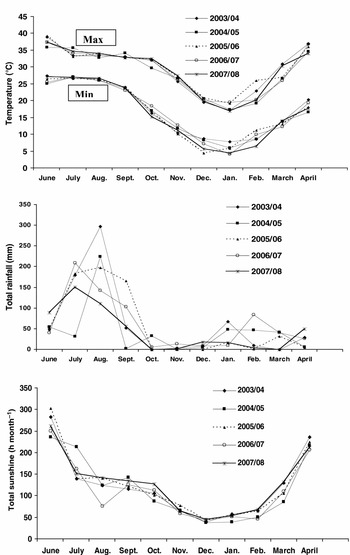
A field experiment was established in June 2003 on the experimental farm of Punjab Agricultural University (PAU) at Ludhiana (30°56′N, 75°52′E; 247 m asl), India. The soil was a deep alluvial loamy sand, Typic Ustochrept, low in organic carbon (4.2 g C kg˗1 at 0–15 cm) and slightly alkaline (pH 7.2). The region has a sub-tropical climate, with hot, dry to wet summers (June–October) for maize and cool, dry winters (November–April) for wheat. Average annual rainfall is 650 mm constituting 44% of pan evaporation. The depth to the groundwater was over 15 m. Mean minimum and maximum temperatures during the maize season (June–October) were 23 °C and 33 °C and during the wheat season (November–March) 13 °C and 27 °C, respectively. Monthly distribution of rainfall and minimum and maximum temperatures for the experimental period (June 2003–April 2007) are shown in Figure 1. Mean minimum and maximum temperatures during the maize growing seasons (June–October) showed small variations. In the wheat season (November–April), minimum temperature during November–December was below the long-term average (LTA) in 2005/06 and above the LTA during February to April during 2003/04 and 2006/07. Rainfall during August was below LTA in 2007/08 and above the average in 2003/04 and 2004/05. In July, rainfall was below LTA during 2005/06.
Mean monthly minimum and maximum temperature, rainfall and sunshine at the experimental site at Ludhiana (June 2003–April 2008).

Experimental layout and treatments
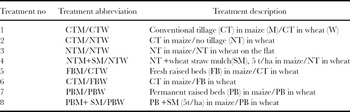
Experimental work was initiated in 2003 to test the feasibility and effectiveness of no tillage, fresh and permanent raised beds, and straw mulch for the maize-wheat system in Punjab representing the Trans IGP of India. The experiment compared eight different treatments comprising combinations of conventional or no tillage, on the flat or in raised beds (fresh or permanent), with or without wheat straw mulch over five years (ten crops) in a randomized complete block design with four replicates (see Table 1 for details of all treatments). The randomization of plots was adjusted so that the same layout (flat or beds) occurred in the corresponding plots in replicates 1 and 2, and in replicates 3 and 4. This was done to provide longer runs for the bed planter and to eliminate the need to turn the tractor across the beds. Wheat straw at 5 t ha−1 as per treatment was applied within two days after sowing of maize. Plot size was 7 m × 4.02 m, with earth bunds around each plot. The PRB treatments were established in the previous non-experimental wheat crop planted in November 2002.
Treatment descriptions.

Raised beds were initially formed after conventional tillage using a four-wheel tractor with a bed former and seeder attachment. The width of the beds (mid-furrow to mid-furrow) was 67.5 cm, bed width of 37.5 cm and 20 cm height. The beds were maintained permanently from crop to crop with reshaping as necessary by a four-wheel tractor. Before sowing of each crop on these permanent raised beds, renovation (mostly in the furrows) was done. Each raised bed had one maize and two wheat rows. The cropping pattern was implemented over five years, starting with maize sown in June 2003.
Crop management
After pre-irrigation for both maize and wheat, the furrows of PBM/PBW (with or without SM) treatments were cleaned and the beds reshaped in a single pass using the tractor-driven bed planter, with little disturbance in the beds. For the flat treatments (CTM/CTW, CTM/NTW, FBM/CTW, CTM/FBW), there was one dry cultivation with a four-wheel tractor disc hoe followed by two runs of comb harrows and two plankings, a wooden plank used to break clods and level the field. Fresh beds were prepared after conventional tillage followed by bed formation and sowing in a single pass with a bed planter. Well-decomposed farm yard manure (15 t ha−1, on a fresh weight basis containing about 45% moisture) was applied to maize plots, and uniformly spread a week before the sowing and before reshaping of the permanent beds each year. Maize (hybrid, cultivar Paras) seed (20 kg ha−1) was sown with hand drill on the raised beds and flat plots manually behind a hand plough between 15 and 20 June in different years. On flat layouts, maize was sown with a row spacing of 60 cm and plant-to-plant spacing of 20 cm. Maize was seeded in one row per bed (middle of bed) at plant-to-plant spacing of 17.8 cm. The plant-to-plant spacing on the beds was adjusted to keep the population density similar on flats and raised beds.
Two rows of wheat (cultivar PBW 343) were planted on top of each bed with 20 cm spacing between the rows, and 47.5 cm between the rows on adjacent beds with a tractor-drawn drill. The wheat on flat plots was sown with a tractor-driven seed-cum-fertilizer drill (in CTW treatments) or a zero till drill with inverted-T openers (in NTW treatments) with 20 cm row spacing. The wheat was sown at 100 kg ha˗1 on the flat and 75 kg ha˗1 on the beds between 5 and 12 November in different years, but usually by 10 November.
Fertilizer (120–26-25 kg ha˗1 of N, P and K, respectively) was applied to each crop. To maize, one-third of N and full dose of P and K was applied at sowing; the remaining N was top dressed in two equal split doses at knee high and pre-tasselling stage to all plots. To wheat, half of N and full doses of P and K was applied at sowing, while the remaining N was top dressed at first irrigation. Urea, diammonium phosphate and muriate of potash were used as source of nutrients. Weeds were well controlled in maize using Atrataf 50WP (atrazine) at 1.25 kg ha−1 one day after sowing of the crop as a pre-emergence treatment. To control weeds in wheat Arelon 75WP (isoproturon) at 1.25 kg ha ha−1 plus 2,4-D sodium salt (80%) at 0.625 kg ha−1 (35 days after sowing (DAS)) were used to control grass and broadleaf weeds, respectively. The maize and wheat were hand harvested and the stubbles were removed at ground level. Maize was harvested from 27 September to 2 October and wheat was harvested from 6 to 14 April in different years of the study period.
Irrigation management
The quantity of water applied at each irrigation to the crops was measured using a ‘Parshall flume’. At each site, all plots were irrigated on the same day prior to cultivation and sowing, and again on the same day 2–4 weeks after sowing each year. The depth of irrigation water for both maize and wheat was 75 mm for the flat plots and 50 mm for raised beds at each irrigation. While maize did not receive any irrigation during 2003, four irrigations were applied on the flat and five irrigations on raised beds during 2004 and 2–3 irrigations in other years. Wheat received three (in 2004/05) to six (in 2005/06) irrigations in different years and the number of irrigations was similar for both on the flat and raised beds in a particular year.
Data collection and analysis
Crop growth and yield. Periodic dry matter of two randomly selected plants of maize and 1 m row length of wheat was measured. The number of cobs per plant and number of grains per cob and test weight were recorded from five plants from each plot. In wheat, spike counts of wheat were done from two 1-m long rows in each plot in the first two years. The spike length and number of grains per spike were recorded from 10 randomly selected spikes from each plot. The dry weight of wheat plant tops was determined on two 1-m long rows at early tillering (30 DAS) and anthesis. At maturity, grain and straw yields were determined on an area of 10.8 m2 in the middle of each plot. Moisture content in grain and straw was determined by drying sub-samples at 70 °C, and yields are reported on dry weight basis.
Light interception
Light interception was measured in maize crop at the knee high, tasselling and silking stages and in wheat crop at 30 days after sowing, booting (ear peep) and anthesis stages, using a 1-m long Licor® quantum line sensor. Measurements were made above the crop canopy (IO) and at the soil surface under the canopy (Is) at three sites within each plot. The sensor was positioned at an angle across the plant rows so that the readings were taken mid-row to mid-row across two adjacent beds or two (maize)/four rows (wheat) on the flat layouts. Light interception by the canopy (LIC) was calculated as a percentage of total incident radiation using the relationship: LIC = (IO − Is) /Io × 100.
Soil temperature
The soil temperature at 5.0 cm depth in the central row/bed of each plot was recorded in the afternoon (14:30 hours) up to emergence and at various other crop growth stages.
Water use and water use efficiency
Soil samples to 180 cm soil depths were taken for the determination of soil moisture content at sowing and at harvest in all the treatments. The water use was calculated as explained by Singh et al. (Reference Singh, Gandhi and Raheja1960), taking into account the effective rainfall, soil profile moisture contributions and depth of irrigation water applied. The water use efficiency (WUE) was calculated by the formula:
WUE (kg ha−1 cm−1) = Grain yield (kg ha−1)/ Water use (cm)
Soil bulk density and infiltration rate
The soil bulk density (0–15 cm) was measured after wheat 2004/05 (two crop cycles) and 2007/08 (five crop cycles). Bulk density was determined using the core method. The cumulative infiltration of water through soil was measured after wheat 2007/08 using a double-ring infiltrometer. The infiltrometer consisted of an open outer and an inner ring. Both rings were filled with water such that the inner ring is submerged. After a known interval of time (8 h), the fall in water depth (mm) in the inner ring was measured, this is equal to the amount of water that has infiltrated into the ground.
Economic analysis
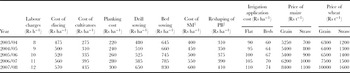
The cost of cultivation was calculated by taking into account cost of seed, fertilizers, biocides, wheat straw for mulch and the hiring charges of manual labour and machine use (discing, cultivator, planking, seed-cum-fertilizer drill, bed planter, reshaping of permanent beds) for land preparation and sowing, irrigation and fertilizer application, plant protection, harvesting, and threshing, and the time required (h ha−1) to complete an individual field operation. The yearly labour wages, cost of machine use for different tillage and seeding operations, labour cost for applying irrigation, and market price of grain and straw of maize and wheat are given in Table 2. The cost of irrigation pumping was calculated by multiplying electric watts required to irrigate a particular plot and cost of electricity as per the state electricity board. The prices of manual, machine labour and diesel in each year were taken as per the Government of India norms. The gross income and net-returns were calculated on the basis of market price for maize and wheat at the time of harvest in each year (Table 2). The price of wheat straw and of maize stover was also considered for calculating the gross income of the cropping system. The net returns were calculated by subtracting total variable costs from the gross income.
Labour charges (Indian Rs), cost of machine use for discing, cultivators, planking, bed sowing, reshaping of beds, cost of applying irrigation, market price of grain and straw of maize and wheat in different years.

†Straw mulch; ‡Permanent beds.
Statistical methods
The crop and soil water data were analysed using analysis of variance (ANOVA) by using IRRISTAT version 92 (IRRI, 1992). The crop data were analysed keeping years as the main and treatments as sub-effects using split-plot design. The comparison of treatment means was made by least significant difference (LSD) at p = 0.05. Since there were no significant year × treatment interactions, mean effects are presented and discussed.
RESULTS AND DISCUSSION
Soil temperature
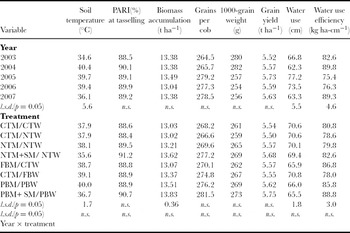
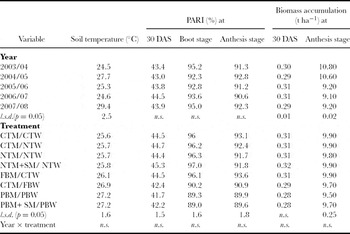
Soil temperature at seed depth (5 cm) during maize emergence was lower in 2003 than in 2004 and did not differ in the years 2004 to 2007 (Table 3). Wheat straw mulch in NTM+SM and PBM+SM treatments reduced the mean maximum soil temperature at seed depth by 2.7 and 3.1 °C compared to the corresponding no mulch treatments (NTM and PBM), respectively (Table 3). Mulch reduced the impact of solar radiation by acting as a physical barrier resulting in lower soil temperature than the bare soil. This result is in agreement with Burrows and Larson (Reference Burrows and Larson1992) and Sekhon et al. (Reference Sekhon, Hira, Sidhu and Thind2005). The soil temperature did not vary among the other treatments except for an increasing trend in soil temperature for raised beds. This was probably due to exposure of more surface area to the incident solar radiation in raised beds than in flat conventional treatments. The effect of straw mulch on soil temperature was reduced to about 1°C at knee-high stage compared with no mulch due to coverage of soil surface by the growing maize plants and partial decomposition of straw mulch (data not shown).
Soil temperature in the seeding zone (5 cm deep) during emergence, photo-synthetically active ration interception (PARI), dry biomass accumulation at physiological maturity, grains/cob, 1000-grain weight, grain yield, water use and water use efficiency of maize in different years and treatments.

As for maize, raised beds (CTM/FBW, PBM/PBW, PBM+SM/PBW) in wheat recorded higher soil temperature (mean of 27.1 v. 25.8 °C) compared to the flat treatments (CTW and NTW) from germination to 30 days after sowing (Table 4). Soil temperature remained similar when compared separately among flat layout and raised bed treatments. There was no effect of straw mulch applied to the previous maize on soil temperature.
Soil temperature in the seeding zone (5 cm depth) during emergence, photo-synthetically active ration interception (PARI) and biomass accumulation of wheat under different treatments.

Photo-synthetically active radiation interception
The photosynthetically active radiation interception (PARI) values were similar in all the five years of the study period (Table 3). The values of PARI in the maize recorded at tasselling stage were similar and ranged from 88.4 to 91.2% in all the treatments during the five years of the study period (Table 3). However, there was an increasing trend in PARI for straw mulch treatments due to better crop growth compared to no mulch.
The trends for PARI in wheat were consistent with the biomass observations (Table 4). The values of PARI did not differ among the different years measured at the three growth stages of wheat (Table 4). The PARI at the three growth stages (30 DAS, booting and anthesis) of wheat was generally lower in raised bed treatments compared to flat layout (Table 4). The differences in PARI between flat and raised bed treatments were greater at 30 DAS and decreased with the advancement in crop growth. The lower PARI in wheat on raised beds compared with flat layout was due to lower plant population and leaf area index. Recently, Yadvinder-Singh et al. (Reference Yadvinder-Singh, Humphreys, Kukal, Dhillon, Balwinder-Singh, Thaman, Prashar, Yadav, Navneet-Kaur, Smith, Timsina and Gajri2008) showed that light interception in wheat was greater in treatments with the higher biomass production.
Biomass accumulation
The biomass accumulation by maize at the physiological maturity was similar in all years of the study (Table 3). The dry biomass accumulation by maize at the physiological maturity stage was greater in straw mulch plots on the flat (NTM+SM) (Table 3). However, no beneficial effect of straw mulch on biomass yield was noted for maize sown on raised beds (PBM v. PBM+SM). The higher biomass accumulation in the mulched treatments was possibly due to more leaf area index and PARI. Gajri et al. (Reference Gajri, Arora and Chaudhary1994) and Tolk et al. (Reference Tolk, Howell and Evett1999) also reported similar effects of straw mulching in maize planted on the flat.
The dry biomass accumulation in wheat was higher during 2003/04 and 2004/05 than in other years of the study period (Table 4). Wheat accumulated less dry biomass in raised bed treatments compared with flat layouts at 30 days after seeding and at anthesis (Table 4), which can be ascribed to lower plant population as a result of lower seed rate used on beds. In earlier studies, Yadvinder-Singh et al. (Reference Yadvinder-Singh, Humphreys, Kukal, Dhillon, Balwinder-Singh, Thaman, Prashar, Yadav, Navneet-Kaur, Smith, Timsina and Gajri2008) reported less dry matter accumulation in bed planted wheat in early crop growth stages due to lower population on beds.
Yield components and yield of maize
Characters of maize contributing to grain yield, such as number of grains per cob and test weight, were not influenced by either the years or different treatments (Table 3). Our results contrast with the study of Ma and Han (Reference Ma and Han1995) who reported higher yield attributes under mulched treatment but their study was under non-irrigated conditions. As with yield components, grain yield of maize did not differ significantly among various tillage, layout and mulch treatments during the five years of the study period (Table 3). Consistent with our study, Kler et al. (Reference Kler, Dhaliwal, Kaur, Dhaliwal, Hansra and Jerath1992) and Kapusta et al. (Reference Kapusta, Krausz and Matthews1996) have also reported similar maize yield under no tillage and conventional tillage. In contrast, studies by Aggarwal et al. (Reference Aggarwal, Garg, Singh, Singh, Yadav and Sharma2000) showed higher maize yield on raised beds than on flat sowing under the climatic conditions similar to that in the present study. The latter was possibly due to the fine soil texture of the experimental field where maize on flat layout suffered from water logging.
Yield components and yield of wheat
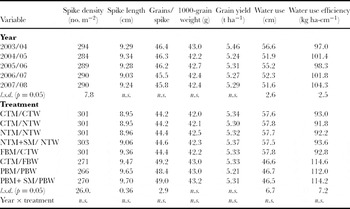
The spike density was lower during 2004/05 compared with 2003/04 but was on a par with the other years of the study period (Table 5). Other yield contributing characters as well as grain yield of wheat did not differ significantly among the years (Table 5). The spike density was significantly lower on raised beds compared with flat layout due to wider row spacing (Table 5). Spike density was similar on fresh and permanent beds and was not influenced by straw mulching in the previous maize. Spike length (9.54 cm v. 9.06 cm) and number of grains (48.9 v. 44.4) in each spike were greater in raised beds during all the years of the study period than with flat layout (Table 5). The longer spikes in bed planted wheat were possibly due to wider spacing, which provided better light conditions in the canopy for photosynthesis than with wheat on flat layout. Lower spike density and longer spikes on raised beds have previously been reported by Dhillon et al. (Reference Dhillon, Prashar and Thaman2004), and Yadvinder-Singh et al. (Reference Yadvinder-Singh, Humphreys, Kukal, Dhillon, Balwinder-Singh, Thaman, Prashar, Yadav, Navneet-Kaur, Smith, Timsina and Gajri2008). The test weight of wheat was similar under different treatments (Table 5).
Spike density, spike length, 1000-grain weight, grain yield, water use and water use efficiency of wheat in different years and treatments.

As with maize, the grain yield of wheat did not vary significantly among various tillage, planting systems and straw mulch treatment during the five years of the study (Table 5). The longer spikes and more grains per spike compensated for the lower tiller and spike density on the raised beds. In an earlier study on a RW system, Yadvinder-Singh et al.(2008) also reported similar wheat yield under fresh and permanent raised beds. The spike length and number of grains/spike were similar in different treatments on the flat (Table 5). The NT treatments produced grain yield similar to the CT in the present investigation. Consistent with our results, Nagarajan et al. (Reference Nagarajan, Singh, Singh and Singh2002) and Yadvinder-Singh et al. (Reference Yadvinder-Singh, Humphreys, Kukal, Dhillon, Balwinder-Singh, Thaman, Prashar, Yadav, Navneet-Kaur, Smith, Timsina and Gajri2008) have recorded similar grain yield of wheat under conventional and no tillage. There are, however, many reports of higher yields of NT wheat than CT wheat and this is likely to be the result of more timely sowing of wheat in the NT system (Malik et al., Reference Malik, Yadav and Singh2004; Yadvinder-Singh and Ladha, Reference Yadvinder-Singh, Ladha, Lal, Hobbs, Uphoff and Morris2004). As all the treatments were sown on the same date in our experiment, within the optimum sowing window, yields were similar.
In permanent maize-wheat systems, Govaerts et al. (Reference Govaerts, Sayre and Deckers2005) reported that residue retention was essential to maintain productivity and realize the benefits of direct drilling. But no such data were obtained in the present study where assured supply of ground water was available for irrigation. The benefits of raised beds for upland crops (maize and wheat) in fine-textured soils prone to water logging have been clearly demonstrated in the other parts of the world (Batchelor et al., Reference Batchelor, Collins and Parsons1980; Thompson and North, Reference Thompson and North1994). However, symptoms of waterlogging after heavy rains or flood irrigation on flats were not observed in our experiments, possibly due to coarse texture of the soil.
Water use and water use efficiency in maize
Total water use by maize was lower and water use efficiency was higher during 2004 and 2007 due to better distribution of rainfall than in other years of the study period (Table 3). Water use of maize was lower by 4.5 cm on raised beds (FBM, PBM, PBM+SM) compared with crop sown on the flat (Table 3). The raised beds received less irrigation water (25 cm) than the flat layouts (30 cm) resulting in lower water use. Averaged over five years (2003/07), maize planted on raised beds recorded about 6.8% lesser water use and 7.8% higher water use efficiency than CTM/CTW. Similar results of lower water use and high water use efficiency in bed planted maize were reported earlier by Aggarwal et al. (Reference Aggarwal, Garg, Singh, Singh, Yadav and Sharma2000) and Kaur and Mahey (Reference Kaur and Mahey2005). There was no effect of straw mulch on water use and water use efficiency in maize. Straw mulch may have positive effects on crop yield and water use efficiency under limited water supply situations.
Water use and water use efficiency in wheat
Total water use by wheat was higher and water use efficiency was during 2003/04 and 2006/07 than in other years of the study (Table 5). The wheat crop received more irrigation water during the above two years due to unfavourable distribution of rainfall. Wheat on raised beds had 19.2% lower water use (averaged across treatments and years) than on flat layout (treatments with CTW or NTW) (Table 5). Similarly, water use efficiency recorded in wheat on the raised beds was 22.6% more (averaged across treatments and years) than on the flat layout (Table 5). Less water use in bed planted treatments than in flat layout was possible due to the lower amount of irrigation water (average of 22 cm v. 33 cm). Earlier studies (Aggarwal and Goswami, Reference Aggarwal and Goswami2003; Ram et al., Reference Ram, Yadvinder-Singh, Timsina, Humphreys, Dhillon, Kumar and Kler2005) have reported similar or higher yields of wheat on raised beds compared with flat and 30–50% reductions in irrigation water used on beds.
Economic analysis of the maize-wheat system
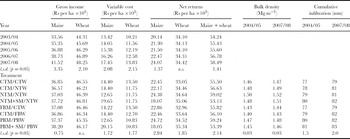
Gross income as well as variable costs increased over the years due to increase in the price of produce and cost of cultivation respectively; the increase was significant in 2006/07 compared with that in 2003/04 (Table 6). Net income from maize and maize + wheat system was also significantly higher in 2006/07 than in 2003/04. The data presented in Table 6 revealed that significantly higher gross income of Rs 38 200 ha−1 from maize was obtained in NTM+SM compared with all the other treatments except in PBM + SM treatment, which provided gross income of Rs 37 370 ha−1. However, net return was significantly lower in mulch treatments due to high economic value of wheat straw compared with all the other treatments (Table 6). The variable cost was significantly lower in the NTM and PBM compared with the other treatments except FBM. In wheat, while gross income was similar in all the treatments, the variable costs were significantly lower in PBW treatments than in CTW and FBW (Table 6). The variable costs in PBW treatments were on a par with NTW treatments (Table 6). The net returns (Rs 59 020–59 240 ha−1) from the maize-wheat system were significantly higher for NTM/NTW and PBM/PBW treatments than for all other treatments (Table 6). Under situations where wheat straw has no economic value, NTM+SM/NTW and PBM+SM/PBW will provide highest net returns. Indeed the higher return over variable costs in the permanent bed system clearly corroborates the findings of Sayre and Limon-Ortega (Reference Sayre and Limon-Ortega2002). Landers et al. (Reference Landers, Saturnino, de Freitas, Saturnino and Landers2001) have previously recorded higher net income in NT compared with CT. The current study showed the economic benefits of adopting double no tillage and permanent raised bed planting in maize-wheat system in northwest India.
Gross income, variable costs and net returns from maize-wheat system, and soil bulk density and cumulative infiltration after wheat in different treatments.

Soil physical properties
Soil bulk density in the 0–15 cm layer recorded after two (wheat 2004/05) and five years of continuous cropping (wheat 2007/08) was significantly affected by tillage and planting systems (Table 6). The bulk density of soil showed a slight increasing trend after five years compared with that measured after two years. Fresh beds (CTM/FBW) recorded significantly lower bulk density than all the other treatments. Double no till plots without straw mulch (NTM/NTW) recorded the maximum bulk density, which was significantly more than the double conventional tillage plots (CTM/CTW). Application of straw mulch to preceding maize showed no effect on soil bulk density (Table 6). The higher bulk density recorded in NT plots might be due to an undisturbed soil surface as a result of direct seeding of crops. These results are in conformity with those reported earlier by Yang et al. (Reference Yang, Ping, Ping, Qing and Fei1999) and Kumar et al. (Reference Kumar, Singh, Yadav, Malik and Hobbs2002). The infiltration rate on raised beds and NT plus straw mulch was significantly higher than on CTM/CTW (Table 6). More infiltration in NT and PB bed plots might be due to the minimal disturbance of pore continuity. In an earlier study, higher infiltration in no till than in conventional till plots was reported by Shaver et al. (Reference Shaver, Peterson, Ahuja, Westfall, Sherrod and Dunn2002).
CONCLUSIONS
Over the five years, the results suggest similar yields of maize and wheat from maize-wheat systems on the loamy sand, regardless of layout (beds, flat) or tillage for maize or wheat or straw mulch, under irrigation and the climatic conditions of central Indian Punjab. Permanent raised beds and double no tillage systems potentially offer many advantages, including reduced inputs such as energy (for powering tractors and pumps), labour and machinery for tillage and seed for wheat, and irrigation water savings for PRBs. When both net returns (ignoring the cost of mulch) and water use efficiency factors are taken into account PBM+SM/PBW will be the most profitable for sustainable maize-wheat systems of northwest India. The permanent raised beds for maize are likely to perform even better on fine-textured soils prone to water logging, which generally yields poorly on conventional, flat layouts during the monsoons of northwestern India (Dhadli et al., Reference Dhadli, Gurpreet-Singh and Sukhpreet-Singh2009).
Acknowledgements
This work was supported by the Australian Centre for International Agricultural Research (ACIAR).