Introduction
Species of the genus Pygorchis Looss, 1899 are rare and little understood trematodes that occur in the cloaca of birds. Based on their morphological characters, the representatives of the genus Pygorchis and morphologically similar Cloacitrema Yamaguti, 1935, Oswaldotrema Muniz-Pereira & Pinto, 2000 and Pittacium Szidat, 1939 form the subfamily Cloacitrematinae Yamaguti, 1958 within the Philophthalmidae Looss, 1899. The genus Pygorchis consists of three species, the type species Pygorchis affixus Looss, 1899 and Pygorchis alakolensis Zhatkanbaeva, 1967, which are known from the Palearctic, and the Nearctic species Pygorchis americanus Dronen, 1985. Concerning host specificity, P. affixus is known in hooded crows Corvus cornix Linnaeus, 1758, common kestrels Falco tinnunculus Linnaeus, 1758, Eurasian marsh harriers Circus aeruginosus (Linnaeus, 1758) and pied avocets Recurvirostra avosetta Linnaeus, 1758 from Egypt (Looss Reference Loos1899), in grey herons Ardea cinerea Linnaeus, 1758 from the Czech Republic (eight records; Sitko, Reference Sitko1999, Reference Sitko2012; Sitko et al., Reference Sitko, Faltýnková and Scholz2006; Sitko & Heneberg, Reference Sitko and Heneberg2015), in black-winged stilts Himanthopus himanthopus from Ukraine (Iskova et al., Reference Iskova, Sharpilo, Sharpilo and Tkach1995) and in white wagtails Motacilla alba Linnaeus, 1758 from Russia (Bykhovskaya-Pavlovskaya, Reference Bykhovskaya-Pavlovskaya1974). Concerning the other two less frequently reported species, P. alakolensis was found in representatives of the Laridae Rafinesque, 1815 – namely, in black-headed gulls Chroicocephalus ridibundus (Linnaeus, 1758), Caspian terns Hydroprogne caspia Kaup, 1829, common terns Sterna hirundo Linnaeus, 1758 in Kazakhstan (Zhatkanbaeva, Reference Zhatkanbaeva1967) and in European herring gulls Larus argentatus Pontoppidan, 1763 in Russia (Semenova, Reference Semenova1983; Semenova & Ivanov, Reference Semenova and Ivanov1985; Nekrasov et al., Reference Nekrasov, Pronin, Sanzhieva and Timoshenko1999); and P. americanus was described in roseate spoonbills Platalea ajaja Linnaeus, 1758 in Texas (Dronen, Reference Dronen1985). There are no molecular data available for the Pygorchis.
In the present study, we performed a molecular characterization of two of the three currently known Pygorchis spp., report the extension of the distribution area of P. alakolensis (previously known only from Central Asian lakes and rivers) and used molecular phylogenetics to confirm of the classification of Pygorchis into Philophthalmidae.
Material and methods
Sampling
For the molecular analyses, we examined the Pygorchis spp. that were obtained from the adult male of S. hirundo collected on July 20, 2014 and from the adult female of A. cinerea collected on May 10, 2015; both were found in the vicinity of Záhlinice (district Kroměříž, Czech Republic; 49°16′N, 17°28′E). The molecular analyses involved one specimen of each examined species. For the morphological analyses, the examined birds originated from various locations throughout the Czech Republic. The morphological analyses included one specimen from S. hirundo and 16 specimens from A. cinerea. We obtained all specimens of Pygorchis from birds provided as dead from various causes for deposition in the Comenius Museum in Přerov, Czech Republic. We immediately examined all the birds upon receipt, or we froze the specimens and subsequently examined within the next two months. For the molecular analyses, we fixed representative individuals of Pygorchis in 96% ethanol. For the comparative morphological analyses, we stained the freshly obtained Pygorchis in Semichon's carmine, followed by dehydration through an alcohol series, clearing with xylene-alcohol and pure xylene, and we then mounted them in Canada balsam. For the analyses of egg length, we measured the longest egg present within each examined adult individual. The dimensions are shown as a range (mean ± standard deviation), indicated in μm.
DNA extraction, amplification and sequencing
We extracted, amplified and sequenced the DNA using the primers that targeted two mitochondrial loci (cytochrome c oxidase I (CO1) and NADH dehydrogenase subunit 1 (ND1)) and one nuclear ribosomal DNA locus (18S rDNA) using the reaction conditions as described (Sitko et al., Reference Sitko, Bizos and Heneberg2017; Heneberg et al., Reference Heneberg, Sitko, Těšínský, Rząd and Bizos2018). We used the primers JB3 and JB4.5 to amplify the CO1 locus (Bowles et al., Reference Bowles, Blair and McManus1992), ND1J and ND1J2A to amplify the ND1 locus (Morgan & Blair, Reference Morgan and Blair1998; Bray et al., Reference Bray, Littlewood, Herniov, Williams and Henderson1999) and C for and A rev to amplify the 18S rDNA locus (Routtu et al., Reference Routtu, Grunberg, Izhar, Dagan, Guttel, Ucko and Ben-Ami2014). We submitted the consensus sequences to the National Center for Biotechnology Information (NCBI) GenBank database under the accession numbers MW139332–MW139333 (CO1), MW183675–MW183676 (ND1) and MW143563 (18S rDNA).
Phylogenetic analyses
We aligned the newly generated sequences with those of Philophthalmidae obtained from NCBI GenBank as of October 31, 2020, and sequences of the corresponding outgroups by using MUSCLE. We corrected the alignments for any inconsistencies, trimmed the sequences to cover the same extent of the analysed loci and removed short-length sequences from the alignments. The trimmed CO1 locus (partial CO1 coding sequence) corresponded to nt 107–351 (245 bp) of Philophthalmus gralli JQ675731. The trimmed ND1 locus (partial ND1 coding sequence) corresponded to nt 1–378 (378 bp) of P. gralli KF986207. The trimmed 18S rDNA locus (partial small-subunit ribosomal ribonucleic acid coding sequence) corresponded to nt 50–763 (714 bp) of P. gralli JX121231. For each locus, we calculated the maximum likelihood fits of 24 nucleotide substitution models. To determine the tree inference and to obtain tree nodal support values, we used a bootstrap procedure at 1000 replicates and the nearest-neighbour-interchange as the maximum likelihood heuristic method, when the initial tree was formed using a neighbour-joining algorithm. We used best-fit models for the follow-up maximum likelihood phylogenetic analyses. We also estimated the pairwise distances expressed as the number of base differences per site obtained by averaging over all sequence pairs between groups in order to analyse the evolutionary divergence between the Pygorchis spp. using the bootstrap procedure at 1000 replicates.
Results
Central European Pygorchis
During the examination of Czech birds, we identified two species of the genus Pygorchis. These species were represented by P. affixus, which was an infrequent parasite of adult A. cinerea, and by P. alakolensis, which we report for the first time from Europe, and which parasitized S. hirundo. The two species were of similar dimensions; the only difference was in the position of testes and in the extent of vitelline follicles. In the majority of P. affixus individuals, the testes were in parallel position; however, approximately 10% of examined individuals had testes positioned obliquely. The vitelline follicles did not extend beyond the intestinal caeca, or, in exceptional cases, they extended them at only one side. In the examined P. alakolensis individual, the testes were positioned obliquely, and the vitelline follicles extended beyond the intestinal caeca, which resembled the situation that is characteristic for P. americanus. We provide the prevalence and intensities of infection by the Pygorchis spp. in table 1.
Prevalence (n), relative prevalence (%) and intensity (I) of infections by Pygorchis spp. in analysed birds of Czech origin.

The data are based only on individuals, which were obtained until May of the respective year, because it is likely that the Pygorchis spp. lifecycles include intermediate hosts that are absent in the Czech Republic. We applied this limitation due to the extrapolation of our data that we obtained on a local strictly migratory C. ridibundus population (J. Sitko, pers. obs.). In C. ridibundus, the trematodes of the gastrointestinal tract, which have their intermediate hosts at C. ridibundus wintering sites only, usually did not survive beyond May, whereas such trematodes of the liver and kidneys usually survived until the autumn migration.
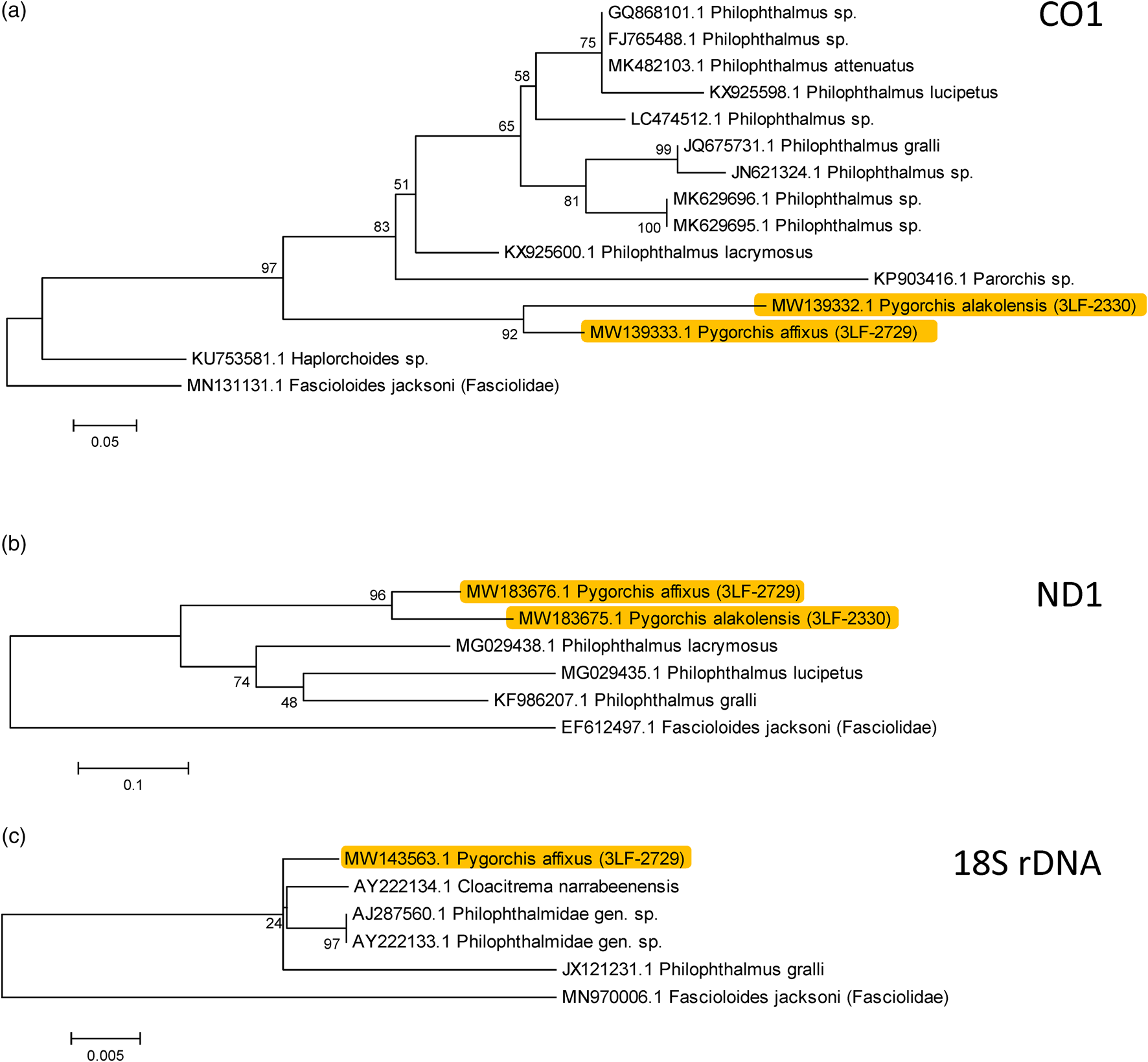
Because the morphological support for the validity of P. alakolensis description was weak, we sequenced the DNA of one of the two individuals of P. alakolensis found, and sequenced a representative P. affixus individual. The phylogenetic analysis of CO1 and ND1 (fig. 1) suggested that the two sequenced specimens represented two independent species that jointly formed a Pygorchis clade within Philophthalmidae. The phylogenetic analysis, therefore, revealed P. alakolensis as a valid species, which is properly classified into the genus Pygorchis.
Maximum likelihood analyses of sequences of mitochondrial and nuclear DNA loci of Philophthalmidae. (a) CO1; (b) ND1; (c) 18S rDNA. The bars indicate the number of substitutions per nucleotide. Sequences of Pygorchis spp. are highlighted.

Description of the analysed specimen of P. alakolensis:
-
Pygorchis alakolensis Zhatkanbaeva, 1967.
-
Synonym. Pygorchis alacolensis Zhatkanbaeva, 1967 (Semenova & Ivanov, Reference Semenova and Ivanov1985; Ivanov et al., Reference Ivanov, Semenova, Parshina, Kalmykov and Fedorovich2003; Schuster, Reference Schuster2013).
-
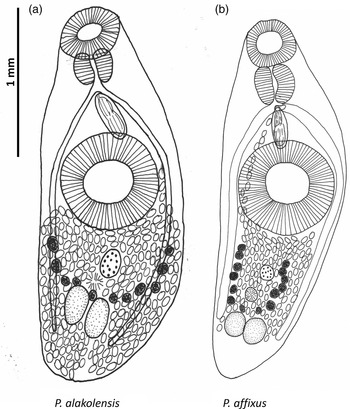
Collection Comenius Museum Přerov (J. Sitko), one specimen, number P-P-1870/6 (fig. 2a).
-
Host. Charadriiformes – Sterna hirundo.
-
Locality. Czech Republic: Záhlinice (49.29°N, 17.48°E).
Representative drawings of the Pygorchis alakolensis (a) and Pygorchis affixus (b) analysed in this study.

Description
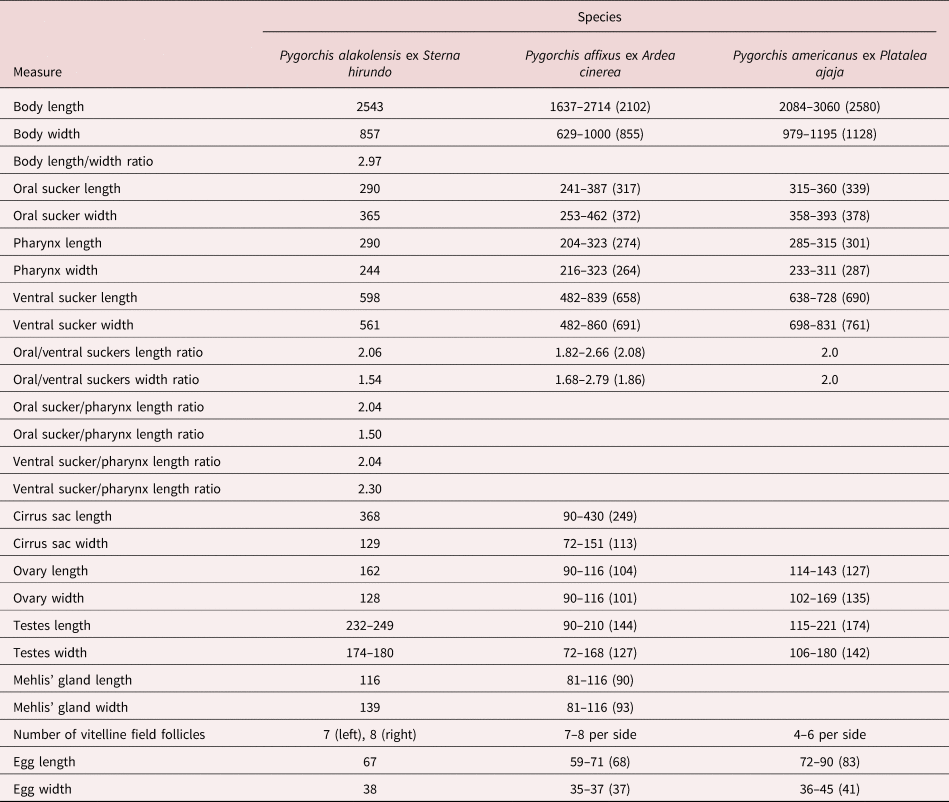
Based on one specimen from S. hirundo. Egg-shaped body tapering anteriorly, broader in rear part. Body 2543 × 857, body length/width ratio 1:2.97. Suckers distinct. Oral sucker subterminal, broadly oval 290 × 365. Pharynx 290 × 244, large, muscular. Intestinal bifurcation just posterior to pharynx, caeca extend slant to lateral edge of ventral sucker, pass along ventral sucker edge and extend slightly up to level of ovary, form loop around testes and end blind posterior to testes at about half of testes width. Ventral sucker oval 598 × 561, in the middle of the body. Suckers’ length ratio 1:2.06, width ratio 1:1.54. Oral sucker/pharynx length ratio 1:2.04, width ratio 1:1.5. Ventral sucker/pharynx length ratio 1:2.06, width ratio 1:2.3. Genital pore medial, posterior to pharynx. Cirrus sac oval, 368 × 129, between ventral sucker and pharynx. Testes oblong, between intestinal caeca, in oblique position at posterior body end; right testis 232 × 180, left testis 249 × 174. Ovary 162 × 128, oval or globular. Mehlis’ gland 116 × 139, oval, medial, between ovary and testes. Vitelline fields consist of seven (left side) or eight (right side) large follicles cutting through intestinal branches at level of ovary in mediolateral direction. Uterus fills whole body posterior to ventral sucker and terminates onto surface of body in zone of intestinal bifurcation. Eggs 67 × 38, contain miracidium with pigment stain.
Molecular features
CO1 (MW139332) and ND1 (MW183675) sequences. The lowest interspecific evolutionary divergence (in base differences per nucleotide): CO1: 0.140 ± 0.030 compared to P. affixus (0.322 ± 0.049 and 0.297 ± 0.049 compared to Philophthalmus lucipetus and Philophthalmus lacrymosus, respectively). ND1: 0.128 ± 0.026 compared to P. affixus (0.259 ± 0.054 and 0.287 ± 0.059 compared to P. lucipetus and P. lacrymosus, respectively).
Discussion
The morphology of P. affixus is highly variable, and previous descriptions do not allow distinguishing P. affixus unequivocally from P. alakolensis based on morphological features (see table 2 for comparative measurements of the three Pygorchis spp.). Schuster (Reference Schuster2013) summarized the state-of-the-art identification features of the Pygorchis and Cloacitrema spp. as follows: ‘[t]he position of testes to each other even within one species may vary from parallel to slightly oblique … for P. alakolensis and P. americanus while in P. affixus the testes are in a parallel position’ and ‘[v]itelline fields extending extracaecally can be seen in P. alakolensis and P. americanus but not in the type species, P. affixus.’ However, as an example of the variability found, Bykhovskaya-Pavlovskaya (Reference Bykhovskaya-Pavlovskaya1974) reported three adult P. affixus in M. alba that were examined at the Curonian spit. The mentioned publication did not contain any description; however, it contained a drawing where P. affixus has testes in serial order and the left field of vitelline follicles extends towards the body edge – that is, beyond the caeca. Therefore, both key morphological identification features of P. affixus cannot be applied to all individuals of this species. Based on our own examinations and based on published data, we estimate that only approximately 80% of P. affixus fit the characteristic description of this species (fig. 2b). Therefore, the validity of P. alakolensis was questionable until the molecular data provided a strong independent support of the existence of both P. affixus and P. alakolensis as two independent species.
Measurements of Pygorchis spp. based on the adult individuals collected in Czechia (P. affixus, P. alakolensis; this study and Sitko, Reference Sitko2012) and in the USA (P. americanus; Dronen, Reference Dronen1985).

The host species of the individuals described are: P. alakolensis – one adult individual from S. hirundo; P. affixus – 16 adult individuals from A. cinerea; P. americanus – eight adult individuals from Platalea ajaja. The data are shown as a range (mean).
The descriptions of P. alakolensis are also variable and all (including the one that is provided in the present study) are based on a small number of examined specimens. Semenova & Ivanov (Reference Semenova and Ivanov1985) examined one specimen of P. alakolensis from a cloaca of L. argentatus. It was of similar dimensions as the presently examined specimen, oral sucker was subterminal, ovary was slightly larger than testes, vitelline fields consisted of six fields at each side, reaching diagonally the body edges, and eggs were thinner, 60–67 × 45–52. The size of the ovary was twice larger, and the testes twice smaller compared to the original description by Zhatkanbaeva (Reference Zhatkanbaeva1967), but matched the dimensions of the specimen examined in the present study. The cirrus sac (190 × 90) was three-times smaller compared to Zhatkanbaeva (Reference Zhatkanbaeva1967) and twice shorter compared to the present study. The oral sucker (400 × 360) was larger compared to Zhatkanbaeva (Reference Zhatkanbaeva1967) and somewhat larger compared to the presently examined specimen. The number of vitelline fields reported by Semenova & Ivanov (Reference Semenova and Ivanov1985) was lower (six) compared to Zhatkanbaeva (Reference Zhatkanbaeva1967) and compared to the present specimen (seven to eight). The type specimen that was described by Zhatkanbaeva (Reference Zhatkanbaeva1967) was slightly larger than the one examined in the present study, with correspondingly larger oral sucker; the eggs were of the similar size.
Sitko & Heneberg (Reference Sitko and Heneberg2015) noticed that they were able to retrieve P. affixus only from adult herons in their study area in Central Europe; moreover, seven of the eight records they report originated from April or May. Therefore, they suggested that this species must be introduced by migrating herons from Africa. The distribution of intermediate hosts of P. alakolensis is unclear; the Central European populations of their host, S. hirundo, migrate to Mosambique and South Africa (Kralj et al., Reference Kralj, Martinović, Jurinović, Szinai, Sütő and Preiszner2020); it also cannot be excluded that some S. hirundo individuals migrate to the Caspian Sea, where the previously known area of distribution of P. alakolensis is located (Semenova & Ivanov, Reference Semenova and Ivanov1985).
In conclusion, we provided the first conclusive molecular evidence on the validity of P. alakolensis, which we report for the first time from Europe. To complement previously published data, we provide the description of a third specimen of this species. We confirmed the classification of Pygorchis into Philophtalmidae.
Acknowledgements
We thank Jiří Bizos for expert technical assistance. We also thank the landlords, gamekeepers and the staff of local rescue stations for providing us with carcasses of untreatable birds.
Financial support
This study was supported by the Ministry of Culture of the Czech Republic (project number DE07P04OMG007).
Conflicts of interest
None.
Ethical standards
The authors assert that all procedures contributing to this work comply with the ethical standards of the relevant national and institutional guides on the care and use of animals.
Author contributions
PH and JS conceived the study, JS examined the host birds and performed the morphological analyses, PH performed the molecular and phylogenetic analyses and wrote the manuscript. Both authors revised the manuscript and agreed on its final version.
Data and materials availability
Representative specimens of the helminths analysed in this study are available in the collections of the Comenius Museum in Přerov. All data are available in the main text.