1. INTRODUCTION
Accidents generally result in a serious damage, loss, death, injury or pollution, and marine accidents such as a collision, contact, grounding, fire or explosion involve large economic, political and ecological consequences. Therefore many governments investigate marine accidents by branches of their Departments of Transportation (for details see the Appendix). Courts also provide experienced field experts who are drawn from pilots, captains, naval architects or engineers. These experts mostly interpret the rules and regulations in a subjective assessment process. Ensuring justice becomes harder due to the many rules and regulations and outcomes may vary significantly.
In the conventional method, proper values of “Fraction Defectives” (FDs) are assigned as to the roles of parties (i.e. vessels) involved in the related case. In the conventional application of marine accident analysis, FDs are determined in a complete assessment process and subject to bias due to the limitations of human judgment and cognitive interpretations. Thus, the losing parties often appeal to reject the decision.
This paper provides an alternative process to improve the decision making approach for marine accident analyses. A Generic Fuzzy Analytical Hierarchy Process (GF-AHP) method is proposed. This structured multi-criteria decision making method is preferred, based on its superiority derived from the decomposition of the proposed purpose, organisation of the complexity and consensus of expert consultation. Traditionally, Fraction Defective Management (FDM) is used as a method to apportion the FDs for detecting the liabilities of the involved vessels. To the best of our knowledge, FDM for collisions by using pairwise comparison has not been addressed in the literature.
The International Regulations for Preventing Collisions at Sea (COLREGS, 1972) published by the International Maritime Organization (IMO) is an international comprehensive guide for the purpose of providing safe vessel traffic at sea. In our system, each criterion (COLREG rules involved in the collision) that contributes to the causes of the collision has a percentage value. The sum of all criteria for both vessels is assumed as having a total 100% value. FD is a contributory rate obtained as a result of a GF-AHP alternative weighting process taking into consideration the criteria's weights.
The aim of this paper is to make recommendations for court experts, inspectors and accident investigators to construct a model for assigning the percentages to the FDs of each vessel's actions on a time basis. Also, this research will help the court experts to prevent the unfair FD ratings for similar incidents occurring in the future.
For this research, a historical maritime accident is selected. Contributory causes, conditions and circumstances are criticised and compared with the other assessments. Then, all these scenarios are analysed in a consideration that it will take a significant role in our navigational and operational maritime accident history. The same conditions are adapted to the same location and the same accident is simulated again with the same circumstances at the Main Bridge Simulator of the Maritime Department, Istanbul Technical University (ITU) (Figure 1).
Illustration of the JMS full-mission ship handling simulator main bridge. (Courtesy of JMS manual).

2. COLLISION ASSIGNMENTS
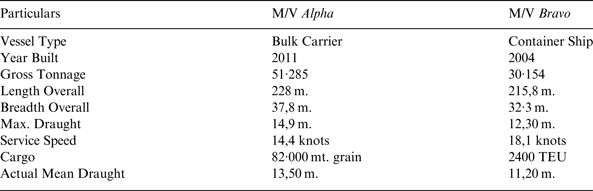
First of all, we prefer to conceal the names of the vessels for ethical reasons and the possibility of affecting court decisions. However, the remainder of the data of the vessels implemented for the collision of our imaginary vessels is based on a real incident. The particulars of the imaginary vessels (M/V Alpha and M/V Bravo) are given in Table 1.
Particulars of M/V Alpha and M/V Bravo.
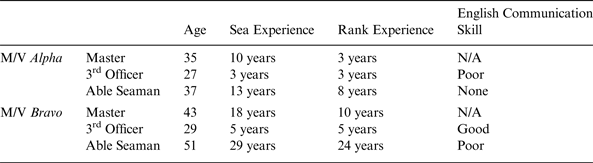
Information of the relevant crews for both vessels is given in the Table 2.
Information of M/V Alpha and M/V Bravo's Relevant Crews.
Recorded conditions on the day of the accident were:
• Height of Tide: 0·3 m.
• Tidal Stream: WNW 0·2 knots
• Wind Speed – 10 knots
• Wind Direction – SE
• Sea – S/2 m.
• Visibility – 10 nm.
On 7 July 2013 at 22:19:45 hours, M/V Alpha and M/V Bravo collided in the eastern approaches of the Singapore Strait, 6·5 nm NE bearing of Horsburg Lighthouse. Details of the accident in terms of both sides are given below.
2.1. Bridge of M/V Alpha
At approximately 21:25 M/V Alpha passed abeam Horsburg Lighthouse, and maintained heading 048° (T) at a speed of 9·8 knots. The officer of the watch was the 3rd Officer whose English was poor. An able seaman was also present as a lookout. Radar was adjusted to 6 nm range, head up, relative motion, off centre and 3 min trails function was activated. At 22:00, 20 minutes prior to collision, the officer adjusted the radar range to 12 nm. Positions of the vessels are shown in Figure 2.
Illustration of the Vessels on British Admiralty Chart (BA 3831) 22:00.
M/V Bravo was a vessel approaching from the starboard bow on a collision course and was visible on the radar screen with clear trail as seen in Figure 3. After a while, the officer adjusted the range back to 6 nm and M/V Bravo was still visible on the radar screen.
Simulated Radar Screenshot on M/V Alpha, 22:02.
As the vessel approached the eastbound Traffic Separation Scheme (TSS) lane, there was heavy vessel traffic; transiting vessels in both lanes of the TSS, fishing vessels on the starboard side of M/V Alpha, some of which were sailing and some not, and anchored vessels on the starboard bow which were disturbing the view with their deck lights on. Therefore the officer could not detect M/V Bravo visually as it transited between anchored vessels.
The simulated radar screenshot is compared with the real radar records (Figure 4) derived from the Voyage Data Recorder (VDR), which records all critical data related to the voyage. As is seen from Figures 3 and 4, both these radar screenshots indicate the same moment. However, there is one difference between these images concerning the radar scaling. Since the original radar is adjusted to 12 nm, as mentioned in the narrative of the event, our simulated image indicates that it is adjusted to 6 nm. In that respect, the vessels at a distance of more than 6 nm, seen on the real radar screen, are not visible on our simulated radar image.
Real Radar Screenshot from M/V Alpha, 22:02.
Though it is a very tough task to create such a scenario to make the real accident happen by using simulators, we simulated the collision as closely as possible. The similarities between two images are clearly seen in Figure 4.
At 22:08, 12 minutes prior to collision, at a distance of 4·5 nm from M/V Bravo, the officer plotted her on the radar, and identified the ship with the Automatic Identification System (AIS). He noticed the unchanging bearing and 0·0 nm Closest Point of Approach (CPA) value on radar screen when Time to Closest Point of Approach (TCPA) was 12·5 minutes (Figure 5). Though M/V Alpha was the give-way vessel and M/V Bravo was the stand-on vessel according to International Regulations for Preventing Collisions at Sea (COLREGS, 1972), the officer hoped M/V Bravo would make an evasive manoeuver, as M/V Alpha could not manoeuver due to congested traffic. However, he did not make any communication with the other vessel and M/V Alpha maintained its course and speed.
Simulated Radar Screenshot of M/V Alpha 22:08 (CPA: 0·0 nm., TCPA: 12·5 min., Range: 4·5 nm).
At 22:15, 5 minutes prior to the collision, when the distance between the vessels was 2 nm, the officer of M/V Alpha called the M/V Bravo on Very High Frequency (VHF) Radio channel 16 without receiving any response (Figure 6).
Illustration of the Vessels Chart BA3831, 22:15.
At 22:16, 4 minutes prior to the collision, the officer made another call, which was responded to by the M/V Bravo. They agreed to maintain communication on VHF channel 15. Officers could hear each other clearly, but the communication was interrupted by other ships' communication. After a few seconds, a sound was heard on VHF “Increase your speed, I will pass clear of you.” The officer of M/V Alpha tried to communicate with M/V Bravo without receiving any response for 3 minutes, while both vessels were maintaining course and speed. At 22:20:09, 30 seconds prior to the collision, the officer of M/V Alpha started a hard port turn in order to prevent the collision.
2.2. Bridge of M/V Bravo
M/V Bravo was proceeding towards the eastern approaches to the Singapore Strait from the east at a speed of 14·5 knots. At 20:00, the 3rd Officer took over the bridge watch, and there was an able seaman as a lookout. Radar was adjusted to the 12 nm range, north up, relative motion, off centre and the 3 min trails function was activated. At 20:15 the master came to the bridge to check traffic and prepare night orders. After 10 minutes, the master told the officer to call him at a certain point near the TSS and in case of any heavy traffic and then the master left the bridge. At 20:35 course was altered from 311° (T) to 284° (T). At approximately 21:20 the officer noticed many targets on the radar screen: anchored vessels ahead and some fishing vessels on the starboard bow. He decided to pass through the anchored vessels by adjusting CPA to 4 cables and radar range to 6 nm. At 21:40, the officer noticed that two ships were proceeding to the TSS from northeast, on his starboard bow, which were on a probable collision course. He was fully concentrating on these vessels and a planned hard turn to port after them. The officer did not notice the approaching vessels from the port bow and neither did the able seaman who was on duty as a lookout.
At 22:05, 15 minutes prior to collision, M/V Alpha was visible on radar screen at a distance of 6 nm (Figures 7 and 8).
Illustration of the Vessels on Chart BA 3831. 22:05.
Simulated Radar Screenshot of M/V Bravo, 22:05 (the officer plotted the ships approaching from stbd bow and M/V Alpha was visible on the screen).
Both vessels maintained their courses and speeds. At 22:08, 12 minutes prior to collision, though the distance between the M/V Alpha and M/V Bravo was decreasing dangerously, the officer did not notice the M/V Alpha, as he was concentrating on the vessels approaching from the starboard bow (Figure 9).
Simulated Radar Screenshot of M/V Bravo, 22:08 (The officer is still fully concentrating on ships approaching from starboard bow).
At 22:14, 6 minutes prior to collision, the normal situation on the bridge was changed suddenly, when the officer noticed the green side light on his port bow at a distance of 2 nm. (Figure 10). Following this, the officer plotted the other ship on radar, and plotted his own position on the Chart. M/V Alpha called M/V Bravo on VHF Ch. 16. He responded to the call, and agreed to communicate on channel 15. Communication was not effective.
Illustration of the Vessels on Chart BA 3831, 22:14.
At 22:17, 3 minutes prior to collision, M/V Alpha requested M/V Bravo to increase speed to pass clear of M/V Alpha which made the officer of M/V Bravo confused, and he could not understand the intentions. He knew it was quite impossible to increase the speed of the ship in time, so he did not respond and assumed the request was not relevant for him, as the other vessels were very close to him. At 22:18, 2 minutes prior to collision, he decided to call the master while he was maintaining course and speed. At 22:19:47, 1 minute prior to collision, he made a hard turn to starboard manually to prevent the collision. Figure 11 indicates the moment of collision.
The Moment of Collision on Chart BA3831, 22:20:40.
3. METHODOLOGY
3.1. Fuzzy sets and triangular fuzzy numbers
Linguistic variables are expressed as fuzzy words instead of numbers in a type of artificial language. For instance, weather condition is such a variable, and expressed as cold, very cold, hot or very hot (Bellman and Zadeh, Reference Bellman, Zadeh, Dunn and Epstein1977).
A linguistic variable is approximate because of its character of being too complex or unclear for description in quantitative terms. Humanistic systems commonly use linguistic variables such as human supported decision systems, law, economy, medical realms, artificial intelligence, pattern recognitions and related areas (Zadeh, Reference Zadeh1975).
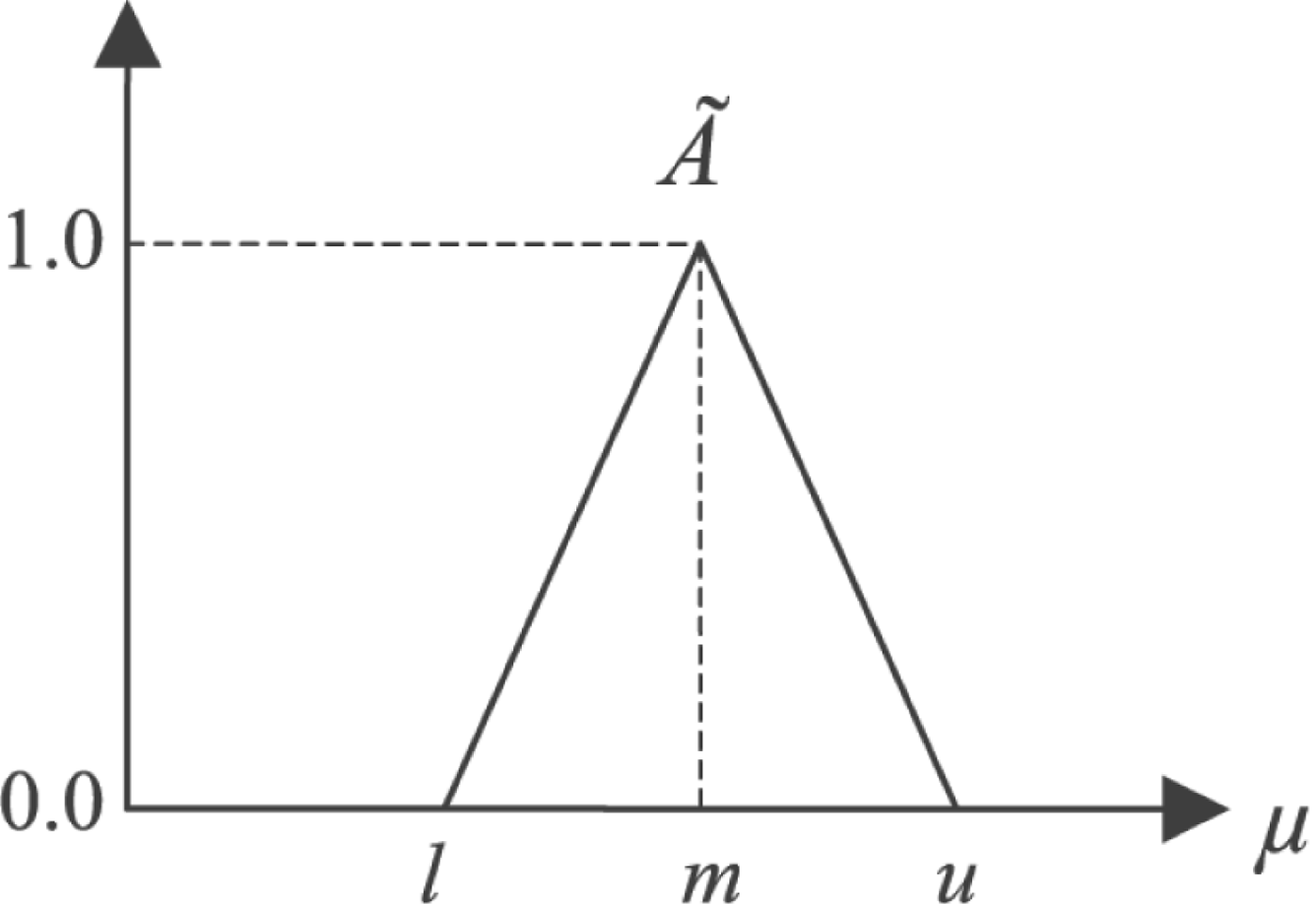
Zadeh firstly developed and introduced Fuzzy sets (Zadeh, Reference Zadeh1965). A triangular fuzzy number is a convex and normalized fuzzy set à and μ à (x) is the continuous linear function which is membership function of Ã.
à is the subset of X for all x ∈ X, which is assumed a universe of discourse. μ à (x) ∈ [0,1] is the membership function of à and represents the membership of x to Ã.
A triangular fuzzy number Ã=(l, m, u) is basically,
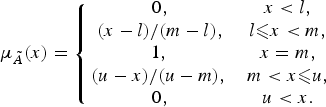 $$\mu _{\tilde A} (x) = \left\{ {\matrix{ {0,} & {x \lt l,} \cr {(x - l)/(m - l),} & {l \les x \lt m,} \cr {1,{\rm}} & {x = m,} \cr {(u - x)/(u - m),{\rm}} & {m \lt x \les u,} \cr {0,} & {u \lt x.} \cr}} \right.$$
where l and u are the upper value and lower value, which are bounds of fuzzy number à and m is the midpoint. A triangular fuzzy number (TFN) is shown in Figure 12.
Triangular fuzzy number.
Arithmetic operations between TFN and crisp numbers are defined by Zadeh (Reference Zadeh1965) which are given below:
Two positive triangular fuzzy numbers l 1, m 1, u 1 and l 2, m 2, u 2 then:
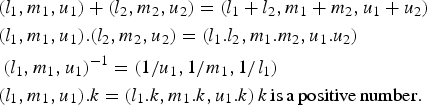 $$\eqalign{& (l_1, {\rm} m_1, {\rm} u_1 ){\rm} + {\rm (}l_2, {\rm} m_2, {\rm} u_2 {\rm )} = (l_1 + l_2, {\rm} m_1 + {\rm} m_2, {\rm} u_1 + u_2 ) \cr & (l_1, {\rm} m_1, {\rm} u_1 ){\rm}. (l_2, {\rm} m_2, {\rm} u_2 ) = (l_1. l_2, {\rm} m_1. m_2, {\rm} u_1. u_2 ) \cr & \; (l_1, {\rm} m_1, {\rm} u_1 )^{ - 1} = {\rm} (1/u_1, {\rm} 1/m_1, {\rm} 1/l_1 ) \cr & (l_1, {\rm} m_1, {\rm} u_1 ).k{\rm} = {\rm} (l_1. {\rm} k,{\rm} m_1. k{\rm}, {\rm} u_1. {\rm} k)\,k{\rm} \,{\rm is}\,{\rm a}\,{\rm positive}\,{\rm number}{\rm.}} $$
3.2. Fuzzy Analytical Hierarchy Process (F-AHP)
The Analytical Hierarchy Process (AHP) was firstly proposed by Saaty (Reference Saaty1980) as a decision making tool which is widely used by many researchers (Leung and Cao, Reference Leung and Cao2000; Lee et al., Reference Lee, Pham and Zhang1999; Weck et al., Reference Weck, Klocke, Schell and Ruenauver1997; Duru et al., Reference Duru, Bulut and Yoshida2012). The main purpose of AHP is to utilise expert consultation. However, the classical AHP does not reflect the human thinking style (Chang, Reference Chang1996). Classical AHP uses the exact values when comparing the criteria or alternatives (Cakir and Canpolat, Reference Cakir and Canpolat2008). On the other hand, there are many criticisms based on its unbalanced scale, uncertainty and imprecision of pairwise comparisons are highly discussed in the literature. Analytical Hierarchy Process (AHP) has been evolved into the FAHP by Laarhoven and Pedrycz (Reference Laarhoven and Pedrycz1983). The FAHP overcomes the shortcomings of the fuzziness of the decision making process. FAHP is more accurate, and it is developed to handle the above shortcomings. It is accomplished by the adaptation of triangular fuzzy numbers into the pairwise comparison matrix. Then several FAHP methods are developed for various decision-making problems. Laarhoven and Pedrycz firstly proposed the FAHP by comparisons of fuzzy ratios (Laarhoven and Pedrycz, Reference Laarhoven and Pedrycz1983). Buckley worked on trapezoidal fuzzy numbers to evaluate the alternatives with respect to the criteria (Buckley, Reference Buckley1985). For the pairwise comparisons Chang developed an extent analysis method for the synthetic extent values (Chang, Reference Chang1996).
The steps of the extent synthesis method are:
Let X={x 1, x 2…x n} as an object set and U={u 1, u 2…u n} be a goal set. Each object is taken, and extent analysis is performed for each goal. Therefore, m extent analysis values for each object can be obtained.
 $$M_{g_i} ^1, M_{g_i} ^2,..., M_{g_i} ^m, \quad i{\rm} = 1,{\rm} 2 \ldots n$$
where all M gj(j=1,2…m) are the triangular fuzzy numbers.
Step 1: Regarding the ith object, the value of fuzzy synthetic extent is defined as:
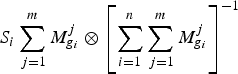 $$S_i \sum\limits_{\,j = 1}^m {M_{g_i} ^j} \otimes \left[ {\sum\limits_{i = 1}^n {\sum\limits_{\,j = 1}^m {M_{g_i} ^j}}} \right]^{ - 1} $$
Obtaining  $\mathop \sum \limits_{\,j = 1}^m M_{g_i} ^j ,$the fuzzy addition operation of m extent analysis values for a particular matrix is performed as:
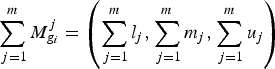 $$\sum\limits_{\,j = 1}^m {M_{g_i} ^j} = \left( {\sum\limits_{\,j = 1}^m {l_j, \sum\limits_{\,j = 1}^m {m_j, \sum\limits_{\,j = 1}^m {u_j}}}} \right)$$
and to obtain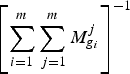 $\left[ {\mathop \sum \limits_{i = 1}^m \mathop \sum \limits_{\,j = 1}^m M_{g_i} ^j} \right]^{ - 1} $, the fuzzy addition operation of
 $M_{g_i} ^j (\,j = 1,2 \ldots m)$ values is performed as:
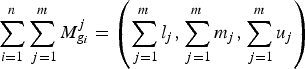 $$\sum\limits_{i = 1}^n {\sum\limits_{\,j = 1}^m {M_{g_i} ^j}} = \left( {\sum\limits_{\,j = 1}^m {l_j, \sum\limits_{\,j = 1}^m {m_j, \sum\limits_{\,j = 1}^m {u_j}}}} \right)$$
The inverse of the vector is
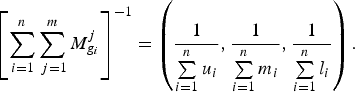 $$\left[ {\sum\limits_{i = 1}^n {\sum\limits_{\,j = 1}^m {M_{g_i} ^j}}} \right]^{ - 1} = \left( {\displaystyle{1 \over {\sum\limits_{i = 1}^n {u_i}}}, \displaystyle{1 \over {\sum\limits_{i = 1}^n {m_i}}}, \displaystyle{1 \over {\sum\limits_{i = 1}^n {l_i}}}} \right).$$
Step 2: The degree of possibility of M 2=(l 2, m 2, u 2)⩾M 1=(l 1, m 1, u 1) is defined as:
 $$V(M_2 \ges M_1 ) = \mathop {\sup} \limits_{y \ges x} \left\lfloor {\min (\mu _{M_1} (x),\mu _{M_2} (y))} \right\rfloor $$
and also can be expressed as follows:
 $$V(M_2 \ges M_1 ) = hgt\, (M_1 \cap M_2 )$$
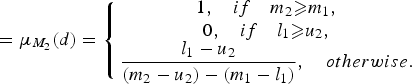 $$ = \mu _{M_2} (d) = \left\{ {\matrix{ {1,{\rm} \quad if \quad m_2 \ges m_1 {\rm,}} \cr {0,\quad{\rm} if \quad l_1 \ges u_2 {\rm,}} \cr {\displaystyle{{l_1 - u_2} \over {(m_2 - u_2 ) - (m_1 - l_1 )}}, \quad {\rm} otherwise.} \cr}} \right.$$
d is the y-axis value of the highest intersection point D between  ${\mu} _{{\rm M}_1} $ and
 ${\mu} _{{\rm M}_2}. $ Both V (M 1⩾M 2) and V(M 2⩾M 1) should be known for the comparison of M 1 and M 2
Step 3: The degree of possibility for a convex fuzzy number to be greater than k convex fuzzy M i(i=1, 2…) numbers can be defined by
 $$\eqalign{V(M \ges & M_{1,} M_2 \ldots M_k ) \cr = & V[(M \ges M_1 )and(M \ges M_2 )and{\rm} \ldots {\rm} and(M \ges M_k )] \cr = & minV{\rm} (M \ges M_i ),i = 1,{\rm} 2,{\rm} 3{\rm} \ldots k.} $$
Assume that for d(A i)=minV (Si⩾Sk)fork=1, 2…n; then the weight vector is given by
 $$W' = {\rm} (d'(A_1 ),{\rm} d'(A_2 ) \ldots d'(A_n ))^T $$
where A i=(i=1, 2…n) are n elements.
Step 4: Normalization and normalized weight vectors are:
 $$W = {\rm} (d(A_1 ),{\rm} d(A_2 ) \ldots d(A_n ))^T, $$
where W is a non-fuzzy number.
3.3. Design of the Application
In this paper, a novel approach by using a F-AHP procedure named Generic Fuzzy-AHP (GF-AHP) is applied to our problem (Bulut et al., Reference Bulut, Duru, Kececi and Yoshida2012). This method is an extension of the conventional method includes Centric Consistency Index (CCI) check, prioritisation of expert experience and a rank method for direct numerical inputs. The procedure of GF-AHP is shown in stepwise progress in the Figure 13. GF-AHP allows researchers to implement CCI control, expert prioritization and direct numerical inputs.
Procedure of GF-AHP.
For the GF-AHP method, as an expert priority multiplier lambda coefficient is conducted for aggregation of individual matrices (Bulut et al., Reference Bulut, Duru, Kececi and Yoshida2012). We assume a ij>0, a ij×a ji=1 and A=(a ij)n×n is a judgment matrix. From the judgment matrix A, the prioritisation method derives a priority vector w=(w 1, w 2…w n)T, where w i⩾0 and 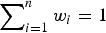 $\sum\nolimits_{i = 1}^n {w_i} = 1$, D={d 1, d 2…d m} is the set of decision makers (DM), and λ={λ 1, λ 2…λ m} is the weight vector of DM, where λ k>0, k=1, 2…m, and
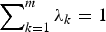 $\sum\nolimits_{k = 1}^m {\lambda _k = 1} $.
E={e 1, e 2…e m} is the year of experience in their professional career for each DM, and λ k for each DM is defined by
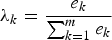 $$\lambda _k = \displaystyle{{e_k} \over {\sum\nolimits_{k = 1}^m {e_k}}} $$
A (k)=(a ij(k))n×n is the judgment matrix provided by the DM d k.
w i(k) is the priority vector of criteria for each DM calculated as follows:
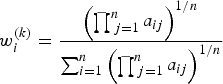 $$w_i^{(k)} = \displaystyle{{\left( {\prod\nolimits_{\,j = 1}^n {a_{ij}}} \right)^{1/n}} \over {\sum\nolimits_{i = 1}^n {\left( {\prod\nolimits_{\,j = 1}^n {a_{ij}}} \right)^{1/n}}}} $$
The aggregation of individual priorities is defined by
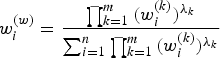 $$w_i^{(w)} = \displaystyle{{\prod\nolimits_{k = 1}^m {(w_i^{(k)} )^{\lambda _k}}} \over {\sum\nolimits_{i = 1}^n {\prod\nolimits_{k = 1}^m {(w_i^{(k)} )^{\lambda _k}}}}} $$
where w i(w) is the aggregated weight vector. After the aggregation process, Chang's (Reference Chang1996) extent synthesis methodology is applied for subsequent choice selection.
After the final consistency control, the GF-AHP procedure is completed. The consistency control and CCI for fuzzy-AHP applications is explained in the following section.
3.4. Centric Consistency Index (CCI)
According to Saaty's approach, all matrices should be consistent (Saaty and Vargas, Reference Saaty and Vargas1987). For consistency checking of the GF-AHP method, Bulut et al. (Reference Bulut, Duru, Kececi and Yoshida2012) used CCI. The Geometric Consistency Index (GCI) method formalised from the geometric mean method (RGMM) is proposed (Crawford and Williams, Reference Crawford and Williams1985; Aguarón and Moreno-Jiménez, Reference Aguarón and Moreno-Jiménez2003). For the classical AHP method, GCI measures the individual consistency of judgment matrices. Centric Consistency Index (CCI) calculates the consistency in aggregated matrices.
 $$\eqalign{CCI(A) = & \displaystyle{2 \over {(n - 1)(n - 2)}}\sum\limits_{i{\rm \lt} j} {\left( {\log \left( {\displaystyle{{a_{Lij} + a_{Mij} + a_{Uij}} \over 3}} \right)} \right.} - \log \left( {\displaystyle{{w_{Li} + w_{Mi} + w_{Ui}} \over 3}} \right) \cr & \left. { + \log \left( {\displaystyle{{w_{Lj} + w_{Mj} + w_{Uj}} \over 3}} \right)} \right)^2 \cr {\rm}} $$
When CCI(A) is 0, A is fully consistent. Aguarón and Moreno-Jiménez (Reference Aguarón and Moreno-Jiménez2003) also express the thresholds  $(\overline {GCI} )$ as
 $\overline {GCI} = 0 {\cdot} 31$ for n=3;
 $\overline {GCI} = 0 {\cdot} 35$ for n=4 and
 $\overline {GCI} = 0 {\cdot} 37$ for n>4. When
 $CCI(A) \lt \overline {GCI} $ that means this matrix is sufficiently consistent.
4. ANALYSIS OF THE COLLISION
Vessels need to follow navigation rules at sea to prevent collisions. In our real case, two vessels were involved in the accident. As a conventional approach, the COLREGs are referred to analyse marine accidents. The collision summarised in Section 2 is discussed below. Contributing factors are criticised in terms of each vessel.
4.1. COLREG rules for the M/V Alpha
After expert consultation, it is decided that M/V Alpha has violated five COLREG Rules that are detailed below. Rule 16 is unique for M/V Alpha.
4.1.1. Rule 5 Lookout
At 22:08 the officer plotted the M/V Bravo on the radar for the first time, 12 minutes prior to the collision when the distance between the vessels was 4·5 nm. Plotting was made by using the AIS data that are generated from target ships, which could lead to not realising the critical situation. The officer should have used his own radar data for anti-collision purposes. In that respect the officer of M/V Alpha violated COLREG Rule 5 which is related with lookout. It mentions “Every vessel shall at all times maintain a proper lookout by sight as well as by hearing as well as by all available means appropriate in the prevailing circumstances and conditions so as to make a full appraisal of the situation and of the risk of collision.”
4.1.2. Rule 6 Safe speed
M/V Alpha was navigating with almost 10 knots speed which should be adjusted to each internal and external condition such as visibility, traffic density, stopping distance, sea condition, conditions of radar, number location and movement of vessels detected by radar etc. Therefore M/V Alpha should have adjusted speed in accordance with COLREG Rule 6, Safe Speed. The officer should have adjusted the speed taking into account the traffic density (Rule 6(a)(ii)), effective manoeuvre and stopping distance (Rule 6 (a)(iii)), bright lights beamed by the anchored vessels which affected the visibility at night time (Rule 6 (a)(iv)), and vessels which were very close to him, and obstructed an effective evasive manoeuvre (Rule 6(b)(v)). In that respect, the officer of M/V Alpha violated COLREG Rule 6.
4.1.3. Rule 7 Risk of collision
The officer of M/V Alpha noticed the risk collision and expected the other vessel to make an evasive manoeuvre due to his limited opportunities of manoeuvring. Nevertheless noticing a risk is not sufficient to prevent any collision, as the officer should have used all available means to prevent collision and make the other vessel's officer acknowledge the risk of collision (Rule 7(a)). The officer could occasionally adjust the radar range to a larger scale to obtain early warning of risk of collision (Rule 7(b)). Moreover, instead of expecting the other vessel's manoeuvre without any action on his part, the officer should have used other available equipment such as VHF to notify the risk of collision and his limited manoeuvre opportunities to the other officer. Also the officer could adjust the radar to automatic detection for any dangerous targets; even if he could not observe them. Thus the officer assumed the port side as safe, because he made an assumption which is based on scanty information about radar (Rule 7(c)). From these points of view, the officer of M/V Alpha violated COLREG Rule 7, risk of collision.
4.1.4. Rule 8 Action to avoid collision
In case of any collision situation, the most important action is to prevent the collision regardless of being give-way or stand-on vessel. Therefore, the officer of M/V Alpha should have tried to establish not only VHF communication earlier than 3 minutes prior to collision, but should also have slackened the speed of the ship. This means the officer did not take preventive action in ample time (Rule 8(a)). He did not take the most effective action to prevent a close-quarters situation in good time. Therefore he could not ensure passing at a safe distance (Rule 8(c)). Moreover the officer could have reduced speed to allow more time for action to avoid collision (Rule 8(e)). In that respect, the officer of M/V Alpha violated COLREG rule 8, as he was reluctant to take action to avoid collision due to several reasons.
4.1.5. Rule 16 Action by give-way vessel
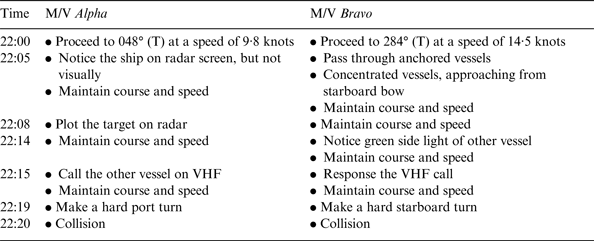
In case of any situation that a vessel is directed to keep out of the way of another vessel, it should, so far as possible, take early and substantial action to keep well clear. As the officer of M/V Alpha did not take action as a give-way vessel, he violated COLREG rule 16, action by give-way vessel. A time chart of the actions taken by M/V Alpha is given in Table 3.
Actions taken by the vessels.
4.2. COLREG rules for M/V Bravo
Field experts confirmed that M/V Bravo has violated five COLREG Rules. Rule 17 is unique for M/V Bravo.
4.1.1. Rule 5 Lookout
During navigation, the officer of the watch should at all times carry out a proper lookout. Proper lookout not only means observing the stand-on vessels, but also observing give-way vessels. Though M/V Bravo was the stand-on vessel according to COLREG, the officer of M/V Bravo should not have observed only the stand-on vessels for him. Also he did not notice the vessels approaching from the port bow on the radar screen. When the officer of M/V Alpha called the M/V Bravo, the astonishment of the officer of M/V Bravo is an obvious indicator that he did not notice the M/V Alpha earlier. Observations on the bridge should be maintained to avoid collision. In that respect, the officer of M/V Bravo violated COLREG Rule 5, lookout.
4.1.2. Rule 6 Safe speed
M/V Bravo was navigating at almost 14.5 knots speed that may be considered excessive speed in such congested areas, thus a circular related to safety of navigation in the Singapore Strait and published by Maritime and Port Authority of Singapore Strait, restricts the speed of vessels to 12 knots within the Strait. Though M/V Bravo was not inside the Strait, she was exposed to the congested traffic that perhaps should have prompted a lower speed. For the purpose of adjusting speed, the officer of M/V Bravo should have taken into account the CPA value of anchored vessels (Rule 6(a)(ii)), effective manoeuvre and stopping distance (Rule 6(a)(iii)), bright lights of the anchored vessels (Rule 6(a)(iv)) and vessels which were very close to him and obstructing an effective evasive manoeuvre (Rule 6(b)(v)).
4.1.3. Rule 7 Risk of collision
Every vessel shall use all available means appropriate to the prevailing circumstances and conditions to determine if risk of collision exists. The officer of M/V Bravo did not notice the risk of the collision until the officer of M/V Alpha called him (Rule 7(a)). However, he should have detected the targets, and have noticed the risk of collision. He changed the range scale of the radar occasionally and this did not enable him to detect M/V Bravo (Rule 7(b)). Moreover, when he changed the range scale, he needed to modify some other settings of the radar to the range that was neglected. This might be a reason why he did not detect M/V Alpha (Rule 7(c)).
4.1.4. Rule 8 Action to avoid collision
In case of any collision situation, the most important action is to prevent the collision regardless of being give-way vessel or stand-on vessel. Therefore, the officer of M/V Bravo should not have spent valuable time trying to plot his position on the paper chart when the officer of M/V Alpha called him to ask his intention. This may have prevented consideration of an evasive manoeuvre (Rule 8(a)).
As he was fully concentrating on the vessels approaching from the starboard bow and he did not notice M/V Alpha, he could not take any effective action in ample time (Rule 8(c)). Moreover, when he noticed the starboard side light of M/V Alpha at a very close distance he could have slackened his speed to gain more time to assess the situation and take effective action for the purpose of taking more action and avoiding any probable collision by gaining more time (Rule 8(e)). In that respect, the officer of M/V Bravo violated COLREG Rule 8.
4.1.5. Rule 17 Action by stand-on vessel
In case of any collision situation each vessel should take evasive action to prevent collision. Though the priority of taking evasive action is on the give-way vessel, stand-on vessels should take the best action to avoid collision, when it becomes apparent that the other vessel is not taking action or when the two vessels are so close that action by the give-way alone will not be sufficient. The officer of M/V Bravo did not take any action as stand-on vessel. In that respect, M/V Bravo violated COLREG rule 17. A time chart of the actions taken by M/V Bravo is given in Table 3.
5. APPLICATION OF FRACTION DEFECTIVE MANAGEMENT (FDM)
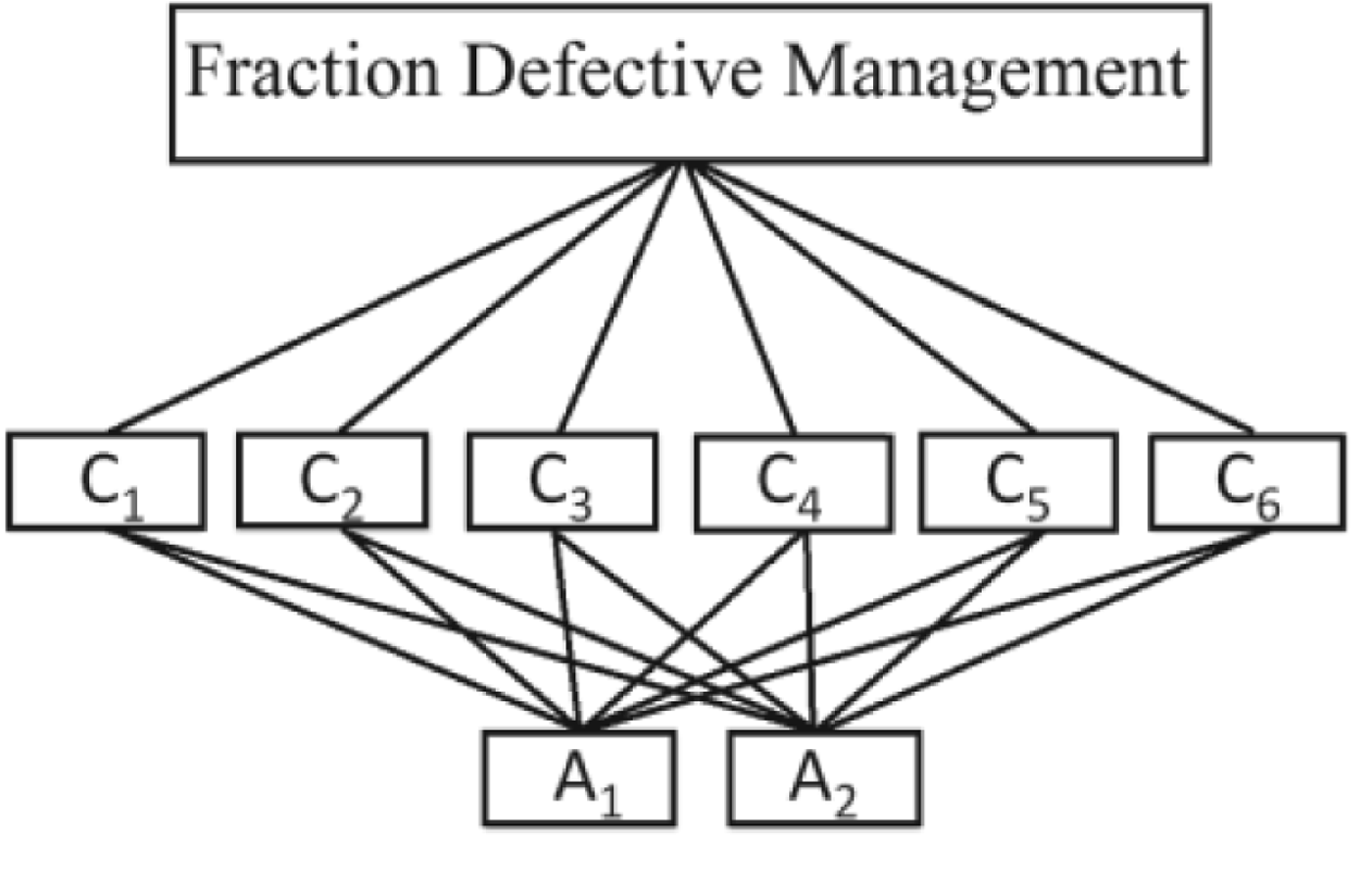
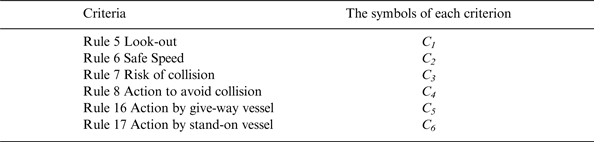
Hierarchical design is used in GF-AHP. Objectives, criteria and alternatives are placed in the hierarchy. All criteria assessed in the court judgment process are discussed by field experts. The main criteria such as Rule 5 (C1), Rule 6 (C2), Rule 7 (C3), Rule 8 (C4), Rule 16 (C5), Rule 17 (C6) are confirmed to analyse their impact on alternatives. Then the survey is applied to seven decision makers (DM). Four of them are master mariners, two of them are academicians whose research area is marine accident analysis and one of them is a VTS operator. Figure 14 shows the corresponding hierarchical design of the FDM.
Hierarchical design of the fraction defective management.
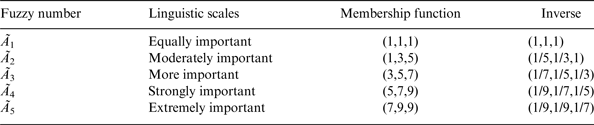
The GF-AHP approach is employed to determine the weights of criteria and alternatives. In the application process of the GF-AHP approach, a pairwise comparison table is formed. In the first step of the F-AHP approach, weights and priorities are compared for the each criterion using a pairwise fuzzy extension of Saaty's 1–9 scale (Table 4).
Membership function of linguistic scale.
In Table 5, the criteria and their symbols are expressed. The GF-AHP approach is applied to calculate weights of alternatives for each criterion. Table 6 shows the alternatives for the track selection and their symbols.
The criteria for the model of marine accident analysis and their symbols.
The alternatives for the model of marine accident analysis and their symbols.

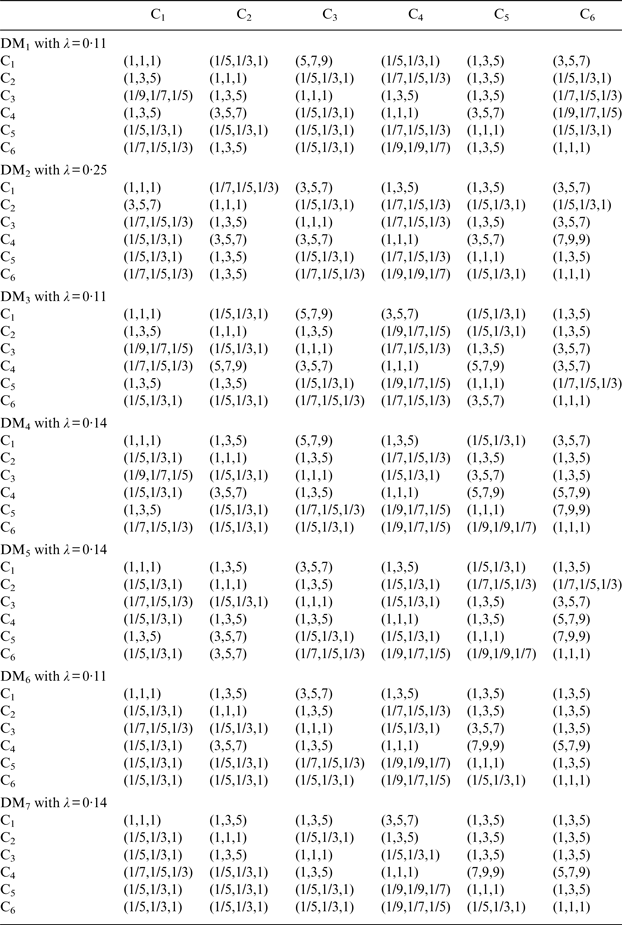
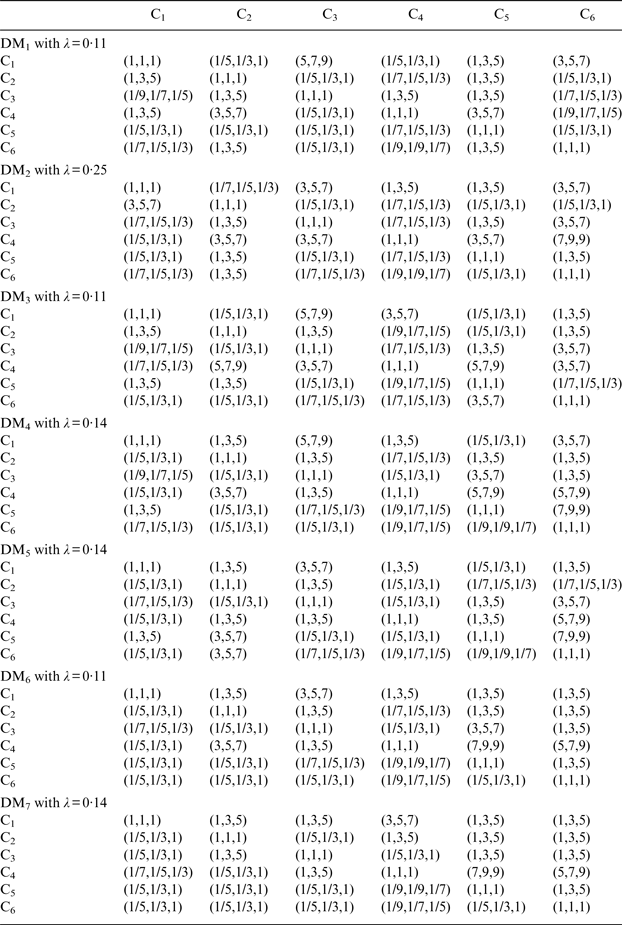
For the decision process, the pairwise comparison survey was conducted and reported as follows. The individual fuzzy judgment matrices which assesses criteria-to-criteria comparison are presented in Table 7. Lambda (λ) is the expertise priority of the decision maker based on the time spent in this industry. The individual fuzzy priority vector and aggregated weight vector are depicted in Table 8. Decision makers usually find that Rule 8 is the most important factor and that lookout is the second crucial indicator.
The individual fuzzy judgment matrix for criteria of marine accident analysis.
The individual fuzzy priority vector of decision-makers and aggregated weight vector for criteria of marine accident analysis.
The mean aggregated weight (MAW) is calculated for each criteria as 0·31, 0·11, 0·13, 0·35, 0·10 and 0·06 respectively (Table 9). To compute the aggregated weight vector, expert priority vector of decision makers (λ) is multiplied by the individual priority vector of each decision maker. The result is consistent since the CCI is 0·23 less than the threshold of 0·37.
The aggregated fuzzy judgment matrix for criteria of marine accident analysis.
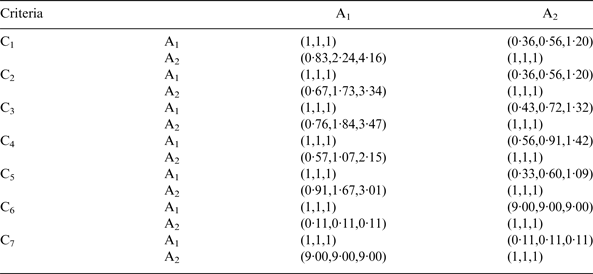
Then, similar steps are followed for alternatives. Table 10 indicates the aggregated fuzzy judgment matrix under each criterion that is calculated from the decision makers' individual fuzzy judgment matrices. Consistency control is not applied to the alternatives because there are two vessels (M/V Alpha and M/V Bravo) involved in the collision. Thus, when n=2 it is accepted that it is totally consistent (Duru et al., Reference Duru, Bulut and Yoshida2012).
The aggregated fuzzy judgment matrix for alternatives of marine accident analysis under each criterion.
Table 11 indicates the final outputs of the FDM problem. FDs of the vessels are found to be 57% for M/V Bravo while for M/V Alpha it is 43%. The difference between the FDs is 14% after the expert consultation process. According to the official reports of the court judgment for this collision, FD of M/V Alpha is 40% and M/V Bravo is 60%, with a difference of 20%. The superiority of the FDM is quite explicit since the difference between the ranges of first judgment and expert consultation by using GF-AHP is 6%.
Final assessment of alternatives of marine accident analysis.
Table 12 indicates that this decision burdens the M/V Bravo with 5% more financial and legal obligations. Similarly, comparing to the first situation, FD of M/V Alpha has changed from 40% to 43%. This means M/V Alpha's responsibilities are increased by 7·5%. This proves that the conventional marine accident analysis is applied from a holistic point of view. Also, the complete assessment process involves human judgment that is limited and subject to bias.
Changes of the responsibilities.

6. CONCLUSION
In order to make professional judgments and fair decisions, FDM should be utilised for complex decision making situations. In this research, the GF-AHP method is conducted for FDM on a simulated real collision. In the Simulator Centre of ITU, in front of the field experts, the same vessels were navigated, and collided again as occurred in real time. After an expert consultation, all contributory causes were determined by the experienced captains, pilots and as well as the academics. Contributions of the COLREG rules and regulations were discussed to find the values of the FDs.
If available, VDR data are always considered as a primary source of evidence in the courts. Even though the simulation process is omitted, it is obvious that all judges and experts use the VDR records. In that respect, the systematic F-AHP approach is more convenient than the regular basis as the method provides an explicit opportunity of prioritising all criteria that caused the accident. Thus, each criterion is criticised in a stepwise manner instead of a holistic perspective. Moreover, by using the main bridge simulator, we can visualise it with real data to make the experts feel the event. As a result, we combined the GF-AHP method and simulator by using real VDR records that enabled the experts to imagine the collision and assess the criteria much more clearly than the holistic assessment.
During the marine accident judgment process, FDM involves the insurance companies, ship owners, banks, personnel of the vessels, etc. Judgements can burden the participants with large financial losses. Therefore, the decision-making process is thought very significant, and should be able to be conducted in all cases. The empirical results prove that experts decide the FDs by looking at the big picture rather than fractionating the defectives in a stepwise manner. Human judgment is limited, and can be manipulated by cognitive bias. In this study, we proposed a decision support model for FDM that classifies the problem, and defines the final result by the consensus of the experts. We also hope to improve the investigations of the marine accident.
APPENDIX: THE MAIN DATA SOURCES FOR MARINE ACCIDENTS
Global Integrated Shipping Information System (GISIS)
IMO MSC-MEPC.3/Circ.3
IMO FSI 20/INF.17
FSI and IMO Council documents on IMODOCS
IMO Performance Indicators
International Shipping Facts and Figures – Information Resources on Trade, Safety, Security and the Environment
Lloyd's Casualty Returns available from Lloyd's Register Library
LMIU Casualty Reports
IHS Fairplay World Casualty Statistics
International Union of Marine Insurers (IUMI)
European Maritime Safety Agency: Annual Maritime Accident Review
ShipPax Information
Marine Casualty Profiles International Maritime Statistics Forum
Wally Mandryk Lloyd's List Intelligence
Australian Transport Safety Bureau (ATSB)
Transportation Safety Board of Canada (TSBC)
BEAmer- The Bureau d'enquêtes sur les événements de mer
Dutch Transport Safety Board
Transport Accident Investigation Commission (TAIC)
Swedish Accident Investigation Board (SHK)
UK Marine Accident Investigation Branch (MAIB)
Marine Accident Reporting Scheme (MARS)
US National Transportation Safety Board (NTSB)